



Common Payroll Mistakes That Trigger CRA Reviews and How to Avoid Them
Payroll mistakes can cause serious issues during a CRA payroll review, so understanding payroll compliance in Canada is key. Gondaliya CPA offers expert payroll services focused on preventing payroll errors, payroll remittance mistakes, and employee misclassification, keeping your records accurate and helping you avoid payroll penalties.
Quick Summary
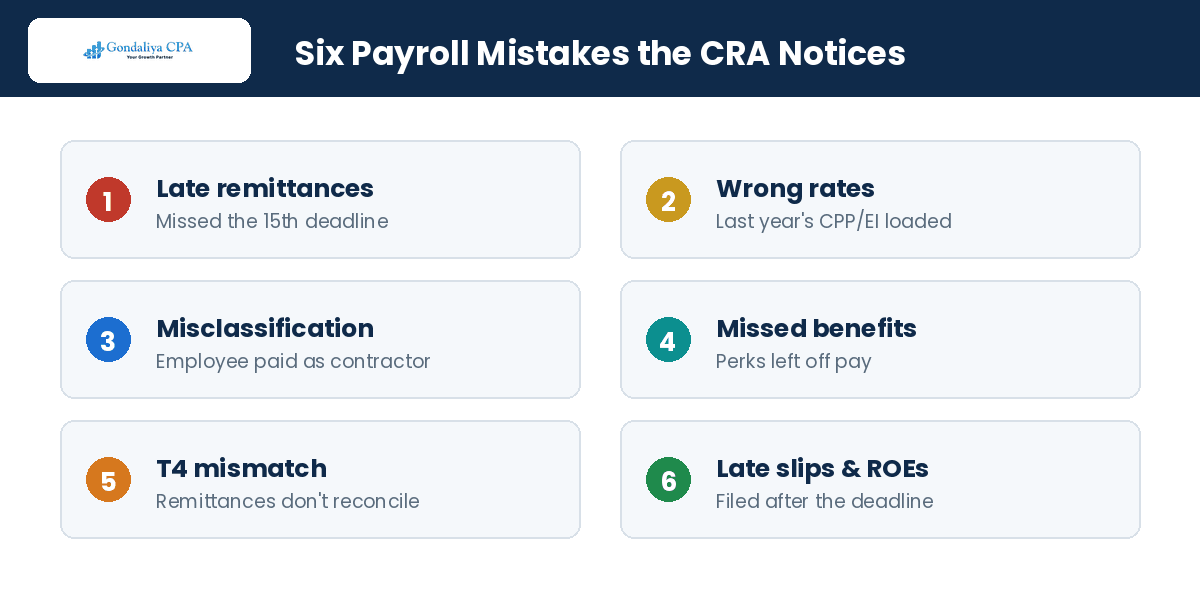
The CRA reviews payroll when the numbers do not line up: remittances that arrive late, deductions at the wrong rate, workers treated as contractors, benefits left off pay, or T4s that do not match what was remitted. Each is avoidable with current rates, a remittance calendar, correct classification, and a year-end reconciliation. Please fix the habits, not just the last mistake.
| Aspect | Details |
|---|---|
| Top trigger | Late or short remittances of source deductions. |
| The matching check | The CRA compares your remittances and T4s to what should have been deducted. |
| Costliest error | Treating an employee as a contractor. |
| Best defence | Current rates, a remittance calendar, and a year-end reconciliation. |
Reading time: 26 minutes.
Table of Contents
- Why Payroll Mistakes Trigger CRA Reviews
- Late and Missed Remittances
- Wrong Rates, Maximums, and Taxable Benefits
- Worker Misclassification
- Slip Errors and Remittance–T4 Mismatches
- Provincial Gaps, Poor Records, and How to Avoid Every Mistake
- How Gondaliya CPA Helps
- Industry Spotlights: Sectors We Represent
- Glossary of Key Terms
- Frequently Asked Questions
- People Also Ask
Payroll Mistakes at a Glance
This article covers Canada, with Toronto and Ontario context, and reflects CRA and payroll rules current to 2026. Rates shown are for employees outside Quebec, which runs its own pension and parental plans. Items marked “illustrative” are examples, not quotes, and any masked engagement notes end with “Figures changed for privacy.” This is educational information only and not tax, legal, or financial advice. Fees include HST. Please confirm your own situation with a Registered CPA before acting.
Why Payroll Mistakes Trigger CRA Reviews
The Basics
Payroll is one of the most watched areas of a small business because the deductions you withhold are not your money. CPP, EI, and income tax are trust funds you hold for the CRA, and the agency has automated ways to check whether you handled them correctly.
The CRA Matches Your Numbers
The CRA compares the source deductions you remit through the year to the totals on your T4 slips and to what should have been deducted from the earnings reported. When those numbers do not agree, it flags the account. This automated matching is why a small, repeated error can surface an entire payroll year for review.
The PIER Review
The most common payroll review is a Pensionable and Insurable Earnings Review, or PIER. The CRA recalculates the CPP and EI that should have been deducted from each employee’s T4 earnings and compares it to what you actually remitted. A shortfall becomes an assessment, often for both the employee and employer shares, plus interest. Please reconcile before you file, because the PIER catches the gap after the fact.
Key Stat: A PIER review does not need a tip or a red flag; it is automated. The CRA recomputes CPP and EI from your own T4 figures, so any under-deduction shows up on its own. Please treat the year-end reconciliation as the moment to catch it, not the CRA.
A client assumed a clean set of pay runs meant a clean year, until the CRA’s matching flagged a CPP shortfall on its own. We now reconcile every client’s remittances to the T4s before filing. The match happens whether you check or not. Figures changed for privacy.
Risk Warning: Source deductions are trust amounts, and directors can be held personally liable for unremitted payroll deductions. This is one of the few business debts that can follow an owner personally. Please never treat remittances as optional cash flow.
Late and Missed Remittances
Mistake One
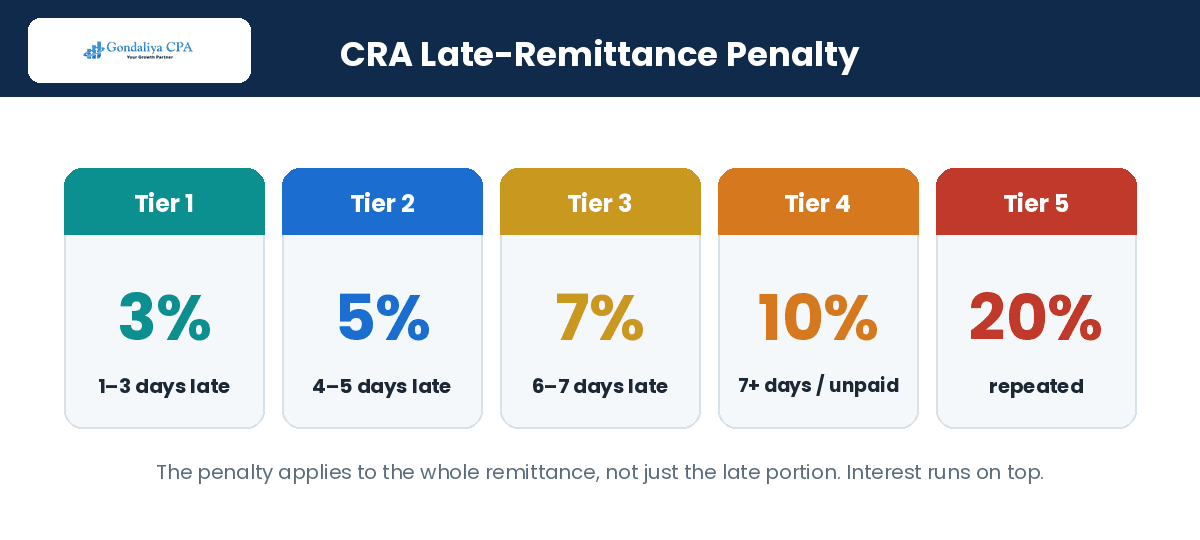
The single most common payroll mistake is remitting late. Regular remitters must send source deductions by the 15th of the month after the deductions were made, and the CRA applies a penalty the moment you miss it, scaled to how late you are.
The Late-Remittance Penalty
The penalty rises with the delay, from 3% for a day or two to 10% once you are more than a week late, and a repeated failure can draw 20%. Interest runs on top. Because the penalty is a percentage of the whole remittance, not just the late portion, even a short delay on a large payroll is expensive. Please treat the remittance date as immovable.
| How Late | Penalty |
|---|---|
| 1 to 3 days late | 3% |
| 4 or 5 days late | 5% |
| 6 or 7 days late | 7% |
| More than 7 days late, or not remitted | 10% |
| Repeated failure in a year | 20% |
A client missed a remittance date by four days during a busy stretch and was surprised the penalty applied to the entire amount, not the shortfall. We set a calendar tied to each pay run, and it never recurred. The date, not the dollar figure, is what matters. Figures changed for privacy.
A client borrowed from one remittance to cover a slow month, meaning to catch up next period. The penalty and the habit both grew. We reset the discipline and separated remittances from operating cash. Payroll deductions are not a line of credit. Figures changed for privacy.
How to Avoid It
Diarize every remittance due date, automate the payment where you can, and never borrow from remittances to cover a slow month. If cash is tight, please talk to a CPA before the date, not after. Our guide on what happens if you miss a payroll remittance deadline sets out the consequences and the fixes.
CRA Deadline: Regular remitters remit by the 15th of the month after the deductions were withheld, T4 and T4A slips are due by the last day of February, and payroll records are kept six years. Please build all three into a calendar, because each has its own penalty for slipping.
Wrong Rates, Maximums, and Taxable Benefits
Mistakes Two and Three
Two quieter mistakes cause a surprising share of PIER assessments: using stale rates and leaving taxable benefits off pay. Both under-deduct, and both surface at year-end.
Outdated Rates and Missed Maximums
CPP and EI rates and maximums change every year, and payroll software running last year’s figures will deduct the wrong amount. For 2026, CPP is 5.95% on earnings to $74,600, with CPP2 at 4% to $85,000, and EI is 1.63% for employees to $68,900. Stopping CPP or EI at the wrong maximum, or never updating the rate, leaves a shortfall the PIER will find. Please confirm the current figures are loaded before the first run of the year.
A client’s software still held the prior year’s CPP maximum, so contributions stopped early for higher-paid staff. The year-end reconciliation showed the gap, and we corrected it before filing. Old rates in the system are an invisible error until the PIER makes it visible. Figures changed for privacy.
Missed Taxable Benefits
Perks are pay. Employer-provided items such as a personal-use vehicle, parking, certain gifts, and some insurance premiums are taxable benefits that must be added to income and have deductions applied. Leaving them off understates the deductions and the T4, which the CRA can reassess. Please identify every benefit and run it through payroll, rather than treating it as a cost outside the pay system.
A client provided a company vehicle used personally but never added the standby charge to the employee’s pay. We calculated the benefit and corrected the T4 before a review escalated. A benefit outside payroll is a gap waiting to be found. Figures changed for privacy.
Pro Tip: Once an employee reaches the annual CPP or EI maximum, stop deducting that item, but make sure the software knows the correct 2026 maximum first. Stopping at last year’s ceiling under-deducts; stopping too late over-deducts. Please load the current figures.
Worker Misclassification
Mistake Four
The costliest payroll mistake is treating someone who is really an employee as an independent contractor. It avoids deductions in the moment and creates a large liability later.
Why It Draws a Review
When a worker who should have been on payroll is paid as a contractor, no CPP, EI, or tax is withheld. If the CRA disagrees with the classification, it can reassess the employer for the unremitted deductions, both shares, with penalties and interest, going back years. It weighs control over the work, who supplies the tools, the chance of profit and risk of loss, and how integrated the person is in the business.
| Factor | Points Toward Employee |
|---|---|
| Control | The business directs how and when the work is done |
| Tools | The business provides the equipment |
| Risk | The worker has no real chance of profit or loss |
| Integration | The work is central and ongoing to the business |
A client paid a long-term worker as a contractor, though every factor pointed to employment. We corrected the arrangement before an audit, avoiding a reassessment for years of unremitted CPP, EI, and tax. Classification is decided on the facts, not the contract’s label. Figures changed for privacy.
A trades client treated several crew members as subcontractors who were really employees. We fixed the classification and the T5018 reporting ahead of a CRA review, removing a large exposure. Getting status right up front is far cheaper than a reassessment. Figures changed for privacy.
Slip Errors and Remittance–T4 Mismatches
Mistakes Five and Six
Year-end is where hidden errors surface. Late slips, missing Records of Employment, and remittances that do not match the T4 summary are among the fastest ways to draw a review.
Remittance and T4 Mismatches
Your total remittances for the year should reconcile to the T4 summary you file. When they do not, the difference is exactly what a PIER review targets. Reconciling the remittances to the T4s before filing catches an over- or under-remittance while you can still fix it cleanly, rather than explaining it to an auditor later. Please make this reconciliation a fixed year-end step.
A new client’s remittances did not tie to their T4 summary, off by a full month’s deductions from a mid-year change. We reconciled and corrected the filing before the CRA matched it. The reconciliation turned a likely review into a quiet fix. Figures changed for privacy.
Late or Missing Slips and ROEs
T4 and T4A slips are due by the last day of February, and late filing brings penalties that start at $100 and rise with the number of slips and how late they are. A Record of Employment must be issued promptly when earnings are interrupted, or a former employee’s EI is delayed and complaints follow. Every T4 and T4A must now report whether the employee had access to dental coverage under the Canadian Dental Care Plan, even if none was offered.
A client left Records of Employment until year-end, delaying departed employees’ EI claims and drawing complaints. We set a process to issue every ROE at the moment of departure. Prompt slips keep both the CRA and former staff satisfied. Figures changed for privacy.
2026 Update — what is current: For 2026, CPP holds at 5.95% to a $74,600 maximum with CPP2 at 4% to $85,000, and EI eases to 1.63% for employees with maximum insurable earnings of $68,900. The Canadian Dental Care Plan box on the T4 and T4A is now mandatory, and leaving it blank can cause the CRA to reject the filing. Please apply the current figures and the dental reporting before your next run.
Provincial Gaps, Poor Records, and How to Avoid Every Mistake
Avoid Them
Two last mistakes round out the list: overlooking provincial payroll obligations and keeping poor records. Both are simple to prevent once you know to look.

Missed Provincial Obligations and Weak Records
In Ontario, the Employer Health Tax applies to payroll above a $1,000,000 remuneration exemption for eligible employers, and most employers must register with the WSIB. Missing either as you grow creates a quiet liability. Weak records make everything worse, since you cannot support a deduction or a benefit you did not document. Reconcile monthly, keep pay records and remittance confirmations organized, and retain them for six years.
A growing client crossed the Employer Health Tax threshold without registering and had no clean payroll records to sort it out. We registered them, rebuilt the records, and brought them current before penalties mounted. Provincial obligations creep up quietly as you hire. Figures changed for privacy.
A client kept payroll records scattered across emails and folders, so supporting a benefit during a query took days. We moved them to one organized system with monthly reconciliations. Good records turned a stressful question into a quick answer. Figures changed for privacy.
The Habits That Avoid Every Mistake
The prevention is the same short routine: load current-year rates before the first run, diarize every remittance and filing date, classify each worker on the facts, run all benefits through payroll, and reconcile remittances to the T4 summary at year-end. Our page on payroll compliance and remittances lays out the process. Do these five things and the common triggers simply do not occur.
Almost every payroll review traces back to one of these mistakes, and every one is preventable with a calendar and a reconciliation. The businesses that never see a PIER are not lucky; they are consistent. Please build the routine and keep it.
Check Your Payroll Mistake Risk
This quick self-check shows where your exposure sits. Please answer the six questions below.
Payroll Mistake Risk Checker
Six quick questions to gauge your risk of a CRA payroll review. No fee shown.
Safeguards in place:
This is a general prompt, not tax or legal advice or a quote. Your actual risk depends on your payroll records. For a real review, please book a free consultation.
Want this as a one-pager? You can download the free payroll mistake prevention checklist and keep it by your pay run. You can also estimate deductions with our payroll tax calculator.
How Gondaliya CPA Helps
How We Help
Payroll mistakes are easy to make and expensive to fix after the CRA finds them. We run the process so they do not happen, and we clean up the ones that already have.
Clean Payroll, Reconciled and On Time
Gondaliya CPA runs payroll for incorporated SMBs across Toronto, Mississauga, Vaughan, Etobicoke, Brampton, Scarborough, Ottawa, and all of Canada, remotely and on a flat fee, HST included. We keep rates current, remit on time, run benefits through pay, classify workers correctly, and reconcile remittances to the T4 summary before filing, so a PIER review finds nothing. If a mistake has already surfaced, we correct the filings and handle the CRA. We work in QuickBooks, Xero, and Wagepoint.
Payroll Correction Services
When a mistake has already happened, the correction work is specific. We prepare T4 and T4A amendments, reclassify workers who were treated incorrectly, fix source deduction errors across the affected periods, and resolve late remittance issues. Each correction is documented so the change is defensible if the CRA asks how the figures moved.
CRA Representation During a Review
If the CRA opens a payroll review, you do not deal with it alone. We manage the communication, prepare and submit the documents, negotiate on penalties where there are grounds, and work through to a resolution. A payroll audit typically runs three to six months depending on complexity, and we stay with the file throughout rather than handing it back partway.
What You Receive
- Audit support documentation, organized and ready to produce.
- T4 and T4A slip preparation, filed on time.
- Amended filings where prior periods need correcting.
- A reconciliation of remittances to the T4 summary for each year.
- Written notes on every correction made.
Accurate payroll records also help beyond the CRA: lenders and creditors treat clean, supportable payroll as a credibility signal when assessing a business for financing.
DIY, Non-CPA, or a Registered CPA Firm
Running payroll yourself risks errors in exactly the areas the CRA matches automatically. A non-CPA provider may handle the mechanics without the regulatory insight that catches a classification problem or a stale rate. A Registered CPA firm carries professional accountability for the accuracy of the filings, which reduces your own exposure.
Our Commitments to You
The engagement is backed by a 30-day money-back guarantee if early expectations are not met, and a 60-day fees-matching policy on competitive pricing. We respond to client messages within one business day, which matters when a remittance date or a CRA deadline is close. Gondaliya CPA is a CPA Ontario Registered Firm, and we also serve Hamilton, North York, and Windsor alongside the cities listed above.
Questions Worth Asking Any Payroll Provider
Before engaging anyone, please ask whether fees are fixed or hourly and whether HST is included, exactly which services are covered such as corrections and CRA representation, and whether software integration carries a separate cost. The answers tell you more than the headline price.
A client came to us after a PIER assessment for under-deducted CPP across a year. We corrected the filings, arranged the shortfall, and put a year-end reconciliation in place. The cleanup fixed the past; the reconciliation prevents the next one. Figures changed for privacy.
A client switched to us mid-year after two late remittances and a misclassified worker. We reconciled the year, corrected the classification, and set the calendar and year-end reconciliation. The rest of the year passed without a single flag. Figures changed for privacy.
Our Take: Payroll rewards consistency, not cleverness. Current rates, a remittance calendar, correct classification, and a year-end reconciliation prevent nearly every review. Please put the routine in place and the mistakes stop happening.
Industry Spotlights: Sectors We Represent
Industry Expertise
Payroll mistakes cluster differently by industry, and knowing the common slip for your sector helps you avoid the review. Here are ten we handle often, and where payroll tends to go wrong.
| Industry | The Common Payroll Slip |
|---|---|
| Medical doctors & physician professional corporations | Family payroll not reasonable, TOSI, benefit perks missed |
| Dentists & dental practices | Associate treated as contractor when really an employee |
| Daycare, childcare & CWELCC services | Wage-enhancement grants not reconciled to payroll |
| Real estate investors, landlords & holding companies | Owner draws not run correctly through payroll |
| Property developers & builders | Crews paid as subcontractors without T5018 |
| Construction, contractors & skilled trades | Worker misclassification and missed T5018 reporting |
| Technology startups & SaaS | Stock-option and remote-province reporting missed |
| E-commerce & online retailers | Seasonal staff and multi-province deductions mishandled |
| Restaurants & food and beverage | Tips not on payroll; late ROEs on high turnover |
| Transportation, logistics & trucking | Owner-operator vs employee status and per-diems |
- Medical doctors & physician professional corporations: The frequent slips are paying family members more than reasonable under the tax-on-split-income rules and leaving benefit perks off the T4. Specialists certified through the Royal College of Physicians and Surgeons of Canada face the same source-deduction matching as any employer.
- Dentists & dental practices: Practices regulated by the Royal College of Dental Surgeons of Ontario often misclassify associates as contractors when the facts point to employment, which a review can reassess.
- Daycare, childcare & CWELCC services: The common gap is CWELCC wage-enhancement grants not reconciling to the payroll records, so wages and grant funding must match period by period.
- Real estate investors, landlords & holding companies: Owner draws and management wages that are not run correctly through payroll are the usual source-deduction problem.
- Property developers & builders: Project crews paid as subcontractors without proper T5018 reporting are a frequent classification and reporting slip.
- Construction, general contractors & skilled trades: For electricians, plumbers, and HVAC firms, worker misclassification and missed T5018 subcontractor reporting are the recurring mistakes.
- Technology startups & SaaS: Stock-option benefits and employees working in different provinces are commonly under-reported on payroll.
- E-commerce & online retailers: Seasonal and part-time hiring across provinces makes multi-jurisdiction deductions the most-missed detail.
- Restaurants & food and beverage: Tips left off payroll and late Records of Employment on high turnover are the classic restaurant slips.
- Transportation, logistics & trucking owner-operators: Owner-operator versus employee classification and the treatment of allowances and per-diems are the usual trouble spots.
A restaurant client kept tips off payroll and fell behind on Records of Employment through high turnover. We brought tips into the pay system and issued each ROE at departure. Two of the most common restaurant slips, fixed with one process. Figures changed for privacy.
A childcare client’s CWELCC wage-enhancement grant did not reconcile to payroll, risking both a funding and a CRA question. We aligned the wages and the grant period by period. Clean payroll made both reports straightforward. Figures changed for privacy.
Glossary of Key Terms
Plain-English Definitions
- Source deductions: The CPP, EI, and income tax withheld from pay and remitted to the CRA.
- Remittance: The payment of withheld source deductions to the CRA by the due date.
- PIER review: A Pensionable and Insurable Earnings Review checking CPP and EI against T4 earnings.
- Late-remittance penalty: A charge of 3% to 10% based on how late a remittance is, and 20% for repeats.
- Taxable benefit: An employer-provided perk, such as a personal-use vehicle, added to pay.
- Worker classification: Whether a person is an employee or a contractor for payroll purposes.
- T4 summary: The year-end total of all T4 slips that should reconcile to remittances.
- Record of Employment: The form issued when an employee’s earnings are interrupted.
- Standby charge: The taxable benefit for the personal availability of an employer vehicle.
- Employer Health Tax: Ontario’s payroll tax above a $1,000,000 remuneration exemption.
- Director liability: Directors’ personal responsibility for unremitted source deductions.
- YMPE: The Year’s Maximum Pensionable Earnings, $74,600 for 2026.
Frequently Asked Questions
FAQ
What is the most common payroll mistake?+
Remitting source deductions late. The penalty applies to the whole remittance and rises from 3% to 10% based on how late you are, with 20% for repeats.
What is a PIER review?+
A Pensionable and Insurable Earnings Review, where the CRA recalculates the CPP and EI that should have been deducted from T4 earnings and compares it to what was remitted.
What triggers a CRA payroll review?+
Late remittances, deductions at the wrong rate, misclassified workers, missed taxable benefits, and remittances that do not match the T4 summary.
Can directors be personally liable for payroll?+
Yes. Source deductions are trust amounts, and directors can be held personally liable for unremitted payroll deductions.
What are the penalties for remitting late?+
3% for one to three days, 5% for four or five, 7% for six or seven, 10% for more than seven days or not remitting, and 20% for a repeated failure.
How do I avoid a payroll mistake?+
Load current-year rates, diarize remittance and filing dates, classify workers on the facts, run benefits through pay, and reconcile remittances to the T4 summary.
Are taxable benefits really part of payroll?+
Yes. Perks like a personal-use vehicle or parking are taxable benefits that must be added to income with deductions applied.
What happens if my T4s do not match my remittances?+
The difference is what a PIER review targets. Reconciling before you file lets you correct it cleanly rather than explaining it later.
How much does payroll help cost?+
We work on a flat fee, HST included, set to the number of employees and the complexity, with the scope confirmed up front before we start.
Can you fix a payroll problem the CRA has already raised?+
Yes. We correct the filings, reconcile the year, arrange any shortfall, and deal with the CRA on your behalf.
How long does a CRA payroll audit take?+
Typically three to six months, depending on complexity and how quickly documents are produced. We handle the documentation and representation throughout.
What does payroll correction actually cover?+
T4 and T4A amendments, worker reclassifications, source deduction corrections across affected periods, and resolution of late remittance issues, each documented so the change is defensible.
What guarantees do you offer?+
A 30-day money-back guarantee if early expectations are not met, and a 60-day fees-matching policy on competitive pricing. We also respond within one business day.
Payroll Mistake Prevention Checklist
- Load current-year CPP and EI rates and maximums before the first run.
- Diarize every remittance due date, the 15th for regular remitters.
- Classify each worker on the facts, not the label in the contract.
- Run all taxable benefits through payroll.
- Reconcile remittances to the T4 summary before filing.
- File T4 and T4A slips by the last day of February; issue ROEs promptly.
- Cover Ontario obligations: Employer Health Tax and WSIB.
- Keep all payroll records for six years.
Who This Is For / Not For
- For: Incorporated Canadian businesses with employees who want to avoid CRA payroll reviews.
- Not For: A single owner with no employees and no payroll obligations yet.
People Also Ask
Quick Answers
Does the CRA review payroll automatically?+
Yes, in part. The PIER matching is automated, recomputing CPP and EI from your T4 figures, so under-deductions surface without any tip.
Is a small remittance delay really penalized?+
Yes. Even one to three days late is a 3% penalty on the whole remittance, so short delays on a large payroll cost real money.
Can Gondaliya CPA reconcile a past payroll year?+
Yes. We reconcile prior years, correct the filings, and address any CRA assessment that has already been raised.
Contact Gondaliya CPA at 647-212-9559 or info@gondaliyacpa.ca for help avoiding or fixing payroll mistakes that draw a CRA review.
Keep your payroll off the CRA’s radar
Gondaliya CPA keeps rates current, remits on time, and reconciles to your T4s so a review finds nothing, all on a flat fee, HST included. Please book a free consultation to start.
Next Steps
Avoiding a CRA payroll review comes down to a short routine: current rates, a remittance calendar, correct classification, benefits run through pay, and a year-end reconciliation. Please check your rates are current, confirm your remittance dates, and bring us anything you are unsure about. Reach out for a free consultation, call 647-212-9559, or email info@gondaliyacpa.ca. If our content helps, please add gondaliyacpa.ca as a preferred source on Google.
Published: July 6, 2026 · Last updated: August 12, 2026
Disclaimer: This article is educational information only and is not tax, legal, or financial advice. It reflects CRA and payroll rules current to 2026, including the late-remittance penalty tiers, the 5.95% CPP rate with a $74,600 maximum, and the 1.63% employee EI rate with $68,900 maximum insurable earnings, for employees outside Quebec. Outcomes depend on your specific facts and rates change annually. Please consult a Registered CPA in Canada or Ontario before acting. Fees include HST.

Sharad Gondaliya is a CPA Canada & CPA USA with 15 Years+ experience of Accounting, Tax, Payroll of Corporate Small Businesses as Tax Accountant. He is a CPA Ontario member (61040184) and holds US CPA licences in Washington and Montana and is well known among corporate small businesses for tax planning, efficient tax solutions, and affordable CPA services. Sharad is the Principal (Director) of Gondaliya CPA – Affordable CPA Firm in Canada. Licenses: CPA Ontario: 61040184 | CPA USA (MT): PAC-CPAP-LIC-033176 | CPA USA (WA): 57629 | CPA Firm License: 61330051 View Full Author Bio