



Resident Director Services for Foreign Companies Expanding Into Canada
Resident director Canada is essential for foreign companies looking to start a business in Canada, offering nominee director services Canada that comply with local regulations and corporate compliance requirements. Gondaliya CPA specializes in Canadian corporate representative and local director services Canada, supporting seamless foreign owned corporation Canada setup and ongoing compliance.
Quick Summary
Federal incorporation under the CBCA requires that at least 25% of directors be resident Canadians, and at least one where there are fewer than four. A resident director satisfies that rule, holds real fiduciary duty, and appears on the public record. Please note the appointment is the start of the obligation, not the end of it: the annual return, the ISC register, and the CRA accounts all follow.
| Aspect | Details |
|---|---|
| The federal rule | 25% resident Canadians, or one where there are fewer than four directors. |
| The provincial variation | Ontario, British Columbia, and Alberta apply different residency demands. |
| The liability | Every director carries it, including a nominee with limited authority. |
| The ongoing work | Annual returns, ISC register, minute book, CRA accounts. |
Reading time: 34 minutes.
Table of Contents
- Resident Director for Foreign Companies: Roles and Importance
- Affordable Nominee Director Services Tailored for Non-Residents
- Non-Resident Incorporation Support and Foreign Company Registration in Canada
- Supporting Foreign Company Expansion into Canada with Local Director Services
- Distinctions Between Nominee Director, Resident Director, and Shareholder Roles
- How Gondaliya CPA Supports Ongoing Corporate Compliance and Governance
- Frequently Asked Questions
- Corporate Governance Essentials: Key Compliance Controls for Foreign-Owned Companies
- Industry Spotlights: Sectors We Represent
- Professional Guidance and Quick Reference
The Numbers That Matter
This article covers Canada, with Ontario and Toronto context, and reflects CBCA, OBCA, Corporations Canada, and CRA rules current to 2026. It assumes a foreign parent company incorporating a Canadian subsidiary or registering a branch. Figures marked illustrative are examples, not quotes, and any masked engagement notes end with “Figures changed for privacy.” This is educational information only and not tax, legal, or financial advice. Rules and processing times change, so please confirm your own situation with a Registered CPA before acting.
Resident Director for Foreign Companies: Roles and Importance
Resident Director for Foreign Companies: Roles and Importance
The Role
A resident director in Canada plays a key role for foreign companies aiming to grow here. This person makes sure the company follows Canadian corporate laws, especially those under the Canada Business Corporations Act (CBCA). The resident director keeps business running smoothly and builds trust with local partners.
Foreign companies often find Canadian corporate compliance confusing. A resident director helps them handle rules set by Corporations Canada and provincial offices. This role eases the process of opening a subsidiary or branch office, making it vital for any expansion plan in Canada.
Understanding Nominee Director Services in Canada
Nominee director services help foreign companies that don’t have a permanent base in Canada. These services offer local knowledge and meet residency laws at the same time.
Key Differences: Resident Director vs Nominee Director vs Agent for Service
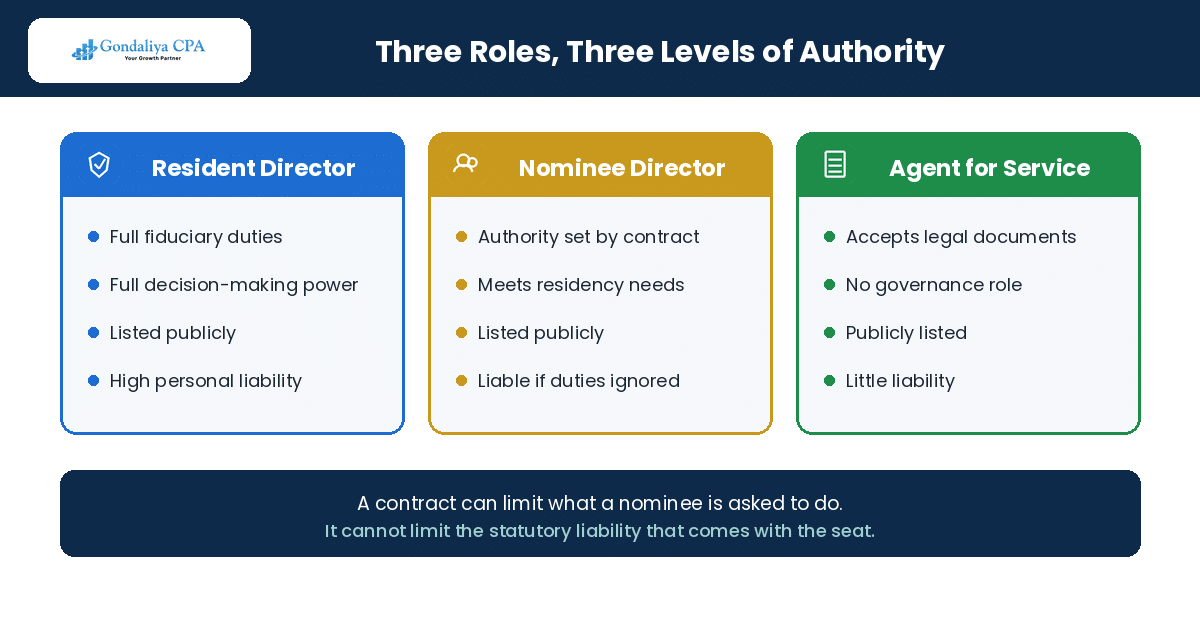
| Role | Authority Level | Public Record Status |
|---|---|---|
| Resident Director | Full authority | Listed publicly |
| Nominee Director | Limited authority | Listed publicly |
| Agent for Service | No decision power | Not listed as director |
Resident directors hold real control. Nominee directors have less control but still appear on public records. Agents for service just act as contact points and don’t make decisions.
Risks Associated with Nominee Directors
Using nominee directors comes with risks. Companies might lose some control over decisions or face liabilities if nominees act improperly. It’s important to choose nominees carefully and set clear rules about their roles.
A foreign parent appointed a nominee it had never met, on a one-page letter with no scope of authority. The appointment was valid at the registry and unusable at the bank, because the bank asked what the nominee could actually sign. Figures changed for privacy.
Canadian Director Requirement for Corporations: Legal Overview
The CBCA requires that at least 25% of directors be resident Canadians, unless exceptions apply. If a company has fewer than four directors, one must live in Canada.
Does a Canadian Corporation Actually Require a Canadian Resident Director?
Yes, most corporations need at least one resident director under federal CBCA rules. Some provinces like Ontario may waive this rule under certain conditions, but you should check local laws before setting up your company.
Why Foreign Companies Need Nominee Director Services for Expansion
Foreign firms entering Canada face extra challenges like complex regulations and unfamiliar business culture. Using nominee directors helps these firms meet legal requirements while getting local insight.
Reasons why nominee directors are needed:
- Meet compliance rules
- Provide local representation
- Build trust with clients and partners
Nominee directors help foreign companies start faster in Canada’s market and reduce risks tied to legal issues.
Overview of Canadian Corporate Compliance for Foreign-Owned Businesses
Canadian corporate compliance means meeting yearly obligations such as:
- Filing annual returns within six months after fiscal year-end
- Registering for a CRA business number, usually within five business days
- Keeping accurate financial and governance records
- Filing taxes, including T2 returns if income is earned in Canada
Knowing these duties helps avoid fines and supports long-term success in Canada’s economy.
Key Stat: Federally, at least 25% of directors must be resident Canadians, and where the board has fewer than four directors, at least one must live in Canada. That single requirement is what most foreign parents are solving for when they arrive.
Affordable Nominee Director Services Tailored for Non-Residents
Affordable Nominee Director Services Tailored for Non-Residents
The Service
Nominee director services in Canada help foreign companies set up their business without needing a local director right away. A nominee director steps in as the resident director Canada to meet legal rules. This helps companies follow incorporation laws at both federal and provincial levels.
For non-residents, these services offer affordable access to qualified professionals who meet residency rules. They ease the process of foreign company expansion Canada. Businesses can start operating smoothly while keeping control over decisions.
Picking a provider with experience matters. They make sure nominee directors know their duties under Canadian corporate law. This lowers risks and keeps operations running well during the early days or when building local teams.
Confidential Nominee Director Agreements and Privacy Protection
Keeping nominee director arrangements private protects the parent company and follows Canadian corporate compliance rules. Nominee director agreements spell out roles, limits of authority, indemnity, and privacy terms that fit each client.
These contracts keep things clear but protect sensitive info from public view except for what law requires, like annual filings or control registers. They also shield nominees by limiting personal liability through indemnification clauses that follow the law‑1.
Privacy extends to separating registered office addresses from nominee directors’ personal details where possible. This keeps anonymity within legal limits while meeting rules from Corporations Canada or provincial registries.
Resident Director Compliance Support Across Provinces Including Ontario
Resident director rules differ by province but are key to keeping corporations legal in Canada. Gondaliya CPA offers support for resident director Canada needs across federal CBCA rules and provinces like Ontario.
In Ontario, residency demands are less strict, but expert advice helps interpret laws correctly. It also covers extra-provincial registration when businesses operate beyond where they incorporated2. For federal corporations, the rule says 25% of directors must be resident Canadians, or at least one if there are fewer than four3.
Our team helps clients track annual return deadlines, update control records correctly, confirm nominee eligibility, and file on time—all parts of staying compliant with Canadian corporate compliance requirements.
Registered Office and Mailing Address Solutions in Ontario
A registered office is required by both federal CBCA law and the Ontario Business Corporation Act (OBCA). It’s where legal papers get delivered but doesn’t have to be the same as a resident director’s home or work address4.
Gondaliya CPA provides registered office provision services designed for foreign-owned companies needing professional mailing addresses in Toronto or Ontario. We handle mail like official notices from Corporations Canada or CRA tax letters so nothing gets missed.
Having a separate mailing address helps protect privacy connected to resident director Canada roles while meeting registry rules clearly and securely.
Annual Nominee Director Agreements and Ongoing Compliance Management
Renewing nominee director agreements each year is part of good governance supporting ongoing Canadian corporate compliance. These renewals confirm consent terms and update any changes about eligibility or conflicts5.
Compliance management also means filing annual returns on time; keeping accurate minute books with board decisions involving nominees; updating Investment Canada Act registers; submitting T2 tax forms with correct officer info; plus handling payroll tied to authorized signatories6.
Regular checks reduce risks like missing updates that could cause fines or even dissolve a corporation—important for smooth operations inside Canada’s regulated environment.
A subsidiary skipped one annual return while the parent restructured overseas. Corporations Canada moved toward dissolution, and reviving the corporation cost far more in time and filings than the return would have. Figures changed for privacy.
1: Corporations Canada – Directors’ Duties & Liability Accessed 2026
2: Ontario Business Registry – Extra-Provincial Registration Requirements Accessed 2026
3: Corporations Canada – Resident Canadians on Boards Accessed 2026
4: OBCA Section 12(1)(a): Registered Office Requirement Accessed 2026
5: Corporate Governance Best Practices – CPA Ontario Guidance Accessed 2026
6: CRA Corporate Tax Filing Obligations & Officer Information Updates Accessed 2026
Non-Resident Incorporation Support and Foreign Company Registration in Canada
Non-Resident Incorporation Support and Foreign Company Registration in Canada
The Setup
Expanding a foreign company into Canada means understanding incorporation rules, resident director needs, and Canadian corporate compliance. If you’re a non-resident founder, you usually need to appoint a resident director Canada. This helps meet legal duties under the Canada Business Corporations Act (CBCA) or provincial laws like Ontario’s Business Corporations Act (OBCA). The federal incorporation turnaround time often takes 5 to 10 business days when your filings are correct and complete[^1]. After incorporation, registering your CRA business number generally requires 1 to 3 business days but can take longer depending on the accounts you ask for[^2].
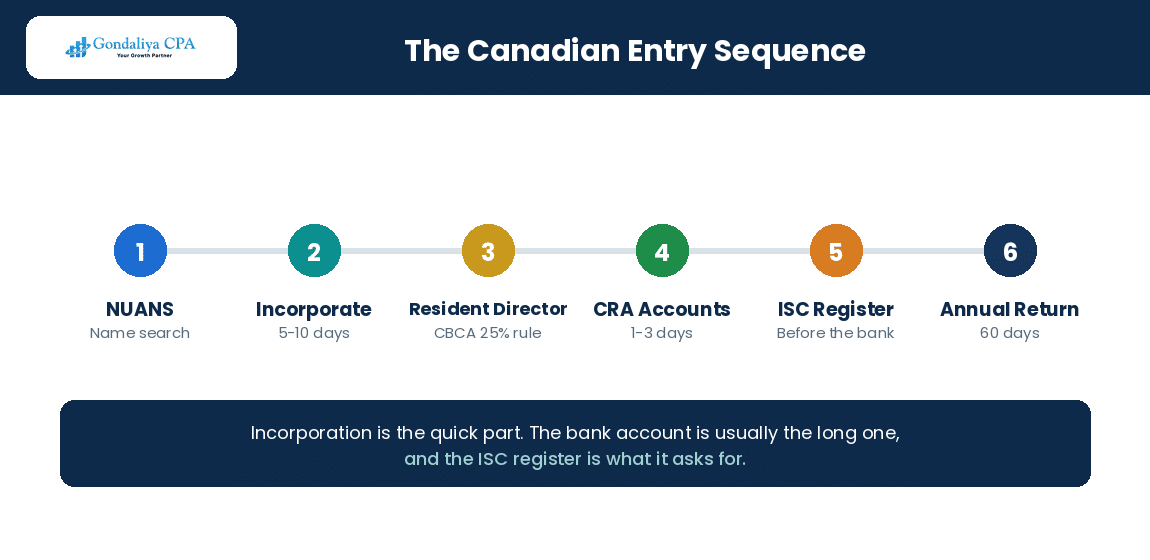
Before starting business activities, foreign companies must register federally or provincially on time. This involves getting a NUANS name search report for federal setups and registering extra-provincially if working outside the initial jurisdiction. Canadian corporate law requires keeping records up-to-date. That means annual returns and registers of individuals with significant control must be maintained.
We guide foreign-owned companies at every stage—from applying to staying compliant—making it easier to enter the Canadian market with fewer risks.
[^1]: Corporations Canada – Incorporation Processing Times
[^2]: Canada Revenue Agency – Business Number Registration
Step-by-Step Nominee Director Appointment and Onboarding Process
Nominee director services Canada help when foreign companies don’t have Canadians eligible to serve as directors. The process involves picking nominee directors who meet residency rules but don’t run daily operations unless allowed.
Here’s how resident directors, nominee directors, and agents for service differ:
- Resident Director
- Has full fiduciary duties and decision-making power
- Appears on public records
- Faces high personal liability by law
- Nominee Director
- Holds limited authority per contract, mainly meets residency needs
- Listed publicly
- Could be liable if they ignore duties
- Agent for Service
- Only accepts legal documents; no role in governance
- Publicly listed
- Little liability unless acting beyond role
So, nominee directors meet residency demands but need vetting because they may carry personal risks under CBCA or OBCA rules[^3].
There are risks with nominee setups: loss of control by the parent company, anti-money laundering checks due to Individuals with Significant Control (ISC) disclosures, banking challenges in due diligence, and reputation issues. These get less risky when clear contracts limit authority. Also, thorough onboarding covers their fiduciary duties well.
We make sure nominees fully grasp their legal duties before they agree. We include independence statements that follow Corporations Canada’s advice.
[^3]: Corporations Canada – Directors’ Duties
Transparent Pricing Structure and Flexible Payment Options
Wondering how much resident director and Canadian setup services cost? Gondaliya CPA offers affordable resident director services for a flat annual fee including HST: [EDITOR: insert exact flat annual fee incl. HST]. This fee covers nomination paperwork prep, filing coordination, ISC register upkeep, plus year-round advice.
Here are what can affect pricing:
- Federal vs Provincial jurisdiction differences
- Number of directors or shareholders involved
- Complexity of share structures (like multiple classes)
- Number of CRA accounts needed (payroll or GST/HST add tasks)
- Required GST/HST security deposits increase upfront costs
We offer flexible payments too — choose quarterly installments or one lump sum. You won’t get surprise fees thanks to clear billing policies backed by our 60-Day Fees-Matching Guarantee.
Clients enjoy fixed fees that give budget certainty plus quick help within one business day—even weekends—especially during tax season or bank account setup times.
Streamlined Coordination with Tax Filing, Banking Access, and Minute Book Maintenance
Canadian corporate compliance covers many ongoing tasks after incorporation. You’ll file tax returns (T2), submit payroll forms (T4 slips), handle GST/HST returns when needed, and keep minute books updated. Those books show resolutions and share issues reflecting who owns what accurately.
Opening bank accounts depends on solid proof of lawful directorship that fits FINTRAC rules requiring clear beneficial ownership through ISC registers updated yearly[^4]. Banks also check if agents for service differ from actual directors during account opening. Getting expert help avoids delays or refusals that could block early cash flow[^5].
Ongoing compliance means:
- Filing federal annual returns within six months after fiscal year-end[^6]
- Updating registered office addresses right away[^7]
- Keeping accounting records as CRA requires[^8]
- Paying all source deductions on time to avoid penalties[^9]
Gondaliya CPA connects all these dots using cloud tools like QuickBooks plus manual reviews so clients stay ready for audits while focusing on growth—not paperwork.
A bank held a new subsidiary account for six weeks because the ISC register named one controlling individual and the incorporation filing named another. Both were correct in isolation; neither matched the other. Figures changed for privacy.
Governance Flexibility and Legal Compliance Assurance
Resident directors in Canada carry legal duties like acting honestly in good faith and showing care as CBCA section 122(1) explains[^10]. They can be personally responsible if payroll deductions aren’t paid or if collected GST/HST isn’t sent to CRA[^11].
Fiduciary duty means putting the company’s interests first over personal gains while handling conflicts openly. Directors can defend themselves by showing they took reasonable care even if things go wrong—a reason why good onboarding is key[EDITOR: link placeholder pending update].
Board setups can be flexible too. You can have enough resident directors meeting requirements while letting non-residents hold executive roles without breaking rules or increasing risk just because someone lives outside Canada[EDITOR: link placeholder pending update].
Directors & Officers insurance protects from money losses caused by accidental breaches. That helps build trust among international investors focused on Toronto/Ontario markets where Gondaliya CPA works closely.
[^10]: Canada Business Corporations Act Section 122(1)
[^11]: CRA Statutory Liabilities Overview for Directors
[^12]: Corporate Law Fiduciary Duty Explained – CPA Ontario Resource
[EDITOR: link placeholder pending update]
[^13]: See “Federal vs Ontario Incorporation” section re board composition flexibility
For help with foreign company registration in Canada—including dependable nominee director services suited to your needs—contact Gondaliya CPA at info@gondaliyacpa.ca or call 647‑212‑9559 for a free consultation focused on cross-border expansions into Toronto/Ontario backed by over 1300+ five-star Google reviews confirming reliable results nationwide.
Risk Warning: A nominee director’s authority can be limited by contract, but the statutory liability cannot. Unpaid payroll source deductions and uncollected GST/HST remittances attach to every director on the record. Please make sure any nominee you appoint understands that before signing.
Supporting Foreign Company Expansion into Canada with Local Director Services
Supporting Foreign Company Expansion into Canada with Local Director Services
The Expansion
Expanding a foreign company into Canada means you have to follow Canadian corporate compliance rules closely. One big rule is having a resident director Canada. This person keeps your business legal and running smoothly. When the parent company or founders live outside Canada, nominee director services Canada come in handy.
Resident directors represent your company in Canada. They meet legal duties under federal or provincial law, like the CBCA’s 25% rule for resident directors. Their presence helps with extra-provincial registration too, when needed[1]. Without them, you risk losing good standing with Corporations Canada and CRA.
Nominee director services in Canada let you hire local people who meet residency needs without giving up control. These nominees know their responsibilities well. They help avoid problems that can happen if non-residents try to act as directors.
Combining local director services with good tax planning and bookkeeping helps foreign companies avoid common mistakes when entering the Canadian market. It also keeps compliance steady whether you’re in Ontario or dealing federally[2].
Case Study: Successful Setup of a Canadian Subsidiary for a Non-Resident Client
A European software company wanted to open a subsidiary in Toronto but didn’t have Canadian directors. We helped by using nominee director services Canada along with appointing resident directors to meet CBCA’s rules.
Here’s what we did:
- Incorporated an Ontario corporation registered federally.
- Added two nominee directors living in Ontario.
- Coordinated share issues based on transfer pricing rules.
- Registered for CRA accounts including GST/HST and payroll.
This setup met all Corporations Canada and CRA deadlines without affecting control by the parent team[3]. The subsidiary started working just ten days after incorporation.
(Note: Figures have been changed to keep privacy.)
Managing Corporate Compliance to Avoid CRA Filing Delays
Canadian corporate compliance means meeting deadlines for annual returns, T2 tax returns, GST/HST payments, payroll deductions, and keeping proper records like minute books. Resident directors oversee these duties for foreign-owned businesses in Canada[4].
If you miss deadlines, CRA fines you or Corporations Canada may dissolve your company. Resident directors keep submissions on time by coordinating accountants and government agencies. They also handle fiduciary duties to avoid legal troubles[5].
Here’s a quick look at key tasks:
- Annual Return Filing: 60 days after fiscal year-end (Resident Director/CPA)
- T2 Corporate Tax Return: 6 months after fiscal year-end (Accounting Team)
- GST/HST Remittance: Monthly or quarterly (Payroll & Finance)
- Payroll Source Deductions: Monthly (Employer/Resident Director)
Staying ahead here avoids banking issues or CRA audits later.
Coordinating Nominee Director Role with Corporate Tax Planning
Nominee director services Canada must fit smoothly into your tax plans when expanding into Canada. Nominees meet residency rules but usually don’t make independent decisions. This way, the parent company keeps control[6].
Early nominee appointments help set intercompany agreements that follow transfer pricing rules. This lowers risks from Part XIII withholding taxes or thin capitalization limits[7]. It also helps plan for GST/HST account registrations, which might need deposits from non-residents depending on sales volume.
A well-run nominee setup supports smooth cross-border deals and meets disclosure needs like Individuals With Significant Control registers at Corporations Canada[8].
A parent charged management fees to its Canadian subsidiary with no intercompany agreement in place. The deduction was defensible on the facts and undocumented on paper, which is the harder position to hold in a review. Figures changed for privacy.
Addressing Common Challenges Faced by Foreign Owned Corporations in Canada
Foreign company expansion canada often runs into challenges from different provincial laws versus federal rules around resident directors; managing multiple registrations; understanding withholding taxes; plus keeping Canadian corporate compliance all along[9].
Some common problems are:
- Missing when extra-provincial registration applies.
- Forgetting ISC register updates, which can trigger FINTRAC concerns.
- Ignoring Regulation 105 withholding on payments abroad leading to fines.
- Finding reliable nominee directors who fully understand their legal duties.
The best way to avoid these is to work with experienced CPA firms that offer resident director services combined with ongoing advice — cutting costly mistakes before they happen[10].
[CTA] For help tailored to your business expanding anywhere across Canada — contact Gondaliya CPA at 647‑212‑9559 or info@gondaliyacpa.ca for a free talk about local directorships and full Canadian business setup support.
Sources & References
- Corporations Canada – Residency Requirements Accessed June 2026
- Ontario Business Registry – Extra Provincial Registration Accessed June 2026
- Our Actual Experience – European Software Firm Subsidiary Setup (Illustrative). Figures changed for privacy
- CRA – Corporate Income Tax Guide Accessed June 2026
- Canada Labour Code – Statutory Liabilities Accessed June 2026
- Corporations Act – Directors’ Duties Accessed June 2026
- CRA Transfer Pricing Guidelines Accessed June 2026
- ISED ISC Register Guidance Accessed June 2026
- FINTRAC AML Regulations Overview Accessed June 2026
- Gondaliya CPA Internal Risk Controls Documentation
Distinctions Between Nominee Director, Resident Director, and Shareholder Roles
Distinctions Between Nominee Director, Resident Director, and Shareholder Roles
The Distinctions
A resident director Canada is someone on the board who actually lives in Canada. This is needed to follow incorporation rules. Nominee director services Canada often provide a person who meets this residency need but doesn’t take part in running the company day-to-day. Shareholders own parts of the company but usually don’t manage or direct it.
Resident directors have to be Canadian citizens or permanent residents living in Canada[1]. Nominee directors mainly help companies meet legal requirements and might only act when told by the parent company. Shareholders vote on major choices but don’t handle daily business.
Here’s a quick look:
- Resident Director: Must live in Canada. Has legal duties to the company and is listed publicly.
- Nominee Director: Usually lives in Canada too. Has the same legal duties, but might not control operations. Also shown publicly.
- Shareholder: No need to live in Canada. Only owns shares. May show up in ownership records.
Nominee directors still carry full legal responsibility even if they don’t manage much[2]. Knowing these roles helps foreign firms follow Canadian rules smoothly.
Eligibility Criteria and Regulatory Requirements for Nominee Directors in Canada
Nominee director services Canada must follow clear rules set by federal and provincial laws. To be a nominee director, a person needs to be at least 18, not bankrupt, and without certain criminal records[3].
Canadian corporate compliance also means nominees must prove their residency when needed. Foreign company expansion Canada relies on picking nominees who fit rules under CBCA or OBCA laws.
Some key points:
- At least 25% of directors for federal companies must be Canadian residents if there are four or more directors[4].
- Nominee details must be clearly shown during filings.
- Providers check carefully to avoid conflicts of interest.
If these rules aren’t met, companies may face penalties like fines or even dissolution[5]. Working with Registered firms helps keep everything on track with the latest laws.
Legal Compliance and Ethical Standards Governing Nominee Director Services
Nominee directors must follow Canadian corporate compliance just like any other director. They have a fiduciary duty, meaning they must act honestly and protect the company’s interests[6].
This duty includes:
- Avoiding conflicts between their own interests and the company’s.
- Taking care when making decisions.
- Meeting legal requirements like paying source deductions on time.
Having a resident director canada does not reduce these duties; all directors are held accountable. Ethical rules also stop nominee roles from being used to hide illegal activities under FINTRAC rules[7].
Registered nominee providers keep clear records about what nominees can do and protect clients from risks with agreements when needed.
Risks and Limitations of Nominee Directors: What They Can and Cannot Do
Nominee directors face risks like losing control if they act differently than owners want. They also carry personal liability because courts hold all directors responsible for issues such as unpaid payroll taxes or GST/HST debts[8].
Common limits include:
- They cannot pass their fiduciary duties to someone else.
- Their signing powers may be limited contractually but remain legally valid unless stated otherwise.
- Their names appear on public records, exposing them to regulator checks from CRA or ISED[9].
To reduce risks, companies should vet nominees well, use clear contracts defining powers, and monitor activities under Canadian corporate compliance support canada standards.
Risk Table – Nominee Director Arrangements
| Risk Area | Possible Impact | How To Prevent |
|---|---|---|
| Loss Of Control | Wrong business decisions | Clear mandate agreements |
| Personal Liability | Money penalties & harm | Insurance & legal advice |
| Regulatory Scrutiny | Investigations (AML) | Transparent info & KYC checks |
Using expert help cuts risks while keeping foreign-owned companies legally represented inside Canada.
Maintaining Corporate Governance to Satisfy Financial Institutions and Regulators
Good corporate governance helps meet bank requirements for opening accounts plus deadlines set by regulators for annual returns under CBCA and Ontario Business Registry rules[10].
Important steps include:
- Having a registered office provision Ontario where official mail goes safely.
- Filing annual returns on time that list current officers and directors accurately.
Governance also means keeping minutes of meetings involving resident nominee directors ready for audits. This keeps companies aligned with Canadian corporate compliance while expanding into Canada.
Such care reassures banks about the company’s legitimacy. This smooths out account setups after incorporation — especially in places like Toronto/Ontario where firms like Gondaliya CPA offer affordable resident director services plus broad compliance support for international businesses entering Canada’s market.
Footnotes
- Corporations Canada – “Director Residency Requirements” Accessed June 2026
- Corporations Canada – “Director Duties Under CBCA” Accessed June 2026
- Ontario Business Registry – “Eligibility Criteria For Directors” Accessed June 2026
- Corporations Canada – “Resident Canadian Percentage Rule” Accessed June 2026
- CRA – “Penalties For Noncompliance With Corporate Filings” Accessed June 2026
- CPA Ontario – “Fiduciary Duty Explained” Accessed June 2026
- FINTRAC Guidance Notes – “Anti-Money Laundering Obligations” Accessed June 2026
- CRA – “Director Liability Rules” Accessed June 2026
- Investment Industry Regulatory Organization / ISED Register Overview (Access date Jun ’26)
- Ontario Business Registry Annual Return Filing Guide accessed Jun ’26
- Corporations Canada Registered Office Requirements FAQ accessed Jun ’26
How Gondaliya CPA Supports Ongoing Corporate Compliance and Governance
How Gondaliya CPA Supports Ongoing Corporate Compliance and Governance
Our Work
Gondaliya CPA offers resident director Canada and nominee director services Canada for foreign companies entering the Canadian market. We make sure your business follows all Canadian corporate compliance rules. Our goal is to keep your company’s governance strong while lowering regulatory risks.
Expert Team Profiles: Meet Our Qualified CPAs and Director Service Specialists
Our team at Gondaliya CPA includes Registered Ontario CPAs who know the resident director Canada role well. We also provide nominee director services Canada. Sharadkumar (Sharad) Gondaliya, CPA leads us with over ten years of experience in helping foreign companies expand to Canada.
Here’s what our specialists do:
- Understand Canadian corporate law and directors’ duties under federal CBCA and provincial laws
- Keep compliance registers updated, including the federally required Individuals with Significant Control (ISC) register
- Ensure appointed directors meet legal requirements without putting your business at risk
We take care to avoid liability or penalties by managing all legal details carefully.
Serving Toronto, GTA, Ontario, and Nationwide Corporate Clients
We work with foreign parent companies setting up in Toronto, Greater Toronto Area (GTA), Ontario, and across Canada. Whether you need a resident director for federal incorporation under CBCA or provincial setup via OBCA in Ontario, we support you locally.
Foreign company expansion Canada involves extra-provincial registration when operating outside one province. We help you handle these steps quickly while keeping your directors compliant with residency rules.
Transparent Communication and Dedicated Client Support Throughout Engagement
We focus on clear communication during our nominee director services Canada. From the first call to annual filings and ISC updates, we provide:
- Clear timelines
- Defined responsibilities
- Early reminders about deadlines related to Canadian corporate compliance
Our clients get fast answers to questions about duties like source deduction remittances or GST/HST filing. Our staff understands non-resident corporations’ needs under CRA rules.
This careful approach lowers risks connected to directorship roles. It also builds trust between your leadership and our advisors who work just for you within Canada’s rules.
Call to Action: Schedule a Free Consultation and Start Your Nominee Director Appointment Today
Start setting up compliant governance needed for foreign company expansion into Canada by booking a free consultation now. Learn how cost-effective resident director Canada options combined with reliable nominee director services can make incorporation smooth.
Reach out at 647-212-9559 or info@gondaliyacpa.ca. Get advice from an established Ontario CPA firm trusted by many clients in Toronto, Ontario, and beyond.
A parent asked how long the whole sequence takes end to end. Incorporation ran about a week, the CRA accounts a further three days, and the bank account another month, which is the part nobody plans for. Figures changed for privacy.
Frequently Asked Questions
Frequently Asked Questions
FAQ
What is the minimum number of resident directors required if a corporation has fewer than four directors?+
For corporations with fewer than four directors, at least one director must be a Canadian resident under federal CBCA rules. This ensures compliance with Canadian residency requirements.
How many Canadian provinces have no residency requirement for directors?+
Several provinces, including British Columbia and Alberta, have no mandatory residency requirement for directors. This offers flexibility in provincial incorporations.
What is the typical incorporation turnaround time for federal corporations in Canada?+
Federal incorporation usually takes 5 to 10 business days once all documents are correctly filed with Corporations Canada.
When is the annual return filing deadline for Canadian corporations?+
Annual returns must be filed within 60 days after the corporation’s fiscal year-end to maintain good standing.
How long does it take to register a CRA business number after incorporation?+
Registering a CRA business number typically takes between 1 and 3 business days but can vary based on account types requested.
What is the Part XIII withholding tax rate on payments to non-residents?+
The general Part XIII withholding tax rate is 25%, but tax treaty benefits may reduce this rate depending on the country of residence.
What security deposit applies for GST/HST accounts held by non-residents?+
Non-resident businesses may need to provide a GST/HST security deposit, which depends on estimated sales volume and past compliance history.
Who maintains the Individuals with Significant Control (ISC) register, and why is it important?+
Canadian corporations must maintain ISC registers internally. This register identifies individuals controlling or significantly influencing the company and supports regulatory transparency.
What triggers extra-provincial registration requirements?+
Corporations operating in provinces other than where they were incorporated must file extra-provincial registrations to legally conduct business in those jurisdictions.
Can foreign companies operate branch offices in Canada without incorporation?+
Yes, foreign companies can register branch offices, but they must comply with provincial laws and corporate compliance requirements as if they were local entities.
Is it possible to do business in Canada without forming a legal entity?+
Some businesses sell products or services without an entity through partnerships or sole proprietorships, but this can limit liability protections and tax planning options.
What are Regulations 105 and 102 withholding rules related to foreign payments?+
Regulation 105 requires withholding on interest or dividend payments to non-residents; Regulation 102 covers withholding on certain other payments. Non-compliance results in penalties.
Why is transfer pricing documentation like Form T106 necessary?+
Form T106 supports compliance with transfer pricing rules by reporting transactions between related foreign and Canadian entities, preventing tax base erosion.
When should international information returns such as Form T1134 be filed?+
Canadian taxpayers owning controlled foreign affiliates must file Form T1134 annually to disclose global income and assets for tax transparency.
How do thin capitalization rules affect foreign companies operating in Canada?+
These rules limit the amount of debt a Canadian subsidiary can have from related foreign parties to prevent excessive interest deductions reducing taxable income.
How do tax treaty benefits impact withholding taxes for foreign investors?+
Tax treaties can lower or eliminate withholding taxes on dividends, interest, and royalties paid by Canadian corporations to foreign residents.
What types of CRA accounts might a corporation need besides corporate tax accounts?+
Corporations often require payroll accounts, GST/HST accounts, import/export accounts, and sometimes WSIB registration depending on their operations.
Why is minute book upkeep essential for Canadian corporations?+
Minute books document corporate resolutions, director meetings, and shareholder decisions. Proper upkeep ensures legal compliance and eases audits or disputes.
Who qualifies as an officer in Canadian corporations, and what are their responsibilities?+
Officers manage daily company operations under board authority. They must comply with fiduciary duties similar to directors but focus on execution rather than governance alone.
How often should officer information updates be filed with regulators?+
Officer changes must be reported promptly during annual filings or immediately upon appointment or resignation to maintain accurate public records.
Corporate Governance Essentials: Key Compliance Controls for Foreign-Owned Companies
Corporate Governance Essentials: Key Compliance Controls for Foreign-Owned Companies
Quick Reference
- Fiduciary Duty: Directors and officers must act honestly in good faith and prioritize the company’s best interests at all times.
- Duty of Care: They are expected to perform their roles diligently with reasonable skill and attention under CBCA standards.
- Due Diligence Defence: Directors can defend against liability claims by demonstrating informed decision-making based on reasonable inquiry.
- Indemnity & D&O Insurance: Corporations commonly provide indemnification clauses plus Directors & Officers insurance to protect personal assets against claims.
- Governance Flexibility: Boards can mix resident and non-resident directors as long as legal residency percentages are met per jurisdictional rules.
- Legal Compliance Assurance: Maintaining updated records, timely filings, and clear role definitions minimizes risks of penalties or dissolution.
- Risks: Unclear agreements or neglected duties expose nominee directors to personal liability including unpaid taxes or regulatory fines.
- Compliance Issues & Prevention Controls: Regular monitoring of ISC registers, timely annual returns submission, proper bookkeeping, and using expert CPA guidance reduce violations risks effectively.
Industry Spotlights: Sectors We Represent
Industry Expertise
Foreign parents arrive in Canada across every sector. Here are eleven and what the resident director question looks like in each.
| Industry | The Entry Question |
|---|---|
| Technology startups & SaaS | Subsidiary versus branch, and transfer pricing on the licence |
| E-commerce & online retailers | GST/HST registration and a possible non-resident security deposit |
| Transportation, logistics & trucking | Extra-provincial registration across every province served |
| Property developers & builders | Withholding on payments to non-resident contractors |
| Real estate investors & holding companies | Part XIII withholding and treaty relief on distributions |
| Construction, contractors & skilled trades | Regulation 105 withholding on services performed in Canada |
| Restaurants & food and beverage | Payroll accounts and source deductions from the first hire |
| Consulting firms | Whether an entity is needed at all, or a branch registration |
| Medical doctors & physician corporations | College rules on who may hold shares, before residency is considered |
| Dentists & dental practices | RCDSO share restrictions that override the usual nominee options |
| Daycare, childcare & CWELCC services | Provincial licensing alongside the corporate registration |
- Technology startups & SaaS: The most common foreign entrant we see. The subsidiary is straightforward; the intercompany licence agreement behind it is what needs drafting before the first invoice.
- E-commerce & online retailers: Non-resident sellers often need a GST/HST account and sometimes a security deposit, which depends on projected sales rather than on the corporate structure.
- Transportation, logistics & trucking: Operating across provinces triggers extra-provincial registration in each one, which is the requirement most often missed after incorporation.
- Property developers & builders: Payments to non-resident subcontractors carry withholding obligations that fall on the Canadian payer, not the recipient.
- Real estate investors, landlords & holding companies: Distributions to a foreign parent attract Part XIII withholding at 25% unless a treaty reduces it, so the structure has to be set before the first payment.
- Construction, general contractors & skilled trades: Regulation 105 applies to services performed in Canada by non-residents, and the penalty for ignoring it lands on the paying corporation.
- Restaurants & food and beverage: The payroll account and its source deductions become a director liability from the first pay run, which is why the resident director needs to be watching them.
- Consulting Firms: Some foreign consultancies do not need a Canadian entity at all. Answering that question first saves the cost of one that is never used.
- Medical doctors & physician professional corporations: College rules restrict who may hold shares, and those restrictions sit above the CBCA residency question rather than beside it.
- Dentists & dental practices: The RCDSO limits shareholdings to Registered dentists for clinical services, which rules out most standard nominee arrangements.
- Daycare, childcare & CWELCC services: Provincial licensing runs on its own timetable, and the corporate registration has to be in place before that process can even start.
Across foreign-entrant files in one year, the two most frequent surprises were extra-provincial registration nobody had budgeted for and a bank account timeline running four times longer than the incorporation. Figures changed for privacy.
Professional Guidance and Quick Reference
Guidance
Professional Guidance on Resident Director Appointments: How Gondaliya CPA Supports Foreign-Owned Corporations
Entering Canada involves more moving parts than the incorporation itself. You need to know which residency rule applies to your jurisdiction, who can serve as a resident director, what a nominee can and cannot be asked to sign, where the registered office sits, what the ISC register has to show, and which CRA accounts you need before the first payroll or the first sale. Gondaliya CPA provides resident director services and ongoing corporate compliance for foreign-owned corporations.
We handle the work that keeps the structure standing: the incorporation and NUANS search, the director appointment and consent documents, the registered office and mail handling, the ISC register, the extra-provincial registrations, the annual returns, and the T2, payroll, and GST/HST filings that follow.
Our team follows Corporations Canada, Ontario Business Registry, and CRA practice closely, and builds the plan around your own facts rather than a template. Whether you are opening a first subsidiary, registering a branch, or repairing a structure that has drifted out of compliance, we give clear advice based on the current rules.
Quick Answers: Key Numbers & Concepts at a Glance
At a Glance
- Federal residency rule: 25% of directors must be resident Canadians
- Small boards: At least one resident director where there are fewer than four
- Federal incorporation: 5 to 10 business days
- CRA business number: 1 to 3 business days
- Annual return: Within 60 days after fiscal year-end
- T2 corporate tax return: Six months after fiscal year-end
- Part XIII withholding: 25% general rate, reducible by treaty
- ISC register: Maintained internally by the corporation
- Provinces without a residency rule: British Columbia and Alberta among them
- Registered office: Required federally and under the OBCA
Who This Is For / Not For
Fit Check
- For: Foreign parent companies incorporating a Canadian subsidiary, non-resident founders who need to satisfy the CBCA residency rule, and foreign-owned corporations already incorporated but behind on annual returns or ISC updates.
- Not For: Companies looking for a nominee to conceal beneficial ownership, and regulated professional corporations where the governing college restricts shareholdings to Registered members.
People Also Ask
Quick Answers
Can a nominee director refuse to sign something the parent wants?+
Yes, and sometimes must. A nominee holds the same fiduciary duty as any director, and that duty runs to the corporation. An agreement can limit what a nominee is asked to do; it cannot require a nominee to breach the duty.
Does incorporating in Ontario avoid the residency requirement?+
Ontario applies different residency demands than the federal CBCA, and British Columbia and Alberta impose none. That does not remove the other obligations, and extra-provincial registration still applies wherever the corporation actually operates.
Why does the bank ask more questions than the registry did?+
Because FINTRAC obligations require the bank to identify beneficial ownership. The registry records who the directors are; the bank wants to know who controls the corporation, which is what the ISC register is for.
Glossary of Key Terms
Plain-English Definitions
- Resident director: A director who lives in Canada, satisfying the statutory residency requirement.
- Nominee director: A resident director appointed mainly to meet residency rules, with authority limited by contract.
- Agent for service: A person who accepts legal documents for a corporation without any governance role.
- CBCA: The Canada Business Corporations Act, governing federally incorporated companies.
- OBCA: The Ontario Business Corporations Act, governing Ontario incorporations.
- Corporations Canada: The federal registry that administers incorporation and annual returns.
- Registered office: The address where legal documents are delivered to the corporation.
- Extra-provincial registration: Registering to operate in a province other than the one of incorporation.
- ISC register: The Individuals with Significant Control register a corporation maintains internally.
- NUANS report: The name search report required for a federal incorporation.
- Fiduciary duty: The obligation to act honestly and in the best interests of the corporation.
- Duty of care: The obligation to act with the skill and diligence a reasonable person would apply.
- Part XIII withholding: Tax withheld on certain payments from Canada to non-residents.
- Thin capitalization: Rules limiting interest deductions on debt owed to related non-residents.
- Transfer pricing: The rules governing prices charged between related cross-border entities.
- D&O insurance: Directors and Officers insurance covering personal exposure from the role.
Resident Director Requirement Check
This quick self-check flags which parts of the Canadian entry sequence apply to you. Please answer the six questions below.
Resident Director Requirement Check
Six quick questions on your Canadian entry. No fee shown.
Items to address:
This is a general prompt, not tax or legal advice or a quote. Your position depends on your full facts. For a real review, please book a free consultation.
Want a checklist to work from? You can download our free resident director setup checklist before your consultation.
Pro Tip: Prepare the ISC register at incorporation, not when the bank asks for it. The register is what turns a list of directors into an answer about who actually controls the corporation, and it is the single document most often missing when an account application stalls.
Appoint a resident director who understands the duty, define the authority in writing, keep the ISC register current, register extra-provincially wherever you operate, and diarize the annual return at 60 days. Those five steps carry a foreign-owned corporation through its first two years in Canada.
2026 Update — what is current: The CBCA still requires 25% resident Canadian directors, and one where the board has fewer than four. ISC register obligations continue to expand, and Corporations Canada now publishes certain ISC information. Federal incorporation still runs 5 to 10 business days and CRA business number registration 1 to 3. Please confirm current processing times and any provincial residency changes before you rely on the figures in this article.
Resident Director Canada: Essential Nominee Director Services and Corporate Compliance for Foreign Companies Expanding to Canada
Set up your Canadian entity with the residency rule handled from day one
Gondaliya CPA supplies the resident director, the registered office, the ISC register, the extra-provincial registrations, and the annual returns and CRA filings that follow, on a flat annual fee with a one-business-day response. Please book a free consultation.
Next Steps
Entering Canada goes more smoothly when the residency question is settled before the incorporation is filed rather than after. Please contact us at 647-212-9559 or info@gondaliyacpa.ca, gather your parent company documents, intended share structure, and the provinces you expect to operate in, and let us map the sequence with you. If our content helps, please add gondaliyacpa.ca as a preferred source on Google.
Published: July 31, 2026 · Last updated: July 31, 2026
Editorial policy: We research against Corporations Canada, Ontario Business Registry, CRA, and FINTRAC sources, fact-check the figures, and Sharad Gondaliya, CPA, reviews the content, which we update as the rules change.
Disclaimer: This article is educational information only and is not tax, legal, or financial advice. Figures marked illustrative are examples rather than quotes or guarantees. It reflects CBCA, OBCA, Corporations Canada, CRA, and FINTRAC rules current to 2026, including the 25% resident Canadian director requirement, the 60-day annual return deadline, federal incorporation turnaround of 5 to 10 business days, CRA business number registration of 1 to 3 business days, and the 25% general Part XIII withholding rate. Rules, processing times, and provincial requirements change and outcomes depend on your specific facts. Please consult a Registered CPA before acting.

Sharad Gondaliya is a CPA Canada & CPA USA with 15 Years+ experience of Accounting, Tax, Payroll of Corporate Small Businesses as Tax Accountant. He is fully certified CPA Ontario and CPA USA and is well known among corporate small businesses for tax planning, efficient tax solutions, and affordable CPA services. Sharad is the Principal (Director) of Gondaliya CPA – Affordable CPA Firm in Canada. Licenses: CPA Ontario: 61040184 | CPA USA (MT): PAC-CPAP-LIC-033176 | CPA USA (WA): 57629 | CPA Firm License: 61330051 View Full Author Bio