



Resident Director Services in Canada: How Non-Residents Can Incorporate and Operate a Canadian Business Successfully
Resident director services Canada play a crucial role for Canadian corporation non resident in meeting the resident director requirement, and nominee director Canada solutions offer a practical way to fulfill this need. Gondaliya CPA highlights the importance of these services for maintaining legal standing and operational stability within Canadian regulations.
Quick Summary
A resident director is required for federal corporations under the Canada Business Corporations Act, where at least 25% of directors must be resident Canadians, or at least one where there are fewer than four. Please note Ontario repealed its equivalent requirement on July 5, 2021, so a non-resident can incorporate under the Ontario Business Corporations Act with no Canadian director at all. Resident director services Canada: What Canadian corporation non resident must know about nominee director Canada and resident director requirement.
| Aspect | Details |
|---|---|
| Federal (CBCA) | 25% resident Canadian directors, minimum one if fewer than four. |
| Ontario (OBCA) | No residency requirement since July 5, 2021. |
| The real question | Which jurisdiction to incorporate in, before hiring anyone. |
| The tax caveat | Central management in Canada can make the corporation tax-resident here. |
Reading time: 31 minutes.
Table of Contents
- What the Resident Director Requirement Actually Is
- Nominee and Resident Director Services Explained
- Federal or Ontario: Choosing Your Jurisdiction
- The Incorporation Process, Step by Step
- Registered Office, Records, and Governance
- The ISC and Transparency Register
- Corporate Tax Residency, T2, and Withholding
- Banking Access and Ongoing Compliance
- Costs, Risks, and What Is Included
- Industries Supported by Nominee Director Services
- Glossary and Frequently Asked Questions
- People Also Ask
The Numbers That Matter
This article covers Canada, with Ontario and Toronto context, and reflects corporate and CRA rules current to 2026. It assumes a privately held corporation with one or more non-resident owners. “Illustrative” figures are examples, not quotes, and any masked engagement notes end with “Figures changed for privacy.” This is educational information only and not tax, legal, or immigration advice; incorporation and director arrangements require a lawyer alongside your CPA. Fees include HST. Corporate statutes differ by province and change, so please confirm your own situation before incorporating.
Understanding Resident Director Requirement for Canadian Corporations
What the Resident Director Requirement Actually Is
The Rule
In Canada, having a resident director is a key rule for some corporations, but not all of them, and the difference matters enormously to a non-resident founder. Where it applies, it means a director must live in Canada. Non-resident business owners must follow this rule when setting up their company in a jurisdiction that imposes it. The resident director helps meet the relevant corporate law. This rule stops misuse by foreign businesses. This rule was designed to keep a Canadian presence in the governance of corporations. Without a resident director, a company in one of those jurisdictions cannot be registered properly.
Key points about resident directors:
- Must be a Canadian resident.
- Ensures company follows laws.
- Helps with official communication.
- Required in some jurisdictions.
Please note the last point carefully, because a great deal of published guidance still says the requirement applies in most provinces, and that is out of date. Federally, under the Canada Business Corporations Act, at least 25% of directors must be resident Canadians, or at least one director where there are fewer than four. Ontario repealed its equivalent rule, subsection 118(3) of the Ontario Business Corporations Act, effective July 5, 2021. Residency requirements now remain federally under the CBCA and in a small number of provinces, while British Columbia, Alberta, Ontario, Quebec, New Brunswick, Nova Scotia, and Prince Edward Island impose none.
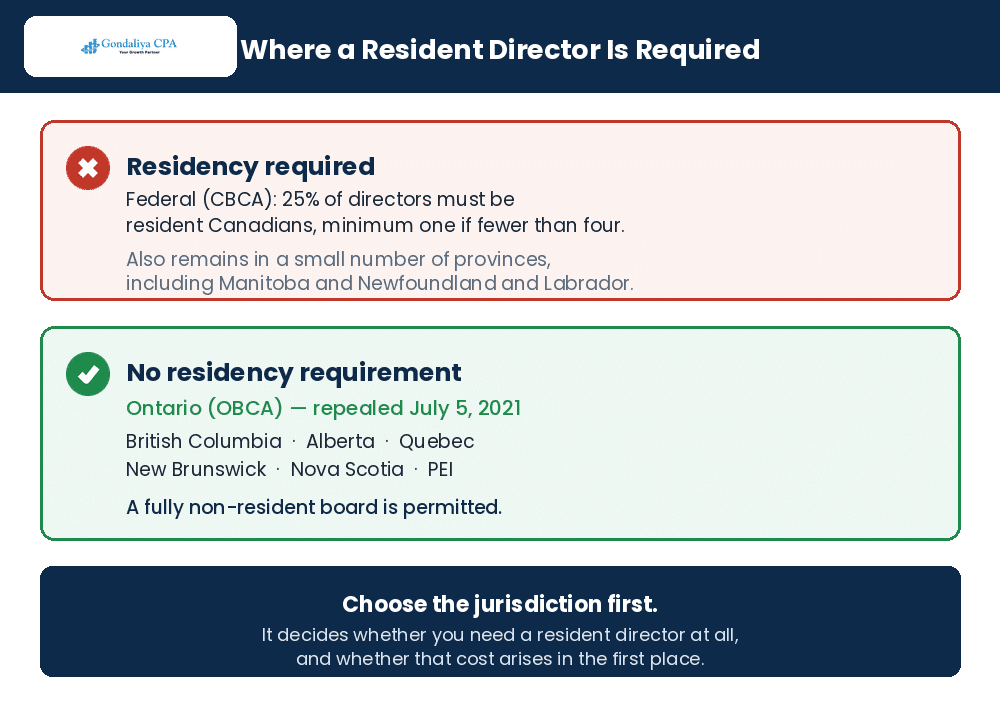
Non-resident owners often need help to meet this rule, and they turn to services offering resident director support in Canada. That help is genuinely valuable where the requirement applies. But the honest first step is to establish whether it applies to you at all, because for many founders choosing Ontario removes the requirement entirely and with it the cost and complication of finding a Canadian willing to sit on the board.
Risk Warning: A lot of online guidance, and some service providers, still state that Ontario requires 25% resident Canadian directors. That requirement was repealed on July 5, 2021. Please do not pay for a nominee director to satisfy an Ontario rule that no longer exists; check the jurisdiction first.
A founder abroad had been quoted for a nominee director to satisfy what they were told was an Ontario requirement. Because Ontario repealed that rule, incorporating provincially meant they needed no Canadian director at all. Checking the jurisdiction first saved an ongoing annual cost. Figures changed for privacy.
The Role and Legality of Nominee Director Services in Canada
Key Features of Nominee Director Services in Canada
Nominee and Resident Director Services Explained
The Service
Nominee directors help non-residents meet the residency rule easily where that rule applies. A nominee director arrangement means someone else acts as the resident director. The real owner keeps control through share ownership, while the nominee satisfies the statutory residency requirement.
Here’s how nominee directors work:
- Act as the official resident director.
- Follow the law under Canada Business Corporations Act (CBCA) or Ontario Business Corporations Act (OBCA).
- Take on legal responsibilities.
- Must put the company’s interests first.
Nominee directors have duties like any other director. They must act honestly and protect the corporation. If they don’t, they can face legal trouble. So, choosing a trustworthy nominee is important.
Nominee director services in Canada help non-resident business owners meet the resident director requirement under Canadian law where it applies. A nominee director is someone appointed to fulfill these legal duties. This lets foreign entrepreneurs open and run Canadian corporations without being residents. Typically, these services include appointing a Canadian resident as director. They also handle record keeping and regulatory filings. For companies with non-resident owners, this meets legal rules without changing who controls the business. The nominee has fiduciary duties but usually does not manage daily operations unless allowed. This service makes starting and running a company easier for non-residents in places like Ontario or federal jurisdictions.
Our Take: A nominee director is a real director with real legal duties and real liability, not a name on a form. That is precisely why the arrangement is legitimate when documented properly, and why anyone offering to be a silent signature should be avoided. The duties cannot be contracted away.
Importance of Resident Director Services for Non-Resident Canadian Corporations
Non-resident business owners need good resident director services to stay legal in Canada. These services keep companies in line with rules about taxes, filings, and records.
Here’s why resident director services matter:
- Help with tax and filing deadlines.
- Keep proper corporate records.
- Improve trust with banks and partners.
- Provide local contact for government agencies like CRA.
Resident directors simplify running a Canadian corporation from abroad. They reduce mistakes caused by distance or lack of local knowledge.
Privacy and Confidential Agreements in Nominee Director Arrangements
Nominee director arrangements involve private information that needs protection. Confidentiality agreements spell out each party’s roles, responsibilities, and limits on liability. Indemnity agreements protect nominee directors from personal risks tied to their legal duties under the applicable statute. These agreements clarify that nominees act to meet residency rules and don’t take control beyond what’s agreed. Risks include misunderstandings about authority or liability exposure if duties aren’t clear. Proper confidentiality terms and open communication help prevent misuse while meeting legal transparency requirements. Nominee directors face liability risk since they must act responsibly, but they do not hide who really owns the company. They can’t be used as secret proxies that break disclosure rules, and beneficial ownership must still be disclosed under the significant-control rules covered below.
A client asked whether a nominee director could keep their ownership off the record entirely. It cannot: the significant-control rules require the real owners to be recorded regardless of who sits on the board. Being clear about that at the outset avoided a compliance problem later. Figures changed for privacy.
Federal or Ontario: Choosing Your Jurisdiction
The Decision
This is the decision that determines whether you need a resident director at all, and it should be made before anything else. Federal incorporation under the CBCA gives you a name protected across Canada and a federal corporate identity, but it carries the 25% resident director requirement. Ontario incorporation under the OBCA carries no residency requirement since July 5, 2021, so a board made up entirely of non-residents is permitted.
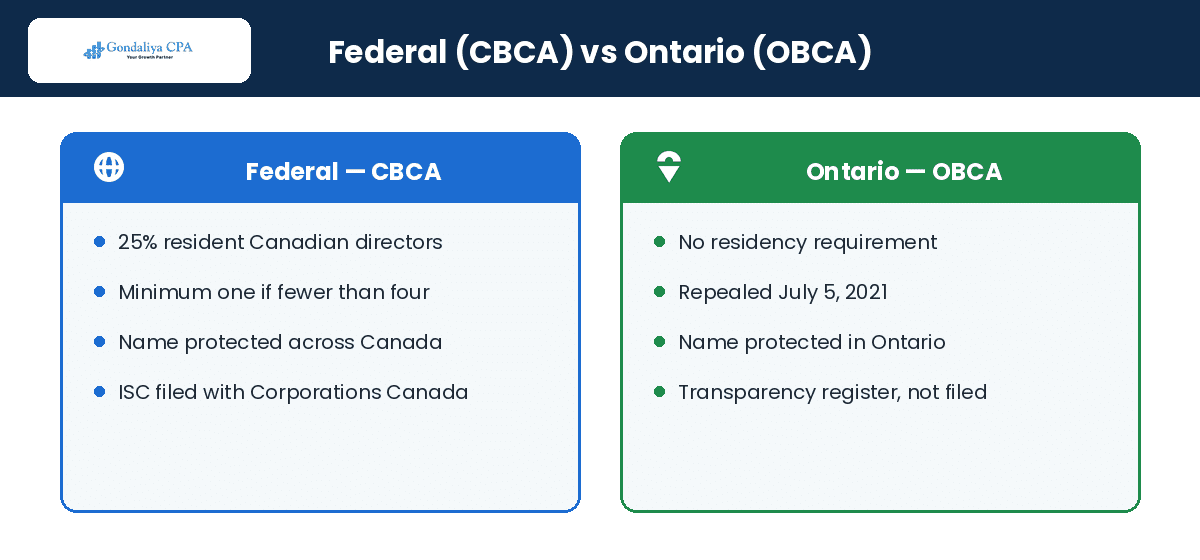
| Factor | Federal (CBCA) | Ontario (OBCA) |
|---|---|---|
| Resident director requirement | 25%, minimum one if fewer than four | None since July 5, 2021 |
| Nominee director needed? | Often, for a fully non-resident board | Not required by the statute |
| Name protection | Across Canada | Within Ontario |
| Significant control register | Maintained and filed with Corporations Canada | Transparency register maintained, not filed |
| Registered office | In Canada | In Ontario |
Neither choice is automatically better. Federal incorporation suits businesses that want national name protection or expect to operate across several provinces. Ontario incorporation suits founders who want the simplest path with a non-resident board and whose operations will centre on Ontario. What matters is making the decision deliberately, with the residency consequence understood, rather than defaulting to federal and then paying for a director you would not have needed. For timing, our page on how long incorporation takes in Ontario sets out what to expect.
Choose the jurisdiction first, then decide whether you need a resident director. For many non-resident founders whose business will operate in Ontario, incorporating under the OBCA removes the residency requirement altogether. Where federal incorporation is the right commercial choice, a properly documented resident director is the way to satisfy the CBCA.
A group defaulted to federal incorporation because it sounded more established, then needed a resident director to satisfy the CBCA. Their operations were entirely within Ontario. Had the jurisdiction been chosen deliberately, the requirement and its cost would not have arisen. Figures changed for privacy.
A client had signed a nominee arrangement drafted overseas that tried to strip the director of all decision-making authority. Directors’ duties are statutory and cannot be contracted away, so the agreement was rewritten to limit scope properly instead. The distinction protected both sides. Figures changed for privacy.
Canadian Nominee Director Appointment Process Explained
The Incorporation Process, Step by Step
The Process
A nominee director in Canada acts as a resident director to meet the resident director requirement. This rule applies to corporations under federal or provincial laws. The service helps non-resident business owners follow residency rules and stay legal.
Step-by-Step Guide: From Initial Consultation to Director Appointment
Starting a Canadian company as a non-resident involves these steps:
- Initial consultation: Discuss where to incorporate (federal or provincial), plan shares, and pick resident directors.
- Name search & NUANS report: Make sure your business name is unique and allowed.
- Jurisdiction choice: Decide between federal incorporation (CBCA) or a province like Ontario.
- Share structure setup: Choose share types and how many each owner gets.
- Plan director appointment: Find nominee directors who meet residency rules; get their written consent.
- Set registered office: Have a physical address inside the chosen jurisdiction.
- File incorporation papers: Send Articles of Incorporation plus initial office info and board resolutions.
- Register business number & CRA accounts: Sign up for GST/HST and payroll accounts if needed.
- Extra-provincial registration (if needed): Register if you operate outside your incorporated province.
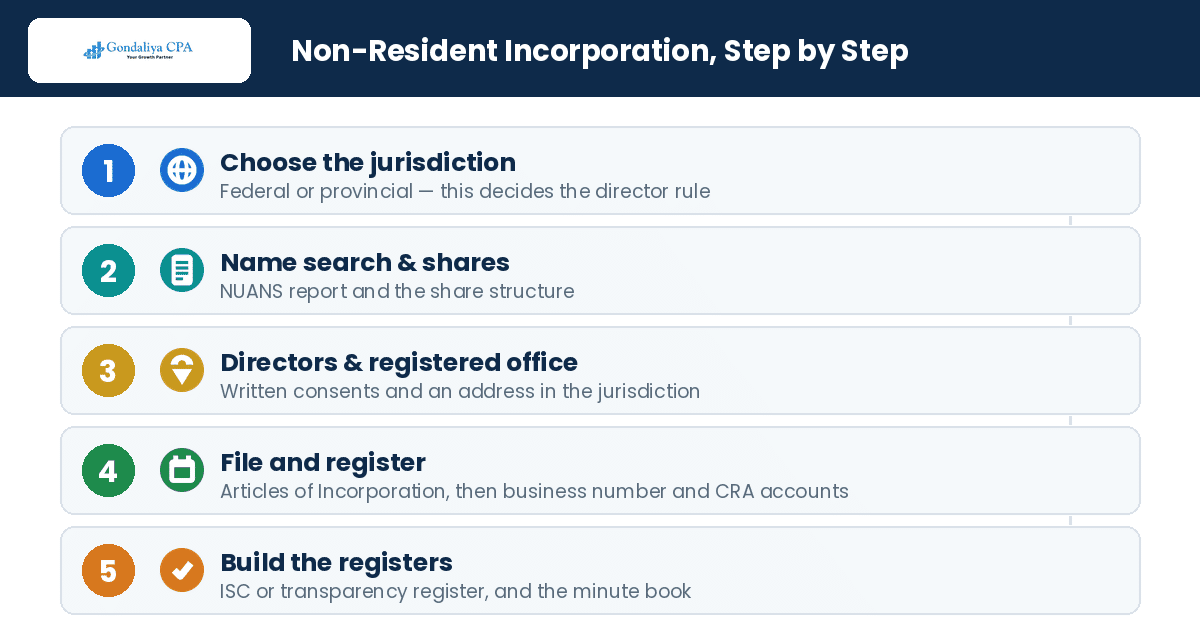
Usually, this process takes about 10 to 15 business days when done by CPAs experienced with non-resident setups. The appointment process itself starts with checking if any proposed nominee fits the residency criteria for the chosen jurisdiction. Next, they check for any conflicts of interest. After the client agrees, official paperwork appoints the director. Nominee directors have real duties. They must act honestly and in the company’s best interest. They cannot just sign papers silently. They take on legal responsibility during their time as director. Both sides use indemnity agreements to protect themselves without breaking rules. The appointment documents go to Corporations Canada or provincial registries like Ontario’s Business Registry.
Preventing Common Delays in Incorporation
Preventing common delays matters here: timely submission of paperwork prevents government backlogs, and clear client communication ensures fast document approvals and signatures. Understanding the difference between your business number and corporation number avoids confusion at the CRA registration stage.
Worked Example: Nominee Director Appointment Process
Client requests director service during the initial consultation, we verify eligibility and secure written consent swiftly, and appointment documents are filed electronically with Corporations Canada or the provincial registry within days. Moving quickly at the consent stage is what keeps the ten-to-fifteen-day timeline realistic. Figures changed for privacy.
How Does Gondaliya CPA Set Up Resident Director Services?
- Intake & KYC: Collect client info complying with anti-money laundering rules.
- Jurisdiction Assessment: Choose federal or provincial incorporation based on client needs.
- Name Search & NUANS: Confirm business name availability with government databases.
- Share Structure & Director Appointment: Plan shares distribution and appoint nominee directors meeting residency rules.
- Registered Office Setup: Establish physical address within jurisdiction for official correspondence.
Registered Office, Records, and Governance
The Address
Registered Office and Mailing Address Services in Ontario for Non-Residents
Setting up a registered office is key for non-resident corporations, especially in Toronto where many foreign businesses start under OBCA laws. This address receives legal documents, government notices, and other official mail needed to stay compliant. Non-residents without a physical place in Ontario can use registered office providers who offer mail forwarding while following registry rules. This keeps privacy intact despite public records listing addresses. This service works well alongside director appointments. It helps remote clients stay connected with local rules through trusted agents familiar with Ontario’s specific requirements. Our page on whether you can use a virtual office for your corporation covers what registries will and will not accept.
Managing Corporate Minute Book and Board Resolutions
Good governance calls for regular board meetings documented with minutes kept safe by the service provider. This helps with audits and shows good faith if the CRA or a registry reviews the company. Maintain detailed minute books with records of all board meetings and resolutions, and prepare formal board resolutions annually to document key decisions as required by law. Regular reviews between clients and CPA teams keep governance aligned with best practices. This builds trust needed when handling complex cross-border setups using affordable resident director services made for SMBs across hubs like Toronto.
Annual Nominee Director Agreements and Compliance Management
Where a nominee arrangement is used, agreements get renewed yearly to confirm the fiduciary duties required by the applicable statute, and these contracts limit the nominee’s authority to what’s allowed and confirm their ongoing role during annual return filing periods.
Pro Tip: Keep the minute book current from day one rather than reconstructing it later. When a bank, a buyer, or the CRA asks for corporate records, a complete minute book is what turns a two-week scramble into a same-day response. Please treat it as live, not archival.
A non-resident-owned corporation had no minute book beyond the incorporation documents, and a bank review stalled while records were reconstructed. Building the minute book properly and keeping it current removed the obstacle. Records are the cheapest form of readiness there is. Figures changed for privacy.
A founder assumed a Canadian mailing address from a courier service would serve as the registered office. Registries expect an address in the jurisdiction that can receive service of legal documents, so we arranged a compliant one. The wrong address type stalls the filing. Figures changed for privacy.
Supporting Client Privacy and Legal Compliance Through Professional Nominee Director Services
The ISC and Transparency Register
Disclosure
It’s important to meet the significant-control obligations, and they differ between federal and Ontario corporations. An individual with significant control, or ISC, is broadly someone who holds 25% or more of the voting rights, or 25% or more of the shares measured by fair market value, or who has direct or indirect influence amounting to control in fact.
Federal corporations under the CBCA have been required to keep a register of individuals with significant control since June 2019, and since January 22, 2024 they must also file that ISC information with Corporations Canada, with some of it made available to the public. Ontario corporations have been required since January 1, 2023 to prepare and maintain the equivalent, called a transparency register, kept at the registered office or another designated location and updated annually and within 15 days of any change; under the OBCA there is no filing requirement. Missing these obligations can bring serious consequences: federally, failure to maintain and file the register can expose directors and officers to significant fines and, in the most serious cases, imprisonment.
The register needs constant updates to show who holds key control in the company. Resident directors support this by helping with disclosures during annual return filing windows set by Corporations Canada or the provinces. Corporations Canada requires disclosure of all individuals with significant control within set timelines, and note that a nominee director is not usually an individual with significant control simply by virtue of the appointment; the register is about who really owns and controls the corporation. Keeping the register updated shows who really controls the company, and beneficial ownership must still be disclosed according to the rules to avoid misuse of nominee arrangements. Registered CPA firms offering these services stick to governance standards closely. This reduces risks like penalties for incorrect ISC records or regulatory problems.
Here’s what matters most:
- Appointment of nominee director: meets resident director requirement
- Fiduciary duties and liability: protects against governance breaches
- Privacy protection: balances confidentiality with legal transparency
Note that beneficial ownership must still be disclosed according to ISC rules to avoid misuse of nominee directors.
Key Stat: Ontario’s transparency register must be updated annually and within 15 days of any change in significant control. Federal corporations must file their ISC information with Corporations Canada, where some of it becomes publicly searchable. These are separate regimes with different mechanics, and mixing them up is a common error.
An Ontario corporation had prepared no transparency register at all, believing the obligation applied only to federal companies. Building it and putting a fifteen-day change process in place closed the gap. The Ontario obligation is quiet but real. Figures changed for privacy.
Corporate Tax Residency, T2, and Withholding
The Tax Side
Where your directors live affects corporate tax residency under Canadian law. Central management and control usually counts where the top decisions are actually made. This is the point most non-resident founders underestimate: a corporation incorporated in Canada is generally resident in Canada for tax purposes, and appointing Canadian-resident directors who genuinely direct the company reinforces that. Corporate residency status affects T2 returns, GST/HST registrations, withholding on payments abroad, and treaty relief eligibility.
Coordinating Nominee Director Services with Corporate Tax Planning and CRA Filings
Non-resident companies using nominee directors should sync governance with tax plans carefully. File correct annual T2 Corporate Income Tax Returns even if shareholders live outside Canada, generally within six months after the fiscal year-end, with the balance due earlier. Companies must file accurate CRA returns like T2 income tax forms every year, no matter where shareholders live.
Regulation 105 and Part XIII Are Not the Same Thing
These two withholding regimes are frequently confused, including in a lot of published guidance, so please note the distinction. Regulation 105 requires 15% withholding on payments made to a non-resident for services rendered in Canada, which is why it matters when you pay a foreign consultant or contractor who performs work here. Part XIII is the withholding that applies to passive amounts paid to non-residents, including dividends, interest, rents, and royalties, generally at 25% unless a tax treaty reduces the rate. So dividends paid abroad fall under Part XIII, not Regulation 105. Follow Part XIII withholding rules for passive income paid abroad unless treaties lower rates, apply Regulation 105 correctly on payments for services performed in Canada, and use treaties to reduce tax where they apply.
| Regime | What it applies to | Rate |
|---|---|---|
| Regulation 105 | Payments to non-residents for services rendered in Canada | 15%, unless a waiver applies |
| Part XIII | Dividends, interest, rents, royalties paid to non-residents | 25%, often reduced by treaty |
| T2 return | The corporation’s own income tax return | Due 6 months after year-end |
Corporate Tax Filing Readiness Tips
CPAs help combine bookkeeping tools such as QuickBooks, Xero, and Hubdoc with expert advice for foreign entrepreneurs running businesses in Toronto or Ontario. This method cuts risks of wrong filings that trigger audits or penalties. It also helps manage cash flow through proper withholding practices. Maintain detailed bookkeeping integrated with professional CPA review, and file T2 income tax returns accurately regardless of shareholder residence location. For the corporate tax backdrop, see our guide to what taxes corporations pay in Canada.
Risk Warning: Treating Regulation 105 as the rule for dividends paid abroad is a common and costly error. Dividends, interest, rents, and royalties fall under Part XIII at 25% unless a treaty reduces the rate. Please confirm which regime applies before any payment leaves Canada, because the payer is liable for under-withheld amounts.
A corporation paid a foreign consultant for work performed in Canada and withheld nothing, treating it as an ordinary supplier invoice. Regulation 105 applied at 15%. Correcting it early, and applying for a waiver where appropriate on future engagements, kept the exposure contained. Figures changed for privacy.
An overseas owner paid rent on a Canadian property to themselves abroad without withholding, treating it as an internal transfer. Part XIII applied at 25%, subject to treaty relief. Setting up the withholding correctly from the first payment avoided a growing liability. Figures changed for privacy.
Practical Benefits of Resident Director and Nominee Director Services
Resident director services Canada help Canadian corporations with owners living outside the country. They make sure the company follows the resident director requirement. This service lets foreign owners meet legal rules without losing control of their business. For a Canadian corporation non resident owners, these professionals handle legal duties while keeping governance smooth.
Banking Access and Ongoing Compliance
Operations
Combining Nominee Director Arrangements with Corporate Tax and Banking Access Solutions
Banks often require at least one resident officer or director before opening accounts, and this is a commercial reality rather than a statutory rule. Professional resident directors meet this need. They help clients get through bank onboarding faster using trusted CPA firm contacts. This is worth separating from the legal question: even where Ontario imposes no residency requirement, a bank may still want a local director or officer before it opens an account, so a resident director can be commercially useful even when it is not legally required.
Streamlining Business Operations and Governance Flexibility through Nominee Directors
Combining these services also cuts down admin tasks by bundling registered office duties, register upkeep, annual return filings, and payroll setup including source deductions, all crucial for staying compliant. By appointing a resident director, companies simplify tasks such as opening bank accounts needing local presence, maintaining a registered office address, filing annual returns on time, and managing CRA correspondence. This setup helps businesses run smoothly across borders.
Ensuring Ongoing Resident Director Compliance and Corporate Governance
Ongoing Management and Transparent Communication with Clients
After appointing nominee directors, good management keeps your company on track:
- Keep the Individual With Significant Control (ISC) register updated. This shows who really controls the company.
- Respond quickly to CRA letters. Ignoring them can cause fines or delays with T2 returns or withholding tax issues.
- Help with annual return filing on time. Avoid penalties from late or missed filings.
Managing compliance means watching CRA correspondence closely so replies happen fast enough to avoid penalties on source deductions or GST/HST reports affecting non-resident-owned corporations. Resident directors also handle CRA letters on tax issues quickly to avoid missed deadlines on withholding taxes or GST/HST accounts.
Regulatory Compliance Monitoring Essentials
Monitor all CRA correspondence diligently for tax notices and filing deadlines, and review regulatory updates affecting directorship roles and corporate governance yearly. We send regular updates about upcoming deadlines, register changes, CRA notices, and what actions you need to take. If a CRA letter escalates, our CRA audit representation team responds on the corporation’s behalf.
We helped a foreign entrepreneur set up an Ontario corporation, with our resident director appointed to satisfy the bank’s onboarding requirement rather than a statutory one. The service included banking introductions that enabled multi-currency accounts plus completing all tax registrations within ten business days after incorporation. Figures changed for privacy.
A Vancouver tech startup fully owned overseas incorporated federally, so the CBCA residency requirement applied and no founder qualified. We delivered a fast appointment combined with CRA registration help, leading to a successful bank account approval within three weeks. Federal incorporation is where the requirement genuinely bites. Figures changed for privacy.
A non-resident group left the federal ISC filing until the annual return was due, not realizing it must be filed on incorporation and updated on change as well. Building the register at incorporation removed the scramble. Front-loading the registers is far cheaper than retrofitting them. Figures changed for privacy.
Transparent Pricing Structure for Nominee Director Services in Canada
Costs, Risks, and What Is Included
The Details
Cost Structure Highlights
Resident director service flat annual fee covers filings, registered office, ISC maintenance, and CRA liaison support.
No hidden charges; fee transparency builds client trust.
Resident director services and nominee director arrangements come with clear annual fees. These fees cover all the compliance needed where the resident director requirement applies. Clients, including non-resident owners, know what they pay, with no surprise charges. The flat fee includes filings required by law, a registered office address, register upkeep, and handling CRA letters. This meets rules set by Corporations Canada and the Ontario Business Registry. It helps keep companies running smoothly under Canadian regulations. Clients get a fixed cost that fits federal rules like the CBCA’s 25% Canadian-resident director need. Provincial differences are also handled well. This keeps costs low for foreign business owners and cuts down on paperwork.
What’s Included in Gondaliya CPA’s Resident and Nominee Director Packages
Gondaliya CPA’s nominee director Canada packages help non-resident owners meet legal local directorship rules. Here is what they include:
- Appointment of qualified resident directors who meet residency laws.
- Registered office address in Ontario or other needed places.
- Maintaining Individual with Significant Control (ISC) records as required.
- Filing annual returns through Ontario Business Registry or Corporations Canada.
- Managing CRA communications like T2 filing reminders and Regulation 105 notices.
- Assistance with bank introductions within financial institution limits.
- Indemnity agreements to explain fiduciary duties under CBCA/OBCA laws.
These features ensure clients follow Canadian rules fully. They make doing business across provinces easier where residency rules change.
How Gondaliya CPA Supports Non-Resident Entrepreneurs with Resident Director Compliance
Gondaliya CPA offers resident director services for non-resident entrepreneurs setting up in Canada. We do more than just name a director; we handle ongoing compliance tasks too.
Our support includes:
- Helping at incorporation.
- Managing annual filings.
- Ensuring timely legal compliance.
- Advising on corporate governance matters.
By working with Gondaliya CPA, non-residents get expert help to meet Canadian rules easily. We keep your corporation’s standing good so you can focus on growing your business here.
Maintaining Legal Compliance for Non-Resident Incorporation Support
Resident director services Canada also handle CRA compliance issues like tax filing (T2), Regulation 105 withholding, and GST/HST security deposits.
Risk Management
Indemnity agreements protect nominees from unexpected liabilities due to their fiduciary duties under the applicable corporate statute. Regular compliance monitoring lowers chances of CRA audits or register penalties. Professional nominee directors file all documents on time to avoid fines or cancellation. They follow Corporations Canada and Ontario Business Registry rules closely. Their job includes keeping records accurate and helping communication with government agencies. The firm focuses on clear governance while respecting ISC disclosure laws. This helps prevent issues tied to anti-money laundering rules connected to directorship appointments.
Key points about legal compliance:
- Meet ISC register filing deadlines
- Handle CRA tax and withholding obligations
- Keep records up-to-date and clear
- Communicate with federal and provincial regulators
Why Non-Resident Canadian Corporations Should Choose Gondaliya CPA for Resident Director Services
Benefits of Using Gondaliya CPA Over DIY or Non-CPA Providers
Choosing between doing it yourself, a non-CPA provider, or a Registered CPA firm matters. The benefits of using Gondaliya CPA include access to Sharad Gondaliya, CPA with over fifteen years’ experience assisting hundreds of clients; expert advice on corporate tax planning linked to directorship arrangements; faster incorporation timelines supported by established government contacts; proactive updates on regulatory change affecting directors; and responsive support including weekend availability for urgent issues. Clients get fast responses, usually within one business day, and can reach out on weekends if needed. Plus, there are protections against surprise fees through money-back guarantees and fee-matching offers valid for sixty days after starting work.
Meet the Lead CPAs Behind Gondaliya CPA’s Resident Director and Nominee Director Expertise
Gondaliya CPA is led by Sharad Gondaliya, CPA Gondaliya, CPA (Canada & USA). He has over 15 years helping small businesses across Ontario with resident director services in Canada. Alongside him is Vandana Goel, CPA. She specializes in handling accounting for cross-border incorporations involving non-resident owners.
Together, they manage statutory filings strictly following Corporations Canada rules. They also keep individual significant control registers updated and handle extra-provincial registrations when needed. The team works directly with banks during account openings using modern tools like QuickBooks and Hubdoc to keep things accurate and timely.
Their focus balances cost against strict regulatory needs—a fact reflected in over 1300 positive Google reviews. They keep clients informed about changing laws like updates coming in 2026 that affect directorship residency rules.
| Factor | DIY | Non-CPA provider | Registered CPA firm |
|---|---|---|---|
| Jurisdiction advice | Often missed | Variable | Assessed before incorporating |
| Tax residency awareness | Low | Limited | Built into the plan |
| CRA representation | None | Limited | Full |
| Register compliance | Often missed | Sometimes | Maintained |
| Risk exposure | Highest | Variable | Managed with indemnity agreements |
| Technical expertise | Self-taught | Limited | Registered CPA (Canada & USA) |
| Pricing | Lowest | Variable | Flat fee, HST included |
2026 Update — what is current: The CBCA still requires 25% resident Canadian directors, or at least one where there are fewer than four. Ontario’s requirement was repealed on July 5, 2021 and has not returned. Federal corporations file ISC information with Corporations Canada, with some made public; Ontario corporations maintain a transparency register updated annually and within 15 days of change, with no filing requirement. Regulation 105 withholding is 15% on services rendered in Canada; Part XIII is generally 25% on passive amounts, subject to treaty relief.
Check What Your Canadian Corporation Needs
This quick self-check flags whether a resident director is required for your situation. Please answer the six questions below.
Resident Director Requirement Check
Six quick questions on what your setup actually needs. No fee shown.
Items to address:
This is a general prompt, not tax, legal, or immigration advice or a quote. Requirements depend on your jurisdiction and facts. For a real review, please book a free consultation.
Want a checklist to work from? You can download our free non-resident incorporation checklist before your consultation.
Industries Supported by Nominee Director Services: Startups, Healthcare, Consulting, and More
Industry Expertise
Service Areas: Serving Toronto, GTA, and Broader Ontario Corporate Clients
Resident director services Canada are available across Toronto, GTA, and wider Ontario. This includes places like Etobicoke, Vaughan, Mississauga, Brampton, Scarborough, Ottawa, Oshawa, Guelph, Hamilton, North York, Windsor, and more. Many small businesses owned by non-residents operate here.
Companies from outside Canada use our expertise to handle local director requirements and federal CBCA rules. We help with quick incorporation steps and ongoing corporate tax filings under CRA guidelines for foreign entrepreneurs.
Our coverage combines local knowledge with a national reach. That’s key when dealing with registrations or extra-provincial filings needed for Canadian corporation non resident setups spanning multiple provinces.
Resident director and non-resident incorporation support serves many industries that need trustworthy directors who meet legal standards. Here are ten sectors and where the issues tend to sit.
| Industry | The Non-Resident Angle |
|---|---|
| Medical doctors & physician professional corporations | Professional corporation rules on top of corporate law |
| Dentists & dental practices | Regulator requirements alongside incorporation |
| Daycare, childcare & CWELCC services | Local licensing that needs a local presence |
| Real estate investors, landlords & holding companies | Part XIII withholding on rents paid abroad |
| Property developers & builders | Extra-provincial registration across projects |
| Construction, contractors & skilled trades | Payroll and source deductions tied to the office |
| Technology startups & SaaS | Founders abroad, jurisdiction choice, investor trust |
| E-commerce & online retailers | GST/HST registration for non-resident sellers |
| Restaurants & food and beverage | Municipal licences and food safety compliance |
| Transportation, logistics & trucking | Permits and board resolutions across provinces |
| Consulting firms | Registry upkeep and ISC disclosures for foreign consultants |
- Medical doctors & physician professional corporations: Physician corporations must follow strict rules from OHIP and the Royal College of Physicians and Surgeons of Canada as well as corporate law, and professional corporation statutes carry their own restrictions on who may be a shareholder or director, which usually matter far more than the general residency rule. Physician corporations must follow strict OHIP/RCPSC rules. Qualified nominees help keep licenses valid alongside medical practice laws.
- Dentists & dental practices: A practice regulated by the Royal College of Dental Surgeons of Ontario faces regulator requirements alongside incorporation, and those professional rules govern the ownership structure before any residency question arises.
- Daycare, childcare & CWELCC services: Childcare operations, including CWELCC-funded ones, need genuine local presence for licensing and inspection, so the practical local support matters more than the directorship formality.
- Real estate investors, landlords & holding companies: Real estate investors with special property law needs also face Part XIII withholding when rents are paid to non-residents, which is a recurring obligation rather than a one-off setup item.
- Property developers & builders: Multiple project entities often mean extra-provincial registration in each province of operation, on top of the incorporation itself.
- Construction, general contractors & skilled trades: Construction contractors managing payroll linked to their office need source deduction accounts set up correctly from the first hire, and Regulation 105 can apply where non-resident contractors perform work in Canada.
- Technology startups & SaaS: Founders abroad can start quickly, and the jurisdiction choice is the decisive one, because incorporating in Ontario avoids the residency requirement entirely while transparent governance builds investor trust.
- E-commerce & online retailers: Online retailers face GST/HST registration issues, and non-resident vendors selling into Canada have their own registration rules to work through.
- Restaurants & food and beverage: Restaurants deal with food safety and municipal licences that require a genuine local operating presence, quite apart from the corporate paperwork.
- Transportation, logistics & trucking: Transportation firms handle trucking permits and board resolutions across provinces, so the corporate records have to keep pace with the operating footprint.
- Consulting Firms: Foreign consultants benefit from affordable resident directors who keep registry info current plus ISC disclosures required federally. This boosts client confidence.
Case Studies Highlighting Successful Non-Resident Company Setups in Toronto and Ontario
We’ve helped many clients start businesses using resident director service flat annual fees during the non-resident incorporation process Canada-wide. Here are two examples:
A tech startup incorporated federally but worked mainly in Toronto. Our resident director satisfied the CBCA requirement while the owners managed remotely from overseas. Had they incorporated in Ontario, no Canadian director would have been needed at all. Figures changed for privacy.
An e-commerce retailer expanding into Ontario used our registered office support and significant control register help. This let them register CRA accounts quickly without being physically present. The registered office, not the directorship, was the real bottleneck. Figures changed for privacy.
Contact Gondaliya CPA today at 647-212-9559 or info@gondaliyacpa.ca for your free consultation on navigating resident director services in Canada effectively.
Glossary and Frequently Asked Questions
Definitions & FAQ
- Resident director: A director who is a resident Canadian, required in some jurisdictions.
- Nominee director: A director appointed largely to satisfy a residency requirement, with full legal duties.
- CBCA: The Canada Business Corporations Act, the federal incorporation statute.
- OBCA: The Ontario Business Corporations Act, the Ontario incorporation statute.
- ISC: An individual with significant control, broadly 25% of votes or value, or control in fact.
- Transparency register: Ontario’s equivalent of the ISC register, maintained but not filed.
- Registered office: The official address in the jurisdiction that receives legal and government mail.
- NUANS report: The name search confirming a proposed corporate name is available.
- Extra-provincial registration: Registering to carry on business in a province other than the one of incorporation.
- Central management and control: The test that looks at where a corporation is really directed, relevant to tax residency.
- Regulation 105: The 15% withholding on payments to non-residents for services rendered in Canada.
- Part XIII: The withholding, generally 25%, on passive amounts paid to non-residents.
- Indemnity agreement: The contract protecting a director against certain liabilities of the role.
What is the minimum number of directors required for federal incorporation in Canada?+
For federal corporations under the CBCA, at least one director must be a Canadian resident if there are fewer than four directors. If there are four or more, at least 25% must reside in Canada. Ontario, by contrast, has imposed no residency requirement since July 5, 2021.
Does Ontario require a resident director?+
No. Subsection 118(3) of the OBCA was repealed effective July 5, 2021, so an Ontario corporation may have a board made up entirely of non-residents. British Columbia, Alberta, Quebec, New Brunswick, Nova Scotia, and Prince Edward Island also impose no residency requirement.
What is the typical incorporation timeline for non-resident Canadian corporations?+
The incorporation process generally takes 10 to 15 business days when handled by experienced CPAs. Delays usually come from name approval, document signatures across time zones, and bank onboarding rather than the filing itself.
When is the annual return filing window for Canadian corporations?+
Annual returns must be filed during specific windows set by Corporations Canada or provincial registries, usually within a few months after the corporation’s anniversary date.
How does Part XIII dividend withholding tax apply to non-residents?+
Part XIII applies to passive amounts paid to non-residents, including dividends, interest, rents, and royalties, generally at 25% unless reduced or exempted by a tax treaty between Canada and the recipient’s country. The payer is responsible for withholding and remitting.
What is Regulation 105 withholding tax and who must comply?+
Regulation 105 requires 15% withholding on payments made to non-residents for services rendered in Canada, such as fees to a foreign consultant working here. It does not apply to dividends, which fall under Part XIII. A waiver can reduce or eliminate the withholding in some cases.
What risks are associated with nominee director liability?+
Nominee directors face the same legal responsibilities as any director and may be liable if they fail in their fiduciary duties, including for certain unpaid corporate amounts. Proper indemnity agreements help mitigate these risks, but they cannot remove the statutory duties themselves.
What happens if significant control register obligations are missed?+
Federally, failing to maintain and file the ISC register can expose directors and officers to substantial fines and, in serious cases, imprisonment. In Ontario, the transparency register must be maintained and updated annually and within 15 days of a change, with penalties for non-compliance.
How does a resident director differ from a local representative or having no director?+
A resident director fulfills a legal residency requirement where one applies and carries full directors’ duties. A local representative may assist operationally without directorship duties. Having no director at all is not permitted; every corporation must have at least one director.
What banking access challenges do non-resident Canadian corporations face?+
Banks commonly require a resident director or officer, and in-person identity verification, before opening accounts. This is a bank policy rather than a statutory rule, but it is often the practical reason a non-resident founder engages a resident director even in Ontario.
Key Insights on Resident Director Services by Gondaliya CPA
Scope/Assumptions: Services include directorship appointment, registered office setup, ISC register upkeep, and regulatory filings.
Direct Answer: Resident director services help non-residents meet residency requirements legally and efficiently.
Non-Resident Incorporation Checklist
- Choose the jurisdiction first; it decides whether a resident director is required.
- Run the NUANS name search before anything else is filed.
- Plan the share structure and who holds significant control.
- Arrange the registered office address in the chosen jurisdiction.
- Appoint directors and obtain written consents, with indemnity agreements where relevant.
- Register the business number and any GST/HST and payroll accounts needed.
- Build the ISC or transparency register at the outset, not later.
- Confirm which withholding regime applies before paying anything abroad.
Who This Is For / Not For
- For: Foreign entrepreneurs and non-resident owners requiring legal compliance when incorporating and operating a Canadian business.
- Not For: Anyone seeking to use a nominee arrangement to avoid disclosure obligations, which the significant-control rules exist specifically to prevent.
People Also Ask
Quick Answers
Can a non-resident own 100% of a Canadian corporation?+
Yes. There are no restrictions on foreign shareholders owning shares in Canadian corporations, federally or in Ontario. The residency rules that exist apply to directors, not shareholders, and only in certain jurisdictions.
Does appointing a Canadian director make my company taxable in Canada?+
A corporation incorporated in Canada is generally resident in Canada for tax purposes regardless. Where directors are located matters most for foreign-incorporated companies, because central management and control exercised in Canada can make them Canadian-resident for tax.
How can CRA audit risks on GST/HST and source deductions be minimized?+
Maintaining timely filings, accurate records, and prompt responses to CRA notices reduces audit risk significantly. For non-resident-owned corporations, the most common issues are late registrations and missed withholding rather than the returns themselves.
Contact Gondaliya CPA at 647-212-9559 or info@gondaliyacpa.ca for help incorporating and running a Canadian business from abroad, on a flat fee, HST included, quoted in writing before any work starts. If a holding structure is part of the plan, see our guide on whether you need a holding company.
Incorporating in Canada from overseas? We tell you what you actually need
Gondaliya CPA assesses the jurisdiction before you incorporate, provides a resident director only where one is genuinely required, sets up the registered office, builds the significant control register, registers your CRA accounts, and files the T2, on a flat annual fee, HST included, with a one-business-day response. Please book a free consultation.
Next Steps
Resident director services help non-residents meet residency requirements legally and efficiently, but the first and most valuable step is establishing whether the requirement applies to you at all. Federally, under the CBCA, it does. In Ontario it has not since July 5, 2021. Get the jurisdiction right, put the registered office and significant control register in place from the outset, confirm which withholding regime applies before money leaves Canada, and keep the minute book current. Please contact us for a straight answer on your setup, gather your identification and ownership details, and let us assess the jurisdiction before anything is filed. Contact Gondaliya CPA at 647-212-9559 or info@gondaliyacpa.ca today, serving Toronto, the GTA, and clients across Canada. If our content helps, please add gondaliyacpa.ca as a preferred source on Google. Contact Gondaliya CPA today for expert guidance on resident director services that protect your business compliance across Canada’s complex regulations.
Published: July 23, 2026 · Last updated: July 23, 2026
Disclaimer: This article is educational information only and is not tax, legal, or immigration advice, and incorporation and director arrangements require a lawyer alongside your CPA. It reflects corporate and CRA rules current to 2026, including the CBCA requirement that at least 25% of directors be resident Canadians with a minimum of one where there are fewer than four, the repeal of subsection 118(3) of the OBCA effective July 5, 2021, the CBCA obligation since January 22, 2024 to file individuals with significant control information with Corporations Canada, the Ontario transparency register requirement effective January 1, 2023 updated annually and within 15 days of change, Regulation 105 withholding of 15% on services rendered in Canada, and Part XIII withholding generally at 25% subject to treaty relief. Corporate statutes differ by province and change. Please consult a Registered CPA and a lawyer before acting. Fees include HST.

Sharad Gondaliya is a CPA Canada & CPA USA with 15 Years+ experience of Accounting, Tax, Payroll of Corporate Small Businesses as Tax Accountant. He is a CPA Ontario member (61040184) and holds US CPA licences in Washington and Montana and is well known among corporate small businesses for tax planning, efficient tax solutions, and affordable CPA services. Sharad is the Principal (Director) of Gondaliya CPA – Affordable CPA Firm in Canada. Licenses: CPA Ontario: 61040184 | CPA USA (MT): PAC-CPAP-LIC-033176 | CPA USA (WA): 57629 | CPA Firm License: 61330051 View Full Author Bio