



How High-Income Business Owners Can Use Holding Companies for Long-Term Tax and Estate Planning
Quick Summary
High-income Canadian business owners use a holding company to defer tax on retained profit, hold investments apart from operating risk, freeze value for the next generation, and protect the lifetime capital gains exemption on an eventual sale. Please note the structure supports the plan; it does not replace a will, a shareholder agreement, or the trust and legal work that sit alongside it.
| Aspect | Details |
|---|---|
| The tax lever | Deferral through tax-free intercorporate dividends. |
| The estate lever | An estate freeze, so future growth accrues to the next generation. |
| The limit to watch | Passive income above $50,000 grinds the small business deduction. |
| The exit lever | Purification, to keep the exemption available on a share sale. |
Reading time: 30 minutes.
Table of Contents
- What a Holdco Does for a High-Income Owner
- Passive Income and the Small Business Deduction
- The Lifetime Capital Gains Exemption and a Future Sale
- Transferring Portfolios and Personal-Use Property
- Estate Freezes and Intergenerational Transfer
- Income Splitting, TOSI, and Attribution
- Trusts, Prescribed Rate Loans, Giving, and IPPs
- Probate, Post-Mortem Planning, and Life Insurance
- Industry Spotlights: Sectors We Represent
- Glossary of Key Terms
- Frequently Asked Questions
- People Also Ask
The Numbers That Matter
This article covers Canada, with Ontario and Toronto context, and reflects CRA rules current to 2026. It assumes a Canadian-controlled private corporation and a high-income owner-manager. “Illustrative” figures are examples, not quotes, and any masked engagement notes end with “Figures changed for privacy.” This is educational information only and not tax, legal, or financial advice, and estate work requires your own lawyer alongside your CPA. Fees include HST. Corporate, trust, and passive-income rules change, so please confirm your own situation before acting.
What a Holdco Does for a High-Income Owner
The Role
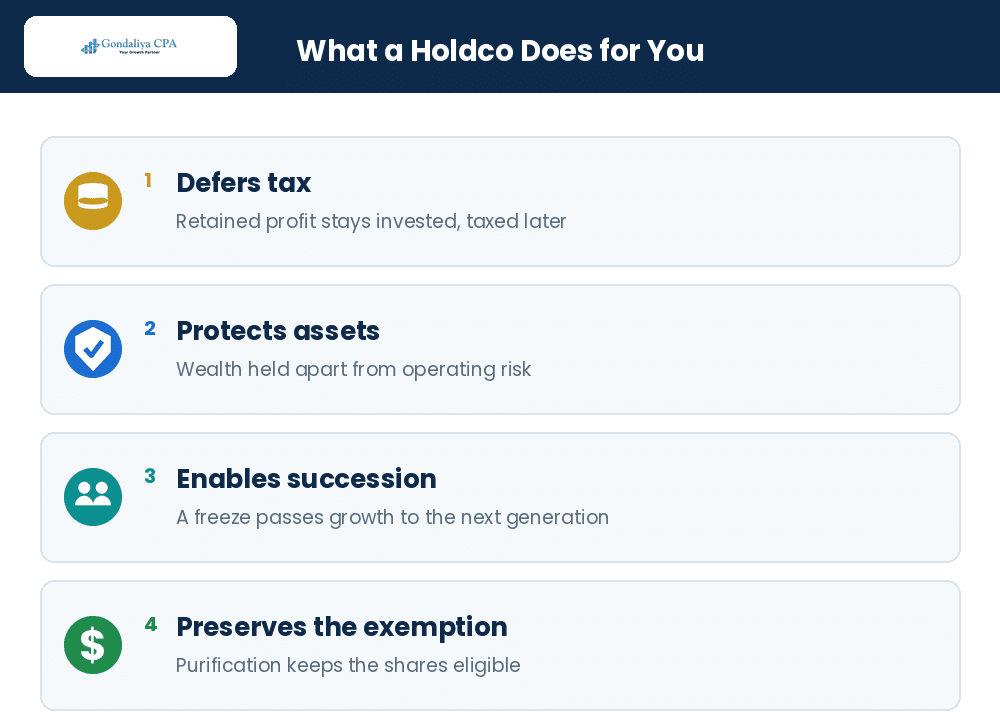
Owning a holding corporation, or Holdco, can be smart for high-income business owners in Canada. It helps with tax planning, especially around estate and corporate wealth management. A Holdco mainly owns assets or shares of other companies. It doesn’t usually run day-to-day business activities. When it comes to holding company estate planning, a Holdco does a few important jobs: it protects assets by keeping them separate from business risks; it defers taxes since money inside the Holdco may be taxed less than personal income; and it helps preserve family wealth by making it easier to pass assets to the next generation with fewer taxes. Putting these together makes your corporate wealth planning stronger and supports your family legacy goals.
Why Owners Establish a Holdco
Business owners pick Holdcos for several reasons. They get tax savings by keeping profits in the corporation at lower rates. Succession is easier because the Holdco setup reduces capital gains taxes when passing ownership. They can pool funds inside the Holdco for better investment chances. The structure protects personal assets from lawsuits or business debts. Holding company estate planning is a key strategy for corporate wealth planning and family wealth preservation, especially when combined with high income tax planning in Canada. Gondaliya CPA offers expert guidance on trust and holding company planning, shareholder planning strategies, and business succession planning to ensure tax efficient wealth transfer and intergenerational wealth transfer.
Asset Protection and Timing Flexibility
Using a Holdco helps keep your assets safe. Valuable items stay separate from daily business risks. If problems happen with the operating company, only those assets are at risk, not the ones held by the Holdco. This approach guards your family’s wealth and offers peace of mind during uncertain times. Holdcos also give good chances to save on taxes when investing: you can spread dividends among family members to reduce total taxes paid, within the split-income rules covered later, and you decide when to take money out, which helps control tax timing based on your yearly situation. Thinking about these points early lets you use a Holdco as a useful tool for long-term financial health within Canadian tax rules.
A high-income owner had built substantial retained profit inside the operating company with no structure around it, and no plan for passing it on. Introducing a holdco separated the wealth from the trading risk and gave the succession plan somewhere to sit. The structure came first; everything else followed. Figures changed for privacy.
Passive Income and the Small Business Deduction
The Grind
Passive investment income inside a holding company can change how much Small Business Deduction (SBD) you get. Canadian-controlled private corporations (CCPCs) lose some of their SBD if their passive income goes over certain limits. This affects corporate wealth planning and chances to defer taxes.
The passive investment income threshold is $50,000 per year. For each dollar over that, the small business limit of $500,000 drops by five dollars. When passive income hits $150,000, the small business deduction disappears completely. This matters a lot for high-income business owners using holding companies to save on taxes. Holdcos often collect passive income like dividends from subsidiaries or interest from cash saved up. That money grows corporate wealth but going past the limit means paying higher tax rates on active business profits because the SBD shrinks. So, it’s smart to keep passive income under control in holdcos.
| Key threshold | Amount | Impact |
|---|---|---|
| Passive investment income threshold | $50,000 | Starts reducing the small business deduction |
| Reduction rate | $5 per $1 of excess | The limit erodes quickly above the threshold |
| Phase-out limit | $150,000 | Complete loss of the small business deduction |
| Small business limit | $500,000 | Shared among associated corporations |
Some tax moves include timing dividends so they go directly to personal accounts or being cautious about reinvesting too much passively inside the corporation. Knowing how CRA rules affect your setup helps you keep tax savings now and later while protecting family wealth. Good planning means separating active business earnings from passive investments where possible. Also, watch annual thresholds during valuation reviews so growth shares stay effective without cutting SBD benefits critical for incorporated SMBs nationwide. Please note that dividends between connected corporations are excluded from the passive income calculation, which is precisely why holding the investments in the holdco can protect the operating company’s low rate.
Key Stat: Passive investment income above $50,000 reduces the $500,000 small business limit by $5 for every $1 of excess, eliminating it entirely at $150,000. For a high-income owner accumulating investments corporately, this is the threshold that quietly decides whether active profit is taxed at the low rate or the general rate.
A high-income owner had accumulated years of investments inside the operating company and was steadily grinding away the small business deduction without realizing it. Moving the portfolio to a holdco protected the low rate on the active business going forward. The grind is invisible until you model it. Figures changed for privacy.
An owner assumed the holdco and opco each had their own small business limit and had planned two years of profit around it. Testing the group showed they were associated and shared one. Correcting the assumption before filing avoided a reassessment. Figures changed for privacy.
The Lifetime Capital Gains Exemption and a Future Sale
The Exemption
The Lifetime Capital Gains Exemption (LCGE) lets you skip tax on a substantial amount of gains when selling qualified small business shares. For qualified small business corporation shares the exemption is $1,275,000 for 2026, being the $1,250,000 figure confirmed in the federal budget of November 4, 2025 indexed to inflation from 2026, so please confirm the indexed amount for the year of sale before relying on it. Using good holding company estate planning makes it easier to use this exemption when you sell.
With a holdco, you can do an estate freeze that splits shares into growth shares and frozen shares. Growth shares hold future value increases without changing the value fixed at freeze time. This strategy helps maximize LCGE benefits later. Corporate wealth planning means making sure your operating company meets CRA’s Qualified Small Business Corporation (QSBC) rules: mostly active business assets, with less than half in passive investments. Holding companies help by keeping investments separate from operating firms. Good planning also involves setting up trusts and shareholder agreements that fit your succession goals. These help pass wealth smoothly while making full use of lifetime exemptions, which only apply once per person over all qualifying sales.
Pro Tip: Purification, moving surplus out of the operating company to the holdco, is what keeps the shares eligible for the exemption, and it needs runway. Please start it well before a sale is on the table, because a company purified the month before diligence rarely satisfies the tests that look back over time.
An owner preparing to sell found that accumulated cash inside the operating company had put the exemption at risk on the share sale. Purifying through the holdco, with enough time before the transaction, restored eligibility. Runway is the whole game on purification. Figures changed for privacy.
Transferring Portfolios and Personal-Use Property
Transfers
Moving your personal investments into a holding company can improve corporate wealth planning but comes with some tax considerations around passive investment income limits in holdcos. The benefits are real: easier management since all investments are under one corporation; better creditor protection; the ability to keep earnings inside the company for tax deferral; and simpler intergenerational transfers using trusts linked to holdcos.
But watch out for these points. Transfers might trigger capital gains if done at market value without special elections. The type of income generated affects small business deduction eligibility. Passive investment income must be watched carefully against the $50,000 limit each year. Getting advice is smart so you can use Section 85 rollovers where possible to avoid immediate taxes and align holdings with long-term family strategies balanced against current CCPC deduction rules.
Personal-Use Property Is Different
Putting personal-use items like cottages or cars into a holding company needs caution because it often causes extra income tax for high earners doing complex structuring. The CRA usually treats these transfers as sales at fair market value, which could mean capital gains taxes unless special rollover rules apply, but those rarely cover purely personal property without business use. Other things to keep in mind: no special rollover treatment like with small business shares; possible recapture rules if the property is depreciable; and transfer pricing issues if transactions happen between you personally and your corporation later on. High-income taxpayers should think carefully since unexpected taxes might undo benefits from using holdcos or trusts in their plans. Professional help is important before moving non-business assets because valuation methods are tricky and CRA rules change often.
Risk Warning: Moving a cottage or other personal-use property into a holding company is one of the few holdco moves that usually creates tax rather than saving it, because the rollovers that help with business assets generally do not apply. Please get advice before transferring anything personal into a corporation.
An owner planned to move a family cottage into the holdco for what they believed were estate reasons, not realizing it would be treated as a sale at fair market value and trigger a gain. We modelled the cost before anything moved. Some assets belong outside the corporation. Figures changed for privacy.
Managing U.S. Estate Tax Exposure Using Canadian Holding Companies
High-net-worth Canadians owning U.S. assets face tricky estate tax rules under U.S. law. Canadian holding companies can help reduce exposure as part of high-income tax planning across Canada.
Instead of owning U.S. property directly, a Canadian holdco owns U.S.-based subsidiaries or real estate indirectly. This adds layers between your personal estate and American assets, lowering valuation risk at death under IRS rules for non-residents.
Working with cross-border experts who know both CRA and IRS rules is key to avoiding double taxation issues. They tailor legal structures to fit each client's situation while helping protect family wealth internationally.
Estate Freezes and Intergenerational Transfer
The Freeze
Using estate freezes with holding companies forms a key part of holding company estate planning in Canada. Business owners use this approach to keep family wealth intact, manage taxes, and plan for smooth business succession.
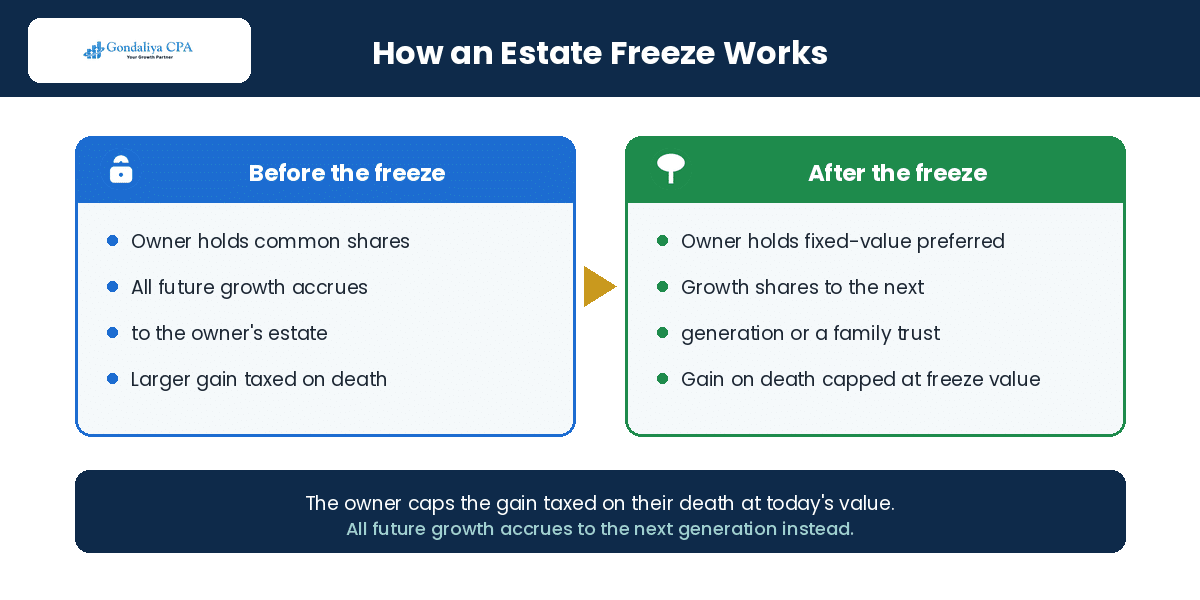
An estate freeze means locking in the current value of an operating company’s shares. This happens by swapping common shares for fixed-value preferred shares inside a corporate structure. Then, growth shares go to the next generation or a family trust. Future growth happens outside the original owner’s estate. This helps limit capital gains tax on death and supports passing wealth between generations while matching business succession goals. Holding companies help by gathering ownership interests, separating risks, and managing cash needs during changeovers. They can also lower probate fees by reducing direct share ownership in operating firms. Our experience shows that pairing an estate freeze with a well-structured holdco can cut tax exposure on deemed disposition at death and boost family wealth preservation over time.
Incorporation itself is the starting point for much of this. Starting a corporation is a key step for business owners who want to protect family wealth and plan for succession. Incorporation helps separate your personal assets from business risks. It also creates opportunities to defer taxes and pass wealth smoothly. You can use multiple share classes in a corporation to do an estate freeze. This locks in current values while letting future growth go to heirs or trusts, without immediate tax hits. Business owners need clear shareholder agreements. Keeping proper records supports succession plans. This way, wealth transfers happen with less fuss and lower probate fees in Ontario, since shares change hands instead of selling assets. Incorporation protects you from creditors by keeping business risks in one company and holding investments separately inside a holding company. When set up right, your corporation makes it easier to use prescribed rate loans, family trusts, charitable giving, and Individual Pension Plans for tax planning across Canada. If a restructuring is needed, our page on whether you can change your business structure sets out the options.
An owner in their fifties froze the value of the operating company into preferred shares and let the growth accrue to a family trust holding new common shares. The gain on their eventual death was capped at that day’s value. Freezing early is what makes the numbers work. Figures changed for privacy.
An owner planned to freeze at a value based on an old valuation that no longer reflected the business. Refreshing the valuation before the freeze meant the frozen shares were set correctly. A freeze built on a stale number causes problems later. Figures changed for privacy.
Income Splitting, TOSI, and Attribution
The Rules
Income splitting with holding companies is still possible but you must follow CRA’s Tax on Split Income (TOSI) rules closely. These rules aim to stop income sprinkling abuses in private corporations.
Family trusts plus holdcos let you distribute dividends or investment income to adult beneficiaries who meet TOSI exemption rules, like active business roles or enough equity ownership over time. If those conditions aren’t met, dividends might face top marginal tax rates under TOSI. To optimize income splitting, structure share classes carefully within holdcos. Use discretionary family trusts to allocate taxable dividends smartly while staying within CRA rules. Shareholder agreements help by clearly stating voting rights and dividend claims tied to each share class. This method helps high-income families lower total taxes without triggering heavy TOSI penalties when done right under Canadian law.
Corporate Attribution
Corporate attribution rules decide how income earned through related parties, like spouses or minor kids, is taxed back to original owners. These rules affect shareholder planning when using holding companies alongside family trusts. Shareholder agreements must clearly explain how these attribution rules impact voting power, dividend rights, and limits that match CRA guidelines. Trust coordination services are key here, aligning trust rules with corporate setups for clients across Toronto, Ontario, and Canada-wide. Ignoring attribution effects can cause surprise personal tax bills even if holdco strategies delay corporate taxes. Keeping valuations current and filings coordinated lowers audit risks in complex setups involving multiple generations or beneficiaries.
Our Take: Income splitting through a holdco and family trust still works, but only where the facts genuinely support it, such as an adult child actually working in the business. The documentation is what makes it hold. Please treat the roles and the paperwork as part of the plan, not an afterthought.
A family allocated dividends through a trust to adult children who were genuinely active in the business, with hours and responsibilities documented from the start. When the allocation was later reviewed, the records carried it. The facts have to be real, and written down. Figures changed for privacy.
Trusts, Prescribed Rate Loans, Giving, and IPPs
The Toolkit
Around the holding company sit several tools that a high-income owner can use together.
Prescribed Rate Loans
Prescribed rate loans help shift income among family members while managing TOSI rules. The CRA updates the low interest rates every three months, and the prescribed rate is 3% for the current quarter. Lending money at this rate avoids extra taxes if done properly. By using these loans, higher-income owners can lend money to family members in lower tax brackets. Those family members pay interest at the prescribed rate each year, reducing overall taxes for the household. But watch out: TOSI rules limit how much income splitting works. You have to follow exceptions closely to avoid problems. Holding companies often lend cash or dividends through formal agreements that meet CRA standards. Proper paperwork prevents surprises like taxable benefits or audits later on. Please note the rate is locked for the life of the loan when it is made, so the quarter you set it up in matters.
Family Trusts
Family trusts are powerful tools when paired with holding companies. They let you decide who gets income each year, often favoring adult kids or spouses based on their taxes. Trusts protect assets from creditors by separating ownership from beneficiaries’ personal finances. This helps if lawsuits happen against shareholders or directors. Also, placing shares into a trust before death can lower probate fees in Ontario. Probate fees only apply to assets passing directly through someone’s name after they die. Trusts need careful legal setup because of CRA’s 21-year rule that taxes capital gains inside trusts every two decades. Reviewing trusts regularly keeps them working well with your family’s needs and tax laws. Our guide to trust tax planning for high-income Canadians goes deeper on the trust side.
Lifetime Tools for Wealth Protection: Inter Vivos Trusts
Inter vivos trusts start while you are alive. They help shield assets from creditors or divorce claims. They also let you make planned payments that adjust as family situations change. These trusts let you keep control without giving full ownership right away, a big plus when dealing with holding company shares.
Discretionary distributions from family trusts let trustees decide who gets what based on needs. But they must follow TOSI rules carefully to avoid extra split-income taxes.
Charitable Giving
Charitable giving through your corporation can reduce taxes and support causes you care about. Corporations can give money directly to registered charities for immediate tax deductions within Income Tax Act limits. Another option is setting up private foundations funded by holding companies. These let you make grants over time while possibly getting capital gains exemptions when donating appreciated assets. Donor-advised funds offer flexibility too. You contribute assets to an outside manager but keep control over where donations go. Many Canadian entrepreneurs like this simple way to give back while keeping control. These methods cut down on passive investment income inside holdcos and fit well with estate freezes for incorporated businesses around Ontario and Toronto.
Individual Pension Plans
Individual Pension Plans (IPPs) are great for high earners who want more than RRSPs offer for retirement savings. IPPs let older business owners save more each year toward a predictable pension income later on. With IPPs tied into corporate structures like holdcos focused on Canadian wealth planning, companies deduct contributions as expenses. This lowers their taxable income effectively. Employees get defined benefit pensions with steady payouts that often adjust with inflation measures over time. IPPs work well alongside estate freezes and succession plans because they provide both solid retirement income and good tax management during the accumulation years common among wealthy taxpayers.
| Structure | Purpose | Key Benefit |
|---|---|---|
| Holding Company | Combine business shares | Tax deferral & creditor protection |
| Family Trust | Flexible income sharing | Income splitting & tax reduction |
| Testamentary Tools | Manage assets post-death | Lower probate & tax benefits |
Core Wealth Structures: Testamentary Tools
Testamentary tools add legal rules that kick in after death. Use graduated rate estates to lower taxes and allow income splitting after death. Trust coordination services help follow CRA rules like the 21-year deemed disposition while getting the best after-tax results.
A high-income owner used a prescribed rate loan to a lower-bracket spouse, documented properly and with the rate locked at the quarter it was made. The household’s overall tax fell without running into the split-income rules. The paperwork is what made it work. Figures changed for privacy.
An owner donated appreciated securities in kind through the corporation rather than selling them and giving cash. The gain on the donated shares was eliminated while the credit was preserved. Same generosity, materially better tax result. Figures changed for privacy.
A family trust was approaching its twenty-first year with significant accrued gains inside it and no one tracking the date. Planning the distribution ahead of the deemed disposition avoided a large unexpected bill. The 21-year clock runs quietly from day one. Figures changed for privacy.
Probate, Post-Mortem Planning, and Life Insurance
On Death
A Legacy-Centered Approach to Estate Planning for High-Net-Worth Families in Canada
Holding company estate planning plays a key role in protecting family wealth. It also helps with corporate wealth planning for high-net-worth families across Canada. This method organizes assets to keep taxes low and protect from creditors. It also makes passing assets down through generations easier.
Using holding companies lets business owners separate risks from investments. They can still control how assets get shared. A legacy-focused plan keeps capital inside the family. It reduces probate fees and income taxes when someone dies. This way, ownership matches what the family wants, helping smooth transitions.
The goal is to grow corporate assets steadily. It also protects family interests from unexpected problems or disagreements.
Holding company estate planning helps business owners in Canada protect their wealth. It focuses on corporate wealth planning, especially for those with high income tax rates. This approach aims to cut down probate fees in Ontario and stop your assets from losing value after death. Knowing about the clearance certificate (TX19) and using the right structures can keep your family’s wealth safe. Holding company estate planning can reduce tax costs for high-income earners, limit probate fees in Ontario, help assets transfer without hassle, and use the clearance certificate (TX19) to clear taxes before transferring.
Wills Come First
Wills are the base of any solid estate plan that focuses on family wealth preservation and holding company estate planning. A clear will tells who gets what, names guardians, and picks executors. This cuts down confusion after someone passes. If there’s no will, provincial rules decide who inherits. That can cause delays or higher probate costs, especially for businesses using holding companies. Wills should cover share transfers carefully to avoid tax hits like deemed dispositions at fair market value. Starting with wills means personal wishes match up with corporate plans. This helps keep taxes low and makes transitions smoother.
Advanced Testamentary Planning: Testamentary Trusts and Dual Wills Tailored for the Canadian Context
Testamentary trusts set up by wills give nice tax perks after death through graduated rate estates. These trusts spread taxable income among several beneficiaries instead of just one person's return, cutting overall tax bills.
Dual wills split complex assets like real estate or shares in holding companies from simpler cash or investments. This helps lower probate fees in Ontario since a secondary will covering private company shares does not go through probate. It also helps keep cash ready for estate taxes without selling parts of the business too soon.
Tax-efficient corporate investing fits well here. Capital dividend accounts inside holding companies combine with testamentary trust payouts under CRA rules. Together, they build layers of protection that support lasting legacies and smart money management for Canadian entrepreneurs with big estates.
Post-Mortem Planning and the Clearance Certificate
When someone passes away, private shares usually face capital gains tax because the government treats them like they were sold at market value. Getting a clearance certificate (TX19) confirms that all taxes are paid before handing over these assets, avoiding CRA penalties or delays. The CRA’s service standard for issuing that certificate is 120 calendar days from a complete request, and it will not begin until all returns are filed and assessed and balances are paid or secured, so the time has to be built into the administration. You can also use the capital dividend account (CDA) to send money to heirs tax-free. Don’t forget about the lifetime capital gains exemption, it might lower taxes on small business corporation shares if you qualify.
Probate in Ontario
Probate fees differ across Canada. In Ontario, the Estate Administration Tax is nil on the first $50,000 of the estate’s value, then $15 for each $1,000, or part of it, above $50,000, so a $500,000 estate pays $6,750. Smart holding company setups can reduce the value subject to these fees by using share redemption or freezes. These methods must follow CRA compliance rules. Knowing how probate works in different provinces is important so your plan stays valid everywhere. It also helps avoid problems like CRA audits related to wrong asset values or hidden transactions. The executor must also file an Estate Information Return with the Ontario Ministry of Finance within 180 days of the estate certificate being issued.
Life Insurance as Liquidity
Corporate-owned life insurance works well as a cash source when settling estate taxes. It stops families from having to sell business parts quickly just to pay bills. This insurance lowers probate fee exposure by covering costs inside the company itself. When combined with holding company estate planning, it helps families keep control and avoid costly sales during succession. The benefits of life insurance here include funding estate taxes without selling business shares, cutting down probate fee charges, and keeping the business running smoothly during transitions.
Preparing Future Generations Through Financial Literacy and Embedding Legacy Values
Family trust distribution planning guides how income gets shared among beneficiaries over time. It respects CRA's TOSI rules, which limit income splitting between family members.
Teaching heirs about money management inside these trusts helps keep wealth growing for generations, not just passing it on blindly. It supports values tied to your family's legacy set up when creating the holding company.
Risk Warning: Never distribute an estate before the TX19 clearance certificate is in hand. If a reassessment follows and the beneficiaries have the money, the executor can be pursued personally for the shortfall. Please build the 120-day service standard into the timeline rather than treating it as a formality.
A family faced a large deemed disposition on private company shares with no liquidity to pay it, and the only obvious option was selling part of the business quickly. Corporate-owned life insurance, arranged in advance, would have funded the bill. Liquidity is the piece owners plan for last and need first. Figures changed for privacy.
2026 Update — what is current: The capital gains inclusion rate remains one-half; the proposed increase was announced and then reversed. The lifetime capital gains exemption on qualified small business corporation shares is $1,275,000 for 2026, being the $1,250,000 amount confirmed in the November 4, 2025 federal budget indexed from 2026. The small business limit is $500,000, shared among associated corporations, ground down by $5 per $1 of passive income above $50,000 and eliminated at $150,000. The prescribed rate is 3% for the current quarter. Graduated rate estates remain exempt from the alternative minimum tax, and the AMT rate for those it applies to is 20.5%.
Check Your Holdco Estate Planning Readiness
This quick self-check flags which parts of a long-term plan are already in place. Please answer the six questions below.
Holdco Estate Planning Readiness Check
Six quick questions on your long-term plan. No fee shown.
Gaps flagged:
This is a general prompt, not tax or legal advice or a quote. Estate planning depends on your full facts and needs your lawyer alongside your CPA. For a real review, please book a free consultation.
Want a checklist to work from? You can download our free holdco estate planning checklist before your consultation.
How We Build a Holding Company Estate Plan
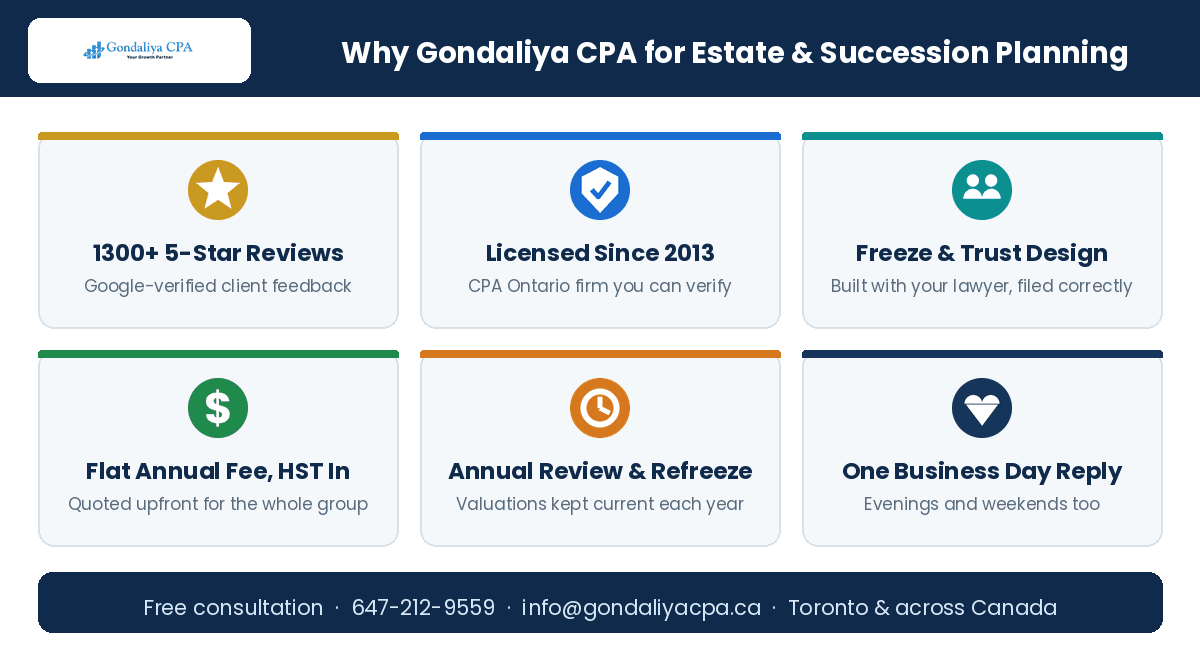
We start with an initial consultation assessing family goals and corporate structure. Then comes a detailed financial and legal document review, followed by customized plan drafting incorporating trusts and share classes. We coordinate with legal advisors for shareholder agreements, provide implementation support including elections and rollovers filings, and carry out ongoing annual reviews ensuring compliance and refreeze updates. Running structures with operating companies plus one or more holding companies adds complexity that needs expert CPA oversight for accurate compliance. Challenges include coordinating legal advice during incorporation changes, doing accurate valuations reflecting market changes affecting frozen versus growth shares, meeting filing deadlines across several entities, ensuring correct election filings such as section 85 rollovers, and aligning trust coordination for beneficiary payouts under changing TOSI rules. These factors add administrative work and extra costs mainly from professional fees covering accounting expertise plus legal advice needed for strong governance frameworks. We charge a flat annual fee, HST included, quoted in writing after a free consultation, so the ongoing cost is clear before you commit.
Estate Planning as a Team-Based Process Involving Professional Advisors and Family Collaboration
Good holding company estate plans need teamwork. CPAs with knowledge in high income tax planning in Canada work together with lawyers drafting shareholder agreements and family members setting clear goals.
Staying ready for CRA audits means documenting transactions like freezes or rollovers well. Open communication reduces disputes during succession while boosting confidence that everything meets legal rules.
Teamwork essentials: CPA expertise on high income tax issues, legal help with shareholder agreements, family involvement in goal setting, and careful records for CRA audit readiness.
A holding company is the container, not the plan. What makes it work for a high-income owner is the combination: deferral while you build, a freeze when the time is right, a trust where the family needs flexibility, purification before a sale, and liquidity for the tax on death. Each piece needs the others.
An owner had a holdco, a trust, and a freeze in place, but a will drafted years earlier that did not deal properly with the new share classes. Updating the will aligned the personal documents with the corporate structure. The plan is only as good as the will behind it. Figures changed for privacy.
Industry Spotlights: Sectors We Represent
Industry Expertise
Long-term holdco and estate planning looks different by sector, usually because of what the business is worth and how it eventually changes hands. Here are ten sectors and where the planning tends to sit.
| Industry | The Long-Term Planning Angle |
|---|---|
| Medical doctors & physician professional corporations | Corporate investing plus an eventual wind-down or transfer |
| Dentists & dental practices | Purification and a freeze ahead of a practice sale |
| Daycare, childcare & CWELCC services | Succession while the licence keeps operating |
| Real estate investors, landlords & holding companies | Property held in the holdco and passed through a trust |
| Property developers & builders | Multiple entities frozen and transferred in sequence |
| Construction, contractors & skilled trades | Protecting retained profit while planning the handover |
| Technology startups & SaaS | A freeze and trust well before an exit |
| E-commerce & online retailers | Sweeping surplus up and structuring for a sale |
| Restaurants & food and beverage | Property and operations separated for succession |
| Transportation, logistics & trucking | Fleet value frozen and liquidity planned for death |
- Medical doctors & physician professional corporations: Incorporated physicians accumulate investments corporately over a career, so protecting the small business deduction and planning how the professional corporation eventually winds down or transfers are the two long-term questions. Specialists certified through the Royal College of Physicians and Surgeons of Canada plan on the same timeline.
- Dentists & dental practices: A practice regulated by the Royal College of Dental Surgeons of Ontario is usually sold at some point, so purification through the holdco and a freeze at the right moment protect both the exemption and the family’s share of the growth.
- Daycare, childcare & CWELCC services: Where an owner has built value in a CWELCC-funded operation, succession has to keep the licence running while the ownership moves, which is exactly what a holdco and trust structure is built to do.
- Real estate investors, landlords & holding companies: Property is the natural holdco asset, and passing it through a trust under the holdco lets the growth accrue to the next generation while the deemed disposition on death is capped by the freeze.
- Property developers & builders: With several project entities, the freeze and the transfer have to be sequenced across all of them, and valuations kept current so the frozen and growth shares stay accurate.
- Construction, general contractors & skilled trades: For electricians, plumbers, and HVAC firms, the holdco protects retained profit from the liability of the work while the succession plan decides who takes over the trading company.
- Technology startups & SaaS: Where value can grow quickly, freezing early into a holdco and trust captures far more growth for the next generation than freezing once an exit is already in sight.
- E-commerce & online retailers: Sweeping surplus up to the holdco protects it from a volatile operating business and keeps the operating company clean enough for the exemption if a sale comes.
- Restaurants & food and beverage: Where property sits alongside the restaurant, separating the two into different corporations makes both the protection and the succession far simpler to execute.
- Transportation, logistics & trucking: Fleet-heavy businesses carry real value and real risk, so freezing the value and arranging liquidity for the tax on death matter as much as the day-to-day tax planning.
A physician’s professional corporation had accumulated a large portfolio with no plan for what happened at retirement or death. A holdco to hold the investments, plus a will that dealt properly with the shares, gave the career’s savings a structure. Incorporated professionals need the estate half, not just the tax half. Figures changed for privacy.
A real estate group held property personally and in the operating company, exposing it to trade risk and complicating succession. Moving the property into a holdco with a family trust simplified both. Property-heavy families gain the most from getting the container right. Figures changed for privacy.
Glossary of Key Terms
Plain-English Definitions
- Holding company (holdco): A corporation that owns shares, investments, or assets rather than running a business.
- Clearance certificate: The CRA document on Form TX19 certifying no outstanding taxes before an asset transfer after death.
- Capital dividend account (CDA): The account allowing tax-free dividend payments from the untaxed portion of capital gains.
- Estate freeze: The technique fixing the current value of shares while future growth passes to heirs.
- Small business deduction (SBD): The tax benefit reducing rates on active business income up to the business limit.
- Tax on Split Income (TOSI): The rules limiting income sprinkling among family members.
- Section 85 rollover: The tax-deferred transfer of assets into a corporation.
- Section 86 reorganization: The share exchange commonly used to carry out an estate freeze.
- Lifetime capital gains exemption (LCGE): The exemption sheltering gains on qualifying small business shares.
- Qualified small business corporation (QSBC): A corporation whose shares meet the tests for the exemption.
- Family trust: A trust holding shares, allowing flexible allocation of income among beneficiaries.
- Prescribed rate loan: A loan at the CRA’s prescribed rate used to split investment income within a family.
- Individual Pension Plan (IPP): A defined benefit pension for high-earning owners, funded by the corporation.
- 21-year rule: The deemed disposition that taxes accrued gains inside a trust every twenty-one years.
- Inter vivos trust: A trust created during your lifetime, often used to hold growth shares in an estate freeze.
- Testamentary trust: A trust created by your will that comes into existence on death.
- Dual wills: An Ontario technique using a primary and secondary will to keep private company shares out of probate.
- Graduated rate estate (GRE): An estate taxed at graduated rates for its first 36 months, enabling post-mortem planning.
Frequently Asked Questions
FAQ
What is a Clearance Certificate (TX19) and why is it important?+
The Clearance Certificate (TX19) confirms all taxes owed are paid before transferring shares after death. It prevents CRA penalties and transfer delays, and it protects the executor from personal liability. The CRA’s service standard for issuing it is 120 calendar days from a complete request.
How do probate fees work in Ontario, and how can they be reduced?+
Ontario’s Estate Administration Tax is nil on the first $50,000 and $15 per $1,000 above that, so a $500,000 estate pays $6,750. Using share redemption or estate freezes within holding companies can lower the value subject to the fees legally.
What happens to a business owner’s shares upon death in Canada?+
Shares face a deemed disposition at fair market value, which can trigger a large capital gain on the final return. Proper planning with holding companies, freezes, and trusts can cap that gain and ensure smoother transfers to the next generation.
How does the Alternative Minimum Tax (AMT) affect holding company estate planning?+
The AMT can increase tax on individuals with large capital gains or donations, and strategic structuring and timing help minimize its impact. Please note graduated rate estates are exempt from the AMT, and the rate is 20.5% for those it does apply to.
What are the main risks in holding company estate planning?+
Risks include CRA audits, misapplication of TOSI rules, breaching the passive income limits, improper share class design, and failing to maintain corporate records. Each is manageable with current valuations, proper documentation, and an annual review.
How much does holding company estate planning cost in Canada?+
Costs vary by complexity but typically include professional fees for tax advice, legal coordination, valuation services, and ongoing compliance support. We quote a flat annual fee, HST included, in writing after a free consultation, with no surprise invoices.
How do I prepare before starting an estate planning review?+
Gather financial statements, corporate documents, wills, shareholder agreements, and any existing trust deeds or previous tax filings. Complete information upfront makes the review faster and the plan more accurate.
What deliverables should I expect from Gondaliya CPA in holding company estate planning?+
Expect a tailored plan including corporate structuring, shareholder agreements coordination, trust coordination, tax deferral strategies, and a succession roadmap, all on a flat annual fee, HST included, quoted in writing after a free consultation.
Essential Concepts in Holding Company Estate Planning
- Shareholder Agreements: Define voting rights, dividend policies, and share transfers to align with family goals.
- Section 85 & 86 Rollovers: Allow tax-deferred transfers of assets into corporations during incorporation or restructuring.
- RDTOH & CDA Usage: Manage refundable dividend taxes and capital dividend accounts for efficient tax-free distributions.
- Probate Fee Reduction: Use share redemption techniques to minimize Ontario probate fees on estate assets.
- Share Class Structuring: Design multiple classes to separate voting power from economic benefits for flexibility.
- Trustee Identification & Coordination: Select trustees carefully; coordinate trusts to comply with CRA’s 21-year rule.
- Annual Review & Refreeze Process: Regularly update valuations and refreeze shares to reflect current business values.
- Shareholder Register & Minute Book Maintenance: Keep accurate records for corporate governance and CRA audit readiness.
- CRA Compliance Controls: Implement processes to monitor passive income thresholds and TOSI rule adherence.
- Family Trust Distribution Planning: Allocate income among beneficiaries strategically to reduce overall family taxes.
- Intercorporate Dividends Flow: Utilize intercompany dividends without immediate taxation under specific conditions.
- Corporate-Owned Life Insurance Usage: Fund estate taxes smoothly while avoiding forced asset sales during succession events.
Who This Is For / Not For
- For: High-income Canadian business owners seeking tax-efficient succession plans, and families aiming at long-term wealth preservation through corporate structures.
- Not For: Businesses without incorporated entities, or those unwilling to engage professionals for complex planning.
How To Choose the Right CPA Firm in Toronto or Ontario
- Look for specialized experience in Canadian corporate tax and estate laws.
- Verify credentials including professional designations like CPA.
- Ask about cross-border expertise if U.S. assets exist.
- Confirm comprehensive service offerings: tax planning, trust coordination, audit defence.
- Evaluate client testimonials and the consultative approach.
People Also Ask
Quick Answers
How does income splitting work within TOSI rules using holding companies?+
Income splitting must meet TOSI exemptions like active involvement in the business or sufficient equity ownership; otherwise dividends may face top marginal tax rates. Share classes and a discretionary family trust give the flexibility, but the underlying facts and documentation are what make an allocation hold.
What is the difference between DIY estate planning and working with a CPA?+
DIY plans risk errors and missed opportunities, particularly around freezes, rollovers, and the exemption. A CPA provides guidance ensuring compliance, optimized tax strategies, and long-term wealth preservation, working alongside your lawyer on the legal documents.
Can Canadian holding companies help with U.S. estate tax exposure?+
High-net-worth Canadians owning U.S. assets face tricky estate tax rules under U.S. law, and a Canadian holdco owning U.S. assets indirectly can add layers between your personal estate and those assets. Cross-border advice covering both CRA and IRS rules is essential here.
Contact Gondaliya CPA at 647-212-9559 or info@gondaliyacpa.ca for advice on holding company estate planning, on a flat fee, HST included, quoted in writing before any work starts. For the mechanics of the structure, see our guide to holding company tax planning strategies, and for what goes wrong, the holdco tax mistakes that cost owners the most.
Build the structure your family wealth will pass through
Gondaliya CPA reviews your corporate structure against your family goals, designs the holdco, freeze, and trust framework with your lawyer, files the elections and rollovers, and reviews it annually, on a flat annual fee, HST included, with a one-business-day response. Please book a free consultation.
Next Steps
For a high-income owner, a holding company is where the long game is played: deferral while you are building, protection throughout, a freeze when the value is right, a trust where the family needs flexibility, purification before any sale, and liquidity for the tax that lands on death. Good holding company estate plans need teamwork, with CPAs working alongside lawyers drafting shareholder agreements and family members setting clear goals, and with careful records kept for CRA audit readiness. Please contact us for a review, gather your statements, corporate documents, wills, and any trust deeds, and let us look at the whole picture before anything is restructured. Contact Gondaliya CPA at 647-212-9559 or info@gondaliyacpa.ca today, anywhere in Toronto, Ontario, or across Canada. If our content helps, please add gondaliyacpa.ca as a preferred source on Google.
Published: July 22, 2026 · Last updated: July 22, 2026
Disclaimer: This article is educational information only and is not tax, legal, or financial advice, and estate planning requires your own lawyer alongside your CPA. It reflects CRA rules current to 2026, including the $500,000 federal small business limit shared among associated corporations, the passive income grind of $5 per $1 above $50,000 eliminating the limit at $150,000, the $1,275,000 lifetime capital gains exemption for 2026 on qualified small business corporation shares, being the $1,250,000 amount confirmed in the November 4, 2025 federal budget indexed from 2026, the one-half capital gains inclusion rate, the 3% prescribed rate for the current quarter, the exemption of graduated rate estates from the alternative minimum tax with a 20.5% rate where it applies, the TX19 clearance certificate with a 120-day service standard, and Ontario’s Estate Administration Tax of nil on the first $50,000 and $15 per $1,000 above. Outcomes depend on your specific facts, and rules change. Please consult a Registered CPA and a lawyer before acting. Fees include HST.

Sharad Gondaliya is a CPA Canada & CPA USA with 15 Years+ experience of Accounting, Tax, Payroll of Corporate Small Businesses as Tax Accountant. He is a CPA Ontario member (61040184) and holds US CPA licences in Washington and Montana and is well known among corporate small businesses for tax planning, efficient tax solutions, and affordable CPA services. Sharad is the Principal (Director) of Gondaliya CPA – Affordable CPA Firm in Canada. Licenses: CPA Ontario: 61040184 | CPA USA (MT): PAC-CPAP-LIC-033176 | CPA USA (WA): 57629 | CPA Firm License: 61330051 View Full Author Bio