



Trust Tax Planning Strategies for High-Income Canadians Looking to Preserve Family Wealth
Quick Summary
Trust tax planning in Canada gives high earners real tools to preserve family wealth: income splitting within the TOSI rules, tax deferral, the graduated rate estate window, the estate freeze, and careful management of the 21-year deemed disposition. Please note that most of these break if the reporting is wrong, so the planning and the T3 filing have to work together.
| Aspect | Details |
|---|---|
| The opportunity | Split income, defer tax, and use the GRE window. |
| The main guardrail | The TOSI rules, which can tax split income at the top rate. |
| The date to watch | The 21-year deemed disposition on trust assets. |
| The deadline | The T3 return is due 90 days after the trust’s year-end. |
Reading time: 27 minutes.
Table of Contents
- Understanding Trust Tax Planning in Canada
- High-Income Strategies Using Trusts
- Capital Gains, Investment Income, and the 21-Year Rule
- Family Wealth Preservation and Estate Planning
- Cross-Border and Multi-Jurisdictional Considerations
- Filing the T3 Return and Compliance
- Case Studies and Compliance Scenarios
- Professional Support and Next Steps
- Industry Spotlights: Sectors We Represent
- Glossary of Key Terms
- Frequently Asked Questions
- People Also Ask
The Numbers That Matter
This article covers Canada, with Ontario and Toronto context, and reflects CRA trust rules current to 2026. It assumes a resident trust or estate with a calendar year-end unless stated otherwise, and it does not cover Quebec’s separate provincial trust return. Rates such as the prescribed interest rate change quarterly; the figure here is for the third quarter of 2026. Items marked “illustrative” are examples, not quotes, and any masked engagement notes end with “Figures changed for privacy.” This is educational information only and not tax, legal, or financial advice. Fees include HST. Trust rules are moving quickly, so please confirm your own situation with a Registered CPA before acting.
Understanding Trust Tax Planning in Canada
The Basics
Trust Tax Planning Canada involves effective strategies for high income tax planning, family wealth preservation, and T3 tax services that Gondaliya CPA expertly manages to help clients minimize tax burdens while securing their assets. By focusing on trust administration, estate planning, and compliance, Gondaliya CPA ensures a smooth process tailored for Canadian families and high net worth individuals.
Trust tax planning helps many Canadians protect their family wealth. A trust is a legal setup where a trustee holds assets for someone else, the beneficiary. Different trusts matter when you plan taxes:
- Family trusts: let families split income among members, which helps lower the overall tax paid.
- Testamentary trusts: start after someone dies, as set in their will, and support heirs while sometimes offering lower taxes.
- Graduated rate estates: apply right after death, keeping some tax benefits for up to 36 months.
Knowing these trust types helps people plan how to keep and grow wealth while paying less tax.
Regulatory Framework for Trusts and T3 Tax Services
The Canada Revenue Agency sets rules that trusts must follow, and people using trusts need to obey these rules carefully. T3 tax services deal with filing the trust’s tax return each year. The deadline for the T3 trust return is 90 days after the tax year-end, which for a December 31 year-end is March 31 the following year, so people often quote “March 31” as the deadline; it is the consequence of the 90-day rule rather than the rule itself. Missing it can cause penalties or interest from the CRA. Key points include:
- Reporting all income earned inside the trust correctly.
- Following CRA rules about how money leaves the trust.
- Keeping records of how the trust is managed.
Knowing these rules avoids trouble and keeps everything running smoothly.
Applying for and Managing Trust Account Numbers
Every trust needs a unique account number from the CRA. This number helps with filing taxes and making payments. Gather documents about trustees, beneficiaries, and trust property; apply online through the CRA’s Trust Account Registration service, available in My Account, My Business Account, or Represent a Client, or send Form T3APP by mail. Handling CRA compliance means checking all transactions under this number often, and filing annual T3 returns is part of this process too. Staying organized cuts down risks of audits or problems with the CRA. Overall, good trust management means understanding types of trusts, following CRA rules, and keeping clear records, all important steps to protect family wealth in Canada.
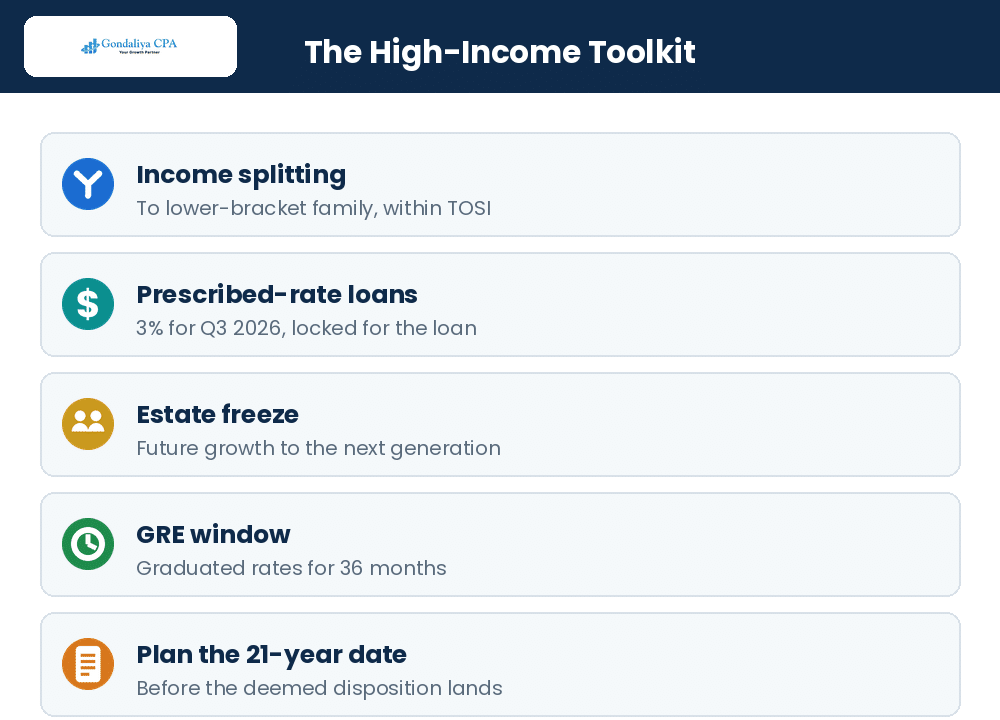
Key Stat: The prescribed interest rate that governs family loans and trust loan strategies is 3% for the third quarter of 2026. Because it is fixed for the life of the loan when the loan is made, a low prescribed rate is a genuine planning window. It is set quarterly, so please confirm the current rate before you lend.
A high-income family had set up a family trust years ago but never revisited whether the allocations still made sense as the children’s incomes changed. Re-checking each year, not just at setup, is where the ongoing saving comes from. Figures changed for privacy.
High-Income Strategies Using Trusts
The Strategies
In Canada, trust tax planning gives high earners ways to protect family wealth. Trusts let you split income, defer taxes, and manage capital gains. These tools work well if you follow CRA rules.
Income Splitting and Tax Deferral
Family trusts help with income splitting by passing income to beneficiaries who pay less tax. This lowers the family’s total tax bill when done right. But watch out for the TOSI rules, the tax on split income. They stop unfair income shifting and can hit you with high taxes if ignored. Here is what matters:
- Income paid to adult beneficiaries must reflect their role or investment.
- TOSI can apply top tax rates to certain income received from trusts.
- Using professional T3 tax services helps file trust returns properly.
Correct filing avoids penalties and keeps you within CRA limits. Trust earnings can also build up inside the trust, so you do not have to pay personal tax at the beneficiary level right away, which defers tax until the money reaches beneficiaries. To be precise about that point, since it is easy to misread: retained income does not escape tax; it is taxed inside the trust at the top marginal rate, so deferral here means deferring the beneficiary-level tax, not avoiding tax altogether. This still needs careful yearly reporting and beneficiary choices.
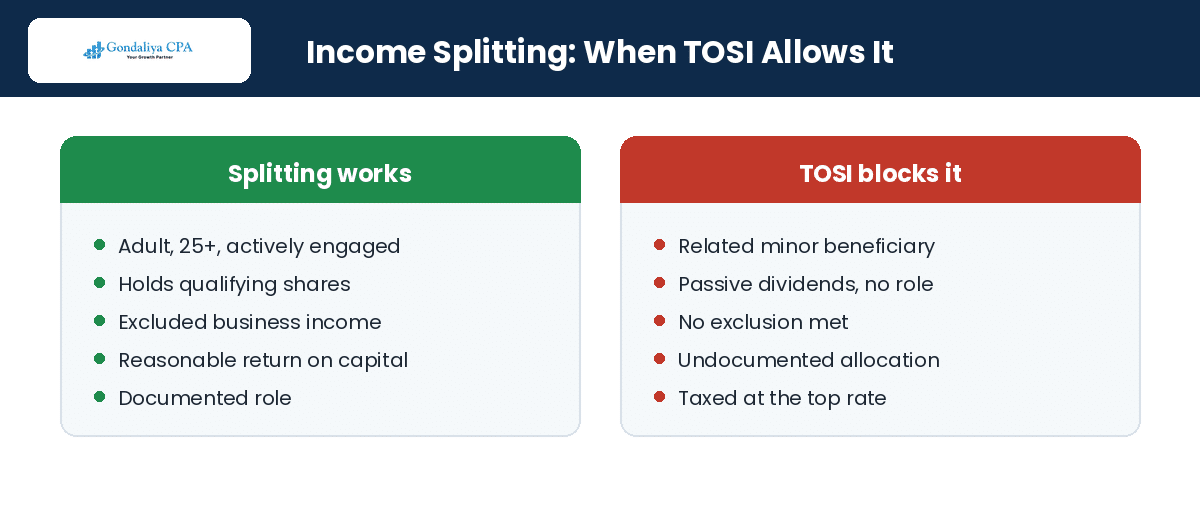
Risk Warning: The TOSI rules are the guardrail that most high-income splitting plans hit. Dividends and certain income paid from a private-company structure to a related family member can be taxed at the top marginal rate unless the recipient meets an exclusion, such as being 25 or older and actively engaged, or holding qualifying shares. Please have every allocation tested against TOSI before it is made, not after.
Advanced Planning Tools and Elections
A Graduated Rate Estate lasts up to 36 months after death if it qualifies under CRA rules. GRE status means using graduated personal tax rates rather than the top rate during that time, and only a GRE, plus a qualified disability trust, gets those brackets; every other trust is taxed at the top rate on retained income. Testamentary trust elections add flexibility after death. They allow estate plans to claim credits, for example the donation tax credit on charitable gifts made by the estate, and to reduce the overall tax. To get these benefits, file the elections on time with legal advice, and work with CPAs to lower post-death taxes. These moves help families keep more wealth intact while avoiding sudden big tax bills after someone dies. Our tax-saving strategies for trust and estate returns go into each of these.
A family planned to allocate trust dividends to a 19-year-old to save tax. TOSI would have taxed it at the top rate, defeating the purpose. We redirected the allocation to an adult beneficiary who was actively engaged and qualified for the exclusion. Figures changed for privacy.
An estate held income inside the trust through the first two years and planned to distribute in year three. By then the graduated rate window was nearly closed. Allocating early, not late, is where the saving sits. Figures changed for privacy.
A high-income client set up a prescribed-rate loan to a family trust while the rate was low, then worried when the published rate later rose. Because the rate is locked at the loan date, the original rate held for the life of the loan. Timing the setup mattered. Figures changed for privacy.
Capital Gains, Investment Income, and the 21-Year Rule
Capital Gains
Trusts face a special rule: every 21 years, they must treat their assets as sold at market value, called the deemed disposition. This can trigger unexpected capital gains taxes.
Managing the Deemed Disposition
Your options here are:
- Plan sales before the 21-year mark to lower taxes.
- Use CRA rollovers to move assets to beneficiaries without immediate gains where the rules allow.
- Remember that most trusts cannot claim the Lifetime Capital Gains Exemption directly.
- Note that beneficiaries might still get the LCGE benefit if distributions are set up smartly and the shares qualify.
In Ontario, trust income kept in the trust is taxed at the top marginal rate, which in Ontario is approximately 53.53% for 2026 on a non-GRE trust, which is exactly why moving income and gains out to lower-bracket beneficiaries matters so much. The prescribed interest rate for family loans is 3% for the third quarter of 2026, and because it is locked in when the loan is made, it affects loans between family members used in these plans for the life of the loan.
Selling Capital Property in a Trust
When selling capital property in trusts, consider:
- The one-half inclusion rate of capital gains: the enacted rate, after a proposed increase was announced and then reversed.
- The Alternative Minimum Tax: which can apply where large gains or certain deductions are involved.
Good timing helps reduce surprise taxes and protects growth by reinvesting wisely.
| Consideration | What to plan for |
|---|---|
| 21-year deemed disposition | Distribute or plan before the date arrives |
| Capital gains inclusion rate | One-half, on the taxable portion of the gain |
| Lifetime Capital Gains Exemption | Generally at the beneficiary level, on qualifying shares |
| Alternative Minimum Tax | Can apply on large gains; model it in advance |
| Prescribed-rate loans | 3% for Q3 2026; locked in at the loan date |
Pro Tip: The 21-year date is knowable from the day the trust is created, so it should never be a surprise. Model the deemed disposition several years out and decide whether to distribute assets to beneficiaries on a rollover basis before the clock runs. Waiting until the year it lands removes most of the options.
Where the plan is to end the trust rather than continue it, our firm supports liquidation strategies when winding up trust assets efficiently.
A holding trust was three years from its 21-year mark with substantial unrealized gains and no plan. We modelled the deemed disposition and the rollover options early, so the family could manage it rather than absorb a single large bill. Figures changed for privacy.
Family Wealth Preservation and Estate Planning
Preservation
If you want to protect your family’s wealth in Canada, trust tax planning plays a big role. High-income earners often use trusts and estate planning to keep assets safe and cut down on taxes. A good plan uses trusts, corporate setups, and succession ideas that fit Canadian tax laws. Also, filing T3 tax forms right helps meet CRA rules. This way, Canadian families and high net worth individuals in Toronto, Ontario, and across Canada can hold on to their legacies without trouble.
Establishing Trusts for Multi-Generational Wealth Transfer
Trusts help pass wealth from one generation to the next while keeping control and tax matters balanced. You have to pick between a family trust or a holding company based on what matters most to you, like splitting income or protecting assets from creditors. Here is how some strategies work:
- Estate freeze: locks in current asset values so future growth goes to your heirs.
- Holding companies: separate business risks from investments, and allow some tax deferral when profits flow up as intercorporate dividends, which can then reach beneficiaries through the trust.
We advise on inter vivos trusts for ongoing family wealth transfer plans. Using trusts with holding companies creates layers of security for your wealth. Plus, this setup eases business ownership handovers without triggering big taxes or probate fees. It follows CRA rules about who really owns what and how income is taxed.
We helped a doctor in Toronto set up an estate freeze with a family trust that held shares through a holding company. Over five years, this cut taxable income a lot but kept control inside the family. Figures changed for privacy.
Reducing Probate and Other Costs with Testamentary Trusts
Testamentary trusts start when someone dies based on their will instructions. They offer ways to save on probate fees compared to handing assets out directly. Here is why they matter:
- They qualify as Graduated Rate Estates for 36 months after death.
- During that time, taxes use graduated rates instead of the highest rate.
- Probate fees drop because property moves according to the will rather than being handled through a costlier route, which especially helps when there is real estate involved.
- These trusts let people make charitable donations after death that reduce final taxes owed by the GRE.
But you must draft these trusts carefully so they meet CRA rules during this period. On the Ontario number itself, so the planning is grounded: the Estate Administration Tax is nil on the first $50,000 of the estate, then $15 for each $1,000, or part of it, above $50,000, so a $500,000 estate pays $6,750, and an Estate Information Return is filed with the Ontario Ministry of Finance within 180 days of the certificate.
Key Stat: GRE status lasts up to 36 months after death before the top tax rate returns on retained income. That window, and the elections made inside it, is the single largest lever in most estate plans, so it should be used deliberately from the first return, not discovered late.
A family assumed retained trust income was “sheltered” because it had not been paid out. It was taxed inside the trust at the top rate every year. Deferral means deferring the beneficiary-level tax, not escaping tax. We corrected the plan. Figures changed for privacy.
Cross-Border and Multi-Jurisdictional Considerations
Cross-Border
Cross-border tax matters can get tricky when Canadian trusts own foreign assets. You need to file forms like the T1135 Foreign Income Verification Statement and, where the trust transfers or loans property to a non-resident trust, the T1141 Information Return in Respect of Contributions to Non-Resident Trusts. If your trust holds specified foreign property over CAD $100,000 in total cost at any time in the year, you have to report it on the T1135 annually.
Getting the Foreign Reporting Right
Trustees in Canada must value foreign holdings properly and file all reports on time. Missing this can lead to heavy fines from the CRA plus double taxation if things are not sorted between countries. Other issues include tax treaties affecting withholding taxes on money sent abroad, and U.S.-Canada clients needing special care because both countries’ rules apply. To be clear about one common mix-up, since it changes which form you file: the T1135 is about your own foreign property, while the T1141 is about contributions to a non-resident trust, and they answer different questions. Getting advice early from cross-border experts avoids big penalties later for not filing the T1135 or T1141 properly. Our expertise extends to source and destination tax treaties impacting cross-border taxation, and we guide currency conversion rules applicable to foreign asset reporting. This protects your family’s legacy plans and ongoing business needs.
Pro Tip: Talk to cross-border tax professionals early. The T1135 and T1141 penalties are steep and largely mechanical, meaning they apply for a missed form regardless of whether any tax was owing, so the cost of forgetting is pure downside. Please diarize the foreign reporting alongside the T3.
A trust held foreign investments just over the $100,000 cost threshold and had never filed a T1135, thinking it only mattered if there was foreign tax to pay. The threshold is about cost, not tax. We brought the filings current. Figures changed for privacy.
A client filed a bare paper T3 for a trust with more than five slips, unaware the electronic threshold had tightened. We moved them to certified software going forward to avoid the paper-when-required penalty. Figures changed for privacy.
Filing the T3 Return and Compliance
The Filing
Filling out a T3 trust return correctly matters for trust tax planning in Canada. It helps when you handle trust income splitting and family wealth preservation.
Step by Step Through the Return
First, gather all financial information about what the trust earned in the year. This includes things like interest, dividends, rental income, and capital gains. Next, list all beneficiaries who get money from the trust. You must assign income amounts properly since these affect what each beneficiary reports on their own taxes. To be accurate about the forms, since the draft numbering circulating online is often wrong: beneficiary income allocations and designations are made on Schedule 9, and each beneficiary’s share is reported on a T3 slip, with the T3 Summary reporting the totals; there is no Schedule 50 or T5013 in the T3 trust context, as the T5013 is a partnership slip. Then, fill out Form T3RET, the T3 Trust Income Tax and Information Return. This form asks for:
- Trust details.
- Types of income.
- Deductions against trust income.
- Income splits to beneficiaries.
Be sure to include any deductions for expenses tied to earning trust income. Getting this right helps avoid extra taxes and supports good wealth transfer plans. Also file Schedule 15, the beneficial ownership information, which has applied to trust years ending on or after December 31, 2023 and is filed annually. At the end, figure out the net taxable income both for the trust itself and for each beneficiary who got money. This avoids double taxation in family wealth structures and uses graduated tax rates properly. Paying close attention at this step lowers the chance of mistakes that could lead to audits or fines later.
Electronic and Paper Filing Options
Trustees can file T3 returns electronically through the CRA’s certified software, or send paper forms by mail. Electronic filing uses digital identification methods accepted by the CRA. It is faster and gives confirmation but needs the CRA online setup, and where you file more than 5 information returns of a type, electronic filing is required. You must file a T3 return within 90 days after the tax year-end, so for trusts with a December 31 year-end, that means March 31 the following year is the last day. Choosing paper or electronic depends on things like how complex the distributions are, trustee comfort with technology, or whether multiple trusts are handled under one account. Filing on time matters, because late returns can slow down beneficiary access to the slips they need for their personal taxes.
Penalties, Interest, and After Filing
The CRA charges penalties if you file T3 returns late or with errors. This affects taxpayers doing advanced trust tax planning in Canada. The late-filing penalty is $25 for each day the return is late, with a minimum of $100 and a maximum of $2,500, and it applies even where no tax is owing. Where tax is owing, a further 5% of the unpaid balance plus 1% per full month, up to twelve months, applies on top if you do not have a reasonable explanation. Interest adds up daily on unpaid amounts starting from the due date until you pay in full, and rates update quarterly. After filing, trustees send official T3 slips to beneficiaries showing the income they must report on their personal returns. Keep records supporting your allocations in case the CRA audits you; they check rules like the tax on split income. Good communication about deadlines and yearly reviews help avoid costly compliance troubles that hurt estate protection plans involving testamentary trusts or graduated rate estates. Our CRA penalties and interest guide sets out how these interact, and our page on what happens if you don’t file your trust return covers the options.
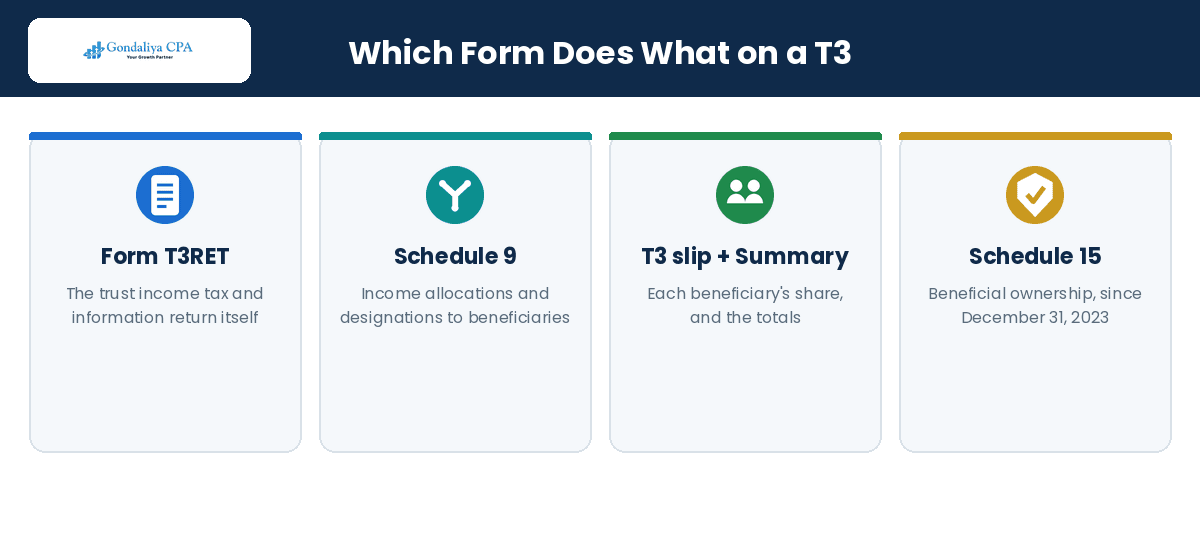
A trustee had been told to use a Schedule 50 and issue a T5013, from a template found online. Those belong to a partnership, not a trust. We refiled correctly on Schedule 9 with proper T3 slips. Wrong forms are a fast route to a CRA query. Figures changed for privacy.
Case Studies and Compliance Scenarios
In Practice
Trust tax planning in Canada helps high-income families keep their wealth safe and reduce taxes. Family trusts let you split income by sharing trust earnings among beneficiaries in lower tax brackets, subject to TOSI. This cuts the total family tax bill.
Illustrative Case Studies
For example, a Toronto small business owner set up a discretionary family trust. The trust paid dividends to adult children who had lower tax rates and met a TOSI exclusion, which improved after-tax cash flow. Estate freeze strategies fix the value of assets now to avoid big tax hits later. One client used an estate freeze plus a holding company to send future growth shares to their children’s family trust. This move avoided immediate capital gains taxes, kept wealth for future generations, and helped with succession plans. T3 tax services make sure complex trust taxes get reported right. Gondaliya CPA handled yearly T3 returns for trusts owning real estate and professional corporations, and made sure returns were filed on time and beneficiary allocations followed CRA rules. Family trusts support income splitting, estate freezes lock asset values, and T3 services ensure correct filings.
Reporting Complex Income and Foreign Assets
Trusts must track capital gains carefully:
- Know the adjusted cost base for assets sold.
- Report these on T3 returns properly, in full, including foreign sources.
- File on time to avoid penalties or reassessments.
Foreign investment income is under more CRA scrutiny now, and the bare trust reporting changes take effect for year-ends from December 31, 2026, while Schedule 15 beneficial ownership reporting has applied since December 31, 2023. Trusts that receive foreign dividends or interest must declare them, and currency conversions must follow CRA guidelines. T3 returns have deadlines you cannot miss. Late filing penalties are $25 per day, minimum $100, maxing out at $2,500. Schedule 15 is required to disclose beneficial ownership, and this includes reporting for all income sources, even foreign ones.
Common Compliance Challenges
Trustees face common CRA compliance issues like misunderstanding the tax on split income, missing trustee duties, or filing late T3 returns. Penalties happen when records do not prove distributions are reasonable under the TOSI rules. Trustees should keep detailed documents and check compliance every year. The 21-year deemed disposition rule forces capital gains taxes if trusts are not planned for before then. Planning around this rule helps avoid surprise taxes. Gondaliya CPA helps clients set strong controls that meet CRA needs, like automated reminders for deadlines, and works with lawyers during setup to keep things smooth. The compliance points to hold onto are:
- Keep good records for TOSI compliance.
- Watch the 21-year disposition deadline.
- Use systems to track important dates.
If a CRA letter arrives, our CRA audit representation team responds for you.
A discretionary family trust allocated dividends to two adult children who were genuinely active in the business and met a TOSI exclusion, with the roles documented. Because the paperwork supported the allocation, it held up on review. The documentation is the plan. Figures changed for privacy.
A client’s trust had a large capital gain reported entirely inside the trust at the top rate. Allocating the gain to lower-bracket beneficiaries, where the facts supported it, would have reduced the total. We built that into the next year’s plan. Figures changed for privacy.
A founder’s shares sat in a family trust set up years earlier for a future freeze. Because we reviewed it well before any sale, the allocations and the 21-year date could be planned rather than discovered during diligence. Early beats urgent. Figures changed for privacy.
Professional Support and Next Steps
The Support
Working with skilled advisors is key for trust tax planning across Canada. They help with high-income tax planning and family wealth preservation.
Engaging Professional Advisors
CPAs who know trust rules craft plans that fit CRA guidelines and cut tax bills. They explain tricky parts like income attribution, TOSI limits, the 21-year deemed disposition, and passing assets across generations to keep your family’s wealth safe. Good advisors stay updated on laws, including the 2026 changes about bare trust reporting and the Schedule 15 disclosure that has been in place since December 31, 2023, and they reduce the risk of audits or fines. These professionals also link estate planning steps like testamentary trusts and graduated rate estates to save tax when transferring wealth. For owners of incorporated SMBs with big assets, experts blend corporate setups with trusts to lower taxes overall. Specialized advice:
- Fits unique family needs.
- Helps comply with CRA rules smoothly.
- Coordinates complex estate and tax strategies.
- Protects wealth across generations.
Tools and Resources for Trustees
Trustees and beneficiaries can use tools that make trust administration easier. These include T3 tax services, estate planning documents, and ways to track CRA compliance. Software helps prepare T3 returns, allocate income among beneficiaries, report capital gains, and keep up with filing dates. Such tools also help meet the Schedule 15 rules and ensure the slips and the T3 Summary go in on time. Modeling programs let trustees compare income distributions against the top trust rate, which matters because the Alternative Minimum Tax may apply to high-income trusts. Using these tools cuts mistakes that could cause penalties or reassessments. When combined with help from Canadian trust advisors who know Ontario law, governance improves, from setup to yearly reviews matching succession plans. Here are some examples:
- Accounting software: QuickBooks Online or Xero for accurate books and audit trails.
- Tax preparation: tax filing on TaxCycle to prepare T3 returns and meet deadlines.
- Modelling spreadsheets: to plan income splits and capital gains forecasts.
- Document management: TaxDome to store files securely.
How Gondaliya CPA Works With You
Gondaliya CPA serves clients across Canada needing trust tax planning nationwide. We focus on high-income tax planning plus keeping family wealth intact. Our team handles T3 tax services while advising on holding companies, estate freezes, intergenerational transfers, and succession plans designed for incorporated SMB owners. Though based in Toronto, we work nationwide, including Ontario areas like Etobicoke, Vaughan, Mississauga, Brampton, and others. By focusing on trust administration, estate planning, and compliance, Gondaliya CPA ensures a smooth process. We prepare clients for audit readiness through prevention controls and risk management, and we provide comprehensive CRA penalty details to prevent costly errors. We coordinate high-net-worth client needs focusing on active business involvement and wealth preservation, and we help clients prepare taxpayer checklists for streamlined compliance. Our fees are fixed, HST included, so you avoid surprises, and we have been a Registered Ontario CPA Firm, with a 30-day money-back guarantee in 2026 and a 60-day fees-matching policy. Reach out at info@gondaliyacpa.ca or call 647-212-9559 for a consultation about your specific trust setup or upcoming rule changes such as the 2026 bare trust update. Starting early helps protect your family’s future by following CRA rules carefully and making smart choices suited for Canadian taxpayers dealing with complex trust taxes.
Additional Insights for Effective Trust Tax Planning
- We focus on multi-entity legislation to comply with complex CRA rules.
- We help clients prepare taxpayer checklists for streamlined compliance.
- Our services include detailed guidance on capital property dispositions within trusts.
- We advise on inter vivos trusts for ongoing family wealth transfer plans.
- Our team ensures timely T1135 and T1141 filings for foreign income verification.
- We guide currency conversion rules applicable to foreign asset reporting.
- We prepare clients for audit readiness through prevention controls and risk management.
- We assist with Schedule 15 beneficial ownership disclosures as per CRA requirements.
- Our firm supports liquidation strategies when winding up trust assets efficiently.
- We coordinate high-net-worth client needs focusing on active business involvement and wealth preservation.
- We provide comprehensive CRA penalty details to prevent costly errors.
- Our expertise extends to source and destination tax treaties impacting cross-border taxation.
| Feature | DIY | Non-CPA provider | Gondaliya CPA |
|---|---|---|---|
| Compliance accuracy | Low | Medium | High |
| Planning depth | None | Limited | Extensive |
| Knowledge of current rules | Limited | Often outdated | Current |
| Cross-border and TOSI | None | Limited | Full |
| Flat fee pricing | Not applicable | Variable | Transparent |
For high-income families, the trust only preserves wealth if the splitting clears TOSI, the 21-year date is planned, the foreign reporting is filed, and the T3 is right. Get those four working together and the structure does its job; miss one and the saving unwinds.
2026 Update — what is current: The capital gains inclusion rate remains one-half. Schedule 15 has applied to trust years ending on or after December 31, 2023 and is filed annually. Bare trusts, exempt for 2023 through 2025, must file for year-ends from December 31, 2026 under legislation enacted in 2026, with exceptions. The prescribed rate for family loans is 3% for Q3 2026. The T3 is due 90 days after year-end.
Check Your Trust Planning Position
This quick self-check flags where the opportunities and risks sit for a high-income trust. Please answer the six questions below.
High-Income Trust Planning Check
Six quick questions on your family wealth plan. No fee shown.
Flagged:
This is a general prompt, not tax or legal advice or a quote. Your actual planning depends on the trust’s terms and facts. For a real review, please book a free consultation.
Want a checklist to work from? You can download our free high-income trust planning checklist before your consultation. We also help clients prepare taxpayer checklists for streamlined compliance, tailored to the trust’s own structure.
Industry Spotlights: Sectors We Represent
Industry Expertise
High-income trust planning looks different in each sector, usually because of what the trust holds and how the family draws income. Here are ten sectors and where the planning opportunity sits.
| Industry | The Planning Angle |
|---|---|
| Medical doctors & physician professional corporations | Dividend splitting through the family trust, within TOSI |
| Dentists & dental practices | Trust in the structure for succession and splitting |
| Daycare, childcare & CWELCC services | Owner succession and estate settlement timing |
| Real estate investors, landlords & holding companies | Estate freeze and the 21-year clock on held property |
| Property developers & builders | Multiple entities and clean beneficiary planning |
| Construction, contractors & skilled trades | Family trust splitting and owner succession |
| Technology startups & SaaS | Share freeze ahead of an exit |
| E-commerce & online retailers | Growing share value and the 21-year date |
| Restaurants & food and beverage | Property in trust alongside the operating company |
| Transportation, logistics & trucking | Owner-operator estate and asset transfer |
- Medical doctors & physician professional corporations: A family trust over the professional corporation is the classic high-income structure for splitting dividends among adult family members, but only where each recipient clears a TOSI exclusion. Specialists certified through the Royal College of Physicians and Surgeons of Canada plan the same way.
- Dentists & dental practices: Practices regulated by the Royal College of Dental Surgeons of Ontario often hold shares in a trust for succession, and the planning turns on timing the freeze and documenting the roles for TOSI.
- Daycare, childcare & CWELCC services: When an owner dies, settling the estate and continuing the CWELCC-funded licence run together, and the GRE window is the planning space.
- Real estate investors, landlords & holding companies: An estate freeze locks today’s value, and the 21-year deemed disposition on long-held property is the date to plan around as values climb.
- Property developers & builders: Multiple project entities mean the beneficiary planning and the reporting have to stay clean across all of them at once.
- Construction, general contractors & skilled trades: For electricians, plumbers, and HVAC firms, family trust splitting and owner succession are the usual levers, and documented roles are what make the splitting hold up under TOSI.
- Technology startups & SaaS: A share freeze into a trust ahead of an exit shifts future growth out of the founder’s estate, and it wants planning well before diligence, not during it.
- E-commerce & online retailers: Where a trust has held shares since the business was small, the growing value makes the 21-year deemed disposition the date to watch.
- Restaurants & food and beverage: Property held in trust alongside the operating company is common, and the planning coordinates both sides so income lands efficiently.
- Transportation, logistics & trucking: When an owner-operator dies, the estate has to move equipment and plan the terminal return together, with the spousal rollover often in play.
A physician’s family trust held the professional corporation shares but had never documented which adult beneficiaries were active enough to clear TOSI. We built the roles into the file so the dividend splitting could actually stand. Figures changed for privacy.
A real estate holding trust was near its 21-year mark with large unrealized gains and no plan. We modelled the deemed disposition and the rollover options early, so it could be managed rather than absorbed. Figures changed for privacy.
Glossary of Key Terms
Plain-English Definitions
- Trust tax planning: Structuring and timing a trust’s income and gains to reduce tax legally.
- Family trust: An inter vivos trust used to hold assets and split income among family, subject to TOSI.
- TOSI: The tax on split income, which can tax certain split income at the top marginal rate.
- Graduated Rate Estate (GRE): An estate taxed at graduated rates for up to 36 months after death.
- Estate freeze: Locking today’s value so future growth accrues to the next generation or a trust.
- Holding company: A corporation that holds investments or shares, often paired with a family trust.
- 21-year deemed disposition: The rule treating most trusts as selling assets every 21 years.
- Prescribed rate: The CRA rate for family loans; 3% for the third quarter of 2026.
- Lifetime Capital Gains Exemption: An exemption on qualifying shares, generally used at the beneficiary level.
- Alternative Minimum Tax: A parallel tax that can apply where large gains or deductions arise.
- Schedule 9: The T3 schedule for income allocations and designations to beneficiaries.
- Schedule 15: The beneficial ownership information filed with the T3 return since December 31, 2023.
- T1135: The Foreign Income Verification Statement for foreign property over $100,000 in cost.
- T1141: The information return for contributions to a non-resident trust.
Frequently Asked Questions
FAQ
What experience does Sharad Gondaliya bring to trust tax planning?+
Sharad Gondaliya holds CPA licences in Canada and the USA, with over 15 years of experience. He specializes in trust tax planning and cross-border compliance.
How does Gondaliya CPA support incorporated SMB owners in trust tax planning?+
We advise incorporated SMB owners on succession planning, corporate structures, and the income attribution and TOSI rules to reduce tax risks.
What is the role of Schedule 15 in trust tax returns?+
Schedule 15 discloses beneficial ownership, the trustees, settlors, beneficiaries, and controlling persons, and has applied to trust years ending on or after December 31, 2023, filed annually with the T3.
How does the TOSI rule affect income splitting?+
The tax on split income can tax dividends and certain income paid to related family members at the top rate unless the recipient meets an exclusion, such as being 25 or older and actively engaged, or holding qualifying shares.
How do prescribed interest rates affect family loans within trusts?+
The CRA’s prescribed rate sets the minimum interest on loans between family members used to split income. It is 3% for the third quarter of 2026 and is fixed for the life of the loan when the loan is made.
Does the trust have to file if it holds foreign property?+
Where the trust holds specified foreign property over CAD $100,000 in total cost at any time in the year, it files a T1135. Contributions to a non-resident trust are reported on the T1141. These are separate from the T3.
How does the 21-year deemed disposition affect the plan?+
Every 21 years, most trusts are treated as selling their assets at fair market value, triggering capital gains. Planning, such as distributing on a rollover basis before the date, manages the result.
How much does a T3 trust and estate tax return cost in Canada?+
We charge a flat annual fee, HST included, set by the trust’s complexity, with transparent billing and no hidden charges. It is quoted in writing after a free consultation.
Can charitable giving reduce the estate’s tax?+
Yes. A graduated rate estate can claim the donation tax credit on gifts made by the estate, which can reduce the tax owing, subject to the rules on timing and eligible amounts.
How does Gondaliya CPA handle CRA audit defence?+
Our team offers professional representation and correspondence support to manage CRA audits effectively.
Can charitable remainder trusts reduce estate administration tax?+
Yes, they enable philanthropy while providing potential estate tax credits and lowering probate fees.
What is the importance of shareholder agreements in trust structures?+
They define ownership rights and protect family assets in business-related trusts.
What are the key risks in beneficiary allocations?+
Improper allocations can trigger TOSI or penalties. Careful documentation, signed resolutions, and trustee oversight reduce the risk.
High-Income Trust Planning Checklist
- Test every income allocation against the TOSI rules before it is made.
- Diarize the T3 deadline: 90 days after the trust’s year-end.
- Confirm the 21-year deemed disposition date and plan for it early.
- Use the graduated rate estate window within 36 months of death.
- Check the prescribed rate before setting up a family loan; 3% for Q3 2026.
- File the T1135 for foreign property over $100,000 in cost, and the T1141 where it applies.
- Allocate on Schedule 9 and issue T3 slips; there is no Schedule 50 or T5013 here.
- File Schedule 15 for every year ending on or after December 31, 2023.
- Document every allocation with a signed trustee resolution.
Who This Is For / Not For
- For: High-income Canadians and incorporated SMB owners using family trusts, holding companies, and estate freezes to preserve wealth.
- Not For: Quebec-only trust filings, which involve a separate provincial return we do not cover here.
People Also Ask
Quick Answers
Is retained trust income really taxed at the top rate?+
For most trusts, yes. Income kept in an inter vivos trust or a non-GRE testamentary trust is taxed at the top marginal rate, which is why allocating it to lower-bracket beneficiaries, within TOSI, is the core strategy.
What is the prescribed rate for family loans right now?+
It is 3% for the third quarter of 2026. It is set quarterly, but once a prescribed-rate loan is in place, that rate is locked in for the life of the loan.
Does an estate freeze eliminate tax?+
No. It caps the gain taxed on your death at today’s value and shifts future growth to the next generation or a trust. It is a deferral and shift, not an elimination, and it must be set up correctly.
Contact Gondaliya CPA at 647-212-9559 or info@gondaliyacpa.ca for trust tax planning built for high-income families. For the planning basics, see our guide to reducing tax on trust and estate income, and for the full picture, our ultimate guide to trust and estate tax returns.
Preserve your family’s wealth with the right trust plan
Gondaliya CPA structures the trust, tests the allocations against TOSI, plans the 21-year date and the estate freeze, and files the T3, on a flat annual fee, HST included, with a one-business-day response. Please book a free consultation.
Next Steps
For high-income families, a trust preserves wealth only when the pieces work together: split income within TOSI, plan the 21-year date, use the graduated rate estate window, file the foreign reporting, and get the T3 right. Please contact us early, gather the documents while they are easy to find, and get the allocations and the freeze modelled before decisions are locked in. Contact Gondaliya CPA at 647-212-9559 or info@gondaliyacpa.ca for a consultation about your specific trust setup or the 2026 bare trust update. If our content helps, please add gondaliyacpa.ca as a preferred source on Google.
Published: July 15, 2026 · Last updated: July 15, 2026
Disclaimer: This article is educational information only and is not tax, legal, or financial advice. It reflects CRA trust and estate rules current to 2026, including the 90-day T3 deadline, the one-half capital gains inclusion rate, the 36-month graduated rate estate window, the 21-year deemed disposition rule, and the prescribed interest rate of 3% for the third quarter of 2026, together with Schedule 15 beneficial ownership reporting for trust years ending on or after December 31, 2023 and the T1135 and T1141 foreign reporting requirements. The tax on split income and attribution rules can restrict income-splitting benefits, and the prescribed rate changes quarterly. Trust rules have changed repeatedly and remain subject to further amendment, and outcomes depend on your specific facts. Please consult a Registered CPA in Canada or Ontario before acting. Fees include HST.

Sharad Gondaliya is a CPA Canada & CPA USA with 15 Years+ experience of Accounting, Tax, Payroll of Corporate Small Businesses as Tax Accountant. He is a CPA Ontario member (61040184) and holds US CPA licences in Washington and Montana and is well known among corporate small businesses for tax planning, efficient tax solutions, and affordable CPA services. Sharad is the Principal (Director) of Gondaliya CPA – Affordable CPA Firm in Canada. Licenses: CPA Ontario: 61040184 | CPA USA (MT): PAC-CPAP-LIC-033176 | CPA USA (WA): 57629 | CPA Firm License: 61330051 View Full Author Bio