



How to Reduce Taxes on Trust and Estate Income Through Effective T3 Tax Planning Strategies
Quick Summary
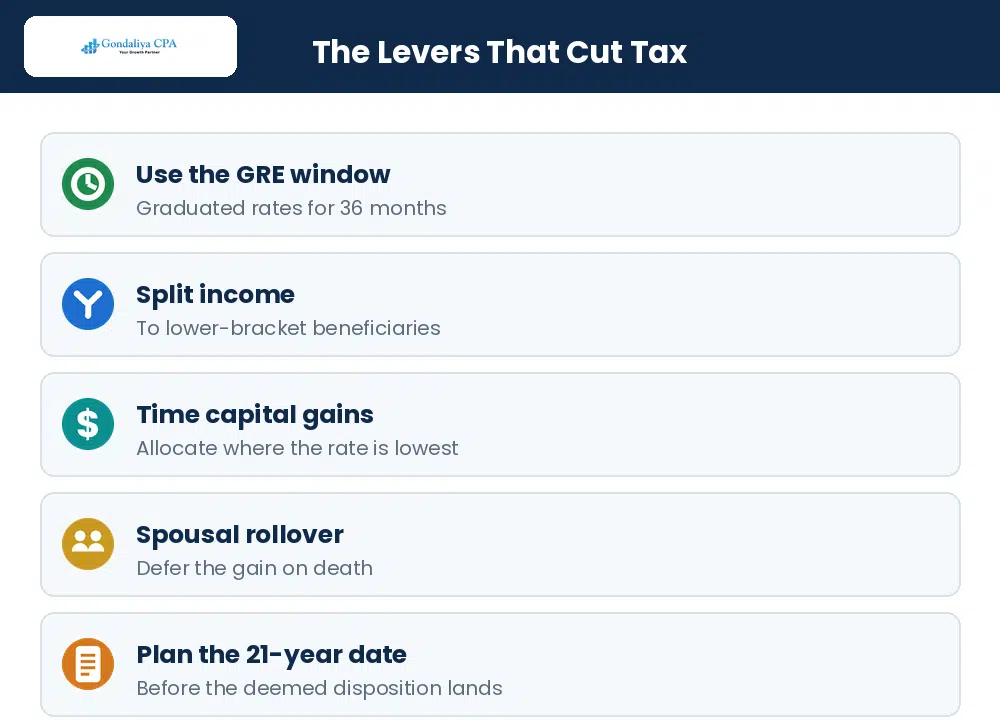
Effective trust tax planning in Canada uses trust income distribution planning and family trust tax strategies to lower overall tax liabilities. The biggest levers are the 36-month graduated rate estate window, allocating income to beneficiaries in lower brackets, timing capital gains, and the spousal rollover on death. Please note the retained income of most trusts is taxed at the top rate, so moving income out to the right beneficiary is usually the whole point.
| Aspect | Details |
|---|---|
| The core idea | Move income to beneficiaries who pay a lower rate. |
| The window | The graduated rate estate: 36 months after death. |
| The trap | Retained income in most trusts is taxed at the top rate. |
| The deadline | The T3 return is due 90 days after the trust’s year-end. |
Reading time: 26 minutes.
Table of Contents
- Overview of Trust and Estate Tax Planning
- Canadian Trust Tax Rules and T3 Filing Requirements
- Tax Planning for Different Types of Trusts
- Strategies to Minimize Trust and Estate Taxes
- Income Distribution and Beneficiary Optimization
- Executor Planning and Efficient Estate Settlement
- Probate and Estate Administration Tax Savings
- Professional Support and Choosing a Firm
- Industry Spotlights: Sectors We Represent
- Glossary of Key Terms
- Frequently Asked Questions
- People Also Ask
The Levers That Move Tax
This article covers Canada, with Ontario and Toronto context, and reflects CRA trust rules current to 2026. It assumes a resident trust or estate with a calendar year-end unless stated otherwise, and it does not cover Quebec’s separate provincial trust return. Items marked “illustrative” are examples, not quotes, and any masked engagement notes end with “Figures changed for privacy.” This is educational information only and not tax, legal, or financial advice. Fees include HST. Trust rules are moving quickly, so please confirm your own situation with a Registered CPA before acting.
Overview of Trust and Estate Tax Planning
The Basics
Trust and estate tax planning in Canada helps manage money when you pass it on. Good trust tax planning lowers taxes on income from trusts. Estate tax planning aims to cut taxes after someone dies. Using smart trust income tax strategies can make sure your beneficiaries get more from your estate.
What Are Trusts and Estates?
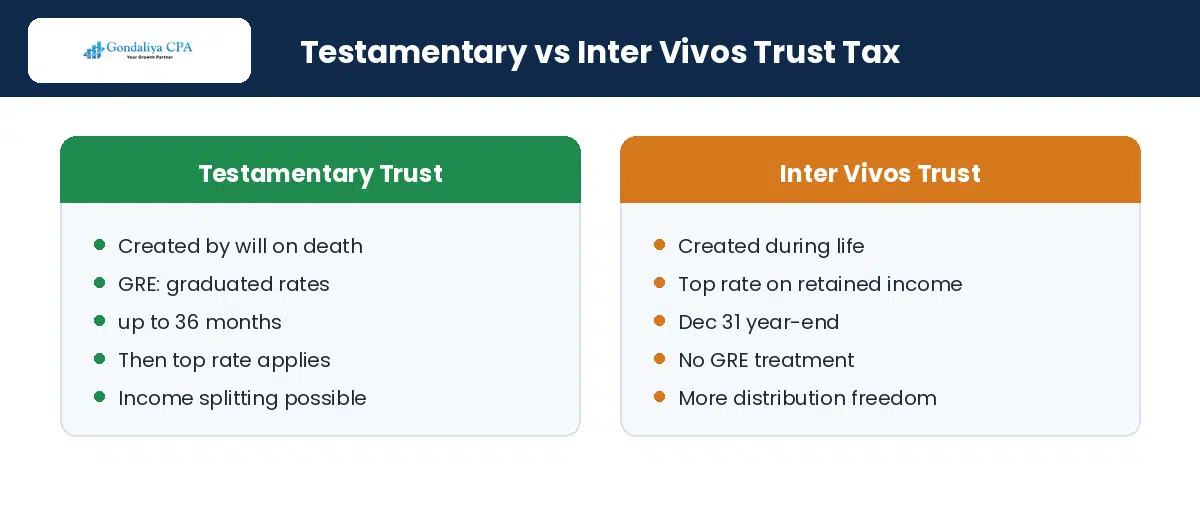
In Canada, a trust means one person holds assets for another’s benefit. There are two main kinds: testamentary trusts start when someone dies, as the will says; inter vivos trusts are set up while a person is alive. A testamentary trust might have some tax benefits compared to inter vivos trusts, but only where the estate qualifies as a graduated rate estate during its 36-month window; outside that window a testamentary trust is taxed at the top rate like other trusts. You have to file a T3 tax return to report income made by these trusts or estates. Knowing the differences helps people decide how to handle their assets best.
Why Tax Planning Is Essential
Tax planning keeps you in line with CRA rules and helps avoid paying too much tax. People often make mistakes like missing some income sources, not understanding how to share income, and forgetting T3 return deadlines. Smart tax-saving strategies reduce trust and estate income tax bills. For example, using capital gains exemptions or donating to charities can save money and increase what goes to heirs.
How Planning Protects Beneficiaries
Good beneficiary tax planning stops delays or problems with inheritances. Techniques like income splitting let families spread taxable income across members with lower rates. A solid plan looks at things like when assets get shared, how they are split, and which deductions apply. Getting help from a CPA who knows this stuff gives confidence and suits your situation well. This simple intro prepares you for deeper talks about trust taxes later in this guide.
Key Stat: The capital gains inclusion rate remains one-half. A proposed increase was announced and then reversed, so any plan built on the higher rate that never took effect should be revisited. The exemptions and allocations below all work off the one-half rate.
A family let income accumulate inside a trust for years because no one had explained that retained income is taxed at the top rate. Redirecting it to two lower-bracket beneficiaries changed the household tax meaningfully, with nothing exotic involved. Figures changed for privacy.
A client believed a testamentary trust always got graduated rates. Its GRE window had closed years earlier, so it had been paying the top rate throughout. Re-checking classification each year is not optional. Figures changed for privacy.
Canadian Trust Tax Rules and T3 Filing Requirements
The Rules
Canadian trust tax rules set how trusts report and pay tax on income they earn. Trustees must file a T3 tax return every year to show this income. Using smart trust income tax strategies means knowing the rules well. Trustees have duties like filling out CRA forms, including the T3 return and Schedule 15. They need to report things like capital gains, dividends, rental income, and distributions to beneficiaries correctly.
The T3 Trust Income Tax and Information Return
The T3 tax return is a key form for any trust making money in a year. It shows all trust income sources, such as capital gains from selling assets, dividends from investments, and rental income from properties. This return also includes forms like Schedule 15. To be precise about that schedule, since it is often described loosely: Schedule 15 reports the beneficial ownership of the trust, meaning the trustees, settlors, beneficiaries, and controlling persons, and it has applied to trust years ending on or after December 31, 2023. Trustees can use strategies to allocate some income directly to beneficiaries. This helps reduce total taxes since beneficiaries might pay less tax on that income. The type of trust matters here: testamentary trusts happen after someone dies; inter vivos trusts are created while someone is alive. Each type reports income differently on the T3.
Who Must File a T3 Return and When
A trustee has to file a T3 return if the trust earned taxable income or made capital gains during the year, and under the enhanced rules most express trusts now file even where there was no income. Here are the main cases: getting interest, dividends, or rent; making capital gains by selling assets; paying out money to beneficiaries; and creating or running testamentary trusts after death. Bare trusts holding property were not required to file for the 2023, 2024, and 2025 tax years, but legislation enacted in 2026 requires certain bare trusts to file for year-ends from December 31, 2026, with exceptions, so a bare trust arrangement should be reviewed now.
| Trigger event | Filing requirement |
|---|---|
| Any taxable investment or rental income | Must file yearly |
| Capital gain realization | Include in the current year’s return |
| Distribution payments | Report with allocation slips |
| New testamentary trust or estate | File for its tax years |
CRA Deadline: The T3 return is due 90 days after the trust’s fiscal year-end. For a December 31 year-end, that is March 31. The slips and any balance owing are due the same day. Please diarize the date the moment the trust exists.
The T3 Filing Deadline and Responsibilities
The CRA requires trustees to submit T3 returns on time with all related slips for beneficiaries. Missing deadlines leads to fines, starting at $25 daily up to $2,500 per late return. To state the penalty in full: it is $25 for each day the return is late, with a minimum of $100 and a maximum of $2,500, and it applies even where no tax is owing. Trustees must keep good records for each year. This includes notes on capital gains, dividend papers, and plans for distributing money following the trust deed or will plus Canadian laws. Here is what trustees need to do: prepare returns promptly using trusted software like TaxCycle; send official slips to beneficiaries before deadlines; and check CRA rules every year since laws can change, for example the 2026 legislation bringing certain bare trusts into filing. Failing these duties risks audits and extra taxes on the estate later on. Our page on when the T3 trust return is due covers the timing, and what happens if you don’t file your trust return covers the consequences.
A trustee assumed the T3 followed the April personal deadline and filed late, with the daily penalty already running. The 90-day rule catches people who assume it matches the T1. We now diarize the date at the first meeting. Figures changed for privacy.
A trustee kept an inter vivos trust’s income inside the trust to “keep it simple,” unaware it was taxed at the top rate every year. Distributing to lower-bracket beneficiaries was the simpler answer all along. Figures changed for privacy.
Tax Planning for Different Types of Trusts
By Trust Type
If you’re looking at trust tax planning in Canada, you need to know how different trusts work with taxes. Estate tax planning isn’t one-size-fits-all. Each trust type has its own rules and strategies. You have to match these strategies to what the trust is for and who benefits. Here, we explain key points about testamentary trusts, inter vivos trusts, and family trusts so you can plan smarter and keep more after-tax income.
Testamentary Trust Planning
A testamentary trust pops up when someone dies and their will creates it. Where the estate qualifies, it gets a special tax treatment called the graduated rate estate (GRE). That means it pays taxes like a person would, with rates going up gradually instead of jumping to the highest rate right away, but this only lasts for 36 months after death or until everything is paid out, and only the GRE (and a qualified disability trust) get the brackets. Because of this GRE rule, you can do some estate tax planning. For example, spreading income among beneficiaries through careful payouts can lower overall taxes. You might also use estate freeze techniques to lock in asset values before death, which helps reduce capital gains taxes later. Keep in mind though, once 36 months are up or all assets are given out, the GRE advantage ends. Any leftover income then gets taxed at the top personal rates unless you make other changes.
| Feature | Testamentary Trust |
|---|---|
| Creation | By will, on death |
| Tax rates | Graduated Rate Estate for up to 36 months, if it qualifies |
| Income splitting | Possible through distributions |
| Estate freeze compatibility | Helps lock asset values |
| Key limitation | The GRE window ends after 36 months |
Testamentary trusts give short-term tax perks under Canadian law but need close attention when the GRE runs out. The 36-month window is the planning opportunity; the day it closes, retained income moves to the top rate.
Inter Vivos Trust Taxation
An inter vivos trust starts while someone is alive. People use these trusts to plan long term, like passing down wealth or protecting assets from creditors. Family trusts fall under this category too, and many business owners across Canada use them. Unlike a qualifying testamentary trust in its GRE window, inter vivos trusts face a big tax hit right away: the government taxes any income the trust keeps at the top rate. So it’s important to file T3 tax returns every year that show all income and allocations clearly. Estate freezes often go hand-in-hand with family inter vivos trusts. They freeze asset values now so future growth happens outside of the frozen estate. But since retained income inside the trust gets taxed heavily each year, it pays to send income out quickly to beneficiaries who might pay less tax. The key points: file annual T3 returns listing all earned income; undistributed income is taxed at top rates; distribute wisely to cut down double taxation; and these often work alongside family holding companies for better results. This stuff can get tricky fast. That’s why CPAs who know both corporate tax rules and trust income tax strategies come in handy for staying compliant with the CRA.
Family Trust Tax Strategies
Family trusts offer a flexible way to divide income among many beneficiaries, making them a solid tool in Canadian estate and trust tax planning. The big idea here is income splitting, moving taxable amounts from high earners like trustees or settlors over to family members with lower incomes. There is an important limit to name, though: the tax on split income rules restrict splitting income with related minors and certain adults, so allocations to family members have to clear those rules to actually save tax. Planning distributions carefully helps beneficiaries pay less combined personal and dividend tax than if money just sat inside the family trust where top marginal rates hit hard. This also avoids situations where income is taxed inefficiently. Common ways people handle this include choosing between dividends or interest based on who receives it, using prescribed-rate loans between settlor or trustee and beneficiary, timing capital gains sales smartly with exemptions, and linking charitable donations through family foundations connected to the trust.
| Strategy | Purpose | Benefit |
|---|---|---|
| Income splitting | Move taxable amounts | Lower total household taxes |
| Beneficiary distribution | Match incomes and deductions | Use personal credits fully |
| Capital gains timing | Plan sale dates | Cut capital gain exposure |
| Charitable donations | Get donation credits | Reduce taxable income |
Risk Warning: Income splitting is not automatic. The tax on split income rules and the attribution rules can claw the benefit straight back if income is allocated to a related minor or to a spouse without meeting the conditions. Please have the allocations checked before they are made, not after.
Family trust tax moves take skill but can trim your total taxes when done right, with clear beneficiary plans that follow Canadian law. Done carelessly, the split-income and attribution rules undo them, so the planning has to come first.
A family planned to allocate trust income to a teenage child to save tax. The split-income rules would have taxed it at the top rate anyway, defeating the purpose. We redirected the allocation to an adult beneficiary who qualified. Figures changed for privacy.
Strategies to Minimize Trust and Estate Taxes
The Strategies
Trust tax planning in Canada takes some careful thought. You need to look at estate tax planning together with trust income tax strategies. These help you spread out income the right way, use what the law allows, and cut down taxes for trusts and estates. When done well, these plans can boost the money that passes on after taxes and keep you on good terms with the CRA.
The Spousal Rollover on Death
One of the biggest deferrals available is the spousal rollover. Under subsection 70(6) of the Income Tax Act, capital property that passes on death to a surviving spouse or common-law partner, or to a qualifying spousal trust, transfers at the deceased’s cost base rather than at fair market value, provided both were resident in Canada, so the deemed disposition tax is deferred rather than triggered. The rollover applies automatically where the conditions are met, but the executor can elect out of it property by property, which can make sense where the deceased has unused capital losses or lifetime capital gains exemption to absorb. Our tax-saving strategies for trust and estate returns work through where each of these fits.
Pro Tip: The spousal rollover is a deferral, not forgiveness. The surviving spouse inherits the deceased’s cost base, so the gain is taxed later when they sell or die. Please plan for that future gain rather than treating the rollover as a permanent saving.
Income Distribution and Beneficiary Optimization
Distribution
Getting trust income to the right beneficiaries helps with beneficiary tax planning. It’s a key part of trust income tax strategies. When you plan who gets what, you can lower total taxes by giving income to those who pay less tax. Here’s what to keep in mind. Income splitting means giving dividends or interest to grown-up beneficiaries who have unused credits or lower tax rates, which cuts family-wide taxes, subject to the split-income rules. Capital gains allocation means sending capital gains to those who face lower taxes, which helps avoid big tax hits inside the trust. Timing of distributions means picking times when beneficiaries earn less elsewhere so their total taxable income stays low. And the use of testamentary versus inter vivos trusts matters: testamentary trusts get GRE status for 36 months after death, which means they pay lower rates temporarily, while inter vivos trusts don’t get this but offer more freedom in distributions. You must keep good records and follow the CRA’s T3 rules closely. Wrong moves could lead to fines or reassessments.
| Strategy | Benefit | Things to watch for |
|---|---|---|
| Income splitting | Cuts family-wide taxes | Watch the attribution and split-income rules |
| Capital gains allocation | Avoids high-rate capital gains | Needs careful tracking |
| Timing distributions | Matches low-income years | Coordinate with the beneficiary |
| Using GRE status | Lower rates for 36 months | Only applies shortly after death |
An estate held income inside the trust through the first two years after death and planned to distribute in year three. By then most of the GRE benefit was gone. Allocating in the early years, not the last one, is where the saving sits. Figures changed for privacy.
A trust realized a large capital gain and reported it all inside the trust at the top rate. Allocating the gain to beneficiaries in lower brackets, where the facts supported it, would have reduced the total. We built that into the following year’s plan. Figures changed for privacy.
Executor Planning and Efficient Estate Settlement
The Executor
Executors have a big role in estate tax planning. They handle estate freeze techniques, succession plans, and timely filings. These affect how much tax gets paid in the end. Executors should focus on the following.
The Executor’s Planning Levers
Estate freeze techniques lock asset values at death so future growth happens outside the main estate, which might shift growth into companies or trusts taxed at lower rates. Succession planning coordination matches wills with business setups so ownership moves smoothly without immediate taxes. Timely filing of T3 returns means filing within 90 days after year-end for any trust made by the will. Managing deemed dispositions and elections means using rollover options, such as the spousal rollover under subsection 70(6) of the Income Tax Act, where you can defer capital gains from asset transfers to a surviving spouse or a qualifying spousal trust. Getting this right reduces probate delays and saves money for beneficiaries.
The Sequencing That Protects the Executor
There is one more executor point the plan depends on, because it is where personal liability lives. Before distributing the estate, the executor should obtain a clearance certificate on Form TX19, which confirms the CRA is satisfied the taxes are paid. Distributing before it arrives leaves the executor personally liable for amounts found later, up to the value distributed, and the CRA’s service standard for issuing the certificate is 120 calendar days from a complete request. If a CRA letter arrives during administration, our CRA audit representation team responds for you.
An executor distributed the estate to ease family pressure, before the clearance certificate arrived. A reassessment followed, the beneficiaries had spent the money, and the liability was his alone. The certificate is the executor’s protection, not a formality. Figures changed for privacy.
An executor elected out of the spousal rollover on one property to use the deceased’s unused capital losses, then rolled the rest. Property-by-property choice is where the saving lives. Figures changed for privacy.
Probate and Estate Administration Tax Savings
Probate
Probate fees often hit estates hard in Ontario and other provinces. Cutting down estate administration taxes means acting before death and during estate settlement.
Ontario’s Estate Administration Tax, Stated Correctly
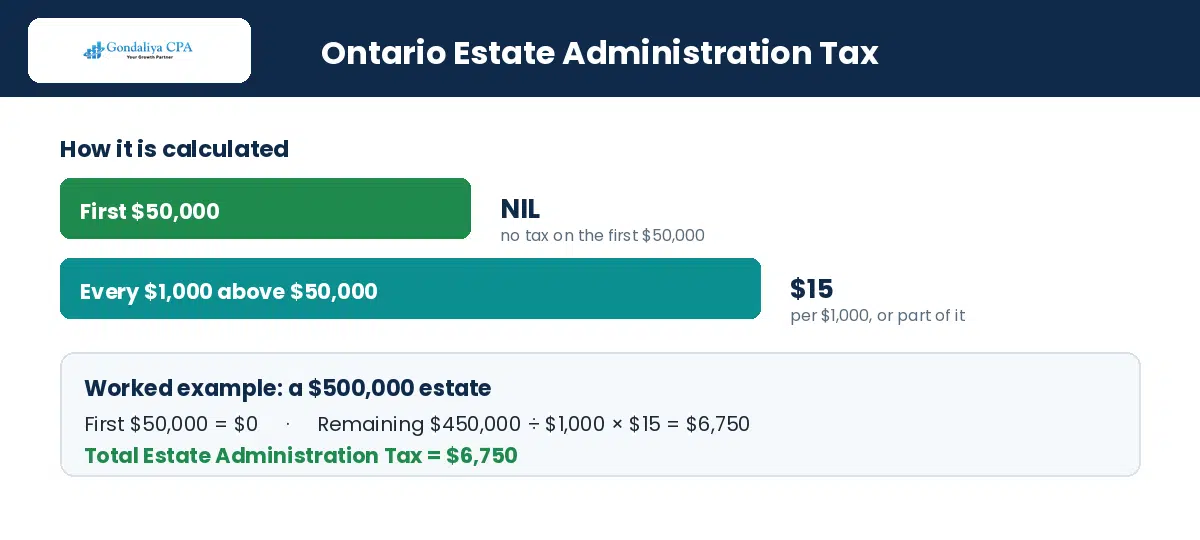
Before the strategies, the number itself: Ontario charges no Estate Administration Tax on the first $50,000 of the estate’s value, then $15 for each $1,000, or part of it, above $50,000. So a $500,000 estate pays $6,750. The old lower tier on the first $50,000 was eliminated for certificates applied for from January 2020, which is why older summaries quoting a rate on the first $50,000 are out of date. An Estate Information Return must also be filed with the Ontario Ministry of Finance within 180 days after the estate certificate is issued.
Reducing What Probate Touches
Using joint ownership structures wisely, such as holding property jointly with right of survivorship, can skip probate, but watch out for the attribution rules and for unintended bare trust arrangements when a name is added to title. Establishing inter vivos and family trusts before death moves assets early and cuts down what probate will touch. Gifting assets while alive where it makes sense shrinks the probateable estate but causes deemed dispositions that must be reported properly. Assets with a named beneficiary, such as registered accounts and insurance, generally pass outside probate as well. Putting these ideas into your overall trust tax planning setup can trim both direct trust taxes, like the T3 return, and indirect ones such as administration fees.
Our Take: Probate planning is worth doing, but never at the cost of a clean tax result. Adding an adult child to title to dodge a few thousand in probate can create a bare trust, a reportable disposition, and a family dispute. Please weigh the whole picture, not just the probate line.
A client added an adult child to a property title purely to save probate, and unintentionally created a bare trust with its own reporting and a possible disposition. The probate saving was small next to the mess. We untangled it. Figures changed for privacy.
A family used a prescribed-rate loan to a spousal beneficiary so the investment income sat with the lower earner without tripping the attribution rules. Set up properly, the structure did exactly what splitting could not. Figures changed for privacy.
Professional Support and Choosing a Firm
The Support
Trust tax planning in Canada can get tricky without the right help. A good estate tax planning approach keeps things legal and helps reduce what you owe. CPAs dig into trust income tax strategies to spot where taxes can be lowered on the T3 tax return.
What a CPA Does Here
They check the trust’s structure, where income comes from, and how it’s shared. That way, they find chances for savings, like income splitting or capital gains exemptions, and charitable donations might also cut your taxes. At Gondaliya CPA, we work with business owners who use trusts or estates. We review family and inter vivos trusts by Canadian rules to report everything correctly on T3 returns. We also look at who gets what so beneficiaries pay less tax overall. Our experience covers real estate investors with family trusts, doctors using professional corporation trusts, and startups freezing shares for succession plans. We build trust income tax strategies that fit each case while following CRA rules closely.
Help for Executors, Trustees, and Estate Planners
Executors and trustees must file a T3 return within 90 days after the fiscal year ends. Missing this deadline can cause penalties for everyone involved. A graduated rate estate window lets you use personal tax rates for up to 36 months after death instead of higher ones, so timing matters a lot in estate tax planning. Professionals help with meeting all filing deadlines on time, planning beneficiary taxes smartly, timing capital gains within GRE windows, and choosing between testamentary or inter vivos trust setups. Gondaliya CPA guides executors from gathering paperwork to submitting returns, which helps avoid mistakes that raise taxable amounts or cause missed elections.
CRA Audit Support and Post-Mortem Compliance
CRA audits on trusts or estates need careful prep because reporting rules are complex in Canada. Gondaliya CPA offers support focused on post-mortem compliance tied to T3 returns. We check old filings against new laws, including the bare trust disclosure changes taking effect for year-ends from December 31, 2026, and prepare detailed documents for CRA reviews. If errors pop up later or you find new info after filing, our support for the Voluntary Disclosures Program helps fix those issues early, which lowers penalty risks while keeping clear talks open with the CRA. We don’t stop at filing; we keep track of changing laws so clients stay compliant during the long estate administration times common in family trusts or business successions.
What to Look for in a Specialist
When you pick a specialist, check if they’re Registered by CPA Ontario; a firm like Gondaliya CPA fits this, with a strong record of five-star Google reviews as one signal of the work. Good specialists know Canadian trust tax laws well, communicate clearly, and act to cut your tax bills. Look for Registered Ontario CPA credentials, experience with T3 filings, clear communication, and a proactive approach to reducing liabilities. Experts make sure you stay CRA compliant by filing T3 returns on time, represent you during CRA audits or questions, and support those audits with the needed documents. Local knowledge matters too: a Toronto-area firm knows Ontario’s specific needs, including probate fees and filing rules, so it can handle the 90-day window, manage local administrative tasks, and understand provincial provisions like the graduated rate estate.
| Feature | DIY | Non-CPA provider | Gondaliya CPA |
|---|---|---|---|
| Compliance accuracy | Low | Medium | High |
| Planning depth | None | Limited | Extensive |
| Knowledge of current rules | Limited | Often outdated | Current |
| CRA audit support | None | Limited | Full |
| Flat fee pricing | Not applicable | Variable | Transparent |
Tailored Strategies and How We Work
Every client’s situation differs, so one-size-fits-all doesn’t work here. We create plans that fit personal needs, weighing the age and residency of beneficiaries, their other sources of income, and ways to maximize after-tax amounts while staying CRA compliant. Gondaliya CPA works closely with clients from the start and offers ongoing advice as laws change or new issues come up, from reviewing documents to preparing allocation schedules for your T3 return. We keep clients updated on legislative changes, like the 2026 bare trust amendments, and work on a flat annual fee, HST included, with no surprise bills. We serve clients across Toronto, Etobicoke, Vaughan, Mississauga, Brampton, Scarborough, Ottawa, Hamilton, and Canada-wide. Please contact us early in the administration, not the week before the deadline.
A startup founder’s shares sat in a family trust set up years earlier for a future freeze. Because we reviewed it well before any sale, the allocations and the 21-year date could be planned rather than discovered during diligence. Early beats urgent every time. Figures changed for privacy.
2026 Update — what is current: The capital gains inclusion rate remains one-half. Schedule 15 has applied to trust years ending on or after December 31, 2023 and is filed annually. Bare trusts, exempt for 2023 through 2025, must file for year-ends from December 31, 2026 under legislation enacted in 2026, with exceptions. The graduated rate estate window is 36 months, and the T3 is due 90 days after year-end.
Check Your Trust Planning Position
This quick self-check flags where the planning opportunities and risks sit. Please answer the six questions below.
Trust Tax Planning Check
Six quick questions on where your tax can be lowered. No fee shown.
Signals:
This is a general prompt, not tax or legal advice or a quote. Your actual planning depends on the trust’s terms and facts. For a real review, please book a free consultation.
Want a checklist to work from? You can download our free trust tax planning checklist before your consultation.
Industry Spotlights: Sectors We Represent
Industry Expertise
Trust planning looks different in each sector, usually because of what the trust holds and who the beneficiaries are. Here are ten sectors and where the planning opportunity sits.
| Industry | The Planning Angle |
|---|---|
| Medical doctors & physician professional corporations | Family trust over the PC for dividend splitting |
| Dentists & dental practices | Trust in the structure for succession and splitting |
| Daycare, childcare & CWELCC services | Owner succession and estate settlement timing |
| Real estate investors, landlords & holding companies | Estate freeze and the 21-year clock on held property |
| Property developers & builders | Multiple entities and clean beneficiary planning |
| Construction, contractors & skilled trades | Family trust splitting and owner succession |
| Technology startups & SaaS | Share freeze ahead of an exit |
| E-commerce & online retailers | Growing share value and the 21-year date |
| Restaurants & food and beverage | Property in trust alongside the operating company |
| Transportation, logistics & trucking | Owner-operator estate and asset transfer |
- Medical doctors & physician professional corporations: A family trust holding the professional corporation shares is a common route to split dividends among adult family members, subject to the split-income rules. Specialists certified through the Royal College of Physicians and Surgeons of Canada plan the same way as any incorporated family.
- Dentists & dental practices: Practices regulated by the Royal College of Dental Surgeons of Ontario often place shares in a trust for succession, and the planning turns on timing the transfer and the allocations.
- Daycare, childcare & CWELCC services: When an owner dies, settling the estate and continuing the CWELCC-funded licence run together, and the GRE window is the planning space.
- Real estate investors, landlords & holding companies: An estate freeze locks today’s value and the 21-year deemed disposition on long-held property is the date to plan around, especially as values grow.
- Property developers & builders: Multiple project entities mean the beneficiary planning and the reporting have to stay clean across all of them at once.
- Construction, general contractors & skilled trades: For electricians, plumbers, and HVAC firms, family trust splitting and owner succession are the usual levers, and documented allocations are what make them hold up.
- Technology startups & SaaS: A share freeze into a trust ahead of an exit shifts future growth out of the founder’s estate, and it wants planning long before a sale, not during diligence.
- E-commerce & online retailers: Where a trust has held shares since the business was small, the growing value makes the 21-year deemed disposition the date to watch.
- Restaurants & food and beverage: Property held in trust alongside the operating company is common, and the planning coordinates both sides so income lands efficiently.
- Transportation, logistics & trucking: When an owner-operator dies, the estate has to move equipment and plan the terminal return together, with the spousal rollover often in play.
A physician’s family trust held the professional corporation shares but had never allocated a dividend to the two adult beneficiaries who qualified. Building that into the plan reduced the household tax without touching the practice. Figures changed for privacy.
A real estate holding trust was three years from its 21-year mark with large unrealized gains and no plan. We modelled the deemed disposition and the distribution options early, so it could be managed rather than absorbed. Figures changed for privacy.
A client wanted to gift a rental to an adult child to shrink the probateable estate, not realizing it triggered a deemed disposition and tax now. We modelled both paths before anything moved. Figures changed for privacy.
Glossary of Key Terms
Plain-English Definitions
- T3 return: The annual Trust Income Tax and Information Return filed by trusts and estates.
- Schedule 15: The beneficial ownership information filed with the T3 return since December 31, 2023.
- Graduated Rate Estate (GRE): An estate taxed at graduated rates for up to 36 months after death.
- Testamentary trust: A trust created by a will on death.
- Inter vivos trust: A trust created while the settlor is alive; a December 31 year-end.
- Family trust: An inter vivos trust used to hold assets and split income among family.
- Income splitting: Allocating income to lower-bracket beneficiaries, subject to the split-income rules.
- Deemed disposition: A tax event where assets are treated as sold at fair market value without a sale.
- 21-year rule: The deemed disposition that applies to most trusts every 21 years.
- Spousal rollover: The subsection 70(6) deferral of gains on transfer to a spouse or spousal trust on death.
- Estate freeze: Locking today’s value so future growth accrues to the next generation or a trust.
- Attribution rules: Rules that tax certain income back to the person who transferred the property.
- Clearance certificate: The CRA confirmation on Form TX19 that estate taxes are settled.
- Estate Administration Tax: Ontario’s probate tax; nil on the first $50,000, then $15 per $1,000.
Frequently Asked Questions
FAQ
What is the T3 filing deadline for trusts and estates in Canada?+
Trustees must file the T3 tax return within 90 days after the trust’s fiscal year-end. For estates with a December 31 year-end, this means filing by March 31. The slips and any balance owing are due the same day.
What is the Graduated Rate Estate window and how long does it last?+
The GRE window applies for up to 36 months after death. During this time, the estate pays tax at graduated personal rates instead of the top marginal rate, which is the main planning opportunity in estate tax.
How does the 21-year deemed disposition rule affect inter vivos trusts?+
Every 21 years, most trusts must report a deemed disposition of assets at fair market value, triggering capital gains taxes unless an exception applies. Planning, such as distributing before the date, manages the result.
How does the spousal rollover reduce tax on death?+
Under subsection 70(6), capital property passing to a surviving spouse or a qualifying spousal trust transfers at cost base rather than fair market value, deferring the gain. It is automatic where the conditions are met, but the executor can elect out property by property.
Can I split trust income with my children to save tax?+
Sometimes, but the tax on split income rules restrict allocations to related minors and certain adults, often taxing the income at the top rate anyway. The allocation has to clear those rules to actually save tax, so please have it checked first.
Who should consider professional trust and estate tax planning?+
Individuals with family trusts, business owners, executors, trustees, and those managing estates benefit from expert planning to minimize taxes and comply with CRA rules.
How does Gondaliya CPA manage T3 trust and estate returns?+
We prepare accurate T3 returns, ensure timely filing, optimize income allocations for beneficiaries, and offer ongoing compliance support tailored to your situation.
How much does a T3 trust and estate tax return cost in Canada?+
We charge a flat annual fee, HST included, set by the trust’s complexity, with transparent billing and no hidden charges. It is quoted in writing after a free consultation.
What are common risks when filing trust tax returns?+
Missing the 90-day deadline, inaccurate income allocations, ignoring the 21-year deemed disposition, and failing to file Schedule 15 properly.
What should I prepare before starting trust or estate tax planning?+
Gather the trust documents, investment statements, capital gains records, prior years’ returns, and details on beneficiary distributions.
Trust Tax Planning Checklist
- Diarize the T3 deadline: 90 days after the trust’s year-end.
- Use the graduated rate estate window while it is open, within 36 months of death.
- Allocate income to lower-bracket beneficiaries, subject to the split-income rules.
- Check the attribution rules before splitting with a spouse or minor.
- Plan for the 21-year deemed disposition well before it lands.
- Review the spousal rollover and whether to elect out.
- Document every allocation with a signed trustee resolution.
- File Schedule 15 for every year it has applied.
- Request the TX19 clearance certificate before distributing anything.
Who This Is For / Not For
- For: Trustees, executors, and business owners whose shares or property sit in a trust, who want to reduce tax on trust and estate income legally.
- Not For: Quebec-only trust filings, which involve a separate provincial return we do not cover here.
People Also Ask
Quick Answers
Is retained trust income really taxed at the top rate?+
For most trusts, yes. Income kept in an inter vivos trust or a non-GRE testamentary trust is taxed at the top marginal rate, which is why allocating it to lower-bracket beneficiaries is the core strategy.
Does an estate freeze reduce tax?+
It shifts future growth off your estate to the next generation or a trust, capping the gain taxed on your death at today’s value. It is a deferral and shift, not an elimination, and it needs to be set up correctly.
Can I fix a trust return I never filed?+
Often yes. The Voluntary Disclosures Program may reduce or cancel penalties where you come forward voluntarily, before the CRA contacts you.
Contact Gondaliya CPA at 647-212-9559 or info@gondaliyacpa.ca to discuss your trust or estate tax needs and start saving on taxes legally and efficiently. For the mistakes to avoid, please read our guide to common T3 tax return mistakes, and for the full picture, our ultimate guide to trust and estate tax returns.
Reduce the tax on your trust and estate income
Gondaliya CPA plans the allocations, the timing, and the elections, then prepares and files the T3, on a flat annual fee, HST included, with a one-business-day response. Please book a free consultation early.
Next Steps
Reducing tax on trust and estate income rewards planning that happens before the year-end, not after it. Use the graduated rate estate window while it is open, allocate income to beneficiaries who pay less, respect the split-income and attribution rules, plan for the 21-year date and the spousal rollover, and never distribute before the clearance certificate. Please contact us early during the administration, gather the documents while they are easy to find, and get the allocations modelled while the options are still open. Contact Gondaliya CPA at 647-212-9559 or info@gondaliyacpa.ca today to discuss your trust or estate tax needs and start saving on taxes legally and efficiently. If our content helps, please add gondaliyacpa.ca as a preferred source on Google.
Published: July 15, 2026 · Last updated: July 15, 2026
Disclaimer: This article is educational information only and is not tax, legal, or financial advice. It reflects CRA trust and estate rules current to 2026, including the 90-day filing deadline, the 36-month graduated rate estate window, the 21-year deemed disposition rule, the one-half capital gains inclusion rate, the subsection 70(6) spousal rollover, and Ontario’s Estate Administration Tax of nil on the first $50,000 and $15 per $1,000 above. The tax on split income and attribution rules can restrict income-splitting benefits. Trust rules have changed repeatedly and remain subject to further amendment, and outcomes depend on your specific facts. Please consult a Registered CPA in Canada or Ontario before acting. Fees include HST.

Sharad Gondaliya is a CPA Canada & CPA USA with 15 Years+ experience of Accounting, Tax, Payroll of Corporate Small Businesses as Tax Accountant. He is a CPA Ontario member (61040184) and holds US CPA licences in Washington and Montana and is well known among corporate small businesses for tax planning, efficient tax solutions, and affordable CPA services. Sharad is the Principal (Director) of Gondaliya CPA – Affordable CPA Firm in Canada. Licenses: CPA Ontario: 61040184 | CPA USA (MT): PAC-CPAP-LIC-033176 | CPA USA (WA): 57629 | CPA Firm License: 61330051 View Full Author Bio