



Estate Tax Planning Strategies Every Canadian Executor Should Know Before Filing a T3 Return
Quick Summary
Before filing a T3 return, an executor should understand the graduated rate estate window, the deemed disposition on death, the spousal rollover, charitable donation planning, and the clearance certificate that protects them personally. Please note the executor is personally liable for tax the estate should have paid, so the clearance certificate is not optional housekeeping; it is the executor’s protection.
| Aspect | Details |
|---|---|
| The window | The graduated rate estate: graduated rates for 36 months after death. |
| The big event | The deemed disposition on death, and the spousal rollover that defers it. |
| The protection | The clearance certificate on Form TX19, before distributing. |
| The deadline | The T3 is due 90 days after the estate’s tax year-end. |
Reading time: 25 minutes.
Table of Contents
- The Executor’s Role and Tax Responsibilities
- The Returns an Executor Files
- The Graduated Rate Estate Window
- The Deemed Disposition and the Spousal Rollover
- Charitable Donation Planning
- Loss Carrybacks and Post-Mortem Planning
- Probate and the Estate Information Return
- The Clearance Certificate That Protects You
- Professional Support for Executors
- Industry Spotlights: Sectors We Represent
- Glossary and Frequently Asked Questions
- People Also Ask
What the Executor Must Know
This article covers Canada, with Ontario and Toronto context, and reflects CRA rules current to 2026. It assumes a resident deceased and a resident estate, and it does not cover Quebec’s separate provincial return. Items marked “illustrative” are examples, not quotes, and any masked engagement notes end with “Figures changed for privacy.” This is educational information only and not tax, legal, or financial advice, and it is not a substitute for advice from the estate’s own lawyer and CPA. Fees include HST. Estate rules change, so please confirm your own situation with a Registered CPA before acting.
The Executor’s Role and Tax Responsibilities
The Role
Estate tax planning Canada is essential for executors to manage their tax responsibilities effectively, including T3 return filing and estate settlement process in Canada. Gondaliya CPA offers expert estate accountant services, helping with estate administration accounting, trust and estate CPA services, and avoiding estate tax mistakes during estate tax preparation services.
Being named an executor is an honour and a serious legal responsibility. You step into the shoes of the person who died for tax purposes, and you answer to the beneficiaries, to the CRA, and to the law for how the estate is handled. The tax piece is where executors most often feel out of their depth, and it is where mistakes are most expensive.
The core tax duties are to file the deceased’s final personal return, to file the estate’s own T3 returns while it exists, to pay the tax the estate owes, and to obtain clearance from the CRA before distributing what is left. Miss the last one and the liability can land on you personally, which is the single most important thing an executor should understand before filing anything.
Roles and Tax Responsibilities of Executors in Estate Administration
Once named, an executor should tell the CRA quickly. They need to collect all financial details about the deceased’s property. This means making financial statements that show income earned after death. That income may be taxed under special rules for estates. The executor also manages estate administration accounting, watching how money moves between the estate and beneficiaries.
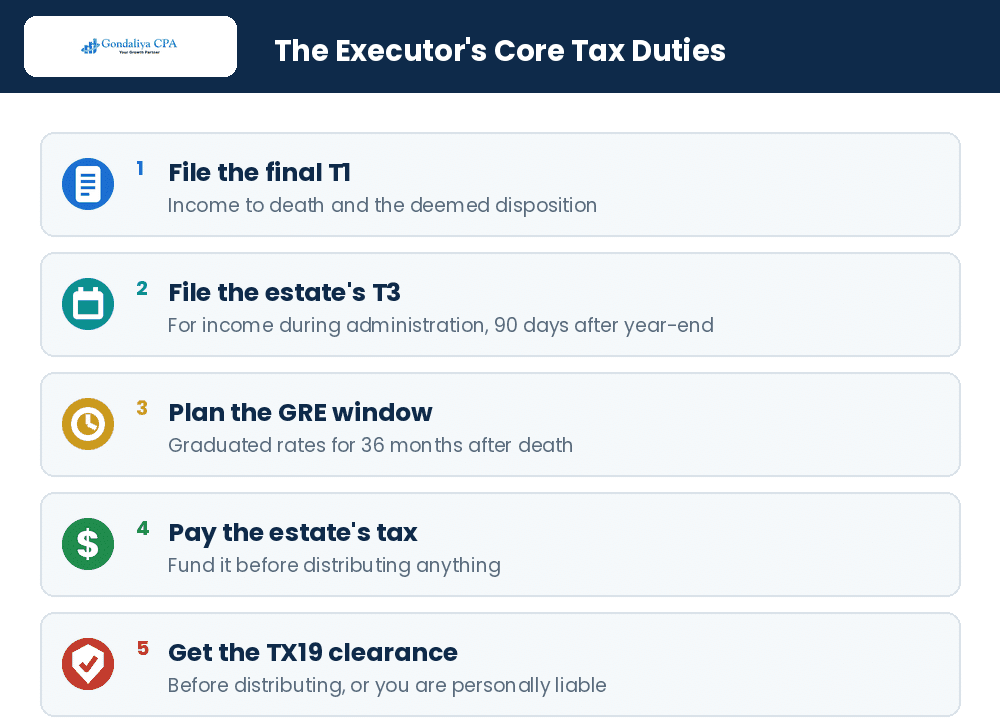
The good news is that most of the estate’s tax outcome is decided by planning that happens before the T3 is filed, not by the filing itself. An executor who understands the graduated rate estate window, the deemed disposition, the spousal rollover, and donation planning can make choices that materially reduce what the estate pays. An executor who simply files whatever the software produces usually leaves money on the table and, occasionally, exposes themselves to liability.
Understanding the Importance of Estate Tax Planning
Estate tax planning tips:
- Use graduated rate estates to spread out income.
- Consider spousal rollovers to defer taxes.
- Plan early to avoid surprises.
- Work with professionals if needed.
Steps Involved in Settling an Estate
When someone dies, an executor must manage both assets and tax filings carefully: distribute assets following the will or local laws; file final tax returns on time; and apply for a clearance certificate before handing out money. Skipping any step risks personal liability for unpaid estate taxes. It is safer to wait for CRA’s green light before releasing funds.
Settling an estate follows rules under Canadian federal law and Ontario provincial law:
- Obtain letters of appointment, also called probate.
- Inform all involved parties about their roles.
- List all assets owned by the deceased.
- Pay debts before giving out inheritances.
Following these steps keeps things organized and legal.
Executor Duties Regarding Asset Distribution and Tax Compliance
Executors carry serious responsibility here. Distributing assets too soon can cause personal liability if taxes are not paid first. Keeping detailed financial records is essential for transparency. Good record keeping protects executors if questions arise later about how money was handled.
An executor came to us a year into an administration, having filed returns without any planning, and asked why the tax was so high. Several of the levers below had already closed. Bringing us in at the start, not the end, is what protects both the estate and the executor. Figures changed for privacy.
An executor was unsure whether the deemed disposition went on the terminal T1 or the estate’s T3, and had started putting it in the wrong place. It belongs on the terminal return. Catching that before filing avoided an amendment. Figures changed for privacy.
The Returns an Executor Files
The Filings
Two different returns do two different jobs, and executors routinely confuse them.
The Final T1 Return
The deceased’s final personal return, often called the terminal return, reports their income up to the date of death and the deemed disposition of their capital property. Its due date depends on when the death occurred: if the death was between January 1 and October 31, the terminal return is due by the following April 30; if the death was between November 1 and December 31, it is due six months after the date of death. Getting the terminal return right matters, because it is where the deemed disposition lands and where several planning choices are made.
Preparing the Final T1 Income Tax and Benefit Return
Executors need to collect all income details. This includes employment pay, investment income, and any deductions valid before death. The final T1 only covers earnings up to the death date, unlike estate returns which come later.
For example, if someone died on March 15th, their final T1 covers income from January 1st to March 15th that year. Executors should use slips like T4s or RRSP withdrawal papers to report income correctly.
Optional Tax Returns and Their Relevance
Sometimes, optional returns like rights or things returns help delay some taxes under specific rules. They may be useful depending on each estate’s situation but are not always required.
Sometimes executors file extra returns beyond the usual final T1:
- Rights or Things Return: Used when the deceased was entitled to income that comes after death but before filing. Think unpaid dividends that are owed.
- Optional Reporting: Estates can choose to report certain income types separately on an optional terminal return. This can make things clearer or help with tax planning.
These returns handle tricky cases where income timing causes confusion. For instance, a dividend declared before death but paid later fits here. Filing a rights or things return avoids taxing it twice.
Knowing these options helps executors fulfill their tax duties properly, following CRA rules.
The T3 Estate Return
Once the person has died, their estate is a separate taxpayer, and it files a T3 Trust Income Tax and Information Return for the income the estate earns during administration. The T3 is due 90 days after the estate’s tax year-end. A graduated rate estate may choose a non-calendar year-end within the first twelve months, which is a planning tool in itself, while other estates use a December 31 year-end. The estate also files Schedule 15, the beneficial ownership information, which has applied to trust years ending on or after December 31, 2023.
Income Reporting Requirements for Estates After Death
Estates must report all income earned after death on a separate T3 return. This is different from the deceased person’s final personal tax return. Income includes interest, dividends, rent, and business profits earned by estate assets while settling affairs.
Capital gains happen with deemed disposition at death. This means property is treated as sold at fair market value right before death. Capital gains must appear on the final personal return or on later T3 returns if assets sell afterward. Accurate valuations as of death date matter for this.
Estate administration accounting keeps track of all money coming in and going out during settlement. Executors need clear records showing how capital gains were worked out using cost base info from investments or appraisals near death.
Executors also issue T3 slips to beneficiaries who get income from the estate. These slips show each beneficiary’s share of taxable income from the trust or estate. Also, Schedule 15 reporting is required where there are beneficial ownership details about trusts set up by estates.
Filing the T3 return correctly protects executors from personal liability and ensures proper tax treatment for income after death.
Filing Previous Year Returns and Addressing Outstanding Tax Obligations
Before filing estate returns, executors should check if all past-year returns are done. Missing old filings can lead to penalties on both the estate and beneficiaries.
CRA enforces stiff penalties for late filings on deceased persons’ taxes. Executors must clear any unpaid balances or incomplete returns during estate accounting.
Ignoring this raises risk for executors who may be held liable under Canadian law. Hiring a skilled estate accountant across Canada reduces these risks.
| Obligation | Deadline | Consequence if Missed |
|---|---|---|
| Final Individual (T1) Return | Per the terminal return rules | Late fees plus interest |
| Prior-Year Returns | According to each due date | Penalties plus possible audits |
How to File a T3 Return for an Estate in Canada: Step-by-Step Process
Executors must file a T3 return within 90 days after each taxation year-end chosen by the estate, often December 31. For estates under graduated rate status, this can extend up to three years but requires yearly filings until everything is distributed.
Executor duties include:
- Collecting financial documents like bank statements, investment info, and property values.
- Preparing detailed accounts showing all transactions since death.
- Calculating taxable income applying graduated rates when possible.
- Issuing correct T3 slips to beneficiaries as per the will.
- Completing Schedule 15 disclosures where beneficial ownership applies.
Taxes owed must be paid quickly. Otherwise, penalties can hit estates or even executors personally if assets get distributed too soon without CRA clearance certificates.
| Step | Executor Action | CPA Role | Common Bottleneck |
|---|---|---|---|
| Collect documents | Provide wills, death certificates, investments | Check and verify completeness | Missing valuations or delayed documents |
| Prepare accounts | Track receipts and disbursements post-death | Model dispositions and allocations | Complex holdings needing appraisal |
| Calculate taxes owed | Confirm liabilities against credits | Apply GRE and AMT rules where relevant | Unclear beneficiary entitlements |
| Issue slips and reports | Deliver accurate beneficiary info on time | Ensure compliance with Schedule 15 | Late slip issuance delays filing |
| Submit returns and pay balances | Approve the final package | Electronic filing and confirmation | Balances unpaid at filing |
| Aspect | Final T1 Return | T3 Estate (Trust) Return |
|---|---|---|
| Purpose | Report deceased’s income until death, including the deemed disposition | Report estate or trust income after death |
| Filing Deadline | April 30, or six months after death if death was Nov 1 to Dec 31 | 90 days after the estate’s fiscal year-end |
| Income Covered | Employment, investments, capital gains pre-death | Income from estate assets post-death |
| Executor Tax Responsibilities | Prepare and submit on behalf of deceased | File as trustee for ongoing estate management |
| Rights or Things Return Option | Optional; reports property rights transferred post-death | Not applicable |
| Tax Rates Applied | Individual rates | Graduated rates where GRE rules apply |
| Schedule 15 | Not applicable | Filed with the T3, for years ending on or after Dec 31, 2023 |
CRA Deadline: The T3 is due 90 days after the estate’s tax year-end, and the terminal T1 is due April 30 following the year of death, or six months after death where death occurred in November or December. Please diarize both the moment you accept the role, because the penalties run automatically. Late filings bring penalties starting at 5% plus 1% each month after that, sometimes reaching 25%, and filing T3 returns late, after 90 days past year-end, leads to penalties starting at $25 daily, up to $2,500. Executors can face personal risk too if they do not act promptly with these tax filings.
An executor filed the terminal T1 and assumed the estate had no further filing to do, not realizing the estate was a separate taxpayer that owed a T3. The gap surfaced later, with penalties running. Knowing which return does which job avoids that entirely. Figures changed for privacy.
The Graduated Rate Estate Window
The Window
This is the single largest planning lever available to an executor, and it has a clock on it.
For up to 36 months after death, an estate can qualify as a graduated rate estate, which means it is taxed at graduated personal rates rather than the top marginal rate that applies to most trusts. Only a graduated rate estate, and a qualified disability trust, get those brackets; every other trust pays the top rate on income it retains. That difference is large, and it is available only inside the 36-month window.
Inside that window, an executor can allocate income across tax years, choose the estate’s year-end, use the graduated brackets deliberately, and time the realization of gains. Once the 36 months end, or the estate distributes everything, the graduated rates stop and retained income moves to the top rate. Planning early in the window, not late, is where the saving lives.
Income Allocation and Splitting to Lower-Bracket Beneficiaries
Income splitting inside an estate means directing income to the people who will pay the least tax on it.
The GRE period gives estates a chance to reduce taxes by spreading out income or giving it to beneficiaries who pay less tax.
Income allocation allows estates to distribute income among beneficiaries who may have lower tax rates, reducing overall tax liability.
Prescribed-Rate Loans and Ongoing Family Planning
Use prescribed-rate loans strategically to shift income among family members at low interest rates.
Tax-efficient wealth transfer methods include lifetime gifts with prescribed-rate loans, use of trusts, spousal rollovers, and charitable donations to minimize taxes on inheritance.
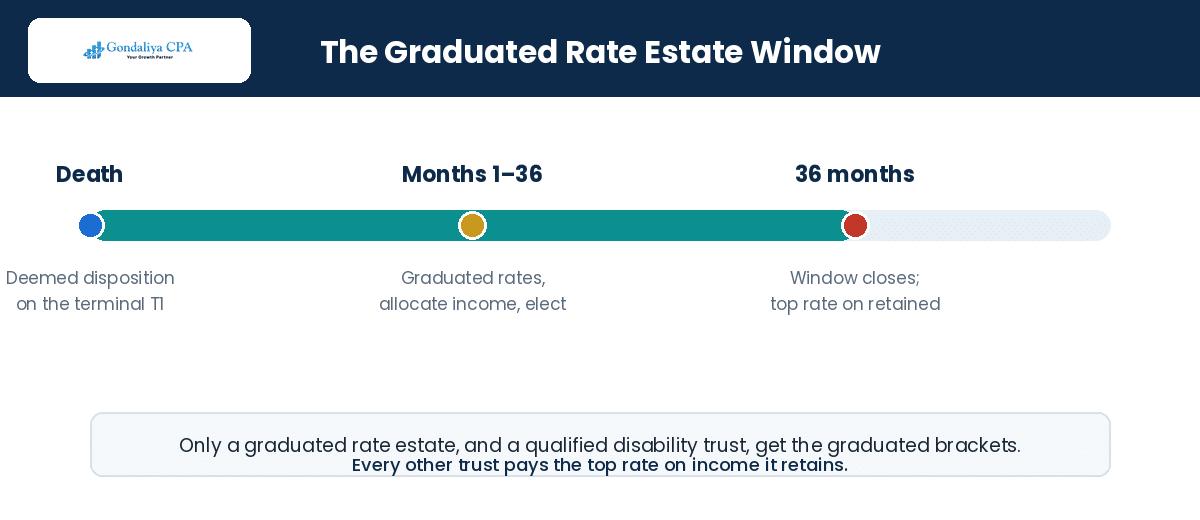
Key Stat: The graduated rate estate window lasts up to 36 months after death. During it, the estate is taxed at graduated rates instead of the top marginal rate, so the elections and allocations made inside the window are the executor’s biggest opportunity to reduce tax.
An executor planned to settle everything in the third year and distribute in one go. Spreading income across the earlier years of the GRE window, while the graduated rates were available, reduced the total. The window rewards acting early, not tidying up at the end. Figures changed for privacy.
The Deemed Disposition and the Spousal Rollover
On Death
On death, the tax system treats the deceased as having sold their capital property at fair market value immediately before death. This deemed disposition can trigger significant capital gains on the terminal return, on things like a portfolio, a rental property, or private company shares. It is often the largest single tax event in a person’s life, and it lands on the executor’s desk.
The Spousal Rollover
The main relief is the spousal rollover. Where capital property passes on death to a surviving spouse or common-law partner, or to a qualifying spousal trust, and both were resident in Canada, it transfers at the deceased’s cost base rather than at fair market value, so the gain is deferred rather than triggered. The rollover applies automatically where the conditions are met, but the executor can elect out of it on a property-by-property basis, which can make sense where the deceased had unused capital losses or lifetime capital gains exemption to absorb.
The key point for an executor is that the rollover is a deferral, not forgiveness. The surviving spouse inherits the deceased’s cost base, so the gain is taxed later, when they sell or die. Planning treats the rollover as buying time, and uses that time deliberately.
RRSPs and RRIFs on Death
When someone dies, CRA treats their property as if sold at fair market value right then. This is called deemed disposition. It can trigger capital gains tax on appreciated assets. Registered accounts like RRSPs or RRIFs often get special treatment through spousal rollover rules that let taxes be deferred in some cases.
Understanding these effects helps plan better before taking action on an estate’s finances.
Pro Tip: The election out of the spousal rollover is made property by property, so it is not all or nothing. Where the deceased has unused losses or lifetime capital gains exemption, electing out on selected assets can use them up, while rolling the rest defers the gain. Please have the whole picture modelled before choosing.
An executor let the spousal rollover apply to everything by default, missing the chance to use the deceased’s unused capital losses. Electing out on a couple of properties would have absorbed those losses. The default is not always the best answer, which is why it is modelled. Figures changed for privacy.
An executor believed the AMT would apply to the estate and had budgeted for it. Because graduated rate estates are exempt from the AMT, that concern fell away and the plan was simpler than feared. Knowing the exemption changed the whole approach. Figures changed for privacy.
Charitable Donation Planning
Donations
Charitable giving is one of the most flexible tools an executor has, and the graduated rate estate rules make it more powerful than many realize.
A donation made by the will or by the graduated rate estate can generate a donation tax credit, and the rules give real flexibility about which return claims it. A gift made by a graduated rate estate can, within limits, be applied against the estate’s income, the deceased’s terminal return, or the year before death, which lets the executor put the credit where it does the most good. Donating publicly listed securities that have appreciated can be especially efficient, because the capital gain on securities donated in kind can be eliminated while the donation credit is still available.
The mechanics matter here, and the timing and eligibility rules are specific, so this is an area where a wrong assumption wastes a real credit. But the principle is simple: charitable intentions and tax efficiency can point in the same direction, and the executor’s job is to line them up.
An estate intended to make a significant charitable gift, and by routing it through the graduated rate estate and choosing where to claim the credit, the executor put it against the return where it saved the most. The same gift, claimed carelessly, would have saved far less. Figures changed for privacy.
An estate planned to sell appreciated securities and donate the cash. Donating the securities in kind instead removed the capital gain on them while preserving the donation credit. Same charity, same generosity, a better tax result. Figures changed for privacy.
Loss Carrybacks and Post-Mortem Planning
Post-Mortem
Some of the most valuable executor planning happens after death, using losses that arise during administration.
Where the estate realizes a capital loss in the graduated rate estate period, that loss can, under the rules, be carried back against capital gains on the deceased’s terminal return, which can recover tax already paid on the deemed disposition. This is one reason not to rush distributions: keeping the estate open long enough to use a loss can be worth more than closing it quickly. Post-mortem planning for private company shares, addressing the potential for the same value to be taxed more than once, is a specialized area that can save substantial tax where a corporation is involved, and it should be handled with professional advice.
Navigating Complex Business Holdings in Estates
Estate tax issues get more complicated when business holdings or multi-generational families enter the picture.
Business owners often hold assets in several companies. Coordinating taxes between corporations and beneficiaries is tough but necessary to avoid double taxation hitting heirs hard.
Handling these calls for experts who know both tax laws and family dynamics well. Integrating holding companies helps manage corporate assets efficiently, facilitates smooth family succession, and reduces double taxation risks.
Multi-Generational Estates, Testamentary Trusts, and Attribution Rules
Multi-generational estates bring other twists: setting up testamentary trusts, balancing fair shares among heirs, dealing with attribution rules that stop accidental taxes, and choosing between gifts during life versus bequests at death. Using exemptions like principal residence relief also plays a part.
Advisors watch out for problems like AMT triggering because unrealized gains pass down generations without proper elections being made timely. This saves more wealth from needless taxes while following CRA rules carefully.
Good advice blends legal intent with what is practical under current law so families keep as much value as possible.
Risk Warning: Distributing the estate too quickly can destroy planning that is still available, such as a loss carryback or post-mortem steps for private company shares. Please do not rush to close the estate before the planning is done, and never distribute before the clearance certificate, covered below.
An estate held a portfolio that fell in value after death. Because the estate was kept open, the loss could be carried back against the gains on the terminal return, recovering tax already paid. Closing early would have wasted it. Patience was worth real money here. Figures changed for privacy.
An executor planned to distribute quickly to close the file, before the loss carryback and post-mortem steps were done. Slowing down to keep the estate open for the planning preserved a real saving. Fast is not always cheapest. Figures changed for privacy.
Probate and the Estate Information Return
Probate
Probate is separate from income tax, but it lands on the executor too, and Ontario has its own return.
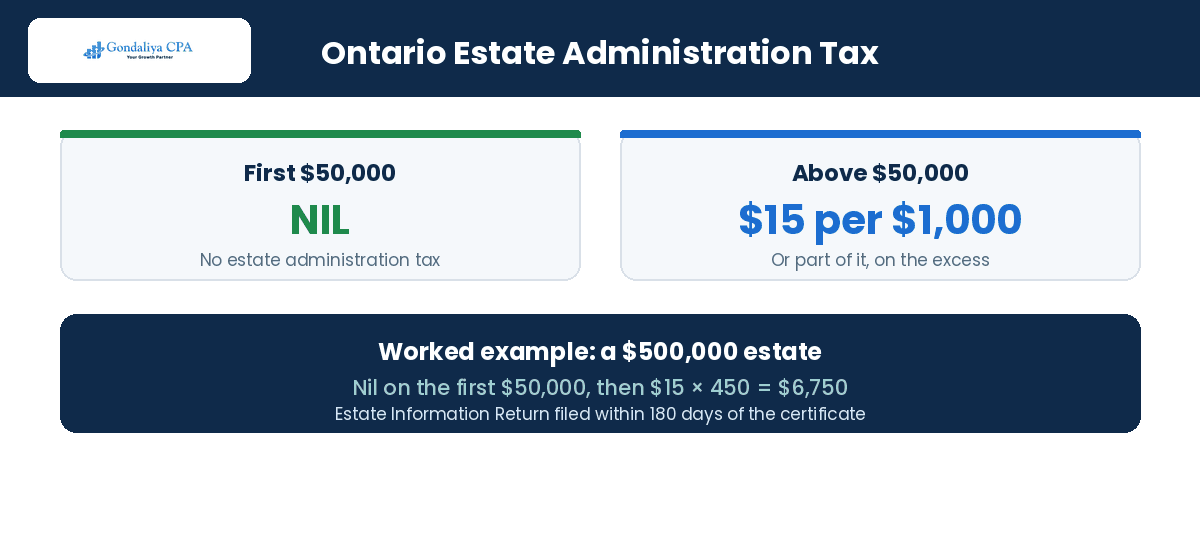
In Ontario, the Estate Administration Tax, commonly called probate, is charged at nil on the first $50,000 of the estate’s value, then $15 for each $1,000, or part of it, above $50,000. So a $500,000 estate pays $6,750. On top of the tax itself, the executor must file an Estate Information Return with the Ontario Ministry of Finance within 180 days of the estate certificate being issued, setting out the estate’s assets and their values. This is a filing obligation in its own right, with its own penalties for getting it wrong, and it is easy to overlook amid the income tax work.
Provincial and Territorial Tax Considerations for Deceased Estates
Ontario also applies unique provincial tax rates alongside federal rates when calculating taxes on final individual returns and later trust and estate filings like T3 returns. Knowing these details matters in careful estate tax planning Canada-wide.
Other provinces have different fees and rules. Executors handling estates in more than one province need advice tailored to local laws for full compliance and better outcomes.
Our Take: Executors often focus on the income tax and forget the Estate Information Return, which has its own 180-day deadline and its own penalties. Please treat it as a distinct obligation, not a footnote to the T3, and diarize it separately from the income tax filings.
An executor overlooked the Ontario Estate Information Return entirely, focused on the income tax filings, until the 180-day deadline was nearly past. We filed it in time. It is a separate obligation with its own penalties, not part of the T3. Figures changed for privacy.
The Clearance Certificate That Protects You
Your Protection
If you read only one section as an executor, read this one, because it is where your personal liability lives.
Before distributing the estate to the beneficiaries, the executor should obtain a clearance certificate from the CRA on Form TX19. The certificate confirms the CRA is satisfied that all amounts the estate owes have been paid or secured. If you distribute the estate and a reassessment later shows more tax was owing, and you did not obtain the certificate, the CRA can hold you personally liable for the shortfall, up to the value you distributed, because the beneficiaries have the money and you released it.
The CRA will not issue the certificate until all required returns are filed and assessed, the balances are paid or secured, and any objections are resolved. Its service standard for issuing the certificate is 120 calendar days from a complete request, so it takes time, and that time has to be built into the administration. An executor who distributes early to relieve family pressure, before the certificate arrives, takes on a risk that is entirely avoidable.
How to Apply for the TX19 Clearance Certificate
To apply for a TX19 Clearance Certificate:
- File all outstanding final individual (T1) returns plus necessary T3 trust and estate filings.
- Provide proof of payment arrangements if full payment is not done yet.
- Allow for the CRA’s service standard, which varies depending on case details.
Giving out assets without this certificate risks executors paying out of pocket if later tax assessments arise due to mistakes or missed amounts.
Risk Warning: Never distribute the estate before the TX19 clearance certificate is in hand. If you do and a reassessment follows, the CRA can pursue you personally for the shortfall, up to the amount you distributed. The certificate is the single most important protection an executor has.
An executor distributed the estate to ease family pressure, before the clearance certificate arrived. A reassessment followed, the beneficiaries had spent the money, and the liability was his alone. The certificate is the executor’s protection, not a formality. Figures changed for privacy.
An executor requested the clearance certificate but had not finished filing every return, so the CRA could not start the 120-day clock. Once the returns were assessed and balances secured, the request proceeded. Sequence matters as much as the request itself. Figures changed for privacy.
Professional Support for Executors
The Support
Executor work sits at the intersection of income tax, trust rules, and probate, which is exactly why it is easy to get wrong alone.
Record Keeping and Documentation Required by Executors
Keeping good records helps executors handle their tax duties right. Executors should keep these papers:
- Death certificates
- Wills and probate letters
- Investment statements showing value at death
- Final T1 returns of the deceased from prior years
- Adjusted cost base info for capital assets
- Insurance policies affecting estate value
- Detailed beneficiary lists
These help with T3 return filing when the estate earns income after death. They also prevent CRA compliance issues like missing info or late forms. An estate accountant Canada expert can organize these records clearly for audits or reviews.
It is smart to keep digital backups with tools like Hubdoc plus physical copies. Track transactions carefully, especially asset sales, since capital gains may arise from death-triggered deemed dispositions.
What Should an Executor Prepare Before the Engagement?
- Death certificate and will copies
- Probate letters
- Asset valuations as of death date
- Prior final T1 returns filed
- Investment statements post-death
- Beneficiary details including addresses
Preparing these aids smooth CPA onboarding.
Common Mistakes Executors Should Avoid When Filing Estate Tax Returns
Executors deal with complex federal and Ontario tax laws on estates. Some common errors cause big problems:
- Filing T3 returns late, after 90 days past year-end, leads to penalties.
- Giving out assets before getting a clearance certificate risks personal tax bills if money is owed.
- Mixing up final individual (T1) returns with T3 trust and estate filings causes confusion over what period is taxed.
- Wrong valuations or missed spousal rollovers can trigger extra capital gains taxes.
To avoid trouble: file on time; get professional advice early; keep detailed records; and always get clearance certificates before payments.
| Common Executor Mistake | Consequence | Prevention Tip |
|---|---|---|
| Late T3 Return Filing | Penalties and interest | Use reminders; watch deadlines |
| Distributing Assets Before Clearance | Personal liability | Get TX19 clearance certificate |
| Incomplete Income Reporting | Audit risk and reassessment | Work with accountants |
| Incorrect Capital Gains Calculation | Higher taxes | Verify valuations and rollover rules |
What a CPA Does for an Executor
A CPA who works in this area prepares the terminal T1 and the estate’s T3 returns, models the deemed disposition and the spousal rollover, plans the charitable donations and the loss carrybacks, coordinates the graduated rate estate elections, files the Estate Information Return, and requests the clearance certificate at the right time. Just as importantly, a CPA times these steps in the right order, because several of them depend on each other and on the 36-month window. At Gondaliya CPA, we guide executors from the first meeting through to the clearance certificate, on a flat fee, HST included, so there are no surprises during an already difficult time. If a CRA letter arrives during the administration, our CRA audit representation team responds on the estate’s behalf.
Trust and Estate CPA Services Offered by Gondaliya CPA
Gondaliya CPA offers a full range of trust and estate accounting services that fit Canadian T3 return filing rules. We handle:
- Valuations at date-of-death using fair market values
- Calculating capital gains from deemed dispositions
- Creating clear estate financial statements for smooth administration
- Filing final T1 returns plus T3 returns covering post-death income
- Preparing beneficiary allocation schedules with Schedule 15 disclosures
- Helping get clearance certificates (TX19) showing all taxes are paid
We manage estates with multiple beneficiaries or those owning corporate holdings often seen in small business owner estates across Toronto and Ontario. We meet CRA deadlines strictly, usually within 90 days after each trust or estate year ends, to avoid fines.
Our team works closely with clients from start to finish. That cuts down hassles while making sure everything follows Canadian trust and estate tax laws correctly.
What Deliverables Do Clients Receive?
Clients get detailed financial statements, capital gains calculations, beneficiary allocation schedules with Schedule 15 reporting, and clearance certificate support.
Tools That Keep an Estate on Track
Estate administration runs over months or years, so the work benefits from proper systems: TaxCycle for the terminal and T3 returns, cloud accounting such as QuickBooks Online or Xero for the estate’s bookkeeping during administration, and TaxDome to keep the documents and deadlines organized in one place. These are the same tools we use across our client work, and they matter more, not less, on a file that stays open for years and carries personal liability for the executor.
| Feature | DIY | Non-CPA provider | Gondaliya CPA |
|---|---|---|---|
| Terminal T1 and T3 accuracy | Low | Medium | High |
| GRE and rollover planning | None | Limited | Extensive |
| Clearance certificate handled | Often missed | Sometimes | Always |
| Ordering of the steps | Ad hoc | Variable | Sequenced |
| Flat fee pricing | Not applicable | Variable | Transparent, HST included |
An executor’s tax result is decided by the planning done before and during the T3, not by the filing itself. Get the graduated rate estate window, the rollover, the donations, and the clearance certificate right, in the right order, and both the estate and the executor are protected.
2026 Update — what is current: The capital gains inclusion rate remains one-half. Graduated rate estates remain exempt from the alternative minimum tax, and the AMT rate for those it applies to is 20.5%. Schedule 15 has applied to trust years ending on or after December 31, 2023. The graduated rate estate window is 36 months, the T3 is due 90 days after year-end, and the CRA’s clearance certificate service standard is 120 days.
Check Your Executor Readiness
This quick self-check flags where the planning and the risks sit for an estate. Please answer the six questions below.
Executor Readiness Check
Six quick questions on the estate’s tax steps. No fee shown.
Flagged:
This is a general prompt, not tax or legal advice or a quote. Your actual steps depend on the estate and the will. For a real review, please book a free consultation.
Want a checklist to work from? You can download our free executor estate tax checklist before you file anything.
Industry Spotlights: Sectors We Represent
Industry Expertise
Executor work looks a little different depending on what the deceased owned, usually because of the business assets in the estate. Here are ten sectors and where the executor’s planning tends to sit. We tailor plans for sectors like real estate, manufacturing, tech startups, retail, agriculture, and professional services, ensuring industry-specific asset valuation and income reporting accuracy.
| Industry | The Executor’s Planning Angle |
|---|---|
| Medical doctors & physician professional corporations | Post-mortem planning for the PC shares |
| Dentists & dental practices | Practice shares and the deemed disposition |
| Daycare, childcare & CWELCC services | Continuing the licence while settling the estate |
| Real estate investors, landlords & holding companies | Deemed disposition on held property and the rollover |
| Property developers & builders | Multiple entities and the ordering of the steps |
| Construction, contractors & skilled trades | Owner-manager shares and equipment in the estate |
| Technology startups & SaaS | Private company shares and post-mortem planning |
| E-commerce & online retailers | Business value and the terminal return |
| Restaurants & food and beverage | Operating company and property in the estate |
| Transportation, logistics & trucking | Fleet, equipment, and the spousal rollover |
- Medical doctors & physician professional corporations: Where the deceased held a professional corporation, the shares face a deemed disposition and post-mortem planning is often where the largest saving sits. Specialists certified through the Royal College of Physicians and Surgeons of Canada leave the same estate questions as any incorporated owner.
- Dentists & dental practices: A practice regulated by the Royal College of Dental Surgeons of Ontario usually sits in a corporation, so the executor plans the deemed disposition on the practice shares carefully.
- Daycare, childcare & CWELCC services: When an owner dies, settling the estate and keeping the CWELCC-funded licence running happen together, and the graduated rate estate window is the planning space.
- Real estate investors, landlords & holding companies: Held property faces the deemed disposition on death, so the spousal rollover and the timing of any sale are the executor’s central questions.
- Property developers & builders: Multiple project entities mean the executor has to sequence the returns and the planning across all of them, which is where the ordering matters most.
- Construction, general contractors & skilled trades: For electricians, plumbers, and HVAC firms, the owner-manager shares and any equipment held personally both face the deemed disposition, so both belong in the plan.
- Technology startups & SaaS: Private company shares that have grown in value can carry a large deemed disposition, so post-mortem planning to avoid double taxation is often the executor’s biggest lever.
- E-commerce & online retailers: The value built into an online business shows up on the terminal return through the deemed disposition, so valuing it properly is part of the executor’s job.
- Restaurants & food and beverage: An operating company and any property held alongside it both come into the estate, so the executor coordinates the deemed disposition across both.
- Transportation, logistics & trucking: Fleet and equipment, and often a spouse in the business, mean the executor plans the deemed disposition and the spousal rollover together.
An executor for a physician’s estate faced a large deemed disposition on the professional corporation shares. Post-mortem planning, handled early with the estate’s lawyer, addressed the double-tax exposure and reduced the total. The corporation is where the biggest executor savings often sit. Figures changed for privacy.
A trucking owner-operator died with a spouse active in the business. Planning the spousal rollover on the equipment and shares, while using the graduated rate estate window, kept the estate’s tax manageable. Coordinating both levers together is what worked. Figures changed for privacy.
Glossary and Frequently Asked Questions
Definitions & FAQ
- Executor: The person responsible for administering an estate, also called an estate trustee in Ontario.
- Terminal return: The deceased’s final T1 personal return, to the date of death.
- T3 return: The estate’s annual Trust Income Tax and Information Return during administration.
- Graduated Rate Estate (GRE): An estate taxed at graduated rates for up to 36 months after death.
- Deemed disposition: The treatment of the deceased as selling capital property at fair market value on death.
- Spousal rollover: The subsection 70(6) deferral of gains on transfer to a spouse or spousal trust on death.
- Clearance certificate: The CRA confirmation on Form TX19 that the estate’s taxes are settled.
- Estate Information Return: The Ontario return filed within 180 days of the estate certificate.
- Estate Administration Tax: Ontario’s probate tax; nil on the first $50,000, then $15 per $1,000.
- Loss carryback: Using an estate loss against gains on the terminal return to recover tax.
- T3 slip: The slip issued to each beneficiary showing their share of the estate’s taxable income, part of the beneficiary allocation.
What is the deadline to file a T3 estate return in Canada?+
The T3 is due 90 days after the estate’s tax year-end. A graduated rate estate can choose a non-calendar year-end within the first twelve months; other estates use December 31, which means a March 31 filing.
When is the deceased’s final T1 return due?+
If the death occurred between January 1 and October 31, the terminal return is due the following April 30. If the death occurred between November 1 and December 31, it is due six months after the date of death.
Why does an executor need a clearance certificate?+
Because without it, distributing the estate can leave the executor personally liable for any tax later found owing, up to the amount distributed. The TX19 certificate confirms the CRA is satisfied the estate’s taxes are settled. Its service standard is 120 days.
What is a graduated rate estate and why does it matter?+
A GRE is taxed at graduated personal rates rather than the top marginal rate, for up to 36 months after death. It is the executor’s biggest planning lever, because most trusts pay the top rate on retained income.
Does the spousal rollover eliminate tax on death?+
No. It defers the gain by transferring capital property to a surviving spouse or spousal trust at cost base. The spouse inherits that cost base, so the gain is taxed later when they sell or die. The executor can elect out property by property.
How can charitable donations reduce the estate’s tax?+
A gift by a graduated rate estate can, within limits, be claimed against the estate’s income, the terminal return, or the year before death, and donating appreciated securities in kind can eliminate the gain on them while keeping the credit.
Is a graduated rate estate subject to the alternative minimum tax?+
No. Graduated rate estates are exempt from the AMT. For taxpayers to whom the AMT does apply, the rate is 20.5%, but a GRE is not among them.
What are the main estate tax planning strategies used in Canada?+
Estate tax planning strategies include using graduated rate estates, spousal rollovers, charitable donations, and prescribed-rate loans. These reduce taxable income and protect wealth.
What penalties apply for late filing of estate tax returns in Canada?+
Late filing penalties start at 5% plus 1% monthly up to 25%. Additional daily fines can apply for late T3 returns, affecting executors personally.
How is the Estate Administration Tax (Ontario probate fee) calculated?+
Ontario probate fees charge $15 per $1,000 over $50,000 of estate value. The first $50,000 is exempt from this fee.
When should an executor consider filing a Rights or Things return?+
Executors file this optional return when the deceased was entitled to income earned after death but before filing, such as unpaid dividends.
How does income allocation and splitting help reduce estate taxes?+
Income allocation allows estates to distribute income among beneficiaries who may have lower tax rates, reducing overall tax liability.
What role does post-mortem planning play in estate tax management?+
Post-mortem planning uses tools like GRE elections and spousal rollovers after death to optimize tax outcomes and delay taxes where possible.
How can holding company integration benefit family business succession plans?+
Integrating holding companies helps manage corporate assets efficiently, facilitates smooth family succession, and reduces double taxation risks.
What are some tax-efficient wealth transfer methods in Canadian estates?+
Methods include lifetime gifts with prescribed-rate loans, use of trusts, spousal rollovers, and charitable donations to minimize taxes on inheritance.
How do DIY, CPA, and non-CPA providers compare for estate T3 return preparation?+
DIY risks errors and missed deductions. Non-CPAs may lack full tax expertise. CPAs offer accurate filings with tailored tax-saving strategies.
How does Gondaliya CPA prepare an estate T3 return?+
We gather all financial documents, value assets at death date, calculate taxable income using GRE rules where applicable, and file timely T3 returns with CRA compliance.
How much do CPA estate T3 tax services cost in Canada?+
Fees vary by complexity but Gondaliya CPA offers clear pricing upfront with no surprises. Costs reflect comprehensive handling of all trust and estate filings, on a flat fee, HST included, quoted in writing after a free consultation.
What risks do CRA compliance issues pose during estate administration, and how are they prevented?+
Risks include penalties and personal liability for executors. Prevention involves timely filings, thorough record-keeping, professional advice, and obtaining clearance certificates.
What should an executor prepare before starting an estate T3 engagement?+
Gather the death certificate and will copies, probate letters, asset valuations as of the date of death, prior final T1 returns, investment statements after death, and beneficiary details including addresses. Preparing these aids smooth CPA onboarding.
Executor Estate Tax Checklist and Practical Insights on Estate Tax Topics
- File the deceased’s final T1 return, including the deemed disposition.
- Diarize the T3 deadline: 90 days after the estate’s tax year-end.
- Use the graduated rate estate window while it is open, within 36 months.
- Review the spousal rollover and whether to elect out on any property.
- Plan where the charitable donation credit is claimed.
- Keep the estate open long enough to use any loss carryback.
- File the Ontario Estate Information Return within 180 days of the certificate.
- Request the TX19 clearance certificate before distributing anything.
- Notify the CRA of the death promptly and gather the deceased’s financial details.
- Use prescribed-rate loans strategically to shift income among family members at low interest rates.
- Compare DIY filings with professional CPA services; avoid costly errors that increase audits or penalties.
- Track TX19 clearance certificate progress closely; premature asset distribution risks personal liability.
- Factor Ontario probate fees into settlement costs early in administration budgeting.
- Maintain transparent records supporting valuations to ease audits or beneficiary disputes.
- Choose a CPA firm experienced in multi-jurisdictional estates when cross-provincial assets exist.
Who This Is For / Not For
- For: Executors and estate trustees in Ontario and across Canada handling an estate’s tax, who want to reduce tax and protect themselves personally.
- Not For: Quebec-only estate filings, which involve a separate provincial return we do not cover here.
People Also Ask
Quick Answers
Can an executor be held personally liable for the estate’s tax?+
Yes. If the executor distributes the estate without obtaining the clearance certificate and more tax is later found owing, the CRA can pursue the executor personally, up to the amount distributed. The certificate is the protection against this.
How long does it take to get a clearance certificate?+
The CRA’s service standard is 120 calendar days from a complete request, and it will not begin until all returns are filed and assessed and the balances paid or secured. This time has to be built into the administration.
Can one firm handle the terminal return and the T3?+
Yes, and it is the simplest way to make sure the deemed disposition, the rollover, the loss carrybacks, and the GRE elections are coordinated across both returns rather than handled in isolation.
Contact Gondaliya CPA at 647-212-9559 or info@gondaliyacpa.ca for help administering an estate, from the terminal return to the clearance certificate. For the planning behind the return, see our guide to reducing tax on trust and estate income, and for the full picture, our ultimate guide to trust and estate tax returns.
Administering an estate? We guide you from the return to the clearance certificate
Gondaliya CPA prepares the terminal T1 and the T3, plans the rollover, the donations, and the loss carrybacks, files the Estate Information Return, and requests the clearance certificate, on a flat fee, HST included, with a one-business-day response. Please book a free consultation.
Next Steps
An executor’s tax result is decided before the T3 is filed, not by the filing itself. Understand the graduated rate estate window, plan the deemed disposition and the spousal rollover, put the charitable donations where they do the most good, keep the estate open long enough to use any loss, file the Estate Information Return, and never distribute before the clearance certificate. Please contact us early in the administration, gather the documents while they are easy to find, and let us sequence the steps so both the estate and you are protected. Contact Gondaliya CPA at 647-212-9559 or info@gondaliyacpa.ca today. If our content helps, please add gondaliyacpa.ca as a preferred source on Google.
Published: July 20, 2026 · Last updated: July 20, 2026
Disclaimer: This article is educational information only and is not tax, legal, or financial advice, and it is not a substitute for advice from the estate’s own lawyer and CPA. It reflects CRA rules current to 2026, including the 90-day T3 deadline, the terminal T1 timing, the 36-month graduated rate estate window, the one-half capital gains inclusion rate, the subsection 70(6) spousal rollover, the exemption of graduated rate estates from the alternative minimum tax, Schedule 15 beneficial ownership reporting for trust years ending on or after December 31, 2023, the TX19 clearance certificate with a 120-day service standard, and Ontario’s Estate Administration Tax of nil on the first $50,000 and $15 per $1,000 above. Estate rules change and outcomes depend on your specific facts. Please consult a Registered CPA and the estate’s lawyer before acting. Fees include HST.

Sharad Gondaliya is a CPA Canada & CPA USA with 15 Years+ experience of Accounting, Tax, Payroll of Corporate Small Businesses as Tax Accountant. He is a CPA Ontario member (61040184) and holds US CPA licences in Washington and Montana and is well known among corporate small businesses for tax planning, efficient tax solutions, and affordable CPA services. Sharad is the Principal (Director) of Gondaliya CPA – Affordable CPA Firm in Canada. Licenses: CPA Ontario: 61040184 | CPA USA (MT): PAC-CPAP-LIC-033176 | CPA USA (WA): 57629 | CPA Firm License: 61330051 View Full Author Bio