



Why Hiring a CPA for Trust and Estate Tax Returns Can Help Executors Reduce Tax Risks
Quick Answer
A CPA for T3 return work reduces an executor’s tax risk in Canada by getting the deemed disposition, the graduated rate estate, the spousal rollover, and the beneficiary allocations right, filing the T3 on time, and sequencing the clearance certificate so the executor is not left personally liable. Please note the executor, not the estate, carries that liability.
| Metric | Figure |
|---|---|
| T3 estate return filing deadline | 90 days after the estate’s tax year-end |
| Graduated rate estate window | 36 months after death |
| Clearance certificate service standard | 120 calendar days |
| Late-filing penalty on a T3 | $25 per day, minimum $100, maximum $2,500 |
| Estate Information Return deadline (Ontario) | 180 days after the estate certificate |
| Google reviews | 1450+ five-star reviews from clients |
Reading time: 31 minutes.
Table of Contents
- Quick Answer: The Executor’s Risk and the CPA’s Role
- What Is Trust and Estate Tax Return Preparation?
- The Executor’s Tax Responsibilities After Death
- Final Return vs T3 Estate Return: The Difference
- The Deemed Disposition on Death
- The Graduated Rate Estate and the 36-Month Window
- Filing the T3 Estate Return
- The Alternative Minimum Tax and Estates
- Why a CPA Reduces the Executor’s Risk
- The Clearance Certificate That Protects You
- How We Prepare an Estate T3, Cost, and Risks
- Industries, Glossary, FAQ, and Next Steps
The Numbers That Matter
This article covers Canada, with Ontario and Toronto context, and reflects CRA rules current to 2026. It assumes a resident deceased and a resident estate, and it does not cover Quebec’s separate provincial return. “Illustrative” figures are examples, not quotes, and any masked engagement notes end with “Figures changed for privacy.” This is educational information only and not tax, legal, or financial advice, and it is not a substitute for advice from the estate’s own lawyer and CPA. Our scope includes valuation modeling using QuickBooks/Xero data integration, applicable for both simple and complex estates including corporate holding companies. Fees include HST. Estate rules change, so please confirm your own situation with a Registered CPA before acting.
Quick Answer: The Executor’s Risk and the CPA’s Role
Answer-First
The T3 Trust Income Tax Return reports income earned by estates and trusts in Canada. This form helps keep things legal with the CRA. Filing it right cuts down on extra taxes and penalties. A CPA for T3 return knows the ins and outs of trust tax rules. They can help prepare the return accurately and smoothly.
Key Takeaways
- The executor, not the estate, is personally liable for tax the estate should have paid.
- The T3 estate return is due 90 days after the estate’s tax year-end.
- The graduated rate estate window lasts 36 months after death and taxes income at graduated rates.
- The deemed disposition on death can trigger large capital gains on the final return.
- The spousal rollover defers those gains where property passes to a spouse or spousal trust.
- The clearance certificate on Form TX19 is what protects the executor before distributing.
- A CPA sequences these steps in the right order, which is where the risk is actually reduced.
Quick Comparison
| Return or task | Primary purpose | Best next step | Typical timeline |
|---|---|---|---|
| Final T1 (terminal return) | Report the deceased’s income to death | Gather slips and cost base records | April 30, or 6 months after a Nov–Dec death |
| T3 estate return | Report income the estate earns after death | Set the estate’s year-end | 90 days after year-end |
| Deemed disposition | Tax accrued gains at death | Value assets at date of death | On the terminal return |
| Spousal rollover | Defer the gain to a spouse | Decide whether to elect out | On the terminal return |
| Schedule 15 | Report beneficial ownership | List trustees and beneficiaries | With the T3, years ending on/after Dec 31, 2023 |
| Clearance certificate | Protect the executor before distributing | File all returns first | 120-day service standard |
Who This Is For / Not For
- For: Executors and estate trustees of incorporated SMB owners and high-income deceased individuals, who want accurate trust tax preparation and protection from personal liability.
- Not For: Quebec-only estate filings, which involve a separate provincial return we do not cover here.
- Also note: This service suits executors managing estates with complex assets or multiple beneficiaries needing precise trust accounting. It may be unnecessary for small estates with straightforward asset distributions.
This is general information, not tax or legal advice for your estate.
An executor in Toronto came to us after filing the estate’s first T3 alone and receiving a CRA query on the beneficiary allocations. Correcting the allocations and documenting them settled it, but the stress was avoidable. Getting the T3 right the first time is the whole point. Figures changed for privacy.
What Is Trust and Estate Tax Return Preparation?
The Basics
Gondaliya CPA offers expert CPA services for T3 return and estate tax accounting in Canada, providing accurate T3 filing services and professional trust tax preparation. Their team supports executors with trust and estate tax returns, estate tax compliance support, and CRA trust reporting assistance to help avoid executor tax mistakes and manage trust accounting expertise.
Trust and estate tax return preparation is the work of reporting an estate’s or trust’s income to the CRA and allocating it correctly between the estate and its beneficiaries. Preparing trust and estate taxes takes skill. A CPA for T3 return helps ensure everything follows Canadian tax rules. They prepare trust tax returns with care. They handle complex estates and meet CRA rules on time. Tasks include calculating income shares, reporting capital gains on death, filling Schedule 15 for beneficial ownership, and filing all forms promptly.
Estate tax accountants in Canada work to reduce risks from late or wrong filings. Their trust tax preparation matches CRA standards closely. They check details to avoid executor errors like misreporting deemed dispositions or misusing graduated rate estate (GRE) rules. The services cover income allocation calculations, capital gains reporting after death, Schedule 15 disclosures, and timely filing of T3 returns. The firm serves executors of incorporated SMB owners and high-net-worth individuals across Toronto, Ontario, and Canada.
Eligibility and Filing Requirements
Only estates or trusts under Canadian law file a T3 return. They must get a trust account number from the CRA first, through the Trust Account Registration service or Form T3APP. When filing, use Form T3RET plus schedules that show income, deductions, credits, and payments to beneficiaries. Using estate tax accountant Canada services ensures all rules are followed and you get any deductions allowed. Trust tax preparation works with many types of trusts: testamentary trusts set up by wills, inter vivos trusts created during life, family trusts for business succession, and graduated rate estates within 36 months after death. Estates under these trusts need careful accounting to fit their unique tax rules.
Gondaliya CPA’s Capabilities for Complex Structures
Gondaliya CPA handles tough cases. They provide CPA for T3 return services for high-net-worth estates in Toronto, Ontario, and across Canada. The firm deals with complex setups like corporate holding companies inside an estate plan needing corporate and trust filings together.
They use advanced models to calculate deemed disposition values at death. They also maximize GRE benefits over the 36-month period allowed. Schedule 15 beneficial ownership reporting is handled carefully.
Gondaliya CPA uses tools like QuickBooks and Xero plus deep knowledge of CRA clearance certificates (TX19). This helps them offer smooth service from start to finish, including final distribution support.
| Term | Plain-English meaning |
|---|---|
| Estate | The property and affairs a person leaves on death, administered by the executor |
| Executor / estate trustee | The person responsible for administering the estate |
| T3 return | The estate’s or trust’s annual income tax and information return |
| Graduated rate estate | An estate taxed at graduated rates for up to 36 months after death |
| Deemed disposition | The treatment of the deceased as selling capital property at death |
An executor assumed the estate could simply keep using the deceased’s SIN and did not realize it needed its own trust account number. We registered the trust so the T3 could be filed properly. That first administrative step trips up many first-time executors. Figures changed for privacy.
The Executor’s Tax Responsibilities After Death
The Duties
An executor’s tax duties run from notifying the CRA through to obtaining clearance before the estate is distributed. Executors and trustees have a few key jobs when filing the T3: collect all financial papers tied to the estate or trust; tell the CRA about the person’s death; file the return within 90 days after the estate’s fiscal year ends; and make sure assets go to the right people following laws and wishes. Knowing these tasks helps executors avoid mistakes that could cost money or cause delays.
The Executor Responsibility Map
| Duty | Where it applies | Who it affects |
|---|---|---|
| Notify the CRA of the death | At the start of administration | The estate and the executor |
| Gather and value assets | Early, at date-of-death values | The deemed disposition |
| File the final T1 return | For the deceased | The deceased’s tax |
| File the estate’s T3 return | During administration | The estate’s tax |
| Obtain the clearance certificate | Before distributing | The executor personally |
Executors face personal liability if they distribute assets before clearance certificates confirm no taxes are owed. That single point is why executor work carries risk that ordinary personal tax does not, and why the sequencing of the steps matters as much as the filing.
Risk Warning: Distributing the estate before the clearance certificate is the mistake that most often lands an executor with a personal tax bill. If a reassessment follows and the beneficiaries have the money, the CRA can pursue the executor for the shortfall. Please never distribute before the certificate is in hand.
An estate tax accountant in Canada assists with reporting income earned after death but before it’s paid out. They help apply graduated rate estate status to reduce taxes over up to 36 months.
Executors who rely only on informal advice might miss deadlines or report income wrong. This can cause costly reassessments or slow probate closure. Professionals make things smoother and keep everything legal during settlement.
An executor notified the CRA of the death promptly but had not gathered date-of-death valuations, which held up the deemed disposition modelling for weeks. Getting the valuations early, not late, keeps the whole file moving. The order of the steps matters. Figures changed for privacy.
Final Return vs T3 Estate Return: The Difference
The Difference
The final T1 reports the deceased’s income to the date of death; the T3 reports the estate’s income after death. Executors often must file both, and confusing them is a common and costly error. The final T1 covers employment, investment, and capital gains income up to death, and its deadline depends on when the death occurred. The T3 covers income the estate earns during administration, and it is due 90 days after the estate’s tax year-end. Optional returns, such as a rights or things return, can separate certain income the deceased was entitled to but had not received, which can reduce the overall tax.
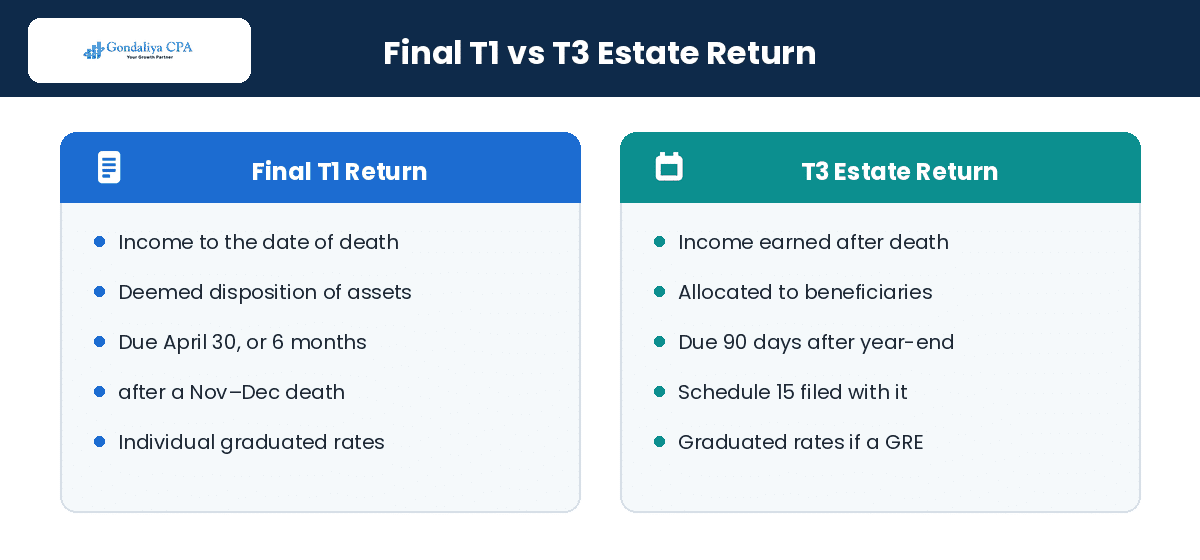
| Aspect | Final T1 return | T3 estate return |
|---|---|---|
| Purpose | Report the deceased’s income to death | Report the estate’s income after death |
| Filing deadline | April 30, or 6 months after death if death was Nov 1 to Dec 31 | 90 days after the estate’s tax year-end |
| Income covered | Employment, investments, capital gains before death | Income from estate assets after death |
| Who files | The executor, for the deceased | The executor, as trustee of the estate |
| Tax rates applied | Individual graduated rates | Graduated rates where the estate is a GRE |
The final T1 and the T3 are not interchangeable. One closes the deceased’s personal tax to the date of death; the other reports the estate as a separate taxpayer afterward. An executor who treats them as one filing, or misses that the estate owes its own return, invites penalties and a reassessment.
An executor filed the terminal T1 and believed the estate’s tax work was finished, not realizing the estate was a separate taxpayer owing a T3. We caught it before the penalties grew. Knowing which return does which job is the difference between a smooth file and a reassessment. Figures changed for privacy.
The Deemed Disposition on Death
On Death
On death, the CRA treats the deceased as having sold their capital property at fair market value immediately before death. This deemed disposition can trigger capital gains on the final return, on a portfolio, a rental property, or private company shares. Accurate date-of-death valuations matter, because the gain is measured against them, and the executor is the one who has to get them right.
The Spousal Rollover and Principal Residence
The main relief is the spousal rollover. Where capital property passes on death to a surviving spouse or common-law partner, or to a qualifying spousal trust, and both were resident in Canada, it transfers at the deceased’s cost base rather than at fair market value, so the gain is deferred rather than triggered. The rollover applies automatically where the conditions are met, but the executor can elect out of it property by property, which can make sense where the deceased had unused capital losses or lifetime capital gains exemption to absorb. The principal residence exemption can also shelter the gain on a qualifying home, and the rollover is a deferral, not forgiveness, because the spouse inherits the deceased’s cost base.
| Situation | Capital gains treatment | Rollover available? |
|---|---|---|
| Property to a surviving spouse | Deferred at cost base | Yes, unless the executor elects out |
| Property to other beneficiaries | Deemed disposition at fair market value | No |
| Qualifying principal residence | Gain may be exempt | Principal residence exemption |
| Private company shares | Deemed disposition; post-mortem planning | Spousal rollover may apply |
Impact of Testamentary Spousal or Common-Law Partner Trust Income on Tax Filing
Testamentary spousal or common-law partner trusts have special Canadian tax rules. They let some taxes be delayed when property moves from one spouse to another. But these trusts come with tricky filing steps that need care.
A CPA for T3 return helps by:
- Applying rollover rules that push capital gains taxes until later sales happen.
- Reporting any unrealized gain changes following the rules about who really owns assets (Schedule 15).
- Filing joint elections between surviving partners’ final returns (T1) and these trusts’ T3 returns.
Wrong moves can cause sudden taxes due. Expert help cuts this risk while using tax reliefs right.
Pro Tip: The election out of the spousal rollover is made property by property, so it is not all or nothing. Where the deceased has unused losses or lifetime capital gains exemption, electing out on selected assets can use them up while rolling the rest. Please have the whole picture modelled before choosing.
An executor let the spousal rollover apply to everything by default, missing the chance to use the deceased’s unused capital losses. Electing out on a couple of properties would have absorbed those losses. The default is not always the best answer, which is why we model it. Figures changed for privacy.
The Graduated Rate Estate and the 36-Month Window
The Window
A graduated rate estate is taxed at graduated personal rates rather than the top rate, for up to 36 months after death. A Graduated Rate Estate (GRE) lets some estates pay taxes like individuals do, using graduated rates instead of flat ones. GRE status lasts up to 36 months after death. This can lower taxes on income made after someone passes away. Executors who know about GRE can plan better and save more for beneficiaries.
To be a GRE, an estate must come only from someone’s death, not from other trusts like testamentary ones set up separately. The executor files forms proving eligibility along with yearly returns. GRE status cuts overall taxes by taxing income at graduated rates rather than the top rate that applies to most trusts. Only a graduated rate estate, and a qualified disability trust, get those brackets. That’s why hiring pros who focus on trust tax preparation, like an estate tax accountant Canada, helps manage complicated estates well, especially when dealing with many assets or high-net-worth clients in Ontario. Charitable donation flexibility and post-mortem planning both live inside this window, which is why acting early in it matters.
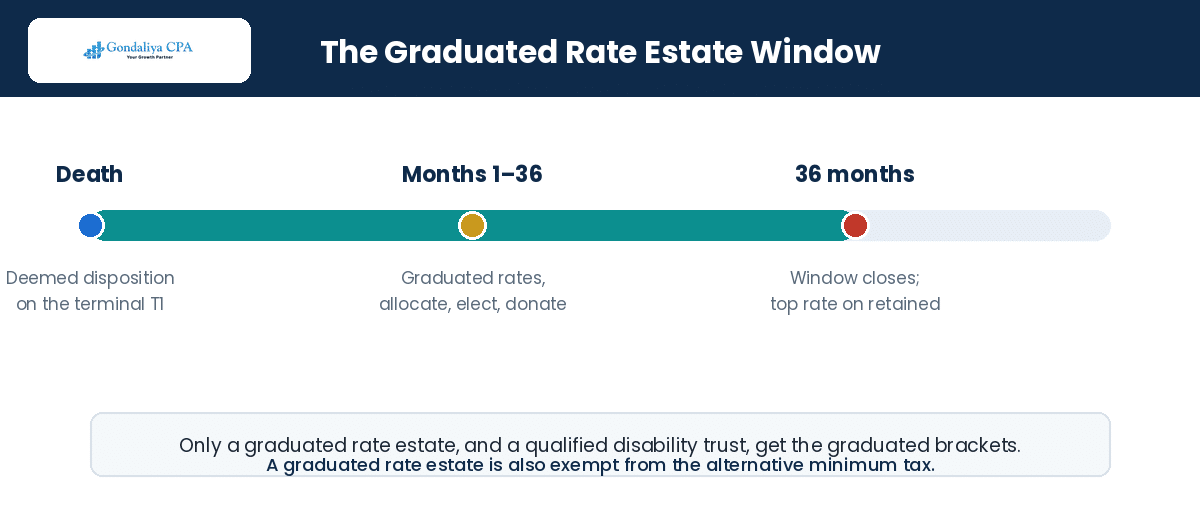
Key Stat: The graduated rate estate window lasts up to 36 months after death. During it, the estate is taxed at graduated rates instead of the top marginal rate, so the elections and allocations made inside the window are the executor’s biggest opportunity to reduce tax.
An estate held income inside the trust through the first two years and planned to distribute in year three, by which point the graduated rate window was nearly closed. Allocating earlier, while the graduated rates were available, would have reduced the total. Early beats late here. Figures changed for privacy.
An estate had more than five T3 slips to issue and a client tried to paper-file, unaware the electronic threshold had tightened. We moved the filing to certified software so it met the requirement. The mechanical rules trip up self-filers as often as the technical ones. Figures changed for privacy.
Filing the T3 Estate Return
The Filing
The executor files the T3 within 90 days of the estate’s tax year-end, allocates income to beneficiaries or the estate, and files Schedule 15. The T3RET is completed with the estate’s income, deductions, and the amounts allocated to beneficiaries, and a T3 slip goes to each beneficiary showing their share, with the T3 Summary reporting the totals. Income can be taxed in the estate or allocated out to beneficiaries, and where it is allocated, it is taxed in their hands rather than the estate’s. Getting that split right is central to the whole exercise.
Schedule 15 and the Deadlines
Schedule 15, the beneficial ownership information, has applied to trust years ending on or after December 31, 2023, and is filed annually with the T3. It reports the trustees, settlors, beneficiaries, and controlling persons. On the deadlines, executors must file the T3 return within 90 days after the estate’s fiscal year ends. Missing this deadline can lead to penalties or interest. Where you file more than 5 information returns of a type, electronic filing is required. Good trust tax preparation means keeping clear records and dividing income properly among beneficiaries, and it also means preparing Schedule 15 for beneficial ownership. An estate tax accountant across Canada makes sure all slips like T3 and T5 are correct and match the reported amounts.
Income Allocation and Beneficiary Distribution Advice
Getting income allocation right is key when doing T3 filing services. A CPA for T3 return makes sure the trust or estate’s investment income shows up properly, either on the trust’s form or passed out to beneficiaries with T3 slips.
Think about which part of interest, dividends, or capital gains goes to beneficiaries or stays in the trust; making clear schedules that show each beneficiary’s share based on will instructions or laws; and sending T3 slips on time, 90 days after the fiscal year ends.
Good distribution advice cuts risks for executors, so no mistakes or late filings happen. It also keeps trustees, executors, and beneficiaries clear about what money is taxable.
Deemed Year-End Considerations and Additional Trusts Management
Trusts must file a new T3 return every year unless they end sooner. A deemed year-end can trigger income or gains recognition that needs taxes paid then.
Executors juggling multiple related trusts benefit from special knowledge through T3 filing services that cover:
- Setting correct fiscal periods per CRA rules.
- Handling extra filings like rights-or-things returns when assets change hands without selling.
- Watching ongoing Schedule 15 disclosures about beneficial owners.
Good management keeps everything smooth across many estate entities. It cuts errors from missed deadlines or incomplete reports.
CRA Deadline: The T3 estate return is due 90 days after the estate’s tax year-end. For an estate that uses a December 31 year-end, that means a March 31 filing. Please diarize it the moment you take on the role, because the late-filing penalty runs automatically at $25 per day, with a minimum of $100 and a maximum of $2,500.
An executor was unsure whether investment income after death belonged on the terminal T1 or the estate’s T3, and had begun putting it in the wrong place. Income earned after death belongs on the T3. Catching that before filing avoided an amendment and a query. Figures changed for privacy.
The Alternative Minimum Tax and Estates
AMT
The alternative minimum tax is a parallel calculation, but graduated rate estates are exempt from it. Non-experts might miss alternative minimum tax (AMT) issues in rich estates. They can also mess up timing between the deceased’s final T1 return and the following T3 filing, both vital for compliance. Where the AMT does apply, to individuals and to most trusts other than a graduated rate estate or a qualified disability trust, the rate is 20.5%, and it can interact with large capital gains and donation claims. For an estate that qualifies as a GRE, though, the AMT does not apply, which simplifies the planning inside the 36-month window.
Our Take: A lot of executor anxiety about the AMT on an estate is misplaced, because a graduated rate estate is exempt from it. The real AMT question usually sits on the deceased’s own final return, where large gains or donations can trigger it, not on the estate’s T3. Knowing which is which saves worry.
An executor had budgeted for the AMT on the estate, believing it would apply. Because graduated rate estates are exempt, that concern fell away and the plan was simpler than feared. Knowing the exemption changed the whole approach to the file. Figures changed for privacy.
Why a CPA Reduces the Executor’s Risk
The Value
A CPA reduces the executor’s risk by getting each technical piece right and sequencing them in the correct order. Hiring a Registered CPA cuts down errors common in self-prepared or non-CPA trust returns. A skilled estate tax accountant Canada-based offers exact capital gains calculations on death-triggered dispositions, proper spousal rollovers when eligible, smart use of GRE benefits with graduated tax rates, well-planned charitable donation arrangements after death, and correct income splits among beneficiaries to avoid double taxation. These points lower audit chances from CRA checks. Plus, they help executors manage after-tax wealth transfers better. Professional trust tax preparation also keeps you on track with deadlines like the 90-day limit after an estate’s fiscal year ends.
Doing it yourself or using non-specialists often leads to mistakes: missing deadlines causes penalties of $25 daily, with a minimum of $100, capped at $2,500; wrong valuations can hide taxable gains; not filing Schedule 15 risks fines starting at $100 each time; issuing beneficiary slips incorrectly raises audit risk. Non-experts might miss AMT interactions on the deceased’s own return, and they can also mess up timing between the deceased’s final T1 return and the following T3 filing. Executors face personal liability if they distribute assets before clearance certificates confirm no taxes are owed. Using professional T3 filing services lowers these risks through strong quality checks and experience handling CRA audits.
| Where a CPA reduces risk | What it prevents |
|---|---|
| Deemed-disposition accuracy | Under- or over-reported gains at death |
| Spousal rollover handling | Missed deferrals or a wasted election |
| GRE utilization | Top-rate tax where graduated rates were available |
| Post-mortem and loss carryback | Double tax on private company shares |
| Charitable giving structuring | A donation credit claimed where it saves least |
| Principal residence planning | An exemption missed on a qualifying home |
| Income allocation to beneficiaries | Double taxation and mismatched slips |
| Holding company integration | Corporate and trust filings that do not reconcile |
| CRA correspondence | Queries that escalate without a clear record |
Tax Planning Strategies for Investment Income Within Trusts and Estates
Tax planning inside trusts and estates looks to lower tax bills on investment income. Trusts face high tax rates, so smart income allocation matters. An estate tax accountant Canada expert might:
- Split income by giving taxable amounts to beneficiaries in lower tax brackets.
- Time capital gains to delay paying taxes when possible.
- Use graduated rate estates (GRE) within 36 months after death to get better tax rates.
- Arrange investments based on how the trust rules tax different assets.
These moves need exact numbers and good trust tax preparation. This helps stay on the CRA’s good side and keeps more money after taxes.
What Are the Tax-Efficient Strategies Gondaliya CPA Uses?
- Maximizing GRE benefits over 36 months post-death.
- Applying spousal rollovers to defer capital gains taxes.
- Utilizing charitable donations within allowable windows to reduce taxable income.
An estate held a large capital gain reported entirely inside the trust at the top rate. Allocating the gain to lower-bracket beneficiaries, where the facts supported it, reduced the total. The technical rules and the documentation together are what made the allocation hold. Figures changed for privacy.
An executor felt family pressure to distribute quickly and nearly released funds before the clearance certificate. We explained the personal-liability exposure and held the distribution until the TX19 arrived. The wait protected them entirely. Figures changed for privacy.
The Clearance Certificate That Protects You
Your Protection
Before distributing the estate, the executor should obtain a clearance certificate from the CRA on Form TX19. The certificate confirms the CRA is satisfied that all amounts the estate owes have been paid or secured. If you distribute the estate and a reassessment later shows more tax was owing, and you did not obtain the certificate, the CRA can hold you personally liable for the shortfall, up to the value you distributed, because the beneficiaries have the money and you released it.
The CRA will not issue the certificate until all required returns are filed and assessed, the balances are paid or secured, and any objections are resolved. Its service standard for issuing the certificate is 120 calendar days from a complete request, so it takes time, and that time has to be built into the administration. Accurate filing also speeds up getting clearance certificates, which are needed to close the estate without risking personal liability.
Risk Warning: Never distribute the estate before the TX19 clearance certificate is in hand. If you do and a reassessment follows, the CRA can pursue you personally for the shortfall, up to the amount you distributed. The certificate is the single most important protection an executor has.
An executor requested the clearance certificate but had not finished filing every return, so the CRA could not start the 120-day clock. Once the returns were assessed and the balances secured, the request proceeded. Sequence matters as much as the request itself. Figures changed for privacy.
How We Prepare an Estate T3, Cost, and Risks
The Engagement
We prepare an estate T3 in a set sequence, from intake to the clearance certificate, so nothing is missed. Work starts once you become executor: an initial consultation and document intake to collect will copies and probate letters and set the goals; a review and valuation of date-of-death asset values, modelling the deemed dispositions; preparation of the deceased’s final T1 return; estate income modelling and allocation, calculating net income and allocating it between beneficiaries and the estate under GRE rules; T3 trust return preparation and filing, completing the forms, issuing slips, and filing electronically within 90 days after year-end; clearance certificate support, helping apply for the TX19 to prevent early-distribution risks; and ongoing advisory and compliance monitoring through any CRA queries until the estate closes. Timelines depend on case complexity but usually take about three months after getting all documents, unless holdings are multi-jurisdictional or include corporate structures.
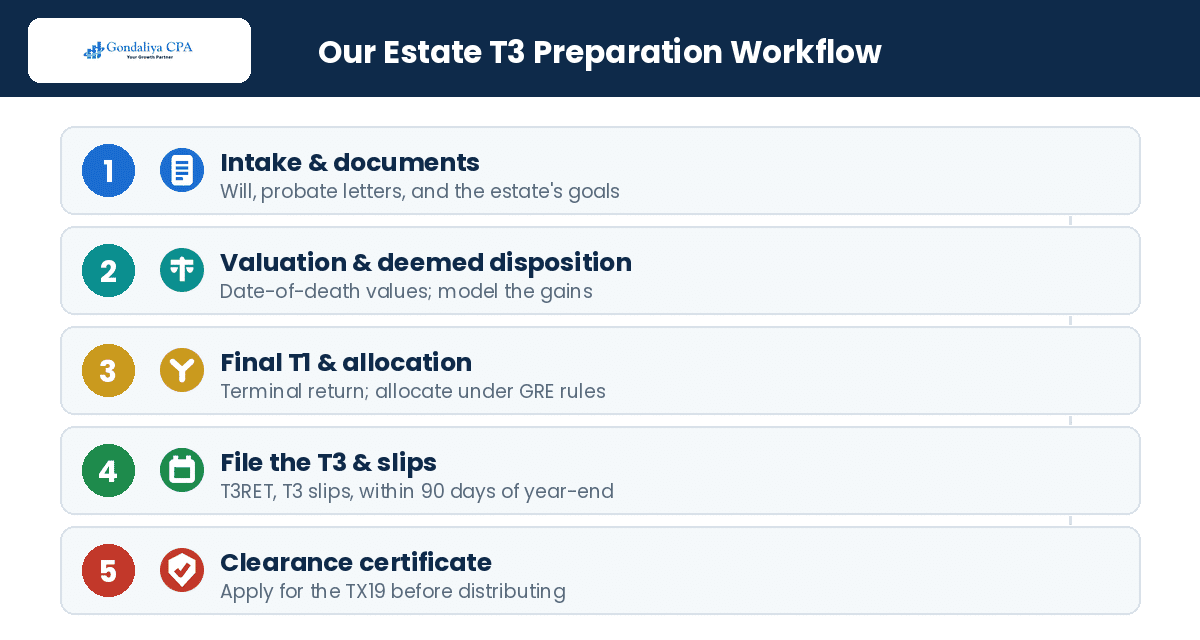
| Phase | Typical duration | Client role | Firm role |
|---|---|---|---|
| Initial consultation | Within the first week | Provide documents | Review initial data |
| Valuation & final return prep | Up to four weeks | Confirm assets | Model valuations |
| Estate income allocation | Two weeks | Approve beneficiary info | Allocate incomes and slips |
| Trust return completion | One week | Review draft | File returns |
| Clearance certificate support | Variable | Submit applications | Liaise with the CRA |
Preparing Formal Estate Accounts and Record Keeping for Settlements
Estate accounts track every financial move during administration: money in and out, investments, gains or losses, expenses, payments to heirs, and debts left over. This is estate settlement accounting in practice.
An estate tax accountant Canada-wide can help by:
- Gathering full records that meet provincial probate rules.
- Matching bank statements with ledgers using tools like QuickBooks or Xero.
- Reporting valuations as of date of death for final returns.
Trust tax preparation means keeping neat records all through settlement. This makes audits easier if CRA asks and clears up any beneficiary questions.
| Key Components of Formal Estate Accounts | Purpose |
|---|---|
| Asset Valuation Reports | Show fair market value at death |
| Transaction Ledgers | Keep track of all ins and outs |
| Expense Documentation | Back up claims that reduce taxable income |
| Distribution Schedules | List payments made to each beneficiary |
What Deliverables Do You Get?
Clients receive an estate and asset diagnostic, a deemed-disposition and capital gains projection, the final T1 return, the estate T3 return and slips, the T3 Summary, a beneficiary allocation schedule, GRE and AMT memo support, estate financial statements, clearance certificate application support, the CRA filing confirmation, and ongoing advisory support. Core deliverables are the returns, the slips, and the clearance support; optional deliverables are the deeper advisory work where an estate is complex.
How Much Do CPA Estate T3 Tax Services Cost in Canada?
Our estate T3 services are billed as a flat annual fee, HST included, quoted in writing after a free consultation, with no surprise invoices. Reputable firms usually charge a flat fee covering everything, from start to clearance certificate application, with no hidden charges later. Prices depend mostly on how complex the estate is, how many beneficiaries there are, whether holding companies are involved, the level of advice needed about GRE and AMT, and the number and difficulty of related filings. You can estimate the corporate side of a group with our corporate tax calculator. Clear pricing helps clients plan their budgets better during the process.
How Gondaliya CPA Ensures Cost Clarity
Gondaliya CPA uses clear flat fees that include HST and cover all main steps, from valuing assets at death to sending final forms. No surprise bills happen thanks to their 60-Day Fees-Matching Policy.
Clients get easy-to-understand bills that match exactly what was agreed on. Changes get communicated quickly so budgets stay in check. Their 1450+ five-star Google reviews show clients appreciate this honesty paired with solid service quality.
| Pricing driver | What increases cost | How to keep it efficient |
|---|---|---|
| Estate complexity | Many or varied asset types | Organize records early |
| Number of beneficiaries | More slips and allocations | Provide a clear beneficiary list |
| Capital property | Valuations and gains at death | Gather cost base records |
| Holding company integration | Corporate and trust filings together | Share the corporate structure up front |
| GRE and advisory depth | More planning beyond compliance | Agree the scope at intake |
To talk it through, please contact us at 647-212-9559 or info@gondaliyacpa.ca for a free consultation, or see our guide to reducing tax on trust and estate income.
Risks, CRA Compliance Issues, and Prevention Controls
Executors often make mistakes like filing T3 returns late, misusing spousal rollovers, forgetting deemed dispositions, wrong beneficiary splits causing double taxes, skipping Schedule 15 disclosures, ignoring alternative minimum tax rules, and paying out before getting clearance certificates. Using professional trust tax preparation cuts these risks by filing on time per CRA deadlines, correctly calculating capital gains and losses, using graduated rate estate benefits right, checking calculations carefully, and keeping good records for every decision.
| Risk area | What happens if missed | CPA control |
|---|---|---|
| Late T3 filing | $25/day penalty, min $100, max $2,500 | Deadlines diarized at intake |
| Distributing before clearance | Executor personally liable | Sequence the TX19 first |
| Missed deemed disposition | Unreported gains and reassessment | Date-of-death valuation modelling |
| Wrong beneficiary split | Double taxation and audit risk | Documented allocation schedule |
| Skipped Schedule 15 | Compliance exposure | Filed annually with the T3 |
Managing CRA Audits and Providing Representation Support
Sometimes trusts or estates get audited by CRA because of errors or random checks. A CPA for T3 return offers expert representation in these cases. These CPAs know trust accounting rules well. They understand documentation needs, beneficiary reports, related-party checks, and alternative minimum tax issues for trusts.
During an audit, CPAs communicate directly with CRA officers for executors or trustees. This reduces stress and protects client interests by using clear records made through proper trust tax preparation.
This helps solve audits faster and avoids long disputes or penalties from non-compliance found during reviews.
Voluntary Disclosure and Appeals Assistance for Trust and Estate Taxes
If past filings missed something, like charitable donation elections, or if there’s a dispute over trust or estate assessments, an estate tax accountant in Canada can help fix things.
They guide clients through the voluntary disclosure program to correct errors without penalties.
They also assist with appeals if clients want to challenge reassessments on tricky issues like AMT on high-income testamentary trusts or principal residence exemptions after death.
These services help trustees stay in good standing with CRA while following the rules on clearance certificate timings.
Continuous Support Beyond Tax Filing
Gondaliya CPA does more than file accurate trust returns that follow national rules. They provide ongoing advice tuned into new laws affecting future filings, such as the Schedule 15 disclosures.
They spot problems early so clients can adjust plans before issues grow, saving money on AMT too.
The team stays open after filing too, helping executors respond quickly if CRA asks questions so problems don’t grow bigger.
Support doesn’t stop after sending forms. Gondaliya keeps watch on law changes that affect how testamentary trusts get taxed now and later, giving quick advice so trustees can make smart choices ongoing.
They send regular updates explaining what new rules mean so trustees stay informed and ready to act fast when needed.
This steady help lowers risk often seen when relying on one-time preparers who don’t follow up properly after filing season ends.
Proactive Advice for Future T3 Filings and Estate Planning
Their expertise goes further into smart strategies that boost intergenerational wealth transfers using things like prescribed-rate loans within ongoing trusts, cutting taxes while preserving family assets smoothly over time.
Early meetings build custom plans including corporate setups where needed so family businesses keep running without hassle after the owner’s passing.
Regular check-ins keep plans aligned with changing tax laws so compliance stays strong while making full use of available reliefs like AMT carry-forwards too.
Executors get confidence knowing support covers them now, and looks ahead for coming years’ duties too without surprises down the road.
What Should an Executor Prepare Before the Engagement?
Executors should gather these before working with an estate tax accountant Canada-wide: certified copies of the will; probate or appointment letters; the death certificate; a list of beneficiaries with contact info; corporate charts if relevant; statements showing investments and property at date of death; appraisals or valuations at date of death if available; prior year personal income returns; adjusted cost base records for assets held; and insurance policies relevant to claims or distributions. Having complete info upfront speeds up processing and avoids delays from missing data during sensitive times. We also offer downloadable checklists tailored for Ontario and Toronto executors. You can download the free estate executor tax checklist anytime.
Estate T3 Filing Fit Checker
This quick self-check flags where the planning and the risks sit for an estate. Please answer the eight questions below.
Estate T3 Filing Fit Checker
Eight quick questions on the estate’s tax steps. No fee shown.
Filing-readiness:
This is a general prompt, not tax or legal advice or a quote. The turnaround band is illustrative and depends on the estate. For a real review, please book a free consultation.
A holding company sat inside an estate, so the corporate T2 and the estate T3 had to reconcile to each other. Preparing both under one roof kept the numbers consistent and the file clean for the eventual clearance request. Split across two providers, that reconciliation is where errors creep in. Figures changed for privacy.
2026 Update — what is current: The capital gains inclusion rate remains one-half. Graduated rate estates remain exempt from the alternative minimum tax, and the AMT rate for those it applies to is 20.5%. Schedule 15 beneficial ownership reporting has applied to trust years ending on or after December 31, 2023. The T3 is due 90 days after year-end, the GRE window is 36 months, and the CRA’s clearance certificate service standard is 120 days.
Industries, Glossary, FAQ, and Next Steps
Industry Expertise
Estate and T3 work looks a little different by sector, usually because of the business assets in the estate. Here are ten sectors and where the executor’s planning tends to sit.
| Industry | Typical Estate / T3 Need |
|---|---|
| Medical doctors & physician professional corporations | PPC dividends and post-mortem planning on the shares |
| Dentists & dental practices | Practice shares and the deemed disposition |
| Daycare, childcare & CWELCC services | Continuing the licence while settling the estate |
| Real estate investors, landlords & holding companies | Deemed disposition on property and the rollover |
| Property developers & builders | Multiple entities and clean reconciliations |
| Construction, contractors & skilled trades | Owner-manager shares and equipment in the estate |
| Technology startups & SaaS | Valuing intangibles and post-mortem planning |
| E-commerce & online retailers | Business value and inventory on the terminal return |
| Restaurants & food and beverage | Operating company and property in the estate |
| Transportation, logistics & trucking | Fleet, equipment, and the spousal rollover |
Summary of Industry-Specific Tax Challenges and Solutions
| Industry Sector | Key Tax Challenge | Solution Focus |
|---|---|---|
| Medical & Dental Professionals | Handling professional corporations; following regulations | Correct PPC dividend treatment; precise Schedule 15 |
| Real Estate Investors & Developers | Valuing assets; applying principal residence exemption | Deemed disposition reports; using GRE rules |
| Technology Startups & E-commerce | Valuing intangibles; cross-border transactions | Aligning deferred revenue; managing international aspects |
| Food Service & Skilled Trades | Inventory swings; payroll complexities | Detailed revenue reports; reducing AMT exposure |
Executors gain value by working with a Registered Ontario CPA firm skilled in these industries’ trust tax preparation needs. This reduces filing errors that raise audit chances and makes administration smoother overall.
- Medical doctors & physician professional corporations: Executors handling their estates must file the T3 carefully, showing income from physician professional corporations and following OHIP and Royal College of Physicians and Surgeons of Canada rules, with post-mortem planning on the PPC shares often the biggest lever. Some issues they face include deferred income plans, CWELCC childcare credits where applicable, and capital gains on practice assets. An estate tax accountant Canada trusts rely on will check slips like T4A(P), T4A(OAS), and PPC dividends. They also verify Schedule 15 for beneficial ownership reporting with CRA rules. Proper trust tax preparation helps avoid mistakes when reporting professional incomes.
- Dentists & dental practices: A practice regulated by the Royal College of Dental Surgeons of Ontario usually sits in a corporation, so the executor plans the deemed disposition on the practice shares and watches for spousal rollovers on those shares after death.
- Daycare, childcare & CWELCC services: When an owner dies, settling the estate and keeping the CWELCC-funded licence running happen together, and the graduated rate estate window is the planning space.
- Real estate investors, landlords & holding companies: T3 filing must report deemed dispositions of real estate at fair market value on death, apply the principal residence exemption where eligible, and track the adjusted cost base across holding companies in the estate. These assets include rental properties, holding companies, land development projects, and GST/HST matters during sales or transfers. Other key points: tracking adjusted cost base across holding companies in trusts; separating rental income from capital gains properly; and avoiding alternative minimum taxes under graduated rate estates rules. Following CRA guidelines reduces audit risks on real estate portfolios inside trusts.
- Property developers & builders: Multiple project entities mean the executor has to sequence the returns and keep the corporate and trust filings reconciling across all of them.
- Construction, general contractors & skilled trades: For electricians, plumbers, and HVAC firms, the owner-manager shares and any equipment held personally both face the deemed disposition, with payroll often run through ADP or Wagepoint that the CPA needs to understand.
- Technology startups & SaaS: Valuing intangible assets like intellectual property or software when they belong to a deceased person is tricky, and private company shares that have grown carry a large deemed disposition, so post-mortem planning matters. An estate tax accountant Canada knows how to handle deferred revenue schedules and stock option plans during trust accounting. Accurate reporting means matching financial statements from QuickBooks or Xero to CRA forms. Other things to watch out for: cross-border transactions for clients operating internationally; ensuring Canadian compliance without ignoring US business rules where relevant; and meeting deadlines with T3 filing services to avoid penalties. These tasks are often complex because startup equity structures can be complicated.
- E-commerce & online retailers: The value built into an online business, and any inventory, show up on the terminal return through the deemed disposition, so valuing them properly and matching QuickBooks or Xero to the CRA forms is part of the job.
- Restaurants & food and beverage: Fluctuating inventory and an operating company alongside any property mean the executor coordinates the deemed disposition and the revenue reporting across both. Trust returns must show business revenues accurately after death. Employment deductions allowed by CRA also matter here.
- Transportation, logistics & trucking: Fleet and equipment, and often a spouse in the business, mean the executor plans the deemed disposition and the spousal rollover together, separating active beneficiaries from passive ones. It’s important to separate income among beneficiaries who actively work in the business versus those who receive passive distributions from testamentary trusts. This careful planning lowers risks of triggering alternative minimum taxes through smart trust tax preparation.
An executor for a physician’s estate faced a large deemed disposition on the professional corporation shares. Post-mortem planning, handled early with the estate’s lawyer, addressed the double-tax exposure. The corporation is where the biggest executor savings often sit. Figures changed for privacy.
A restaurant estate held fluctuating inventory and an operating company, and the T3 had to report the business revenue accurately after death. Reconciling the books to the return kept the file clean. Inventory-heavy estates live or die on that reconciliation. Figures changed for privacy.
Criteria for Selecting an Experienced Estate Tax Accountant in Canada
Picking the right estate tax accountant in Canada matters a lot. You want someone who knows trust tax preparation and how to handle T3 returns well. A good CPA for T3 return will understand Canadian estate tax rules. This includes CRA regulations about graduated rate estates (GRE), deemed disposition, and Schedule 15 reporting. Look for an Ontario CPA firm with experience working on estates of incorporated SMB owners or high-net-worth people.
Here are some things to check:
- Professional Credentials: Make sure they are CPA Ontario members and registered.
- Specialized Experience: Have they worked on estates with capital gains on death, spousal rollovers, or alternative minimum tax (AMT)?
- CRA Compliance: Can they meet tight deadlines like the 90-day T3 filing without penalties?
- Clear Pricing: Do they offer flat fees or fixed prices so you won’t get surprise bills?
- Good Communication: Can they reply within one business day? Do they offer weekend or evening help?
Choosing a skilled estate tax accountant Canada-wide means your trust tax preparation follows current CRA rules and avoids issues.
How To Choose the Right CPA Firm in Toronto/Ontario for Estate T3 Returns
Look for firms with:
- CPA Ontario membership verified credentials.
- Proven experience with GREs and Schedule 15 disclosures.
- Transparent fixed pricing structures without hidden fees.
Key Questions for Your CPA Interview
When you talk to CPAs about your estate’s trust tax preparation, ask clear questions to find out if they fit your needs:
- What experience do you have with T3 returns for incorporated SMB owners?
- How do you handle GRE status or alternative minimum tax problems?
- Can you explain how you deal with Schedule 15 beneficial ownership disclosures?
- What tools do you use for date-of-death valuations and deemed disposition?
- How do you manage final T1 returns together with the estate’s T3 filings?
- Do you offer advice or support after the filing deadlines?
These questions help pick an estate tax accountant Canada trusts and lowers risks for executors.
Comparing CPA Firms to Non-CPA Providers and DIY Options
| Factor | DIY | Non-CPA Provider | Registered CPA Firm |
|---|---|---|---|
| Compliance Risk | High | Moderate | Low |
| Executor Liability | High | Moderate | Minimal |
| Expertise in Complex Issues | Limited | Varies | Extensive |
| CRA Audit Readiness | Poor | Fair | Excellent |
| Cost | Lowest | Mid-range | Higher but Clear |
| Best For | Simple Estates | Medium complexity | Executors wanting peace of mind |
In short: Hiring a Registered CPA cuts chances of costly mistakes. They offer thorough professional trust tax preparation tailored to Canadian laws.
Benefits of Professional vs Non-Professional or Self-Prepared Returns
- They apply complex rules like GRE right, reducing audit risks.
- They spot planning chances like using charitable donation windows.
- They split income properly among beneficiaries to save taxes.
- They handle clearance certificates correctly so executors aren’t liable.
- Pros also make communication smoother with CRA if questions come up after filing.
When a CPA Is Essential Versus Optional
You need a CPA when the estate is complex. Think incorporated businesses, big capital assets needing deemed disposition, or many beneficiaries requiring tricky income splits under GRE rules.
If the estate is simple with no companies or large assets, you might skip the CPA. But watch out: Schedule 15 reporting will make things harder to do alone.
Why Local Knowledge Matters for Estate and Trust Tax
Local knowledge matters a lot when dealing with provincial differences like Ontario probate alongside federal CRA trust rules. A Toronto-based team knows local legal details well, helping speed up paperwork and avoid delays common elsewhere.
Estate work needs knowing local requirements like timely probate fee notices in Ontario, plus federal tasks such as rights-or-things returns where needed. Missing deadlines here can cause fines, often due to outside experts missing local specifics.
Trust accounting done by locals ensures rules get followed not just by law but by practical steps that smooth out settlement periods too.
Executors gain from this insight by avoiding common mistakes that could cost money later on.
Bilingual Client Support for Multicultural Families
Offering bilingual help breaks down language walls many Canadian families face when handling cross-cultural inheritances. This improves understanding of tricky things like AMT, spousal rollovers, and splitting income among beneficiaries, reducing errors caused by miscommunication.
Multilingual service fits Canada’s official languages policy well. It makes clients feel comfortable during important talks starting from the first meeting onward.
Our team easily supports English-French speakers every step of the way here.
Glossary of Key Terms
- Estate: The property and affairs a person leaves on death, administered by the executor.
- Executor / estate trustee: The person responsible for administering the estate.
- Testamentary trust: A trust created by a will, arising on death.
- Graduated Rate Estate (GRE): An estate taxed at graduated personal rates up to 36 months after death.
- Deemed disposition on death: The treatment of the deceased as selling capital property at fair market value on death.
- Final T1 return: The deceased’s personal return to the date of death, also called the terminal return.
- T3 estate return: The estate’s annual income tax and information return during administration.
- T3 slip: The slip issued to each beneficiary showing their share of the estate’s income.
- Clearance certificate (TX19): The CRA document confirming no taxes are owing before distributing assets.
- Spousal rollover: The subsection 70(6) deferral of gains on transfer to a spouse or spousal trust.
- Alternative Minimum Tax (AMT): A parallel tax; graduated rate estates are exempt, and the rate is 20.5% where it applies.
- Schedule 15: The beneficial ownership disclosure form filed annually with the T3, applying to trust years ending on or after December 31, 2023.
- Adjusted cost base: The tax cost of an asset, used to work out the capital gain.
- Principal residence exemption: The relief that can shelter the gain on a qualifying home.
People Also Ask
Can I file a T3 return myself without a CPA?+
You can, but you risk errors that lead to penalties or audit triggers without expert knowledge. Because the executor is personally liable, many choose a CPA for the T3 to protect themselves, especially where there are capital property, a holding company, or several beneficiaries.
How long does it take to complete a trust tax return?+
Typically about three months after all documents are received, depending on complexity. Multi-jurisdictional holdings or corporate structures take longer, while a straightforward estate can move faster.
Is a graduated rate estate subject to the alternative minimum tax?+
No. Graduated rate estates are exempt from the AMT. For taxpayers to whom the AMT applies, the rate is 20.5%, but a GRE is not among them, so AMT usually concerns the deceased’s own final return rather than the estate’s T3.
What is the difference between probate and the T3 return?+
Probate, in Ontario the Estate Administration Tax with its Estate Information Return, is about administering the estate. The T3 is the estate’s income tax return. They are separate obligations with separate deadlines.
When is the deceased’s final return due compared with the T3?+
The final T1 is due April 30 following the year of death, or six months after death where death was in November or December. The T3 is due 90 days after the estate’s tax year-end. They are different dates.
Frequently Asked Questions
| Question | Short answer |
|---|---|
| Executor’s key duties? | File the final T1 and the T3, notify the CRA, allocate income, obtain clearance. |
| Final return vs T3? | The T1 covers income to death; the T3 covers estate income after death. |
| What is a GRE? | An estate taxed at graduated rates for up to 36 months after death. |
| Does AMT hit the estate? | No; graduated rate estates are exempt. The rate is 20.5% where it applies. |
| Why hire a CPA? | Accurate filings, met deadlines, and protection from personal liability. |
What are the key tax responsibilities of an executor after death in Canada?+
Executors must file the deceased’s final T1 return and any required T3 trust returns. They notify the CRA, collect estate assets, and allocate income correctly. They also obtain a clearance certificate before distributing, which is what protects them from personal liability.
What is the difference between a final tax return and a T3 estate return?+
A final tax return (T1) reports the deceased’s personal income up to death. The T3 estate return reports income earned by the estate or trust after death. The T1 is due April 30 or six months after a November-to-December death; the T3 is due 90 days after year-end.
What is a Graduated Rate Estate (GRE) and why does the 36-month window matter?+
A GRE allows estates to use individual graduated tax rates for up to 36 months post-death, potentially lowering taxes on income earned during that period. After the window, retained income is taxed at the top rate, which is why the elections inside it matter.
How does Alternative Minimum Tax (AMT) affect estate and high-income planning?+
The AMT can increase tax on individuals with large capital gains or donations, but graduated rate estates are exempt from it. Where it applies, the rate is 20.5%. Proper planning on the deceased’s own return helps manage AMT exposure.
Why does hiring a CPA reduce an executor’s trust and estate tax risks?+
CPAs ensure accurate filings, meet deadlines, apply complex rules correctly, and help avoid costly errors or CRA audits. They also sequence the clearance certificate correctly so the executor is not left personally liable.
What are tax-efficient ways to settle and transfer estate wealth?+
Using spousal rollovers, GRE status, charitable donations, and proper income splitting can reduce taxes on transfers to beneficiaries.
How does DIY filing compare with CPA or non-CPA providers for estate T3 returns?+
DIY risks errors and penalties. Non-CPA providers vary in expertise. Registered CPAs offer compliance, accuracy, and audit support.
What deliverables do you get from professional CPA estate T3 services?+
Clients receive accurate T3 filings, beneficiary slips, clearance certificate assistance, detailed income allocations, and ongoing advisory.
How much do CPA estate T3 tax services cost in Canada?+
We charge a flat annual fee, HST included, set by the estate’s complexity, with transparent billing and no surprise invoices. It is quoted in writing after a free consultation. Costs reflect valuation, preparation, filing, and support through the clearance certificate.
What are common risks and CRA compliance issues in estate trust filing?+
Late filings cause penalties. Errors in valuations or beneficiary reporting increase audit chances. Missing Schedule 15 disclosures leads to fines.
What should an executor prepare before starting an estate T3 engagement?+
Gather the will, probate documents, asset valuations at death, beneficiary information, prior returns, adjusted cost base records, and insurance policies relevant to the estate. Complete information upfront speeds up the work and avoids delays.
Credentials & Registrations
Gondaliya CPA offers experienced professionals specializing in Canadian trust tax laws. The firm maintains authoritative knowledge updated through ongoing legislative changes ensuring trusted guidance across all filings.
| Trust signal | What it means for clients |
|---|---|
| Registered Ontario CPA firm | Registered with CPA Ontario; verifiable on the public register |
| US CPA licences in Washington and Montana | Cross-border credibility; Canadian rules still govern the file |
| Flat annual fee, HST included | No surprise invoices; quoted before work starts |
| 1450+ five-star Google reviews | A consistent track record clients can read |
| CPA Ontario Registered Firm | A registration you can verify |
You can verify our firm directly on the CPA Ontario public firm directory. Our editorial policy is simple: we research against CRA and Ontario sources, fact-check the figures, and Sharad Gondaliya, CPA, reviews the content, which we update as the rules change.
Contact Gondaliya CPA at 647-212-9559 or info@gondaliyacpa.ca for help with an estate’s T3 and the clearance certificate. For the planning behind the return, see our ultimate guide to trust and estate tax returns, and if a CRA letter arrives, our CRA audit representation team responds for you.
Filing an estate T3? We handle it from the return to the clearance certificate
Gondaliya CPA prepares the final T1 and the T3, models the deemed disposition and the rollover, allocates the beneficiary income, and requests the clearance certificate, on a flat annual fee, HST included, with a one-business-day response. Please book a free consultation.
Next Steps
Hiring a CPA for the T3 reduces an executor’s risk because the deemed disposition, the graduated rate estate, the rollover, the allocations, and the clearance certificate all have to be right and in the right order. Please provide all requested documents early to speed processing, approve the valuations before the returns are finalized, and stay engaged through the clearance certificate application until the estate closes. Contact Gondaliya CPA at 647-212-9559 or info@gondaliyacpa.ca for a free consultation about your estate, anywhere in Toronto, Ontario, or across Canada. If our content helps, please add gondaliyacpa.ca as a preferred source on Google.
Published: July 20, 2026 · Last updated: July 20, 2026
Disclaimer: This article is educational information only and is not tax, legal, or financial advice, and it is not a substitute for advice from the estate’s own lawyer and CPA. It reflects CRA rules current to 2026, including the 90-day T3 deadline, the terminal T1 timing, the 36-month graduated rate estate window, the one-half capital gains inclusion rate, the subsection 70(6) spousal rollover, the exemption of graduated rate estates from the alternative minimum tax with a 20.5% rate where it applies, the TX19 clearance certificate with a 120-day service standard, and Schedule 15 beneficial ownership reporting for trust years ending on or after December 31, 2023. We make no guarantee of any outcome, refund, or saving. Rules change and outcomes depend on your specific facts. Please consult a Registered CPA and the estate’s lawyer before acting. Fees include HST.

Sharad Gondaliya is a CPA Canada & CPA USA with 15 Years+ experience of Accounting, Tax, Payroll of Corporate Small Businesses as Tax Accountant. He is a CPA Ontario member (61040184) and holds US CPA licences in Washington and Montana and is well known among corporate small businesses for tax planning, efficient tax solutions, and affordable CPA services. Sharad is the Principal (Director) of Gondaliya CPA – Affordable CPA Firm in Canada. Licenses: CPA Ontario: 61040184 | CPA USA (MT): PAC-CPAP-LIC-033176 | CPA USA (WA): 57629 | CPA Firm License: 61330051 View Full Author Bio