



Holding Company Tax Planning Strategies in Canada: How Business Owners Can Reduce Taxes and Protect Wealth
Holding company tax planning Canada is vital for maximizing benefits and minimizing liabilities in corporate tax planning. Gondaliya CPA offers clear guidance on holding company tax strategies, helping Canadian holding company owners navigate rules and optimize their corporate tax planning Canada.
Quick Summary
A holding company can defer tax, protect assets from operating risk, and organize succession, mainly by receiving tax-free intercorporate dividends from the operating company and holding them apart from the business. Please note it is not right for everyone: it adds a second corporation to file and only earns its keep when there are retained profits to protect or invest, or a clear succession or creditor-protection reason. Holding company tax planning Canada: Effective strategies for corporate tax planning with Canadian holding company insights.
| Aspect | Details |
|---|---|
| The core mechanism | Tax-free dividends from the operating company to the holdco. |
| The main benefits | Tax deferral, asset protection, and succession planning. |
| The key limit | It defers tax; it does not eliminate the eventual personal tax. |
| Who it suits | Owners with retained profits, creditor exposure, or succession goals. |
Reading time: 26 minutes.
Table of Contents
- What Is a Holding Company?
- Tax-Free Intercorporate Dividends
- Tax Deferral and the Passive Income Grind
- Asset Protection and Creditor Risk
- Succession, Estate Freezes, and Family Trusts
- The Lifetime Capital Gains Exemption and Purification
- The Costs and When a Holdco Is Wrong
- Setting Up and Running a Holdco Correctly
- Industry Spotlights: Sectors We Represent
- Glossary of Key Terms
- Frequently Asked Questions
- People Also Ask
The Numbers That Matter
This article covers Canada, with Ontario and Toronto context, and reflects CRA rules current to 2026. It assumes a Canadian-controlled private corporation, or CCPC, and an owner-managed group. Plans assume compliance with CRA guidelines including associated corporation rules, TOSI regulations, passive investment limits and updated federal-provincial rates. “Illustrative” figures are examples, not quotes, and any masked engagement notes end with “Figures changed for privacy.” This is educational information only and not tax, legal, or financial advice, and whether a holding company suits you depends on your specific facts. Fees include HST. Corporate and passive-income rules change, so please confirm your own situation with a Registered CPA before restructuring.
Holding Company Tax Planning in Canada: Importance for Business Owners
Holding company tax planning in Canada helps business owners reduce their taxes and protect their assets. Using a Canadian holding company, or holdco, is a popular way to do this. It offers more than just tax savings. A holdco also shields personal wealth from business risks and makes ownership changes easier.
With a holdco, owners keep personal assets separate from operating companies (opcos). This separation lowers the risk that personal wealth will be affected by business problems. Also, intercorporate dividends allow money to move between companies without extra tax. This helps keep access to the small business deduction (SBD), which cuts overall taxes.
A smart holdco setup can make a big difference for entrepreneurs who want to protect and grow their wealth.
What Is a Holding Company?
The Basics
Defining a Canadian Holding Corporation (Holdco)
A Canadian holding company mainly holds shares or assets of other businesses. It usually doesn’t run day-to-day operations but manages investments instead. This role is key in corporate tax planning Canada.
The holdco moves money between subsidiaries without triggering extra tax on profits. It helps with flexible dividend payments and using capital gains exemptions when selling shares. The structure also lets business owners manage passive income more easily.
Knowing how a Canadian holding company works is helpful for anyone trying to plan their corporate taxes better.
A holding company, often shortened to holdco, is a corporation whose main purpose is to own things rather than to run a business. It typically holds the shares of an operating company, the opco that actually trades, and may also hold investments, real estate, or cash. The opco earns the income; the holdco holds the wealth. That simple separation is the root of nearly every advantage a holding company offers.
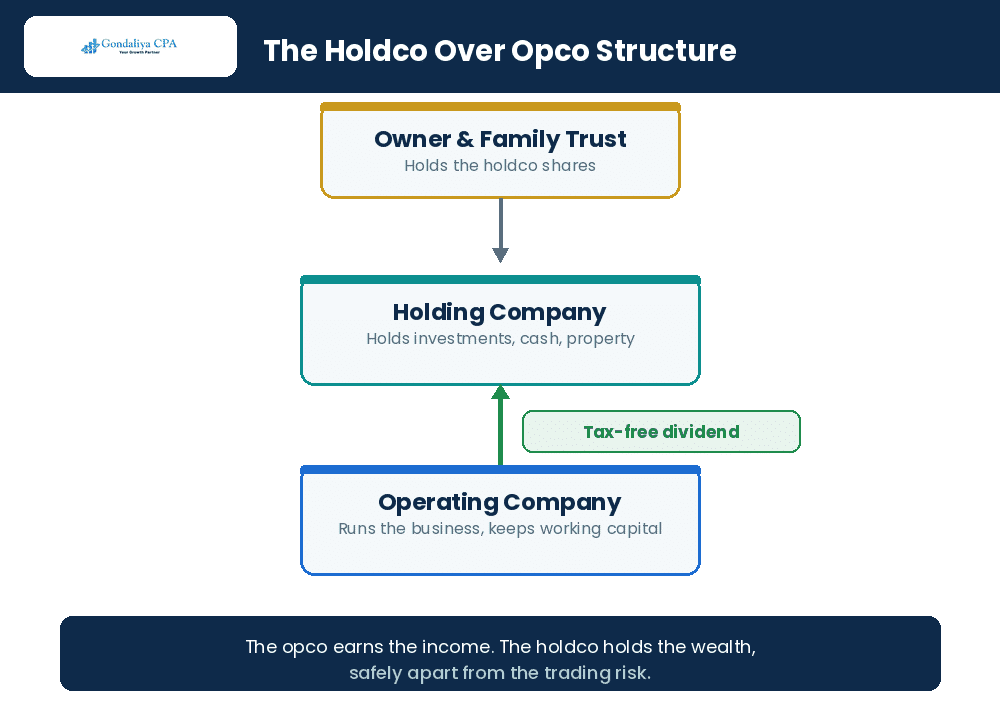
The structure matters because a corporation is a separate legal person. When the operating company pays its after-tax profits up to the holding company as a dividend, that money leaves the reach of the operating business, and it does so, in the right circumstances, without an immediate tax bill. From there the holding company can invest it, protect it, or pass it down, all while the operating company keeps trading with only the working capital it actually needs.
None of this is exotic. It is the standard architecture behind most established owner-managed groups in Canada. What varies is whether a particular owner has enough retained profit, enough risk, or enough of a succession plan to make the second corporation worth its cost. To decide that, our page on whether you need a holding company is the place to start.
Overview of Corporate Tax Planning Strategies Using Holdcos
Holding company tax strategies focus on protecting assets and managing income smartly. Here are some common tactics:
- Asset Protection: Keep personal wealth safe by separating it from business risks.
- Income Splitting: Share income with family members who pay lower taxes, within legal limits.
- Dividend Timing: Choose when to pay dividends to control taxable income.
- Capital Gains Exemption: Use lifetime capital gains exemption when selling shares owned by the holdco.
- Tax-Efficient Investments: Invest extra funds through the holdco to defer taxes until money is withdrawn.
These steps help business owners manage their finances well while following Canadian corporate tax rules. Using holding company tax planning Canada can improve cash flow now and support growth later.
Understanding these strategies matters if you want your business to stay profitable and avoid surprises in changing economic conditions.
Common Holdco Structure Types and Their Tax Implications
There are different holdco structures you see often: single-tier holdco-opco models versus multi-tier holdings with several subsidiaries handling real estate, IP licensing, or other roles. Each has unique effects on asset protection, small business deduction access, intercompany deals, and Part IV taxes on portfolio dividends received by Holdcos.
Here’s a quick look:
| Structure Type | Small Business Deduction Access | Asset Protection Level | Dividend Flexibility | Key Limitation |
|---|---|---|---|---|
| Single OpCo | Full | Limited | Direct | No asset separation |
| Two-Tier HoldCo–OpCo | Maintained if set up right | High | Better | More complex & costly |
| Multi-Tier Holdings | Varies | Very high | Highest | Heavy admin workload |
Most SMB owners wanting creditor protection plus flexible wealth options paired with solid corporate tax planning Canada results stick with the two-tier holdco-opco model. Choosing depends a lot on your size, goals, and how much complexity you want—Registered Ontario CPAs know current rules well enough to guide you.
Opco Alone vs Holdco–Opco Structure: What Is the Difference?
Opco alone holds operations but exposes assets directly to business risks. Holdco–Opco splits ownership; Holdco protects assets and manages investments separately while enabling flexible dividend flows.
An owner assumed a holdco was only for large companies and had left several years of profit exposed inside the operating company. Moving the retained earnings up to a holding company separated the wealth from the trading risk. The size of the business was never the real question. Figures changed for privacy.
An owner thought moving money to a holdco would trigger tax and had avoided it for years. Because the dividend between the connected companies flowed tax-free, the surplus moved up without a bill. The fear of a tax hit had kept the wealth exposed. Figures changed for privacy.
Tax Advantages and Benefits of Holding Companies
Key Holding Company Tax Planning Strategies
Tax-Free Intercorporate Dividends
The Mechanism
Intercorporate Dividends as a Tax-Free Transfer Mechanism
Intercorporate dividends let Canadian holding companies get dividend payments from their operating subsidiaries without paying extra tax. This is a key part of holding company tax planning Canada. It helps move money within corporate groups while keeping capital safe for reinvestment or creditor protection.
The Income Tax Act says dividends paid between connected corporations are usually tax-free for the receiving corporation. This helps with cash flow and delays personal taxes until shareholders take dividends.
Using intercorporate dividends well supports corporate tax planning Canada by lowering taxable income at the holding company level and improving after-tax returns.
For example: An operating company (Opco) pays dividends to its Canadian holding company (Holdco). The Holdco keeps that money for future investments or payouts. This setup lets owners choose when to pay dividends based on their own tax situations.
The engine of holding company planning is the intercorporate dividend. When the operating company pays a dividend to a connected holding company, that dividend generally flows across tax-free, because the profit was already taxed once inside the operating company and the system does not tax it again as it moves between related corporations. This is the single mechanism that makes almost everything else possible.
How Do Intercorporate Dividends Enhance Dividend Flexibility?
They enable seamless movement of funds between subsidiaries without triggering immediate personal taxes. This flexibility supports reinvestment or deferred payouts aligned with owner needs.
Because the money arrives in the holding company without a fresh tax hit, the owner can sweep surplus cash out of the operating business regularly, leaving the opco lean, and let the holdco decide what to do with it. The tax the owner personally will eventually pay, when the money finally comes out to them as a dividend, is deferred until that day, not avoided. That distinction runs through this whole article: a holding company is a deferral and protection tool, not a way to make tax disappear.
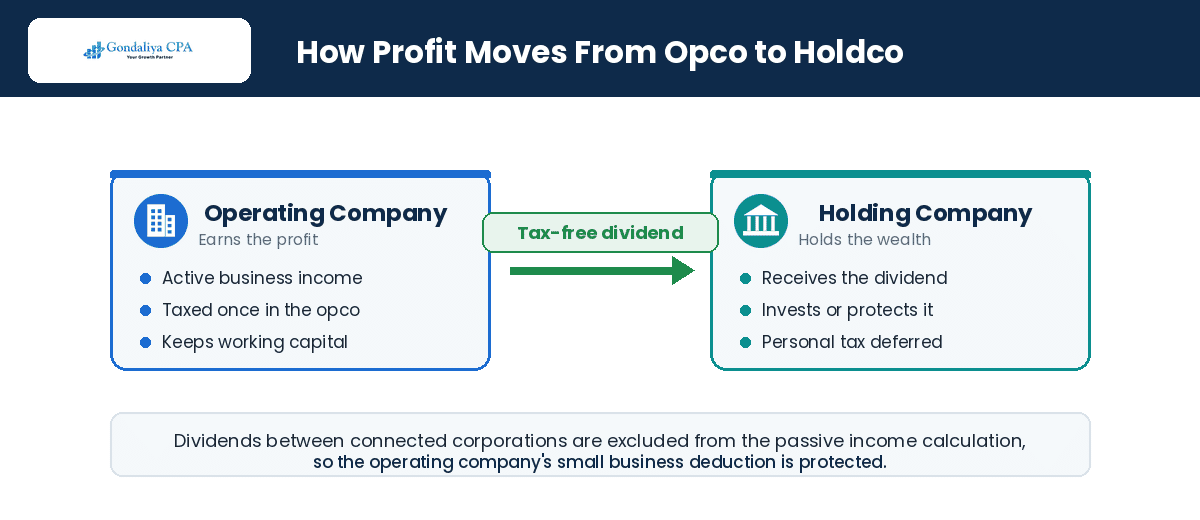
Key Stat: A dividend from an operating company to a connected holding company generally moves tax-free, because the underlying profit was already taxed in the operating company. That single feature is what lets an owner move surplus out of the trading business and hold it safely, while deferring the personal tax until the money is finally paid out to them.
An owner was paying themselves large dividends personally each year and paying full personal tax, simply to get cash out of the operating company for safety. Redirecting the surplus to a holding company achieved the same protection while deferring the personal tax. The money was safe without being taxed early. Figures changed for privacy.
Tax Deferral and the Passive Income Grind
Deferral
Tax-Deferral Opportunities Through Holding Company Structures
Holding company tax planning Canada lets you delay paying taxes by splitting your business into two parts: an operating company (Opco) and a holding company (Holdco). When Opco makes money, it can send dividends to Holdco without triggering taxes thanks to intercorporate dividend rules. You only pay personal tax when you take money out from Holdco.
This setup helps business owners keep earnings inside the corporate group. They can then reinvest or earn passive income at lower corporate tax rates instead of higher personal rates. Corporate tax planning Canada with holdcos helps choose the best time to pay dividends, so you lower your immediate personal taxes but still grow your capital inside the company.
For example: instead of taking out all profits every year and paying top taxes, a Canadian holding company can collect earnings through Opco dividends. That cash grows inside Holdco without extra tax until you need it for investments or payouts.
Tax deferral is the benefit owners feel first. Money that would have been taxed in the owner’s hands if drawn personally can instead stay invested inside the corporate group, working, until the owner actually needs it. Over years, deferring the personal tax and reinvesting the difference can compound into a meaningful advantage, which is why so many incorporated professionals and business owners accumulate investments corporately.
The Passive Income Grind, and Where the Holdco Helps
There is an important rule to plan around. Where a Canadian-controlled private corporation earns more than $50,000 of adjusted aggregate investment income in a year, its access to the small business deduction begins to grind down, reducing by $5 for every $1 of passive income above $50,000, and it is eliminated entirely once passive income reaches $150,000. Losing the small business deduction means the operating company’s active income is taxed at the higher general rate rather than the low small business rate, which is a real cost. Here is where the holding company earns its keep: dividends between connected corporations are excluded from that passive income calculation, so moving the surplus up to a holdco and investing it there can keep the operating company’s small business deduction intact. The holding company still pays tax on its own passive income, but the operating company’s low rate is protected.
| Item | The 2026 rule | Why it matters for a holdco |
|---|---|---|
| Small business limit | $500,000 of active business income | Taxed at the low small business rate |
| Shared limit | Split across associated corporations | A group shares one $500,000 limit |
| Passive income grind starts | Above $50,000 of investment income | The limit begins to phase out |
| Grind rate | $5 of limit lost per $1 over $50,000 | The limit erodes quickly |
| Grind fully eliminates the limit | At $150,000 of passive income | Active income taxed at the general rate |
Managing Passive Income Risks and Small Business Deduction Reduction Amongst Associated CCPCs
Passive investment income over $50,000 a year triggers cuts to the small business deduction’s $500,000 limit among associated CCPCs.
Managing passive income carefully is vital in holding company setups to keep low small business tax rates for linked entities.
Canadian-controlled private corporations must watch total investment income closely. Going past limits causes a proportional cut in the shared small business deduction among connected corporations. Holdcos often hold passive investments; but too much passive income can raise taxes by cutting SBD access.
Ways to handle this include:
- Separating active businesses from investments using different companies
- Avoiding too many passive assets in holdcos past key thresholds
Corporate tax planning Canada means checking related entities’ incomes under CRA’s association rules regularly.
This protects important SBD benefits for SMB owners wanting good after-tax profits while following rules for groups of CCPCs.
Monitoring Small Business Deduction Full Grind Start
Track passive investment income quarterly to avoid hitting the full SBD phase-out starting at $50K passive income per year combined across associated corporations.
Risk Warning: A holding company does not switch off the passive income rules; it relocates the passive income. The holdco pays tax on what it earns, and if the group is associated, the small business limit is still shared. Please have the whole group modelled, because a holdco set up without regard to association can move a problem rather than solve it.
Monitoring and Mitigating Risks Related to Passive Income SBD Grind
Watch these risks:
- Passive Investment Income Threshold: Going over $50,000 cuts your SBD limit bit by bit until it vanishes near $150K passive income across related firms.
- Associated Corporation Rules: Owning several connected corporations combines their numbers—reducing each one’s share of the SBD if you’re not careful.
How to manage:
- Review financials every quarter.
- Separate active business revenue from investment income clearly.
- Move extra investments outside operating groups if needed.
- Plan dividend payments smartly so earnings don’t pile up too much.
- Use accounting software that flags when you near limits.
Ignoring these could cost more than money—you invite audits focused on misclassifying income. CRA may add penalties or charge interest later on if things look off.
An operating company had built a large investment portfolio inside itself and was quietly losing its small business deduction to the passive income grind. Moving the investments to a holding company protected the operating company’s low rate going forward. The grind was eroding the low rate before anyone noticed. Figures changed for privacy.
Understanding the Refundable Dividend Tax on Hand (RDTOH) and General Rate Income Pool (GRIP) Systems
The Refundable Dividend Tax on Hand (RDTOH) system recovers taxes paid on investment income inside Canadian-controlled private corporations (CCPCs). When a company pays taxable dividends, it gets refunds of RDTOH amounts. This stops double taxation of passive income. RDTOH arises at 30⅔% on investment income and is refunded at 38⅓% of taxable dividends paid, split into eligible and non-eligible pools since 2019.
Holding companies can use RDTOH smartly by syncing dividend payments with operating companies. Proposed rules in Bill C-31, not yet law as of October 2026, would suspend the dividend refund on a taxable dividend paid to an affiliated private or subject corporation that has a later balance-due day, for taxation years beginning on or after November 4, 2025. The General Rate Income Pool (GRIP) tracks earnings taxed at general rates that qualify for eligible dividends. Managing GRIP well helps Holdcos pay eligible dividends efficiently, boosting shareholder after-tax benefits.
In practice, matching intercorporate dividend flows with RDTOH refunds means businesses get their refundable taxes back quickly while keeping money in the group. These systems are key parts of advanced holding company tax strategies that improve cash flow and cut overall taxes.
What Are RDTOH and Why Do They Matter?
RDTOH recovers taxes paid on investment earnings inside CCPCs when taxable dividends are paid out to shareholders; managing RDTOH ensures better cash flow management for holdcos.
Asset Protection and Creditor Risk
Protection
Asset Protection Benefits Provided by a Holding Corporation
Beyond tax, a holding company is a shield. An operating business carries risk, from lawsuits, from suppliers, from lenders, from the ordinary hazards of trading. Cash and investments left sitting inside that operating company are exposed to those risks. If the business is sued or fails, creditors can reach the assets on its balance sheet.
A Canadian holding company offers solid protection for your assets by keeping them separate from your business risks. Things like real estate, patents, investments, or cash held in Holdco don’t get touched if Opco faces lawsuits or debts.
Creditors usually can’t claim assets owned only by the holdco unless you gave specific guarantees. This separation helps protect wealth and makes passing assets on easier because they stay safe even if the operating business struggles.
This approach fits well with good corporate governance advice seen in professional holding company tax planning Canada services focused on keeping wealth safe from surprises.
By sweeping surplus assets up to a holding company, an owner puts that wealth behind a legal wall. The operating company keeps only what it needs to run, so a creditor of the operating business generally cannot reach the investments and retained earnings sitting safely in the holdco. For any owner in a litigious industry, or one carrying real financial risk in the trading company, this protection alone can justify the structure, before a single dollar of tax is considered.
Our Take: The tax benefits of a holding company get the attention, but for many owners the asset protection is the quiet reason it is worth it. Keeping years of accumulated profit out of the reach of the trading company’s creditors is peace of mind that a good year of tax deferral cannot buy.
A business in a claims-prone industry held all its retained earnings inside the operating company. A single dispute could have reached the lot. Moving the surplus to a holding company put years of profit behind a wall before any trouble arrived. Protection is cheapest bought early. Figures changed for privacy.
Succession, Estate Freezes, and Family Trusts
Succession
A holding company is also the natural home for succession planning. When an owner starts thinking about passing the business to the next generation, or eventually selling it, the holdco is where the structure is built.
The Estate Freeze
The classic move is an estate freeze. The owner locks in the current value of their shares, often exchanging them for fixed-value preferred shares, so that all future growth in the business accrues to new common shares held by the next generation, frequently through a family trust. The owner caps the gain that will be taxed on their eventual death at today’s value, and the children, or a trust for them, capture the future growth. Done at the right time, a freeze can save a great deal of tax on death and hand the business down cleanly.
Estate Freeze Strategies and Intergenerational Wealth Transfer Considerations
Estate freeze plans using Canadian holding companies help owners lock their shares’ current value while letting future gains go to their kids or trusts. Owners swap common shares for fixed-value preferred shares through section 85 rollovers during incorporation or restructuring.
The growth after this swap goes straight to new shareholders without causing immediate capital gains tax when passed on. This method eases passing wealth between generations while cutting probate fees and estate paperwork.
Holding companies work well here because they handle multiple share types and controlled distributions that match succession plans within comprehensive holding company tax planning Canada advice.
Estate Freeze and Family Trust Structures Within Multi-Entity Holdco Setups
Estate freezes paired with family trusts work well inside multi-entity Canadian holding company structures. They help keep wealth within families while lowering taxes.
An estate freeze locks in share values of founders using section 85 rollovers or share exchanges under section 86. Growth after that goes to new common shares held by family trusts or beneficiaries. This avoids triggering capital gains taxes right away and helps keep wealth inside the family.
Family trusts act as flexible shareholders here. They allow dividends to be spread out among family members but must follow TOSI rules closely. This lets families split income but needs careful planning because of new laws coming in 2026 about attribution and anti-surplus stripping.
The Family Trust
A family trust sitting under the holding company adds flexibility. It can hold the growth shares, allow income to be allocated among family members within the tax on split income rules, and give the owner room to decide later who ultimately receives what. Pairing a holding company with a family trust is the standard framework for multi-generational business wealth in Canada, and it connects directly to the trust and estate planning we do across the firm. Our guide to trust tax planning for high-income Canadians goes deeper on the trust side.
Income Splitting and Dividend Sprinkling with Holdco Income-Splitting
Using a Canadian holding company to split income is smart. It means sharing dividends among family members who own shares while following Tax on Split Income (TOSI) rules. A holdco allows spreading dividends to family shareholders more flexibly without triggering bad tax effects if done right.
Business owners can create different share classes in Holdco. This way, they assign income based on who works in the business or who qualifies for exemptions. It lowers family taxes by moving taxable income from high earners to those in lower tax brackets.
But watch out—CRA changed TOSI rules recently, making split income exemptions harder to claim. Getting expert advice helps follow these rules while using holding company tax strategies that fit current laws.
Applying Tax on Split Income (TOSI) Rules and Corporate Attribution Rules in Multi-Entity Structures
Tax on split income (“TOSI”) rules limit certain dividend splitting among family members through private corporations unless exceptions apply.
In multi-layer holdco-opco setups common in Canadian holding companies, knowing TOSI effects is critical when sharing family incomes within legal limits.
TOSI mostly hits when non-arm’s length people get split-type amounts not matching their work or risk in the business. Family shareholders getting too much compared to their input face higher taxes meant to stop unfair income sprinkling.
Corporate attribution rules add complexity by attributing some incomes back to original taxpayers under certain conditions—affecting both holdcos and opcos in complex ownership chains.
Business owners should team up with CPAs who know holding company tax strategies Canada well. These pros help structure shares and pay policies that follow TOSI rules while legally managing family wealth sharing safely inside the law.
Corporate Attribution Rules Impact Within Multi-Layer Holdings
Attribution rules can reassign incomes or losses across related parties affecting taxation of trusts or family shareholders inside holdcos; understanding these is key for compliant family wealth planning.
U.S. Estate Tax Considerations Relevant to Canadian Holding Companies
For Canadians with U.S. assets held through Canadian holding companies—or who do business across borders—U.S estate tax rules can affect succession planning with estate freezes involving holdcos.
Estate freeze methods lock in current values of businesses so future growth goes to heirs without immediate tax charges. But U.S estate tax applies differently depending on citizenship or residency.
Cross-border holdings may face double taxation unless arranged with treaties and trusts properly.
Gondaliya CPA holds both CPA Ontario and CPA USA licenses covering Washington & Montana states—this helps provide advice blending Canadian and U.S. tax laws smoothly for wealth protection across borders.
It’s wise to plan early for differences between gifts and inheritances under U.S law versus Canada’s rules. Aligning valuations across countries helps avoid surprises after death when estates transfer from one generation to the next.
An owner planned to pass the business to two children but had never frozen their value, so all the growth was still accruing to them and building a large future tax bill on death. An estate freeze with a family trust under the holdco capped that gain and shifted the growth down. Timing the freeze early mattered. Figures changed for privacy.
For example: we helped a wealthy entrepreneur near Mississauga do an estate freeze using preferred shares held in a family trust controlled Holdco. The move delayed $400K+ in capital gains taxes while keeping control aligned with CRA rules. Figures adjusted for privacy.
A family trust under a holding company let an owner allocate dividends among adult children who were genuinely involved in the business, within the split-income rules, with the roles documented. The structure gave flexibility the owner did not have with shares held personally. Figures changed for privacy.
An owner set up a holdco expecting a second full small business limit, not realizing the two companies were associated and shared one. We modelled the group so the expectation matched reality before any surprise at filing time. Association is the trap owners miss most. Figures changed for privacy.
The Lifetime Capital Gains Exemption and Purification
The LCGE
For owners who may one day sell, the holding company plays a role in protecting the lifetime capital gains exemption on qualifying small business corporation shares. The exemption can shelter a large capital gain on a sale, but only if the shares qualify at the time of sale, and one of the tests looks at how much of the company’s value is tied up in assets that are not used in the active business, like surplus cash and investments.
When too much passive wealth builds up inside the operating company, the shares can fail that test and lose access to the exemption. Regularly moving surplus up to a holding company, sometimes called purifying the operating company, keeps the operating company lean enough that its shares stay eligible. In this way the holdco does double duty: it protects the wealth and it protects the exemption on the eventual sale.
QSBC Monitoring and Qualification Requirements for Small Business Deduction Purposes
Canadian holding companies must watch their Qualified Small Business Corporation (QSBC) status closely to keep the Lifetime Capital Gains Exemption (LCGE) and full Small Business Deduction (SBD).
To qualify for LCGE on QSBC shares:
- Most assets before sale should be in an active business mainly in Canada.
- Less than half of the assets can be investments or personal-use property.
- You need to have owned the shares for at least 24 months before selling.
The SBD limit is exactly $500,000 per group of associated corporations. If you own multiple connected companies, they share that limit together—not separately.
You must review any restructuring or asset moves between operating company (Opco) and holding company carefully. Section 85 rollovers let you move non-active assets from Opco to Holdco without paying taxes right away.
Keeping good records on what assets you hold helps during CRA audits when claiming LCGE and small business deductions.
Capital Gains Exemption and Its Application in Future Sale Scenarios
The Lifetime Capital Gains Exemption (LCGE), part of corporate tax planning Canada rules, lets qualifying small business corporation (QSBC) shareholders shelter up to $1,275,000* of capital gains from taxes when selling shares — even if those shares are held through a holdco.
To get this benefit, you must keep QSBC status during ownership by following strict purification steps before selling. Combining section 88 wind-ups with smart share transfers between Opco and Holdco helps keep these conditions intact.
These detailed holding company tax strategies need expert help because CRA watches closely how active business tests differ from passive investments. Doing this right protects your exemption and boosts after-tax proceeds when selling your business or assets.
* $1,275,000 for 2026: the $1,250,000 amount confirmed in the November 4, 2025 federal budget, indexed annually from 2026.
A holding company is rarely about a single benefit. The same act of moving surplus up to the holdco protects the small business deduction, shields the wealth from creditors, and keeps the operating company’s shares clean for the lifetime capital gains exemption. That is why it sits at the centre of so many owner-managed plans.
An owner preparing to sell discovered that years of cash piled up inside the operating company had put the lifetime capital gains exemption at risk on the share sale. Purifying the company by moving the surplus to a holdco, well ahead of the sale, restored the eligibility. Late is much harder than early here. Figures changed for privacy.
An owner nearing a sale had let cash build in the operating company, and the shares were close to failing the exemption test. Purifying through a holdco, with enough runway before the sale, kept the exemption available. Runway is everything on purification. Figures changed for privacy.
Multi-Entity Tax Planning Overview for Canadian Holding Companies
Multi-entity tax planning helps Canadian holding companies cut down taxes and protect their assets. Usually, this means setting up several corporations. You’ll find an operating company (Opco) and one or more holding companies (Holdcos). This setup spreads out business risks, controls passive income, and keeps access to the small business deduction under Canada’s tax rules.
A Canadian holding company owns shares in one or more Opco businesses. It lets dividends move between companies without extra tax thanks to connected corporation rules. Also, Holdcos can hold earnings at lower investment income rates. This setup offers flexibility with dividend timing, protects assets from creditors, and supports smooth succession planning.
Keep in mind associated corporation rules affect the $500,000 small business limit shared by related firms. Also, passive investment income over $50,000 can reduce that limit. Proper structuring helps keep the full small business deduction intact.
Here’s what we saw: a Toronto SMB owner used a two-tier Holdco-Opco model to separate operations from investments. They cut taxable passive income by $65,000 yearly and kept their full $500,000 SBD limit. Numbers changed for privacy.
Complexity, Implementation Challenges, and Annual Cost of Holding Company Strategy
The Costs and When a Holdco Is Wrong
The Honest Part
Holding company tax planning in Canada can get complicated fast. You need to figure out the right structure to protect your wealth and follow CRA rules. Setting up these tax strategies means looking closely at your business, your goals, and how the rules apply.
Some tricky parts are setting up shareholdings the right way. You want smooth dividend flows without running into Part IV tax surprises. Watching passive income inside the holdco matters too because it affects your Small Business Deduction (SBD) access. Plus, rules on associated corporations and passive income thresholds keep changing, adding layers to manage.
Expect costs that match this complexity. Corporate tax planning in Canada covers stuff like forming the company, figuring out dividend timing, tracking RDTOH balances, checking QSBC status, and planning for succession.
At Gondaliya CPA, we offer a flat fee that includes all these services—no hidden bills. That way, incorporated SMB owners know what to expect when they use Canadian holding companies.
Complexity in Holding Company Tax Planning Explained
Setting up multi-tier structures requires detailed legal structuring plus ongoing monitoring of tax positions including Part IV taxes on portfolio dividends to prevent surprises.
| Cost Component | Description | Illustrative Fee (CAD) |
|---|---|---|
| Incorporation & Share Structuring | Legal setup of holdco-opco shares | $1,200 |
| Corporate Tax Planning | Dividend timing; RDTOH/CDA projections | $2,500 |
| Passive Income Monitoring | Tracking thresholds impacting SBD eligibility | $800 |
| QSBC Qualification Review | Ensuring LCGE eligibility through purification steps | $1,000 |
| Succession/Estate Freeze Design | Estate freeze mechanics integrated with holdco | $2,000 |
Figures are illustrative only.
Pricing Overview for Holding Company Tax Planning Services
Gondaliya CPA charges a flat annual fee of $4,500 including HST covering incorporation, filings, modeling, advisory support and audit correspondence assistance.
What Deliverables Do You Get?
- Structure Diagnostic Memo summarizing current setup risks/opportunities
- Holdco–Opco Design Memo with optimized share classes & flowcharts
- Dividend & RDTOH/CDA projections with timing strategies
- Passive Income/SBD impact analysis report
- LCGE Purification Plan supporting capital gains exemption eligibility
- Estate Freeze Roadmap outlining freeze mechanics & succession steps
- Incorporation & Share Structuring Support documentation
- Annual T2 Return Filing & Corporate Financial Statements preparation
- CRA Correspondence Support during audits or queries
- Ongoing Advisory Support for evolving corporate tax law changes
A holding company is not free and not always right. It is a second corporation, which means a second set of financial statements, a second corporate tax return, a second minute book, and additional accounting and legal fees every year. For an owner with little retained profit, no meaningful creditor risk, and no succession plan, that ongoing cost can outweigh any benefit, and the honest advice is often to wait.
Associated Corporation Rules Overview
These rules group related corporations’ incomes affecting shared small business deduction limits and passive income calculations; ignoring them can reduce available deductions unexpectedly.
There are also traps. If the holding company and operating company are associated, they share one small business limit rather than getting one each, so an owner who expects two full limits can be disappointed. Passive income accumulating in the holdco is still taxed. And a structure built without a real reason simply adds complexity. The right question is never whether a holdco is good in the abstract, but whether it earns its cost for this owner, this year.
| A holdco usually helps when | A holdco usually waits when |
|---|---|
| The opco has retained profits to protect | Profits are all drawn out personally each year |
| The business carries real creditor risk | There is little litigation or financial risk |
| Passive income threatens the SBD | Investment income is minimal |
| Succession or a future sale is in view | No succession or sale is contemplated |
| The exemption needs protecting | The shares are nowhere near the value tests |
Handling Personal Investment Portfolio and Personal Use Property Transfers to a Holdco
Moving personal investments or personal use property into a Canadian holding company isn’t simple. You have to mind how passive income works under tax laws.
Passive investment income inside a holdco counts toward a total investment income number. If that passes $50,000 a year, it starts cutting down your Small Business Deduction dollar-for-dollar. Once it hits about $150,000 combined across related companies, the deduction disappears completely.
Also note:
- Refundable Dividend Tax on Hand (RDTOH) builds up from taxes paid on dividends inside holdcos.
- Timing dividends well helps get some of those refundable taxes back through capital dividends from Holdco.
If you move personal use property incorrectly, you might trigger immediate taxable gains because of deemed disposition rules. Using Section 85 rollovers can delay taxes but needs proper fair market value reporting when transferring assets between individuals and their holdcos.
A good tactic is separating active business earnings from passive investments by using different entities. This helps protect small business deductions while getting better after-tax returns on portfolio holdings inside Canadian holding companies.
Risk Warning: Setting up a holding company with no retained profit, no risk, and no succession plan usually just adds a second annual filing for no benefit. Please do not incorporate a holdco because it sounds sophisticated; incorporate it because a specific benefit, modelled for your group, outweighs the ongoing cost.
GAAR Considerations in Holding Company Structures: General Anti-Avoidance Rule applies if arrangements abuse legislation intent; professional advice avoids risky structures that could lead to reassessments or penalties by CRA.
A newer owner asked us to set up a holding company because a peer had one. With profits all drawn personally and no creditor risk or succession plan yet, it would only have added a second return. We advised waiting until the benefit was real. Honest sometimes means “not yet.” Figures changed for privacy.
A reorganization to introduce a holdco was nearly done in the wrong sequence, which would have triggered avoidable tax. Ordering the steps correctly, with the lawyer, kept it clean. On a restructure, the sequence is as important as the structure. Figures changed for privacy.
Setting Up and Running a Holdco Correctly
The Setup
When a holding company does make sense, the setup and the ongoing running both have to be done properly. The structure is created by incorporating the holdco and arranging the share ownership so the holding company holds the operating company’s shares, often as part of a reorganization that also introduces a family trust where succession is a goal. This is legal and tax work together, and the ordering matters, because a reorganization done in the wrong sequence can trigger tax that careful planning would have avoided.
Running It Year to Year
Once in place, the group needs coordinated corporate filings. The operating company and the holding company each file their own T2 corporate tax return, the intercorporate dividends have to be documented and reported correctly, and the two sets of books have to reconcile with each other. Having one firm prepare both returns is the simplest way to keep the dividends, the balances, and the association status consistent, which is exactly what the CRA looks at. Our guide to what taxes corporations pay in Canada sets out the corporate filing backdrop, and if a restructuring is on the table, our page on whether you can change your business structure covers the options.
Year-Round Planning Checklist Covering Salary/Dividend Modeling, RDTOH Review, and TOSI Compliance
Good holding company tax strategies mean staying on top of salary/dividend choices, RDTOH balances, and TOSI rules all year long.
Salary vs Dividend Modeling:
You want to balance salary payments that create RRSP room with dividends that get taxed lower sometimes. This balance helps maximize your take-home pay without losing CPP benefits or paying too much tax.
RDTOH Review:
Check refundable dividend tax on hand regularly to make sure you’re getting back taxes paid on investment income inside Holdcos when paying eligible dividends. Missing this hurts cash flow.
TOSI Compliance:
Watch out for split-income tax rules that hit certain family members with top tax rates on non-arm’s length dividends. Catch risks early so you can fix issues before penalties start.
| Review | Frequency | Purpose |
|---|---|---|
| Salary-Dividend Mix Analysis | Quarterly | Balance personal vs corporate taxes |
| RDTOH Balance Reconciliation | Semi-annually | Get max refundable dividend recovery |
| TOSI Risk Assessment | Annually | Stay compliant; avoid steep surtaxes |
Salary vs Dividend Mix Modeling Benefits
Optimizing salary/dividend mixes balances RRSP room creation against personal taxes paid; this improves cash flow while maximizing after-tax wealth accumulation inside holdcos.
We saw a Scarborough professional corporation client benefit from quarterly reviews adjusting pay splits based on profit changes. They improved cash flow and claimed all RDTOH refunds on time. Figures changed for privacy.
Strategies for Continuous Optimization of Corporate Tax Planning with Holdcos
Try these approaches:
- Watch Passive Investment Income: Keep investment income under limits to hold onto the full small business deduction.
- Time Dividends Smartly: Coordinate dividends between corporations to use Part IV tax exemptions fully and boost RDTOH recoveries.
- Do Purification Checks Often: Confirm your small business corporation status stays valid so you keep lifetime capital gains exemption eligibility.
- Adjust Estate Freezes With Market Changes: Revalue assets regularly so you don’t trigger unexpected capital gains during succession.
- Use Tech Tools: Programs like QuickBooks help track costs and earnings accurately for claims like LCGE.
For instance: We worked with clients across Ontario including Hamilton and Ottawa who benefited from quarterly check-ins using current federal-provincial rates tables. This avoided surprises at year-end filings and kept after-tax earnings growing despite changing laws. Numbers altered for confidentiality.
Gondaliya CPA internal workflow documentation; tool stack includes QuickBooks, Xero, Hubdoc; proprietary processes ensure data integrity.
Compliance Risk & Structure Accuracy Importance
Accurate structures reduce audit risk and GAAR challenges. Properly following CRA rules on passive income thresholds and TOSI keeps your benefits intact without penalties or interest charges.
Pro Tip: Keep the holding company and operating company returns under one roof. When the same firm prepares both T2s, the intercorporate dividends, the shared small business limit, and the intercompany balances all reconcile by design. Split across two providers, that reconciliation is where errors and CRA queries begin.
A group had its opco and holdco returns prepared by two different providers, and the intercompany dividend and loan balances did not reconcile, drawing a CRA query. Bringing both returns under one roof fixed the mismatch. Two providers on one group is where the numbers drift apart. Figures changed for privacy.
2026 Update — what is current: The federal small business limit is $500,000 of active business income, shared among associated corporations. The passive income grind reduces that limit by $5 for every $1 of adjusted aggregate investment income above $50,000, eliminating it at $150,000. Dividends between connected corporations are excluded from that passive income calculation, which is the mechanism behind holdco planning. The capital gains inclusion rate remains one-half.
Check Whether a Holdco Fits Your Business
This quick self-check flags whether a holding company is likely to earn its cost for your group. Please answer the six questions below.
Holding Company Fit Check
Six quick questions on whether a holdco earns its cost. No fee shown.
Signals pointing to a holdco:
This is a general prompt, not tax or legal advice or a quote. Whether a holdco suits you depends on your full facts. For a real review, please book a free consultation.
Want a checklist to work from? You can download our free holding company planning checklist before your consultation.
Interactive Tools and Downloadable Resources for Holdco Tax Planning
Corporate tax planning Canada works better with handy tools. We provide interactive resources to make holding company tax strategies easier to understand.
You’ll find calculators that show how passive income affects your small business deduction limits. We also offer flowcharts that map dividends between operating companies (opcos) and holding companies (holdcos). Plus, checklists help you gather all needed documents before you talk with us.
Downloadable guides explain topics like:
- How to recover RDTOH
- Steps for LCGE share purification with section 85 rollovers
- Estate freeze basics under ITA sections 85 and 86
These resources let you learn at your own pace. Using them with expert advice helps you make smarter decisions about forming or changing Canadian holding companies within CRA rules.
Recommended Internal and External Resources for In-Depth Understanding
For a solid grip on key parts of holding company tax planning Canada, check these official sources:
| Resource | Focus Area |
|---|---|
| CRA – Small Business Deduction | Rules for eligibility; $500K active business limit; associated corporations rules |
| CRA – Passive Income Rules | Effect of $50K passive income limit on SBD reduction; what counts as investment income |
| CRA – LCGE Limits | LCGE amounts; QSBC shares qualification |
| ITA Sections 85 & 86 | Share transfer rollovers; asset moves into holdcos without immediate tax; estate freeze methods |
Reading these will give you a better grasp before setting up or reviewing holdco structures under changing laws.
Industry Spotlights: Sectors We Represent
Industry Expertise
Where a holding company helps varies by sector, usually because of what the business holds and how it is eventually sold or passed on. Here are ten sectors and where the holdco opportunity sits.
| Industry | The Holdco Angle |
|---|---|
| Medical doctors & physician professional corporations | Corporate investing without grinding the SBD |
| Dentists & dental practices | Purifying the practice shares before a sale |
| Daycare, childcare & CWELCC services | Holding surplus apart from operating risk |
| Real estate investors, landlords & holding companies | Property in a holdco, separate from the opco |
| Property developers & builders | Creditor protection across project entities |
| Construction, contractors & skilled trades | Shielding retained profit from trade risk |
| Technology startups & SaaS | A freeze and trust ahead of an exit |
| E-commerce & online retailers | Sweeping surplus out of a volatile business |
| Restaurants & food and beverage | Property held apart from the operating company |
| Transportation, logistics & trucking | Equipment and surplus behind a legal wall |
- Medical doctors & physician professional corporations: Incorporated physicians who invest their retained earnings corporately are the classic case for a holdco, because moving the investments up keeps the professional corporation’s small business deduction intact. Specialists certified through the Royal College of Physicians and Surgeons of Canada plan the same way.
- Dentists & dental practices: A practice regulated by the Royal College of Dental Surgeons of Ontario is often sold eventually, so purifying the practice shares through a holdco keeps the lifetime capital gains exemption available on that sale.
- Daycare, childcare & CWELCC services: Where an owner builds surplus from CWELCC-funded operations, a holdco holds that surplus apart from the operating and licensing risk of the centre.
- Real estate investors, landlords & holding companies: Real estate is the natural holdco asset, held separately from any operating business so the property and its equity sit behind their own wall.
- Property developers & builders: With several project entities carrying real risk, a holdco above them protects the accumulated profit from any single project going wrong.
- Construction, general contractors & skilled trades: For electricians, plumbers, and HVAC firms, the trading company carries genuine liability, so sweeping retained profit up to a holdco shields it from the risks of the work.
- Technology startups & SaaS: A freeze into a holdco and trust ahead of an exit shifts future growth to the next generation or a trust, and it wants planning well before any diligence begins.
- E-commerce & online retailers: Online businesses can be volatile, so sweeping surplus into a holdco keeps the accumulated profit safe from the swings of the operating store.
- Restaurants & food and beverage: Where property is owned alongside the restaurant, holding it in a separate holdco keeps it apart from the operating company’s day-to-day risk.
- Transportation, logistics & trucking: Fleet and equipment sit in a risk-heavy operating company, so a holdco holds the surplus and, where relevant, the equipment behind a legal wall.
Working Examples & Case Highlights
- Worked Example: Ontario Holdco receipt of tax-free dividends: Opco pays dividends to Holdco with no extra tax; cash accumulates for reinvestment or payout.
- Worked Example: SBD limit reduction by passive income: Passive earnings exceeding thresholds proportionally reduce access to the $500K SBD limit.
- Worked Example: Capital dividend from non-taxable capital gains: Holdco receives capital dividend account credits that can be paid out tax-free.
- Worked Example: Medical doctor’s professional corporation case: Family income allocated within TOSI limits to minimize surtaxes.
A physician’s professional corporation had accumulated a sizable portfolio and was starting to lose its small business deduction to the passive income grind. A holdco to hold the investments protected the PC’s low rate. Incorporated professionals are the textbook holdco case. Figures changed for privacy.
A trades business held years of retained profit inside the operating company, exposed to the liability of the work. Moving the surplus to a holdco put it behind a wall before any claim arrived. For risk-heavy trades, protection is the headline benefit. Figures changed for privacy.
Glossary of Key Terms
Plain-English Definitions
- Holding company (holdco): A corporation that owns shares, investments, or assets rather than running a business.
- Operating company (opco): The corporation that actually carries on the trading business.
- Intercorporate dividend: A dividend paid between connected corporations, generally tax-free.
- CCPC: A Canadian-controlled private corporation, the type that qualifies for the small business deduction.
- Small business deduction (SBD): The reduced corporate tax rate on active income up to the business limit.
- Business limit: The $500,000 of active income taxed at the small business rate, shared by associated corporations.
- Passive income grind: The reduction of the business limit as investment income rises above $50,000.
- Adjusted aggregate investment income (AAII): The measure of passive income that drives the grind.
- Estate freeze: Locking today’s share value so future growth accrues to the next generation.
- Purification: Moving surplus out of the opco to keep its shares eligible for the exemption.
- Lifetime capital gains exemption (LCGE): The exemption sheltering gains on qualifying small business shares.
- Associated corporations: Related corporations that must share one business limit.
- Refundable Dividend Tax on Hand (RDTOH): Refundable tax paid on investment income inside a CCPC, recovered when taxable dividends are paid out.
- General Rate Income Pool (GRIP): The pool tracking earnings taxed at general corporate rates that can support eligible dividends.
- Part IV tax: The refundable tax on certain dividends a corporation receives, notably portfolio dividends from non-connected companies.
- Capital dividend account (CDA): The account tracking tax-free amounts, like the untaxed half of capital gains, payable as tax-free capital dividends.
- Section 85 rollover: The provision that lets assets move into a corporation at tax cost, deferring the gain.
- Section 86 exchange: The share-exchange provision commonly used to implement an estate freeze.
- Tax on split income (TOSI): The rules taxing certain family dividends at the top rate unless an exception applies.
Frequently Asked Questions
FAQ
What is holding company tax planning and why does it matter for a Canadian business owner?+
Holding company tax planning helps owners reduce taxes, protect assets, and manage income efficiently. It supports better control over corporate funds and succession.
What are the best holding company tax planning strategies to reduce tax and protect wealth?+
Strategies include income smoothing, estate freezes, family income allocation within TOSI limits, and proper dividend timing.
How do you use a holding company for succession and estate freezes?+
Owners freeze share values using preferred shares while future growth passes to heirs or trusts, minimizing immediate capital gains taxes.
What is the main tax benefit of a holding company in Canada?+
Tax deferral. Surplus profit can move from the operating company to a connected holding company as a tax-free intercorporate dividend and stay invested there, deferring the personal tax the owner would pay if they drew it out. It defers, rather than eliminates, that personal tax.
How do intercorporate dividends and Part IV tax work between Opco and Holdco?+
Opco pays dividends to Holdco tax-free under connected corporation rules. However, Part IV tax applies on certain portfolio dividends received by Holdco, impacting tax planning.
Does a holding company help with the passive income rules?+
Yes. Dividends between connected corporations are excluded from adjusted aggregate investment income, so moving surplus to a holdco and investing it there can keep the operating company’s small business deduction intact. The holdco still pays tax on its own passive income.
What is share purification in the context of holding companies?+
Share purification ensures shares qualify as Qualified Small Business Corporation shares. It involves restructuring to meet CRA’s active business requirements for LCGE eligibility.
How do section 85 rollovers assist in holdco setups?+
Section 85 rollovers allow transferring assets into a holdco without immediate tax. This defers gains and supports estate freezes or restructuring.
Do a holdco and opco get two small business limits?+
Not if they are associated. Associated corporations share one $500,000 business limit rather than getting one each. This is a common misunderstanding, and it is one reason the whole group should be modelled before setting up a holdco.
Does a holding company protect my assets from creditors?+
Moving surplus assets to a holding company generally keeps them out of reach of the operating company’s creditors, because they sit in a separate corporation. It is one of the strongest reasons to use the structure, especially in higher-risk industries.
When is a holding company not worth it?+
When there is little retained profit, no real creditor risk, and no succession or sale in view. In that case the second corporation’s annual filing and legal costs usually outweigh any benefit, and waiting is the better advice.
What are the risks and CRA rules that limit holding company benefits?+
Risks include GAAR application, non-compliance penalties, and passive income limits. CRA closely audits structures to ensure adherence to tax laws.
How much does a holding company cost to run?+
It adds a second corporate tax return, financial statements, and a minute book each year, on top of the operating company. We quote a flat annual fee, HST included, for the group, in writing after a free consultation, so the ongoing cost is clear before you commit.
How Much Does CPA Holding Company Tax Planning Cost in Canada?+
Expect fees from $3,000 up depending on complexity; Gondaliya CPA offers a transparent flat fee package of $4,500 inclusive of filings plus advisory services annually.
Quick Answers: Key Numbers & Concepts at a Glance
- Lifetime Capital Gains Exemption (LCGE) limit: $1,275,000 (2026, indexed)
- Small Business Deduction (SBD) full grind start: Passive income > $50,000/year
- Passive income cap for zero SBD: ~$150,000 combined among associated corps
- Refundable Dividend Tax on Hand (RDTOH): Recovers taxes paid on investment income
- Part IV Tax: Applies to portfolio dividends received by Holdco from non-connected corporations
- Section 85 rollover: Transfers assets at tax cost base between corporations
- Associated corporation rules: Combine incomes & deductions for related companies
Holding Company Planning Checklist
- Confirm there is retained profit, creditor risk, or a succession goal to justify the holdco.
- Model the whole group for association before assuming two small business limits.
- Use tax-free intercorporate dividends to move surplus up to the holdco.
- Keep passive investments in the holdco to protect the opco’s small business deduction.
- Purify the operating company to protect the lifetime capital gains exemption on a sale.
- Consider an estate freeze and a family trust where succession is a goal.
- Have both T2 returns prepared under one roof so the group reconciles.
- Review the structure yearly as profit, risk, and plans change.
Who This Is For / Not For
- For: Incorporated Canadian business owners with retained profit, creditor exposure, or a succession or sale in view, who want to defer tax and protect wealth.
- Not For: Owners who draw all profit personally, carry little risk, and have no succession plan, for whom a holdco is usually premature.
People Also Ask
Quick Answers
Is a holding company the same as a family trust?+
No. A holding company is a corporation that owns assets; a family trust is a legal arrangement where a trustee holds assets for beneficiaries. They are often used together, with a trust holding the growth shares under a holdco, but they are different tools doing different jobs.
Can a holding company own real estate?+
Yes, and it commonly does. Holding real estate in a holdco, separate from any operating business, keeps the property and its equity apart from the trading company’s risk. The right structure depends on the property’s use and the plan for it.
Does a holding company reduce tax or just defer it?+
Mainly it defers tax rather than eliminating it. The personal tax on money paid out to the owner still comes due when it is finally drawn. The benefit is deferring that tax, keeping more invested in the meantime, plus the asset protection and succession advantages.
Contact Gondaliya CPA at 647-212-9559 or info@gondaliyacpa.ca to find out whether a holding company fits your business, on a flat fee, HST included, quoted in writing before any work starts. To start with the threshold question, see our page on whether you need a holding company, and for the tax backdrop, our guide to what taxes corporations pay in Canada.
Professional Guidance in Holding Company Tax Planning: How Gondaliya CPA Supports Canadian Business Owners
Holding company tax planning Canada can get tricky. You need know-how to handle corporate rules and CRA laws. Gondaliya CPA offers corporate tax planning Canada services that fit your business needs. We focus on holding company tax strategies for small and mid-size incorporated businesses and high earners.
We help you with things like intercorporate dividends, managing passive income, refundable dividend tax on hand (RDTOH), capital dividend accounts (CDA), and how lifetime capital gains exemption (LCGE) fits in your Canadian holding company. Our goal is to lower taxes legally while protecting your assets from creditors.
Our team knows CRA policies inside out. We create plans that match your financial goals. Whether you want to set up a new holdco-opco setup or improve an old one, we give clear advice based on the latest laws — including changes coming in 2026 about small business deductions and passive income limits.
How Do We Build Holding Company Tax Plans at Gondaliya CPA?
- Intake & goals review to understand your needs.
- Financial & structure analysis focusing on Opco-Holdco relations.
- Modeling dividend timing, RDTOH balances, and passive income impacts.
- Incorporation support including share structuring and section 85 rollovers.
- Ongoing advisory with annual reviews and CRA audit readiness support.
Tools Used for Effective Tax Planning
Gondaliya CPA uses QuickBooks, Xero, Hubdoc, Wagepoint, Stripe, Rotessa, ADP for precise data tracking and payroll management.
Holdco Setup Options: DIY vs CPA vs Non-CPA Provider – Which Fits?
DIY often misses complex issues risking compliance problems; non-CPA providers may lack specialized knowledge; Registered CPAs like Gondaliya CPA provide expert guidance tailored for Canadian laws.
Inviting Consultation and Customized Corporate Tax Planning Services
Gondaliya CPA invites SMB owners from Toronto, Ontario, and across Canada to talk about their holding company tax planning Canada needs. We offer free consultations where we listen closely to your situation.
Our CPAs know corporate wealth protection through holdco-opco setups well. We review your current structure against CRA rules, including how passive income affects small business deduction.
Then, we craft plans just for you that cover things like:
- Dividend timing
- RDTOH use
- Capital dividend account withdrawals
- Succession plans using estate freezes under ITA rollovers
Call us at 647-212-9559 or email info@gondaliyacpa.ca to book a no-pressure chat about making your corporation’s taxes work smarter within Canadian holding company rules.
Protect your wealth with the right corporate structure
Gondaliya CPA tells you honestly whether a holding company earns its cost, structures it with your lawyer if it does, and files both T2 returns so the group reconciles, on a flat annual fee, HST included, with a one-business-day response. Please book a free consultation.
Next Steps
A holding company can defer tax, protect your wealth from operating risk, keep your small business deduction intact, and organize succession, but only when there is a real reason behind it. The right first step is not to incorporate; it is to model your group and decide whether the benefit outweighs the cost. Please contact us for a straight answer, gather your corporate documents while they are to hand, and let us look at the whole group before anything is restructured. Contact Gondaliya CPA at 647-212-9559 or info@gondaliyacpa.ca for a consultation about your structure, anywhere in Toronto, Ontario, or across Canada. If our content helps, please add gondaliyacpa.ca as a preferred source on Google. For personalized assistance contact Gondaliya CPA at 647-212-9559 or info@gondaliyacpa.ca — experts in Canadian holding company tax planning across Ontario and beyond.
Published: July 22, 2026 · Last updated: July 22, 2026
Disclaimer: This article is educational information only and is not tax, legal, or financial advice. It reflects CRA rules current to 2026, including the $500,000 federal small business limit shared among associated corporations, the passive income grind that reduces the limit by $5 for every $1 of adjusted aggregate investment income above $50,000 and eliminates it at $150,000, the exclusion of connected intercorporate dividends from that calculation, and the one-half capital gains inclusion rate. Whether a holding company suits you depends on your specific facts, and corporate rules change. Please consult a Registered CPA and, for reorganizations, a lawyer before acting. Fees include HST.

Sharad Gondaliya is a CPA Canada & CPA USA with 15 Years+ experience of Accounting, Tax, Payroll of Corporate Small Businesses as Tax Accountant. He is a CPA Ontario member (61040184) and holds US CPA licences in Washington and Montana and is well known among corporate small businesses for tax planning, efficient tax solutions, and affordable CPA services. Sharad is the Principal (Director) of Gondaliya CPA – Affordable CPA Firm in Canada. Licenses: CPA Ontario: 61040184 | CPA USA (MT): PAC-CPAP-LIC-033176 | CPA USA (WA): 57629 | CPA Firm License: 61330051 View Full Author Bio