



Holding Company Tax Mistakes That Can Cost Canadian Business Owners Thousands in Missed Planning Opportunities
Many Canadian entrepreneurs face corporate tax planning mistakes related to holding company bookkeeping, investment income taxation, and business restructuring errors. Gondaliya CPA shares expert CPA tax planning tips to help prevent these common holding company errors and reduce the risk of corporate tax problems.
Quick Summary
The costliest holding company tax mistakes in Canada are letting passive income grind down the small business deduction, missing the one-year shareholder loan repayment rule, mistiming intercorporate dividends into Part IV tax, poor RDTOH and capital dividend account tracking, and weak bookkeeping. Common Holding Company Tax Mistakes and CPA Tax Planning Tips for Canadian Businesses. Please note most are avoidable with planning, and several can be corrected after the fact through the CRA’s voluntary disclosures program.
| Aspect | Details |
|---|---|
| The most common mistake | Passive income crossing $50,000 and grinding the SBD. |
| The costliest surprise | An unrepaid shareholder loan taxed personally under 15(2). |
| The hidden bill | Mistimed dividends triggering Part IV tax at 38⅓%. |
| The fixable ones | Many past errors can be corrected before the CRA calls. |
Reading time: 28 minutes.
Table of Contents
- Why Holdco Tax Mistakes Cost So Much
- Passive Income and the Small Business Deduction
- Shareholder Loans and the One-Year Rule
- Intercorporate Dividends and Part IV Tax
- RDTOH and Capital Dividend Account Errors
- Improper Structure and Associated Corporations
- Bookkeeping and Compliance Errors
- How We Catch and Correct Holdco Mistakes
- Industry Spotlights: Sectors We Represent
- Glossary of Key Terms
- Frequently Asked Questions
- People Also Ask
The Numbers That Matter
This article covers Canada, with Ontario and Toronto context, and reflects CRA rules current to 2026. It assumes a Canadian-controlled private corporation, or CCPC, and an owner-managed holdco-opco group. “Illustrative” figures are examples, not quotes, and any masked engagement notes end with “Figures changed for privacy.” This is educational information only and not tax, legal, or financial advice. Fees include HST. Corporate and passive-income rules change, so please confirm your own situation with a Registered CPA before acting.
Corporate Tax Planning Challenges for Canadian Holding Companies
Why Holdco Tax Mistakes Cost So Much
The Stakes
Corporate tax planning is a big deal for incorporated SMBs in Canada, especially those with holding companies. These businesses face specific issues that can cost them a lot if not handled right. Good tax planning keeps your business on the right side of CRA rules. It also helps you use all the deductions you can get. Incorporated SMBs often miss chances to save because of simple corporate tax planning mistakes. One key point is the small business deduction limit of $500,000. If passive income isn’t managed well and this limit is passed, the taxes can jump a lot.
Why Proper Tax Planning Matters for Incorporated SMBs in Canada
- Avoid going over the $500,000 small business deduction limit.
- Watch how passive income affects your taxes.
- Work with a CPA on smart tax planning.
Many holding company tax mistakes come from not knowing the rules around passive income and shareholder loans. For example, if your passive investment income goes over $50,000, you lose some of your small business deduction. Also, ignoring the shareholder loan one-year repayment rule causes trouble under subsection 15(2). These slip-ups lead to surprise taxes and headaches. The good news is that most of these mistakes are avoidable with the right planning, and several can be fixed after the fact.
Common Corporate Tax Planning Mistakes That Impact Canadian Businesses
- Don’t let passive investment income cross $50,000.
- Pay back shareholder loans within one year.
- Learn subsection 15(2) to avoid penalties.
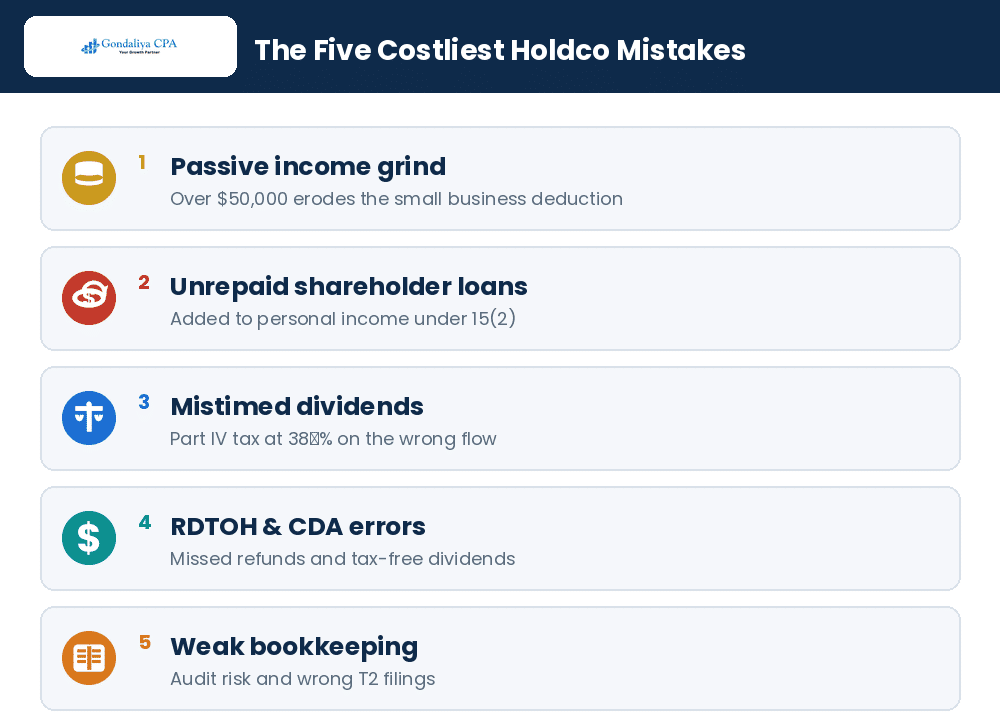
The pattern across all of them is the same. A holding company concentrates the very features that create tax advantages, the intercorporate dividends, the retained passive income, the shareholder loans, the capital dividend account, so when one is handled wrong, the cost is concentrated too. That is why a mistake in a holdco often costs thousands, not hundreds, and why it is worth getting each one right the first time. The threshold questions are worth reading first: whether you need a holding company at all, and what taxes corporations pay in Canada.
An owner came to us after several years of running a holdco without review, and three separate small errors had compounded into a real bill. None was large on its own; together they cost thousands. Reviewing the group once a year would have caught every one. Figures changed for privacy.
An owner assumed the holdco and opco each had their own $500,000 limit and had planned around two, until we tested the group and found they were associated and shared one. Correcting the plan before filing avoided a reassessment. Association is the assumption that costs the most. Figures changed for privacy.
Passive Income and the Small Business Deduction
The Grind
Managing Passive Income Limits and Refundable Tax Mechanisms
Letting passive income run wild grinds down your small business deduction fast. If you don’t watch passive income properly, it can eat into your small business deduction. Going past $50,000 in investment income lowers the deductions on active business profits. This mistake can cost thousands every year and mess with your tax plan. Once passive investment income passes $50,000 among associated firms, the SBD shrinks by $5 for every extra dollar until it disappears at $150,000.
Consequences of Passive Income Tax Mistakes on Small Business Deduction
- Stay under the $50,000 passive investment income threshold.
- Know how excess passive income affects your deductions.
- Manage investments carefully to protect tax breaks.
| Passive income in the year | Effect on the $500,000 small business limit |
|---|---|
| Up to $50,000 | No reduction; full limit available |
| $75,000 | Limit reduced by $125,000 |
| $100,000 | Limit reduced by $250,000 |
| $150,000 or more | Limit eliminated entirely |
Losing the small business deduction means the operating company’s active income is taxed at the higher general rate rather than the low small business rate, which is a real and recurring cost. The way to protect the low rate is to watch how passive income affects your taxes, to manage investments carefully to protect tax breaks, and, where the numbers justify it, to hold the investments in a holding company so the connected intercorporate dividends do not count toward the operating company’s passive income. Please note the fix is planning, not panic; the grind is predictable once you are watching it.
Key Stat: Passive investment income above $50,000 reduces the $500,000 small business limit by $5 for every $1 of excess, wiping it out entirely at $150,000. For a corporation near the threshold, a single strong investment year can quietly push active profit from the low rate to the general rate.
An operating company’s portfolio had a good year and pushed passive income over the threshold, quietly grinding away part of the small business deduction before anyone noticed at year-end. Watching it quarterly, and moving the investments to a holdco, protected the low rate going forward. The grind is silent until the bill arrives. Figures changed for privacy.
Shareholder Loans and the One-Year Rule
Shareholder Loans
Shareholder Loan Mistakes and Their Tax Implications
Mistakes with shareholder loans rank among the priciest holdco errors. The one-year repayment rule is key here: if you don’t repay a loan within that time, the CRA counts it as personal income under subsection 15(2). This means more taxes, and that’s avoidable with proper tracking and timely repayments. Ignoring the shareholder loan one-year repayment rule causes trouble, and the amount added back to personal income can be large.
The rule is specific. Where a shareholder borrows from the corporation and the loan is not repaid within one year after the end of the corporation’s tax year in which it was made, the full amount is included in the shareholder’s personal income. Repay shareholder loans within one year, keep detailed records of loan repayments, and understand subsection 15(2) to dodge tax hits. Watch out for repaying and re-borrowing as a series of loans and repayments, which the rules can look through, so the repayment has to be real.
Risk Warning: An unrepaid shareholder loan is one of the most expensive surprises a holdco owner can face, because the whole loan can be added to personal income under subsection 15(2). Please diarize every shareholder loan’s repayment deadline the day it is made, and make the repayment genuine, not a paper round-trip.
An owner had drawn a large shareholder loan and forgotten the one-year clock, heading toward a full personal income inclusion. We flagged it in time to repay properly before the deadline. Caught a few weeks later, it would have been a five-figure personal tax hit. Timing was everything. Figures changed for privacy.
An owner treated the refundable Part IV tax as nothing to worry about, not realizing it was tying up cash until the right dividend was paid out to recover it. Planning the dividend flow freed the cash sooner. Refundable does not mean costless. Figures changed for privacy.
Intercorporate Dividends and Part IV Tax
Part IV Tax
Dividend Flow Strategies Between Operating and Holding Companies
Missing dividend timing often costs the most money. Intercorporate dividends need careful handling because poorly timed payments attract Part IV tax, a heavy charge on cash movement between corporations. When a holding company and operating company aren’t structured properly, ownership might not match where money is earned or spent. This also triggers associated corporation rules and Part IV tax errors on dividends between related companies, leading to surprise bills during tax time.
Part IV tax hits private corporations on certain dividends at 38⅓% of the amount. It applies to dividends a corporation receives from a corporation it is not connected to, and it can also apply to dividends from connected corporations to the extent the payer received its own dividend refund. Proposed rules in Bill C-31, not yet law as of October 2026, would suspend the dividend refund on a taxable dividend paid to an affiliated private or subject corporation that has a later balance-due day, for taxation years beginning on or after November 4, 2025. Dividends between connected corporations are generally free of Part IV tax where the connection is genuine, which is exactly why losing connected status, through a share-ownership mistake, can turn a tax-free dividend into a taxable one. Smart strategies consider eligible versus non-eligible dividends while matching operational cash flow plus refundability linked to RDTOH accounts, which minimizes the surprise Part IV tax bills usually found during year-end reviews without expert checks.
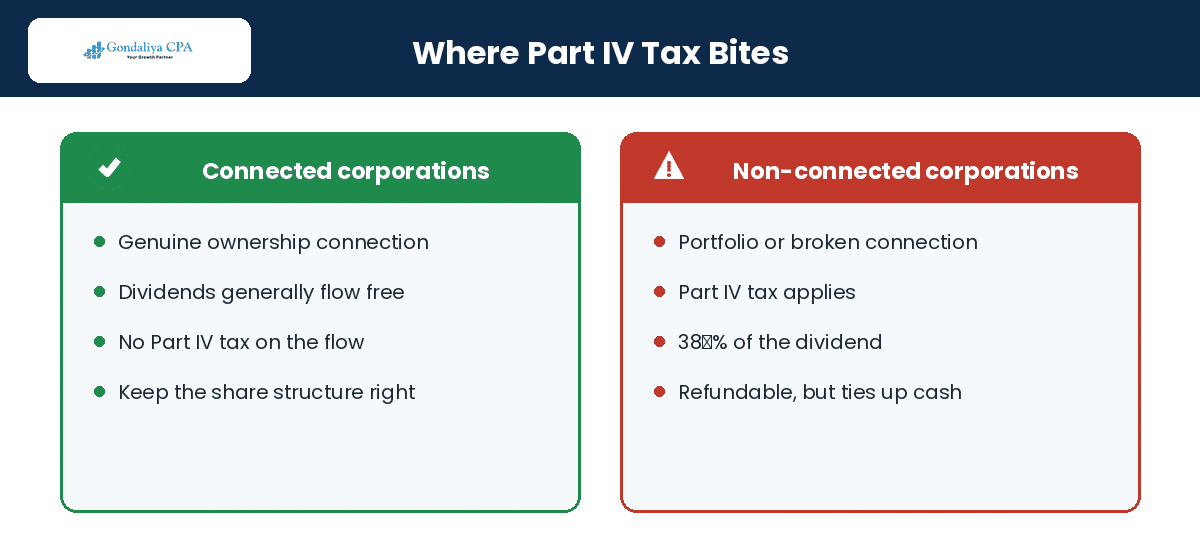
Our Take: The Part IV tax on intercorporate dividends is refundable, which lulls owners into treating it as harmless. It is not: it ties up cash until the right dividend is paid out to recover it, and the timing mismatch is where the real cost sits. Please plan the dividend flow, do not just execute it.
A group paid a dividend up the chain without checking that the connection was intact after a share change, and it drew Part IV tax that careful timing would have avoided. Restructuring the ownership restored the connection for future years. Connected status is not something to assume. Figures changed for privacy.
A corporation kept earnings inside the holdco without paying dividends and left its RDTOH refund unclaimed for years, hurting cash flow. Timing a dividend correctly recovered it. The refundable tax only comes back when the right dividend is paid. Figures changed for privacy.
RDTOH and Capital Dividend Account Errors
RDTOH & CDA
Common RDTOH mistakes include missing timely refunds after paying taxable dividends or messing up capital dividend account balances. These errors hike taxes unnecessarily. Errors in tracking Refundable Dividend Tax on Hand (RDTOH) and Capital Dividend Accounts (CDA) lead to missed dividend refunds or taxable dividends. This causes unnecessary tax payments and cash flow issues.
How RDTOH Works
The refundable dividend tax on hand system recovers taxes paid on investment income inside a CCPC. Investment income earned by a CCPC gives rise to RDTOH at 30⅔% of that income, and it is refundable at 38⅓% of taxable dividends paid. Since 2019, RDTOH has been split into two pools, eligible and non-eligible, and the type of dividend you pay determines which pool refunds, so paying the wrong type can leave the refund stranded. Errors in Capital Dividend Accounts cause big costs too, either overstating taxable amounts or missing the chance to pay non-taxable capital dividends. Maintaining accurate RDTOH and CDA records is how you optimize refundable dividend tax credits and pay tax-free capital dividends when you are entitled to.
| Account | What it tracks | The common error |
|---|---|---|
| RDTOH (two pools) | Refundable tax on investment income | Paying the wrong dividend type, stranding the refund |
| Capital dividend account | Tax-free portion of capital gains | Missing the chance to pay a tax-free capital dividend |
| Both | Feed correct dividend planning | No schedule kept, so balances are unknown |
A corporation had a healthy capital dividend account balance it never used, and the owner had been drawing taxable dividends when a tax-free capital dividend was available. Tracking the account and electing correctly changed the mix. Money was left on the table simply because no one watched the balance. Figures changed for privacy.
A share transfer into a holdco nearly missed the section 85 rollover election window, which would have triggered an immediate capital gain instead of a deferral. Filing the election on time kept the deferral intact. Timing is the whole game on a rollover. Figures changed for privacy.
Improper Structure and Associated Corporations
Structure
Improper Corporate Structure and Its Effect on Tax Efficiency
When a holding company and operating company aren’t structured properly, it causes extra taxes that could be avoided.
Connected Corporation Requirements and Small Business Deduction Impact
If your businesses are connected, you share the small business deduction limit. Associated corporations combine their $500,000 federal active business limit into one pool. Many don’t realize this and get hit with unexpected taxes when their combined passive income goes over the limits. Align holdco and opco ownership with operations, watch out for associated corporation rules, and avoid Part IV tax errors on dividends paid internally.
There is a real difference between structural mistakes and missed-planning mistakes. Structural errors, like the wrong share ownership, mess up associated corporation status and can cause the CRA to group related entities when applying the small business deduction pool. Missed planning shows up in bad timing of intercorporate dividends.
Steps to Set Up a Holding Company Structure in Ontario
Building an effective holdco-opco setup takes care:
- Incorporate two separate companies: one for operations (OpCo) and one to hold shares (HoldCo).
- Issue correct share classes that match control rights and dividend shares.
- Avoid giving HoldCo only non-voting shares—it might break connection rules and cost you creditor protection plus higher taxes.
- Use shareholder agreements that clearly explain roles between OpCo and HoldCo owners.
A bad structure can lead to wasted tax savings and exposure under association rules.
Moving shares into a holding company also needs precise timing with section 85 rollover elections, because transfers that miss the window cause immediate capital gains instead of deferrals.
Share Transfer Procedures and Section 85 Election Timing
Moving shares into a holding company needs precise timing with section 85 rollover elections:
- Structure mistakes happen when transfers miss windows causing immediate capital gains instead of deferrals.
- Planning mistakes come from ignoring the one-year shareholder loan repayment rule, making loans taxable under subsection 15(2).
Doing this right keeps deferrals safe and avoids unexpected personal taxes from misclassified loans.
Our page on whether you can change your business structure covers the reorganization options.
Risk Warning: Assuming a holdco and opco each get their own $500,000 small business limit is one of the most common and costly structural misunderstandings. Associated corporations share one limit. Please have the whole group tested for association before you rely on two limits, because the reassessment is expensive.
A group was set up with the holdco holding only non-voting shares, which risked the connection the owner was relying on for tax-free dividends and creditor protection. Correcting the share classes restored both. The share structure is not a formality; it decides the tax result. Figures changed for privacy.
A professional corporation had no schedules for its adjusted cost base, paid-up capital, or capital dividend account, so every T2 was a scramble and errors crept in. Building proper schedules made filing clean and defensible. Records are the difference between calm and chaos at year-end. Figures changed for privacy.
Why Ontario Business Owners Use Holding Companies
Ontario business owners often use holding companies to improve tax efficiency and protect their assets. A holding company Canada setup keeps business risks separate from investments and passive income. But watch out for common holding company tax mistakes that can eat away at these benefits. For example, wrong share ownership or poor handling of intercorporate dividends can cause trouble. When done right, holdcos help entrepreneurs lower taxable income while staying on CRA’s good side.
Key Tax Rules Governing Holding Companies in Ontario
Holding companies in Ontario must follow some key tax rules:
- Part IV Tax Rate: This hits private corporations on certain dividends at 38⅓% of the amount.
- Refundable Dividend Tax on Hand (RDTOH): Tracks refundable taxes on investment income; the current general rate is 30⅔%.
- Small Business Deduction Limit: The $500,000 cap applies to qualifying Canadian-controlled private corporations (CCPCs).
- Passive Investment Income Threshold: Earning over $50,000 in passive income cuts your small business deduction by $5 for every extra dollar.
Knowing these rules helps avoid surprises like sudden Part IV tax bills or losing SBD benefits.
Income Splitting with Family Members Under TOSI Compliance
Income splitting still attracts attention but carries risks due to expanded TOSI rules targeting improper allocations to family members who don’t work actively in the business.
CPA-led planning ensures distributions meet all rules, avoiding costly retroactive surtaxes.
Common mistakes involve wrongly classifying family shareholders’ roles triggering big TOSI tax hits compared to proper salary or dividend mixes.
Professional advice balances estate freeze goals with compliant pay structures preserving wealth transfer efficiently.
Estate Freeze Transactions and Lifetime Capital Gains Exemption Multiplication
Estate freezes lock current values by transferring future growth via preferred shares held by heirs through HoldCos.
Mistakes that lose lifetime capital gains exemption include not meeting QSBC status before sale, missing required crystallization steps, or having too many passive assets disqualifying LCGE eligibility.
Timing errors also reduce benefits if freezes happen too late before liquidity events—cutting exemption use and retirement funds significantly.
Well-planned freezes preserve LCGE limits across generations using trust-owned holdings smoothly integrated in corporate groups during transitions.
Asset Protection and Creditor Proofing Using Holding Companies
A proper holdco-opco setup shields assets inside HoldCos from operational liabilities housed in OpCos—helping protect net worth effectively.
Bad structures lose this protection, exposing earnings to unsecured claims plus higher combined taxes caused by poor entity setups affecting deductions too.
Clear legal separation backed by governance policies strengthens defenses protecting wealth vehicles—especially important amid today’s market swings common in Toronto/Ontario SMBs needing local expertise applying provincial rules carefully.
Bookkeeping and Compliance Errors
The Records
Key Risks Arising from Holding Company Bookkeeping Errors
Poor bookkeeping hurts holdco tax planning big time. When records are sloppy, it’s hard to report correctly or prove compliance. Businesses often mess up by not tracking intercompany transactions or missing records on shareholder loans or capital dividend accounts. This can bring audits or fines from the CRA. Keep close track of all intercompany dealings, record shareholder loans and CDAs carefully, and fix any inadequate bookkeeping quickly.
Maintaining Corporate Governance and Formalities
Messy records make it tough to track adjusted cost base, paid-up capital, RDTOH balances, capital dividend accounts, and shareholder loans, all of which are vital for filing T2 returns properly. Poor records risk audits, penalties, or CRA reassessments, especially with complex structures involving professional corporations. Keeping formal minutes about dividend decisions also prevents shareholder disputes over payouts through the holdco versus the opco. Following CRA rules closely helps stop many corporate tax problems before they start.
Importance of Compliance To Avoid CRA Corporate Tax Risks
Regularly check accounting methods and work with a CPA who spots issues early. This proactive approach reduces chances of audits or penalties from regulators.
- Stick to CRA compliance requirements at all times.
- Review accounting practices often.
- Get help from CPAs to catch risks early.
| Common bookkeeping error | Consequence | Prevention |
|---|---|---|
| Missing shareholder loans | Taxable inclusions under 15(2) | Monthly account reconciliation |
| Missing CDA/RDTOH schedules | Wrong dividend payments | Automated accounting systems |
| Poor ACB/PUC tracking | Incorrect capital gains reported | Regular CPA reviews |
Pro Tip: Use proper bookkeeping tools, such as QuickBooks or Xero, so intercompany transactions, shareholder loans, RDTOH, and the capital dividend account are tracked as they happen, not reconstructed at year-end. Please pair the software with a regular CPA review, because the tool records the numbers but a person has to read them.
A group’s intercompany balances had drifted apart because the two companies’ books were never reconciled to each other, and a CRA query followed. Cleaning up the bookkeeping and reconciling monthly closed it. Good records are not busywork; they are the audit defence. Figures changed for privacy.
An owner discovered a past filing error and feared penalties, but because they came to us before the CRA made contact, we corrected it through the voluntary disclosures program. Coming forward first is what kept the penalties off. Early beats waiting for the letter. Figures changed for privacy.
How Gondaliya CPA Supports Corporate Tax Planning
How We Catch and Correct Holdco Mistakes
The Fix
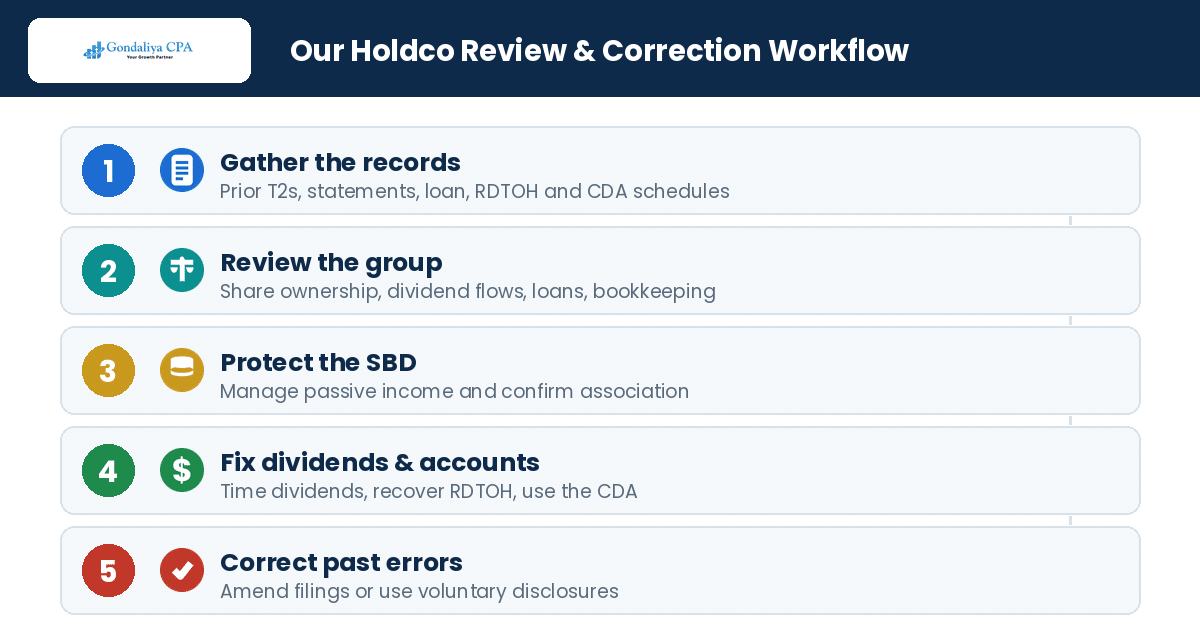
We catch holdco mistakes through a structured review, and we correct them, often through the CRA’s voluntary disclosures program where past filings need fixing. Gondaliya CPA helps you spot and fix holding company tax mistakes that many incorporated small businesses face in Canada. We focus on avoiding costly errors linked to corporate structures, managing passive income, and keeping up with CRA rules.
Overview of Gondaliya CPA’s Corporate Tax Planning Services
Our services fit holding companies in Canada, aiming to get the best from small business deductions while staying under passive investment income limits. With our CPA tax planning know-how, we guide you through complex rules to improve your after-tax results.
What the Review Covers
In the first meeting, we look at your corporate setup and find the common mistakes that affect holding companies in Canada. We check share ownership, dividend flows between corporations, shareholder loans, and bookkeeping habits that might cause unexpected taxes or penalties.
Initial Consultation: Assessing Your Corporate Tax Needs
Catching these early lets us make a plan that fits your situation and meets CRA rules.
Information Gathering: Essential Documents and Data Collection
Good information is key because bookkeeping and record-keeping mistakes hurt holdco tax planning. We ask for documents like:
- Prior-year T2 returns to check past filings and missed claims
- Financial statements to review earnings and taxable income
- Shareholder loan balances to spot risks under subsection 15(2)
- RDTOH/CDA schedules to verify refundable dividend credits
- Adjusted cost base records for capital gains work
Collecting all this helps us find hidden risks during our review.
Tax Planning Optimization: Tailored Strategies for Holding Companies
Then we craft strategies: managing the small business deduction by keeping passive investment income below $50,000, timing dividends so you can recover RDTOH properly, protecting the lifetime capital gains exemption where it applies, and using intercorporate dividends wisely to avoid Part IV tax by keeping connected status correct. Where a past filing was wrong, we can use the voluntary disclosures program to correct it, often before penalties apply.
Compliance Review to Meet CRA Requirements
We check if you follow CRA rules carefully. For example, shareholder loans have a one-year repayment rule under subsection 15(2). Breaking this can cause personal income to be taxed. We also look at the current refundable dividend tax rates as updated for 2026 affecting RDTOH balances. Plus, we see if associated corporation status changes your small business deduction eligibility.
Representation Services for CRA Audits and Disputes
If the CRA audits or disputes arise, we stand by you. Issues like part IV tax show up when intercorporate dividends happen between non-connected corporations but get wrongly treated due to lost connected status. We handle auditor questions quickly so you avoid surprise bills caused by missed compliance or filing errors tied to holdco work.
Deliverables Clients Receive and Expected Timelines
You’ll get a clear report listing any holding company tax mistakes plus how we fix them, customized to how complex your company is.
- Summary of corporate structure analysis
- Report on passive investment income effects
- Review notes on shareholder loans
- RDTOH/CDA reconciliation statements
- Amended T2 filings if needed
- Schedule for ongoing advice
We tell you deadlines upfront; most cases wrap up in about 8–12 weeks depending on document access and any changes needed. Remember, T2 corporate returns must be filed within six months after the fiscal year-end, and the balance is generally due within two or three months, so a correction is best started early.
Ongoing Support to Keep Your Corporate Tax Planning Current
Missed dividend timing often costs the most money. We help keep your bookkeeping accurate because good records are crucial for holdco plans over time. Our regular checks update your strategy based on your goals or changes in laws affecting passive income or refund accounts like RDTOH/CDA. Staying on top stops old mistakes from eating into your savings again.
If you want help avoiding costly holding company tax mistakes or corporate tax planning mistakes, reach out at info@gondaliyacpa.ca or call 647-212-9559. We’ll focus on improving your holding company Canada setup with expert CPA tax planning services made for incorporated SMB owners across Toronto, Ontario, and Canada-wide.
Pricing and Cost Management in Corporate Tax Planning
Corporate tax planning costs can vary a lot. It depends on how complex your holding company is, how much passive income you earn, and what rules you need to follow. Holding company tax mistakes often make things more expensive. They can cause penalties or extra paperwork. Knowing how the small business deduction limit and passive investment income threshold work helps keep your costs under control in Canada. We charge a flat annual fee, HST included, quoted in writing after a free consultation, so there are no surprise invoices. The example packages below show how the fee scales with complexity; actual fees vary depending on your case.
Factors Influencing the Cost of Corporate Tax Planning in Canada
Several things affect how much corporate tax planning costs for Canadian holding companies:
- Complex corporate setups need more work to spot errors that could cost money.
- Passive investment income over $50,000 cuts into your small business deduction, making taxes higher.
- Shareholder loan one-year repayment rule means you have to track loans carefully or face personal tax charges.
- Refundable Dividend Tax on Hand (RDTOH) rate needs smart timing of dividends to get tax credits back.
- CPA tax planning fees grow when there’s more to check and fix or when they need to keep a close eye on things.
Comparison Table: Typical Service Packages and Associated Costs
| Service package | Description | Typical fee (CAD incl. HST) | Complexity Level | Common mistakes addressed |
|---|---|---|---|---|
| Basic Compliance Review | Annual T2 filing check & basic bookkeeping | $1,200 | Low | Filing errors, late submissions |
| Standard Holdco Tax Planning | Passive income review + SBD impact analysis | $3,500 | Medium | Passive income mismanagement |
| Shareholder Loan Cleanup | Subsection 15(2) loan reconciliation & correction | $4,800 | High | Unrepaid loans causing personal inclusions |
| Full Structural Restructuring | Opco-Holdco restructuring + CDA/RDTOH optimization | $7,500 | Very High | Poor structure causing lost benefits |
Prices shown are examples; actual fees vary depending on your case. To review yours, please contact us at 647-212-9559 or info@gondaliyacpa.ca, or see our guide to what taxes corporations pay in Canada. If a CRA letter has already arrived, our CRA audit representation team responds on your behalf.
Managing Corporate Tax Planning Expenses Without Sacrificing Quality
It’s tricky to balance paying less with still getting good advice. Some issues, like Part IV tax or rules about associated corporations, can cause surprise bills if missed.
Try these tips:
- Find potential Part IV tax problems early with a thorough review.
- Use bookkeeping tools like QuickBooks or Xero for accurate tracking that helps with RDTOH and CDA accounts.
- Work with a CPA who knows Canadian holdco rules well. That keeps you safe from costly errors.
Saving money by cutting corners might seem smart now, but it can lead to bigger bills later from CRA audits or missed deductions.
How Complexity and Industry Specifics Affect Pricing
Industry details change the price too:
- Real estate owners often deal with rental income affecting their small business deduction.
- Medical professionals must follow extra provincial rules besides federal ones.
- Bad tracking of RDTOH or capital dividend accounts raises audit risks in any sector.
There’s a difference between structural mistakes like wrong share ownership and missed-planning errors. This difference affects how often and how much fixing costs. Industries with many intercompany deals usually pay more because bookkeeping gets harder.
Understanding Value Beyond Basic Tax Preparation Services
Choosing between doing it yourself or hiring a CPA matters for long-term costs:
- DIY methods might miss important points like dividend timing or the shareholder loan repayment rule. These can cause big tax hits later.
- CPAs catch problems early and help avoid CRA trouble. They know how to handle refundable dividend credits well. Non-CPA firms might charge less but can’t fully represent you if there’s a CRA dispute.
Spending on expert help means fixing current holding company tax mistakes and keeping up with new rules. This protects your business without surprises down the road.
Almost every holdco mistake is cheaper to prevent than to fix, and cheaper to fix early than to have reassessed. A yearly review that checks passive income, shareholder loans, dividend timing, and the RDTOH and CDA balances catches the expensive ones while they are still small.
2026 Update — what is current: The federal small business limit is $500,000, shared among associated corporations, and the passive income grind reduces it by $5 for every $1 of adjusted aggregate investment income above $50,000, eliminating it at $150,000. Part IV tax on non-connected dividends is 38⅓%. Investment income gives rise to RDTOH at 30⅔%, refundable at 38⅓% of taxable dividends paid, split into eligible and non-eligible pools. The capital gains inclusion rate remains one-half.
Check Your Holdco for Common Mistakes
This quick self-check flags where the common holdco mistakes may be sitting in your group. Please answer the six questions below.
Holdco Mistake Check
Six quick questions on where the common errors hide. No fee shown.
Flagged to review:
This is a general prompt, not tax or legal advice or a quote. Your actual position depends on the full facts. For a real review, please book a free consultation.
Want a checklist to work from? You can download our free holdco mistake-prevention checklist before your review.

Industry Spotlights: Sectors We Represent
Industry Expertise
Holding company tax mistakes show up differently across the sectors we serve, usually because of how each business earns and holds its money. Here are ten sectors and where the errors tend to appear.
| Industry | The Mistake That Tends to Appear |
|---|---|
| Medical doctors & physician professional corporations | TOSI missteps on dividends paid through the holdco |
| Dentists & dental practices | Shareholder loan repayment errors under 15(2) |
| Daycare, childcare & CWELCC services | Passive income quietly grinding the SBD |
| Real estate investors, landlords & holding companies | Rental income pushing passive income over the limit |
| Property developers & builders | Associated corporation rules complicating the SBD |
| Construction, contractors & skilled trades | Wrong share ownership breaking connected status |
| Technology startups & SaaS | Opco-holdco set up failing the connection test |
| E-commerce & online retailers | Mixing active revenue with investment income |
| Restaurants & food and beverage | RDTOH and CDA left untracked |
| Transportation, logistics & trucking | Unrepaid shareholder loans across fleet entities |
Tax Planning for Medical Professionals and Physician Professional Corporations
Medical professionals who use holding companies often face tax challenges. These can lead to costly holding company tax mistakes. Corporate tax planning mistakes, like poor dividend strategies or missing chances to use the small business deduction, raise taxes. CPAs who understand physician professional corporations help by applying smart tax plans. They focus on CRA rules and ways to keep more income after taxes using holding companies, shareholder loans, and passive income management.
- Medical doctors & physician professional corporations: Physician corporations must handle OHIP billing, Royal College of Physicians and Surgeons of Canada rules, and corporate laws carefully, and mistakes can trigger taxable benefits or tax on split income when dividends are paid through the holdco. Good books and the right setup avoid the shareholder loan and RDTOH problems.
- Dentists & dental practices: A practice regulated by the Royal College of Dental Surgeons of Ontario often runs into the one-year shareholder loan rule; if a loan is not repaid on time, the amount counts as personal income and raises taxes, so clear repayment records are key.
Unique Challenges for Dentists and Dental Practices
Some corporate tax planning mistakes dentists make include ignoring proper dividend flows between operating companies (Opco) and holding companies (Holdco). This causes Part IV tax on intercorporate dividends. Keeping clear loan repayment records is key for CRA compliance.
Dental practices gain from CPA advice that helps manage cash flow while following shareholder loan rules. This avoids costly penalties from missed repayments or deadlines.
- Daycare, childcare & CWELCC services: Childcare operators, including those in CWELCC-funded services, have to watch the $50,000 passive income threshold and review RDTOH balances often, so earnings kept inside the holdco do not strand refundable tax.
Considerations for Daycare, Childcare Operators Including CWELCC Services
To avoid trouble:
- Track passive investments closely.
- Review RDTOH balances often.
- Keep expenses and passive income clear in books.
CPAs help childcare businesses in Ontario follow CRA rules properly, especially those involved in CWELCC services in Toronto.
- Real estate investors, landlords & holding companies: Holding too much rental property inside a holdco can push investment income high, reducing the small business deduction, and missing lifetime capital gains exemption purification before a sale can cost exemptions worth a great deal.
Holding Companies in Real Estate: Investors, Landlords, Developers
Real estate investors using holdcos face special tax issues:
- Passive investment income over $50,000 reduces Small Business Deduction.
- Lifetime capital gains exemption (LCGE) limits apply to small business corporation shares.
- Part IV tax applies on some intercorporate dividends.
Holding too much rental property inside a holdco might push investment income high. This can increase combined federal-provincial rates close to 26%, instead of lower small business rates.
Missing LCGE purification before selling means losing exemptions worth hundreds of thousands. Also, bad timing of dividends between connected corporations leads to surprise Part IV taxes during audits.
Planning real estate holdings carefully helps reduce these risks for Ontario landlords and developers.
- Property developers & builders: With several project entities, structural errors in share ownership mess up associated corporation status, so the CRA groups the entities when applying the one shared small business deduction pool.
- Construction, general contractors & skilled trades: For electricians, plumbers, and HVAC firms, structural mistakes and bad dividend timing both push the combined federal-provincial rate higher than needed, and the fix is usually cleaning up the ownership and the RDTOH accounts.
Tax Issues for Construction Companies, General Contractors, and Skilled Trades
Construction firms often mix up structure mistakes with missed-planning mistakes. Structural errors like wrong share ownership mess up associated corporation status. This causes CRA to group related entities wrongly when applying Small Business Deduction pools.
These errors push combined federal-provincial rates higher than needed. Expert CPAs familiar with Ontario’s construction sector can spot and fix these issues early — especially around Mississauga or Vaughan areas.
- Technology startups & SaaS: Founders often set up the opco-holdco structure incorrectly and fail the basic connected corporation test, and mixing active revenue with non-arm’s-length transactions makes filings complex and invites audits, so separating operating income from investing gains keeps taxes low.
Strategies for Technology Startups, SaaS Companies, and E-commerce Businesses
Poor control over passive income above $50K cuts down Small Business Deductions. That hurts cash flow needed during growth phases.
Good CPA support focused on Toronto’s tech scene helps startups handle these issues well.
- E-commerce & online retailers: Online businesses can drift into mixing active revenue with investment income inside one company, which both complicates the filing and risks the small business deduction, so the accounts need to be kept clean.
- Restaurants & food and beverage: Restaurants risk RDTOH mistakes when they keep earnings too long inside a holdco without paying dividends, and errors in the capital dividend account cost money too, so the books must tie payroll systems to the bookkeeping correctly.
Tax Planning Insights for Restaurants, Food & Beverage Operations
Restaurants need strict bookkeeping that ties payroll systems like ADP with QuickBooks correctly. That way they avoid surprises at year-end from missed deductions or wrong earnings handling.
- Transportation, logistics & trucking: Unrepaid shareholder loans cause big penalties for owner-operators under the one-year rule, and mistimed intercorporate dividends with ignored Part IV tax cause surprise bills, especially where many connected entities run fleets together.
Transportation, Logistics, and Trucking Owner-Operators Tax Challenges
Late repayments add amounts back into personal taxable income plus penalties and interest.
Good software like Xero combined with Wagepoint helps record keeping but expert review remains key to catch risks unique to Ontario areas like Hamilton or North York.
A trucking owner-operator group had unrepaid shareholder loans across two fleet entities, each approaching its one-year deadline. Reconciling and repaying them properly avoided a large personal inclusion. In multi-entity fleets, the loans are the mistake that hides in plain sight. Figures changed for privacy.
A real estate holdco had built up so much rental and investment income that the small business deduction was grinding, and a sale ahead risked the exemption for lack of purification. Planning both, with runway, protected the rate and the exemption. Property-heavy holdcos need watching on two fronts. Figures changed for privacy.
Identifying When Your Business Needs Advanced Corporate Tax Support
Holding company tax mistakes can cost you more than you think. If your business has a complex setup or struggles with passive income taxes, it’s time to seek help. Many companies keep making corporate tax planning mistakes without realizing it. If this sounds familiar, working with a CPA tax planning expert can save you from trouble and missed chances.
Here are signs your business might need advanced support:
- Complex corporate structures causing confusion
- Issues with passive income taxation rules
- Repeated errors in corporate tax planning
- Trouble keeping up with CRA compliance
Getting help early means fewer headaches later.
What to Look for in a CPA Firm Handling Complex Corporate Tax Planning
Picking the right CPA firm for holding company Canada issues matters a lot. You want a firm that knows how to handle tricky structures and avoid common corporate tax planning mistakes.
Look for these qualities:
- Strong knowledge of CRA rules on passive income and shareholder loans
- Experience with small business deduction grind
- Ability to create strategies that fit your goals
- Focus on compliance and managing risks
A good CPA firm will not just file your taxes but help you make smart choices that keep you safe and save money.
Importance of Local Expertise and Proactive Communication
Local expertise gives a real edge when dealing with Ontario’s rules on holding companies. Firms like Gondaliya CPA understand both federal and provincial laws deeply.
Why local knowledge helps:
- They know Ontario’s specific regulations well
- They watch for legislative changes, like the 2026 passive income rule updates
- They keep clients informed before surprises hit
Good communication matters too. A firm that stays in touch prevents unexpected CRA audits or fines from catching you off guard.
Coordinating Corporate Tax and Accounting for Optimal Outcomes
Coordinating tax planning with accounting is key to avoiding holdco mistakes. When bookkeeping and taxes talk to each other, fewer errors happen.
Key points to manage:
- Tracking intercompany dividends properly
- Keeping shareholder loan balances clear
- Managing RDTOH credits and capital dividend accounts correctly
These areas often cause problems if not handled carefully. A unified approach helps make sure your T2 filings match your tax plan and follow the rules.
Questions to Ask Before Engaging a CPA for Corporate Tax Planning
Before hiring a CPA for corporate tax work, ask some tough questions:
- How do you catch holding company tax mistakes early?
- Can you explain how you handle passive income taxes under current CRA rules?
- What’s your experience fixing shareholder loan issues under subsection 15(2)?
- How will you keep me updated during restructures or corrections?
- Do you offer flat fees or could I get surprise bills?
These questions show if they understand complex issues and how transparent they are with clients.
Transitioning from Basic Tax Filing to Comprehensive Corporate Tax Support
Many businesses start with simple T2 filings but miss deeper problems. Moving toward full corporate tax support means spotting repeated planning mistakes before they cost too much.
This includes:
- Reviewing how operating vs holding companies work within Canada’s changing rules
- Watching the $50,000 passive income limit affecting small business deductions
- Fixing dividend timing or using capital dividend accounts well
Making these moves helps protect your profits after taxes instead of leaving money on the table.
Gondaliya CPA’s Commitment to Helping Canadian SMBs Build Financial Confidence
Gondaliya CPA works only with incorporated SMBs in Toronto and Ontario. They focus on stopping holding company Canada errors by offering affordable, Registered services.
Here’s what stands out about them:
- 1450+ five-star Google reviews
- Fixed annual pricing so no surprise fees pop up
- Fast responses—even on weekends
Their team supports entrepreneurs who want clear advice backed by solid compliance.
Glossary of Key Terms
Plain-English Definitions
- Holding company (holdco): A corporation that owns shares, investments, or assets rather than running a business.
- Operating company (opco): The corporation that actually carries on the trading business.
- Small business deduction (SBD): The reduced corporate tax rate on active income up to the business limit.
- Passive income grind: The reduction of the business limit as investment income rises above $50,000.
- Subsection 15(2): The rule that taxes an unrepaid shareholder loan as personal income.
- Part IV tax: The 38⅓% refundable tax on certain dividends between corporations.
- RDTOH: Refundable dividend tax on hand; refundable tax on investment income, in eligible and non-eligible pools.
- Capital dividend account (CDA): The account tracking the tax-free portion of capital gains, payable as a tax-free dividend.
- Connected corporations: Corporations related by ownership, whose dividends can flow without Part IV tax.
- Associated corporations: Related corporations that must share one small business limit.
- Section 85 rollover: The election that transfers assets into a corporation on a tax-deferred basis.
- TOSI: Tax on split income, which restricts dividends to family members who are not active in the business.
Frequently Asked Questions
FAQ
What are holding company tax mistakes and why do they cost Canadian business owners so much?+
Holding company tax mistakes often involve passive income mismanagement, shareholder loan errors, and improper corporate structures. These errors reduce tax benefits and cause unexpected CRA penalties, costing business owners significantly, because a holdco concentrates the very features that create the tax advantages.
How does poor passive income management grind the small business deduction?+
When passive investment income exceeds $50,000, the small business deduction is reduced by $5 for every extra dollar earned, and it is eliminated at $150,000. This results in higher corporate taxes and lower available tax savings, because active income then falls to the general rate.
What RDTOH and Capital Dividend Account mistakes cost the most?+
Errors in tracking Refundable Dividend Tax on Hand and Capital Dividend Accounts lead to missed dividend refunds or taxable dividends when a tax-free capital dividend was available. This causes unnecessary tax payments and cash flow issues that a kept-current schedule would prevent.
How do intercorporate dividend and Part IV tax errors create surprise bills?+
Mistimed or incorrect dividend payments between connected corporations trigger Part IV tax at 38⅓%. This leads to unexpected taxes during CRA audits or year-end reviews, often because connected status was assumed rather than confirmed after a share change.
What mistakes cause business owners to lose the Lifetime Capital Gains Exemption?+
Failing to meet Qualified Small Business Corporation criteria, holding excess passive assets, or missing proper share purification causes loss of LCGE benefits upon sale. Purifying the operating company well ahead of a sale is what keeps the exemption available.
What are the most costly holding company tax mistakes to avoid?+
Avoid exceeding passive income limits, failing shareholder loan repayment rules, mismanaging dividend flows causing Part IV taxes, poor bookkeeping, and neglecting compliance updates.
How do we catch and correct holding company tax mistakes at Gondaliya CPA?+
We conduct thorough corporate structure reviews, analyze passive income impacts, reconcile shareholder loans under subsection 15(2), verify RDTOH/CDA accounts, and file amended returns as needed.
What deliverables do you get?+
Clients receive detailed reports on errors found, correction plans, corporate structure summaries, passive income impact analysis, loan reconciliations, amended filings, and ongoing advisory schedules.
How much does CPA holding company tax planning and cleanup cost in Canada?+
Costs vary by complexity, from a basic compliance review at $1,200 to a full restructuring at $7,500+, with factors including corporate setup intricacy, passive income levels, shareholder loan issues, and filing requirements. We quote a flat annual fee, HST included, in writing after a free consultation.
Key Points on Corporate Tax Risks & Prevention Controls
- Understand subsection 15(2) and repay shareholder loans on time to avoid a personal inclusion.
- Monitor passive investment income closely; stay below $50K threshold for maximum deductions.
- Maintain accurate RDTOH and CDA records to optimize refundable dividend tax credits.
- Align opco-holdco ownership correctly to prevent Part IV tax on intercorporate dividends.
- Confirm connected status after any share change before paying a dividend up the chain.
- Reconcile the two companies’ books to each other every month.
- Use voluntary disclosures proactively to correct past filing errors, often without penalties.
- Review the whole group with a CPA at least once a year.
What to Prepare Before a Holdco Review
- Prior-year T2 corporate returns for the past filing checks.
- Financial statements detailing revenue streams and taxable income.
- Shareholder loan balances with dates for the subsection 15(2) review.
- RDTOH and CDA schedules showing the refundable tax positions.
- Records of adjusted cost base for capital gains calculations.
Who This Is For / Not For
- For: Incorporated Canadian business owners running a holdco-opco group who want to catch and fix costly holdco tax mistakes.
- Not For: Owners with a single operating company and no holding company, for whom these specific holdco errors do not yet apply.
Quick Comparison Table: Common Holding Company Tax Mistakes & Solutions
| Mistake Type | Impact | Solution | Industry Focus |
|---|---|---|---|
| Excess Passive Income | Loss of Small Business Deduction | Income monitoring & planning | All sectors |
| Shareholder Loan Mismanagement | Personal Income Inclusion under 15(2) | Timely repayments & tracking | Professional practices |
| Poor Dividend Timing | Part IV Tax penalties | Careful dividend scheduling | Multi-corporate groups |
| Inadequate Bookkeeping | Audit risk & inaccurate filings | Automated systems & CPA review | SMBs across sectors |
| LCGE Qualification Failures | Loss of Capital Gains Exemption | QSBC status maintenance | Real estate & startups |
People Also Ask
Quick Answers
Fixing it yourself: DIY vs CPA vs non-CPA provider, which route fits?+
DIY risks missing complex rules that lead to penalties. Non-CPA firms offer limited representation if the CRA disputes something. A Registered CPA ensures full compliance, proactive planning, and audit support, which matters most on the very holdco rules that cost the most when missed.
Can a past holdco mistake be fixed after the fact?+
Often yes. The CRA’s voluntary disclosures program can correct past filing errors, frequently without penalties, if you come forward before the CRA contacts you. Some structural issues can also be corrected going forward with the right reorganization.
How can I tell if my holdco has a hidden mistake?+
The warning signs are passive income near the threshold, an outstanding shareholder loan, dividends moving between companies without a plan, and no current RDTOH or CDA schedule. A yearly review checks each of these before it becomes a bill.
Contact Gondaliya CPA at 647-212-9559 or info@gondaliyacpa.ca to review your holdco for costly mistakes, on a flat fee, HST included, quoted in writing before any work starts. For the structure behind the return, see our guide to holding company tax planning strategies, and to start with the threshold question, whether you need a holding company.
Why Trust Gondaliya CPA?
Gondaliya CPA offers expert knowledge in Canadian holdco rules combined with deep local Ontario experience. We have a track record of preventing costly errors through clear strategies backed by ongoing compliance checks. Our transparent pricing and fast response times ensure clients stay informed without surprises.
Think your holdco has a costly mistake? We find it and fix it
Gondaliya CPA reviews your holdco-opco group for passive income, shareholder loans, dividend timing, and RDTOH and CDA errors, corrects past filings through voluntary disclosures where needed, and files both T2 returns so the group reconciles, on a flat annual fee, HST included, with a one-business-day response. Please book a free consultation.
Next Steps
Holding company tax mistakes cost thousands not because the rules are secret, but because a holdco concentrates the features that go wrong: passive income, shareholder loans, intercorporate dividends, and the refundable-tax accounts. The fix is a yearly review that checks each one before it becomes a bill, and a correction path through voluntary disclosures for anything already off. Please contact us for a review, gather your T2 returns, statements, and loan and account schedules, and let us look at the whole group before the CRA does. Contact Gondaliya CPA at 647-212-9559 or info@gondaliyacpa.ca today, anywhere in Toronto, Ontario, or across Canada. If our content helps, please add gondaliyacpa.ca as a preferred source on Google.
Next Steps: How to Begin Your Corporate Tax Planning Journey with Gondaliya CPA
Ready to get started? Schedule a free consultation where they’ll look at your current risks like overlooked passive incomes or shareholder loan troubles.
What happens next?
- They create a plan with clear deadlines for fixes and amended filings
- You get ongoing advice to avoid common corporate tax planning mistakes going forward
Contact Gondaliya CPA at 647-212-9559 or info@gondaliyacpa.ca. Take charge of your corporate structure today without pressure—just expert help designed for Canadian SMB owners dealing with complex holdco issues.
Published: July 22, 2026 · Last updated: July 22, 2026
Disclaimer: This article is educational information only and is not tax, legal, or financial advice. It reflects CRA rules current to 2026, including the $500,000 federal small business limit shared among associated corporations, the passive income grind that reduces the limit by $5 for every $1 of adjusted aggregate investment income above $50,000 and eliminates it at $150,000, the subsection 15(2) shareholder loan rule, the 38⅓% Part IV tax on non-connected dividends, RDTOH arising at 30⅔% and refundable at 38⅓% of taxable dividends paid across eligible and non-eligible pools, and the one-half capital gains inclusion rate. Outcomes depend on your specific facts, and corporate rules change. Please consult a Registered CPA and, for reorganizations, a lawyer before acting. Fees include HST.

Sharad Gondaliya is a CPA Canada & CPA USA with 15 Years+ experience of Accounting, Tax, Payroll of Corporate Small Businesses as Tax Accountant. He is a CPA Ontario member (61040184) and holds US CPA licences in Washington and Montana and is well known among corporate small businesses for tax planning, efficient tax solutions, and affordable CPA services. Sharad is the Principal (Director) of Gondaliya CPA – Affordable CPA Firm in Canada. Licenses: CPA Ontario: 61040184 | CPA USA (MT): PAC-CPAP-LIC-033176 | CPA USA (WA): 57629 | CPA Firm License: 61330051 View Full Author Bio