



How to Use a Holding Company for Tax Planning, Asset Protection, and Business Wealth Growth in Canada
Holding company benefits Canada include effective tax planning strategies, corporate asset protection, and well-structured holding company setups that help incorporated SMBs manage intercorporate dividends, capital gains treatment, and shareholder wealth planning. Gondaliya CPA offers expert advice on corporate restructuring Canada, moving profits to holding company, and optimizing connected corporations for better tax deferral and CRA compliance.
Quick Summary
A holding company owns shares and assets rather than trading, which lets profits move up from the operating company as tax-free intercorporate dividends, keeps wealth out of reach of operating creditors, and gives investments a home that protects the small business deduction. Please note it adds a second corporation to file every year, so it earns its keep only when there is retained profit, real risk, or a succession plan behind it. In short, holding company benefits Canada come down to tax planning strategies, corporate asset protection, and a holding company structure explained and run properly.
| Aspect | Details |
|---|---|
| Tax planning | Deferral through intercorporate dividends and dividend timing. |
| Asset protection | Wealth held apart from the operating company’s creditors. |
| Wealth growth | Investments pooled and managed in one corporation. |
| The cost | A second set of books, financial statements, and T2 return. |
Reading time: 33 minutes.
Table of Contents
- What Is a Holding Company?
- Setup, Associated and Connected Corporations
- Corporate Asset Protection and Creditor Proofing Strategies
- Moving Profits Up: Intercorporate Dividends and Safe Income
- RDTOH, Part IV Tax, and the Capital Dividend Account
- Managing Passive Investment Income and Impact on Small Business Deduction
- Section 85 Rollovers, Shareholder Loans, and Restructuring
- Capital Gains, the LCGE, and Real Property
- Estate Freeze, Succession, Family Trusts, and TOSI
- Costs, Risks, and Whether a Holdco Suits You
- Industry Spotlights: Sectors We Represent
- Glossary, FAQ, and People Also Ask
The Numbers That Matter
This article covers Canada, with Ontario and Toronto context, and reflects CRA rules current to 2026. It assumes a Canadian-controlled private corporation and an owner-managed group. “Illustrative” figures are examples, not quotes, and any masked engagement notes end with “Figures changed for privacy.” This is educational information only and not tax, legal, or financial advice, and reorganizations require a lawyer alongside your CPA. Fees include HST. Corporate and passive-income rules change, so please confirm your own situation before restructuring.
What Is a Holding Company?
The Basics
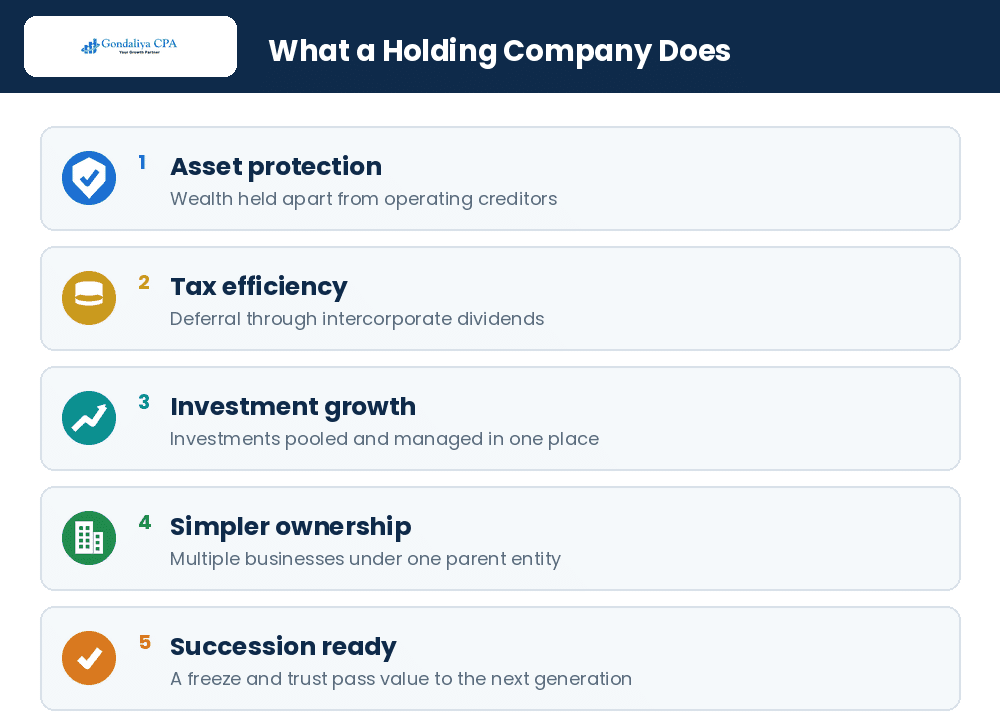
A holding company is a type of business that owns shares in other companies. It doesn’t run daily operations but focuses on managing investments and assets. Setting up a holding company in Canada offers benefits like better corporate asset protection, tax advantages, and ways to help grow wealth for shareholders.
Key Benefits of Holding Companies
- Asset Protection: It protects assets from risks tied to operating companies. This lowers exposure to creditor claims.
- Tax Efficiency: Businesses can use tax planning strategies such as income splitting and deferring taxes to reduce their overall tax load.
- Investment Growth: Holding companies manage investments in one place, making it easier to decide how to use capital wisely.
Operating Company vs Holding Company
Knowing the difference between an operating company and a holding company helps when setting up your business. The key difference is what they do. Operating companies deal directly with customers and make money by selling goods or services. Holding companies focus on managing investments and lowering risks.
| Feature | Operating Company | Holding Company |
|---|---|---|
| Purpose | Runs daily business activities | Owns shares or interests in others |
| Revenue | Makes money from sales or services | Earns income mostly from dividends |
| Liability | Faces risks from operations | Has limited liability by design |
Common Holding Company Structures for Canadian Businesses
Canadian businesses use several common structures when setting up holding companies:
- Single-Tier Structure: One parent holding company owns multiple operating companies. Simple but less flexible.
- Multi-Tier Structure: Several layers of ownership where holding companies own operating companies that own others. Good for complex setups.
- Family Trust Integration: Often paired with holding companies for estate planning. Family trusts help with succession and offer tax perks.
These structures let businesses pick the best fit for their goals while enjoying the benefits allowed by Canadian law.
An owner asked whether they needed a multi-tier structure because it sounded more sophisticated, when a straightforward single holdco over one opco met every goal they had. Complexity should follow need, not the other way round. The simplest structure that works is usually the right one. Figures changed for privacy.
Setup, Associated and Connected Corporations
Getting Started
Incorporation and Setup Process for Holding Companies in Ontario and Other Provinces
Starting a holding company requires a few steps that may differ slightly by province, including Ontario:
- Choose Business Name & Structure: Pick a name that follows provincial rules. Decide on federal or provincial incorporation.
- File Articles of Incorporation: Submit paperwork stating the company’s purpose (holding) and share details.
- Get Licenses/Permits if Needed: Make sure you follow local rules depending on your industry, like real estate.
- Open Corporate Bank Accounts & Set Up Accounting Systems: Start banking accounts made for businesses, using tools like QuickBooks or Xero to keep records neat.
- Seek Professional Advice: Talk to CPAs or lawyers who know CRA rules to set up properly, especially for corporate asset protection.
This process helps reduce risks linked to incorporation while taking advantage of tax planning strategies in Canada’s provinces.
Associated Corporations and Connected Corporations Explained
In Canada, understanding associated and connected corporations matters because it affects taxes. An associated corporation happens when two corporations share control or have overlapping shareholders. This means they might have to share the small business limit under CRA rules, so please note that associated corporations divide one $500,000 limit between them rather than each getting their own. A connected corporation means there is direct ownership affecting how dividends flow between them, and it is generally established where the recipient corporation controls the payer or owns more than 10% of the votes and value. This can help avoid problems with misclassification that could lead to penalties. Knowing these concepts well and working with experts during setup helps you stay compliant and benefit from effective tax planning strategies Canada offers through well-planned corporate asset protection approaches.
Risk Warning: Owners often assume a holdco and opco each get their own $500,000 small business limit. Where the corporations are associated, they share one limit between them. Please have the group tested for association before you plan around two limits, because a reassessment on this point is expensive.
A client incorporated a holdco themselves and gave it only non-voting shares, which put the connected status they were relying on at risk. Correcting the share classes restored the tax-free dividend flow. Share structure is not paperwork; it decides the tax outcome. Figures changed for privacy.
Corporate Asset Protection and Creditor Proofing Strategies
Protection
Corporate asset protection is a big reason to use a holding company in Canada. It helps keep valuable assets safe from business risks and creditor claims. A holding company separates risky operations from important investments or intellectual property. This limits what creditors can reach if an operating company runs into trouble.
Typically, the holding company owns shares of one or more operating companies but doesn’t handle daily business. This setup keeps creditors away from assets inside the holdco if an opco faces financial problems. Courts in Canada respect this separation when formal rules are followed and no fraud occurs.
Some ways to protect assets include:
- Keeping clear share ownership records
- Avoiding cheap asset transfers
- Following CRA rules on intercompany deals
Insurance helps but can’t replace this legal structure. In practice, many clients reduce risk by isolating earnings and real estate inside the holdco, away from risky operations.
Our Take: The tax benefits get the attention, but for many owners the asset protection is the quiet reason a holdco is worth it. Years of accumulated profit sitting inside a trading company is exposed in a way most owners have never priced. Moving it up costs little and removes that exposure.
A business in a claims-prone sector held all its retained earnings inside the operating company, where a single dispute could have reached the lot. Moving the surplus up to a holdco put years of profit behind a wall before any trouble arrived. Protection is cheapest bought early. Figures changed for privacy.
Moving Profits to Holding Company: Methods and Tax Implications
Moving Profits Up: Intercorporate Dividends and Safe Income
The Mechanism
Tax Planning Advantages Including Tax Deferral Opportunities
Holding companies bring useful tax planning advantages in Canada. They let businesses defer personal taxes by keeping income inside corporations and moving dividends smartly. This helps grow wealth over time.
Why does this work? Corporations pay lower tax rates on income than individuals, up to a $500,000 limit under the small business deduction. Holding earnings inside the holdco means you can reinvest before paying personal tax.
Other strategies include:
- Timing dividends as eligible or non-eligible
- Using refundable dividend tax on hand (RDTOH) accounts
- Leveraging capital dividend accounts for tax-free capital gain distributions
These fit within CRA rules and aim to boost after-tax returns. We’ve helped many small businesses in Ontario plan these steps while staying up-to-date with 2026 changes on passive investment income.
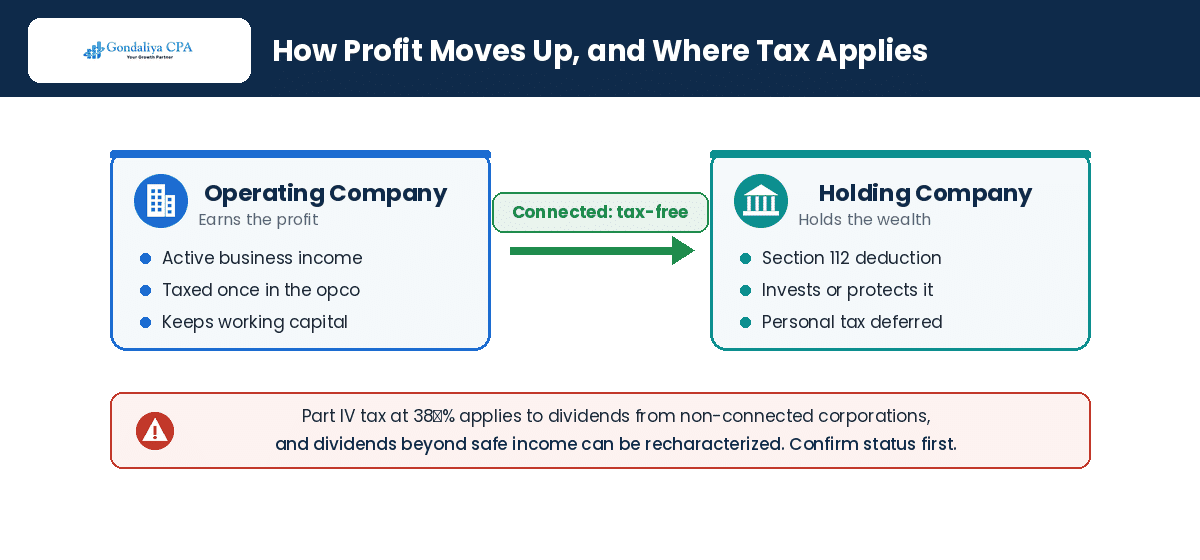
Moving profits from an operating company to a holding company is a common tax planning strategy in Canada. It helps protect assets and grow wealth. The main way to do this is by paying intercorporate dividends. These dividends usually qualify for a deduction under section 112 of the Income Tax Act. This means the holding company receives profits without paying tax right away.
Use of Intercorporate Dividends to Transfer Profits Tax-Free
Intercorporate dividends let connected companies move profits without triggering immediate tax. This is key to holding company structures in Canada. When an operating company pays dividends to its parent holdco, these amounts usually qualify for full deduction against taxable income in the holdco where the corporations are connected. That stops profits from being taxed twice within the group. Eligible dividends paid from an operating company to its connected holding company can flow without tax. But non-eligible dividends or wrong transfers may cause Part IV tax on refundable dividend tax on hand (RDTOH), cutting benefits. So, timing and dividend types matter a lot.
Tax Deferral Techniques Using Holding Companies
Holding companies let you use intercorporate dividends smartly. These dividends are allowed under section 112(1)(a), meaning payments between connected CCPCs happen without extra corporate-level tax right away. This is core to many tax planning strategies Canada-wide that delay personal taxes until profits leave the company as personal income.
Using intercorporate dividends lets profits stay inside the corporate structure longer. Personal taxes get deferred until money comes out as shareholder payments. Many Canadian tax plans use this to keep earnings in a holdco for reinvestment or creditor protection. The practical steps are:
- Pay eligible intercorporate dividends
- Use section 112 deduction
- Avoid Part IV tax on RDTOH
- Time dividend payments carefully
Safe Income Concepts and Calculations for Dividend Flow Management
Safe income means the after-tax earnings a corporation has accumulated that can support a tax-free intercorporate dividend. Knowing how to calculate safe income is vital when moving dividends between companies while protecting capital dividend accounts (CDA). Section 112 offers deductions for intercorporate dividends, but paying dividends beyond a share’s safe income can, in certain circumstances, cause part of the dividend to be recharacterized as a capital gain rather than a tax-free dividend. Regular checks of safe income help decide when and how much dividend to pay. This way, shareholders keep more wealth without breaking CRA rules about capital gains and dividend deductibility.
Remember:
- Safe income = after-tax earnings available for distribution
- Section 112 limits deductions based on safe income
- Avoid overpaying dividends beyond safe income
- Reconcile safe income often for smart dividend timing
Our experience shows how well-designed share classes and dividend policies keep flows smooth while avoiding surprise Part IV taxes.
Key Stat: A dividend from an operating company to a connected holding company generally moves without immediate tax under the section 112 deduction, because the underlying profit was already taxed once. That single feature is what makes the holdco structure work for deferral, protection, and reinvestment.
An owner believed moving money to the holdco would trigger tax and had left the surplus exposed for years. Because the dividend between the connected companies flowed under section 112, it moved without a bill. The fear of a tax hit had been the only obstacle. Figures changed for privacy.
RDTOH, Part IV Tax, and the Capital Dividend Account
The Accounts
Impact of Refundable Dividend Tax on Hand (RDTOH) and Part IV Tax
Refundable Dividend Tax on Hand (RDTOH) builds up when private companies earn certain investment incomes taxed higher than active business earnings. When these amounts get paid out as taxable dividends, either by an operating company or a holdco, the RDTOH refunds help reduce overall taxes. Investment income earned by a CCPC gives rise to RDTOH at 30⅔% of that income, and it is refundable at 38⅓% of taxable dividends paid. Since 2019 the RDTOH has been split into eligible and non-eligible pools, so the type of dividend you pay determines which pool refunds, and paying the wrong type can leave the refund stranded.
Part IV tax hits when corporations receive intercorporate dividends in circumstances the rules target, and it applies at 38⅓% of dividends received from non-connected corporations. It can also apply to dividends from connected corporations to the extent the payer received its own dividend refund, which stops double refunds. Proposed rules in Bill C-31, not yet law as of October 2026, would suspend the dividend refund on a taxable dividend paid to an affiliated private or subject corporation that has a later balance-due day, for taxation years beginning on or after November 4, 2025. Knowing how RDTOH balances work with Part IV tax is key if you want to use holding company benefits Canada-wide. It influences when profits should move between your corporate group via intercorporate dividends. Managing your portfolio inside a holdco means balancing growth and these rules, and you can use multiple corporations or trusts linked by share ownership to better handle RDTOH recovery. Keeping good records makes it easier to follow CRA’s complex rules on passive income in holdcos.
The Capital Dividend Account
Capital dividend accounts track tax-free capital gains and certain life insurance proceeds. They allow corporations to pay tax-free dividends to shareholders, enhancing after-tax returns through strategic dividend distribution planning. Capital gains earned inside a holdco can be paid out via capital dividend accounts without extra personal tax. This is one of the most valuable and most frequently overlooked accounts in an owner-managed group.
| Account | What it tracks | The common error |
|---|---|---|
| RDTOH (two pools) | Refundable tax on investment income | Paying the wrong dividend type, stranding the refund |
| Capital dividend account | The tax-free portion of capital gains | Never electing, so a tax-free dividend is missed |
| Safe income | After-tax earnings supporting a dividend | Paying beyond it without advice |
We helped clients arrange dividend payments so their holdco recovered about $30,000 CAD in RDTOH credits over two years. They received eligible intercorporate dividends without Part IV penalties after we confirmed their connected corporation status per CRA guidelines. Confirming the status first is what made the timing work. Figures changed for privacy.
A corporation had a healthy capital dividend account balance it had never used, and the owner had been drawing taxable dividends when a tax-free capital dividend was available. Electing correctly changed the mix. Money was left on the table simply because no one watched the balance. Figures changed for privacy.
Managing Passive Investment Income and Impact on Small Business Deduction
The Grind
Holding companies in Canada give some nice tax planning options. But watch your passive investment income, because it can affect your small business deduction. The CRA sets a $50,000 yearly limit on passive income for Canadian-controlled private corporations (CCPCs). Go over that, and the small business deduction shrinks or disappears. That means higher corporate tax rates for your operating company.
Investment Opportunities Within a Holding Company Structure
Passive income covers things like interest, dividends from unrelated companies, rental income not linked to active business, and capital gains from investments. Holding companies must keep tabs on these earnings because too much passive income affects the deduction for all linked companies. Passive income faces higher combined federal-provincial rates once it exceeds $50,000 per year, and this reduces eligibility for the small business deduction proportionally, cutting the $500,000 limit by $5 for every $1 above the threshold until the deduction disappears entirely at $150,000. Careful planning between operating companies and holdcos can prevent hitting those limits. For instance, keeping rental properties separate protects the opco’s active status needed for SBD eligibility. Investments might include stocks managed through brokerage accounts held in the holdco’s name.
Potential Reduction of Small Business Deduction Among Associated CCPCs
| Threshold | Effect on the Small Business Deduction | Source |
|---|---|---|
| $50,000 passive investment income | Starts reducing the SBD limit | CRA – Passive Investment Income |
| $5 per $1 of excess | The rate at which the limit erodes | Same |
| $150,000 passive investment income | Full elimination of the SBD | Same |
| $500,000 business limit | Shared among associated corporations | Same |
Also, splitting assets helps protect them. Keeping active business stuff in one company and investments in a separate holding company controls risk better. It also helps manage passive income relative to those important tax thresholds. Accounting software like QuickBooks or Xero helps track everything accurately each year. Please note that dividends between connected corporations are excluded from the passive income calculation, which is exactly why moving surplus up to the holdco can protect the operating company’s low rate.
Structuring Corporate Investments Using Holding Companies
Key points:
- Separate passive investments from operations
- Watch passive income limits ($50K+ triggers higher rates)
- Use RDTOH for tax recovery
- Manage multiple related corporations carefully
We worked with a Toronto real estate investor who split their businesses. One company handled property management; another holdco held rental properties. The passive income stayed below $45,000 annually. That kept their full small business deduction intact and protected assets between companies. Figures changed for privacy.
Section 85 Rollovers, Shareholder Loans, and Restructuring
The Mechanics
Section 85 Rollover Mechanics for Tax-Free Share Transfers
A section 85 rollover lets businesses transfer shares or assets to a holding company without paying taxes right away. This works great inside a holding company structure and fits well in tax planning strategies Canada-wide. The law lets shareholders pick a transfer price between fair market value and adjusted cost base. This defers capital gains tax until something else happens down the road, like selling shares outside the rollover deal. This rollover smooths share transfers when forming or reorganizing companies without triggering taxes that eat into shareholder money or cash flow.
Corporate Restructuring Scenarios Involving Holding Company Formation
Corporate restructuring often means forming new holding companies alongside operating businesses using section 85 rollovers. These rollovers let you defer recognizing gains when transferring assets between connected corporations. This helps split operational activities from investments clearly, making risk management easier depending on each entity’s role. Connected corporation rules affect many CRA provisions such as passive income treatment, small business deduction availability, and Part IV taxes. Knowing these rules helps design share classes that keep structures flexible but compliant, supporting ongoing entrepreneurial tax planning across Canada. Keep in mind timing rules around associated corporations prevent unexpected aggregation effects that can hurt intended benefits; getting expert advice here avoids costly mistakes.
Remember:
- Use section 85 rollover to defer gains during transfers
- Separate operating vs investment roles clearly
- Understand connected corporation impact on taxes/deductions
- Plan share classes carefully for compliance
- Watch timing and association rules closely
Our page on whether you can change your business structure covers the reorganization options.
Shareholder Loans and Their Role in Tax and Cash Flow Management
Shareholder loans let owners move cash in or out temporarily without triggering immediate taxable benefits if handled properly under Income Tax Act rules. These loans help manage cash flow needs and support protecting corporate assets by keeping owner funds separate from retained earnings. If not tracked carefully, loans can be treated as income leading to costly reassessments or loss of deductions. Please note the one-year rule: where a shareholder loan is not repaid within one year after the end of the corporation’s tax year in which it was made, the amount can be included in the shareholder’s personal income. Proper paperwork and repayment schedules help avoid issues affecting family enterprise finances overall. Shareholder loan agreements define terms for cash advances between shareholders and corporations, help manage cash flow while avoiding taxable benefits, and proper documentation ensures CRA compliance and audit readiness.
Pro Tip: Diarize every shareholder loan’s repayment deadline the day the loan is made, and make the repayment genuine rather than a paper round-trip. An unrepaid loan is one of the most expensive and most avoidable surprises in an owner-managed group.
One client moved their sole proprietorship into an opco-holdco setup using section 85 rollovers on shares worth about $500,000 (just an example). They deferred capital gains taxes and created preferred shares for succession plans. Doing the rollover properly at the start avoided a gain that would have been payable immediately. Figures changed for privacy.
We helped many small businesses set up formal shareholder loan agreements at incorporation to avoid benefit problems despite frequent fund moves during seasonal cash demands common among construction contractors around Mississauga and Vaughan areas. The agreements were what kept the moves clean. Figures changed for privacy.
Capital Gains, the LCGE, and Real Property
The Exemption
Capital Gains Treatment and Maximizing Lifetime Capital Gains Exemption (LCGE)
The lifetime capital gains exemption (LCGE) lets Canadian business owners shelter a substantial capital gain when selling qualifying small business shares. For qualified small business corporation shares the exemption is $1,275,000 for 2026, being the $1,250,000 amount confirmed in the federal budget of November 4, 2025 indexed to inflation from 2026, so please confirm the indexed amount for the year of sale before relying on it.
Holding companies help with the LCGE by enabling estate freezes. Shareholders swap current shares for fixed-value preferred shares while issuing new common shares that grow in value inside the holdco for family members later. To qualify, companies must meet strict active business rules set by CRA. Capital gains earned inside a holdco can be paid out via capital dividend accounts without extra personal tax. This works well with rollovers like section 85 transfers. It’s best to plan early before major sales happen, because purification, moving surplus out of the operating company so the shares stay eligible, needs runway rather than a last-minute clean-up.
Strategies for Real Property Ownership via Holding Companies
Many real estate investors use holding companies to protect assets by keeping property separate from active business risks. This separation reduces creditor claims against properties if the operating business faces trouble. But owning property through corporations has downsides too. You might face double taxation when selling unless you use rollovers like section 85 or qualify for LCGE where possible, and provincial land transfer taxes differ if properties are held personally versus corporately, which is important especially in places like Ontario. Smartly structured real estate portfolios inside holdcos fit well with corporate restructuring goals, helping shield liabilities and preserve wealth under Canadian law.
Main points:
- Use holdcos to separate property from operations
- Beware double taxation risks on property sales
- Consider provincial land transfer tax differences
- Align real estate holding with corporate goals
An owner preparing to sell discovered accumulated cash inside the operating company had put the exemption at risk on the share sale. Purifying through the holdco, with time before the transaction, restored eligibility. Runway is the whole game on purification. Figures changed for privacy.
Estate Freeze, Succession, Family Trusts, and TOSI
Succession
Facilitating Business Succession and Intergenerational Wealth Transfer
Holding companies play a big role in business succession planning and passing wealth between generations in Canadian family businesses. A common method is an estate freeze: current shareholders exchange their common shares for fixed-value preferred shares while new common growth shares go to heirs or trusts. This locks in current value but lets future growth happen under the heirs’ ownership without triggering immediate taxes, using section 85 or section 86 rollovers. A section 86 rollover allows tax-deferred share exchanges within a corporation, supporting restructuring or share class conversions without immediate tax, preserving shareholder wealth during corporate changes.
Planning for Estate Freeze Using Holding Company Shares
Estate freezes work by issuing preferred shares so senior shareholders lock current values. Future growth goes to junior shareholders, usually heirs. Combining this with lifetime capital gains exemption eligibility through qualifying small business corporation shares helps reduce probate fees and defers capital gains taxes. This setup smooths control transfers while keeping access to lifetime capital gains exemptions down the road. This keeps wealth safe inside corporately protected entities while creating clear frameworks for succession supported by thorough record keeping of elections filed properly across provinces including Ontario. Share redemptions offer liquidity events without immediate personal tax if set up right, and buy-sell agreements set clear rules for share transfers during events like death or retirement, protecting shareholder wealth by preventing disputes and ensuring smooth ownership transitions. We assist clients around Toronto with valuation reports, corporate minute books, shareholder agreements, and annual reviews needed for compliant succession.
Using Holding Companies in Business Sale and Succession Planning
Key takeaways:
- Use estate freezes in succession planning
- Employ share redemptions properly for liquidity
- Apply LCGE carefully with holdco structures
- Use section 85 rollovers before sales/succession
Considerations for Using Family Trusts in Conjunction with Holding Companies
Family trusts add flexibility in wealth distribution among beneficiaries. Combined with multi-tier holdcos, they optimize succession planning and income splitting while complying with TOSI rules. Pairing family trusts with holding companies gives flexibility in sharing wealth among family members while keeping creditor protection through separate legal entities. This combo supports estate freeze methods that cut probate fees after death and keep access to lifetime capital gains exemptions via the QSBC share tests required by CRA. But be careful, because poorly set up trusts can trigger attribution rules causing back taxes that hurt cash flow across the group.
Income Splitting Considerations and Implications of Tax on Split Income (TOSI)
Income splitting through holding companies must handle Canada’s TOSI rules carefully. Since January 2018, these rules limit tax benefits where split income doesn’t reflect fair returns for contributions made. Before TOSI, families often split income widely among relatives at low marginal rates. Now most such payments face top tax rates unless they meet exceptions: active involvement; age limits; or reasonable return tests based on labour or property input. Holding companies still help but require strong proof of participation plus expert advice because audits target aggressive splits. Getting it wrong risks reassessment plus penalties wiping out benefits.
Effects of Corporate Attribution Rules on Income Splitting
Attribution rules block shifting earned income among relatives just to reduce higher marginal taxes. Instead, top bracket rates apply where the rules are not met. This cuts down aggressive avoidance schemes aiming at federal-provincial fairness goals seen widely across Canadian entrepreneur setups involving trusts, family partnerships, or typical opco-holdco models common among SMBs around Greater Toronto Area markets we serve extensively here.
You need careful reviews balancing legit pay against attribution traps using specialized legal and accounting advice familiar with cross-provincial differences affecting final rulings case-by-case. We advise clients in Toronto to keep detailed records showing hours worked and value added so splits stand up under scrutiny. For the estate side of this, see our guide to holding companies for long-term tax and estate planning.
We guided physician corporation owners through multi-tier preferred and common share classes to freeze estates protecting over $2 million CAD equity using LCGE alongside trusts tailored to family needs. Freezing at the right moment is what captured the growth for the next generation. Figures changed for privacy.
We examined diverse cases from restaurant groups to e-commerce firms, spotting remuneration plans that were fully compliant and minimized surprise reassessments otherwise likely without deep upfront analysis. The documentation of roles and hours carried each one. Figures changed for privacy.
Costs, Risks, and Considerations Related to Holding Companies
Costs, Risks, and Whether a Holdco Suits You
The Honest Part
Implementation Complexity and Ongoing Maintenance Costs
Setting up a holding company structure takes some work. You have to figure out the right share classes, tax elections, and intercorporate agreements. That’s where professional advice helps you get the best holding company benefits Canada offers. Once set up, each corporation needs its own books. Both the operating company and the holdco file separate T2 tax returns every year, generally due within six months after the fiscal year-end, with the balance due earlier. Extensions happen only rarely if approved directly by CRA agents. Plus, you must keep up with CRA reporting rules. All this adds to your admin costs compared to running a single corporation. Tax planning strategies Canada should weigh these extra expenses when deciding if a holdco makes sense. Still, a well-built holding company can save you money over time by deferring taxes and protecting assets.
Compliance with CRA Requirements and Corporate Tax Filing Essentials
Legal and Tax Compliance Risks Including CRA Audits and Penalties
Holding companies help protect corporate assets but can attract CRA attention. Complex moves like intercorporate dividends or section 85 rollovers get checked closely. Mistakes here might cause misclassified dividends or wrong use of capital dividend accounts, which means penalties. CRA audits often look at income splitting rules or whether passive investment income limits were breached. Keeping clean records helps you avoid reassessments or fines. Following CRA rules matters a lot. All incorporated businesses must file T2 Corporation Income Tax Returns yearly. Missing deadlines means penalties that grow fast, damaging reputation and financial health, especially when you run multiple connected corporations needing consolidated oversight systems ahead of time. Good bookkeeping backs audit readiness too. Keep accurate minutes covering dividend declarations, intercompany deals, share issuances, plus solid accounting records using tools like QuickBooks or Xero as we do at Gondaliya CPA. If a CRA letter arrives, our CRA audit representation team responds on your behalf.
We helped many SMB clients—from medical offices to real estate investors—stay on top of filings every year avoiding fines thanks to early engagement and constant monitoring practices adapted to evolving provincial and federal standards. Figures changed for privacy.
Evaluating the Suitability of a Holding Company Based on Business Size and Goals
Holding company benefits Canada vary depending on how big your business is and what you want to achieve. Small businesses with little retained earnings might find setup costs too high for the benefits they get in creditor protection or tax deferral. On the flip side, companies expecting to keep large profits gain more by putting assets into a holdco. This separation helps shield assets from operational risks. Business owners also use this setup with family trusts for estate freeze plans. To decide if a holding company fits your needs, look at how much retained earnings you have now, your risk exposure from operations versus investments inside corporations, plans to sell soon, and how you want to pass on wealth.
| A holdco usually helps when | A holdco usually waits when |
|---|---|
| The opco retains meaningful profit | All profit is drawn out personally each year |
| The business carries real creditor risk | There is little litigation or financial risk |
| Passive income threatens the SBD | Investment income is minimal |
| A sale or succession is in view | No sale or succession is contemplated |
Risks of Holding Personal Use Property and Portfolio Investments in a Holding Company
Putting personal stuff like RVs or portfolio investments inside a holding company has risks. The CRA watches transfers of personal-use property that don’t happen at fair market value closely. Such moves can trigger immediate taxes. Portfolio investments inside holdcos generate passive income taxed at higher rates once certain limits are hit. Also, courts sometimes ignore corporate protection when personal property gets mixed in badly, and creditors might still come after those assets. It’s safer to keep purely personal things outside the corporation. For investments held in a holdco, keep clear records showing fair market value during transfers and prove they’re part of real business activity.
Assessing Long-Term Tax Efficiency and Regulatory Changes Impact
How well a holding company works over time depends on changes in laws around intercorporate dividends, capital gains exemptions on QSBC shares, passive income taxes, plus province-specific fees or deadlines. Ontario has its own quirks that affect costs. Safe-income calculations remain central when moving funds between connected companies without triggering unexpected tax, and businesses need regular checkups on their structures to stay compliant while keeping tax advantages from multi-tiered holdings common among Canadian SMBs served by firms like Gondaliya CPA in Toronto and Ontario.
Simplifying Ownership of Multiple Businesses Through a Holding Company
A good holding company structure makes owning several different businesses easier across sectors common among incorporated SMBs in Toronto/Ontario and wider Canada.
By putting all equity interests under one parent entity instead of many individual stakes:
- Governance becomes simpler
- Boards oversee all subsidiaries clearly
- Financial statements consolidate efficiently saving time during audits
- Banking relationships improve boosting credit profiles especially during uncertain times
Also legal costs drop since internal reorganizations usually mean share transfers not asset sales, which is much less paperwork and due diligence. Our experience shows how multi-opco holdings allow quick acquisitions or sales, adapting smoothly as client needs change while preserving protections unique to proper incorporation maintained year-round.
Additional Key Considerations for Holding Company Success
- Corporate Minute Books: Maintain accurate minutes of meetings, resolutions, and shareholder decisions to support legal compliance and audit readiness.
- Shareholder Agreements: Clearly define rights, obligations, dispute resolution processes, and transfer restrictions among shareholders to protect interests.
- Fraudulent Conveyance Legislation: Avoid asset transfers intended to defraud creditors; improper actions may lead to reversal or penalties under Canadian law.
- Timing Restrictions on Asset Transfers: Follow CRA timelines carefully when moving assets between corporations to prevent unexpected tax liabilities or penalties.
- Insurance Overlap: Complement legal asset protection with adequate insurance but do not rely solely on coverage for creditor proofing.
- Small Business Deduction Limit Reduction Due to Passive Income: Monitor passive income levels as exceeding $50K can reduce or eliminate the deduction across associated CCPCs.
- Fiduciary Duties: Directors must act honestly and in the corporation’s best interest, managing conflicts and following corporate laws to avoid liability.
- Refund of Taxes Paid on Investment Income: Use mechanisms like RDTOH to recover taxes paid on investment income efficiently within the corporate group.
- Share Redemption Tactics: Employ share redemptions tactically for liquidity events or succession without triggering immediate personal taxes when structured correctly.
- Lifetime Capital Gains Exemption Application: Plan holdco shares eligibility carefully to maximize LCGE benefits during sale or transfer of small business shares.
Case Examples Illustrating Holding Company Benefits and Challenges
Summary list:
Benefits
- Creditor protection
- Efficient profit retention
- LCGE use during sale
- Controlled succession
Challenges
- Passive income thresholds limit deductions
- Misclassification causes penalties
- Safe income errors lose benefits
- Higher admin burden without experts
Well-planned holding companies give clear advantages: better creditor protection; keeping profits inside via intercorporate dividends; LCGE optimization during sales; plus smoother succession control. The challenges are real too: crossing the passive investment limits cuts small business deductions; wrong classification leads to Part IV exposure; inaccurate safe income calculations cost CDA benefits; and DIY setups add admin headaches without CPA guidance.
2026 Update — what is current: The capital gains inclusion rate remains one-half. The lifetime capital gains exemption on qualified small business corporation shares is $1,275,000 for 2026, being the $1,250,000 amount confirmed in the November 4, 2025 federal budget indexed from 2026. The small business limit is $500,000, shared among associated corporations, reduced by $5 per $1 of adjusted aggregate investment income above $50,000 and eliminated at $150,000. Part IV tax on non-connected dividends is 38⅓%. RDTOH arises at 30⅔% and is refundable at 38⅓% of taxable dividends paid, across eligible and non-eligible pools.
Check Whether a Holdco Fits Your Business
This quick self-check flags whether a holding company is likely to earn its cost for your group. Please answer the six questions below.
Holding Company Fit Check
Six quick questions on whether a holdco earns its cost. No fee shown.
Signals pointing to a holdco:
This is a general prompt, not tax or legal advice or a quote. Whether a holdco suits you depends on your full facts. For a real review, please book a free consultation.
Want a checklist to work from? You can download our free holding company setup checklist before your consultation.
For tech startups near Toronto, we designed layered share classes allowing steady flow-through of eligible dividends between companies to reduce upfront personal taxes. Retained earnings stayed invested inside the holdco’s portfolio supporting growth goals. Figures changed for privacy.
Industry Spotlights: Sectors We Represent
Industry Expertise
How a holding company helps varies by sector, usually because of what the business holds and how it eventually changes hands. Here are ten sectors and where the holdco opportunity sits.
| Industry | The Holdco Angle |
|---|---|
| Medical doctors & physician professional corporations | Corporate investing without grinding the SBD |
| Dentists & dental practices | Purifying practice shares ahead of a sale |
| Daycare, childcare & CWELCC services | Surplus held apart from operating and licence risk |
| Real estate investors, landlords & holding companies | Property separated from active business risk |
| Property developers & builders | Creditor protection across project entities |
| Construction, contractors & skilled trades | Shielding retained profit from trade liability |
| Technology startups & SaaS | Layered share classes and a freeze before exit |
| E-commerce & online retailers | Sweeping surplus out of a volatile business |
| Restaurants & food and beverage | Property held apart from the operating company |
| Transportation, logistics & trucking | Fleet, equipment, and surplus behind a legal wall |
- Medical doctors & physician professional corporations: Incorporated physicians who invest retained earnings corporately are the classic holdco case, because moving the investments up protects the professional corporation’s small business deduction. Specialists certified through the Royal College of Physicians and Surgeons of Canada plan the same way.
- Dentists & dental practices: A practice regulated by the Royal College of Dental Surgeons of Ontario is usually sold eventually, so purifying the practice shares through a holdco keeps the lifetime capital gains exemption available on that sale.
- Daycare, childcare & CWELCC services: Where an owner builds surplus from CWELCC-funded operations, a holdco holds that surplus apart from the operating and licensing risk of the centre.
- Real estate investors, landlords & holding companies: Keeping rental properties in a separate holdco protects the operating company’s active status needed for SBD eligibility, and separates the property from the trading risk entirely.
- Property developers & builders: With several project entities carrying real risk, a holdco above them protects accumulated profit from any single project going wrong, and simplifies governance across the group.
- Construction, general contractors & skilled trades: For electricians, plumbers, and HVAC firms the trading company carries genuine liability, so sweeping retained profit up to a holdco shields it, and formal shareholder loan agreements keep seasonal cash moves clean.
- Technology startups & SaaS: Layered share classes allow eligible dividends to flow between companies while retained earnings stay invested, and a freeze before an exit shifts future growth to the next generation or a trust.
- E-commerce & online retailers: Online businesses can be volatile, so sweeping surplus into a holdco keeps accumulated profit safe from the swings of the operating store while keeping the opco clean for a sale.
- Restaurants & food and beverage: Where property is owned alongside the restaurant, holding it in a separate holdco keeps it apart from the operating company’s day-to-day risk and simplifies succession.
- Transportation, logistics & trucking: Fleet and equipment sit in a risk-heavy operating company, so a holdco holds the surplus and, where relevant, the equipment behind a legal wall.
A physician’s professional corporation had accumulated a sizable portfolio and was starting to lose its small business deduction to the passive income grind. A holdco to hold the investments protected the low rate. Incorporated professionals are the textbook holdco case. Figures changed for privacy.
A trades business held years of retained profit inside the operating company, exposed to the liability of the work. Moving the surplus to a holdco put it behind a wall before any claim arrived. For risk-heavy trades, protection is the headline benefit. Figures changed for privacy.
Glossary, FAQ, and People Also Ask
Definitions & Answers
- Holding company (holdco): A corporation that owns shares, investments, or assets rather than running a business.
- Operating company (opco): The corporation that actually carries on the trading business.
- Intercorporate dividend: A dividend paid between corporations, deductible under section 112 where the conditions are met.
- Connected corporation: A corporation controlled by the recipient, or in which it owns more than 10% of votes and value.
- Associated corporations: Related corporations that must share one $500,000 small business limit.
- Safe income: After-tax earnings that can support a tax-free intercorporate dividend.
- Part IV tax: The 38⅓% refundable tax on dividends received from non-connected corporations.
- RDTOH: Refundable dividend tax on hand, arising at 30⅔% and refundable at 38⅓% of taxable dividends paid.
- Capital dividend account (CDA): The account tracking tax-free capital gains and certain life insurance proceeds.
- Section 85 rollover: The tax-deferred transfer of assets or shares into a corporation.
- Section 86 rollover: The tax-deferred share exchange used in reorganizations and estate freezes.
- Estate freeze: Locking today’s share value so future growth accrues to the next generation.
- LCGE: The lifetime capital gains exemption sheltering gains on qualifying small business shares.
- TOSI: Tax on split income, restricting dividends to family members without a reasonable contribution.
Frequently Asked Questions
What is the role of shareholder loan agreements in a holding company structure?+
Shareholder loan agreements define terms for cash advances between shareholders and corporations. They help manage cash flow while avoiding taxable benefits. Proper documentation ensures CRA compliance and audit readiness, and the one-year repayment rule should be diarized when the loan is made.
How do buy-sell agreements support succession planning within holding companies?+
Buy-sell agreements set clear rules for share transfers during events like death or retirement. They protect shareholder wealth by preventing disputes and ensuring smooth ownership transitions, which matters most when several family members or partners hold shares.
What fiduciary duties must directors observe in holding companies?+
Directors must act honestly and in the corporation’s best interest. Managing conflicts, protecting assets, and following corporate laws avoid liability. Proper fiduciary duties management sustains shareholder trust and CRA compliance.
How is safe income calculated for dividend distribution planning?+
Safe income is broadly the after-tax retained earnings attributable to a share that can support a tax-free intercorporate dividend. Regular calculation helps you avoid paying dividends beyond it, which can cause part of the dividend to be treated as a capital gain instead.
What are capital dividend accounts used for in Canadian holding companies?+
CDAs track tax-free capital gains and certain life insurance proceeds. They allow corporations to pay tax-free dividends to shareholders, enhancing after-tax returns through strategic dividend distribution planning, provided the election is filed correctly.
How does refundable dividend tax on hand (RDTOH) management benefit holdcos?+
RDTOH accumulates from investment income taxes paid at higher rates. Managing RDTOH helps corporations recover these taxes when paying taxable dividends, reducing overall tax burdens on investment income. Since the account is split into two pools, the dividend type must match the pool.
How do non-eligible dividends differ from eligible dividends in a holdco context?+
Non-eligible dividends arise from income taxed at the small business rate, while eligible dividends come from general corporate income taxed at higher corporate rates. Choosing the right type affects shareholder tax liability, and it determines which RDTOH pool refunds.
What strategies help prevent CRA compliance issues related to connected corporations definitions?+
Maintaining clear ownership records, adhering to share control rules, and tracking associated corporation status avoid misclassification risks. Confirming connected status before paying a dividend up the chain, especially after any share change, prevents unexpected Part IV tax.
People Also Ask
Does a holding company reduce tax or just defer it?+
Mainly it defers tax rather than eliminating it. The personal tax on money paid out to the owner still comes due when it is finally drawn. The benefit is deferring that tax, keeping more invested meanwhile, plus the asset protection and succession advantages.
Why are family trusts often integrated with multi-tier holding company structures?+
Family trusts add flexibility in wealth distribution among beneficiaries. Combined with multi-tier holdcos, they optimize succession planning and income splitting while complying with TOSI rules, and they can help reduce probate on death.
What is a Section 86 rollover, and when is it used?+
A section 86 rollover allows a tax-deferred share exchange within a corporation. It supports restructuring or share class conversions without immediate tax, preserving shareholder wealth during corporate changes, and it is commonly used to carry out an estate freeze.
Holding Company Setup Checklist
- Confirm there is retained profit, creditor risk, or a succession goal to justify the holdco.
- Test the group for association before assuming two small business limits.
- Issue share classes that establish and preserve connected status.
- Use section 112 intercorporate dividends to move surplus up, within safe income.
- Keep passive investments in the holdco to protect the opco’s small business deduction.
- Track RDTOH and the capital dividend account, and time dividends to recover them.
- Document shareholder loans and diarize the one-year repayment deadline.
- File both T2 returns under one roof and review the structure yearly.
Who This Is For / Not For
- For: Incorporated Canadian business owners with retained profit, creditor exposure, investments, or a succession plan, who want tax deferral and asset protection.
- Not For: Owners who draw all profit personally, carry little risk, and have no investments or succession plan, for whom a holdco is usually premature.
Final Guidance and Professional Consultation
Importance of Professional Advice When Setting Up and Managing a Holding Company
They also help keep dividend flows and shareholder records clear for audits. Without this knowledge, mistakes can cost you benefits or money. So, consulting with experts reduces risks and keeps your holdco working as it should.
Recommendations for Engaging Accountants and Legal Advisors Specialized in Holdco Matters
Choose Registered Ontario CPA firms experienced with holding company matters to get the best results. Firms like Gondaliya CPA know CRA regulations inside out and work with many incorporated small businesses in Toronto and Ontario. Good accountants handle corporate tax filings (T2), rollover provisions (section 85), and estate freezes smoothly.
It’s smart to also work with legal advisors who know how to design share classes properly. This teamwork makes sure your holdco setup fits your goals without legal or tax problems.
Choosing a CPA Firm for Holdco Work
| Criteria | Why It Matters |
|---|---|
| Registered CPA firm | Follows up-to-date CRA policies |
| Experience with holdcos | Avoids penalties from non-compliance |
| Integrated tax and legal support | Makes succession and restructuring easier |
| Transparent pricing | Prevents surprise fees during setup or ongoing |
Contact Gondaliya CPA at 647-212-9559 or info@gondaliyacpa.ca to find out whether a holding company fits your business, on a flat fee, HST included, quoted in writing before any work starts. For the strategy detail, see our guide to holding company tax planning strategies, and for what goes wrong, the holdco tax mistakes that cost owners the most.
Schedule a Consultation with Gondaliya CPA for Tailored Holding Company Strategies
If you want advice on holding company benefits Canada-wide—like choosing the right structure, protecting assets, or planning taxes—contact Gondaliya CPA. They offer fixed annual pricing so you won’t get surprise bills. Their team replies fast within one business day across Toronto and Ontario.
Call 647-212-9559 or email info@gondaliyacpa.ca to book a free consultation made just for your incorporated small business.
Set up your holding company the right way, from the start
Gondaliya CPA tells you honestly whether a holdco earns its cost, structures it with your lawyer if it does, handles the section 85 and 86 elections, and files both T2 returns so the group reconciles, on a flat annual fee, HST included, with a one-business-day response. Please book a free consultation.
Next Steps
Holding companies bring several benefits for Canadian business owners. They help with tax planning strategies Canada-wide and protect corporate assets from risks. A solid holding company structure lets you keep earnings inside the corporation, which can delay personal taxes. It also separates assets from daily business risks, making your investments safer. Plus, holding companies help with succession planning.
Summary of Holding Company Advantages and Strategic Uses in Canada
Some key advantages include:
- Defering personal taxes by retaining earnings
- Shielding assets from operating business risks
- Supporting smooth succession planning
Getting expert help is important when creating or running a holding company, because CRA compliance issues can be tricky to understand, and without proper guidance you might face unexpected tax problems like Part IV tax or losing small business deductions due to passive income rules. Please contact us for a straight answer, gather your corporate documents while they are to hand, and let us look at the whole group before anything is restructured. Contact Gondaliya CPA at 647-212-9559 or info@gondaliyacpa.ca today, anywhere in Toronto, Ontario, or across Canada. If our content helps, please add gondaliyacpa.ca as a preferred source on Google.
Published: July 23, 2026 · Last updated: July 23, 2026
Legal Disclaimer Regarding Personalized Tax and Legal Advice
Disclaimer: This article is educational information only and is not tax, legal, or financial advice, and reorganizations require a lawyer alongside your CPA. It reflects CRA rules current to 2026, including the $500,000 federal small business limit shared among associated corporations, the passive income grind of $5 per $1 above $50,000 eliminating the limit at $150,000, the section 112 deduction for intercorporate dividends, the 38⅓% Part IV tax on non-connected dividends, RDTOH arising at 30⅔% and refundable at 38⅓% of taxable dividends paid, the $1,275,000 lifetime capital gains exemption for 2026 on qualified small business corporation shares, being the $1,250,000 amount confirmed in the November 4, 2025 federal budget indexed from 2026, and the one-half capital gains inclusion rate. Outcomes depend on your specific facts, and rules change. Please consult a Registered CPA before acting. Fees include HST.

Sharad Gondaliya is a CPA Canada & CPA USA with 15 Years+ experience of Accounting, Tax, Payroll of Corporate Small Businesses as Tax Accountant. He is a CPA Ontario member (61040184) and holds US CPA licences in Washington and Montana and is well known among corporate small businesses for tax planning, efficient tax solutions, and affordable CPA services. Sharad is the Principal (Director) of Gondaliya CPA – Affordable CPA Firm in Canada. Licenses: CPA Ontario: 61040184 | CPA USA (MT): PAC-CPAP-LIC-033176 | CPA USA (WA): 57629 | CPA Firm License: 61330051 View Full Author Bio