



How to Prepare Your First T2 Corporate Tax Return After Incorporation in Canada
T2 Corporate Tax Return is a key process for businesses in Canada, and Gondaliya CPA offers clear guidance on corporate tax filing Canada to help you file your first corporate tax return accurately. Their expertise in T2 tax preparation ensures compliance with CRA regulations, making the process smooth and straightforward.
Quick Summary
A first T2 comes down to four decisions and one deadline: choose the fiscal year-end, register the CRA program accounts, prepare statements mapped to GIFI codes, attach the schedules your activity requires, and file electronically within six months. Please note the return is mandatory even where the corporation did nothing and earned nothing.
| Aspect | Details |
|---|---|
| The filing deadline | Six months after the fiscal year-end. |
| The payment deadline | Two months, or three for an eligible CCPC. |
| The core schedules | Schedule 1, plus GIFI Schedules 100, 125 and 141. |
| The filing method | Electronic, through CRA-certified software. |
Reading time: 33 minutes.
Table of Contents
- Introduction to Corporation Income Tax Return in Canada
- Filing Requirements and Deadlines for Corporate Tax Returns
- Obtaining and Completing the T2 Corporation Income Tax Return
- Paying Corporate Taxes and Instalment Payments
- Tools and Support for T2 Tax Preparation and Filing
- Additional Resources, Examples, and Next Steps
- Frequently Asked Questions (FAQs) on T2 Corporate Tax Return and Filing
- Essential Insights for Your First Corporate Tax Return with Gondaliya CPA
- Industry Spotlights: Sectors We Represent
- Professional Guidance and Quick Reference
The Numbers That Matter
This article covers Canada, with Ontario and Toronto context, and reflects CRA rules current to 2026. It assumes a newly incorporated Canadian corporation preparing its first T2 return. Figures marked illustrative are examples, not quotes, and any masked engagement notes end with “Figures changed for privacy.” This is educational information only and not tax, legal, or financial advice. Rates, thresholds, and filing requirements change, so please confirm your own situation with a Registered CPA before acting.
Introduction to Corporation Income Tax Return in Canada
Introduction to Corporation Income Tax Return in Canada
The Basics
Overview of the T2 Corporation Income Tax Return and Its Importance
The T2 Corporate Tax Return is a key form for companies in Canada. It shows the government a corporation’s income, expenses, and taxes owed. Filing this return right keeps your business in good standing with the CRA. It can affect your company’s money situation quite a bit.
Who Must File a Corporation Income Tax (T2) Return in Canada
Every resident corporation in Canada must file a T2 return every year. This includes:
- Corporations Resident in Canada: Businesses set up under Canadian laws must file.
- Canadian-Controlled Private Corporations (CCPC): These get tax benefits but still need to file.
- Mandatory Filing: Even if your company did nothing or earned no money, you still have to send in the return.
Knowing these rules helps you avoid trouble with the CRA.
Recent Updates on Mandatory Electronic Filing for T2 Returns and Associated Penalties
The CRA now requires all T2 returns to be filed online. This helps speed things up and cuts errors. If you don’t follow this rule, you could face penalties:
- Late Filing Penalty: Sending your return after the due date without a good reason can cost you money.
- Interest Charges: Any unpaid tax will also build up interest until paid.
Keep up with these changes so you don’t pay extra fees.
Understanding the Distinction Between T2 and T2 Short Return Forms
There’s a difference between the full T2 form and the simpler T2 Short form. This matters for small or new companies:
- T2 Form: Most corporations must fill this out. It covers all income, deductions, credits, and more.
- T2 Short Form: Only some small or inactive companies qualify for this easier version. The CRA sets strict rules about who can use it.
Picking the right form depends on how big your company is and how much it does during the year. Using the correct form makes tax prep easier and keeps you within CRA rules.
A founder assumed no return was needed because the company had not started trading. The T2 was still due, and the late-filing position had to be corrected before a lender would consider the file. Figures changed for privacy.
Key Stat: Every resident corporation files a T2 annually, whether or not it operated or earned anything. Penalties attach to the filing obligation itself, starting at $200, and they do not scale down for a company with no revenue.
Filing Requirements and Deadlines for Corporate Tax Returns
Filing Requirements and Deadlines for Corporate Tax Returns
The Deadlines
Determining your corporation’s tax year and its impact on filing deadlines
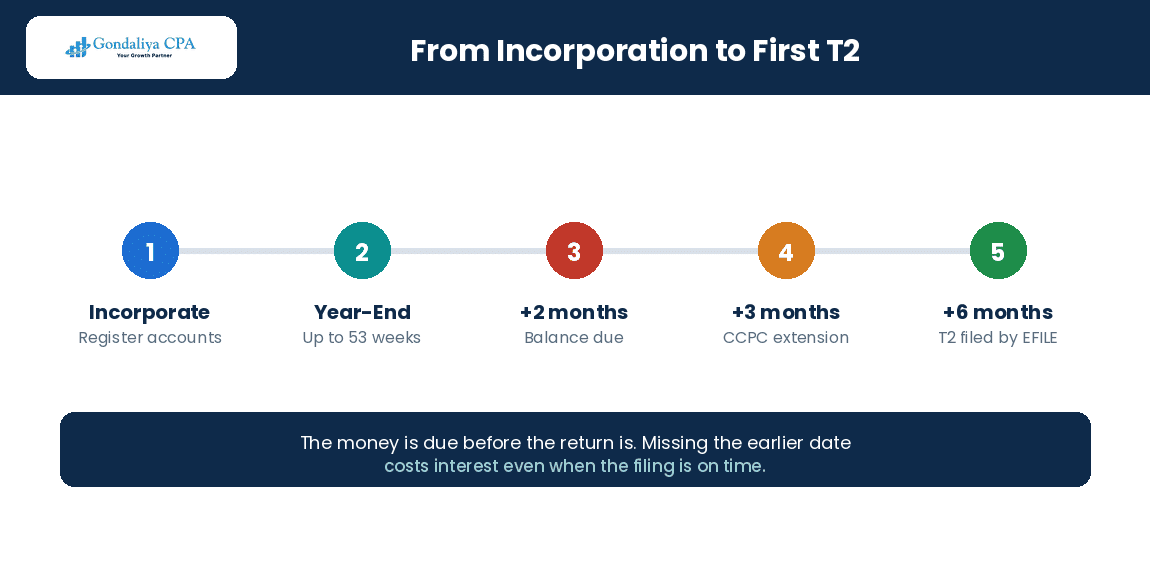
Your corporation’s fiscal year shows which months your first T2 Corporate Tax Return will cover. When you start a business in Canada, you can pick a fiscal year-end up to 53 months after incorporation. Most people pick a 12-month period that fits their business or the calendar year.
Your fiscal year choice affects when to file your return and pay taxes. The T2 must be filed within six months after your fiscal year ends. Taxes owed are due within two months—three months if you’re a Canadian-controlled private corporation (CCPC) getting the small business deduction. Picking a fiscal year that matches payroll or GST/HST periods can make things easier.
For example: if you incorporate on January 1st and pick December 31st as your year-end, your T2 covers January 1 to December 31. You file by June 30 next year, and pay by February 28 or March 31, depending on CCPC status.
Key points:
- First fiscal period can last up to 53 months
- File T2 return six months after year-end
- Pay balance within two or three months, based on CCPC
(CRA source: T2 Corporation Income Tax Guide)
When to file your corporation income tax return to avoid penalties
You need to file your First Corporate Tax Return on time to skip CRA penalties and interest. Your corporate income tax return (T2) is due six months after your corporation’s taxation year ends. This applies even if you made no income.
If you miss the deadline, CRA charges late-filing penalties. They start at $200 plus daily fines based on unpaid taxes. Interest builds daily on any unpaid balance from the day after it was due until you pay it all.
Even if you have no taxable income, filing nil returns on time is required. If you don’t, penalties still apply. Directors may face personal liability too, especially for late payroll remittances.
To avoid problems:
- Mark deadlines clearly when you incorporate
- Prepare documents early with help from an experienced tax pro
- Use certified electronic filing methods required by law
For instance, a company in Toronto with a December 31st year-end must file T2 by June 30 next year and pay taxes by March 31 if it’s a CCPC.
(CRA source: Late-filing penalty information)
A corporation set a first fiscal period running past twelve months on the assumption that longer meant simpler. The return had to be refiled across two periods, and the small business deduction had to be recalculated for both. Figures changed for privacy.
Eligibility criteria for using the T2 Short Return
The T2 Short Return suits some small corporations that meet specific CRA rules. It simplifies reporting compared to the full T2 form but only applies if all criteria are met:
- Must be a resident Canadian-controlled private corporation (CCPC) all year
- Gross revenue under $1 million annually including associates
- No complex transactions like foreign affiliates or multiple share classes
- No claims beyond basic refundable investment tax credits such as SR&ED
Non-resident corporations cannot use the T2 Short because they need more detailed disclosures about cross-border activities and withholding taxes.
Using this shorter form saves time but requires checking CRA rules carefully before choosing it for your first corporate tax filing.
(CRA source: T2 Short guide)
Specific rules for non-resident corporations and personal services businesses
Resident corporations—those incorporated or doing business mainly in Canada—must file corporate income tax returns every year unless they are exempt by law.
Non-resident corporations with permanent establishments in Canada also must file returns. Their rules differ about taxable income attribution and treaty benefits documents. These companies can’t use simple forms like the T2 Short because their filings need more details about residency and international transactions.
Personal services businesses (PSBs) provide services mainly through one person who would otherwise be an employee. PSBs face special limits including higher federal rates and no small business deduction. They must file returns reflecting these rules even if newly set up.
Some organizations like registered charities or certain financial institutions might be exempt from regular filings but should check CRA guidelines every tax season since rules change through 2026, including new electronic filing requirements.
Consequences of late filing and payment, including penalties and interest
| Consequence | Description |
|---|---|
| Late-filing penalty | At least $200 plus extra daily fines around half percent per day, capped at a max |
| Interest charges | Added daily compounded monthly on unpaid amounts |
| Loss carryforward delays | Late filings delay using losses against future profits |
| Director liability | Directors risk personal liability, especially over payroll remittances |
Penalties grow bigger if lateness repeats over years. Voluntary disclosure programs exist but don’t guarantee relief from all penalties nor replace timely filing habits during first filings.
Planning ahead helps avoid trouble — working with affordable CPA firms experienced in new incorporations cuts risk when preparing First Corporate Tax Returns anywhere in Ontario or Toronto.
Sharad Gondaliya, CPA, has over ten years helping many Canadian business owners handle their first corporate tax filings correctly.
Contact Gondaliya CPA at info@gondaliyacpa.ca or call 647‑212‑9559 for expert help with your First Corporate Tax Return under current Canadian laws.
Figures come directly from Canada Revenue Agency publications.
Risk Warning: The filing deadline and the payment deadline are different dates, and the money is due first. A corporation that files on time at six months but paid nothing at two can still owe interest from the earlier date. Please diarize both.
Obtaining and Completing the T2 Corporation Income Tax Return
Obtaining and Completing the T2 Corporation Income Tax Return
The Forms
The T2 Corporate Tax Return is a must for all resident corporations in Canada. Even if you just started your business, you need to file it. Filing your first corporate tax return means you have to get the right forms, fill them out carefully with the right papers, and send in all needed schedules. Doing this keeps you in line with CRA rules and stops any penalties for filing late or messing up the forms.
How to Obtain the T2 Return Form: Downloads, Printable Versions, and Alternate Formats
You can find the official T2 Corporate Tax Return form on the Canada Revenue Agency (CRA) website. The CRA offers PDFs that you can print and electronic versions that work with approved tax software.
- The T2 form includes many schedules based on what your company does.
- Since 2026, most companies must file electronically with CRA-certified software; paper forms are usually not accepted unless there’s a special reason.
- To avoid a CRA penalty for late filing, start early by downloading your forms soon after your fiscal year ends.
Make sure you use the newest version of the forms from Canada.ca. Using old or incomplete forms can slow down processing or cause problems.
Step-by-Step Guidance for Completing the Corporation Income Tax (T2) Return
Filling out your first T2 return takes some prep. You need important documents and financial reports before you start filling out the form:
- Gather incorporation papers like articles of incorporation and share records.
- Collect bank statements, sales invoices, expense receipts, payroll info, loan agreements, GST/HST filings, and details about shareholder loans.
- Prepare financial statements following CPA Canada standards (CSRS 4200), including balance sheets and income statements with GIFI codes.
- Fill out Schedule 100 (Balance Sheet), Schedule 125 (Shareholder Information), Schedule 141 (Financial Statement Details), plus other schedules based on what your business does.
- Double-check numbers against your source documents to avoid mistakes flagged by CRA.
Doing this right cuts audit risks and helps you claim deductions like small business deductions or capital cost allowance.
Required Schedules and Forms Commonly Included With T2 Returns
New companies usually file several important schedules with their main return:
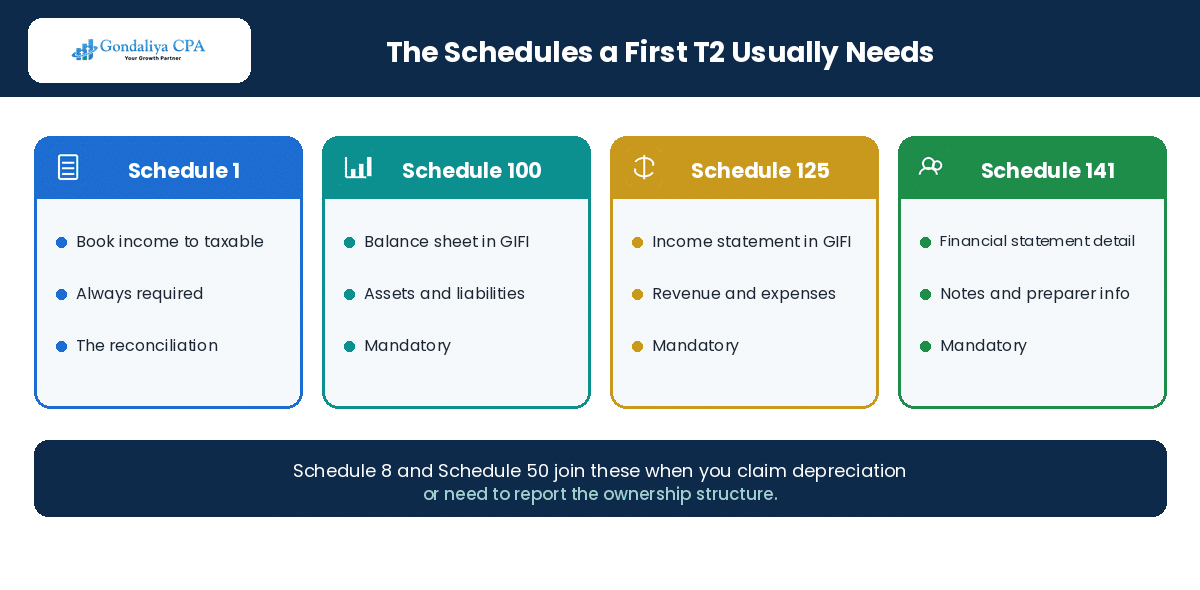
| Schedule | Purpose | When Needed |
|---|---|---|
| Schedule 1 | Reconciles accounting net income to taxable income | Always needed |
| Schedule 8 | Calculates Capital Cost Allowance (depreciation) | If claiming depreciation |
| Schedule 50 | Reports shareholder information | Shows ownership structure |
You might also need extra provincial schedules depending on where your business is in Canada.
Filing these right helps figure taxable income properly by balancing expenses and earnings during your first year.
Using the General Index of Financial Information (GIFI) and Other Reporting Requirements
The GIFI system uses numbers set by CRA to standardize financial reports:
- First-year businesses usually submit three main GIFI tables: Balance Sheet (Schedule 100), Income Statement (Schedule 125), plus extra details on Schedule 141 if needed.
- These codes let CRA systems process returns automatically and keep filings consistent across Canada.
You must send full GIFI info when e-filing your T2 return. Leaving parts out might cause delays or questions from tax officials.
Overview of Corporate Distributions, Compensating Shareholders, and Shareholder Benefits Taxation
When your corporation pays dividends or makes other distributions, they need proper reporting. Use Schedule 125 to list shareholder info for taxes:
- Loans between shareholders and their corporation must be declared under rules about shareholder loans. Missing this could lead to benefit assessments under section 15(2).
- Paying shareholders through salary instead of dividends changes personal taxes for them and what deductions your corporation can claim.
Keeping good records about shareholder payments helps avoid costly reclassifications or penalties if CRA audits you.
Sharad Gondaliya, CPA, has over 10 years’ experience helping Canadian business owners file their first corporate tax returns right under current laws.
A first-year return was rejected twice for missing GIFI detail before anyone looked at the tax itself. The numbers were correct throughout; the mapping to Schedules 100 and 125 was what held it up. Figures changed for privacy.
Paying Corporate Taxes and Instalment Payments
Paying Corporate Taxes and Instalment Payments
The Payments
Understanding corporate tax payments and instalment requirements
In Canada, corporations must pay taxes on their taxable income. They also need to make instalment payments during the year. If your business is new, you might get a break called first-year instalment relief. This can lower or delay your payments in that first year. For Canadian-controlled private corporations (CCPCs), the CRA gives more time to pay any balance after filing. This is called a CCPC balance-due extension.
Even if you don’t owe taxes at year-end, you still have to file a T2 Corporate Tax Return with the CRA. Not filing it on time can cause penalties and interest charges. You can file yourself using DIY software, hire a bookkeeper, or go with a CPA firm. Each option has its pros and cons, especially when dealing with CCPC extensions or instalment relief.
Key points:
- Pay taxes on taxable income
- Make instalments during the year
- First-year instalment relief may apply
- CCPCs get extended balance-due dates
- File T2 return even if no tax is owed
- Choose filing method: DIY software, bookkeeper, CPA firm
Calculating taxes payable including active business income and investment income considerations
To figure out what you owe, add up income from your business and investments. Investment income goes on Schedule 7 – Aggregate Investment Income. The small business deduction lowers tax rates on active business income up to $500,000 for most CCPCs.
You can claim Capital Cost Allowance (CCA) to write off assets over time. New rules let some businesses expense assets faster if bought after incorporation.
Don’t forget other deductions like startup costs before you incorporated. Track these carefully under CRA rules to get the most deductions without problems.
Remember:
- Include active business and investment income
- Use Schedule 7 for investment income reporting
- Small business deduction cuts federal tax rate on first $500K
- CCA lets you deduct depreciation on assets
- New businesses can claim startup costs
| Item | Description | Reference |
|---|---|---|
| Small Business Deduction | Cuts federal rate on first $500K active BI | CRA – Small Business Deduction |
| Schedule 7 | Reports aggregate investment income | CRA – T2 Schedules |
| Capital Cost Allowance (CCA) | Depreciation expense claim | CRA – CCA Guide |
Methods for paying corporate taxes in Canada and deadlines for payments
Your tax payment deadline depends on your fiscal year-end. Usually, you must file your T2 return within six months after year-end. But the payment of any balance due happens sooner — two months after fiscal year-end or three months for certain CCPCs.
If you file late, the CRA charges penalties starting at 5% of what you owe plus extra daily fees. Interest keeps growing until you pay in full.
You can pay online using CRA My Payment or through banks with remittance vouchers from certified accounting software when e-filing.
New businesses should watch these dates closely to avoid fines that hurt cash flow.
Quick list:
- File T2 within 6 months after year-end
- Pay balance due 2 months post year-end (3 months for some CCPCs)
- Late filing triggers penalties & interest
- Pay electronically via CRA My Payment or bank vouchers
Advice for managing additional business taxes such as payroll, EI premiums, and GST/HST remittances
Besides corporate tax, companies may have other accounts to manage with the CRA before filing their first T2:
- RP0001 Payroll Source Deductions Account: Needed if you have employees. It’s used for withholding CPP contributions, Employment Insurance premiums (EI), and personal tax.
- RT0001 GST/HST Account: Required when revenues exceed $30,000 annually or if you choose to register earlier.
Setting these up early helps make sure you send remittances on time and keep records clean.
Payroll requires issuing T4 slips yearly that show employee earnings and deductions through RP account filings. GST/HST returns come in monthly, quarterly, or yearly depending on your assigned schedule.
Keeping everything coordinated lowers audit risk and keeps all your tax filings smooth in Canada’s system.
Pro Tip: Register the RP payroll and RT GST/HST accounts at incorporation rather than when they are first needed. Backdating a registration is possible but slow, and the remittance obligation starts from the activity, not from the date the account opened.
Tools and Support for T2 Tax Preparation and Filing
Tools and Support for T2 Tax Preparation and Filing
The Tools
Overview of CRA-approved software options for T2 tax preparation and electronic filing
The CRA requires all corporations to file their T2 Corporate Tax Return electronically. They must use approved software to do this. Using CRA-certified software makes the process easier and faster. Some popular options are TaxCycle, Profile Business Software, Cantax, and Genutax. These programs handle important schedules like Schedule 1 for reconciliations, Schedule 8 for capital cost allowance (CCA), and GIFI reports like Schedules 100, 125, and 141.
This certified software helps automate tax calculations and checks your data against CRA rules. It also creates files that work with EFILE or Internet File Transfer methods. For businesses filing their first corporate tax return, these tools help avoid common mistakes such as choosing the wrong fiscal period or claiming small business deductions incorrectly.
Make sure to keep your software updated. Changes coming in 2026 affect things like GIFI submission rules and balance due dates for Canadian-controlled private corporations (CCPCs). Staying current with these updates is key to following Corporate Tax Filing Canada guidelines.
Benefits of using expert assistance from Gondaliya CPA for accurate T2 tax preparation
Getting help from a Registered CPA firm like Gondaliya CPA can really make a difference. We focus on Canadian corporate tax rules, especially for companies filing their first Corporate Tax Return.
Our team does more than just fill out forms. We check incorporation papers, confirm your fiscal year-end is correct, set up CRA program accounts right, and match your financial statements to the right GIFI codes. We find all deductions you qualify for, like new immediate expensing options under CCA rules. We also handle small business deduction limits correctly and review shareholder loan transactions carefully.
We work hard to avoid common errors in First Corporate Tax Returns while making sure you get all the credits you deserve under CRA rules. Our pricing is fixed annually—no surprise bills—and we offer support even on evenings or weekends. Plus, we represent clients before the CRA if needed.
Using pros cuts down your risk of errors compared to doing it yourself or hiring unlicensed helpers.
Practical tips for organizing records and maximizing eligible deductions before filing
Good record keeping makes preparing your First Corporate Tax Return smoother and helps you claim more deductions:
- Gather incorporation documents like articles of incorporation and share registers early.
- Keep detailed sales ledgers that match your GST/HST filings.
- Save bank statements for every account from your incorporation date.
- Compile payroll registers with source deductions reported via RP accounts.
- Collect invoices for asset purchases to support capital cost allowance claims.
- Track pre-incorporation costs separately but have them ready if CRA allows them.
- Document shareholder loan details clearly—show advances versus repayments.
To maximize deductions, know which expenses qualify. For example, immediate expensing lets you write off qualifying assets faster after incorporation. You can also claim home office expenses based on how much space you use just for work.
Having well-organized records also helps with timely reconciliations during compilation engagements under CSRS 4200 standards—a necessary step before you finish your T2 return.
Common pitfalls to avoid when preparing and submitting the corporation income tax return
Some mistakes can slow down your First Corporate Tax Return or trigger CRA audits:
- Picking a fiscal period longer than twelve months means you’ll need to refile.
- Leaving out required GIFI schedules causes your return to be rejected.
- Not reporting associated corporations messes up small business deduction calculations.
- Claiming personal expenses as business costs risks being flagged as shareholder benefits under subsection 15(2).
- Forgetting to reconcile GST/HST revenue can cause problems during reviews.
- Missing deadlines leads to interest charges—even if you don’t owe taxes yet.
Avoid these by double-checking everything against checklists from the CRA website made just for new companies. Getting an accountant involved early helps catch errors before you file and saves hassle later.
Efficient ways to file corporate taxes online, including direct CRA submissions
Canadian corporations must file T2 returns electronically through two main ways:
- EFILE – Mostly used by authorized accountants who prepare returns in certified software that connects securely with the CRA network. They get confirmation numbers once the submission goes through.
- Internet File Transfer (XML upload) – Used mainly by people who prepare their own returns with third-party software. This method lets users upload files directly through secure portals found in My Business Account dashboards.
After filing online:
- Keep the confirmation numbers; they prove you filed on time.
- Watch for digital Notices of Assessment that show if your return was accepted.
- Fix any issues quickly using professional advice when needed.
Filing electronically speeds up refunds compared to mailing paper returns. It also meets mandatory e-filing rules that now apply across Canada’s CCPCs since recent law changes affecting Corporate Tax Filing Canada requirements.
A founder filed their own first return and claimed a full year of home office costs without recording the space used. The claim itself was reasonable; without the measurement behind it, most of it could not be supported. Figures changed for privacy.
Additional Resources, Examples, and Next Steps
Additional Resources, Examples, and Next Steps
Resources
Introduction to Course Curriculum for Comprehensive Understanding of T2 Corporate Tax Returns
Getting the basics of the T2 Corporate Tax Return is key for new Canadian businesses. This course walks you through filing rules, choosing your fiscal year-end, what schedules you need, deductions, and risks. It also gives you a glossary with terms like CCPC, GIFI, Schedule 1 reconciliation, and small business deduction. For quick answers about things like who can file a T2 Short return or deadlines, check out the People Also Ask section.
Real-World Examples Illustrating Preparation of T2 Corporate Tax Returns for Small Businesses
Seeing actual examples makes first-time tax filing less confusing. We share cases with real numbers—like how many months the fiscal period covered, transactions each month, payroll size, GST/HST filing details, and which CRA schedules (100/125/141) were used. These stories show how catching up on bookkeeping plus CPA help cuts errors and speeds things up while keeping accuracy high.
Guidance on Related Schedules for Investment Income and Dividends Paid
Schedule 7 records all investment income your corporation earned during the year. Filling it out right matters because it changes taxable income and dividends shown on T5 slips. New businesses must watch dividends paid carefully to follow CRA rules about related-party deals and avoid trouble under subsection 15(2). Reporting well helps claim credits like refundable dividend tax on hand (RDTOH).
| Schedule | Purpose | When Required | Common Errors | Source |
|---|---|---|---|---|
| Schedule 7 | Aggregate investment income | If your corp earns interest/dividends/gains | F forgetting some income; wrong dividend classification | CRA Guide T4012 |
| Schedule 50 | Shareholder information | Required for all corporations | Leaving out details about related corps | CRA |
Accessing Ongoing Support, Updates on Corporate Tax Regulations, and Further Learning Materials
Keeping up with corporate tax rules helps avoid problems after your first filing. Gondaliya CPA shares updates from trusted sources like CRA’s official site (Canada.ca) and Corporations Canada’s notes on changes affecting taxes or mandatory electronic filing starting in 2026. We also suggest signing up for CPA Canada newsletters that cover standards for preparing financial statements alongside your T2 return.
Encouragement to Contact Gondaliya CPA for Personalized Corporate Tax Filing Assistance
Filing your first T2 return has many steps—from picking a fiscal year-end to gathering documents and submitting electronically via CRA-approved software. At Gondaliya CPA we use a clear process made for new Canadian SMBs: intake calls; checking accounts; catching up bookkeeping; drafting financials under CSRS 4200 compilation standards; tax planning reviews; then e-filing on time with all rules followed—including new 2026 mandates.
Our Registered Ontario firm offers fixed-fee pricing with no surprise bills plus weekend/evening help backed by over “1300+ five-star Google reviews.” You can email us at info@gondaliyacpa.ca or call 647-212-9559 anytime for a free chat about your First Corporate Tax Return.
Sharad Gondaliya, CPA, has more than 10 years’ experience helping Canadian business owners file their T2 Corporate Tax Return correctly while maximizing deductions allowed by law.
Verified Registered Ontario CPA Firm Directory
Frequently Asked Questions (FAQs) on T2 Corporate Tax Return and Filing
Frequently Asked Questions (FAQs) on T2 Corporate Tax Return and Filing
FAQ
What is the maximum length of a corporation’s first fiscal period?+
The first fiscal period can last up to 53 months after incorporation, allowing flexibility in choosing your year-end.
When is the filing due date for your first T2 return after fiscal year-end?+
The T2 return must be filed within six months after your fiscal year-end to avoid penalties.
What is a CCPC balance-due extension?+
CCPCs with small business deductions get an extended deadline to pay their tax balance, usually three months after fiscal year-end.
How many typical T2 schedules does a first-year corporation file?+
First-year corporations commonly file 3 to 5 key schedules such as Schedule 1, 100, 125, and sometimes Schedule 8 or 50.
What is the small business deduction business limit for CCPCs?+
The small business deduction applies to the first $500,000 of active business income for eligible CCPCs.
What is the CCA half-year rule rate?+
The CCA half-year rule allows you to claim only half of the normal Capital Cost Allowance in the acquisition year.
What penalty does CRA impose for late filing of T2 returns?+
CRA charges a minimum $200 plus daily fines around 0.5% per day on unpaid taxes when filing late.
How many GIFI schedules are typically filed with a T2 return?+
Corporations usually submit three main GIFI schedules: Balance Sheet (Schedule 100), Income Statement (Schedule 125), and Financial Details (Schedule 141).
Essential Insights for Your First Corporate Tax Return with Gondaliya CPA
Essential Insights for Your First Corporate Tax Return with Gondaliya CPA
Quick Reference
- Front Matter and Scope: Understand the assumptions and coverage of your T2 filing.
- Who This Is For / Not For: Know if your corporation qualifies or should consider other forms.
- Choosing Your First Fiscal Year-End: Pick a date that suits your business operations within allowed limits.
- CRA Accounts Setup: Register payroll (RP0001) and GST/HST (RT0001) accounts before filing.
- Documents Preparation: Gather incorporation papers, financial statements, and supporting documents early.
- Required Financial Statements: Prepare balance sheets and income statements compliant with CPA standards.
- Typical Schedules Filed: Include Schedules 1, 8, 50, 100, 125 as relevant to your business activities.
- Eligible Deductions and Credits: Claim small business deductions, CCA claims, startup costs properly.
- How to File With CRA: Use certified software for electronic filing via EFILE or Internet File Transfer.
- Consequences of Late Filing: Penalties start at $200 plus interest; directors may face personal liability.
- Common Mistakes: Avoid missing schedules, incorrect fiscal periods, and unclaimed credits.
- Filing Route Options: Choose between DIY software, bookkeeper help, or CPA firm support based on complexity.
- Gondaliya CPA Preparation Process: From intake to e-filing with fixed fees and expert guidance.
- Deliverables You Receive: Finalized T2 return with schedules, financial statements, and CRA correspondence assistance.
- Cost of First T2 Filing in Canada: Varies by service level; fixed-fee offers transparency and no surprises.
- Risks and Compliance Controls: Prevent audits by maintaining accurate records and timely filings.
- Founder Preparation Checklist: Organize records, set up accounts, clarify ownership before engagement.
- Industry Differences in First T2 Returns: Filing needs may vary by sector; get tailored advice from Gondaliya CPA.
- Realistic Numeric Example Walkthroughs: Understand how figures translate into forms and taxes payable.
- Choosing the Right CPA Firm in Toronto/Ontario: Look for expertise in first-time corporate tax returns with strong reviews.
- Trust Gondaliya CPA (E-E-A-T): Registered experts providing transparent services backed by client satisfaction.
For expert help preparing your First Corporate Tax Return in Canada, contact Gondaliya CPA at info@gondaliyacpa.ca or call 647‑212‑9559 today.
The question we hear most from first-time filers is which schedules they actually need. For most new corporations it is three or four, and the time goes into the statements behind them rather than the forms themselves. Figures changed for privacy.
Industry Spotlights: Sectors We Represent
Industry Expertise
A first T2 looks different by sector. Here are eleven and the schedule that carries the most weight in each.
| Industry | The Schedule That Carries the Most Weight |
|---|---|
| Technology startups & SaaS | Schedule 1, reconciling deferred revenue to taxable income |
| E-commerce & online retailers | Schedule 125, with processor fees and inventory correctly split |
| Consulting firms | Schedule 50, since shareholder detail drives the whole file |
| Construction, contractors & skilled trades | Schedule 8, with equipment placed in the right CCA class |
| Property developers & builders | Schedule 23, allocating the business limit across associated corporations |
| Real estate investors & holding companies | Schedule 7, reporting aggregate investment income |
| Transportation, logistics & trucking | Schedule 8, with fleet assets spread across several classes |
| Restaurants & food and beverage | Schedule 100, where payroll liabilities have to reconcile |
| Daycare, childcare & CWELCC services | Schedule 125, with subsidy revenue recognised in the right period |
| Dentists & dental practices | Schedule 125, splitting exempt clinical from taxable cosmetic revenue |
| Medical doctors & physician corporations | Schedule 50, because college rules limit who may hold shares |
- Technology startups & SaaS: Subscription revenue collected up front is deferred, and the Schedule 1 reconciliation is where that difference between book and tax income shows up.
- E-commerce & online retailers: Gross sales and processor fees have to appear separately on Schedule 125, or the GST/HST reconciliation will not tie to the return.
- Consulting Firms: Shareholder detail on Schedule 50 matters most, because owner draws and personal services business risk both trace back to it.
- Construction, general contractors & skilled trades: Equipment bought in the first period meets the half-year rule, and the CCA class chosen on Schedule 8 governs every year afterwards.
- Property developers & builders: Project corporations under common control are associated, so the $500,000 limit is shared rather than claimed in full by each.
- Real estate investors, landlords & holding companies: Rental and investment earnings belong on Schedule 7, and reporting them as active income is a common first-year error.
- Transportation, logistics & trucking: Fleet assets sit across several CCA classes, and the first Schedule 8 sets the pattern for the life of each vehicle.
- Restaurants & food and beverage: Payroll starts early, and the source deduction liabilities on Schedule 100 have to agree with what was actually remitted.
- Daycare, childcare & CWELCC services: Subsidy funding arrives on its own schedule, and recognising it in the wrong period distorts the first year in both directions.
- Dentists & dental practices: Exempt clinical revenue and taxable cosmetic work have to be separated on Schedule 125 before the GST/HST position can be supported.
- Medical doctors & physician professional corporations: The college restricts who may hold shares, and Schedule 50 has to reflect a structure that satisfies both the regulator and CRA.
Across first T2 returns prepared in one season, the two items that most often needed rework were an incorrect fiscal period and missing GIFI detail. Neither affected the tax owing; both delayed the assessment. Figures changed for privacy.
Professional Guidance and Quick Reference
Guidance
Professional Guidance on Your First T2: How Gondaliya CPA Supports Canadian Founders
A first T2 involves more than a form. You need the fiscal year-end confirmed, the RP and RT program accounts registered, bookkeeping brought current, financial statements prepared under CSRS 4200, the trial balance mapped to GIFI codes, the right schedules attached, and the return filed electronically inside six months. Gondaliya CPA prepares first corporate tax returns for newly incorporated Canadian businesses.
We handle the work that determines the outcome: reviewing the incorporation documents, confirming the year-end, setting up the CRA accounts, catching up the books, drafting the compilation statements, claiming the small business deduction and capital cost allowance correctly, and filing through certified software with confirmation retained.
Our team follows CRA practice closely and builds the return around your own facts rather than a template. Whether this is a first filing, a late first filing, or a corporation that has never filed at all, we give clear advice based on the current rules.
Quick Answers: Key Numbers & Concepts at a Glance
At a Glance
- T2 filing deadline: Six months after fiscal year-end
- Balance due: Two months, or three for an eligible CCPC
- Minimum late-filing penalty: $200
- Small business deduction limit: $500,000 of active business income
- T2 Short revenue ceiling: Under $1 million including associates
- GIFI schedules: 100, 125 and 141
- Common first-year schedules: 3 to 5, including Schedule 1
- CCA half-year rule: Half the normal claim in the acquisition year
- GST/HST registration: Above $30,000 of revenue
- Filing method: EFILE or Internet File Transfer
Who This Is For / Not For
Fit Check
- For: Newly incorporated Canadian corporations facing a first T2, founders unsure which schedules apply, and companies that have passed a first year-end without filing.
- Not For: Unincorporated sole proprietors, who report on a personal return rather than a T2, and corporations already served by a firm handling the full filing.
People Also Ask
Quick Answers
Does a corporation with no activity still file a T2?+
Yes. The obligation attaches to the corporation, not to the income, and a nil return is still a return. The minimum penalty applies regardless of revenue.
Can the first fiscal period end whenever the founder chooses?+
Within limits, yes. Once chosen it sets every deadline that follows, and changing it later requires CRA approval, so it is worth deciding deliberately.
Who can still file a T2 on paper?+
Almost nobody. Electronic filing through certified software is now the rule, and paper is accepted only in narrow circumstances.
Glossary of Key Terms
Plain-English Definitions
- T2 return: The corporate income tax return every incorporated company files annually.
- T2 Short Return: A simplified return available to some small, straightforward corporations.
- CCPC: A Canadian-Controlled Private Corporation, eligible for the small business deduction.
- GIFI: The General Index of Financial Information, the CRA’s standard financial statement codes.
- Schedule 1: The reconciliation of accounting net income to taxable income.
- Schedule 7: The schedule reporting aggregate investment income.
- Schedule 8: The capital cost allowance calculation.
- Schedule 50: The shareholder information schedule.
- Fiscal year-end: The date the accounting period closes, which sets the filing deadlines.
- Small business deduction: The reduced corporate rate on the first tranche of active business income.
- Half-year rule: The rule limiting the first-year CCA claim on a newly acquired asset to half.
- CSRS 4200: The standard governing compilation engagements in Canada.
- EFILE: The certified electronic channel used by authorised preparers.
- Internet File Transfer: The XML upload route for self-prepared returns.
- Notice of Assessment: The CRA’s response confirming how a filed return was assessed.
- Personal services business: A corporation providing services that would otherwise be employment.
First T2 Readiness Check
This quick self-check flags what still needs settling before your first T2 is due. Please answer the six questions below.
First T2 Readiness Check
Six quick questions on your first return. No fee shown.
Items to settle:
This is a general prompt, not tax or legal advice or a quote. Your position depends on your full facts. For a real review, please book a free consultation.
Want a checklist to work from? You can download our free first T2 checklist before your consultation.
Set the fiscal year-end deliberately, register the CRA accounts early, bring the bookkeeping current before drafting statements, map the trial balance to GIFI codes, attach the schedules your activity requires, and file electronically inside six months. Those six steps carry a new corporation through its first T2 without a reassessment.
2026 Update — what is current: Electronic filing through CRA-certified software is now required for most corporations, with paper accepted only in narrow circumstances. The six-month filing deadline and the CCPC balance-due extension are unchanged, and Schedules 100, 125 and 141 remain the mandatory GIFI schedules. Please confirm the current small business limit, immediate expensing eligibility, and penalty rates before relying on the figures in this article.
T2 Corporate Tax Return and Corporate Tax Filing Canada: A Complete Guide for Your First Corporate Tax Return with Gondaliya CPA
Get your first T2 filed right, before the deadline does the deciding
Gondaliya CPA confirms the year-end, sets up the CRA accounts, brings the books current, drafts the compilation statements, maps the GIFI codes, and files electronically with confirmation retained, on a fixed annual fee with a one-business-day response. Please book a free consultation.
Next Steps
For expert help preparing your First Corporate Tax Return in Canada, please contact Gondaliya CPA at info@gondaliyacpa.ca or call 647‑212‑9559 today. Starting early lowers compliance risk and gives us time to catch anything that needs correcting before the filing deadline. If our content helps, please add gondaliyacpa.ca as a preferred source on Google.
Published: August 5, 2026 · Last updated: August 5, 2026
Editorial policy: We research against CRA and CPA Canada sources, fact-check the figures, and Sharad Gondaliya, CPA, reviews the content, which we update as the rules change.
Disclaimer: This article is educational information only and is not tax, legal, or financial advice. Figures marked illustrative are examples rather than quotes or guarantees. It reflects CRA rules current to 2026, including the six-month T2 filing deadline, the CCPC balance-due extension, the $200 minimum late-filing penalty, the $500,000 small business deduction limit, the $1 million T2 Short revenue ceiling, and mandatory GIFI Schedules 100, 125 and 141. Rates, thresholds, and filing requirements change and outcomes depend on your specific facts. Please consult a Registered CPA before acting.

Sharad Gondaliya is a CPA Canada & CPA USA with 15 Years+ experience of Accounting, Tax, Payroll of Corporate Small Businesses as Tax Accountant. He is a CPA Ontario member (61040184) and holds US CPA licences in Washington and Montana and is well known among corporate small businesses for tax planning, efficient tax solutions, and affordable CPA services. Sharad is the Principal (Director) of Gondaliya CPA – Affordable CPA Firm in Canada. Licenses: CPA Ontario: 61040184 | CPA USA (MT): PAC-CPAP-LIC-033176 | CPA USA (WA): 57629 | CPA Firm License: 61330051 View Full Author Bio