



How Canadian Corporations Can Use the CRA VDP to Correct Unreported Income and Tax Errors
CRA VDP corporation cases involving unreported corporate income Canada require timely voluntary disclosure Canada to avoid penalties and interest. Gondaliya CPA offers expert support in corporate tax errors correction, GST/HST issues, shareholder benefits, and reassessment to help Canadian corporations maintain compliance and reduce enforcement action risks.
Quick Summary
Four conditions decide whether a disclosure works: it must be voluntary, complete, about overdue information, and accompanied by an estimated payment. Please note the tax itself is never forgiven. What the programme buys is relief from penalties that can reach half the understated amount, and protection from prosecution.
| Aspect | Details |
|---|---|
| The timing | Before any CRA audit, letter or enforcement contact. |
| The scope | Every affected year and every tax type, in full. |
| The payment | Estimated tax and interest included with the application. |
| The relief | Penalties, not the tax owing. |
Reading time: 37 minutes.
Table of Contents
- What is the Voluntary Disclosures Program (VDP) and Its Importance for Corporations
- The Four Criteria for a Valid Voluntary Disclosure under IC00-1R7 Guidelines
- Voluntary Disclosure Process and Application Steps
- Financial and Legal Implications of Voluntary Disclosures
- Best Practices and Common Pitfalls in Voluntary Disclosures
- Next Steps and Additional Resources
- Frequently Asked Questions (FAQs) — CRA VDP Corporation & Corporate Tax Errors
- Checklists, Sector Issues and Choosing a Firm
- Industry Spotlights: Sectors We Represent
- Professional Guidance and Quick Reference
The Numbers That Matter
This article covers Canada, with Ontario and Toronto context, and reflects CRA rules current to 2026 including the VDP changes effective October 2025. It assumes an incorporated business. Figures marked illustrative are examples, not quotes, and any masked engagement notes end with “Figures changed for privacy.” This is educational information only and not tax or legal advice. Where deliberate misstatement may be involved, please obtain legal counsel alongside accounting help, because accountant-client communications do not carry privilege.
What is the Voluntary Disclosures Program (VDP) and Its Importance for Corporations
What is the Voluntary Disclosures Program (VDP) and Its Importance for Corporations
The Basics
The Voluntary Disclosures Program (VDP) lets corporations fix unreported income and tax mistakes without facing penalties. The Canada Revenue Agency (CRA) offers this option to businesses that want to correct errors in their filings.
When companies come forward on their own, they avoid tough penalties from CRA audits. The VDP helps promote honesty and responsibility among business owners. It creates a clear way for companies to get back on track with Canadian tax rules.
Recent Changes to the VDP Effective October 2025 and Their Impact on Corporate Taxpayers
Starting in October 2025, the VDP will have new rules that change how corporations use it. These updates clarify who can apply and make the process smoother.
One big change is about timing: corporations must submit disclosures before CRA starts any enforcement action. If they don’t, they might lose access to relief under the program. Also, companies will need to provide full details for all years involved.
These changes push businesses to act quickly if they have unpaid taxes or filing errors from past years.
Key Benefits of Using the VDP to Correct Unreported Corporate Income and Corporate Tax Errors
Using the VDP brings several benefits for companies with unreported corporate income:
- Penalty Relief: Firms can reduce or erase penalties by fixing mistakes early.
- Interest Reduction: Taxes still must be paid, but interest charges might be lowered depending on CRA’s rules.
- Better Compliance Record: Fixing errors shows good faith and helps future interactions with CRA.
- Protection from Prosecution: Voluntary disclosure made before enforcement protects companies from criminal charges related to serious tax issues.
This program helps companies clear up financial problems and improve their standing with tax authorities.
Understanding CRA’s Approach to Corporate Tax Compliance and Enforcement
The CRA takes corporate tax compliance seriously across Canada. Companies must file correct returns and keep detailed records that show their true finances over time.
When problems pop up—like missed sales or wrongly classified expenses—CRA uses audits and assessments to enforce the rules:
- Audits often focus on industries where non-compliance happens more often.
- Penalties increase when companies repeatedly fail or act negligently in reporting.
- If returns are never filed, CRA can reassess taxes anytime without limits.
Knowing this makes it clear why programs like VDP matter for fixing old mistakes while keeping a company in good standing.
The call that comes too late is always the same one. An envelope has arrived, and the option that was available the previous week has closed. Figures changed for privacy.
Risk Warning: Where returns were never filed at all, the CRA can reassess without any time limit. The normal three-year window simply does not start until a return exists.
The Four Criteria for a Valid Voluntary Disclosure under IC00-1R7 Guidelines
The Four Criteria for a Valid Voluntary Disclosure under IC00-1R7 Guidelines
The Criteria
To make a valid voluntary disclosure under the IC00-1R7 guidelines, corporations must meet four clear rules. These rules help the CRA decide if penalty and interest relief apply when fixing corporate tax errors.
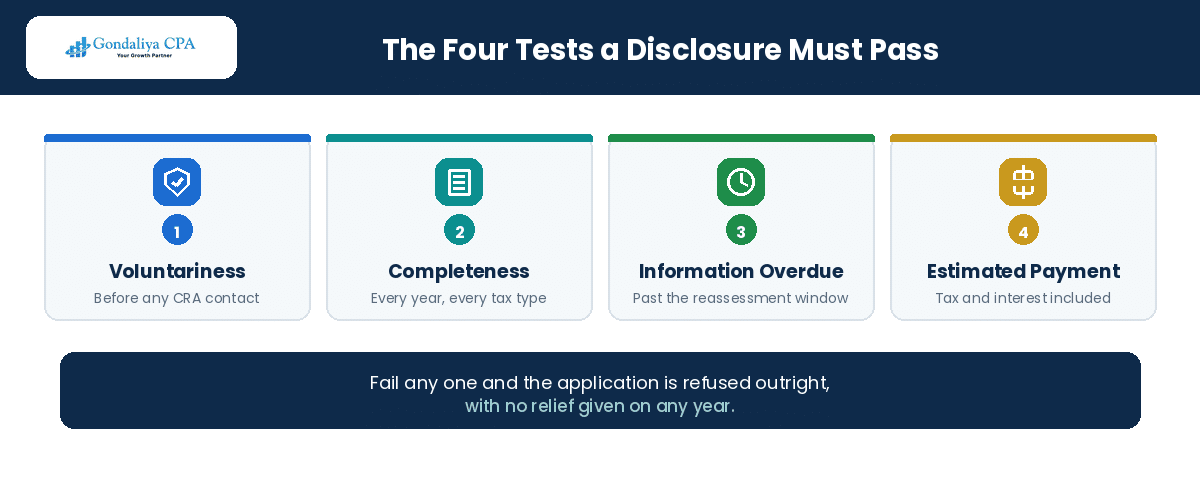
- Voluntariness
The disclosure has to come before the CRA starts any audit or enforcement. That means you report unreported corporate income Canada or other errors on your own, without being asked first. - Completeness
You need to share all facts, covering every year and tax type involved—like T2 returns or GST/HST filings. Leaving things out might get your disclosure rejected. - Information Overdue
The info must be about tax matters that are overdue, usually past reassessment periods. This timing justifies using the voluntary disclosure program. - Estimated Payment Included
Usually, you must include an estimate of the taxes owed with your disclosure unless you worked out something else with CRA beforehand.
Following these four steps is key to getting accepted in voluntary disclosure Canada programs aimed at fixing corporate tax errors and easing penalties CRA VDP Corporation Reference.
Distinction Between Unprompted and Prompted VDP Applications and Their Implications
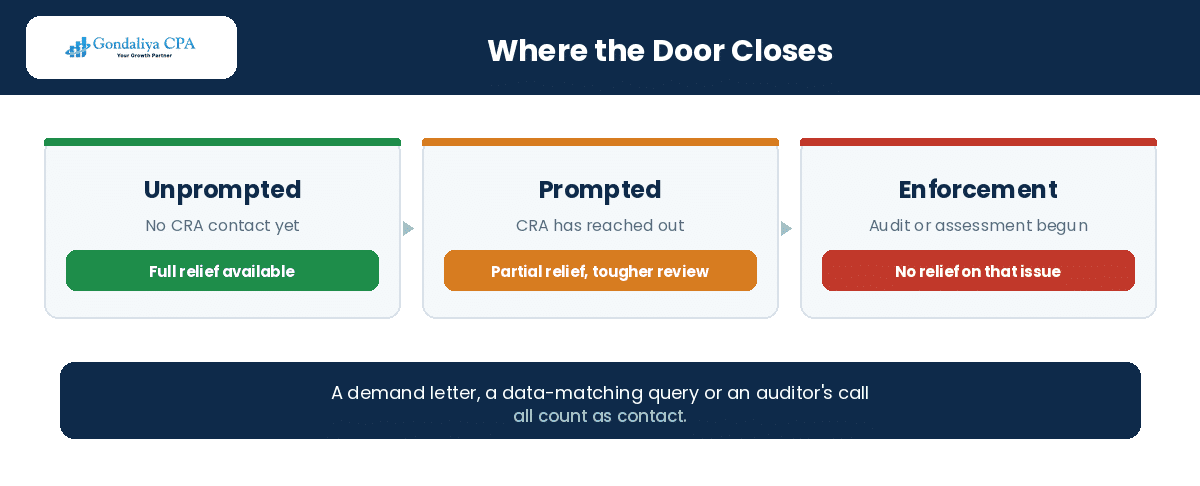
There are two types of voluntary disclosures: unprompted and prompted.
- Unprompted Disclosures:
These happen before the CRA contacts you. You report problems like unreported corporate income Canada proactively, no audit or review yet. - Prompted Disclosures:
These come after the CRA reaches out but before any formal enforcement like assessments starts.
Only unprompted disclosures can get full relief under CRA standard voluntary disclosure acceptance rules IC00-1R7. Prompted ones might get some relief but face tougher checks since they look less voluntary. Corporations should know this to judge their chances well in voluntary disclosure Canada programs CRA Source.
How Corporate Tax Audits Affect VDP Eligibility for Canadian Businesses
Audits change what counts as “voluntary” in the VDP program:
- Once an audit focuses on certain issues like unreported corporate income Canada, those problems can’t be fixed through VDP anymore.
- If the CRA already sent demand letters or notices about missing returns or suspected errors, you can’t use VDP for those same issues later.
- But if you find other mistakes unrelated to the audit, those may still qualify if disclosed fast enough.
This is why contacting a CPA expert early helps when audits begin. They guide you through GST/HST remittance errors or source deduction shortfalls before things get complicated CRA Enforcement Guidance.
For example, a Toronto retailer we helped started a voluntary disclosure just days before an audit notice arrived on sales revenue discrepancies. That quick move saved their eligibility despite ongoing investigations elsewhere in their books. (Details changed for privacy.)
Common Situations Where Corporations Qualify for VDP Including GST/HST and Source Deductions
| Situation | Tax Account Affected | What Relief Might Look Like |
|---|---|---|
| Unreported Sales Revenue | Income Tax (T2) | Penalty & interest relief possible |
| Understated Income | Income Tax | Penalties may be reduced |
| Overstated Expenses | Income Tax | Corrections required |
| Unfiled T2 Returns | Income Tax | Must file to comply |
| Misclaimed Input Tax Credits | GST/HST | Reimbursements + possibly less penalty |
| Unremitted GST/HST | GST/HST | Must pay amounts owing |
| Payroll Source Deduction Shortfalls | Payroll Taxes | Liability must be paid |
Most of these happen from bookkeeping slips rather than fraud. Using VDP quickly helps fix these while cutting penalty risks with Canadian tax authorities Canada.ca – Voluntary Disclosure Program.
One case: A construction firm caught up three years of missed payroll remittances plus understated income through our catch-up catch-up corporate tax filing service — they lowered penalties but still paid all taxes and interest as required. (Names changed.)
Industry-Specific Considerations and Impact on Eligibility for Voluntary Disclosure
Some industries have patterns that affect what errors occur and how they affect voluntary disclosure Canada eligibility:
- Restaurants & Food Services:
Cash sales sometimes go unreported; reporting fully avoids worse penalties. - E-commerce Retailers:
Tracking platform sales can cause income understatement needing restatement over several years. - Construction & Skilled Trades:
Complex subcontractor payments increase risks around source deduction accuracy. - Real Estate Investors & Holding Companies:
Foreign property holdings can cause missing foreign asset reports, affecting disclosure completeness.
Each industry faces unique challenges when preparing disclosures under IC00‑1R7 guidelines CRA Sector Insights. Early help tailored by sector reduces risks tied to delays that could lead to costly audits or legal action after enforcement begins.
By sticking closely to these rules—and making disclosures before any official inquiry—Canadian corporations can correct past mistakes safely. Getting professional help focused on Ontario’s diverse business scenes makes this process smoother and more reliable.
Key Stat: Only unprompted disclosures, made before any CRA contact, qualify for full relief. Once a letter arrives the same facts fall into the prompted category and face a tougher review.
Voluntary Disclosure Process and Application Steps
Voluntary Disclosure Process and Application Steps
The Process
Step-by-Step Guide to Preparing and Submitting a VDP Application for Corporations
Applying for the CRA VDP corporation program means following the Canada Revenue Agency’s rules carefully. First, you check if your case qualifies. The disclosure must be voluntary and complete, covering income that was reported late enough to qualify.
You’ll need all financial records from the years in question before you start writing up your disclosure.
Here’s what to do:
- Check your tax issues: Look at corporate tax errors or unreported income to confirm CRA hasn’t started any audits.
- Gather documents: Get all T2 returns, bank statements, sales invoices, payroll info, GST/HST filings, shareholder loan accounts, and foreign asset reports.
- Fix previous filings: Restate revenues and expenses correctly for every year involved.
- Estimate payments: Calculate taxes owed plus interest. Penalties might be waived but taxes must be paid.
- Fill out forms: Complete VDP forms with clear explanations for each correction.
- Send your application: Submit it by mail or electronically with any estimated payment included.
- Respond to CRA: Reply quickly if they ask for more info during their review.
Following these steps helps you meet voluntary disclosure Canada rules while lowering risks from corporate tax errors.
Documentation Requirements and Ensuring Completeness in Disclosures
Your disclosure works best when you provide full documentation covering all related years and tax types.
Make sure to include:
- Original T2 returns plus corrected versions
- Detailed ledger entries matching bank deposits
- Sales records including cash and online sales not reported before
- Supplier invoices backing expenses
- Payroll records along with remittance receipts
- GST/HST filings showing input tax credits and corrections
- Shareholder benefit details about loans or withdrawals wrongly recorded as expenses
- Foreign asset reports like T1134/T1135 if they apply
You must disclose every mistake involving unreported corporate income Canada completely—partial info may get rejected by CRA [CRA Income Tax Information Circular 2019‑04R].
We helped a Toronto retailer who found four years of missed online sales around $750K each year (numbers changed). We gathered six years of merchant statements plus supplier invoices linked to QuickBooks files in about 15 business days. This made their submission solid and accepted by CRA without problems.
Assessment and Calculation of Tax Liability, Penalties, and Interest by the CRA
When CRA gets a voluntary disclosure fixing corporate tax errors or unreported corporate income Canada, they recalculate what you owe based on your corrected taxable income per year.
Here’s what happens:
- Taxes owed can’t be erased; you must pay both principal and interest [CRA Voluntary Disclosures Program].
- Penalties may be waived depending on how honest you were Income Tax Act s.163(2).
- Interest adds up daily, compounded monthly until paid [Canada.ca].
They recalculate taxable income after fixing mistakes like overstated expenses or missing revenue. Then federal and provincial rates apply per fiscal year.
| Component | Description |
|---|---|
| Restated Net Income | Adjusted profits or losses |
| Federal/Provincial Tax | Calculated using current rates |
| Gross Negligence Penalties* | May be waived if disclosed voluntarily |
| Arrears Interest | Compounded monthly until paid |
*Penalty waivers depend on each case reviewed by CRA officers.
For an Etobicoke builder correcting three years of subcontractor payment errors ($420K yearly revenue approx.), we adjusted payroll shortfalls too. Total extra taxes plus interest hit about $95K CAD after two quarters prep time (numbers altered).
Negotiation and Communication with CRA During the VDP Review Process
Talking clearly with CRA during voluntary disclosure Canada reviews helps your chances of getting penalty relief.
Expect:
- A letter confirming they got your application with timelines;
- Follow-up questions from auditors asking for extra info;
- Chances to discuss details through your representative;
- Final decision letters explaining acceptance or conditions;
Being open builds trust needed when negotiating penalties or payment plans [CRA Guidelines].
Quick replies speed things up. Having professionals handle talks stops mistakes that might cause rejection.
We worked with a Vaughan tech startup fixing five years of tricky SaaS revenue errors (~$1M turnover approx.). Staying on top of requests within 30-day windows helped us close things smoothly despite multiple follow-ups (figures changed).
Role of Professional Representation and How Gondaliya CPA Supports Corporations Through VDP
Fixing corporate tax mistakes needs expert help like the CPA voluntary disclosure service Gondaliya CPA offers.
We help by:
- Checking eligibility focused on incorporated businesses facing issues like missed business income or wrong T2 filings;
- Organizing documents using tools such as QuickBooks/Xero to make sure nothing’s missing;
- Restating finances across multiple years so everything lines up;
- Calculating taxes accurately including GST/HST credits plus payroll shortfall fixes;
- Managing communication between clients & CRA to ease admin work;
- Advising when legal help is needed due to possible criminal risks;
With over “1300+ 5-star Google reviews,” our Ontario-based firm offers fixed fees plus fast replies—even evenings or weekends—to support companies in Toronto/Ontario and beyond.
Pro Tip: Reply to every CRA request inside the window given. Nothing damages a file faster than a follow-up letter going unanswered while the officer forms a view of how cooperative the taxpayer is.
Financial and Legal Implications of Voluntary Disclosures
Financial and Legal Implications of Voluntary Disclosures
The Exposure
Using the CRA VDP corporation program lets Canadian businesses fix unreported corporate income Canada and other tax mistakes. It offers a clear way to correct errors. You might get relief from some penalties and interest. But, you still owe the tax due. Serious cases can still lead to legal trouble.
Overview of Penalty and Interest Relief Available Through VDP for Corporate Tax Errors
The CRA’s Voluntary Disclosures Program gives penalty relief when disclosures are complete and voluntary. Corporations can avoid penalties like the gross negligence penalty—50% of understated tax—and repeated failure-to-report penalties, which can be up to 10%. Partial interest relief is possible, though not guaranteed.
Keep in mind, tax owing must be paid no matter what. The CRA asks for an estimated payment with your application. This covers all taxes plus interest calculated up to your disclosure date. So, while penalties may be waived, the main tax amount stays.
The CRA expects full disclosure across all years affected. Incomplete applications can get rejected without any relief. Acceptance depends on the facts in each case (CRA VDP Guidelines).
Potential Risks of Criminal Exposure and False Statement Penalties Without Voluntary Disclosure
Ignoring known tax errors carries big risks beyond fines:
- False Statement Penalty: If you knowingly or carelessly give false info, ITA s.163(2) says you could pay a 50% penalty on understated taxes.
- Gross Negligence Penalty: Also 50%, this applies if you recklessly ignore accuracy.
- Criminal Prosecution Risk: Fraud or willful default might lead to criminal charges under Canadian law (Department of Justice Canada).
Voluntary disclosure before CRA starts enforcement lowers risk but doesn’t guarantee immunity if behavior was very bad.
Impact of VDP on Corporate Reassessments, Taxpayer Appeals, and Administrative Reviews
When accepted into the VDP:
- The CRA reassesses your prior T2 returns based on your disclosures.
- You must pay assessed taxes quickly; but you can negotiate payment plans.
- You keep rights for administrative review or judicial appeal of reassessment results.
You can withdraw your application before final decision letters come out, but then you lose any relief benefits.
You also have ongoing duties to file accurate returns in future that match corrected records from the disclosure (CRA Income Tax Information Circular IC07‑1R6).
Addressing Shareholder Benefits, Loans, Foreign Reporting, and Multi-Year Restatement Issues
Disclosures often cover tricky issues like shareholder transactions or foreign reporting:
- Shareholder Benefits & Loans: Mistakes here need fixing under ITA ss.15(1)–(2). Incorrect withdrawals counted as expenses can trigger taxable benefits.
- Foreign Reporting Omissions: Missing T1134 (foreign affiliate info) or T1135 (foreign property) forms bring big daily penalties—over $25 per day—with no time limit if there was misrepresentation (CRA Foreign Reporting Guidance).
You must restate all affected years—usually six—to meet record retention rules under ITA s.230 (Canada Revenue Agency Record Retention Rules). This shows full transparency across periods needing correction.
Taxpayer Rights and Protections During and After the Voluntary Disclosure Process
During the process:
- Corporations keep taxpayer rights including confidentiality within legal limits.
- After reassessment, payment plans help settle amounts without immediate enforcement if agreed early with CRA.
Disclosures must stay fully voluntary; if CRA already started an audit or sent a demand letter, you can’t get penalty relief under VDP (CRA Eligibility Conditions).
Knowing these rights helps business owners deal with compliance confidently while cutting financial risks from past unreported income Canada-wide.
Key Stat: Gross negligence penalty rate stands at 50% on understated taxes — source: ITA s.163(2).
Statutory Requirement: Six-year record retention mandated by ITA s.230 supports comprehensive multi-year restatements required in disclosures — source: Canada Revenue Agency Records Keeping Guide.
Risk Warning: Applying after receiving a demand letter from CRA disqualifies corporations from penalty relief via voluntary disclosure — source: CRA Eligibility Criteria.
Pro Tip: Include an estimated payment covering all unpaid taxes plus accrued interest up until your application’s effective date for smoother acceptance chances — source: CRA Application Requirements.
Our Take: Full transparency across all affected years builds credibility essential for successful resolution through Canada’s current voluntary disclosure framework at Gondaliya CPA Toronto office supporting clients nationwide.*
For help fixing unreported business income through reliable CPA voluntary disclosure services focused on Ontario incorporated SMBs call us today at 647‑212‑9559 or email info@gondaliyacpa.ca.
Foreign reporting omissions are the quiet killer in these files. A missing T1135 accrues daily and, where there was misrepresentation, carries no limitation period at all. Figures changed for privacy.
Best Practices and Common Pitfalls in Voluntary Disclosures
Best Practices and Common Pitfalls in Voluntary Disclosures
The Pitfalls
Typical Corporate Tax Errors Leading to VDP Applications and How to Avoid Them
Corporate tax errors often force companies to apply through the CRA VDP corporation program. Common issues include unreported corporate income Canada-wide, mistakes in GST/HST remittances, misreporting shareholder benefits, and missed T2 returns. For example, some income slips through the cracks when cash sales or online earnings aren’t tracked well. GST/HST errors happen when companies underpay taxes or wrongly claim input tax credits (ITCs). Shareholder benefits like loans or withdrawals, if not properly reported, may trigger penalties. Late or missing T2 filings add more risk.
Avoid these problems by keeping accurate books that catch all income sources, including digital sales. Regularly check your GST/HST accounts so payments and claims match CRA rules (Canada.ca). Document shareholder transactions clearly to avoid classification mistakes under ITA sections 15(1) and 15(2). Always file T2 returns on time to dodge late fees.
Frequent Mistakes in VDP Submissions That May Jeopardize Penalty Relief
A big mistake in voluntary disclosures is submitting partial or selective information. The CRA requires full disclosure; skipping years or tax types can cause refusal. Incomplete submissions fail the completeness test (Income Tax Information Circular IC07-1R6). Timing matters a lot: you must disclose before any audit contact or enforcement begins. After that point, you lose your chance for relief.
Some also submit wrong details, which risks false statement penalties—these can hit up to 50% of understated taxes under ITA section 163(2)(a)(ii). Missing estimated payments weakens your case since it shows less intent to comply.
To increase penalty relief chances, restate all affected years fully and back your numbers with good documentation before applying.
Maintaining Post-VDP Compliance and Strategies to Prevent Future Non-Compliance
Once accepted under CRA standard voluntary disclosure acceptance terms, businesses must keep strong compliance habits. Keep all records for at least six years as Corporations Canada requires. Stay on top of tax filings like T2 returns, GST/HST remittances, payroll deductions, and any foreign asset reporting.
Set up internal controls using software like QuickBooks or Xero. These tools help catch errors early by automating reconciliations and reminding you of deadlines. Have annual CPA checks for extra security.
Talk regularly with tax pros so you adjust quickly to changing rules and maintain solid compliance over time.
How to Preserve Voluntary Disclosure Eligibility When Facing a CRA Audit or Enforcement Action
You must apply for voluntary disclosure before CRA contacts you about an audit or enforcement action (CRA Income Tax Information Circular IC07-1R6). Once CRA starts an audit, demands missing returns, sends reassessments, or uses data matching programs that find issues—your voluntariness stops right away.
If you submit disclosures after audit notice, you lose penalty relief options. Worse yet, you could face gross negligence penalties.
If an audit looms, consult a CPA fast—but avoid sending incomplete info once CRA has contacted you. This protects your chances for relief available only before enforcement begins.
Practical Tips from Gondaliya CPA to Maximize Benefits and Minimize Risks in Voluntary Disclosures
- Make sure your voluntary disclosure includes a complete restatement of every year involved. Fix taxable income mistakes year after year. Adjust revenue recognition errors plus expense fixes including disallowed items per s.18(1)(a). Handle shareholder benefits and loans properly under s.15 rules. Also recalculate GST/HST net taxes correctly by comparing input credits claimed against output taxes owed (CRA Memorandum GI-010).
- Working with licensed CPAs specializing in corporate tax helps improve accuracy and avoids delays caused by missing paperwork (CPA Ontario).
- Get advice early so you can address common issues specific to your industry — like e-commerce revenue tracking for retailers or source deduction problems for contractors — reducing risk during reviews without risking legal troubles.
Key Stat: False statement penalty rate can reach 50% on understated amounts – Source: CRA Income Tax Act s163(2)
Statutory Requirement: Six-year record retention mandatory – Source: Corporations Canada
Risk Warning: Applying after receiving an audit notice forfeits voluntariness – Source: CRA IC07-1R6
Pro Tip: Include estimated payment upfront demonstrating good faith effort – Source: CRA Voluntary Disclosures Program Guidelines
Our Take: Full transparency across all years avoids costly rejections
For expert guidance navigating complex voluntary disclosures involving unreported business income Canada-wide call Gondaliya CPA at 647-212-9559, email info@gondaliyacpa.ca, serving Toronto/Ontario businesses with proven expertise backed by over 1300+ 5-star Google reviews.
The most common reason a file fails is not the size of the error. It is a partial submission that covered three years when the CRA could see there were five. Figures changed for privacy.
Next Steps and Additional Resources
Next Steps and Additional Resources
The Next Move
When and Why Canadian Corporations Should Act Promptly to File a Voluntary Disclosure
If your corporation has unreported corporate income or made corporate tax errors, acting quickly matters. Filing a voluntary disclosure under the CRA VDP corporation program can stop penalties from growing. The CRA only accepts disclosures that are voluntary, full, and filed before they reach out about the issue.
Waiting too long can lead to bigger fines for serious mistakes or failing to report income repeatedly. Interest builds on unpaid taxes every day, which can add up fast. Filing early helps cut down penalty charges and shows you’re trying to follow the rules.
Fixing mistakes right away also protects company directors from possible liability linked to source deductions and GST/HST payments. For businesses in Toronto or anywhere in Canada, sorting this out fast lowers chances of audits later.
- Avoid bigger penalties by disclosing early
- Prevent daily interest buildup on owed taxes
- Shield directors from legal risks tied to deductions
- Reduce future audit chances
How to Access Expert Assistance from Gondaliya CPA for Corporate Tax Corrections
Gondaliya CPA knows how to handle CRA VDP corporation filings for companies with unreported income across Canada. We walk you through every step of fixing past tax errors using methods that match current CRA rules.
Our fixed-fee services suit small and mid-sized incorporated businesses needing help with voluntary disclosures. We cover eligibility checks, filing the application, reviewing reassessments, and helping with payment plans. Licensed Ontario CPAs handle your case carefully to avoid mistakes.
You get quick responses—within one business day—and support evenings or weekends if needed. This helps when dealing with complex cases over multiple years or accounts. Call us at 647-212-9559 or email info@gondaliyacpa.ca for a free chat about your situation under voluntary disclosure Canada rules.
- Specialized help for incorporated SMBs
- Step-by-step guidance through disclosure process
- Fixed fees with no surprises
- Quick replies including evenings/weekends
Related CRA Programs and Resources for Corporate Tax Compliance and Disclosure
Besides the Voluntary Disclosures Program (CRA VDP corporation), other CRA options can help keep your taxes straight:
- Taxpayer Relief Provisions: Can reduce penalties or interest if you face unusual situations—but you still owe the taxes themselves.
- GST/HST Self-Correction Program: Lets businesses fix certain GST/HST errors without formal disclosures if they meet criteria.
- Director Liability Regime: Makes directors responsible for unpaid source deductions; correcting problems early cuts this risk.
Check official info on Canada.ca or the CRA’s Voluntary Disclosures page. Keep an eye on updates about deadlines, rules, and penalty rates including new 2026 interest compounding changes.
- Taxpayer relief may reduce penalties but not taxes owed
- GST/HST self-correction avoids formal disclosure sometimes
- Directors face personal liability if source deductions aren’t paid
Contact Information and Consultation Opportunities for Voluntary Disclosure Support
Need help fixing corporate tax issues through CRA VDP corporation? Reach out:
Gondaliya CPA Professional Corporation
Phone: 647-212-9559
Email: info@gondaliyacpa.ca
We serve Toronto, Ontario, and all across Canada—including places like Etobicoke, Vaughan, Mississauga, Brampton—and more. We focus only on helping incorporated business owners correct unreported income problems.
Book a free consultation by phone or email. We keep your info private and explain next steps clearly without pressure or hidden fees. Over 1300 five-star Google reviews back our work with complex voluntary disclosures.
- Available nationwide in Canada
- No-pressure free consultations
- Trusted by hundreds of clients
Legal Disclaimer and Encouragement for Professional Advice Before Submitting VDP Applications
Voluntary disclosure Canada programs have strict legal rules by the CRA. Your application must be fully voluntary before they start enforcement actions. Incomplete disclosures can be denied relief but still lead to reassessments with full tax payments plus penalties and interest.
This info is educational only—not legal advice—and doesn’t replace talking with qualified professionals who know your specific case before submitting any application under CRA VDP corporation rules. Cases involving deliberate false statements might bring criminal charges against corporations and officers, needing legal counsel along with accounting help since accountant-client communications lack solicitor-client privilege under Canadian law.
Use experienced licensed CPAs like Gondaliya CPA who know both technical rules and filing details needed to prepare accurate applications following all current laws through 2026 and beyond.
Sharad Gondaliya, CPA, has over 10 years helping Canadian business owners sort their books right.
Directors underestimate their personal exposure on source deductions. The corporation may be the taxpayer, but unremitted payroll follows the individuals for up to three years. Figures changed for privacy.
Risk Warning: Accountant-client communications do not carry solicitor-client privilege in Canada. Where deliberate misstatement may be in question, please instruct a lawyer alongside your CPA before anything is written down.
Frequently Asked Questions (FAQs) – CRA VDP Corporation & Corporate Tax Errors
Frequently Asked Questions (FAQs) — CRA VDP Corporation & Corporate Tax Errors
FAQ
What is the maximum age of information eligible for voluntary disclosure under CRA VDP?+
CRA generally accepts disclosures covering tax years within six years before the disclosure date, aligning with record retention rules.
What is the gross negligence penalty rate for corporate tax errors?+
The gross negligence penalty rate stands at 50% of the understated tax amount.
How does the false statement penalty apply to corporate disclosures?+
False statements can trigger a 50% penalty on understated taxes under ITA s.163(2).
What is the director liability period for unpaid source deductions?+
Directors may be liable for up to three years of unpaid payroll source deductions.
How long must corporations retain records to comply with CRA rules?+
Corporations must retain all tax-related records for at least six years from the end of the tax year.
How many prior filings are required for a typical corporate voluntary disclosure?+
Disclosures usually require restating all affected T2 returns and related filings within the six-year period.
Under which category does a corporate VDP application typically fall?+
Most corporate disclosures qualify as standard voluntary disclosures under CRA’s acceptance criteria.
What is the typical preparation turnaround time for a corporate VDP submission?+
Preparation times range from 4 to 12 weeks depending on case complexity and documentation completeness.
What scope and assumptions guide a corporate VDP filing with Gondaliya CPA?+
Scope includes full income restatement, GST/HST corrections, payroll remittance review, and shareholder benefit adjustments.
What are key numbers at a glance in a typical corporate voluntary disclosure?+
Key numbers include total unreported income, tax owed, interest accrued, and penalties waived or reduced.
What does “complete” require across years and tax types in a VDP application?+
Complete means full disclosure of all affected tax years and types—T2 income, GST/HST returns, payroll remittances, shareholder transactions.
How does the corporate VDP process work step by step?+
It involves eligibility assessment, document gathering, income restatement, payment estimation, form completion, submission, and CRA follow-up.
How does VDP compare with T2 amendments or taxpayer relief options?+
VDP offers penalty relief if disclosed timely; T2 amendments correct errors without relief; taxpayer relief addresses penalties post-assessment.
What documents does a corporate VDP application require?+
Required documents include original and corrected T2 returns, financial statements, GST/HST filings, payroll records, and shareholder loan details.
How is corporate tax liability calculated before filing a disclosure?+
Liability equals corrected taxable income multiplied by applicable rates plus interest; penalties may be waived upon disclosure acceptance.
What happens after CRA accepts or denies a corporate disclosure?+
Upon acceptance, reassessments occur with possible penalty waivers. Denial leads to regular assessments without relief.
When should a corporation involve a tax lawyer instead of only a CPA?+
Involvement of a lawyer is advised if criminal prosecution risk or complex legal issues arise during disclosure.
Which disclosure route fits best: DIY vs bookkeeper vs corporate CPA?+
Complex cases benefit from CPA expertise; DIY or bookkeepers suit minor corrections but risk errors affecting relief eligibility.
What deliverables can corporations expect from Gondaliya CPA’s VDP service?+
Deliverables include eligibility assessment report, complete disclosure package preparation, CRA communication handling, and post-assessment support.
How much does a typical corporate VDP filing cost in Canada?+
Costs vary by complexity but fixed-fee arrangements often range between $5,000 to $15,000 CAD including preparation and representation services.
What are the risks of leaving corporate tax errors undisclosed to CRA?+
Risks include severe penalties, interest accumulation, audits, reassessments without relief, director liability exposure, and potential criminal charges.
Essential Checklist Before Starting Your Corporate Voluntary Disclosure
Checklists, Sector Issues and Choosing a Firm
Quick Reference
- Verify no ongoing CRA audit or enforcement has started.
- Gather all T2 returns for affected years plus corrections.
- Compile complete GST/HST filings including input tax credits claims.
- Collect payroll records with source deduction remittance evidence.
- Assemble shareholder benefit documents like loans or dividends.
- Obtain foreign asset reports (T1134/T1135) if applicable.
- Estimate outstanding taxes plus accrued interest accurately.
Industry-Specific Disclosure Issues Across 10 Key Sectors
- Restaurants: Unreported cash sales require thorough reconciliation.
- E-commerce: Multiple sales platforms increase risk of missed revenues.
- Construction: Complex subcontractor payments affect source deductions accuracy.
- Real Estate: Foreign property holdings necessitate comprehensive foreign reporting compliance.
- Manufacturing: Inventory valuation mistakes impact income reporting.
- Retail: Point-of-sale discrepancies cause understated sales revenue.
- Technology: SaaS revenue recognition requires careful adjustment over multiple periods.
- Transportation: Fuel tax credits and expenses need detailed verification.
- Professional Services: Incorrect expense classification affects taxable income.
- Agriculture: Seasonal fluctuations lead to timing differences in revenue reporting.
How to Choose the Right CPA Firm in Toronto/Ontario for Your Corporate Disclosure
- Ensure firm specializes in voluntary disclosures for incorporated businesses.
- Look for fixed-fee pricing transparency with no hidden costs.
- Confirm experience with multi-year restatements and complex GST/HST issues.
- Check client reviews emphasizing responsiveness and professionalism.
- Verify knowledge of industry-specific compliance challenges you face.
Gondaliya CPA ticks all these boxes with proven results serving Ontario SMBs nationwide.
Why Trust Gondaliya CPA With Your CRA Voluntary Disclosure?
- Over 10 years helping Canadian corporations resolve unreported income cases reliably.
- CPA Ontario members skilled in both technical accounting and negotiation with CRA officers.
- Transparent fixed fees combined with rapid response times including evenings/weekends support availability.
- Expertise across diverse industries ensuring tailored strategies reducing penalties effectively.
- Backed by 1300+ five-star Google reviews showcasing client satisfaction in complex disclosures.
For expert guidance fixing unreported business income Canada-wide through professional voluntary disclosure services call Gondaliya CPA at 647‑212‑9559, email info@gondaliyacpa.ca, serving Toronto/Ontario SMBs confidently every step of the way.
Turnaround is driven by documents, not complexity. Files where the bank statements and merchant reports are already gathered close in weeks; the rest wait on paperwork. Figures changed for privacy.
Industry Spotlights: Sectors We Represent
Industry Expertise
The error that triggers a disclosure differs by sector. Here are eleven and what typically surfaces.
| Industry | What Usually Needs Disclosing |
|---|---|
| Restaurants & food and beverage | Unreported cash and platform sales |
| E-commerce & online retailers | Revenue across multiple marketplaces |
| Construction, contractors & skilled trades | Subcontractor payments and source deductions |
| Real estate investors & holding companies | Foreign property reporting and shareholder loans |
| Technology startups & SaaS | Revenue recognised in the wrong periods |
| Transportation, logistics & trucking | Fuel credits and expense substantiation |
| Consulting firms | Expense classification and shareholder benefits |
| Property developers & builders | Cost allocation and unfiled returns across entities |
| Daycare, childcare & CWELCC services | Subsidy income and payroll remittance gaps |
| Dentists & dental practices | Input tax credits on exempt supplies |
| Medical doctors & physician corporations | Shareholder withdrawals recorded as expenses |
- Restaurants & food and beverage: Cash takings and delivery platform revenue are where understatement concentrates in this sector.
- E-commerce & online retailers: Revenue spread across several marketplaces rarely reconciles to what was reported.
- Construction, general contractors & skilled trades: Subcontractor arrangements and payroll source deductions are the recurring exposure.
- Real estate investors, landlords & holding companies: Foreign property reporting and undocumented shareholder loans usually appear together.
- Technology startups & SaaS: Subscription revenue recognised on receipt rather than delivery needs restating across periods.
- Transportation, logistics & trucking: Fuel tax credits and expense substantiation both need verifying before disclosure.
- Consulting Firms: Expense classification and personal spending routed through the corporation are the usual findings.
- Property developers & builders: Costs allocated across entities without basis, often alongside unfiled returns.
- Daycare, childcare & CWELCC services: Subsidy income timing and payroll remittance shortfalls need correcting together.
- Dentists & dental practices: Input tax credits claimed against exempt clinical work require a GST/HST restatement.
- Medical doctors & physician professional corporations: Shareholder withdrawals booked as expenses trigger benefit adjustments under s.15.
The common thread is that almost none of it was deliberate. Records drifted, a platform was missed, a withdrawal was coded wrongly, and years passed before anyone looked. Figures changed for privacy.
Professional Guidance and Quick Reference
Guidance
Professional Guidance on Corporate Voluntary Disclosures: How Gondaliya CPA Supports Canadian Corporations
A voluntary disclosure is not a negotiation about how much tax is owed. The tax is the tax. What is being decided is whether penalties reaching half the understated amount apply, and whether prosecution remains on the table. That decision turns almost entirely on timing and completeness. Gondaliya CPA prepares these files on a fixed fee.
We handle what decides the outcome: confirming eligibility before anything is submitted, gathering the full document set across every affected year, restating income and expenses year by year, correcting GST/HST net tax and input credits, fixing shareholder benefits and loans under section 15, addressing foreign reporting where T1134 or T1135 obligations were missed, calculating tax and interest for the estimated payment, and handling every CRA exchange through to the decision letter.
Our team works from your own records and will tell you plainly whether the door is still open before you spend anything. Where deliberate misstatement may be involved, we say so and bring counsel in. You get clear advice and a fixed price before we start.
Quick Answers: Key Numbers & Concepts at a Glance
At a Glance
- Gross negligence penalty: 50% of understated tax
- False statement penalty: Up to 50% under ITA s.163(2)
- Repeated failure to report: Up to 10%
- Record retention: Six years under ITA s.230
- Director liability: Up to three years on source deductions
- Foreign reporting penalty: Over $25 per day
- Preparation turnaround: Typically 4 to 12 weeks
- Unfiled returns: No reassessment time limit applies
- The four tests: Voluntary, complete, overdue, payment included
- VDP rule change: Effective October 2025
Who This Is For / Not For
Fit Check
- For: Incorporated Canadian businesses with unreported income, unfiled returns, GST/HST or payroll shortfalls, where the CRA has not yet made contact about the issue.
- Not For: Situations already under audit or enforcement on the same issue, where the voluntariness test has already failed and different advice is needed.
People Also Ask
Quick Answers
Can I disclose one year and leave the others?+
No. Partial disclosure fails the completeness test and is a common reason files are refused outright, with no relief given on any year.
Does the CRA tell me if an audit has already started?+
Not necessarily in advance. A demand letter, a data-matching query or an auditor’s call all count as contact, which is why timing advice matters.
Is the tax itself ever forgiven?+
No. The programme relieves penalties and sometimes part of the interest. The principal tax remains payable in every accepted case.
Glossary of Key Terms
Plain-English Definitions
- Voluntary Disclosures Program: The CRA route to correct filings before enforcement begins.
- Voluntariness: The requirement that disclosure precede any CRA contact on the issue.
- Completeness: The requirement to disclose every affected year and tax type.
- Unprompted disclosure: One made before the CRA reaches out at all.
- Prompted disclosure: One made after CRA contact but before formal enforcement.
- Gross negligence penalty: A 50% charge on understated tax where accuracy was recklessly ignored.
- False statement penalty: A 50% charge under ITA s.163(2) for knowingly false information.
- Arrears interest: Interest on unpaid tax, compounded monthly until settled.
- Estimated payment: The tax and interest figure submitted with the application.
- Restatement: Correcting income and expenses across every affected year.
- Shareholder benefit: A corporate payment or perk treated as taxable income to the shareholder.
- T1134: The foreign affiliate information return.
- T1135: The foreign income verification statement for specified foreign property.
- Director liability: Personal responsibility for unremitted source deductions.
- Taxpayer relief provisions: A separate route that may reduce penalties or interest after assessment.
- Reassessment: The CRA revisiting and adjusting a previously filed return.
Corporate VDP Eligibility Check
This quick self-check indicates where your operation most likely has room. Please answer the six questions below.
Corporate VDP Eligibility Check
Six quick questions on your position. No fee shown.
Points to raise with us:
This is a general prompt, not tax or legal advice or a quote. Your position depends on your full facts. For a real review, please book a free consultation.
Want a checklist to work from? You can download our free corporate VDP checklist before your consultation.
Establish first whether the CRA has made contact, because that single fact decides whether relief is available. Disclose every affected year and every tax type, not a selection. Include an estimated payment covering tax and interest. Restate the figures properly rather than approximating. Answer every CRA request inside the window given. Where deliberate misstatement may be involved, instruct a lawyer before anything is written down.
2026 Update — what is current: Revised VDP rules took effect in October 2025, tightening the timing requirement and the expectation of full detail across all years. New interest compounding changes apply from 2026. The 50% gross negligence and false statement penalties, the six-year retention rule and the three-year director liability period are unchanged. Please note this article cites both IC00-1R7 and IC07-1R6 as the governing circular, so please confirm which applies before relying on it.
CRA VDP Corporation: How Gondaliya CPA Helps Correct Unreported Corporate Income Canada and Corporate Tax Errors
Come forward before they come to you
Gondaliya CPA confirms your eligibility, assembles the full document set, restates income and expenses across every affected year, corrects GST/HST and payroll, resolves shareholder benefits and foreign reporting, calculates the estimated payment, and handles every CRA exchange to the decision letter, on a fixed fee with a one-business-day response. Please book a free consultation.
Reading time: approximately 4 minutes
Next Steps
Please book a free consultation with Gondaliya CPA and bring whatever CRA correspondence exists, your last filed T2, and an honest note of what you believe is wrong. The first thing we establish is whether the door is still open, and that costs nothing to find out. You will get a fixed fee before any work begins. If our content helps, please add gondaliyacpa.ca as a preferred source on Google.
Published: August 17, 2026 · Last updated: August 17, 2026
Editorial policy: We research against CRA and CPA Ontario sources, fact-check the figures, and Sharad Gondaliya, CPA, reviews the content, which we update as the rules change.
Disclaimer: This article is educational information only and is not tax, legal, or financial advice. Figures marked illustrative are examples rather than quotes or guarantees. It reflects CRA rules current to 2026, including the 50% gross negligence and false statement penalties under ITA s.163(2), the six-year record retention requirement under ITA s.230, the three-year director liability period, and the revised VDP rules effective October 2025. Rates, limits and expensing rules change and outcomes depend on your specific facts. Please consult a CPA Ontario member before acting.

Sharad Gondaliya is a CPA Canada & CPA USA with 15 Years+ experience of Accounting, Tax, Payroll of Corporate Small Businesses as Tax Accountant. He is a CPA Ontario member (61040184) and holds US CPA licences in Washington and Montana and is well known among corporate small businesses for tax planning, efficient tax solutions, and affordable CPA services. Sharad is the Principal (Director) of Gondaliya CPA – Affordable CPA Firm in Canada. Licenses: CPA Ontario: 61040184 | CPA USA (MT): PAC-CPAP-LIC-033176 | CPA USA (WA): 57629 | CPA Firm License: 61330051 View Full Author Bio