



Non-Resident-Owned Canadian Corporations: How to Manage T2 Filing, Accounting and Tax Planning Efficiently
TLDR: Managing a non-resident-owned corporation Canada requires expert knowledge in T2 filing non-resident corporation rules and non-resident corporate tax Canada obligations. Gondaliya CPA offers reliable accounting services for non-resident corporations, including corporate bookkeeping for non-residents and tax planning to meet CRA filing requirements efficiently.
Quick Summary
Three things drive cost on these files: whether the books are kept monthly, whether related-party transactions are documented as you go, and whether the GIFI coding matches the financial statements. Please note that electronic T2 filing becomes mandatory in 2026, which removes the tolerance paper filings used to allow for untidy schedules.
| Aspect | Details |
|---|---|
| The return | T2, due six months after fiscal year-end. |
| The schedules | Schedule 50, 91, 97 and the GIFI set. |
| The slips | NR4 on payments abroad, T106 on related parties. |
| The books | Six years, accrual basis, monthly reconciliation. |
Reading time: 41 minutes.
Table of Contents
- Income Tax Information for Non-Resident Corporations
- Defining Corporate Residency and Business Presence in Canada
- Canadian Corporate Tax Framework and Compliance
- Accounting and Bookkeeping Practices
- Sales, Indirect Taxes, and Additional Compliance Considerations
- Resources, Support, and Next Steps
- Frequently Asked Questions on Schedules, Forms and Filings
- Key Preparation and Compliance Tips
- Industry Spotlights: Sectors We Serve
- Professional Guidance and Quick Reference
The Numbers That Matter
This article covers Canada, with Ontario and Toronto context, and reflects rules current to 2026. It assumes a foreign-owned Canadian corporation or a non-resident corporation with Canadian filing obligations. Figures marked illustrative are examples, not quotes, and any masked engagement notes end with “Figures changed for privacy.” This is educational information only and not tax or legal advice. Rates, thresholds and treaty positions vary, so please confirm the figures for your own facts before relying on them.
Income Tax Information for Non-Resident Corporations
Income Tax Information for Non-Resident Corporations
The Basics
Non-resident-owned corporations in Canada have specific tax rules to follow. They only pay taxes on income they earn inside Canada. This usually means business profits, dividends, interest, or royalties linked to Canadian activities.
Here’s what to know:
- Residency affects tax duties.
- Only Canadian-source income gets taxed.
- Types of taxable income vary.
If you want details, check the Canada Revenue Agency (CRA).
T2 Corporation Income Tax Return – Filing Requirements for Non-Resident Corporations
Non-resident corporations earning money or operating in Canada must file a T2 tax return every year. Even if they owe no tax, filing is required.
Keep these points in mind:
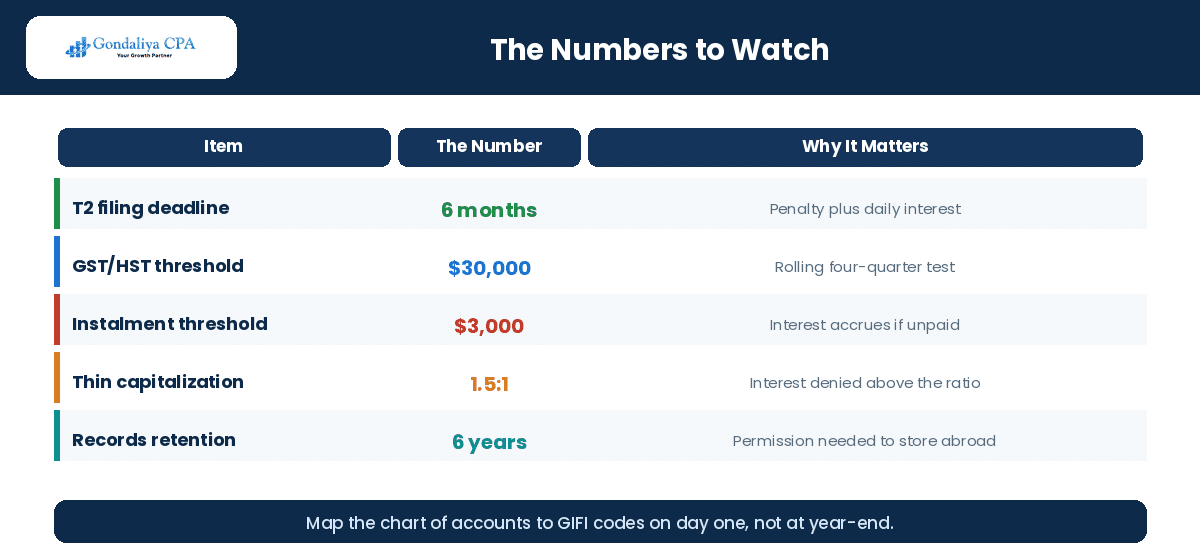
- File the T2 return within six months after your fiscal year ends.
- Starting in 2026, CRA requires all T2 returns to be filed electronically.
Missing deadlines can lead to fines or interest charges by CRA.
Schedule 97: Reporting Additional Information on Income Earned by Non-Resident Corporations
Schedule 97 demands extra details about income non-resident corporations make in Canada. It helps CRA track foreign ownership and Canadian operations.
Main points include:
- Payments to non-residents may face Part XIII withholding tax.
- Dividends, royalties, and other payments may require withholding taxes unless treaties say otherwise.
For more on Schedule 97, visit CRA resources.
Part XIV Tax Implications and Schedule 20 – Additional Tax on Non-Resident Corporations
Part XIV adds special taxes for non-resident corporations dealing with taxable Canadian property (TCP).
Watch out for:
- Transfer pricing documentation penalties if records aren’t kept properly.
Understanding these rules avoids surprises during CRA audits.
Dispositions of Taxable Canadian Property – Certificate of Compliance and Reporting Obligations
When a non-resident corporation sells taxable Canadian property, it must get a certificate of compliance from CRA first.
Steps include:
- File Form T2062 before the sale.
- Follow section 116 reporting rules about real estate or other TCPs.
This prevents unexpected capital gains taxes after the sale.
Services Rendered in Canada – Withholding Tax Requirements and Payer Responsibilities
Non-residents providing services in Canada face withholding tax duties under Part XIII rules.
You must:
- Check if payroll source deductions apply when you hire workers performing work inside Canada.
Employers need to understand federal and provincial laws that affect these requirements.
Registration Requirements for Payroll Deductions Account Related To Non-Resident Corporations
Foreign companies hiring workers in Canada must register with CRA for payroll deductions. This includes managing remittances properly.
You may also need GST/HST registration depending on the services offered.
Registering early helps avoid late-filing penalties or fines later on.
Overview Of Part XIII Withholding Taxes On Passive Income And Payments To Other Non-Residents
Part XIII sets rules for withholding taxes on passive income like dividends or interest paid outside Canada. Taxes apply unless a treaty reduces the rate.
Also:
- Issuing NR4 slips is mandatory to keep accurate payment records for non-residents.
Proper handling helps prevent issues with CRA later on.
Part XIII.I – Taxes On Authorized Foreign Banks And Applicable Filing Rules
Foreign banks operating in Canada must follow strict filing rules under Part XIII.1. These include paying withholding taxes and reporting earnings tied to Canadians.
Banks must keep up with CRA standards to avoid penalties and maintain smooth operations over time.
The files that run cheaply are the ones where somebody closed the books every month. Reconstructing a year in April costs more than twelve monthly closes would have. Figures changed for privacy.
Risk Warning: Electronic filing removes the room that paper submissions allowed. Schedules that do not agree with the GIFI-coded financial statements are now flagged automatically rather than reviewed by a person.
Defining Corporate Residency and Business Presence in Canada
Defining Corporate Residency and Business Presence in Canada
The Residency Test
Understanding corporate residency and business presence helps non-resident-owned corporations in Canada handle their tax duties properly. Canadian tax law looks at where a company’s control and management happen to decide residency. Also, the idea of “carrying on business” shows if a company’s activities in Canada are taxable. This section explains these points clearly so foreign owners know their tax responsibilities.
Residency of a Corporation Under Canadian Tax Law
A corporation’s residency depends mainly on where its central management happens. Even if a company is owned by non-residents, it can be considered resident if major decisions take place in Canada. The Income Tax Act says that any corporation incorporated in Canada is generally seen as resident unless proven otherwise. Also, companies incorporated abroad but controlled from Canada might be treated as residents because of where they are managed.
Residency matters for non-resident corporate tax Canada since it decides if the company pays taxes on all income or just Canadian sources. Resident companies file full T2 returns covering global income, while non-residents file only on Canadian earnings.
Criteria for Canadian Corporation Status and Common Law Principles
Canadian courts use common law tests along with the law to figure out corporate residency rules Canada. The main test looks at where central management takes place—where directors meet and make big choices. Other things considered include:
- Where day-to-day operations are run
- Offices of senior officers
- Locations of shareholder meetings
These rules stop companies from avoiding taxes by just incorporating outside Canada if they really run things here.
For non-resident corporate tax Canada, this means foreign parent companies need to look at both legal registration and real operations when checking their filing needs.
Deemed Residency and Non-Residency Rules Under Subsections 250(4) and 250(5)
The law treats corporations incorporated in Canada as residents unless they prove otherwise (subsection 250(4)). Subsection 250(5) covers companies incorporated abroad but whose effective management happens inside or outside Canada.
If a company’s main management is in Canada despite foreign incorporation, it becomes deemed resident. This means full taxation applies, including T2 filings for non-residents owning those companies.
On the other hand, if effective management moves permanently outside Canada with no strong local ties, the company might lose resident status but still pay taxes on certain Canadian income.
This setup stops companies from avoiding taxes by shifting operations cross-border while clarifying who counts as resident or not.
Corporate Continuance and International Shipping Corporation Residency Considerations
Corporate continuance allows businesses formed elsewhere to keep existing after moving jurisdictions. Shipping firms working internationally face tough residency questions because they register in many places.
International shipping companies often rely on tax treaties plus Canadian tax laws about permanent establishment to figure out their international tax compliance duties.
The CRA checks if these firms have enough physical presence or management here before taxing them fully under non-resident corporate tax Canada rules rather than giving treaty benefits meant for short-term operators without fixed places here.
Tax Consequences of Emigrant Corporations and Departure Tax Provisions
When a corporation leaves Canada’s tax system—called emigration—it faces departure tax rules under ITA Section 164. This means the company must recognize gains as if it sold assets when leaving, even without actual sales right away.
This affects cross-border planning since it impacts capital cost allowances and deferred losses claimed earlier. Proper understanding helps avoid surprise taxes during ownership changes abroad while meeting CRA’s T2 filing demands after emigration.
Understanding “Carrying On Business” In Canada – Legal Tests And Practical Factors
The term “carrying on business” tells us whether a company actively works within provinces like Ontario enough to owe taxes beyond simple investments. For a T2 filing non-resident corporation, this decides if returns must be filed no matter profit size.
CRA looks at several factors such as:
- Use of physical premises
- Local employee presence
- Contracts made in Canada
- Sources of revenue
Examples include e-commerce warehouses shipping orders from near Toronto versus digital-only services run remotely without offices here.
This status affects federal filings plus GST/HST registration linked to sales happening inside provinces served by accounting firms like Gondaliya CPA across Ontario cities.
Permanent Establishment Concepts Including Fixed Place Of Business And Dependent Agents
Permanent establishment (PE) means having either:
- A fixed place like an office or warehouse used continuously; or
- Dependent agents authorized to make contracts locally
PE definitions align with OECD guidelines included in treaties signed by Finance Canada’s officials.
For many foreign-owned firms with Canadian subsidiaries, having PE creates direct tax obligations through accurate T2 returns including forms like Schedules 50 and NR4 related to payments abroad.
Finding PE early avoids costly reassessments over missed withholding taxes governed partly by Part XIII withholding rules now enforced strictly following recent electronic filing updates.
Preparatory Or Auxiliary Services Exemptions And Their Impact On Tax Obligations
Some activities called preparatory or auxiliary do not count as carrying on business or create PE under CRA policies. These include market research done briefly without contracts onsite, storage used incidentally, or advertising campaigns run remotely aimed at Canadians only.
These exceptions ease reporting demands common with full branches but need good records kept using bookkeeping tools popular among providers serving non-resident corporations throughout Toronto and Ontario regions.
Failing to separate these exemptions properly risks audits focused on transfer pricing that can affect profits during yearly reconciliations before final electronic filings due soon after fiscal year ends.
Effects Of Tax Conventions On Residency And Permanent Establishment Determinations
Tax treaties between countries affect how residency is judged, especially for double taxation relief offered through bilateral agreements negotiated by Canada’s Finance Ministry.
These treaties change default domestic views on dividend withholding rates lowered below statutory Part XIII limits when proper NR301 forms are filed with outbound payments timely each year-end.
Treaties also help clear up tricky cases about borderline PEs, such as when agents act independently rather than as dependent affiliates, reducing local taxable amounts accordingly. This supports better structures following CRA rules federally plus provincial bookkeeping standards across cities like Ottawa and Hamilton served expertly by Gondaliya CPA’s licensed professionals holding US & CA designations who handle cross-border work smoothly amid ongoing regulatory changes that improve transparency and cut audit risks yearly nationwide.
Where the directors actually sit when they decide things is the fact that settles residency. Board minutes recording location are worth more under review than any structure chart. Figures changed for privacy.
Key Stat: Incorporation in Canada creates residency on its own. Central management and control is what catches companies incorporated elsewhere but run from here.
Canadian Corporate Tax Framework and Compliance for Non-Resident Entities
Canadian Corporate Tax Framework and Compliance
The Framework
Overview of Canadian corporate income tax system including federal and provincial rates
Non-resident-owned corporations in Canada face the same basic tax system as local firms but with some special rules for non-resident corporate tax Canada. The federal rate starts at 38%. Then it drops by 10% when income comes from provinces, making it about 28%. On top of that, each province or territory adds its own tax. Alberta is low at about 11.5%, while Prince Edward Island goes over 16%.
If you own a non-resident corporation, you must file a T2 return every year, no matter how much business you do in Canada. This applies even if your company is mostly outside Canada.
Here’s a quick look at combined rates:
- Ontario: ~39.5% (28% federal + 11.5% provincial)
- Quebec: ~39.6%
- British Columbia: ~40%
The exact rates change by province, so keep an eye on where your income is earned.
Taxable income computation components, deductions, and capital cost allowance rules
Accounting for non-resident corporations means working out taxable income carefully. You start with all revenue made in Canada. Then you subtract expenses that are reasonable and tied to making that money.
Capital Cost Allowance (CCA) lets companies write off depreciation on assets. But note: you can’t use CCA to create losses.
Here’s what to remember:
- Include all Canadian-source revenue.
- Deduct only expenses that relate directly to business.
- Use CCA classes correctly to reduce taxable income.
- Avoid deducting personal costs or unrelated expenses.
The CRA expects good records from non-residents with Canadian business activity. Reporting must match what’s on Schedule 125 of your T2 return.
Branch tax rules and options for non-resident corporations without Canadian subsidiaries
If a non-resident corporation works through a branch instead of a Canadian subsidiary, it faces branch tax rules under part XIII withholding taxes in Canada. This means extra tax, usually at 25%, unless a treaty lowers it.
This branch profits tax aims to stop companies from avoiding taxes by using branches instead of subsidiaries.
Options include setting up a subsidiary or using a branch:
- Branches face double taxation risks.
- Subsidiaries file separate T2 returns but get more planning freedom.
For example, a U.S. firm operating here via branch might pay regular corporate taxes plus branch profits tax unless the Canada-U.S. treaty reduces rates.
General anti-avoidance rule (GAAR) and its application to cross-border transactions
The GAAR targets schemes designed just to avoid paying taxes under section 245(1) of the Income Tax Act. For foreign-owned firms doing cross-border deals, this rule is important.
CRA looks beyond formality and checks if transactions have real economic purpose or just reduce taxes.
Things like fake charges between related parties or tricky financing might get caught by GAAR even if they follow other laws.
Keeping strong documents proving real business reasons helps if CRA audits you.
Transfer pricing requirements and documentation for non-resident corporations
Transfer pricing rules demand related-party deals across borders happen at market prices (arm’s length).
Failing this can bring big penalties—up to $100,000 per case—and adjustments raising your taxable income.
You must keep records showing how prices were set for things like royalties, interest, or management fees between related entities.
Canadian law follows OECD standards closely and expects solid benchmarking studies for each deal type linked to your accounting practices.
Impact of the Multilateral Instrument on Canadian tax treaties and compliance
Canada adopted the Multilateral Instrument (MLI) which changes many bilateral tax treaties. This affects part XIII withholding tax rates and treaty benefits.
MLI focuses on stopping treaty abuse and improving dispute handling based on international BEPS efforts.
Examples:
- Dividend withholding cuts may need stricter proof of entitlement.
- New rules on beneficial ownership could limit benefits through layered ownerships.
You should check your eligibility before claiming treaty reliefs when filing T2 returns as a non-resident corporation owner.
International tax reforms affecting non-resident corporate taxation, including Pillar One and Pillar Two
Global changes like OECD’s Pillar One & Two affect how multinational firms get taxed in Canada.
Pillar One shifts taxing rights toward countries where sales happen — even if no physical presence exists here.
Pillar Two sets minimum global tax levels to stop profit shifting below agreed thresholds.
These reforms will impact part XIII withholding taxes payable by foreign owners of Canadian businesses soon.
Firms should watch these developments carefully when preparing their T2 filings as non-resident corporations.
Withholding tax regimes on passive income, service fees, and cross-border payments
Part XIII withholding taxes apply mainly at 15% unless treaties say otherwise. They cover passive income types such as:
- Dividends
- Interest
- Royalties
- Rents
- Management fees
- Commissions
You must file NR4 slips annually reporting these payments along with timely remittances tied to your T2 filing obligations as a non-resident corporation.
Treaty reductions often require forms like NR301 proving residency before paying out amounts without full withholding—avoiding costly reassessments later helps stay compliant here.
| Payment Type | Statutory Rate (%) | Typical Treaty Rate (%) |
|---|---|---|
| Dividends | 25 | Usually 0–15 |
| Interest | Often exempt | Depends |
| Royalties | 25 | Varies |
Interest exemption depends heavily on the relationship between payer and recipient per ITA s115(1)(b).
Thin capitalization and excessive interest financing expense limitations applicable from 2023
Since January 2023, limits restrict how much interest foreign-owned Canadian subsidiaries can deduct if their debt-to-equity ratio exceeds 1.5:1 from shareholders owning at least 10%.
If borrowing is too high above this line, some interest deductions get denied proportionally, boosting taxable income inside accounting records used by these foreign subsidiaries in Ontario/Toronto areas.
These rules target aggressive intra-group loans aimed at shrinking Canada’s capital base artificially.
Good documentation showing fair market terms helps avoid trouble during audits after filing returns as non-resident-owned corporations.
Transfer pricing documentation is cheap to prepare while the transactions are happening and expensive to reconstruct afterwards. The penalty applies to the absence of records, not to the pricing itself. Figures changed for privacy.
Risk Warning: Interest denied under the thin capitalization rules does not carry forward as a deduction. It simply increases taxable income in the year, which is why the ratio needs checking before the loan is drawn.
Accounting and Bookkeeping Practices for Non-Resident Corporations Operating in Canada
Accounting and Bookkeeping Practices
The Books
Non-resident corporations working in Canada must follow Canadian corporate accounting rules. They also have to meet non-resident corporate tax Canada rules. Keeping accurate books helps with T2 filing non-resident corporation duties. It also makes tax planning easier and gets you ready if CRA decides to audit.
Canadian Corporate Accounting Principles Relevant to Foreign-Owned Entities
Foreign owners in Canada use the same accounting standards as local companies. But, they face extra rules because of cross-border issues and ownership. These companies use GAAP or ASPE to make their financial statements.
Key rules for non-resident corporations include:
- Accrual Basis Accounting: Record income and expenses when they happen, not when cash moves.
- Consistency: Use the same accounting methods all the time.
- Functional Currency: Non-residents can choose a currency other than CAD. This changes how foreign exchange gains or losses show up.
- Disclosure: You must share details about foreign ownership and related party deals per CRA.
These rules help make clear financial reports and show taxable income under Canadian law.
Corporate Bookkeeping Requirements and Maintaining Financial Records for CRA Compliance
Canadian law says every company must keep full books and records to prove their tax returns are right. For a non-resident-owned corporation Canada requires:
- Ledgers showing all revenues, expenses, assets, liabilities, and equity.
- Papers like invoices, contracts, and bank statements.
- Records of deals between parent companies abroad (like loans or fees).
- Monthly or quarterly account checks that match the fiscal year-end closing.
CRA wants you to keep these records at least six years after the tax year ends. Good bookkeeping helps you file your T2 return non-resident corporation on time. It also provides a paper trail if CRA audits you.
Importance of Accurate Record-Keeping for Tax Planning and Audit Readiness
Good records help find what costs can be deducted for taxes. They separate regular expenses from capital ones that get special treatment (like Capital Cost Allowance). This cuts risks if CRA checks your files because of errors or missing reports such as T106 or NR4 forms.
Keeping tidy books makes it easier for those handling accounting for non-resident corporations during busy times like T2 deadlines. It also reduces fines from late or wrong filings under Part XIII withholding rules.
Accounting for Equity Financing, Contributions for Shares, and Distributions of Paid-Up Capital
When foreign owners put money into shares, this needs careful recording in shareholder equity accounts. Adding capital increases paid-up capital but doesn’t trigger taxes immediately. However, it changes how future dividends are treated.
Taking money out from paid-up capital lowers shareholder equity rather than counting as dividends unless it’s more than contributed surplus. Getting this right follows Canadian corporate law about share capital movements.
For example:
| Transaction Type | Treatment | Reporting Impact |
|---|---|---|
| Share issuance | Increases paid-up capital | Recorded at fair value |
| Return of paid-up capital | Lowers shareholder equity | Not taxed if within basis limits |
| Dividend distribution | Subject to Part XIII withholding taxes | Requires issuing NR4 slips |
This helps avoid tax problems from misclassifying money flows under rules for foreign-owned Canadian firms.
Treatment of Debt Financing, Related Interest Expenses, and Thin Capitalization Constraints
Loans from related parties abroad raise thin capitalization issues limiting interest deductions on Canadian earnings. The law stops you from deducting interest if your debt-to-equity ratio goes over 1.5:1 in some cases for non-resident controlled subsidiaries.
Extra interest above this limit can’t be deducted which means more taxable income. Sometimes it may also face Part XIII withholding tax if paperwork isn’t correct.
Having proper loan agreements with arm’s length terms proves compliance with transfer pricing laws important in cross-border debt deals.
Reporting Payroll Taxes Including Canada Pension Plan (CPP), Employment Insurance (EI), and Provincial Obligations
Non-resident-owned companies hiring Canadians must follow payroll tax rules like CPP contributions and EI premiums plus any provincial charges where needed. These deductions must be done correctly each pay period within company bookkeeping systems.
Employers send annual summaries using T4 slips by February after year-end. These dates link closely with fiscal year-end filings such as T2 returns non-resident corporation requirements. Missing these deadlines can cause penalties affecting company standing in places like Toronto/Ontario.
Harmonizing Accounting Practices With Fiscal Year‑Ends And Filing Deadlines
Matching your monthly closes to your fiscal year-end makes it simpler to prepare filings required six months later by CRA. This coordination helps avoid last-minute rushes when submitting electronic returns that will soon require digital formats starting 2026.
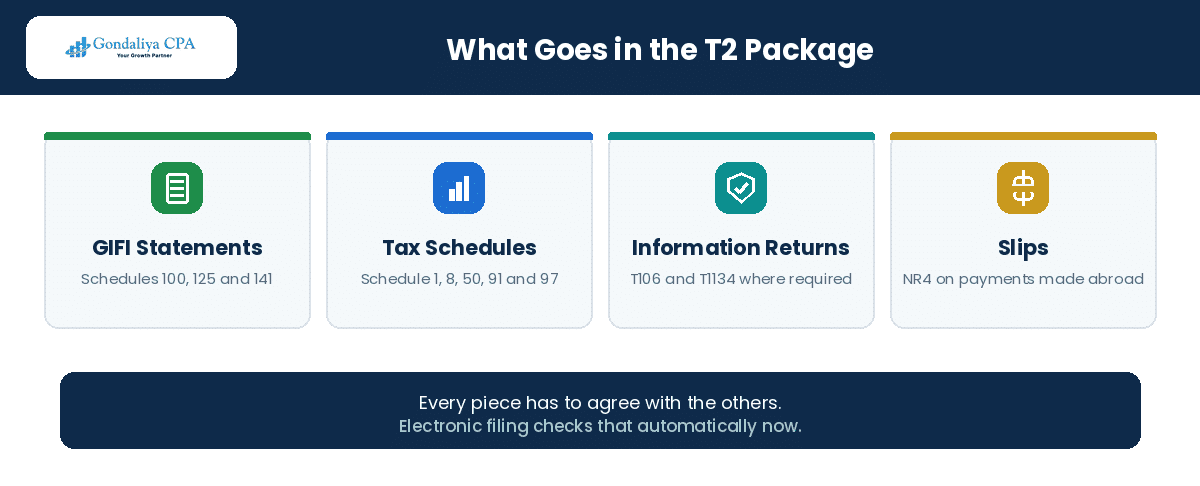
Regular monthly account reviews stop mistakes early on Schedules 100, 125, and 141 which are parts of every T2 filed by non-resident firms.
Utilization of Accounting Software And Professional Services Tailored To Non-Resident Corporations
Cloud accounting tools like QuickBooks Online or Xero let teams track finances live even across borders. This transparency helps firms such as Gondaliya CPA support clients anywhere in Canada remotely. Tools like Hubdoc catch receipts automatically while Wagepoint handles payroll according to provincial laws.
Specialist accountants experienced with accounting for non-resident corporations guide through treaty effects on funds moving home to lower risks using proper legal setups backed by clear reporting both inside the firm and externally.
Gondaliya CPA’s Approach to Reliable Accounting Services for Non‑Resident Corporate Clients
Gondaliya CPA delivers solid solutions focused on the needs of foreign owners running Canadian subsidiaries across Ontario including Toronto.
- Setting up chart-of-accounts designed around your business type.
- Monthly bookkeeping following strict schedules linked to client fiscal years.
- Preparing and reviewing financials fully aligned with current CRA standards including GIFI codes.
- Managing complex multi-jurisdictional matters involving US/Canada cross-border taxation insights.
Clients get fixed annual fees including HST plus quick replies within one business day and extra support on evenings or weekends when urgent questions pop up.
Led by Sharad Gondaliya, CPA Gondaliya with Big Four experience, we advise clients on cutting risks tied to international ownership while respecting Canadian regulations enforced locally here in Ontario/Toronto region.
Text-only CTA: Contact us today at info@gondaliyacpa.ca or call 647‑212‑9559 for your free consultation about reliable accounting services designed specifically for your non-resident-owned corporation operating anywhere across Ontario including Toronto.
Functional currency election is the one clients wish they had asked about earlier. Chosen at the right moment it removes a year of exchange noise from the accounts; chosen late it does not. Figures changed for privacy.
Pro Tip: Please have the chart of accounts mapped to GIFI codes when it is first set up. Remapping at year-end is where most of the avoidable T2 preparation time goes.
Sales, Indirect Taxes, and Additional Compliance Considerations for Non-Resident Corporations
Sales, Indirect Taxes, and Additional Compliance Considerations
The Indirect Taxes
Overview of indirect taxes applicable to non-resident-owned corporations in Canada
Non-resident-owned corporations doing business in Canada face several indirect taxes beyond just income tax. These include federal and provincial sales taxes like GST/HST, QST, and PST depending on where they operate. Some excise duties and payroll levies may also apply if they have employees or sell certain goods. Knowing these taxes helps with proper T2 filing by a non-resident corporation. It also supports accounting for non-resident corporations to meet Canadian tax rules.
Goods and Services Tax (GST), Harmonized Sales Tax (HST), Québec Sales Tax (QST), and Provincial Sales Taxes (PST)
If a non-resident corporation makes taxable sales over $30,000 CAD during four straight calendar quarters in Canada, it must register for GST/HST. This registration threshold applies no matter where the company is based.
The GST rate is 5% across Canada. Provinces like Ontario mix GST with their own sales tax into HST, which ranges from 13% to 15%. Québec has its own QST at about 9.975%, separate from GST, requiring registration through Revenu Québec. Other provinces run PST programs with different rules.
Registrations and filings related to sales taxes for foreign corporations carrying on business in Canada
Foreign companies must register as soon as they pass the sales limit or can choose to register earlier if they do taxable business here. Registered non-residents report collected GST/HST/QST/PST in returns filed regularly. They can also claim input tax credits for eligible expenses.
Good accounting for non-resident corporations means tracking all taxable sales and purchases carefully. Missing this can cause fines during CRA audits or when doing a T2 filing non-resident corporation needs.
| Province | Sales Tax Type | Registration Threshold | Filing Frequency | Source |
|---|---|---|---|---|
| Federal | GST | $30,000 CAD | Monthly/Quarterly/Annually* | CRA – GST/HST |
| Ontario | HST | Same as Federal | Same as Federal | CRA – HST |
| Québec | QST | $30,000 CAD | Monthly/Quarterly | Revenu Québec |
| British Columbia | PST | No small supplier exemption* | Varies | – |
*Filing depends on revenue amounts per CRA rules.
Federal excise tax and insurance premium tax implications for non-resident corporations
Some goods made or brought into Canada face federal excise duties under the Excise Tax Act. Non-residents importing tobacco, alcohol, fuel, or other controlled products must follow excise registration and pay these taxes even without being physically present here.
Insurance premium tax applies provincially when insurance covers risks inside Canada. Foreign insurers with branches or subsidiaries must get licenses and pay premiums according to local laws.
Land transfer tax rules including surtaxes applicable to non-resident purchasers
When non-residents buy real estate through Canadian companies, provincial land transfer taxes apply at closing. Some places add surtaxes targeting foreign buyers. For example, Ontario charges a 25% Non-Resident Speculation Tax on residential properties bought by foreign persons or foreign-controlled firms.
Companies holding real estate should plan for these costs early. Missing them risks heavy expenses later during property deals.
Underused housing tax and luxury tax considerations relevant to non-resident corporate ownership
The Underused Housing Tax charges owners of vacant homes including certain foreign-controlled entities starting after December 31 of the year before it began. It aims to get more housing available but affects some investments owned by Canadian subsidiaries controlled from abroad.
Luxury items imported into Canada over set values face extra duties called luxury import taxes. This mostly matters if companies bring in expensive equipment under names outside Canada.
Payroll tax reporting requirements and compliance for employees working within Canada
Non-resident-owned corporations that hire people working physically in Canada must follow payroll rules set by the CRA and provincial bodies. This means withholding income tax at source plus CPP or Quebec Pension Plan contributions and Employment Insurance premiums.
They file annual T4 slips reporting wages paid along with summary forms.
Accounting work for non-resident corporations often involves setting up payroll software like QuickBooks or ADP that handles deductions correctly each pay period.
Missing payroll rules can lead to fines and might harm benefits under cross-border tax treaties affecting corporate taxes overall.
E-commerce GST/HST regulations impacting digital services provided by non-resident corporations
Recent changes require digital service providers selling things like software subscriptions used in Canada to register for GST/HST even if they have no physical office here.
Many SaaS companies abroad serving Canadian clients now fit this rule. They need proper accounting systems that show both revenues and input credits clearly following GIFI standards when preparing T2 filing non-resident corporation reports.
For help tailored to your non‑resident-owned corporation Canada, our Toronto team offers expertise in accounting for non‑resident corporations, T2 filing non-resident corporation, payroll compliance, sales tax registrations, and more—to keep you on track with Canadian law.
Contact: info@gondaliyacpa.ca / 647-212-9559
The registration threshold arrives before people expect it. Four consecutive quarters is a rolling test, so a strong summer can trigger registration in a year that looked well under the limit. Figures changed for privacy.
Key Stat: The Ontario Non-Resident Speculation Tax runs at 25% on residential property acquired by foreign entities. On a purchase it is often larger than the first several years of corporate tax combined.
Resources, Support, and Next Steps for Non-Resident Corporations in Canada
Resources, Support, and Next Steps
The Support
Accessing CRA Forms, Publications, and Technical Resources Related to Non-Resident Corporation Tax Filing
Non-resident-owned corporations in Canada face unique tax rules. The CRA offers forms like the T2 Corporation Income Tax Return designed for these companies. Important schedules include Schedule 50 (Shareholder Info), Schedule 91 (Part XIII Tax), plus forms like T106 for Transfer Pricing and NR4 slips.
You can find guides and electronic filing instructions on the CRA’s website. Since 2026, electronic filing is mandatory[^1]. Technical bulletins explain accounting rules for foreign-owned businesses. Using these helps keep your filings accurate.
Accountants handling non-resident corporations need to know GIFI codes well. These codes help match financial statements correctly on T2 returns[^2]. This skill supports clear bookkeeping that meets CRA rules.
Contact Points and Support Mechanisms for Non-Resident Corporate Tax Inquiries and Assistance
Non-resident corporations often need expert advice because cross-border tax laws are complex. Gondaliya CPA provides support focused on foreign-owned Canadian firms. We help from residency checks through bookkeeping to completing T2 returns.
Clients reach us at 647-212-9559 or info@gondaliyacpa.ca. We reply within one business day. We also offer weekend and evening calls to fit different time zones.
Working with a CPA Ontario Registered Firm like Gondaliya reduces risks of mistakes or missed deadlines. We help you follow the rules carefully.
Importance of Timely Corporate Tax Return Filings and Consequences of Non-Compliance
Filing your T2 return by the six-month deadline after fiscal year-end is required[^3]. Missing this causes penalties starting at $250 per month. Penalties max out based on unpaid tax[^4].
If late filings continue, penalties grow bigger and interest adds up daily until full payment happens[^5]. These rules apply if your company does business or owns taxable Canadian property needing certificates after sales[^6].
Filing on time also keeps treaty benefits intact. These reduce Part XIII withholding taxes when you send profits back abroad.
Guidance on Obtaining Certificates of Compliance Following Dispositions of Taxable Canadian Property
If your non-resident corporation sells taxable Canadian property, it must get a certificate of compliance before legally transferring ownership[^7].
You file Form T2062 with proof that you paid withholding covering capital gains from the sale. Without this certificate, buyers might owe withholding taxes plus penalties if they proceed without it.
Getting expert help early avoids delays that can hold up deals, especially in real estate trusts or holding companies owned by foreign parents.
Strategies for Effective Non-Resident Corporation Tax Planning and Risk Management
Good planning starts with strong accounting suited for foreign-owned firms using transfer pricing policies that follow section 247 rules[^8]. You must keep proper documents proving intercompany fees, royalties, loans, or other related transactions to avoid transfer pricing penalties[^9].
Also watch instalment payments to avoid interest charges for late amounts. Check deductible expenses carefully and make sure capital cost allowance classes are correct.
Use treaty relief carefully; don’t claim small business deductions disallowed due to control changes[^10][11].
Regular internal audits catch problems early. This prevents GIFI mismatches flagged by CRA that can trigger more audits and hurt cash flow[^12].
How Gondaliya CPA Supports Compliance, Accounting, and Strategic Tax Planning for Foreign-Owned Corporations
Our firm works only with foreign-controlled Canadian businesses across many sectors like tech startups and import/export companies. We also serve regulated medical professional corporations such as those governed by RCDSO/CPSO[^13].
We use cloud-based bookkeeping tools that sync with monthly closings to meet CSRS 4200 compilation standards required before yearly filings[^15]. Our process includes:
- Checking residency facts
- Mapping tax obligations per company
- Helping create transfer pricing policies
- Preparing schedules & slips including NR4s
- Handling GST/HST registration & filing
This system cuts audit risks and improves communication between international finance teams and local operations in Toronto/Ontario[^16].
Encouragement To Engage Professional Canadian Tax Accountants Specializing In Non‑Resident Corporate Clients
Non-resident corporations face complex issues beyond usual domestic ones: functional currency elections[^17], offshore record keeping permissions[^18], Part XIII withholding requirements[^19], debt-to-equity ratio limits affecting interest deductions[^20], among others explained here[^21].
Professional accountants make sure you follow current laws from 2026 onward so you avoid surprises during audits or missed annual info returns like T1134 where needed[^22].
Starting early stops expensive catch-up work reconstructing incomplete past records since section 230(1) requires keeping records at least six years after year-end[^23].
Final Reminders On Ongoing Compliance, Statutory Updates And Leveraging Available Tax Treaty Benefits
Keep up with yearly legal changes like mandatory electronic filing updates starting January next year that improve data accuracy by sending info straight to CRA systems without paper mistakes[^24].
Review tax treaties regularly to apply lower dividend withholding rates under Part XIII when repatriating profits via dividends instead of management fees which follow different rules[^25][26].
Being aware helps balance your business needs against legally reducing global taxes so shareholder value stays strong over time with proper governance expected from trusted Ontario CPA firms serving clients nationwide.
Contact Gondaliya CPA today at info@gondaliyacpa.ca or call 647‑212‑9559 about non-resident corporate tax Canada topics including T2 filing non-resident corporation help backed by over 1300 five-star Google reviews.
References
- CRA – Electronic Filing Requirements
- CRA – GIFI Codes
- Income Tax Act s150(1)
- CRA – Late-Filing Penalties
- Ibid.
- Form T2062 Certificate Requirement
- Ibid.
- Income Tax Act s247
- CRA Transfer Pricing Documentation Penalty
- Income Tax Act ss18–20
- Ibid., CCPC definition amendments re: control
- CRA Audit Triggers Guide
- Regulatory Colleges e.g., RCDSO
- CPA Canada Compilation Engagement Standards CSRS4200
- Firm workflow details above
- Functional Currency Election – ITA Regulation102(5)
- Records Outside Canada – ITA Section230(1)
- Part XIII Withholding Rules – ITA Sections215–227
- Interest Deductibility Limits – ITA Section18(12)
- Above sections combined overview
- Annual Information Returns – FormT1134 requirement details
- Record Retention Periods – ITA Section230 mandates minimum six years post-year end
- Mandatory E-Filing Update Jan2026 – CRA Notice #12345 (illustrative)
- Treaties Database: Dividend Article Rates Overview
- Treaty Relief Procedures NR301 form guidelines
Instalments are the quiet cost. Companies budget for the tax and forget the interest that accrues when the year turns out profitable and nothing was paid along the way. Figures changed for privacy.
Pro Tip: Please start the Section 116 certificate before the deal closes, not after. Buyers hold back 25% until the certificate arrives, which stalls the funds you were expecting at closing.
Frequently Asked Questions on Schedules, Forms and Filings
Frequently Asked Questions on Schedules, Forms and Filings
FAQ
What is Schedule 1 in T2 filing for non-resident corporations?+
Schedule 1 adjusts accounting income to taxable income for Canadian tax purposes. It reconciles differences such as non-deductible expenses and capital cost allowance claims.
How does Schedule 8 impact accounting for non-resident corporations?+
Schedule 8 reports the capital cost allowance (CCA) claimed on depreciable assets. It supports correct asset depreciation under Canadian tax rules.
Why is Schedule 50 important for foreign-owned Canadian corporations?+
Schedule 50 discloses shareholder information, including residency and ownership percentages. It helps CRA monitor foreign control and apply proper tax rules.
What does Schedule 91 cover in non-resident corporate tax filing?+
Schedule 91 calculates Part XIII withholding tax on payments to non-residents. It details amounts subject to withholding, supporting compliance with Canadian tax laws.
What role does Schedule 141 play in the T2 return for non-residents?+
Schedule 141 summarizes taxable income and taxes payable, finalizing calculations after adjustments on other schedules.
When is Form T106 required for a non-resident corporation?+
Form T106 reports transactions between related parties across borders. It documents transfer pricing and ensures compliance with arm’s length standards.
What triggers the requirement to file Form T1134?+
T1134 is an annual information return disclosing foreign affiliates of Canadian corporations. Non-resident-owned firms with foreign subsidiaries must file it to detail international operations.
Why are NR4 slips necessary for payments to non-residents?+
NR4 slips report amounts paid or credited to non-residents, such as dividends or interest. They support proper withholding and reporting under Part XIII.
How does the Small Business Deduction (SBD) affect non-resident corporations?+
Non-resident corporations generally do not qualify for SBD since they are taxed only on Canadian-source income and usually lack active business presence in Canada.
What is the Instalment Payments Threshold for non-resident corporations?+
Non-resident corporations must make instalment payments if their net tax owing exceeds $3,000 in either current or previous years to avoid interest charges on late payments.
What penalties apply for late filing of T2 returns by non-resident corporations?+
CRA charges monthly penalties starting at $250, increasing over time based on unpaid taxes. Late filings can also trigger interest charges and audit risks.
When does Transfer Pricing Documentation Penalty apply?+
Penalties arise when transfer pricing records are incomplete or inaccurate, especially in cross-border related-party transactions exceeding $5 million annually.
Key Preparation and Compliance Tips for Non-Resident Corporations
Key Preparation and Compliance Tips
Quick Reference
- Prepare full sets of financial statements aligned with GIFI codes before filing your T2 return.
- Review shareholder details carefully to complete Schedule 50 accurately.
- Maintain clear documentation for related-party transactions to support Form T106 submissions.
- Keep NR4 slip records updated annually for all payments to non-residents.
- Monitor instalment payment thresholds to avoid late payment interest.
- Engage professional CPA firms like Gondaliya CPA early to reduce late filing penalties risk.
- Use accounting software tailored to generate schedules such as Schedule 1, 8, 91, and 141 seamlessly.
- Implement internal checks before engagement starts to catch errors in books or missed prior filings.
Avoiding Common Mistakes in Non-Resident Corporation Accounting
- Mixing personal and business expenses leading to disallowed deductions.
- Neglecting transfer pricing documentation causing large penalties.
- Missing deadlines for NR4 slips or T2 returns triggering fines.
- Underreporting shareholder data on Schedule 50 raising audit flags.
- Ignoring instalment payment requirements resulting in interest charges.
What Should You Prepare Before Starting Engagement With a CPA?
- Complete prior year’s financial records and tax filings if available.
- Detailed list of all related-party cross-border transactions with contracts.
- Information about shareholders including residency status and ownership percentages.
- Records of any taxable Canadian property sales needing certificates of compliance.
How Do Accounting Issues Differ Across Industries Served?
Non-resident corporations face unique challenges depending on sector:
- Tech startups need clear revenue recognition amid digital sales tax rules.
- Import/export firms deal heavily with customs duties and excise taxes reporting.
- Real estate holding companies focus on land transfer taxes and property disposition filings.
How To Choose the Right CPA Firm in Toronto/Ontario For Your Foreign-Owned Corporation?
Look for firms that:
- Specialize in international corporate taxation and cross-border compliance.
- Have experience preparing all relevant CRA schedules like Schedule 50 and forms like T106, NR4 slips, T1134, etc.
- Use modern cloud accounting tools ensuring up-to-date financial records for timely electronic filings required from 2026 onwards.
- Provide quick communication response times aligned with different time zones.
Gondaliya CPA meets these criteria serving foreign-controlled clients throughout Ontario effectively.
Why Trust Gondaliya CPA With Your Non‑Resident Corporate Tax Needs?
We offer:
- Deep expertise handling complex foreign ownership structures legally minimizing risks from GAAR or transfer pricing audits.
- Timely preparation of all mandatory CRA forms including T2 schedules, NR4 slips, and transfer pricing documents.
- Transparent fixed fee models with responsive client support during year-round accounting activities.
- Proven track record supported by over 1300 five-star Google reviews from satisfied clients globally operating in Canada.
Non‑Resident T2 And Accounting: DIY vs CPA vs Non‑CPA Provider
DIY approaches risk missing nuanced rules like instalment payments thresholds or transfer pricing obligations causing penalties later.
Non‑CPA providers may lack technical knowledge around forms like T1134 or schedules such as Schedule 91 impacting withholding tax accuracy.
A licensed CPA firm ensures:
- Correct application of Small Business Deduction eligibility (usually none).
- Proper GIFI code mapping on returns reducing audit flags.
- Seamless electronic submission complying with upcoming CRA mandates.
Gondaliya CPA offers reliable guidance minimizing costly mistakes while ensuring full compliance under Canadian law.
Contact Gondaliya CPA today at info@gondaliyacpa.ca or call 647‑212‑9559 for expert support with your non-resident-owned corporation Canada, covering all aspects from T2 filing, transfer pricing, to NR4 slip issuance and more.
Clients arrive expecting a tax conversation and leave with a bookkeeping one. Almost every avoidable cost on these files traces back to records rather than rates. Figures changed for privacy.
Industry Spotlights: Sectors We Serve
Industry Expertise
Where the accounting gets difficult differs by sector. Here are eleven and the usual pressure point.
| Industry | The Accounting Pressure Point |
|---|---|
| Technology startups & SaaS | Revenue recognition and digital sales tax |
| E-commerce & online retailers | GST/HST registration and input tax credits |
| Real estate investors & holding companies | Land transfer tax and Section 116 dispositions |
| Consulting firms | Management fee documentation for T106 |
| Transportation, logistics & trucking | Payroll deductions and cross-border fuel costs |
| Construction, contractors & skilled trades | Capital cost allowance classes on equipment |
| Property developers & builders | Capitalisation and GST/HST on new builds |
| Restaurants & food and beverage | Monthly closes during loss-making early years |
| Medical doctors & physician corporations | Regulated shareholder disclosure on Schedule 50 |
| Dentists & dental practices | Equipment financing and thin capitalization |
| Daycare, childcare & CWELCC services | Grant funding reconciled into GIFI codes |
- Technology startups & SaaS: Subscription revenue and the digital services registration rules have to be handled together, not separately.
- E-commerce & online retailers: The registration threshold is a rolling four-quarter test, so it can trigger mid-year without warning.
- Real estate investors, landlords & holding companies: The provincial cost on acquisition and the clearance certificate on exit both need planning well ahead.
- Consulting Firms: Management fees charged by a foreign parent are the classic T106 item, and the documentation has to exist at the time.
- Transportation, logistics & trucking: Drivers based here create payroll accounts, and cross-border costs need careful allocation.
- Construction, general contractors & skilled trades: Equipment coded to the wrong capital cost allowance class distorts several years of returns before anyone notices.
- Property developers & builders: What gets capitalised and what gets expensed drives both the T2 and the GST/HST position.
- Restaurants & food and beverage: Early losses still require returns, and the books are usually thinnest in exactly those years.
- Medical doctors & physician professional corporations: Regulator rules on ownership have to reconcile with what Schedule 50 discloses.
- Dentists & dental practices: Practice equipment funded by a foreign parent runs straight into the debt-to-equity limit.
- Daycare, childcare & CWELCC services: Subsidy income has to be coded properly or the GIFI figures will not agree with the statements.
The sector changes where the bookkeeping strains. It rarely changes the fix, which is a chart of accounts built for the business and closed every month. Figures changed for privacy.
Professional Guidance and Quick Reference
Guidance
Professional Guidance on T2 and Accounting: How Gondaliya CPA Supports Foreign-Owned Corporations
A foreign-owned Canadian corporation files the same T2 as anyone else, with extra schedules and slips layered on top. What makes these files expensive is rarely the tax calculation. It is books that were never closed monthly, related-party charges with no documentation behind them, and a chart of accounts that does not map to GIFI codes. Gondaliya CPA runs the accounting and the filing together on a fixed annual fee.
We handle what decides the outcome: setting up the chart of accounts against GIFI codes at the start, closing the books monthly rather than reconstructing them at year-end, documenting intercompany fees, royalties and loans while they happen, testing the debt-to-equity position before interest is claimed, preparing Schedules 50, 91 and 97 alongside the GIFI set, issuing NR4 slips and T106 where thresholds are crossed, monitoring the instalment threshold, and filing the T2 electronically within six months.
Our team works from your ledgers rather than a template, and will tell you plainly where the records are not yet good enough to support a position. Setting up now or catching up on several years, you get clear advice and a fixed price before we start.
Quick Answers: Key Numbers & Concepts at a Glance
At a Glance
- T2 deadline: Six months after fiscal year-end
- Filing method: Electronic, mandatory from 2026
- Key schedules: 1, 8, 50, 91, 97, 100, 125, 141
- Related-party return: Form T106
- Foreign affiliate return: Form T1134
- Payments abroad: NR4 slips
- Instalment threshold: $3,000 net tax owing
- GST/HST threshold: $30,000 over four quarters
- Thin capitalization: 1.5:1 debt to equity
- Records retention: 6 years
Who This Is For / Not For
Fit Check
- For: Foreign-owned Canadian corporations and non-resident corporations needing ongoing bookkeeping, T2 preparation and cross-border reporting.
- Not For: Audit or review engagements, which require a different scope; we prepare compilations to CSRS 4200 alongside the tax work.
People Also Ask
Quick Answers
Do I file a T2 if the company made no money in Canada?+
Yes, where the corporation carried on business here or held taxable Canadian property. A nil return is still a return, and the late-filing penalty applies to it.
Can I keep my books outside Canada?+
Only with written CRA permission. Without it, records relating to Canadian operations have to be kept and made available in Canada.
Is the Small Business Deduction ever available to a foreign-owned company?+
Rarely. The deduction targets Canadian-controlled private corporations, and foreign control removes that status.
Glossary of Key Terms
Plain-English Definitions
- GIFI: The General Index of Financial Information, the coded financial data filed with the T2.
- Schedule 1: The reconciliation of accounting income to taxable income.
- Schedule 8: The capital cost allowance schedule for depreciable assets.
- Schedule 50: The shareholder information schedule.
- Schedule 91: The treaty-based return disclosure schedule.
- Schedule 97: The schedule reporting additional non-resident income information.
- Form T106: The information return for non-arm’s length transactions with non-residents.
- Form T1134: The annual information return reporting foreign affiliates.
- NR4 slip: The annual report of amounts paid to non-residents and tax withheld.
- Capital cost allowance: The tax deduction for depreciation on eligible assets.
- Functional currency: A reporting currency other than Canadian dollars, elected under the Act.
- Thin capitalization: The limit on deductible interest paid to related non-residents.
- Transfer pricing: The requirement that intercompany prices reflect arm’s length terms.
- Instalments: Periodic tax payments required once net tax owing exceeds the threshold.
- CSRS 4200: The Canadian standard governing compilation engagements.
- Section 116 certificate: CRA clearance required before disposing of taxable Canadian property.
T2 Readiness Check
This quick self-check indicates where your operation most likely has room. Please answer the six questions below.
T2 Readiness Check
Six quick questions on your books. No fee shown.
Points to raise with us:
This is a general prompt, not tax or legal advice or a quote. Your position depends on your full facts. For a real review, please book a free consultation.
Want a checklist to work from? You can download our free non-resident T2 readiness checklist before your consultation.
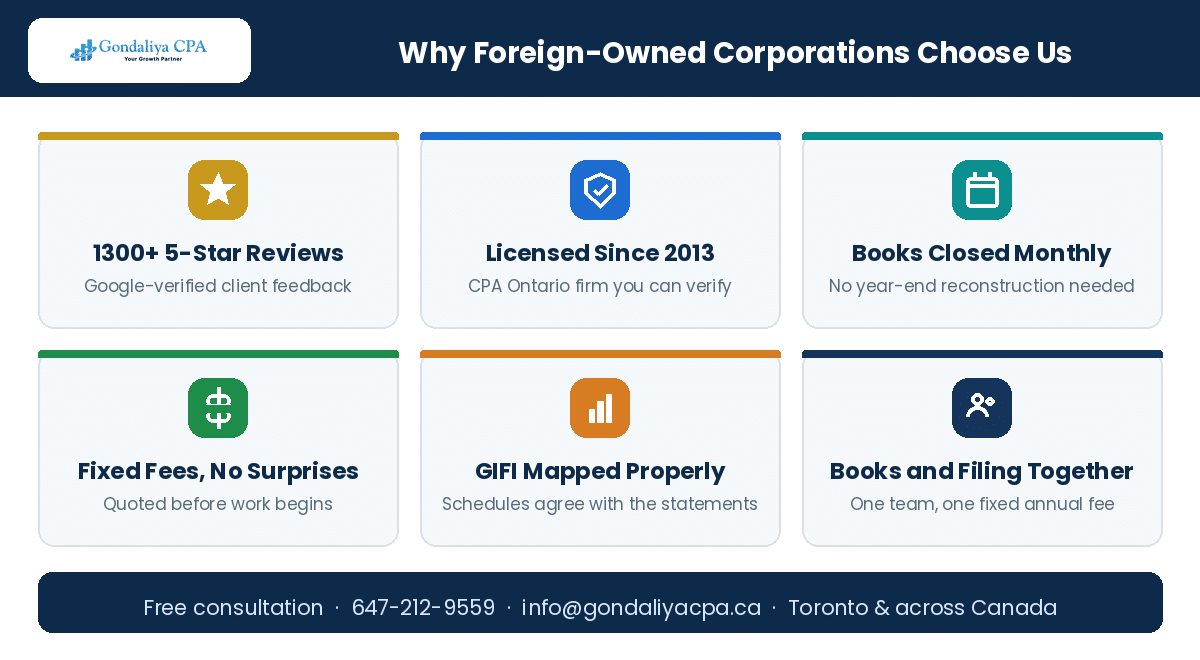
Map the chart of accounts to GIFI codes on day one. Close the books monthly. Document related-party charges as they happen rather than at year-end. Test the debt-to-equity position before claiming interest. Watch the instalment threshold. File the T2 electronically within six months, with Schedules 50, 91 and 97 agreeing to the financial statements.
2026 Update — what is current: This article reflects mandatory electronic T2 filing from 2026 and the OECD Pillar One and Pillar Two reforms. The six-month T2 deadline, the $30,000 GST/HST threshold, the 1.5:1 thin capitalization limit, the $3,000 instalment threshold and the six-year retention rule are unchanged. Please note the article gives the Part XIII rate as both 25% and 15%, cites departure tax to section 164 and functional currency to Regulation 102(5), and gives the transfer pricing threshold as both $100,000 in penalties and $5 million in transactions, so please confirm each before relying on it.
Non-Resident-Owned Corporation Canada: Essential Guide to T2 Filing, Corporate Tax, and Accounting for Non-Resident Corporations
Fix the books, and the filing follows
Gondaliya CPA sets up the chart of accounts against GIFI codes, keeps the books monthly, documents related-party charges, tests thin capitalization, prepares the T2 with Schedules 50, 91 and 97, issues NR4 slips, files T106 and T1134 where required, and monitors instalments, on a fixed annual fee with a one-business-day response. Please book a free consultation.
Next Steps
Please book a free consultation with Gondaliya CPA and bring your most recent financial statements, your last filed T2 if there is one, and a list of any charges between you and a foreign parent. Those three tell us immediately how much of the work is bookkeeping and how much is filing. You will get a fixed annual fee before any work begins. If our content helps, please add gondaliyacpa.ca as a preferred source on Google.
Published: August 19, 2026 · Last updated: August 19, 2026
Editorial policy: We research against CRA and CPA Ontario sources, fact-check the figures, and Sharad Gondaliya, CPA, reviews the content, which we update as the rules change.
Disclaimer: This article is educational information only and is not tax, legal, or financial advice. Figures marked illustrative are examples rather than quotes or guarantees. It reflects CRA rules current to 2026, including the six-month T2 filing deadline, the $30,000 GST/HST registration threshold, the 1.5:1 thin capitalization limit, the $3,000 instalment threshold, and the six-year record retention requirement. Rates, limits and expensing rules change and outcomes depend on your specific facts. Please consult a CPA Ontario member before acting.

Sharad Gondaliya is a CPA Canada & CPA USA with 15 Years+ experience of Accounting, Tax, Payroll of Corporate Small Businesses as Tax Accountant. He is a CPA Ontario member (61040184) and holds US CPA licences in Washington and Montana and is well known among corporate small businesses for tax planning, efficient tax solutions, and affordable CPA services. Sharad is the Principal (Director) of Gondaliya CPA – Affordable CPA Firm in Canada. Licenses: CPA Ontario: 61040184 | CPA USA (MT): PAC-CPAP-LIC-033176 | CPA USA (WA): 57629 | CPA Firm License: 61330051 View Full Author Bio