



How a Resident Director Helps Non-Resident Business Owners Maintain Canadian Corporate Compliance
Understanding resident director requirement Canada is essential for foreign entrepreneurs looking to form a Canadian corporation, and Gondaliya CPA provides expert nominee director services Canada to fulfill these obligations effectively. We support non-resident corporations and non-resident incorporation services with tailored solutions that comply with Canadian corporate compliance standards and director requirements.
Quick Summary
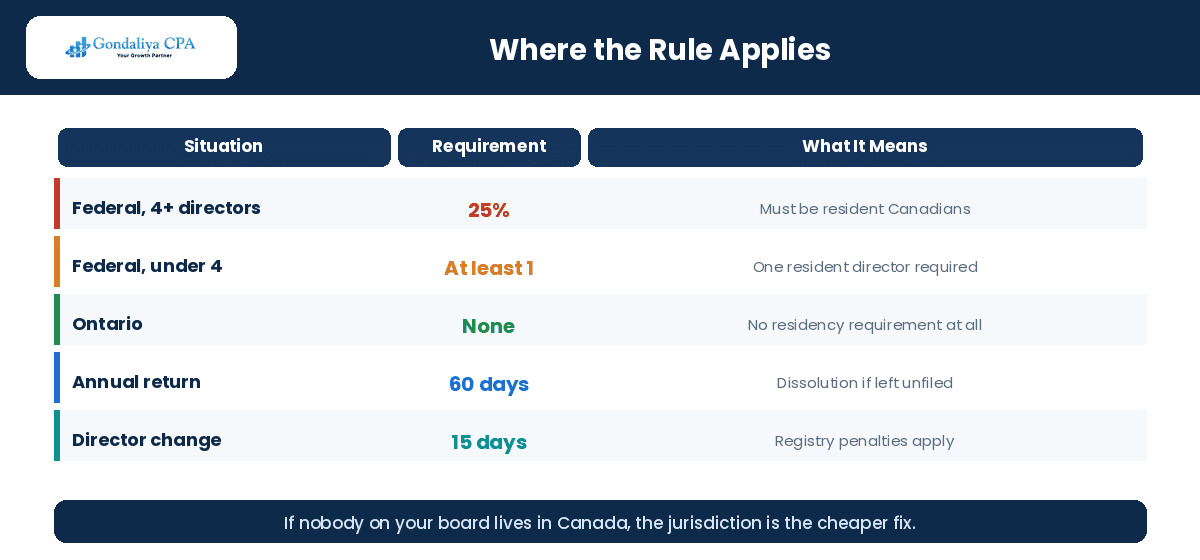
The rule is jurisdictional, not national. Federal corporations under the CBCA need 25% resident Canadian directors where there are four or more. Ontario requires none. Please note that a nominee director solves a residency requirement, not a control problem, and that the person appointed carries real personal liability for payroll and GST/HST regardless of how little they decide.
| Aspect | Details |
|---|---|
| The federal rule | 25% resident directors where there are four or more. |
| The Ontario position | No resident director requirement. |
| The filing window | 60 days for annual returns, 15 for director changes. |
| The exposure | Personal liability for source deductions and GST/HST. |
Reading time: 37 minutes.
Table of Contents
- Overview of Resident Director and Nominee Director Services in Canada
- Benefits and Strategic Value of Resident Director Services
- Nominee Director Services for Non-Resident Corporations
- Client Onboarding and Service Process for Resident Director Services
- Serving Toronto, Greater Toronto Area (GTA), and Ontario Regions
- Legal Responsibilities, Ethical Considerations, and Alternatives
- Frequently Asked Questions (FAQs)
- Key Numbers at a Glance
- Industry Spotlights: Sectors We Serve
- Professional Guidance and Quick Reference
The Numbers That Matter
This article covers Canada, with Ontario and Toronto context, and reflects rules current to 2026. It assumes a foreign owner incorporating or already operating a Canadian corporation. Figures marked illustrative are examples, not quotes, and any masked engagement notes end with “Figures changed for privacy.” This is educational information only and not tax or legal advice. Director residency rules and liabilities differ by province and by statute, so please confirm the position for your own jurisdiction before appointing anyone.
Overview of Resident Director and Nominee Director Services in Canada
Overview of Resident Director and Nominee Director Services in Canada
The Basics
Understanding Resident Director Requirement Canada for Foreign-Owned Corporations
Canada requires foreign-owned corporations to have resident directors in certain cases. Under the Canada Business Corporations Act (CBCA), federal companies with four or more directors must have at least 25% who are resident Canadians. But, Ontario does not have this rule. So, companies incorporated there don’t need a resident director. This difference matters a lot depending on where your business is set up.
Definition and Role of Resident Directors and Nominee Directors
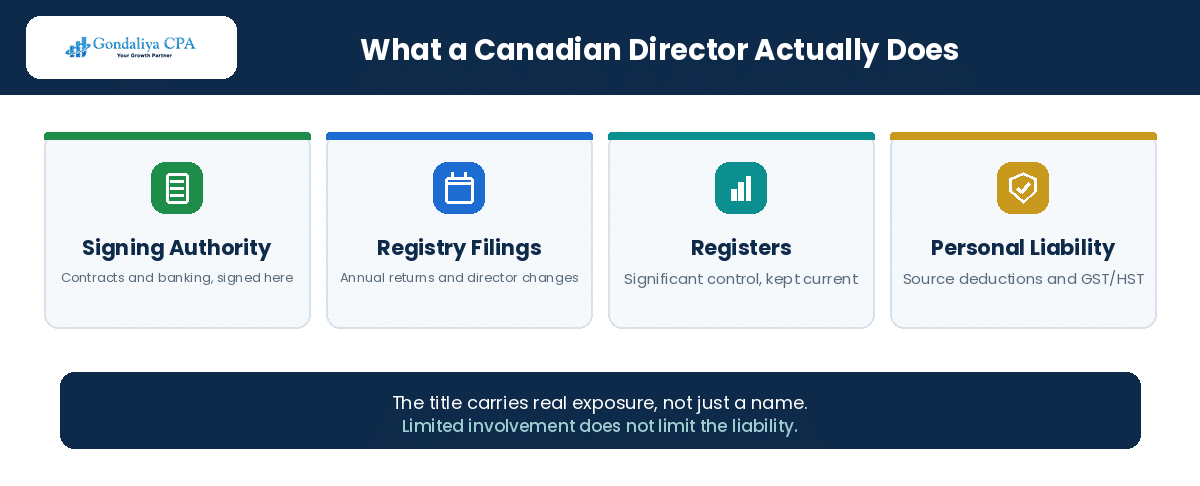
Resident directors handle signing authority for the company. They make sure the corporation follows rules and stays in touch with agencies like Corporations Canada. Nominee directors are different—they act as stand-ins for non-resident owners. They might face risks like damage to their reputation or even quitting suddenly without warning. Both types must follow Canadian law and carry duties such as avoiding conflicts of interest and acting loyally for the company’s benefit.
Legal Framework Governing Director Requirements in Canada
The rules about directors come from two main laws: the Canada Business Corporations Act (CBCA) and provincial acts like the Ontario Business Corporations Act (OBCA).
- CBCA Section 105(1) says when resident directors are required.
- OBCA Sections 118-119 cover director duties specific to Ontario companies.
These laws shape how corporations pick and keep their directors.
Importance of Appointing a Resident Director for Canadian Corporate Compliance
Appointing a resident director helps companies meet legal requirements under both federal and provincial laws. Without one, foreign-owned businesses risk losing good standing or breaking regulations. A resident director makes it easier to follow Canadian corporate rules and handle government paperwork properly.
Distinction Between Resident Director and Nominee Director Services
Resident director services involve active participation in managing the company’s affairs. Nominee director services, on the other hand, mean appointing someone who represents non-resident owners but doesn’t manage daily decisions. For example, Gondaliya CPA offers nominee director services in Canada, helping businesses meet legal demands without involving those appointed in active management roles.
The first question is almost never who the director should be. It is whether you need one at all, and that turns entirely on the province you incorporate in. Figures changed for privacy.
Risk Warning: A nominee director carries the same personal exposure for unremitted payroll deductions and GST/HST as any other director. Limited involvement in decisions does not limit that liability.
Benefits and Strategic Value of Resident Director Services
Benefits and Strategic Value of Resident Director Services
The Value
Resident director services help non-resident corporations across Canada stay on the right side of the law. A resident director Canada serves as a key contact between foreign owners and Canadian authorities. They know the rules and keep everything running smoothly. Non-resident business owners often find these tasks tricky, so having a local expert really helps.
Ensuring Compliance with Canadian Corporate Laws and Regulations
Canadian corporate compliance means following rules about director residency under the Canada Business Corporations Act (CBCA) and provincial laws. Federal corporations need at least 25% of directors to be Canadian residents. If there are fewer than four directors, at least one must live in Canada. This is the resident director requirement Canada.
Resident directors handle filings like annual returns, changes in directorship, registered office updates, and control registers. They help meet deadlines set by Corporations Canada or provincial registries. Missing these deadlines can lead to penalties or even losing good standing.
For example:
- A federal company with four directors must have one resident Canadian director.
- Without meeting this rule, the company risks losing its legal status.
Hiring a professional resident director service keeps things in order.
Facilitating Bank Account Setup and Financial Operations
Opening a Canadian bank account usually needs someone living in Canada with signing authority. Resident directors fill this role by signing contracts and authorizing banking locally. They also help set up CRA accounts for GST/HST, payroll deductions, and corporate taxes.
Non-resident companies get quicker responses from banks and government agencies through their resident director. This cuts down delays caused by time zones or distance when contracts require local signatures.
For example:
- A foreign-owned company needing quick access to funds benefits from having a local resident director.
- This lets them handle money matters without giving up control of daily decisions.
Supporting Visa and Immigration Processes for Foreign Entrepreneurs
Foreign entrepreneurs often need nominee director services Canada for visas linked to investments or work permits. A qualified resident director shows immigration authorities that the business operates properly in Canada.
Nominee directors follow legal rules but do not hide who owns or controls the company. They act as local representatives meeting residency requirements for immigration programs.
This service is useful when visa applicants don’t know suitable people living in Ontario/Toronto or other provinces but still need a verified local director during incorporation.
Maintaining Confidentiality and Privacy Protection for Directors
Keeping information private is very important when working with nominee directors. Public records like the individuals with significant control register under CBCA will update in 2026 to include more info about directors.
Professional firms provide confidential agreements so nominee directors agree to keep their involvement secret when possible. They protect personal data following privacy laws like PIPEDA.
Privacy means safe handling of:
- Director consents
- Corporate resolutions
- Banking documents
- CRA communication logs
Experts make sure all this stays secure while following legal rules.
Enhancing Business Credibility and Operational Stability
Having a reliable resident Canadian director boosts trust among banks, suppliers, clients, regulators, and investors. It shows your business follows Canadian laws properly.
It also helps avoid problems from missed filing deadlines or ignored notices sent overseas that could harm reputation.
Resident directors watch compliance schedules closely based on your industry—from real estate to tech startups—to keep things running smoothly without interruptions.
Cost Efficiency Compared to Hiring Local Management
Gondaliya CPA offers flat annual fees including HST for resident director services plus corporate compliance support in Ontario/Toronto areas. This saves money compared to hiring full-time local managers with salaries and benefits.
Clients get expert help all year at a reasonable price. CPA Ontario members use tools like QuickBooks or Xero and provide fast support even on weekends or evenings—usually within one business day response time.
This approach cuts costs but keeps your company fully compliant under current regulations—including changes coming in 2026 about directorship rules.
For advice on how resident director services can protect your non-resident corporation Canada’s interests while keeping costs low, contact Gondaliya CPA at 647‑212‑9559 or info@gondaliyacpa.ca. Get your free consultation today focused on Toronto/Ontario incorporations that meet current rules including upcoming 2026 updates affecting directors.
Banking is the practical reason clients call, not the statute. A board with nobody in Canada can satisfy the corporate law and still struggle to open an account. Figures changed for privacy.
Key Stat: Annual returns are due within 60 days of the anniversary date. Missing them long enough leads to administrative dissolution, which stops the company acting until it is revived.
Nominee Director Services for Non-Resident Corporations
Nominee Director Services for Non-Resident Corporations
The Service
Nominee director services play a key role for non-resident corporations in Canada. They help these companies meet the need for a resident director and keep everything compliant. This is important because Canadian law requires at least one director to live in Canada. Without this, foreign businesses can’t operate smoothly or follow legal rules under the Canada Business Corporations Act (CBCA) or local laws.
How Nominee Director Services Support Non-Resident Incorporation in Canada
Nominee director Canada services give non-resident corporation Canada owners someone local to fulfill residency rules. If a company has four or more directors, 25% must be Canadian residents. For fewer than four, at least one resident director is needed[1]. Resident director services handle important filings, consent forms, and governance tasks. Without this help, foreign owners might struggle to open bank accounts or deal with CRA programs due to lack of local contacts.
Here’s what nominee directors do:
- Provide a Canadian resident to meet legal requirements
- Handle consent paperwork properly
- Keep up with corporate governance standards
- Help open bank accounts and CRA registrations
Features of Professional Nominee Director Services Offered by Gondaliya CPA
Gondaliya CPA offers nominee director Canada services made for non-residents incorporating across Ontario and other provinces needing a Canadian resident director. Their service includes:
- Finding qualified Canadian residents who meet CBCA rules[2]
- Managing all consents to act as directors
- Handling annual return filings and updating control registers
- Communicating clearly about duties while avoiding liability
They make sure you stay on the right side of regulations but still control your corporation.
Confidential Agreements and Privacy Guarantees in Nominee Director Arrangements
Privacy matters a lot with nominee directors. Professionals use strict confidentiality agreements that protect both sides. These agreements explain roles clearly and set rules for resignations if needed. Even so, nominee directors are legally responsible as officers; misuse can hurt their reputation[3]. Being clear about responsibilities helps protect everyone’s privacy and avoids problems around ownership details.
Maintaining Ongoing Corporate Compliance through Nominee Directors
Resident director compliance support doesn’t stop after appointment. It means keeping an eye on things all year round. For non-resident owners not used to Canadian laws, nominee directors help by:
- Filing annual returns on time within the 60-day window after the anniversary date[4]
- Updating significant-control registers
- Handling CRA letters about payroll or GST/HST linked to directors[5]
This ongoing help lowers risks of penalties or losing corporate status because of missed deadlines.
Registered Office and Mailing Address Services in Ontario
Ontario law says every corporation must have a registered office inside the province where records can be accessed during business hours[6]. Many nominee director packages include this address along with mailing services for official mail from government agencies like CRA. This keeps important notices safe and stops clients from having their personal addresses on public records.
Annual Nominee Director Agreements and Renewal Process
Before anyone becomes a nominee director, they must give written consent per section 106(1) CBCA[7]. Gondaliya CPA handles this yearly with formal nomination agreement renewals. These renewals match board resolutions and confirm ongoing consent to serve. They also let clients adjust agreements based on new rules starting in 2026—like stricter reporting of people with significant control[8].
Transparent Pricing and Fee Structure for Nominee Director Services
Gondaliya CPA charges a flat annual fee including HST for all resident director services tailored to non-resident corporations across Toronto/Ontario. The fee covers:
- Jurisdiction complexity
- Number of extra-provincial registrations
- Volume of payroll or GST accounts managed
- Condition of existing registers
- Any late filings
For exact pricing based on your case, email info@gondaliyacpa.ca or call 647‑212‑9559 for a free consult.
- Corporations Canada – Resident Canadian definition & minimum residency rules under CBCA sections 105–108
- CBCA Section 106 – Consent To Act Requirements
- Department Of Justice – Risks Associated With Nominee Directors
- Corporations Canada – Annual Return Filing Deadlines & Procedures
- Excise Tax Act Section 323 – GST/HST Liability Of Directors
- Ontario Business Corporations Act Section 12 – Registered Office Requirement
- CBCA Section 106(1) – Written Consent To Serve As A Director
- Updated Significant-Control Register Rules Effective January 2026 (Canada Gazette)
For expert guidance on setting up compliant nominee directorships supporting your non-resident corporation’s success across Ontario/Toronto areas contact us at info@gondaliyacpa.ca or call us at 647‑212‑9559 today for your free consultation opportunity
Written consent before appointment is not paperwork, it is the moment liability attaches. Anyone agreeing to act should read what they are signing and understand the two-year window that follows. Figures changed for privacy.
Pro Tip: Please keep signed resignation letters in the minute book even when a replacement is appointed at the same time. Proving the date someone ceased to be a director is what limits their exposure later.
Client Onboarding and Service Process for Resident Director Services in Canada
Client Onboarding and Service Process for Resident Director Services
The Process
Initial Consultation to Assess Corporate Needs and Residency Requirements
When we start working with a non-resident corporation Canada client, the first thing is a chat. We check what the company needs and if it has to follow residency rules. Some companies must have a resident director Canada, depending on federal or provincial laws. Gondaliya CPA looks at where the company was made, how many directors there are, where they work, and who owns it. This helps us know if the director rules apply and fit the client’s goals.
We also decide if nominee director services Canada make sense or if other options work better for foreign owners. This talk clears up what resident Canadian directors must do and what risks come with nominee directors.
Appointment Procedure for Resident or Nominee Directors
To add a resident or nominee director, we get their okay first. They must give written consent to act before we file any papers. This step follows Corporations Canada rules1. It shows they agree and know their legal duties.
Nominee directors face special risks. They hold the title but don’t control decisions. That can bring liability without power2. Written consent forms explain these limits and sometimes include indemnity notes — but these don’t wipe out CRA personal liability3.
Gondaliya CPA helps clients do this right. We prepare resolutions for appointments, file on time (usually within 15 days), and keep clear records.
Ongoing Management and Monitoring of Compliance Obligations
Keeping up with Canadian corporate rules means constant care after setup. Important duties include:
- Filing annual returns within 60 days after each anniversary5.
- Updating registers like those listing people with major control right away.
- Keeping records at least six years per CBCA section 122(1)6.
If a company misses filing deadlines, Corporations Canada can dissolve it after about two months of delay7. That stops the company from acting legally until it fixes things.
Gondaliya CPA sends reminders before annual returns are due and flags when registers need updates due to changes in shares or directors.
| Duty | Deadline | What Happens If Missed | Source |
|---|---|---|---|
| Annual Return Filing | Within 60 days post-anniv. | Administrative dissolution | CBCA s.162; Corporations.ca |
| Register Updates | Right after any change | Penalties for non-compliance | CBCA s.21; CRA guidelines |
| Records Retention | At least six years | Risk of audits | CBCA s.122 |
Communication and Documentation Practices to Ensure Transparency
Keeping things clear means managing all legal registers well. This includes minute books with resolutions, consents, meeting notes, and share registers showing who owns what8. Good records back up solid governance, especially for foreign-owned Canadian firms under close watch.
Gondaliya CPA keeps in touch often so records stay accurate and ready for audits or regulators. Clients get regular reports with upcoming deadlines plus advice on improving record keeping based on their industry (like real estate holding companies needing detailed minute books).
Good paperwork lowers chances of disputes among shareholders or directors and proves that duties under Canadian law get followed9.
Coordination with Tax Filing, Banking Access, and Minute Book Maintenance
Resident director services help with day-to-day stuff too — like opening Canadian bank accounts that need ID tied to registered directors10. We make sure bank signatories match company records kept by Gondaliya CPA.
Setting up CRA accounts (for GST/HST or payroll) links directly to company registration info including appointed directors who could face personal liability for unpaid taxes under Income Tax Act sections 227/32311.
Minute book upkeep goes hand in hand with tax compliance by logging board approvals of financial moves so everything shows clearly during CRA audits of cross-border companies.
Planning for Director Transitions and Succession
Changing directors takes care to avoid penalties that hurt both company standing and people’s personal risk12. When adding or removing directors:
- Get written consent first.
- Pass formal board resolutions.
- File notices within set times (usually 15 days).
Keep resignation letters safe in minute books even if replacement happens later than wanted13.
Gondaliya CPA guides clients through these steps with checklists and timeline tools so deadlines don’t get missed under Corporations Canada’s rules for non-resident firms14.
For help appointing resident or nominee directors in Ontario/Toronto areas, call Gondaliya CPA at 647‑212‑9559 or email info@gondaliyacpa.ca for a free consultation about affordable resident director services made for foreign entrepreneurs running businesses in Canada.
References
1: Corporations Canada – Director Appointment & Consent Requirements
2: Department of Justice – Risks Associated With Nominee Directors
3: Income Tax Act Section 227 – Director Liability
4: Corporations Regulations – Registry Filings Deadlines
5: CBCA Section 162 – Annual Returns
6: CBCA Section 122(1) – Records Retention
7: Corporations Canada’s Dissolution Procedures
8: Corporate Governance Best Practices Guide – Registers Maintenance
9: Fiduciary Duties Under Canadian Law – Department of Justice Publications
10: Bank Account Opening Guidelines Linked To Registered Directors Information
11: Income Tax Act Sections 227 & 323 – Director Liability
12: Penalties Related To Late Filing Of Director Changes
13: Best Practices For Maintaining Resignation Letters In Minute Books
14: Corporations Canada Guidelines For Director Appointments And Removals
The minute book is where most of these engagements start. Foreign owners inherit a company with consents missing and registers never opened, and the cleanup takes longer than the setup would have. Figures changed for privacy.
Risk Warning: Indemnity wording in a consent form does not displace personal liability to the CRA. It may give the director a claim against the company, which is worth little if the company cannot pay.
Serving Toronto, Greater Toronto Area (GTA), and Ontario Regions
Serving Toronto, Greater Toronto Area (GTA), and Ontario Regions
The Regions
Non-resident corporations in Canada face tricky rules about directors living here. The Canada Business Corporations Act says at least 25% of directors must be Canadian residents for federal companies. But provinces like Ontario don’t require resident directors for their own incorporated companies[1]. So, foreign businesses working in Toronto, the GTA, or Ontario need to know these differences well.
Resident director services help companies follow these rules by providing a Canadian presence on their boards when needed. Nominee director Canada services let non-resident owners meet these rules without losing control or ownership. They handle important things like filing papers on time, keeping annual returns up to date, and managing CRA letters.
If you run a non-resident corporation Canada business near Toronto or places like Mississauga and Vaughan, expert advice keeps you safe from penalties or even being dissolved[2]. It’s smart to have help that understands both federal and local laws.
Industries Benefiting from Resident and Nominee Director Services
Some industries really need resident director services because their rules are strict or they work across Canada:
- Startups & Technology: They grow fast and need clear board rules.
- Financial Services: They must follow tough laws like anti-money laundering.
- Healthcare: Medical groups with foreign owners face special limits set by regulators.
- Import/Export & Wholesale Trade: They cross borders and need correct CRA setups tied to directors.
- Franchises & Retail Chains: Big brands with many locations must stay legal everywhere they operate.
Resident director services help these businesses meet deadlines right and handle risks well[3]. When it’s hard to be physically present, nominee directors step in as legal reps.
Specific Considerations for High-Risk Sectors and Regulatory Compliance
High-risk sectors get extra attention because mistakes can cost a lot or hurt people. Directors there need to know how long they can be held personally responsible.
Canadian law says directors might owe money for things like unpaid payroll taxes for up to two years after the fact[4]. They also can be liable if GST/HST payments fail under the Excise Tax Act[5]. Nominee director services watch these time frames closely to avoid surprises.
Also, it’s key to keep records about who controls the company. Not revealing this info can damage your reputation during audits—especially in finance or healthcare[6].
Customized Support for Foreign Entrepreneurs and Non-Resident Business Owners
Foreign entrepreneurs setting up Canadian companies get big help from nominee director Canada setups made just for them. This support includes:
- Checking residency rules before setting up
- Getting signed papers that follow Corporations Canada rules
- Keeping proper records like minute books and share lists
- Helping with bank accounts using trusted resident reps
- Sending reminders about yearly filings and CRA accounts
This way, non-resident owners stay confident their company follows laws all year without losing control. CPA firms with cross-border experience offer resident director Canada packages suited for clients entering markets like Toronto/GTA/Ontario[7].
- Corporations Act (Ontario); OBCA Section 118
- Corporations Canada Annual Return Filing Guidelines
- CBCA Sections 21(1), 105 – Director Requirements
- Income Tax Act Section 227(4) – Director Liability Limitation Period
- Excise Tax Act Section 323 – GST/HST Remittance Liability
- Corporations Regulations Part XXI – Significant-Control Register Obligations
- Gondaliya CPA client service protocols; CPA Ontario Registered Firm
Groups incorporate federally for the national name protection and then discover the board composition problem afterwards. In Ontario the same business would have needed no director at all. Figures changed for privacy.
Pro Tip: Please decide the board first and the jurisdiction second. If nobody involved lives in Canada, Ontario incorporation removes the requirement entirely rather than working around it.
Legal Responsibilities, Ethical Considerations, and Alternatives
Legal Responsibilities, Ethical Considerations, and Alternatives
The Duties
Fiduciary Duties and Liabilities of Resident and Nominee Directors
Resident directors Canada and nominee directors Canada both have to act in the company’s best interest. They must be honest and make decisions carefully. This is called fiduciary duty. The duty of care means directors need to think things through before acting.
If a conflict of interest pops up, directors must tell the right people fast. Ignoring this can lead to trouble. The law says directors could face legal problems if they don’t do their job well.
There’s also a director liability limitation period. For example, if the CRA finds unpaid taxes, it usually has two years from the time they tell the director to take action. That’s why resident or nominee directors must keep an eye on rules closely.
Here’s an example: A foreign-owned company had one resident director. They owed $25,000 in GST/HST plus penalties after two years. The director lost their defense because records were missing.
Compliance Obligations under Canadian Corporate Governance Standards
Canadian companies must follow certain rules to stay legal. This includes keeping records about who controls the company, filing annual returns on time, and having proper board meeting minutes.
Resident director services help non-resident owners with all these duties. They make sure deadlines aren’t missed and paperwork stays up to date at Corporations Canada or provincial offices.
Good governance means holding regular meetings and documenting decisions clearly. Laws like CBCA sections 105-108 guide how these meetings should work.
Gondaliya CPA offers corporate compliance support for foreign entrepreneurs who set up businesses federally or in provinces like Ontario and Toronto. They manage filings without forcing directorships but coordinate what’s needed.
Ethical Practices Including Transparency, Confidentiality, and Conflict of Interest Management
Nominee director risks include hiding who really controls the company. This can hurt reputations if people feel tricked.
Good ethics means being clear about roles. Don’t pretend a nominee has real power if they don’t. Everyone should know who calls the shots in a foreign-owned Canadian company.
Directors handle sensitive info during filings or when talking with CRA. Keeping this data confidential is key. Directors must protect client details while doing their work carefully.
Having clear conflict-of-interest policies builds trust between nominee directors and clients. Services like Gondaliya CPA follow rules like CBCA section 122(1) that require openness.
Alternative Solutions to Resident Director Requirements (Incorporation in Provinces Without Residency Rules, Appointment of Canadian Partners)
Not every province needs a resident Canadian director. Ontario stands out since OBCA section 118(2) doesn’t require one[5].
This lets non-resident owners form companies there without appointing local directors directly. But remember, if you operate elsewhere in Canada too, you might still need local representation.
Another way is to partner with trusted Canadians who agree to be directors but let you keep control from afar. This balances legal rules with saving money—a popular choice for small businesses growing into Ontario or Toronto markets.
Here’s a quick look at some provinces:
- Ontario: No resident director needed; minimum 1 director; extra-provincial registration required
- Alberta: Resident director needed; minimum 1 director; extra-provincial registration required
- British Columbia: Resident director needed; minimum 1 director; extra-provincial registration required
Source info comes from provincial laws and Corporations Canada records.
Evaluating Costs Versus Benefits of Using Professional Resident Director Services
Resident director Canada services usually charge a flat annual fee including HST. Exact amounts depend on how complex your business is but firms like Gondaliya CPA offer clear pricing[7].
Hiring local managers full-time costs more than paying for professional resident director services that handle filings and reduce risks linked to CRA debts or missing registry deadlines.
When deciding between a resident director or Ontario incorporation without one, think about:
- How much control you want
- Your risk of being personally liable
- How reliable your filings need to be
- What fits your budget
Many non-resident companies find using professional resident directors safer than managing everything themselves—which can lead to costly mistakes[8].
Summary of Key Factors When Choosing a Resident or Nominee Director Provider
Picking good resident director services means checking if they are licensed CPA firms in Ontario (CPA Ontario membership) with solid experience helping foreign clients deal with tax issues like GST/HST[9].
Look for these traits:
- Consent-to-act forms that follow Corporations Canada rules
- Quick replies within one business day plus weekend or evening contact options
- Flat fees that cover only what’s needed—no surprise charges
- Strong reputation backed by over 1300 five-star Google reviews
Gondaliya CPA fits these standards by helping entrepreneurs across Toronto/Ontario maintain proper corporate governance without headaches.
References:
- Income Tax Act – Section on Director Liability Limitation Periods
- Corporations Canada – Annual Return Filing Requirements
- CBCA Sections 105–108 – Board Meeting Procedures
- Department Of Justice – Risks Associated With Nominee Directorships
- OBCA Section 118(2) – No Residency Requirement In Ontario
- Provincial Registries – Extra-provincial Registration Rules
- Gondaliya CPA Pricing Policy Documentation [Internal]
- Comparative Analysis Report On Incorporation Options For Non‐Residents [Illustrative]
- CPA Ontario Directory Verification https://www.cpaontario.ca/protecting-the-public/directories/firm/gondaliya-5sqvmj
Nobody plans to be the director who carries an unpaid GST/HST balance. It happens because the records that would have proved due diligence were never kept in the first place. Figures changed for privacy.
Key Stat: The CRA generally has two years from the date a person ceases to be a director to assess them personally. Documenting the resignation date is what starts that clock running.
Frequently Asked Questions (FAQs) on Resident Director Canada and Nominee Director Services
Frequently Asked Questions (FAQs)
FAQ
What is the minimum resident director requirement for Canadian federal corporations?+
Federal corporations with four or more directors must have at least 25% resident Canadian directors. Companies with fewer than four directors need at least one resident director.
What is the deadline for filing annual returns for Canadian corporations?+
Annual returns must be filed within 60 days after the corporation’s anniversary date to maintain good standing.
When must changes in directorship be filed?+
Director changes must be reported within 15 days of the appointment or resignation to Corporations Canada or provincial registries.
How long is the director liability limitation period in Canada?+
Directors can be held liable for unpaid taxes or penalties up to two years after receiving notice from tax authorities.
What is the required records retention period under Canadian corporate law?+
Corporations must keep records, including minute books and registers, for at least six years following transactions.
What happens if a corporation misses filing deadlines?+
Failure to file annual returns can lead to administrative dissolution and loss of legal status until filings are restored.
Does appointing a resident director affect the corporation’s tax residency in Canada?+
No, appointing a resident director does not change where the corporation is tax resident; it fulfills legal compliance only.
How do you appoint, replace, or remove a director in a Canadian corporation?+
Directors must give written consent before appointment. Removal or replacement requires board resolutions and timely filings.
What are the best practices to maintain year-round compliance for non-resident corporations?+
Keep up with filing deadlines, update registers promptly, maintain proper records, and monitor CRA correspondence regularly.
Key Numbers at a Glance – Gondaliya CPA Resident Director Services
Key Numbers at a Glance
Quick Reference
- Resident director percentage required: Minimum 25% federally (if 4+ directors)
- Annual return filing window: 60 days post-anniversary
- Director change filing deadline: Within 15 days
- Director liability limitation period: Up to 2 years post-notice
- Records retention period: Minimum 6 years
- Flat annual fee including HST: Competitive fixed pricing for all compliance services
Scope for the 2026 Tax Year and Corporate Governance Practices
- New significant-control register requirements will expand public disclosures.
- Directors must ensure all ownership info stays updated.
- Enhanced reporting demands increase compliance vigilance.
- Gondaliya CPA provides tailored support adapting to these regulatory changes.
Comparison Table: Resident Director vs Ontario Incorporation Without One
| Feature | Resident Director Required | Ontario Incorporation Without Resident Director |
|---|---|---|
| Legal Residency Requirement | Yes (Federal companies) | No |
| Filing Responsibility | Managed by resident director | Managed by corporation owners |
| Bank Account Setup | Easier with local director | Possible but may face delays |
| Liability Risk | Shared with resident director | On corporate owners |
What Triggers Registry or CRA Compliance Problems?
- Missing annual return deadlines.
- Late filings of director appointments or removals.
- Failure to update control registers promptly.
- Ignoring CRA notices about GST/HST or payroll accounts.
How Do We Support Non-Resident Owners at Gondaliya CPA?
- Provide clear consultation on residency rules and obligations.
- Handle all document preparation and filings on time.
- Offer flat fee pricing with no hidden costs.
- Maintain communication about upcoming deadlines and compliance updates.
What Deliverables Do You Get from Our Resident Director Services?
- Written consent forms aligned with Corporations Canada rules.
- Timely filings of annual returns and directorship changes.
- Registered office address services when required.
- Secure record keeping and privacy protection agreements.
How Much Do Resident Director and Compliance Services Cost in Canada?
Gondaliya CPA charges a flat annual fee inclusive of HST tailored by complexity, jurisdiction, and number of registrations required.
Top Mistakes Non-Resident Corporations Make and How to Prevent Them
- Missing critical filing deadlines — prevent by scheduling reminders.
- Failing to keep registers updated — assign responsibility clearly.
- Using unqualified nominee directors — choose licensed professionals like Gondaliya CPA.
What Should You Prepare Before an Engagement Starts?
Have details ready on current directors, company incorporation documents, jurisdiction of registration, shareholder info, and any past compliance history.
How Do Director Requirements Differ Across Ten Industries We Serve?
Industries like finance, healthcare, import/export, technology, retail chains each face unique regulatory demands affecting how directors operate locally.
A Realistic Numeric Walkthrough for Non-Resident Companies
For a federal company with four directors: one must be resident Canadian (25%). Annual return due within 60 days post anniversary; missing it risks dissolution.
How To Choose The Right CPA Firm in Toronto/Ontario for Non-resident Corporate Compliance?
Look for licensing credentials (CPA Ontario), proven experience with foreign clients, transparent fees, fast response times, and strong privacy practices.
Why Trust Gondaliya CPA?
We are licensed CPAs specializing in non-resident corporate compliance across Ontario/Toronto with over 1300 five-star reviews validating our quality service.
People Also Ask
Can I act as my own resident director if I live outside Canada?+
No; a resident director must live in Canada as per federal law for most corporations.
Is nominee directorship risky for individuals appointed?+
Yes; they face potential liabilities despite limited management control but risk can be mitigated through professional agreements.
Are there provinces without resident director requirements?+
Yes; Ontario does not require it under OBCA section 118(2).
Glossary of Key Terms
- Resident Director: A board member who lives in Canada fulfilling legal residency requirements.
- Nominee Director: An appointed individual who acts on behalf of foreign owners but may have limited control.
- Annual Return: Mandatory yearly filing updating corporate info with government registries.
- Control Register: A record of individuals holding significant ownership or influence over the corporation’s shares.
Next Steps
Contact Gondaliya CPA today at info@gondaliyacpa.ca or call 647‑212‑9559 for expert guidance on compliant resident or nominee director services tailored for your non-resident Canadian corporation needs.
The engagements that go smoothly are the ones where somebody owns the calendar. Sixty days and fifteen days are short windows when the people responsible are in another time zone. Figures changed for privacy.
Industry Spotlights: Sectors We Serve
Industry Expertise
Why a Canadian director matters differs by sector. Here are eleven and the usual driver.
| Industry | Why a Canadian Director Matters |
|---|---|
| Technology startups & SaaS | Board governance for investors and grant programs |
| Real estate investors & holding companies | Local signing authority on property transactions |
| E-commerce & online retailers | Bank and payment processor onboarding |
| Consulting firms | CRA account setup tied to a registered director |
| Transportation, logistics & trucking | Payroll accounts and source deduction liability |
| Construction, contractors & skilled trades | Bonding and prequalification requirements |
| Property developers & builders | Municipal and lender documentation signed locally |
| Restaurants & food and beverage | Licensing applications requiring a local officer |
| Medical doctors & physician corporations | Regulator limits on who may hold shares and office |
| Dentists & dental practices | Professional corporation ownership restrictions |
| Daycare, childcare & CWELCC services | Provincial licensing tied to named individuals |
- Technology startups & SaaS: Investors and funding programs expect a board that can meet and resolve properly, wherever the founders live.
- Real estate investors, landlords & holding companies: Closings move faster when someone in Canada can sign, and slower when nobody can.
- E-commerce & online retailers: Banks and payment processors ask for a local director long before any regulator does.
- Consulting Firms: CRA program accounts are opened against named directors, which is where the practical need usually arises.
- Transportation, logistics & trucking: Payroll here means source deduction liability attaches personally to whoever is on the register.
- Construction, general contractors & skilled trades: Bonding and prequalification packages routinely ask for Canadian officer details.
- Property developers & builders: Lender and municipal paperwork needs a signature that can be given in person on short notice.
- Restaurants & food and beverage: Liquor and food premises licences generally require an identified local officer.
- Medical doctors & physician professional corporations: Regulator rules restrict both share ownership and who may serve, which no nominee arrangement overrides.
- Dentists & dental practices: Practice ownership limits apply before any question of director residency arises.
- Daycare, childcare & CWELCC services: Licences attach to named people, so board changes have to be reported to more than one authority.
The statute is rarely what forces the appointment. Banks, licensing bodies and lenders ask for a Canadian director well before Corporations Canada does. Figures changed for privacy.
Professional Guidance and Quick Reference
Guidance
Professional Guidance on Directors: How Gondaliya CPA Supports Foreign-Owned Corporations
The resident director question has a simple answer that most people reach the long way round. Federal incorporation under the CBCA requires 25% resident Canadian directors once there are four or more. Ontario requires none at all. If nobody on your board lives in Canada, the cheapest fix is usually the jurisdiction, not a nominee. Gondaliya CPA advises on both, and provides director services where they are genuinely needed.
We handle what decides the outcome: testing whether your chosen jurisdiction actually imposes a residency requirement, obtaining written consent to act before any filing, preparing appointment resolutions and filing director changes inside fifteen days, filing annual returns inside the sixty-day window, opening and maintaining the significant control register, keeping the minute book and resignation letters in order, and coordinating bank and CRA account setup against the registered director details.
Our team will tell you plainly when you do not need a nominee director, which is more often than the market suggests. Incorporating now or repairing a board that has drifted out of compliance, you get clear advice and a fixed annual fee before we start.
Quick Answers: Key Numbers & Concepts at a Glance
At a Glance
- Federal requirement: 25% resident directors where there are four or more
- Federal, fewer than four: At least one resident director
- Ontario requirement: None
- Quebec requirement: None
- Consent to act: In writing, before appointment
- Director change filing: Within 15 days
- Annual return: Within 60 days of the anniversary date
- Records retention: 6 years
- Director liability window: 2 years after ceasing to be a director
- Registered office: Required in the province of incorporation
Who This Is For / Not For
Fit Check
- For: Foreign owners incorporating in Canada, or already holding a Canadian corporation whose board no longer meets the residency rule.
- Not For: Arrangements intended to conceal beneficial ownership, which we do not provide and which the significant control register is designed to prevent.
Director Requirement Check
This quick self-check indicates where your operation most likely has room. Please answer the six questions below.
Director Requirement Check
Six quick questions on your board. No fee shown.
Points to raise with us:
This is a general prompt, not tax or legal advice or a quote. Your position depends on your full facts. For a real review, please book a free consultation.
Want a checklist to work from? You can download our free resident director readiness checklist before your consultation.

Check whether your jurisdiction imposes a residency rule at all before appointing anyone. Get written consent to act before the filing, not after. File director changes inside fifteen days and annual returns inside sixty. Open and maintain the significant control register. Keep signed resignation letters in the minute book. Please treat director liability for payroll and GST/HST as real, because it is.
2026 Update — what is current: This article notes expanded significant control register disclosure taking effect in January 2026. The 25% federal residency threshold, the 60-day annual return window, the 15-day director change filing deadline, the six-year retention rule and the two-year director liability period are unchanged. Please note the article states in one place that Canadian law requires at least one director to live in Canada, which is not the position in Ontario or Quebec, and lists Alberta and British Columbia as requiring resident directors, so please confirm the current rule for your province before relying on it.
Resident Director Canada Requirements and Nominee Director Services for Foreign-Owned Canadian Corporations
Check the jurisdiction before appointing anyone
Gondaliya CPA tests whether a residency rule applies to you, obtains written consent to act, files appointments and changes inside fifteen days, keeps annual returns inside the sixty-day window, maintains the significant control register and minute book, and coordinates bank and CRA account setup, on a fixed annual fee with a one-business-day response. Please book a free consultation.
Next Steps
Please book a free consultation with Gondaliya CPA and bring your articles of incorporation, a list of current directors with the country each lives in, and your most recent annual return. Those three settle in the first meeting whether you need a Canadian director at all. Calling before you incorporate keeps the jurisdiction option open. You will get a fixed annual fee before any work begins. If our content helps, please add gondaliyacpa.ca as a preferred source on Google.
Published: August 19, 2026 · Last updated: August 19, 2026
Editorial policy: We research against CRA and CPA Ontario sources, fact-check the figures, and Sharad Gondaliya, CPA, reviews the content, which we update as the rules change.
Disclaimer: This article is educational information only and is not tax, legal, or financial advice. Figures marked illustrative are examples rather than quotes or guarantees. It reflects CRA rules current to 2026, including the 25% federal resident director threshold, the 60-day annual return window, the 15-day director change filing deadline, the two-year director liability period, and the six-year record retention requirement. Rates, limits and expensing rules change and outcomes depend on your specific facts. Please consult a CPA Ontario member before acting.

Sharad Gondaliya is a CPA Canada & CPA USA with 15 Years+ experience of Accounting, Tax, Payroll of Corporate Small Businesses as Tax Accountant. He is a CPA Ontario member (61040184) and holds US CPA licences in Washington and Montana and is well known among corporate small businesses for tax planning, efficient tax solutions, and affordable CPA services. Sharad is the Principal (Director) of Gondaliya CPA – Affordable CPA Firm in Canada. Licenses: CPA Ontario: 61040184 | CPA USA (MT): PAC-CPAP-LIC-033176 | CPA USA (WA): 57629 | CPA Firm License: 61330051 View Full Author Bio