



Non-Resident Corporation Tax Compliance in Canada: How to Avoid Costly Filing and Compliance Mistakes
Non-resident corporate tax filing requires understanding Canadian tax filing for non-residents and fulfilling corporate filing requirements Canada to stay compliant. Gondaliya CPA offers Canadian corporation compliance services that guide non-resident businesses through their tax obligations and help prevent costly penalties.
Quick Summary
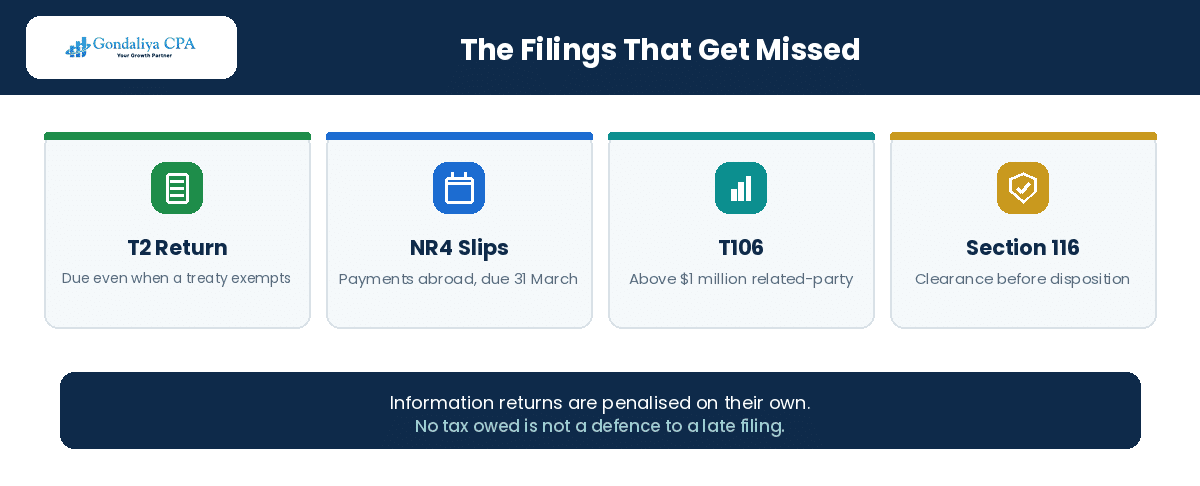
Treaty relief removes the tax, not the filing. A non-resident corporation carrying on business in Canada files a T2 within six months of year-end whether or not anything is payable. Please note that the late-filing penalty is calculated on unpaid tax, but the repeated-failure and information return penalties apply regardless.
| Aspect | Details |
|---|---|
| The return | T2, with Schedule 91 or 97 as applicable. |
| The deadline | Six months after fiscal year-end. |
| The withholding | Part XIII at source, reported on NR4. |
| The sale | Section 116 certificate before closing. |
Reading time: 38 minutes.
Table of Contents
- Overview of Non-Resident Corporation Compliance and Tax Filing in Canada
- Residency and Tax Status of Corporations under Canadian Law
- Tax Compliance Requirements for Non-Residents Carrying on Business in Canada
- Tax Obligations of Corporations Incorporated in Canada versus Foreign Corporations
- Navigating Canadian Corporate Tax Filing and Compliance Deadlines
- Support Services, Resources, and Contact Information
- Frequently Asked Questions on Non-Resident Corporation Compliance in Canada
- Key Insights on Non-Resident Corporation Compliance
- Industry Spotlights: Sectors We Serve
- Professional Guidance and Quick Reference
The Numbers That Matter
This article covers Canada, with Ontario and Toronto context, and reflects rules current to 2026. It assumes a non-resident corporation with Canadian filing obligations. Figures marked illustrative are examples, not quotes, and any masked engagement notes end with “Figures changed for privacy.” This is educational information only and not tax or legal advice. Treaty positions depend on the specific convention and your own facts, so please confirm before relying on a rate or exemption quoted here.
Overview of Non-Resident Corporation Compliance and Tax Filing in Canada
Overview of Non-Resident Corporation Compliance and Tax Filing in Canada
The Basics
Income Tax Information for Non-Resident Corporations
Non-resident corporations that work in Canada must follow certain tax rules. They need to file a T2 Corporation Income Tax Return, even if a treaty means they don’t owe taxes here. The main concern is income made inside Canada, which might be taxed.
- Taxable Canadian Property: Property or business interests in Canada can trigger tax duties.
- Treaty Benefits: Treaties can lower or remove tax charges but don’t stop you from filing returns.
Important Notice on Filing Requirements and Currency Specifications
All non-resident corporations must follow Canadian corporate rules, including how they report money. Income should be shown in Canadian dollars (CAD). Use the right exchange rates for conversions.
- Use the Bank of Canada rate to convert currencies.
- Stick to CRA deadlines for filing forms on time.
T2 Corporation Income Tax Return: Obligations for Non-Resident Corporations
Filing a T2 return is required if a non-resident corporation earns income from Canada. This covers money made from selling goods or offering services here.
- Fill out Form T2 plus schedules like Schedule 91 and Schedule 97.
- Report all income correctly to avoid fines.
Schedule 97: Reporting Additional Information on Non-Resident Income Sources
Schedule 97 asks for details about different kinds of income non-residents earn. This includes dividends, interest, and royalties linked to Canadian sources.
- List all types of income clearly.
- Provide proof when needed; it helps meet CRA’s expectations.
Schedule 20, Part XIV: Calculation and Payment of Additional Tax on Non-Resident Corporations
This schedule explains extra taxes that non-resident corporations may owe based on their activity in Canada. It deals with cases where additional tax applies due to certain business actions here.
- Work out extra taxes owed using CRA rules.
- Pay on time to avoid penalties or late fees.
Dispositions of Taxable Canadian Property: Certificates of Compliance and Notification Procedures
When selling taxable Canadian property like real estate, a non-resident corporation must get a Certificate of Compliance under Section 116 first.
- Inform CRA about the sale at least one month ahead.
- Get the certificate before finishing the sale.
Following these steps will help non-resident corporations keep up with compliance and tax rules in Canada. It lowers chances of penalties or audits by CRA.
The filings we are asked to fix are almost never about money owed. They are nil returns nobody knew were due, and by the time the letter arrives there are three years of them. Figures changed for privacy.
Risk Warning: A treaty exemption does not remove the filing obligation. Please file the return and claim the exemption on it, rather than treating the exemption as a reason not to file.
Residency and Tax Status of Corporations under Canadian Law
Residency and Tax Status of Corporations under Canadian Law
The Residency Test
Figuring out if a corporation is resident in Canada matters a lot for tax rules. Non-resident corporation compliance Canada requires knowing this status first. Canadian corporate compliance depends on it because it decides what taxes a company must pay.
Definition and Criteria for a Canadian Corporation
A company counts as Canadian if it’s incorporated under Canada’s federal or provincial laws. Incorporation here means the business is automatically resident in Canada for tax reasons. That triggers Canadian corporate compliance duties.
Some main points are:
- Incorporated under federal or provincial laws (like Canada Business Corporations Act).
- Incorporated inside Canada’s borders.
That means companies must file T2 returns and handle GST/HST regardless of where they do business.
Residency Determination: Common Law Principles and Statutory Provisions
Residency isn’t only about incorporation. The law looks at where the company is really controlled, using common law ideas. A foreign company can be seen as resident if central control is in Canada.
What matters?
- Where directors meet often.
- Where key business choices happen.
- Where executives manage daily work.
If these point to Canada, then non-resident corporate tax filing applies—even if the company is foreign-incorporated.
Deemed Resident Status Under Subsection 250(4) of the Income Tax Act
Subsection 250(4) says a corporation is resident if central management happens mainly in Canada. This covers companies not incorporated here but run from Canada.
The effects are:
- Company pays tax on all income, worldwide.
- Must file annual T2 returns like local firms.
For example, a U.S.-based company managed fully from Toronto falls under this rule and must comply with non-resident corporate tax filing.
Deemed Non-Resident Status per Subsection 250(5) and Treaty Implications
Sometimes, a company can be treated as non-resident even if deemed resident by default. This happens because of treaties between Canada and other countries to avoid double taxation.
Here’s what happens:
- Treaty-based exemptions apply.
- Still, certain info returns like Schedules 91/97 must be filed.
- Filing is required even when no tax is owed due to treaty benefits.
This approach balances the need to follow treaty rules with ongoing transparency for foreign-owned companies operating in Canada.
Corporate Continuance and Residency Changes under Subsection 250(5.1)
Corporate continuance means moving a company’s incorporation from one place to another without ending it—say from one province or country to another. Subsection 250(5.1) deals with how such moves affect residency status and Canadian corporate compliance.
Things to watch:
- Whether residency changes after continuance.
- How filings like T2 or GST/HST adjust after the move.
Corporations must track these changes carefully since they impact their non-resident corporation compliance Canada obligations greatly.
Residency Rules for International Shipping Corporations under Subsection 250(6)
Shipping companies get special treatment because they operate differently. Under subsection 250(6), they’re considered residents only if they’re registered in specific places or meet rules about vessel control in Canadian waters.
Key points:
- They’re exempt from normal residency tests unless ships mainly operate from Canadian ports.
These rules reduce extra burdens while making sure taxes apply when there’s a strong link to Canada’s shipping sector, including proper customs paperwork at offices like Gondaliya CPA’s Toronto location.
Departure Tax Obligations for Emigrant Corporations under Section 219.1
When a corporation that was once resident leaves Canada by shifting management abroad, section 219.1 kicks in. It makes the company pay “departure tax,” which means recognizing gains as if it sold assets on departure day—even without an actual sale.
What corporations must do:
- File final T2 return with departure details.
- Pay related taxes before deregistering.
- Adjust instalments for future filings if needed.
Ignoring this can cause penalties and interest. Professional advice helps avoid mistakes during cross-border moves, especially for foreign-owned holding companies served by firms like Gondaliya CPA in Ontario regions such as Mississauga & Vaughan.
References
Income Tax Act, RSC 1985, c I‐3 ss 230–253; CRA Guides: RC4110 Non‐Residents & Part XIII Withholding Taxes; IC75‐18R6 Treaties & Residence Rules; Finance Canada Treaty Texts Articles IV–VII; Excise Tax Act shipping firm regs; Department of Justice bulletins on shipping GST/HST treatment.
Where the board actually meets decides more than where the company was registered. Minutes that record attendance and location are the cheapest protection a cross-border group can keep. Figures changed for privacy.
Pro Tip: Please record the physical location of every director at every board meeting in the minutes. Reconstructing that two years later, under audit, is close to impossible.
Tax Compliance Requirements for Non-Residents Carrying on Business in Canada
Tax Compliance Requirements for Non-Residents Carrying on Business in Canada
The Requirements
Non-resident corporations doing business in Canada must follow Canadian corporate tax filing rules. They need to file T2 returns on time and stick to CRA rules. This helps avoid penalties and makes sure income earned in Canada is reported correctly. Staying on top of non-resident corporation compliance Canada is key for smooth operations.
Definition of Carrying on Business in Canada for Non-Resident Corporations
A non-resident corporation carries on business in Canada if it earns income from Canadian sources through direct or indirect activities. This could be through a fixed place of business, employees, or agents acting for the company. The Income Tax Act section 115 says these corporations must file T2 returns every year, even if no tax is due.
For example:
- A foreign company with an office in Toronto
- A warehouse used for sales within Canada
Even if a tax treaty exempts the entity from some taxes, filing duties under Canadian corporate compliance still apply.
Impact of Tax Conventions and Permanent Establishment Concepts
Tax treaties shape how non-residents pay tax by defining “permanent establishment” (PE). PE means a fixed place like an office or branch where business happens regularly. Article V in most treaties covers this.
If there’s a PE, profits tied to it are taxable in Canada. Without PE, some income may avoid tax but companies often still need to file info returns with CRA.
Treaties also affect withholding rates under Part XIII withholding tax duties later discussed.
Fixed Place of Business and Dependent Agent Criteria
Having a fixed place of business means owning or renting offices, factories, workshops, or mines that stay in Canada permanently or for long periods.
Dependent agents are people who regularly have authority to sign contracts on behalf of the foreign company but aren’t independent (like exclusive sales reps).
Both fixed places and dependent agents create taxable presence. This triggers T2 filing and possibly Part I taxes under non-resident corporation compliance Canada rules.
Services Rendered in Canada: Withholding Tax Obligations and Possible Exemptions
When Canadian residents pay non-residents for services, Part XIII withholding taxes usually apply unless reduced by treaty relief. These payments cover:
- Management fees
- Consulting charges
- Royalties linked to service use
Exemptions can apply if services don’t count as carrying on business — like short-term consulting visits below set limits. Waivers may also come via CRA Regulation 105 certificates after review.
Good paperwork proving exemptions helps avoid problems during audits focused on part XIII withholding tax duties tied to correct non-resident corporate tax filing.
Registration for Payroll Deductions and Corporation Income Tax Accounts
If a non-resident hires workers physically based in Ontario or elsewhere in Canada, it must register for payroll deduction accounts with CRA no matter where the corporation lives. This covers CPP contributions, EI premiums, and income tax withheld from wages each pay period.
Also, registering for a federal corporation income tax account helps with electronic filings and payments related to annual T2 returns under Canadian corporate compliance rules.
Missing these registrations can lead to penalties and extra costs. It pays to set them up early when starting local operations.
Part XIII Withholding Tax: Scope and Compliance Requirements
Part XIII applies withholding mainly on passive investment incomes paid abroad like:
- Dividends (25%)
- Interest (usually exempt)
- Rents (25%)
- Royalties (25%)
These rates might be lower due to treaties. Canadian payers must deduct the right amount at source and send NR4 slips showing these payments subject to taxes.
Failing to withhold properly risks fines for payers plus reassessments for recipients who missed reporting income.
Compliance means checking residency status via NR301/NR302 forms, keeping good records, and claiming any treaty benefits correctly during yearly reconciliations as part of solid non-resident corporate tax filing processes.
Additional Tax on Authorized Foreign Banks Under Part XIII.1
Authorized foreign banks with branches or agencies operating inside Canada’s financial system face extra taxes under Part XIII.1 ITA rules. These rules focus specifically on banking activities done domestically but owned abroad.
This surtax sits above regular branch profit calculations. It aims at balancing fairness between domestic banks and foreign-owned ones while following broader Canadian corporate compliance standards.
Multinational banks must understand these rules well since their reporting needs differ from other companies working outside regulated banking sectors.
Branch Tax on Non-Resident Corporations: Conditions and Calculations
Branches run by foreign corporations earn profits taxable under branch tax rules similar to dividend taxation via Part XII.I at 25%, minus treaty reductions when applicable.
The calculation starts with net after-tax profits adjusted according to ITA guidelines that consider only expenses linked directly to those earnings.
Filing requires detailed schedules alongside regular T2 returns. This ensures full transparency consistent with accounting standards expected throughout Canadian corporate compliance frameworks.
Payers get caught more often than recipients. A Canadian company that fails to withhold on a management fee is liable for the tax it should have deducted, plus penalties, whatever the foreign party does. Figures changed for privacy.
Risk Warning: Regulation 105 withholding applies to services performed in Canada even where no permanent establishment exists and no tax is ultimately payable. The waiver has to be applied for before the payment, not after.
Tax Obligations of Corporations Incorporated in Canada versus Foreign Corporations
Tax Obligations of Corporations Incorporated in Canada versus Foreign Corporations
The Comparison
Canadian corporations must follow strict Canadian corporate compliance rules. They file annual T2 returns and handle GST/HST obligations. Foreign corporations, even if not incorporated here, must follow non-resident corporation tax Canada rules if they do business or own taxable property in Canada.
Canadian companies report under the Income Tax Act and Excise Tax Act no matter who owns them. Foreign companies trigger these rules when they set up a permanent establishment or carry on business in Canada. Both types have to meet deadlines for returns like T2 and issue slips such as NR4 when paying amounts subject to Part XIII withholding tax.
To sum up: Incorporated Canadian firms have constant compliance duties. Foreign corporations’ obligations depend on their Canadian activities or presence.
Central Management and Control as a Factor in Residence Determination
Central management and control helps decide if a company counts as resident in Canada for tax reasons. This test looks at where big decisions get made, not just where the company was incorporated.
If central management happens mostly in Canada—like regular board meetings—the company is usually seen as resident. That means full non-resident corporate tax filing duties apply under Canadian law. But if decision power stays outside Canada, the firm might be non-resident for tax but still face some compliance requirements.
This rule stops companies from dodging Canadian corporate compliance by just incorporating offshore but managing things from Toronto or other Ontario spots.
Effect of Corporate Continuance into Canada on Tax Residency
Corporate continuance means a foreign company carries on inside Canada by re-registering or merging. This can change its tax residency.
When a foreign firm continues into Canada, it instantly becomes resident. This happens because central management shifts to here. Then, it must follow all non-resident corporation compliance canada rules that apply to domestic companies—like timely T2 filings and GST/HST rules.
Continuance changes the legal status from foreign to domestic taxpayer under section 250(4) of the Income Tax Act, so full Canadian corporate compliance kicks in.
Application of Treaty Tie-Breaker Rules in Dual Residency Cases
Dual residency happens when both Canada and another treaty country say a company is resident. To fix this, treaties use tie-breaker rules based on where effective management sits, where board meetings happen, and where daily decisions are made.
These tie-breakers decide which country taxes income streams subject to Part XIII withholding taxes, such as dividends or royalties paid abroad at treaty-reduced rates. Applying these rules right avoids double taxation but needs good documents backing residency claims during non-resident corporate tax filing.
Ignoring treaty rules can cause wrong withholding amounts and penalties from CRA linked to part XIII withholding tax duties.
| Factor | Description | Impact |
|---|---|---|
| Place of Effective Management | Where key strategic decisions happen | Decides main residence |
| Board Meeting Locations | Jurisdiction with most board sessions | Supports residency claims |
| Treaty Provisions | Articles handling dual residency conflicts | Resolves tax rights between countries |
Tax Planning Tips for Managing Corporate Residency Status
You can plan your corporation’s residency status to cut down on non-resident corporate tax filing work while staying compliant:
- Keep clear records showing where central management happens.
- Hold board meetings regularly either inside or outside Canada depending on what residence you want.
- Use treaty-based returns carefully when claiming dual residency exemptions.
- Watch out for changes that affect continuance and your company’s status.
- Work with experts who know cross-border issues about non-resident corporation compliance canada rules.
Planning well lowers risks like missed filings or wrong Part XIII withholding claims while following laws expected to update through 2026.
Implications of Board Meeting Locations and Director Residency on Compliance
Where board meetings happen plays a big role in deciding if a company is taxed as Canadian resident. This affects Canadian corporate compliance duties like filing T2 returns on time.
Director residency matters too when auditors check for permanent establishment presence. Directors living mostly outside Ontario or Toronto who join remotely don’t always create central control unless major decisions occur in Canada with proper minutes kept as per section 230 record rules.
Companies should keep detailed minutes stating attendance locations and director residencies every year. That way, they support their claimed fiscal residence before CRA or risk penalties tied to late filings or wrong classifications.
Continuing a company into Canada changes its residence the moment it happens. Groups plan the corporate step and forget the tax one, then discover a filing obligation that started months earlier. Figures changed for privacy.
Key Stat: Incorporation in Canada makes a company resident automatically. Central management and control is the test that catches companies incorporated elsewhere but run from here.
Navigating Canadian Corporate Tax Filing and Compliance Deadlines
Navigating Canadian Corporate Tax Filing and Compliance Deadlines
The Deadlines
If you run a non-resident corporation in Canada, you need to keep up with strict tax filing deadlines and compliance rules. These deadlines help ensure your non-resident corporation compliance Canada stays on track. Filing on time means you meet Canadian corporate compliance standards and avoid fines.
Corporate Tax Filing Deadlines and Penalties for Non-Resident Corporations
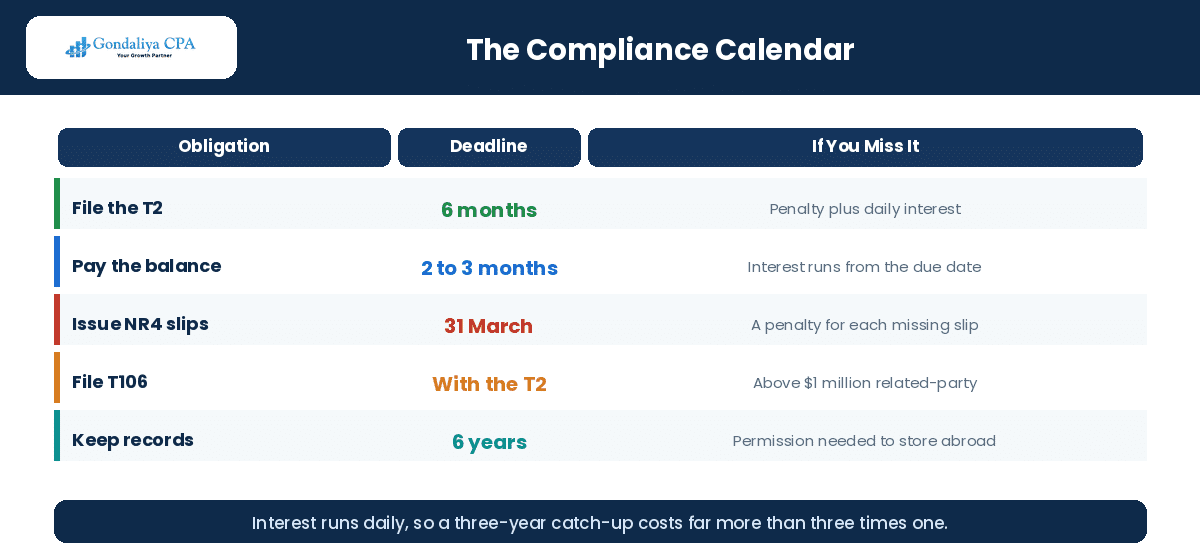
Non-resident corporations that do business or own taxable property in Canada must file a T2 Corporation Income Tax Return every year. You usually have six months after your fiscal year ends to file this return. For example, if your fiscal year ends on December 31, you need to file by June 30 next year.
You must pay any taxes owed within two months after your fiscal year ends, but some corporations get an extra month. If you miss these deadlines, penalties kick in. They start at 5% of the unpaid tax plus 1% each month up to a full year. Repeat offenders face even higher penalties.
You also have to pay attention to Part XIII withholding taxes and file NR4 slips on time. Interest piles up daily on unpaid amounts from when they’re due until you pay.
| Obligation | Deadline | Penalty If Missed | Source |
|---|---|---|---|
| T2 Return | Six months after FY ends | Late-filing penalty + interest | CRA – T2 Guide |
| Balance Due Payment | Two or three months after FY end | Interest charges | CRA – Payment Info |
| NR4 Information Slip | March 31 following FY | Penalty per missing slip | CRA – NR4 Guide |
Claiming Treaty Exemptions and Filing Supporting Schedules (e.g., Schedule 91)
If your non-resident corporation claims treaty exemptions, you still must file the right forms in Canada. Even when exempt from tax by a treaty, you generally file a treaty-based return using Schedule 91 with your T2 return.
Schedule 91 asks for details like the treaty article used, type of income exempted, and proof of eligibility. This helps the CRA see you qualify for the exemption.
Missing Schedule 91 can cause CRA auditors to deny benefits or hit you with penalties for incomplete filings. Filling it out right supports non-resident corporation compliance Canada expects and protects your treaty rights.
For instance, a U.S.-based parent claiming exemption under Article VII must include proof of permanent establishment along with Schedule 91 info.
Transfer Pricing Rules Applicable to Non-Resident Permanent Establishments
Canada’s transfer pricing rules say non-residents with permanent establishments (PEs) here must price related-party transactions as if they were dealing at arm’s length. This prevents companies from shifting profits by setting odd prices between related entities across borders.
You need to keep documentation proving these prices are fair and match section 247(3) of the Income Tax Act. While there’s no direct filing just for transfer pricing within PEs, related disclosures might appear on forms like T106 if controlled affiliates are involved.
The CRA checks cross-border deals involving PEs closely during audits. If they find problems, they can reassess taxes and charge penalties for misrepresentation or negligence.
Keeping good transfer pricing records meets Canadian corporate compliance rules for foreign-owned businesses operating through PEs in Canada.
Maintaining Canadian Corporate Records and General Index of Financial Information
The Income Tax Act requires all corporations to keep proper books and records for six years after their last use or assessment. This includes financial statements, invoices, contracts — especially those tied to activities by your Canadian branch or subsidiary.
You can store records electronically but must make them available quickly if the CRA asks. If records are kept outside Canada permanently, written permission is needed first.
Along with annual filings, companies submit a General Index of Financial Information (GIFI). This summarizes key financial data in standard codes so reviewers can check details easily.
Good record keeping supports ongoing non-resident corporation compliance Canada requires and lowers risks during audits through clear bookkeeping aligned with best practices near Toronto/Ontario from Gondaliya CPA Professional Corporation.
Avoiding Corporate Tax Penalties through Accurate and Timely Compliance
You avoid tax penalties mainly by meeting all deadlines precisely and submitting complete returns showing accurate income numbers including Part XIII withholding taxes.
Common mistakes that cause penalties include:
- Missing the six-month deadline for T2 returns
- Under-withholding Part XIII taxes leading to liability
- Failing to withhold Regulation 105 when paying foreign service fees
- Not issuing or filing NR4 slips on time reporting payments outside Canada
Using controls like automated reminders inside accounting software—QuickBooks or Xero—and working with CPAs familiar with cross-border issues helps avoid errors.
Spotting problems early and using voluntary disclosure programs might reduce penalties but don’t guarantee waivers since each case is reviewed carefully.
Accuracy plus timely action are key to smooth non-resident corporate tax filing across Ontario/Canada supported professionally at Gondaliya CPA.
Available Forms, Guides, and Technical References for Non-Resident Corporations
- T2 Corporation Income Tax Return: The main federal form used by all corporations (CRA)
- Schedule 91: For treaty-based return disclosures (CRA)
- NR4 Slip & Summary: To report payments subject to Part XIII withholding (CRA)
- T106/T1134 Returns: For reporting transactions involving controlled foreign affiliates (CRA)
- Income Tax Act Sections & Regulations: The legal rules including withholding duties in sections 115–116 (Justice Laws Website)
These forms provide official guidance needed not just to file properly but also to keep up with changes coming in January 2026 around information return thresholds, remittance timings, and GST/HST registration rules affecting foreign-owned entities.¹⁴¹⁵¹⁶
Interest is the part that surprises people. It runs daily from the original due date, so a three-year catch-up costs far more than three times a one-year one. Figures changed for privacy.
Pro Tip: Please set the reminders in QuickBooks or Xero at year-end plus five months, not six. That leaves a working month to gather documents before the T2 is actually due.
Support Services, Resources, and Contact Information for Non-Resident Corporate Tax Compliance
Support Services, Resources, and Contact Information
The Support
Access to Canadian Corporate Compliance Services for Non-Resident Businesses
Non-resident corporations with Canadian tax duties face many rules under the Income Tax Act and CRA guidelines. They need to file taxes right and meet Canadian corporate compliance standards. Services cover T2 returns, including Schedules 91 and 97, NR4 slips, GST/HST registration and filings, withholding tax remittances under Part XIII, plus info returns like T106 and T1134.
Foreign-owned Canadian corporations get help with treaty claims, managing instalment payments, avoiding penalties, keeping records per section 230 of the Act, and handling CRA audits or demands quickly. Working with CPA experts lowers the chance of missing deadlines or making errors that cause fines or interest.
- Prepare T2 returns with Schedules 91 & 97
- File NR4 slips on time
- Register for GST/HST if needed
- Handle withholding tax remittances (Part XIII)
- Submit information returns (T106/T1134)
How to Request Assistance or Consultation from Gondaliya CPA
Gondaliya CPA helps non-resident corporation compliance Canada-wide. They cover Toronto and Ontario areas too. To ask for help or a free consultation on your non-resident corporate tax filing:
- Call 647-212-9559 during business hours
- Email info@gondaliyacpa.ca with your questions
They reply fast—usually within one business day—and explain how to fix past filings or clean up bookkeeping. They review withholding obligations under Regulations 102/105/Part XIII. Also handle GST/HST registrations for foreign companies selling in Canada. They provide clear annual compliance plans.
They work with many industries:
- Real estate holding companies using cross-border treaties
- Tech startups needing simple reports
- Import/export businesses managing Regulation 105 waivers
- Medical professional corporations facing shareholder rules
Useful Government Links and CRA Resources for International Tax Filings
It’s best to check official government sites for guidance on non-resident corporation compliance in Canada:
| Resource | What It Covers | Link |
|---|---|---|
| CRA – Filing Requirements for Non‐Residents | When non-residents must file T2 returns; treaty exceptions | CRA Filing Requirements |
| Income Tax Act (ITA) Sections & Regulations | Rules taxing foreign-owned Canadian firms | Justice Laws Website |
| Excise Tax Act – GST/HST Registration Rules | GST/HST duties for non-residents active in Canada | Canada Revenue Agency – GST/HST |
| Finance Canada Treaties Database | Texts of treaties affecting withholding taxes and residency | Finance Treaty Database |
These sites explain deadlines—usually six months after fiscal year-end—penalties for late filing, forms like NR4 slips, info return limits (T106/T1134), security deposits CRA may ask foreign entities to pay, plus getting section 116 certificates when selling assets.
Contact Information for Canadian Tax Inquiries and Support
Canada Revenue Agency National Business Enquiries:
Phone: 1-800-959-5525 (toll-free in Canada)
TTY: 1‐800‐665‐0354 (for hearing impaired)
CRA International Tax Services Office:
Phone: +1‐613‐940‐8495
Mailing Address:
International Returns Unit — Sudbury Processing Centre
1050 Notre Dame Avenue
Sudbury ON P3A 5C1
If you want advice on Ontario operations or Toronto-headquartered subsidiaries needing both federal and provincial compliance, contact Gondaliya CPA at the number or email above.
Disclaimers and Notes on Scope of Information Provided
This information serves as a general overview about non-resident corporation compliance in Canada based on laws effective through December 31st 2026. It’s not legal advice and doesn’t promise results before CRA or courts. Laws can change after this date.
You should always talk with licensed professionals who know your specific facts before acting on your international corporate tax matters. Gondaliya CPA keeps all info confidential but can’t accept responsibility if you rely only on this public summary without a formal agreement.
Author Credentials and Expertise of Gondaliya CPA in Non-Resident Corporate Tax Filing
Gondaliya CPA is a licensed Ontario Chartered Professional Accountant firm focused on small-to-medium incorporated businesses across Toronto/Ontario and beyond. They specialize in tricky cross-border taxation issues involving foreign ownership that follow Canadian laws enforced by agencies like the CRA’s International Division.
Sharad Gondaliya, CPA Gondaliya leads the firm as Principal. He holds credentials from both CPA Ontario & US bodies. With over ten years’ experience, he handles Part XIII withholding taxes, treaty relief claims, multi-year catch-up filings fixing past gaps, bookkeeping cleanup following ITA Section 230 standards, plus audit defense tactics that protect compliance while cutting risk every year.
If you want help with non-resident corporation compliance in Canada, call us at 647–212–9559 or email info@gondaliyacpa.ca today. Our team covers Toronto/Ontario regions providing reliable guidance backed by more than “1300 five-star Google reviews.”
Catch-up work is more common than first-time setup. A group discovers three or four years of unfiled returns, and the practical question is sequencing, not whether tax is owed. Figures changed for privacy.
Key Stat: The T106 threshold is $1 million in transactions with related non-residents in a year. It is an information return, so the penalty applies whether or not any tax results.
Frequently Asked Questions on Non-Resident Corporation Compliance in Canada
Frequently Asked Questions on Non-Resident Corporation Compliance in Canada
FAQ
What is the T106 filing threshold for non-resident corporations?+
Non-resident corporations must file a T106 if transactions with related foreign affiliates exceed $1 million CAD annually.
How long must non-resident corporations retain Canadian tax records?+
Corporations must keep records for at least six years after the tax year to meet CRA requirements.
What penalties apply for late T2 return filing?+
CRA imposes a 5% initial penalty plus 1% per month on unpaid taxes, up to 12 months.
What are repeated failure penalties for missing filings?+
If a corporation repeatedly misses deadlines within three years, penalties increase to 10% plus 2% monthly.
How do treaty-reduced withholding rates work in Canada?+
Tax treaties lower withholding rates on dividends, interest, and royalties paid abroad; rates vary by treaty.
When do Part XIII withholding and NR4 reporting obligations apply?+
Part XIII applies when Canadian entities pay non-residents dividends or royalties; NR4 slips report these payments annually.
When are Regulation 102 and Regulation 105 withholding rules enforced?+
Regulation 102 applies to interest and dividends; Regulation 105 applies to fees for services performed in Canada by non-residents.
What best practices ensure year-round compliance?+
Maintain accurate records, file returns timely, verify treaty eligibility, and regularly review CRA updates.
Should I handle non-resident filings myself or hire a CPA?+
CPA services reduce risks of errors, optimize treaty claims, and ensure full compliance with complex Canadian rules.
What deliverables can I expect from Gondaliya CPA for compliance services?+
You receive complete tax filings, schedules, NR4 slips, GST/HST registrations, and audit support documentation.
How much does non-resident corporate compliance cost in Canada?+
Fees vary by complexity but typically start around $2,500 CAD annually depending on filing scope and advisory needs.
What are common compliance mistakes and how can I avoid them?+
Missing deadlines, improper withholding, incomplete filings, and poor recordkeeping cause issues; proactive planning prevents these.
What should I prepare before starting a compliance engagement with Gondaliya CPA?+
Gather financial statements, related-party transaction data, previous returns, and details on Canadian business activities.
Do compliance obligations differ across industries served by Gondaliya CPA?+
Yes. Real estate holders face Section 116 rules; tech startups focus on transfer pricing; each industry has unique demands.
Key Insights on Non-Resident Corporation Compliance
Key Insights on Non-Resident Corporation Compliance
Quick Reference
- T106 Filing Threshold: Report related party transactions exceeding $1 million CAD yearly.
- Records Retention Period: Keep documents accessible for six years post-assessment.
- Late Filing Penalties: Initial 5%, plus monthly increments up to one year.
- Repeated Failure Penalty: Doubled fines if failures recur within three years.
- Treaty Reduced Withholding Rates: Available under Canada’s tax treaties; rates differ per country.
- Part XIII & NR4 Reporting: Apply to passive income payments like dividends and royalties.
- Regulations 102 & 105 Withholding: Distinct rules depending on income type and service location.
- Year-Round Compliance Best Practices: Consistent bookkeeping, early filings, CRA rule monitoring.
- DIY vs CPA Services: Expert guidance minimizes risk; DIY carries higher error potential.
- Service Deliverables: Full tax return preparation with schedules and government forms included.
- Compliance Costs: Variable; request quotes tailored to your business size and complexity.
- Common Mistakes & Prevention: Early planning and professional reviews reduce errors.
- Engagement Preparation Tips: Organize financials and relevant documents before consultation.
- Industry Compliance Differences: Tailored advice based on sector-specific regulations applied by Gondaliya CPA.
For expert assistance in managing non-resident corporation compliance Canada-wide, contact Gondaliya CPA at info@gondaliyacpa.ca or call 647‑212‑9559.
The corporations that never get a penalty letter are not the ones with the cleverest structure. They are the ones that diarised the deadlines and filed on time every year. Figures changed for privacy.
Industry Spotlights: Sectors We Serve
Industry Expertise
The filing that gets missed differs by sector. Here are eleven and the usual gap.
| Industry | The Filing Most Often Missed |
|---|---|
| Real estate investors & holding companies | Section 116 certificate before disposition |
| Technology startups & SaaS | T106 on related-party transactions |
| Consulting firms | Regulation 105 withholding on services here |
| E-commerce & online retailers | GST/HST registration once selling into Canada |
| Transportation, logistics & trucking | Payroll registration for Canada-based staff |
| Construction, contractors & skilled trades | T2 treaty-based return with Schedule 91 |
| Property developers & builders | NR4 slips on rents paid abroad |
| Restaurants & food and beverage | Nil T2 returns during start-up years |
| Medical doctors & physician corporations | Residency documentation for the board |
| Dentists & dental practices | Records kept outside Canada without permission |
| Daycare, childcare & CWELCC services | GIFI schedules alongside the T2 |
- Real estate investors, landlords & holding companies: The certificate governs the closing, so it has to be applied for months before completion.
- Technology startups & SaaS: Licence fees and cost recharges to a parent cross the threshold faster than founders expect.
- Consulting Firms: Work physically performed in Canada triggers withholding at source regardless of the eventual tax position.
- E-commerce & online retailers: The registration obligation arrives well before any income tax filing question does.
- Transportation, logistics & trucking: One driver based here creates payroll accounts, deductions and remittances immediately.
- Construction, general contractors & skilled trades: Project work often qualifies for treaty relief, but only if the return claiming it is actually filed.
- Property developers & builders: Rents paid to a non-resident owner need withholding and an annual slip, which is routinely overlooked.
- Restaurants & food and beverage: Loss-making early years still require returns, and skipping them starts the penalty clock.
- Medical doctors & physician professional corporations: Where directors meet and decide has to be documented, not assumed.
- Dentists & dental practices: Keeping books permanently outside Canada requires written CRA permission first.
- Daycare, childcare & CWELCC services: The financial data has to be coded into GIFI format, which catches groups using foreign statement layouts.
The sector changes which filing gets missed. It rarely changes the cause, which is almost always that nobody owned the deadline. Figures changed for privacy.
Professional Guidance and Quick Reference
Guidance
Professional Guidance on Compliance: How Gondaliya CPA Supports Non-Resident Corporations
Non-resident compliance in Canada is mostly a calendar problem. The T2 is due six months after year-end, NR4 slips by 31 March, and Part XIII withholding at the time of payment. Miss one and penalties and daily interest start, often on returns where no tax was ever owed. Gondaliya CPA runs the whole compliance cycle for non-resident corporations on a fixed annual fee.
We handle what decides the outcome: confirming whether you carry on business here and whether a permanent establishment exists, preparing the T2 with Schedule 91 or 97 as the treaty position requires, reviewing Part XIII and Regulation 105 withholding before payments go out, filing NR4 slips and summaries, registering for GST/HST and payroll where thresholds are met, preparing T106 and T1134 where the related-party thresholds are crossed, obtaining Section 116 clearance ahead of dispositions, and bringing multi-year gaps up to date through voluntary disclosure where it fits.
Our team works from your own records and the CRA account history rather than a template, and will tell you plainly where a treaty helps and where the filing is still required. Current on filings or several years behind, you get clear advice and a fixed price before we start.
Quick Answers: Key Numbers & Concepts at a Glance
At a Glance
- T2 deadline: Six months after fiscal year-end
- Balance due: Two months, three for some corporations
- NR4 deadline: March 31 following the calendar year
- Late filing penalty: 5% plus 1% per month, to 12 months
- Repeated failure: 10% plus 2% per month
- Part XIII rate: 25%, reduced by treaty
- Treaty forms: NR301, NR302, filed before payment
- T106 threshold: $1 million in related-party transactions
- Record retention: 6 years
- Treaty return schedule: Schedule 91 with the T2
Who This Is For / Not For
Fit Check
- For: Non-resident corporations with Canadian filing obligations, whether current, newly triggered, or several years behind.
- Not For: Personal non-resident tax questions, or corporations already Canadian resident by incorporation, which follow ordinary domestic rules.
People Also Ask
Quick Answers
Do I still file if the treaty means I owe nothing?+
Yes. The treaty removes the tax, not the return. A treaty-based T2 with Schedule 91 is how the exemption is claimed in the first place.
Can multiple years of missed filings be brought up to date at once?+
Usually yes, and often through the Voluntary Disclosures Program if the CRA has not contacted you first. Sequencing the years correctly matters.
Who is liable if the Canadian payer forgets to withhold?+
The payer. Liability for the tax that should have been deducted sits with the Canadian company, along with penalties and interest.
Glossary of Key Terms
Plain-English Definitions
- Carrying on business: Activity in Canada going beyond mere presence, such as employees, offices or agents.
- Permanent establishment: A fixed place of business, or a dependent agent, creating Canadian taxing rights.
- T2 return: The corporation income tax return, due six months after year-end.
- Schedule 91: The treaty-based return disclosure filed with the T2.
- Schedule 97: The schedule reporting additional non-resident income source information.
- Part XIII withholding: Tax deducted at source on passive payments to non-residents.
- NR4 slip: The annual report of amounts paid to non-residents and tax withheld.
- Regulation 102: Withholding on employment income paid to non-residents working in Canada.
- Regulation 105: Withholding on fees for services physically performed in Canada.
- Section 116 certificate: CRA clearance required before a non-resident disposes of taxable Canadian property.
- T106: The information return reporting non-arm’s length transactions with non-residents.
- T1134: The information return reporting foreign affiliates.
- GIFI: The General Index of Financial Information, the coded financial data filed with the T2.
- Departure tax: Tax on deemed disposition when a corporation ceases to be Canadian resident.
- Central management and control: The common law test locating where a company is really run.
- Voluntary Disclosures Program: The route to correct past filings before the CRA makes contact.
Compliance Exposure Check
This quick self-check indicates where your operation most likely has room. Please answer the six questions below.
Compliance Exposure Check
Six quick questions on your filings. No fee shown.
Points to raise with us:
This is a general prompt, not tax or legal advice or a quote. Your position depends on your full facts. For a real review, please book a free consultation.
Want a checklist to work from? You can download our free non-resident compliance checklist before your consultation.
File the T2 within six months whether or not tax is owed. Claim treaty relief on Schedule 91 rather than by not filing. Review withholding before payments leave Canada, not at year-end. Issue NR4 slips by 31 March. Watch the $1 million T106 threshold. Keep six years of records, and get written permission before storing them permanently outside Canada. Start Section 116 clearance months ahead of any sale.
2026 Update — what is current: This article notes changes coming in January 2026 around information return thresholds, remittance timings and GST/HST registration rules for foreign-owned entities. The six-month T2 deadline, the 31 March NR4 deadline, the 5% plus 1% late filing penalty, the six-year retention rule and the $1 million T106 threshold are unchanged. Please note the article describes Regulation 102 as applying to interest and dividends, where it in fact covers employment income, and cites branch tax to Part XII.I, so please confirm both before relying on them.
Non-Resident Corporate Tax Filing and Canadian Corporate Compliance: A Practical Guide to Avoid Penalties and Meet Corporate Filing Requirements in Canada
File on time, exemption or not
Gondaliya CPA prepares the T2 with Schedules 91 and 97, reviews Part XIII and Regulation 105 withholding before payments, files NR4 slips and summaries, handles T106 and T1134 where thresholds are crossed, obtains Section 116 clearance ahead of a sale, and brings multi-year gaps up to date, on a fixed annual fee with a one-business-day response. Please book a free consultation.
Next Steps
Please book a free consultation with Gondaliya CPA and bring your last filed Canadian return if there is one, your Canadian business number, and a note of which years may be outstanding. Those three tell us immediately how large the gap is and whether voluntary disclosure is still open to you. Calling before the CRA does keeps that option available. You will get a fixed fee before any work begins. If our content helps, please add gondaliyacpa.ca as a preferred source on Google.
Published: August 19, 2026 · Last updated: August 19, 2026
Editorial policy: We research against CRA and CPA Ontario sources, fact-check the figures, and Sharad Gondaliya, CPA, reviews the content, which we update as the rules change.
Disclaimer: This article is educational information only and is not tax, legal, or financial advice. Figures marked illustrative are examples rather than quotes or guarantees. It reflects CRA rules current to 2026, including the six-month T2 filing deadline, the 31 March NR4 deadline, the 5% plus 1% late filing penalty, the six-year record retention requirement, and the $1 million T106 threshold. Rates, limits and expensing rules change and outcomes depend on your specific facts. Please consult a CPA Ontario member before acting.

Sharad Gondaliya is a CPA Canada & CPA USA with 15 Years+ experience of Accounting, Tax, Payroll of Corporate Small Businesses as Tax Accountant. He is a CPA Ontario member (61040184) and holds US CPA licences in Washington and Montana and is well known among corporate small businesses for tax planning, efficient tax solutions, and affordable CPA services. Sharad is the Principal (Director) of Gondaliya CPA – Affordable CPA Firm in Canada. Licenses: CPA Ontario: 61040184 | CPA USA (MT): PAC-CPAP-LIC-033176 | CPA USA (WA): 57629 | CPA Firm License: 61330051 View Full Author Bio