



Canadian Corporation for Foreign Entrepreneurs: How to Structure Your Business for Maximum Tax Efficiency
Canadian corporation for foreign entrepreneurs offers a clear path for establishing a foreign-owned Canadian corporation while managing the details of non-resident corporation Canada rules. Gondaliya CPA guides clients through choosing the right Canadian business structure to maximize compliance and growth opportunities.
Quick Summary
A company incorporated in Canada is resident here for tax purposes regardless of who owns it, so foreign owners pay Canadian tax on worldwide income. Please note that foreign control also costs you CCPC status, and with it the small business deduction and the enhanced SR&ED rate.
| Aspect | Details |
|---|---|
| The residency test | Incorporation, or central management and control. |
| The director rule | 25% resident directors federally, waivable. |
| The cost of control | No CCPC status, so no small business deduction. |
| The repatriation | 25% on dividends, reduced by treaty. |
Reading time: 43 minutes.
Table of Contents
- Residency of a Corporation under Canadian Law
- Establishing a Business in Canada for Foreign Entrepreneurs
- Taxation Framework Applicable to Foreign-Owned Canadian Corporations
- Specific Tax Rules and Reporting for Foreign Entrepreneurs
- Taxation of Canadian Resident Subsidiaries Owned by Non-Residents
- Tax Considerations for Branch Operations of Foreign Corporations
- Frequently Asked Questions (FAQ)
- Key Points on Foreign-Owned Canadian Corporation Compliance
- Industry Spotlights: Sectors We Serve
- Professional Guidance and Quick Reference
The Numbers That Matter
This article covers Canada, with Ontario and Toronto context, and reflects rules current to 2026. It assumes a foreign entrepreneur setting up or already running a Canadian business. Figures marked illustrative are examples, not quotes, and any masked engagement notes end with “Figures changed for privacy.” This is educational information only and not tax or legal advice. Corporate law, director residency and immigration rules vary by province, so please confirm the position for your chosen jurisdiction before incorporating.
Residency of a Corporation under Canadian Law
Residency of a Corporation under Canadian Law
The Residency Test
Definition and Importance of Corporate Residency
Corporate residency decides how Canada taxes a company. A non-resident corporation owned by foreign entrepreneurs needs to know its residency status. This status affects income tax and reporting duties under the Income Tax Act. Without knowing this, companies could face trouble with Canadian authorities.
Criteria for Determining Residency: Incorporation versus Central Management and Control
Canada looks at two main points to decide corporate residency: where the company was incorporated and where its central management operates. Being incorporated federally or provincially in Canada matters here. For example:
- A company incorporated in Canada but run from another country may still count as Canadian resident.
- Where directors make major decisions plays a big role in residency.
Director Residency Requirement
For federal corporations under the Canada Business Corporations Act (CBCA), at least 25% of directors must live in Canada. This rule ensures some local control over the company’s key decisions.
Deemed Resident Corporations – Reference to Subsection 250(4)
Subsection 250(4) says some corporations get treated as residents even if they aren’t incorporated here. If they mainly do business or have big operations in Canada, they become deemed resident corporations. This means they owe Canadian taxes like any other resident company.
Common Law Principles in Corporate Residency Determination
Courts use common law rules to figure out corporate residency beyond just the law text. They check things like:
- Where board meetings happen
- How decisions get made
- Daily activities of the company
These factors help courts decide if a corporation really counts as a Canadian resident for tax purposes.
Deemed Non-Resident Corporations – Reference to Subsection 250(5)
Subsection 250(5) covers corporations that are seen as non-resident even if their setup might suggest otherwise. If a company doesn’t meet certain rules about incorporation place or where management controls lie, it may be classified as deemed non-resident. Non-residents face different tax rules in Canada, so this matters a lot.
Continued Corporation and Emigrant Rules – Subsection 250(5.1)
This part deals with continued corporations—companies that keep existing legally after shareholders leave Canada or change residence. The emigrant rules affect foreign-owned Canadian corporations when owners move abroad. Knowing these helps avoid surprise taxes while staying on top of filing duties.
Residency Provisions for International Shipping Corporations – Subsection 250(6)
International shipping companies get special treatment under subsection 250(6). Even if they mostly operate overseas but are registered in Canada, they can qualify for certain tax exemptions on income earned abroad. These rules recognize their unique business model.
Treatment of Emigrant Corporations and Departure Tax Implications – Section 219.1
Section 219.1 talks about departure taxes for emigrant corporations when shareholders leave Canada with shares in domestic companies. Foreign entrepreneurs dealing with cross-border investments should understand this section well to avoid unexpected tax bills during moves outside Canada.
Founders assume that owning a Canadian company from abroad keeps them outside the Canadian system. Incorporating here settles the residency question on its own, and everything else follows from that. Figures changed for privacy.
Risk Warning: Running a foreign company from Canada can make it Canadian resident by central management and control, even though it was never incorporated here. Where the board actually meets matters.
Establishing a Business in Canada for Foreign Entrepreneurs
Establishing a Business in Canada for Foreign Entrepreneurs
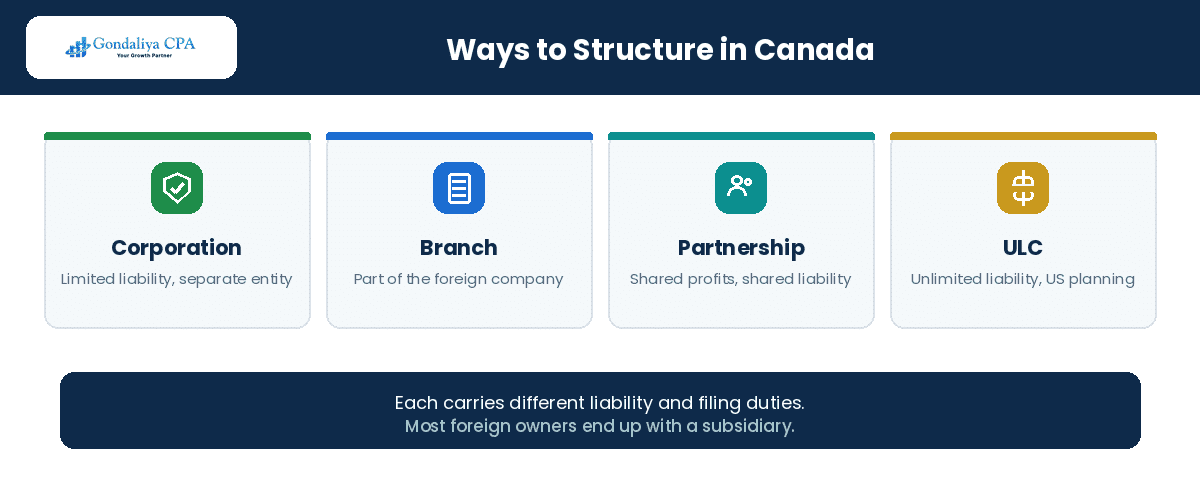
The Structures
Foreign entrepreneurs can set up a Canadian corporation with ease. Canada’s rules support non-resident ownership and offer flexible business options. A Canadian corporation for foreign entrepreneurs may be formed federally or provincially. Each comes with specific rules about directors, taxes, and compliance. Knowing the available Canadian business structure choices helps you manage taxes and regulations better.
Overview of Available Business Structures
Canada has several business structures fit for foreign-owned Canadian corporations or non-resident corporations Canada-wide. The main ones are:
- Corporations: Separate legal entities under federal (CBCA) or provincial laws. They provide limited liability and continue even if owners change.
- Sole Proprietorships: Owned by one person without a separate legal status; the owner carries all risks personally.
- Partnerships: Two or more people share profits and losses. General partnerships mean all partners are fully liable; limited partnerships restrict some liabilities.
- Branches of Foreign Corporations: These act as parts of a foreign company inside Canada but aren’t separate legal bodies.
- Unlimited Liability Companies (ULCs): Found in some provinces like Nova Scotia, these allow special tax planning but expose owners to full liability.
Each choice affects taxes, rules, registrations, and control differently. For example, a foreign-owned Canadian corporation limits owner liability but has stricter filing rules than sole proprietorships or partnerships.1
1: CRA – Types of Businesses: https://www.canada.ca/en/revenue-agency/services/tax/businesses/topics/sole-proprietorships-partnerships-corporations.html
Incorporation: Federal and Provincial Frameworks Including the Canadian Business Corporations Act (CBCA)
When foreign entrepreneurs incorporate in Canada, they pick either federal or provincial paths.
- Federal Incorporation (CBCA):
- Works across all provinces without needing extra registrations at first.
- Requires at least 25% of directors to live in Canada unless shareholders all agree otherwise2.
- Offers nationwide name protection using NUANS searches.
- Provincial Incorporation:
- Governed by each province’s law, like Ontario’s OBCA.
- Also asks for 25% resident directors3.
- Often requires extra-provincial registrations if doing business elsewhere.
Both let you form a foreign-owned Canadian corporation but differ in director rules and paperwork.
| Factor | Federal (CBCA) | Ontario (OBCA) | Best For | Limitations |
|---|---|---|---|---|
| Director Residency | 25% minimum; waivers possible | 25% minimum | Multi-province vs local focus | Waivers only federal |
| Name Protection | Nationwide with NUANS | Province-specific | Broad brand protection federally | Extra-provincial filings needed |
| Registration Complexity | One registration covers Canada | Multiple if outside province | Depends on scope of operations |
Verdict: Federal suits those operating across many provinces. Provincial is fine if business stays local.23
2: Corporations Canada – CBCA Director Requirements: https://corporationscanada.ic.gc.ca/eic/site/cd-dgc.nsf/eng/h_cs02154.html
3: Ontario Business Registry – OBCA Directors: https://www.ontario.ca/page/directors-and-officers-business-corporations-act-obca
Director Residency Requirements and Variances by Province
Most Canadian laws say at least 25% of directors must live in Canada. This applies to federal CBCA companies and many provinces like Ontario.
However, federally you can waive this if all shareholders agree,4 allowing boards with no resident directors — useful for fully non-resident corporations across Canada.
Provincial differences include:
- Quebec has no residency rule for directors.5
- British Columbia allows waivers but expects transparency.6
Ignoring these rules can cause problems with corporate actions or banking. Choosing provinces that match your board setup eases management.
4: Corporations Canada – Resident Director Waiver: https://corporationscanada.ic.gc.ca/eic/site/cd-dgc.nsf/eng/h_cs02155.html
5: Enterprise Registrar Quebec – No Residency Requirement FAQ
6: BC Corporate Registry – Directors & Officers Guide
Branch Operations of Foreign Corporations and Related Tax Considerations
A branch is a part of a foreign company operating in Canada without creating a new company here.7 It’s easier on paper than forming a subsidiary but carries full liability risks within Canada.
Tax-wise:
- Branch income pays Part I tax rates on active Canadian business income.8
- Unlike subsidiaries taxed separately as residents,9 branches report only their Canadian permanent establishment income per Income Tax Act section 115(1).
Branches also face branch tax under section 212(1), which hits repatriated earnings harder than dividends from subsidiaries who get treaty benefits.10
Deciding between branch or subsidiary depends on risk comfort, exit plans, funding needs, and how long you plan to stay in Canada’s market.
7: CRA – Carrying On Business & Permanent Establishment Guidance https://www.canada.ca/en/revenue-agency/services/tax/businesses/topics/non-residents-carrying-on-business-canada/permanent-establishment.html
8: Income Tax Act s115(1) https://laws-lois.justice.gc.ca/eng/acts/I‑3.3/page‑22.html#h‑1014890
9: CRA T2 Filing Obligations Non Residents https://www.canada.ca/en/revenue-agency/services/forms-publications/publications/t4012/t4012-nonresidents-canadian-tax-return-guide.html
10: Income Tax Act s212(1); Finance Treaty Text
Unlimited Liability Companies in Select Provinces and Their Tax Treatment
Unlimited Liability Companies (ULCs) exist mainly in Nova Scotia and some Atlantic provinces.11 They’re popular with US investors because they can choose “check-the-box” tax treatment back home while staying corporations in Canada.
Features:
- Shareholders have unlimited personal liability like partners despite the corporate label.12
- ULC profits pay normal Canadian corporate taxes but US investors might avoid double taxation via treaties.13
This mix means you should weigh the personal risk versus cross-border tax advantages when picking ULCs over regular corporations.
11: Nova Scotia Registry – ULC Information https://novascotia.ca/sns/access/business/incorp/unlimited-liability.asp
12: CPA Canada Commentary on ULC Risks https://www.cpacanada.ca/en/business-and-accounting-resources/audit-and-assurance/international-auditing-guidance/resources/unlimited-liability-companies-in-canadian-tax-law
13: Finance Department Treaties Analysis
Sole Proprietorships and Partnerships: Characteristics and Registration Obligations
Sole proprietorships are simple: one person owns everything and takes on all risks personally.14 They need little paperwork beyond registering trade names as required.15 Their income flows directly onto personal tax returns regardless of where the owner lives.16
Partnership types include:
- General Partnerships where partners share management duties and all have unlimited liability.17
- Limited Partnerships which limit some partners’ risks based on money invested but don’t create separate taxable entities; partners report shares individually.18
Registration depends on province rules, often requiring public notices.19 These setups usually don’t fit large ventures due to risk exposure. Many international investors prefer corporations for clearer protection between personal assets and business debts.20
[14] Government of Ontario — Registering Your Sole Proprietorship
[15] CRA — Reporting Self-employment Income
[16] Income Tax Act — Resident Status Rules
[17] Partnership Act Provisions Vary By Province
[18] Limited Partnership Regulations — Provincial Registries
[19] Public Notice Requirements — Various Jurisdictions
[20] Gondaliya CPA Experience With SMB Clients
Joint Ventures And Franchises: Legal And Operational Considerations
Joint ventures let two or more parties pool resources to share profits or losses. They may use contracts without forming new companies—or create special jointly owned corporations with clear agreements covering decision power,21 profit sharing,22 intellectual property rights,23 dispute resolution,24 and exit plans. Clear terms help keep things smooth especially if related-party transactions cross borders requiring transfer pricing documentation.25
Franchises grant rights to use a brand through contracts governed by provincial franchise disclosure laws. Franchisors usually prefer franchisees to run incorporated businesses for uniform accounting that simplifies royalty payments plus GST/HST collection regardless of owner nationality as long as thresholds set by CRA are met.26
- Franchise Association Guidelines
- Joint Venture Contract Essentials
- Intellectual Property Rights In JV Agreements
- Dispute Resolution Clauses Best Practices
- Transfer Pricing Documentation Rules Section T106 Threshold $500K [CRA Reference]
- GST/HST Place Of Supply Rules [CRA Publication GI50]
The director residency waiver is the detail that decides where clients incorporate. Federal allows it with unanimous shareholder agreement, and that single option often settles the jurisdiction question. Figures changed for privacy.
Pro Tip: Please check banking before you choose the province. Some institutions will not open an account for a board with no Canadian resident director, whatever the corporate statute permits.
Taxation Framework Applicable to Foreign-Owned Canadian Corporations
Taxation Framework Applicable to Foreign-Owned Canadian Corporations
The Framework
Foreign entrepreneurs who set up a Canadian corporation need to get familiar with the tax rules that apply. The kind of Canadian business structure chosen matters a lot. It affects taxes, paperwork, and what benefits the company might get.
Foreign-owned Canadian corporations and non-resident corporations in Canada face specific rules. These rules decide what income gets taxed and how to comply with the law.
General Canadian Income Tax Rules Relevant to Non-Resident Corporations
A foreign-owned Canadian corporation usually pays tax on its global income if it’s considered a resident under the Income Tax Act[1]. But if a non-resident corporation does business in Canada, it only pays tax on income earned inside Canada[2].
Dividends sent from such corporations to non-resident shareholders face Part XIII withholding tax. The default rate is 25%, but tax treaties can lower this between 5% and 15%[3][4]. To get these treaty rates, the shareholder must file an NR301 form before payments start.
There’s also a Section 116 withholding rule. When non-residents sell certain property or shares, the buyer must hold back 25% of the gross amount until taxes clear or certificates show payment[5].
Example: If a German entrepreneur runs a company in Ontario and pays dividends yearly, those dividends normally have 25% withheld. But under the Canada-Germany treaty, this drops to 15%. Filing NR301 helps apply this lower rate.
Residence and Source Rules Governing Income Tax Obligations
Canadian laws say any corporation incorporated here counts as resident for tax purposes[6]. This is true even if foreigners control it. So foreign-owned companies incorporated federally or provincially still owe taxes on worldwide income.
If a non-resident corporation has a branch or permanent establishment (PE) in Canada, it only pays tax on income from that PE’s activities inside Canada[7].
The idea of “source” means where money comes from. For example, passive earnings like interest or royalties paid by Canadians to non-residents are taxed based on their Canadian source.
Canadian-Controlled Private Corporations (CCPCs): Definitions and Tax Benefits
A CCPC is a private company controlled only by Canadians during its tax year[8]. If foreigners have control, it can’t be a CCPC.
Losing CCPC status means losing some important perks:
- No Small Business Deduction (SBD), which lowers federal corporate tax rates
- No enhanced Scientific Research & Experimental Development (SR&ED) credits at special rates
Usually, having non-resident shareholders disqualifies you from these benefits because they affect control tests done by CRA[9].
Example: Two U.S. founders start an Ontario company and own all voting shares. Despite being incorporated in Canada, this company isn’t CCPC because Canadians don’t control it. So it pays regular corporate taxes without SBD perks.
Withholding Taxes on Passive Income Paid to Non-Residents and Application of Tax Treaties
Canada charges Part XIII withholding taxes mostly on passive payments like dividends sent from residents to non-residents:
| Payment Type | Statutory Rate | Treaty Rates | Form Needed | When To Remit |
|---|---|---|---|---|
| Dividends | 25% | Usually 5%-15% | NR301 | Within one month after |
Tax treaties often reduce these rates based on agreements between countries. You must submit NR301 before getting paid to claim treaty benefits[10].
Missing or wrong filings can cause extra withholding or penalties later.
Transfer Pricing Regulations for Non-Arm’s-Length Transactions and Documentation Requirements
Canada requires related parties in cross-border deals to use market prices—called arm’s length prices—to avoid hiding income or shifting profits[11]. When transactions between related companies go over $1 million CAD annually, firms must submit documentation about pricing methods along with their T2 tax returns.
The government limits interest deductions when debt exceeds twice the equity invested—this is called thin capitalization (a debt-to-equity ratio roughly capped at 2:1). Interest expenses beyond that limit are not deductible[12].
Keeping transfer pricing records reduces audit risks. Missing deadlines can lead to penalties up to $1000 per day[13].
Overview of General Filing, Reporting Requirements, and Compliance Obligations
Foreign-owned corporations in Canada must file their T2 Corporate Income Tax Return within six months after their fiscal year ends[14]. Alongside this return, they include schedules like Schedule 91 for shareholder details important for CCPC status[15], plus Schedule 97 covering related party transactions that affect thin capitalization[16].
Other ongoing duties include:
- Registering for GST/HST if annual revenues go over $30K CAD or if selling taxable goods/services inside Canada
- Setting up payroll accounts when hiring staff within provinces
- Paying taxes and remittances on time to avoid penalties
- Filing annual reports federally or provincially through appropriate registries
Following these steps helps keep your company in good standing. This is especially true for foreign entrepreneurs operating outside big cities but doing business all over Canada[17].
References:
- https://www.canada.ca/en/revenue-agency/services/tax/businesses/topics/corporations.html
- Ibid – Carrying On Business In Canada Guidance
- ITA Part XIII – Withholding Taxes
- FinanceCanada – Model Convention Articles X & XI
- ITA Section116 Clearance Certificate Process
- ITA Section250 Residency Rule
- CRA Permanent Establishment Guidelines
- ITA Section125 Definition Of CCPCs
- CRA Interpretation Bulletin IT‐490R4 Control Tests For CCPC Status
- CRA Guide RC4228 – Applying Reduced Treaty Rates Using Form NR301
- Regulation102 Transfer Pricing Documentation Requirement Summary
- Thin Capitalization Rules Explained – CRA Technical Interpretation #2019–0520511E5
- Penalties For Late Or Missing Transfer Pricing Documentation -CRA Notice TPB–001
- T2 Return Due Date Information
- Schedule91 Shareholder Information Instructions-T2 Guide IC87–10R6
- Schedule97 Associated Parties And Thin Capitalization-T2 Guide IC87–10R6
- CRA Business Registration And Compliance Checklist
Losing CCPC status is the surprise that lands hardest. Founders budget for the corporate rate they read about, then discover the small business deduction was never available to them. Figures changed for privacy.
Key Stat: Foreign control removes CCPC status entirely. Please build your projections on the general corporate rate from the outset rather than the small business rate.
Specific Tax Rules and Reporting for Foreign Entrepreneurs
Specific Tax Rules and Reporting for Foreign Entrepreneurs
The Reporting
If you’re a foreign entrepreneur setting up a Canadian corporation, you need to know some specific tax rules. These apply to foreign-owned Canadian corporations and non-resident corporations Canada. The rules affect your choice of Canadian business structure, reporting duties, and taxes you pay.
Carrying on Business in Canada: Tests and Tax Consequences
A foreign-owned Canadian corporation is usually considered resident in Canada just by being incorporated here1. But figuring out if a non-resident corporation Canada is “carrying on business” in Canada changes its tax duties a lot. The CRA looks at many things like having physical offices, contracts signed here, or employees working in Canada2.
If a non-resident corporation carries on business without being incorporated here, it might owe Part I income tax on profits from its permanent establishment (PE) in Canada3. On the other hand, if it’s incorporated federally or provincially, it’s resident no matter where management happens.
Here’s what that means for taxes:
- File T2 corporate returns every year.
- Include Schedules 91 (non-resident info) and 97 (tax treaty claims).
- Pay instalments if needed.
- Follow withholding rules when paying non-residents4.
Choosing the right Canadian business structure can help you avoid branch taxes under section 212(1)(b) of the Income Tax Act.
We helped a US parent create an Ontario subsidiary with no permanent establishment risk outside incorporation. This setup made sure only the subsidiary got taxed.
Taxable Canadian Property: Definition, Withholding, and Reporting Obligations
Taxable Canadian property means real estate located in Canada or shares of private companies holding mostly such property or resource assets5. When a foreign owner sells taxable Canadian property—like shares—they must follow Section 116 withholding rules. The buyer must hold back up to 25% unless they get clearance from the CRA6.
Part XIII withholding tax applies mainly to dividends paid by foreign-owned Canadian corporations. The default rate is 15%, but treaties can lower this with NR301 forms7. Not deducting the right amount causes penalties.
You also need to file NR4 slips yearly. These show payments subject to Part XIII withholding and when money was sent out8.
Here’s a quick look at key obligations:
- Section 116 Clearance: Certificate to reduce or remove withholding on sales.
- Part XIII Dividend Withholding: Usually 15%, reduced by treaties.
- NR4 Slip Filing: Annual report of payments and withholdings.
Digital Services Tax (DST), Goods and Services Tax/Harmonized Sales Tax (GST/HST), and Provincial Sales Taxes (PST) Compliance
Foreign-owned Canadian corporations selling digital goods may face DST rules. These are new and mostly affect federal procurement for now. Provinces are still figuring this out9.
GST/HST registration becomes necessary if your revenue passes $30,000 CAD over four calendar quarters from taxable supplies in Canada — including digital services sent into the country10. If you don’t register, you can’t claim input tax credits, which hurts your costs.
Provincial sales taxes vary a lot:
- Ontario mixes PST into HST.
- Quebec uses QST, which needs separate filings even if you have GST registration.
Following CRA place-of-supply rules is key. They check where customers are versus where suppliers live[CRA GST/HST Info Sheet GI-131].
Example: A UK e-commerce seller registered for GST/HST after making over $30K from online sales shipped to Toronto customers starting July.
Payroll Taxes and Regulation 105 Withholding on Payments to Non-Residents
Non-resident corporations paying employees working physically inside Canada must open payroll accounts with CRA11. Employers owe CPP/QPP contributions no matter who owns them12.
Regulation 105 says employers must deduct federal withholding tax on payments like salaries made to non-residents working here13. This is different from Part XIII dividend withholding but part of overall compliance. Employers must file T4 summaries yearly14.
Ignoring these rules risks audits and fines. Directors might face personal liability if they don’t properly collect payroll deductions15.
Scientific Research and Experimental Development (SR&ED) Incentives Available to Corporations
Canadian-controlled private corporations get refundable SR&ED investment tax credits easily. Foreign-owned ones qualify too but usually only get non-refundable credits that offset payable taxes without cash refunds1617.
Your company’s structure matters here. Keeping control levels avoids losing CCPC status needed for better credit rates18.
Eligible costs include wages for R&D done mostly within provinces plus related overheads19. You should keep good records proving experimental development phases for audits20.
Tip: Plan early so your share structure fits claiming SR&ED before fiscal year-end.
Overview of the General Anti-Avoidance Rule (GAAR) and Its Application to Foreign-Owned Corporations
The GAAR stops transactions aimed mainly at dodging taxes rather than real business reasons2122. Foreign-owned Canadian corporations using complex cross-border setups should watch out for issues with intercompany loans, transfer pricing, dividend routing through low-tax places, or fake losses.23
If GAAR applies, CRA can deny treaty benefits, which may cause big unexpected bills plus interest or penalties24.
Good documentation showing real economic substance helps avoid trouble.25 Always seek advice before doing risky moves.
For questions about your Canadian corporation for foreign entrepreneurs or help with foreign-owned Canadian corporation compliance under non-resident corporation Canada laws, contact Gondaliya CPA at info@gondaliyacpa.ca or call 647-212-9559.
References
- Income Tax Act R.S.C.,1985,c.I‐3,s2(3); Canada Revenue Agency
- CRA Interpretation Bulletin IT‐440R – Carrying On Business In Canada
- Income Tax Act ss115(1),(6); Schedule 91 Instructions
- Schedule 97 – Treaty-Based Return Form Guidance – CRA Publication
- ITA Regs., definition “taxable canadian property” Sec104(13)-(14); Canada.ca
- ITA Section 116 Clearance Certificate Process – Canada Revenue Agency
- ITA Sections 212–215 — Part XIII Withholding Rates Table
- NR4 Information Returns Guide – Canada Revenue Agency
- Government Of Canada’s Digital Services Taxes Overview Report
- GST/HST Memorandum Series – Registration Requirements For Non‐Residents
Payroll is the obligation foreign owners overlook. One employee working from Canada creates registration, deduction and remittance duties regardless of where the company or its directors sit. Figures changed for privacy.
Risk Warning: Directors can be personally liable for unremitted payroll source deductions. That exposure follows the individual, not the corporation, and it does not stop at the border.
Taxation of Canadian Resident Subsidiaries Owned by Non-Residents
Taxation of Canadian Resident Subsidiaries Owned by Non-Residents
The Subsidiary
Canadian resident subsidiaries owned by non-residents follow the same tax rules as any Canadian corporation. They must understand their income tax duties, how income is treated, what expenses can be deducted, the capital cost allowance (CCA), how to repatriate funds, and rules around loans between related companies. This helps foreign entrepreneurs set up a Canadian corporation that fits their needs.
Income Tax Liability and Rate Structure for Resident Subsidiaries
A foreign-owned Canadian corporation is considered a resident under the Income Tax Act. It must file a T2 corporate tax return every year. This return reports all income earned worldwide, no matter where the shareholders live.
Here’s what you need to know:
- Foreign-owned corporations usually don’t qualify as Canadian-controlled private corporations (CCPC).
- That means they miss out on the small business deduction.
- They pay the regular corporate tax rate on active business income earned in Canada.
- Provincial taxes apply too. For example, Ontario’s combined federal-provincial rate is about 26.5%.
This setup affects how much tax gets paid and where it makes sense to incorporate within Canada.
Example: A US parent owns an Ontario subsidiary with $500,000 taxable business income. The subsidiary files a T2 return yearly and pays general federal and Ontario taxes without small business benefits due to foreign ownership.
Treatment of Business, Property Income, Capital Gains, and Losses Under the Income Tax Act
Resident subsidiaries must report all taxable income sources:
- Active business income from operations inside Canada
- Property income like rent or investment earnings
- Capital gains from selling assets
- Losses incurred during business activities
Active business profits are fully taxable at standard rates. Property incomes such as interest or royalties may face Part XIII withholding when paid across borders but are counted in net income for tax purposes.
Capital gains get taxed on 50% of their value as per section 38(1) ITA. Losses can offset profits either by applying them backward up to three years or forward up to twenty years. This helps manage profit swings.
Keep in mind: foreign-owned subsidiaries don’t get special tax breaks just because their owners live outside Canada. Their tax treatment follows normal rules for resident corporations.
Deductibility of Expenses Including Interest, Meals, Entertainment, and Loss Carry-Overs
Expenses count only if they are reasonable and directly relate to earning business revenue:
- Interest on loans is generally deductible unless thin capitalization rules kick in.
- Thin capitalization means debt from non-resident shareholders can’t exceed 1.5 times equity.
- Excess interest beyond this limit isn’t deductible.
- Meals and entertainment expenses get only 50% deduction.
- Losses not used in one year can be carried back or forward following specific rules.
Good records proving expenses support claims during CRA audits, especially for related-party cross-border costs.
Capital Cost Allowance (CCA) Mechanism for Depreciable Assets
CCA lets businesses deduct depreciation over time on eligible assets used in making income:
- Foreign-owned companies claim CCA just like domestic ones.
- Assets must be inside Canada and used in the business.
- Some assets have faster CCA options, like clean energy equipment (Class 43).
- Claiming CCA lowers taxable income now but spreads asset cost recovery over several years.
No special perks exist solely because of foreign ownership.
Repatriation of Funds: Dividends, Paid-Up Capital, and Withholding Tax Considerations
Sending money back to non-resident owners usually happens via dividends, which face Part XIII withholding tax at 25%. Many countries have treaties lowering this rate—often between 5% and 15%, like the US-Canada treaty Article X.
Returns of paid-up capital don’t trigger withholding taxes because they’re returning original investments, not profits. Still, accounting must clearly show these amounts under subsection 84(1) ITA.
Before selling shares held by non-residents, clearance certificates under Section 116 ensure any owed taxes get paid promptly.
Non-residents receive Form NR4 reporting dividends paid and taxes withheld. To claim treaty benefits reducing withholding rates, proper forms like NR301 must be filed.
Inter-Corporate Loans: Loans from Non-Resident Parents and Reverse Loans from Canadian Subsidiaries
Canadian subsidiaries often get loans from their non-resident parents or lend money back abroad. These loans affect thin capitalization rules limiting debt relative to equity contributed by connected non-residents — usually capped at a debt-to-equity ratio of 1.5:1 per Regulation Section102 ITARules.
If loans exceed this ratio:
- Interest deductions on excess debt get denied.
- This can raise taxable income unexpectedly if not planned well.
Proper loan agreements help prove terms are at arm’s length:
- Fair interest rates
- Repayment plans
- Security or guarantees
- Board approvals
Reverse loans going out require transfer pricing compliance too. These loans must reflect market terms to avoid being treated as disguised dividends triggering extra taxes.
Clear documentation supports audit defense and keeps cross-border financing clean under CRA rules.
Paid-up capital is the underused route home. Returning original investment carries no withholding, but only where the accounting recorded it properly at the time it went in. Figures changed for privacy.
Pro Tip: Please document intercompany loans as you would with a bank: written terms, a rate, a repayment schedule and a board resolution. Reconstructed agreements rarely survive a CRA review.
Tax Considerations for Branch Operations of Foreign Corporations
Tax Considerations for Branch Operations of Foreign Corporations
The Branch
If you’re a foreign entrepreneur starting a Canadian corporation or running a branch here, you’ll need to get familiar with Canadian tax rules. Non-resident corporation Canada setups and foreign-owned Canadian corporations have specific tax and compliance rules. These cover things like permanent establishment, branch tax, bookkeeping, employee taxes, GST/HST, and regulatory needs.
Definition and Identification of Permanent Establishment (PE) under Canadian Law and Tax Treaties
A permanent establishment (PE) means a fixed place where a non-resident company does business in Canada. Under the Income Tax Act and most tax treaties, having a PE means you must pay Canadian income tax on the profits linked to that PE.
PE can be an office, branch, factory, or even a construction site lasting over 12 months. For foreign-owned Canadian corporations that run branches (not subsidiaries), figuring out if you have a PE matters because it decides if you owe Part I corporate income tax.
Also, agents who can sign contracts may create what’s called a deemed PE. Some treaties exclude minor activities from being considered a PE.
Quick Example:
A U.S. tech startup has no office in Canada but hires an Ontario sales agent who can sign deals. That setup counts as a deemed PE under the Canada-U.S. treaty. The startup then must file T2 tax returns for income earned through that agent’s work.
Branch Tax and Its Implications for Non-Resident Corporations
Foreign companies running branches in Canada pay corporate income tax on income from their Canadian business plus an extra “branch tax” under section 91 of the Income Tax Act.
This branch tax is 25% on after-tax earnings sent back home as dividend-like payments from the branch to the head office. The goal is to stop companies from avoiding taxes by operating as branches instead of subsidiaries.
Besides this, Part XIII withholding taxes apply when dividends come from foreign-owned Canadian corporations incorporated here.
Key point: Choosing between setting up a corporation or operating as a branch impacts your taxes because branch taxes differ from dividend withholding rates under treaties.
| Payment Type | Statutory Rate | Typical Treaty Rate* | Form Required | When to Pay | Source |
|---|---|---|---|---|---|
| Branch Tax | 25% | Often reduced | N/A | With return filing | ITA s.91; CRA Guide |
| Dividend Withholding | 25% | 5%-15% | NR301 | Within one month | ITA ss.115/212; NR301 |
*Treaty rates vary by country; always check your treaty details.
Bookkeeping and Record-Keeping Obligations for Branch Operations
Branches run by non-resident companies must keep detailed records about their Canadian activities per subsection 230(1)(a) of the Income Tax Act. This helps show correct taxable income for the PE or branch.
You also need either:
- A registered office in Canada where your records are kept and accessible; or
- An agent authorized to receive legal documents within the jurisdiction, such as Ontario’s OBCA rules if incorporated provincially.
Failing this can lead to penalties or reassessments based on estimates instead of real data.
It’s best to separate your branch’s books from your head office’s accounts clearly. This makes transfer pricing transparent and helps with T106 filings when you have intercompany transactions.
Taxation of Non-Resident Employees Working in Canadian Branches
If employees work physically in Canada for your branch, payroll obligations kick in regardless of whether you’re a resident employer.
You must register for payroll accounts with CRA and deduct things like:
- CPP/QPP contributions
- Employment Insurance premiums
- Federal and provincial income taxes
You also need to remit these amounts on time.
For non-resident shareholders working locally:
- Salaries get standard payroll deductions.
- Dividends paid directly face Part XIII withholding unless reduced by treaty.
Passive incomes like dividends or royalties paid offshore are taxed separately under specific rules too.
Proper classification matters since CRA often audits cross-border employee setups among foreign entrepreneurs operating branches here.
Applicability of GST/HST to Branch Activities
Whether GST/HST applies depends mostly on if your business earns more than $30,000 CAD over four consecutive calendar quarters inside Canada—no matter if it’s through a subsidiary or direct branch operation.
Foreign-owned businesses making taxable supplies usually must register for GST/HST with CRA before charging it correctly.
Where the customer is located determines which provincial rate applies—for example, Ontario uses its harmonized rate set by current laws effective through 2026.
You can claim input tax credits for eligible expenses paid locally if you keep proper invoices and records matching bookkeeping standards mentioned earlier. This helps reduce net GST/HST owed each reporting period (monthly or quarterly).
Missing mandatory registration risks penalties, interest charges, and audits that hit cash flow hard—especially with new rules targeting digital services sold internationally but used in Canada since early 2026.
Regulatory and Compliance Considerations for Unlimited Liability Companies Operating in Canada
Unlimited liability companies owned outside Canada face stricter rules about director residency requirements.
Federally incorporated companies under CBCA must have at least one director who lives in Canada.25 Provinces like Ontario require most directors to live within that province unless very limited exceptions apply. These rules prevent owners abroad from dodging physical presence obligations completely, which could risk your company’s legal standing.
Failing residency requirements may lead to losing good standing status needed for banking and government contracts across regions like Toronto/Ontario where firms such as Gondaliya CPA specialize in cross-border corporate setups compliant with these laws.
Good governance includes keeping proper records like minute books with clear resolutions recorded and director attendance documented every year. This paper trail helps defend against disputes or audits questioning decisions made without valid authority—a common risk when controls are ignored initially trying to save costs but leading to big problems later on.
Licensed professionals recommend annual reviews of governance documents along with secure electronic backups meeting privacy laws. This protects client confidentiality while maintaining transparency required by regulators continuously checking adherence during random nationwide audits emphasizing record retention policies strictly enforced today.
References
Income Tax Act RSC1985 c1 (5th Supp); Corporate Residency Definitions Sections; CBCA Resident Director Rule Section28(1); OBCA Director Residency Provisions Section142(b); FinanceCanada Treaties Database www.fin.gc.ca ; CRA Guides T4002,T4012,T1134 Instructions ; NUANS Name Search System www.nuans.com ; CPAOntario Directory https://www.cpaontario.ca/protecting-the-public/directories/firm/gondaliya‐5sqvmj.
Need help setting up your foreign-owned Canadian corporation or handling cross-border taxes? Contact Gondaliya CPA. We serve clients across Toronto/Ontario with clear advice based on real experience. Reach out at info@gondaliyacpa.ca or call 647‑212‑9559 for a free consultation any time during weekdays or weekends.
Branches look cheaper on the first year of numbers. Add the branch tax and the loss of treaty-rate dividend planning and the subsidiary usually wins over any reasonable horizon. Figures changed for privacy.
Key Stat: GST/HST registration is triggered at $30,000 in taxable supplies over four consecutive quarters, whether you operate through a branch or a subsidiary.
Frequently Asked Questions (FAQ)
Frequently Asked Questions (FAQ)
FAQ
What is the Canadian director residency requirement for foreign-owned corporations?+
At least 25% of directors must reside in Canada for federal and most provincial corporations. Some provinces, like Quebec, have no such rule.
How does Part XIII withholding tax apply to dividends from Canadian corporations?+
Part XIII withholding tax applies at a 25% rate on dividends paid to non-resident shareholders unless reduced by tax treaties.
Can treaty-reduced dividend withholding rates be claimed by foreign shareholders?+
Yes, foreign shareholders can claim reduced rates by filing an NR301 certificate before dividend payments begin.
What is the Section 116 withholding tax rate on dispositions of taxable Canadian property?+
The standard withholding tax rate under Section 116 is 25% of the gross proceeds on the sale by non-residents.
When is the T2 corporate tax return deadline for foreign-owned Canadian corporations?+
The T2 return must be filed within six months after the corporation’s fiscal year-end.
What is the T106 transfer pricing threshold in Canada?+
Canadian entities must file transfer pricing documentation if related-party transactions exceed $1 million CAD annually.
What is the thin capitalization debt-to-equity ratio limit?+
Interest deductions are limited when debt from non-residents exceeds 1.5 times the company’s equity.
Is a registered office and records required to be in Canada for foreign-owned corporations?+
Yes, a registered office in Canada and accessible corporate records are mandatory for compliance.
Is an agent for service of process required for non-resident corporations operating in Canada?+
Yes, appointing a Canadian agent ensures legal documents can be served properly within jurisdiction.
How does foreign ownership impact Small Business Deduction eligibility?+
Foreign-controlled corporations generally lose eligibility for the Small Business Deduction (SBD).
Why must NR301 certificates be filed by foreign shareholders?+
Filing NR301 certifies eligibility for treaty-reduced withholding rates on dividends and other payments.
Are NR4 slips required for reporting dividend payments to non-residents?+
Yes, corporations must file NR4 slips annually to report dividends paid and taxes withheld to non-resident shareholders.
What role do shareholder agreements play in foreign-owned Canadian corporations?+
They define governance, rights, and obligations among shareholders including voting, dividends, and share transfers.
Why is paid-up capital important in corporate structuring?+
Paid-up capital represents invested funds; it affects distributions and compliance with tax rules like subsection 84(1).
Key Points on Foreign-Owned Canadian Corporation Compliance
Key Points on Foreign-Owned Canadian Corporation Compliance
Quick Reference
- Multiple share classes: Using different classes helps control voting rights and dividend preferences.
- Dividend withholding tax: Non-resident dividends usually face 25% withholding unless treaties reduce it.
- CSA vs. OBCA incorporation comparison: CBCA allows waivers of director residency; OBCA requires resident directors without waiver options.
- Extra-provincial registration requirements: Corporations operating outside their incorporation province must register extra-provincially.
- Branch tax under ITA s.91: Branches pay an additional 25% tax on repatriated earnings as branch tax.
- Transfer pricing documentation penalties: Failure to file can lead to daily fines up to $1000 or more per violation.
- Intercompany loans documentation: Proper agreements ensure arm’s length compliance and avoid recharacterization by CRA.
- Reverse loans from Canadian subsidiaries: Loans back to parents must meet transfer pricing rules to prevent hidden dividends.
- Meals and entertainment 50% deductibility: Only half of these expenses qualify as deductible business expenses under CRA rules.
- Capital Cost Allowance (CCA) mechanisms: CCA lets companies depreciate eligible assets over time to reduce taxable income.
- CRA T2 Filing Guide references: Corporations should follow CRA’s T2 guide instructions carefully to avoid errors or penalties.
For tailored advice on Canadian corporation setup or ongoing compliance, contact Gondaliya CPA at info@gondaliyacpa.ca or call 647‑212‑9559.
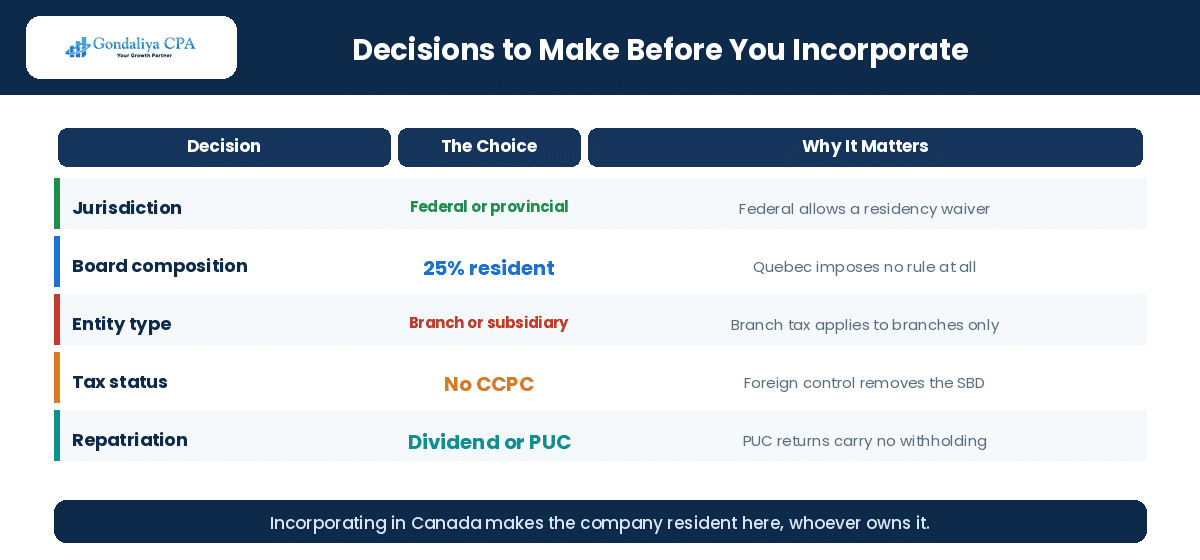
The founders who do best decide three things before incorporating: the jurisdiction, the board composition and the route for getting money home. Everything after that is administration. Figures changed for privacy.
Industry Spotlights: Sectors We Serve
Industry Expertise
What foreign owners need to settle first differs by sector. Here are eleven and the usual issue.
| Industry | The First Thing to Settle |
|---|---|
| Technology startups & SaaS | SR&ED credits become non-refundable without CCPC status |
| E-commerce & online retailers | GST/HST registration on sales into Canada |
| Real estate investors & holding companies | Taxable Canadian property and Section 116 exposure |
| Consulting firms | Whether a Canadian presence creates a permanent establishment |
| Restaurants & food and beverage | Director residency and local banking requirements |
| Construction, contractors & skilled trades | Branch versus subsidiary on a fixed-term project |
| Property developers & builders | Provincial land transfer cost on acquisitions |
| Transportation, logistics & trucking | Payroll registration for drivers based in Canada |
| Medical doctors & physician corporations | Regulator limits on who may own the shares |
| Dentists & dental practices | Professional corporation ownership restrictions |
| Daycare, childcare & CWELCC services | Provincial licensing alongside the corporate setup |
- Technology startups & SaaS: Foreign control turns refundable SR&ED credits into non-refundable ones, which changes the cash runway materially.
- E-commerce & online retailers: The registration threshold arrives well before any income tax question does.
- Real estate investors, landlords & holding companies: Shares of a property-holding company are themselves taxable Canadian property, which catches owners at exit.
- Consulting Firms: A subsidiary settles the question cleanly; working through a branch leaves it open to argument.
- Restaurants & food and beverage: Banking and supplier accounts often need a resident director even where the statute does not.
- Construction, general contractors & skilled trades: A defined project end date is one of the few cases where a branch genuinely fits.
- Property developers & builders: Land transfer cost on acquisition can exceed the first years of corporate tax entirely.
- Transportation, logistics & trucking: One driver based here creates payroll registration, deductions and remittance duties immediately.
- Medical doctors & physician professional corporations: Regulator rules on share ownership can rule out foreign investment before tax is considered.
- Dentists & dental practices: Provincial restrictions on practice ownership constrain the structure from the start.
- Daycare, childcare & CWELCC services: Licensing conditions sit alongside the corporate setup and often decide the province.
The sector changes what has to be settled first. The order does not: jurisdiction, board, structure, then how money gets home. Figures changed for privacy.
Professional Guidance and Quick Reference
Guidance
Professional Guidance on Canadian Setup: How Gondaliya CPA Supports Foreign Entrepreneurs
Setting up in Canada from abroad is straightforward once four things are decided: federal or provincial incorporation, who sits on the board, branch or subsidiary, and how profits come home. Getting these right at the start costs little. Correcting them once the company is trading costs a great deal more. Gondaliya CPA handles the whole setup on a fixed fee.
We handle what decides the outcome: choosing the jurisdiction against your board composition and where you will actually operate, arranging the director residency waiver where federal incorporation suits, comparing branch and subsidiary on total cost including branch tax and the eventual exit, registering for GST/HST and payroll where thresholds are met, filing NR301 before dividends so treaty rates apply at source, keeping related-party debt inside the thin capitalization limit, and preparing the T2 with Schedules 91 and 97.
Our team works from what you actually plan to do in Canada rather than a template, and will tell you plainly where foreign ownership costs you something and where it does not. Incorporating now or restructuring later, you get clear advice and a fixed price before we start.
Quick Answers: Key Numbers & Concepts at a Glance
At a Glance
- Director residency: 25% federally, waivable by unanimous shareholder agreement
- Quebec directors: No residency requirement
- CCPC status: Lost under foreign control
- Dividend withholding: 25%, typically 5% to 15% by treaty
- Treaty form: NR301, filed before payment
- T2 deadline: Six months after fiscal year-end
- Schedules required: Schedule 91 and Schedule 97
- GST/HST threshold: $30,000 over four quarters
- Thin capitalization: 1.5:1 debt to equity
- Meals and entertainment: 50% deductible
Who This Is For / Not For
Fit Check
- For: Foreign entrepreneurs incorporating in Canada, or already running a foreign-owned Canadian corporation and reviewing its structure.
- Not For: Immigration or work permit questions, which need a licensed immigration consultant or lawyer rather than a CPA.
People Also Ask
Quick Answers
Do I need to visit Canada to incorporate?+
No. Incorporation, banking setup and CRA registrations can generally be completed remotely, though some banks still require an in-person or video verification step.
Can I be the sole director of my Canadian corporation from abroad?+
Federally, yes, where all shareholders agree to waive the residency requirement. Provincial rules differ, and Quebec imposes no residency rule at all.
Is a subsidiary always better than a branch?+
Usually, but not always. A short-term contract with a defined end date can suit a branch, while anything with a growth or exit plan generally favours a subsidiary.
Glossary of Key Terms
Plain-English Definitions
- Corporate residency: Whether a company is Canadian resident by incorporation or by central management and control.
- CBCA: The Canada Business Corporations Act, governing federal incorporation.
- OBCA: The Ontario Business Corporations Act, governing Ontario incorporation.
- Director residency requirement: The rule that a proportion of directors must live in Canada.
- CCPC: A Canadian-controlled private corporation, which foreign control disqualifies.
- Small business deduction: The reduced federal rate available only to CCPCs.
- Permanent establishment: A fixed place of business, or a dependent agent, creating Canadian taxing rights.
- Branch tax: Additional tax on earnings repatriated from a Canadian branch.
- Part XIII withholding: Tax deducted at source on passive payments to non-residents.
- NR301: The declaration filed to claim treaty-reduced withholding rates.
- NR4 slip: The annual report of amounts paid to non-residents and tax withheld.
- Taxable Canadian property: Property whose disposition by a non-resident is taxable in Canada.
- Paid-up capital: The tax-recognised capital of a share class, returnable without withholding.
- Thin capitalization: The limit on deductible interest paid to related non-residents.
- ULC: An unlimited liability company, used mainly for US cross-border tax planning.
- GAAR: The general anti-avoidance rule, applied where a transaction lacks commercial substance.
Canadian Structure Readiness Check
This quick self-check indicates where your operation most likely has room. Please answer the six questions below.
Canadian Structure Readiness Check
Six quick questions on your Canadian setup. No fee shown.
Points to raise with us:
This is a general prompt, not tax or legal advice or a quote. Your position depends on your full facts. For a real review, please book a free consultation.
Want a checklist to work from? You can download our free foreign entrepreneur setup checklist before your consultation.
Choose the jurisdiction against your board composition, not the other way round. Arrange the residency waiver federally if no director will live here. Compare branch and subsidiary including the exit. Budget on the general corporate rate, since foreign control removes CCPC status. File NR301 before the first dividend. Keep parent loans inside 1.5:1. Register for GST/HST and payroll before the thresholds are crossed, not after.
2026 Update — what is current: This article notes new digital services rules affecting supplies used in Canada and continuing GST/HST obligations for foreign sellers. The 25% director residency requirement, the loss of CCPC status under foreign control, the 25% statutory dividend withholding rate, the six-month T2 deadline and the $30,000 GST/HST threshold are unchanged. Please note the article gives the thin capitalization ratio as both 2:1 and 1.5:1, gives the default dividend withholding rate as both 25% and 15%, and cites branch tax to both section 91 and section 212(1), so please confirm each before relying on it.
Canadian corporation for foreign entrepreneurs: Understanding foreign-owned Canadian corporations and non-resident corporation Canada business structure
Decide the structure before you incorporate
Gondaliya CPA chooses the jurisdiction with you, arranges the director residency waiver where needed, compares branch against subsidiary on total cost, registers you for GST/HST and payroll, files NR301 before dividends, checks thin capitalization on parent loans, and prepares the T2 with Schedules 91 and 97, on a fixed fee with a one-business-day response. Please book a free consultation.
Next Steps
Please book a free consultation with Gondaliya CPA and bring your ownership chart, where your directors live, and what you plan to do in Canada in the first two years. Those three settle the jurisdiction and structure questions in the first meeting. Calling before you incorporate keeps every option open. You will get a fixed fee before any work begins. If our content helps, please add gondaliyacpa.ca as a preferred source on Google.
Published: August 19, 2026 · Last updated: August 19, 2026
Editorial policy: We research against CRA and CPA Ontario sources, fact-check the figures, and Sharad Gondaliya, CPA, reviews the content, which we update as the rules change.
Disclaimer: This article is educational information only and is not tax, legal, or financial advice. Figures marked illustrative are examples rather than quotes or guarantees. It reflects CRA rules current to 2026, including the 25% federal director residency requirement, the 25% statutory dividend withholding rate, the six-month T2 filing deadline, the $30,000 GST/HST registration threshold, and the 26.5% Ontario combined corporate rate. Rates, limits and expensing rules change and outcomes depend on your specific facts. Please consult a CPA Ontario member before acting.

Sharad Gondaliya is a CPA Canada & CPA USA with 15 Years+ experience of Accounting, Tax, Payroll of Corporate Small Businesses as Tax Accountant. He is a CPA Ontario member (61040184) and holds US CPA licences in Washington and Montana and is well known among corporate small businesses for tax planning, efficient tax solutions, and affordable CPA services. Sharad is the Principal (Director) of Gondaliya CPA – Affordable CPA Firm in Canada. Licenses: CPA Ontario: 61040184 | CPA USA (MT): PAC-CPAP-LIC-033176 | CPA USA (WA): 57629 | CPA Firm License: 61330051 View Full Author Bio