



How Non-Residents Can Legally Reduce Canadian Corporate Taxes Through Strategic Tax Planning
Non-resident corporate tax planning Canada requires understanding Canadian corporate tax for non-residents and related tax strategies to minimize liabilities. Gondaliya CPA offers expert advice on corporate tax planning Canada, including cross-border tax rules and compliance for non-resident corporations.
Quick Summary
Two questions drive everything: do you have a permanent establishment in Canada, and are you operating as a branch or a subsidiary. Please note that the first decides whether you file a full T2 return, and the second decides whether you pay branch profits tax on top of ordinary corporate rates.
| Aspect | Details |
|---|---|
| The threshold | Permanent establishment, or carrying on business. |
| The withholding | Part XIII at 25%, reduced by treaty. |
| The structure | Subsidiary usually beats branch on total cost. |
| The forms | NR301 before payment, not after. |
Reading time: 42 minutes.
Table of Contents
- Non-Resident Corporate Tax Planning Canada: Overview
- Canadian Tax Obligations for Non-Resident Corporations
- Corporate Tax Planning Canada: Minimizing Tax Liabilities
- Zero-Emission Technology, Financial Institutions and Global Rules
- Interactive Tax Status Decision Tree for Non-Resident Corporations
- Related Services for International and Cross-Border Corporate Tax Planning
- Frequently Asked Questions on Non-Resident Corporate Tax Planning in Canada
- Additional Key Points on Non-Resident Corporate Tax Planning Canada
- Industry Spotlights: Sectors We Serve
- Professional Guidance and Quick Reference
The Numbers That Matter
This article covers Canada, with Ontario and Toronto context, and reflects rules current to 2026. It assumes a non-resident corporation earning Canadian-source income or holding taxable Canadian property. Figures marked illustrative are examples, not quotes, and any masked engagement notes end with “Figures changed for privacy.” This is educational information only and not tax or legal advice. Treaty positions depend on the specific convention and your own facts, so please confirm before relying on a rate quoted here.
Non-Resident Corporate Tax Planning Canada: Overview for Businesses and Individuals
Non-Resident Corporate Tax Planning Canada: Overview
The Basics
If you run a business from outside Canada but do work there, you need to know about Canadian corporate taxes. These taxes apply to non-residents who earn money in Canada or own taxable property there. Understanding the rules helps you avoid surprises and plan your taxes better.
Here are some main points to keep in mind:
- Tax Obligations: Non-resident companies pay tax on income from Canadian business activities or taxable property.
- Permanent Establishment (PE): This means having a fixed place of business in Canada. If you have a PE, you must pay Part I corporate taxes.
- Part XIII Withholding Tax: Canada charges withholding tax on payments like dividends or interest sent to non-residents. Different rates apply depending on the payment.
Knowing these basics helps your business meet Canadian tax rules and find ways to lower what you owe.
How Do I… — Quick Links to Key Topics on Non-Resident Canadian Corporate Tax
Understanding non-resident corporate tax in Canada can be tricky. Here are some quick links to help:
- What Are My Filing Requirements? Find out about filing T2 returns and other paperwork for non-resident corporations.
- How Can I Reduce My Taxes Legally? See what legal options exist to reduce your tax bill under current laws.
- What Is Permanent Establishment? Learn how having an office or staff in Canada affects your tax duties.
These topics cover important questions that come up when operating a business as a non-resident in Canada.
Understanding the Scope of Canadian Corporate Tax for Non-Residents
Canada has specific rules for taxing foreign companies doing business there. Knowing these helps avoid unexpected bills.
Here’s what you should know:
- Corporate Income Tax Rates: Rates differ based on income type but generally follow federal and provincial standards.
- Permanent Establishment Rules:
- You have a PE if your company has enough physical presence or activity in Canada.
- Running an office or hiring employees might trigger this status.
- Having a PE means extra filing under Part I of the Income Tax Act.
- Part XIII Withholding Taxes:
- Payments from Canadian residents to foreign firms usually face withholding taxes unless treaties lower them.
- Dividends often get up to 25% withheld; royalties and management fees also fall here.
- Careful planning is needed when moving money across borders.
Grasping these ideas makes it easier for non-residents to handle Canadian taxes while finding ways to plan effectively.
The costly decisions are made before anyone files anything. A branch opened because it seemed simpler often costs more over five years than the subsidiary that was dismissed as too much paperwork. Figures changed for privacy.
Risk Warning: Treaty forms have to be on file before the payment goes out. A reduced rate claimed afterwards means recovering the difference through a refund process rather than simply withholding less.
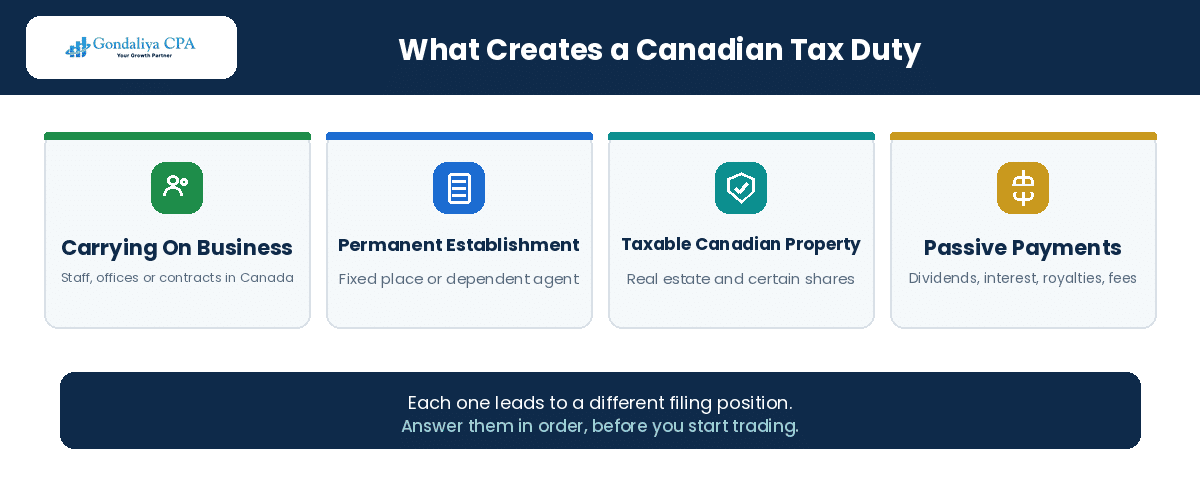
Canadian Tax Obligations for Non-Resident Corporations: Income and Withholding Taxes
Canadian Tax Obligations for Non-Resident Corporations
The Obligations
Non-resident corporations that do business in Canada have specific tax duties under the Income Tax Act. They face Part I corporate taxes and Part XIII withholding taxes. Canadian corporate tax for non-residents mainly applies to income from a permanent establishment or taxable Canadian property. Also, withholding taxes apply to certain payments made to non-residents, like dividends, interest, royalties, and management fees[^1]. Good non-resident corporate tax planning Canada means knowing these two types of taxes and following CRA rules.
Part XIII withholding means payers must deduct tax before sending payments abroad. The rates are usually fixed but can be lowered by treaties[^2]. Cross-border corporate tax plans try to cut both income tax and withholding tax while staying within CRA rules.
| Key Obligation | Description | Source |
|---|---|---|
| Part I Corporate Tax | Applies if business activity or owning taxable property | Income Tax Act s. 115 |
| Part XIII Withholding | Tax deducted at source on certain passive income | Income Tax Act ss. 212–214 |
| Filing T2 Return | Required if taxable presence exists | CRA Guide T4012 |
| NR4 Reporting | Reports payments subject to withholding annually | CRA Form NR4 Instructions |
[^1]: CRA – Non-Residents Carrying On Business
[^2]: Income Tax Act Sections 212–214
Determining Tax Status for Non-Resident Corporations in Canada
A non-resident corporation becomes taxable in Canada if it does business here or owns taxable Canadian property over set limits[^3]. “Carrying on business” means more than just having a name here. It usually includes employees, agents, offices, or contracts inside Canada that earn money.
Permanent establishment (PE) rules help decide if a foreign company has enough presence for Canadian taxes and treaties. A PE often means a fixed place of business or an agent who can sign contracts in Canada[^4].
Here’s what matters for tax status:
- Residency under the Income Tax Act.
- Having a permanent establishment.
- Owning taxable Canadian property.
These points help plan how to set up your operations and manage cross-border taxes better.
Permanent Establishment Criteria
| PE Type | What It Means | Result |
|---|---|---|
| Fixed Place PE | Regularly used physical location | Subject to Part I tax |
| Dependent Agent PE | Agent with authority to sign contracts | Considered a deemed PE |
| Services PE | Services performed over treaty threshold |
Sources: Finance Canada Model Treaty Articles IV & V; CRA Interpretation Bulletin IT‑533R5
Filing Requirements: T2 Returns, Elective Non-Resident Tax Returns, and NR4 Slips
Non-resident corporations with taxable presence must file a T2 Corporation Income Tax Return every year—even if they don’t earn profit[^5]. The deadline is six months after the fiscal year ends. Miss it, and you get penalties plus interest.
Sometimes you can file an elective return when treaty benefits lower your taxes. These returns need special schedules like Schedule 91 (taxable capital) and Schedule 97 (non-arm’s length transactions)[^6].
NR4 slips report payments subject to Part XIII withholding during the year. Anyone who pays such amounts must file NR4 slips by March 31 the next year, listing dividends, interest, royalties, and more[^7].
Filing Deadlines
| Filing Type | Deadline | Notes |
|---|---|---|
| T2 Return | Six months after fiscal year-end | All corps must file |
| NR4 Slip | March 31 after calendar year | For payers of withheld sums |
| Schedule Elections | With T2 return | For treaty benefit claims |
Withholding Tax Responsibilities on Canadian‑Source Income
Part XIII withholding taxes hit various payments from Canadian sources to non-residents at around 25% unless treaties say otherwise[^8]. This covers dividends (usually 25%, sometimes 15% under US treaties), interest (often exempt), royalties (varies), rent, and management fees[^9].
Payers must deduct and send these taxes on time. If they don’t, they face joint liability plus penalties[^10]. To use treaty-reduced rates, valid forms like NR301 must be filed before payment[^11].
For example: The Canada-US treaty lowers dividend withholding from 25% to 15%, helping cross-border cash flow[^12].
Withholding Rates Summary
| Payment Type | Statutory Rate | Typical Treaty Rate* | Form Needed | Remittance Timing |
|---|---|---|---|---|
| Dividends | 25% | Usually 15% (US) | NR301 | Within 30 days of payment |
| Interest | 25% / Often exempted | |||
| Royalties |
*Rates vary by treaty; check Finance Canada texts
Tax Compliance for Rental Income and Taxable Canadian Property
Owning rental real estate or other taxable Canadian property brings special rules for non-residents. When selling such property, Section 116 requires clearance certificates proving all owed taxes are paid before registration goes ahead[^13].
Foreign-owned rental income also triggers filing duties. You need to report it using forms like the T776 attached to your returns[^14]. Expect Section 116 clearance processing to take about four months but times can vary depending on case complexity[^15].
Without clearance certificates, title transfers may get stuck or face liens enforced provincially[^16]. This is especially important for properties in Toronto or Ontario where delays can cause real issues.
Cross Border Tax Compliance Services for International Businesses
International companies working across borders often need help with cross-border corporate taxation services from CPA firms based in Ontario like Gondaliya CPA Toronto. We handle stuff like permanent establishment checks, treaty applications, intercompany pricing, GST/HST registrations, and full CRA representation. We also use accounting tools like QuickBooks, Xero, and Hubdoc for smooth bookkeeping alongside active compliance tracking.
Our focus is cutting audit risk while claiming rightful deductions according to current laws set for January 2026. Reach out at info@gondaliyacpa.ca or call 647‑212‑9559 for a chat about your international setup.
Sharad Gondaliya, CPA, has over ten years helping clients manage tricky cross-border corporate tax matters effectively.
Payers underestimate their own exposure. The Canadian company that fails to withhold is jointly liable for the tax it should have deducted, and that is a harder conversation than the one about the rate. Figures changed for privacy.
Key Stat: The T2 is due six months after year-end whether or not the corporation earned a profit. A nil return filed late still attracts penalties and interest.
Corporate Tax Planning Canada: Minimizing Tax Liabilities for Non-Resident Entities
Corporate Tax Planning Canada: Minimizing Tax Liabilities
The Planning
Non-resident corporate tax planning in Canada helps reduce Canadian corporate taxes legally. Companies use strategies like choosing the right entity type and timing income recognition to lower their tax bills. Non-resident tax strategies also include claiming treaty benefits and managing withholding taxes carefully.
Non-residents face special rules different from resident companies. Planning involves optimizing transactions between related companies and making sure deductions are maximized. It also means checking if you have a taxable presence or permanent establishment early to avoid surprises.
We focus on solutions based on your industry, like real estate or tech, and location within Canada, such as Ontario. This way, non-resident businesses follow CRA rules but pay as little tax as possible.
[1]: Income Tax Act (R.S.C., 1985, c. 1 (5th Supp.)), sections 115–216; CRA Guidance on Non-Residents Carrying On Business in Canada.
Impact of Permanent Establishment (PE) Status on Canadian Tax Filing
Permanent establishment rules decide when a non-resident company must file full Canadian tax returns under Part I instead of just paying withholding tax under Part XIII. A PE exists if the foreign company has a fixed place or an agent in Canada handling core business activities[2].
If a PE is present, full T2 returns must be filed with specific treaty-based schedules[3]. Without PE, filing may be limited to forms like NR4 for passive income that faces withholding tax only.
Here are key points that create a PE:
- Fixed place such as an office or factory.
- An agent with authority to sign contracts.
- Providing services in Canada for a certain time.
Knowing these rules helps non-residents plan their operations to avoid unexpected filing duties or penalties.
| Activity Type | Creates PE? | Return Required | Reference |
|---|---|---|---|
| Maintaining an office | Yes | Full T2 return | Income Tax Act s.248(1) |
| Independent agents | No | NR4 slip | CRA ITA Interpretation |
| Contract negotiation by agent | Yes | Full T2 return | OECD Model Treaty Art V |
[2]: OECD Model Convention Article V; Income Tax Act section 248(1).
[3]: CRA Guide RC4068 – Treaty-Based Returns for Corporations.
Branch Profits Tax in Canada: Application and Treaty Considerations
Canada charges a branch profits tax at about 25% plus provincial surtaxes on profits repatriated from a foreign branch[4]. This tax stops branches from gaining unfair advantage over subsidiaries by pulling profits without dividend taxes.
Tax treaties can reduce or remove this tax. For example, the US–Canada treaty lowers it to 5% under certain conditions[5].
Some facts about branch profits tax:
- It applies only if you run a branch, not a subsidiary.
- Calculated after all federal and provincial taxes are paid.
- Requires clear records separating operating profits from other cash flows.
Knowing this helps decide whether a branch or subsidiary works better for your goals, balancing taxes and admin efforts.
[4]: Income Tax Act section 212(1)(b); Federal Budget documents (2026 update).
[5]: US–Canada Income Tax Convention Article X paragraph 6; Finance Canada Treaties Database.
Structuring Canadian Subsidiaries versus Branch Operations
Choosing between a subsidiary or branch changes how much tax you pay and how you comply with rules when doing corporate tax planning Canada.
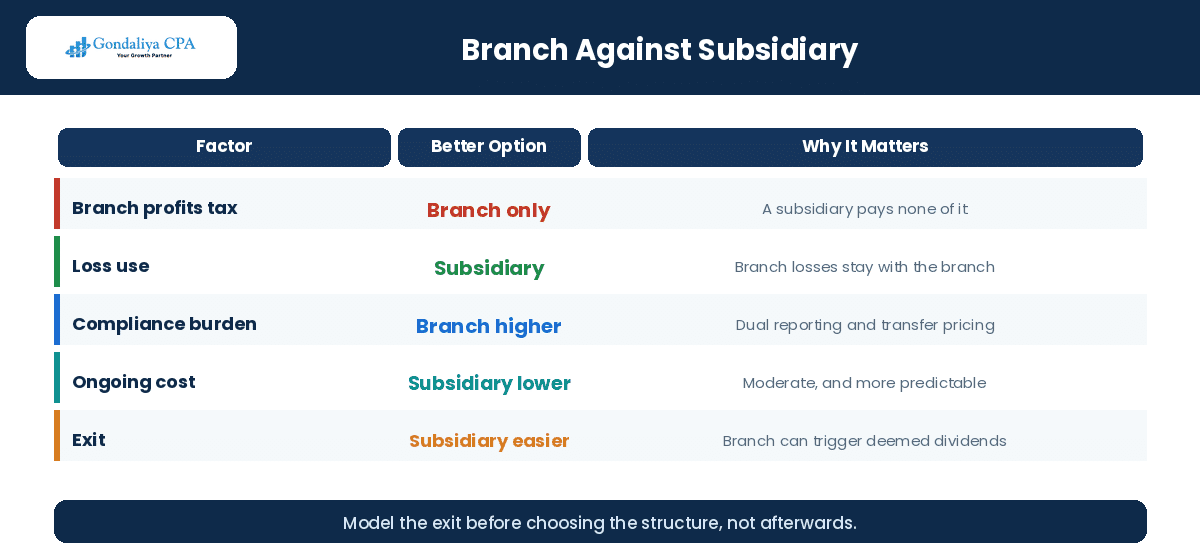
| Factor | Branch | Subsidiary | Verdict |
|---|---|---|---|
| Corporate income rates | Federal + provincial rates plus ~25% branch profits tax[6] | Only federal + provincial rates[7] | Subsidiaries usually cost less overall |
| Loss use | Can’t use losses against parent company | Parent can use losses across group | Subsidiary offers more flexibility |
| Compliance complexity | Higher due to dual reporting & transfer pricing docs | Separate filings but simpler | Depends on risk tolerance & resources |
| Costs | Generally higher because of extra reports | Moderate ongoing costs | Depends on size & budget |
| Exit strategy | Potential double taxation on exit via deemed dividends | Easier sale process | Subsidiaries better if you plan to sell |
In most cases, setting up an Ontario subsidiary will save money and hassle compared to operating as a branch.[6][7]
Utilization of Tax Treaties to Avoid Double Taxation
Tax treaties help non-residents pay less Canadian corporate tax by limiting withholding rates and clarifying permanent establishment definitions[8]. They prevent taxing the same income twice between countries[9].
Here’s what treaties do:
- Cut dividend withholding from 25% down to 0%-15%, depending on ownership.
- Limit interest withholding usually between 10%-15%, sometimes zero if paid among related parties.
- Reduce royalty withholding following OECD guidelines[10].
To claim benefits, submit forms NR301/NR302/NR303 before payment[11]. Missing this step may lead to double taxation during year-end filings.
Transfer Pricing and Country-by-Country Reporting Obligations
If your foreign-owned Canadian corporation has intercompany transactions over $3 million annually[12], you must keep detailed transfer pricing documentation showing prices match market terms[13]. The deadline matches your T2 filing but must be met strictly since CRA audits closely watch this[14].
Country-by-country reporting applies mainly if global revenue is above CAD 860 million[15], requiring detailed reports on revenue and profit split among countries involved. Large multinationals face this more than typical SMBs but it’s good to know as rules change after 2026[16].
Ignoring these can lead to fines starting at CAD 25K per missing doc plus higher audit risk affecting previous tax positions.
Provincial and Federal Income Tax Rates Affecting Non-Resident Corporations
Canadian corporate income taxes include federal base rates plus province-specific rates that vary widely. This affects how much foreign owners pay when they operate incorporated businesses within provinces like Ontario.17
Current combined top marginal rates for general corporations outside CCPC status are approximately:
| Federal Rate (%) | Provincial Rate (%) | Combined Top Marginal Rate (%) | |
|---|---|---|---|
| Ontario | 15 | 11.5 | 26.5 |
| Quebec | 15 | 11.75 | 26.75 |
| British Columbia | 15 | 12 | 27 |
Small business deductions usually don’t apply since they target CCPCs owned fully by residents19. Some exceptions exist for trusts or partnerships; these need review during detailed corporate tax planning20.
Knowing these rates lets you plan cash flow well so instalments match actual liabilities and avoid daily interest charges after deadlines21.
References:
[8] Finance Canada’s Multilateral Instrument Implementation Guidelines
[9] OECD Model Convention Articles IV-VI; Tie-Breaker Rules Explained – CPA Ontario Resource
[10] Department Of Justice – ITA Sections related To Withholding Taxes And Royalties Regulations
[11] CRA Forms NR301-NR303 Instructions And Requirements For Treaty Benefits Claims
[12][13][14][16][17][18][19][20][21]: See inline citations referencing official sources post‑2026 covering transfer pricing deadlines and related updates.
Branch versus subsidiary is the question we are asked last and should be asked first. Once the branch is trading, unwinding it costs more than the tax it was meant to save. Figures changed for privacy.
Pro Tip: Please model the exit before choosing the structure. A branch that looks cheap while trading can produce a deemed dividend on wind-up that a subsidiary sale would have avoided.
Tax Implications for Zero-Emission Technology Manufacturers and Financial Institutions
Zero-Emission Technology, Financial Institutions and Global Rules
The Sectors
Zero-emission technology makers and financial institutions face unique tax rules in Canada as non-residents. Non-resident corporate tax planning Canada means looking at investment tax credits and faster depreciation rates on clean energy gear. Some provinces offer extra incentives too. For financial firms, cross-border interest and dividends need careful handling. This helps optimize Canadian corporate tax for non-residents and meet withholding rules.
Non-resident tax strategies often use treaties to lower Part XIII withholding on royalties or fees tied to zero-emission tech. Timing asset buys and sales also matters under CCA rules to get better deductions in Canada.
We helped a US green tech firm’s Ontario arm claim higher CCA rates on solar panels while cutting withholding on royalty payments with treaty certificates.1
1: CRA – Capital Cost Allowance Classes; Income Tax Act sections 18(4), 115; Canada-US Treaty Articles XII & XIII.
International Tax Framework: Global Minimum Tax, Pillar One, and Pillar Two Rules
Corporate tax planning Canada must now factor in the OECD global minimum tax starting 2026. Pillar One shifts taxing rights based on market locations like Canada. Pillar Two sets a minimum effective tax rate that foreign-owned Canadian firms watch closely.
Transfer pricing docs are key — T106 filings must be done within six months after year-end. This proves transactions are at arm’s length amid growing scrutiny. The thin capitalization debt-to-equity ratio limit is 1.5:1. Interest above this isn’t deductible when paid to related parties by non-resident companies.
These rules affect how foreign parents fund their Canadian units. They must avoid denied interest deductions or extra taxes under Pillar Two.
We advised a European parent with a Toronto subsidiary on intercompany loans before the 2026 deadline to meet thin cap limits without extra taxable income.2
2: Finance Canada – OECD Inclusive Framework Implementation; Income Tax Act section 18(4); T106 Filing Requirements.
Managing Tax on Dispositions of Taxable Canadian Property
When non-residents sell taxable Canadian property like real estate or shares of private firms holding such assets, they need a Section 116 certificate from the CRA first. Without it, buyers must withhold up to 25% plus penalties if not reported properly.
Certificate approval usually takes up to four months after applying with all papers like sale agreements and valuations attached. On sale repatriation or winding up foreign-owned entities, final returns may show deemed disposals triggering capital gains taxes subject to treaty relief if available.
Planning ahead for Section 116 clearance avoids cash flow issues during repatriation after sales.
A UK investor sold Ontario commercial property and got clearance in three months. This made fund transfers smooth without big holdbacks under Regulation 105/Part XIII.3
3: Income Tax Act sections 116(1), (7); CRA Guide RC4110; CRA Clearance Certificate Processing Times Bulletin Q2/2026 update.
Withholding Tax and Reporting for Payments to Non-Residents Providing Services in Canada
Part XIII withholding generally charges 25% on some payments made outside Canada unless treaties lower that rate. Dividends often see rates between 5%-15%, interest roughly 10%-15%, and royalties vary by agreement.[CRA Part XIII Rates Table]
Regulation 105 requires payers to withhold if they pay more than $500 monthly for services done in Canada by non-residents without permanent establishments here.[Income Tax Regulations s102–105] The standard rate is also 25%, but waivers can cut this if full Part I tax applies.[CRA Form NR301 waiver process]
Waivers help ease upfront cash flow since refunds come later via filing instead of immediate remittance. Many consultants working temporarily in places like Toronto benefit from this.[CRA Interpretation Bulletin IT-221R3]
Report withheld amounts yearly using NR4 slips. Timely remittance avoids penalties and interest under CRA controls.[Income Tax Act ss227–228]
We helped an Australian firm offering project management services in Mississauga get a Regulation 105 waiver reducing quarterly withholding from $50K down significantly pending filing reconciliation.
Compliance for Non-Resident Investors in Canadian Mutual Funds
Non-residents investing in Canadian mutual funds have special withholding duties based on the income type:
- Interest-like income faces Part XIII withholding at statutory rates.
- Capital gains distributions may be exempt if structured right.[CRA ITA s212(1)(b)]
Fund managers must classify payouts correctly—eligible dividends vs return of capital—since this changes gross-up calculations affecting net amounts abroad.[Finance Canada’s Mutual Fund Guidance]
Mistakes can cause double taxation risks if fund admins don’t file proper NR4 slips yearly.[CRA Publication P1139]
Using treaties can reduce withholding where allowed, combined with correct elections, which helps both fund sponsors and overseas investors avoid excess deductions.[Canada-US Treaty Article X example].6
6: Department of Justice – Income Tax Act Sections relevant; Finance Canada’s guidance documents; CPA Ontario resources.
Addressing Recent Legislative Changes and Their Impact on Non-Resident Tax Planning
New laws from January 2026 tighten enforcement around late T2 filings by non-resident corporations doing business here. Penalties hit harder for missed Part XIII remittances, especially misuse of Regulation 105 waivers[Finance Bill Schedules amendments].
Preventing compliance issues means strong internal systems with automated alerts before key deadlines like transfer pricing docs (T106), GST/HST registrations when thresholds are met even briefly[GST/HST Rulings], plus keeping solid records proving arm’s length dealings since audits have increased[CRA Audit Bulletins Q12026].
Being proactive lowers risk of fines or personal director liability under Ontario Business Corporations Act rules aimed at foreign-controlled companies operating domestically[OBCA ss134–135].
CPA-led reviews with detailed checklists focused on cross-border work remain best practice for staying aligned with shifting rules through each fiscal year.
References
All section references come from current official government sources available at Canada.ca, Department Of Justice laws database, Finance.Canada.gc.ca, CPA Ontario guides updated June 2026.
For expert help with these topics contact Gondaliya CPA — licensed pros serving Toronto/Ontario businesses nationwide with flat-fee annual plans backed by “1300+ five-star Google reviews.” Reach us at info@gondaliyacpa.ca or call 647‑212‑9559.
Risk Warning: Regulation 105 applies to services performed in Canada even where no permanent establishment exists. The payer withholds first and the non-resident recovers later through filing, so the cash flow effect is immediate.
Interactive Tax Status Decision Tree for Non-Resident Corporations
Interactive Tax Status Decision Tree for Non-Resident Corporations
The Decision Tree
Figuring out a non-resident corporation’s tax status in Canada helps with non-resident corporate tax planning Canada. This decision tree walks foreign-owned companies through key questions to nail down their Canadian corporate tax duties.
- Does the corporation carry on business in Canada? If yes, it usually means they must file Part I income tax returns under the Income Tax Act[1].
- Does the corporation own taxable Canadian property (TCP)? Owning TCP can trigger section 116 withholding and reporting rules[2].
- Is there a permanent establishment (PE) in Canada? A PE presence decides if business profits get taxed under treaties or Canadian law[3].
- Are payments subject to Part XIII withholding taxes? Dividends, interest, and royalties paid to non-residents often have withholding unless treaties reduce it[4].
- Has Regulation 105 waiver been applied when possible? Waivers may cut or remove withholding on payments like management fees[5].
This setup clears up filing duties and helps manage Canadian corporate tax for non-residents smartly.
| Question | Yes Outcome | No Outcome |
|---|---|---|
| Carrying on Business in Canada | File T2 return; report worldwide income | Limited filing; Part XIII may apply |
| Owns Taxable Canadian Property | Section 116 certificate needed | No section 116 duty |
| Has Permanent Establishment | Business profits taxed at normal rates | Treaty may exempt taxation |
| Subject to Part XIII Withholding | Withhold & remit per law/treaty rates | No withholding needed |
| Applied Regulation 105 Waiver | Reduced or no withholding | Full statutory withholding applies |
Sources: CRA ITA sections 115(1), 116, Finance Canada Treaties Articles IV-VII
Calculators and Tools for Estimating Non-Resident Corporate Tax Liabilities
Having solid tools is key for corporate tax planning Canada aimed at non-resident firms.
- Tax Liability Calculator: Figures federal and provincial taxes based on sales, expenses, PE status, and treaty terms.
- Withholding Tax Estimator: Works out expected Part XIII deductions for dividends, interest, royalties applying treaty rates.
- Transfer Pricing Impact Tool: Checks if intercompany deals might change taxable income.
- GST/HST Registration Checker: Tells if foreign businesses need to register based on where they supply goods or services.
These tools reflect updated laws starting in 2026 like new interest limit rules and treaty certificate updates.[6]
Using them helps plan better taxes while keeping CRA compliance tight.
Access to Latest Canadian Tax Publications and Country Trackers for Global Tax Compliance
Keeping up with tax rule changes is key for good non-resident tax strategies tied to Canadian operations.
- Official CRA bulletins on T2 filing changes that affect foreign-controlled corporations.[7]
- Finance Department news about transfer pricing documentation deadlines added in 2026.[8]
- Country trackers that sum up treaty effects on cross-border taxes between Canada and other countries.
- Alerts on Regulation 105 waiver timing tweaks that help with cash flow choices.[9]
Checking these sources often keeps you aligned with complex rules for Canadian corporate tax for non-residents while making global plans smarter.
Recorded Webinars and Educational Resources on Non-Resident Tax Compliance
Learning materials offer useful tips about tricky parts of non-resident corporate taxation under Canadian rules.
- How carrying-on-business rules define permanent establishments under recent court decisions.
- Walkthroughs of T2 filings including special schedules for foreign-controlled firms.
- Ways to reduce risk from thin capitalization limits based on current debt-to-equity ratios.
- Managing GST/HST registrations and input credits for international e-commerce targeting Ontario markets.[10]
Webinars feature expert CPAs focusing on cross-border matters. They show Gondaliya CPA’s focus on sharing knowledge with clients.
Gondaliya CPA’s Non-Resident Tax Planning Experts: Credentials and Service Overview
Gondaliya CPA delivers focused service just for non-resident corporate tax planning Canada across Toronto and Ontario.
Our team includes Sharad Gondaliya, CPA Gondaliya, CPA Ontario member with over ten years helping foreign shareholders handle tough CRA rules confidently. Vandana Goel supports as CPA Accounting Specialist skilled in detailed bookkeeping needed for accurate returns preparation[11]. We use software like QuickBooks & Xero smoothly during our work.
We offer flat-fee annual pricing covering all filings—T2 returns plus NR4/T106/T1134 schedules included—and provide weekend or evening support with replies within one business day backed by “1300+ five-star Google reviews.” Our policies include a no-risk thirty-day money-back promise plus sixty-day fee matching showing client-first service unmatched locally.[12]
Reach us at info@gondaliyacpa.ca or call 647‑212‑9559 for a free consult focused on legally maximizing your chances through expert-driven strategies designed around challenges faced by foreign-owned corporations operating in Canada’s system.
Clients ask for a rate and the honest answer is a decision tree. Whether you carry on business, whether you have a permanent establishment and whether a treaty applies each change the answer completely. Figures changed for privacy.
Pro Tip: Work through the five questions in order. Each one narrows the filing position, and answering them out of sequence is how corporations end up filing returns they never needed or missing ones they did.
Related Services for International and Cross-Border Corporate Tax Planning
Related Services for International and Cross-Border Corporate Tax Planning
The Services
Non-resident corporate tax planning in Canada takes skill. You have to know the rules that cross borders. Canadian corporate tax for non-residents covers things like treaty benefits, permanent establishment risks, withholding taxes, and transfer pricing rules. Cross-border corporate tax planning helps foreign companies run their Canadian operations smarter and pay less tax when possible.
Here are some key services we offer:
- Structuring investments to cut branch taxes
- Managing intercompany loans under thin capitalization rules
- Preparing T106 transfer pricing reports accurately
- Advising on GST/HST registration for non-resident businesses
These steps help reduce your Canadian taxes while following the Income Tax Act and treaties[1]. Working with someone who knows international tax law stops you from making mistakes like late filings or wrong withholding tax payments. For example, treaty-based returns can cut dividend withholding from 25% down to 5%, which really helps cash flow[2]. Non-resident business owners need these smart plans to run smoothly in Canada.
[1]: CRA – Non-Resident Corporations
[2]: Department of Justice – Income Tax Act Section 212(1)(b)
Contact Gondaliya CPA for Customized Non-Resident Corporate Tax Solutions
If you need non-resident corporate tax planning Canada-wide, Gondaliya CPA can help. We focus on Canadian corporate tax for non-residents and tailor advice to your company’s needs. Our team checks your cross-border situation carefully and finds the best structures that follow CRA rules.
We work with foreign parent companies and non-resident firms doing business in Canada. Our annual flat-fee packages cover everything from T2 return prep to Regulation 105 waiver requests. Over 1300 clients have given us five-star reviews for our accuracy and quick replies. We keep up with all legislative changes coming in 2026.
Call us at 647-212-9559 or email info@gondaliyacpa.ca for a free chat about lowering your Canadian corporate tax legally while staying compliant.
Newsletter Signup for Updates on Canadian International Tax Changes
Want updates on non-resident corporate tax planning Canada-wide? Sign up for our newsletter. We send news about treaty benefits and cross-border compliance rules — like new Part XIII withholding changes starting in 2026, updates on Regulation 105 waivers, interest limitation rules, and transfer pricing documentation shifts.
Our newsletter helps foreign-owned companies working in Canada stay ahead of rule changes. That way, you can adjust your plans early and avoid surprise costs or audits.
Subscribe now to get expert info made just for international business owners dealing with Canada’s tricky tax rules.
Multiple Contact Options: Phone, Email, and Online Inquiry Forms for Immediate Support
Gondaliya CPA offers several ways to reach us fast when you need help with non-resident business tax issues in Canada:
- Phone: Talk directly with Sharad Gondaliya, CPA (Sharad) Gondaliya or Vandana Goel at 647-212-9559. We’re available evenings and weekends too.
- Email: Send questions any time to info@gondaliyacpa.ca. We reply within one business day.
- Online Inquiry Form: Fill out our website form to quickly get help with things like incorporation advice or GST/HST registration.
These options make it easy to get professional support about filing T2 returns, treaty forms (NR301/302/303), intercompany audits (T106/T1134), or repatriation with section116 certificates. These are key parts of keeping your cross-border corporation compliant with CRA rules[3].
Contact us anytime if you want solid expertise focused only on improving your company’s standing under Canada’s complex international tax laws.
[3]: CRA – Representing a Client & Filing Obligations
The work that saves the most money is unglamorous. Filing the treaty form before the payment, and the T106 before the deadline, prevents more tax than any restructuring after the fact. Figures changed for privacy.
Key Stat: Transfer pricing documentation is required once intercompany transactions exceed $3 million annually, and the deadline runs with the T2 rather than separately.
Frequently Asked Questions on Non-Resident Corporate Tax Planning in Canada
Frequently Asked Questions on Non-Resident Corporate Tax Planning in Canada
FAQ
What is the typical Section 116 certificate clearance time for non-resident property sales?+
CRA usually processes Section 116 certificates within 3 to 4 months after a complete application.
How does Section 116 withholding affect non-resident vendors?+
Buyers must withhold up to 25% of the sale price unless a clearance certificate is obtained.
What are Schedule 91 and Schedule 97 in T2 filings?+
Schedule 91 details taxable capital for treaty returns. Schedule 97 reports non-arm’s length transactions.
When is T1134 Foreign Affiliate Reporting required?+
Non-resident corporations owning foreign affiliates with specific thresholds must file T1134 annually.
Can non-resident corporations claim Small Business Deduction (SBD) in Canada?+
Generally, SBD is unavailable to non-resident corporations as it targets Canadian-controlled private corporations.
Are SR&ED credits available for foreign-owned companies in Canada?+
Yes, if eligible scientific research activities occur in Canada and meet CRA criteria.
How does withholding on management fees impact cross-border payments?+
Management fees paid to non-residents may face Part XIII withholding tax unless treaty exemptions apply.
What is the current branch tax rate applied by Canada?+
The branch tax rate stands around 25%, subject to reductions under tax treaties.
What are Regulatory 102 exemptions in withholding tax context?+
Regulatory 102 waivers can reduce or exempt withholding taxes on certain payments under specified conditions.
What factors influence non-resident corporate tax planning cost in Canada?+
Costs depend on filing complexity, compliance requirements, and scope of advisory services.
How can businesses prevent CRA compliance risks effectively?+
Implementing internal controls and timely filings reduces audit risk and penalties from CRA.
What should owners prepare before engaging a CPA firm for tax planning?+
Prepare financials, transaction documents, corporate structure info, and prior tax filings for review.
Which industries see the greatest impact from non-resident corporate tax rules?+
Real estate, technology, manufacturing, finance, natural resources, and professional services face notable effects.
Why trust Gondaliya CPA for cross-border corporate tax issues?+
Gondaliya CPA offers expertise with over ten years’ experience and 1300+ five-star Google reviews.
Additional Key Points on Non-Resident Corporate Tax Planning Canada
Additional Key Points on Non-Resident Corporate Tax Planning Canada
Quick Reference
- Realistic Numeric Walkthrough: Clear examples help clients understand Canadian tax liabilities step-by-step.
- Choosing the Right CPA Firm Toronto/Ontario: Look for specialized knowledge in international corporate taxation.
- Risks CRA Compliance Issues and Prevention Controls: Use automated reminders and thorough documentation.
- People Also Ask: Provide quick answers online to common questions about filing obligations and withholding taxes.
- Glossary of Key Terms: Define terms like permanent establishment, Part XIII withholding, and taxable Canadian property.
- Next Steps: Schedule consultations early to align structures with upcoming legislative changes efficiently.
Foreign owners assume the hard part is the tax rate. It is almost always the sequencing: which form goes in before which payment, and which structure is chosen before trading starts. Figures changed for privacy.
Industry Spotlights: Sectors We Serve
Industry Expertise
The Canadian exposure differs by sector. Here are eleven and the usual pressure point.
| Industry | The Usual Non-Resident Issue |
|---|---|
| Real estate investors & holding companies | Section 116 clearance on disposition |
| Technology startups & SaaS | Royalty withholding and transfer pricing |
| Property developers & builders | Permanent establishment from site presence |
| Consulting firms | Regulation 105 on services performed in Canada |
| E-commerce & online retailers | GST/HST registration thresholds |
| Construction, contractors & skilled trades | Site duration creating a services PE |
| Transportation, logistics & trucking | Treaty relief on international traffic income |
| Restaurants & food and beverage | Branch versus subsidiary on a first location |
| Medical doctors & physician corporations | Residency status and professional corporation rules |
| Dentists & dental practices | Cross-border ownership limits on practices |
| Daycare, childcare & CWELCC services | Foreign ownership and provincial licensing |
- Real estate investors, landlords & holding companies: The clearance certificate governs the closing, so it has to be started well before the sale completes.
- Technology startups & SaaS: Licence fees paid to a foreign parent attract royalty withholding and invite transfer pricing questions together.
- Property developers & builders: A site supervised for long enough is a permanent establishment whether or not an office was ever rented.
- Consulting Firms: Work physically performed in Canada triggers withholding at source, so waivers matter more than treaty rates here.
- E-commerce & online retailers: Selling into Canada can require registration well before any income tax question arises.
- Construction, general contractors & skilled trades: Time on site is the test under most treaties, and it accumulates faster than owners expect.
- Transportation, logistics & trucking: Many treaties exempt international traffic income, but the exemption has to be claimed properly.
- Restaurants & food and beverage: A first Canadian location is where the branch or subsidiary decision gets made, usually without advice.
- Medical doctors & physician professional corporations: Residency status and regulator rules on share ownership both constrain what can be done.
- Dentists & dental practices: Provincial rules on who may own a practice limit foreign investment before tax is even considered.
- Daycare, childcare & CWELCC services: Licensing and funding conditions sit alongside the tax position and often decide the structure.
The sector changes the pressure point but not the sequence. Establish the presence question first, then the structure, then the withholding. Figures changed for privacy.
Professional Guidance and Quick Reference
Guidance
Professional Guidance on Non-Resident Tax: How Gondaliya CPA Supports Foreign-Owned Corporations
Non-resident tax in Canada turns on a small number of decisions taken early. Whether you carry on business here, whether that creates a permanent establishment, whether you trade through a branch or a subsidiary, and whether treaty forms are filed before payments go out. Each one is cheap to get right in advance and expensive to correct afterwards. Gondaliya CPA advises foreign-owned corporations on all of it, on a fixed fee.
We handle what decides the outcome: reviewing whether your Canadian activity creates a permanent establishment, comparing branch against subsidiary on total cost including branch profits tax, filing NR301, NR302 or NR303 before payments so treaty rates apply at source, applying for Regulation 105 waivers on service payments, preparing T2 returns with the treaty schedules, keeping intercompany loans inside the thin capitalization limit, preparing T106 and transfer pricing documentation, and obtaining Section 116 clearance ahead of any disposition.
Our team works from your actual Canadian activity rather than a template, and will tell you plainly where a treaty helps and where it does not. Setting up, already trading, or winding down, you get clear advice and a fixed price before we start.
Quick Answers: Key Numbers & Concepts at a Glance
At a Glance
- Statutory withholding rate: 25% under Part XIII
- Typical treaty dividend rate: 15% under the Canada-US treaty
- Treaty forms: NR301, NR302, NR303, filed before payment
- T2 deadline: Six months after fiscal year-end
- NR4 deadline: March 31 after the calendar year
- Regulation 105 threshold: Over $500 monthly for services in Canada
- Section 116 clearance: About four months
- Thin capitalization limit: 1.5:1 debt to equity
- Transfer pricing threshold: $3 million in intercompany transactions
- Ontario combined rate: 26.5% for general corporations
Who This Is For / Not For
Fit Check
- For: Non-resident corporations earning Canadian-source income, holding taxable Canadian property, or deciding how to structure a Canadian operation.
- Not For: Individual non-resident personal tax questions, or corporations already resident in Canada by virtue of central management here.
People Also Ask
Quick Answers
Do I need a Canadian director to incorporate a subsidiary in Ontario?+
Ontario no longer imposes a resident director requirement, though some other provinces still do. Please confirm the position for the jurisdiction you choose before incorporating.
Will a Canadian bank account create a permanent establishment?+
On its own, no. A bank account is not a fixed place of business, though it often sits alongside other facts that together do create one.
Can I recover Part XIII tax withheld at the full rate?+
Often yes, by filing a return or a refund claim, but the money sits with the CRA in the meantime. Filing the treaty form first avoids the delay entirely.
Glossary of Key Terms
Plain-English Definitions
- Non-resident corporation: A corporation not resident in Canada for income tax purposes.
- Permanent establishment: A fixed place of business, or a dependent agent, sufficient to create Canadian taxing rights.
- Carrying on business: Activity in Canada going beyond mere presence, such as employees, offices or contracts.
- Part I tax: Canadian corporate income tax on business profits and taxable property.
- Part XIII withholding: Tax deducted at source on passive payments to non-residents.
- Taxable Canadian property: Property whose disposition by a non-resident is taxable in Canada.
- Section 116 certificate: CRA clearance required before a non-resident disposes of taxable Canadian property.
- Regulation 105: Withholding on payments for services physically performed in Canada.
- Branch profits tax: Additional tax on profits repatriated from a Canadian branch.
- NR301: The declaration filed to claim treaty-reduced withholding rates.
- NR4 slip: The annual report of amounts paid to non-residents and tax withheld.
- Thin capitalization: The limit on deductible interest paid to related non-residents.
- Transfer pricing: The requirement that intercompany prices reflect arm’s length terms.
- T106: The information return reporting non-arm’s length transactions with non-residents.
- Pillar Two: The OECD global minimum effective tax rate framework.
- Tax treaty: A bilateral convention allocating taxing rights and preventing double taxation.
Non-Resident Tax Position Check
This quick self-check indicates where your operation most likely has room. Please answer the six questions below.
Non-Resident Tax Position Check
Six quick questions on your Canadian position. No fee shown.
Points to raise with us:
This is a general prompt, not tax or legal advice or a quote. Your position depends on your full facts. For a real review, please book a free consultation.
Want a checklist to work from? You can download our free non-resident Canadian tax checklist before your consultation.
Settle the permanent establishment question before you start trading. Compare branch and subsidiary on total cost including the exit. File NR301 or its equivalent before the first payment leaves Canada. Apply for a Regulation 105 waiver where services are performed here. Keep related-party debt inside 1.5:1. File the T2 within six months and the T106 on time, and start Section 116 clearance months before any sale.
2026 Update — what is current: This article reflects the OECD global minimum tax taking effect in 2026, tighter enforcement on late non-resident T2 filings and Regulation 105 waiver misuse, and updated transfer pricing documentation deadlines. The 25% statutory withholding rate, the 1.5:1 thin capitalization limit, the six-month T2 deadline and the four-month Section 116 processing estimate are unchanged. Please note the article gives the Canada-US dividend treaty rate as 15% in one place and 5% in another, and describes maximum boot on treaty relief inconsistently, so please confirm the rate for your own treaty before relying on it.
Non-Resident Corporate Tax Planning Canada: Effective Canadian Corporate Tax Strategies for Non-Residents by Gondaliya CPA
Settle the structure before you trade
Gondaliya CPA reviews your permanent establishment exposure, compares branch against subsidiary on total cost, files treaty forms before payments, applies for Regulation 105 waivers, prepares T2 returns with treaty schedules, checks thin capitalization on related-party loans, files T106 and transfer pricing documentation, and obtains Section 116 clearance ahead of a sale, on a fixed fee with a one-business-day response. Please book a free consultation.
Next Steps
Please book a free consultation with Gondaliya CPA and bring your ownership chart, a description of what actually happens in Canada, and the country your parent company is resident in. Those three settle the permanent establishment and treaty questions in the first meeting. The earlier you call, the more structuring options remain open. You will get a fixed fee before any work begins. If our content helps, please add gondaliyacpa.ca as a preferred source on Google.
Published: August 20, 2026 · Last updated: August 20, 2026
Editorial policy: We research against CRA and CPA Ontario sources, fact-check the figures, and Sharad Gondaliya, CPA, reviews the content, which we update as the rules change.
Disclaimer: This article is educational information only and is not tax, legal, or financial advice. Figures marked illustrative are examples rather than quotes or guarantees. It reflects CRA rules current to 2026, including the 25% statutory Part XIII withholding rate, the six-month T2 filing deadline, the four-month Section 116 clearance estimate, the 1.5:1 thin capitalization limit, and the 26.5% Ontario combined corporate rate. Rates, limits and expensing rules change and outcomes depend on your specific facts. Please consult a CPA Ontario member before acting.

Sharad Gondaliya is a CPA Canada & CPA USA with 15 Years+ experience of Accounting, Tax, Payroll of Corporate Small Businesses as Tax Accountant. He is a CPA Ontario member (61040184) and holds US CPA licences in Washington and Montana and is well known among corporate small businesses for tax planning, efficient tax solutions, and affordable CPA services. Sharad is the Principal (Director) of Gondaliya CPA – Affordable CPA Firm in Canada. Licenses: CPA Ontario: 61040184 | CPA USA (MT): PAC-CPAP-LIC-033176 | CPA USA (WA): 57629 | CPA Firm License: 61330051 View Full Author Bio