



GST/HST and Tax for Online Grocery Businesses in Canada: What Owners Need to Know Before Filing Corporate Taxes
Online Grocery GST/HST Canada requires precise handling of grocery e-commerce tax Canada aspects such as GST/HST registration, taxable grocery items, small supplier threshold, and delivery fees GST/HST treatment. Gondaliya CPA offers expert online grocery tax accountant services to support grocery business GST/HST filing, input tax credits, platform operator rules, and CRA GST/HST compliance for smooth e-commerce bookkeeping.
Quick Summary
Four things decide an online grocer’s GST/HST position: whether each item is zero-rated or taxable, how the delivery fee is allocated across a mixed basket, whether the platform or the seller collects the tax, and whether input tax credits are backed by invoices. Please note that records must be kept six years.
| Aspect | Details |
|---|---|
| The items | Classified individually, not per order. |
| The delivery | Allocated across the basket contents. |
| The platform | May collect and remit on your behalf. |
| The credits | Claimable only with supporting invoices. |
Reading time: 41 minutes.
Table of Contents
- Understanding GST/HST Obligations for Online Grocers
- Registration, Platform Rules and Compliance
- Electronic Filing, ITCs and Corrections
- Software, Automation and Professional Support
- Our GST/HST Services and Pricing
- Cross-Border, Product Status and Best Practices
- Frequently Asked Questions
- Key Points, Costs and Deliverables
- Online Grocery Sub-Sectors We Serve
- Professional Guidance and Quick Reference
The Numbers That Matter
This article covers Canada, with Ontario and Toronto context, and reflects rules current to 2026. It assumes an incorporated online grocery or food e-commerce business selling through its own site, a marketplace, or both. Figures marked illustrative are examples, not quotes, and any masked engagement notes end with “Figures changed for privacy.” This is educational information only and not tax or legal advice. Product classification turns on specific facts, so please confirm each item before relying on it.
Understanding GST/HST Obligations for Online Grocery Businesses in Canada
Understanding GST/HST Obligations for Online Grocers
The Basics
GST/HST Filing Basics and Its Importance for Grocery E-Commerce
Filing GST/HST matters a lot for online grocery businesses in Canada. It keeps your business legal and lets you get back taxes paid on things you bought for your store. Knowing about grocery e-commerce tax in Canada helps you avoid surprises. Getting help from an online grocery tax accountant can make filing less confusing and safer.
Who Must Register for GST/HST: Small Supplier Threshold and Beyond
Canada sets a limit called the small supplier threshold to decide if you must register. If your sales go over $30,000 in four straight quarters, you must register. Even below that, many grocery sellers sign up to get input tax credits on what they buy. After registering, you must file your GST/HST electronically. This makes reporting quicker and cuts mistakes.
Tax Classification of Grocery Products: Zero-Rated, Taxable, and Exempt Items
Knowing which groceries are taxed is key:
- Zero-Rated Basic Groceries: Staples like bread, milk, fruits, veggies, unprocessed meat, and eggs usually aren’t taxed.
- Taxable Items: Things like soda or ready-made meals get taxed even in grocery orders.
- Item-Level Tax Status: Each product’s tax depends on its type—how it’s packed or prepared may change the rules.
Checking items one by one helps you file correct GST/HST returns.
Delivery Fees and GST/HST Treatment for Online Grocery Orders
Delivery fees have special tax rules:
- How Is the Delivery Fee Taxed? Usually, delivery with zero-rated goods stays zero-rated too.
- But if your order mixes taxable items with zero-rated ones, rules change because of incidental supply principles.
- Incidental Supply Rules: These explain how to tax combined services or fees. Knowing these stops costly mistakes later.
Platform Operator Rules and Their Impact on Online Grocery Sellers
Selling through marketplaces like Amazon or Shopify means extra tax duties:
- Marketplace Facilitator Rules: Many platforms collect and pay GST/HST for you now.
- So even if you don’t charge GST/HST yourself inside these platforms, you should understand how this works.
- It affects your pricing and what customers see at checkout.
Overview of Provincial Sales Tax Considerations on Food Products
Not all provinces handle taxes the same way:
- Some provinces (like BC) don’t join the HST system.
- These places add PST on top of federal taxes.
- Which Province’s Rate Applies? When shipping groceries across provinces online:
- The customer’s shipping address decides which rate applies.
- Knowing this helps set prices right and avoid problems with tax collection.
Nobody classifies a catalogue item by item until the CRA asks them to. Doing it once, properly, is far cheaper than doing it under review. Figures changed for privacy.
Risk Warning: Marking a whole order zero-rated because most of it is basic groceries is the error we see most. Please classify at the item level instead.
When Must Online Grocery Businesses Register for GST/HST?
Registration, Platform Rules and Compliance
The Registration
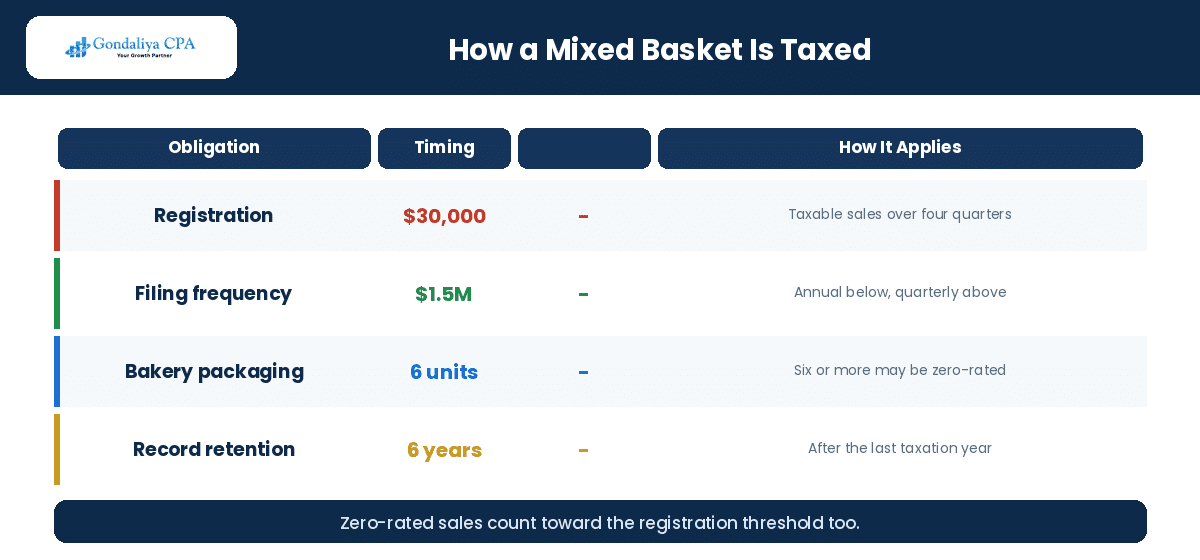
If you run an online grocery business in Canada, you must register for GST/HST once your taxable revenues go over $30,000. This includes all sales from grocery e-commerce tax Canada activities over four straight calendar quarters. The $30,000 small supplier threshold counts both taxable and zero-rated sales but leaves out exempt supplies.
Most incorporated online grocers hit this limit fast because of high sales and delivery fees that GST/HST applies to. Smaller sellers often register early too, so they can claim input tax credits on expenses like packaging or software.
Remember, registering on time means you follow CRA rules and avoid trouble.
Marketplace Facilitator Rules Affecting Online Grocery Sales
Marketplace facilitator rules come from the Digital Economy Framework 2026. These say that platforms helping online grocery sales must collect and pay GST/HST for the third-party sellers on their site or app.
If you sell through a marketplace that acts like a platform, usually that marketplace handles the GST/HST payments. But if you are acting as the marketplace operator yourself, then you have to deal with filing and remittance duties under CRA rules.
Sellers need to know if they are just vendors or marketplace operators because the tax rules differ a lot between these roles.
GST/HST Registration Process for E-Commerce Grocery Sellers
E-commerce grocery sellers must register for GST/HST when their revenues pass $30,000 or earlier if they want to. To do this, get a Business Number (BN) with a GST/HST program account from CRA. You’ll also get an access code in the mail to set up your account.
Starting in 2024, most businesses have to file returns electronically — no more paper forms unless CRA allows it for special reasons. You can use CRA’s My Business Account or certified software like QuickBooks or Xero to file returns.
Registering on time keeps you clear with CRA and lets you claim input tax credits for your online grocery costs.
Maintaining CRA GST/HST Compliance: Record-Keeping and Reporting Essentials
Online grocers must keep records for at least six years after their last taxation year ends. These records support everything related to online grocery GST/HST Canada rules. That means invoices, receipts, contracts, delivery logs, payment statements, and product info showing which items are zero-rated or taxable.
You need original documents when claiming input tax credits too — things like receipts proving you bought packaging materials or fuel for deliveries.
Not keeping good records can lead to audits where CRA might deny your credits and charge penalties.
Good bookkeeping helps keep your corporate filings smooth and your grocery business reports correct.
| Record Type | Retention Period | Notes |
|---|---|---|
| Sales Invoices | 6 years | Include detailed product info |
| Purchase Receipts | 6 years | Needed for Input Tax Credit claims |
| Delivery & Shipping Logs | 6 years | Prove delivery fee allocations |
| Payment Processor Statements | 6 years | Match deposits with sales |
Filing Frequency Options: Quarterly versus Annual Returns for Grocery E-Commerce
Your filing schedule depends on how much money your business makes each year:
- Annual: If under $1.5 million in worldwide taxable supplies.
- Quarterly: If above $1.5 million.
Late filing brings penalties of 1% per month plus interest that stacks up daily
Quarterly filings help manage cash flow but mean more work than annual ones. Annual reports work better for smaller businesses selling mostly zero-rated groceries with little net tax owed.
The CRA decides your filing periods based on last year’s revenue. You can ask them to change it but only before the new period starts
Common GST/HST Filing Mistakes Among Online Grocery Sellers
- Marking entire orders as zero-rated without checking each item.
- Taxing drinks or prepared foods wrong.
- Using shipping addresses instead of place-of-supply rules for rates.
- Forgetting to fix tax amounts when giving refunds.
- Claiming input tax credits without real invoices.
Penalties hit not just late payments but also errors caught during audits. Keeping careful track of what marketplaces pay you and what you report lowers risk big time.
Check your product classifications often against Schedule VI Part III rules about basic groceries’ zero-rating.
Sellers assume the platform handled the tax and the platform assumes the seller did. That gap is where the assessment lands, so please confirm which of you is collecting. Figures changed for privacy.
Key Stat: The $30,000 threshold counts zero-rated sales too. Please note that a grocer selling almost entirely basic groceries can still cross it and be required to register.
Mandatory Electronic Filing Requirements Starting 2024
Electronic Filing, ITCs and Corrections
The Filing
Starting in 2024, all incorporated online grocery businesses in Canada must file their GST/HST returns online. This rule applies to every business, no matter how big or how often they file. The CRA wants to make the process smoother for everyone. It covers monthly, quarterly, and annual filings under grocery business GST/HST filing rules.
Filing electronically speeds up return processing and helps cut down on mistakes you might see with paper forms. If you don’t file electronically, you could face fines or delays when getting your input tax credit (ITC) refunds. For online grocers selling in multiple provinces, electronic filing helps track where sales happen, which is important for applying the right HST rates.
This rule includes all incorporated companies selling groceries online in Canada, like specialty food sellers or delivery platforms registered for GST/HST. You should start filing online early to avoid any tech problems during busy times.
Comparison of GST/HST Filing Methods: CRA Account, NETFILE, Software, and More
Online grocery stores have a few ways to file their GST/HST returns electronically:
- CRA My Business Account: Lets you submit returns securely using your business number (BN) and access code from CRA.
- NETFILE: Mostly for individuals; not great for incorporated grocery businesses because it’s complicated.
- Certified Tax Software: Many accounting programs connect directly to CRA systems. They help prepare returns and send them automatically.
- Third-party Providers: Companies like Gondaliya CPA offer expert help that combines software use with professional checks.
Working with an online grocery tax accountant can make setting up your CRA GST/HST account easier. They also keep your access codes safe. Using certified software cuts down on mistakes but needs careful setup to match the tax status of items under Schedule VI Part III rules.
| Method | Best For | Key Benefit | Consideration |
|---|---|---|---|
| CRA My Business Account | Small to medium grocers | Free government service | You enter data manually |
| Certified Tax Software | Larger businesses | Automation and fewer errors | Setup can be tricky |
| Third-party Provider | Complex catalogs or platforms | Expert help and compliance | Extra fees apply |
Most incorporated online groceries find it best to use certified software plus CPA support. This combo fits Canadian grocery business GST/HST filing rules well.
Step-by-Step Guide to Preparing and Filing GST/HST Returns for Online Grocery Businesses
- Gather Sales Data Collect sales info showing which products are zero-rated basic groceries and which are taxable per Schedule VI Part III classifications.
- Calculate Net Tax Find total GST/HST collected minus allowed ITCs on expenses tied to taxable supplies like packaging or delivery costs.
- Document Input Tax Credits Keep invoices proving ITC claims—for rent, software used only for your e-commerce work, fuel for delivery vehicles, payment processing fees, marketing tied directly to taxable sales.
- Fill Out Return Forms Use your chosen electronic method and make sure line entries show net tax correctly without mixing in income taxed at the corporate level (T2).
- File On Time Submit by your deadline based on yearly revenue size; late filing can mean penalties.
Following these steps lowers audit risks and helps you get proper refunds by keeping good documentation per CRA rules.
Input Tax Credit (ITC) Claims: Maximizing Credits for Grocery E-Commerce Expenses
Input tax credits help reduce what you owe by letting you recover GST/HST paid on business costs linked to taxable sales. Common deductible expenses include:
- Packaging materials used for taxable products
- Rent split fairly between storage areas handling taxable goods
- Accounting and bookkeeping software licenses used mostly (over 90%) for ecommerce
- Fuel for delivery vehicles carrying mixed baskets with taxed items
- Payment gateway fees divided according to transaction types
- Marketing campaigns focused on taxable products
To claim these properly, keep careful records tying each expense invoice back to the product mix sold—zero-rated versus taxable—to meet evidence requirements from Excise Tax Act section 286(1).
Claiming too many ITCs without proof can lead to reassessments plus interest charges. It’s smart to review claims often and get advice from an online grocery tax accountant who knows Canadian indirect taxes well.
Handling Multi-Period or Past Year GST/HST Filings and Corrections
If you find mistakes in past filings—like wrong product classifications causing overpaid or unpaid taxes—here’s what you do:
- File amended returns if the error is found within allowed reassessment periods under Income Tax Act section 152(4).
- Make adjustments on later periods if you’re outside those time limits but need corrections.
- Use the voluntary disclosure program when big unpaid amounts exist; this avoids harsher penalties if done before an audit starts.
Fixing errors quickly helps limit risks and keeps things smooth during audits triggered by unusual refund claims from zero-rated sellers who also claim lots of ITCs without proper documents.
Managing Audit and CRA Correspondence Related to GST/HST Filing
CRA audits target areas with high risk—like large refund claims that don’t match reported sales mixes involving zero-rated basics plus taxed prepared foods sold online. To prepare:
- Gather all documents showing product classifications with Schedule VI backing.
- Match payout reports from platforms against filed revenues for consistency.
- Keep clear records explaining why each ITC claimed qualifies based on expense type.
Getting expert help early reduces risks through better communication with CRA. This cuts chances of disputes turning into full appeals that take up a lot of time and money.
Gondaliya CPA offers specialized audit defense services focused on Toronto-based incorporated grocers dealing with complex indirect taxes across Canada.
A grocer selling mostly zero-rated stock and claiming steady input tax credits sits in a permanent refund position. That is legitimate, and it is also what draws the review. Figures changed for privacy.
Risk Warning: An input tax credit without a supporting invoice is not claimable, however real the purchase was. Please check the documentation before the claim goes in, not after.
Accounting Software Integration for Online Grocery GST/HST Tracking
Software, Automation and Professional Support
The Tools
Using accounting software makes tracking online grocery GST/HST Canada easier. These tools handle grocery e-commerce tax Canada rules automatically. For example, QuickBooks and Xero record sales, input tax credits, and delivery charges right in your CRA GST/HST account.
They spot the difference between zero-rated basic groceries and taxable items at the product level. That helps with accurate tax filing. The software also stops common mistakes like mixing up delivery fees or missing input tax credits on rent or packaging.
This setup saves time by cutting down manual data entry. It keeps monthly records clean and ready for audits by the CRA.
- Tracks sales and input tax credits automatically
- Correctly treats delivery charges
- Separates zero-rated groceries from taxable goods
- Supports monthly reconciliations with fewer errors
AI-Powered Compliance Tools to Minimize Errors Before Filing
AI tools check your input tax credit claims before you file taxes. They flag refund claims that lack proof — something the CRA watches closely in online grocers. These tools also warn about late filings that can lead to penalties and interest.
The AI looks over your transactions using Excise Tax Act rules. It spots wrong classifications between zero-rated and taxable goods. Plus, it finds odd claims like too many input tax credits without invoices or mismatched sales reports.
By catching these issues early, you can fix them before deadlines. This lowers your risk of CRA penalties or reassessments.
- Identifies unsupported refund claims
- Monitors filing dates to avoid penalties
- Detects incorrect supply classifications
- Finds unusual ITC claim patterns
Automating Input Tax Credit Optimization and Provincial Rate Applications
Automation helps you claim all eligible input tax credits easily. It also handles provincial sales tax rules on food products sold in Canada’s many provinces.
The system uses place of supply rules based on shipping addresses. This way, it applies correct HST rates for each province — like 13% in Ontario or just 5% GST federally.
It handles tricky cases where some provinces add taxes on certain foods that are usually exempt elsewhere. Delivery fees get split fairly between taxable and zero-rated items too, following CRA-approved methods.
These automated steps cut errors while maximizing your recoverable input tax credits under federal and provincial laws.
- Applies correct provincial sales taxes automatically
- Uses place of supply rules by shipping location
- Allocates delivery fees properly between items
- Maximizes input tax credit claims
Use of Digital Platforms for Streamlined GST/HST Return Preparation
Starting 2024, electronic filing becomes mandatory for incorporated businesses, including online grocers in Canada per CRA rules.
Digital platforms simplify this process by handling marketplace facilitator rules affecting grocery e-commerce tax Canada when selling via third parties.
They match platform payouts with actual deposits after fees, refunds, discounts, or chargebacks — important since seller books often don’t match payment processor statements.
This reconciliation ensures you file accurate returns quickly through certified EFILE systems tied directly to your CRA GST/HST account.
These tools also generate detailed reports useful for audits or fixing past return mistakes involving mixed baskets of zero-rated and taxable groceries.
- Supports mandatory e-filing starting 2024
- Manages marketplace facilitator rules easily
- Reconciles payouts vs deposits accurately
- Creates audit-ready reports
Benefits of Combining Professional CPA Services with Technology Solutions
Working with a CPA familiar with online grocery taxes in Canada improves accuracy beyond what tech alone can do. Gondaliya CPA offers deep knowledge in GST/HST filings for grocery businesses combined with smart bookkeeping tools made for this field.
CPA help adds value especially if the CRA reviews your refund positions or ITC claims flagged by software but needing expert legal understanding to resolve.
A CPA’s guidance pairs well with digital tools to keep your filings right while helping cash flow stay steady. They also provide audit defense support if questions come up during a CRA review anywhere in Canada including Toronto/Ontario clients.
Combining tech efficiency with licensed CPA advice reduces risk and supports better compliance in complex online grocery sales environments.
If you want help optimizing your online grocery GST/HST Canada compliance with smart accounting software plus expert CPA advice, contact Gondaliya CPA at 647-212-9559 or info@gondaliyacpa.ca for a free consult focused on incorporated Canadian grocers facing changing tax rules online.
Software gets the classification right only if somebody sets the tax codes right first. The automation is downstream of a decision a person still has to make. Figures changed for privacy.
Pro Tip: Please set the tax code on every SKU at the point it is added to the catalogue. Retrofitting codes across thousands of products later is where the cost sits.
Overview of Gondaliya CPA’s GST/HST Return Preparation and Filing Services
Our GST/HST Services and Pricing
The Service
Gondaliya CPA helps online grocers in Canada with GST/HST return preparation and filing. We know grocery business GST/HST filing rules well, especially for e-commerce. Our online grocery tax accountants focus on accurate returns that follow CRA rules. We help reduce audit risks and boost your input tax credit claims.
We check sales data by tax status for each item. We also reconcile what platforms pay out and file returns on time. This process fits well with your corporate taxes and avoids costly mistakes often made in grocery e-commerce tax in Canada.
Our services cover:
- Detailed sales reviews by tax type
- Platform payout reconciliation
- Timely return submissions
Clients from Toronto and across Canada rely on us for precise filings that match the tricky zero-rated versus taxable supply rules.
Input Tax Credit Assessment and Optimization Strategies
Input tax credits, or ITCs, let businesses get back GST/HST they pay on business costs. Online grocers can claim ITCs on stuff like packaging, rent for storage spaces, software subscriptions, fuel for delivery vehicles, and payment processing fees. Claiming ITCs well can even put you in a refund position, which helps cash flow.
Good ITC claims need solid records showing each expense relates to taxable or partly taxable sales. Mistakes can lead to denied claims during CRA checks. Gondaliya CPA uses tools like QuickBooks or Xero combined with Hubdoc to track invoices carefully.
Here’s how we optimize ITC claims:
- Separate zero-rated from taxable purchases
- Use partial ITC calculations when expenses support both exempt and taxable sales
- Keep an eye on product mix changes that affect eligibility
This way, you get the most valid ITCs without raising CRA alarms.
GST/HST Account Registration, Deregistration, and Election Support
If your online grocery business makes more than $30,000 in worldwide taxable sales over four quarters, you must register for a GST/HST account. This threshold excludes basic groceries but counts other taxable supplies. Mandatory registration means you must charge and remit GST/HST properly.
You can also register voluntarily if you’re under the $30K limit. This lets you claim input tax credits on your expenses even if most sales are zero-rated or exempt—common for specialty food sellers or startups testing their market.
You might deregister if revenues stay below the small supplier limit or if you stop operating. Elections about filing frequency or using quick methods require careful timing to follow CRA rules.
We help clients understand these rules based on current laws like Excise Tax Act Section 240(1).
Comprehensive Ongoing Support: From Document Collection to Return Confirmation
Canadian law requires keeping records like invoices, contracts, receipts, and shipping documents for six years after the fiscal year ends. These records prove your income and ITC claims during audits.
Our ongoing support includes:
- Monthly collection of source documents
- Checking documents against bank statements and platform reports
- Digital archiving that meets retention rules
- Final checks before electronic filing to ensure accuracy
This reduces risk from missing or weak records that could cause CRA penalties or reassessments.
Addressing E-Commerce Specific Challenges: Platform Sales, Subscription Services, and Meal Kits
E-commerce has some special GST/HST rules online grocers must watch out for:
- Marketplace Facilitator Rules: Since 2026, certain platform operators must collect and remit GST/HST directly for sellers on their marketplaces. You’ll need to compare gross sales reported by platforms with the deposits you get after fees.
- Subscription & Bundled Supplies: Subscription orders may include zero-rated foods plus taxable add-ons like supplements. Meal kits bundled with several ingredients might be taxed fully or zero-rated based on how much prep they involve.
To avoid mistakes:
- Map out all transactions carefully
- Reconcile platform payouts vs actual income
- Check delivery fees against supply rules
Gondaliya CPA guides clients through these updates with accounting setups built for multi-channel selling across provinces with HST (like Ontario).
Transparent Pricing Models and Service Guarantees for Grocery Business Clients
Our flat annual fee covers gst/hst return prep plus corporate T2 filing. If you need bookkeeping cleanup before starting work with us, that’s included too.
What affects pricing?
| Driver | Impact | Tips | Questions |
|---|---|---|---|
| Order Volume | More orders means more work | Use batch uploads via API | How many orders monthly? |
| Product Catalogue Size | More SKUs need more tax checks | Regularly prune your product list | How many product types sold? |
| Platforms & Payment Processors Used | More sources complicate reconciliations | Consolidate payment processors | Which platforms do you use? |
| Provinces Shipped To | Different rates per province | Ship mainly within fewer provinces | Where do you ship? |
| Filing Frequency | Monthly filings take more effort | Match frequency to your volume | What’s your assigned filing period? |
| Past Errors / Catch-up Months | Raises setup effort | Provide full past records | Any fixes needed before start? |
Clients get a 30-day money-back guarantee plus a 60-day fee-matching policy. We reply fast—even nights and weekends—and have over 1450 five-star Google reviews backing our service.
For pricing info specific to your grocery setup, email info@gondaliyacpa.ca or call 647-212-9559 anytime.
Catalogue size drives the fee more than order volume does. Ten thousand orders of forty products is simpler than four hundred orders of two thousand. Figures changed for privacy.
Verification: Our CPA Ontario firm registration can be checked on the public firm directory. Please verify any firm before granting access to your accounting file.
Impact of Cross-Border Sales and US Customer Transactions on GST/HST
Cross-Border, Product Status and Best Practices
The Detail
Canadian online grocery sellers making sales to US customers face specific GST/HST rules. Goods shipped from Canada to the US count as exports. These exports are zero-rated under Schedule VI Part III of the Excise Tax Act. That means no GST/HST is charged on those sales. But businesses must keep proof that the goods were exported.
If you sell groceries online to US customers through your website or digital platforms, you might still need to register for GST/HST. This depends on your Canadian taxable revenue and if you pass the small supplier threshold. Having cross-border sales doesn’t free you from filing GST/HST returns in Canada.
Starting 2026, platform operators who facilitate sales must collect and remit GST/HST for vendors who are not registered. This includes third-party delivery services and marketplace operators. Online grocers should check if platform fees include these taxes and adjust their accounting accordingly.
When online grocers sell digital products or services, like meal plan subscriptions, special registration rules apply. Physical groceries shipped outside Canada stay zero-rated. But digital services may trigger different GST/HST registration requirements.
Working with an online grocery tax accountant helps navigate these changing rules. They make sure your business follows cross-border sale regulations, platform obligations, and digital economy registrations without errors.
Tax Status of Dietary Supplements, Packaging Sizes, and Mixed Basket Allocations
Not all grocery items in an online order get the same tax treatment. It depends on what they are and how they’re packaged:
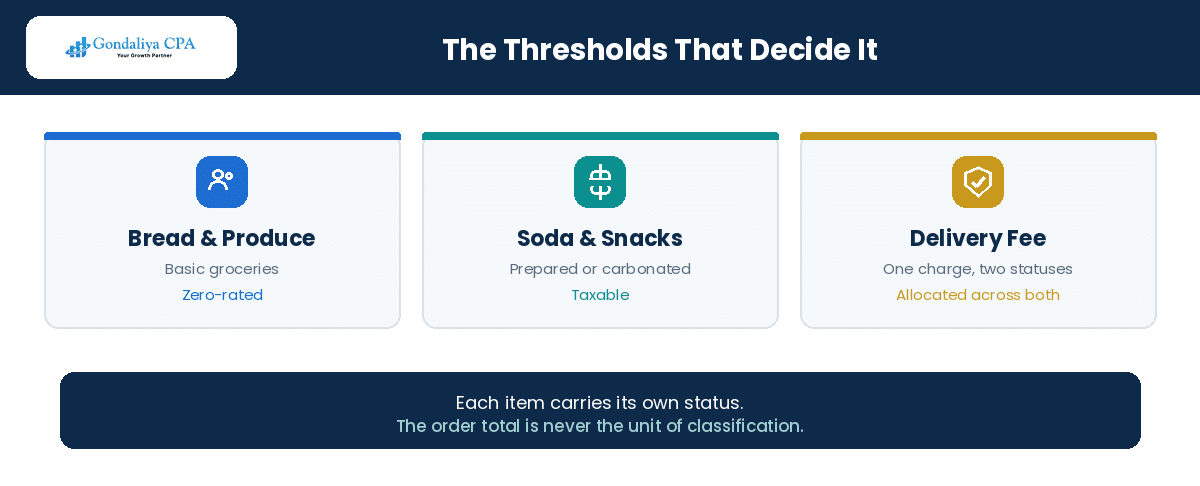
- Zero-Rated Groceries: Fresh fruits and veggies, raw meat (uncooked, unseasoned), basic dairy without extra additives allowed by law, standard breads (not specialty types), grains, flour, and sugar in normal retail packages.
- Taxable Items in Grocery Orders: Carbonated drinks; candy and snacks; ready-to-eat heated meals; catering platters; salads served as dishes instead of loose ingredients; single-serving packages often get taxed because of portion size rules.
Packaging size matters too:
- Bakery items with six or more pieces per package usually qualify for zero-rating.
- Packages with fewer than six pieces often become taxable.
- Drinks follow a similar six-unit rule affecting their tax status.
Dietary supplements or protein powders don’t automatically count as basic groceries. Their tax status depends on labelling claims (like vitamin supplements vs food), format (pill vs drink), and intended use regulated by federal rules. Each product needs careful review before assigning tax codes.
For mixed baskets containing both taxable snacks and zero-rated vegetables, each item’s tax has to be allocated separately when sold. Delivery fees should be split between taxable and exempt parts unless billed separately for one category.
| Category | Zero-Rated | Taxable | Key Factor | CRA Source |
|---|---|---|---|---|
| Fresh Produce | Yes | No | Unprocessed state | Schedule VI Part III |
| Carbonated Beverages | No | Yes | Carbonation & portion size | Memorandum 19-F15 |
| Bakery Goods (>6 units) | Yes | No | Package quantity | Memorandum 19-F15 |
| Bakery Goods (<6 units) | No | Yes | Single-serving rule | Verify current memo |
| Dietary Supplements | Review Req. | Often yes | Label & format | Memorandum 19-F14 |
Refunds, Bad Debt Adjustments, and CRA Compliance Best Practices
When you give refunds after a sale, it changes how much GST/HST you owe. The seller must adjust net taxes reported in the GST/HST return during the refund period.
Bad debt adjustments let businesses claim input tax credits when customers don’t pay after invoicing. To do this right, you need proof that you tried hard to collect before claiming a bad debt.
The CRA charges penalties starting at 1% per month for late filing or payment. Interest builds up daily until you pay off what’s owed.
If you mess this up often or refund a lot without fixing your net tax figures, it can trigger audits or reassessments adding interest and penalties.
Best practice: keep clear records linking every credit or refund back to its original invoice. Also save any letters or emails showing attempts to collect bad debts.
The Role of Professional Accountants in Ensuring Timely and Accurate Filing
For online grocers across Canada, the yearly flat fee for full GST/HST filing help covers cleaning up books through preparing final corporate returns tailored for incorporated grocers in places like Toronto.
At Gondaliya CPA we use clear workflows. We start with intake interviews then review product lists carefully. That ensures every item gets the right tax classification based on CRA rules. Monthly reconciliations match platform payouts against recorded sales early on. We double-check input tax credits before quarterly or annual filings. Our team answers client questions within one business day—even weekends sometimes.
Clients trust us because we hold Ontario CPA credentials. We have over 1450 five-star Google reviews showing consistent quality. Plus we offer transparent policies like money-back guarantees and fees-matching promises.
Importance of Annual Reviews and Proactive Tax Planning for Grocery Businesses
The CRA usually audits online grocers when certain red flags appear:
- Large refunds compared to total sales suggesting possible misreporting.
- Big differences between reported revenues versus bank deposits.
- High amounts of zero-rated supplies unusual for the industry.
- Discrepancies spotted during platform payout checks.
- Input tax credit claims missing supporting documents.
To stay out of trouble year-round:
- Update product lists regularly checking new SKUs’ correct classifications.
- Reconcile payments received against income reports often.
- Log all discounts and refunds that affect net taxes owed immediately.
- Keep good records proving ITC eligibility as per CRA guidelines.
- Manage deadlines strictly to avoid fines accumulating later.
Doing these helps reduce audit chances while giving room for smarter cash flow planning. This matters especially with mixed supply orders common across Canadian provinces including Ontario.
Final Recommendations for Maintaining Full GST/HST Compliance and Leveraging Expert Support
Deciding whether to DIY your GST/HST filings or hire professionals depends on your business complexity:
- DIY works okay if your inventory is small and mostly simple groceries. But there’s risk if rules change or mistakes slip through later costing more money;
- CPA Firms, especially those who know online grocery tax accountant issues well, handle tricky details like package-size impacts or combined basket analysis correctly;
- Non-CPA Providers can be cheaper but might lack skills needed during audits risking incomplete compliance;
Here’s a quick comparison:
| Factor | DIY | CPA Firm | Non-CPA Provider |
|---|---|---|---|
| Handling Complex Issues | Low | High | Limited |
| Accuracy in Classification | Medium | High | Limited |
| Audit Defense | None | Strong | Weak |
| Cost | Lowest | Mid-range | Lower |
| Filing Discipline | Self-managed | Professionally managed | Variable |
Bottom line: A CPA Ontario Registered Firm with experience in grocery business GST/HST filing will likely avoid costly mistakes tied to indirect taxes faced by Canadian e-commerce grocers today.
Sharad Gondaliya, CPA, has helped hundreds of Canadian business owners over more than ten years.
The six-unit bakery rule catches more sellers than any other single classification point. A four-pack of muffins is not the same supply as a dozen. Figures changed for privacy.
Key Stat: Exports to US customers are zero-rated, but only if you hold proof of export. Please keep the shipping documentation alongside the invoice.
FAQs on Online Grocery GST/HST Filing and Compliance
Frequently Asked Questions
FAQ
What is item-level tax status in online grocery GST/HST filing?+
Item-level tax status means classifying each grocery product as zero-rated, taxable, or exempt. It ensures accurate GST/HST reporting.
What are the mandatory GST/HST registration thresholds for online grocers in Canada?+
You must register if your taxable sales exceed $30,000 over four consecutive quarters.
How do delivery charges affect GST/HST for online grocery sales?+
Delivery fees follow the tax status of goods delivered—zero-rated items mean no tax on delivery, taxable items mean delivery fees are taxed.
What input tax credits can online grocery businesses claim?+
You can claim GST/HST paid on expenses like packaging, fuel, rent, software, and payment processing fees related to taxable sales.
How does Gondaliya CPA handle online grocery files?+
We classify products by tax type, reconcile platform payouts, prepare returns, and ensure timely CRA-compliant filings.
What are common top mistakes in GST/HST filing for online grocers?+
Misclassifying products, ignoring delivery fee rules, not reconciling payments, and late filing often cause errors and penalties.
How do bad debts and inventory write-offs impact GST/HST returns?+
You may adjust input tax credits for bad debts with proof of collection attempts. Inventory shrinkage or spoilage needs proper documentation for claims.
What should an online grocer prepare before engaging Gondaliya CPA?+
Prepare detailed sales records, invoices for expenses, delivery logs, platform payout reports, and prior GST/HST filings.
Key Points: Best Practices to Stay Compliant Year-Round with Online Grocery GST/HST
Key Points, Costs and Deliverables
Quick Reference
- Regularly update product tax classifications at the item level.
- Keep clear records of all invoices and receipts for six years.
- Reconcile payment processor payouts against recorded revenues monthly.
- Separate zero-rated basic groceries from taxable items in reports.
- File all returns electronically by CRA deadlines to avoid penalties.
- Review refunds and bad debt adjustments promptly in filings.
- Use certified software integrated with accounting platforms like QuickBooks or Xero.
- Conduct annual reviews with your CPA for proactive tax planning.
Choosing the Right CPA Firm in Toronto/Ontario for Your Online Grocery Business
- Confirm expertise in grocery e-commerce GST/HST laws and Excise Tax Act compliance.
- Look for firms offering integration with popular accounting software.
- Ensure fast response times and personalized client support.
- Check credentials such as Ontario CPA licensing and industry reviews.
- Consider transparent pricing models without hidden fees.
- Evaluate experience managing multi-provincial filing requirements.
How Much Does GST/HST and Tax Support Cost for an Online Grocer in Canada?
Costs vary by order volume, product catalog size, number of platforms used, provinces served, filing frequency, and any catch-up work required. Gondaliya CPA offers flat annual fees including return preparation plus corporate filings starting at competitive rates tailored to your business size.
Filing Requirements: DIY vs CPA vs Non-CPA Providers
| Factor | DIY | CPA Firm | Non-CPA Provider |
|---|---|---|---|
| Handling Complex Issues | Limited | Expert | Moderate |
| Classification Accuracy | Medium | High | Variable |
| Audit Defense | None | Strong | Weak |
| Cost | Lowest | Mid-range | Lower |
| Filing Discipline | Self-managed | Professionally managed | Mixed |
What Deliverables Do You Get When Working with Gondaliya CPA?
- Comprehensive GST/HST return preparation tailored to online groceries.
- Monthly reconciliation reports linking sales to payment processor data.
- Detailed classification summaries by product tax status.
- Electronic filing confirmations with CRA receipt copies.
- Year-end summary reports supporting T2 corporate return integration.
How Do Tax Issues Differ Across 10 Online Grocery Sub-Sectors We Serve?
Tax treatment varies by sector like specialty foods, meal kits, subscription services, bulk suppliers, organic produce sellers, prepared meals vendors, ethnic food distributors, discount grocers, health supplement providers, and beverage retailers due to varying zero-rating eligibility and bundled supply rules.
Realistic Numeric Walkthrough: Calculating Input Tax Credits
If you spent $10,000 on packaging (60% linked to taxable goods), you claim $6,000 ITCs on that expense. For delivery costs split 40% taxable items vs 60% zero-rated groceries on a $5,000 bill you claim $2,000 ITCs accordingly.
Top Mistakes and How Do You Prevent Them?
Mistakes include wrong classification of snacks as zero-rated or missing platform facilitator remittances. Prevention involves regular product list reviews using CRA’s Schedule VI Part III references plus cross-checking marketplace payouts monthly.
Amended Returns & Voluntary Disclosure Program
Fix errors within reassessment periods by filing amended returns through CRA portals or via your CPA. Use the Voluntary Disclosure Program proactively to correct large past mistakes without heavy penalties before audits begin.
CRA GST/HST Review Triggers Specific to Online Grocers
Large disproportionate refunds compared to reported sales or inconsistent payment deposits raise red flags during CRA audits focusing on input tax credits claimed without invoices or wrong zero-rated item reporting.
Penalties and Interest: What Happens If You File Late?
CRA charges 1% per month on unpaid amounts plus daily compounding interest until full payment is made. Repeated late filings may cause further fines or audit scrutiny impacting business cash flow negatively.
What Are Filing Requirements for T2 Corporate Returns Related to GST/HST?
T2 returns must integrate accurate net tax calculations reported on GST/HST slips ensuring consistency between federal income taxes and indirect taxes paid/collected within the fiscal year.
Managing Payment Processor Payouts With GST/HST Reporting
Reconcile gross sales shown in your accounting software versus actual deposits after fees/refunds from processors like PayPal or Stripe monthly to avoid mismatches causing audit issues later.
Spoilage & Inventory Write-Offs: How To Handle Taxes
Record losses due to spoilage or theft carefully as these affect your inventory values but generally don’t impact input tax credit claims unless related expenses involve taxable supplies; keep proof ready if audited.
Best Practices to Stay Compliant Year-Round
Maintain updated item-level tax statuses regularly; file returns electronically by deadlines; reconcile all sales channels monthly; document refunds/bad debts properly; use certified accounting tools integrated with professional guidance from Gondaliya CPA.
Eight practices and one that makes the rest possible: reconcile the platform payout monthly. Left to year-end it becomes archaeology rather than bookkeeping. Figures changed for privacy.
Online Grocery Sub-Sectors We Serve
Industry Expertise
Which issue dominates differs by sub-sector. Here are ten and the usual focus.
| Sub-Sector | The GST/HST Focus |
|---|---|
| Specialty food sellers | Item-level review of non-standard products |
| Meal kit providers | Bundled supply and degree of preparation |
| Subscription grocery boxes | Recurring baskets mixing statuses each cycle |
| Bulk and wholesale suppliers | Package size thresholds on repeat lines |
| Organic produce sellers | Mostly zero-rated, so a standing refund position |
| Prepared meal vendors | Heated and ready-to-eat items are taxable |
| Ethnic food distributors | Imported lines needing individual classification |
| Discount grocers | High order volume with thin documentation |
| Health supplement providers | Label and format decide the status |
| Beverage retailers | Carbonation and the six-unit packaging rule |
- Specialty food sellers: Unusual products rarely map cleanly to a memorandum, so each needs its own review.
- Meal kit providers: How much preparation is included decides whether the kit is taxable or zero-rated.
- Subscription grocery boxes: Every cycle is a fresh mixed basket, so allocation has to be systematic.
- Bulk and wholesale suppliers: Package quantity thresholds apply on every repeat line, not once.
- Organic produce sellers: A near-total zero-rated mix plus input tax credits means constant refunds.
- Prepared meal vendors: Heated or ready-to-eat food is taxable regardless of the ingredients inside.
- Ethnic food distributors: Imported lines need classification before they reach the catalogue.
- Discount grocers: Volume makes weak documentation expensive when a review arrives.
- Health supplement providers: Labelling claims and format decide whether it is food or a supplement.
- Beverage retailers: Carbonation and unit count both change the answer on the same product.
The sub-sector changes which classification question comes up first. It does not change the discipline, which is item-level status, allocated delivery and documented credits. Figures changed for privacy.
Professional Guidance and Quick Reference
Guidance
Professional Guidance for Online Grocers: How Gondaliya CPA Handles Your GST/HST
Online grocery GST/HST turns on one thing above all: tax status is decided item by item, not order by order. A basket of bread and soda is two different supplies, and the delivery fee has to be split across them. Get that right and registration, filing and credits all follow. Gondaliya CPA handles the full cycle on a fixed annual fee.
We handle what decides the outcome: classifying every SKU as zero-rated or taxable under Schedule VI Part III, allocating delivery fees across mixed baskets, confirming whether the platform or you collect the tax, applying place-of-supply rules by the customer’s location, tracking the $30,000 threshold across zero-rated and taxable sales, documenting input tax credits with real invoices, adjusting for refunds and bad debts, and filing electronically on time.
Our team reconciles platform payouts to deposits monthly, because that gap is the first thing a reviewer looks at. Own site, marketplace or both, you get clear advice and a fixed price before we start.
Quick Answers: Key Numbers & Concepts at a Glance
At a Glance
- Classification: Item by item, not per order
- Registration: $30,000 across four quarters
- Zero-rated sales: Count toward that threshold
- Delivery fees: Allocated across the basket
- Bakery rule: Six or more units per package
- Filing: Electronic, mandatory since 2024
- Frequency: Annual under $1.5M, quarterly above
- Late penalty: 1% per month plus daily interest
- Input tax credits: Need supporting invoices
- Records: Six years after the last tax year
Who This Is For / Not For
Fit Check
- For: Incorporated Canadian online grocery and food e-commerce businesses selling through their own site, a marketplace, or both.
- Not For: Product labelling or food safety compliance, which sits with the regulator; we handle the tax classification and filing.
People Also Ask
Related Questions
Is a mixed basket taxed as one supply?+
No. Each item carries its own status, and the delivery fee is allocated across the basket unless it is billed separately for one category.
Do zero-rated sales count toward the $30,000 threshold?+
Yes. Zero-rated supplies are taxable supplies at a rate of zero, so they count. Exempt supplies do not.
If the platform collects the tax, do I still file?+
Usually yes. You still report your own position and claim input tax credits, so please confirm which sales the platform covered.
Glossary of Key Terms
- Zero-rated supply: A taxable supply at a rate of zero, such as basic groceries.
- Taxable supply: A supply on which GST/HST is charged at the applicable rate.
- Exempt supply: A supply outside the GST/HST system, carrying no input tax credit.
- Basic groceries: The zero-rated food category set out in Schedule VI Part III.
- Item-level status: Classifying each product rather than the order as a whole.
- Mixed basket: An order containing both zero-rated and taxable items.
- Incidental supply: A charge that follows the status of the goods it relates to.
- Delivery fee allocation: Splitting a shipping charge across the basket contents.
- Small supplier threshold: The $30,000 revenue level triggering mandatory registration.
- Place of supply: The rule determining which provincial rate applies.
- Marketplace facilitator: A platform required to collect and remit on a seller’s behalf.
- Platform operator: The party running the marketplace and carrying its obligations.
- Input tax credit: GST/HST recoverable on purchases used in commercial activities.
- Net tax: Tax collected less input tax credits claimed for the period.
- Bad debt adjustment: A recovery of tax remitted on an invoice that went unpaid.
- Voluntary Disclosures Program: The CRA route for correcting errors before a review begins.
Grocery GST/HST Readiness Check
This quick self-check indicates where your operation most likely has room. Please answer the six questions below.
Grocery GST/HST Readiness Check
Six quick questions on your catalogue. No fee shown.
Points to raise with us:
This is a general prompt, not tax or legal advice or a quote. Your position depends on your full facts. For a real review, please book a free consultation.
Want a checklist to work from? You can download our free grocery GST/HST checklist before your consultation.
Classify every SKU at the item level. Allocate delivery fees across the basket. Confirm who collects on platform sales. Apply the rate for the customer’s province. Track zero-rated sales against the threshold. Keep an invoice behind every credit claimed. Reconcile payouts to deposits monthly. Please file electronically and on time.
2026 Update — what is current: This article notes platform operator rules under the Digital Economy Framework taking effect in 2026 and mandatory electronic filing from 2024. The $30,000 small supplier threshold, Schedule VI Part III zero-rating, the six-unit packaging rule and the six-year retention requirement are unchanged. Please note the article states in one place that the threshold excludes basic groceries where zero-rated sales do count toward it, cites Income Tax Act section 152(4) for GST/HST amendments where the Excise Tax Act governs, cites Income Tax Act section 231(4) for refund adjustments where that provision sits in the Excise Tax Act, and describes exports as zero-rated under Schedule VI Part III where Part V covers exports, so please confirm each before relying on it.
Online Grocery GST/HST Canada: Expert Tax Accountant Services for Grocery Business GST/HST Filing and E-Commerce Compliance
Classify the item, not the order
Gondaliya CPA classifies every SKU under Schedule VI Part III, allocates delivery fees across mixed baskets, confirms whether the platform or you collect, applies place-of-supply rules by province, documents input tax credits with real invoices, adjusts for refunds and bad debts, and files electronically on time, on a flat annual fee including HST with a one-business-day response. Please book a free consultation.
Next Steps
Please book a free consultation with Gondaliya CPA and bring your product catalogue export, your platform payout reports, and your last filed GST/HST returns. Those three tell us immediately whether your items are classified correctly and whether the payouts reconcile to what you reported. You will get a flat annual fee including HST before any work begins. If our content helps, please add gondaliyacpa.ca as a preferred source on Google.
Published: · Last updated:
Editorial policy: We research against CRA and CPA Ontario sources, fact-check the figures, and Sharad Gondaliya, CPA, reviews the content, which we update as the rules change.
Disclaimer: This article is educational information only and is not tax, legal, or financial advice. Figures marked illustrative are examples rather than quotes or guarantees. It reflects CRA rules current to 2026, including the $30,000 small supplier threshold, the $1.5 million annual filing line, the six-unit bakery packaging rule, the 1% per month late filing penalty, and the six-year record retention requirement. Rates, limits and expensing rules change and outcomes depend on your specific facts. Please consult a CPA Ontario member before acting.

Sharad Gondaliya is a CPA Canada & CPA USA with 15 Years+ experience of Accounting, Tax, Payroll of Corporate Small Businesses as Tax Accountant. He is a CPA Ontario member (61040184) and holds US CPA licences in Washington and Montana and is well known among corporate small businesses for tax planning, efficient tax solutions, and affordable CPA services. Sharad is the Principal (Director) of Gondaliya CPA – Affordable CPA Firm in Canada. Licenses: CPA Ontario: 61040184 | CPA USA (MT): PAC-CPAP-LIC-033176 | CPA USA (WA): 57629 | CPA Firm License: 61330051 View Full Author Bio