



How Insurance Brokers in Canada Can Reduce Taxes and Improve Cash Flow With Strategic Tax Planning
Insurance broker tax planning Canada: Effective Insurance Brokerage Tax Strategies and Corporate Tax Planning by Gondaliya CPA
Gondaliya CPA offers practical insurance broker tax planning Canada solutions focused on insurance brokerage tax strategies and tax efficient insurance brokerage practices to reduce corporate taxes in Canada. Their expertise includes corporate tax planning, CRA tax planning, and commission income tax planning tailored to help insurance brokers maximize tax savings while managing business expenses effectively.
Quick Summary
Tax planning matters a lot for insurance brokers in Canada. When brokers use smart tax strategies, they can lower their corporate taxes and improve cash flow. Knowing the details of insurance broker tax planning helps you follow the rules and claim all the deductions you qualify for under Canadian law.
Reading time: 47 minutes.
Table of Contents
- Why Tax Planning Matters for Brokers
- Specialized Brokerage Tax Services
- Our Process from Discovery to Ongoing Support
- Key Dates, Deductions and Year-End Planning
- Client Experiences and Case Studies
- Next Steps and Resources
- Frequently Asked Questions
- Key Tax Planning Insights
- Brokerage Situations We Serve
- Professional Guidance and Quick Reference
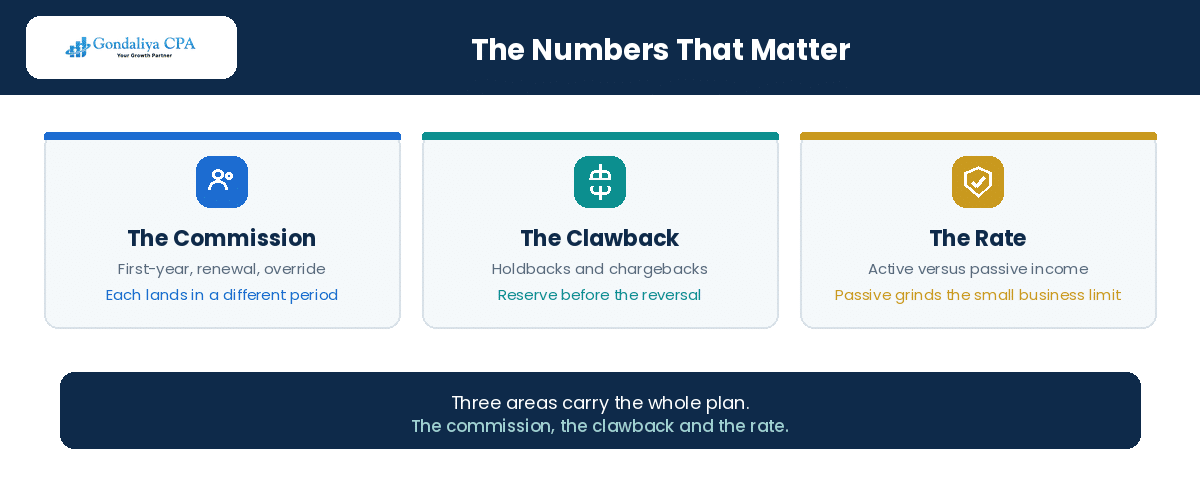
The Numbers That Matter
This article covers Canada, with Ontario and Toronto context, and reflects rules current to 2026. It assumes an incorporated insurance brokerage or producer earning commission income, whether personal lines, commercial lines, life or living benefits. Figures marked illustrative are examples, not quotes, and any masked engagement notes end with “Figures changed for privacy.” This is educational information only and not tax or legal advice. Rates, thresholds and licensing rules change, so please confirm current figures before acting.
Insurance Broker Tax Planning in Canada: Strategies to Maximize Savings
Why Tax Planning Matters for Brokers
The Basics
How Gondaliya CPA Supports Insurance Brokers
Gondaliya CPA works closely with insurance brokers to improve their tax situation. As an insurance broker tax accountant, we build plans that fit your business needs. We find ways to use insurance brokerage tax strategies that keep you compliant while saving you money.
Set up a discovery meeting with Gondaliya CPA. We will build a plan focused on corporate tax planning that fits your insurance broker business.
Understanding the Importance of Effective Tax Planning
Good insurance broker tax planning Canada can help your cash flow and get more from small business deductions. Here’s why it matters:
- Timing cash flow right helps cover costs when they come up.
- Using small business deductions cuts down what you owe in taxes.
These moves make sure your money works better for you, not the other way around.
How Professional Tax Accounting Reduces Your Corporate Tax Burden
Experts can make a big difference managing your taxes:
- Getting commission income timing right changes how much cash you have on hand.
- Keeping instalments and remittances on time avoids running out of cash at tough times.
Working with an accountant who knows insurance brokers helps stop surprises and keeps things running smoothly.
Simplifying Complex Rules to Stay Compliant and Maximize Deductions
Following CRA rules and provincial licensing guidelines can feel tricky:
- Keep good records so CRA claims go through without issues.
- Know what your provincial regulator requires, especially about commissions.
- Check in regularly with a professional to clear up questions and spot more chances for deductions.
This helps you avoid audits while keeping more of what you earn as an insurance broker across Ontario or anywhere else in Canada.
Brokers almost never come to us with a revenue problem. They come with a quarter where the instalment landed the same month as a chargeback run. Figures changed for privacy.
Risk Warning: A corporation serving one carrier or agency with no other clients can attract personal services business treatment, which removes the small business deduction. Please have the structure reviewed.
Specialized Insurance Brokerage Tax Services for Canadian Brokers
Specialized Brokerage Tax Services
The Services
Insurance broker tax planning Canada needs special attention. Insurance brokers have unique income and expenses. Good insurance brokerage tax strategies focus on the corporate setup, when commissions come in, and using all the right deductions. Insurance broker corporate tax planning lowers taxes and helps with cash flow.
Brokers who are incorporated get advice made just for them. Their pay comes from commissions and expenses change a lot. Planning carefully keeps things within CRA rules. It also helps you access the small business deduction available to Canadian-controlled private corporations. This kind of planning supports growth in Ontario and across Canada.
Corporate Tax Planning and Commission Income Strategies
Insurance broker corporate tax planning balances salary and dividends well. It also times commission income so it fits the fiscal year. This smooths out big jumps in taxable income caused by first-year commissions, renewals, overrides, or chargebacks.
A CPA who knows this field follows CRA rules about commission reporting and T4A slips. They create plans that reduce large taxable income spikes. Correctly classifying commissions can defer tax legally without risking audits or penalties. This matters for incorporated brokers who want better after-tax cash flow while staying compliant.
How commission income is optimized:
- Align commission receipt dates with fiscal year-ends
- Balance salary versus dividend payments
- Use correct T4A slip reporting rules
- Defer tax without breaking any laws
Managing Business Expenses and Maximizing Deductions
Managing business expenses well helps insurance brokers get the most from deductions under CRA rules. Deductible costs often include provincial licensing fees, errors and omissions insurance premiums, client meals within the statutory limit, CRM software subscriptions, continuing education tied to your work, and vehicle costs with good records.
Keeping clear records proves these claims during CRA audits or reviews. The table below shows which expenses count as professional deductions versus personal spending. Doing this cuts your taxable income while keeping your books clean.
| Expense Type | Deductibility | Conditions | Records Needed |
|---|---|---|---|
| Licensing Fees | Fully deductible | Must relate to licensing | Invoices, proof of payment |
| Errors & Omissions Insurance | Deductible | Must be reasonable | Policy papers, receipts |
| Client Entertainment | 50% deductible | Within meal and entertainment limits | Receipts, event details |
| CRM Software Subscriptions | Fully deductible | For business use only | Subscription invoices |
| Continuing Education | Deductible | Directly related to profession | Certificates, receipts |
Compliance Advisory on Deadlines, Reporting and Regulation
CRA compliance guidance is key because deadlines are strict for T4 and T4A slips on commissions paid by corporations. Instalment payment due dates affect cash flow too. Missing deadlines causes penalties plus interest that adds up fast.
In Ontario, general insurance brokers are regulated by RIBO while life agents are registered through FSRA. Each framework has its own requirements that affect how commissions get processed inside corporations, so please confirm your own licensing position before restructuring.
Main deadlines include:
- T4 and T4A slip filing: Due the last day of February after year-end.
- Corporate instalments: Monthly or quarterly depending on your circumstances and prior-year tax.
Keeping a calendar updated with these dates reduces late penalties and matches instalment payments to your commission inflows.
Cash Flow Management Solutions
Cash flow management for insurance brokers must handle uneven commission payments all year long. First-year sales bring large upfront commissions but then smaller renewal ones come later. This makes it hard to match money coming in with taxes due.
Good plans forecast money coming in versus bills going out like payroll and CPP remittances linked to salary choices made earlier. Setting aside reserves for chargebacks protects your cash without losing deduction claims at year-end.
Fixing commission timing cash flow issues needs neat bookkeeping with real-time cloud accounting. This helps adjust money flow before problems hit, which generic accounting without insurance experience rarely catches.
Boutique Service With Industry Knowledge
Specialized CPA services for insurance brokers understand industry-specific issues like split producer arrangements or MGA holdback policies, plus the rules for Canadian-controlled private corporations working across provinces including the Toronto area where Gondaliya CPA operates.
This boutique service offers custom plans instead of generic ones, tailored to each client’s pay structure and licensing framework.
Clients feel sure their advisor knows the technical side, including how passive investment income affects the small business deduction and how daily cash needs shift during ups and downs in premiums common across personal and commercial lines nationwide.
Tailored Solutions for Agents and Brokerages
Insurance brokerage tax strategies must fit many product types, from group benefits consultants needing special expense treatment to trucking line producers, to reach the best effective tax rates allowed under the associated corporation rules that share the small business limit across a related group.
Strategic tax planning includes thinking about holding companies carefully, avoiding extra complexity unless there are significant retained earnings needing protection, balanced against extra yearly administrative costs.
Proactive Planning for Corporate Tax Efficiency
Insurance broker corporate tax planning means choosing bonus timing early enough before year-end to get the deduction in the right year, rather than relying on dividends which give no corporate deduction but serve a different purpose in the integration calculation.
Modelling scenarios based on expected commissions plus fixed overhead finds the best mix to cut total tax personally and corporately while keeping cash ready during busy renewal months when instalment payments come due.
Support for Regulatory Filing and Deadline Management
Filing T4 and T4A slips on time every year reduces the risk of reassessment. Following your instalment payment schedule avoids interest that piles up if you miss deadlines, something busy offices covering Etobicoke through Vaughan to Mississauga cannot afford.
For help with complex brokerage taxes contact Gondaliya CPA at info@gondaliyacpa.ca or call 647-212-9559 for a free chat about your incorporated brokerage.
The bonus accrual is the single decision that most often changes the corporate tax number. It has to be declared before year end and paid within the statutory window to hold. Figures changed for privacy.
Key Stat: The small business limit is shared across associated corporations. Please confirm your group structure before assuming you have the full amount.
Our Process: From Discovery Call to Ongoing Support
Our Process from Discovery to Ongoing Support
The Process
Initial Discovery Call and Assessment
The first step is a discovery call. We talk about your insurance brokerage’s current tax situation and business setup. This helps us find smart ways for insurance broker tax planning Canada that fit your goals. We look at how you earn commissions, how you pay yourself, your expenses, and whether you are incorporated.
Here’s what we focus on:
- Small business deduction limits in the Income Tax Act
- Passive investment income limits that affect your business deduction
- How associated corporations might share or reduce these benefits
Knowing these rules early helps us plan better tax savings and manage cash flow timing.
We also check your bookkeeping, commission tracking, MGA agreements, and any past year-end adjustments. This way, we fix real problems instead of guessing.
Setup and Clean-Up Phase
Good records are key to proper insurance brokerage tax strategies. We start by fixing trust account reconciliations to meet your regulator’s requirements. Keeping client money separate from your own prevents legal issues. It also helps with expense claims.
We review commission tracking closely to make sure all commissions are recorded correctly, including first-year and renewal splits. Chargebacks on lapsed policies need special handling. Setting reserves avoids surprise taxable income reversals later.
Financial reporting clean-up means matching bank statements with the cloud accounting entries brokers use. Accurate reports help calculate deductions like advertising costs within allowed limits or vehicle expenses under the correct capital cost allowance class.
This phase sets the stage for corporate structures that let you deduct more without audit risk from poor paperwork or errors.
Implementation of Customized Tax Strategies
Once records are clean, we start customizing insurance brokerage tax strategies for each client type, whether personal lines, commercial property and casualty, or life and living benefits brokers. We focus on choosing salary versus dividends based on RRSP room and CPP contributions.
Some key points:
- Optimize the small business deduction by managing passive investment income, using holding companies where it fits
- Time bonuses around renewal periods to match instalment obligations
- Manage expenses like CRM software subscriptions that boost leads while excluding non-deductible items such as most life insurance premiums
Every move follows the law while improving cash flow so brokers save corporate tax across Canada with clear books ready for review.
Ongoing Support and Regulatory Monitoring
We keep helping with monthly or quarterly financial statements showing commissions earned plus chargeback reserves based on MGA holdbacks. These reports clarify working capital needs linked to upcoming CRA instalments.
We track regulatory changes that affect whether commissions can flow directly into corporations depending on your lines of business.
Our role as an insurance broker tax accountant goes beyond filing deadlines. We advise when CRA guidance changes what expenses you can deduct or when the small business deduction rules shift, which matters in Ontario and Toronto as much as anywhere.
Regular Advisory Updates and Year-End Planning
Tax rules change and affect brokerages’ profits. Gondaliya CPA sends regular updates about important changes such as:
- Movements in small business deduction thresholds
- Changes in dividend gross-up and credit rates affecting integration
- CRA documentation expectations for expense claims
- Payroll remittance deadlines affecting CPP timing
Year-end planning uses this information to plan moves such as buying eligible capital assets before year end or timing bonus payments within the allowed window. Early notice avoids surprises during filing season while legally lowering tax.
Continuous Collaboration for Maximum Efficiency
Good insurance broker corporate tax planning needs steady teamwork all year, not just at tax time. Regular check-ins let us adjust strategies as revenue changes from things like trailer commission swings or family employment shifts.
We watch shareholder loans and unexpected chargebacks after renewals closely too.
This ongoing work helps maximize legal deductions while avoiding common mistakes seen in small incorporated insurance brokers. It also lets us respond quickly if passive income limits start cutting access to the lower corporate rate.
By working together often using monthly financial dashboards and reminders about deadlines, clients stay on top of cash flow while following Canadian corporate tax rules carefully.
For guidance tailored to incorporated producers seeking efficient insurance broker corporate tax planning across Toronto and Ontario, contact Gondaliya CPA at info@gondaliyacpa.ca or call 647-212-9559 for a free consultation.
Trust account reconciliation is where clean-up usually starts. Client money mixed with operating money is a licensing problem before it is ever a tax problem. Figures changed for privacy.
Risk Warning: Chargebacks on lapsed policies reverse income you have already been taxed on. Please build the reserve while the commission is being received, not when the clawback arrives.
Key Dates, Deductions and Year-End Planning for Insurance Brokers
Key Dates, Deductions and Year-End Planning
The Calendar
Key Dates and Deadlines
Insurance brokers in Canada need to keep an eye on key tax dates. Missing these can cause penalties and extra interest. Here are some important deadlines:
| Obligation | Deadline | Applies To |
|---|---|---|
| T2 Corporate Income Tax Return | Six months after fiscal year end | Incorporated brokers |
| Balance owing | Two or three months after year end | By circumstance |
| Corporate instalments | Monthly or quarterly by your schedule | Based on prior-year tax |
| T4 and T4A slips | Last day of February | Salaries and commissions paid |
Being on time helps with smooth insurance broker tax planning Canada and avoids extra costs. Adding these dates to your calendar keeps things on track.
Eligible Deductions and Credits
Insurance brokerage businesses have many ways to reduce taxable income through deductions:
- Professional fees like licensing dues paid to your regulator count as deductible expenses.
- Advertising costs spent on lead generation qualify as business expenses.
- Errors and omissions insurance premiums are also deductible.
- Continuing education costs that maintain professional skills can be written off.
- Vehicle expenses are deductible only for the business-use portion, so keep mileage logs.
Research and development credits rarely apply to brokerages, but it is worth checking annually with a CPA. Keep all receipts and invoices organized to support claims. Talking with an insurance broker tax accountant helps you find the right deductions and stay within CRA rules.
Managing Professional Expense Deductions
Here are some simple habits to manage your professional expense deductions without raising questions:
- Use separate bank accounts for business spending only.
- Capture every receipt quickly using cloud accounting with receipt capture.
- Only claim expenses that are reasonable relative to your income.
- Take advantage of immediate expensing for eligible property where the rules allow it.
- Calculate home office use carefully by measuring the workspace area and keep utility bills ready.
These ideas help with smart insurance brokerage tax strategies while keeping your taxable income down.
Year-End Planning for Brokerages
Year-end is a key time for tax moves if you run an incorporated brokerage. Here’s what matters:
- Record commissions earned but not yet paid before closing the fiscal year.
- Set up reserves for expected MGA chargebacks with proper documentation.
- Time bonuses so payment falls within the statutory window and the deduction lands in the right tax year.
- Decide dividend payments carefully, since non-eligible dividends often suit smaller retained earnings.
Good cut-off discipline avoids costly mistakes later. It also helps with planning instalment payments based on reported net income.
Life Insurance and Retirement Planning Considerations
Life insurance owned by a corporation usually does not allow premium deductions unless it secures a loan and the conditions are met. Still, it offers long-term advantages:
- Death benefits can create a credit to the capital dividend account, allowing tax-free distributions to shareholders.
- You can use life insurance for buy-sell agreements that transfer business value between partners without heavy tax.
For retirement, RRSP room builds from earned income such as salary, not dividends, so how you pay yourself matters here. A CPA familiar with insurance broker corporate tax planning can align coverage with retirement savings properly, particularly where passive investment income affects your small business deduction.
Commission Income Planning and Cash Flow
Commission income has unique challenges because payment timing often lags behind when it is earned:
- Keep clear records separating first-year commissions from renewal commissions.
- Plan instalment payments expecting delays like trailer overrides so you don’t get caught short during busy seasons.
Using cash flow forecasts helps manage potential clawbacks from lapsed policies. Reserve funds each quarter on a documented basis. Working with an insurance broker tax accountant makes setting up commission structures easier, balancing cash flow needs against CRA expectations.
Staying Tax Efficient While Compliant
Staying tax-efficient means following the law closely while watching licensing rules that vary by province:
- Mix salary, which creates RRSP room, with dividends, which avoid CPP, but keep pay reasonable with documentation showing actual work done.
- Avoid arrangements like undisclosed override splits or paying family members without paperwork, since these draw reassessments.
- Handle GST/HST correctly, since financial service commissions are generally exempt, which affects your input tax credit position.
- Keep detailed digital records of all deductions aligned across your payroll system, which reduces audit risk.
Review plans yearly as rules change, especially those affecting the small business limit through passive income. This approach protects the benefits legally available under Canadian rules, particularly in places like Toronto where many incorporated insurance brokers operate.
Financial service commissions being exempt is the point most brokers miss on the GST/HST side. Exempt supplies carry no input tax credits, which changes the whole recovery picture. Figures changed for privacy.
Key Stat: Bonuses must be paid within the statutory window after year end for the corporation to keep the deduction. Please diarise the payment date, not just the declaration.
Client Experiences: How Gondaliya CPA Helped Insurance Brokers Save
Client Experiences and Case Studies
In Practice
Gondaliya CPA focuses on insurance broker tax planning Canada. We create corporate tax plans that help reduce taxes and keep more cash in your business. Our work follows CRA rules and the Income Tax Act closely. We help insurance brokers find deductions, choose the right mix of salary and dividends, and time things well at year-end.
We look at areas many miss, like managing chargeback reserves, handling passive income, and making professional expenses work harder.
A brokerage owner in Toronto reduced corporate tax by rebalancing dividend payments against salary. This preserved RRSP room, kept the structure clear of personal services business treatment, and eased cash flow during busy renewal months. Figures changed for privacy.
We make sure every deduction, from licence fees to vehicle costs, is backed by clear records. This keeps clients ready for any review. Our knowledge covers Ontario licensing frameworks too. Clients say our cash flow plans match their commission schedules better now.
Case Studies in Tax Planning and Expense Management
Insurance brokerage tax strategies need close attention to income timing and deductible costs.
One case involved a broker with multiple offices whose large MGA holdbacks were hurting cash flow. We set up a documented reserve approach that handled chargebacks on lapsed policies and timed bonuses correctly at year-end. Figures changed for privacy.
Another client used split override arrangements. We restructured the remuneration mix to lower personal tax legally while protecting CPP entitlement and RRSP room.
Managing expenses is just as important. A life and living benefits advisor increased professional expense deductions by tracking continuing education costs and applying the statutory meal limit correctly. This raised deductions without risking problems from poor record keeping.
These examples show how careful insurance broker corporate tax planning can capture savings missed by generic accounting or a do-it-yourself approach.
What Clients Say
Clients often describe Gondaliya CPA as a trusted insurance broker tax accountant who gives clear advice for incorporated brokers:
- “They really know Canadian-controlled private corporation rules. I saved thousands.” — Brokerage Principal, Mississauga
- “Their help with commission timing made cash flow easier in busy months.” — Commercial Lines Producer, Vaughan
- “I liked how they checked all my business expenses carefully to get the maximum deduction.” — Life & Living Benefits Advisor, Toronto
We start with a detailed conversation to find the specific issues, like associated corporation limits or the effect of passive investment income, then build a plan that fits the rules.
Client Outcomes at a Glance
| Client Type | Strategy Used | Result | Location |
|---|---|---|---|
| Multi-Office Broker | Chargeback reserves and bonus timing | Better cash flow; lower year-end taxes | Toronto |
| Split Override Producer | Salary and dividend mix | Protected RRSP room; smoother payments | Vaughan |
| Life & Living Benefits Advisor | Maximized professional expenses | Higher deductibility within CRA limits | North York |
These outcomes show the benefit of good record keeping plus smart tax moves based on Canadian law. Figures and details changed for privacy.
Integrity, Compliance and Boutique Service
Gondaliya CPA is an experienced insurance broker tax accountant firm licensed by CPA Ontario. We serve clients around Toronto and across Canada. Our plans always follow the Income Tax Act. We do not use aggressive arrangements that invite audits or penalties.
Our boutique model means quick replies, often within one business day, and weekend support for time-sensitive cases like late-year fixes or shareholder loan clean-ups under section 15(2). Flat annual fee pricing means no surprise bills, plus coverage including the bookkeeping setup needed for tracking deductions properly.
Integrity guides all our advice, from checking your licensing position before discussing commission flows to confirming the GST/HST treatment of financial service commissions.
This approach is reflected in over 1450 five-star Google reviews praising solid advice focused on real results for incorporated Canadian businesses.
For help with your brokerage’s tax issues, contact us at info@gondaliyacpa.ca or call 647-212-9559 for a free chat about improving your after-tax earnings.
Split override arrangements are where documentation matters most. If the paperwork does not match the money flow, the reassessment writes itself. Figures changed for privacy.
Pro Tip: Please document the reserve basis when you set it, not at filing. A reserve with a written rationale survives review; one without it rarely does.
Next Steps and Resources for Your Brokerage
Next Steps and Resources
Next Steps
Schedule Your Free Discovery Meeting
Incorporated insurance brokers in Canada can really benefit from a close look at their tax plans. A free discovery meeting lets us spot key ways to save based on your brokerage’s commission setup, pay mix, and expenses. We focus on the Income Tax Act rules and CRA guidelines that matter most for Ontario firms.
In this session, we check your current tax situation. We look for chances to use the small business deduction, manage chargeback reserves, and time your year-end income sensibly. Finding these early helps with cash flow while keeping you within your regulator’s rules.
Call us at 647-212-9559 or email info@gondaliyacpa.ca to set up your no-pressure meeting about insurance broker corporate tax planning in Canada.
Get a Customized Tax Plan
You need a tax plan made for your insurance brokerage. It matches your business expenses with allowed deductions under the Income Tax Act. Our plan looks at commissions, professional costs like advertising, CRM software, licences, vehicle costs and home office claims to secure the largest legal write-offs.
We also work out the best mix of salary and dividends for you. That way you can build RRSP room, manage CPP cost, and use the dividend rules sensibly across eligible and non-eligible dividends. We watch passive income limits too, since they can reduce your small business deduction.
This plan covers when to declare bonuses so your payments match instalment schedules for smoother cash flow.
Talk to Gondaliya CPA for a custom insurance brokerage tax strategy made for incorporated brokers who want to lower corporate taxes in Canada.
Expert Advice on CRA Compliance
Dealing with CRA rules can get complicated quickly. Our CPA Ontario Registered Firm knows how to handle taxes for incorporated insurance brokers. We guide you through which expenses count as deductions and make sure you report commissions or referral fees properly on T4 and T4A slips.
We help clients mainly in Toronto and Ontario check their bookkeeping before filing corporate returns. We make sure you follow the federal rules including the GST/HST treatment that applies to financial services commissions. If you face an audit or dispute, we stand with you.
For advice from an insurance broker tax accountant who knows Canadian law for incorporated businesses, contact info@gondaliyacpa.ca or call 647-212-9559.
Ongoing Tax Tips and Regulatory Updates
Keep up with changes in Canadian corporate tax rules that affect insurance brokers. Our updates are aimed at professionals running incorporated businesses like yours, and cover:
- Movements in small business deduction thresholds
- Changes in passive income rules affecting holding companies
- Capital cost allowance rates for vehicles used in brokering
- Reminders about instalment deadlines linked with renewal periods
We also share guidance on choosing between salary and dividends to improve after-tax cash flow, and warn about common issues with personal services business rules when the CRA reviews family salaries or shareholder loans.
Guides and Checklists for Broker Tax Planning
We offer practical tools that break down insurance broker corporate tax planning across Canada. These include:
- A year-end planning checklist showing bonus payment timing
- A commission and chargeback timing calendar syncing revenue recognition
- Vehicle expense templates supporting Class 10 and 10.1 claims
- Spouse payroll reasonableness worksheets following the split-income rules
Each checklist is based on CRA publications and the reasonableness test in the Income Tax Act. They help you keep the records needed if the CRA reviews your file while making sure expenses are claimed correctly.
Estimating Your Potential Benefit
Modelling different pay mixes shows how your corporation’s taxable income changes. It considers typical situations Canadian incorporated insurance brokers face, including commission timing differences between new sales and renewals, how chargeback reserves affect the numbers, dividend types affecting refundable taxes, and the CPP trade-off in choosing salary versus dividends.
The exercise shows how much you might reduce corporate tax while improving after-tax cash flow, using inputs that match real producer situations from Toronto and Ontario but which apply across Canada, with provincial rates varying.
Please book a free consultation or contact us and we will run the numbers with you.
The salary and dividend question rarely has one answer. It has a different answer each year, and the year it changes is usually the year nobody re-ran the numbers. Figures changed for privacy.
Pro Tip: Please revisit the remuneration mix annually rather than setting it once. RRSP room, CPP cost and passive income all shift year to year.
FAQs on Insurance Broker Tax Planning Canada
Frequently Asked Questions
FAQ
What is the federal small business deduction limit for insurance brokers in Canada?+
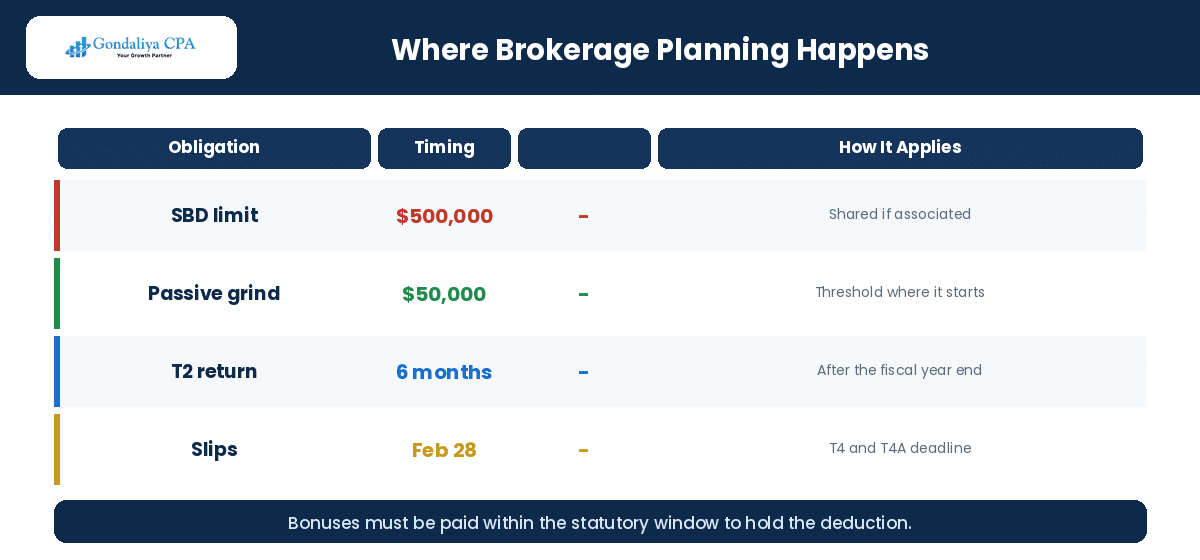
The federal small business limit is $500,000 of active business income, shared across associated corporations and reduced where passive investment income is significant.
How does passive investment income affect insurance broker tax planning?+
Passive investment income above $50,000 in a year begins grinding down the small business deduction available in the following year, increasing tax on active income.
What CPP contributions apply to incorporated brokers?+
A corporation paying salary remits both the employee and employer share of CPP, and the rate and earnings ceilings are set annually. Please confirm current figures before budgeting.
When must T4 and T4A slips be filed for commissions and salaries?+
All T4 and T4A slips must be filed by the last day of February following the calendar year.
How often are corporate instalment payments due for insurance brokerages?+
Instalments are monthly or quarterly depending on your circumstances and prior-year tax, calculated against your fiscal year rather than the calendar.
What are MGA holdbacks and how do they impact cash flow?+
MGA holdbacks delay commission payments. Managing reserves for these helps smooth cash flow.
What risks come with personal services business rules for insurance brokers?+
A corporation working essentially as an employee for one payer can be reassessed as a personal services business, which removes the small business deduction and most expense claims.
Should incorporated insurance brokers pay themselves via salary or dividends?+
A balanced mix suits most. Salary builds RRSP room and CPP entitlement while dividends avoid CPP cost, and the right split changes year to year.
How do chargeback reserves relate to lapsed policies?+
Chargeback reserves anticipate reversals on lapsed policies and help avoid unexpected taxable income spikes.
Is paying a spouse or family member advisable for tax planning?+
Yes, if the work performed is real, the amount is reasonable, and it is documented. Otherwise the split-income rules and reasonableness test apply.
When is it beneficial to use a holding company structure in an insurance brokerage?+
Holding companies suit brokerages with significant retained earnings needing protection, but they add annual administrative cost, so the benefit has to justify it.
What issues arise from shareholder loans and personal spending?+
Improper use of shareholder loans may trigger income inclusion and reassessment under section 15(2).
How does GST/HST apply to commissions earned by insurance brokers?+
Most financial service commissions are exempt supplies. Exempt supplies carry no input tax credits, which changes what you can recover on your costs.
What key year-end planning moves improve tax efficiency?+
Declaring bonuses before year end and paying them within the statutory window, recording reserves properly, and setting cut-off correctly on earned commissions.
Which tax strategies should insurance brokers avoid to prevent audits?+
Avoid undisclosed override splits, non-arm’s length family payments without paperwork, and over-claiming expenses relative to income.
Fifteen questions and one sitting under most of them: how do I get paid, and when. Everything else in brokerage tax planning follows from that answer. Figures changed for privacy.
Key Tax Planning Insights for Insurance Brokers
Key Tax Planning Insights
Quick Reference
Thresholds and Rates That Shape the Plan
- The federal small business limit of $500,000 caps how much active income gets the reduced rate.
- Passive investment income above $50,000 begins grinding that limit down in the following year.
- CPP cost affects salary planning, and the rate and ceilings are set annually.
- Meals and entertainment expenses are deductible only up to 50%.
- Non-eligible dividends carry their own gross-up and credit, which drives the integration comparison.
- Vehicle costs fall into Class 10 or 10.1 depending on cost, with a prescribed ceiling.
- The strict deadline for T4 and T4A slip filing is the last day of February annually.
- Instalment obligations depend on prior-year tax, and timely payment avoids interest.
Structural and Operational Levers
- Provincial regulators govern licensing, and compliance matters for deductible expense claims.
- Personal services business risk arises where related party work lacks proper contracts or the corporation serves one payer.
- MGA holdbacks require careful reserve management to stabilize cash flow.
- Chargeback reserves mitigate tax shocks from policy cancellations or lapses.
- The salary versus dividend choice affects RRSP room creation and CPP contributions paid.
- Paying a reasonable salary to family members supports tax-efficient income splitting where the work is real.
- Holding companies can protect assets but increase annual administrative costs.
- Shareholder loan clean-ups under section 15(2) prevent unintentional taxable benefits.
- Proper GST/HST handling reflects that exempt financial service commissions carry no input tax credits.
- Effective year-end planning includes bonus timing aligned with renewal periods.
- Aggressive strategies that conflict with the personal services business rules are best avoided.
- Meticulous records support every deduction and income classification claimed.
For personalized advice on these topics and more, contact Gondaliya CPA at info@gondaliyacpa.ca or call 647-212-9559 today.
Twenty points and one underneath them: know how much of your income is active and how much is passive. That single split drives the rate you pay. Figures changed for privacy.
Brokerage Situations We Serve
Industry Expertise
Which lever matters most differs by brokerage. Here are ten and the usual focus.
| Brokerage Situation | Where the Planning Concentrates |
|---|---|
| Solo producer, one agency | Personal services business risk on a single payer |
| Personal lines P&C brokerage | Renewal cadence and instalment matching |
| Commercial lines producer | Large first-year commissions and income spikes |
| Life and living benefits advisor | MGA holdbacks and chargeback reserves |
| Split override arrangements | Documentation matching the actual money flow |
| Growing retained earnings | Passive income grinding the small business limit |
| Family members on payroll | Reasonableness and the split-income rules |
| Multiple related corporations | Associated corporations sharing the limit |
| Considering a holdco | Asset protection weighed against admin cost |
| Behind on filings | Catch-up returns and instalment interest exposure |
- Solo producer, one agency: The structural risk that outweighs every deduction question.
- Personal lines P&C brokerage: Steady renewals make instalments easier to match.
- Commercial lines producer: One large placement can distort a whole fiscal year.
- Life and living benefits advisor: Holdbacks and clawbacks drive the reserve position.
- Split override arrangements: Paperwork that does not match the flow invites reassessment.
- Growing retained earnings: Investment income earned this year affects next year’s rate.
- Family members on payroll: The work has to be real and the amount reasonable.
- Multiple related corporations: The limit is shared, not multiplied.
- Considering a holdco: Worth it above a certain retained balance, not below it.
- Behind on filings: Interest accrues quietly and compounds the problem.
The brokerage changes which lever matters. It does not change the method, which is track commission by stream, reserve for chargebacks, then set the remuneration mix deliberately. Figures changed for privacy.
Professional Guidance and Quick Reference
Guidance
Professional Guidance for Brokers: How Gondaliya CPA Builds Your Tax Plan
Incorporated insurance brokers reduce tax and improve cash flow through a handful of levers: timing commission recognition across first-year, renewal and override streams, reserving for MGA holdbacks and chargebacks, protecting the small business deduction from the passive investment income grind, setting the salary and dividend mix deliberately, and declaring bonuses before year end so the deduction lands correctly. Gondaliya CPA handles brokerage tax planning on a fixed annual fee.
We handle what decides the outcome: separating first-year from renewal and override commission so the timing is visible, building documented chargeback reserves before the clawback arrives, monitoring passive investment income against the small business limit, checking associated corporation status across a related group, testing personal services business exposure where one payer dominates, modelling salary against dividends for RRSP room and CPP cost, and matching instalment obligations to your renewal cycle.
Our team starts with how you get paid, because commission structure drives the timing, the reserve and the remuneration decision all at once. Personal lines, commercial lines or life and living benefits, you get clear advice and a fixed price before we start.
Quick Answers: Key Numbers & Concepts at a Glance
At a Glance
- Small business limit: $500,000, shared if associated
- Passive income grind: Starts above $50,000
- Corporate return: T2, six months after year end
- Balance owing: Two or three months after year end
- Slips: T4 and T4A by end of February
- Meals: 50% deductible
- Vehicles: Class 10 or 10.1
- Commissions: Generally exempt for GST/HST
- Main risk: Personal services business treatment
- Records: Six years retention
Who This Is For / Not For
Fit Check
- For: Incorporated insurance brokers, producers and brokerages in Canada earning commission income across personal lines, commercial lines, life or living benefits.
- Not For: Brokers employed on a T4 by an agency, who file a personal return rather than a corporate one.
People Also Ask
Related Questions
Can a producer bill commissions through a corporation at all?+
It depends on your licensing framework and the carrier or agency agreement. Please confirm your regulator’s position before restructuring the flow.
Do I charge GST/HST on referral fees?+
Referral fees are not automatically exempt the way commission on a financial service is. The treatment turns on what was actually supplied.
What if my commission income spiked this year and instalments were based on last year?+
You may face a shortfall at filing. Reviewing the estimate mid-year is usually cheaper than paying interest on the difference.
Glossary of Key Terms
- T2: The corporation income tax return.
- Small business deduction: The reduced federal rate on active business income.
- Passive investment income: Investment earnings that can grind the small business limit.
- Associated corporations: Related companies sharing one business limit.
- Personal services business: An incorporated employee arrangement taxed punitively.
- First-year commission: The upfront commission on a newly placed policy.
- Renewal commission: The recurring commission on a policy in force.
- Override: A commission share paid on another producer’s business.
- Trailer: Ongoing commission tied to a book of business.
- MGA holdback: Commission retained by the managing general agency.
- Chargeback: Commission reversed when a policy lapses early.
- Chargeback reserve: An amount set aside against expected reversals.
- Integration: The comparison of corporate plus personal tax on salary versus dividends.
- Capital dividend account: The pool allowing certain tax-free distributions.
- Section 15(2): The shareholder loan and benefit provision.
- Instalments: Periodic prepayments of corporate tax.
Brokerage Tax Planning Readiness Check
This quick self-check indicates where your operation most likely has room. Please answer the six questions below.
Brokerage Tax Planning Readiness Check
Six quick questions on your brokerage. No fee shown.
Points to raise with us:
This is a general prompt, not tax or legal advice or a quote. Your position depends on your full facts. For a real review, please book a free consultation.
Want a checklist to work from? You can download our free insurance broker tax planning checklist before your consultation.
Track first-year, renewal and override commission separately. Reserve for holdbacks and chargebacks as they arise. Watch passive investment income against the limit. Check whether your corporations are associated. Test personal services business exposure where one payer dominates. Declare bonuses before year end and pay within the window. Review the salary and dividend mix annually. Please keep six years of records.
2026 Update — what is current: This article reflects rules current to 2026. The federal small business limit of $500,000, the $50,000 passive investment income threshold at which the grind begins, the six-month T2 filing deadline, the end-of-February slip deadline, the 50% limit on meals and entertainment, the section 15(2) shareholder benefit rules and the six-year retention requirement are unchanged. Please note that the federal small business limit is $500,000 rather than $600,000; that the Class 14.1 rate for eligible capital property is 5% rather than 25%; that CPP rates, ceilings and the passenger vehicle capital cost limit are revised annually; and that instalment obligations are calculated against your fiscal year rather than fixed calendar months, so please confirm each figure before relying on it.
Insurance Broker Tax Planning Canada: How Gondaliya CPA Helps Brokerages Cut Tax and Smooth Cash Flow
Start with how you get paid
Gondaliya CPA separates first-year, renewal and override commission so the timing is visible, builds documented chargeback reserves before the clawback arrives, monitors passive investment income against the small business limit, checks associated corporation status across your group, tests personal services business exposure, models salary against dividends for RRSP room and CPP cost and matches instalment obligations to your renewal cycle, on a flat annual fee including HST with a one-business-day response. Please book a free consultation.
Next Steps
Please book a free consultation with Gondaliya CPA and bring a commission statement showing your first-year, renewal and override split, details of any MGA holdback arrangement, and your last filed corporate return. Those three tell us immediately where the timing risk sits, what reserve you need, and whether the remuneration mix still fits. You will get a flat annual fee including HST before any work begins. If our content helps, please add gondaliyacpa.ca as a preferred source on Google.
Published: · Last updated:
Editorial policy: We research against CRA and CPA Ontario sources, fact-check the figures, and Sharad Gondaliya, CPA, reviews the content, which we update as the rules change.
Disclaimer: This article is educational information only and is not tax, legal, or financial advice. Figures marked illustrative are examples rather than quotes or guarantees. It reflects CRA rules current to 2026, including the $500,000 small business limit, the $50,000 passive income threshold, the six-month T2 filing deadline, the end-of-February slip deadline, and the six-year retention requirement. Rates, limits and expensing rules change and outcomes depend on your specific facts. Please consult a CPA Ontario member before acting.

Sharad Gondaliya is a CPA Canada & CPA USA with 15 Years+ experience of Accounting, Tax, Payroll of Corporate Small Businesses as Tax Accountant. He is a CPA Ontario member (61040184) and holds US CPA licences in Washington and Montana and is well known among corporate small businesses for tax planning, efficient tax solutions, and affordable CPA services. Sharad is the Principal (Director) of Gondaliya CPA – Affordable CPA Firm in Canada. Licenses: CPA Ontario: 61040184 | CPA USA (MT): PAC-CPAP-LIC-033176 | CPA USA (WA): 57629 | CPA Firm License: 61330051 View Full Author Bio