



Tax Deductions for Tire Shops in Canada: What Tire Business Owners Can Legally Claim
Tire Shop Tax Deductions Canada: Guide to Tire Business Expenses and Automotive Tax Savings with Gondaliya CPA
Tire shop tax deductions Canada are essential for managing tire business expenses effectively, and Gondaliya CPA offers clear guidance on maximizing automotive tax deductions and tire shop tax savings. Understanding allowable expenses and tax credits helps tire shop owners reduce taxable income while maintaining compliance with Canadian tax laws.
Quick Summary
If you run a tire shop in Canada, knowing which expenses you can deduct is a big help for cutting your taxes. Tire shop tax deductions Canada cover many costs that keep your business running. These include buying tires, paying employees, and covering rent or utilities. Claiming these right can save money and keep you in good standing with the CRA.
Reading time: 46 minutes.
Table of Contents
- Overview of Vehicle Expenses and Classification
- Types of Deductible Vehicle Expenses
- Tracking Automobile Expenses
- Compliance and Common Mistakes
- Optimizing Tax Savings
- Professional Support and Resources
- Frequently Asked Questions
- Key Points on Tire Shop Tax Management
- Tire Shop Situations We Serve
- Professional Guidance and Quick Reference
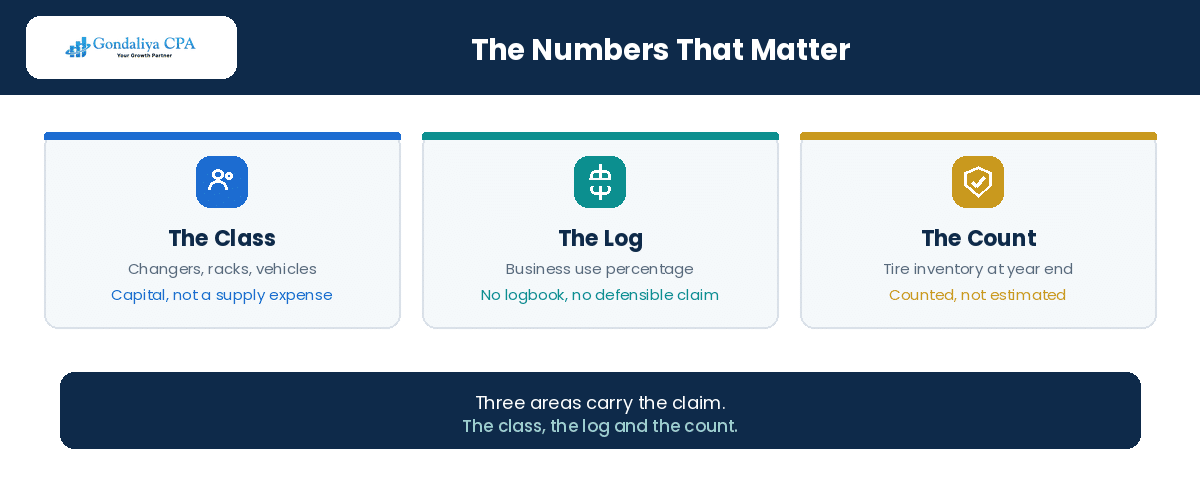
The Numbers That Matter
This article covers Canada, with Ontario and Toronto context, and reflects rules current to 2026. It assumes an incorporated tire shop or automotive service business with shop equipment, service vehicles and inventory. Figures marked illustrative are examples, not quotes, and any masked engagement notes end with “Figures changed for privacy.” This is educational information only and not tax or legal advice. Passenger vehicle cost ceilings, lease limits and per-kilometre rates are all revised periodically, so please confirm current amounts before filing.
Tire Shop Tax Deductions Canada: Overview of Business Expenses
Overview of Vehicle Expenses and Classification
The Basics
Motor Vehicle Expenses Relevant to Tire Shops
Motor vehicle expenses count a lot among automotive tax deductions. For tire shops, this usually means:
- Fuel costs for vehicles used in the business
- Repairs and maintenance to keep vehicles working
- Insurance premiums protecting your vehicles
- Depreciation through capital cost allowance claims
Knowing what fits here helps make sure you don’t miss any deductible vehicle costs.
Vehicle Definition and Classification
The CRA sets rules on how to classify your vehicles for tax purposes. There are two broad categories:
- Passenger vehicles, which are subject to a prescribed capital cost ceiling revised periodically.
- Motor vehicles that fall outside the passenger vehicle definition, such as certain vans and pickups used mainly for business, which are not subject to that ceiling.
Class 10 applies to most vehicles at or below the prescribed limit, letting you claim depreciation over time. Vehicles above the ceiling sit in Class 10.1, where the deductible cost is capped.
Business Use: Eligibility and Impact on Deductions
You must show that your vehicle expenses relate to business use. That means:
- Keeping vehicle logbooks showing mileage for work versus personal trips
- Calculating the business use percentage accurately
Only the portion of use related to your tire business counts as a deduction. Keeping clear records helps if the CRA asks questions later.
Ownership Structures: Owned, Joint and Leased Vehicles
How you hold the vehicle changes how deductions work:
- Owned vehicles: You deduct actual operating costs tied to business use, plus capital cost allowance.
- Joint ownership: Each owner claims based on their share and their own business use.
- Leased vehicles: Lease payments are deductible but only up to prescribed limits for passenger vehicles.
Knowing these details prevents mistakes when claiming expenses based on whether you own or lease.
Key Forms for Claiming Vehicle Expenses
You need the right forms when reporting motor vehicle expenses:
- T2125: Statement of business or professional activities, for unincorporated operators
- Form T777: Statement of employment expenses, where an employee claim applies
- GST/HST records: Supporting input tax credit claims
Incorporated shops report through the corporate return rather than the T2125. These records help you claim without trouble during filing or a CRA review.
The vehicle question splits every tire shop file in two. Shops with a logbook claim what they are owed; shops without one argue about percentages they cannot prove. Figures changed for privacy.
Risk Warning: A vehicle above the prescribed cost ceiling falls into Class 10.1, where the deductible cost is capped. Please confirm the current ceiling before assuming the full price is claimable.
Types of Deductible Vehicle Expenses for Tire Shops
Types of Deductible Vehicle Expenses
The Expenses
Tire shop tax deductions in Canada cover many vehicle-related expenses. Incorporated tire businesses can claim these to lower taxable income. These automotive tax deductions include operating costs, depreciation through capital cost allowance, interest on vehicle loans, lease payments, GST/HST matters, and taxable benefits for employer-provided vehicles. Knowing how each works helps you follow CRA rules and get the best tire shop tax savings.
Operating Expenses
Vehicle expenses tied directly to your tire business are generally deductible where you keep proper records and the amounts are reasonable. Common deductible tire business expenses include:
- Fuel costs for vans used for business trips
- Oil changes and repairs on delivery trucks
- Insurance premiums related to business use
- Parking fees during work hours
- Licensing fees for vehicles used in operations
For example, fuel for a mobile tire installer’s van is deductible in proportion to business use. Routine work like brake repairs on your fleet trucks also counts as a current expense.
Keep detailed invoices with dates, vendor names, and service descriptions tied to business use. Exclude personal use based on a logbook or mileage records.
Capital Cost Allowance and Depreciation
You don’t expense vehicles all at once. Fixed costs are depreciated over time using capital cost allowance. Passenger vehicles fall under Class 10 or 10.1 depending on cost relative to the prescribed limit. Heavier trucks may sit in a different class.
Here’s what matters:
- Class 10 carries a 30% declining balance rate each year.
- The half-year rule generally limits your claim to half the normal amount in the year the vehicle becomes available for use.
- Where an accelerated or immediate expensing measure applies, it may change this, but passenger vehicles above the ceiling remain capped.
A shop buys a service truck for $45,000 that is not a passenger vehicle, so no cost ceiling applies. In Class 10 at 30% with the half-year rule, the first-year claim is $6,750. If the same vehicle were a passenger vehicle above the prescribed ceiling, the claim would be based on the capped amount instead. Figures changed for privacy.
Keep accurate records of purchase price including non-refundable taxes, acquisition date, and asset class.
Interest on Vehicle Loans
Interest on money borrowed to buy vehicles used in your tire business may be deductible, subject to the prescribed limits for passenger vehicles.
Remember:
- The borrowing must be traceable to the purchase of an eligible vehicle.
- Where a loan funds both personal and business use, only the business portion counts.
Keep loan documents showing the amounts tied to business assets, plus payment schedules showing interest paid during the tax period.
Lease Payments and Related Treatment
If you lease vehicles for your incorporated tire shop, lease payments can be deducted where they meet the reasonableness test:
- Monthly lease payments for passenger vehicles are deductible up to a prescribed monthly ceiling, which is revised periodically.
- Amounts that reduce principal under a purchase arrangement are not current expenses.
Where leases are between related parties at below-market rates, the CRA may adjust the treatment, so please have such arrangements reviewed.
Keep contracts with clear payment details and proof of payment for any review.
GST/HST on Vehicle-Related Expenses
Registered Canadian businesses like incorporated tire shops can claim input tax credits on GST/HST paid on eligible vehicle costs including fuel, parts, repairs, rentals and leases, where the conditions are met:
- Keep original receipts or invoices showing the tax charged and the vendor’s registration number.
- Match purchases or services to your taxable supplies.
- Exclude personal use based on logs or mileage tracking.
Failing here risks losing credits plus interest. Keeping good electronic records helps during a review.
Taxable Benefits on Employer-Provided Vehicles
When employers provide passenger vehicles available for personal use, including commuting, to employees or owner-managers, this creates taxable benefits reported on T4 slips.
Important details:
- The passenger vehicle cost ceiling affects how the benefit is calculated.
- Standby charges are based on cost and the number of days the vehicle is available.
- An operating cost benefit applies unless the employee reimburses personal-use costs within the required period.
These benefits increase employment income and change payroll withholding obligations. Detailed logbooks separating personal from business kilometres are necessary, and reimbursements need receipts to reduce the benefit properly.
Standby charges catch owner-managers off guard more than any other item. The vehicle sits in the yard available for use, and the benefit accrues whether it moves or not. Figures changed for privacy.
Key Stat: Availability, not actual use, drives the standby charge. Please track availability days alongside kilometres.
How to Track Automobile Expenses for Tax Purposes
Tracking Automobile Expenses
The Logbook
If you run a tire shop in Canada, keeping track of your vehicle expenses matters a lot. It helps you claim the right automotive tax deductions. When you properly document how you use your vehicle, you can write off tire business expenses tied to it. This makes your tax filing smoother and improves your tire shop tax savings.
Mileage Tracking Requirements and Best Practices
Tire shops need clear records of business kilometres driven. The Canada Revenue Agency expects a logbook or equivalent record showing the date, destination, purpose, and distance of each trip. This separates personal driving from work trips.
Here’s what to do:
- Write down trips as they happen, not later.
- Use digital apps or paper logbooks that meet CRA standards.
- Keep business trips like mobile service calls separate from parts runs.
- Save receipts for fuel, repairs, insurance, and leases linked to the vehicle.
Accurate mileage logs back up your vehicle cost claims and support the business use percentage you rely on.
Full Logbook and Sample Period Methods
The CRA allows a full logbook or, once a full base-year logbook exists, a representative sample period.
Full logbook. Keep a detailed logbook for a complete twelve-month period, tracking total and business kilometres. You then claim actual expenses including fuel, repairs, insurance, lease payments, loan interest within the limits, and parking, apportioned by business use.
Sample period. After establishing a full base-year logbook, a shorter representative period can be used to project business use in later years, provided the pattern is consistent. This is not a substitute for the base year, so please do not start with a sample.
Note that a flat per-kilometre allowance is generally an employer reimbursement mechanism rather than a claim method for a business deducting its own vehicle costs. Please confirm which applies to your situation before relying on it.
Calculating the Deductible Percentage
To find how much mileage is deductible, divide your business kilometres by total kilometres and multiply by one hundred.
A tire shop owner in Toronto drives 20,000 kilometres in a year, of which 12,000 are business trips. Business use is therefore 60%, and 60% of the eligible vehicle costs can be claimed. Figures changed for privacy.
| Metric | Value |
|---|---|
| Total kilometres | 20,000 km |
| Business kilometres | 12,000 km |
| Business use percentage | 60% |
Use this percentage to calculate how much of your vehicle expenses qualify, whether through capital cost allowance or operating costs.
Applying the Percentage to Vehicle Expenses
Once you have your business use percentage:
- Only that portion of expenses counts as deductible.
- You can include fuel, maintenance, insurance and lease payments, apportioned accordingly.
- Loan interest deductions apply but only up to the prescribed limits for passenger vehicles.
- Personal travel must be excluded entirely.
Following these rules keeps your claims defensible and avoids problems during a CRA review.
Documentation and Recordkeeping Obligations
You need solid proof to support any auto expense claim:
- Detailed mileage logs listing dates, purposes and destinations, showing business against total kilometres
- Receipts for fuel purchases
- Bills for repairs or maintenance services
- Insurance policies showing coverage periods and costs
- Lease contracts with payment details where leasing applies
- Loan statements showing interest paid
Keep all these records for six years after the end of the tax year they relate to. Electronic copies count if stored so they remain legible. Without proper documents, deductions may be denied, which raises your taxable income unexpectedly.
For guidance on automotive tax deductions for incorporated tire shops, email info@gondaliyacpa.ca or call 647-212-9559.
The base-year logbook is the piece shops skip. Without it there is nothing to sample from, and a three-month record on its own rarely holds up. Figures changed for privacy.
Pro Tip: Please record the odometer at the start and end of the year as well as each trip. Total kilometres are the denominator in every percentage you claim.
Compliance and Avoiding Common Mistakes in Tire Shop Claims
Compliance and Common Mistakes
The Risks
Tire shop tax deductions Canada demand you follow CRA rules closely. Tire business expenses and automotive tax deductions must be legitimate and documented. Doing this right helps you save tax without inviting a review.
CRA Documentation Requirements
The Canada Revenue Agency expects all tire business expenses to be reasonable and incurred to earn income. You need proper documents like receipts, invoices, bank statements, contracts, and detailed logs. For automotive claims on service vehicles or mobile units, keep mileage logs with date, purpose, distance travelled, and vehicle information.
If you claim expenses without proof, the CRA can deny them. For example:
- Buying a new tire changer? Keep the invoice with cost and proof of payment.
- Advertising? Save copies of ads or contracts with media outlets.
Keep your records organized to support claims for inventory purchases or wages. The CRA expects these documents to be kept for six years after the tax year ends.
Red Flags That Draw CRA Attention
Some things make the CRA look more closely at your claims:
- Cash sales not recorded in the books
- Automotive expense claims that are high relative to revenue
- Large improvements booked as current expenses instead of capital assets
- Paying family members without evidence they performed work
- Missing GST/HST documentation on significant purchases
These often come from overstating automotive deductions or unsupported expenses. Claiming full vehicle lease costs without logs showing business use is a common example.
Avoid these by keeping good records and applying the reasonableness test carefully.
Retention Timeline
| Document Type | Retention Period | Notes |
|---|---|---|
| Invoices and receipts | At least 6 years | From fiscal year-end |
| Mileage logs | At least 6 years | Must have trip-level detail |
| Payroll records | At least 6 years | Includes T4 slips |
| Lease agreements | Lease term plus 6 years | Covers rent and improvements |
Start early to avoid last-minute pressure around filing deadlines such as the T2 return, due six months after fiscal year-end. Digital copies are fine if they remain accessible and legible.
Common Errors: Weak Logs and Over-Claiming
Automotive deductions rely on clear mileage records showing real business use. Common mistakes include:
- Recording only monthly totals without trip information
- Counting personal trips as deductible business travel
- Using a fixed percentage without supporting evidence
These errors reduce your tire shop tax savings when reviewed. Keep logs showing the date, odometer readings and purpose for each trip, such as a parts delivery, and separate personal from business travel clearly.
Employers must also follow payroll rules when paying employees for vehicle use, to avoid taxable benefit problems.
Repairs Versus Improvements
Knowing the difference between repairs and improvements matters for claiming tire business expenses.
Repairs restore an asset without materially bettering it, and are deducted in full when incurred.
Improvements increase value or extend useful life, and are capitalized and depreciated over time.
Examples:
- Replacing worn parts on an existing hoist is a repair, deducted now.
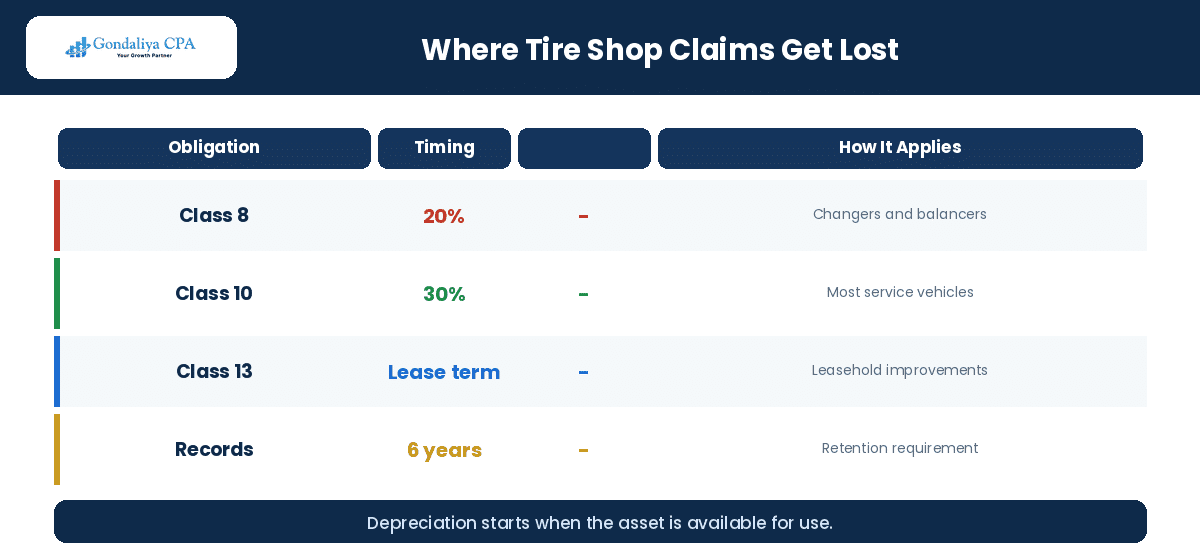
- Installing a new alignment rack is a capital purchase, typically Class 8.
Mislabelling these leads to denied deductions or adjustments later, particularly on disposal.
Personal Use and Home Office
You can’t claim personal vehicle use. It has to be split properly with accurate logs showing only work kilometres. Where you use part of your home for mobile service administration, that space may qualify as a workspace-in-home deduction if the CRA conditions are met. This can include a share of utilities but not general household costs unrelated to the business.
Phone bills should separate private calls from business dispatch, ideally using itemized statements. Software subscriptions used both personally and commercially need a similar reasonable allocation.
For guidance on automotive deductions specific to incorporated Toronto-area shops, call 647-212-9559 or email info@gondaliyacpa.ca for a free consultation.
The repair versus improvement call is where tire shops most often go wrong. A new alignment rack is not a repair to the shop, however much it feels like maintenance. Figures changed for privacy.
Risk Warning: A monthly mileage total with no trip detail is not a logbook. Please record each trip individually, since a reconstructed summary rarely survives a review.
Optimizing Tire Shop Tax Savings Through Expense Management
Optimizing Tax Savings
The Strategy
Running a tire shop means keeping an eye on expenses. Managing your tire business expenses well helps you capture automotive tax deductions and improve tire shop tax savings in Canada. It comes down to sorting costs the right way and keeping good records. That lowers taxable income and keeps you on the right side of CRA rules.
Ownership Versus Leasing
Choosing between owning or leasing vehicles changes how you deduct automotive costs. If you own, you claim capital cost allowance on the purchase price, subject to the passenger vehicle ceiling where it applies.
Lease payments are also deductible, but only up to the prescribed monthly limit. GST/HST paid on leases can be recovered as an input tax credit, separately from the lease deduction itself.
Leasing offers steady monthly payments without a large upfront cost, but reduces your capital cost allowance pool. Owning lets you depreciate the asset over time but means tracking what happens on disposal, including recapture or terminal loss.
Either way, you must split business and personal use carefully.
A tire shop in Toronto leases a van and deducts the lease payments up to the prescribed monthly ceiling, recovering the HST separately as an input tax credit. The owner keeps detailed mileage logs to separate business trips from personal ones. Figures changed for privacy.
Mixed Personal and Business Use
Tire shops often use one vehicle for work deliveries and personal trips. How that vehicle is classified affects which motor vehicle expenses you can claim, including fuel, repairs, insurance, lease payments and capital cost allowance.
The CRA allows deductions only in proportion to income-earning use. That means logbooks recording dates, trip reasons, and distance for each drive.
Some vehicles used mainly for mobile service may fall outside the passenger vehicle definition, which changes the applicable class and removes the cost ceiling. Confirming this early is worthwhile.
Digital Tracking Tools
Digital tools make logbook compliance easier. They record mileage accurately and reduce paperwork, sorting trips by business or personal use and producing reports if the CRA asks.
Good habits include:
- Recording odometer readings before and after trips
- Noting why each trip happened
- Saving digital copies alongside paper receipts
- Keeping the app updated so records meet current standards
Clear records support your automotive deductions when filing corporate taxes and meet the CRA’s evidence requirements.
Maximizing Capital Cost Allowance
To get the most from capital cost allowance, place assets in the right classes.
| Asset Type | CCA Class | Rate | Half-Year Rule |
|---|---|---|---|
| Tire changer and balancer | Class 8 | 20% | Applies |
| Passenger vehicle | Class 10 or 10.1 | 30% | Applies |
| Computer equipment | Class 50 | 55% | Applies |
| Leasehold improvements | Class 13 | Over lease term | Applies |
The half-year rule limits your claim to half the usual amount in the year an asset becomes available for use, unless a specific accelerated measure applies to that property and period.
Buying equipment before year-end and classifying it correctly can improve your deduction, provided the asset is actually available for use.
GST/HST Input Tax Credits
If your tire shop is incorporated and registered for GST/HST, you can recover tax paid on eligible purchases. This includes inventory, equipment, utilities tied to the business, rent where applicable, and operating costs.
To get these credits right:
- Keep original invoices showing the vendor’s registration number
- Allocate mixed-use items reasonably
- File returns on time claiming all eligible credits
Failing here risks losing credits during a review, plus interest.
Watch how provincial tire stewardship or environmental fees are handled, since the treatment affects both revenue reporting and your credit position. These programmes are provincially administered and change, so please confirm the current requirements for your province.
Summary of Key Opportunities
Tire shop owners gain from watching these areas closely:
- Know what counts as current versus capital spending among tire business expenses.
- Use correct vehicle classifications to support automotive deductions.
- Use mileage tracking to back up motor vehicle expense claims.
- Time depreciable asset purchases so the available-for-use and half-year rules work in your favour.
- Collect proper GST/HST invoices so input tax credits cover what they should.
Doing these together captures the tire shop tax savings legally available to incorporated small businesses.
Timing an equipment purchase before year end only works if the machine is installed and running. An alignment rack still in its crate is not available for use. Figures changed for privacy.
Key Stat: Leasehold improvements go to Class 13 and are written off over the lease term, not the 20% you might assume from equipment. Please check the lease length first.
Professional Support and Additional Resources
Professional Support and Resources
The Support
If you run a tire shop in Canada, understanding your tax deductions can feel complicated. You need to know which tire business expenses count and how automotive tax deductions work. This knowledge helps you save money by using everything tire shop tax deductions Canada allows. Knowing the rules about capital cost allowance and CRA compliance is key, especially for incorporated shops across Ontario and beyond.
Working With Gondaliya CPA
Gondaliya CPA helps you identify every deduction available. We know how to tell current expenses apart from capital costs. This lets you claim properly without breaching the reasonableness test. Our advice lowers the chance of a review and makes sure tire business expenses are legitimately deducted or amortized. Whether you have a multi-bay store, a mobile unit, or a franchise, we build plans that fit your setup.
Services Focused on Expense Optimization
We focus on making your automotive tax deductions work harder. Our services include:
- Reviewing all deductible expenses including inventory handling, equipment purchases such as balancers and changers, rent shares, and utility splits by bay
- Planning capital cost allowance around the applicable rules and any expensing measures
- Advice on payroll so technician wages and bonuses are properly supported
- Help with GST/HST filing to capture input tax credits on operations and capital purchases
We combine accurate bookkeeping with corporate tax filing, so every dollar spent works to lower taxable income within the rules.
Tools to Manage Expenses Year-Round
We provide tools to help you manage tire business expenses through the year. Examples include:
- Inventory valuation worksheets for year-end counts
- Registers tracking capital assets and depreciation classes for shop equipment
- Logbook templates to separate personal from business vehicle use
- Checklists covering advertising, employee benefit records, and environmental fees
These keep your records organized and ready if the CRA asks. They also surface write-offs before year-end pressure builds.
Preparing for a CRA Review
If the CRA reviews your claims, being ready matters. We help you assemble:
- Invoices linking supplier charges to business use
- Payroll reports showing bonuses that are reasonable
- Vehicle logs showing personal versus commercial mileage
- Lease documents explaining rent splits
- Proof of environmental fees paid under the applicable programme
We spot common triggers such as high vehicle costs relative to revenue or missing input tax credit documentation, so issues get fixed early. We also advise on the record retention the law requires. For background, see our CRA audit guide.
Official Guidance Worth Knowing
The CRA publishes guidance covering business expenses, capital cost allowance classes and rates, and the documentary requirements for input tax credits. These cover the federal rules on deductible automotive costs. Provincial environmental fee programmes affecting tires sold or recycled are administered separately, so check your province’s current requirements directly.
Get Customized Advice
Want real tire shop tax savings? Gondaliya CPA offers advice built for your situation, from one-bay shops to larger fleet suppliers across Toronto and Ontario. Call 647-212-9559, email info@gondaliyacpa.ca, or reach us here for a free conversation about your incorporated business. We cover inventory handling, capital cost allowance strategy and more, all under flat-fee pricing with no surprises.
Seasonal storage is the item unique to tire shops that we most often find mishandled. Fees collected in October for storage running to April sit across two periods. Figures changed for privacy.
Pro Tip: Please treat prepaid seasonal storage as deferred revenue recognised over the storage period, rather than income on collection.
FAQs about Tire Shop Tax Deductions in Canada
Frequently Asked Questions
FAQ
What are the record retention requirements for tire shop tax documents?+
You must keep invoices, mileage logs, lease agreements, payroll records, and receipts for at least six years from the end of the fiscal year.
How does the reasonableness requirement affect tire business expense claims?+
The Income Tax Act disallows expenses that are unreasonable in the circumstances or not incurred to earn income, which makes accurate documentation essential.
What is the difference between a terminal loss and recapture on vehicle disposal?+
A terminal loss arises where the class is emptied and proceeds are less than the undepreciated capital cost. Recapture is income arising where proceeds exceed the class balance.
How do environmental fees impact tire shop tax filings?+
Fees related to tire sales must be reported properly under the applicable provincial programme, which affects both revenue reporting and your GST/HST position.
Can workspace-in-home deductions apply for mobile tire service owners?+
Yes, where the space meets the CRA conditions for business use, a proportional share of eligible costs can be claimed.
Are software purchases for tire shops eligible for capital cost allowance?+
Yes. Software falls into specific classes depending on its type, and is depreciated at the rate for that class.
What are common audit triggers related to vehicle expenses in tire shops?+
Vehicle costs that are high relative to revenue, missing mileage logs, overstated lease payments, or weak evidence of business use.
How does GST/HST input tax credit eligibility work for tire shops?+
Credits can be claimed on GST/HST paid on eligible business expenses like inventory and leases, where supported by proper documentation and related to taxable supplies.
Eight questions and one underneath most of them: can you prove the business use. Documentation decides more tire shop claims than eligibility ever does. Figures changed for privacy.
Key Points on Tire Shop Tax Management
Key Points on Tire Shop Tax Management
Quick Reference
Assets, Classes and Disposal
- Classify leasehold improvements properly: Class 13 amortizes them over the lease term rather than a fixed rate.
- Maintain a detailed asset register: Track purchase dates, classes and depreciation to manage recapture or terminal losses.
- Manage trade-ins accurately: Record trade-in values so the asset cost base and CCA claims are correct.
- Watch disposal outcomes: Selling a fully depreciated asset can produce recapture, which is taxable income.
- Confirm available-for-use: Depreciation starts when the asset is ready to use, not when it is paid for.
Payroll, Benefits and Records
- Understand payroll records and bonuses: Keep clear documents including T4 slips showing wages and commissions paid.
- Report taxable benefits correctly: Declare benefits like employer-provided vehicles on T4 slips.
- Track phone expenses: Separate personal use from business calls when claiming.
- Plan corporate filing deadlines: File the T2 within six months after fiscal year-end to avoid penalties.
- Use digital logbook tools: Mileage tracking that meets CRA standards supports vehicle claims.
- Avoid non-deductible costs: Fines and personal expenditures unrelated to the business do not qualify.
Inventory, Receivables and Storage
- Value inventory consistently: Apply first in first out or weighted average the same way each year.
- Prepare receivable aging schedules: Monitor outstanding balances and write off bad debts with documentation.
- Handle prepaid storage carefully: Allocate seasonal storage fees over the period the service is provided.
- Track environmental fees: Handle the collection and remittance flow correctly under your provincial programme.
For customized support on these topics, contact Gondaliya CPA at info@gondaliyacpa.ca, call 647-212-9559, or book a free consultation.
Fifteen points and one underneath them: know which side of the capital line each purchase sits on. That call drives the asset register, the disposal outcome and the deduction. Figures changed for privacy.
Tire Shop Situations We Serve
Industry Expertise
Which issue dominates differs by shop type. Here are ten and the usual focus.
| Tire Shop Situation | Where the Exposure Sits |
|---|---|
| Single-bay independent | Capital versus current on equipment purchases |
| Multi-bay retail store | Inventory valuation and year-end counts |
| Mobile tire service | Vehicle logs and business-use percentage |
| Seasonal storage operator | Prepaid storage recognised over the period |
| Franchise location | Franchise fees and leasehold improvements |
| Shop with delivery fleet | Class assignment and standby charges |
| Owner using one vehicle | Mixed personal and business apportionment |
| Heavy equipment investment | Available-for-use timing before year end |
| High cash volume | Sales recording and documentation trails |
| Behind on records | Reconstruction and adjustment requests |
- Single-bay independent: A changer or balancer is capital, not a supply expense.
- Multi-bay retail store: Stock on hand at year end drives cost of goods sold.
- Mobile tire service: Without a logbook the vehicle claim has no foundation.
- Seasonal storage operator: October fees cover months in the next period.
- Franchise location: Fees and fit-out costs rarely belong in one class.
- Shop with delivery fleet: Availability creates a benefit even when parked.
- Owner using one vehicle: The percentage must be provable, not assumed.
- Heavy equipment investment: A crated machine is not available for use.
- High cash volume: Unrecorded sales are the fastest route to a review.
- Behind on records: Correcting first costs less than correcting after contact.
The shop type changes where the exposure sits. It does not change the method, which is classify every purchase correctly, log the driving, then count the inventory. Figures changed for privacy.
Professional Guidance and Quick Reference
Guidance
Professional Guidance for Shop Owners: How Gondaliya CPA Reviews Your Claims
Tire shops lose deductions in a predictable set of ways: vehicle claims made with no logbook to support the business-use percentage, equipment expensed when it should be capitalized, leasehold improvements put in the wrong class, inventory estimated rather than counted, prepaid seasonal storage taken into income on collection, and standby charges on shop vehicles never calculated. Gondaliya CPA handles tire shop accounting on a fixed annual fee.
We handle what decides the outcome: separating capital purchases from current repairs, assigning changers, balancers, racks and vehicles to the correct capital cost allowance class, confirming available-for-use dates before year end, calculating and documenting the business-use percentage from a proper base-year logbook, valuing tire inventory consistently, recognising seasonal storage over the storage period, and reviewing standby and operating benefits on employer-provided vehicles.
Our team starts with the asset register and the logbook, because those two carry most of the value on a tire shop return. Single bay, multi-bay retail or mobile service, you get clear advice and a fixed price before we start.
Quick Answers: Key Numbers & Concepts at a Glance
At a Glance
- Corporate return: T2, six months after year end
- Class 8: 20% for shop equipment
- Class 10: 30% for most vehicles
- Class 10.1: Capped, above the ceiling
- Class 13: Leasehold, over the lease term
- Class 50: 55% for computer equipment
- First year: Half-year rule applies
- Depreciation starts: When available for use
- Logbook: Full base year, then sample
- Records: Six years retention
Who This Is For / Not For
Fit Check
- For: Incorporated tire shops, multi-bay retailers, mobile tire services and automotive service businesses across Canada.
- Not For: Provincial tire stewardship programme registration and environmental fee rate setting, which are handled by the programme administrator.
People Also Ask
Related Questions
Is a pickup used for the shop a passenger vehicle?+
Not necessarily. Certain vans and pickups used mainly for business fall outside the passenger vehicle definition, which removes the cost ceiling. The test turns on seating and business-use proportion.
How should I value tire inventory at year end?+
Use a consistent method such as first in first out or weighted average, applied the same way each year, and count the stock rather than estimating.
Can I deduct the environmental fee I remit?+
The fee is generally handled as part of your revenue and remittance flow rather than a straight deduction. Please have the treatment confirmed for your province.
Glossary of Key Terms
- T2: The corporation income tax return.
- Capital cost allowance: Tax depreciation on equipment and vehicles.
- Class 8: The 20% class covering shop equipment.
- Class 10: The 30% class covering most vehicles.
- Class 10.1: The capped class for passenger vehicles above the limit.
- Class 13: Leasehold improvements over the lease term.
- Half-year rule: The first-year restriction on CCA claims.
- Available for use: When an asset becomes eligible for depreciation.
- Recapture: Income arising where proceeds exceed the class balance.
- Terminal loss: A deduction where a class is emptied below its balance.
- Business use percentage: The share of kilometres driven to earn income.
- Base-year logbook: A full twelve-month record establishing the pattern.
- Standby charge: The benefit arising when a vehicle is available for personal use.
- Input tax credit: GST/HST recoverable on business purchases.
- Deferred revenue: Amounts collected before the service is provided.
- Environmental fee: The provincial levy applied on tire sales.
Tire Shop Readiness Check
This quick self-check indicates where your operation most likely has room. Please answer the six questions below.
Tire Shop Readiness Check
Six quick questions on your shop. No fee shown.
Points to raise with us:
This is a general prompt, not tax or legal advice or a quote. Your position depends on your full facts. For a real review, please book a free consultation.
Want a checklist to work from? You can download our free tire shop deduction checklist before your consultation.

Put every purchase on the right side of the capital line. Keep an asset register by CCA class. Run a full base-year mileage logbook. Count tire inventory rather than estimating it. Confirm available-for-use dates before year end. Recognise seasonal storage over the storage period. Review standby charges on shop vehicles. Please keep six years of records.
2026 Update — what is current: This article reflects rules current to 2026. The Class 8 rate of 20%, the Class 10 rate of 30%, Class 13 leasehold treatment over the lease term, the Class 50 rate of 55%, the half-year and available-for-use rules, the six-month T2 filing deadline and the six-year retention requirement are unchanged. Please note that the passenger vehicle capital cost ceiling, the deductible monthly lease limit and the interest deduction cap are all revised periodically, so the figures of $30,000, $34,000 and $35,000 that circulate in older guidance are each out of date; that a flat per-kilometre allowance is generally an employer reimbursement mechanism rather than a claim method for a business deducting its own vehicle costs; and that provincial tire stewardship and environmental fee programmes are administered provincially and change independently of federal tax rules.
Tire Shop Tax Deductions Canada: How Gondaliya CPA Helps Shop Owners Claim Correctly
Start with the asset register
Gondaliya CPA separates capital purchases from current repairs, assigns changers, balancers, racks and vehicles to the correct capital cost allowance class, confirms available-for-use dates before year end, calculates and documents the business-use percentage from a proper base-year logbook, values tire inventory consistently, recognises seasonal storage over the storage period and reviews standby and operating benefits on employer-provided vehicles, on a flat annual fee including HST with a one-business-day response. Please book a free consultation.
Next Steps
Please book a free consultation with Gondaliya CPA and bring a list of your shop equipment with purchase dates, your mileage logbook if you have one, and your last filed corporate return. Those three tell us immediately what remains to claim on your assets, whether the vehicle percentage holds up, and where the documentation is thin. You will get a flat annual fee including HST before any work begins. If our content helps, please add gondaliyacpa.ca as a preferred source on Google.
Sharad Gondaliya, CPA — Founder & Managing Director, Gondaliya CPA Professional Corporation
Sharad Gondaliya, CPA, has over 15 years of experience serving incorporated tire shops and automotive service businesses, covering capital cost allowance classes for shop equipment and service vehicles, the half-year and available-for-use rules, passenger vehicle cost ceilings, mileage logbook standards and business-use apportionment, lease and interest deductibility limits, tire inventory valuation, seasonal storage revenue, environmental fee handling, GST/HST input tax credits, standby charges on employer-provided vehicles, and CRA audit representation. Gondaliya CPA is a CPA Ontario Registered Firm, serving clients across Toronto, Etobicoke, Vaughan, Mississauga, Brampton, Scarborough, Ottawa, Oshawa, Guelph, Hamilton, North York, Windsor, and Canada-wide. Verify our firm on the CPA Ontario public firm directory.
CPA Ontario | US CPA licences in Washington and Montana | CPA Ontario Registered Firm | 1450+ 5-star Google reviews
Published: · Last updated:
Editorial policy: We research against CRA and CPA Ontario sources, fact-check the figures, and Sharad Gondaliya, CPA, reviews the content, which we update as the rules change.
Disclaimer: This article is educational information only and is not tax, legal, or financial advice. Figures marked illustrative are examples rather than quotes or guarantees. It reflects CRA rules current to 2026, including the Class 8 and Class 10 CCA rates, Class 13 leasehold treatment, the half-year rule, the available-for-use rule, and the six-year retention requirement. Rates, limits and expensing rules change and outcomes depend on your specific facts. Please consult a CPA Ontario member before acting.

Sharad Gondaliya is a CPA Canada & CPA USA with 15 Years+ experience of Accounting, Tax, Payroll of Corporate Small Businesses as Tax Accountant. He is a CPA Ontario member (61040184) and holds US CPA licences in Washington and Montana and is well known among corporate small businesses for tax planning, efficient tax solutions, and affordable CPA services. Sharad is the Principal (Director) of Gondaliya CPA – Affordable CPA Firm in Canada. Licenses: CPA Ontario: 61040184 | CPA USA (MT): PAC-CPAP-LIC-033176 | CPA USA (WA): 57629 | CPA Firm License: 61330051 View Full Author Bio