



How Scaffolding Companies in Canada Can Reduce Taxes and Improve Cash Flow With Strategic Tax Planning
Scaffolding Business Tax Planning Canada: How a Tax Accountant for Scaffolding Companies Can Maximize Your Scaffolding Tax Savings
TLDR: Scaffolding business tax planning Canada can significantly impact your bottom line when done correctly, and a tax accountant for scaffolding companies at Gondaliya CPA provides specialized knowledge to identify key tax credits and savings opportunities. By focusing on scaffolding company tax planning and scaffolding tax savings, they help businesses comply with regulations while optimizing financial performance.
Quick Summary
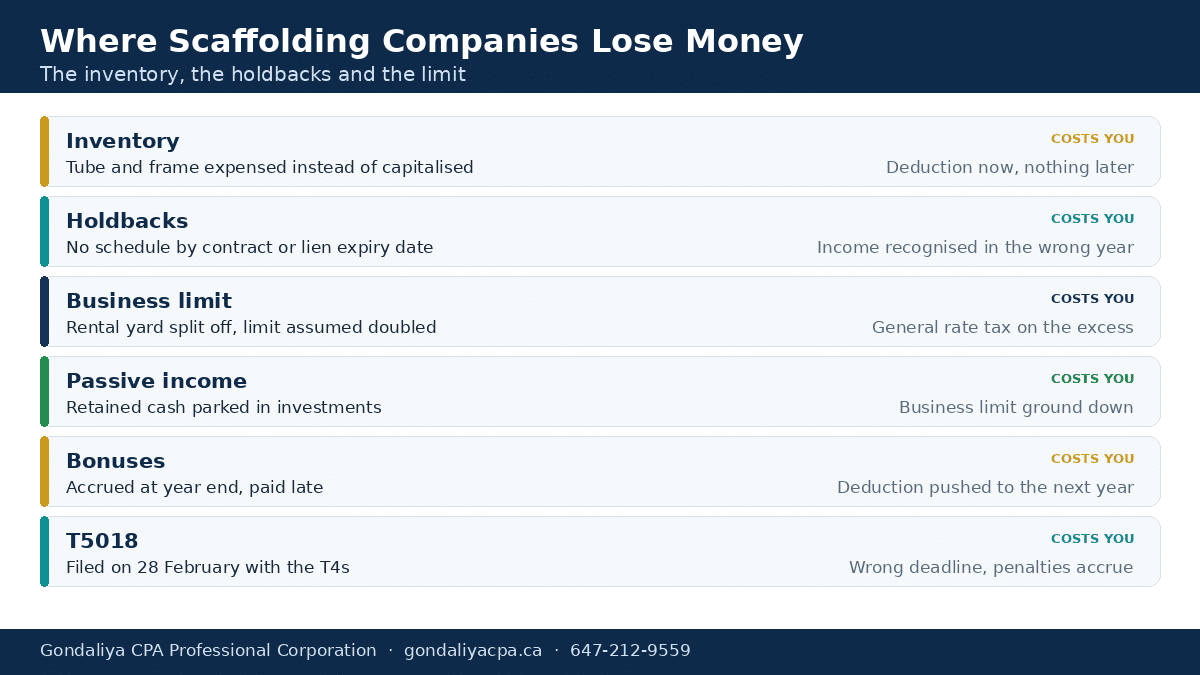
Scaffolding sits between equipment rental and construction labour, and the tax file has to work on both sides. Scaffold inventory as capital property, holdback timing under provincial lien legislation, the business limit shared across associated corporations, and the owner pay mix decide most of the outcome.
Reading time: 43 minutes.
Table of Contents
- Understanding Scaffolding Business Tax Planning in Canada
- Key Components of Scaffolding Business Tax Planning in Canada
- Key Tax Planning Strategies for Scaffolding Companies
- Specialized Tax Savings for Scaffolding Companies
- Role of a Tax Accountant in Scaffolding Business Tax Planning
- Preparing for the Scaffolding Business Tax Season
- Client Success Insights and Contact Options
- Frequently Asked Questions (FAQ)
- Additional Tax Planning Insights for Scaffolding Companies
- Professional Guidance and Quick Reference
The Numbers That Matter
This article covers Canada, with Ontario and Toronto context, and reflects rules current to 2026. It applies to incorporated scaffolding companies including erect-and-dismantle contractors, scaffold rental yards, swing stage and mast climber operators and shoring specialists. Figures marked illustrative are examples, not quotes, and any masked engagement notes end with “Figures changed for privacy.” This is educational information only and not tax or legal advice. Construction lien interpretation, Occupational Health and Safety Act compliance, scaffold standards and WSIB classification sit with the relevant authority or with counsel rather than with your accountant.
Understanding Scaffolding Business Tax Planning in Canada
Understanding Scaffolding Business Tax Planning in Canada
The Basics
Tax planning matters a lot for scaffolding companies in Canada. Smart tax moves can save money and improve cash flow. This lets businesses invest in growing. Here, we cover the basics of scaffolding company tax planning. Every owner should know these points.
What Is Scaffolding Company Tax Planning?
Scaffolding company tax planning means arranging your finances to pay less tax while following Canadian rules. It covers things like deductions, credits, and when you report income. Hiring a tax accountant for scaffolding companies helps you get the most from the Income Tax Act benefits.
Key Components of Scaffolding Business Tax Planning in Canada
Key Components of Scaffolding Business Tax Planning in Canada
The Components
Understanding Deductions
- You can deduct costs like equipment, wages, and day-to-day expenses.
- Capital Cost Allowance (CCA) lets you spread out depreciation on scaffold gear over time.
Utilizing the Small Business Deduction
- Incorporated scaffolding firms might get a lower corporate tax rate using this deduction.
- The limit is $500,000; going over it means higher taxes due to special rules.
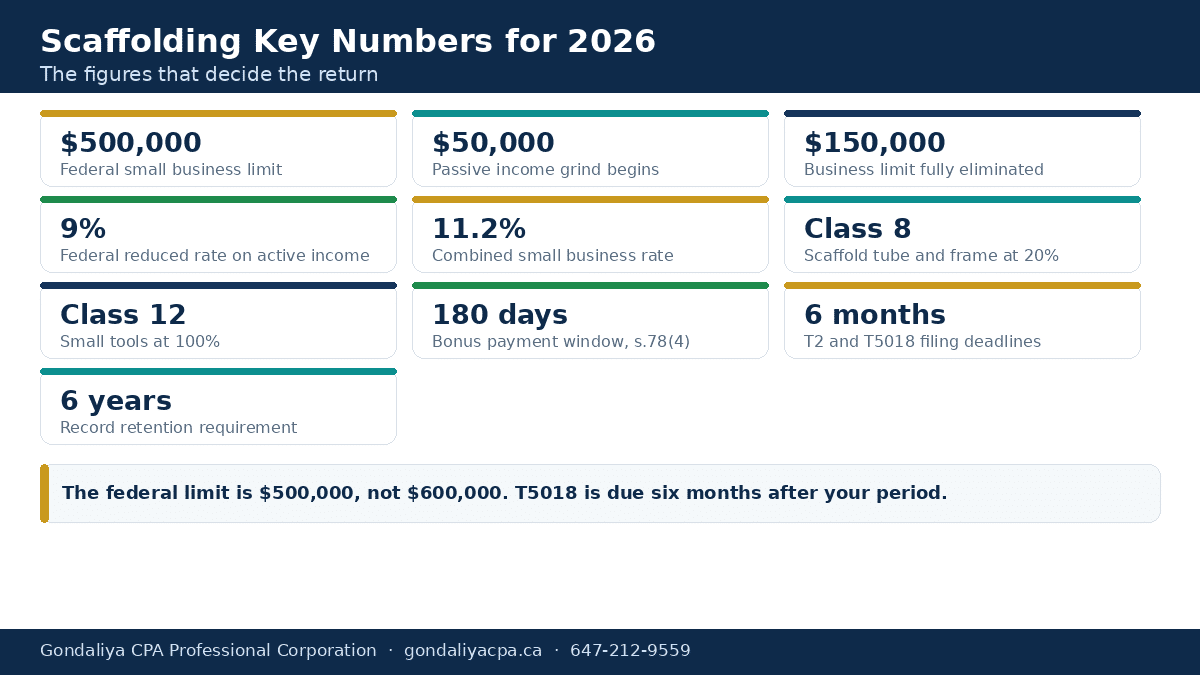
The federal business limit is $500,000 of active business income for an eligible CCPC, shared across associated corporations, and it is reduced by $5 for every $1 of adjusted aggregate investment income above $50,000.
Strategic Timing of Income and Expenses
- When you record income or expenses changes your taxable income.
- For example, delaying revenue recognition until after year-end can cut this year’s tax bill.
Revenue recognition is not a timing choice. Income is reported when it is earned under the terms of the contract, not when it suits the return. What can be planned is when work is performed and billed, and when a holdback becomes receivable.
Equipment Purchase Strategies
- Choosing to buy or lease affects cash flow and taxes.
- Sometimes you can expense eligible purchases right away instead of depreciating slowly.
Payroll Considerations
- Paying salaries or dividends impacts personal taxes for owners differently.
- Finding a balance may boost RRSP room and affect CPP payments.
GST/HST Implications
Knowing how GST/HST applies to scaffolding services keeps you compliant and helps claim input tax credits (ITCs).
Record Keeping Requirements
- Good records support your claims if CRA audits you.
- Keep supplier invoices, payroll slips, client contracts, and any holdback or billing letters handy.
Benefits of Effective Tax Planning
Having good scaffolding business tax plans brings perks like:
- Better Cash Flow: You pay less tax by using deductions smartly.
- Higher Profits: Cutting costs boosts net income.
- Compliance Peace: Staying updated avoids CRA penalties.
To wrap up, knowing how scaffolding company tax planning works helps keep your business financially healthy. It also opens doors to steady growth across Ontario’s tough market.
Key Tax Planning Strategies for Scaffolding Companies
Key Tax Planning Strategies for Scaffolding Companies
The Strategies
Tax planning for scaffolding companies means balancing corporate and personal taxes carefully. You want to make the most of capital cost allowance claims and manage when income comes in. For scaffolding business tax planning in Canada, knowing these details helps keep you legal and improves cash flow. A tax accountant for scaffolding companies can set up plans that fit your business needs and rules.
Importance of Corporate and Personal Tax Planning
Good scaffolding business tax planning in Canada means matching company profits with how owners get paid. Choosing salary or dividends changes both the company’s deductions and what you pay in personal taxes.
Salary vs Dividends:
- Salary lowers corporate tax because it’s an expense but requires payroll taxes like CPP and source deductions. It also creates RRSP contribution room for the owner.
- Dividends don’t lower corporate tax but may get you dividend tax credits personally. Still, they don’t build RRSP room or CPP coverage.
Picking between these depends on your RRSP space, CPP wants, how complex you want things, and your family’s total income.
Small Business Deduction Management:
The small business deduction (SBD) cuts federal corporate tax on active business income up to $600,000 per group. If your scaffolding company has related businesses—like rental yards or labor-only firms—watch out. The SBD limit applies to all associated companies combined. Also, if passive investment income goes over $50,000 yearly, SBD gets reduced in phases.
Keeping track of income across related businesses keeps your full SBD intact.
The federal small business deduction limit is $500,000, not $600,000. The higher figure belongs to the provincial limits in Saskatchewan, Prince Edward Island and Nova Scotia. This article states $500,000 correctly earlier, so please plan against $500,000 federally.
Maximizing Capital Cost Allowance (CCA) on Scaffolding Equipment
You need to know if scaffold parts count as capital property or just small tools to claim CCA right.
- Scaffold tubes, frames, clamps usually go in Class 8 with a 20% declining balance rate. That means you spread depreciation over years instead of deducting it all at once.
- Small tools under $500 each can often be expensed immediately if you track them well.
Plan your equipment buys by checking what class the asset fits into. This helps get bigger depreciation while matching your operational needs.
For example: buying new scaffold gear late in the year limits your CCA claim to half the usual amount because of the half-year rule. Buying some gear earlier or spreading purchases helps boost yearly deductions without hurting cash flow.
Bill C-15 received Royal Assent on 26 March 2026, reinstating the accelerated investment incentive. For most depreciable property acquired after 2024 and available for use before 2030 the half-year rule is effectively suspended and an enhanced first-year deduction applies, phasing down after 2029.
Timing Asset Purchases and Sales Around Business Year End
The Income Tax Act uses a half-year rule that lets you claim only 50% of normal CCA for assets bought in the year they’re acquired. This means you can’t write off the full depreciation right away but spread it out over time.
Smart timing moves include:
- Buying equipment before year-end if extra deductions will lower this year’s tax.
- Waiting to sell assets until after year-end if selling would cause more taxable income due to recapture.
Also, think about holdback releases that affect revenue timing when making year-end decisions. Keep cash flow steady by planning these moves carefully.
Balancing Salary, Dividends, and Bonuses for Tax Efficiency
Paying bonuses within three months after fiscal year-end lets you reduce current profits legally while rewarding staff or owners. Make sure you document these payments well so CRA accepts them.
The bonus accrual rule sits in subsection 78(4), not 18(1)(a). A bonus accrued at year end must be paid within 180 days of the year end for the deduction to hold in the year it was accrued.
If you pay a spouse or family member reasonable wages tied to real work done, it supports legal income splitting without triggering attribution rules under section 67(1).
| Payment Type | Corporate Deduction | Personal Tax Effect | Creates RRSP Room | Payroll Needed |
|---|---|---|---|---|
| Salary | Yes | Included on personal T4 | Yes | Required |
| Dividends | No | Get dividend credits | No | Not required |
| Bonus | Yes | Like salary if paid soon | Yes | Required |
Income Splitting Techniques Applicable to Scaffolding Businesses
Income splitting works when done openly with clear jobs for family members:
- Family must do real work that matches their pay.
- Keep payroll records like timesheets to prove wage fairness during audits.
Just giving dividends can be risky under “tax on split income” (TOSI) rules unless shares meet specific conditions. Good recordkeeping protects your claims if CRA checks things out later.
For questions about optimizing your incorporated scaffolding company anywhere in Toronto/Ontario or Canada-wide, contact Gondaliya CPA at info@gondaliyacpa.ca or call 647-212-9559 for a free consultation today.
Splitting a rental yard into its own corporation protects the inventory, but the two companies then share one business limit. Owners usually discover that the year the second entity turns profitable. Figures changed for privacy.
Specialized Tax Savings for Scaffolding Companies
Specialized Tax Savings for Scaffolding Companies
The Savings
Planning taxes for scaffolding companies in Canada takes a sharp focus. You need to find ways to cut tax costs and keep more cash flowing. Smart scaffolding business tax planning means using deductions, credits, and registered plans that fit the industry. It also means staying within CRA rules. To save on scaffolding taxes, know which expenses you can claim, handle shareholder dealings right, and tap into government programs made for construction businesses.
Home Office and Vehicle Expense Deductions
Tax accountants who work with scaffolding companies often spot home office and vehicle deductions as major ways to save. If you use part of your home just for your scaffolding business—like handling admin or management—you can claim part of your bills. This might include utilities, property taxes, insurance, and upkeep costs. The Income Tax Act section 18(1)(a) backs this up.
Vehicle costs matter too. You can claim fuel, insurance (based on how much you use the vehicle for work), lease payments within limits, repairs, maintenance, and parking fees while at job sites or yards. Keeping a detailed logbook is key here. It must track how many kilometers you drive for business.
When it comes to GST/HST input tax credits, scaffolding firms can get back GST/HST paid on eligible vehicle costs if they keep good records. This helps lower cash going out but needs careful bookkeeping under Excise Tax Act rules.
Quick example:
- A scaffolder in Toronto drives 15,000 km yearly
- Of that, 4,500 km is work-related
- Fuel costs hit $6,000
- They claim $1,800 plus GST/HST credits on those expenses
The Class 10.1 passenger vehicle ceiling is $39,000 before tax for 2026, up from $38,000 in 2025, with deductible lease cost capped at $1,100 per month and deductible interest at $350 per month.
Utilizing Tax Credits Relevant to Construction and Scaffolding Industries
Keeping an eye on the small business deduction matters a lot for scaffolding companies in Canada. It affects the federal tax rates up to $600K of active business income per group. Structuring your company carefully helps use this deduction fully without losing it due to passive income limits.
For meals and entertainment, only half of these expenses count if they’re for valid client meetings or crew trips. The CRA allows 50% deductibility here. You should note why you spent this money—for example, a safety training lunch—to support your claim and avoid extra taxable income.
Some provincial credits may apply too. Usually, SR&ED credits do not fit unless your scaffolding work involves real innovation beyond usual tasks like setting up or taking down scaffoldings.
Scaffold tube and frame is the single largest asset class on most of these files, and it is Class 8 at 20%. Small tools below the threshold sit in Class 12 and come off faster. Figures changed for privacy.
Registered Plans and Tax-Deferred Accounts: TFSA, RRSP, and RESP
For incorporated scaffold owners, deciding between salary or dividends impacts registered plan contributions like RRSPs or TFSAs. Only earned salary creates contribution room for RRSPs; dividends don’t count for this purpose.
In 2026, the CPP contribution rate will be 5.95% each for employers and employees. This bumps up payroll costs if you pay yourself a salary instead of dividends—a key point when setting pay strategies with CPA help.
RESPs don’t give immediate corporate deductions but help fund education later on. Families involved in RESP setups should document everything clearly.
Pay type at a glance
| Method | Deductible by Corp? | Personal Taxes | RRSP Room? | CPP Contributions? | Tax Slip Type |
|---|---|---|---|---|---|
| Salary | Yes | Higher Rates | Yes | Employer + Employee | T4 |
| Dividends | No | Lower Rates | No | None | T5 |
Managing Shareholder Loans and Avoiding Undue Taxable Benefits
Shareholder loans can cause tax trouble if not handled right in scaffolding companies with corporations. The Income Tax Act section 15(2) says if loans last over one year-end without repayment or proper terms, they get treated as income taxed to the shareholder.
Using company money for personal spending risks being called taxable benefits too—unless you repay quickly with solid proof. Good bookkeeping should separate business advances from personal use clearly.
Keep minutes from board meetings showing approval of any shareholder loans to defend yourself during CRA audits. These reviews check if loans or payments to family members look reasonable in multi-crew firms often seen in this sector.
If you want help with your scaffolding company’s tax planning—from home office claims to sorting shareholder loans—contact Gondaliya CPA at info@gondaliyacpa.ca or call 647-212-9559 for advice in Toronto/Ontario areas.
The base CPP contribution rate is 5.95% for the employee and 5.95% for the employer on pensionable earnings between the basic exemption and the first earnings ceiling. A second contribution of 4% each applies on earnings between the first and second ceilings, so total payroll cost on a higher salary is more than 5.95% alone.
Role of a Tax Accountant in Scaffolding Business Tax Planning
Role of a Tax Accountant in Scaffolding Business Tax Planning
The Accountant
A tax accountant who knows scaffolding company tax planning helps scaffolding contractors across Canada manage their taxes. They look closely at how the business works and find ways to lower taxes legally. This helps improve cash flow while sticking to Canadian tax rules.
How a Tax Accountant Identifies Customized Savings Opportunities
Tax accountants find savings by checking things like equipment capital assets, labor costs, and small business deduction eligibility. They figure out if scaffold parts fit into Capital Cost Allowance classes like Class 12 or Class 8. This helps claim depreciation without extra tax risks.
Some key points they consider:
- Which equipment qualifies under CCA classes
- Managing small business deduction limits with associated corporations
- Timing income recognition to delay taxable income within CRA rules
For example, splitting rental yards from erect-and-dismantle crews wrong can cut available deductions. Tax accountants watch out for that.
Comprehensive Income Tax Consulting Services for Scaffolding Companies
They advise on when to recognize income, especially around holdbacks and progress billings common in construction. A CPA can also represent you during CRA audits or questions about T2 filings. This ensures all income like rental inventory and labor services is reported correctly.
It’s also important to:
- File T2 returns on time to avoid penalties
- Align income reporting with construction billing practices
Missing filing deadlines can cause extra charges that eat into profits.
Support with Tax Compliance, Audit Advice, and Record Keeping
Good record keeping backs every tax plan made for scaffolding companies. This includes payroll records that follow employment laws when paying family or subcontractors. Also:
- Job cost sheets showing erect-and-dismantle hours vs rental days
- Holdback schedules based on provincial lien laws
- Minutes documenting pay decisions
These documents make audits smoother and lower chances of reassessments by CRA.
Advising on Business Structuring to Optimize Tax Outcomes
Tax accountants help owners pick business setups that protect assets but keep tax benefits. For instance, putting rental inventory into separate corporations may protect it but affects small business deduction limits due to associated corporation rules.
Other choices they help with:
- Salary versus dividends for owners
- Impact on RRSP room and CPP contributions
Each option has pros and cons depending on your situation.
Booking Consultations and Ongoing Tax Support
Incorporated scaffolding contractors can get free consultations from Ontario CPA firms with experience in construction tax planning. Ongoing help keeps you updated on rules year-round, not just at filing time.
Reach out to an expert corporate tax planner in Toronto Ontario today at 647-212-9559 or info@gondaliyacpa.ca for help tailored to Canadian scaffolding companies.
Preparing for the Scaffolding Business Tax Season
Preparing for the Scaffolding Business Tax Season
Tax Season
Organizing Financial Records and Documentation Best Practices
Good scaffolding company tax planning starts with well-kept financial records. Bookkeeping must be clear and up-to-date to back every tax decision. Keep payroll files, job cost sheets, inventory counts, holdback schedules, contracts, shareholder loan papers, and meeting minutes in order.
Watch shareholder loans closely. Mixing personal spending with company funds can cause tax trouble under section 15(2) of the Income Tax Act. Keep track of all payments with receipts or invoices. Solid record-keeping cuts audit risks and supports your scaffolding business tax planning Canada by proving expenses and income timings.
Keep these records handy:
- Payroll records for salary deductions
- Job cost sheets for project expenses
- Inventory counts for stock values
- Holdback schedules matching lien expiry
- Shareholder loan documents to avoid benefit issues
Monitoring Tax Law Changes Affecting Scaffolding Businesses in Canada
Tax rules change often, so keep an eye on updates that affect scaffolding businesses. Important laws include the Income Tax Act, Excise Tax Act, Ontario Construction Act, and Occupational Health and Safety Act.
Recent 2026 updates affect small business deduction limits and capital cost allowance rules. For example, new immediate expensing options apply to some equipment purchases. The Excise Tax Act covers GST/HST duties linked to rental yards and billing timing.
The Ontario Construction Act affects lien holds but does not change federal tax rules directly. Still, it influences cash flow planning. Check CRA policies regularly to catch changes affecting salary or dividend choices or passive income calculations.
Here’s what to watch:
- Income Tax Act updates on deductions and expenses
- Excise Tax Act rules on GST/HST registration
- Ontario Construction Act lien and cash flow matters
- Occupational Health and Safety Act compliance rules
- CRA policy bulletins for salary vs dividends
Key Considerations to Prepare for Year-End Tax Planning
Your T2 corporate tax return is due six months after your fiscal year ends. Start preparing early by reviewing bonus accruals that qualify for deductions under subsection 18(1)(a) ITA.
Assess capital asset purchases carefully. Classify scaffold parts correctly between classes like Class 8 or Class 12 according to Schedule II rules. This helps maximize your capital cost allowance while following half-year rules.
Make sure revenue recognition matches provincial lien laws—holdbacks count as income only when released per the Ontario Construction Act. Confirm subcontractor payments comply with T5018 reporting deadlines and payroll slips (T4s) are complete.
Identifying unpaid liabilities before filing stops costly errors later.
A holdback under a provincial construction or lien act is generally not included in income until it becomes receivable. Keep the schedule by contract with substantial performance and lien expiry dates on it.
Important steps include:
- Track year-end bonus payments carefully
- Review capital asset additions for proper CCA classification
- Match revenue timing to lien release rules
- Complete subcontractor T5018 reports on time
- Verify payroll slips are accurate
Proactive Strategies to Minimize Tax Liabilities Before Filing
Managing the small business deduction takes careful attention if you have associated corporations sharing the $600,000 limit.
Keep passive investment income below $50,000 net to keep full access to this deduction. Above $50K, your benefits phase out until $150K when they end completely.
Choosing salary or dividends affects CPP costs and RRSP contribution room differently. Owners should consider which fits their situation best based on how a scaffolding company operates.
Don’t forget to claim all eligible GST/HST input tax credits quickly on equipment buys and operating costs tied directly to taxable sales — including bare rentals — while keeping clear documents as required by section 169 ETA.
Focus on these tactics:
- Track combined small business deduction limits among affiliates
- Watch passive investment income thresholds closely
- Decide smartly between salary or dividend payments
- Claim GST/HST input tax credits on eligible expenses promptly
For tailored advice around incorporated scaffolding contractors in Toronto or Ontario aiming at solid scaffolding company tax planning, contact Gondaliya CPA at info@gondaliyacpa.ca or call 647-212-9559 for a free consultation today.
This table summarizes Canadian federal and provincial requirements.
| Record Type | Purpose | Retention Period | Source |
|---|---|---|---|
| Payroll Records | Support salary expense deductions | Minimum 6 years | ITA s230 / CRA Payroll Guide |
| Job Cost Sheets | Validate project-specific expenses | Minimum 6 years | ITA s230 / CPA Compilation |
| Inventory Counts | Verify closing stock valuation | Annual | Accounting Standards ASPE |
| Holdback Schedules | Align revenue recognition/timing | Until lien expiry +3 yrs | Ont Construction Act / ITA |
| Shareholder Loan Docs | Prevent unintended shareholder benefit | Indefinite | ITA s15(2) |
Client Success Insights and Contact Options
Client Success Insights and Contact Options
Client Insights
Real-World Success Stories Demonstrating Effective Tax Savings
Many scaffolding companies in Canada have found ways to lower their taxes and keep more cash on hand. For example, a scaffolding rental business in Toronto timed their equipment purchases carefully. This helped them claim capital cost allowances and delay paying some corporate taxes—all within the rules. Another company that runs several crews split owner payments between salary and dividends. This kept RRSP contribution room intact and cut CPP costs.
These results come from scaffolding company tax planning that fits the Income Tax Act’s rules about small business deductions, associated corporations, and capital assets. Using a tax accountant for scaffolding companies helps make sure these methods are done right with good paperwork.
Here’s a simple example:
A residential scaffold supplier paid bonuses during allowed timeframes to claim deductions while keeping workers happy during busy seasons. This improved cash flow by lowering taxable income at the right times.
This shows how careful scaffolding business tax planning Canada-wide can save money. It involves good records, smart timing, and using CCA classes like Class 12 for small tools or Class 53 for some equipment.
Google Reviews and Testimonials Highlighting Client Satisfaction
Clients often talk about how Gondaliya CPA knows scaffolding company tax planning inside out. They praise the firm for quick replies and helpful advice. With more than 1450 five-star Google reviews across Ontario—including Toronto, Mississauga, Vaughan, Brampton—and other provinces, Gondaliya CPA has built trust.
Clients mention:
- Easy explanations of tricky construction tax rules
- Spotting missed deductions like holdback timing changes
- Flat-fee pricing so budgets stay steady
- Quick answers—even on weekends when urgent questions come up
This feedback shows Gondaliya CPA’s focus on real scaffolding tax savings following CRA rules and local laws about scaffold standards.
Clear Steps to Engage Gondaliya CPA for Scaffolding Tax Planning
To work with Gondaliya CPA, start with a free chat about your specific scaffolding business—whether you manage crews that build and take down scaffolds or run rental yards.
The process looks like this:
- A first call to understand your revenue, crew size, inventory, and financing
- Check your bookkeeping and capital asset lists tied to scaffold gear
- Review your holdback schedule based on provincial lien laws (like Ontario Construction Act)
- Model pay mixes of salary vs dividends considering CPP charges
- Review GST/HST filings to make sure input credits are claimed properly
Each step produces clear reports that meet CRA rules (including T2 filings with T5018 if needed). The firm promises replies within one business day and offers weekend help if required.
You can reach Gondaliya CPA by phone at 647-212-9559 or email info@gondaliyacpa.ca. The free consult means no pressure—you can see if their scaffolding company tax planning fits your needs first.
Contact Forms and Consultation Booking for Personalized Tax Planning Assistance
If you want help designed just for Canadian incorporated scaffolding businesses looking to reduce corporate taxes:
Use the contact form on the website or book your free consultation now by calling 647-212-9559 or emailing info@gondaliyacpa.ca.
The team knows construction taxes well—from equipment loans to year-end bonus windows—and helps you handle everything while following Canadian law.
This expert advice matches the realities of incorporated scaffolders in places like Toronto and Ottawa—and clients nationwide who want clear solutions that follow labour contractor rules and rental yard regulations.
Sharad Gondaliya, CPA, has over 10 years helping hundreds of Canadian construction businesses with corporate tax matters.
Plan against a $500,000 federal business limit and watch the $50,000 grind. Put scaffold tube and frame in Class 8, small tools in Class 12. Pay year-end bonuses within 180 days. Keep the holdback schedule by contract. File T5018 six months after your reporting period ends, not on 28 February. Please keep six years of records.
Frequently Asked Questions (FAQ)
Frequently Asked Questions (FAQ)
FAQ
What is the T5018 contract payment reporting deadline?+
The T5018 form must be filed by February 28 following the fiscal year-end. It reports payments to subcontractors in construction, including scaffolding businesses.
The T5018 return is not due on 28 February. It is due within six months of the end of your chosen reporting period, which may be the calendar year or your fiscal period, applied consistently. February is the T4 and T5 date and the three get conflated constantly.
How does the Ontario Construction Act affect lien and cash flow management?+
The Ontario Construction Act regulates lien holds and payment timelines. It impacts when you recognize revenue and plan cash flow for scaffolding projects.
What are key Occupational Health and Safety Act compliance rules for scaffolding companies?+
Scaffolding firms must follow workplace safety standards, worker training, and equipment inspections under provincial Occupational Health and Safety laws.
What is the Meals & Entertainment Deduction Limit?+
Only 50% of eligible meals and entertainment expenses related to business activities can be deducted from taxable income.
What is the CPP employer and employee contribution rate for 2026?+
Both employer and employee rates are set at 5.95% each starting in 2026, increasing payroll costs for salaried scaffolding owners.
When is the tax year-end filing deadline for T2 returns?+
T2 corporate tax returns must be filed within six months after the corporation’s fiscal year-end.
Should I buy, lease, or finance scaffold inventory and trucks?+
Each option affects cash flow, taxes, and ownership. Buy to capitalize depreciation; lease to preserve cash; finance to spread costs over time.
What is a rental inventory corporation setup?+
Separating rental assets into a distinct corporation can protect assets but may limit small business deductions due to associated company rules.
What are essential year-end planning moves for a scaffolding corporation?+
Plan income timing, finalize capital purchases before year-end, accrue bonuses properly, and review holdback schedules for revenue recognition.
Which strategies should scaffolding owners avoid in tax planning?+
Avoid aggressive income splitting without real work done, mixing personal and business funds in shareholder loans, or missing reporting deadlines.
What records support every tax planning position?+
Keep payroll slips, job cost sheets, holdback schedules, contracts, shareholder loan documents, vehicle logbooks, and equipment invoices.
How does DIY tax planning compare with using a CPA or non-CPA provider?+
DIY risks missed deductions and errors. Non-CPA providers may lack specialized knowledge. CPAs offer expert advice tailored to scaffolding businesses with compliance assurance.
How do we build a scaffolding tax plan at Gondaliya CPA?+
We analyze your business structure, equipment assets, pay strategies, holdbacks, GST/HST claims, then customize plans optimizing deductions and credits.
What deliverables do you get from Gondaliya CPA tax planning services?+
Clients receive detailed reports on tax savings opportunities, documentation checklists, income timing strategies, payroll optimization advice, and ongoing support.
How much does tax planning cost for a scaffolding company in Canada?+
Pricing varies by complexity but typically ranges from flat fees to hourly rates. Gondaliya CPA offers transparent pricing with no hidden charges.
What are the top planning mistakes scaffolding companies make and how do you prevent them?+
Common mistakes include poor record keeping, ignoring associated corporation rules, late filings, improper income splitting. Prevention involves professional advice and regular reviews.
What should you prepare before a tax planning engagement starts?+
Gather financial statements, payroll records, equipment purchase details, contracts, shareholder loan info, holdback schedules, GST/HST filings.
Which planning levers matter most across different scaffolding segments?+
Equipment CCA claims, small business deduction limits management, salary vs dividend mix, income timing on rentals versus labor services vary by segment focus.
Eighteen questions and two underneath most of them: is the business limit shared, and is the holdback schedule real. Those two settle most scaffolding files. Figures changed for privacy.
Additional Tax Planning Insights for Scaffolding Companies
Additional Tax Planning Insights for Scaffolding Companies
Quick Reference
- Monitor passive investment income closely to avoid reduction of small business deduction benefits.
- Track combined active business income limits among associated corporations carefully.
- Use clear documentation when paying family members wages tied to real work performed.
- Claim GST/HST input tax credits promptly on all eligible scaffold-related purchases.
- Plan capital asset acquisitions considering half-year rule impacts on CCA claims annually.
- Balance salary versus dividend payments based on RRSP room needs and CPP contribution impacts.
- Maintain thorough vehicle logs to maximize allowable expense claims related to work travel.
- Avoid mixing personal expenditures with company funds in shareholder loan accounts.
- Confirm subcontractor payments comply with T5018 reporting requirements timely.
- Regularly update holdback release schedules per applicable provincial construction laws for accurate revenue recognition.
For expert scaffolding company tax planning in Canada contact Gondaliya CPA at info@gondaliyacpa.ca or call 647-212-9559 today.
Professional Guidance and Quick Reference
Guidance
Who This Is For
- For: Incorporated scaffolding companies across Canada, including erect-and-dismantle contractors, scaffold rental yards, swing stage and mast climber operators and shoring specialists.
- Also for: Owners adding a rental entity, owners several years behind on filings, and owners preparing statements for a lender or bonding company.
- Not for: Unincorporated sole proprietors and partnerships, whose filing obligations run through a personal return rather than a T2.
- Not for: Scaffold standards, Occupational Health and Safety Act compliance, worker training and WSIB classification, which sit with the relevant authority.
- Not for: Construction lien interpretation and contract drafting, which are legal questions for counsel.
People Also Ask
How much does accounting cost for a scaffolding company in Canada?+
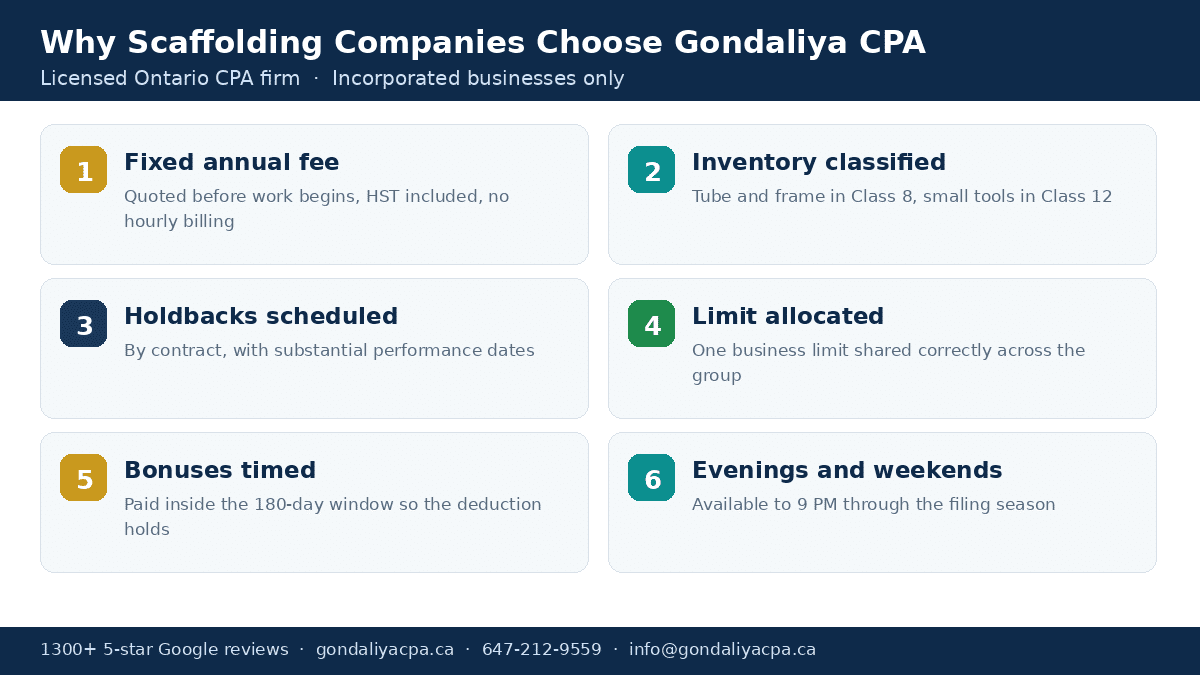
Our fee is fixed, quoted annually and includes HST. It is set before work begins based on transaction volume, crew size, whether a rental yard is operated, and how many associated corporations are in the group.
Do I need a CPA or is a bookkeeper enough?+
A bookkeeper maintains the ledger. A CPA firm is required for compilation financial statements a lender or bonding company will accept, associated corporation planning, and representation on a CRA review.
What financial statements will a lender or bonding company expect?+
A balance sheet, an income statement and notes covering work in progress and holdbacks, prepared as a compilation engagement under CSRS 4200.
Glossary of Key Terms
- T2 Return: The corporation income tax return filed annually by an incorporated business.
- SBD (Small Business Deduction): The reduced federal rate on active business income up to the business limit.
- Business Limit: The $500,000 of active business income eligible for the reduced rate, shared across associated corporations.
- Associated Corporations: Related companies that must share one business limit between them.
- Passive Income Grind: The reduction of the business limit by $5 for every $1 of adjusted aggregate investment income above $50,000.
- Specified Investment Business: A corporation whose income is principally from property, which loses the small business deduction.
- CCA (Capital Cost Allowance): The tax depreciation claimed on capital assets.
- Half-Year Rule: The rule limiting first-year capital cost allowance to half the normal amount.
- Accelerated Investment Incentive: The enhanced first-year deduction reinstated by Bill C-15 in 2026.
- Class 8: The 20 percent class covering scaffold tube, frame, clamps and yard equipment.
- Class 12: The 100 percent class covering small tools below the prescribed threshold.
- Recapture: Income added back when an asset is sold above its undepreciated capital cost.
- Holdback: An amount retained from a progress draw until the lien period expires.
- Substantial Performance: The point under provincial lien legislation that starts the holdback release clock.
- WIP: Work in progress, revenue earned but not yet billed at the year end.
- TOSI: The tax on split income, which taxes certain amounts paid to related people at the top rate.
- Shareholder Loan: Company funds used personally, taxable if not repaid within the period the Act allows.
- T5018: The contract payment information return for construction activity.
Scaffolding Readiness Check
This quick self-check indicates where your company most likely has room. Please answer the six questions below.
Scaffolding Readiness Check
Six quick questions on your company. No fee shown.
Points to raise with us:
This is a general prompt, not tax or legal advice or a quote. Your position depends on your full facts. For a real review, please book a free consultation.
Want a checklist to work from? You can download our free scaffolding company tax checklist before your consultation.
This article reflects rules current to 2026. The federal small business limit of $500,000, the federal reduced rate of 9%, the $50,000 to $150,000 passive income grind, the Class 8 rate of 20%, the 50% meals and entertainment limitation, the six-month T2 filing deadline, the 180-day bonus payment window under subsection 78(4), the objection window of 90 days and the six-year retention requirement are unchanged. The Class 10.1 ceiling rose to $39,000 before tax for 2026, with deductible lease cost at $1,100 per month and interest at $350 per month. Ontario reduced its small business rate to 2.2% effective 1 July 2026, giving a combined rate near 11.2%. Bill C-15 received Royal Assent on 26 March 2026, reinstating the accelerated investment incentive. Please note that the federal business limit is $500,000 rather than $600,000, and that T5018 is due six months after your reporting period ends rather than on 28 February.
Scaffolding Company Tax Planning Canada: How Gondaliya CPA Supports Contractors
Start with the asset list and the holdback schedule
Gondaliya CPA allocates scaffold inventory between Class 8 and Class 12, confirms available-for-use dates and applies the reinstated investment incentive, builds the holdback schedule by contract with substantial performance and lien expiry dates, allocates one business limit across associated corporations, models the salary and dividend mix against RRSP room and CPP cost, and prepares T5018 on the correct period and deadline, on a flat annual fee including HST with a one-business-day response. Please book a free consultation.
Next Steps
Please book a free consultation with Gondaliya CPA and bring your scaffold asset list with purchase dates, your current holdback schedule, and your last filed corporate return. Those three tell us immediately whether the inventory is classified correctly, whether holdback income is being recognised at the right time, and how the business limit is being used across the group. You will get a flat annual fee including HST before any work begins. If our content helps, please add gondaliyacpa.ca as a preferred source on Google.
Published: · Last updated:
Editorial policy: We research against CRA and CPA Ontario sources, fact-check the figures, and Sharad Gondaliya, CPA, reviews the content, which we update as the rules change.
Disclaimer: This article is educational information only and is not tax, legal, or financial advice. Figures marked illustrative are examples rather than quotes or guarantees. It reflects CRA rules current to 2026, including the $500,000 federal business limit, the passive income grind, Class 8 and Class 12 treatment, the half-year rule and its 2026 suspension, and the six-year retention requirement. Rates, limits and expensing rules change and outcomes depend on your specific facts. Please consult a CPA Ontario member before acting.

Sharad Gondaliya is a CPA Canada & CPA USA with 15 Years+ experience of Accounting, Tax, Payroll of Corporate Small Businesses as Tax Accountant. He is a CPA Ontario member (61040184) and holds US CPA licences in Washington and Montana and is well known among corporate small businesses for tax planning, efficient tax solutions, and affordable CPA services. Sharad is the Principal (Director) of Gondaliya CPA – Affordable CPA Firm in Canada. Licenses: CPA Ontario: 61040184 | CPA USA (MT): PAC-CPAP-LIC-033176 | CPA USA (WA): 57629 | CPA Firm License: 61330051 View Full Author Bio