



Small Engine Repair Tax Deductions in Canada: Tools, Equipment, Parts, Vehicles & Business Expenses
Small Engine Repair Business Tax Deductions and Expenses in Canada: Tools, Vehicle Costs, and CCA Explained
Small engine repair business tax deductions and expenses in Canada cover a range of costs including repair tools, vehicle expenses, and CCA deductions. Gondaliya CPA supports repair shops by ensuring all small engine business tax deductions and small engine shop tax deductions are properly claimed to reduce taxable income.
Quick Summary
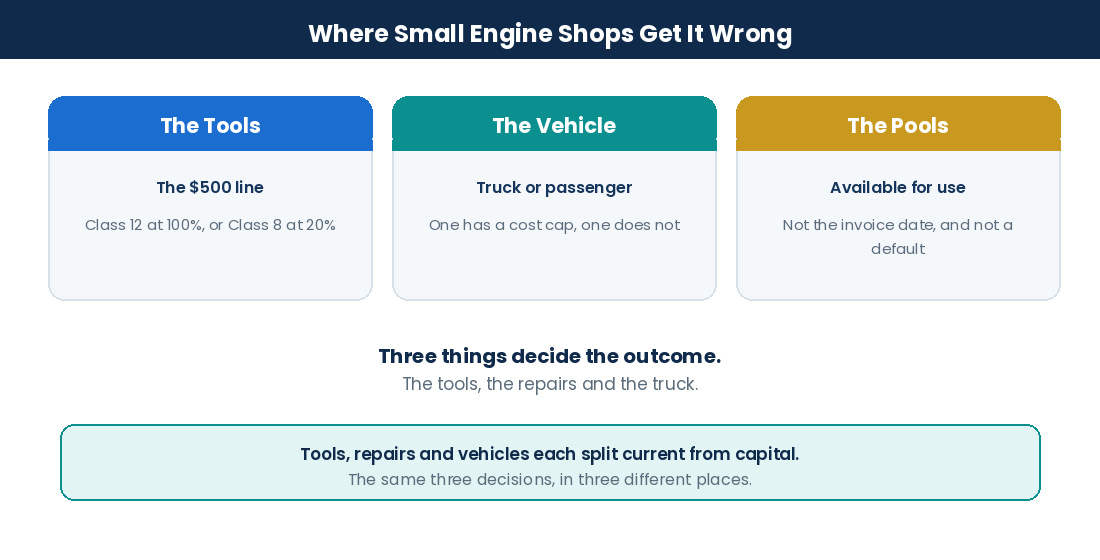
Three lines govern a repair shop’s return: the $500 threshold that separates tools you write off from tools you depreciate, the repair-against-replacement test on shop equipment, and the vehicle rules that treat a service truck differently from a passenger car.
Reading time: 52 minutes.
Table of Contents
- The Line That Decides Everything
- Structure, Registration and Obligations
- Tracking Income and Expenses
- Tools, Parts, Vehicles and Premises
- Capital Cost Allowance for Repair Shops
- GST/HST, Deadlines and Working With Us
- Frequently Asked Questions
- The Deduction Checklist
- Businesses We Serve
- Professional Guidance and Quick Reference
The Numbers That Matter
This article covers Canada, with Ontario and Toronto context, and reflects rules current to 2026. It is written for incorporated Canadian small engine repair businesses. Figures marked illustrative are examples, not quotes, and any masked engagement notes end with “Figures changed for privacy.” This is educational information only and not tax or legal advice. Rates and thresholds change, so please confirm the current position before acting.
The Line That Decides Everything
The Line That Decides Everything
Current or Capital
One Question, Three Forms
Most tax questions in a repair shop reduce to whether something is deducted now or written off over years. It appears in three places, and getting each right is worth more than any other single thing you do.
| Where It Appears | The Test | What Turns On It |
|---|---|---|
| Buying a tool | Is it under $500 | Class 12 at 100%, or Class 8 at 20% |
| Working on equipment | Restoring or improving | Current expense, or added to a pool |
| Buying a vehicle | Service truck or passenger vehicle | Class 10, or Class 10.1 with a cost cap |
None of these is a judgement call you can leave to the year end. Each one needs a note on the invoice at the time, because reconstructing the reasoning eighteen months later is where shops lose deductions.
The Half-Year Rule Applies More Widely Than Expected
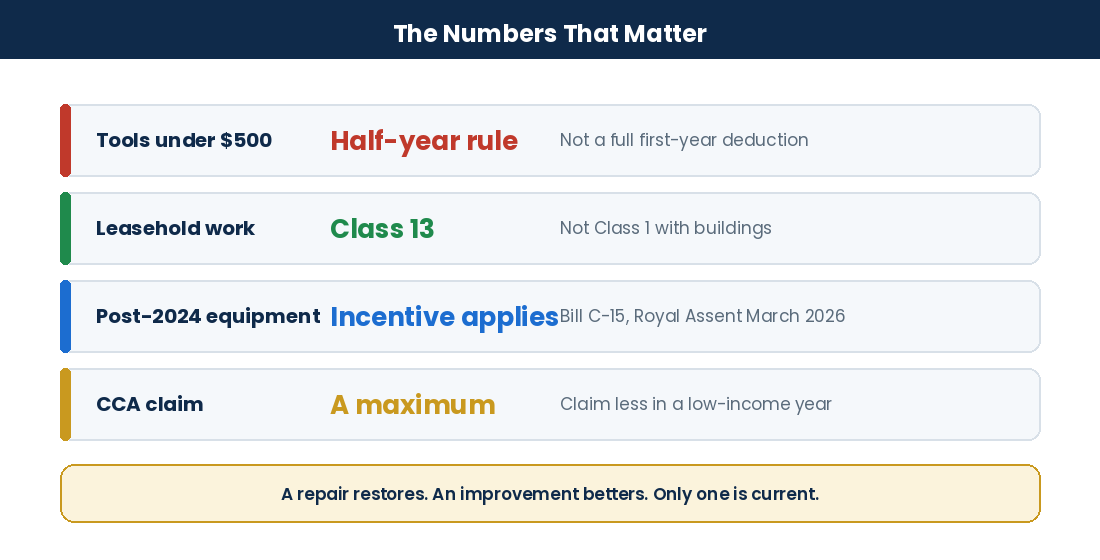
A common assumption is that a tool under $500 is fully deducted in the year of purchase. It is not, in the ordinary case. Class 12 carries a 100% rate, but the half-year rule generally applies to tools, so the first-year claim is half.
The practical effect is that a $400 tool bought in year one produces a $200 claim in that year and $200 in the next. Over two years it is fully written off, which is still far better than Class 8 treatment, but it is not the immediate full deduction most guidance describes.
What Changed in 2026
Bill C-15 received Royal Assent on 26 March 2026, reinstating the accelerated investment incentive for most depreciable property acquired after 2024 and available for use before 2030.
Where it applies, the incentive gives an enhanced first-year deduction instead of the ordinary half-year treatment. For an equipment-heavy business this matters on every purchase in the window, and returns already filed on the plain half-year rule for recent purchases are worth revisiting.
- Check purchases made after 2024 against the incentive
- Available for use is the test, not the purchase date
- Returns still within the reassessment period can be adjusted
- The incentive applies to most classes, not all
Please note the second point. An engine hoist bought in December and installed in February is available for use in the later year, and that timing decides which year the claim falls in.
Shops ask which expenses are deductible. Nearly all of them are. The question that actually moves money is when, and that is decided at the counter, not at year end. Figures changed for privacy.
Risk Warning: Tools under $500 are generally subject to the half-year rule despite the 100% class rate. Please do not expect a full first-year deduction.
Understanding Small Engine Repair Business Taxes in Canada
Structure, Registration and Obligations
The Setup
Overview of Small Engine Repair Business Types
In Canada, small engine repair businesses usually operate as either sole proprietorships or incorporated companies. Each changes how you pay tax and report income.
Sole Proprietorship vs. Incorporation
A sole proprietorship means one person owns and runs the business. It is straightforward to set up and profits go on your personal return. You are personally responsible for the debts.
Incorporation creates a separate legal entity. It provides liability separation and files its own T2 return, and a Canadian-controlled private corporation claiming the small business deduction pays a lower rate on active business income retained in the company.
How Business Structure Affects Taxes
Sole proprietors pay personal rates on all profits, which rise with income. An incorporated shop pays corporate rates on income left in the business, which allows deferral until the money is taken out.
Two differences matter specifically for a repair shop, and both are frequently missed.
First, premises. A sole proprietor working from home prorates household costs by the area used. A corporation does not. It pays a reasonable amount for the space under a proper arrangement, or reimburses specific supported costs. Applying the proprietor method to a corporation is one of the most common errors we see on these files.
Second, vehicles. A sole proprietor claims the business-use portion of vehicle costs. A corporation that owns the vehicle claims the costs in full and reports a taxable benefit for personal use. The arithmetic is different and so is the reporting.
Tax Obligations for Canadian Small Engine Repair Businesses
Income Tax Basics
Every repair business pays tax on net profit: revenue less allowable costs such as tools, parts and shop expenses. Business income is reported on the accrual basis, meaning when earned rather than when collected, which matters where work is invoiced in one period and paid in another.
Keep records throughout the year. Receipts for parts and tools support the claims, and reconstructing them in April rarely produces a complete set.
Federal Versus Provincial/Territorial Taxes
| Province | Sales Tax Position | Where It Is Filed |
|---|---|---|
| Ontario | 13% HST | On your CRA return |
| British Columbia | 5% GST plus separate PST | GST on the CRA return, PST separately |
| Alberta | 5% GST only | On your CRA return |
| Quebec | 5% GST plus separate QST | Administered by Revenu Québec |
The third column is added because it decides where the filing goes. Only GST and HST appear on your CRA return; provincial sales taxes in BC, Saskatchewan, Manitoba and Quebec are separate registrations with separate filings.
Ontario’s corporate small business rate also moves to 2.2% from 1 July 2026, which changes the combined rate on active business income.
Common CRA Requirements
- Keep detailed records: invoices, receipts, payroll documents.
- File returns on time to avoid penalties.
- Register for GST/HST once taxable sales exceed $30,000, including labour.
- Keep supporting documents for every deduction.
- Remember the single-quarter test as well as the four-quarter one.
The last point catches shops that grow quickly. Exceeding $30,000 in a single calendar quarter triggers the obligation, not only over four consecutive quarters, and a busy spring season can cross it well before a year has passed. Our page on GST/HST registration covers the mechanics.
Registering Your Small Engine Repair Business and Setting Up for Tax Compliance
- Pick a Business Structure. Sole proprietorship or incorporation, with the premises and vehicle differences above in mind.
- Register Your Business Name. A NUANS report supports a federal or Ontario incorporation.
- Get a Business Number. The CRA identifier covering income tax, payroll and GST/HST accounts.
- Set Up Payroll Accounts. Before the first pay run, not after.
- Register for GST/HST. On either threshold test, or voluntarily if you have significant start-up purchases.
- Apply for Municipal Licences. Including any environmental or waste handling requirements for your municipality.
- Open Separate Bank Accounts. A dedicated account and card, from day one.
Step five deserves a note. Registering voluntarily before you cross the threshold lets you recover tax on the equipment and fit-out purchases that come with opening a shop, which for a business buying a hoist, compressor and diagnostic gear is a real amount.
Setting Up for Tax Compliance
- Keep Good Records: Receipts, invoices, purchase orders, inventory counts, vehicle logs, lease agreements, payroll records and T4 slips, warranty reimbursement documentation, environmental fee charges, work-in-progress schedules, customer deposit tracking and a capital asset list.
- Separate Expenses: Know which tools are current expenses and which enter a capital cost allowance pool.
- Track Inventory Well: Parts inventory drives cost of goods sold, and obsolete stock needs documented write-downs.
- Log Vehicle Use: Detailed logs showing business distance, dates and odometer readings.
- File On Time: The T2 is due six months after year end; payment is due earlier.
- Set Up Bookkeeping Early: Software that separates labour from parts revenue, since that split matters for both reporting and analysis.
Please note the fifth point, because it catches corporations regularly. Filing and payment have different deadlines. An eligible CCPC generally has three months after year end to pay while the return itself is due at six months, so paying and filing are separate diary entries. Our corporate tax filing service handles both.
Key Numbers at a Glance
| Item | Value |
|---|---|
| Small supplier threshold | $30,000, on either threshold test |
| Class 8 rate | 20% declining balance |
| Class 10 rate | 30% declining balance |
| Class 12 rate | 100%, generally with the half-year rule |
| T2 filing deadline | Six months after fiscal year end |
| Payment deadline | Three months for an eligible CCPC, two for others |
| Record retention | Six years from the end of the year concerned |
The premises question separates proprietors from corporations more sharply than anything else, and shops that incorporated mid-year often carry the old method forward without noticing. Figures changed for privacy.
Key Stat: A corporation does not prorate home premises costs by area. Please use a proper arrangement or reimbursement instead.
How to Track and Report Small Engine Repair Business Income and Expenses
Tracking Income and Expenses
The Records
Best Practices for Tracking Income
Record every sale and service payment as it happens. That supports what you report and, equally, what you deduct against it.
Invoicing Customers Effectively
Issue invoices promptly, with:
- Customer name
- Service date
- Repairs performed and parts used
- Labour charges shown separately from parts
- Total amount due
- Payment terms
- Method of payment
The labour and parts split is worth doing even where you quote a single price, because it tells you where the margin actually sits. A shop that cannot see labour margin separately from parts margin is running on a number that averages two very different businesses.
Managing Cash vs. Electronic Payments
Record payments as received, whatever the form. Cash needs particular care: issue a receipt every time, and reconcile the till to deposits daily rather than weekly.
Cash-handling businesses are examined on one comparison more than any other, which is deposits against reported revenue. Label every deposit that is not revenue as it arrives, because an owner contribution or a loan advance sitting undescribed in the records reads as unreported income until you show otherwise.
Systematic Expense Tracking
Using Accounting Software
Accounting software built for Canadian small businesses tracks tools, equipment, fuel, rent and wages, and can flag purchases above the threshold for capital treatment.
Two setup decisions pay for themselves. Separate labour revenue from parts revenue in the chart of accounts. And create a capital purchases account that anything over the threshold goes into by default, so nothing lands in supplies by accident.
That second point is the single most common cause of lost deductions in a repair shop: a compressor or hoist bought in a busy month, coded to supplies, never entered in the asset register, and therefore generating no capital cost allowance in that year or any year after.
Separating Personal and Business Expenses
Keep a dedicated bank account and card for the business. Where a personal payment happens anyway, code it to the shareholder loan immediately rather than burying it in an expense account.
- Costs paid personally and never entered are the largest category of missed deductions
- Reimburse the shareholder, or credit the loan account, with the receipt attached
- Watch the shareholder loan balance, which is its own tax issue if it grows
- Keep vehicle logs where a vehicle is used both ways
Please note the reasonableness requirement. Expenses have to be reasonable in the circumstances, and amounts paid to family members are tested against what the work was actually worth. Wages to a spouse or child are deductible where the work was genuinely performed and the pay reflects it, with payroll processed properly.
What Good Records Look Like at Year End
| Record | What It Supports |
|---|---|
| Repair orders linked to invoices | Revenue, and the labour against parts split |
| Supplier invoices for parts | Cost of goods sold and sales tax credits |
| Physical inventory count, signed | Closing stock and any write-down |
| Asset register with dates and costs | Capital cost allowance claims |
| Vehicle logbook | Business use, and the benefit calculation |
| Payroll records and slips | Wage deductions and remittances |
| Bank and card reconciliations | Completeness of both revenue and costs |
Keep these for six years from the end of the year they relate to. Electronic copies are acceptable provided they stay readable, and a software migration that leaves old attachments unopenable is a retention failure even though the data technically exists. Our bookkeeping and accounting services keep this running through the year.
Equipment coded to supplies in a busy month is the most expensive filing error in a repair shop, because it costs the claim every year afterwards, not just once. Figures changed for privacy.
Pro Tip: Please set a capital purchases account in your software so anything over the threshold cannot land in supplies by accident.
Essential Small Engine Repair Tax Deductions: Tools, Equipment, Parts, and Vehicles
Tools, Parts, Vehicles and Premises
The Deductions
What Expenses Are Deductible?
Costs incurred to earn business income are deductible where they are reasonable and supported. For a repair shop that covers:
- Tools and equipment
- Replacement parts and consumables
- Vehicle costs tied to the work
- Premises costs, including rent and utilities
- Wages, insurance, licences and professional fees
Tools and Equipment Purchases
| Item | Treatment | First-Year Effect |
|---|---|---|
| Hand tools under $500 | Class 12, 100% rate | Generally half in year one under the half-year rule |
| Engine hoist, compressor, welder | Class 8, 20% rate | Half-year rule, or the incentive where it applies |
| Diagnostic computers and equipment | Generally Class 8; some computer equipment differs | Depends on the class |
| Application software | Class 12 | Software is often exempt from the half-year rule |
| Shop fit-out in leased premises | Class 13, over the lease term | Amortised, not depreciated at a rate |
Two corrections to how this is usually presented. Tools under $500 are not fully deducted in year one in the ordinary case, because the half-year rule applies. And leasehold improvements are Class 13, amortised over the lease term including renewal options within limits, not Class 1 with buildings.
Keep the purchase invoice and add the item to the asset register at the time. An asset never entered generates no claim in any year.
Replacement Parts and Consumables
Parts are inventory and flow through cost of goods sold. The calculation is opening stock, plus purchases, less closing stock.
- Count inventory physically at year end and sign off the count
- Write down obsolete or unusable stock, with the basis documented
- Record core charges on exchange parts consistently
- Keep supplier invoices, which also support sales tax credits
The second point is worth doing properly. A write-down reduces taxable income, but it needs a documented basis rather than a round number written into the accounts at year end. A count sheet identifying the specific stock and why it is unsellable is what supports it.
Vehicle Expenses (Fuel, Maintenance, Insurance)
Deductible vehicle costs include fuel, maintenance, insurance, parking during work, tolls and tyres. How they are claimed depends on two things: the type of vehicle and whether the corporation or the owner holds it.
| Situation | Treatment |
|---|---|
| Corporation owns a service truck | Class 10, costs claimed in full, benefit reported for personal use |
| Corporation owns a passenger vehicle | Class 10.1, subject to a cost cap, benefit reported |
| Owner’s personal vehicle used for the business | Reimbursement on a reasonable per-kilometre basis, with a log |
| Vehicle leased by the corporation | Lease deduction, with a limit on passenger vehicles |
The distinction in the first two rows is real money. A truck fitted out for the trade with permanent racking and shelving may fall outside the passenger vehicle definition, which removes the cost cap and the Class 10.1 restrictions. That is worth confirming before the purchase rather than after.
Please note the third row. Where the owner’s own vehicle is used, a corporation reimburses at a reasonable per-kilometre rate rather than claiming a share of the costs. The prescribed rates change annually and are tiered by distance, so use the current year’s figures rather than a rate quoted in an older article.
A logbook recording date, destination, purpose and distance supports all of this. Without it, the position is difficult to sustain whichever route applies.
Shop and Premises Expenses
- Rent on workshop space
- Utilities serving the work bays, including heat and ventilation
- Waste disposal and environmental handling fees
- Shop supplies and consumables
- Insurance premiums and licence fees
- Professional fees for accounting and legal advice
On home premises, the treatment depends on the structure. A sole proprietor prorates household costs by the area used for the business. A corporation does not; it pays a reasonable amount under a proper arrangement or reimburses supported costs, and the route chosen has consequences worth deciding deliberately.
Record-Keeping for Deductions
| Expense Type | Records Needed |
|---|---|
| Tools & Equipment | Purchase invoices plus the asset register entry |
| Replacement Parts | Supplier invoices plus the year-end inventory count |
| Vehicle Expenses | Fuel receipts, maintenance bills and the logbook |
| Premises | Lease agreements and utility bills |
| Wages | Payroll records, slips and remittance confirmations |
| Sales tax credits | Invoices carrying the supplier’s registration number |
The last row is the one shops most often fall down on. A receipt without the supplier’s GST/HST registration number will not support a credit however genuine the purchase, and counter receipts from smaller suppliers are where it goes missing.
The difference between a service truck and a passenger vehicle is worth confirming before you buy, because the cost cap applies to one and not the other. Figures changed for privacy.
Risk Warning: Leasehold improvements are Class 13, amortised over the lease term. Please do not place them in Class 1 with buildings.
Capital Cost Allowance (CCA) for Small Engine Repair Shops
Capital Cost Allowance for Repair Shops
The Pools
What Is Capital Cost Allowance (CCA)?
Capital cost allowance is how a business deducts the cost of an asset over time rather than all at once. Assets go into classes, each with a rate, and the claim is calculated on the undepreciated balance of the pool.
Three features matter in practice.
The half-year rule. In the year an asset becomes available for use, the claim is generally calculated on half the addition. Where the reinstated accelerated investment incentive applies, an enhanced first-year deduction replaces this.
The claim is a maximum. You may claim less, or nothing. In a loss year, claiming nothing preserves the pool for a year when the deduction is worth more, and that is a decision rather than a default.
Disposals matter. Selling or scrapping an asset can produce recapture, which is income, or a terminal loss, which is a deduction. Both depend on the pool balance, which is why the register has to reflect assets you actually still own.
A Worked Example
A Toronto shop buys an engine hoist for $5,000 and places it in Class 8 at 20%. The figures are illustrative only.
| Year | Calculation | Claim | Closing Pool |
|---|---|---|---|
| 1, half-year rule | $5,000 × 20% × 50% | $500 | $4,500 |
| 2 | $4,500 × 20% | $900 | $3,600 |
| 3 | $3,600 × 20% | $720 | $2,880 |
Note what the half-year rule does. The first year is the smallest claim, not the largest, which is the opposite of what owners expect when they buy equipment to reduce a tax bill. Where the incentive applies to a post-2024 purchase, the first-year figure is substantially higher.
CCA Classes Relevant to Small Engine Repair Assets
| Class | Rate | Typical Shop Assets |
|---|---|---|
| Class 1 | 4% | Buildings you own |
| Class 8 | 20% | Workbenches, parts washers, compressors, welders, hoists |
| Class 10 | 30% | Service trucks and vehicles outside the passenger definition |
| Class 10.1 | 30% | Passenger vehicles, subject to a cost cap |
| Class 12 | 100% | Tools under $500, application software |
| Class 13 | Over the lease term | Leasehold improvements in rented premises |
Class 1 covers buildings you own. Leasehold improvements belong in Class 13, amortised over the lease term rather than at a fixed rate, and guidance combining the two in one line is wrong.
Class 10.1 carries a further wrinkle worth knowing. Each passenger vehicle in that class sits in its own pool, there is no recapture or terminal loss on disposal, and the cost is capped. Those three features together mean the treatment differs from every other class here.
Claiming CCA on Tools, Machinery, and Vehicles
- Tools under $500 go to Class 12, generally with the half-year rule
- Larger equipment goes to Class 8 at 20%
- Confirm whether a truck falls outside the passenger vehicle definition before buying
- Permanent racking and shelving in a service truck may be treated with the vehicle or separately
- Keep the mileage log, since it supports both the claim and the benefit calculation
Repair Against Replacement
The test is whether the work restores the asset to its previous condition or improves it beyond that.
| Work Done | Usual Treatment |
|---|---|
| Servicing a compressor to keep it running | Current expense |
| Replacing a worn component in the ordinary course | Generally current |
| Rebuilding a hoist to extend its working life materially | Capital |
| Upgrading equipment to add new capability | Capital |
| Repainting the shop | Current |
| Adding a new bay or permanent structure | Capital |
Where the amount is significant, decide deliberately and write the reasoning on the invoice. Getting it wrong costs in both directions: expensing something capital risks a denied deduction, while capitalising something current defers a deduction you could have taken immediately and nobody ever queries that one.
Maximizing Asset Deductions Over Time
- Time purchases against the availability-for-use test rather than the invoice date
- Check post-2024 purchases against the reinstated incentive
- Claim less in a low-income year to preserve the pool
- Record disposals so the pool reflects what you own
- Revisit returns still within the reassessment period where the incentive was not applied
The last point is worth acting on. A shop that filed on the plain half-year rule for equipment bought after 2024 may be able to adjust, and our corporate tax cleanup service handles that review.
Buying equipment in December to reduce this year tax rarely does much, because the first-year claim is the smallest one. The incentive changes that for eligible purchases. Figures changed for privacy.
Key Stat: Capital cost allowance is a maximum, not an obligation. Please claim less in a low-income year rather than defaulting to the full amount.
GST/HST for Small Engine Repair Businesses: Registration, Calculation, and Filing
GST/HST, Deadlines and Working With Us
Sales Tax and Filing
When to Register for GST/HST
Register once taxable sales exceed $30,000 over four consecutive calendar quarters, or in a single calendar quarter. Both labour and parts count toward the threshold, which is why repair shops reach it sooner than owners expect.
Registering voluntarily below the threshold is often worth it for a new shop, because the tax paid on equipment, fit-out and initial parts inventory becomes recoverable. A business spending heavily on setup is generally better registered.
- Track taxable sales against both threshold tests
- Keep invoices showing tax charged
- Note when revenue crossed the threshold, since the obligation runs from there
- Remember that tax owed on sales after the crossing point is payable whether or not it was charged
The last point is the one that hurts. Registering late does not remove the obligation for the intervening period, and recovering the tax from customers after the fact rarely works.
Collecting, Reporting, and Remitting GST/HST
Charge tax on taxable sales at the rate for the place of supply. Ontario is 13% HST; Alberta is 5% GST.
Where labour and parts are supplied together for a single price, they generally form a single supply taxed as one. Showing the components separately on the invoice is good practice for your own margin analysis, but it does not change the tax treatment of a bundled repair.
Illustrative example. A Toronto shop charges $500 plus 13% HST for a tune-up including parts and labour. It collects $65 in tax and $565 in total. It remits the $65 less the credits it claims on its own purchases for the period.
Please note that collected tax is held in trust. It is not revenue and it is not working capital, and directors can be assessed personally for amounts not remitted. Setting it aside as it comes in is the practical protection.
Input Tax Credits for a Repair Shop
- Parts purchased for resale or use in repairs
- Tools and equipment
- Shop rent and utilities
- Fuel and vehicle costs, on the business portion
- Professional fees and software subscriptions
Each needs an invoice carrying the prescribed information, and above a modest threshold that includes the supplier’s registration number. A supplier who is not registered charged no recoverable tax, so check rather than assume. Our guide to input tax credits in Canada sets out the full requirements.
Tax Planning, Instalments, and Key Filing Deadlines
| What You Must File | Deadline | Who It Applies To |
|---|---|---|
| T2 Corporate Return | Six months after fiscal year end | All incorporated businesses, including dormant ones |
| Corporate tax payment | Three months for an eligible CCPC, two for others | Corporations with a balance owing |
| GST/HST Return | Monthly, quarterly or annually by size | Registered suppliers |
| Instalment Payments | Generally quarterly for a CCPC | Corporations with tax payable over the threshold |
| Payroll remittances | By your assigned remitter type | Any shop with employees |
Two points on this table. The payment deadline is earlier than the filing deadline, which surprises corporations every year. And a dormant corporation still files, since having no activity is not an exemption.
Instalments are generally required where tax payable exceeds the threshold in the current or a preceding year, and they can be based on the prior year or an estimate of the current one. Choosing the basis is a real decision for a shop whose year is materially different from the last.
Planning Around the Year End
- Time equipment purchases against the availability-for-use test
- Check the reinstated incentive on anything acquired after 2024
- Decide the capital cost allowance claim rather than defaulting
- Count inventory properly, since the write-down is real money
- Review the shareholder loan balance before year end
- Confirm the payroll remitter type as the shop grows
Working With Gondaliya CPA
We handle accounting and tax for incorporated repair businesses on a flat annual fee covering bookkeeping with reconciliation, the asset register and capital cost allowance decisions, sales tax filings, payroll, financial statements and the corporate return.
Where records need correcting first we do that before filing, and we tell you what we find in both directions. Fees are quoted before work begins, including HST, with a one-business-day response and evening and weekend availability. Our engagements carry a 30-day money-back arrangement and a 60-day fee-matching arrangement.
Bring three things to a first conversation: your last filed corporate return, a list of equipment purchased in the last two years, and three months of bank statements including any personal card used for the business. Those show where the deductions are.
Contact Gondaliya CPA at info@gondaliyacpa.ca, call 647-212-9559, or send us a message. Our page on accounting for small engine repair businesses covers the service in full, and our guide to capital cost allowance goes deeper on the classes.
The equipment list from the last two years is where we start. On most repair shop files it contains at least one purchase that never reached the register. Figures changed for privacy.
Risk Warning: Collected sales tax is held in trust and directors can be assessed personally. Please set it aside as it arrives rather than using it as working capital.
Frequently Asked Questions (FAQs) on Small Engine Repair Tax Deductions in Canada
Frequently Asked Questions
FAQ
What are the top tax deductions for incorporated small engine repair shops?+
Tools and equipment, parts, vehicle costs, shop rent and utilities, leasehold improvements, wages, insurance, licences and professional fees. Capital items are deducted through capital cost allowance rather than immediately.
How does the half-year rule affect capital cost allowance claims?+
In the year an asset becomes available for use, the claim is generally calculated on half the addition. Full rates apply afterwards. Where the reinstated investment incentive applies, an enhanced first-year deduction replaces it.
Are tools under $500 fully deducted in the year I buy them?+
Not in the ordinary case. They go to Class 12 at a 100% rate, but the half-year rule generally applies, so the first-year claim is half and the balance follows the next year.
Can mobile technicians claim travel and fuel costs?+
Yes, on the business portion, with a logbook recording date, destination, purpose and distance. How the claim is made depends on whether the corporation or the owner holds the vehicle.
What per-kilometre rate applies to business use of a personal vehicle?+
The CRA sets prescribed rates annually and they are tiered by distance. Please use the current year’s figures rather than a rate quoted in an older article, since they change.
Are meals and entertainment expenses fully deductible?+
No. The deduction is generally limited to 50% where the expense relates to business. Keep the receipt and note the purpose and who attended.
How should environmental fees and stewardship charges be handled?+
Fees paid on disposal or recycling of parts are ordinary deductible business costs. Track them with invoices and the relevant provincial programme documentation.
Can customer deposits affect tax reporting?+
Yes. A deposit is not revenue until the work is performed, so the timing of recognition matters. Track deposits separately so they are not reported early or missed later.
Is a service truck treated differently from a passenger vehicle?+
Yes. A truck fitted out for the trade may fall outside the passenger vehicle definition, which removes the Class 10.1 cost cap. Confirm the position before purchase rather than after.
Which shop expenses qualify as deductible costs?+
Rent, utilities, shop supplies and consumables, waste disposal, insurance premiums, licence fees and professional services, where they relate to earning business income.
What is the tax treatment for employee wages versus contractor payments?+
Employees require payroll deductions and T4 slips. Contractors may require information slips. Classification is decided on the facts of the relationship, not on the wording of a contract.
How do warranty reimbursements from manufacturers affect taxes?+
They are business income and must be reported. Keep records matching each reimbursement to the specific repair so revenue and cost line up in the same period.
Should I charge GST/HST on labour and parts separately?+
Where labour and parts are supplied together for a single price they generally form one supply taxed as one. Showing the split on the invoice helps your own margin analysis but does not change the tax.
When should equipment be repaired rather than replaced, from a tax view?+
Repairs that restore an asset are current expenses. Work that materially extends life or adds capability is capital and enters a pool. Record the reasoning on the invoice at the time.
What happens when I sell or scrap shop equipment?+
Proceeds reduce the pool and may produce recapture, which is income, or a terminal loss, which is a deduction. Class 10.1 vehicles are an exception with neither.
Which costs are not deductible?+
Personal expenditure, fines and penalties, political contributions, the disallowed portion of meals and entertainment, and any claim without supporting documentation.
Sixteen questions and one underneath most of them: is this current or capital. The rest follows from the answer. Figures changed for privacy.
Best Practices: Capturing Every Deduction for Small Engine Repair Businesses
The Deduction Checklist
Quick Reference
Capital Decisions
- Set a capital purchases account so nothing over the threshold lands in supplies.
- Add every asset to the register at the time of purchase, with the date and cost.
- Note the reasoning for capital against current on the invoice itself.
- Check whether the reinstated incentive applies to anything acquired after 2024.
- Time purchases against availability for use, not the invoice date.
- Decide the capital cost allowance claim rather than defaulting to the maximum.
- Record disposals so the pool reflects assets you still own.
- Confirm whether a truck falls outside the passenger vehicle definition before buying.
Records and Documentation
- Maintain organized records supporting every expense claim, including receipts and invoices.
- Use detailed vehicle logs showing date, purpose and distance for all business trips.
- Separate personal from business spending using dedicated accounts and cards.
- Code any personal payment to the shareholder loan immediately, with the receipt attached.
- Review contracts with technicians carefully, distinguishing employees from contractors.
- Track inventory counts annually with signed reports confirming stock levels.
- Document obsolete stock write-downs with the specific items identified.
- Document warranty reimbursements clearly linked to specific jobs.
- Check invoices carry the supplier’s registration number before claiming credits.
- Track customer deposits separately so revenue is recognised in the right period.
Filings and Obligations
- Register for GST/HST on either threshold test, and consider registering early if setup costs are heavy.
- Set collected tax aside as it arrives, since it is held in trust.
- Diarise the payment deadline separately from the filing deadline.
- File even where the corporation was dormant.
- Confirm your payroll remitter type as the shop grows.
- Watch the shareholder loan balance before each year end.
- Keep six years of records, readable through any software change.
- Conduct an annual deduction review, or engage a CPA to do it.
For professional guidance on maximizing your small engine repair tax deductions in Canada, contact Gondaliya CPA at info@gondaliyacpa.ca, call 647-212-9559, or book a free consultation.
Twenty-six points, and the first two in the first group prevent most of the losses on their own. Everything else is refinement. Figures changed for privacy.
Businesses We Serve
Industry Expertise
Repair and trade businesses share the same issues. Here are ten and the usual finding.
| Business | The Deduction Usually Missed |
|---|---|
| Small engine repair shops | Equipment coded to supplies, never in the register |
| Mobile repair operators | Vehicle treatment, and the passenger vehicle cap |
| Marine and powersports dealers | Parts inventory write-downs never documented |
| Lawn and garden equipment shops | Seasonal stock obsolescence at year end |
| Auto and truck repair | Shop fit-out placed in the wrong class |
| Welding and fabrication | Post-2024 equipment filed on the plain half-year rule |
| Appliance repair | Costs paid on the owner’s personal card |
| Tool and equipment rental | Disposals never recorded, so pools overstate |
| Skilled trades generally | Repair against replacement decided by default |
| Any shop taking deposits | Revenue recognised in the wrong period |
- Small engine repair shops: Check supplies for equipment.
- Mobile repair operators: Confirm the vehicle class.
- Marine and powersports dealers: Document the write-down.
- Lawn and garden equipment shops: Count before year end.
- Auto and truck repair: Fit-out is Class 13.
- Welding and fabrication: The 2026 change may help.
- Appliance repair: Bring the personal statements.
- Tool and equipment rental: Record what left.
- Skilled trades generally: Write the reasoning down.
- Any shop taking deposits: Match to the work done.
The trade changes the equipment. It does not change the question, which is whether each purchase was current or capital and when it became available for use. Figures changed for privacy.
Professional Guidance and Quick Reference
Guidance
Professional Guidance: How Gondaliya CPA Handles Your Repair Shop
Repair shops lose deductions in a predictable set of ways: equipment bought in a busy month and coded to supplies so it never enters the asset register and never generates a claim in any year, tools under $500 expected to produce a full first-year deduction when the half-year rule generally applies, leasehold improvements placed in Class 1 with buildings instead of Class 13, a passenger vehicle bought without checking whether it falls outside the definition and its cost cap, the sole proprietor premises method applied to a corporation, post-2024 equipment filed on the plain half-year rule without checking the reinstated incentive, and costs paid on the owner personal card that never reach the books at all. Gondaliya CPA handles repair shop accounting on a flat annual fee.
We handle what decides the outcome: setting a capital purchases account so nothing over the threshold is miscoded, maintaining the asset register with dates and availability-for-use timing, applying the reinstated incentive to eligible purchases, choosing the capital cost allowance claim rather than defaulting, confirming vehicle classification before purchase, documenting inventory write-downs properly, and identifying costs paid personally so they are reimbursed or credited to the loan account.
Our team starts with your last filed corporate return, a list of equipment purchased in the last two years and three months of bank statements including any personal card used for the shop. Whatever your trade, you get clear advice and a fixed price before we start.
Quick Answers
- Tools under $500: Class 12, half-year rule applies
- Shop equipment: Class 8 at 20%
- Service trucks: Class 10 at 30%
- Passenger vehicles: Class 10.1, with a cost cap
- Leasehold improvements: Class 13, over the lease term
- Buildings you own: Class 1 at 4%
- 2026 change: Investment incentive reinstated
- Timing test: Available for use, not invoice date
- Premises: A corporation does not prorate
- Collected tax: Held in trust, so set it aside
Who This Is For
- For: Incorporated Canadian small engine repair shops and mobile repair operators, and the trades that share the same equipment and vehicle questions.
- Not For: A statement of the current prescribed rates or vehicle limits, which change annually and should be confirmed for the year concerned.
People Also Ask
Do I still file if my repair shop had no activity?+
Yes. A dormant corporation retains its filing obligation. The return is quick to prepare and generally carries little or no penalty, since the calculation runs on tax owing.
What changed for equipment purchases in 2026?+
Bill C-15 received Royal Assent on 26 March 2026, reinstating the accelerated investment incentive for most depreciable property acquired after 2024 and available for use before 2030.
Are leasehold improvements Class 1?+
No. Leasehold improvements are Class 13, amortised over the lease term. Class 1 covers buildings you own.
Glossary of Key Terms
- Current expense: A cost deducted in the year incurred.
- Capital expenditure: The cost of an asset, deducted over time.
- Capital cost allowance: The tax depreciation claim, a maximum not an obligation.
- Class 8: Most shop machinery and equipment, at 20%.
- Class 10: Vehicles outside the passenger definition, at 30%.
- Class 10.1: Passenger vehicles, capped and pooled separately.
- Class 12: Tools under $500 and application software, at 100%.
- Class 13: Leasehold improvements, amortised over the lease term.
- Half-year rule: Half the addition in the year of availability for use.
- Available for use: When an asset becomes eligible for depreciation.
- Recapture: Income arising where proceeds exceed the pool balance.
- Terminal loss: A deduction where a pool closes above proceeds.
- Cost of goods sold: Opening stock plus purchases less closing stock.
- Single supply: Labour and parts bundled and taxed as one.
- Shareholder loan: The account recording amounts between owner and company.
- Trust amounts: Collected sales tax and source deductions.
Deduction Readiness Check
This quick self-check indicates where your operation most likely has room. Please answer the six questions below.
Deduction Readiness Check
Six quick questions on your shop. No fee shown.
Points to raise with us:
This is a general prompt, not tax or legal advice or a quote. Your position depends on your full facts. For a real review, please book a free consultation.
Want a checklist to work from? You can download our free small engine repair deduction checklist before your consultation.
Set a capital purchases account so nothing over the threshold is miscoded. Enter every asset in the register at purchase. Note capital against current reasoning on the invoice. Check post-2024 equipment against the reinstated incentive. Confirm vehicle classification before buying. Document inventory write-downs specifically. Bring the personal card statements. Please keep six years of records.
2026 Update — what is current: This article reflects rules current to 2026. The Class 8 rate of 20%, the Class 10 and 10.1 rates of 30%, the Class 12 rate of 100%, the $500 tool threshold, the $30,000 GST/HST small supplier threshold on both tests, the six-month T2 filing deadline and the six-year record retention requirement are unchanged. Bill C-15 received Royal Assent on 26 March 2026, reinstating the accelerated investment incentive for most depreciable property acquired after 2024 and available for use before 2030, and Ontario\u2019s small business rate moves to 2.2% from 1 July 2026. Please note that tools under $500 are generally subject to the half-year rule despite the 100% Class 12 rate, so guidance describing a full first-year deduction overstates the first-year claim; that leasehold improvements belong in Class 13 amortised over the lease term rather than Class 1 with buildings; that Class 10.1 passenger vehicles are pooled separately with a cost cap and produce neither recapture nor terminal loss on disposal; that the timing test for a capital cost allowance claim is when an asset becomes available for use rather than the invoice date; that a corporation does not prorate home premises costs by area and does not apply a business-use percentage to a company vehicle, instead reporting a taxable benefit; that prescribed per-kilometre rates are set annually and tiered by distance, so figures quoted from earlier years are stale; and that collected sales tax is held in trust with directors capable of personal assessment for amounts not remitted.
Small Engine Repair Tax Canada: How Gondaliya CPA Supports Repair Shops
Start with the equipment list
Gondaliya CPA rebuilds the asset register with dates and availability-for-use timing, applies the reinstated investment incentive to eligible purchases, chooses the capital cost allowance claim rather than defaulting to the maximum, confirms vehicle classification before the cap bites, documents inventory write-downs on a defensible basis, identifies costs paid personally so they are reimbursed or credited, and handles the sales tax, payroll and corporate return, on a flat annual fee including HST with a one-business-day response. Please book a free consultation.
Next Steps
Please book a free consultation with Gondaliya CPA and bring your last filed corporate return, a list of equipment bought in the last two years, and three months of bank statements. Those three show where the deductions are, what was missed, and what remains to claim on the equipment, and where the documentation is thin. You will get a flat annual fee including HST before any work begins. If our content helps, please add gondaliyacpa.ca as a preferred source on Google.
Published: · Last updated:
Editorial policy: We research against CRA and CPA Ontario sources, fact-check the figures, and Sharad Gondaliya, CPA, reviews the content, which we update as the rules change.
Disclaimer: This article is educational information only and is not tax, legal, or financial advice. Figures marked illustrative are examples rather than quotes or guarantees. It reflects CRA rules current to 2026, including the $30,000 GST/HST threshold, the Class 8 rate, Class 13 leasehold treatment, the half-year rule, and the six-year retention requirement. Rates, limits and expensing rules change and outcomes depend on your specific facts. Please consult a licensed CPA before acting.

Sharad Gondaliya is a CPA Canada & CPA USA with 15 Years+ experience of Accounting, Tax, Payroll of Corporate Small Businesses as Tax Accountant. He is fully certified CPA Ontario and CPA USA and is well known among corporate small businesses for tax planning, efficient tax solutions, and affordable CPA services. Sharad is the Principal (Director) of Gondaliya CPA – Affordable CPA Firm in Canada. Licenses: CPA Ontario: 61040184 | CPA USA (MT): PAC-CPAP-LIC-033176 | CPA USA (WA): 57629 | CPA Firm License: 61330051 View Full Author Bio