



Boat Dealer Tax Deductions in Canada: Inventory, Advertising, Financing & Dealership Expenses
Boat Dealer Tax Deductions Canada: Essential Guide to Boat Dealership Taxes, Accounting, and Business Expenses with Gondaliya CPA
Boat dealer tax deductions Canada are key for managing boat dealership taxes and accounting effectively, including business expenses like financing, advertising, and inventory costs. Gondaliya CPA helps boat dealers with tax planning, GST/HST issues, capital cost allowance (CCA), and bookkeeping to maximize deductions and reduce tax liability.
Quick Summary
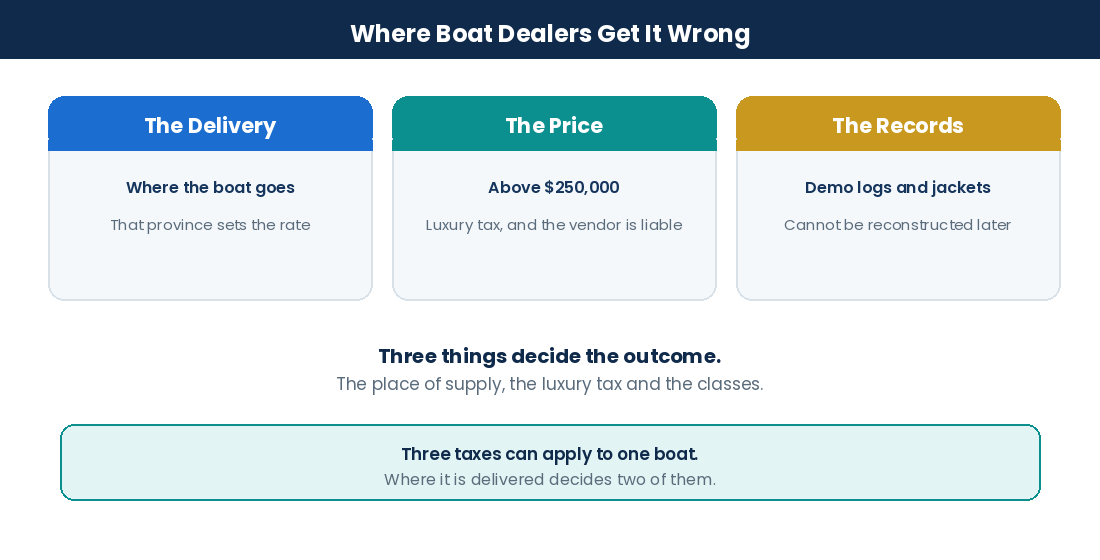
Most deduction questions in a dealership are ordinary. The three that are not are the luxury tax on vessels above the threshold, the place of supply that decides which sales tax applies, and the treatment of demonstration boats that sit between inventory and use.
Reading time: 54 minutes.
Table of Contents
- Three Taxes on One Boat
- The Legal and Regulatory Environment
- Inventory, Financing and Advertising
- Dealership Segments and Their Differences
- Compliance, Remittances and Reporting
- Planning, Examples and Working With Us
- Frequently Asked Questions
- Best Practices and Common Mistakes
- Businesses We Serve
- Professional Guidance and Quick Reference
The Numbers That Matter
This article covers Canada, with Ontario and Toronto context, and reflects rules current to 2026. It is written for incorporated Canadian boat dealerships and marine retailers. Figures marked illustrative are examples, not quotes, and any masked engagement notes end with “Figures changed for privacy.” This is educational information only and not tax or legal advice. Thresholds and vehicle limits change, so please confirm the current position before acting.
Three Taxes on One Boat
Three Taxes on One Boat
What Makes Marine Different
The Stack on a Single Sale
| Tax | When It Applies | What Decides It |
|---|---|---|
| GST/HST | On most vessel sales | Where the boat is delivered |
| Provincial sales tax | In BC, Saskatchewan, Manitoba and Quebec | Where the boat is delivered, filed separately |
| Luxury tax | On subject vessels above the threshold | The sale price, and your vendor status |
Ordinary retailers deal with the first row. A boat dealership can face all three on one transaction, and two of them turn on a fact that is decided after the paperwork is signed: where the boat physically goes.
The Place of Supply Rule Most Guidance Gets Wrong
For goods, the applicable rate generally follows the province where the boat is delivered or made available, not where the dealership sits.
Guidance saying that a Toronto dealer selling to a Quebec buyer charges Ontario HST is wrong. Delivery in Quebec means 5% GST, with Quebec sales tax administered separately by Revenu Québec. Delivery in British Columbia means 5% GST plus BC provincial tax, again filed separately.
Equally, the approach of “charge Ontario HST and adjust the return later once delivery is confirmed” is not a method. The rate is determined by the delivery arrangement agreed at the time of sale, and the invoice should reflect it.
- Establish the delivery province before the invoice is raised
- Record how and where delivery occurred, with dated transport documents
- Remember that only GST and HST go on your CRA return
- BC, Saskatchewan, Manitoba and Quebec taxes are separate registrations
- Exports out of Canada are zero-rated with proof of export
The Luxury Tax Is Not Only a Manufacturer’s Problem
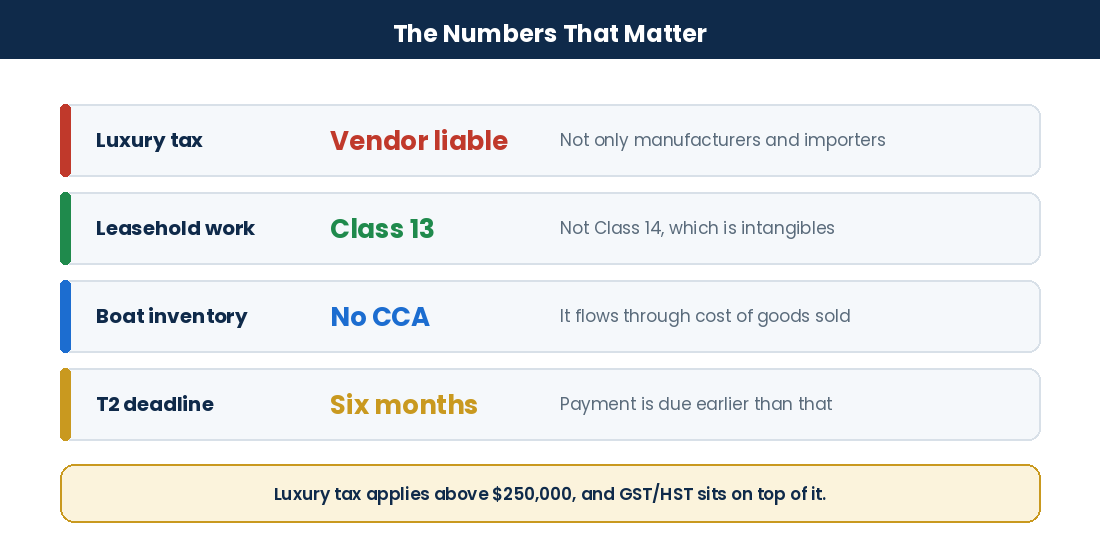
The Select Luxury Items Tax Act applies to subject vessels priced above $250,000. The tax is the lesser of 20% of the amount above the threshold and 10% of the total price.
Guidance suggesting that manufacturers or importers usually bear this and that dealers are not directly liable understates the position materially. A registered vendor selling a subject vessel above the threshold is liable for the tax, and a dealer selling boats in that range needs to know whether registration applies to them.
| Point | Position |
|---|---|
| Threshold for vessels | $250,000 |
| Calculation | The lesser of 20% above the threshold and 10% of the total |
| Who is liable | The registered vendor on a qualifying sale |
| Registration | Separate from GST/HST, with its own returns |
| Interaction | GST/HST is generally calculated on the price including luxury tax |
The last row catches dealers out. Where luxury tax applies, it forms part of the consideration on which GST/HST is then calculated, so the two do not simply sit side by side.
A dealer selling in the yacht range needs the luxury tax question answered before the first sale, not after. It is not a manufacturer-only matter. Figures changed for privacy.
Risk Warning: The rate follows where the boat is delivered, not where the dealership sits. Please establish the delivery province before invoicing.
Boat Dealer Taxes in Canada: Legal and Regulatory Environment
The Legal and Regulatory Environment
The Framework
Boat dealers operate under several regimes at once. Knowing which applies to a given transaction is most of the work.
| Regime | What It Governs |
|---|---|
| Income Tax Act | Corporate income, deductions and capital cost allowance |
| Excise Tax Act | GST/HST on sales, and input tax credits on purchases |
| Select Luxury Items Tax Act | Luxury tax on subject vessels above $250,000 |
| Provincial sales tax statutes | BC, Saskatchewan, Manitoba and Quebec, filed separately |
| Payroll obligations | Source deductions on wages and commissions |
Key Filing Dates
| Obligation | Deadline |
|---|---|
| T2 corporate return | Six months after fiscal year end |
| Corporate tax payment | Three months for an eligible CCPC, two for others |
| GST/HST return | Monthly, quarterly or annually by size |
| Payroll remittance | The 15th of the following month for a regular remitter |
| Luxury tax return | Separate, where you are registered |
Please note the first two rows, because guidance frequently confuses them. The T2 return is due six months after year end. The two-month figure is a payment deadline and applies to corporations that are not eligible CCPCs. Describing the T2 filing deadline as two months is wrong and leads dealerships to panic in the wrong month.
Key Income Tax Regulations Affecting Boat Dealerships
- Section 18 sets out the general limitations on deductions.
- Section 20(1)(c) permits interest deductions on money borrowed to earn income.
- Section 67 requires expenses to be reasonable in the circumstances.
- Section 67.1 is the 50% restriction on meals and entertainment specifically.
- Schedule II of the Regulations sets out the capital cost allowance classes.
The fourth item is worth naming precisely. Section 67.1 is not a general limitation on business expenses; it is the meals and entertainment rule, and describing it vaguely leaves dealerships unsure which costs it touches.
Understanding Capital Cost Allowance (CCA) Classes Relevant to Boat Dealers
Capital cost allowance spreads the cost of an asset over years rather than deducting it at once. Boat inventory is not depreciated; it flows through cost of goods sold when sold. Everything else the dealership owns generally goes into a class.
CCA Half-Year Rule
In the year an asset becomes available for use, the claim is generally calculated on half the addition. Full rates apply afterwards.
One current point. Bill C-15 received Royal Assent on 26 March 2026, reinstating the accelerated investment incentive for most depreciable property acquired after 2024 and available for use before 2030. Where it applies, an enhanced first-year deduction replaces the ordinary half-year treatment, which matters on forklifts, lifts and yard equipment.
Relevant Classes
| Class | Rate | Typical Dealership Assets |
|---|---|---|
| Class 1 | 4% | Buildings you own |
| Class 8 | 20% | Forklifts, service tools, lifts, office furniture |
| Class 10 | 30% | Tow vehicles outside the passenger definition |
| Class 10.1 | 30% | Passenger vehicles, subject to a cost cap |
| Class 12 | 100% | Application software, tools under $500 |
| Class 13 | Over the lease term | Leasehold improvements, including dock and yard work on leased sites |
| Class 50 | 55% | Computer hardware and systems software |
Two corrections to how these are usually listed. Leasehold improvements are Class 13, not Class 14, which covers limited-life intangibles such as patents and franchises. And the cost cap applies to Class 10.1 passenger vehicles, not Class 10; the cap figure is set annually and has risen well above older published amounts, so use the current year’s number rather than a stale one.
On dock and marina structures, the class depends on what was built and whether you own or lease the site. Work on a leased marina site is generally Class 13; a structure on land you own is assessed on its own facts. Placing a dock rebuild in Class 17 without checking is not safe.
Harmonized Sales Tax (GST/HST) Obligations for Boat Dealerships
- Register once taxable sales exceed $30,000 over four consecutive calendar quarters, or in a single calendar quarter.
- File monthly, quarterly or annually according to your assigned frequency.
- Charge at the rate for the place of supply, which follows delivery.
- Keep documents supporting every input tax credit claimed.
- Exports are zero-rated with proof, and credits on related costs remain recoverable.
Please note the single-quarter test, which most guidance omits. A dealership selling one substantial boat can cross $30,000 in a single quarter, long before four quarters have passed. Our GST/HST filing service handles the returns thereafter.
The T2 filing and payment deadlines are different dates and dealerships confuse them every year. Six months to file, and the payment is due earlier. Figures changed for privacy.
Key Stat: The T2 return is due six months after year end. The two-month figure is a payment deadline for corporations that are not eligible CCPCs.
Inventory Management and Related Tax Deductibility for Boat Dealers
Inventory, Financing and Advertising
The Core Costs
Inventory is the main asset of a dealership. It is not deducted when bought; the cost moves to cost of goods sold when the boat is sold. Inventory is valued at the lower of cost and net realizable value.
| Category | Treatment |
|---|---|
| New and used boats | Cost to COGS on sale, valued at lower of cost and net realizable value |
| Parts inventory | Same basis, counted at year end |
| Consignment stock | Not your inventory; only the commission is your income |
| Demonstration boats | Held for sale but used, so treatment depends on the actual use |
| Inventory write-down | Deductible where the loss is real and documented |
Do a physical count at year end and sign it off. Keep deal jackets showing purchase prices and floor plan details. Write-downs need a documented basis identifying the specific units and why they cannot be sold at cost, rather than a round figure entered at year end.
Trade-Ins and Consignment Sales
A trade-in reduces the consideration on which GST/HST is calculated where the customer is not registered, so tax applies to the net amount rather than the full price with the trade-in treated as a separate sale.
Please note the qualification, because it is regularly missed. Where the customer is a GST/HST registrant trading in a boat used in their business, the treatment differs and the trade-in can be a taxable supply in its own direction. Check the customer’s status before applying the netting rule.
On consignment, the boat is not yours. Record the commission as income and the amounts paid across to the owner separately, with the consignment agreement on file.
Financing Costs and Their Treatment in Boat Dealership Tax Returns
Floor plan interest on borrowing used to carry inventory is deductible against business income where it relates to earning taxable revenue. Keep lender statements and reconcile them monthly to the floor plan balances.
- Floor plan interest is deductible with proper documentation
- Chargebacks reduce the interest previously claimed
- Financing on a vessel held for personal use is not deductible
- Monthly reconciliation is what makes the claim sustainable
- Loan arrangement fees follow their own rules rather than the interest rules
Illustrative example. A dealer claims $120,000 of floor plan interest supported by lender statements. A $10,000 chargeback arises on cancelled sales, reducing the deductible amount to $110,000 for the period. Figures changed for privacy.
The last bullet is worth separating. Costs of arranging financing are not interest and are generally deductible over a period rather than in the year paid, which is a different treatment from the interest itself.
Advertising and Promotional Expense Deductions for Marine Businesses
| Expense | Treatment |
|---|---|
| Print and digital advertising | Deductible with contracts or invoices |
| Boat show booth rental | Deductible with the invoice |
| Staff travel and accommodation to shows | Deductible on the business portion |
| Meals while travelling | Generally limited to 50% |
| Sponsorships | Deductible where a business purpose is documented |
| Client entertainment | Generally limited to 50%, and some categories are denied |
Two points on advertising for Canadian dealerships. Advertising directed at a Canadian market placed with foreign broadcasters or in foreign periodicals can face restrictions, so where you place a campaign matters and not only what it costs.
On sponsorships, the test is whether a business benefit was expected. A sponsorship of a local regatta with signage and dealership presence is straightforwardly promotional. One that produces goodwill and nothing identifiable needs the reasoning documented at the time.
Operating Expenses Common to Boat Dealerships Eligible for Tax Relief
- Rent on showroom, yard and marina premises
- Utilities including hydro and heating
- Security service contracts
- Dock repairs, as distinct from major rebuilds
- Yard storage consumables such as shrink-wrap
- Insurance premiums and licence fees
- Professional fees for accounting and legal advice
The fourth item is the repair against replacement test in marine form. Work that keeps a dock serviceable is a current expense. Work that replaces or materially improves it is capital and enters a class, which one depending on the structure and whether the site is owned or leased.
Where premises include any personal-use area, split the costs on a defensible basis and document how. That split is examined whenever a dealership is reviewed.
Deducting Costs Associated with Service, Repair Shops, and Parts Retail
- Lifts, hoists and service tools go to Class 8 at 20%
- Tools under $500 go to Class 12, generally with the half-year rule
- Computer hardware and systems software go to Class 50 at 55%
- Application software goes to Class 12
- Leasehold improvements to a service bay go to Class 13 over the lease term
Track each asset separately with serial numbers, purchase dates and cost. The date that matters for the claim is when the asset became available for use, not the invoice date, and a lift bought in December but commissioned in February falls in the later year.
The single most expensive filing error we see in dealerships is equipment coded to supplies in a busy month, because it costs the claim every year afterwards. Figures changed for privacy.
Risk Warning: Leasehold improvements are Class 13, not Class 14. Class 14 covers limited-life intangibles such as patents and franchises.
Tax Implications Across Boat Dealership Segments
Dealership Segments and Their Differences
By Segment
Tax Implications for New Boat Franchise Dealers vs. Used and Consignment Dealers
New franchise dealers hold boats as inventory at cost, moving to cost of goods sold on sale, and capitalise showroom and dock improvements. Used and consignment dealers work differently: consignment stock is not theirs, so only the commission is income.
| Item | New Franchise Dealer | Used and Consignment Dealer |
|---|---|---|
| Boats held | Inventory at cost | Consignment stock is not inventory |
| Revenue recorded | Full sale price | Commission on consignment sales |
| Floor plan interest | Common and deductible | Less common, depends on stock ownership |
| Trade-ins | Recorded at fair market value | Recorded at fair market value |
| Premises improvements | Capitalised | Capitalised |
GST/HST Rules on Boat Sales
- Registered dealers charge tax unless the sale is zero-rated as an export.
- The rate follows the province of delivery.
- A deposit generally becomes consideration when applied to the price or forfeited.
- Input tax credits require invoices carrying the prescribed information.
- Exports need proof, such as transport documents showing the vessel left Canada.
The fourth point is where credit claims most often fail. Above a modest threshold the supplier’s GST/HST registration number is required on the invoice, and a counter receipt without it will not support a credit however genuine the purchase.
Marina-Based Dealers: Tax Deductions Related to Slip Rentals and Storage
- Slip rentals and storage space are current expenses where supported by leases.
- Repairs that maintain a dock are current; upgrades that add value are capital.
- Utilities tied to operations are deductible.
- Dock construction on a leased site generally falls under Class 13.
- Shrink-wrap and seasonal consumables are expensed with receipts kept.
Insurance, Licence and Professional Fees Deductibility
- Liability and property insurance on the business is deductible.
- Licences required to operate are deductible where there is no personal use.
- Membership dues for marine dealer associations are deductible.
- Accounting and bookkeeping fees are deductible.
- Legal fees relating to operations are deductible.
- Legal and arrangement fees relating to financing follow a different rule.
The last item is the one to flag. Costs of issuing debt or arranging borrowing are generally deductible over a period rather than immediately, so they are not simply another professional fee line.
Yacht and Large Vessel Brokerage: Unique Accounting and Tax Treatment
Brokers handling vessels above the luxury tax threshold need to establish their position on that tax before the first qualifying sale rather than after it. The registered vendor on a qualifying sale is liable, and describing this as a manufacturer’s concern understates it.
- Confirm whether luxury tax registration applies to your operation
- Keep vessel registration numbers, sale dates, invoices and payment proof
- Show the luxury tax on the customer invoice correctly
- Remember that GST/HST is generally calculated on the price including luxury tax
- File the luxury tax return separately from your GST/HST return
Beyond that, ordinary corporate tax applies: capital cost allowance on office equipment, vehicles and software, and deductions for the costs of earning brokerage commissions.
Tax Issues for Dealers Handling Personal Watercraft and Small Craft
Demonstration and loaner vessels sit between inventory and use, and that is where the difficulty is.
| Use | Position |
|---|---|
| Held for sale, not used | Ordinary inventory |
| Used for customer demonstrations | Still held for sale, with usage logged |
| Loaned to a customer during a service job | Business use, with the reason and period recorded |
| Used personally by an owner or family member | A taxable benefit arises, and costs are restricted |
The last row is the one that produces adjustments. Personal use of a dealership vessel by a shareholder is a benefit, and it needs to be identified and reported rather than absorbed into floor plan interest and operating costs.
Keep a log for every demonstration and loaner vessel showing the date, who used it, and why. Without it the whole category is difficult to defend, and the adjustment tends to cover every period examined.
Powersports Dealers with Marine Lines: Integrated Tax Strategies
Mixed-line dealerships carry a payroll question alongside everything else. Salaries, commissions and employer contributions are deductible where the amounts are reasonable and properly processed.
- Wages and commissions require source deductions and information slips
- Employer CPP and EI contributions are deductible
- Classification is decided on the facts, not on the contract wording
- Seasonal sales staff are a common classification risk
The third point matters more than it sounds. Control over the work, who provides the tools, whether the worker can profit or lose, and how integrated they are all feed the analysis. A written agreement calling someone a contractor does not settle it, and misclassification produces reassessments covering every period examined plus the employer contributions that were never made.
Demonstration vessel logs are the least popular record in a dealership and the one that settles the largest single argument in a review. Figures changed for privacy.
Pro Tip: Please log every demonstration and loaner use as it happens. Reconstructing a season of usage afterwards is not possible.
Compliance, Remittances, and Reporting Requirements
Compliance, Remittances and Reporting
The Obligations
Tax Deduction Remittance Procedures Applicable to Boat Dealership Employees
Dealerships withhold income tax, Canada Pension Plan contributions and Employment Insurance premiums from wages, including commissions paid to salespeople.
- Deduct on total wages plus commissions.
- Remit by the deadline for your assigned remitter type.
- Keep signed contracts showing commission arrangements.
- Keep payroll records showing each pay period clearly.
A regular remitter pays by the 15th of the month following the payroll. Please note that the remitter type changes as the payroll grows, and a dealership moving into a higher category on average monthly withholdings faces a more frequent schedule. Missing that change is a common source of penalties.
Amounts withheld are held in trust. They are not working capital, and directors can be assessed personally for amounts not remitted. That exposure sits in a different category from an ordinary tax debt.
Filing and Reporting Income Tax Returns for Boat Dealerships
An incorporated dealership files a T2 within six months of its fiscal year end, with payment due earlier.
Report every income source: new and used boat sales, consignment commissions, service income, parts sales, and any other revenue. Include the capital cost allowance schedules and any luxury tax position.
A correction on penalties. Guidance stating that late corporate returns bring penalties “starting at $250” is wrong. The corporate late-filing penalty is 5% of the unpaid tax plus 1% per complete month the return is late, to a maximum of twelve months, with a higher rate on repetition. The $250 figure is a separate penalty for failing to file electronically where required, which is a different obligation.
The practical consequence differs. A late return with no balance owing generally carries little or no late-filing penalty, because the calculation runs on unpaid tax. A late return on a profitable year carries a serious one.
Managing Payments and Deductions for Non-Resident Transactions
| Aspect | What You Must Do | Documents Needed |
|---|---|---|
| GST/HST return filing | File on your assigned frequency | Filed returns and working papers |
| Zero-rated export sales | Keep proof the vessel left Canada | Bills of lading and customs documents |
| Withholding on non-resident payments | Apply withholding where the payment qualifies | Contracts and payment records |
| Cross-provincial delivery | Apply the rate for the delivery province | Dated transport and delivery records |
Payments to non-residents such as royalties or management fees may attract withholding, with the rate depending on the payment type and any applicable treaty. Take advice before making the payment rather than after.
Electronic Filing and Record-Keeping Best Practices for Marine Businesses
Keep books and supporting documents for six years from the end of the taxation year they relate to. That is the correct measure; describing it as six years from filing understates the period where a return was filed late.
- Invoices showing vendor name, date, description and registration number
- Commission agreements explaining how pay was calculated
- Floor plan lender statements matching the interest claimed
- Logs showing demonstration and loaner use
- Transport documents proving zero-rated exports
- Vessel registration and luxury tax records where applicable
- Signed year-end inventory counts
Electronic records are acceptable provided they stay readable and retrievable for the whole period. A system migration that leaves years of attachments unopenable is a retention failure even though the data technically exists somewhere.
Reconcile monthly rather than annually. Floor plan interest, inventory and deposits all drift quickly in a dealership, and a twelve-month gap between reconciliations turns a small discrepancy into a reconstruction exercise. Where records have already drifted, our corporate tax cleanup service handles the correction.
Addressing GST/HST Collection and Remittance in Cross-Border Sales
- Register once taxable sales exceed $30,000, on either threshold test.
- Charge based on the delivery province, not the dealership location.
- Keep export documentation for any zero-rated sale.
- Claim input tax credits only where the invoice supports them.
- Set collected tax aside, since it is held in trust.
Where a boat is sold to a buyer outside Canada, the sale can be zero-rated with proof of export. Zero-rated is not exempt: credits on related costs remain fully recoverable, which for a dealership with export sales can produce a persistent refund position worth filing more frequently to collect.
Dealerships with export sales are often in a refund position and filing annually. Moving to quarterly recovers the same money months sooner. Figures changed for privacy.
Risk Warning: There is no $250 starting penalty for a late T2. The penalty is 5% of unpaid tax plus 1% per complete month, so a nil-balance year carries little.
Strategic Tax Planning and Accounting Services for Boat Dealers
Planning, Examples and Working With Us
The Engagement
Role of a Boat Dealer Accountant in Canada: Services and Benefits
- Identify deductible costs across inventory, advertising, financing and operations.
- Assign assets to the right capital cost allowance classes.
- Advise on the luxury tax position under the Select Luxury Items Tax Act.
- Keep records in the condition the CRA expects on review.
- Test worker classification before it becomes a reassessment.
Our bookkeeping and accounting services run this through the year rather than at the year end.
Effective Bookkeeping Techniques Tailored for Boat Dealerships
- Keep detailed deal jackets showing purchase prices, floor plan loans, trade-ins and commissions.
- Reconcile inventory to records on the lower of cost and net realizable value basis.
- Separate demonstration vessels from sale inventory so personal use is not absorbed.
- Record deposits as liabilities until the sale completes or the deposit is forfeited.
- Create a capital purchases account so equipment cannot land in supplies by accident.
The last item prevents the most expensive routine error in a dealership. A forklift or lift coded to supplies never reaches the asset register and generates no claim in that year or any year afterwards.
Illustrative Calculation of CCA for Dealership Assets
A Toronto dealer buys a forklift for $40,000 and places it in Class 8 at 20%. The figures are illustrative only and assume the ordinary half-year rule rather than the reinstated incentive.
| Year | Opening UCC | Rate Applied | Deduction | Closing UCC |
|---|---|---|---|---|
| Year 1 | $40,000 | 20% on half the addition | $4,000 | $36,000 |
| Year 2 | $36,000 | 20% | $7,200 | $28,800 |
| Year 3 | $28,800 | 20% | $5,760 | $23,040 |
Note that the first year produces the smallest claim, which is the opposite of what dealers expect when buying equipment to reduce a tax bill. Where the reinstated incentive applies to a post-2024 purchase, the first-year figure is substantially higher, and returns still within the reassessment period may be worth revisiting.
Boat inventory itself is not depreciated. It is expensed through cost of goods sold on sale, which is why a large inventory position produces no capital cost allowance at all.
Sample Tax Deduction Scenarios for Advertising and Financing Expenses
| Scenario | Amount | Treatment |
|---|---|---|
| Floor plan interest on new boat inventory | $15,000 | Deductible with reconciled lender statements |
| Digital advertising to a Canadian market | $25,000 | Deductible where reasonable and placed appropriately |
| Boat show booth and staff travel | Varies | Deductible, with meals restricted |
| Chargeback on cancelled sales | ($10,000) | Reduces the interest deduction |
All figures illustrative. The second row carries a qualification worth knowing: advertising directed at a Canadian market placed with foreign media can face restrictions, so the placement matters as well as the spend.
Tax Planning Strategies to Minimize Liability and Enhance Cash Flow
- Time equipment purchases against the availability-for-use test, not the invoice date.
- Check anything acquired after 2024 against the reinstated investment incentive.
- Reconcile floor plan interest monthly against lender statements.
- Choose the capital cost allowance claim rather than defaulting to the maximum.
- Review reporting frequency where export sales put you in a refund position.
- Keep warranty reserves supportable by the manufacturer arrangements behind them.
The fourth point is a real decision. Capital cost allowance is a maximum, not an obligation, and claiming less in a weak year preserves the pool for a year when the deduction is worth more. Our corporate tax planning service works through these choices before the year closes.
Utilizing Profit Sharing and Registered Plans for Employee Incentives
Commission structures and retirement arrangements can support retention where they are set up properly and the amounts are reasonable for the work performed.
Please note one point often stated loosely. Employer contributions to an employee’s RRSP are a taxable benefit to the employee, though the employee’s own deduction generally offsets it. A deferred profit sharing plan works differently. Describing registered plans as building wealth without any immediate benefit is not accurate, and the mechanics should be confirmed before a scheme is set up.
Addressing Luxury Tax and Its Impact on High-Value Vessel Sales
- The threshold for subject vessels is $250,000.
- The tax is the lesser of 20% of the amount above the threshold and 10% of the total price.
- A registered vendor selling a qualifying vessel is liable.
- Registration is separate from GST/HST, with its own returns.
- GST/HST is generally calculated on the price including the luxury tax.
- Customer invoices should show the charges clearly.
Confirm your registration position early. A dealership that starts carrying a higher-value line can move into this regime without any deliberate decision having been made, and discovering it after several sales is expensive.
How to Choose the Right CPA Firm for Your Boat Dealership
- Familiarity with dealership inventory, floor plan financing and trade-in mechanics.
- Working knowledge of the luxury tax regime and place of supply rules.
- Clear pricing quoted before work begins.
- Timely delivery of the T2 and the sales tax filings.
- A registration you can verify on the CPA Ontario public directory.
Why Trust Gondaliya CPA
Gondaliya CPA works with incorporated Canadian businesses including dealerships and retail operations, handling bookkeeping with reconciliation, the asset register and capital cost allowance decisions, sales tax filings, payroll, financial statements and the corporate return.
Fees are quoted before work begins, including HST, with a one-business-day response and evening and weekend availability. Our engagements carry a 30-day money-back arrangement and a 60-day fee-matching arrangement, and we tell clients plainly where a position will not hold.
Bring three things to a first conversation: your last filed corporate return, your floor plan lender statements for the year, and a list of equipment purchased in the last two years. Contact Gondaliya CPA at info@gondaliyacpa.ca, call 647-212-9559, or send us a message. Our guides to input tax credits and GST/HST registration cover the sales tax side in detail.
The floor plan statements and the equipment list are where we start. Between them they usually explain most of the gap between reported profit and actual position. Figures changed for privacy.
Key Stat: Boat inventory is not depreciated. It flows through cost of goods sold on sale, so a large stock position generates no capital cost allowance.
Frequently Asked Questions (FAQ) on Boat Dealer Tax Deductions
Frequently Asked Questions
FAQ
What is the payroll source deduction deadline for boat dealerships in Canada?+
A regular remitter pays by the 15th of the month following the payroll. The schedule changes as average monthly withholdings grow, so confirm your remitter type as the dealership expands.
How long should boat dealerships keep records for tax purposes?+
Six years from the end of the taxation year the records relate to, not six years from filing. Electronic records must stay readable for the whole period.
When is the corporate T2 filing deadline for incorporated boat dealerships?+
Six months after fiscal year end. Payment is due earlier, generally three months for an eligible CCPC and two for other corporations.
What is the meals and entertainment deduction limit for marine businesses?+
Generally 50%, under section 67.1. Keep the receipt and note the business purpose and who attended.
How are demo, loaner, and personal-use vessels treated for tax purposes?+
Demonstration vessels remain held for sale with usage logged. Loaners need the reason and period recorded. Personal use by a shareholder is a taxable benefit and restricts the related costs.
What employee, commission, and wage costs can boat dealerships claim?+
Salaries, wages, commissions and employer CPP and EI contributions, where the amounts are reasonable for the work and source deductions were processed properly.
Are salespeople and technicians employees or contractors for tax purposes?+
It depends on the facts: control over the work, who supplies the tools, the chance of profit or loss and integration into the business. The contract wording does not settle it.
How do you handle warranty work, deposits, and customer refunds in accounting?+
Warranty reserves must be supportable by the manufacturer arrangements. Deposits are liabilities until applied or forfeited. Refunds reduce revenue in the period they arise.
Should you buy, lease, or finance dealership equipment for tax efficiency?+
Buying gives capital cost allowance. Leasing gives a deduction for the payments. Financing gives interest deductions plus capital cost allowance on the asset. The comparison depends on rates and cash flow, not on tax alone.
What happens when you sell or scrap dealership assets?+
Proceeds reduce the pool and may produce recapture, which is income, or a terminal loss, which is a deduction. Class 10.1 passenger vehicles are an exception with neither.
How do boat dealers handle bad debts and financing chargebacks?+
A bad debt is deductible once established as uncollectible, not merely overdue. Chargebacks reduce the interest deduction previously claimed and need documenting against the lender statements.
Which costs are not deductible for Canadian boat dealerships?+
Personal expenditure, fines and penalties, the disallowed portion of meals and entertainment, and any claim without supporting documentation.
What records support every deduction claimed by a boat dealership?+
Invoices, deal jackets, commission agreements, floor plan lender statements, demonstration vessel logs, export transport documents, signed inventory counts and payroll records.
What triggers a CRA review of a boat dealership’s tax filings?+
Margins that move without explanation, inventory values inconsistent with sales, weak demonstration vessel records, large financing deductions and worker classification patterns.
Do I need to register separately for luxury tax if I sell high-value yachts?+
Where you sell subject vessels above the $250,000 threshold, luxury tax registration applies separately from GST/HST, with its own returns. Confirm your position before the first qualifying sale.
Can I deduct interest on loans used to finance my boat inventory?+
Yes, where the borrowing relates to earning income from selling boats held as inventory, supported by lender statements reconciled monthly. Financing on a personal-use vessel is not deductible.
Sixteen questions, and two of them decide the sales tax on every boat that leaves the yard: where it is delivered, and what it cost. Figures changed for privacy.
Best Practices to Capture Every Deduction as a Boat Dealer
Best Practices and Common Mistakes
Quick Reference
Best Practices
- Maintain detailed deal jackets with purchase prices and floor plan details.
- Separate demonstration vessels’ business use from personal use through logs.
- Reconcile floor plan interest monthly with lender statements.
- Keep receipts organised by expense type, including advertising and repairs.
- Conduct physical inventory counts annually, signed off, on the lower of cost and net realizable value basis.
- Document sponsorships with clear business purpose support.
- Record warranty reserves realistically, based on manufacturer arrangements.
- Establish the delivery province before the invoice is raised.
- Confirm your luxury tax position before the first qualifying sale.
Common Deduction Mistakes Boat Dealers Should Avoid
- Claiming full CCA without applying the half-year rule on assets acquired mid-year.
- Mixing personal-use vessel costs into business deductions without documentation.
- Ignoring input tax credit documentation requirements, including registration numbers.
- Misclassifying employees as contractors, causing payroll reassessments.
- Overstating warranty reserves beyond what the manufacturer arrangements support.
- Charging the dealership’s own provincial rate on a boat delivered elsewhere.
- Treating the luxury tax as a manufacturer-only concern.
- Coding equipment to supplies so it never reaches the asset register.
- Confusing the T2 filing deadline with the payment deadline.
Preparing Before a Tax Deduction Review Starts
- Gather all deal jackets showing purchase prices and financing terms.
- Collect vessel logs differentiating personal from business use.
- Assemble floor plan lender statements with reconciled monthly interest.
- Compile payroll contracts detailing commission structures.
- Organise receipts supporting advertising and trade show costs.
- Pull export documentation for any zero-rated sales.
- Produce the asset register with dates, costs and availability for use.
- Confirm the delivery province recorded against each out-of-province sale.
For tailored advice about boat dealer tax deductions Canada, contact Gondaliya CPA at info@gondaliyacpa.ca, call 647-212-9559, or book a free consultation.
Twenty-six points, and the last two in the first group are the ones that are hard to fix afterwards. The rest can be caught at year end. Figures changed for privacy.
Businesses We Serve
Industry Expertise
Marine and dealership businesses share the same issues. Here are ten and the usual finding.
| Business | The Issue That Usually Appears |
|---|---|
| New boat franchise dealers | Equipment coded to supplies, never in the register |
| Used and consignment dealers | Consignment stock treated as owned inventory |
| Yacht and large vessel brokers | Luxury tax position never established |
| Marina-based dealers | Dock work placed in the wrong class |
| Personal watercraft dealers | Demonstration vessel logs missing entirely |
| Powersports with marine lines | Seasonal staff classified as contractors |
| Dealers selling across provinces | Own provincial rate charged on delivered boats |
| Dealers with export sales | Refund position sitting on annual filing |
| Service and parts departments | Post-2024 equipment on the plain half-year rule |
| Any dealership taking deposits | Revenue recognised before the sale completes |
- New boat franchise dealers: Check supplies for equipment.
- Used and consignment dealers: Commission only, not the sale.
- Yacht and large vessel brokers: Settle it before the first sale.
- Marina-based dealers: Leased site means Class 13.
- Personal watercraft dealers: Log it as it happens.
- Powersports with marine lines: Facts decide, not contracts.
- Dealers selling across provinces: The rate follows delivery.
- Dealers with export sales: File more often, collect sooner.
- Service and parts departments: Check the 2026 incentive.
- Any dealership taking deposits: A liability until earned.
The segment changes the finding. It does not change the two facts that decide the sales tax on every boat: where it was delivered and what it cost. Figures changed for privacy.
Professional Guidance and Quick Reference
Guidance
Professional Guidance: How Gondaliya CPA Handles Your Dealership
Boat dealerships get into difficulty in a predictable set of ways: charging their own provincial rate on a boat delivered elsewhere when the rate follows the place of delivery, treating the luxury tax as a manufacturer concern when a registered vendor selling a subject vessel above $250,000 is liable, placing leasehold improvements in Class 14 rather than Class 13, applying a cost cap to Class 10 rather than Class 10.1, confusing the six-month T2 filing deadline with the earlier payment deadline, expecting a flat late-filing penalty rather than one calculated on unpaid tax, and running demonstration and loaner vessels with no usage logs at all. Gondaliya CPA handles dealership accounting on a flat annual fee.
We handle what decides the outcome: establishing the delivery province before invoicing, settling the luxury tax position before the first qualifying sale, assigning assets to the correct classes with availability-for-use timing, applying the reinstated investment incentive to eligible purchases, reconciling floor plan interest monthly against lender statements, separating demonstration vessels from sale inventory, and testing worker classification before it becomes a reassessment.
Our team starts with your last filed corporate return, your floor plan lender statements for the year and a list of equipment purchased in the last two years. Whatever your segment, you get clear advice and a fixed price before we start.
Quick Answers
- Sales tax rate: Follows the delivery province
- Luxury tax threshold: $250,000 for subject vessels
- Who is liable: The registered vendor on the sale
- Boat inventory: Not depreciated, goes to COGS
- Consignment stock: Not yours, commission only
- Leasehold improvements: Class 13, not Class 14
- Cost cap: Class 10.1, not Class 10
- T2 filing: Six months, payment earlier
- Late penalty: 5% plus 1% monthly, not a flat amount
- Demonstration vessels: Log every use as it happens
Who This Is For
- For: Incorporated Canadian boat dealerships, marine retailers, yacht brokers and powersports businesses carrying marine lines.
- Not For: A statement of current vehicle cost limits or prescribed rates, which are set annually and should be confirmed for the year concerned.
People Also Ask
Which sales tax applies when I deliver a boat to another province?+
The rate for the province of delivery, not the one where your dealership sits. Delivery in Quebec means GST plus separately administered QST; delivery in Ontario means HST.
Are employee commissions subject to source deductions?+
Yes. Commissions are employment income and attract income tax, CPP and EI withholding in the same way as regular wages.
Is boat inventory depreciated?+
No. Inventory is expensed through cost of goods sold when the boat is sold, and valued at the lower of cost and net realizable value in the meantime.
Glossary of Key Terms
- Cost of goods sold: Opening stock plus purchases less closing stock.
- Net realizable value: The ceiling at which inventory is carried.
- Floor plan financing: Borrowing used to carry boat inventory.
- Chargeback: A lender reversal reducing interest previously claimed.
- Deal jacket: The file supporting a single vessel transaction.
- Consignment stock: Boats held for an owner, not dealership inventory.
- Luxury tax: Applies to subject vessels above $250,000.
- Subject vessel: A vessel within the luxury tax regime.
- Place of supply: What determines which sales tax rate applies.
- Zero-rated export: Taxed at 0%, with credits still recoverable.
- Capital cost allowance: Tax depreciation, a maximum not an obligation.
- Class 13: Leasehold improvements, amortised over the lease term.
- Available for use: When an asset becomes eligible for depreciation.
- Recapture: Income arising where proceeds exceed the pool balance.
- Demonstration vessel: Held for sale but used, requiring a log.
- Trust amounts: Collected sales tax and payroll source deductions.
Dealership Readiness Check
This quick self-check indicates where your operation most likely has room. Please answer the six questions below.
Dealership Readiness Check
Six quick questions on your dealership. No fee shown.
Points to raise with us:
This is a general prompt, not tax or legal advice or a quote. Your position depends on your full facts. For a real review, please book a free consultation.
Want a checklist to work from? You can download our free boat dealer deduction checklist before your consultation.
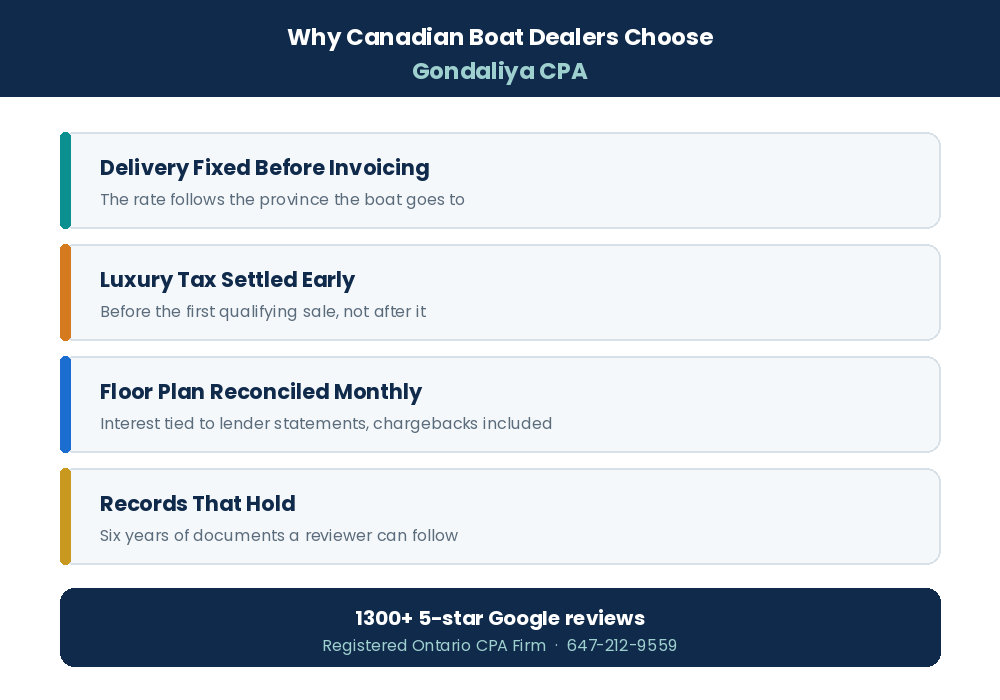
Establish the delivery province before the invoice is raised. Settle the luxury tax position before the first qualifying sale. Enter every asset in the register at purchase. Check post-2024 equipment against the reinstated incentive. Reconcile floor plan interest monthly. Log every demonstration and loaner use. Treat deposits as liabilities until earned. Please keep six years of records.
2026 Update — what is current: This article reflects rules current to 2026. The $250,000 luxury tax threshold for subject vessels, the Class 8 rate of 20%, the Class 10 and 10.1 rates of 30%, the $30,000 GST/HST small supplier threshold on both tests, the six-month T2 filing deadline and the six-year record retention requirement are unchanged. Bill C-15 received Royal Assent on 26 March 2026, reinstating the accelerated investment incentive for most depreciable property acquired after 2024 and available for use before 2030, and Ontario\u2019s small business rate moves to 2.2% from 1 July 2026. Please note that the sales tax rate on a boat follows the province where it is delivered rather than where the dealership is located, so charging an Ontario rate on a vessel delivered to Quebec or British Columbia is wrong and cannot be corrected by adjusting a later return; that under the Select Luxury Items Tax Act a registered vendor selling a subject vessel above the threshold is liable for the tax, calculated as the lesser of 20% of the amount above $250,000 and 10% of the total price, with GST/HST then generally calculated on the price including that tax, so treating it as a manufacturer-only obligation understates dealer exposure; that leasehold improvements belong in Class 13 rather than Class 14, which covers limited-life intangibles; that the vehicle cost cap applies to Class 10.1 passenger vehicles and the capped amount is set annually and now sits well above older published figures; that the T2 filing deadline is six months after year end and is distinct from the earlier payment deadline; and that the corporate late-filing penalty is 5% of unpaid tax plus 1% per complete month rather than a flat starting amount.
Boat Dealer Tax Canada: How Gondaliya CPA Supports Marine Dealerships
Start with the delivery records
Gondaliya CPA establishes the delivery province behind every out-of-province sale, settles the luxury tax position before qualifying sales are made, rebuilds the asset register with availability-for-use timing, applies the reinstated investment incentive to eligible purchases, reconciles floor plan interest monthly against lender statements, separates demonstration vessels from sale inventory, and handles the sales tax, payroll and corporate return, on a flat annual fee including HST with a one-business-day response. Please book a free consultation.
Next Steps
Please book a free consultation with Gondaliya CPA and bring your last filed corporate return, your floor plan lender statements, and a list of equipment bought in the last two years. Those three show where the deductions are, what was missed, and what remains to claim on the equipment, and where the documentation is thin. You will get a flat annual fee including HST before any work begins. If our content helps, please add gondaliyacpa.ca as a preferred source on Google.
Published: · Last updated:
Editorial policy: We research against CRA and CPA Ontario sources, fact-check the figures, and Sharad Gondaliya, CPA, reviews the content, which we update as the rules change.
Disclaimer: This article is educational information only and is not tax, legal, or financial advice. Figures marked illustrative are examples rather than quotes or guarantees. It reflects CRA rules current to 2026, including the $30,000 GST/HST threshold, the Class 8 rate, Class 13 leasehold treatment, the half-year rule, and the six-year retention requirement. Rates, limits and expensing rules change and outcomes depend on your specific facts. Please consult a licensed CPA before acting.

Sharad Gondaliya is a CPA Canada & CPA USA with 15 Years+ experience of Accounting, Tax, Payroll of Corporate Small Businesses as Tax Accountant. He is fully certified CPA Ontario and CPA USA and is well known among corporate small businesses for tax planning, efficient tax solutions, and affordable CPA services. Sharad is the Principal (Director) of Gondaliya CPA – Affordable CPA Firm in Canada. Licenses: CPA Ontario: 61040184 | CPA USA (MT): PAC-CPAP-LIC-033176 | CPA USA (WA): 57629 | CPA Firm License: 61330051 View Full Author Bio