



Motorcycle Dealer Tax Planning in Canada: Strategies to Reduce Taxes and Improve Cash Flow
Motorcycle dealer tax planning Canada: Essential tax strategies, deductions, and accounting tips for motorcycle dealerships
Motorcycle dealer tax planning Canada is key for managing taxes and maximizing deductions in your dealership business. Gondaliya CPA offers expert advice on motorcycle dealer taxes Canada, including GST HST, CCA claims, inventory tax, and effective bookkeeping to support motorcycle dealership tax strategies and improve cash flow.
Quick Summary
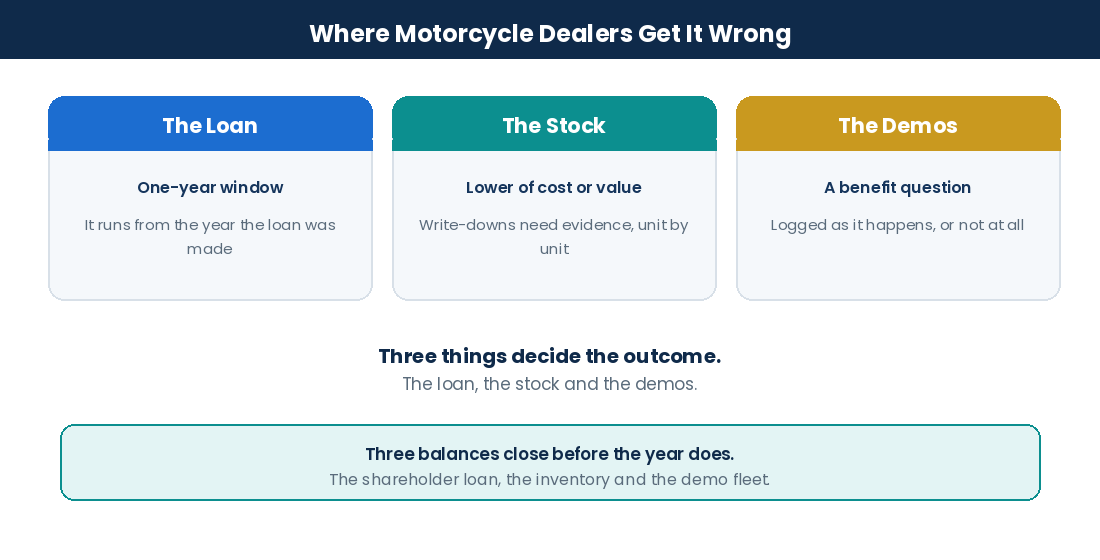
The three balances are inventory carrying value, the shareholder loan account, and the benefit on demonstration units. Each is a decision with a deadline, and each is far cheaper to get right in month eleven than in month fourteen.
Reading time: 53 minutes.
Table of Contents
The Numbers That Matter
This article covers Canada, with Ontario and Toronto context, and reflects rules current to 2026. It is written for incorporated Canadian motorcycle and powersports dealerships. Figures marked illustrative are examples, not quotes, and any masked engagement notes end with “Figures changed for privacy.” This is educational information only and not tax or legal advice. Provincial dealer regulation differs, so please confirm the position where you operate.
The Three Balances
The Three Balances
Decided Before Year End
What Actually Moves the Number
Most dealership tax articles are lists of deductible expenses. Those matter, but they are largely automatic once the bookkeeping is sound. The amounts that swing a dealership’s tax bill are three balances, and each has a deadline attached.
| Balance | The Decision | The Deadline |
|---|---|---|
| Inventory carrying value | Which units are written down, and by how much | The year-end count |
| Shareholder loan account | Whether it is cleared, and how | One year after the year end concerned |
| Demonstration unit benefit | Whether personal use is identified and reported | Throughout the year, in the log |
None of the three can be fixed after the fact. A write-down needs a count that happened. A loan repayment needs money that moved. A benefit needs a log that was kept while the bikes were being ridden.
The Shareholder Loan Window, Precisely
Where a shareholder is loaned money by the corporation, the amount is included in the shareholder’s income unless it is repaid within one year after the end of the corporation’s taxation year in which the loan was made.
Two qualifications that guidance usually skips. The repayment must not be part of a series of loans and repayments, so clearing the balance in December and drawing it again in January does not work. And the inclusion falls in the year the loan was made, which means a late discovery reopens an earlier year rather than affecting the current one.
- Review the loan balance quarterly, not at the year end
- Decide early whether it clears by repayment, salary or dividend
- Where salary is used, remember payroll withholding applies
- Where a dividend is used, remember it is not deductible to the corporation
- Interest benefits can arise on an outstanding balance separately
Demonstration Units Are a Benefit Question, Not a Deduction Question
Demo bikes stay held for sale, so they remain inventory. The tax issue is not whether the dealership can deduct their cost; it is whether personal use by an owner or employee has been identified and reported as a taxable benefit.
Without a log, personal use of demo units cannot be separated from business use, the whole category is difficult to defend, and the adjustment tends to cover every period examined. With a log showing date, rider and purpose, the position is ordinary.
Write-Downs Need Evidence, Not a Round Number
Inventory is carried at the lower of cost and net realizable value. Where a unit will not sell at cost, writing it down reduces taxable income, and that is a legitimate and often substantial planning item in a seasonal business.
What it needs is a documented basis: the specific unit, its cost, the evidence of what it will actually fetch, and who signed the count. A round figure entered at year end with no supporting sheet is the version that gets reversed.
Dealers ask in March what can still be done for the year just ended. By then the three balances are what they are. The conversation belongs in month eleven. Figures changed for privacy.
Risk Warning: Clearing a shareholder loan and redrawing it shortly after can be treated as a series. Please plan the repayment properly rather than timing it around the year end.
Motorcycle dealer tax planning Canada: Key considerations for effective tax management
Key Considerations and the Legal Landscape
The Framework
Understanding the importance of tax planning for motorcycle dealers
Planning lowers what a dealership pays and keeps cash in the business. In a seasonal trade with heavy inventory, timing matters as much as the deductions themselves.
Proactive versus reactive tax strategies
A proactive plan sets the decisions while they are still open: the write-down basis, the loan position, the capital cost allowance claim, the bonus. A reactive approach records what already happened.
The practical difference is that four of the largest planning items in a dealership have deadlines that fall before the accountant usually sees the file.
| Item | Deadline |
|---|---|
| Inventory write-down | The year-end physical count |
| Shareholder loan clearance | One year after the year end concerned |
| Accrued bonus payment | Within 179 days of the year end |
| Equipment available for use | Before the year end, for that year’s claim |
The third row is the one dealerships lose most often. A bonus accrued at the year end is deductible only if it is actually paid within 179 days of that year end. Accrue it and leave it unpaid and the deduction goes.
Unique challenges faced by motorcycle dealerships in Canada
- Sales swing hard with the seasons, so a single year end can look unrepresentative
- Inventory carrying costs are significant and financed
- Trade-ins complicate both margin tracking and sales tax
- Demonstration units sit between inventory and use
- Parts, service and finance income behave differently from unit sales
The first point has a planning consequence. Where the fiscal year end sits relative to the selling season changes the inventory position on the balance sheet substantially, and that is worth reviewing rather than inheriting from whoever incorporated the company.
Legal and regulatory landscape
Key Canadian tax laws impacting dealerships
| Statute | What It Governs |
|---|---|
| Income Tax Act | Corporate income, deductions, capital cost allowance, shareholder loans |
| Excise Tax Act | GST/HST on sales and input tax credits on purchases |
| Provincial sales tax statutes | BC, Saskatchewan, Manitoba and Quebec, filed separately |
| Provincial dealer regulation | Licensing and record-keeping, which differs by province |
| Payroll obligations | Source deductions on wages and commissions |
Please note the fourth row. Dealer licensing and record-keeping rules are provincial, so an Ontario framework does not describe the position in Alberta or British Columbia. Guidance citing one province’s regulator as though it applied nationally is misleading for a dealership operating elsewhere.
Consequences of non-compliance
Late or incorrect filing produces penalties and interest, and a pattern attracts closer examination. Two consequences sit in a different category from the rest.
Trust amounts. Collected sales tax and payroll source deductions are held in trust. Directors can be assessed personally for amounts not remitted, and that exposure survives the corporation for a period after leaving office.
Shareholder loan inclusions. These fall in the year the loan was made, so a problem discovered late reopens a closed-looking year rather than being fixed in the current one.
Key Filing Dates
| Obligation | Deadline |
|---|---|
| T2 corporate return | Six months after fiscal year end |
| Corporate tax payment | Three months for an eligible CCPC, two for others |
| Corporate instalments | Generally monthly, or quarterly for an eligible CCPC |
| GST/HST return, monthly filer | One month after the period end |
| GST/HST return, quarterly filer | One month after the period end |
| GST/HST return, annual filer | Generally three months after the year end |
| Payroll remittance | The 15th of the following month for a regular remitter |
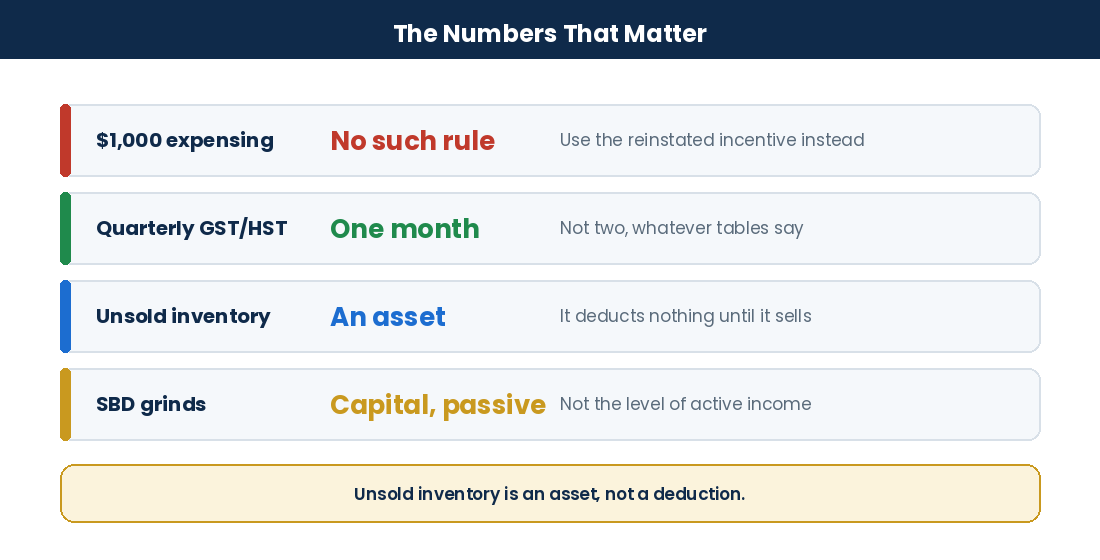
The fifth row corrects a figure that circulates widely. A quarterly GST/HST filer has one month after the period end, not two. Only annual filers get a longer window. A dealership working to a two-month assumption is late every quarter.
The bonus accrual is the cheapest planning item in a dealership and the one most often lost, because the accrual gets made and the payment never follows. Figures changed for privacy.
Key Stat: Quarterly GST/HST returns are due one month after the period end. Please check any schedule built on a two-month assumption.
Year-round financial recordkeeping and its role in motorcycle dealership tax planning
Year-Round Recordkeeping and Software
The Foundation
Building a strong foundation with accurate records
Keep these through the year rather than assembling them at the end:
- Daily sales logs
- Receipts for expenses
- Inventory count sheets
- Unit cost files
- Aging reports showing stock value
- Floor plan financing statements
- Payroll records
- Shareholder loan documents
- Demonstration unit usage logs
Records must be kept for six years from the end of the taxation year they relate to. That is the correct measure; describing it as six years from filing understates the period where a return was filed late.
Daily sales and expense tracking
Track unit sales, parts, accessories and service separately. Those four behave differently on margin and a combined figure hides which part of the business is actually working.
Payroll reporting must be exact, including commissions to salespeople and wages to technicians, with the correct slips issued. Keep rent separate from warranty claims and shop supplies so each department reads cleanly.
Organizing and separating personal and business finances
Keep personal spending out of dealership accounts. Where a personal payment happens anyway, code it to the shareholder loan immediately with the receipt attached rather than burying it in an expense line. Our page on catch-up bookkeeping services covers what to do where this has been running unchecked.
Watch the loan balance through the year, since the repayment window runs from the end of the taxation year in which the loan was made. Personal use of demonstration units is a separate benefit question and needs its own log.
Benefits of timely bookkeeping
Monthly reconciliation between physical counts and the accounting records catches drift while it is small. Aging reports surface old stock in time for a write-down decision to be made properly rather than assumed.
It also keeps GST/HST filings clean, which matters because trade-ins and deposits are where dealership returns most often go wrong.
Preventing errors and missed deductions
| Error | Consequence |
|---|---|
| No unit-level costing | Gross margins are wrong at department level |
| Aged inventory write-downs skipped | Income overstated, tax paid early |
| Floor plan interest unreconciled | Deduction difficult to sustain on review |
| Personal use of demo units missed | Benefit adjustments across every period examined |
| Trade-ins recorded net | Resale margin hidden, sales tax position unclear |
| Warranty revenue recognised early | Profit distorted between periods |
| Family wages without support | Reasonableness challenged, deduction denied |
The fifth row deserves expanding. Recording a trade-in at the net difference rather than at gross values on both sides conceals the actual purchase cost of the used unit, which then flows through to a wrong margin on its resale and a wrong write-down decision later.
Supporting audit-readiness
- Cash transactions with thin supporting paperwork
- Margins low relative to inventory values, suggesting undervalued stock
- Large write-downs raising questions about earlier reporting
- Demonstration unit benefits never reported
- Contractor payments without the required slips
- GST/HST collected not matching what was reported
Keep complete deal files showing trade-in credits separately, and keep the support behind any bad debt or warranty position.
Choosing the right accounting tools
Software built for Canadian small businesses, such as QuickBooks or Xero, handles inventory value, floor plan cost and sales tax properly when it is set up for the trade. Three setup decisions pay for themselves:
- Cost each unit individually, including freight and prep
- Post floor plan interest so it reconciles to the lender statement
- Create a capital purchases account so equipment never lands in supplies
The third prevents the most expensive routine error in a dealership. A lift or hoist coded to supplies never reaches the asset register and generates no capital cost allowance in that year or any year after.
Integration with inventory and payroll systems
Linking inventory to the ledger gives department-level margin. Linking payroll produces correct T4 slips for commissions, technician wages and taxable benefits including demonstration unit use, which is where slip errors usually originate. Where a worker is genuinely a contractor, the reporting differs and the slip type follows the classification.
Training for dealership staff
Staff need to know which records matter and why. The recurring themes are the shareholder loan window, the difference between an employee and a contractor, and the reasonableness requirement on family wages.
Reducing human error through education
Deal jackets, unit cost files, floor plan statements and department reports all need to be captured as work happens. Reconstructing them afterwards is slower and produces a weaker record. Our bookkeeping and accounting services handle this through the year.
Trade-ins recorded net are the quiet one. The margin looks fine until the used unit sits unsold and nobody can say what it actually cost. Figures changed for privacy.
Risk Warning: Records must be kept six years from the end of the taxation year they relate to, not six years from filing. Please measure from the right date.
Maximizing motorcycle dealer tax deductions through proper expense documentation
Deductions and Documentation
The Claims
Common deductible expenses for motorcycle dealerships
Advertising, insurance, and utilities
Advertising that promotes the business is deductible: online campaigns, signage, print, and event sponsorships where a business purpose is documented. Insurance premiums on business property and liability are operating costs. Utilities at the dealership are deductible.
One qualification on advertising worth knowing. Advertising directed at a Canadian market placed with foreign broadcasters or in foreign periodicals can face restrictions, so where a campaign runs matters as well as what it costs.
Employee wages and contractor payments
Wages to sales staff, technicians, office staff and family members are deductible where the amounts are reasonable for work actually performed, with payroll processed and slips issued.
Classification is decided on the facts: control over the work, who supplies the tools, the chance of profit or loss, and integration into the business. A written agreement calling someone a contractor does not settle it, and misclassification produces reassessments plus the employer contributions that were never made.
Salary or dividends for the dealer principal
| Factor | Salary | Dividend |
|---|---|---|
| Deductible to the corporation | Yes | No |
| RRSP contribution room | Creates room | Does not |
| CPP | Contributions required | None |
| Payroll administration | Required | Not required |
| Effect on the small business deduction | Reduces active income | Paid from after-tax income |
The first and last rows are the ones usually left out and they change the analysis. Salary is deductible to the corporation and reduces the income taxed at corporate rates; a dividend is paid from income already taxed. The comparison is therefore not simply about payroll cost, and the right answer depends on the corporation’s rate, the shareholder’s other income and what the loan account is doing.
Documentation best practices
- Save receipts and invoices showing date, amount and vendor details.
- Keep the supplier’s registration number on invoices supporting sales tax credits.
- Log floor plan interest and reconcile monthly to lender statements.
- Hold signed employment agreements setting out duties and pay.
- Track advertising spend against budgets with payment evidence.
- Keep demonstration unit logs showing date, rider and purpose.
The second point is where credit claims most often fail. A counter receipt without the supplier’s GST/HST registration number will not support a claim however genuine the purchase.
Capital Cost Allowance and the 2026 Change
Shop equipment, lifts, computers and vehicles enter capital cost allowance classes rather than being deducted at once.
| Class | Rate | Typical Dealership Assets |
|---|---|---|
| Class 8 | 20% | Lifts, service tools, workbenches, office furniture |
| Class 10 | 30% | Vehicles outside the passenger definition |
| Class 10.1 | 30% | Passenger vehicles, subject to a cost cap |
| Class 12 | 100% | Application software, tools under $500 |
| Class 13 | Over the lease term | Leasehold improvements to showroom or shop |
| Class 50 | 55% | Computer hardware and systems software |
An important correction on immediate expensing. Guidance stating that assets under $1,000 can be fully deducted in the year of purchase is describing a rule that does not exist. There is no $1,000 immediate expensing threshold.
What does apply is the accelerated investment incentive, reinstated by Bill C-15 with Royal Assent on 26 March 2026 for most depreciable property acquired after 2024 and available for use before 2030. Where it applies, an enhanced first-year deduction replaces the ordinary half-year rule. Returns already filed on the plain half-year rule for recent purchases are worth revisiting.
Two further points. The claim year is decided by when an asset becomes available for use, not by the invoice date. And capital cost allowance is a maximum rather than an obligation, so claiming less in a weak season preserves the pool for a year when the deduction is worth more.
Protecting the Small Business Deduction
The small business deduction applies to the first $500,000 of active business income of a Canadian-controlled private corporation. Two things reduce it as a dealership grows, and neither is the level of active income itself.
- Taxable capital employed in Canada. The limit grinds down over a range above $10 million, on an associated group basis.
- Passive investment income. Investment income above a threshold reduces the limit.
- Association. Associated corporations share one limit between them.
Guidance advising dealerships to “avoid exceeding taxable income limits” misidentifies the mechanism. Earning more active business income does not itself reduce the limit; it simply means income above $500,000 is taxed at the general rate. What reduces the limit is capital, passive income and association, and those are the things to watch as a dealership grows or a holding company is added.
Owners plan around active income and miss the two grinds that actually apply. Capital and passive income are what shrink the limit as a group grows. Figures changed for privacy.
Risk Warning: There is no $1,000 immediate expensing rule. Please check the reinstated investment incentive instead for property acquired after 2024.
Managing GST/HST Obligations for Motorcycle Dealerships in Canada
GST/HST Obligations
Sales Tax
Registering and Charging GST/HST
Register once taxable sales exceed $30,000 over four consecutive calendar quarters, or in a single calendar quarter. Once registered, charge on everything taxable: bikes, parts, accessories and service.
Please note the single-quarter test, which most guidance omits. A dealership can cross $30,000 in one strong spring quarter, long before four quarters have passed.
Thresholds and Requirements for Dealerships
- The $30,000 threshold takes account of revenues of associated persons.
- Collect on all taxable goods and services once registered.
- File on your assigned frequency, which changes as you grow.
- Keep records supporting every taxable sale and every credit claimed.
Differences Between Provinces
| Province | Tax Type | Rate | Where It Is Filed |
|---|---|---|---|
| Ontario | HST | 13% | Your CRA return |
| Alberta | GST only | 5% | Your CRA return |
| British Columbia | GST plus PST | 5% plus 7% | GST on the CRA return, PST separately |
| Quebec | GST plus QST | 5% plus 9.975% | QST administered by Revenu Québec |
The last column matters. Only GST and HST go on your CRA return. Provincial sales taxes in BC, Saskatchewan, Manitoba and Quebec are separate registrations with separate filings, and a dealership treating them as one return is missing obligations.
For a bike delivered to another province, the rate follows the place of supply, which for goods is generally where the unit is delivered rather than where the dealership sits.
Filing and Remittance
| Filing Frequency | Return and Payment Due |
|---|---|
| Monthly | One month after the period end |
| Quarterly | One month after the period end |
| Annual | Generally three months after the year end |
Guidance giving quarterly filers two months is wrong and produces a late return every quarter. Annual filers may also have instalment obligations, which a simple deadline table hides entirely.
Collected tax is held in trust. Set it aside as it arrives, because directors can be assessed personally for amounts not remitted.
Common Mistakes in GST/HST Returns
- Trade-ins handled incorrectly, which affects the taxable consideration
- Deposits treated as revenue before the sale completes
- Credits claimed on items used personally
- Demonstration unit personal use not adjusted for
- The dealership’s own provincial rate applied to a unit delivered elsewhere
On trade-ins, where a customer who is not registered trades in a bike, the trade-in value reduces the consideration on which tax is calculated. Where the customer is a registrant trading in a unit used in their business, the treatment differs and the trade-in can be a supply in its own direction. Check the customer’s status before applying the netting rule.
On deposits, a deposit generally becomes consideration when applied to the price or forfeited, not when received.
Claiming Input Tax Credits
- Inventory purchases and parts
- Shop supplies and equipment
- Lease costs and utilities at the premises
- Software subscriptions
- Advertising directed at customers
Each requires an invoice carrying the prescribed information, including the supplier’s registration number above a modest threshold. Where use is mixed, the credit is limited to the business portion on a documented basis.
One point on financing. Interest itself does not carry GST/HST, so there is no credit to claim on floor plan interest. Fees charged by the lender may be a different matter depending on their nature, but the interest line is not a source of credits. Our guide to input tax credits in Canada sets out the requirements, and our GST/HST filing service handles the returns.
Quarterly filers working to a two-month deadline are late every quarter and often do not realise until interest appears on the account. Figures changed for privacy.
Key Stat: Interest carries no GST/HST, so there is no credit on floor plan interest. Please do not include it in a credit calculation.
Tax implications of motorcycle dealer inventory management and floor plan financing
Inventory, Floor Plan and Working With Us
The Balance Sheet
Inventory valuation methods and their tax impact
Inventory is carried at the lower of cost and net realizable value, and the closing figure drives cost of goods sold. Cost includes purchase price, freight, prep and other direct costs of getting a unit ready for sale.
Unit-level costing is what makes the rest possible. Without it you cannot see real margin by unit, and you cannot support a write-down on a specific bike.
Illustrative example. A used bike costs $8,000. Wear and market movement mean it will realistically fetch $7,200. Writing it down by $800 reduces taxable income by that amount and reflects the actual position. Figures changed for privacy.
- Count physically at year end and have the sheet signed
- Support each write-down with the specific unit and the evidence
- Review aging monthly, not at the year end
- Remember that overstating inventory means paying tax early
The last point is worth stating plainly. Carrying stock above what it will fetch does not defer anything; it inflates income now and creates a loss later, which is the wrong way round for a business managing cash.
Floor plan financing considerations
Interest deductibility
Interest on borrowing used to carry inventory is deductible where there is a legal obligation to pay it, the amount is reasonable, and the borrowed money was used to earn income. Reconcile monthly against lender statements.
Two refinements on how this is usually described. Interest is deductible on an accrual basis rather than only when paid. And there is an election available to capitalise interest to the cost of depreciable property in some circumstances, so the flat statement that interest can never be added to cost is not accurate, though expensing is the ordinary treatment for floor plan interest on inventory.
- Reconcile monthly to the lender statement
- Record curtailment payments so the balance ties
- Track chargebacks, which reduce interest previously claimed
- Watch related-party arrangements, where reasonableness is tested harder
Managing cash flow with inventory loans
Floor plans hold cash back until units sell, which is their purpose. The cost is interest that runs whether the bike moves or not, so the aging report is a cash flow document as much as an accounting one.
Buying stock near the year end to create a deduction does not work the way owners often expect. Inventory purchased and unsold is an asset, not an expense; it produces no deduction until it sells. Equipment is different, but its claim depends on availability for use and the first-year rules.
Common pitfalls in year-end financial checks
- Small deductible costs never captured, such as minor repairs and training
- Leasehold improvements treated as repairs, distorting the claim
- Write-downs without net realizable value evidence
- Floor plan fees and curtailments unreconciled
- Demonstration unit benefits unreported
- Warranty revenue recognised against the wrong period
Importance of expert assistance from a motorcycle dealer accountant in Canada
Gondaliya CPA works with incorporated powersports and dealership businesses on corporate tax filing, bookkeeping, sales tax and payroll, with planning done before the year closes rather than reported after it.
- Separate capital assets from inventory correctly
- Reconcile floor plan interest on time
- Assign shop equipment to the right classes and apply the current incentive
- Review the shareholder loan position through the year
- Keep documentation in the condition a review expects
Working With Gondaliya CPA
Fees are quoted before work begins, including HST, with a one-business-day response and evening and weekend availability. Our engagements carry a 30-day money-back arrangement and a 60-day fee-matching arrangement, and we say plainly where a position will not hold.
Bring three things to a first conversation: your last filed corporate return, your floor plan lender statements, and the shareholder loan account balance. Those three show where the planning room is.
Contact Gondaliya CPA at info@gondaliyacpa.ca, call 647-212-9559, or send us a message. Where records have already drifted, our corporate tax cleanup service handles the correction, and our corporate tax filing service covers the return itself.
Buying stock in the last month to reduce tax is the most common misunderstanding in this trade. Unsold inventory is an asset, and it deducts nothing. Figures changed for privacy.
Risk Warning: Inventory bought and unsold at year end is an asset, not a deduction. Please do not plan a year-end tax reduction around stock purchases.
Frequently Asked Questions (FAQ) on Motorcycle Dealer Tax Planning
Frequently Asked Questions
FAQ
What is the Small Business Deduction Limit for motorcycle dealerships?+
It reduces the corporate rate on the first $500,000 of active business income of a Canadian-controlled private corporation. Associated corporations share one limit between them.
When is the GST/HST standard filing deadline for dealers?+
Monthly and quarterly filers both file one month after the period end. Annual filers generally have three months. Guidance giving quarterly filers two months is wrong.
What is the corporate tax filing deadline for incorporated dealers?+
Six months after fiscal year end. Payment is due earlier, generally three months for an eligible CCPC and two for other corporations.
How does the capital cost allowance half-year rule affect dealerships?+
In the year an asset becomes available for use, the claim is calculated on half the addition. Where the reinstated investment incentive applies, an enhanced first-year deduction replaces it.
Are meals and entertainment expenses deductible for motorcycle dealers?+
Generally 50% of reasonable amounts related to the business. Keep the receipt and note the purpose and who attended.
What is the shareholder loan repayment window?+
The loan must be repaid within one year after the end of the corporation’s taxation year in which it was made, and the repayment must not be part of a series of loans and repayments.
How is floor plan interest deductibility handled?+
Deductible where there is a legal obligation to pay, the amount is reasonable and the borrowing was used to earn income. Reconcile monthly to lender statements and record chargebacks.
What is the immediate expensing limit for dealership assets?+
There is no $1,000 immediate expensing rule. The measure that applies now is the accelerated investment incentive, reinstated by Bill C-15 on 26 March 2026 for property acquired after 2024.
Should a dealer principal choose salary or dividends?+
Salary is deductible to the corporation and creates RRSP room but requires CPP and payroll. A dividend is not deductible and is paid from after-tax income. The answer depends on rates, other income and the loan account.
How do you protect the small business deduction as your dealership grows?+
Watch taxable capital employed in Canada and passive investment income, which are what grind the limit, and watch association. Earning more active income does not itself reduce it.
What year-end timing moves improve a dealer’s tax position?+
Settle the write-down basis, clear or plan the shareholder loan, decide the capital cost allowance claim, and pay any accrued bonus within 179 days of the year end.
How do you improve cash flow without creating tax problems?+
Set collected sales tax aside as it arrives, reconcile floor plan interest monthly, review aging to release stuck stock, and file more frequently if you sit in a refund position.
What GST/HST issues are specific to motorcycle dealers?+
Trade-in treatment, which differs by whether the customer is registered, deposits that are not consideration until applied, demonstration unit personal use, and place of supply on out-of-province deliveries.
What records support every planning position in a dealership?+
Deal jackets, unit cost files, signed inventory counts, floor plan statements with reconciliations, payroll records, demonstration unit logs and expense receipts with registration numbers.
What triggers a CRA review of a motorcycle dealership?+
Cash volumes without matching paperwork, margins low against inventory values, large write-downs without support, unreported demonstration unit benefits and sales tax collected not matching returns.
Does buying inventory before year end reduce my tax?+
No. Unsold inventory is an asset and produces no deduction until it sells. Equipment is different, but its claim depends on availability for use and the first-year rules.
Sixteen questions, and the ones with dates attached are the ones worth diarising. The rest can be answered when they come up. Figures changed for privacy.
Key Tax Planning Tips for Motorcycle Dealerships by Gondaliya CPA
Key Tax Planning Tips
Quick Reference
Decisions With Deadlines
- Review the shareholder loan balance quarterly, since the window runs from the year in which the loan was made.
- Settle the inventory write-down basis before the count, with evidence unit by unit.
- Log demonstration unit use as it happens, showing date, rider and purpose.
- Pay any accrued bonus within 179 days of the year end.
- Confirm equipment is available for use before the year end where you want the claim that year.
- Decide the capital cost allowance claim rather than defaulting to the maximum.
- Check anything acquired after 2024 against the reinstated investment incentive.
Running the Year Well
- Plan early with a CPA firm familiar with powersports dealerships.
- Track all sales channels including parts, accessories, service and finance accurately.
- Separate personal finances clearly from business accounts to avoid tax traps.
- Regularly review shareholder loan status and comply with repayment windows.
- Use accounting software integrated with inventory and payroll systems for accuracy.
- Monitor CCA claims carefully, applying the half-year rule and the current incentive.
- Manage GST/HST filings timely while claiming all eligible input tax credits correctly.
- Avoid common mistakes like misclassifying wages or net-recording trade-ins.
- Conduct monthly physical inventory counts and reconcile values before year-end.
- Use strategic timing for purchases and income recognition to optimize taxes.
Points Worth Remembering
- Watch taxable capital and passive income, not active income, for the small business deduction.
- Remember quarterly GST/HST returns are due one month after the period end.
- Remember records run six years from the end of the year they relate to.
- Remember unsold inventory is an asset and deducts nothing.
- Remember interest carries no GST/HST, so no credit arises on it.
- Remember a dividend is not deductible to the corporation while salary is.
- Remember dealer licensing rules are provincial and differ across Canada.
For expert help with your motorcycle dealership’s tax planning across Canada, contact Gondaliya CPA at info@gondaliyacpa.ca, call 647-212-9559, or book a free consultation.
Twenty-four points, and only the first seven have dates on them. Those are the ones that cannot be recovered afterwards. Figures changed for privacy.
Businesses We Serve
Industry Expertise
Dealership and powersports businesses share the same issues. Here are ten and the usual finding.
| Business | The Issue That Usually Appears |
|---|---|
| Motorcycle dealerships | Shareholder loan balance drifting past the window |
| Powersports and ATV dealers | Demonstration unit benefits never reported |
| Marine and boat dealers | Aged stock carried above realizable value |
| RV and trailer dealers | Trade-ins recorded net, hiding true cost |
| Used vehicle dealers | Write-downs with no supporting evidence |
| Dealers with service departments | Lifts and equipment coded to supplies |
| Dealers selling across provinces | Own rate applied to units delivered elsewhere |
| Quarterly sales tax filers | A two-month deadline assumption, so late every quarter |
| Growing groups | Small business deduction grinds not monitored |
| Any dealer accruing bonuses | Accrued but not paid within 179 days |
- Motorcycle dealerships: Review it quarterly.
- Powersports and ATV dealers: Log it as it happens.
- Marine and boat dealers: Aging is a tax document.
- RV and trailer dealers: Record both sides gross.
- Used vehicle dealers: Unit by unit, with proof.
- Dealers with service departments: Check the supplies account.
- Dealers selling across provinces: The rate follows delivery.
- Quarterly sales tax filers: One month, not two.
- Growing groups: Capital and passive income are the grinds.
- Any dealer accruing bonuses: Pay it, do not just book it.
The trade changes the stock. It does not change the three balances that decide the tax, or the fact that all three close before the year does. Figures changed for privacy.
Professional Guidance and Quick Reference
Guidance
Professional Guidance: How Gondaliya CPA Handles Your Dealership
Motorcycle dealerships lose planning room in a predictable set of ways: letting the shareholder loan balance run past the one-year window so an inclusion falls in an earlier year, accruing a bonus and never paying it within 179 days, carrying aged stock above what it will realise so tax is paid early, running demonstration units with no log so personal use cannot be identified, working to a two-month quarterly sales tax deadline when the deadline is one month, planning around a $1,000 immediate expensing rule that does not exist, and watching active income for the small business deduction when the grinds are taxable capital and passive income. Gondaliya CPA handles dealership planning on a flat annual fee.
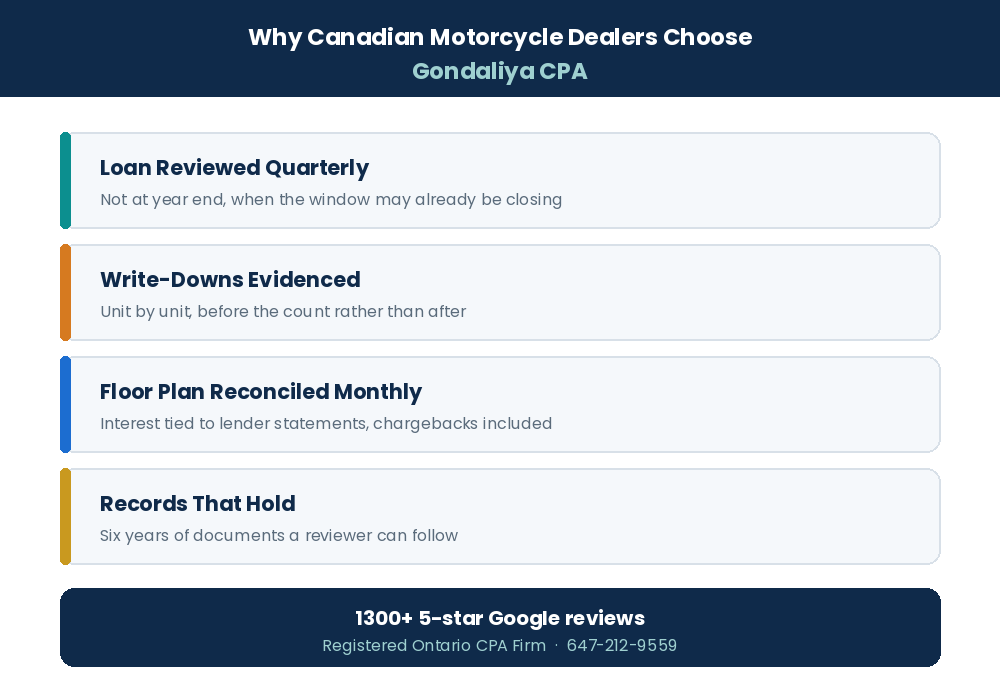
We handle what decides the outcome: reviewing the shareholder loan quarterly rather than at the year end, settling the write-down basis unit by unit before the count, logging demonstration unit use through the season, timing bonuses inside the payment window, checking availability for use on equipment, applying the reinstated investment incentive to eligible purchases, and monitoring capital and passive income against the small business deduction as the group grows.
Our team starts with your last filed corporate return, your floor plan lender statements and the shareholder loan account balance. Whatever your trade, you get clear advice and a fixed price before we start.
Quick Answers
- Shareholder loan: One year after the year it was made
- Accrued bonus: Pay within 179 days
- Inventory: Lower of cost and realizable value
- Unsold stock: An asset, not a deduction
- Demo units: A benefit question, not a deduction one
- Quarterly sales tax: One month, not two
- Immediate expensing: No $1,000 rule exists
- 2026 change: Investment incentive reinstated
- SBD grinds: Capital and passive income
- Floor plan interest: No sales tax credit on it
Who This Is For
- For: Incorporated Canadian motorcycle and powersports dealerships planning the year before it closes rather than reporting it afterwards.
- Not For: A statement of provincial dealer licensing requirements, which differ across Canada and should be confirmed where you operate.
People Also Ask
When does an accrued bonus stop being deductible?+
If it is not paid within 179 days of the year end, the deduction is lost for that year. Accruing without paying is the common failure.
Are demonstration bikes deductible?+
They stay inventory rather than being deducted as an asset. The tax question is whether personal use has been identified and reported as a taxable benefit.
Can I claim input tax credits on floor plan interest?+
No. Interest does not carry GST/HST, so there is nothing to recover on the interest line. Lender fees may differ depending on their nature.
Glossary of Key Terms
- Net realizable value: The ceiling at which inventory is carried.
- Unit-level costing: Tracking cost bike by bike, including freight and prep.
- Cost of goods sold: Opening stock plus purchases less closing stock.
- Write-down: Reducing carrying value where a unit will not realise cost.
- Floor plan financing: Borrowing used to carry inventory.
- Curtailment: A scheduled principal reduction on a floor plan loan.
- Chargeback: A lender reversal reducing interest previously claimed.
- Shareholder loan: Amounts moving between owner and corporation.
- Repayment window: One year after the year in which the loan was made.
- Taxable benefit: Value conferred on a shareholder or employee, reportable.
- Small business deduction: The reduced rate on the first $500,000 of active income.
- Taxable capital: The measure that grinds the small business deduction.
- Capital cost allowance: Tax depreciation, a maximum not an obligation.
- Available for use: When an asset becomes eligible for depreciation.
- Bonus accrual: Deductible if paid within 179 days of the year end.
- Trust amounts: Collected sales tax and payroll source deductions.
Planning Readiness Check
This quick self-check indicates where your operation most likely has room. Please answer the six questions below.
Planning Readiness Check
Six quick questions on your dealership. No fee shown.
Points to raise with us:
This is a general prompt, not tax or legal advice or a quote. Your position depends on your full facts. For a real review, please book a free consultation.
Want a checklist to work from? You can download our free motorcycle dealer planning checklist before your consultation.
Review the shareholder loan quarterly, not at the year end. Settle the write-down basis unit by unit before the count. Log demonstration unit use as it happens. Pay accrued bonuses within 179 days. Check equipment is available for use before the year closes. Apply the reinstated incentive to post-2024 purchases. Watch capital and passive income against the small business deduction. Please keep six years of records.
2026 Update — what is current: This article reflects rules current to 2026. The $500,000 small business deduction limit, the one-year shareholder loan repayment window, the 179-day bonus payment requirement, the Class 8 rate of 20%, the $30,000 GST/HST small supplier threshold on both tests, the six-month T2 filing deadline and the six-year record retention requirement are unchanged. Bill C-15 received Royal Assent on 26 March 2026, reinstating the accelerated investment incentive for most depreciable property acquired after 2024 and available for use before 2030, and Ontario\u2019s small business rate moves to 2.2% from 1 July 2026. Please note that there is no $1,000 immediate expensing threshold, so guidance describing one is describing a rule that does not exist; that quarterly GST/HST returns are due one month after the period end rather than two, with only annual filers receiving a longer window; that the small business deduction is ground down by taxable capital employed in Canada and passive investment income rather than by the level of active business income itself; that the shareholder loan repayment must not form part of a series of loans and repayments, and the income inclusion falls in the year the loan was made rather than the year the problem is found; that inventory purchased and unsold at year end is an asset producing no deduction; that interest carries no GST/HST so no input tax credit arises on floor plan interest; that records run six years from the end of the taxation year concerned rather than from filing; and that dealer licensing and record-keeping requirements are provincial and differ across Canada.
Motorcycle Dealer Tax Planning Canada: How Gondaliya CPA Supports Dealerships
Start with the loan account
Gondaliya CPA reviews the shareholder loan quarterly rather than at the year end, settles the inventory write-down basis unit by unit before the count, logs demonstration unit use through the season, times bonuses inside the payment window, applies the reinstated investment incentive to eligible purchases, monitors taxable capital and passive income against the small business deduction, and handles the sales tax, payroll and corporate return, on a flat annual fee including HST with a one-business-day response. Please book a free consultation.
Next Steps
Please book a free consultation with Gondaliya CPA and bring your last filed corporate return, your floor plan lender statements, and your shareholder loan account balance. Those three show where the planning room is, what is closing, and what remains to claim on the equipment, and where the documentation is thin. You will get a flat annual fee including HST before any work begins. If our content helps, please add gondaliyacpa.ca as a preferred source on Google.
Published: · Last updated:
Editorial policy: We research against CRA and CPA Ontario sources, fact-check the figures, and Sharad Gondaliya, CPA, reviews the content, which we update as the rules change.
Disclaimer: This article is educational information only and is not tax, legal, or financial advice. Figures marked illustrative are examples rather than quotes or guarantees. It reflects CRA rules current to 2026, including the $30,000 GST/HST threshold, the Class 8 rate, Class 13 leasehold treatment, the half-year rule, and the six-year retention requirement. Rates, limits and expensing rules change and outcomes depend on your specific facts. Please consult a licensed CPA before acting.

Sharad Gondaliya is a CPA Canada & CPA USA with 15 Years+ experience of Accounting, Tax, Payroll of Corporate Small Businesses as Tax Accountant. He is fully certified CPA Ontario and CPA USA and is well known among corporate small businesses for tax planning, efficient tax solutions, and affordable CPA services. Sharad is the Principal (Director) of Gondaliya CPA – Affordable CPA Firm in Canada. Licenses: CPA Ontario: 61040184 | CPA USA (MT): PAC-CPAP-LIC-033176 | CPA USA (WA): 57629 | CPA Firm License: 61330051 View Full Author Bio