



Powersports Dealer Tax Guide in Canada: Trade-Ins, Used Units, Demo Models & Taxable Sales
Powersports Dealer Tax Guide in Canada: Trade-Ins, Used Units, Demo Models & Taxable Sales Explained by Gondaliya CPA
This Powersports Dealer Tax Guide in Canada covers essential topics such as trade-ins, used units, demo models, and taxable sales, helping dealers understand GST/HST rules and dealership tax reporting. Gondaliya CPA offers expert advice on powersports dealership taxes, including ATV, snowmobile, and motorcycle dealer taxes across Canada.
Quick Summary
The three numbers are the taxable amount after a trade-in, the notional input tax credit on a used unit bought privately, and the benefit on a demonstration unit used personally. Each has a precise rule, and each is commonly stated wrongly.
Reading time: 54 minutes.
Table of Contents
The Numbers That Matter
This article covers Canada, with Ontario and Toronto context, and reflects rules current to 2026. It is written for incorporated Canadian powersports dealerships selling ATVs, snowmobiles, motorcycles, personal watercraft and side-by-sides. Figures marked illustrative are examples, not quotes, and any masked engagement notes end with “Figures changed for privacy.” This is educational information only and not tax or legal advice. Provincial rules differ, so please confirm the position where you operate.
The Three Numbers
The Three Numbers
The Corrections
Where the Guidance Goes Wrong
| Number | What Circulates | The Rule |
|---|---|---|
| Notional input tax credit | “71% of GST paid” or “75% of the tax collected” | The tax fraction of what you paid for the unit |
| Trade-in reduction | Applied to every trade-in | Only where the customer is not a registrant |
| Deposit timing | Turns on refundable against non-refundable | Tax applies when the deposit is applied or forfeited |
The Notional Credit, Correctly
Where a registrant acquires used tangible personal property from a non-registrant for resupply, it may claim a notional input tax credit. The amount is the tax fraction of the consideration paid, not a percentage of the tax later collected.
| Rate Applying | Tax Fraction |
|---|---|
| 13% HST (Ontario) | 13/113 |
| 15% HST | 15/115 |
| 5% GST | 5/105 |
Illustrative example. An Ontario dealer buys a used bike privately for $10,000 and later sells it for $12,000 plus 13% HST.
| Line | Calculation | Amount |
|---|---|---|
| HST collected on the resale | $12,000 × 13% | $1,560.00 |
| Notional credit on the purchase | $10,000 × 13/113 | $1,150.44 |
| Net tax to remit | $1,560.00 less $1,150.44 | $409.56 |
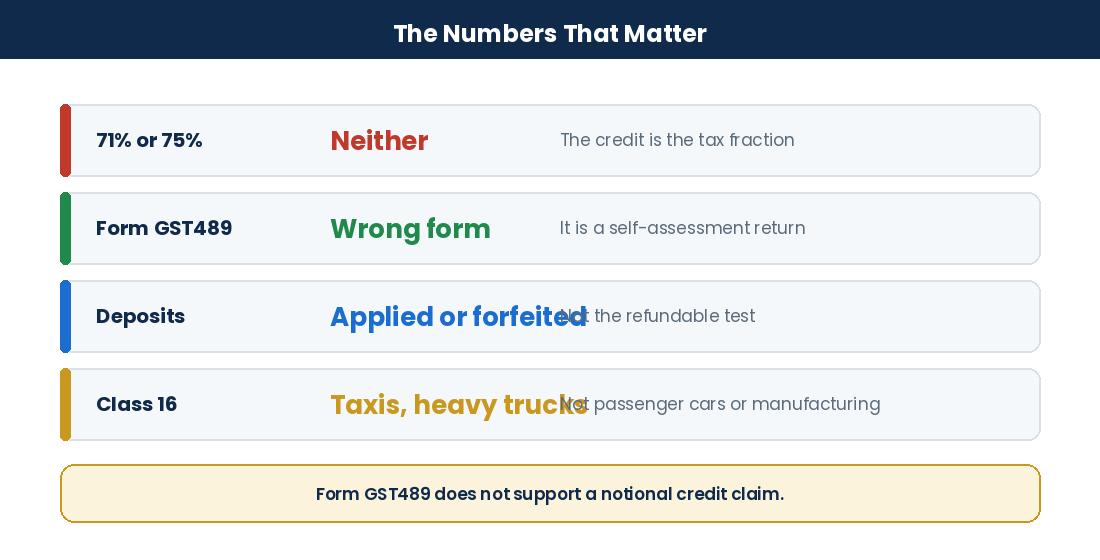
Published versions of this example calculate the credit as 75% of the $1,560 collected, giving $1,170. The figure is close by coincidence and the method is wrong, so it produces a different answer on every other transaction. The credit follows the purchase price, not the resale.
Two conditions attach. The credit is generally claimable when the unit is resupplied taxably, and it cannot exceed the tax on that resupply. And it applies to acquisitions from non-registrants; where the seller is registered you receive a proper invoice and claim an ordinary credit.
The Form That Does Not Do This
Guidance on this topic repeatedly names Form GST489 as the documentation supporting a notional credit claim. It is not. GST489 is the return for self-assessing the provincial part of the HST in particular circumstances, and it has nothing to do with used goods acquired privately.
What supports the claim is your own record of the acquisition: a bill of sale showing the seller, the date, the unit and the price paid, together with evidence that the seller was not registered.
The notional credit is the single most valuable line in a used-unit dealership and the one most consistently calculated the wrong way. Figures changed for privacy.
Risk Warning: The notional credit is the tax fraction of what you paid, not a percentage of what you collected. Please recheck any calculation built on 71% or 75%.
Powersports Dealership Tax Overview: Key Concepts and Definitions
Overview and Key Definitions
The Framework
GST/HST on Powersports Sales: Basic Principles
GST is the 5% federal tax. HST combines it with a provincial component in participating provinces, so Ontario applies 13%. Register once taxable sales exceed $30,000 over four consecutive calendar quarters, or in a single calendar quarter.
Please note the single-quarter test, which most guidance omits. A dealership selling a handful of units can cross $30,000 in one quarter, long before four quarters have passed. Our page on GST/HST registration covers the mechanics.
Specified Motor Vehicles and Their Tax Implications for Powersports Dealers
ATVs, snowmobiles, personal watercraft, motorcycles and side-by-sides are the units a powersports dealer handles. Where a customer who is not a registrant trades one in, the trade-in value reduces the consideration on which tax is calculated.
Illustrative example. A customer trades in an ATV valued at $10,000 towards a motorcycle priced at $20,000. Tax is calculated on $10,000, being the difference.
Where employees or shareholders use demonstration units personally, a taxable benefit arises. The rule that applies depends on the relationship: employee benefits and shareholder benefits are dealt with under different provisions, and the distinction matters because a shareholder benefit is generally not deductible to the corporation while employment income is.
Provincial Motor Vehicle Taxes Affecting Powersports Dealerships
Provincial treatment differs across Canada.
| Province | Position on a Dealer Sale | Where It Is Filed |
|---|---|---|
| Ontario | 13% HST | Your CRA return |
| Alberta | 5% GST | Your CRA return |
| British Columbia | 5% GST plus provincial sales tax | PST filed separately |
| Quebec | 5% GST plus QST | QST administered by Revenu Québec |
Two points worth stating plainly. Only GST and HST appear on your CRA return; provincial sales taxes in BC, Saskatchewan, Manitoba and Quebec are separate registrations with separate filings. And a dealer sale in Ontario is an HST sale; Ontario’s separate retail sales tax on specified vehicles applies to private transfers rather than to sales made by a registered dealer.
Please treat forward-looking claims about provincial changes with caution. Guidance asserting that 2026 updates “will impact trade-in treatments” without naming a measure is speculation, and a dealership should not build a process around it.
Distinctions Between Inventory, Capital Assets, and Other Dealership Components
| Category | What It Covers | How It Is Deducted |
|---|---|---|
| Inventory | Units held for resale, and parts | Cost of goods sold, on sale |
| Capital assets | Shop equipment, vehicles, buildings | Capital cost allowance, over years |
| Leasehold improvements | Work on premises you lease | Class 13, over the lease term |
| Demonstration units | Held out for demonstration and use | Depends on the actual use and intention |
Capital Cost Allowance Classes, Corrected
| Asset | Class | Rate |
|---|---|---|
| Shop and service equipment, furniture, tools over $500 | Class 8 | 20% |
| Vehicles outside the passenger definition | Class 10 | 30% |
| Passenger vehicles above the cost limit | Class 10.1 | 30%, capped |
| Computer hardware and systems software | Class 50 | 55% |
| Application software, tools under $500 | Class 12 | 100% |
| Leasehold improvements | Class 13 | Over the lease term |
| Buildings you own | Class 1 | 4% |
Several corrections are needed here, because published class tables for this industry are wrong on nearly every line.
- Class 8 is a residual class covering furniture, equipment and machinery not specified elsewhere. It is not “general electronic data processing gear”.
- Class 10 covers general vehicles at 30%. Class 10.1 is the restricted class for passenger vehicles above the cost limit.
- Class 16 is not manufacturing equipment and is not passenger vehicles at 30%. It covers taxis, rental vehicles, coin-operated machines and certain heavy freight trucks, at 40%.
- Class 50 is computer hardware and systems software at 55%. It is not a rental or demonstration fleet class.
- Computers are not Class 10 or 10.1 at 30%.
Getting these right matters every year the asset is held, not just in the year of purchase, because the class sets the rate for the life of the pool.
The 2026 Change on Equipment
Bill C-15 received Royal Assent on 26 March 2026, reinstating the accelerated investment incentive for most depreciable property acquired after 2024 and available for use before 2030. Where it applies, an enhanced first-year deduction replaces the ordinary half-year rule.
The test is when an asset becomes available for use, not the invoice date, so a lift bought in December and commissioned in February falls in the later year. And the claim is a maximum rather than an obligation, so claiming less in a weak season preserves the pool.
Every published class table we have seen for this industry gets Class 16 wrong. It is taxis and heavy trucks, not manufacturing and not passenger cars. Figures changed for privacy.
Key Stat: Class 16 covers taxis, rentals and certain heavy trucks at 40%. Please do not use it for passenger vehicles or manufacturing equipment.
How Trade-In Transactions Work for Powersports Dealers in Canada
Trade-In Transactions
The Mechanics
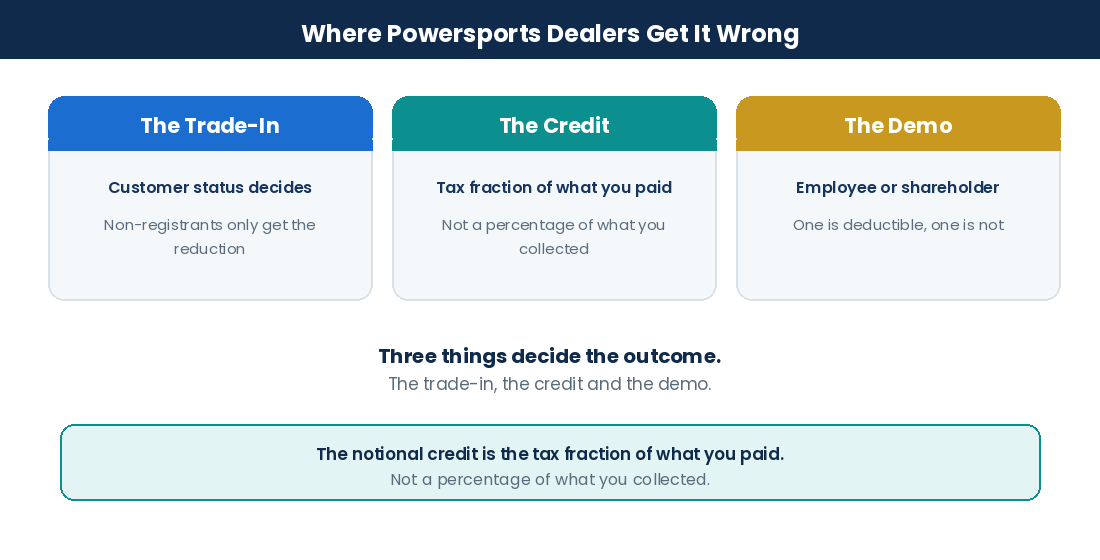
Where a customer trades in a unit, the trade-in allowance reduces the consideration on which tax is calculated, provided the customer is not a GST/HST registrant. Show the full sale price and the trade-in credit separately on the invoice.
| Customer Status | Treatment |
|---|---|
| Not registered | Trade-in reduces the consideration; tax on the net |
| Registered, unit used in their business | No reduction; tax on the full price, and the trade-in is a supply in its own direction |
That second row is the one dealerships miss. A landscaping company trading in a side-by-side is registered, and applying the netting rule to that transaction understates the tax you should have charged.
Calculating Trade-In Value: Factors Influencing Assessment
- The condition of the traded unit
- Current demand for comparable units
- Age, hours or mileage, and wear
- Recent sales of like units
- Reconditioning required before resale
Keep the appraisal on file. It supports the taxable amount on the sale, the cost you carry the used unit at, and the margin when it resells. Those are three separate uses for one document, which is why a thin appraisal creates three problems.
Handling Trade-Ins with Leased or Financed Powersports Units
Where a unit coming in is leased or financed, keep the lease, the payoff quote and the loan documentation. Retention is six years from the end of the taxation year concerned.
Where the price changes after the sale closes, a credit note adjusts the tax previously reported. The adjustment is taken in the reporting period in which the credit note is issued, and the note itself must contain the prescribed information. There is no ninety-day rule; guidance stating one is describing something that does not exist.
Managing Negative Equity in Trade-In Deals
Negative equity arises where the allowance given exceeds what the unit is worth. It happens for real commercial reasons and it needs a note explaining which one.
- A manufacturer or dealer incentive applied to the deal
- A market movement between appraisal and close
- A deliberate pricing decision to win the transaction
Document the reason at the time. An over-allowance with no explanation looks like consideration being shifted to reduce tax, and that is a difficult position to argue eighteen months later.
Tax Treatment of Trade-Ins: GST/HST Rules and Sales Tax Considerations
Record the full sale price in revenue and show the allowance separately, so the income statement reflects total sales before the netting. The tax calculation then applies to the reduced consideration where the customer is a non-registrant.
On the unit coming in, the notional input tax credit applies where it was acquired from a non-registrant for resupply, calculated on the tax fraction of the amount allowed. That is the same rule as an outright private purchase, applied to the trade-in allowance.
Costing Trade-In Units and Impact on Inventory Valuation
| Cost Component | What It Means |
|---|---|
| Purchase Price | The allowance agreed at trade-in |
| Freight | Shipping and delivery charges |
| Preparation & Setup | Labour and materials to make the unit saleable |
| Reconditioning | Repairs and cleaning before resale |
Carry the used unit at that cost, subject to the lower of cost and net realizable value at the year end. Where an over-allowance was given, the unit is carried at a cost above what it will fetch, and that gap should be recognised as a write-down rather than left to appear as a loss on resale.
Our bookkeeping and accounting services handle the inventory side of this through the year rather than at the close.
Registered customers trading in units used in their businesses are the quiet exposure. The netting rule gets applied by habit and the tax is short every time. Figures changed for privacy.
Risk Warning: The trade-in reduction applies only where the customer is not a registrant. Please check status before applying it, not after.
Used Units and Demo Models Taxation
Used Units and Demo Models
The Stock
Taxable Sales of Used Powersports Units: GST/HST Reporting Requirements
A used unit sold by a registered dealer is taxable in the same way as a new one. Tax applies to the selling price, reduced by any trade-in allowance where the customer is a non-registrant.
Where the dealer bought the unit privately, no tax was charged and there is no invoice to support an ordinary credit. The notional input tax credit fills that gap, calculated on the tax fraction of what the dealer paid.
- Keep the bill of sale showing seller, date, unit and price
- Record whether the seller was a registrant
- Claim the credit when the unit is resupplied taxably
- Remember the credit is limited to the tax on that resupply
Demo Models in Dealerships: Classification, Use, and Tax Consequences
A demonstration unit sits between inventory and use, and how it is treated follows what actually happens to it.
| Situation | Treatment |
|---|---|
| Held for sale, occasionally shown | Ordinary inventory |
| Taken into use as a dealership asset | Capital property, entering a class |
| Moved from capital use back to inventory | A change in use, with adjustments arising |
| Used personally by an employee | An employment benefit, reportable |
| Used personally by a shareholder | A shareholder benefit, generally not deductible |
Where a unit is capital property, capital cost allowance applies with the half-year rule in the year it becomes available for use, or the reinstated incentive where that applies. On disposal, recapture or a terminal loss can arise depending on proceeds against the pool balance.
Where use changes between capital and inventory, both the income tax position and the sales tax credit position may need adjusting. That is a real event with real entries, not a reclassification in the notes.
Accounting for Demonstrator Units: Personal Use and Shareholder Implications
Personal use produces a benefit. The measurement follows the ordinary rules for a vehicle made available: a standby element based on the cost or lease cost and the extent of use, and an operating element where the dealership pays running costs.
The distinction between an employee and a shareholder matters more than most dealerships realise:
- An employment benefit is included in the employee’s income and is deductible to the corporation as remuneration
- A shareholder benefit is included in the shareholder’s income and is generally not deductible to the corporation
- The same unit, used by the same person, can fall either way depending on the capacity in which it was provided
Keep a log for every demonstration unit showing the date, who used it, the distance and the purpose. Without one the position cannot be supported, and the adjustment tends to cover every period examined.
Inventory Valuation Methods for Used and Demo Powersports Units
| Category | Cost Basis | Credit Position |
|---|---|---|
| New units | Purchase price plus freight and prep | Ordinary credits on the invoice |
| Used units bought from a registrant | Purchase price plus reconditioning | Ordinary credits on the invoice |
| Used units bought privately | Purchase price plus reconditioning | Notional credit on the tax fraction |
| Demo units returned to stock | Adjusted for the period in capital use | Change-in-use adjustments may arise |
Value inventory at the lower of cost and net realizable value at the year end, with a signed physical count. Write down units where demand or condition has moved against you, identifying the specific units and the basis rather than entering a round figure.
Count monthly rather than annually. A dealership carrying used stock across a long off-season drifts quickly, and a twelve-month gap turns a small discrepancy into a reconstruction exercise.
Impact of Manufacturer Incentives on Used and Demo Unit Tax Calculations
| Factor | New Unit Sales | Used and Demo Unit Sales |
|---|---|---|
| Pricing Flexibility | Limited | Greater |
| Margin Risk | Lower | Higher |
| Documentation Required | Required | Required, and more of it |
| Examination Focus | Trade-in allowances | Notional credit calculations |
Separate manufacturer rebates from your own discounts in the records. A rebate paid by a manufacturer and a discount given by the dealership have different effects on the amount charged and on what the manufacturer reports, and merging them makes both harder to explain.
Incentives give room on price. They do not change the trade-in rule, the notional credit calculation or the documentation required.
The employee against shareholder question on a demo unit decides whether the corporation gets a deduction at all. Same bike, same rider, different answer. Figures changed for privacy.
Pro Tip: Please log demonstration use as it happens. A season of usage cannot be reconstructed afterwards from memory or service records.
GST/HST on Powersports Dealer Sales: Timing, Deposits and Warranty Income
GST/HST Timing, Deposits and Warranty Income
The Timing
Registrant vs Non-Registrant Treatment
Illustrative example. A Toronto dealer sells a new side-by-side for $30,000. The buyer trades in a unit valued at $10,000.
| Buyer | Taxable Amount | HST at 13% |
|---|---|---|
| Not a registrant | $20,000 | $2,600 |
| A registrant | $30,000 | $3,900 |
Figures illustrative. Show the trade-in credit separately on the invoice in both cases; what changes is whether it reduces the amount tax is calculated on.
Timing and Tax Payable Related to Vehicle Registration After Delivery
Vehicle registration with the province does not drive the tax point. Tax is generally payable on the earlier of when consideration is paid and when it becomes due, which for a unit sale is usually invoicing or delivery.
Deposits, Forfeitures, and Their Tax Effects on Sales Transactions
A correction on deposits. Guidance stating that non-refundable deposits are taxed on receipt while refundable ones are not is drawing the wrong distinction. A deposit is not treated as consideration until it is applied to the price or forfeited. At that point tax applies.
| Event | Tax Position |
|---|---|
| Deposit received and held | Not yet consideration |
| Deposit applied to the purchase price | Consideration; tax applies |
| Deposit forfeited on cancellation | Treated as consideration at that point |
| Deposit refunded in full | No supply, no tax |
Where a deal is cancelled after tax has been reported, a credit note adjusts the position in the period the note is issued. Track the deposits balance separately, since a busy pre-season can leave a large amount sitting that is not revenue.
Treatment of Out-of-Province Sales and Input Tax Credits
For goods, the rate follows the place of supply, which is generally the province where the unit is delivered or made available, not where the dealership sits. A unit delivered to Quebec attracts 5% GST with QST administered separately; one delivered to Alberta attracts 5% GST.
Establish the delivery arrangement before the invoice is raised. Charging your own provincial rate and correcting it in a later return is not a method.
Exports out of Canada can be zero-rated with proof of export. Zero-rated is not exempt: credits on related costs remain fully recoverable.
Bad Debts and Price Adjustments
- Where a receivable becomes uncollectible, relief is available for the tax component on the written-off amount
- The debt must actually be established as bad, not merely overdue
- A recovery afterwards reverses the relief
- Price adjustments are handled by credit note in the period it is issued
Both of these are claimed in the return for the period the event occurs, so they belong in your monthly review rather than in a year-end clean-up.
Finance and Warranty Income: Agent vs Principal Tax Considerations
| Role | What You Charge Tax On | What You Record as Revenue |
|---|---|---|
| Agent for a third-party provider | Your commission | The commission earned |
| Principal selling your own product | The full price of the product | The full price, with costs recorded separately |
Which one applies depends on the contract with the provider and on who the customer actually contracts with. Say it on the invoice, because a document that is silent on the point invites the question later.
Certain financial services are exempt rather than taxable, so a dealership arranging finance may be dealing with exempt supplies where no credit arises on related costs. That is a different position again from taxable commission income, and it is worth confirming which one your arrangements produce.
The agent against principal question sits in the contract with the provider, and most dealerships have never read that clause. Figures changed for privacy.
Risk Warning: A deposit becomes consideration when applied or forfeited, not on receipt. Please do not tax deposits on the refundable test.
Dealership Accounting, Reporting, and Tax Planning
Accounting, CCA and Working With Us
The Engagement
Inventory Management and Stock Valuation Practices
- Value at the lower of cost and net realizable value at the year end
- Count physically and have the sheet signed
- Support write-downs unit by unit rather than in aggregate
- Keep purchase invoices, trade-in appraisals, reconditioning costs and sales contracts together
- Reconcile the count to the book records monthly
Used stock carries more documentation weight than new, because the notional credit rests on the acquisition record rather than on a supplier invoice. That is the practical reason used-unit dealerships attract more questions.
Floor Plan Interest Deductibility and Accounting
Interest on borrowing used to carry inventory is deductible where there is a legal obligation to pay, the amount is reasonable, and the borrowing was used to earn income. Reconcile monthly against lender statements and record curtailments so the balance ties.
One point on sales tax: interest carries no GST/HST, so there is no credit to claim on the interest line. Lender fees may differ depending on their nature.
Track interest separately from principal in the ledger. A combined figure is difficult to support and easy to misstate.
Payroll, Owner Remuneration, and Small Business Limit Considerations
Personal use of dealership units by employees or shareholders is reported as a benefit, with payroll consequences where it is employment income. Calculate it from the usage logs kept through the year rather than estimating at the year end.
On the small business deduction, the limit applies to the first $500,000 of active business income of a Canadian-controlled private corporation. Two things grind it as a group grows, and neither is the level of active income itself:
- Taxable capital employed in Canada, on an associated group basis
- Passive investment income above a threshold
- Association, which shares one limit between corporations
Filing Deadlines, Reporting Requirements, and Compliance Best Practices
| Obligation | Deadline | Applies To |
|---|---|---|
| T2 corporate return | Six months after fiscal year end | All corporations, including dormant ones |
| Corporate tax payment | Three months for an eligible CCPC, two for others | Corporations with a balance owing |
| GST/HST return, monthly or quarterly | One month after the period end | Registered dealerships |
| GST/HST return, annual filer | Generally three months after the year end | Smaller registrants |
| Payroll source deductions | 15th of the following month for a regular remitter | Employers |
| T4 and T4A slips | End of February | Employers and payers |
| Record retention | Six years from the end of the taxation year concerned | All records |
The corporate late-filing penalty is 5% of the unpaid tax plus 1% per complete month, to a maximum of twelve, with a higher rate on repetition. Interest compounds daily and only payment stops it.
Note the payment row. It is earlier than the filing deadline and it is the one dealerships miss. Our corporate tax filing and GST/HST filing services cover these together.
Common Tax Reporting Challenges and How to Address Them
- Claiming a full credit on a private purchase instead of the notional credit
- Applying the trade-in reduction to a registrant customer
- Taxing deposits on receipt rather than when applied or forfeited
- Missing credit note adjustments after price changes
- Overlooking bad debt relief on written-off receivables
- Reporting demonstration unit use inconsistently, or not at all
Where an error has been made, an amended or corrected return puts it right. Acting promptly limits interest, and where a penalty would otherwise apply the Voluntary Disclosures Program may be available, but only before the CRA raises the issue. Our guide to input tax credits in Canada covers the documentary requirements in full.
Checklist for Accurate Inventory, Trade-In, and Demo Unit Reporting
| Item | Purpose |
|---|---|
| Trade-in allowance shown separately | Supporting the taxable amount |
| Customer registration status recorded | Deciding whether the reduction applies |
| Purchase documents on private acquisitions | Supporting the notional credit |
| Consignment agreements | Establishing who charges tax |
| Demo use logs | Supporting the benefit calculation |
| Appraisal records | Supporting the value assigned |
| Deposits schedule | Separating held money from revenue |
Gondaliya CPA’s Approach to Powersports Dealer Tax Planning and Support
Gondaliya CPA is a registered Ontario CPA firm working with incorporated powersports and dealership businesses across Canada on bookkeeping, GST/HST filings, corporate tax and CRA representation.
Sharad Gondaliya, CPA (Canada & USA), leads the team with 15+ years of experience. Fees are quoted before work begins, including HST, with a one-business-day response and evening and weekend availability. Our engagements carry a 30-day money-back arrangement and a 60-day fee-matching arrangement.
We focus where the questions actually arise: trade-in status, notional credit calculations and demonstration unit benefits.
Bring three things to a first conversation: your last filed corporate return, a sample of used-unit purchase records, and your demonstration unit logs. Contact Gondaliya CPA at info@gondaliyacpa.ca, call 647-212-9559, or send us a message. Where records have drifted, our catch-up bookkeeping services handle the correction first.
We ask for ten used-unit purchase files at the first meeting. The notional credit calculation on those ten tells us most of what we need to know. Figures changed for privacy.
Key Stat: Interest carries no GST/HST, so no credit arises on floor plan interest. Please exclude it from credit calculations.
FAQs on Powersports Dealer Taxation in Canada by Gondaliya CPA
Frequently Asked Questions
FAQ
What is the trade-in tax treatment for powersports dealers in Canada?+
The trade-in allowance reduces the consideration on which tax is calculated, but only where the customer is not a GST/HST registrant. Show the credit separately on the invoice either way.
How do dealers claim input tax credits on used units purchased from private sellers?+
Through a notional input tax credit calculated on the tax fraction of what was paid: 13/113 at 13%, 15/115 at 15% and 5/105 at 5%. It is not a percentage of the tax collected on the resale.
Is the notional credit rate 71% or 75%?+
Neither. Those figures circulate widely and do not correspond to the rule. The credit is the tax fraction of the purchase price, claimable when the unit is resupplied taxably.
Is Form GST489 used to support a notional credit claim?+
No. GST489 is the return for self-assessing the provincial part of the HST in particular circumstances. Your bill of sale and evidence the seller was not registered are what support the claim.
How does capital cost allowance apply to demo and rental units?+
Where a unit is taken into use as a dealership asset it becomes capital property, with the half-year rule in the year it is available for use or the reinstated incentive where that applies. Moving it back to inventory is a change in use with adjustments.
When must dealers file their GST/HST and T2 corporate tax returns?+
Monthly and quarterly filers file one month after the period end; annual filers generally have three months. The T2 is due six months after fiscal year end, with payment earlier.
What is the required document retention period for dealer records?+
Six years from the end of the taxation year the records relate to, not six years from filing. Electronic records must stay readable for the whole period.
How do deposits and pre-orders affect GST/HST timing rules?+
A deposit is not consideration until it is applied to the price or forfeited. The refundable against non-refundable distinction is not the test, and taxing on receipt reports the tax too early.
What distinguishes agency vs principal roles in warranty and F&I product sales?+
As agent you charge tax on your commission and record the commission as revenue. As principal you charge on the full price and record the full price. The contract with the provider decides which applies.
How are personal use taxable benefits calculated for demo unit usage?+
On the ordinary rules for a vehicle made available: a standby element reflecting cost and extent of use, plus an operating element where the dealership pays running costs. A usage log supports both.
Is the benefit different for an employee and a shareholder?+
Yes, and it matters. An employment benefit is deductible to the corporation as remuneration. A shareholder benefit is generally not deductible, so the same unit can produce two different corporate outcomes.
What are common audit triggers for powersports dealers?+
Notional credit calculations that do not follow the tax fraction, trade-in reductions applied to registrant customers, demonstration units with no logs, and deposits reported as revenue.
Which class do computers go in?+
Class 50 at 55% for hardware and systems software, with application software in Class 12. They are not Class 10 or 10.1 at 30%.
Is Class 16 for passenger vehicles or manufacturing equipment?+
Neither. Class 16 covers taxis, rental vehicles, coin-operated machines and certain heavy freight trucks, at 40%.
What happens on negative equity in a trade-in?+
The unit enters inventory at a cost above what it will realise. Document the commercial reason at the time, and recognise the shortfall as a write-down rather than letting it surface as a loss on resale.
Can I recover tax on a bad debt?+
Relief is available for the tax component of a receivable actually established as uncollectible, claimed in the period of the write-off. A later recovery reverses it.
Sixteen questions, and four of them exist purely because published guidance on this trade states the rule wrongly. Figures changed for privacy.
Best Practices for Accurate Powersports Dealer Tax Compliance
Best Practices and Glossary
Quick Reference
- Separate trade-in reductions clearly on all sales invoices.
- Record the customer’s registration status on every deal with a trade-in.
- Calculate the notional credit on the tax fraction of what you paid.
- Keep bills of sale on private purchases, with evidence the seller was not registered.
- Maintain daily logs for demonstration unit usage.
- Track deposits carefully, applying tax when the deposit is applied or forfeited.
- File GST/HST returns on your assigned frequency to avoid penalties and interest.
- Retain purchase documents, appraisal notes, consignment agreements and credit notes for six years.
- Confirm agency against principal roles in F&I product sales in the contract, then say it on the invoice.
- Reconcile physical inventory counts monthly against book records.
- Establish the delivery province before the invoice is raised on out-of-province sales.
- Document the reason for any negative equity in a trade-in at the time.
Corrections Worth Carrying
- The notional credit is not 71% or 75% of anything.
- Form GST489 does not support a notional credit claim.
- The trade-in reduction does not apply to registrant customers.
- Class 8 is a residual class, not electronic data processing equipment.
- Class 16 is taxis and heavy trucks at 40%, not passenger vehicles or manufacturing.
- Class 50 is computer hardware, not a demo or rental fleet class.
- Deposits are not taxed on the refundable against non-refundable test.
- There is no ninety-day rule for issuing a credit note.
Glossary of Key Terms Relevant to Powersports Dealer Taxation in Canada
- Notional input tax credit: The credit on used goods bought from a non-registrant, at the tax fraction of the price paid.
- Tax fraction: 13/113, 15/115 or 5/105, depending on the rate applying.
- Registrant: A person registered for GST/HST, whose trade-in does not reduce consideration.
- Specified motor vehicle: The category covering ATVs, snowmobiles, motorcycles, watercraft and side-by-sides.
- Deposit: Money held that becomes consideration when applied or forfeited.
- Credit note: The document adjusting tax after a price change, effective in the period issued.
- Change in use: Moving a unit between capital property and inventory, with adjustments arising.
- Standby element: The part of a vehicle benefit reflecting availability rather than running costs.
- Net realizable value: The ceiling at which inventory is carried.
- Available for use: When an asset becomes eligible for depreciation.
For expert help optimizing your powersports dealership’s taxation strategy, contact Gondaliya CPA at info@gondaliyacpa.ca, call 647-212-9559, or book a free consultation.
Thirty points, and the eight in the middle group are corrections to things dealers were told confidently by something they read. Figures changed for privacy.
Businesses We Serve
Industry Expertise
Powersports and dealership businesses share the same issues. Here are ten and the usual finding.
| Business | The Issue That Usually Appears |
|---|---|
| ATV and side-by-side dealers | Notional credit calculated on the wrong base |
| Snowmobile dealers | Deposits taken pre-season reported as revenue |
| Motorcycle dealers | Trade-in reduction applied to registrant customers |
| Marine and watercraft dealers | Place of supply on units delivered elsewhere |
| Dealers with demo fleets | No usage logs, so no defensible benefit figure |
| Used-unit specialists | Full credits claimed on private purchases |
| Dealers selling F&I products | Agent against principal never established |
| Dealers with service departments | Equipment coded to supplies, never in the register |
| Anyone buying equipment | Post-2024 purchases on the plain half-year rule |
| Growing dealer groups | Small business deduction grinds not monitored |
- ATV and side-by-side dealers: Tax fraction of what you paid.
- Snowmobile dealers: A liability until applied.
- Motorcycle dealers: Check status before netting.
- Marine and watercraft dealers: The rate follows delivery.
- Dealers with demo fleets: Log it as it happens.
- Used-unit specialists: Notional, not ordinary.
- Dealers selling F&I products: Read the provider contract.
- Dealers with service departments: Check the supplies account.
- Anyone buying equipment: Check the 2026 incentive.
- Growing dealer groups: Capital and passive income.
The unit changes. The three numbers do not: what is taxable on the trade-in, what is recoverable on the used unit, and what is a benefit on the demo. Figures changed for privacy.
Professional Guidance and Quick Reference
Guidance
Professional Guidance: How Gondaliya CPA Handles Your Dealership
Powersports dealerships get their sales tax wrong in a predictable set of ways: calculating the notional input tax credit as a percentage of the tax collected on the resale rather than the tax fraction of the price paid, applying the trade-in reduction to customers who are GST/HST registrants when the reduction does not apply to them, taxing deposits on receipt using a refundable against non-refundable test that is not the rule, naming Form GST489 as support for a notional credit when it is a self-assessment return for something else entirely, putting computers in Class 10 and passenger vehicles in Class 16, and running demonstration fleets with no usage logs. Gondaliya CPA handles dealership compliance on a flat annual fee.
We handle what decides the outcome: calculating the notional credit on the tax fraction of the acquisition price, recording customer registration status on every trade-in deal, tracking deposits as a liability until applied or forfeited, assigning equipment to the correct classes with availability-for-use timing, establishing the delivery province before invoicing, distinguishing employment from shareholder benefits on demonstration units, and settling the agent against principal position on F&I products.
Our team starts with your last filed corporate return, a sample of used-unit purchase records and your demonstration unit logs. Those three answer most of it. Whatever you sell, you get clear advice and a fixed price before we start.
Quick Answers
- Notional credit: Tax fraction of what you paid
- In Ontario: 13/113, not 71% or 75%
- Trade-in reduction: Non-registrant customers only
- Deposits: Taxed when applied or forfeited
- GST489: Not a notional credit document
- Computers: Class 50 at 55%
- Class 16: Taxis and heavy trucks at 40%
- Demo benefit: Employee and shareholder differ
- Place of supply: Where the unit is delivered
- Floor plan interest: No sales tax credit on it
Who This Is For
- For: Incorporated Canadian powersports dealerships selling ATVs, snowmobiles, motorcycles, personal watercraft and side-by-sides, new and used.
- Not For: A statement of provincial dealer licensing requirements or forward-looking provincial tax changes, which should be confirmed against named measures where you operate.
People Also Ask
Does the trade-in reduction apply to a business customer?+
Not where that customer is a GST/HST registrant and the unit was used in their business. Tax then applies to the full price and the trade-in is a supply in its own direction.
When can I claim the notional credit?+
Generally when the used unit is resupplied taxably, and the credit cannot exceed the tax on that resupply.
Do I charge my own province’s rate on a unit delivered elsewhere?+
No. The rate follows the province where the unit is delivered or made available, so establish the delivery arrangement before invoicing.
Glossary of Key Terms
- Notional input tax credit: The credit on used goods bought from a non-registrant.
- Tax fraction: 13/113, 15/115 or 5/105, by the rate applying.
- Registrant: A person registered for GST/HST.
- Specified motor vehicle: The category covering the units a powersports dealer sells.
- Trade-in allowance: The credit given for a unit taken in.
- Negative equity: An allowance exceeding what the unit will realise.
- Deposit: Money held, becoming consideration when applied or forfeited.
- Credit note: The document adjusting tax after a price change.
- Change in use: Moving a unit between capital property and inventory.
- Standby element: The availability part of a vehicle benefit.
- Reconditioning: Work making a used unit saleable, added to cost.
- Net realizable value: The ceiling at which inventory is carried.
- Available for use: When an asset becomes eligible for depreciation.
- Place of supply: What determines which rate applies.
- Agent or principal: Whether you sell your own product or another’s.
- Trust amounts: Collected sales tax and payroll source deductions.
Dealer Compliance Check
This quick self-check indicates where your operation most likely has room. Please answer the six questions below.
Dealer Compliance Check
Six quick questions on your dealership. No fee shown.
Points to raise with us:
This is a general prompt, not tax or legal advice or a quote. Your position depends on your full facts. For a real review, please book a free consultation.
Want a checklist to work from? You can download our free powersports dealer checklist before your consultation.
Calculate the notional credit on the tax fraction of what you paid. Record the customer registration status on every trade-in. Hold deposits until applied or forfeited. Confirm the class before the rate. Establish the delivery province before invoicing. Log demonstration use as it happens. Settle agent against principal in the provider contract. Please keep six years of records.
2026 Update — what is current: This article reflects rules current to 2026. The $30,000 small supplier threshold on both tests, the Class 8 rate of 20%, the Class 10 and 10.1 rates of 30%, the Class 50 rate of 55%, the six-month T2 filing deadline and the six-year record retention requirement are unchanged. Bill C-15 received Royal Assent on 26 March 2026, reinstating the accelerated investment incentive for most depreciable property acquired after 2024 and available for use before 2030, and Ontario\u2019s small business rate moves to 2.2% from 1 July 2026. Please note that the notional input tax credit on used goods acquired from a non-registrant is calculated as the tax fraction of the consideration paid, being 13/113 at 13% or 5/105 at 5%, and is not a percentage of the tax collected on the resale, so figures of 71% or 75% circulating in guidance are wrong; that Form GST489 is a return for self-assessing the provincial part of the HST and does not support a notional credit claim; that the trade-in reduction applies only where the customer is not a registrant; that a deposit becomes consideration when applied to the price or forfeited rather than on the refundable against non-refundable test; that Class 16 covers taxis, rental vehicles and certain heavy trucks at 40% and is neither passenger vehicles nor manufacturing equipment, while Class 8 is a residual class rather than data processing equipment and Class 50 is computer hardware rather than a rental fleet class; and that there is no ninety-day deadline for issuing a credit note, the adjustment being taken in the period the note is issued.
Powersports Dealer Tax Canada: How Gondaliya CPA Supports Dealerships
Start with the used-unit files
Gondaliya CPA calculates notional credits on the tax fraction of the acquisition price, records customer registration status on every trade-in deal, tracks deposits until applied or forfeited, assigns equipment to the correct classes with availability-for-use timing, establishes the delivery province before invoicing, distinguishes employment from shareholder benefits on demonstration units and settles the agent against principal position, on a flat annual fee including HST with a one-business-day response. Please book a free consultation.
Next Steps
Please book a free consultation with Gondaliya CPA and bring your last filed corporate return, a sample of used-unit purchase records, and your demonstration unit logs. Those three show where the real position is, what is misstated, and what remains to claim on the equipment, and where the documentation is thin. You will get a flat annual fee including HST before any work begins. If our content helps, please add gondaliyacpa.ca as a preferred source on Google.
Published: · Last updated:
Editorial policy: We research against CRA and CPA Ontario sources, fact-check the figures, and Sharad Gondaliya, CPA, reviews the content, which we update as the rules change.
Disclaimer: This article is educational information only and is not tax, legal, or financial advice. Figures marked illustrative are examples rather than quotes or guarantees. It reflects CRA rules current to 2026, including the $30,000 GST/HST threshold, the Class 8 rate, Class 13 leasehold treatment, the half-year rule, and the six-year retention requirement. Rates, limits and expensing rules change and outcomes depend on your specific facts. Please consult a licensed CPA before acting.

Sharad Gondaliya is a CPA Canada & CPA USA with 15 Years+ experience of Accounting, Tax, Payroll of Corporate Small Businesses as Tax Accountant. He is fully certified CPA Ontario and CPA USA and is well known among corporate small businesses for tax planning, efficient tax solutions, and affordable CPA services. Sharad is the Principal (Director) of Gondaliya CPA – Affordable CPA Firm in Canada. Licenses: CPA Ontario: 61040184 | CPA USA (MT): PAC-CPAP-LIC-033176 | CPA USA (WA): 57629 | CPA Firm License: 61330051 View Full Author Bio