



Cybersecurity Company Tax Deductions in Canada: Software, Salaries, Cloud Costs & Business Expenses
Cybersecurity company tax deductions Canada: Essential guide to business expenses and taxes with Gondaliya CPA
Cybersecurity company tax deductions in Canada reduce taxable income across software, payroll, cloud infrastructure and the equipment behind them. Gondaliya CPA helps cybersecurity companies identify what is deductible now, what has to be capitalised, and what has to be spread across the period it covers — and file accurate corporate returns on that basis.
Quick Summary
Three rules in the circulating guidance are wrong in ways that cost money. The deadline for deducting an accrued bonus is 180 days after the end of the taxation year under subsection 78(4) — not 31 December following the year-end, which would give a June year-end an extra six months it does not have. Purchased application software is Class 12 at 100%, written off in full in the year it becomes available for use rather than depreciated slowly — and the hardware beside it is now written off in full too, because Bill C-15 gave Class 50 property acquired after 15 April 2024 and available for use before 2027 a 100% first-year deduction. And a GST/HST input tax credit on a resold licence is fully claimable, because reselling is a taxable supply — the distinction that governs input tax credits is taxable against exempt, not internal use against resale.
Reading time: 33 minutes.
Table of Contents
- Three Things You Have Been Told
- Understanding Tax Deductions for Cybersecurity Companies
- Operating Expenses Line by Line
- Software, Cloud and Resold Licences
- Non-Deductible Expenses and Filing Mistakes
- Filing, Bookkeeping and Digital Tools
- Tax Credits and Additional Incentives
- Audit Risks, Compliance and Records
- Frequently Asked Questions
- Businesses We Serve & Industry Spotlights
- Professional Guidance and Quick Reference
The Numbers That Matter
This article covers Canada, with Ontario and Toronto context, and reflects rules current to 9 October 2026. It is written for incorporated cybersecurity businesses — managed security service providers, consultancies, product companies and firms that resell licences alongside their own services. Gondaliya CPA performs compilation engagements; we do not perform audits or review engagements, and nothing here is security advice. This is educational information only and not tax or legal advice.
Three Things You Have Been Told
Three Things You Have Been Told
The Corrections
Three claims circulate in cybersecurity tax guidance. One invents a deadline, one describes software treatment that is the opposite of the rule, and one would have a reseller surrender input tax credits it is entitled to.
The Bonus Deadline Is 180 Days, Not 31 December
Risk Warning: “bonuses must be paid by December 31 following your fiscal year-end” is not a rule in the Income Tax Act.
Subsection 78(4) says that remuneration unpaid 180 days after the end of the taxation year is deemed not to be incurred in that year — it is deductible only in the year it is actually paid. The clock runs from your year-end, not from a calendar date.
| Year-end | Actual 78(4) deadline | What the source says | Effect |
|---|---|---|---|
| 31 December 2025 | 29 June 2026 | 31 December 2026 | Six months of false comfort |
| 30 June 2026 | 27 December 2026 | 31 December 2026 | Roughly right by accident |
| 30 September 2026 | 29 March 2027 | 31 December 2027 | Nine months of false comfort |
A December year-end accruing a bonus and paying it the following December loses the deduction in the year it was accrued and gets it a year later, which in a growing company is the wrong year. The provision is also not paragraph 20(1)(p), which is the bad debt deduction and has nothing to do with remuneration.
Purchased Software Is Class 12 at 100%
Risk Warning: “Canada usually makes you capitalize software purchases” and “claimed Capital Cost Allowance yearly instead of claiming all at once” describe a slow write-off that does not exist for application software.
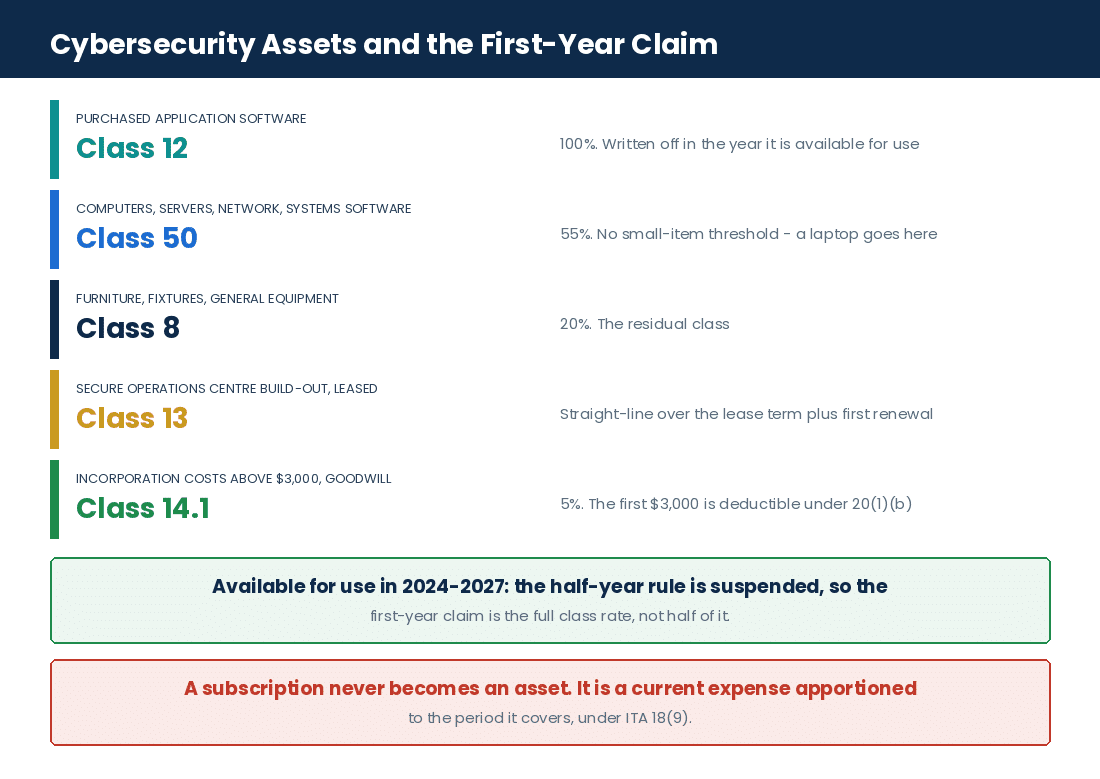
Purchased application software is Class 12 at 100%, so a $50,000 licence purchase is deducted in full in the year it becomes available for use, with the half-year rule suspended by the Accelerated Investment Incentive.
The hardware is no slower. Bill C-15, which received Royal Assent on 26 March 2026, gives Classes 44, 46 and 50 acquired after 15 April 2024 and available for use before 2027 a 100% first-year deduction. Everything else runs on the reinstated incentive: three times the normal first-year amount for property acquired after 2024 and available for use before 2030, one and a half times where the half-year rule would not normally have applied, 2× from 2030 through 2033, and normal rates after 2033.
| What you bought | Class | Rate |
|---|---|---|
| Purchased application software | Class 12 | 100% |
| Systems software, and the hardware it runs on | Class 50 | 55% |
| A subscription or hosted service | Not capital at all | Current expense, apportioned over the period it covers |
| Software acquired as part of a business purchase | Class 14.1 | 5% |
The comparison with the United States runs the other way from how the source puts it. Section 179 expensing is the American route to an immediate write-off; Canada reaches the same place for application software through Class 12, without an election and without a dollar cap. Canadian treatment of a software purchase is not less generous — it is simply arrived at differently.
A Resold Licence Still Carries an Input Tax Credit
Risk Warning: “only costs tied to taxable supplies count — for example, software subscriptions used inside the company rather than licenses sold to clients” has the test backwards.
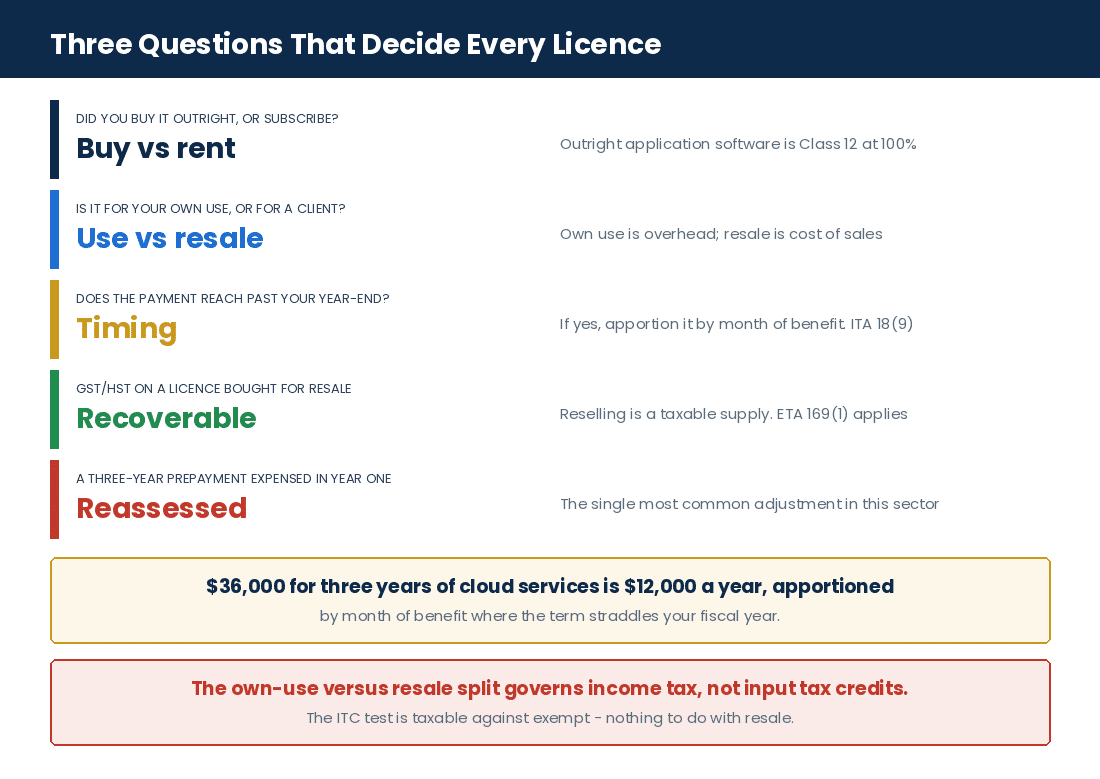
Reselling a licence to a client is a taxable supply. The GST/HST on the licence you bought to resell is recoverable under subsection 169(1) exactly as the tax on your internal tooling is. The distinction that governs input tax credits is taxable against exempt, not internal use against resale.
Section 165 imposes the tax; it does not set out the credit rules. Entitlement is in 169(1) and the documentary standard in 169(4). The own-use versus resale distinction matters a great deal for income tax — a resold licence is cost of sales matched to the revenue, while internal tooling is overhead — but it has no bearing on whether the sales tax comes back.
A managed security provider had been excluding the GST/HST on every licence it bought for resale from its input tax credit claims, on advice that only internal-use tools qualified.
The resale was a taxable supply on which it was charging and remitting tax. Every dollar of that input tax was recoverable, and the claims were made inside the four-year window. Figures changed for privacy.
Understanding Tax Deductions for Cybersecurity Companies
Understanding Tax Deductions for Cybersecurity Companies
Foundations
TLDR: Key Points on Tax Deductions and Business Expenses for Canadian Cybersecurity Companies
At a Glance
- Cybersecurity company tax deductions let a business subtract software, wages, cloud services and much else from taxable income.
- Which costs count as business expenses in Canada turns on one question: current or capital.
- Cybersecurity firms follow the Canada Revenue Agency‘s rules on reporting income and deductions — it is the Canada Revenue Agency, not the Canadian Revenue Agency.
- Three timing rules do most of the damage when they are missed: 18(9) for prepaid amounts, 78(4) for unpaid remuneration, and the available-for-use rules in 13(26) to (32) for capital property.
Introduction: Tax Deduction Strategies for Cybersecurity Businesses in Canada
A cybersecurity company spends heavily on three things: people, software and compute. All three are deductible, but they are deductible on three different timetables, and getting the timetable wrong is what produces reassessments rather than getting the eligibility wrong. Good records are what make the timing defensible.
Defining Business Expenses and Tax Deductions for Cybersecurity Companies
Deductibility starts at paragraph 18(1)(a): an outlay made for the purpose of gaining or producing income from the business. Paragraph 18(1)(b) then denies anything on account of capital, which is recovered instead through capital cost allowance under 20(1)(a). Section 67 caps the whole thing at what is reasonable in the circumstances. Guide T4002 is CRA’s general guide to business expenses for unincorporated operators, and Guide T4012 covers the corporate return.
| Expense category | Deductibility | Provision |
|---|---|---|
| Salaries and wages | Deductible when incurred. Unpaid remuneration is deferred if still unpaid 180 days after year-end | ITA 18(1)(a); 78(4) |
| Software licences | Subscription expensed over the term; outright purchase of application software is Class 12 at 100% | ITA 18(9); Schedule II Class 12 |
| Cloud service costs | Apportioned to the period the payment covers | ITA 18(9) |
| Training and certification fees | Current expense where they maintain existing skills; capital where they confer a lasting advantage | ITA 18(1)(a), 18(1)(b) |
| Insurance premiums | Apportioned where prepaid beyond the fiscal year | ITA 18(9) |
| Meals and entertainment | 50% of the amount paid, with the input tax credit recaptured to match | ITA 67.1 |
Note which statute governs each one. Prepaid amounts are apportioned by subsection 18(9) of the Income Tax Act — not by Regulation 1100 or Schedule II, which deal with capital cost allowance. The meals limit is section 67.1 of the Income Tax Act, not a provision of the Excise Tax Act. And record retention is paragraph 230(4)(b): six years from the end of the last taxation year to which the records relate, measured from the year-end rather than the filing date.
Key Points on Cybersecurity Business Tax Deductions Canada
- Expenses must connect to earning business income, and be reasonable in amount.
- Current expenses are deducted in the year incurred, subject to the three timing rules.
- Capital assets go into classes with set rates — but Class 12 is 100%, so “capital” does not always mean slow.
- Prepaid costs covering several periods are apportioned under 18(9).
- Resold licences are cost of sales matched to the revenue; own-use tools are overhead. This matters for income tax, and not at all for input tax credits.
Canada vs U.S. Small Business Tax Deductions: A Comparison
Key differences in tax codes
| Issue | Canada | United States |
|---|---|---|
| Purchased application software | Class 12 at 100%, no election, no dollar cap | Section 179 election, subject to annual dollar limits |
| Equipment, first year | 100% on Classes 44, 46 and 50 acquired after 15 April 2024 and in use before 2027; 3× the normal first-year amount elsewhere | Section 179 plus bonus depreciation |
| Cloud and prepaid costs | Apportioned to the period covered, ITA 18(9) | Often deductible when paid, subject to the 12-month rule |
| Unpaid bonuses | Deferred if unpaid 180 days after year-end, ITA 78(4) | Generally 2.5 months for an accrual-basis payer |
| Resold licences | Cost of sales matched to revenue; resale agreement supports it | Same matching principle |
| Record retention | Six years from the taxation year-end | Generally three years from filing, longer in some cases |
A firm operating on both sides of the border keeps one set of books and two sets of adjustments. The differences that actually bite are the two timing rules — 18(9) on prepaid amounts and 78(4) on bonuses — because an American template will get both wrong in Canada.
Operating Expenses Line by Line
Operating Expenses Line by Line
Deductions
Office-Related Expenses and Supplies
Rent, utilities and consumable office supplies attributable to the business premises are deducted as incurred. Hardware is where the care is needed: computers, servers and the systems software on them are Class 50 at 55% — but under Bill C-15 a Class 50 purchase made after 15 April 2024 and available for use before 2027 is deducted at 100% in the first year, not 55% and not half of it. There is no general small-item expensing threshold in the Act — the Class 12 100% rate for items under $500 applies to tools and medical or dental instruments, not to a laptop, which goes to Class 50 whatever it cost.
Property Expenses for Cybersecurity Businesses
Leasehold improvements to rented premises — a secure operations centre, access control, cabling — go to Class 13, amortised straight-line over the lease term plus the first renewal period, with a five-year minimum and a forty-year maximum. Repairs and maintenance that restore rather than improve are current expenses deducted when incurred. Track the two separately from the invoice stage, because the distinction is made once and carried for years.
Motor Vehicle and Transportation Costs
- Purchased vehicles go to Class 10 at 30%, or Class 10.1 where the cost exceeds the prescribed limit, in which case there is no recapture and no terminal loss.
- Lease payments are current expenses, capped by section 67.3.
- Interest on money borrowed to buy a passenger vehicle is capped by section 67.2.
- Only the business-use portion is deductible, supported by a contemporaneous kilometre log rather than an estimate.
Home Office Expenses
Risk Warning: the simplified flat rate method was a temporary measure for employees and ended after the 2022 tax year. It never applied to a corporation.
Subsection 18(12) restricts a work space in the home deduction and applies to an individual, not to a corporation. An incorporated cybersecurity company working from the owner’s home does not claim a home office deduction at all. The corporation either pays the shareholder a reasonable rent under a written arrangement, which is income to the shareholder and deductible to the company, or reimburses specific business costs it can substantiate.
Where the owner operates unincorporated, 18(12) applies: the space must be either the principal place of business, or used exclusively to earn income and on a regular and continuous basis for meeting clients, and the deduction cannot create or increase a loss — the excess carries forward.
Business Meals and Entertainment Rules
Meals and entertainment are limited to 50% of the amount paid under section 67.1 of the Income Tax Act. There is no per-meal dollar cap and no requirement that the meal happen away from your usual office. Subsection 67.1(2) carries exceptions — amounts included in an employee’s income as a taxable benefit, amounts billed through to a client and disclosed, and a handful of others. The GST/HST input tax credit on these amounts is recaptured to 50% to match. Keep the receipt with who attended and why.
Employee Salaries, Benefits, and Management Fees
- Wages, bonuses and incentives are deductible when incurred, subject to the 180-day rule in subsection 78(4).
- Employer CPP and EI are deductible on top of gross pay.
- Source deductions are remitted on the band assigned by Regulation 108 from your average monthly withholding amount — the 15th of the following month for a regular remitter. Failing to remit creates liability under subsection 227(9) and director liability under 227.1; it does not deny the wage deduction.
- Management fees to a related party are deductible to the extent they are reasonable under section 67, supported by an agreement describing services actually rendered.
- Equity compensation is not automatically deductible. A corporation issuing its own shares under an employee stock option generally gets no deduction at all; cash-settled awards are a different analysis. This is the one item in a tech payroll that behaves nothing like salary.
Marketing, Advertising, and Promotion
Digital advertising, content and campaign spend is deductible as incurred. Website development splits: costs of building functionality are generally capital, falling into Class 12 where the result is software, while hosting, content updates and routine maintenance are current. Conference and trade show fees are deductible; the hospitality inside the event is caught by the 67.1 limit.
Professional and Administrative Fees
Legal, accounting and consulting fees incurred to earn income are deductible. Fees relating to acquiring capital property are added to the cost of that property instead. Incorporation costs have their own rule: the first $3,000 is deductible under paragraph 20(1)(b), with any excess going to Class 14.1 at 5%. Keep the engagement letters, because they are what show whether a fee maintained operations or acquired something.
Business Insurance Premiums
Cyber liability, errors and omissions, general liability and property premiums are deductible as incurred, apportioned under subsection 18(9) where the policy period runs past the fiscal year-end. For a cybersecurity firm the cyber liability policy is also a commercial necessity rather than a discretionary cost, which makes the reasonableness question straightforward.
Phone, Internet, and Digital Infrastructure
Internet, mobile plans and hosted services are current expenses, apportioned to the periods they cover under subsection 18(9). That provision is long-standing and is not a recent CRA measure expiring at the end of 2026. A multi-year commitment is scheduled by period of benefit, which is the single most common adjustment in this sector.
Banking Charges, Interest, and Financing Costs
Interest on money borrowed for the purpose of earning business income is deductible under paragraph 20(1)(c), and bank and processing charges are ordinary deductions. Financing fees such as loan arrangement costs are deducted over five years under paragraph 20(1)(e) rather than in the year paid.
Capital Cost Allowance (Depreciation)
| Asset | Class | Rate |
|---|---|---|
| Computers, servers, network hardware, systems software | Class 50 | 55% |
| Purchased application software | Class 12 | 100% |
| Furniture, fixtures, general equipment | Class 8 | 20% |
| Leasehold improvements | Class 13 | Straight-line over the lease term plus first renewal |
| Vehicles | Class 10 / 10.1 | 30% |
| Incorporation costs above $3,000, goodwill | Class 14.1 | 5% |
Two timing rules govern the first claim. No capital cost allowance arises before the property is available for use under subsections 13(26) to (32) — that rule is in the Act, not in the Schedule II class definitions. And the half-year rule is suspended. Bill C-15, which received Royal Assent on 26 March 2026, reinstated the Accelerated Investment Incentive at three times the normal first-year amount for property acquired after 2024 and available for use before 2030 — one and a half times where the half-year rule would not normally have applied — with a 2× band from 2030 through 2033 and normal rates after 2033. So a Class 8 addition claims 30% in year one, not 10%. On top of that, Classes 44, 46 and 50 acquired after 15 April 2024 and available for use before 2027 are deducted at 100%, which is where a security firm’s computers, servers and network hardware land.
Lesser-Known Deductions And Industry-Specific Expenses
- Security certifications for staff — CISSP, OSCP, SANS and the rest — are current expenses where they maintain or update existing skills. A qualification that confers a lasting advantage of an enduring nature is capital, and the renewal fees that follow are current either way.
- Penetration testing tooling and lab hardware used to build and test the firm’s own offering, which may be Class 50 or, where the work is genuinely experimental, an SR&ED expenditure instead.
- Bug bounty payouts to external researchers, deductible as incurred, with a T4A required for fees for services above $500 to a Canadian recipient.
- Threat intelligence feeds and data subscriptions, apportioned under 18(9) like any other subscription.
- Research and development that resolves a genuine technological uncertainty, which is a credit rather than a deduction and is dealt with below.
A firm expensed a secure operations centre build-out — access control, cabling, acoustic treatment — as repairs and maintenance in the year it was done.
It was a Class 13 leasehold improvement amortised over the lease term. The deduction was not lost, only spread, and the cost of getting it wrong was the reassessment and the interest on it. Figures changed for privacy.
Software, Cloud and Resold Licences
Software, Cloud and Resold Licences
The Sector Question
This is the part of a cybersecurity company’s return that looks nothing like a general business, and the part where the circulating guidance is least reliable. Three questions decide the treatment of every licence that passes through the business.
| Question | If yes | If no |
|---|---|---|
| Did you buy it outright, or subscribe? | Outright purchase of application software is Class 12 at 100% | A subscription is a current expense, apportioned under 18(9) |
| Is it for your own use, or for resale to a client? | Own use is overhead | Resale is cost of sales, matched to the revenue it supports |
| Does the payment cover a period past your year-end? | Apportion it under 18(9) | Deduct it in the year |
Prepaid and Multi-Year Cloud Commitments
Subsection 18(9) is the provision, and it is unambiguous: an outlay for services to be rendered after the end of the year is deductible in the year the services are rendered, not the year it is paid.
Worked example. A firm pays $36,000 up front for three years of cloud security services beginning on the first day of its fiscal year. The deduction is $12,000 a year across three years, not $36,000 in year one. A commitment starting mid-year is apportioned by month of benefit rather than by fiscal year, so the first year carries a partial amount. Figures changed for privacy.
The same rule reaches prepaid insurance, prepaid support contracts, annual tool licences bought in advance and multi-year domain or certificate purchases. None of it is a recent CRA measure and none of it expires at the end of 2026 — 18(9) has been in the Act for decades.
Own-Use Tooling Against Resold Licences
The income tax consequence of the own-use against resale distinction is real and worth getting right, even though it has no bearing on input tax credits.
| Own-use tooling | Resold licence | |
|---|---|---|
| Income statement line | Operating overhead | Cost of sales |
| Timing | As incurred, apportioned under 18(9) | Matched to the period the related revenue is recognised |
| What supports it | The vendor invoice | The vendor invoice and the signed resale agreement |
| GST/HST | Input tax credit under 169(1) | Input tax credit under 169(1) — the same |
| Effect on gross margin | None; sits below the line | Reduces reported gross margin, which is the correct presentation |
Worked example. A managed security provider buys $100,000 of licences for client deployments. Those costs are recorded as cost of sales and recognised as the clients are invoiced, supported by signed resale agreements showing the firm is contracting to supply the licence rather than consuming it. The GST/HST on the purchase is claimed as an input tax credit in the ordinary way. Figures changed for privacy.
Where the firm acts as agent for the client rather than reselling on its own account, section 177 of the Excise Tax Act decides who is treated as having made the supply, and the accounting changes with it. That is a contract question, settled by what the agreement says about who holds title and who bears the risk.
Is Own Tooling a Subscription or an Asset?
Subscriptions are services and never become assets, however long the term. An outright purchase of application software is a Class 12 asset written off at 100%, which in practice reaches the same place as expensing it, one year later at worst. The question that actually matters is not which label applies but whether the payment reaches past the year-end, because that is what 18(9) turns on.
A firm recorded every licence it bought in one “software” expense account, whether it was an internal tool or a licence deployed into a client environment.
Its gross margin was meaningless, it could not substantiate the resale treatment to a reviewer, and the prepaid portions had never been scheduled. Splitting the account three ways — own use, resale and prepaid — fixed the reporting and the return in the same exercise. Figures changed for privacy.
Non-Deductible Expenses and Common Filing Mistakes
Non-Deductible Expenses and Filing Mistakes
What Does Not Count
- Personal and living expenses, denied outright by paragraph 18(1)(h).
- Fines and penalties imposed under a law, denied by section 67.6.
- Club dues for dining, recreation or sporting facilities, denied by paragraph 18(1)(l).
- Capital outlays, denied by paragraph 18(1)(b) and recovered through capital cost allowance instead — and not claimable at all until the property is available for use.
- Unreasonable amounts, cut back by section 67 however they are characterised.
- Stock option benefits on shares the corporation issues itself, which generally carry no corporate deduction.
| Mistake | Result | How to fix it |
|---|---|---|
| Multi-year commitment expensed once | Reassessment plus interest | Schedule the cost over the term under 18(9) |
| Resold licence booked as overhead | Cost and revenue fall in different periods; gross margin is wrong | Move to cost of sales, with the resale agreement on file |
| Bonus unpaid past the 180-day mark | Deduction deferred to the year of payment under 78(4) | Diarise 180 days from each year-end, not 31 December |
| Contractor status unchecked | Back CPP and EI on both shares, plus penalties | Review against Guide RC4110; rule on Form CPT1 where it is close |
| No withholding on a non-resident contractor | The payer is liable for the amount that should have been withheld | Regulation 105: 15% on fees for services rendered in Canada, unless a waiver is obtained |
| Hardware expensed before it is available for use | Claim denied for the year | Record the commissioning date beside the purchase date |
| Full meal and travel claims | Half the meal claim disallowed, with the input tax credit recaptured | Apply the 50% limit in 67.1 at the posting stage |
| Equity compensation treated as salary | Deduction denied | Analyse each plan on its own terms before accruing anything |
The Regulation 105 point deserves emphasis because cybersecurity firms engage specialist contractors internationally as a matter of course. The 15% withholding applies to fees paid to a non-resident for services rendered in Canada, and it is a payment on account of the non-resident’s potential Canadian tax rather than a final tax. Services performed entirely outside Canada are outside Regulation 105. The liability for failing to withhold falls on the payer, which is what makes it worth checking before the invoice is paid rather than afterwards.
A firm engaged an overseas penetration testing specialist who spent three weeks on site with a client in Toronto.
No Regulation 105 withholding was taken, because nobody had asked where the work was performed. The services were rendered in Canada, the 15% was the payer’s liability, and recovering it from a contractor already paid in full was not realistic. Figures changed for privacy.
Filing Cybersecurity Company Taxes and Claiming Deductions
Filing, Bookkeeping and Digital Tools
Process
Step-by-Step Tax Filing Process
- Gather the records. Software and cloud invoices with their coverage periods, payroll registers, resale agreements, hardware invoices with commissioning dates.
- Split current from capital, and within capital, assign the class before anything is posted.
- Schedule the prepaid amounts under 18(9), by month of benefit rather than by fiscal year.
- Check the 180-day bonus position against subsection 78(4) for anything accrued and unpaid.
- Complete the T2 with the GIFI schedules and the capital cost allowance schedule.
- Pay the balance of tax at two months, and file the return within six months.
Risk Warning: filing within six months is not the whole deadline. The balance of tax is due at two months under paragraph 157(1)(b), or three for an eligible CCPC claiming the small business deduction.
That date falls four months before the return it belongs to and generates interest rather than a notice, so nothing tells you it has passed. Late filing is penalised separately under subsection 162(1) at 5% of the unpaid tax plus 1% per complete month to twelve, with arrears interest compounding daily under 161(1).
Filing With Required CRA Forms
| Form or schedule | What it carries |
|---|---|
| T2 | The corporate income tax return |
| Schedule 100 | GIFI balance sheet |
| Schedule 125 | GIFI income statement — not a salary summary |
| Schedule 1 | Reconciliation of accounting income to taxable income |
| Schedule 8 | Capital cost allowance, by class |
| Schedule 31 | SR&ED investment tax credit, with Form T661 |
| T4 and T4A | Employment income and fees for services, due the last day of February |
Electronic filing of the T2 is mandatory under subsection 150.1(2.1), with a $1,000 penalty for paper under 162(7.2). EFILE certification is a federal CRA programme; there is no provincial authorisation layer.
Gathering Documents and Receipts
- Original invoices showing the period covered, which is what supports the 18(9) apportionment.
- Receipts separating own-use licences from those resold to clients.
- Hardware invoices with the date the asset was available for use, which is frequently later than the purchase date.
- Records of services performed outside Canada, and of non-resident contractors who performed work in Canada.
- Digital copies kept in a form that stays readable for the full retention period.
Summarizing Expenses
- Salaries and wages, separated from contractor payments.
- Software licences, split between current, capital and resale.
- Cloud fees spread by coverage period.
- Hardware with the correct class and its available-for-use date.
- Meals and travel, with the 50% limit applied at the posting stage.
Documenting Business Expenses and Setting Up Bookkeeping
- Separate accounts for cost of sales and overhead, so resold licences never mix with internal tooling.
- Prepaid expenses recorded as assets, not liabilities, and released to expense as the benefit is received.
- Employee wages logged separately from contractor payments, with the classification analysis written down.
- An asset register carrying purchase date, available-for-use date, cost and class for every item.
- A bonus calendar running 180 days from each year-end.
Digital Tools: Accounting Software
QuickBooks Online and Xero both handle the chart of accounts a cybersecurity firm needs, and both integrate with payroll tools including Wagepoint. What they do not do on their own is the 18(9) scheduling — a subscription charged monthly to the credit card posts as a current expense correctly, but an annual or multi-year prepayment needs a schedule someone maintains. Automating the categorisation does not automate the timing.
Using Digital Tools and Tracking Work Expenses
Receipt capture apps reduce the paper problem and feed the ledger directly. For a security firm the obvious caution applies: an expense app is a third-party processor handling corporate financial data, so it belongs in the same vendor assessment as any other SaaS the firm adopts. Convenience in the finance function is not a reason to skip the review you would run for a client.
Expense Management Apps
These tools read receipts and post entries against your categories, which cuts missed deductions and overstated claims alike. They do not decide whether something is capital, and they will happily post a three-year cloud prepayment as a current expense if nobody intervenes. Treat the output as a draft.
Separating Business and Personal Costs
Use dedicated business bank accounts and cards. Personal and living expenses are denied by paragraph 18(1)(h), and an amount paid by the corporation for a shareholder’s benefit is included in the shareholder’s income under subsection 15(1) — so the cost of mixing them is paid twice, once in the denied deduction and once in the shareholder benefit.
CRA Requirements
Every claimed expense must be a reasonable amount incurred to earn income, under paragraph 18(1)(a) and section 67, with capital outlays recovered under 20(1)(a) rather than deducted. The timing rules in subsections 18(9) and 78(4) sit on top of that, and the documentary standard for input tax credits is subsection 169(4) of the Excise Tax Act — which matters most on cross-border purchases, where a foreign supplier with no Canadian registration number charges no GST/HST and there is no credit to claim. Non-compliance produces adjustments and interest rather than a dialogue, which is why the proof matters more than the argument.
Keeping Organized Records
Keep reseller contracts filed separately from internal tool licences, check invoice dates against the periods they cover, and keep the records six years from the end of the last taxation year to which they relate under paragraph 230(4)(b). Consistency is what lets you answer a question about a three-year contract in one email rather than three.
A firm with excellent bookkeeping had every expense categorised correctly and still had a reassessment.
Its accounting software had posted annual tool renewals on the payment date, as it is designed to, and nobody maintained a prepaid schedule. The categories were right and the timing was wrong, which is the harder error to see. Figures changed for privacy.
Tax Credits and Additional Incentives for Canadian Cybersecurity Businesses
Tax Credits and Additional Incentives
Credits
Small Business Deduction Overview
The small business deduction in section 125 reduces the federal corporate rate on active business income from 15% to 9% on up to $500,000 a year for a Canadian-controlled private corporation, with Ontario applying its own reduced rate on top. Salaries are usually a cybersecurity firm’s largest deduction and reduce the income the limit is applied to in the first place.
- The business limit is shared among associated corporations under subsection 125(3).
- It is reduced on taxable capital employed in Canada between $10 million and $50 million under subsection 125(5.1).
- It is also reduced where adjusted aggregate investment income exceeds $50,000, eliminated at $150,000, under subsection 125(5.1)(b) — the passive income grind, which catches a firm holding retained earnings in investments.
- Wages must be reasonable under section 67 and supported by payroll records and T4 slips.
Scientific Research & Experimental Development (SR&ED) Credit
Key Stat: the SR&ED expenditure limit for the enhanced 35% refundable credit is $6 million, following Bill C-15’s Royal Assent on 26 March 2026.
For taxation years beginning after 15 December 2024: up to $2.1 million of refundable credit a year, the taxable capital phase-out running from $15 million to $75 million, eligible Canadian public corporations reaching the enhanced rate for the first time, and capital expenditures eligible again for property acquired after 15 December 2024.
SR&ED is defined in subsection 248(1) and turns on three tests: a technological uncertainty that standard practice cannot resolve, a systematic investigation, and an aim of technological advancement. For a cybersecurity firm the line usually falls between building a detection capability from known techniques, which is not eligible, and establishing by experiment how to detect something that published methods demonstrably miss, which can be.
- Eligible costs are salaries of staff directly engaged, 80% of arm’s length contract payments for work performed in Canada, materials consumed or transformed, and overhead either by the 55% prescribed proxy amount under Regulation 2900(4) or by actual amounts under the traditional method.
- Routine debugging, maintenance and tuning are excluded, as are routine data collection and quality control, by the exclusions in the 248(1) definition itself.
- The reporting deadline is 18 months after the tax year end under subsection 37(11), and the Act provides no mechanism to extend it.
- Keep project records showing the hypothesis, what was tried and what happened, made as the work proceeded.
The definition is in 248(1) and the credit mechanics in section 127; Interpretation Bulletin IT-533 deals with interest deductibility and is not SR&ED authority.
Clean Economy Investment Tax Credits and Carbon Rebates
Risk Warning: Ontario’s cap-and-trade programme was cancelled in 2018. It has not existed for eight years, and no business claims rebates under it.
Ontario’s current industrial carbon programme is the Emissions Performance Standards, which applies to large industrial emitters. A cybersecurity company is not a covered facility and has nothing to claim under it.
| Incentive | What it covers | Does a cybersecurity firm qualify? |
|---|---|---|
| Clean Technology ITC | Up to 30% on specified clean energy property: solar, wind, electrical energy storage, heat pumps, geothermal, non-road zero-emission vehicles and charging equipment | Only if it buys that property itself. Ordinary IT and data-centre hardware is not eligible |
| Canada Carbon Rebate for Small Businesses | Refundable amount returning fuel charge proceeds to CCPCs with 499 or fewer employees | Possibly, for past fuel charge years. The programme is winding down with the fuel charge, and legislation passed 16 March 2026 made the rebates tax-free |
| Ontario cap-and-trade | — | No. Cancelled in 2018 |
| Clean Electricity ITC | Low-emitting electricity generation and transmission | No, outside an unusual on-site generation project |
The honest answer for most cybersecurity firms is that the clean economy credits do not reach them. A firm that installs rooftop solar or battery storage at its own premises can claim the Clean Technology ITC on that property, subject to the labour requirements; buying efficient servers is not a clean technology investment in the statutory sense, however much less power they draw.
Input Tax Credits for GST/HST
- Entitlement is under subsection 169(1), for tax paid on property and services acquired for consumption, use or supply in the course of commercial activity.
- The documentary standard is subsection 169(4) and the Input Tax Credit Information Regulations: over $30 the supplier’s name and the date, over $150 the supplier’s registration number, your name, the terms and a description.
- Section 165 imposes the tax; it is not the credit provision.
- Licences bought for resale qualify, because reselling them is a taxable supply. So do internal tools used in making taxable supplies.
- Meals and entertainment input tax credits are recaptured to 50% to match section 67.1.
- Claims are made within the window in subsection 225(4) — generally four years, two for larger registrants.
- Services supplied to a non-resident may be zero-rated under Schedule VI, Part V, which preserves full input tax credit recovery; it does not restrict it.
A firm was quoted a substantial fee to prepare a clean technology credit claim on a server refresh marketed as energy-efficient.
None of it was eligible property. The equipment went to Class 50, which under the immediate expensing measure meant the whole cost was deducted in the first year — a better outcome than the credit would have been, and it required no claim at all. Figures changed for privacy.
Audit Risks, Compliance Issues, and Record Keeping Best Practices
Audit Risks, Compliance and Records
Controls
Common Mistakes That Trigger Audits
- Booking multi-year cloud commitments as one-time expenses, against subsection 18(9).
- Putting resold licences in overhead instead of cost of sales, which breaks the matching the revenue depends on.
- Missing the 180-day bonus payment window in subsection 78(4).
- Not reviewing worker status, leading to contractor misclassification.
- Failing to withhold under Regulation 105 on non-resident contractors performing services in Canada.
- Claiming full meal and travel costs without the 67.1 limit.
- Expensing hardware before it is available for use under subsections 13(26) to (32).
- Treating equity compensation as deductible salary automatically.
Proactive Record Keeping Systems
- Amortisation schedules for every prepaid amount, reviewed at least quarterly rather than rebuilt at year-end.
- Software asset lists showing purchase date, class and available-for-use date.
- Contract files linked electronically to the ledger entries they support, with resale agreements kept apart from internal licences.
- Bonus payment calendars running 180 days from the year-end, with board resolutions attached.
- Annual worker classification review, documented, against Guide RC4110.
- Non-resident contractor log recording where each engagement’s services were physically performed.
Types of Documentation Required
| Document | What it supports |
|---|---|
| Vendor invoices showing licence type and period | The 18(9) apportionment and the own-use against resale split |
| Signed reseller agreements | Cost of sales treatment and the section 177 agency question |
| Cloud subscription contracts with start and end dates | The prepaid schedule |
| Payroll records with hours, rates and T4 summaries | The wage deduction and the remittance band |
| Board resolutions for bonuses, with payment proof | The 78(4) position |
| Worker status letters and CPT1 rulings | Classification, if challenged |
| Insurance policies with coverage dates | Apportionment of premiums |
| Hardware invoices with commissioning records | The available-for-use date |
Records are kept six years from the end of the last taxation year to which they relate under paragraph 230(4)(b), with the same period for GST/HST under section 286 of the Excise Tax Act. Early destruction needs CRA permission on Form T137, and Guide RC188 sets out the practical requirements.
Case Examples: Tax Savings for Cybersecurity Companies
- A Toronto firm bought $50,000 of application software. It is Class 12 at 100%, so the whole $50,000 was deducted in the year the software became available for use — not spread across years.
- An Ontario firm prepaid $36,000 for three years of cloud security services. Subsection 18(9) apportions it at $12,000 a year, by month of benefit.
- A managed security provider resold $100,000 of client licences. Recorded as cost of sales matched to the invoicing, supported by signed resale agreements — and the GST/HST on the purchases claimed as input tax credits in full.
Figures changed for privacy in each case. Two of the three produce a larger current-year deduction than the circulating guidance suggests, and the third recovers tax the guidance would have surrendered.
How To Catch Up If Books Are Behind
Rebuild from bank statements and vendor invoices, then rebuild the asset register with purchase and available-for-use dates, then schedule every prepaid amount by month of benefit, then test the bonus accruals against 180 days from each year-end, then amend. Check which years are still open before starting: a normal reassessment period of three years from the notice of assessment applies to a CCPC, and an SR&ED claim for a closed 18-month window cannot be revived at all.
A firm three years behind had no asset register and one software expense account covering internal tools, client resales and prepayments.
Rebuilding it produced several years of unclaimed capital cost allowance on hardware, a corrected prepaid schedule, and a gross margin figure the owners could actually use. The amended returns recovered more than the catch-up work cost. Figures changed for privacy.
Frequently Asked Questions (FAQs) on Cybersecurity Company Taxes Canada
Frequently Asked Questions
20 Answers
What is the corporate tax return (T2) deadline for cybersecurity companies?+
When is the bonus payment deduction deadline?+
When does an unpaid bonus stop being deductible?+
How are prepaid expenses like cloud services apportioned?+
Which Capital Cost Allowance (CCA) classes apply to cybersecurity hardware?+
Is own tooling a subscription or an asset?+
How are licenses bought for clients treated in taxes?+
How does payroll source deduction remittance affect deductions?+
Which operating costs are fully deductible, and which are limited?+
Which hardware and lab assets require capitalization?+
How is equity or stock compensation treated for tax purposes?+
Are operations staff employees or contractors?+
What about offshore or non-resident contractors?+
How is revenue from non-resident clients treated?+
Could any development support a tax credit?+
What records does a cybersecurity company need to keep?+
Which returns does the company file, and when?+
What triggers a CRA review of a cybersecurity company’s return?+
Who should use professional CPA services for tax filing?+
Should I file taxes myself or hire a CPA firm like Gondaliya CPA?+
Cybersecurity Company Tax Check
Five quick questions on your books. No fee shown.
Points to raise with us:
This is a general prompt, not tax or legal advice or a quote. Your position depends on your full facts. For a real review, please book a free consultation.
Businesses We Serve & Industry Spotlights
Industry Expertise
Cybersecurity sits inside a wider technology and professional services practice, and the same three questions surface in every sector we act for. Here are eleven and the form the issue usually takes.
| Industry | The Cybersecurity Angle |
|---|---|
| Technology startups & SaaS | Subscription revenue and subscription costs, each apportioned |
| Consulting firms | Pass-through costs and when they become cost of sales |
| E-commerce & online retailers | Payment and fraud tooling bought on multi-year terms |
| Medical doctors & physician professional corporations | Exempt supplies, where input tax credits do not come back |
| Dentists & dental practices | Practice systems as Class 50 rather than an expense |
| Real estate investors, landlords & holding companies | Association under section 256 and one shared business limit |
| Property developers & builders | The current-versus-capital line, in its original setting |
| Transportation, logistics & trucking | Vehicle classes, logbooks and the 10.1 limit |
| Construction, contractors & skilled trades | Non-resident subcontractors and Regulation 105 |
| Restaurants & food and beverage | Payroll remittance bands and the 50% meal limit |
| Daycare, childcare & CWELCC services | What a wholly exempt operator cannot recover |
- Technology startups & SaaS: The nearest neighbour, and subject to 18(9) on both sides — the subscriptions they sell and the ones they buy are apportioned on the same principle.
- Consulting firms: Any firm that buys something to pass on to a client faces the cost of sales question a licence reseller faces, and the answer comes from the engagement terms.
- E-commerce & online retailers: Fraud, identity and payment security tooling is bought on exactly the multi-year terms that trip up the prepaid schedule.
- Medical doctors & physician professional corporations: A useful contrast. A practice making exempt supplies recovers no input tax credits on its security spend, which makes the same purchase materially more expensive than it is for you.
- Dentists & dental practices: Practice management systems and the hardware behind them are Class 50 and Class 12, not an office expense, which is the same call a security firm makes on its own stack.
- Real estate investors, landlords & holding companies: Holding structures are how a growing security firm discovers it is associated and sharing one $500,000 business limit under subsection 125(3).
- Property developers & builders: The repair-versus-improvement distinction in its original setting, which is the same test applied to a secure operations centre build-out.
- Transportation, logistics & trucking: Where a security firm runs response vehicles, the Class 10 against 10.1 question and the kilometre log work exactly as they do for a carrier.
- Construction, contractors & skilled trades: The sector that encounters Regulation 105 most often, for the same reason a security firm does — specialists brought in from abroad to work on a Canadian site.
- Restaurants & food and beverage: Shift payroll at scale, the same Regulation 108 band question, and the 50% meal limit from the other side of the table.
- Daycare, childcare & CWELCC services: A clean illustration of wholly exempt activity, where nothing comes back on inputs — the opposite position to a firm making taxable supplies.
The stack changes. The three questions do not: is it current or capital, what period does the payment cover, and did you buy it for yourself or for a client.
A threat intelligence firm and a SaaS platform keep different products and file nearly identical returns. Figures changed for privacy.
Professional Guidance and Quick Reference
Guidance
Final Thoughts and Practical Tips for Maximizing Deductions
Cybersecurity companies get into difficulty in a predictable set of ways: taking 31 December as the bonus deadline, when subsection 78(4) gives 180 days from the year-end; depreciating purchased application software slowly, when Class 12 writes it off at 100%; excluding resold licences from input tax credit claims, when reselling is a taxable supply and the tax comes back under 169(1); expensing a multi-year cloud commitment in one year, against subsection 18(9); claiming a corporate home office deduction, when subsection 18(12) applies to individuals and the simplified flat rate method ended after 2022; paying a non-resident contractor for work done in Canada without the Regulation 105 15% withholding; accruing equity compensation as deductible salary, when a share issuance generally carries no corporate deduction; chasing clean technology credits on efficient servers, when the eligible property list does not reach IT hardware; claiming under Ontario’s cap-and-trade, which was cancelled in 2018; filing at six months and forgetting the balance of tax at two months under 157(1)(b); and keeping records six years from filing, when paragraph 230(4)(b) runs from the end of the taxation year. Gondaliya CPA handles cybersecurity company accounting and tax on a flat annual fee.
We handle what decides the outcome: drawing the capital line before anything is posted, maintaining the prepaid schedules that accounting software will not maintain for you, splitting resold licences from internal tooling so both the return and the gross margin are right, running the bonus calendar from your actual year-end, checking where every contractor physically performs the work, building an asset register that records the available-for-use date, and preparing compiled statements under CSRS 4200 that state plainly that no assurance is provided. Audit and review engagements are referred out, and we offer no security advice of any kind.
Our team starts with your vendor contracts, your payroll register and your last return. Whatever your stack looks like, you get clear advice and a fixed price before we start.
Tax Deduction Checklist for Canadian Cybersecurity Businesses
Checklist
- Decide current or capital before the entry is posted, not at year-end.
- Keep invoices that show exactly what period each cost covers.
- Schedule every multi-year commitment by month of benefit under 18(9).
- Hold resale agreements linking licence costs to the revenue they support.
- Run the bonus calendar at 180 days from your year-end.
- Review worker classification annually against Guide RC4110.
- Check where non-resident contractors perform the work before paying them.
- Record the available-for-use date beside every hardware purchase.
- Apply the 50% meal limit at the posting stage, and recapture the input tax credit to match.
- Keep certification and training receipts, and decide current or capital on each.
- Pay the balance of tax at two months, not with the return.
- Retain records six years from the taxation year-end.
Quick Answers
At a Glance
- Deductibility: ITA 18(1)(a); capital denied by 18(1)(b)
- Reasonableness: ITA 67
- Prepaid amounts: ITA 18(9)
- Unpaid bonuses: 180 days, ITA 78(4)
- Meals and entertainment: 50%, ITA 67.1
- Personal expenses: denied, ITA 18(1)(h)
- Fines and penalties: denied, ITA 67.6
- Application software: Class 12, 100%
- Computers and servers: Class 50, 55%
- Leasehold improvements: Class 13
- Incorporation costs: $3,000 under 20(1)(b), excess to Class 14.1
- Available for use: ITA 13(26) to (32)
- First-year claim: 100% on Classes 44, 46, 50 in use before 2027; 3× elsewhere
- Input tax credits: ETA 169(1); documents to 169(4)
- Non-resident withholding: 15%, Regulation 105
- Payroll remittance: Regulation 108
- Small business limit: $500,000, ITA 125
- Records: six years from the taxation year-end, ITA 230(4)(b)
Essential Bullet Points: Managing Cybersecurity Business Taxes in Canada
Key Controls and Warning Signs
- Top deduction mistakes and prevention: multi-year subscriptions expensed upfront, resold licences buried in overhead, and bonuses paid past the 180-day mark. All three are scheduling problems with calendar solutions.
- Best practices: contracts that distinguish client resale from internal use, prepaid schedules reviewed quarterly, and worker classification reviewed annually.
- Catching up if the books are behind: rebuild from bank records, then the asset register, then the prepaid schedules, then amend — checking first which years are still within the normal reassessment period.
- Choosing a CPA firm: look for experience with resale arrangements, multi-year commitments and SR&ED, plus flat-fee pricing and Ontario and national coverage.
- Key deliverables from your CPA: an accurate T2, a maintained capital cost allowance schedule, prepaid schedules, payroll compliance checks and an honest assessment of whether an SR&ED claim exists.
- Cost factors: fees track the number of timing judgments in your return rather than revenue. A flat fee agreed before work begins makes it budgetable.
- Handling offshore contractors: confirm worker status, establish where the services are physically performed, and apply Regulation 105 withholding where they are performed in Canada.
- Operating cost limits: meals and entertainment at 50%; insurance, professional fees and most operating costs fully deductible.
- Equity compensation: read the plan before accruing anything. A share issuance generally carries no corporate deduction.
- CRA review triggers: a large one-time expense with no matching asset addition, revenue that does not reconcile between the T2 and the GST/HST returns, and remittances that do not agree to the T4 summary.
- Filing returns and forms: T2 with Schedules 100, 125, 1 and 8, electronically, plus GST/HST and payroll on their own schedules.
- Digital tools: QuickBooks or Xero with receipt capture handles categorisation, not timing. Someone still maintains the prepaid schedule.
- Record retention: six years from the end of the taxation year the records relate to, under paragraph 230(4)(b).
People Also Ask
Related Questions
Can a cybersecurity company deduct a cyber liability insurance premium in full?+
Yes, as incurred, apportioned under subsection 18(9) where the policy period runs past the fiscal year-end. For a security firm it is a commercial necessity rather than a discretionary cost, so the reasonableness question under section 67 is straightforward.
Are staff security certifications deductible?+
Generally yes, as a current expense, where the training maintains or updates existing skills. A qualification conferring a lasting advantage of an enduring nature is capital. Renewal and maintenance fees are current either way.
Does buying energy-efficient servers qualify for a clean technology credit?+
No. The Clean Technology ITC covers specified clean energy property — solar, wind, electrical energy storage, heat pumps, geothermal and similar. Ordinary IT and data-centre hardware is not on the list. The servers go to Class 50 instead, and where they are acquired after 15 April 2024 and available for use before 2027 the whole cost is deducted in the first year — a better outcome than the credit would have been.
Can the corporation pay rent to a shareholder for a home office?+
Yes, where the amount is reasonable under section 67 and supported by a written arrangement. It is deductible to the corporation and income to the shareholder. What a corporation cannot do is claim a home office deduction under subsection 18(12), which applies to individuals.
Do we have to withhold on a contractor who works remotely from abroad?+
No. Regulation 105 reaches fees for services rendered in Canada. A contractor working entirely from outside Canada is outside it. The moment they spend time on a Canadian site, the 15% applies to the fees for that work and the liability sits with the payer.
Glossary
Definitions
- Current expense — a cost consumed in the year, deducted in full under paragraph 18(1)(a).
- Capital expenditure — a cost acquiring or improving an asset of enduring benefit, denied by 18(1)(b) and recovered through capital cost allowance.
- Prepaid expense — an outlay for services to be rendered after the year-end, apportioned to the period of benefit under subsection 18(9).
- Unpaid remuneration — salary or bonus still unpaid 180 days after the year-end, deferred to the year of payment by subsection 78(4).
- Available for use — the date from which capital cost allowance may first be claimed, under subsections 13(26) to (32).
- Cost of sales — costs incurred to deliver what was sold, matched to the revenue, as distinct from overhead.
- Input tax credit — recovery of GST/HST paid on inputs used in commercial activity, under subsection 169(1) of the Excise Tax Act.
- Taxable supply — a supply made in the course of commercial activity, including a licence resold to a client.
- Regulation 105 withholding — 15% withheld from fees paid to a non-resident for services rendered in Canada.
- Specified employee — an employee not dealing at arm’s length with the employer, or a specified shareholder, whose amounts are capped for certain purposes.
- Adjusted aggregate investment income — the measure that grinds the small business limit between $50,000 and $150,000.
Want a checklist to work from? You can download our free cybersecurity company tax checklist before your consultation.
Run the bonus calendar at 180 days from your actual year-end, because 31 December is not a rule and a December year-end accruing on that basis loses the deduction by six months. Write purchased application software off in full — it is Class 12 at 100%, and the whole cost lands in the year the software becomes available for use. Do the same with the hardware, because Class 50 property acquired after 15 April 2024 and commissioned before 2027 is deducted in full as well. Claim the input tax credit on every licence you resell, because reselling is a taxable supply and the test for credits is taxable against exempt, not internal against resale. Schedule every multi-year commitment by month of benefit under 18(9), and accept that your accounting software will not do it for you. Keep resold licences in cost of sales and internal tooling in overhead, so the return and the gross margin are both right. Do not claim a corporate home office deduction — pay the shareholder a reasonable rent instead. Check where every non-resident contractor physically works before you pay them, because Regulation 105 puts the 15% on you. Read the plan before accruing equity compensation. And pay the balance of tax at two months, not with the return.
2026 Update — what is current: This article reflects rules current to 9 October 2026. Bill C-15 received Royal Assent on 26 March 2026, raising the SR&ED expenditure limit for the enhanced 35% refundable credit to $6 million — up to $2.1 million of refundable credit — extending that rate to eligible Canadian public corporations and restoring capital expenditure eligibility for property acquired after 15 December 2024, all for taxation years beginning after that date. The Accelerated Investment Incentive was reinstated by Bill C-15: the half-year rule stays suspended and the first-year allowance is 3× the normal amount for property acquired after 2024 and available for use before 2030, with a 2× band from 2030 through 2033 and normal rates after 2033. The same bill gives Classes 44, 46 and 50 acquired after 15 April 2024 and available for use before 2027 a 100% first-year deduction, which covers a security firm’s computers, servers, network hardware and systems software. The Canada Carbon Rebate for Small Businesses is winding down with the fuel charge, with final 2024-25 amounts issued in December 2025 and legislation passed 16 March 2026 making the rebates tax-free. Ontario’s cap-and-trade programme remains cancelled, as it has been since 2018; the province’s industrial programme is the Emissions Performance Standards, which does not reach a cybersecurity firm. Unchanged: the prepaid apportionment in subsection 18(9), the 180-day unpaid remuneration rule in 78(4), the 50% meal limit in 67.1, Class 12 at 100% for application software and Class 50 at 55% for hardware, input tax credits under 169(1), the 15% Regulation 105 withholding, the $500,000 small business limit with its taxable capital and passive income grinds, and the six-year retention requirement in paragraph 230(4)(b).
Cybersecurity Company Tax Deductions Canada: How Gondaliya CPA Can Help
Start with your vendor contracts, your payroll register and your last return
Gondaliya CPA draws the capital line on your software and hardware, builds the prepaid schedules your accounting software will not maintain, splits resold licences from internal tooling so the return and the gross margin are both right, runs the bonus calendar from your actual year-end, checks where every contractor performs the work before Regulation 105 becomes your problem, and files the GST/HST, payroll and T2 from one reconciled set of books — on a flat annual fee including HST with a one-business-day response. Please book a free consultation.
Next Steps
Please book a free consultation with Gondaliya CPA and bring your vendor contracts with their coverage periods, your payroll register, and your last filed return. Those three settle the prepaid position, the bonus timing and the capital line, which is where almost all of the exposure sits for a cybersecurity firm. If you resell licences, bring one resale agreement too. You will get a flat annual fee including HST before any work begins. We serve Toronto, Mississauga, Vaughan, Brampton, Etobicoke, Scarborough, Ottawa and the rest of Ontario, and work with technology firms across Canada. If our content helps, please add gondaliyacpa.ca as a preferred source on Google.
Published: · Last updated:
Editorial policy: We research against CRA, Department of Finance, Parliament of Canada, Ontario Ministry of Finance, CPA Canada and CPA Ontario sources, fact-check the figures, and Sharad Gondaliya, CPA, reviews the content, which we update as the rules change.
Disclaimer: This article is educational information only and is not tax, legal, financial or security advice. Figures marked illustrative are examples rather than quotes or guarantees. It reflects rules current to 2026, including deductibility under paragraph 18(1)(a) of the Income Tax Act, the prepaid apportionment in subsection 18(9), the unpaid remuneration rule in subsection 78(4), the meals limit in section 67.1, capital cost allowance under Regulation 1100 and Schedule II with the available-for-use rules in subsections 13(26) to (32), input tax credits under subsection 169(1) of the Excise Tax Act, Regulation 105 withholding on payments to non-residents, and the six-year retention requirement in paragraph 230(4)(b). Gondaliya CPA performs compilation engagements under CSRS 4200 and does not perform audit or review engagements. Rates and limits change and outcomes depend on your specific facts. Please consult a licensed CPA before acting.

Sharad Gondaliya is a CPA Canada & CPA USA with 15 Years+ experience of Accounting, Tax, Payroll of Corporate Small Businesses as Tax Accountant. He is a CPA Ontario member (61040184) and holds US CPA licences in Washington and Montana and is well known among corporate small businesses for tax planning, efficient tax solutions, and affordable CPA services. Sharad is the Principal (Director) of Gondaliya CPA – Affordable CPA Firm in Canada. Licenses: CPA Ontario: 61040184 | CPA USA (MT): PAC-CPAP-LIC-033176 | CPA USA (WA): 57629 | CPA Firm License: 61330051 View Full Author Bio