



Compilation Reports for Surety Bonding: What Small Contractors Need for a Bond Line
Surety Bond Financial Statements Canada: Contractor Bonding Requirements, Compilation Engagement, and Financial Reporting by Gondaliya CPA
Surety bond financial statements Canada must meet strict construction company bonding requirements, with compilation engagement reports detailing equipment classes, disposals, and subcontractor payments for reliable financial reporting. Gondaliya CPA delivers contractor bonding financial statements that comply with bonding line standards and support necessary filings like GST/HST and payroll remittance, ensuring clarity and restricted use where applicable.
Quick Summary
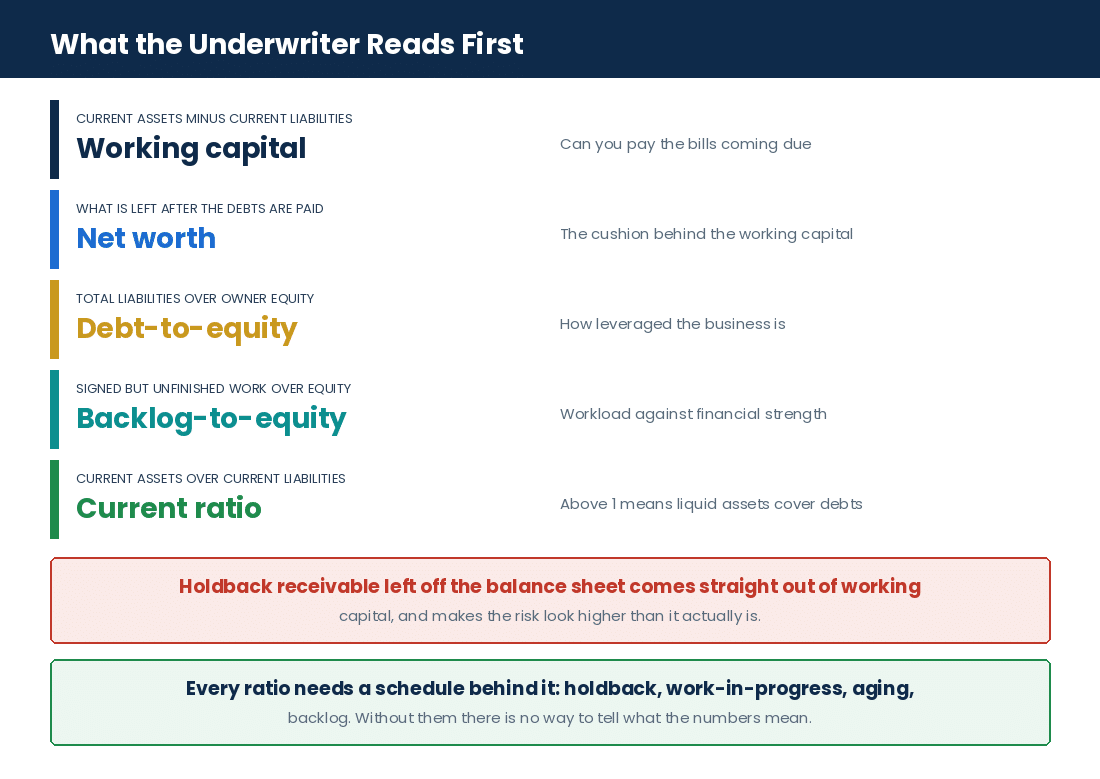
A bond line turns on four numbers and the schedules behind them. Working capital — current assets less current liabilities — is the figure underwriters look at first. Net worth is the cushion behind it. The debt-to-equity ratio says how leveraged the business is, and the backlog-to-equity ratio says whether the work already signed is proportionate to the balance sheet carrying it. What makes those numbers credible is the detail underneath: a holdback schedule, a work-in-progress schedule reconciling costs incurred against billings, receivable and payable aging, and a backlog report. The engagement itself is a compilation under CSRS 4200 — no assurance, a stated basis of accounting, and a restricted use notice naming the surety as the known third-party user. Ask the surety which level they need in writing before the work starts, because a compiled report cannot be converted into an audited one afterwards.
Reading time: 26 minutes.
Table of Contents
- Importance of Financial Statements for Surety Bonds
- Components of the Financial Statements
- Types of CPA Engagements
- What Surety Underwriters Evaluate
- Common Mistakes, Best Practices and Timing
- Regulatory and Filing Requirements
- How Gondaliya CPA Supports Contractors
- Checklist for Statement Preparation
- Frequently Asked Questions
- Businesses We Serve & Industry Spotlights
- Quick Reference and Glossary
The Numbers That Matter
This article covers Canada, with Ontario and Toronto context, and reflects rules current to 10 October 2026. It is written for small and mid-sized Canadian contractors seeking or renewing a surety bond line — general contractors, trades and specialty subcontractors — and for the financial statements a surety asks to see. It is not advice on bond pricing, underwriting decisions or the terms of any particular bond, which are matters for the surety and the broker. Gondaliya CPA performs compilation engagements under CSRS 4200, which provide no assurance; audit and review engagements are referred out. This is educational information only and not tax, legal or accounting advice.
Importance of Financial Statements for Surety Bonds
Importance of Financial Statements for Surety Bonds
Why It Matters
Financial statements matter a lot for small contractors who want surety bonds. These papers show how strong a contractor’s finances really are. Sureties look at these to decide if they can trust the contractor.
In Canada, financial statements for surety bond requests usually include things like balance sheets, income statements, and cash flow reports. They help show if a contractor can handle projects and risks well.
Contractors need to keep their contractor financial statements for bonding honest and up-to-date. That makes it easier to get bonded and keeps clients trusting their business.
Overview of Surety Bond Financial Statements in Canada
In Canada, surety bond financial statements give a clear picture of a contractor’s money matters. They list assets, debts, revenues, expenses, and how profits have changed over time.
A typical set includes:
- Balance Sheet: Lists what the company owns and owes.
- Income Statement: Details sales and costs.
- Cash Flow Statement: Tracks cash coming in and going out.
Often, these come with a CPA Compilation Report made just for surety bonding. This report follows CSRS 4200 rules so it fits Canadian standards and shows clear accounting methods.
Role of CPA Compilation Reports in Surety Bonding
A CPA Compilation Report is key when applying for surety bonds. It organizes your financial info without giving any guarantees—this matches CSRS 4200 rules for compilations in Canada.
This report does a few things:
- It puts balance sheets and income statements together.
- It explains how the data was gathered.
- It points out that there’s no audit or review behind it.
Contractors should know how this report fits into getting bonds or loans from sureties.
Construction Contractor Financial Statements for Bonding Requirements
When making construction contractor financial statements for bonding, some parts must be there:
- Holdback Receivable: Money kept until the job is done; shows how cash flow is managed.
- Progress Billings: Work done compared to payments received; shows project status.
These details help underwriters check the risk before giving bonds based on how contractors manage their money on projects.
Key Elements of Financial Statements for Surety Bond Approval
Getting surety approval means showing these main parts clearly:
| Balance Sheet Element | Description |
|---|---|
| Assets | Everything the company owns |
| Liabilities | Debts owed to others |
| Shareholder Equity | What’s left after paying debts |
| Income Statement Element | Description |
|---|---|
| Revenues | Total money earned |
| Expenses | Costs tied directly or indirectly |
| Profitability Trends | How profit changes over time |
Showing these well proves good financial control. Contractors who do this stand a better chance at getting their bonds approved by Canadian sureties involved with contracts around Ontario here at Gondaliya CPA!
A contractor sent a surety a one-page balance sheet printed from the bookkeeping software, with no report, no notes and no schedules.
The underwriter could not tell what basis of accounting had been used, whether the receivables included holdback, or whether anything had been looked at by an accountant at all. The numbers were not wrong. There was simply nothing to establish where they came from, and the file sat unanswered until a proper compilation was produced. Figures changed for privacy.
Understanding the Components of Financial Statements for Surety Bonds
Components of the Financial Statements
The Statements
Financial statements for surety bond use show a contractor’s financial health. In Canada, sureties check these to decide if they can issue a bond. These statements don’t guarantee a bond but are key in the process. Contractor financial statements for bonding need careful preparation following standard rules.
Balance Sheet: Assets, Liabilities, and Shareholders’ Equity
The balance sheet lists assets, liabilities, and shareholders’ equity on a certain date. It helps check working capital, which is current assets minus current liabilities. This tells if a contractor can cover short-term costs on projects.
- Working Capital means cash or resources to pay bills soon.
- Net Worth (Shareholders’ Equity) shows what’s left after debts are paid.
- Debt-to-Equity Ratio compares total debt to equity; high numbers mean more risk.
Surety bond financial statements Canada require clear details with documents like bank records, loan papers, receivable reports, and equipment lists.
Income Statement: Revenue, Expenses, and Profitability Trends
The income statement shows money earned and spent over time. For bonding:
- Progress Billings are invoices sent for work done but not yet paid.
- Contractors must report revenue using methods allowed by CRA — either as work finishes or based on percentage done.
Profit trends give sureties a peek at how well the business runs. But compiled financials don’t check earnings beyond what management says.
Notes to the Financial Statement and Basis of Presentation
Notes explain the rules used to make the financial statements. The basis of accounting (often cash or modified cash) is spelled out clearly per CSRS 4200 standards. This note shows no guarantee is made about accuracy.
It’s good to keep the same method each year so numbers can be compared easily. Any changes have to be shared clearly. ASPE guidelines help set the right format when needed.
A contractor switched from cash basis to accrual between one bond renewal and the next, without saying so in the notes.
Revenue jumped, receivables appeared on the balance sheet for the first time, and from the underwriter’s side the business looked like it had transformed in twelve months. Nothing had changed except the method. A single sentence in the basis of accounting note would have explained the whole thing. Figures changed for privacy.
CRA Business Records Retention Guide · Income Tax Act S248(1) Definitions · CRA Construction Contract Income Guidance · CPA Canada CSRS 4200 Compilation Engagement Standard (2026 Update) · ASPE Section 1500 – Presentation Standards
Types of CPA Engagements for Surety Bond Financial Statements
Types of CPA Engagements
Which Level
Contractors get different CPA services based on what sureties want. Each type changes what’s checked and how much trust the report gets.
Compilation Engagement and Its Scope
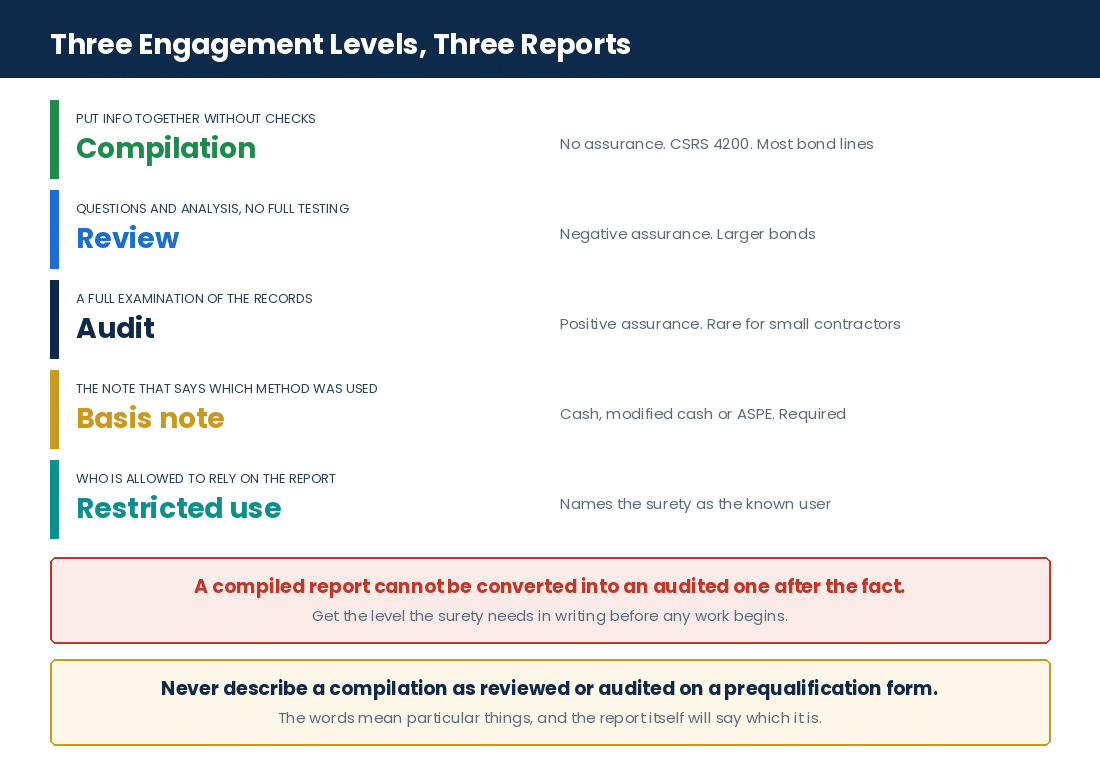
A CPA Compilation Report for surety bonding puts together financial info without checking it thoroughly. The engagement letter explains what’s done:
- The CPA collects info from management.
- No deep review or audit happens here.
The report says right away “no assurance” is given, matching CSRS 4200 rules updated for 2026 that call for clear notes about users like sureties.
Review Engagement vs. Audit Level Requirements
Review uses some checks like questions and analysis but no full testing; audits dig much deeper. For bond lines:
| Level | Description | Assurance Provided |
|---|---|---|
| Compilation | Put info together without checks | No Assurance |
| Review | Limited checks | Negative Assurance |
| Audit | Full exam | Positive Assurance |
Sureties say what they need before work starts because you can’t turn compiled reports into audited ones after they’re done.
Pro Tip: Get written confirmation from your surety on what level of compilation report they need before starting. It avoids redoing work if they want more assurance later.
Notice to Reader and Its Implications for Bonding
Notice to Reader reports mean compilation with no opinion on trustworthiness. Contractors should not call these audited or reviewed since that would be wrong.
“No assurance” means these rely mostly on what management says without outside proof—important when sending contractor bonding financial statements Canada-wide.
A contractor told a general contractor’s prequalification team that its statements were “reviewed by our accountant.”
They were a compilation. The prequalification form asked specifically for the engagement level, the answer given was wrong, and when the actual report arrived carrying a no-assurance statement the submission had to be withdrawn and resubmitted. Nobody intended to mislead anyone. The words simply mean particular things. Figures changed for privacy.
Gondaliya CPA Service Overview – Compilation Reports · CSRS 4200 Sample Report Wording · CPA Canada Bulletin – Third Party User Acknowledgement (2026) · CPA Ontario Handbook – Review & Audit Differences · Surety Association Guidelines – Written Requirement Lock · Notice To Reader Definition – Canadian Accounting Standards Board · Gondaliya CPA Editorial Policy & Disclaimers
What Surety Underwriters Evaluate in Contractor Financial Statements
What Surety Underwriters Evaluate
The Ratios
Surety underwriters check contractor financial statements to see how risky a bond might be. These financial statements for surety bond purposes need to show a true and clear picture of the contractor’s money situation. In Canada, sureties trust surety bond financial statements Canada that follow rules like CSRS 4200 compilation engagements.
They look closely at balance sheets, income statements, and extra schedules that list assets, debts, equity, and cash flows. They want to make sure these numbers match real records like job cost ledgers and holdback schedules. If the numbers don’t line up, it can cause delays or make the contractor look risky.
Contractors applying for bonds should submit honest contractor financial statements for bonding. These usually don’t come with assurance but must clearly explain accounting methods and any limits in the compilation reports.
Critical Financial Ratios in Surety Bonding
Sureties use financial ratios from contractor statements to check credit risk. The key ratios they watch are:
- Debt-to-Equity Ratio: Shows how much debt is used compared to owner’s stake.
- Working Capital: Measures if current assets cover current debts.
- Net Worth (Equity): Tells what’s left after subtracting liabilities from assets.
These ratios help underwriters understand if a contractor can pay bills and keep running smoothly.
Working Capital and Its Impact on Bonding Capacity
Working capital tells if a contractor has enough money on hand to pay short-term bills. It’s a big deal when deciding bonding capacity. If working capital is positive, it means they can pay what they owe soon without problems.
For example, if a company has $500,000 in current assets and $300,000 in current debts, working capital is $200,000. That looks healthy for running projects. But negative working capital sets off alarms about cash flow issues that could slow down work or payments.
Having enough working capital gives sureties more confidence to issue bonds since it shows less chance of missed payments.
Net Worth (Equity) and Debt-to-Equity Ratio Explained
Net worth means the owner’s value left after all debts are paid off. It acts like a safety net against business risks. A bigger net worth usually means better chances of getting bonds because it shows strong financial backing.
The debt-to-equity ratio shows how much money comes from loans compared to owner’s funds:
Debt-to-Equity Ratio = Total Liabilities ÷ Owner’s Equity
A low ratio tells sureties the company isn’t over-leveraged. Too much debt can make them nervous about delays or losses.
For example:
| Total Liabilities | Owner’s Equity | Debt-to-Equity Ratio |
|---|---|---|
| $600,000 | $400,000 | 1.5 |
This means $1.50 of debt per dollar of equity—a moderate level but needs more review with other data like backlog before approval.
Backlog-to-Equity Ratio and Current Ratio Considerations
Backlog-to-equity ratio compares unfinished contracts with owner equity—it shows workload versus financial strength. A big backlog backed by strong equity can boost trust in future earnings and bonding limits.
Current ratio checks if short-term assets cover debts due soon:
Current Ratio = Current Assets ÷ Current Liabilities
A number above 1 means more liquid assets than obligations—this is good when looking at progress billings found in compiled statements used by sureties.
A contractor had healthy equity and a backlog roughly four times the size of it, won in a single good quarter.
The ratios that looked at the balance sheet alone were fine. The one that compared the signed work to the equity carrying it was not, and the underwriter’s concern was never solvency — it was whether the business could finance that much work in progress before the progress draws arrived. The backlog report is what surfaced the question early enough to stage the bids. Figures changed for privacy.
The Importance of Supporting Schedules in Bonding Analysis
Supporting schedules add details that help underwriters dig deeper into compiled financials. These include work-in-progress summaries and aging reports on receivables/payables—including holdback balances tied directly to the main statement figures required by CPA Compilation Reports for surety bonding purposes.
Showing these schedules improves clarity about estimates hidden inside core numbers. This matters because it affects when liabilities show up or when revenue gets counted—important under Canadian standards like ASPE applied here.
Work-in-Progress (WIP) Schedule Preparation and Presentation
A WIP schedule breaks down contract values not finished yet at the report date. It shows costs spent versus what has been billed so far—a key factor in revenue recognition following CRA rules for construction work.
Well-prepared WIP schedules match the “Work In Progress” account on the balance sheet so nothing is overstated or misleading an underwriter about profits or cash flow.
Accounts Receivable Aging and Accounts Payable Aging Reports
Aging reports sort unpaid invoices by how old they are—giving clues on how well money gets collected. This affects cash flow estimates which are vital when evaluating holdback receivables shown in compiled financials submitted across Canada’s construction market.
Accounts payable aging lists what bills must be paid soon ensuring expenses recorded reflect actual amounts owed—avoiding wrong income figures during underwriting reviews.
Backlog Report and Its Relevance to Underwriters
Backlog reports list contracts signed but not yet finished or billed fully; this shows future work pipeline visibility needed for earnings forecasts. Underwriters use this info along with ratios like backlog-to-equity already mentioned.
Accurate backlog details match progress billings disclosed elsewhere so revenues don’t get counted twice—keeping bond applications realistic according to CPA Compilation Engagement rules made for contractors with bonded jobs.
Common Mistakes in Financial Statements That Affect Bonding Capacity
Common Mistakes, Best Practices and Timing
Errors
Financial statements for surety bond purposes must be clear and complete. A big mistake is mixing up compiled statements with audited or reviewed ones. This causes confusion since compiled reports don’t offer the same level of assurance under CSRS 4200. Sureties often reject applications because of this.
Contractors sometimes leave out holdback receivables or record holdback payables too early as expenses. This messes up working capital numbers, which sureties watch closely. Progress billings also get wrongly recorded as earned revenue instead of liabilities until the work is done, which breaks Canadian ASPE rules.
Job cost details might be missing or not match income reported on T2 tax filings. This raises doubts during underwriting. Some subcontractor payments don’t show up in required contract payment information returns. That can lead to compliance problems, hurting bonding chances.
Also, many forget to include a basis of accounting note. Without it, the CPA Compilation Report lacks transparency about no assurance on the financials.
We saw a case where holdbacks were missing from compiled contractor financials sent for a bond application. That cut current assets by $75,000 (just an example), making the risk look higher. Figures are changed for privacy.
Best Practices for Preparing Contractor Financial Statements for Surety Bonds
If you prepare surety bond financial statements Canada-wide, make sure your CPA Compilation Report says clearly it’s a compilation under CSRS 4200. Add a basis of accounting note stating no assurance is provided.
Good contractor financial statements for bonding have detailed schedules backing key items like holdbacks receivable/payable and work-in-progress (WIP). Keeping separate job cost ledgers that reconcile monthly helps catch errors early.
Make sure subcontractor payments are properly recorded too, matching CRA’s contract payment info return rules. Hiring a licensed Ontario CPA firm experienced with construction and bonds helps meet filing deadlines like the T2 corporate tax deadline. They offer affordable compilation services suited for small contractors needing bond lines.
Timing and Presentation of Financial Statements for Bonding Applications
Getting a CPA Compilation Report ready on time improves your chances during bids. Plan your year-end close so you have at least four weeks before deadlines for cleanup, job cost checks, report prep including basis notes, and internal review.
Interim compiled statements can work if you agree upfront but must say clearly what period they cover and if anything big changed since last annual report. Label all amounts clearly if used internally or shown externally to follow CSRS 4200 rules.
Statements should match figures filed on T2 tax returns using GIFI codes. Any mismatch could trigger extra checks by CRA auditors or sureties.
A contractor called us nine days before a bid closed, needing a compilation for a year-end that had not been closed.
The job cost ledger had not been reconciled in five months, the holdback schedule did not exist, and three subcontractor accounts were unposted. We got it done, but the price of compressing four weeks into nine days is that nothing gets reviewed twice. The same work booked a month earlier costs the same and carries none of that risk. Figures changed for privacy.
Surety Bond Readiness Check
Five quick questions on where your bonding package stands. No fee shown.
Points to raise with us:
This is a general prompt, not tax or legal advice or a quote. Your position depends on your full facts. For a real review, please book a free consultation.
Regulatory and Filing Requirements Related to Surety Bond Financials in Canada
Regulatory and Filing Requirements
Compliance
Gondaliya CPA stresses following Canadian federal rules on contractor financial reporting tied to bonds. The T2 Corporate Tax Filing Deadline requires corporations to file within six months after fiscal year-end. Late filing delays documents needed for bond applications.
GST/HST on the package needs attention too—contractors must keep GST/HST remittance records current and payroll deductions correct for subcontractors under CRA rules. Slipping here risks penalties that hurt business standing during underwriting.
CRA’s Income Tax Act covers when holdbacks count as taxable income; Excise Tax Act controls GST/HST collection—all part of what contractors must know across provinces including Ontario.
GST/HST Filing and Payroll Remittance Documentation
Good contractor financial statements for bonding include payroll registers showing source deductions plus GST/HST filing summaries matching CRA deadlines. Handling subcontractors’ payroll right matters since worker classification changes taxes owed versus withheld as per contract payment info return rules.
Having proof that shows registration status under GST/HST adds trust when submitting these packages with compiled reports by licensed CPAs familiar with Canada’s construction sector specifics.
Equipment Classes, Disposals, and T2 Corporate Tax Filing Guidelines
Sureties check equipment class registers closely. They expect assets sorted by CRA classes like Class 8 (equipment), Class 10 (vehicles), Class 50 (computers). Tracking should show when assets started being used so depreciation matches fiscal years tied to compiled statements and tax filings via GIFI codes.
Disposals require noting proceeds against undepreciated costs causing recapture calculations recorded properly in both notes sections of reports and corporate tax returns filed on time according to deadlines. This avoids misstated asset values that could affect working capital seen by sureties during bond reviews.
GIFI Reconciliation and Contract Payment Information Return Details
Reconciling contractor financials using GIFI codes makes sure numbers match between compilation reports at Gondaliya CPA offices and official T2 tax filings required federally. Catching differences early stops problems that might lower how creditworthy sureties see applicants nationally.
Contractors paying subcontractors over $30K yearly must file contract payment information returns electronically every quarter with detailed disclosures included in their reports and filings. Matching these payments across both statutory forms and compilation schedules keeps compliance strong and builds confidence during surety reviews.
A contractor’s compiled revenue and the revenue on the T2 differed by a few thousand dollars, for a reason that turned out to be entirely innocent.
Nobody at the surety knew that. Two documents from the same business, covering the same year, showing different numbers, is the kind of thing an underwriter stops on. Reconciling through the GIFI codes before the package goes out costs an hour and removes the question before it is asked.
How Gondaliya CPA Supports Contractors with Surety Bond Financial Reporting
How Gondaliya CPA Supports Contractors
Our Work
Gondaliya CPA creates financial statements for surety bond needs that fit Canadian contractors. We make sure contractor financial statements for bonding follow surety bond financial statements Canada rules. This helps you submit clear and correct info.
We know what surety companies in Canada and Ontario want. Our reports match their expectations. We combine tax filing and bookkeeping knowledge to give contractors solid documents. These documents are key to getting the bond line you need.
Customized Financial Statement Preparation Aligned with Bonding Standards
We prepare CPA Compilation Reports for surety bonding by following CSRS 4200 standards closely. Each report has a basis of accounting note. It explains the method used, like ASPE or another accepted one, so numbers are clear.
This makes your contractor financial statements for bonding match surety needs in Canada exactly. The note shows how revenue is counted (such as using the completion method) and how holdbacks or progress billings are handled. That cuts down confusion during reviews.
By following CSRS 4200 rules, our reports show they do not provide assurance but still meet CPA Canada and CRA rules for construction company accounting in Canada.
Ensuring Restricted Use and Compliance in Compilation Engagement Reports
Our compilation reports clearly say they give no assurance, per CSRS 4200. They also include a restricted use notice. This limits who can see the report — usually just the surety asking for the bond.
We ask known third-party users to give written permission before seeing the report. This protects contractors and accountants from misuse or wrong interpretation of info outside its intended purpose.
This way, we stay within Income Tax Act rules about third-party use of non-assurance work in Canada, including Ontario. Controlled sharing keeps trust strong while meeting contract needs without pretending to audit or certify.
Steps to Improve Bonding Limits Through Accurate Financial Reporting
Showing accurate working capital matters a lot for bonding limits. Working capital means current assets minus current liabilities. Sureties look at this number to decide on bond amounts.
You also need to present equity or net worth clearly. Plus, keep detailed schedules of holdback receivables (money held but collectable) and payables (amounts owed). Up-to-date holdback records help show real cash flow during underwriting.
Contractors should focus on:
- Reconciling working capital items carefully
- Showing equity clearly with shareholder balances
- Tracking holdbacks according to contract terms
These steps lower risks from incomplete contractor financial statements for bonding. They might also help get bigger credit limits by showing your financial health better.
Practical Examples of Enhanced Bonding Capacity with Prepared Financials
Tracking progress billings right is key. It separates what you billed from what you earned based on contract stages. This avoids early revenue recognition that could mess up profits sureties check.
You must also follow subcontractor payments reporting rules. Filing Contract Payment Information Returns shows transparency about outflows affecting working capital important for bonding.
Keep an equipment class register too. It sorts assets by CRA-approved classes so depreciation claims under Capital Cost Allowance are accurate. This helps value assets on your balance sheet seen by underwriters checking risk linked to your resources.
These actions show how good contractor financials help meet tough standards when applying for new or higher surety bonds in Canada, including Ontario — where Gondaliya CPA works closely with clients.
A contractor’s bond line had not moved in three years, and the assumption was that the surety simply would not go higher.
What had actually happened was that the same incomplete package went in each year: no holdback schedule, no WIP, and working capital understated as a result. Once the schedules were built and the holdback receivable appeared where it belonged, the limit moved on the next renewal. Nothing about the business had changed. Figures changed for privacy.
CRA guidance on income timing about holdbacks · Revenue recognition rules: CPA Canada – ASPE Handbook · Federal filing details: Canada Revenue Agency – Contract Payment Information Return · CCA classes info: CRA – CCA Classes
If you need help preparing your financial statements for surety bond requests that meet surety bond financial statements Canada rules, contact Gondaliya CPA at info@gondaliyacpa.ca or call 647-212-9559 now. Our Ontario firm offers expert advice aimed at improving your contractor financial statements for bonding with care and accuracy.
Checklist for Contractor Financial Statement Preparation for Surety Bonds
Checklist for Statement Preparation
Work From This
Getting your financial statements ready for surety bonds means knowing what to gather. Contractors need clear contractor financial statements for bonding that show their financial health right now. A CPA Compilation Report for surety bonding puts these statements together, following CSRS 4200 standards. This meets Canadian accounting rules.
Here’s what you’ll want to have ready:
- Trial balance with all accounts tied to your construction work.
- Detailed job cost ledgers listing expenses by each project.
- Holdback receivable and payable schedules showing money held or owed per contract terms.
- Progress billing records that compare billings with actual work done.
- Subcontractor payment summaries matching payments reported to CRA.
- Payroll registers and remittance confirmations proving payroll deductions are current.
- Equipment asset registers detailing construction assets.
Each piece links directly to lines on the compiled financial statements. If data is missing or off, sureties see more risk in underwriting.
Summary of Key Financial Metrics and Documentation Needed for Bonding
Sureties look closely at these numbers when checking contractor financial statements Canada-wide:
| Metric | What It Means |
|---|---|
| Working Capital | Current assets minus current liabilities; shows cash available to pay bills |
| Net Worth | Owner’s total equity after debts |
| Debt-to-Equity Ratio | How much debt compared to owner’s equity |
| Holdback Receivable | Money clients owe you but hold back until milestones |
| Progress Billings | Revenue shown based on how much work is done, not just invoices |
References: CRA Business Income Guide – Current Assets & Liabilities · Income Tax Act Section 248(1) – Equity Definition · CPA Canada ASPE Handbook – Financial Ratios Guidance · Surety Association of Canada Standards (example) · CRA Construction Contract Income Rules
You’ll need bank statements, subcontractor contracts, payroll reports, and equipment lists to back these figures up. Having neat, accurate records helps avoid mismatches between your compiled reports and tax returns like the T2.
How Clean Financial Statements Facilitate Higher Bonding Limits
A solid compilation engagement report that follows CSRS 4200 gives a clear snapshot of your finances without audit guarantees. It helps sureties trust your bond line requests more.
Clear financials show:
- Enough working capital to keep projects running
- Proper treatment of holdbacks—no early income claims
- Consistent notes explaining accounting methods used
- Matching progress billings between books and tax reports
The report states it follows CSRS 4200 and has no audit or review assurance. That honesty clears up any confusion about how deep the check was while meeting CPA Canada rules.
Contractors with tidy books avoid slowdowns caused by extra questions or redo requests from sureties before bigger bonds get approved.
Invitation to Consult Gondaliya CPA for Surety Bond Financial Statement Services
Gondaliya CPA focuses on contractor financial statements made for surety bonding in Ontario and across Canada. Our licensed team crafts CPA Compilation Reports that tick all regulatory boxes and fit your bond line needs exactly.
We have over 1300 five-star Google reviews showing our professional and prompt service—including flat-fee pricing yearly. We combine tax filing know-how with deep experience in construction accounting for smooth submissions.
Call us early in your bidding cycle so we can help prepare your records, explain compilation reporting under CSRS 4200 (2026), check holdback schedules, align subcontractor reports, confirm GST/HST reconciliations, and deliver on time per CRA rules.
Contact Options for Professional CPA Support on Surety Bond Financials
Need help with contractor financial statements for bonding? Sharadkumar Gondaliya, CPA (Canada & USA), leads Gondaliya CPA—a licensed Ontario firm registered with CPA Ontario. We’ve worked over ten years with contractors across Toronto and other Canadian cities like Ottawa, Hamilton, Mississauga.
Reach us by phone at 647‑212‑9559 or email info@gondaliyacpa.ca during business hours. We respond within one business day. Plus, we offer a 30-Day Money Back Guarantee and match fees through the year—from bookkeeping right up to corporate tax filings linked to bonded projects.
Sharad Gondaliya, CPA (Canada & USA), has helped hundreds of Canadian business owners over 10+ years.
Frequently Asked Questions
Answers
What is a Compilation Engagement Fee (Annual) for surety bond financial statements?+
When is the T2 Corporate Tax Filing Deadline relevant to bonding packages?+
Compilation, Review or Audit: Which level does a bond line need?+
What does a Compilation Engagement Report say, and what does it not say?+
How does a surety using the statements change the engagement?+
What basis of accounting is used, and what does the note disclose?+
How are holdbacks and work in progress presented and reported?+
Do the statements and the T2 have to agree?+
What about subcontractors, payroll, and GST/HST on the package?+
Which equipment and fleet lines does a surety see?+
When are statements needed, and what happens at a bid deadline?+
File it yourself or hand it to a CPA firm: which route fits a contractor?+
What triggers a CRA review related to contractor financials?+
How do you catch up if the books are behind a bid?+
Best practices for a bond-ready contractor+
Contractor Statements: DIY vs CPA vs Non-CPA?+
How do we handle a bonding package at Gondaliya CPA?+
What deliverables do you get from Gondaliya CPA?+
How much does this cost for surety bond compilation services?+
Top reporting mistakes and how to prevent them+
What to prepare before the work starts (Checklist)+
- Trial balance tied to projects
- Holdback receivable/payable schedules
- Progress billing comparisons
- Subcontractor payment summaries
- Payroll registers plus GST/HST filings
- Equipment asset register sorted by classes
Which questions matter across 10 groups in bonding applications?+
A realistic walkthrough of compilation reporting at Gondaliya CPA+
How to choose a CPA firm in Ontario for surety bonds?+
Why trust Gondaliya CPA with your surety bond financials?+
Businesses We Serve & Industry Spotlights
Industry Expertise
Bonding reaches across the whole construction chain, and the questions a surety asks — what is the working capital, where are the holdbacks, and what work is already signed — land the same way whichever trade is answering them.
| Industry | The Bonding Angle |
|---|---|
| Construction project management firms | Progress billings and WIP across several jobs at once |
| HVAC contractors | Holdback on mechanical work released long after substantial completion |
| Plumbers | Subcontract payments and the contract payment information return |
| Electricians | Job cost ledgers that have to reconcile to the compiled statements |
| Concrete contractors | Equipment-heavy balance sheets and the class register behind them |
| Excavation companies | Fleet disposals, recapture and the effect on net worth |
| Demolition contractors | Short jobs, fast billing cycles and receivable aging |
| Fire protection contractors | Bonded institutional work with long holdback periods |
| Waterproofing contractors | Warranty obligations sitting behind the completed work |
| Construction equipment rental companies | Asset values carrying the whole balance sheet |
| Land surveying companies | Service revenue earned over a project rather than billed at once |
- Construction project management firms: Several contracts at different stages on one balance sheet, which is exactly what the work-in-progress schedule exists to make legible to an underwriter.
- HVAC contractors: Mechanical holdback is often released well after the building is occupied, so the holdback receivable can be a meaningful share of working capital for a long time.
- Plumbers: Where work is passed to other trades, the contract payment information return has to agree with the subcontractor payment summaries in the package.
- Electricians: Job costing is usually the strongest record in the business and the one least often reconciled to the financial statements that go to the surety.
- Concrete contractors: Plant and equipment dominate the balance sheet, so the class register and the available-for-use dates behind the depreciation carry real weight.
- Excavation companies: Machines are bought and sold constantly, and each disposal produces recapture or a terminal loss that moves net worth before the underwriter ever sees it.
- Demolition contractors: Short contracts and quick turnarounds make receivable aging the clearest signal of how well the business actually collects.
- Fire protection contractors: Institutional and public work is where bonding is most often mandatory, and where the holdback periods are longest.
- Waterproofing contractors: Long warranty exposure behind finished jobs, which is a liability question the notes to the statements should address rather than leave implied.
- Construction equipment rental companies: Asset values are the balance sheet, so the equipment register and the depreciation behind it decide the net worth a surety is lending against.
- Land surveying companies: Fee work delivered over the life of a project, which raises the same revenue-recognition question as a construction contract in a lighter form.
Whatever the trade, the package that gets a quick answer has the same four things: a holdback schedule, a work-in-progress schedule, receivable aging and a backlog report.
The package that sits in a queue has a balance sheet and nothing behind it. The underwriter is not being difficult — without the schedules there is no way to tell whether the working capital figure means what it appears to mean. Figures changed for privacy.
Quick Reference and Glossary
Reference
Essential Points for a Bond-Ready Contractor Package
Bond applications stall in a predictable set of ways: holdback receivable left off the balance sheet so working capital reads low, holdback payable booked as an expense before it is owed, progress billings recorded as earned revenue before the work is done, no basis of accounting note so nobody can tell what method was used, a compilation described as a review, job cost ledgers that do not reconcile to the compiled statements, revenue that does not agree with the T2 through the GIFI codes, and subcontractor payments missing from the contract payment information return. Gondaliya CPA prepares bond-ready compilation packages on a flat annual fee.
Quick Answers
At a Glance
- Engagement standard: CSRS 4200, a compilation engagement
- Assurance given: none — a review gives negative assurance, an audit positive
- Working capital: current assets minus current liabilities
- Current ratio: current assets divided by current liabilities; above 1 is the baseline
- Debt-to-equity: total liabilities divided by owner’s equity
- Net worth: what is left after subtracting liabilities from assets
- Backlog-to-equity: signed but unfinished contracts against owner equity
- Basis of accounting note: required, and states that no assurance is provided
- Restricted use notice: names the surety as the known third-party user
- Schedules expected: holdback, work-in-progress, AR and AP aging, backlog
- T2 filing: six months after fiscal year-end
- GIFI reconciliation: compiled figures should agree with the T2
- Equipment classes: Class 8 equipment, Class 10 vehicles, Class 50 computers
- Contract payment information return: subcontractor payments over $30K yearly
- Lead time: at least four weeks before the bid deadline
- Level confirmation: get it from the surety in writing before work starts
Who This Is For / Not For
Fit Check
- For: small and mid-sized Canadian contractors seeking or renewing a surety bond line — general contractors, trades and specialty subcontractors.
- For: contractors being prequalified by a general contractor or an owner who has asked to see financial statements.
- Not for: advice on bond pricing, bonding capacity or underwriting decisions, which are matters for the surety and the broker.
- Not for: contractors whose surety has asked for a review or an audit — Gondaliya CPA performs compilations under CSRS 4200 and refers those engagements out.
People Also Ask
Related Questions
Will a compilation be enough, or will the surety want an audit?+
Most sureties require compilation reports, as they balance cost and detail. Reviews or audits are rare and tend to be requested only for larger bonds or higher-risk files. Get the answer in writing before the work starts, because a compiled report cannot be converted into an audited one afterwards.
Why does leaving holdback off the statements matter so much?+
Because it comes straight out of working capital, which is the number the underwriter reads first. Holdback receivable is money clients owe you but hold back until milestones; leaving it out understates current assets and makes the risk look higher than it is. It belongs on the balance sheet with a schedule behind it.
Can we send the same statements to the bank and the bonding company?+
Not automatically. A compilation report for bonding carries a restricted use notice limiting who may rely on it, usually to the surety asking for the bond, and known third-party users are asked to give written acknowledgement first. Tell your CPA every party who will see the statements before the report is issued.
How far ahead of a bid should we start?+
At least four weeks. That covers the year-end cleanup, the job cost checks, preparing the report including the basis of accounting note, and an internal review before it goes out. Starting later is possible but removes the second look, which is where errors are normally caught.
What if our books are behind and a bid is already open?+
Start compiling interim statements immediately and reconcile the key schedules first — holdbacks and subcontractor payments before anything else. Interim compiled statements can work if agreed upfront, provided they state clearly what period they cover and whether anything significant has changed since the last annual report.
Glossary of Key Terms for Surety Bond Financials
Definitions
- Compilation engagement: a CPA puts financial information together from management’s records without verifying it, under CSRS 4200, and the report states that no assurance is provided.
- Notice to Reader: the older name for a compilation report, meaning no opinion is given on trustworthiness.
- Basis of accounting note: the note that states which method was used — cash, modified cash or ASPE — so the figures can be read correctly.
- Restricted use notice: the statement limiting who may use the report, usually to the surety requesting the bond.
- Working capital: current assets minus current liabilities; the first figure a surety underwriter looks at.
- Holdback receivable: money a client keeps back until milestones are met, collectable by the contractor.
- Holdback payable: amounts the contractor keeps back from its own subcontractors, owed when their work is accepted.
- Progress billings: invoices issued for work done, compared against what has actually been earned at the contract stage.
- Work-in-progress schedule: the breakdown of unfinished contract values, showing costs incurred against amounts billed.
- Backlog: contracts signed but not yet finished or fully billed, which indicates the future work pipeline.
Want a checklist to work from? You can download our free surety bond compilation checklist before your consultation.
A bond-ready package is a short list, and almost every stalled application is missing something on it. A compilation report under CSRS 4200, saying plainly that no assurance is provided, with a basis of accounting note and a restricted use notice naming the surety. Holdback receivable and payable on the balance sheet with a schedule behind each. A work-in-progress schedule reconciling costs incurred against amounts billed, tying to the work-in-progress account. Receivable and payable aging, and a backlog report that agrees with the progress billings disclosed elsewhere so nothing is counted twice. Job cost ledgers that reconcile monthly and figures that agree with the T2 through the GIFI codes. Confirm the engagement level with the surety in writing before the work starts, and give yourself four weeks ahead of the bid. Everything on that list is a document, not a judgment call.
Four things tell us how long your bonding package will take. First, when was the job cost ledger last reconciled? If the answer is more than a month ago, that is the work. Second, does a holdback schedule exist, receivable and payable, by contract? If not, it is usually the single largest omission in the file. Third, do the compiled figures agree with the last T2 through the GIFI codes? A mismatch is the question an underwriter stops on. Fourth, has the surety confirmed the engagement level in writing? Compilation, review and audit are three different pieces of work and you cannot upgrade one into another after the fact. Answer those four and the rest is production.
Surety Bond Financial Statements Canada: How Gondaliya CPA Can Help
Start with your trial balance, your job cost ledger and one signed contract
Gondaliya CPA prepares the compilation report under CSRS 4200 with the basis of accounting note and the restricted use notice the surety needs, builds the holdback receivable and payable schedules by contract, prepares the work-in-progress schedule reconciling costs incurred against amounts billed, produces receivable and payable aging and a backlog report that agrees with the progress billings, reconciles the compiled figures to the T2 through the GIFI codes, checks the subcontractor payments against the contract payment information return, and confirms the equipment class register supports the capital cost allowance claimed — on a flat annual fee including HST with a one-business-day response. Please book a free consultation.
Next Steps
Please book a free consultation with Gondaliya CPA and bring four things: your trial balance, your job cost ledger, one signed contract showing the holdback terms, and whatever the surety has told you in writing about the engagement level they need. Those four settle the working capital figure, the holdback schedules and the scope of the report — which between them account for nearly every delay we see on a bonding package. If a bid is already open, say so at the outset, because interim compiled statements are available and the order the work is done in changes when the deadline is close. You will get a flat annual fee including HST before any work begins. We serve Toronto, Ottawa, Hamilton, Mississauga, Vaughan, Brampton, Etobicoke, Scarborough and the rest of Ontario, and work with contractors across Canada. If our content helps, please add gondaliyacpa.ca as a preferred source on Google.
Published: · Last updated:
Editorial policy: We research against CRA, Department of Finance, Parliament of Canada, CPA Canada and CPA Ontario sources, fact-check the figures, and Sharad Gondaliya, CPA, reviews the content, which we update as the rules change.
Disclaimer: This article is educational information only and is not tax, legal, financial, accounting or underwriting advice. It describes the financial statements and supporting schedules a Canadian surety commonly asks a contractor to provide, and the nature of a compilation engagement performed under CSRS 4200, which provides no assurance. It is not advice on bond pricing, bonding capacity, underwriting decisions or the terms of any particular bond, all of which are matters for the surety and the broker, and no bond outcome is promised or implied. Surety requirements differ between sureties, between provinces and between projects, and the engagement level a given surety will accept must be confirmed with that surety in writing before work begins. Gondaliya CPA performs compilation engagements under CSRS 4200 and does not perform audit or review engagements. Please consult a licensed CPA before acting.

Sharad Gondaliya is a CPA Canada & CPA USA with 15 Years+ experience of Accounting, Tax, Payroll of Corporate Small Businesses as Tax Accountant. He is a CPA Ontario member (61040184) and holds US CPA licences in Washington and Montana and is well known among corporate small businesses for tax planning, efficient tax solutions, and affordable CPA services. Sharad is the Principal (Director) of Gondaliya CPA – Affordable CPA Firm in Canada. Licenses: CPA Ontario: 61040184 | CPA USA (MT): PAC-CPAP-LIC-033176 | CPA USA (WA): 57629 | CPA Firm License: 61330051 View Full Author Bio