



Digital Nomad Tax Residency in Canada: When You Must Pay Canadian Income Tax
Digital Nomad Tax Residency Canada Explained: A Guide to Digital Nomad Canadian Taxes and Income Tax by Gondaliya CPA
Digital nomad tax residency Canada determines how your income is taxed based on where you reside while working remotely, impacting your digital nomad Canadian taxes. Gondaliya CPA offers clear advice on digital nomad income tax Canada laws, helping you understand your tax obligations and optimize your tax position.
Quick Summary
Everything turns on one question, and it is not where you are. Residency is decided by residential ties — a home kept in Canada, a spouse or dependants here, bank accounts, a car, provincial health coverage — so working from Lisbon for a year changes nothing if the house in Ontario is still yours. Get that answer and the rest follows: a resident reports worldwide income on a T1 by April 30, files T1135 once foreign property passes CAD 100,000, and claims foreign tax credits on Form T2209 rather than an exemption. A deemed resident is someone without those ties who still sojourns past 183 days. A non-resident reports only Canadian-source income. And leaving properly is its own event: a departure date you can prove, a part-year return, and deemed disposition under 128.1(4) treating your capital property as sold on the way out.
Reading time: 13 minutes.
Table of Contents
- Understanding Digital Nomad Tax Residency
- Residence-Based Taxation and the Three Types
- Income Reporting and Tax Obligations
- GST/HST, Foreign Credits and Departure
- Tax Planning, Compliance and Examples
- Common Concerns and Pro Tips
- Frequently Asked Questions
- Essential Tax Points for Digital Nomads
- Businesses We Serve & Industry Spotlights
- Professional Guidance and Quick Reference
The Numbers That Matter
This article covers Canadian federal income tax and GST/HST, with Ontario and Toronto context, and reflects rules current to 15 October 2026. It is written for remote workers and self-employed digital nomads with a Canadian connection, and it covers residency determination, worldwide income reporting, foreign property disclosure, foreign tax credits, GST/HST registration and departure. It is not advice on immigration status, visas or work authorisation in any country, nor on the tax rules of the country you are working from. Gondaliya CPA performs compilation engagements under CSRS 4200, which provide no assurance; audit and review engagements are referred out. This is educational information only and not tax or legal advice.
Understanding Digital Nomad Tax Residency in Canada
Understanding Digital Nomad Tax Residency
The Core Question
What Is a Digital Nomad and How Does Taxation Apply?
A digital nomad is someone who works remotely using technology while traveling or living in different places. They earn money from anywhere, which can make their tax situation tricky. In Canada, tax rules depend mostly on your residency status, not just where you work.
If you keep strong ties to Canada—like owning a home or having family there—the Canada Revenue Agency (CRA) might still see you as a resident. That means you could owe taxes on all your income, even what you make abroad.
On the other hand, if the CRA considers you a non-resident, only income earned in Canada gets taxed. So if you’re a remote worker across Ontario and other parts of Canada, knowing your residency status matters a lot when figuring out taxes.
Digital Nomad Tax Residency Canada: Definitions and Key Concepts
Here are some important ideas to understand about digital nomad tax residency in Canada:
- Tax Residency: The CRA decides if you’re a resident based on your residential ties—not just where you physically stay.
- Significant Residential Ties: This includes things like owning a home in Canada, having close family living here, or personal stuff like Canadian bank accounts or cars.
- Non-Resident Status: You can become a non-resident by cutting most of your ties to Canada. But you still need to follow reporting rules when making this change.
Under Canadian tax law, residents must report all income worldwide—including what they earn abroad. Non-residents only report certain Canadian-source income, like rental money from property in Canada.
The term “digital nomad tax residency” means understanding these points well. Getting it wrong could lead to penalties or extra taxes from the CRA because of unpaid amounts.
The single most common misreading we see is that leaving the country ends the obligation.
It does not, and nothing automatically tells you so. There is no letter, no checkpoint, no moment where the system notices. People work abroad for two or three years, file nothing, and discover the position only when something forces the question — a property sale, a mortgage application, a CRA letter. By then the unfiled years have interest running on them. Figures changed for privacy.
Difference Between Tax Residence and Immigration Status
Tax residence and immigration status are two different things—they don’t mean the same.
- Tax Residence looks at how the government taxes you based on your connections and income activities.
- Immigration Status refers to legal permission (like visas) that let you enter or work in another country.
People often think getting a visa somewhere else changes their Canadian tax status. But that’s not true. The CRA follows its own rules for tax residency regardless of visas.
Knowing this difference helps keep things clear and prevents problems with either immigration authorities or tax officials when working internationally.
Residence-Based Taxation and Self-Assessment in Canada
Residence-Based Taxation and the Three Types
Which One Are You
Canada taxes people mainly based on where they live. If you count as a resident for tax reasons, you have to report all your income to the Canada Revenue Agency (CRA). It doesn’t matter if you earned it outside Canada. So, if you’re a digital nomad working from abroad but still considered a Canadian resident, you still owe taxes here.
Filing taxes in Canada works on self-assessment. You must honestly declare your income, deductions, credits, and residency status on your yearly T1 return. The CRA trusts you to report correctly but can check or audit if something looks off.
For digital nomads, knowing how digital nomad income tax Canada rules apply is key. Even if you earn money abroad, Canadian law might tax it. Forgetting to tell CRA about foreign earnings can cause penalties or extra charges.
Here’s the gist:
- Residents report all their worldwide income; non-residents only report income from Canadian sources.
- You must keep good records of your foreign earnings and documents.
- Paying foreign tax may give you credits but doesn’t free you from reporting.
CRA – Residency Status · Income Tax Act R.S.C., 1985, c. 1 (5th Supp.), s 150(1) · CRA – Foreign Tax Credit
Importance of Determining Canadian Tax Residency Status
Figuring out your digital nomad tax residency Canada status matters a lot. It decides which income the CRA can tax and what forms you need to file. If you think you’re not a resident but still have big ties here, CRA can come after you with back taxes and penalties.
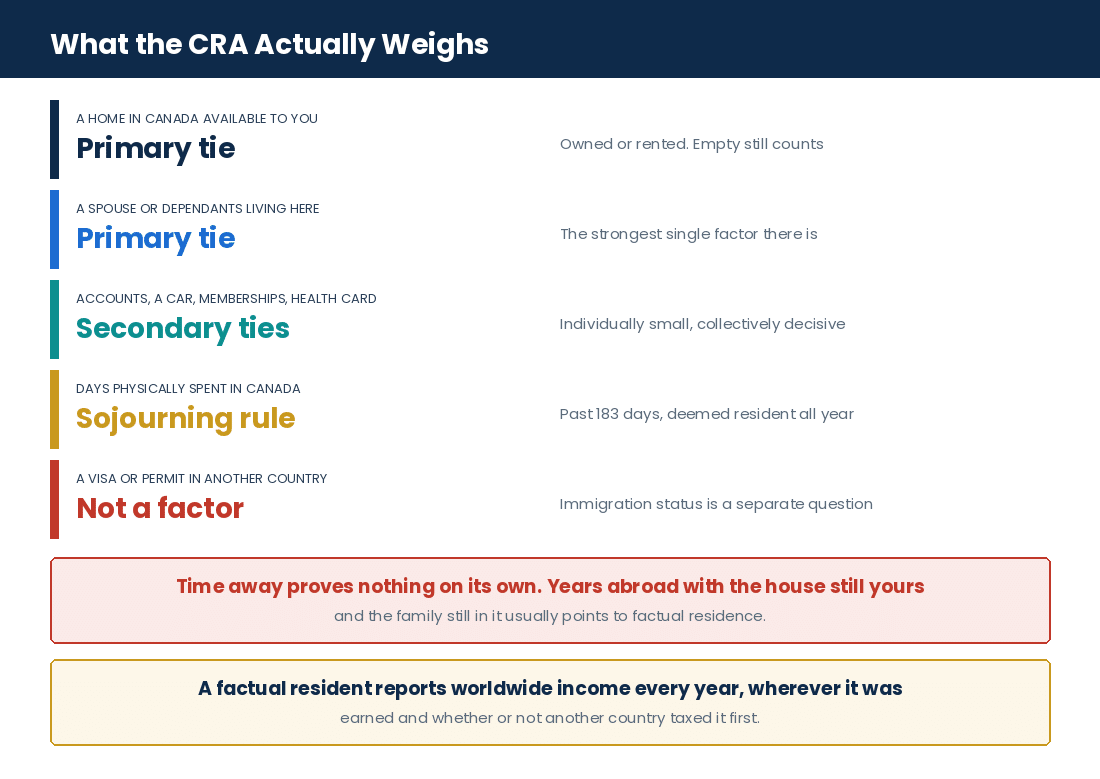
Canadian tax residency depends mostly on residential ties—not just where you stay physically. Primary ties include owning or renting a home in Canada or having close family here. Secondary ties are things like bank accounts or memberships.
Your category—factual resident, deemed resident, or non-resident—affects how and when you file your returns.
Why care?
- Residency decides if CRA taxes worldwide income or just Canadian-sourced money.
- Different residents have different filing deadlines; missing them costs money.
- Correct status helps claim treaty benefits if you have dual residency.
CRA – Residential Ties · Income Tax Act s 2(1); s 250(1) defines resident types · CRA Guide RC4110 – Non‑Residents & Deemed Residents · OECD Model Treaty Article 4 – Residence
Types of Canadian Tax Residency: Factual Resident, Deemed Resident, Non-Resident
Canadian law has three main types of tax residency that affect digital nomad Canadian taxes:
Factual Resident
You’re a factual resident if you keep strong ties in Canada while living abroad temporarily. For example, if you keep a house open year-round in Ontario where your family stays but work remotely overseas sometimes.
Factual residents file full returns showing all income worldwide — including foreign earnings unless a treaty says otherwise.
Deemed Resident
Deemed residents don’t have big residential ties but spend enough days physically inside Canada during the year to qualify under sojourning rules. They pay taxes like factual residents on all worldwide income for that year even without owning property here at year-end.
This usually covers visitors who stay past day limits but don’t set up permanent homes yet owe full reporting.
Non‑Resident
Non-residents lack strong residential ties and don’t meet sojourning day counts. They only pay taxes on some kinds of Canadian-source incomes — like rent from Ontario properties or jobs done inside the province.
Non-resident filers use special forms showing limited filing duties compared to residents.
| Type | What It Means | What You Report |
|---|---|---|
| Factual Resident | Strong residential ties with Canada | Worldwide income every year |
| Deemed Resident | No strong ties but meet day-count rule | Worldwide income for whole year |
| Non‑Resident | No ties and below day threshold | Only certain Canadian-source incomes |
Most people who ask us about this expect to be told they are non-resident. Most are not.
The category is not chosen, and it is rarely close. Where a home sits empty and available, where a spouse or children remain, where the health card is still active, the factual resident answer arrives quickly and the worldwide reporting comes with it. The useful work is not arguing the status — it is deciding whether to change the facts behind it, and when. Figures changed for privacy.
Income Tax Act ss 2(1), (3), (250)(1); CRA guides RC4110; OECD Model Treaty Art 4 · See Income Tax Act s 250(1). · Defined under ITA s128.1(4). · See CRA Sojourner guidance. · Per ITA ss114–115 on withholding & filing rules for non-residents with Canadian property/income sources inside Ontario and across Canada.
Income Reporting and Tax Obligations for Digital Nomads
Income Reporting and Tax Obligations
What You File
If you’re a digital nomad with Canadian tax residency, you have to report all your income worldwide to the Canada Revenue Agency (CRA). It does not matter where you earned or got the money. Knowing what to report helps you follow Canadian tax laws and avoid fines.
Worldwide Income and Canadian Tax Obligations for Digital Nomads
In Canada, residents—including digital nomads—pay taxes on income from everywhere in the world. This is set by section 3 of the Income Tax Act. You must report all types of income on your T1 personal tax return. This includes money from jobs, freelance work, investments, or rentals. The CRA wants to see any foreign income and taxes you already paid abroad.
For instance, if you work remotely outside Canada but keep strong ties here, you must report every contract payment as taxable income in Canada. Not doing so could cause penalties or reassessments.
Also, if you own foreign property over certain limits, you have to fill out Form T1135 yearly. This form shows specific assets like overseas bank accounts or stocks while you are still a resident.
Your “digital nomad tax residency Canada” depends on your residential ties, not just how many days you spend in the country. Even if you stay abroad long, if you keep big connections with Ontario or another place in Canada, you must file.
Tax Filing Requirements and Reporting Deadlines
Canadian residents who are digital nomads must file a T1 return every year by April 30 for the previous calendar year. You must report all global income earned during that time. If you are self-employed, the deadline to file extends to June 15 but any tax owed is still due by April 30.
Late filings bring penalties starting at 5% of what’s unpaid plus more charges for each month late—up to one year. Keeping good records helps get your return done on time and lowers audit chances.
If your residency status changes during the year because you leave Canada, you need to file a part-year resident return. That covers only when you were actually a resident. So having proof of your departure date is key for filing correctly.
If your net tax owing goes over $3,000 in two years straight, instalment payments may be required. Many digital nomads who do consulting or freelance jobs overseas might fall into this.
Essential Documents for Filing as a Digital Nomad
- Income slips like T4s (employment), T5013s (partnership), and NR slips if they apply.
- Statements of foreign income such as contracts and invoices showing what you earned abroad.
- Bank statements from both Canadian and foreign banks that prove your declared funds.
- Form T1135 if your foreign assets go above threshold amounts.
- Receipts for business or self-employment expenses, including home office costs while working remotely.
- Proof of residential ties, like leases or utility bills showing ongoing links with Ontario or other parts of Canada.
It’s best to keep these records organized because CRA wants them kept for six years after filing deadlines.
Income Tax Act RSC 1985 c 1 (5th Supp) s 3 · CRA Guide RC4110 – Residency Status · CRA Form T1135 Instructions · CRA Interpretation Bulletin IT-221R – Residential ties · CRA Individual Filing Deadline Information · Ibid., Self-employed Individuals’ Deadlines · CRA Penalties & Interest Overview · ITA s128.1(4) – Part-Year Resident Returns · CRA Instalment Payment Rules · CRA Record Keeping Requirements
If you’re remote working across Canada—especially Ontario—and want advice on digital nomad tax Canada matters, Gondaliya CPA offers text-only consultation. Reach out at info@gondaliyacpa.ca or call 647‑212‑9559 for help with your filings and questions about digital nomad Canadian taxes.
Digital Nomad Residency Check
Five quick questions on where your residency stands. No fee shown.
Points to raise with us:
This is a general prompt, not tax or legal advice or a quote. Your position depends on your full facts. For a real review, please book a free consultation.
GST/HST, Foreign Tax Credits, and Departure from Canada
GST/HST, Foreign Credits and Departure
The Mechanics
GST/HST Registration Requirements for Self-Employed and Remote Workers
If you’re a self-employed digital nomad working remotely outside Canada, you should know about GST/HST registration. The law says you need to register if you “carry on business” in Canada, even if you’re not physically there.
The CRA uses a broad meaning for “carrying on business.” It covers self-employment inside or outside Canada if you have Canadian clients or operations. For example, if you provide services to Canadian customers and make over $30,000 in four consecutive calendar quarters, you have to register for GST/HST.
Here’s when registration applies:
- You supply taxable goods or services in Canada.
- You have a permanent establishment or home office in Canada.
- You get payments from Canadian clients linked to your services.
After registering, you must charge GST/HST at the rate based on where your service is supplied. If you skip registering when required, penalties and interest can apply.
Say you’re a freelance consultant living abroad. You offer marketing services only to Toronto companies. Over a year, your invoices total $45,000 CAD. Even though you work overseas, this income means mandatory GST/HST registration because your clients are in Ontario. You must file returns quarterly and pay the tax collected.
| Item | Requirement | Source |
|---|---|---|
| Threshold | $30,000 CAD revenue | CRA Guide RC4022 |
| Registration Obligation | If carrying on business in Canada | Income Tax Act s. 123 |
| Applicable Tax Rate | Based on province of supply | CRA Notice GI-131 |
| Filing Frequency | Annual or quarterly | CRA Publication RC4022 |
Sources: CRA – Carrying On Business · GST/HST Small Supplier Threshold · Place of Supply Rules
Foreign Tax Credits and Double Taxation Considerations
If you live in Canada as a digital nomad for tax purposes, you report all income worldwide. But sometimes other countries tax the same income too. That can lead to double taxation.
Canada’s Income Tax Act offers foreign tax credits (FTCs). They help reduce taxes when you pay foreign taxes but keep digital nomad tax residency in Canada.
Canadian residents can claim FTCs against their federal taxes for eligible foreign taxes paid during the year. The credit can’t be more than the Canadian tax owed on that foreign income. So no refunds happen beyond what’s owed domestically.
Key things about FTCs:
- Only real non-refundable foreign income taxes count.
- Keep good proof showing what you paid.
- Calculations happen per country; treaties affect eligibility.
Tax treaties often decide which country claims residency. But getting FTCs still needs proper filing.
Imagine a software developer with digital nomad tax residency who earns $80,000 USD from a U.S. client taxed at 15%. They report that money worldwide but claim an FTC up to what they’d owe federally in Canada—cutting double tax risks.
| Aspect | Description |
|---|---|
| Eligible Taxes | Non-refundable foreign personal/federal/provincial taxes |
| Maximum Credit Limit | Lesser of actual foreign tax or equivalent Canadian tax |
| Documentation Needed | Receipts/statements showing payment details |
Sources: Income Tax Act sections 126(1), CRA Foreign Tax Credit guide T4058
Deemed Disposition and Reacquisition of Assets on Arrival or Departure
When digital nomads start or stop being Canadian residents for tax reasons, there are deemed disposition rules under section 128.1(1) of the Income Tax Act. Basically, some assets are treated as if sold just before leaving or arriving—even if no real sale happens.
This mainly hits when leaving Canada. Your capital property is considered sold at fair market value then “re-bought” on return unless you elect to defer. Stocks and bonds are included but your main home might be exempt.
Not following these rules risks reassessment and interest if CRA finds issues during audits involving digital nomads.
Things to watch out for:
- Keep good records proving fair market value.
- You can choose deferral under subsection 128.1(4), but need security with CRA.
Example: A graphic designer leaves Hamilton owning shares worth $150,000 CAD with an original cost of $100,000 CAD before March 31 departure date.
They must report a deemed gain of $50K unless they file to defer it properly with their departure return. Nothing was sold and no money changed hands, which is precisely why it is the item most often missed. Figures changed for privacy.
| Property Type | Included | Excluded |
|---|---|---|
| Capital Properties | Stocks, bonds, investments | Principal residence* |
| Registered Plans | No | No |
*Subject to case-by-case review per CRA guidance
Sources: ITA ss128.1(1),(4); CRA Departure Return Guide T4055
Tax Planning, Compliance, and Practical Examples
Tax Planning, Compliance and Examples
In Practice
Determining Your Tax Residency: CRA Guidelines and Key Factors
Figuring out your tax residency in Canada matters a lot for digital nomad Canadian taxes. The CRA looks mainly at your residential ties—not just where you physically are. Big ties mean things like owning a home in Canada, having a spouse or kids living here, or personal stuff like cars or bank accounts. Smaller ties could be memberships in Canadian clubs or organizations.
The CRA says leaving Canada for a while doesn’t mean you stop being a tax resident if those big ties stay. Also, if you spend enough days in Canada during the year, the sojourning rule might count you as a resident for the whole year.
Here are some key points about digital nomad tax residency Canada:
- Main Residential Ties: Owning or renting a place here; family living permanently in Canada.
- Secondary Ties: Personal belongings, social club memberships, provincial health insurance.
- Sojourning Rule: Staying past a certain day count can make you deemed resident.
- Departure Date Proof: Knowing when you left affects your tax filing and possible departure tax.
These rules help decide if you must report all your worldwide income to the CRA under digital nomad Canadian taxes rules. For instance, if you work remotely from abroad but keep your Ontario home and family, you likely stay a resident until those ties end properly.
| Tie Type | Importance | Proof Examples |
|---|---|---|
| Home Ownership | Major | Property deed or lease papers |
| Spouse/Dependants | Major | Family documents showing they live with you |
| Bank Accounts | Minor | Statements from Canadian banks |
| Health Coverage | Minor | Active provincial health card |
Sources: CRA – Residency Status, Income Tax Act s.250(1)
Examples Illustrating Tax Scenarios for Digital Nomads
Digital nomads face different tax situations depending on their residency and income type.
Example 1: Resident Working Abroad. A consultant based in Toronto works remotely while traveling but keeps her main home and family in Ontario all through 2026.
She must report all foreign employment income on her T1 return since she’s still considered a resident. Not reporting this can lead to penalties. Figures changed for privacy.
Example 2: Leaving Mid-Year With Property Left. Someone leaves Hamilton mid-year after selling most assets but still owns an investment property worth $600,000 CAD at departure.
They file a part-year return covering income up to that date plus reports on foreign holdings if above limits. This may trigger capital gains unless deferred by election. Figures changed for privacy.
Example 3: Non-Resident Working for Foreign Clients. A freelancer leaves Mississauga before January and only works for clients outside Canada without keeping big residential ties or business activities inside Ontario.
They only report any Canadian-source payments after departure and follow non-resident filing rules. Figures changed for privacy.
These stories show how different facts affect how digital nomad tax Canada rules apply.
Filing Taxes Online: Platforms, Tools, and Support for Digital Nomads
Filing digital nomad Canadian taxes online can get tricky with foreign income involved alongside Canadian filings.
Good software choices include TurboTax Premier (Canada), UFile Premium International Edition, and StudioTax Professional edition. These support forms like Schedule A (Foreign Income Verification Statement) needed by residents.
To keep things smooth:
- Keep clear records of your travel dates inside/outside Canada.
- Track foreign earnings with proper currency exchange rates.
- Save proof for any treaty benefits or foreign tax credits to avoid double taxation.
Getting help from experts who know non-resident filings can save headaches. They make sure treaties apply right and returns meet CRA deadlines.
For example, Gondaliya CPA offers hands-on help combining tools like QuickBooks Online with expert checks on remote work taxes Canadians face abroad. This cuts down errors that happen when self-filing across multiple countries’ income rules.
CRA – Residency Status · Income Tax Act s.250(5); CRA Sojourning Rules · Gondaliya CPA experience based on client cases reviewed annually across Ontario service areas including Hamilton · Department of Justice – Income Tax Act s.250(1) definition of “resident” · CRA Guide T4055 – Reporting Worldwide Income While Abroad · Deemed Disposition Rules per ITA s128(1)(a), Election Deadline per ITA s128(14); see also Departure Return Requirements at CRA · Non-Resident Filing Obligations – Business Carried On In vs Outside Canada guidance at CRA · Software compatibility references from respective vendor sites updated through 2026 season · Gondaliya CPA firm policy includes flat-fee annual personal & non-resident filing packages covering treaty analysis · Integration details available upon consultation request via info@gondaliyacpa.ca
Common Tax Filing Concerns for Digital Nomads and How to Address Them
Common Concerns and Pro Tips
Getting It Right
Digital nomads often wonder about their Canadian tax duties, especially when it comes to digital nomad tax Canada rules. A common question is: do they need to file Canadian income tax returns if they work remotely from another country? The answer depends mostly on their residency status. The CRA looks at your residential ties, not just where you are physically.
Another big concern is reporting all income earned worldwide. If you are a resident for tax purposes, you must report all your earnings—even foreign jobs or business income made while being a digital nomad. Not reporting this can lead to penalties and reassessments. If you are non-resident, you might only owe taxes on some Canadian-source income and don’t have to declare foreign earnings.
Many also worry about declaring foreign property if they still live in Canada. The CRA requires you to disclose certain foreign properties that exceed set limits during your residency years. Skipping this can bring big fines.
Keeping records can be tricky when handling different currencies, clients in various countries, and several payment systems. Good records help make your filing correct and support claims like foreign tax credits.
To handle these issues, remember that your digital nomad income tax Canada duties depend mainly on your residency under the Income Tax Act (ITA) sections 250(1), 128(1), plus CRA rules. Talking with a tax expert who knows non-resident and cross-border cases helps make sure you file right under the current laws through 2026.
Pro Tips for Managing Canadian Tax Responsibilities as a Remote Worker
If you want to manage your digital nomad tax residency Canada well, start by tracking your residential ties closely. These ties decide if you owe Canadian taxes no matter where you work.
- Owning or renting a home in Canada
- Where your spouse or dependants live
- Bank accounts, credit cards, or memberships linked to Canada
These things show strong residential ties the CRA cares about.
If you earn money abroad but remain a resident here, pay instalments on time. This avoids interest charges for late payments. Use bookkeeping apps like QuickBooks or Xero to keep everything organized.
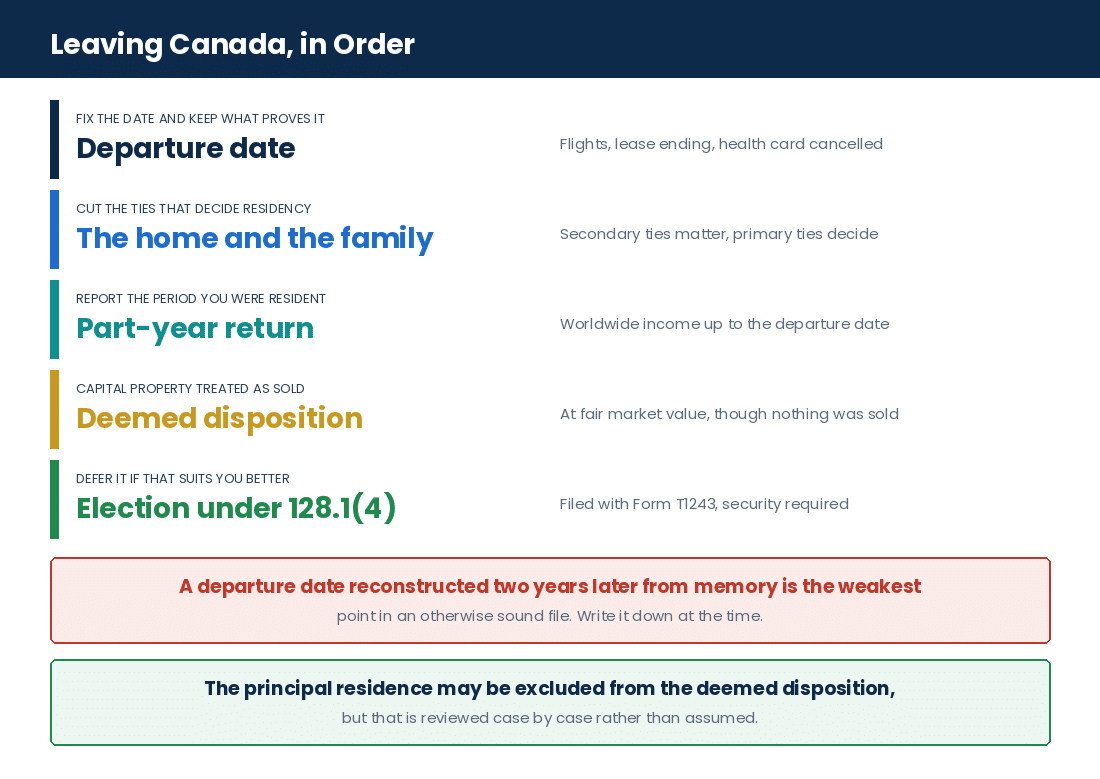
Planning to leave Canada permanently? Fixing an exact departure date with proof matters because it changes how you file part-year returns and triggers special rules called deemed disposition under ITA section 128.1(4).
Be careful with tax treaties. They don’t override Canadian law automatically but might help if you have dual residency and need tie-breaker rules (see ITA section 250(5)).
Hiring a CPA firm familiar with remote worker taxes makes dealing with worldwide income reporting easier. They can guide you through provincial taxes after leaving and help avoid paying too much.
Of everything on this page, the one thing worth doing today is writing down your departure date and keeping what proves it.
A flight record, a lease ending, a health card cancelled, a final utility bill. The date decides the part-year return, the deemed disposition calculation and which income was yours as a resident. Reconstructed two years later from memory, it is the weakest point in an otherwise sound file. Figures changed for privacy.
Contact Gondaliya CPA for Advice on Digital Nomad Income Tax Canada
Handling digital nomad income tax Canada matters takes specific knowledge about remote workers linked to Ontario or other provinces. Gondaliya CPA offers licensed help with personal non-resident filings, preparing departure returns including deemed disposition calculations, and foreign property reporting that meets new laws through 2026. We support clients during audits too.
We know how key it is to figure out your digital nomad tax residency Canada before filing returns or advising on withholding tax from Canadian sources after leaving. Our firm offers flat-fee yearly packages backed by more than “1300+ 5-star Google reviews,” fast one-business-day replies, and money-back guarantees for peace of mind.
Reach out at info@gondaliyacpa.ca or call 647-212-9559 for a free consult focused just on your unique situation under Canada’s changing rules for international remote work taxes.
CRA – Worldwide Income Reporting · CRA – Foreign Property Reporting · Income Tax Act R.S.C., 1985 c.1 (5th Supp.), ss.128(1), 250(1). · CRA – Residential Ties · Ibid.; Significant vs Secondary Ties explained therein. · CRA – Instalment Payments · Income Tax Act s128.1(4); Departure Date Rules. · Income Tax Act s250(5); Treaty Tie-Breakers. · CRA – Deemed Disposition Rules · Updated Residency & Departure Filing Guidance Effective January 2026 – see official CRA publications. · See Non Resident Withholding Obligations · Gondaliya CPA Service Policies & Reviews Summary Internal Document (2026).
Frequently Asked Questions on Digital Nomad Tax Canada
Frequently Asked Questions
Answers
What is the sojourning day count and how does it affect my Canadian tax residency?+
When must I file a departure return after leaving Canada?+
What is the foreign property reporting threshold for Canadian residents?+
How does Income Tax Act s. 220(4.5) relate to digital nomads?+
What penalties apply for late filing of Canadian tax returns?+
How long must I retain my tax records as a digital nomad in Canada?+
What are the filing requirements for Form T2209 regarding foreign tax credits?+
How do provincial health coverage details affect my residency status?+
What is the definition and filing requirement for part-year residents in Canada?+
Which forms should I use if claiming departure property reporting thresholds?+
Essential Tax Points for Digital Nomads
Key Points
Essential Tax Points for Digital Nomads: Gondaliya CPA Insights
- Non-Resident Canadian-source Income Withholding: Non-residents receiving rental or business income from Canada face withholding tax obligations under Income Tax Act s. 162(2).
- Capital Gains Tax on Worldwide Assets: Residents pay capital gains tax on global assets; non-residents only on taxable Canadian property at disposition.
- GST/HST Registration Rules Context: If you carry on business in Canada exceeding $30,000 revenue, register for GST/HST regardless of your physical location.
- Tax Treaties Tie-Breaker Application: Treaties help resolve dual residency but don’t override Canadian domestic residency rules automatically.
- Voluntary Disclosure Programs: The CRA offers programs to correct past filing errors without penalties under certain conditions.
- CRA Forms NR73 & NR74: These forms assist in determining residency status when leaving or entering Canada as a digital nomad.
- Foreign Tax Credits Documentation: Keep official receipts and foreign tax assessments as proof when claiming credits to avoid audit issues.
- Withholding Tax on Canadian Income: Employers or payers must withhold taxes from non-resident earnings related to work performed in Canada.
- Part-Year Resident Filing Instructions: File using Schedule NR, declare income earned while resident, and comply with specific deadline rules.
- Penalties and Interest Rates Specifics: CRA calculates penalties based on late payment amounts and interest accumulates daily until paid in full.
- File It Yourself vs CPA Firm Services: DIY options exist but professional CPA services like Gondaliya CPA provide accuracy and save time on complex filings.
- Common Triggers for CRA Review: Inconsistent reporting, large foreign assets, or failing to disclose income can prompt CRA audits or reassessments.
- Best Practices for Digital Nomads: Maintain detailed travel logs, document residential ties, keep organized financial records, and consult experts timely.
- Digital Nomad Filing: DIY vs CPA vs Non-CPA: CPAs offer specialized knowledge that reduces risks versus non-professionals or self-filing alone.
- What Deliverables Do You Get from Gondaliya CPA? Customized filings, treaty analyses, compliance reviews, audit support, and client education materials.
- How Much Does This Cost? Flat fees tailored to complexity ensure transparent pricing without hidden charges for digital nomad clients.
- Top Digital Nomad Mistakes and How to Prevent Them: Ignoring residency ties, missing foreign property reporting, delayed filings—avoid these by proactive planning.
- Checklist: What to Prepare Before Work Starts: Proof of residence changes, foreign income statements, asset valuations, client contracts, and identification documents ready upfront speeds processing.
- Key Questions Across Ten Groups: Residency status confirmation; foreign income details; asset holdings; treaty benefits eligibility; GST/HST obligations; departure dates; withholding taxes; instalment payments; record retention; voluntary disclosures need assessment.
- A Realistic Walkthrough with Gondaliya CPA: Step-by-step guidance from initial consultation through filing deadlines ensures compliance without surprises.
- How To Choose a CPA Firm in Ontario? Look for experience with international remote workers, transparent pricing, client reviews, and personalized service offerings like those at Gondaliya CPA.
- Why Trust Gondaliya CPA? Proven expertise in digital nomad taxes with strong client satisfaction ensures confidence in navigating complex cross-border issues efficiently.
Contact Gondaliya CPA today at info@gondaliyacpa.ca or call 647‑212‑9559 for tailored advice on digital nomad tax residency Canada challenges.
Businesses We Serve & Industry Spotlights
Industry Expertise
Remote work is the common thread across these sectors, and so are the questions behind it — whether the ties to Canada were really cut, whether foreign earnings have been reported, and whether Canadian clients have pushed the business past the GST/HST threshold.
| Industry | The Digital Nomad Angle |
|---|---|
| No-code development agencies | Small teams working from anywhere, invoicing Canadian clients |
| Digital product businesses | Revenue that arrives wherever the founder happens to be |
| Software resellers | Contracts signed abroad with the home still sitting in Ontario |
| Cloud service providers | Recurring foreign income reportable here while resident |
| Managed service providers | Clients in several countries, each taxing a slice of it |
| Cybersecurity companies | Specialists on long overseas engagements, ties untouched |
| IT staffing companies | Placed workers crossing the sojourning day count |
| Product design studios | Freelancers abroad billing Toronto studios past $30,000 |
| Corporate trainers | Work delivered in person abroad, taxed in two places |
| Call centres | Distributed staff and the payroll questions that follow |
| Cross-border e-commerce sellers | Foreign accounts and stock passing the T1135 threshold |
- No-code development agencies: Often the purest version of this situation — two or three people, no office anywhere, and Canadian clients paying into a Canadian account.
- Digital product businesses: Revenue keeps arriving wherever the founder is, which makes residency the only thing that decides where it is taxed.
- Software resellers: Deals closed from abroad do not change the position while the home, the family and the health card remain in Ontario.
- Cloud service providers: Recurring foreign revenue is fully reportable in Canada while resident, with foreign tax credits rather than an exemption as the relief.
- Managed service providers: Clients spread across several countries means several tax authorities, and the credit has to be worked out country by country.
- Cybersecurity companies: Long overseas engagements feel like leaving, but nothing about the residency position changes unless the ties change with it.
- IT staffing companies: Placed workers moving back and forth are exactly who the sojourning day count catches, often without anyone counting.
- Product design studios: A freelancer abroad billing Toronto studios can cross the $30,000 GST/HST threshold without ever setting foot in the country.
- Corporate trainers: Work physically delivered abroad is usually taxable where performed as well as here, which is what the foreign tax credit is for.
- Call centres: Distributed staff raise the same residency question one person at a time, with payroll obligations attached to each answer.
- Cross-border e-commerce sellers: Foreign payment accounts and overseas stock count toward the T1135 threshold long before they feel like foreign property.
Across all of these, the pattern is the same: the business moved and the paperwork stayed.
Nobody sets out to leave a return unfiled. The work simply becomes location-independent one contract at a time, and no single step feels like the one that should have triggered a filing. The people who never have trouble are the ones who settled the residency question once, deliberately, rather than letting it be decided for them later. Figures changed for privacy.
Professional Guidance and Quick Reference
Guidance
Essential Tax Points for Canadian Digital Nomads
Digital nomads get into difficulty in a predictable set of ways: assuming that leaving the country ends the filing obligation; treating a foreign visa as if it changed Canadian tax status; keeping a home, a spouse or a health card in Canada while filing as a non-resident; never counting the days spent back in Canada against the sojourning rule; missing Form T1135 because foreign accounts crossed CAD 100,000 mid-year; skipping GST/HST registration while billing Canadian clients past $30,000; leaving without fixing a provable departure date; and overlooking deemed disposition on the way out. Gondaliya CPA handles personal and non-resident filings on a flat annual fee.
Quick Answers
At a Glance
- What decides residency: residential ties, not days alone and not immigration status
- Primary ties: a home in Canada, a spouse or dependants here
- Secondary ties: bank accounts, a car, memberships, provincial health coverage
- Factual resident: strong ties kept while living abroad; worldwide income every year
- Deemed resident: no strong ties but past the sojourning day count; worldwide income for the whole year
- Non-resident: no ties and below the day threshold; Canadian-source income only
- Sojourning count: exceeding 183 days in Canada may make you a deemed resident
- T1 deadline: April 30, with June 15 to file if self-employed but tax still due April 30
- Late filing: 5% of the unpaid amount plus 1% per month, up to 12 months
- Instalments: may be required once net tax owing exceeds $3,000 two years running
- Foreign property: Form T1135 once specified foreign property passes CAD 100,000
- Foreign tax credits: Form T2209, capped at the Canadian tax on that foreign income
- GST/HST: register past $30,000 over four consecutive calendar quarters, wherever you are
- Leaving Canada: a part-year return covering the period of residency
- Deemed disposition: capital property treated as sold on departure, deferral available under 128.1(4)
- Departure forms: Form T1243 with the departure return
- Residency determination: Forms NR73 and NR74
- Records: keep everything six years from the end of the tax year
Who This Is For / Not For
Fit Check
- For: Canadian remote workers, freelancers and self-employed consultants living or travelling abroad while keeping some connection to Canada, and those unsure which of the three residency categories they fall into.
- For: people planning a permanent departure who need a part-year return, a departure date they can prove, and a deemed disposition calculation.
- Not for: advice on immigration status, visas or work authorisation in Canada or anywhere else, or on the tax rules of the country you are working from, each of which is a separate question.
- Not for: people who have never had a Canadian connection at all. Someone abroad all year who still owns an Ontario home is squarely in scope, however long they have been away.
People Also Ask
Related Questions
I have been abroad two years. Am I still a Canadian tax resident?+
Quite possibly. Time away is not the test — residential ties are. A home available to you in Canada, a spouse or dependants here, bank accounts, a car and active provincial health coverage all count, and the primary ties carry the most weight. Being away for years with the house still yours and the family still in it usually points to factual residence, with worldwide income reportable every year.
I got a visa in another country. Doesn’t that change my status?+
No. Tax residence and immigration status are separate questions decided by different authorities. A visa gives you permission to be somewhere; it says nothing about what the CRA considers your residential ties to be. The CRA applies its own rules regardless of what any other country has granted you.
Do I owe GST/HST if all my clients are Canadian but I live abroad?+
Likely yes. The test is whether you carry on business in Canada, and the CRA reads that broadly enough to cover self-employment conducted from outside the country for Canadian clients. Past $30,000 in taxable supplies over four consecutive calendar quarters, registration is mandatory and the tax is charged at the rate for the province of supply.
What actually happens when I leave for good?+
Three things. You file a part-year return covering the period you were resident. Your capital property is treated as sold at fair market value immediately before departure under the deemed disposition rules, with deferral available under subsection 128.1(4) if you provide security. And your departure date has to be provable, because it drives both of the first two.
I have unfiled years. What now?+
They are worked through in sequence, oldest first, because each year’s position depends on the one before it. The CRA operates a voluntary disclosure programme that can correct past filing errors without penalties where the conditions are met. The sooner that is started the better, since interest runs on balances regardless.
Glossary of Key Terms
Definitions
- Residential ties: the connections to Canada — home, family, belongings, accounts, health coverage — that the CRA weighs to determine residency.
- Factual resident: someone living abroad who keeps significant residential ties and remains taxable on worldwide income.
- Deemed resident: someone without significant ties who sojourns in Canada past the day count and is taxed on worldwide income for the whole year.
- Non-resident: someone with neither significant ties nor the day count, taxable only on certain Canadian-source income.
- Sojourning rule: the day-count test under which time physically spent in Canada can create deemed residence.
- Part-year resident: someone resident for only part of the calendar year, reporting worldwide income for that period.
- Departure date: the date residency ends, which drives the part-year return and the deemed disposition.
- Deemed disposition: the rule treating capital property as sold at fair market value on ceasing residence, under section 128.1.
- Form T1135: the foreign income verification statement, required once specified foreign property exceeds CAD 100,000.
- Form T2209: the federal foreign tax credit calculation.
- Form T1243: the deemed disposition of property return filed on departure.
- Forms NR73 and NR74: the CRA determination of residency status forms, on leaving and on entering Canada.
- Foreign tax credit: relief for non-refundable foreign income tax paid, capped at the Canadian tax on that income.
- Treaty tie-breaker: the rules that assign a single residence where two countries both claim one.
- Voluntary disclosure: the CRA programme allowing past filing errors to be corrected without penalties in defined circumstances.
Want a checklist to work from? You can download our free digital nomad tax checklist before your consultation.
Four things decide a digital nomad’s position. Ties, not borders — the CRA weighs a home in Canada, a spouse or dependants here, accounts, a car and provincial health coverage, so a visa elsewhere changes nothing and years abroad change nothing on their own. Which of three categories — a factual resident reports worldwide income, a deemed resident does too once the sojourning count passes 183 days, a non-resident reports Canadian-source income only. What follows from being resident — a T1 by April 30, T1135 past CAD 100,000 of foreign property, Form T2209 for foreign tax credits capped at the Canadian tax, GST/HST registration past $30,000 of Canadian billings, instalments past $3,000, and records kept six years. And leaving properly — a provable departure date, a part-year return, and deemed disposition under 128.1(4) with Form T1243.
Three questions tell you where you stand, and you can answer all of them today. First, is there a home in Canada available to you, and is your spouse or are your dependants here? Those are the primary ties, and if either is yes the non-resident position is difficult. Second, do you know how many days you spent in Canada last year? Not roughly — the sojourning rule turns on a count, and nobody keeps one retroactively. Third, if you have left, can you prove the date? A flight record, a lease ending, a cancelled health card. That date drives the part-year return and the deemed disposition, and reconstructing it later is the weakest point in an otherwise sound file.
Digital Nomad Tax Residency Canada: How Gondaliya CPA Can Help
Start with your ties, your days in Canada and your departure date if you have one
Gondaliya CPA works through the residential ties to settle which of the three categories applies and from when, counts the days against the sojourning rule, prepares the T1 with worldwide income and foreign tax credits on Form T2209 rather than guessing at an exemption, files T1135 where foreign property passes the threshold, sorts out GST/HST registration where Canadian clients have pushed you past $30,000, prepares the departure return with the deemed disposition calculation and the deferral election where it helps, and works through unfiled years in sequence including voluntary disclosure where it applies — on a flat annual fee including HST with a one-business-day response. Please book a free consultation.
Next Steps
Please book a free consultation with Gondaliya CPA and bring three things: a list of what you still have in Canada, from the home down to the health card, a count of the days you spent in the country last year, and your departure date with whatever proves it if you have already left. Those three settle the residency category, the sojourning question and the departure filing — which between them account for nearly every adjustment we make on a remote worker’s file. If you have years unfiled, or you have been treating yourself as non-resident while the house in Ontario sits waiting, say so at the outset, because both are routine to work through in order and expensive to discover during a review. You will get a flat annual fee including HST before any work begins. We serve Toronto, Mississauga, Brampton, Vaughan, Etobicoke, Scarborough, Hamilton, Ottawa and the rest of Ontario, and work with remote workers across Canada and abroad. If our content helps, please add gondaliyacpa.ca as a preferred source on Google.
Published: · Last updated:
Editorial policy: We research against CRA, Department of Finance, Parliament of Canada, CPA Canada and CPA Ontario sources, fact-check the figures, and Sharad Gondaliya, CPA, reviews the content, which we update as the rules change.
Disclaimer: This article is educational information only and is not tax, legal, financial or immigration advice. It covers Canadian federal income tax, GST/HST and record-keeping obligations for remote workers and self-employed digital nomads with a Canadian connection, and it does not cover immigration status, visas or work authorisation in any country, nor the tax rules of the country you are working from, each of which is administered separately. Residency thresholds, filing deadlines, reporting thresholds, penalty rates and departure rules change, and the source material refers to updated CRA residency and departure guidance effective January 2026; the figures in this article are those stated in the source material and every one should be confirmed against current CRA guidance before a return is filed. Whether a particular set of ties makes someone resident turns on the full facts. Gondaliya CPA performs compilation engagements under CSRS 4200 and does not perform audit or review engagements. Please consult a licensed CPA before acting.

Sharad Gondaliya is a CPA Canada & CPA USA with 15 Years+ experience of Accounting, Tax, Payroll of Corporate Small Businesses as Tax Accountant. He is a CPA Ontario member (61040184) and holds US CPA licences in Washington and Montana and is well known among corporate small businesses for tax planning, efficient tax solutions, and affordable CPA services. Sharad is the Principal (Director) of Gondaliya CPA – Affordable CPA Firm in Canada. Licenses: CPA Ontario: 61040184 | CPA USA (MT): PAC-CPAP-LIC-033176 | CPA USA (WA): 57629 | CPA Firm License: 61330051 View Full Author Bio