



Foreign Investor Tax Filing in Canada: Rental Income, Withholding Tax & Property Sales
Foreign Investor Tax Filing Canada: A Guide to Real Estate and Rental Income Taxes with Gondaliya CPA
Foreign investor tax filing Canada requires understanding specific rules around real estate and rental income taxes. Gondaliya CPA helps foreign investors and non-residents navigate property tax obligations, including reporting rental income and complying with CRA requirements.
Quick Summary
Owning Canadian property from abroad means money is taken before it reaches you, and getting it back runs on deadlines. Rent is withheld at 25% of gross under Part XIII — on the full rent, not the profit, every month, whether or not the property made money. Form NR6 changes that, letting the withholding follow estimated net income instead, but it has to be approved before the first rent payment. The section 216 election taxes you on net rental income at graduated rates and usually produces a refund — due two years after the calendar year-end, or June 30 where an NR6 was approved, and that second deadline is unforgiving. Selling triggers section 116: the purchaser withholds on the gross price until a certificate of compliance is issued, and you have ten days from closing to notify CRA. CCA is a trap worth understanding — roughly 4% a year on the building, recaptured as income when you sell. And Form T1135 is not your form if you are a non-resident owning Canadian property, however often you are told otherwise.
Reading time: 12 minutes.
Table of Contents
- Understanding Tax Filing Requirements for Foreign Investors
- Rental Income Tax Obligations for Non-Resident Owners
- Taxation of Real Estate Transactions
- Reporting Foreign Property Ownership
- Strategies to Minimize Tax and Ensure Compliance
- How Gondaliya CPA Supports Foreign Investors
- Frequently Asked Questions
- Essential Insights for Foreign Investors
- Businesses We Serve & Industry Spotlights
- Professional Guidance and Quick Reference
The Numbers That Matter
This article covers Canadian federal income tax for non-residents who own Canadian real estate, with Ontario and Toronto context, and reflects rules current to 21 October 2026. It is written for foreign investors holding Canadian rental property, and it covers Part XIII withholding on rent, Form NR6, the section 216 net rental election, allowable expenses and capital cost allowance, section 116 purchaser withholding and the certificate of compliance, record retention, and where Form T1135 does and does not apply. It is not advice on municipal property tax assessment or appeals, on provincial land transfer or speculation taxes, or on which treaty benefits apply to a particular investor. Gondaliya CPA performs compilation engagements under CSRS 4200, which provide no assurance; audit and review engagements are referred out. This is educational information only and not tax or legal advice.
Understanding Tax Filing Requirements for Foreign Investors in Canada
Understanding Tax Filing Requirements for Foreign Investors
Start Here
If you’re a foreign investor wanting to own property in Canada, you’ll face some tax rules. These rules can get confusing. This section breaks down what you need to know about foreign investor tax filing Canada. It focuses on non-resident property tax Canada and how foreign owner rental income tax Canada works.
Who Counts as a Foreign Investor?
A foreign investor is someone who doesn’t live in Canada but owns taxable Canadian property (TCP). TCP includes homes, commercial buildings, and land in Canada. The government treats non-residents differently when it comes to taxes on these properties.
What Is Non-Resident Property Tax in Canada?
Non-resident property tax means taxes on properties owned by people or companies outside Canada. You’ll pay local municipal property taxes based on the property’s assessed value. Also, the federal government taxes rental income earned by non-residents.
- Municipal taxes are set by your local city or town.
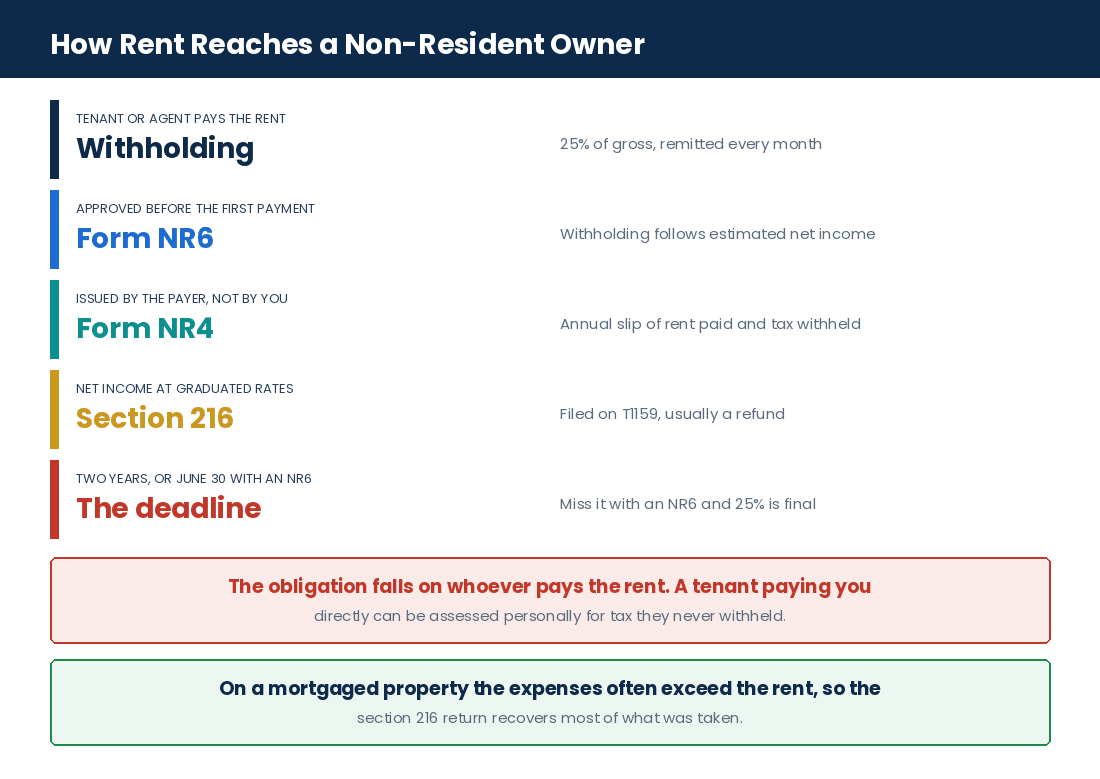
- Rental income from your Canadian property faces a 25% federal tax on gross rent.
- You might lower what you actually pay by electing under Section 216 of the Income Tax Act, which taxes you on net rental income at graduated rates rather than on 25% of the gross.
How Is Foreign Owner Rental Income Taxed?
When you rent out Canadian property as a foreign owner, you must follow certain rules:
- The government withholds 25% of your gross rent each month.
- At the end of the year, the payer or your agent files an NR4 slip reporting all rent paid to you and the tax withheld, and gives you a copy.
- You can choose to be taxed on net rental income instead of gross if you have eligible expenses (this is called the Section 216 election).
For example:
- If you earn $10,000 in rent and don’t deduct any costs, $2,500 gets withheld (that’s 25%).
- But if you spend $3,000 on expenses and choose net-rent taxation, only $7,000 counts as taxable income.
An investor in Hong Kong had owned a Toronto condo for six years and had never filed a section 216 return, because the property manager was withholding faithfully every month and nobody told him there was anything else to do. The withholding was correct. It was also roughly three times his actual liability, because the mortgage interest and condo fees alone nearly consumed the rent.
We filed the open years and recovered most of it. The ones that had closed stayed closed, which is the part that stings: the money was always his, and the only thing standing between him and it was a return nobody had mentioned. Figures changed for privacy.
Record Keeping Requirements
Good record keeping helps avoid trouble with the CRA (Canada Revenue Agency):
- Save copies of leases and rental agreements.
- Keep receipts for all payments related to managing your rentals.
- Keep proof for any deductions or elections you claim under Section 216.
Not keeping records might lead to penalties if the CRA checks your filings or finds mistakes.
Conclusion
Knowing these basics about foreign investor tax filing in Canada makes things clearer. If you’re a non-resident landlord with Canadian property, following these rules helps avoid problems and might save money through elections like Section 216. For specific advice, it’s smart to talk to experts like Gondaliya CPA who know cross-border taxation well.
Rental Income Tax Obligations for Non-Resident Property Owners
Rental Income Tax Obligations for Non-Resident Owners
The Monthly Machinery
If you own property in Canada but live somewhere else, you still have to follow certain tax rules. When you rent out your Canadian property, the person paying your rent must withhold tax from the total amount before sending it to you. Then, you report that rental income yearly using a special tax return called section 216. Knowing these rules helps you avoid penalties.
What Constitutes Rental Income
Rental income is all the money you get from renting your Canadian property. This includes rent plus any extra payments for utilities or services connected to the rental. The Canadian government sees this full amount as taxable under non resident property tax Canada rules. The payer must withhold a fixed percentage of this total gross rent every month.
Here’s a fact: Rent paid to a non-resident landlord has tax withheld at a set rate based on the total rent collected [Income Tax Act ss. 212(1)(d), 215; CRA Guide T4144].
For example, if a foreign owner gets $24,000 in rent for the year before expenses, the payer has to withhold tax on the full $24,000 — even if expenses lower actual profit.
Allowable Expenses and Deductions
You can claim some expenses when filing your section 216 tax return to reduce your net income. But note, this won’t lower withholding tax unless you file Form NR6 (more on that later). Here are common expenses allowed:
- Property management fees
- Repairs and maintenance
- Insurance costs
- Utilities paid by you
- Interest on loans for buying or fixing the property
You can also claim depreciation through Capital Cost Allowance (CCA). Usually, CCA runs about 4% yearly for residential buildings. But be careful — claiming CCA means you might owe extra taxes later when selling due to “recapture.”
Using CCA can cause extra taxes when you sell because of recapture rules [ITA ss. 13(1), 20(1)(a)].
Example: An investor claims $5,000 in repairs plus $2,400 in CCA during one year against $24,000 gross rental income reported later.
Capital cost allowance is the deduction clients most want and least often should take. It feels free: a few thousand dollars off the rental income every year for doing nothing. What it actually does is move tax from now to the year you sell, and change its character on the way, because recapture is ordinary income rather than a capital gain.
Our rule of thumb is that CCA earns its place where the owner needs the deduction now and intends to hold for a long time. Where a sale is anywhere in view, the arithmetic usually goes the other way. Figures changed for privacy.
Overview of Withholding Tax Requirement
Anyone paying rent to a non-resident owner must withhold federal tax monthly at a fixed rate on all rents paid — this includes direct and indirect payments. This rule applies even if there is no net profit yet. Without approval from CRA, withholding can’t be lowered.
The payer sends withheld taxes regularly and provides annual slips (NR4) showing total rents and taxes held back.
CRA demands monthly withholding no matter what — missing this can cause penalties for payers or agents [ITA s. 215].
For instance, if an agent in Toronto collects $2,000 per month in rent sent overseas, they must withhold tax monthly on that whole amount — even if some money covers owner-paid expenses.
The withholding obligation sits on whoever pays the rent, and tenants paying a non-resident landlord directly almost never know that. We have seen a tenant pursued for two years of unremitted tax on rent they had paid in full and in good faith, because the landlord lived abroad and nobody had appointed an agent.
That is a miserable conversation to have with a tenant, and it is entirely preventable. Appointing a Canadian agent at the start of the tenancy moves the obligation to someone who knows it exists. Figures changed for privacy.
Role of Form NR6 in Reducing Withholding Tax
Form NR6 lets non-resident landlords apply to reduce withholding based on estimated net income instead of gross rents alone.
To use Form NR6:
- Apply before any payment that triggers withholding
- Submit proof estimating allowable deductions
- Get CRA approval before deadlines tied to first payment dates
Once approved, future monthly remittances reflect your net rental income — not total rents collected.
This shifts responsibility to the taxpayer but improves cash flow while staying legal.
File Form NR6 early each year before receiving any rent subject to withholding [CRA Guide T4058].
Example: A foreign landlord files NR6 estimating net rentals at half last year’s gross amount. After approval, their monthly remittances drop accordingly starting January that year.
Section 216 Tax Return Process for Non-Resident Owners
Foreign owners report rental income annually under section 216 using specific forms. You declare actual net income after deductions like mortgage interest, repairs, insurance, and CCA where applicable. These returns help reconcile withheld taxes versus actual liability after year-end.
Filing on time avoids interest charges or penalties mostly linked to late or incomplete filings about ownership changes or taxable status during the year.
Where no Form NR6 has been approved, a section 216 return is due two years after the end of the calendar year in which the rent was paid. Where CRA has approved an NR6 undertaking, the return is due within six months of the calendar year-end, meaning June 30 of the following year, and missing that date makes the full 25% of gross rent payable [ITA ss. 216(1), 216(4)].
Example: A foreign landlord in Ontario files her first section 216 return showing adjusted net rentals after deducting mortgage interest ($7K), repairs ($3K), insurance ($1K), plus claimed CCA ($2K). She reports any balance owing after accounting for withheld taxes during the prior year ending December 31st.
Common Mistakes and Best Practices
Some common errors by foreign investors include:
- Not appointing responsible agents who remit monthly withholding properly
- Missing NR6 deadlines causing over-withheld taxes and cashflow issues
- Confusing capital improvements with current expenses leading to wrong deductions
- Ignoring filing deadlines or missing slip issuance which messes up reporting
Good practice means hiring qualified CPAs who know foreign investor real estate tax Canada well. Keep clear records separating repairs from improvements so deductions follow rules exactly. Review lease agreements carefully to define what counts as taxable gross rent versus reimbursed amounts. Stay updated on CRA guidance related specifically to non resident property tax Canada so you avoid audits or extra charges.
If you’re dealing with foreign owner rental income tax Canada, Gondaliya CPA is one Ontario firm that can help with compliance and bookkeeping questions about cross-border investments across Toronto & beyond.
Taxation of Real Estate Transactions for Foreign Investors
Taxation of Real Estate Transactions
Selling
If you’re a foreign investor with property in Canada, there are special tax rules you should know. Non-resident property tax Canada laws tell you how to report and pay tax on income or gains from your real estate. Knowing these rules helps you follow CRA guidelines and avoid fines.
Withholding Tax on Sale of Canadian Property
When a non-resident sells Canadian property, the buyer must hold back some money from the sale price. This money goes to the CRA to cover taxes on any gains the seller made.
- The purchaser’s withholding obligation starts at closing unless a certificate of compliance exists.
- The seller or agent must tell CRA within a set notification period after selling.
- Without this notification, buyers still must withhold, no matter what the seller files later.
If buyers don’t withhold or send in the money, they can be personally responsible under Income Tax Act s. 116.
Example: Say a foreigner sells a condo for $600,000 CAD in Ontario. Without applying for a certificate on time, the buyer must hold part of that amount at closing until clearance is granted.
Default Method vs. Optional Method for Calculating Withholding Tax
Usually, buyers withhold tax based on the full sale price, not just profit. This method is easy but might make sellers pay more upfront than needed.
There’s an optional method where sellers can file paperwork first. Then withholding is based on estimated profit, not total sale price. Sellers must appoint an authorized agent as withholding agent. This agent handles monthly payments during ownership before sale.
If these undertakings aren’t filed or accepted properly, buyers still have full responsibility and face penalties along with sellers.
Note: Purchaser’s obligation kicks in right at sale unless valid undertakings change who pays [Canada.ca — Non-Resident Seller Obligations].
The difference between the two methods is cash, not tax. On a property bought years ago for a fraction of what it now sells for, withholding on the gross price can run to several times the actual liability, and the excess sits with CRA until a return is assessed the following spring.
Vendors routinely plan their next purchase around proceeds that are not going to arrive on time. Applying for the certificate early is the whole answer, and it costs a fraction of the bridge financing people end up arranging instead. Figures changed for privacy.
Certificate of Compliance Application Process
After selling, sellers must notify CRA quickly to apply for a certificate of compliance.
- The clock starts when legal ownership transfers.
- There’s only a limited number of days (notification period) to apply.
- Applying late doesn’t stop withholding but affects how long money stays held.
This certificate shows tax owed based on declared gains instead of full sale price held by buyer. CRA issues it after payment or security is provided by seller.
If no application happens, buyers keep holding funds until final return settles things — this can delay release well past closing date.
Missing this deadline can trap funds and hurt cash flow [Income Tax Act s. 116(3)].
A vendor closed in July and came to us in October, having assumed the lawyer was handling the CRA side. The lawyer had done exactly what lawyers do: held the statutory amount back and waited for a certificate that nobody had applied for. By then a six-figure sum had been sitting in trust for three months and the vendor had a down payment due on a purchase abroad.
Nothing was lost in the end. But the notification clock starts at closing and runs in days, not months, and the cheapest hour on a non-resident sale is the one spent before it rather than after. Figures changed for privacy.
Documentation Needed for Capital Gain Calculation
To figure out capital gains correctly, you need good records:
- Adjusted Cost Base (ACB): What you paid plus costs like commissions or improvements.
- Selling Costs: Legal fees and other selling expenses.
- Capital Cost Allowance (CCA) Rate: Annual depreciation claimed lowers undepreciated capital cost, not adjusted cost base, and is brought back into income as recapture when sold.
Keeping clear documents helps file accurate section 216 tax returns required from non-residents selling taxable property. It also helps avoid paying too much or getting audited later [Income Tax Act s. 40(1)], [45(1)].
Here’s what you’ll want:
| Document Type | Purpose | Source/Reference |
|---|---|---|
| Purchase Agreement | Shows initial purchase cost | Legal contract |
| Receipts/Invoicing | Proves outlays & expenses | Vendor invoices |
| CCA Schedules | Tracks depreciation claimed | Accounting records |
Common Issues and Penalties for Non-Compliance
Foreign investors often make mistakes that lead to fines and audits:
- Not notifying CRA on time delays certificates and funds release.
- Skipping agents means buyers take all liability unexpectedly.
- Filing undertakings late or wrong means bigger withholding at sale.
- Forgetting NR6 forms causes rent-withholding errors monthly.
CRA looks closely when reported income or sales don’t match withheld amounts or missing NR4 slips. Ignoring rules leads to steep penalties and forces catch-up filings under special programs — usually needing expert help familiar with cross-border taxes.
| Common Mistake | Result | How To Avoid |
|---|---|---|
| No Undertaking Filed | More tax held upfront | File undertaking early |
| Late Notification | Buyer keeps funds longer | Watch deadlines carefully |
| No Agent Appointed | Buyer faces full liabilities | Hire qualified agents fast |
Knowing these common issues can keep your foreign investor real estate tax Canada matters smoother and safer.
Need advice about being a non-resident landlord in Ontario? Contact Gondaliya CPA at info@gondaliyacpa.ca or call 647-212-9559 today.
Non-Resident Landlord Readiness Check
Five quick questions on where your departure file stands. No fee shown.
Points to raise with us:
This is a general prompt, not tax or legal advice or a quote. Your position depends on your full facts. For a real review, please book a free consultation.
Reporting Foreign Property Ownership in Canada
Reporting Foreign Property Ownership
The Other Side
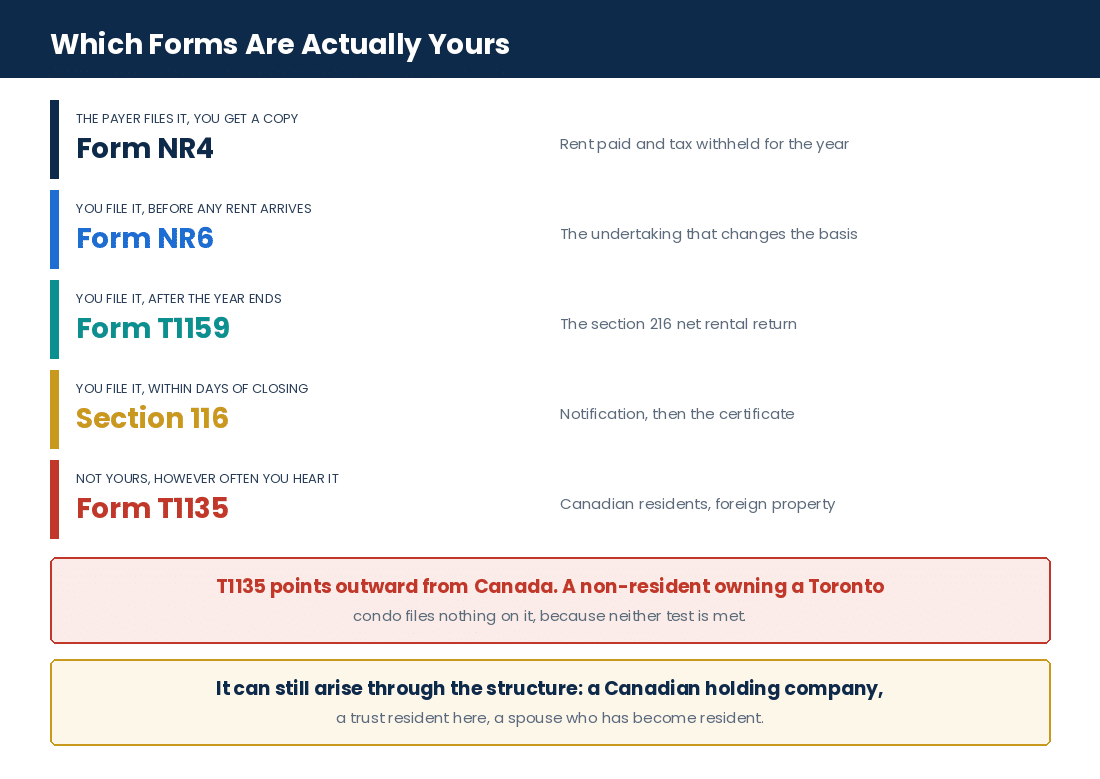
Form T1135 is the one reporting obligation that does not attach to a foreign investor’s Canadian property, and it is worth being clear about why, because it comes up constantly. Form T1135 is filed by Canadian residents reporting property they hold outside Canada. A non-resident who owns a Toronto condo files nothing on T1135 for it: the property is in Canada and the owner is not a Canadian resident. Where it does matter on a cross-border file is on the other side of the structure, and that is what this section sets out.
The form lists specified foreign property owned by people or companies living in Canada or considered residents for tax purposes. A non-resident files a Canadian return only where they earn taxable Canadian income, and that return does not carry a T1135 for property outside Canada. The obligation arises where a Canadian-resident person, corporation or trust within the same structure holds foreign property over the threshold.
If you skip reporting, CRA can charge big penalties and look closer during audits. You should keep good records of what you paid, how much you own, and how much the property is worth at year-end. This info helps with correct reporting on federal and sometimes provincial tax forms.
Specified Foreign Property and Reporting Threshold
Specified foreign property covers real estate outside Canada (not personal-use homes), shares in foreign companies, debts owed by non-residents, partnership interests with these assets, plus money held abroad like bank accounts or trusts linked to investments.
The rule is that a Canadian resident must report if all their specified foreign properties together cost more than a set amount at any time in the year. You add up all the values of these assets owned directly or through others during any month in the year.
Here’s a quick look:
| Item | What It Means |
|---|---|
| Specified Foreign Property | Real estate outside Canada but not personal use |
| Reporting Threshold | Total cost above CAD $100,000 |
| Cost Basis | What you paid plus improvements |
You use cost amount as defined in subsection 248(1) of the Income Tax Act, which is a related but different figure from the adjusted cost base used for capital gains. If your properties don’t reach that total value, you don’t have to file Form T1135 but keep track just in case.
Filing Form T1135: Requirements and Deadlines
Form T1135 is called “Foreign Income Verification Statement.” You must file it if your specified foreign property goes over the threshold during the year. This applies to residents who own assets abroad, including the Canadian-resident trusts and corporations that often sit inside a cross-border real estate structure.
Here’s what you should know:
- Who files: Individuals (even Canadians living temporarily outside), companies, trusts owning specified foreign property above limit
- When: With your yearly tax return; late filing means penalties
- Info needed: Types of assets, max cost per type during year, gross income from each asset type, gains or losses if sold
Deadlines match regular return due dates — usually April 30 after year-end, or June 15 where the taxpayer or their spouse is self-employed, though any balance owing still attracts interest from April 30. You can only get extensions by asking before the deadline passes.
Say an Ontario investor owns a $150K USD condo overseas making rental income — they must fully report all asset codes on their form as per CRA guidance.
We are asked about T1135 by non-resident clients more often than by resident ones, almost always because someone told them a Canadian property over $100,000 has to be reported on it. It does not. The threshold, the form and the whole regime point outward from Canada, not inward.
Where it does bite on these files is the structure around the property: a Canadian holding company, a family trust resident here, a spouse who became resident. Those can carry a real T1135 obligation with real penalties, and they are the ones nobody asks about. Figures changed for privacy.
Exemptions and Special Cases for Foreign Property Reporting
Some cases let you skip full reporting:
- Personal-use properties outside Canada below set value limits
- Properties inside registered plans like RRSPs since earnings are sheltered
- Simplified reporting is available where total cost stays under $250,000 for the whole year, and property held with a Canadian registered securities dealer is reported in aggregate by country rather than property by property
Special situations happen with co-owned properties or indirect ownership through partnerships or trusts. In those cases, you declare your share based on the rules in section 233.3 of the Income Tax Act.
Also, a non-resident does not file T1135. A partnership can have its own filing obligation where Canadian-resident members hold a sufficient interest, which is separate from any section 216 election made on Canadian rental income.
Knowing these details helps avoid needless filings while staying clear of trouble with non resident property tax Canada rules. Firms like Gondaliya CPA assist Toronto clients nationwide with this kind of cross-border accounting, including catch-up filing where years have been missed.
Canada Revenue Agency — Form T1135 and its instructions, Foreign Income Verification Statement; Income Tax Act ss. 233.3, 248(1) definition of cost amount
Strategies to Minimize Tax Liabilities and Ensure Compliance
Strategies to Minimize Tax and Ensure Compliance
Planning
Foreign investors who own real estate in Canada have to follow special tax rules. Knowing how to lower taxes and still follow non resident property tax Canada laws helps avoid fines. Managing foreign owner rental income tax Canada correctly and filing on time cuts down risks.
Usually, tax on rental income paid to a non-resident is held back by the payer or their agent. They report it each year with NR4 slips and send the money monthly. When selling taxable Canadian property (TCP), the purchaser must withhold tax too. This means you have to watch dates and keep good records. Foreign investor tax filing Canada means handling these rules along with yearly returns like section 216 net-rental elections.
Methods to Reduce Withholding Tax on Real Estate Sales
In foreign investor real estate tax Canada, the buyer must hold back part of the purchase price if they buy TCP from someone who is not a resident. This stops taxes from slipping through when someone sells.
To lower this withholding, sellers can ask CRA for a certificate of compliance. They must apply after telling CRA about the sale within a set time. The certificate shows an estimated tax based on profit, not the full sale price. Buyers then only hold that smaller amount.
If you apply late or don’t tell CRA, the buyer still must hold money and might be responsible if they don’t pay taxes right [Income Tax Act ss. 116(3), 116(5)]. Applying early helps sellers keep more cash since holdbacks are based on gain, not total price.
Example: If a non-resident sells a condo for $800,000 CAD but misses applying for the certificate in time, the buyer withholds tax on the whole $800,000 at closing. That cash stays locked up until taxes are finalized later.
Avoiding Penalties through Voluntary Disclosure
CRA usually reviews files when there are problems like missing withholding payments or lost NR4 slips reporting rent sent abroad. Late notices after selling without applying for certificates also raise flags. Sometimes people miss filing returns like section 216 altogether.
The voluntary disclosure program lets taxpayers fix past mistakes before CRA comes knocking hard. It can help avoid bigger penalties and interest charges [CRA Voluntary Disclosures Program].
To catch up, gather all rent receipts showing amounts received; proof of monthly tax payments; copies of any undertakings filed; any section 216 returns already filed on Form T1159; bills proving expenses claimed; plus any CRA letters about audits or assessments.
The disclosure programme rewards arriving first. Once CRA has written to you about the very thing you were going to disclose, the door closes, and the difference between the two sides of that door is usually the penalties rather than the tax.
Most of the non-resident catch-up files we see are not evasion. They are people who bought a property, hired a manager, and genuinely did not know a return existed. That makes them good candidates for relief, provided somebody files before the letter arrives. Figures changed for privacy.
Contact experts who know foreign investor real estate tax Canada well soon. They can guide you through making voluntary disclosures with less cost and stress.
Best Practices for Maintaining Proper Documentation
Keeping solid records helps report foreign owner rental income tax Canada properly and reduces audit risk:
- File Retention Duration: Save papers like purchase contracts, closing statements showing buyer’s withheld amounts, and agent letters who collect rent for at least six years after last use per CRA rules.
- What To Prepare Before Work Starts: Use a checklist including prior returns filed or missed; copies of NR4 slips confirming rents reported vs withheld monthly or quarterly based on elections.
Top foreign investor mistakes and prevention:
| Common Mistake | Effect | How To Avoid |
|---|---|---|
| No appointed agent collecting rent | Wrong withholding risk | Appoint agents early |
| Late undertaking election | Bigger default gross withholding | File undertaking before deadline |
| Missing NR4 slip issuance | Penalties + wrong tenant reporting | Issue slips every year on time |
| Not notifying sale | Buyer holds too much money | Tell CRA right after selling |
| Claiming CCA without planning recapture | Unexpected big recapture tax | Plan depreciation claims carefully |
Good documents also make filing annual returns easier when CPAs handle your taxes in places like Toronto or Hamilton.
Understanding Relevant Tax Treaties Affecting Foreign Investors
A foreign investor is mainly someone who does not live in Canada by law — not explained here — but non-residents must follow federal taxes for TCP ownership [Income Tax Act s. 248(1)].
Taxable Canadian property mostly means real estate in Canada — like rental homes — which triggers rental income taxes and special sale rules including buyer’s holdbacks [ITA s. 116; definition in s. 248(1)].
Canada has many treaties to avoid double taxation affecting gains and where dividends or rent get taxed. These treaties change some rules but don’t remove core domestic filing duties or sales notification requirements for foreigners [Department of Justice — Income Tax Treaty Articles].
Figuring out treaty benefits takes professional advice since it depends on facts beyond just owning property. But knowing them helps manage foreign investor real estate tax Canada issues better.
If you want specific help with foreign investor real estate tax Canada issues or need support with non resident property tax Canada filings, reach out to Gondaliya CPA at info@gondaliyacpa.ca or call 647-212-9559. They offer expert help backed by over 1300 five-star Google reviews.
How Gondaliya CPA Supports Foreign Investors with Tax Filing
How Gondaliya CPA Supports Foreign Investors
Working With Us
Gondaliya CPA helps foreign investors with tax filing in Canada. We focus on foreign investor tax filing Canada rules and non resident property tax Canada requirements. Our Ontario-based team guides you through Canadian real estate tax laws. We make sure your filings are accurate and sent to the CRA on time.
Guidance on Canadian Real Estate and Rental Income Taxes
Foreign investors have special rules for rental income and property taxes in Canada. We explain how foreign owner rental income tax Canada works. This tax applies to the rent tenants or agents pay, so monthly withholding and yearly NR4 slip reports are needed.
You should know the difference between gross rent withholding under Part XIII of the Income Tax Act and net rental income tax returns under section 216.
We help you with foreign investor real estate tax Canada issues like:
- What expenses you can claim
- How to use capital cost allowance (CCA) without losing money
- What happens when you sell and must recapture CCA
- GST/HST rules for short-term rentals
This keeps you legal while managing your cash flow smartly.
Assistance with Certificate of Compliance and Tax Return Preparation
If you sell taxable Canadian property as a non-resident, you must handle the purchaser’s withholding obligation. Gondaliya CPA walks you through the certificate of compliance notification period required by CRA before closing.
We prepare all paperwork to apply for this certificate quickly. It shows that you paid or secured your capital gains tax.
We also file section 216 net rental income returns on time if CRA accepted an undertaking that lowers your rent withholding. Filing late can cause penalties, so we make sure deadlines are met.
The single most valuable half-hour on a new non-resident file is the one spent establishing who has been paying the rent to whom. Everything downstream depends on it: whether the withholding has been happening at all, whether a tenant is quietly exposed, whether an NR6 is even possible for the coming year, and how much of the past is still recoverable.
It is also the question nobody arrives expecting. Most owners come to us asking about the refund, and the answer to that turns out to depend on an arrangement they have never thought about. Figures changed for privacy.
Personalized Advice for Complying with CRA Requirements
It’s important to know who is the withholding agent — usually tenants or agents deduct taxes from rent for non-resident landlords unless an undertaking shifts this duty back to the owner after approval.
Gondaliya CPA advises on how to appoint withholding agents properly. We also explain file retention rules — you need to keep records for six years after filing, as CRA says.
We point out common reasons why CRA may review your file: unpaid withheld taxes, missing NR4 slips, or no notice about property sales. Our bookkeeping checks help prevent these problems by catching issues early.
Contact Information for Expert Tax Consultation and Support
For help with foreign investor real estate tax Canada rules, contact Gondaliya CPA at 647-212-9559 or info@gondaliyacpa.ca. We offer flat-fee yearly services and have over 1300 five-star Google reviews. We serve clients across Toronto, Mississauga, Brampton, Hamilton, and all over Ontario who need help with non resident property tax Canada matters.
Income Tax Act ss. 13(1), 20(1)(a), 40(1), 45(1), 116, 212(1)(d), 215, 216(1), 216(4), 230(4), 233.3, 248(1) · CRA Guide T4144 · CRA Guide T4058 · Forms NR4, NR6, T1135, T1159
Frequently Asked Questions on Foreign Investor Tax Filing in Canada
Frequently Asked Questions
Answers
What triggers a CRA review for foreign investor tax filing?+
Who acts as the withholding agent for rental income in Canada?+
Can withholding tax be reduced to net rental income?+
When is the net rental income return due?+
What does the certificate of compliance notification period mean?+
What happens if the certificate of compliance application is late?+
How is capital cost allowance (CCA) rate relevant to foreign investors?+
What are file retention duration requirements by CRA?+
Does GST/HST apply to foreign-owned short-term rentals in Canada?+
How do tax treaties affect foreign investors in Canadian real estate?+
Essential Insights for Foreign Investors
Essential Insights for Foreign Investors
Key Points
Key insights on managing foreign investor tax obligations with Gondaliya CPA:
- Understand Canadian federal law and Ontario provincial considerations for non-resident property tax.
- Know purchaser’s withholding obligation under Income Tax Act Section 116 when selling Canadian real estate.
- Meet deadlines for undertaking (net rent) applications per CRA NR6 guidance to reduce monthly rent withholding.
- File Section 216 net rental income returns before the due date — two years from the calendar year-end, or June 30 where an NR6 was approved — to reconcile withheld taxes accurately.
- Track capital gains with adjusted cost base and account for recapture triggered by claimed CCA.
- Follow CRA record retention rules by keeping tax files and supporting documents a minimum of six years.
- Monitor GST/HST registration threshold to comply with applicable sales taxes on short-term rentals.
- Use voluntary disclosure program proactively to correct past reporting errors and avoid penalties.
- Appoint qualified withholding agents early — either tenants or property managers — to ensure monthly remittance compliance.
- Choose between DIY filings or professional CPA support based on complexity; Gondaliya CPA offers expert guidance.
For expert help, contact Gondaliya CPA at info@gondaliyacpa.ca or call 647-212-9559.
Businesses We Serve & Industry Spotlights
Industry Expertise
Foreign investors in Canadian real estate sit inside a wider group of people whose Canadian filings turn on where they are considered to live, and the questions that decide an investor file — who withholds, on what amount, and which election brings it back — recur across every one of these situations.
| Who | The Non-Resident Angle |
|---|---|
| Foreign investors in Canadian real estate | Part XIII withholding, NR6 and the section 216 election |
| Canadian snowbird landlords | Rental income reported while living abroad for months |
| Snowbirds | Residency tested against long absences each winter |
| Emigrants leaving Canada | Property kept behind and taxed on eventual sale |
| Canadian owners of US rental properties | The mirror image, with US withholding and elections |
| Immigrants with foreign assets | Form T1135 once Canadian residence begins |
| Foreign shareholders of Canadian corporations | Dividend withholding and treaty rate claims |
| Dual citizens | Two systems reporting the same property |
| Digital nomads | Residential ties weighed against time abroad |
| Real estate syndicators | Non-resident partners inside a Canadian structure |
| Portfolio managers | Cross-border holdings and reporting thresholds |
Spotlights: foreign investors in Canadian real estate · Canadian snowbird landlords · snowbirds · emigrants leaving Canada · Canadian owners of US rental properties · immigrants with foreign assets · foreign shareholders of Canadian corporations · dual citizens · digital nomads · real estate syndicators · portfolio managers.
Professional Guidance and Quick Reference
Guidance
Essential Tax Points for Non-Residents Owning Canadian Property
Foreign investor files go wrong in a predictable set of ways: nobody appoints an agent, so the obligation lands on a tenant who has never heard of it; the NR6 is filed after the first rent payment and is therefore useless for the year; the section 216 return is never filed at all, so 25% of gross becomes the final tax on a property that barely broke even; CCA is claimed for years without anyone modelling the recapture; and the sale closes before anyone tells CRA, leaving six figures in a lawyer’s trust account. Gondaliya CPA prepares non-resident rental and disposition filings on a flat annual fee.
Quick Answers
At a Glance
- Withholding on rent: 25% of gross under Part XIII, every month
- Who withholds: whoever pays the rent — tenant or agent
- Gross, not net: withheld even where the property loses money
- Form NR6: approved before the first payment, lets withholding follow estimated net income
- NR4 slip: issued by the payer or agent, not by the owner
- Section 216: elects net rental income at graduated rates
- Deadline without NR6: two years from the end of the calendar year
- Deadline with NR6: June 30 of the following year, and it is not extendable
- Missing the NR6 deadline: the 25% on gross becomes the final tax
- Form T1159: the return used for the section 216 election
- Deductible: management fees, repairs, insurance, utilities, mortgage interest
- CCA: about 4% on the building, and recaptured into income on sale
- CCA reduces UCC: not adjusted cost base
- Selling: purchaser withholds on gross proceeds under section 116
- Notify CRA: within days of closing, under subsection 116(3)
- Certificate of compliance: shifts the holdback onto the gain instead of the price
- Form T1135: not filed by a non-resident for Canadian property
- Records: six years, under subsection 230(4)
Who This Is For / Not For
Fit Check
- For: non-residents who own Canadian rental property and need the withholding, the NR6 and the section 216 return handled properly.
- For: foreign owners who are selling, or have just sold, and need the certificate of compliance moving; and owners who have never filed a section 216 return and want to know what is recoverable.
- Not for: advice on municipal property tax assessment or appeals, provincial land transfer or speculation taxes, or which treaty benefits apply to a particular investor, all of which sit outside this article’s scope.
- Not for: Canadian residents, whose rental income goes on an ordinary T1 with no withholding at all. A single condo is still squarely in scope, because the filings are required regardless of size.
People Also Ask
Related Questions
My tenant pays me directly. Is anyone supposed to be withholding?+
Yes, and it is the tenant. The obligation under s. 215 falls on whoever pays rent to a non-resident, and a tenant who does not withhold can be assessed personally for the tax they should have held back, on rent they already paid you in full. Almost no tenant knows this. Appointing a Canadian agent at the start of the tenancy moves the duty to someone who does.
I’ve never filed a section 216 return. Can I still get the money back?+
Often, for part of it. Without an approved NR6 you have two years from the end of each calendar year, so the recent years are usually still open even where older ones have closed. Because expenses on a mortgaged rental frequently exceed the rent, the refund can be most of what was withheld. The years that have closed cannot be reopened, which is why this is worth looking at sooner rather than later.
What actually happens if I miss the June 30 deadline?+
The 25% withheld on your gross rent becomes the final tax, and the election is gone for that year. This is the sharpest edge in the whole regime, and it only applies where CRA approved an NR6 — the undertaking you gave was to file by June 30, and the consequence of not doing so is losing the net-income basis entirely. Nothing about it is discretionary.
Should I be claiming CCA on the building?+
Sometimes, and it is a timing decision rather than a saving. CCA of roughly 4% reduces rental income now and is brought back as recapture under 13(1) when you sell, taxed as ordinary income rather than as a capital gain. It also cannot be used to create or increase a rental loss. Claiming it makes sense where you need the deduction now and expect to hold for a long time; it makes less sense where a sale is in view.
Do I need to file Form T1135 for my Canadian condo?+
No. Form T1135 is how a Canadian resident reports property held outside Canada, so it points outward from Canada rather than inward. Your Canadian property is neither foreign nor held by a resident. Where it can arise on a file like yours is through the structure around the property — a Canadian holding company, a trust resident here, a spouse who has become resident — and those are worth checking.
Glossary of Key Terms
Definitions
- Non-resident: someone who does not reside in Canada for tax purposes.
- Taxable Canadian property (TCP): Canadian real estate and certain other holdings defined in subsection 248(1).
- Part XIII tax: the withholding Canada applies to rent, dividends and other amounts paid to non-residents.
- Gross rent: the full rent plus amounts for utilities or services, which is what withholding is calculated on.
- Withholding agent: the tenant, property manager or appointed agent who deducts and remits the tax.
- Form NR6: the undertaking letting withholding follow estimated net income instead of gross rent.
- Form NR4: the annual slip the payer issues showing rent paid and tax withheld.
- Section 216 election: the choice to be taxed on net rental income at graduated rates.
- Form T1159: the return filed to make that election.
- Capital cost allowance (CCA): depreciation claimed on the building, around 4% a year.
- Undepreciated capital cost (UCC): the balance CCA is claimed against, reduced by each claim.
- Recapture: the CCA brought back into income on sale under subsection 13(1).
- Adjusted cost base (ACB): cost plus improvements and acquisition costs, used to compute the capital gain.
- Section 116: the rule requiring a purchaser to withhold on a non-resident disposition.
- Certificate of compliance: the CRA certificate that limits the holdback to tax on the gain.
- Notification period: the short window after closing in which the vendor must notify CRA.
- Form T1135: the Foreign Income Verification Statement filed by Canadian residents holding foreign property over $100,000.
- Voluntary Disclosures Program: the CRA programme for correcting past filings before CRA raises them.
Want a checklist to work from? You can download our free non-resident landlord checklist before your consultation.
Four things decide a foreign investor file. Who withholds — the obligation under s. 215 falls on whoever pays the rent, which means a tenant unless an agent is appointed, and appointing one at the start of the tenancy is the cheapest protection available. What it is calculated on — 25% of gross rent, not profit, every month, whether or not the property made money, unless Form NR6 is approved before the first payment. How it comes back — the section 216 election taxes net rental income at graduated rates and usually produces a refund, due two years after the calendar year-end, or June 30 where an NR6 was approved, with that second deadline losing you the election entirely if missed. And what happens on sale — section 116 withholding on gross proceeds until a certificate of compliance is issued, with the notification clock starting at closing and running in days.
Three questions tell you where you stand. First, who is paying your rent to you, and are they withholding? If the answer is a tenant paying the full amount into your account, something is wrong and it is the tenant who is exposed. Second, have you ever filed a section 216 return? If not, work out which years are still open, because on a mortgaged property the refund is often most of what was withheld. Third, have you claimed CCA? If so, someone should model the recapture before you list the property rather than after.
Foreign Investor Tax Filing Canada: How Gondaliya CPA Can Help
Start with your NR4 slips and a year of rental statements
Gondaliya CPA checks who is withholding and whether an agent needs appointing, files Form NR6 in time to change the basis for the coming year, prepares the section 216 return on Form T1159 and recovers what was over-withheld on the years still open, keeps the CCA decision deliberate rather than accidental by modelling the recapture before it arrives, handles the section 116 notification and the certificate of compliance when you sell, and puts catch-up years through the Voluntary Disclosures Program where that is the right route — on a flat annual fee including HST with a one-business-day response. Please book a free consultation.
Next Steps
Please book a free consultation with Gondaliya CPA and bring three things: your NR4 slips for the years you have them, a year of rental statements showing rent and expenses, and the purchase documents for the property. Those three settle whether the withholding is being done properly, what a section 216 return would recover, and what the position would be on a sale — which between them account for nearly every difficulty we see on a non-resident file. If you have owned the property for years and never filed, say so at the outset: catch-up work is routine, some of it is still recoverable, and it is considerably cheaper raised than found. We advise on Canadian federal tax; municipal assessments, provincial land transfer and speculation taxes, and treaty positions for a particular investor are handled separately. You will get a flat annual fee including HST before any work begins. We serve Toronto, Mississauga, Brampton, Vaughan, Etobicoke, Scarborough, Hamilton, Ottawa and the rest of Ontario, and work with overseas owners of Canadian property worldwide. If our content helps, please add gondaliyacpa.ca as a preferred source on Google.
Published: · Last updated:
Editorial policy: We research against CRA, Department of Finance, Parliament of Canada, CPA Canada and CPA Ontario sources, fact-check the figures, and Sharad Gondaliya, CPA, reviews the content, which we update as the rules change.
Disclaimer: This article is educational information only and is not tax, legal or financial advice. It covers Canadian federal income tax for non-residents owning Canadian real estate, including Part XIII withholding on rent, Form NR6, the section 216 election and section 116 purchaser withholding on a disposition. It does not cover municipal property tax assessment or appeals, provincial land transfer or speculation taxes, or the treaty position of a particular investor, each of which is handled separately. Withholding rates, thresholds, filing deadlines and statutory references change; every reference should be confirmed against current CRA guidance before a return is filed. Whether a person is resident in Canada for tax purposes turns on the full facts. Gondaliya CPA performs compilation engagements under CSRS 4200 and does not perform audit or review engagements. Please consult a licensed CPA before acting.

Sharad Gondaliya is a CPA Canada & CPA USA with 15 Years+ experience of Accounting, Tax, Payroll of Corporate Small Businesses as Tax Accountant. He is a CPA Ontario member (61040184) and holds US CPA licences in Washington and Montana and is well known among corporate small businesses for tax planning, efficient tax solutions, and affordable CPA services. Sharad is the Principal (Director) of Gondaliya CPA – Affordable CPA Firm in Canada. Licenses: CPA Ontario: 61040184 | CPA USA (MT): PAC-CPAP-LIC-033176 | CPA USA (WA): 57629 | CPA Firm License: 61330051 View Full Author Bio