



Twitch Streamer Tax Planning in Canada: Donations, Subscriptions & Sponsorship Income
Twitch Streamer Taxes Canada: Complete Guide to Income Tax, GST/HST, Deductions, and Tax Filing with Gondaliya CPA
Twitch streamer taxes Canada require understanding income tax, GST/HST, and valid streamer tax deductions like equipment claims and home office conditions to manage business income and sponsorship income accurately. Gondaliya CPA offers expert guidance on Twitch subscription income tax, donations, barter valuation, and thorough tax filing to keep your gaming content creator taxes compliant.
Quick Summary
Streaming income is taxed as business income the moment it stops looking like a hobby, and almost nothing about how it arrives changes that. Donations, bits, subs and tips are all income — what the viewer calls it is irrelevant. Report gross, not the payout: if Twitch keeps $25 of $100, you report $100 and deduct $25, because profit is computed under subsection 9(1). Barter counts too, at fair market value, so the hardware a sponsor ships you is income on the day it arrives. GST/HST starts at $30,000 of worldwide taxable supplies across four consecutive calendar quarters, after which you charge, file and claim input tax credits. Gear is capital: computers in Class 50 at 55%, cameras and audio in Class 8 at 20%, prorated for personal use. The home office test is narrower than people think, turning on subsection 18(12). And incorporating is mostly deferral, not saving, with family dividends now caught by the tax on split income rules in section 120.4.
Reading time: 13 minutes.
Table of Contents
- Overview of Twitch Streamer Taxes in Canada
- Income Tax Obligations for Twitch Streamers
- GST/HST Registration and Obligations
- Tax Deductions and Expense Claims
- Business Structures and Tax Planning
- Risk Management and Compliance
- Frequently Asked Questions
- Essential Insights for Streamers
- Businesses We Serve & Industry Spotlights
- Professional Guidance and Quick Reference
The Numbers That Matter
This article covers Canadian federal income tax and GST/HST for residents earning income from Twitch and similar streaming platforms, with Ontario and Toronto context, and reflects rules current to 26 October 2026. It is written for streamers operating as sole proprietors or through a corporation, and it covers hobby versus business income, gross reporting of subscriptions, bits and donations, barter and non-monetary sponsorship, foreign withholding and foreign tax credits, the GST/HST small supplier threshold and input tax credits, capital cost allowance on equipment, the work space in the home test, business structure choices, and catch-up filing. It is not advice on provincial sales taxes outside the HST provinces, on US state-level obligations, or on platform terms of service. Gondaliya CPA performs compilation engagements under CSRS 4200, which provide no assurance; audit and review engagements are referred out. This is educational information only and not tax or legal advice.
Overview of Twitch Streamer Taxes in Canada
Overview of Twitch Streamer Taxes in Canada
Start Here
Twitch streaming as a source of business income
Twitch streaming counts as business income if you do it to make money. The Canada Revenue Agency (CRA) looks at your intent. If you just stream for fun, that’s hobby income. But if you organize your streams and earn money regularly, CRA may call it a business. They check how often you stream, how much you earn, and how serious you are about it.
Income generation methods on Twitch
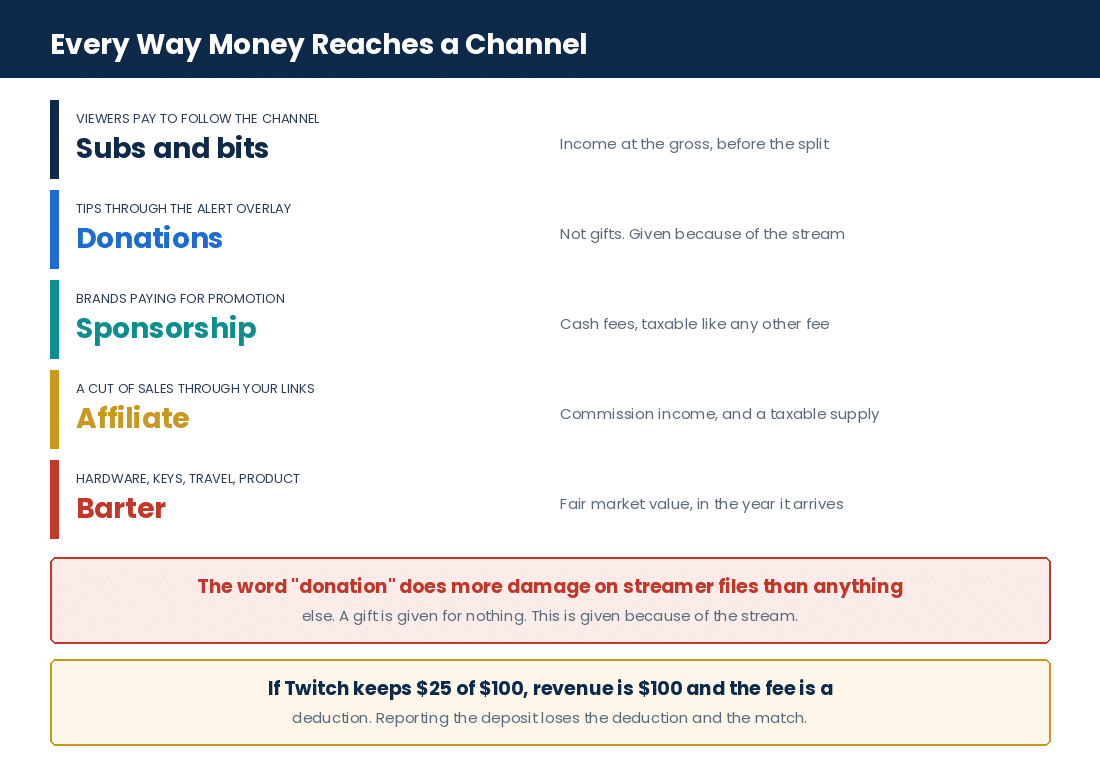
Streamers make cash in several ways:
- Subscriptions & Bits: Fans pay to subscribe or send bits during streams.
- Donations and Tips: Viewers can give money directly as support.
- Sponsorship Fees (Cash): Companies pay streamers to promote their brands.
- Affiliate Commissions: You earn a cut when people buy stuff through your links.
Knowing these helps with Twitch streamer tax planning.
Types of Twitch earnings subject to income tax
Twitch subscriptions and payouts. Money from subscriptions counts as taxable income in Canada. When Twitch pays you, report those earnings properly when filing taxes.
Donations, bits, and digital gifts. Donations or tips from viewers are also taxable. No matter what they call it — tips, gifts, or bits — it’s income linked to your streaming work.
Sponsorships, affiliate earnings, and ad revenue. Sponsorship cash counts as taxable fees. Affiliate commissions add up too. All these streams come together in your total taxable income.
Treatment of barter transactions and non-monetary income on Twitch
Sometimes brands pay with stuff instead of cash. Like hardware or travel costs for promotion. You must report these at their fair market value — basically, what they’d sell for in stores — even if no money changed hands.
The word “donation” does more damage on streamer files than any other single thing. Viewers use it, the overlay says it, and the streamer reasonably concludes it is a gift. It is not. A gift is given for nothing; a donation to a channel is given because of what the channel does, which makes it consideration for a service and therefore income.
We have had the same conversation often enough to recognise the face people make when they hear it. The amounts involved are rarely trivial, because for most mid-sized channels donations are the largest single line. Figures changed for privacy.
Difference between hobby income and business income for Twitch streamers
CRA sets rules to tell hobby from business:
- Do you want to make a profit?
- Is your setup organized?
- Do you stream often?
If yes, CRA treats your earnings like business income. If no, it might be hobby money.
Role of the CRA in regulating streaming income
CRA watches online earners like Twitch streamers closely:
- CRA review triggers: Big unexplained cash flow may cause audits.
- Filing deadline: Submit your taxes on time every year.
- Penalty for late filing: Missing deadlines can mean fines and interest.
Following these rules keeps you clear of trouble. For help with filing and tax questions, consider experts like Gondaliya CPA who know the ropes well.
Income Tax Obligations for Twitch Streamers
Income Tax Obligations for Twitch Streamers
The Core Filing
If you stream on Twitch in Canada, you must report all your earnings to the CRA. This includes donations, bits, subscriptions, ads, sponsorships — basically anything money-wise that comes from your streams. Reporting correctly keeps you in line with tax laws and avoids penalties.
Reporting All Twitch Income to the CRA
You need to tell the CRA about all money you get from streaming. Donations and tips count as income when they’re part of your business — they aren’t just gifts. Subscriptions, bits (also called cheers), and ad revenue all add up before taking out platform fees.
Here’s how it works: Say you get $100 from subscriptions but the platform keeps $25 as a fee. You report the full $100 as income and then claim the $25 as an expense. The CRA wants it that way, because profit is computed under subsection 9(1) of the Income Tax Act from gross revenue with the fee deducted separately.
Remember these points:
- Report all cash payments like donations and tips.
- Show subscription income as the total amount before fees.
- Include ad revenue fully before expenses.
- If you get stuff like game keys or hardware instead of money, put their fair market value as income.
This method matches what CRA says about business income in the CRA Business Income Guide.
Reporting the payout instead of the gross is the error we correct most often, and it looks harmless because the tax comes out roughly the same. It is not harmless. It understates revenue, which is the figure CRA compares against platform data, and it buries a legitimate deduction inside a revenue line where nobody can see it.
When the platform reports one number and the return shows a smaller one, the discrepancy is what opens the file, not the tax. Figures changed for privacy.
Classification of Twitch Streamers as Self-Employed Individuals or Corporations
How you file depends on how you run your streaming work. Most streamers are self-employed unless they set up a corporation. Whether streaming is a hobby or a business matters here but doesn’t mean you can skip reporting income.
The CRA looks at things like:
- How often and regularly you stream
- If you aim to make a profit
- How well you keep records
- How official your deals with sponsors or affiliates are
Keeping good records helps whether you’re self-employed or running a company. If you incorporate, your filing rules change but reporting income stays the same.
Income Tax Filing Deadlines and Requirements for Streamers
If you earn money from streaming in Canada, file your taxes by June 15 for the previous year if you’re self-employed. But if you owe taxes, pay them by April 30. Corporations follow different deadlines based on their fiscal year but usually have six months after year-end.
Filing late? Expect penalties and daily charges after deadlines. Interest also builds on unpaid taxes. Penalties get worse if delays drag on.
File on time to avoid costs and keep credits like GST/HST input tax credits available.
Consequences of Unreported or Underreported Streaming Income
Not telling the CRA about all your streaming income could cause them to check your returns closely. They match what platforms report with what you declare.
If they find missing amounts, expect extra taxes plus interest going back years. Hiding income can bring gross negligence penalties under subsection 163(2) of the Income Tax Act and, in serious cases, prosecution for tax evasion under subsection 239(1).
Good records help back up what you claim during any review.
Foreign Tax Withheld and Eligibility for Foreign Tax Credits
Sometimes foreign platforms take tax out before paying you. When that happens, you might get a foreign tax credit when filing Canadian taxes — subsection 126(1) for non-business income tax, which is what platform withholding on royalties usually is, or subsection 126(2) where it is business income tax. This stops double taxation by reducing what you owe here based on foreign tax paid abroad.
If credits don’t apply — maybe due to treaties or limits — you can try deductions instead, though those usually help less than credits [Income Tax Act Section 20(11)].
Make sure to keep documents like official withholding slips from foreign payers so you can claim these properly during Twitch streamer tax filing in Canada.
Income Tax Act ss. 9(1), 18(1)(a), 20(11), 126(1), 126(2), 150, 162(1), 163(2), 239(1) · CRA Guide T4002: Self-employed Business, Professional, Commission, Farming and Fishing Income
GST/HST Registration Threshold and Obligations for Streamers
GST/HST Registration and Obligations
The $30,000 Line
If you stream on Twitch in Canada, you need to know when to register for GST/HST. The key point is the small supplier threshold. This limit decides if you must sign up with the CRA. It applies no matter if you get donations, subscriptions, or sponsorship money.
$30,000 Small Supplier Threshold
The GST/HST small supplier threshold means you can earn up to $30,000 in gross revenue over four straight calendar quarters without registering. This includes all taxable income from Twitch subscriptions, sponsorships, and affiliate earnings. But once your worldwide taxable supplies go over $30K across four consecutive calendar quarters, or in a single calendar quarter, you have to register under section 240(1) of the Excise Tax Act (ETA).
Situations Requiring Registration
You must register right after your streaming income passes the small supplier limit. This covers affiliate commissions and cash sponsorships. It counts all taxable sales inside Canada unless those sales are zero-rated or exempt by law (see Excise Tax Act sections 165 and 221). Even payments from outside Canada count if they come from Canadian sources following place-of-supply rules.
Tracking Cumulative Twitch Income
You should keep close track of your total Twitch income. That way, you’ll know when you need to register under Twitch streamer tax filing Canada rules.
Your gross revenue includes everything you get before platform fees come out. So don’t just look at what Twitch pays out after fees; count all bits, subscriptions, and ad shares too. The CRA wants gross amounts reported, as set out in CRA Guide RC4022. Keep good records so you catch when your earnings cross that $30K line.
Consequences of Failing to Register When Required
If you wait too long to register, CRA can charge penalties. They may add interest on taxes you owe under section 280 of the Excise Tax Act plus a failure-to-file penalty under section 280.1. Missing registration can bring extra scrutiny if your reported income doesn’t match platform data.
Crossing $30,000 is not a year-end event, and that catches people. A channel that grows through the autumn can pass the threshold in October on the strength of one good month, and registration is then required with effect from a date that has already gone by.
The tax on sales made after that date is owed whether or not it was ever charged to anyone, and there is no going back to viewers for it. Watching the running four-quarter total monthly costs nothing and prevents exactly this. Figures changed for privacy.
Charging GST/HST on Twitch Subscriptions, Sponsorships, and Other Income Sources
After registering for GST/HST — because you made enough from subscriptions or sponsorships — you must charge tax correctly. This includes cash payments and goods given as sponsorships valued fairly, since subsection 153(1) of the Excise Tax Act deems non-money consideration to equal its fair market value.
GST/HST applicability to digital products and services. Digital streaming services usually carry regular GST or HST rates depending on the province where your customers are, under the place-of-supply rules in Schedule IX of the Excise Tax Act and the New Harmonized Value-added Tax System Regulations. Some exported digital products might be zero-rated. But most Canadian streaming transactions require normal tax unless laws say otherwise.
Charging GST/HST on affiliate and sponsorship income. Affiliate commissions count as taxable sales. You must add the correct tax when invoicing Canadian clients. The same goes for cash sponsorship fees — they need GST or HST based on the place-of-supply rules in section 142 of the Excise Tax Act, Schedule IX and the New Harmonized Value-added Tax System Regulations.
Claiming Input Tax Credits (ITCs) on Business Expenses
Once registered, streamers can claim input tax credits for business costs linked to their content creation work. That helps recover some of the taxes paid on expenses.
Eligible expenses for ITCs:
- cameras listed under Class 8 capital assets with a business-use part applied;
- software licenses used only for streaming;
- internet bills divided between personal and work use;
- plus invoices from editors or moderators hired as contractors.
Recordkeeping for GST/HST purposes. Keep all receipts showing vendor names with valid Business Numbers. CRA expects records kept for six years after the end of the year the return relates to, under section 286 of the Excise Tax Act. Having good files helps during audits without risking penalties.
Small Supplier Threshold and Zero-Rated Supplies Related To Streaming
Knowing how zero-rated supplies fit with small supplier rules clears up when some streamed goods or services don’t carry tax but still count towards thresholds.
Streaming Services and Zero-Rated Goods — Definitions and Examples
Zero-rated supplies mostly mean exports — no Canadian tax applies but input credits stay claimable. Most domestic streaming services making subscription income don’t qualify here and must charge regular GST/HST unless specific laws say otherwise (ETA Schedule VI, Part V).
For example:
- International giveaways shipped abroad may be zero-rated
- Digital access given only in Canada is fully taxable at province rates
Experts like Gondaliya CPA often guide creators across Toronto, Hamilton, Mississauga, Ottawa, Vaughan, Brampton, and other regions about these rules.
Maintaining Compliance With GST/HST Rules
You file taxes quarterly or yearly depending on your sales after registration. Missing deadlines leads to penalties like those mentioned earlier plus possible reassessments later on. Staying current cuts audit risks and lets you claim ITCs properly against reported income.
If you’re managing Twitch streamer taxes Canada and need help with GST/HST filing or tracking multiple income streams right — contact Gondaliya CPA at info@gondaliyacpa.ca. Our Ontario CPA firm works flat-fee packages geared toward creators across Toronto and beyond.
Streamer Tax Readiness Check
Five quick questions on where your departure file stands. No fee shown.
Points to raise with us:
This is a general prompt, not tax or legal advice or a quote. Your position depends on your full facts. For a real review, please book a free consultation.
Tax Deductions and Expense Claims for Twitch Streamers
Tax Deductions and Expense Claims
What You Can Claim
Planning taxes as a Twitch streamer in Canada means knowing what expenses you can claim. It also means keeping good records. This helps lower your taxable income and avoids trouble with the CRA. Twitch streamer tax planning is about spotting costs tied to your streaming work and reporting them right. If you do this well, your Twitch streamer taxes Canada filings will go smoother.
Eligible Business Expenses: Equipment, Software, and Home Office
You can deduct costs linked to your streaming business. The Income Tax Act [ITA s.18(1)(a)] allows this if the expenses are reasonable.
Here’s what you can usually claim:
- Equipment: Cameras, mics, computers, and lights you mainly use for streaming.
- Software: Licenses or subscriptions for streaming tools.
- Internet: The part of your internet bill used for streaming.
- Home office: If the space meets CRA rules (see below).
Remember: You only claim the business part if equipment is used both personally and professionally. Keep receipts or invoices as proof.
Example: You buy a $2,400 computer used 70% for streaming. You can claim 70% of its depreciation through Capital Cost Allowance (CCA). Also, you can deduct repair costs based on usage.
Home Office Deduction Criteria and Calculation Methods
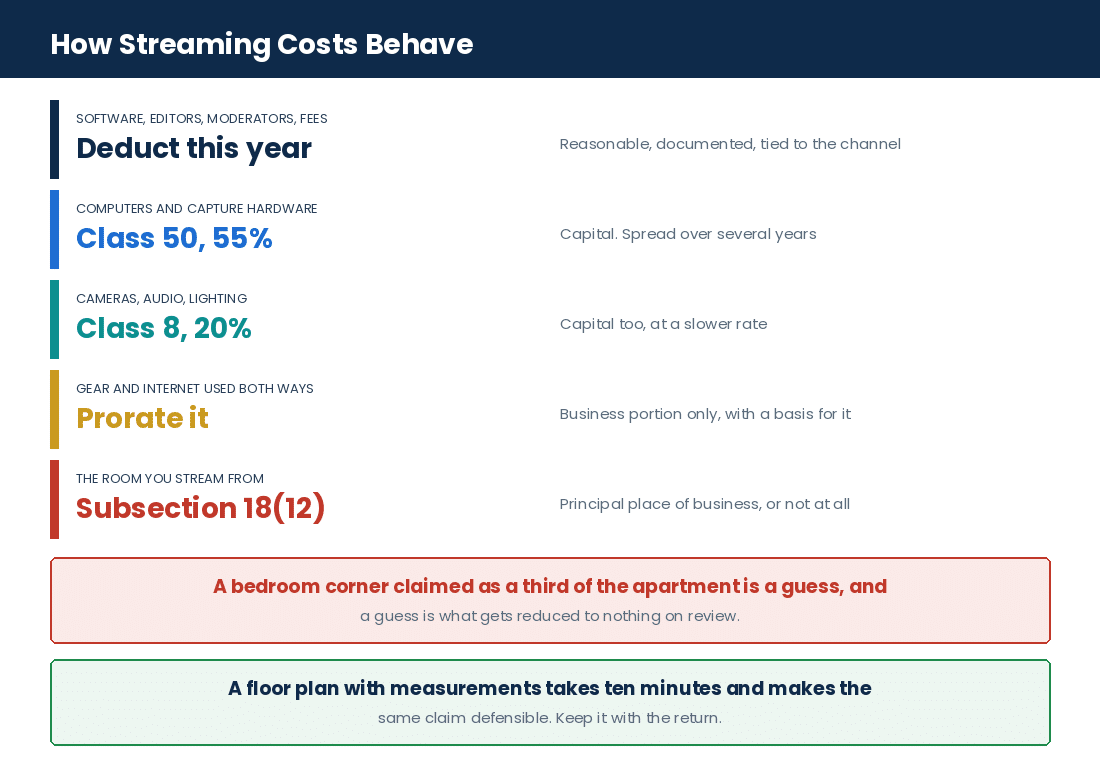
The CRA sets rules to let you claim a home office deduction [Income Tax Act s. 18(12); CRA Guide T4002]. You qualify if the space is your principal place of business — which for most streamers is the test that applies — or if you use it exclusively to earn business income and also use it on a regular and continuous basis to meet clients or customers there. The second test needs both limbs, so a spare room used only for streaming qualifies under the first test or not at all.
Eligible costs include parts of electricity bills, rent or mortgage interest (not principal), and property taxes based on how big the workspace is compared to your whole home.
Here’s an example:
| Expense Type | Total Cost | Workspace % | Amount You Can Deduct |
|---|---|---|---|
| Electricity | $1,200 | 15% | $180 |
| Rent | $12,000 | 15% | $1,800 |
Keep floor plans or pictures that show how big your workspace is. That helps if the CRA asks questions.
The home office claim is where streamers overreach most, and usually not out of greed. A bedroom corner with the setup in it gets claimed as a third of the apartment, because that is roughly how much of the room it takes up, and the room feels like a third of the place.
A floor plan with measurements settles it in ten minutes and makes the claim defensible. Without one, the number is a guess, and a guess is what gets reduced to nothing on review. Figures changed for privacy.
Capital Cost Allowance (CCA) for Depreciable Streaming Assets
Stuff like computers and cameras wear out over time. The CRA lets you write off their cost gradually with CCA under ITA Schedule II classes:
- Computers usually go in Class 50 with about a 55% rate yearly.
- Audio/video gear fits in Class 8 at roughly 20%.
The half-year rule means you only get half the usual CCA in the first year after buying something new [Income Tax Regulations 1100(2)], although the Accelerated Investment Incentive can give a larger first-year claim on eligible property, so the year of purchase is worth checking rather than assuming. Claiming CCA lowers taxable income but reduces how much value you have left in the asset when selling it later.
Example: You buy a $3,000 audio mixer mid-year. Under the half-year rule you can claim about 10% (half of 20%) that year — roughly $300 (CRA Guide T4002).
Streamers expect a new $4,000 machine to come off this year’s income in one go, and it does not. It goes into Class 50 and comes off over several years, which in a growth year feels like being taxed on money that is visibly sitting in the corner of the room.
The useful habit is to think of a big purchase as something that reduces tax across the next few returns rather than this one, and to time it with that in mind instead of buying in December on the assumption it wipes out the year. Figures changed for privacy.
Deducting Contractors, Marketing, and Professional Service Fees
Paying editors, moderators or marketers helps your stream run smooth. Those fees count as contractor expenses if documented properly [ITA s.18(1)(a)]:
- Keep contracts or agreements showing what they did.
- Save invoices with dates and amounts paid.
Fees paid to accountants or tax pros also count if tied directly to your stream business.
Good records help make sure these claims pass CRA checks during audits.
Commonly Challenged Deductions and How To Substantiate Claims
The CRA often questions some deductions because streamers mess up:
- Some treat donations like gifts that don’t count as income. Actually, all viewer payments linked to streaming are income [CRA ITA ss.9 & 18].
- Others overclaim home office size without proof. Show clear measurements plus matching utility bills.
- Claiming full costs on gear used partly personally won’t fly; use prorated amounts backed by logs or notes.
To back up your claims:
- Keep all original receipts sorted by type.
- Track daily use when needed.
- Use written deals with contractors.
- Write down values of barter deals like sponsorships clearly.
Sharad Gondaliya CPA offers guidance focused on Twitch streamer tax filing Canada rules so you report correctly under current laws through 2026.
Business Structures and Tax Planning for Twitch Streamers
Business Structures and Tax Planning
Structure
Picking the right business setup matters for Twitch streamer tax planning in Canada. How you set up your business changes how you report your income and pay taxes. It also affects the deductions you can claim under Canadian tax rules. Knowing the difference between sole proprietorships, corporations, and holding companies can help you lower your Twitch income tax Canada bill.
Here’s why it counts:
- Business structure shapes your tax load.
- It impacts legal protection for your assets.
- It influences how money flows through your accounts.
Comparing sole proprietorship, corporation, and holding company structures
A sole proprietorship means you run the show alone. All money you make from streaming goes straight onto your personal tax return (T1). That means Twitch streamer taxes Canada get taxed at your personal rates with no separate corporate filings. It’s simple and cheap to start but offers no liability protection if things go wrong.
A corporation is a separate legal thing from you. It files its own tax return (T2). Money earned by the stream goes to the corporation first, before you take any salary or dividends. This can help lower your Twitch income tax Canada since corporations pay less tax on retained earnings than individuals do on personal income.
Holding companies sit above corporations. They don’t stream themselves but hold shares of other companies that do. Streamers use holding companies to protect valuable stuff like copyrights or investments from risks tied to running the streaming business.
| Structure | Tax Filing | Liability Protection | Complexity |
|---|---|---|---|
| Sole Proprietorship | Personal T1 Return | None | Low |
| Corporation | Corporate T2 Return | Limited | Moderate |
| Holding Company | Corporate T2 Return (investments) | Strong via asset segregation | High |
Sources: CRA Guides T4002 and T4012; Income Tax Act ss. 3, 248(1)
Tax implications and benefits of incorporation for Twitch streamers
Incorporating offers perks for Twitch streamer tax filing Canada:
- Income Splitting: Dividends to family shareholders are caught by the tax on split income rules in section 120.4, which tax them at the top marginal rate unless the recipient meets an exclusion such as being actively engaged in the business on a regular, continuous and substantial basis, or being 25 or older and holding a sufficient interest in a company that is not a services business. The structure is worth discussing, but it is not the automatic saving it was before 2018.
- Tax Deferral: Money kept inside the corporation gets taxed at smaller business rates — usually less than personal top rates.
- Expense Deductions: Corporations deduct costs like streaming gear depreciation under Capital Cost Allowance rules.
- Limited Liability: Your risk as a shareholder is limited compared to a sole proprietor responsible for debts.
But there’s more paperwork involved: annual financial statements and corporate filings that have different deadlines than personal returns.
Example: If a streamer makes $80K after fees and keeps $40K inside their corporation instead of taking it all out personally, they delay paying higher personal taxes until later.
The word doing the work there is “delay”. Incorporation is deferral, not saving, and it only helps if the money genuinely stays in the company. A streamer who incorporates and then draws everything out to live on has bought themselves filing fees and a second return. Figures changed for privacy.
Using holding companies for investment and asset protection
Holding companies can protect what matters most:
- They keep assets like trademarks or copyrights safe from daily business risks.
- Dividends moved up to a holding company from a connected corporation are generally received free of immediate tax under section 112, so the funds can be invested there, though Part IV tax can apply in some cases.
- They make passing control easier by letting you shift shares without touching operations directly.
For new solo streamers making under $30K (GST/HST threshold), holding companies may be too much hassle unless cash builds up enough to justify it.
Source: CPA Canada Business Advisory Services Guidelines
Timing considerations for incorporation and tax filing differences
When you incorporate changes how and when you file. New corporations must file their first return within six months after their fiscal year ends. Choosing December 31 as year-end fits well with personal tax returns if you’re switching from sole proprietor to corporation.
Here’s a quick look at filing deadlines:
| Aspect | Sole Proprietor | Corporation |
|---|---|---|
| Filing Deadline | April 30 next year (June 15 if self-employed) | Six months after fiscal year-end |
Extensions are sometimes possible if requested early. The CRA expects timely payroll and GST/HST payments based on your schedule too.
Best practices for bookkeeping, record keeping, and CRA representation
Good records keep Twitch streamer taxes Canada smooth:
- Track income types separately — subscriptions, sponsorships, donations — all before platform fees come off [ITA s9].
- Save receipts and invoices for expenses like hardware; know how to claim them properly under Capital Cost Allowance [ITA s20(1)(a)].
- Use software like QuickBooks Online or Xero linked with your bank to catch errors early.
Hiring pros who get gaming creator taxes Canada helps with tricky stuff — like barter deals where goods replace cash payments valued fairly [ITA s18(1)(a)]. For example, Gondaliya CPA offers flat-fee services including financial statement prep and CRA representation to lower audit chances by staying ahead on paperwork.
Sharad Gondaliya, CPA sticks closely to Canada Revenue Agency rules. He works with creators across Canada including Toronto clients needing expert help tailored around changing online income models.
Risk Management and Compliance Best Practices
Risk Management and Compliance
Staying Clear
If you stream on Twitch in Canada, tax planning can get tricky. You need to know common mistakes, what might trigger an audit, reporting rules, catch-up filing options, and how to keep up with compliance. Handling these well lowers your risk and helps with accurate Twitch income tax Canada filings.
Common Tax Mistakes Made by Twitch Streamers and How to Avoid Them
Streamers often mess up reporting or mix up income types. Here’s what usually goes wrong:
- Thinking donations aren’t taxable gifts but business income tied to streaming.
- Reporting money after fees instead of total earnings before fees.
- Forgetting to report barter deals like sponsorships paid with stuff or services at fair market value.
- Claiming business expenses that aren’t reasonable or lack proof.
- Not registering for GST/HST once income passes the small supplier limit.
You can avoid these errors by tracking all payments carefully — tips, subs, sponsorships — and keeping receipts. Use the same currency conversion method for foreign cash. Value barter goods as per Income Tax Act s. 18(1)(a). Good bookkeeping makes Twitch streamer taxes Canada much simpler.
CRA Lifestyle Audits: What Triggers Them and How Streamers Can Prepare
CRA might check your lifestyle if spending looks higher than reported income or platform info doesn’t match. Some common causes are:
- Missing income spotted in third-party slips or platform reports.
- Big jumps in living costs without more taxable earnings.
- Sketchy records or missing papers during past checks.
To get ready, keep clear financial files that match bank deposits with all earnings like subs, bits, donations, affiliate pay, and sponsors [CRA Income Tax Act s. 150]. Save contracts for brand deals plus invoices if you pay editors or helpers. If you find missed returns, tell CRA early to lower penalties.
A streamer who posts their new setup, their car and their holidays is publishing a lifestyle statement, and CRA is perfectly entitled to read it. We have never seen a channel audited because of a video. We have seen plenty where the video made the auditor’s arithmetic easier once the file was already open.
The answer is not to hide anything. It is that the reported income should be able to account for what is visible, and on most channels it comfortably can once the gross figures are being reported properly. Figures changed for privacy.
Reporting Requirements to Reduce Audit Risk and Maintain Compliance
Canadian tax law says file accurate returns on time showing all streaming income no matter how you get paid [Income Tax Act s. 150]. Here are key facts:
| Requirement | Details | Source |
|---|---|---|
| Filing Deadline | April 30 after the calendar year ends (June 15 if self-employed but payment due April 30) | CRA |
| Late Filing Penalty | 5% of the balance owing plus 1% per month up to 12 months | Income Tax Act s. 162(1) |
| Record Keeping Period | Keep records for six years after tax year end | Income Tax Act s. 230(4) |
Organized books help report all streams properly — including donations tax Canada under Twitch streamer tax filing Canada rules.
Catch-Up Filing Options for Previous Years’ Unfiled Returns
Did you skip reporting some years? You can still catch up but act fast to cut risks:
- Voluntary Disclosure Program (VDP): Lets you tell CRA before they start a review and avoid penalties on missed income, under the CRA VDP guidelines.
- Filing Back Returns: Send missing returns with honest details and reconstructed records if needed.
- Get Help: A CPA who knows gaming creator taxes Canada can fix incomplete files right and use relief rules well.
Doing this soon helps limit interest charges under current rules affecting creator income reporting through 2026.
Catch-up files on streaming income are rarely about hiding money. They are about someone who started a channel at nineteen, never thought of it as a business, and woke up three years later with a real income and no returns.
That person is a good candidate for the disclosure programme, and the thing that decides the outcome is arriving before CRA does. Once a letter has gone out about the very years in question, the relief is off the table. Figures changed for privacy.
Action Checklist for Tax Filing and Ongoing Compliance Monitoring
Stick to these tips to be accurate and avoid audits:
- Register your streaming business when yearly revenue goes over $30K CAD.
- Separate payments: tips/donations; subs shares; ad money; affiliate pay; sponsorship cash or goods.
- Price barter items at fair market value as soon as you get them following Income Tax Act rules.
- Only claim sensible expenses directly tied to streaming — gear depreciation (like cameras), internet used for work, home office space meeting CRA rules [ITA ss20(1)(a),67].
- Keep contracts and invoices if paying editors or moderators regularly.
- Convert foreign payments using Bank of Canada exchange rates from transaction days consistently.
This approach covers everything a Toronto-area creator needs while sticking closely to Canadian Twitch streamer taxes Canada laws.
For advice made just for your channel contact Gondaliya CPA at info@gondaliyacpa.ca or call 647-212-9559 for a free chat about expert Twitch streamer tax planning anywhere in Ontario including Hamilton.
FAQs on Twitch Streamer Taxes Canada
Frequently Asked Questions
Answers
What is the penalty for late filing Twitch streamer taxes in Canada?+
When must I start making instalment payments for Twitch income tax?+
How long should I keep tax records for my Twitch streaming business?+
What documents prove my Twitch income?+
How do I report barter income received from sponsors?+
How do I calculate business vs personal use for expense claims?+
What currency conversion method should I use for foreign Twitch income?+
Can I claim a zero-rated supply when streaming to international viewers?+
What triggers a CRA registration review for Twitch streamers?+
Essential Insights for Twitch Streamers
Essential Insights for Streamers
Key Points
Key points for Twitch streamer tax filing and compliance:
- Keep contractor records such as agreements and invoices to support expense claims.
- Understand place of supply rules to correctly charge GST/HST based on client location.
- Track unreported amounts carefully; voluntary disclosure reduces penalties on missed income.
- Know the foreign tax credit limit to avoid double taxation when paid from outside Canada.
- Prepare thoroughly before work starts: organize income streams, expense receipts, contracts.
- Report gross revenue before platform fees, with the fees deducted separately as an expense.
- Value barter and gifted hardware at fair market value in the year received.
- Watch the running four-quarter total so the $30,000 GST/HST threshold is not crossed unnoticed.
- Prorate equipment used both personally and for streaming, and keep the basis for the split.
- Treat incorporation as deferral rather than saving, and test it against what you actually draw.
DIY vs CPA Firm: Which Route Fits a Twitch Streamer?
- DIY filing suits simple streams with under $30K revenue and minimal expenses.
- CPA firms help with complex income streams, incorporation decisions, and audit defense.
- Gondaliya CPA offers tailored services for Canadian streamers with transparent costs.
How Gondaliya CPA Handles Your Twitch Streamer Tax File
- We collect all income details including subscriptions, sponsorships, donations.
- We review your expense receipts and contractor agreements thoroughly.
- Our team applies correct CCA rates for your streaming equipment depreciation.
- We prepare precise GST/HST filings considering place of supply rules.
- We offer expert advice on business structure choices and tax planning strategies.
Deliverables You Get from Gondaliya CPA
- Complete annual personal or corporate tax returns filed accurately and on time.
- Detailed bookkeeping support ensuring proper categorization of all revenues/expenses.
- GST/HST registration assistance and input tax credit claims management.
- Customized tax planning guidance to reduce future liabilities legally.
How Much Does Expert Twitch Streamer Tax Help Cost?
Gondaliya CPA works on flat-fee packages depending on complexity: starting at affordable rates for sole proprietors up to more advanced corporate filings with audit protection options.
Why Trust Gondaliya CPA With Your Streaming Taxes?
Sharad Gondaliya has CPA Ontario credentials plus US CPA licenses backed by 1300+ five-star Google reviews. He knows Canadian streamer tax rules inside out and serves clients from Toronto to Ottawa with proven expertise.
For a free consultation tailored to your channel’s needs contact info@gondaliyacpa.ca or call 647-212-9559 today.
Businesses We Serve & Industry Spotlights
Industry Expertise
Twitch streamers sit inside a wider group of people who earn from an audience rather than an employer, and the questions that decide a streamer file — whether it is a hobby or a business, what the gross figure really was before the platform took its cut, and how to value something a sponsor sent instead of paying — recur across every one of these situations.
| Who | The Creator Tax Angle |
|---|---|
| Twitch streamers | Donations as income, bits, subs and barter valuation |
| Esports organizations | Prize money, player contracts and sponsorship deals |
| Digital platforms | Place of supply and who collects the tax |
| Online course creators | Deferred revenue and cross-border digital sales |
| Digital product businesses | Place of supply where nothing physical ships |
| E-learning platforms | Subscription revenue recognised across periods |
| Musicians | Royalties, foreign withholding and tour expenses |
| DJs | Equipment as capital, gig income and travel claims |
| Public speakers | Fee income, travel and the home office test |
| Side-hustle businesses | The hobby versus business line, and when it is crossed |
| Home-based businesses | Work space in the home under subsection 18(12) |
Spotlights: Twitch streamers · esports organizations · digital platforms · online course creators · digital product businesses · e-learning platforms · musicians · DJs · public speakers · side-hustle businesses · home-based businesses.
Professional Guidance and Quick Reference
Guidance
Essential Tax Points for Canadian Twitch Streamers
Streamer files go wrong in a predictable set of ways: donations treated as gifts because that is what the overlay calls them; the Twitch payout reported as revenue instead of the gross; sponsored hardware never valued at all; the $30,000 threshold crossed in a good month and noticed the following spring; a bedroom corner claimed as a third of the apartment with nothing to support it; and a channel that has been earning for three years with no returns filed because it never felt like a business. Gondaliya CPA prepares creator returns on a flat annual fee.
Quick Answers
At a Glance
- Hobby or business: intent to profit, organisation and regularity decide it
- Donations: income, not gifts, because they follow from what the channel does
- Bits, subs, ads, affiliate: all income, all before platform fees
- Report gross: profit is computed under subsection 9(1), fees deducted separately
- Barter: fair market value, in the year the goods arrive
- Foreign withholding: foreign tax credit under 126(1), or 126(2) if business income tax
- Filing: June 15 if self-employed, but payment is due April 30
- Late filing: 5% plus 1% per month to 12 months, under 162(1)
- Instalments: once net tax owing passes $3,000
- GST/HST: $30,000 of worldwide taxable supplies over four consecutive quarters
- Registration: section 240(1), effective from when you crossed, not when you noticed
- Input tax credits: available once registered, on the business portion
- Computers: Class 50, 55%
- Cameras and audio: Class 8, 20%
- First year: half-year rule under Regulation 1100(2), unless the incentive applies
- Home office: subsection 18(12), principal place of business for most streamers
- Family dividends: caught by tax on split income under section 120.4
- Records: six years, under subsection 230(4)
Who This Is For / Not For
Fit Check
- For: Canadian streamers earning from subscriptions, bits, donations, sponsorships or affiliate links, whether as a sole proprietor or through a corporation.
- For: creators who have been reporting the payout rather than the gross, who have never valued sponsored gear, or who have been earning for a few years without filing.
- Not for: advice on provincial sales taxes outside the HST provinces, US state-level obligations, or platform terms of service, all of which sit outside this article’s scope.
- Not for: someone who streams occasionally with no intent to profit and earns nothing from it. A small channel that does earn is squarely in scope, because the reporting obligation does not wait for a threshold.
People Also Ask
Related Questions
My viewers call them donations. Are they really taxable?+
Yes. The label does not decide it. A gift is given for nothing in return; a donation to a channel is given because of the stream, which makes it consideration for what you do and therefore business income. The same goes for bits, tips and anything else routed through an alert. For most mid-sized channels this is the single largest revenue line, so getting it wrong is not a rounding issue.
When does my channel stop being a hobby?+
When it starts looking like a business: an intention to profit, a degree of organisation, and regularity. There is no hour count or dollar figure that flips it. In practice, a channel with a schedule, a sponsor, a separate account and consistent revenue is a business, and a channel someone streams on when they feel like it with no income is not. Most people asking the question already know which side they are on.
A sponsor sent me a $2,000 graphics card. Do I report that?+
Yes, at fair market value, in the year it arrives. Barter is income even though no money moved, and the value is what the item would sell for. The compensating point is that the card is then yours at that cost for capital cost allowance purposes, so it is not pure downside — but it has to be recorded when it arrives, because reconstructing values a year later is guesswork.
Do I report what Twitch deposited, or what the viewer paid?+
What the viewer paid. If a $100 subscription arrives as $75 after the platform’s share, revenue is $100 and the $25 is a deduction. Profit is computed under subsection 9(1) from gross revenue. Reporting the deposit understates revenue against the figure the platform reports and loses you a legitimate expense at the same time.
Can I write off the gaming PC I also play on?+
The business portion of it, through capital cost allowance rather than as an outright expense. A machine used 70% for streaming gets 70% of the Class 50 claim at 55%. What will not survive review is claiming the whole thing on a computer that is obviously also the household gaming machine. Keep whatever supports the split — stream hours against total use is usually the most defensible basis.
Glossary of Key Terms
Definitions
- Business income: income from an activity carried on with an intention to profit.
- Hobby income: income from an activity with no profit motive, outside the business rules.
- Bits: the Twitch virtual currency viewers buy and spend to cheer on a stream.
- Subscription: a recurring viewer payment to a channel, shared with the platform.
- Donation or tip: a viewer payment outside the platform’s own products, still income.
- Affiliate commission: a share of sales made through a creator’s referral links.
- Barter transaction: payment in goods or services rather than money.
- Fair market value: what an item would fetch between unrelated parties, used to value barter.
- Gross revenue: what the viewer or sponsor paid, before platform fees are deducted.
- Small supplier: a business under $30,000 of worldwide taxable supplies over four consecutive quarters.
- Input tax credit (ITC): recovery of GST/HST paid on costs incurred to make taxable supplies.
- Place of supply: the rules deciding which province’s rate applies to a supply.
- Capital cost allowance (CCA): the deduction spreading an asset’s cost over several years.
- Class 50: the CCA class for computer equipment, at 55%.
- Class 8: the CCA class for cameras, audio and general equipment, at 20%.
- Half-year rule: Regulation 1100(2), limiting the first-year claim on new additions.
- Work space in the home: the deduction governed by subsection 18(12).
- Tax on split income (TOSI): section 120.4, taxing certain family dividends at the top rate.
Want a checklist to work from? You can download our free streamer tax checklist before your consultation.
Four things decide a streamer file. What counts as income — donations, bits, subs, ads, affiliate commissions and sponsored goods, regardless of what the viewer or the overlay called it, because a payment made because of what your channel does is consideration for a service. Which figure you report — the gross the viewer paid, not the platform payout, with fees deducted separately, since profit is computed under subsection 9(1). When GST/HST starts — $30,000 of worldwide taxable supplies across four consecutive calendar quarters, with registration effective from when you crossed rather than when you noticed, and the tax owed on sales after that date whether or not anyone was charged. And what the gear costs you — capital, not expense: Class 50 at 55% for computers, Class 8 at 20% for cameras and audio, prorated for personal use and supported by something better than a guess.
Three questions tell you where you stand, and all three can be answered tonight. First, what did your viewers actually pay last year? Pull the Twitch payout report and find the gross, not the deposits. Second, what is your rolling four-quarter total? Add it up now rather than discovering in April that you passed $30,000 in September. Third, what did sponsors send you that was not money? List it with what it was worth on the day it arrived, because that record is far harder to build a year later.
Twitch Streamer Taxes Canada: How Gondaliya CPA Can Help
Start with a payout report and a list of what sponsors sent you
Gondaliya CPA rebuilds gross revenue from the platform reports before anything else is calculated, separates subs, bits, donations, ad share and affiliate income so each is visible, values barter and gifted hardware at the date it arrived, tracks the rolling four-quarter total against the $30,000 threshold and handles registration when it is crossed, applies the right CCA class to each piece of equipment with a defensible business-use split, tests the work space in the home claim against subsection 18(12) before it is filed, and advises on whether incorporating is deferral worth having given what you actually draw — on a flat annual fee including HST with a one-business-day response. Please book a free consultation.
Next Steps
Please book a free consultation with Gondaliya CPA and bring three things: your platform payout reports for the years in question, a list of anything a sponsor sent you instead of money, and your receipts for gear. Those three settle the revenue figure, the barter position and what is claimable — which between them account for nearly every difficulty we see on a creator file. If the channel has been earning for a few years and nothing has been filed, say so at the outset, because catch-up work is routine, the disclosure programme usually helps, and the thing that decides the outcome is arriving before CRA does. We advise on Canadian federal tax and GST/HST; provincial sales taxes outside the HST provinces and US state obligations are handled separately. You will get a flat annual fee including HST before any work begins. We serve Toronto, Mississauga, Brampton, Vaughan, Etobicoke, Scarborough, Hamilton, Ottawa and the rest of Ontario, and work with creators across Canada. If our content helps, please add gondaliyacpa.ca as a preferred source on Google.
Published: · Last updated:
Editorial policy: We research against CRA, Department of Finance, Parliament of Canada, CPA Canada and CPA Ontario sources, fact-check the figures, and Sharad Gondaliya, CPA, reviews the content, which we update as the rules change.
Disclaimer: This article is educational information only and is not tax, legal or financial advice. It covers Canadian federal income tax and GST/HST for residents earning income from Twitch and similar streaming platforms, including hobby versus business income, gross reporting, barter, capital cost allowance, the work space in the home test and business structure choices. It does not cover provincial sales taxes outside the HST provinces, US state-level obligations, or platform terms of service, each of which is handled separately. Capital cost allowance rates and first-year rules, thresholds, filing deadlines and statutory references change; every reference should be confirmed against current CRA guidance before a return is filed. Whether an activity is a business or a hobby turns on the full facts. Gondaliya CPA performs compilation engagements under CSRS 4200 and does not perform audit or review engagements. Please consult a licensed CPA before acting.

Sharad Gondaliya is a CPA Canada & CPA USA with 15 Years+ experience of Accounting, Tax, Payroll of Corporate Small Businesses as Tax Accountant. He is a CPA Ontario member (61040184) and holds US CPA licences in Washington and Montana and is well known among corporate small businesses for tax planning, efficient tax solutions, and affordable CPA services. Sharad is the Principal (Director) of Gondaliya CPA – Affordable CPA Firm in Canada. Licenses: CPA Ontario: 61040184 | CPA USA (MT): PAC-CPAP-LIC-033176 | CPA USA (WA): 57629 | CPA Firm License: 61330051 View Full Author Bio