



The Ultimate Guide to Multi-Residential Building Taxes and Accounting in Canada
Multi Residential Building Taxes Canada: Comprehensive Guide to Apartment Building Tax Deductions, Corporate Tax Filing, and Capital Cost Allowance with Gondaliya CPA
Multi residential building taxes Canada require careful attention to capital cost allowance, corporate tax filing, and prescribed costs to optimize deductions. Gondaliya CPA helps multi-residential building owners in Ontario navigate CRA requirements, bookkeeping, payroll services, and GST/HST filing to manage rental income and corporate tax efficiently.
Quick Summary
Apartment buildings are taxed through a handful of rules that owners regularly run together. Each building costing $50,000 or more sits in its own capital cost allowance class under Regulation 1101(1ac), so depreciation follows the building rather than the portfolio. Separately, Regulation 1100(11) stops that allowance from creating or increasing a rental loss, which is the rule that surprises people at year end. Rental income is usually a specified investment business under subsection 125(7), so the small business deduction is lost unless the corporation employs more than five full-time employees throughout the year. Long-term residential rent is exempt, so there are no input tax credits on the costs behind it, though the new residential rental property rebate under section 256.2 can apply to qualifying builds. And when a building is sold, recapture under 13(1) and terminal loss under 20(16) are computed class by class, which is the whole point of keeping them separate.
Reading time: 16 minutes.
Table of Contents
- Understanding Taxes and Property Assessment
- Calculating and Reporting Rental Income
- Deductible Expenses and Capital Cost Allowance
- Corporate Structure and Accounting Standards
- Tax Planning Strategies and Compliance
- Additional Resources and Support
- Frequently Asked Questions
- Essential Insights for Owners
- Businesses We Serve & Industry Spotlights
- Professional Guidance and Quick Reference
The Numbers That Matter
This article covers Canadian federal income tax, GST/HST and corporate accounting for multi-residential rental buildings, with Ontario and Toronto context, and reflects rules current to 27 October 2026. It is written for owners holding apartment buildings personally, in partnership or through a corporation, and it covers rental income reporting on Form T776, accrual versus cash basis, bad debts, separate capital cost allowance classes and the rental loss restriction, recapture and terminal loss, the specified investment business test, ASPE versus IFRS, payroll for superintendents, and GST/HST on exempt residential rent. Municipal property tax rates vary by municipality and by year, and the multi-residential class is rated separately from the residential class in many Ontario municipalities, so confirm your own municipality’s current rate rather than relying on a general range. Gondaliya CPA performs compilation engagements under CSRS 4200, which provide no assurance; audit and review engagements are referred out. This is educational information only and not tax or legal advice.
Understanding Multi Residential Building Taxes and Property Assessment in Canada
Understanding Taxes and Property Assessment
Start Here
Multi-Residential Buildings in Canada: Definitions and Key Characteristics
Multi-residential buildings have several rental units inside one structure. These include apartment complexes, condos, and townhouses. When it comes to multi residential building taxes Canada, owners face different tax rules than single-family homes. Assessors look at the building’s location, size, amenities, and condition when setting property values.
Owners should know:
- Multiple rental units under one roof
- Includes apartments, condos, townhouses
- Taxes differ from single-family homes
- Assessed by location, size, condition
Legal and Tax Implications for Multi-Residential Building Owners in Ontario
In Ontario, accounting for multi-residential properties means following specific laws. Owners must respect tenant rights while handling taxes on their rentals. Multi unit rental property taxes Canada cover city property taxes and income tax from rent money. Knowing these rules helps owners handle their finances better.
Key points:
- Follow provincial tenant laws
- Pay municipal and income taxes on rentals
- Understand accounting rules for multi-unit properties
Overview of Property Tax Rates for Multi-Residential Properties in Canada
Tax rates for multi-residential properties change a lot across Canadian cities. Usually, local governments set rates based on a percentage of the property’s value. Bigger cities often have higher rates than small towns because they need more services. Keeping up with apartment building taxes Canada helps owners plan budgets right.
Here’s a quick guide:
| Type of Property | Average Tax Rate (%) |
|---|---|
| Urban Apartment | 1% – 2% |
| Suburban Townhouse | 0.8% – 1.5% |
| Rural Rental Complex | 0.6% – 1% |
These are broad illustrations only. Rates are set municipality by municipality and change each year, and in many Ontario municipalities the multi-residential class is rated separately from the residential class, so check your own municipality’s current rate for the class your building sits in.
Role of Municipal Property Assessment Corporation (MPAC) in Ontario
The Municipal Property Assessment Corporation (MPAC) sets assessed values for multi-residential buildings across Ontario. MPAC checks market trends and sales data regularly. This affects how much tax owners pay under multi residential property accounting rules.
Important facts about MPAC:
- Values properties based on market data
- Updates assessments regularly
- Influences property tax bills directly
Income Approach to Multi-Residential Property Assessment and Its Impact on Taxes
Assessors often use the income approach for evaluating multi-residential buildings like apartment blocks that earn rent money. This method looks at how much income the property generates to decide its value — not just the building’s features alone. This impacts apartment building taxes Canada owed by landlords.
For example: An apartment complex pulls $100,000 from rent yearly but spends $40,000 on upkeep. That leaves $60,000 net income. This number can raise or lower the assessed value used to calculate taxes.
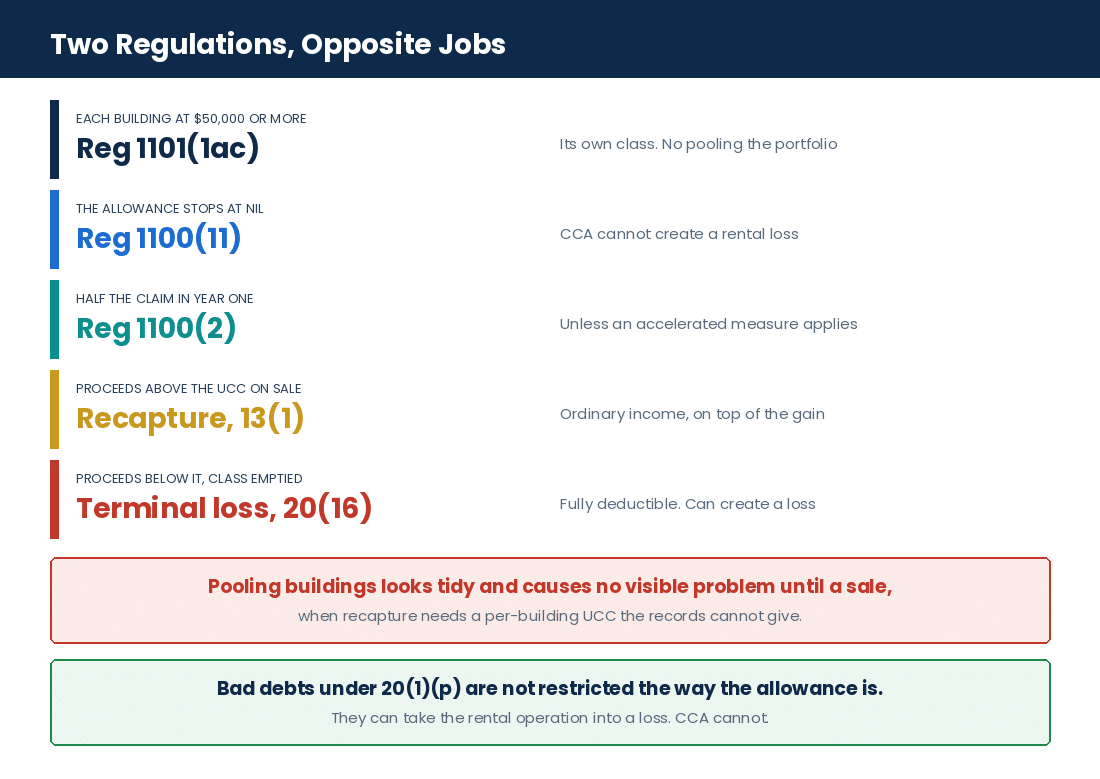
Owners who come to us with two or three buildings have almost always been pooling them in one class, because that is what a general-purpose chart of accounts invites you to do. It looks tidy and it is wrong, and the consequence does not appear until a building is sold.
At that point the recapture calculation needs an undepreciated capital cost for that building alone, and nobody can produce one. Rebuilding it from years of pooled entries is the expensive part, and it is entirely avoidable by splitting them on day one. Figures changed for privacy.
Differences Between Rental Income and Business Income for Tax Purposes
Knowing the difference between rental income and business income matters a lot when dealing with multi unit rental property taxes Canada. Rental income usually comes from leasing apartments without much extra effort from the owner. Business income involves running operations actively, which changes what tax deductions apply under multi residential property accounting rules.
To sum up:
- Rental income = passive earnings from renting units
- Business income = active work or services linked to property
- Each type faces different tax treatment under Canadian law
Calculating and Reporting Rental Income for Multi-Unit Properties
Calculating and Reporting Rental Income
Reporting
Methods for Calculating Rental Income: Accrual vs. Cash Basis
When dealing with multi residential building taxes Canada, you need to calculate rental income correctly. Two main methods exist: accrual and cash basis. The accrual method records rent when it’s earned, not when you actually get paid. This matches expenses and income in the same period. It fits well with big apartment buildings where tenants pay on fixed dates.
The cash basis only counts income when rent hits your bank account. This way is simpler but can mess up your numbers if some rents are overdue at year-end. Across Canada, CRA lets you use either method for multi-residential property accounting Canada-wide. Corporations tend to like accrual because it shows the real financial picture.
Which method you pick affects how much taxable income you report under apartment building taxes Canada rules. Also, companies have to stick with their chosen method every year unless CRA approves a change.
Reporting Rental Income Using CRA Form T776
If you own a multi unit rental property, reporting rent means filling out CRA Form T776 – Statement of Real Estate Rentals. This form shows all gross rents collected from every unit in your buildings. You also list expenses like property tax, insurance, utilities you pay, repairs (not big improvements), management fees, and superintendent wages.
Multi residential property accounting Canada rules ask that expenses be divided correctly by building class, because Regulation 1101(1ac) puts each rental property costing $50,000 or more into a separate capital cost allowance class. Each corporation files one T2 return but attaches T776 forms showing each property’s results separately.
Form T776 needs total rent amounts before subtracting any bad debts or uncollectible rent. These get handled apart. The form helps figure net rental income subject to taxes tied to apartment buildings in Canada, following CRA Guide T4036.
Responsibilities of Co-Owners, Partnerships, and Corporations in Rental Income Reporting
When co-owners or partnerships hold multi residential buildings along with corporations owning other properties, reporting duties change:
- Co-Owners: Report their share of rental income based on ownership on personal tax returns.
- Partnerships: File partnership info returns showing each partner’s share; partners report this on their own returns.
- Corporations: Report all gross rents from owned buildings in the corporate T2 filing, supported by bookkeeping that separates asset classes as required by law.
Good recordkeeping helps meet multi residential property accounting Canada standards and avoids mistakes that can trigger audits under apartment building taxes Canada rules [See Income Tax Act s. 125(7); Income Tax Regulations 1101(1ac), 1100(11)].
Treatment of Uncollectible Rent and Bad Debt Deductions
Apartment building taxes Canada let landlords running corporations deduct bad debts once rent can’t be collected after trying hard enough. According to paragraph 20(1)(p) of the Income Tax Act:
- Bad debt deductions lower taxable rental income, and unlike capital cost allowance they are not restricted from creating a loss.
- You need proof of collection efforts before writing off.
- Only rent already recorded as income counts; you can’t claim for expected future defaults.
This aligns with multi-unit rental property taxes Canada’s focus on careful expense reporting so profits show actual money coming in without overstating losses [CRA Guide T4036].
Bad debts and capital cost allowance get muddled together constantly, and the two behave in opposite ways. A written-off rent arrear is an ordinary deduction that can take the property into a loss. The allowance cannot, because Regulation 1100(11) stops it.
That distinction decides whether a difficult year produces a usable loss or a nil result, and it is worth getting right before the return is filed rather than after. Figures changed for privacy.
GST/HST on Multi-Unit Rentals: Rebates and Filing Requirements
Long-term residential rents usually don’t have GST/HST added since they are exempt supplies under the Excise Tax Act. So landlords can’t claim input tax credits on operating costs related directly to tenant housing in apartments anywhere in Canada.
But:
- There are rebates for new builds that apply partially when qualifying multi-unit residences are built mainly for long-term rentals.
- Landlords must apply for these rebates soon after construction ends and follow CRA’s federal rules closely.
You also need to register for GST/HST if you rent out mixed-use spaces where commercial parts charge HST along with exempt residential units — a common setup in mixed-use properties owned by corporations [Excise Tax Act ss. 240(1) on registration, 256.2 on the new residential rental property rebate, and Schedule V Part I on exempt residential rent].
Recording and Maintaining Accurate Rental Income and Expense Records
Keeping thorough records is key for proper multi residential property accounting Canada practices. This helps if CRA ever audits you under apartment building taxes Canadian law.
Important records include:
- Lease agreements (signed contracts)
- Rent rolls (logs of tenant payments)
- Invoices & receipts (proof of expenses)
- Payroll records (wages for staff like superintendents)
- Property tax bills (municipal charges)
- Utility bills (paid utilities)
These back up numbers shown on Form T776 when filing corporate returns. Accuracy matters here according to CPA standards across Ontario and other provinces including firms like Gondaliya CPA [CPA ASPE guidance]. Separating costs by asset class also helps meet legal thresholds set by ITA regulations [Income Tax Regulations Schedule II].
If you’re managing multi unit rental properties in Toronto or nearby areas and want help with corporate tax filings or questions about rental income taxes across Canadian jurisdictions, Gondaliya CPA offers consultations by email at info@gondaliyacpa.ca or by phone at 647-212-9559 for clear support aligned with current laws through 2026 and beyond.
Deductible Expenses and Capital Cost Allowance for Multi-Residential Buildings
Deductible Expenses and Capital Cost Allowance
The Core Rules
Overview of Allowable Rental Expenses for Multi-Residential Properties
Owners of multi-residential buildings in Canada can deduct many expenses tied to earning rental income. These expenses usually cover day-to-day operations like property maintenance and management. Examples include utilities, property taxes, insurance premiums, salaries for on-site staff, minor repairs, and professional fees such as accounting or legal services related to rentals. The Canada Revenue Agency (CRA) requires clear records showing these costs belong only to rental activities [Income Tax Act ss. 9(1), 18(1)(a); CRA Guide T4036].
It’s important to separate personal expenses from those linked just to the multi-unit residential property when filing under apartment building taxes in Canada.
Distinction Between Current and Capital Expenses in Rental Properties
In Canadian multi-residential property accounting, knowing the difference between current and capital expenses matters a lot.
Current expenses are regular costs needed for daily operations. These include routine repairs or utility bills. You can fully deduct these costs in the year you pay them.
Capital expenses involve buying or upgrading assets that last more than a year, like big renovations or new equipment. You cannot write these off right away. Instead, you add them to your property’s capital cost and recover them slowly using Capital Cost Allowance (CCA).
This difference affects multi-unit rental property taxes because it changes when you get tax relief — either immediately or over time through depreciation, and because Regulation 1100(11) stops capital cost allowance on a rental property from creating or increasing a rental loss [CPA Canada ASPE Section 3061].
Those are two separate regulations doing opposite jobs, and they are easy to run together. Regulation 1101(1ac) splits your buildings into their own classes. Regulation 1100(11) caps the allowance so it cannot take the rental operation into a loss. Neither one does the other’s work.
Description of Major Deductible Expenses: Insurance, Repairs, Salaries, Property Taxes
Apartment building taxes in Canada let owners deduct key expenses such as:
- Insurance: Premiums for fire coverage and liability tied directly to the rental.
- Repairs: Fixes that keep things working without making them better than before — like patching leaks or painting halls.
- Salaries: Pay for superintendents or staff managing daily tasks; make sure payroll records back this up.
- Property Taxes: Municipal realty taxes on each building are deductible against your rental income.
You should keep detailed records following CRA rules. Make sure these costs don’t mix with non-rental activities [Income Tax Act ss. 9(1), 18(1)(a); CRA Guide T4036].
Capital Cost Allowance (CCA): Classes Relevant to Multi-Residential Buildings
Multi-residential buildings in Canada use CCA to write off capital investments bit by bit. The government assigns assets into classes based on their type:
| Asset Type | CCA Class Number | Depreciation Rate |
|---|---|---|
| Building Structure | Separate class per building costing $50,000 or more | Varies by acquisition date |
| Appliances & Equipment | Class 8 | 20% |
| Site Improvements & Parking Lots | Class 17 | 8% |
Each residential building costing $50,000 or more gets its own CCA class under Regulation 1101(1ac); this means you don’t pool multiple buildings together. Depreciation rates depend on asset types; see CRA guide T4002 for details.
This separate-class rule means each building’s depreciation matches its specific investment — not mixed across your whole portfolio [Income Tax Regulations 1101(1ac)].
Rules for Accelerated and Enhanced First-Year Capital Cost Allowance
Canada offers ways to claim more CCA faster on new multi-residential buildings:
- You might get higher first-year deductions for qualifying new buildings.
- Usually, the half-year rule limits first-year claims to half the normal amount unless accelerated options apply.
These rules encourage building new rental housing but follow strict timing rules on how much depreciation you can claim yearly [Income Tax Regulations 1100(2)]. Keep good records showing when you bought assets and how they qualify under multi residential property accounting rules.
Claiming the maximum allowance every year is a reflex worth questioning on an apartment building. The allowance is optional, and in a year where it would be wasted against income that is already nil, taking it simply moves depreciation out of a year when it is useful into a recapture calculation later.
On a building likely to be sold, restraint now is often worth more than the deduction. It is one of the few decisions on these files that is genuinely a choice. Figures changed for privacy.
Handling Recapture, Terminal Loss, and Changing Use of Property for CCA
When selling a multi-unit residential building or changing how you use it:
- Recapture happens if sale proceeds exceed the undepreciated capital cost (UCC). This extra amount counts as taxable income because you claimed too much allowance earlier.
- A terminal loss occurs if proceeds are less than UCC after selling all assets in that class. A terminal loss is fully deductible and can produce an overall loss, which is what distinguishes it from capital cost allowance — Regulation 1100(11) restricts the allowance, not the terminal loss.
- Changing units from long-term rentals may affect your CCA balances and require reports per CRA guidelines [Income Tax Act ss. 13(1) on recapture, 20(16) on terminal loss, and 13(7) on a change in use; CRA Guide T4002].
Track each building’s separate-class account carefully so recapture calculations stay accurate without mixing classes.
Recapture is the moment the separate-class rule earns its keep, and it is also where owners discover they never followed it. On a building held twenty years and depreciated throughout, the recaptured amount on sale can be a very large ordinary income inclusion sitting on top of the capital gain.
Knowing it is coming changes when people sell and how they plan around it. Finding out in April, from an accountant looking at a closed transaction, changes nothing at all. Figures changed for privacy.
Impact of Grants, Subsidies, and Investment Incentives on Capital Costs
If you get grants or subsidies for apartment buildings, they affect how you calculate capital costs:
Government grants reduce the capital cost of the property under subsection 13(7.1) of the Income Tax Act, since only what you actually spend counts toward CCA deductions.
Investment incentives for things like energy upgrades may change how you classify assets but need careful review against program rules versus the general allowance guidelines [Income Tax Act s. 13(7.1); Income Tax Regulations Schedule II].
Make sure to disclose all grants with adjustments during financial reporting following CPA Ontario standards for corporate tax filings.
Apartment Building Tax Readiness Check
Five quick questions on where your departure file stands. No fee shown.
Points to raise with us:
This is a general prompt, not tax or legal advice or a quote. Your position depends on your full facts. For a real review, please book a free consultation.
Corporate Structure Options and Accounting Standards
Corporate Structure and Accounting Standards
Structure
Picking the right corporate structure changes how you handle multi residential building taxes Canada and apartment building taxes Canada. It affects your tax bills, your personal risk, and how complex your accounting gets.
Sole Proprietorship, Partnership, Corporation: Pros and Cons
Multi unit rental property taxes Canada differ based on whether you own as a sole proprietorship, partnership, or corporation.
- Sole Proprietorship: Easy to set up and gives you full control. But you’re personally responsible for all debts. Rental income goes on your personal tax return without extra corporate filings.
- Partnership: Partners share management and resources. They also share liability. Income flows through to each partner’s personal tax return based on their share.
- Corporation: Protects your personal assets by limiting liability. You must file separate T2 corporate tax returns for multi-residential buildings in Canada. But rental income might be taxed under specified investment business rules (Income Tax Act s. 125(7)).
Each structure trades off between admin work and protecting your risk under Canadian law.
Tax Planning Implications
Good multi residential property accounting Canada means knowing how structures affect taxable income and deductions.
If you incorporate, keep in mind:
- Specified investment business status can limit small business deductions unless you meet full-time employee rules (ITA s. 125(7)).
- Each building costing $50,000 or more needs its own capital cost allowance class for depreciation claims (Reg 1101(1ac)), and Regulation 1100(11) separately prevents that allowance from creating a rental loss.
Also, plan payroll carefully if you have onsite staff like superintendents. That changes which expenses are deductible or taxable benefits. Time expenses right to follow CRA rules on rental properties [CRA Guide T4036].
Accounting Standards Applicable to Multi-Residential Property Accounting (ASPE vs. IFRS)
Choosing the right accounting standards shapes how well your reports meet multi residential property accounting Canada rules. You usually pick between ASPE (Accounting Standards for Private Enterprises) or IFRS (International Financial Reporting Standards).
ASPE fits private corporations with simpler disclosure needs and no public accountability [CPA Canada ASPE Handbook]. IFRS suits companies with public interest or those needing international comparability.
Your choice depends on ownership complexity and stakeholder demands like lenders wanting audited IFRS statements versus compilations under ASPE done by licensed CPA firms such as Gondaliya CPA.
| Aspect | ASPE | IFRS |
|---|---|---|
| Disclosure Complexity | Less detailed | More extensive |
| Investment Property | Usually cost model | Fair value model allowed |
| Revenue Recognition | Based on realized transactions | Principles-based approach |
| Consolidation | Required if controlling interest | Similar but more detailed |
Most private apartment owners across Canada use ASPE as it balances accuracy with ease [CPA Canada comparative guidance].
Bookkeeping Best Practices for Apartment Building Owners
Good bookkeeping supports clear multi residential property accounting Canada and helps manage multi unit rental property taxes Canada by tracking income and costs clearly.
Systems for Tracking Income and Expenses
Use software like QuickBooks or Xero set up just for rental properties. Track rent by unit or building plus costs like utilities, maintenance, insurance, and property taxes. These details matter when filing yearly taxes.
Keep digital copies of invoices linked via tools like Hubdoc so paperwork stays audit-ready. This backs expense claims allowed under apartment building tax rules [Income Tax Act ss. 9(1), 18(1)(a), with capital cost allowance under 20(1)(a)].
Regular Reconciliation Tips
Do bank reconciliations every month to catch errors before preparing year-end reports. Match tenant ledgers against deposits to ensure all rent is recorded under multi residential building taxes Canada rules.
Check payroll accounts monthly if you pay superintendents. This avoids mistakes affecting payroll remittances to CRA and deductible salary expenses at year-end, handled best by accountants familiar with apartment bookkeeping.
Preparing Financial Statements and Compilation Reports for Tax Filing
Accurate financial statements help meet apartment building taxes Canada demands while providing clear info per multi residential property accounting Canada rules.
- Statement of Financial Position showing assets with separate classes per Reg 1101(1ac).
- Statement of Operations listing rent income minus operating costs.
- Capital Cost Allowance schedules breaking down assets by class per tax rules.
These support correct taxable income calculations under ITA guidelines on apartment building corporate taxation [CRA Form T2 Schedule 8].
Sign-Off and Certification Needs
Licensed CPA firms prepare compilation reports that show info fairly reflects transactions without giving an audit opinion. This meets CPA Ontario standards followed by firms like Gondaliya CPA serving Toronto and beyond. Signing off confirms data integrity and helps meet deadlines while avoiding penalties often faced by large portfolios managed corporately instead of individually.
Managing Payroll Services and Superintendent Wages Within Rental Properties
Payroll plays a key role in allowable deductions for apartment building taxes Canada, especially if you employ onsite staff who run daily operations. But payroll also requires strict compliance with federal employment laws intersecting tax rules across provinces.
Employers must register properly to remit source deductions such as CPP, EI premiums, and income tax instalments on time per CRA schedules. Using approved payroll software integrated into bookkeeping avoids penalties from missed filings during busy tax seasons.
Superintendent wages count as deductible expenses if pay stubs document hours worked clearly supported internally plus external verification confirming real employment (not contractors). This matters for qualifying small-business deduction tests referenced earlier (ITA s. 125(7)).
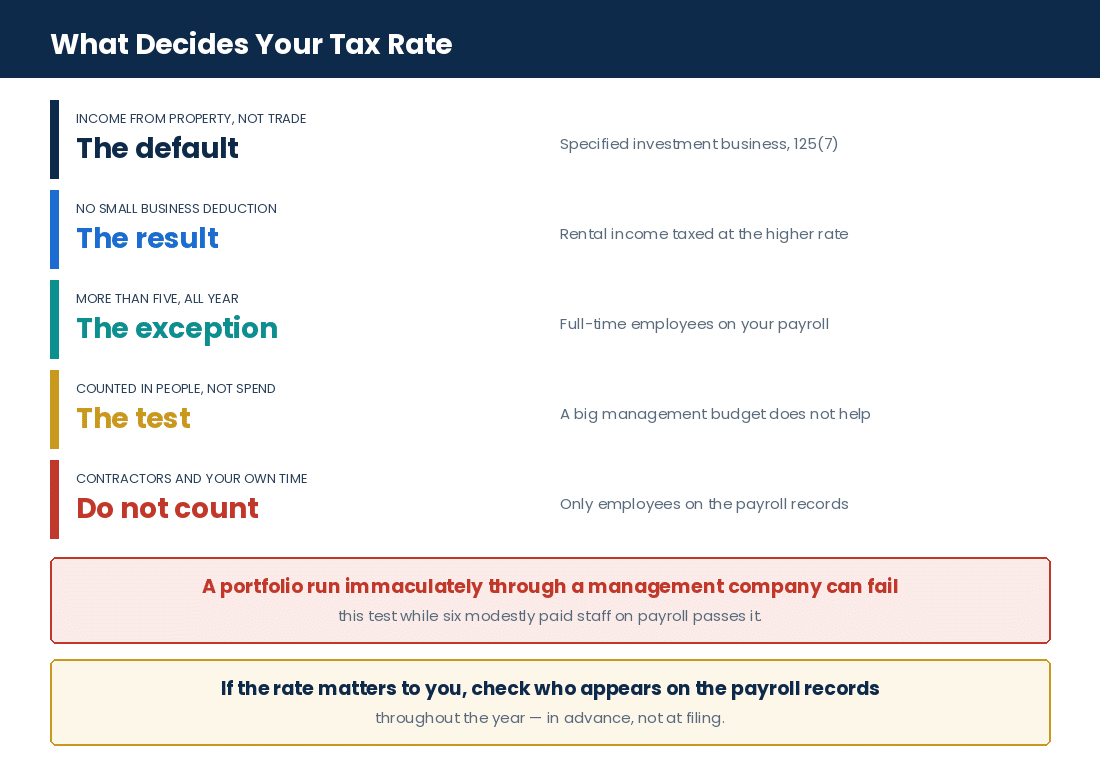
The employee test is counted in people, not in effort, and owners find that hard to accept. A corporation that spends heavily on a professional management company and runs the buildings immaculately can still fail it, while one with six modestly paid staff on the payroll passes.
Contractors do not count. Neither does the owner’s own time. If the test matters to your rate, the question is who appears on the payroll records throughout the year, and that is worth checking in advance rather than at filing. Figures changed for privacy.
Submit payroll remittances timely along with annual T4 summaries electronically via CRA portals. This aligns employer declarations with amounts reported in corporate filings yearly. Missing this step can trigger reassessments or penalties avoided by working with CPAs specialized in multifamily housing nationwide including Toronto firms like Gondaliya CPA.
Tax Planning Strategies and Compliance for Multi-Unit Rental Properties
Tax Planning Strategies and Compliance
Planning
Strategies to Optimize Tax Deductions and Capital Cost Allowance Claims
Owners of apartment buildings in Canada should track all expenses carefully. Property taxes, insurance, utilities, management fees, and superintendent wages all count as deductions. These reduce taxable rental income when properly recorded.
Each building costing above a set amount must get its own capital cost allowance (CCA) class under the Income Tax Regulations. This keeps depreciation separate for each asset. If you lump them together, losses from one can wrongly offset gains from another. The half-year rule means you only claim half the usual CCA on new assets bought in the tax year. Timing your purchases matters for cash flow.
Some renovations qualify for faster write-offs under special investment rules. But watch out — these must follow CRA rules or claims may be denied.
Here’s an example: An Ontario corporation owns two apartment buildings bought in different years. It keeps separate CCA classes for each and claims deductions without mixing costs. This helps avoid CRA audit issues related to multi residential building taxes Canada.
Understanding the Small Business Deduction and Full-Time Employee Test Implications
Usually, rental income from multi residential buildings doesn’t qualify for the small business deduction (SBD). That’s because rental is seen as passive income unless it meets active business tests under Canadian tax law.
One key test is whether the corporation has more than five full-time employees working year-round on property operations — directly or through related firms that manage or maintain the buildings. Payroll records showing hours worked by superintendents or maintenance staff support this claim.
If you don’t meet this employee count, you lose SBD benefits and face higher tax rates on your rental income. Keeping clear, detailed accounts of staffing is a must in multi residential property accounting Canada-wide.
Example: A Toronto landlord hires six full-time staff onsite and contracts a related company for ongoing management services during 2026. This setup meets CRA’s requirements to keep SBD eligibility intact.
Managing Prescribed Costs and Separate Class Asset Designations
Each apartment building costing $50,000 or more must be tracked in its own CCA class per Canadian tax regulations [Income Tax Regulations 1101(1ac)]. This means no mixing costs between properties when calculating depreciation allowances.
Prescribed costs include purchase price plus eligible soft costs like legal fees tied directly to buying the property. Repairs are expensed immediately instead of added to asset cost bases under ITA rules [s. 18(1)(a)].
Keeping a clear register of each building’s original cost helps during CRA audits and when you sell properties later because you need accurate recapture figures on T2 returns filed yearly across Canada — including Ontario’s strict filing system focused on multi unit rental property taxes Canada compliance.
Example: A taxpayer owns three apartment buildings bought over time; each one is recorded separately to avoid errors flagged by CRA in their review process.
Considerations for Non-Arm’s Length Transactions and Related Party Issues
Deals between related parties demand extra care under multi residential property accounting rules set by Canadian tax authorities [Income Tax Act s. 69 for domestic non-arm’s-length dealings, and s. 247 where the related party is a non-resident].
Prices for services or leasing agreements between related companies must match fair market value based on independent appraisals whenever possible. Otherwise, CRA may adjust amounts upward during audits, increasing your taxable income unexpectedly — especially in Ontario and beyond.
You need solid paperwork: contracts, service agreements from associated companies managing your apartments versus direct hires help prove compliance with CRA standards regarding specified investment businesses.
Interest charged on loans between related entities also needs to reflect normal commercial rates to avoid reclassification risks affecting corporate taxes across your holdings.
Example: A landlord corporation uses a connected company outside Toronto for leasing admin services billed hourly at market rates, reducing transfer pricing risks during audits typical among big apartment owners.
Related-company management fees are the most common place an apartment group gets reassessed, and almost never because anyone was being aggressive. A fee gets set once, years ago, at a round number nobody can now justify, and it stays there while the portfolio doubles.
What survives review is a fee with a basis behind it — a percentage of rents, an hourly rate, something a third party would charge. What does not is a figure that appears in the accounts every year with no agreement behind it. Figures changed for privacy.
Soft costs on a renovation are where the current-versus-capital line gets drawn carelessly, usually in the owner’s favour and usually by accident. Architects, permits and financing costs attached to a project that improves the building belong in the capital cost, not in this year’s repairs.
Keeping a separate file per project, opened when the project starts rather than reconstructed at year end, settles the question while the invoices still make sense to the person who approved them. Figures changed for privacy.
Navigating Land Transfer Taxes and Other Transactional Taxes
When you buy apartment buildings in provinces like Ontario, land transfer taxes kick in right away based on purchase price brackets set by law. These can add up quickly if you buy multiple units at once.
You can plan acquisition timing or stagger closings to ease upfront cash demands while still meeting filing deadlines strictly enforced regionally alongside federal reporting tied to adjusted cost bases affecting capital gains shown on annual T2 returns nationwide — including clients served around Hamilton by firms like Gondaliya CPA familiar with local tax details.
Other transactional taxes like GST/HST may also apply, especially on new builds versus resale rentals where exemptions exist impacting input tax credit eligibility. Accurate bookkeeping throughout ownership helps track these properly using software tools integrated with professional accounting services offered by experienced teams specializing in multi unit rental property taxes Canada.
Legal Requirements on Rent Adjustments Following Property Tax Changes
Changes in municipal property taxes can affect how landlords adjust rents in provinces across Canada but don’t fall under federal law directly. However, these increases often appear indirectly in financial reports prepared using ASPE standards that guide how expenses get recognized consistently throughout provinces including Ontario’s tenant markets.
Landlords must notify tenants within provincially mandated time frames when raising rents due to higher property taxes. Although this does not change rent figures inside corporate accounts directly, higher revenue impacts taxable income which must be managed carefully alongside rising expenses.
Tax treatment of GST/HST tied to rent adjustments follows Excise Tax Act rules that limit input tax credit claims depending on supply classifications relevant here.
Role of Professional Tax Accountants in Ensuring Compliance and Planning
Experts in multi residential property accounting understand complex CRA rules around apartment building taxes across Canada well enough to help landlords stay compliant as policies change.
Gondaliya CPA provides fixed-price packages combining bookkeeping using QuickBooks or Xero with compilation reports following ASPE guidelines needed for bank approvals or solid T2 filings with specialized schedules verifying employee tests critical to keeping small business deduction status where possible.
They also clarify limits preventing costly mistakes common among less experienced preparers unfamiliar with sector specifics that matter when government scrutiny increases particularly around Toronto and Ottawa but serving clients nationally too.
Working with skilled CPAs reduces risks from penalties, interest charges, or late filings while making sure deductions claimed are legitimate — helping landlords keep more after-tax profit sustainably over time.
For personalized advice tailored specifically toward your portfolio’s unique circumstances contact Gondaliya CPA today at info@gondaliyacpa.ca or call 647-212-9559 offering free consultations covering multi residential building taxes Canada, apartment building taxes Canada, multi unit rental property taxes Canada, and multi residential property accounting Canada compliance essentials.
Additional Resources and Support for Multi-Residential Building Owners
Additional Resources and Support
Resources
Accessing CRA Resources and Official Publications for Rental Property Taxation
The Canada Revenue Agency (CRA) offers many helpful guides about multi residential building taxes in Canada. These official documents explain how apartment building owners should report rental income, claim capital cost allowance, and follow rules for specified investment businesses under the Income Tax Act. For instance, guide T4036 covers the basics of rental income taxation that apply across the country. Reviewing these materials helps you stay on track with apartment building taxes in Canada.
You can download necessary forms like the T2 Corporation Income Tax Return schedules right from the CRA website. Keeping up with changes or new interpretations helps avoid mistakes when dealing with multi-residential property accounting in Canada.
Utilizing Tax Calculation Tools, Forms, and Digital Services for Property Tax Management
Managing multi unit rental property taxes in Canada needs accurate tools and digital services made for complex properties. The CRA has online calculators to estimate your tax bills based on deductions like capital cost allowance classes assigned to each building.
Accounting software such as QuickBooks or Xero works well for tracking income, expenses, payroll for on-site staff, and GST/HST filings related to apartment buildings. Using these digital tools makes filing easier and keeps your records ready if the CRA audits you.
Important forms include Schedule 8 (Capital Cost Allowance), Schedule 50 (Shareholder Information), and detailed financial statements following ASPE standards suggested by CPA Canada. Using these resources cuts down errors when managing multi residential property accounting across several units or buildings.
Importance of Regular Property Income and Expense Returns to MPAC
It’s crucial to submit accurate income and expense returns regularly to the Municipal Property Assessment Corporation (MPAC). MPAC uses this info to value apartment buildings properly. Their assessments affect municipal taxes in Ontario.
Sending timely returns ensures your property value reflects current market conditions. Old or missing data might cause over-assessment or lost exemptions that increase your taxes. Accountants who prepare these returns often work closely with MPAC to keep things transparent. This communication helps owners get fair treatment when it comes to apartment building taxes in Canada.
The MPAC income and expense return is the one filing apartment owners treat as optional, and it is the one that most directly sets a bill they will pay every year regardless of profit. Left unfiled, the assessment gets built from whatever data MPAC already holds, which on an older building is usually not flattering.
It takes an afternoon from records you already keep for the T776. We treat it as part of the year-end cycle rather than correspondence to deal with later. Figures changed for privacy.
Contact Information and Services Offered by Gondaliya CPA for Multi-Residential Owners
Gondaliya CPA focuses on corporate tax help tailored to multi residential property accounting across Toronto and beyond. Our firm handles bookkeeping services that fit apartment building tax needs, including GST/HST filings, payroll for building staff, annual compilations using ASPE standards, catch-up filings if books fall behind, plus representation during CRA audits related to multi unit rental property taxes.
We offer flat-fee annual pricing so clients can budget without surprises. Our team uses top software like QuickBooks Online combined with expert advice from Sharad Gondaliya, CPA — someone who knows how to handle complex portfolios well in Ontario’s competitive real estate market.
For more info about how we assist multi-residential owners, email info@gondaliyacpa.ca or call 647-212-9559 during business hours.
Summary of Key Points and Recommendations
Managing multi residential building taxes means knowing a few key rules: each rental building costing $50,000 or more gets its own capital cost allowance class; the allowance cannot create or increase a rental loss; meeting full-time employee tests matters for specified investment business status; input tax credits can’t be claimed on exempt supplies like long-term residential rent; good records help avoid artificial losses; regular contact with federal bodies like CRA and provincial ones like MPAC improves tax results within Canadian law for apartment buildings.
Keep detailed payroll records tied directly to superintendent wages. Keep separate files on soft costs during renovations too. These habits protect you if unusual losses come up repeatedly on corporate returns for multiple-unit properties [Income Tax Act s. 125(7); Income Tax Regulations 1101(1ac), 1100(11)] [CRA Guide T4036].
Links to Further Reading and Relevant Government Guidelines
Want more detail on apartment building taxes in Canada? Check out these trusted sources:
| Resource | Description |
|---|---|
| Canada Revenue Agency – Rental Income | Explains taxable rental income aspects including apartments |
| Income Tax Act & Regulations | Defines specified investment businesses & CCA classes |
| Municipal Property Assessment Corporation (MPAC) | Ontario’s process for municipal taxation of apartments |
| CPA Canada Accounting Standards | How to apply ASPE standards when compiling corporate investment property financials |
These government documents form a solid base to prepare compliant filings for multifamily rentals under Canadian federal law and relevant provincial rules.
Frequently Asked Questions on Multi-Residential Building Taxes
Frequently Asked Questions
Answers
What is the prescribed cost threshold for a separate capital cost allowance class?+
How does the full-time employee test affect small business deduction eligibility?+
When is the corporate filing deadline for multi-residential property owners?+
What is the Capital Cost Allowance half-year rule?+
At what threshold does CRA require instalment payments for corporations?+
What is the record retention period for rental property accounting documents?+
When is the GST/HST new residential rental rebate deadline?+
What payroll records must be retained for on-site staff like superintendents?+
What sections of the Income Tax Act are most relevant to multi-residential property accounting?+
Why does each building sit in its own capital cost allowance class?+
Essential Insights for Multi-Residential Building Owners
Essential Insights for Owners
Key Points
Key points at a glance on multi residential building taxes Canada:
- Small Business Deduction: Limited unless the corporation passes the full-time employee test.
- Separate Class per Building: Required when the building costs $50,000 or more, under Regulation 1101(1ac).
- Rental Loss Restriction: Regulation 1100(11) stops capital cost allowance from creating or increasing a rental loss.
- Recapture: Taxable income triggered if sale proceeds exceed undepreciated capital cost (UCC).
- Terminal Loss: Arises when proceeds fall below UCC after disposing of all assets in a class, and it is fully deductible.
- Compilation Financial Statements: Prepared by CPAs to support tax filings without an audit opinion.
- Apartment Rents Qualify for Deductions: Expenses directly related to earning rent are deductible under ITA rules.
- Operating Payroll Includes Only Employees: Contractors typically do not count towards employee tests.
- Soft Costs in Renovations: Generally added to capital cost; not immediately expensed unless minor repairs.
- Rental income is usually passive: specified investment business rules under 125(7) limit deductions unless active management meets CRA criteria.
- Financial statements must show: detailed asset classification, rental income, expenses and capital cost allowance schedules aligning with ASPE guidance.
- Best practice: keep detailed payroll, separate building costs, file on time, and stay in regular contact with CRA and MPAC.
- Most common reporting mistakes: mixing buildings in one CCA class, poor payroll documentation, missing instalment payments, and ignoring the prescribed cost threshold.
Why Trust Gondaliya CPA?
Sharad Gondaliya leads a CPA Ontario registered firm with US CPA licences in Washington and Montana. Our team holds 1300+ 5-star Google reviews across Ontario, specializing in multi-residential property accounting Canada-wide. We prepare compliant corporate filings using CPA Canada ASPE standards and provide clear advice on tax planning related to apartment buildings in Canada.
For expert guidance tailored to your portfolio, contact Gondaliya CPA at info@gondaliyacpa.ca or call 647-212-9559 today.
Businesses We Serve & Industry Spotlights
Industry Expertise
Multi-residential owners sit inside a wider group of people earning from property rather than from trade, and the questions that decide an apartment file — which class an asset belongs in, whether the allowance can be claimed at all this year, and whether the corporation is active or passive — recur across every one of these situations.
| Who | The Property Tax Angle |
|---|---|
| Multi-residential building owners | Separate CCA classes, the loss restriction and the SIB test |
| Rental property owners | Form T776, current versus capital, and recapture on sale |
| Duplex and triplex owners | Buildings below the separate-class threshold, and mixed personal use |
| Student rental owners | Turnover, furnishing costs and short occupancy cycles |
| Basement apartment owners | Part-use of a principal residence and the change-in-use rules |
| Commercial landlords | Taxable rent, input tax credits and a different GST/HST position |
| Real estate syndicators | Partnership reporting and allocations among investors |
| Parking lot businesses | Site improvements as their own class, and taxable supply |
| Storage facility owners | Active business treatment against the passive income line |
| House flippers | Inventory and business income rather than capital property |
| Joint venture businesses | Co-ownership reporting without a partnership return |
Spotlights: multi-residential building owners · rental property owners · duplex and triplex owners · student rental owners · basement apartment owners · commercial landlords · real estate syndicators · parking lot businesses · storage facility owners · house flippers · joint venture businesses.
Professional Guidance and Quick Reference
Guidance
Essential Tax Points for Canadian Apartment Building Owners
Apartment files go wrong in a predictable set of ways: buildings pooled into one capital cost allowance class until a sale makes it impossible to compute recapture; the allowance claimed down into a rental loss that the regulations do not permit; the small business deduction assumed rather than tested against headcount; management fees to a related company set once at a round number with no agreement behind them; bad debts and capital cost allowance treated as though the same loss restriction applied to both; and the MPAC income and expense return left unfiled while the assessment is built without it. Gondaliya CPA prepares apartment building returns on a flat annual fee.
Quick Answers
At a Glance
- Separate class: each rental building costing $50,000 or more, under Regulation 1101(1ac)
- Loss restriction: CCA cannot create or increase a rental loss, under Regulation 1100(11)
- They are different rules: one splits the classes, the other caps the claim
- Half-year rule: half the normal claim in the year of acquisition, Regulation 1100(2)
- Recapture: subsection 13(1), where proceeds exceed undepreciated capital cost
- Terminal loss: subsection 20(16), fully deductible and able to create a loss
- Government assistance: reduces capital cost under subsection 13(7.1)
- Bad debts: paragraph 20(1)(p), and not subject to the CCA loss restriction
- Operating expenses: computed under 9(1), limited by 18(1)(a)
- Specified investment business: subsection 125(7), the default for rental income
- Employee test: more than five full-time employees throughout the year
- Contractors: do not count toward that test
- Residential rent: exempt, so no input tax credits on the costs behind it
- New builds: the rental property rebate under section 256.2 may apply
- Mixed use: registration required under section 240(1) where there is a commercial part
- Non-arm’s length: section 69 domestically, section 247 where a non-resident is involved
- Corporate filing: six months after fiscal year-end
- Records: six years after the last tax year they relate to
Who This Is For / Not For
Fit Check
- For: owners of apartment buildings and other multi-unit residential property, held personally, in partnership or through a corporation, who need the capital cost allowance and corporate filing handled properly.
- For: owners with more than one building whose books pool them in a single class, and owners approaching a sale who have never calculated what recapture will look like.
- Not for: a guide to municipal property tax rates or assessment appeals. Rates are set municipality by municipality, change annually, and the multi-residential class is often rated separately from residential.
- Not for: provincial tenancy law, rent control or above-guideline increase applications, which are handled separately. A single duplex is still in scope, though the separate-class threshold may not be met.
People Also Ask
Related Questions
Can I put all my buildings in one CCA class?+
No, not where each costs $50,000 or more. Regulation 1101(1ac) puts every such rental property into a class of its own. Pooling them looks tidier and causes no visible problem until you sell one, at which point the recapture calculation needs an undepreciated capital cost for that building alone and the pooled records cannot produce one. Splitting them at the outset costs nothing; reconstructing them later is the expensive version.
Why can’t my capital cost allowance take the property into a loss?+
Because Regulation 1100(11) says so. Capital cost allowance on rental property can reduce net rental income to nil but no further; it cannot create or increase a rental loss. This is a different rule from the separate-class requirement, and the two are constantly confused. Ordinary expenses, including bad debts under paragraph 20(1)(p), are not restricted this way and can produce a loss.
My corporation owns apartments. Do I get the small business deduction?+
Usually not. Rental income is normally a specified investment business under subsection 125(7), which takes it outside the deduction. The exception is a corporation employing more than five full-time employees throughout the year. The test counts people on the payroll, not effort or spend, so a well-run portfolio managed by contractors can fail it while one with six modestly paid staff passes.
What happens to all that depreciation when I sell?+
It comes back as recapture under subsection 13(1), to the extent proceeds exceed the undepreciated capital cost, and it is taxed as ordinary income rather than as a capital gain. On a building held for decades and depreciated throughout, that inclusion can be substantial and sits on top of the capital gain. It is worth modelling before a sale is agreed, not after closing.
Can I claim input tax credits on my apartment building’s costs?+
Generally no, because long-term residential rent is an exempt supply, and input tax credits follow taxable supplies. The GST/HST on repairs, utilities and management is simply a cost. Two things change the picture: a commercial component in a mixed-use building, which brings registration under section 240(1) into play, and a qualifying new build, where the rental property rebate under section 256.2 may apply.
Glossary of Key Terms
Definitions
- Multi-residential building: a structure containing several self-contained rental units.
- Capital cost allowance (CCA): the deduction spreading a depreciable asset’s cost over several years.
- Separate class rule: Regulation 1101(1ac), putting each rental building costing $50,000 or more in its own class.
- Rental loss restriction: Regulation 1100(11), preventing CCA from creating or increasing a rental loss.
- Undepreciated capital cost (UCC): the balance of a class after CCA claimed to date.
- Recapture: the CCA brought back into income on sale, under subsection 13(1).
- Terminal loss: the deductible shortfall under subsection 20(16) when a class is emptied below its UCC.
- Half-year rule: Regulation 1100(2), limiting the first-year claim on new additions.
- Current expense: a cost deducted in full in the year incurred.
- Capital expense: a cost added to the asset and recovered through CCA.
- Soft costs: fees and carrying charges on acquisition or construction, often capitalised.
- Specified investment business: subsection 125(7), a business whose principal purpose is earning income from property.
- Full-time employee test: the more-than-five requirement that takes a rental corporation outside that definition.
- Form T776: the Statement of Real Estate Rentals.
- Schedule 8: the T2 schedule carrying capital cost allowance by class.
- Exempt supply: long-term residential rent, which carries no GST/HST and no input tax credits.
- MPAC: the Municipal Property Assessment Corporation, which sets assessed values in Ontario.
- Compilation engagement: financial statements prepared under CSRS 4200 without assurance.
Want a checklist to work from? You can download our free apartment building tax checklist before your consultation.
Four things decide an apartment building file. How the classes are set up — each building costing $50,000 or more belongs in its own capital cost allowance class under Regulation 1101(1ac), and pooling them only becomes visible on a sale, when recapture needs a figure the pooled records cannot give. How far the allowance can go — Regulation 1100(11) stops it creating or increasing a rental loss, which is a separate rule from the first and routinely confused with it. What rate the income is taxed at — rental income is a specified investment business under subsection 125(7) unless the corporation employs more than five full-time employees throughout the year, a test counted in people rather than effort. And what happens on exit — recapture under 13(1) as ordinary income, terminal loss under 20(16) which is fully deductible, both computed class by class.
Three questions tell you where you stand, and all three come out of the CCA schedule. First, is each building in its own class? If the schedule shows one line for a portfolio, that needs fixing before the next disposition, not after. Second, has the allowance ever been claimed into a loss? If so, the claim was overstated and the balance is wrong. Third, how many people were on the payroll all year? That number, not the management budget, decides whether the small business deduction was ever available.
Multi Residential Building Taxes Canada: How Gondaliya CPA Can Help
Start with your CCA schedule and a year of rent rolls
Gondaliya CPA rebuilds the capital cost allowance schedule so each building sits in its own class with a defensible opening balance, checks whether the allowance has been claimed past the point Regulation 1100(11) permits, tests the specified investment business position against actual payroll records rather than assumption, models recapture before a disposition is agreed rather than after it closes, prepares the T2 with Schedule 8 and compiled financial statements under ASPE and CSRS 4200, handles payroll for superintendents and the GST/HST position on any commercial component, and keeps the MPAC income and expense return in the year-end cycle — on a flat annual fee including HST with a one-business-day response. Please book a free consultation.
Next Steps
Please book a free consultation with Gondaliya CPA and bring three things: your most recent capital cost allowance schedule, a year of rent rolls, and your payroll records. Those three settle whether the classes are right, whether the allowance has been overclaimed, and whether the small business deduction was ever available — which between them account for nearly every difficulty we see on an apartment building file. If you are within a year of selling, say so at the outset, because recapture is far easier to plan around than to discover. We advise on federal income tax, GST/HST and corporate accounting; municipal assessment appeals and provincial tenancy matters are handled separately. You will get a flat annual fee including HST before any work begins. We serve Toronto, Mississauga, Brampton, Vaughan, Etobicoke, Scarborough, Hamilton, Ottawa and the rest of Ontario, and work with building owners across Canada. If our content helps, please add gondaliyacpa.ca as a preferred source on Google.
Published: · Last updated:
Editorial policy: We research against CRA, Department of Finance, Parliament of Canada, CPA Canada and CPA Ontario sources, fact-check the figures, and Sharad Gondaliya, CPA, reviews the content, which we update as the rules change.
Disclaimer: This article is educational information only and is not tax, legal or financial advice. It covers Canadian federal income tax, GST/HST and corporate accounting for multi-residential rental buildings, including rental income reporting, capital cost allowance and the separate class and rental loss rules, recapture and terminal loss, the specified investment business test, and payroll for on-site staff. Municipal property tax rates are set by each municipality, change annually, and the multi-residential class is rated separately from the residential class in many Ontario municipalities; the rate ranges in this article are broad illustrations only and your own municipality’s current rate for your property class should be confirmed. This article does not cover municipal assessment appeals, provincial tenancy law or rent regulation, each of which is handled separately. Thresholds, rates, filing deadlines and statutory references change; every reference should be confirmed against current CRA guidance before a return is filed. Gondaliya CPA performs compilation engagements under CSRS 4200 and does not perform audit or review engagements. Please consult a licensed CPA before acting.

Sharad Gondaliya is a CPA Canada & CPA USA with 15 Years+ experience of Accounting, Tax, Payroll of Corporate Small Businesses as Tax Accountant. He is a CPA Ontario member (61040184) and holds US CPA licences in Washington and Montana and is well known among corporate small businesses for tax planning, efficient tax solutions, and affordable CPA services. Sharad is the Principal (Director) of Gondaliya CPA – Affordable CPA Firm in Canada. Licenses: CPA Ontario: 61040184 | CPA USA (MT): PAC-CPAP-LIC-033176 | CPA USA (WA): 57629 | CPA Firm License: 61330051 View Full Author Bio