



Compilation Services for Nonprofit Organizations in Canada
Nonprofit Compilation Engagements Under CSRS 4200
Gondaliya CPA provides compilation services for nonprofit organizations in Canada under CSRS 4200. The work covers nonprofit financial reporting requirements and the preparation of nonprofit financial statements to support board reporting and funding relationships.
Quick Summary
A compilation engagement assembles financial statements from information management provides, without verifying it and without expressing any assurance. The standard is CSRS 4200, issued by the Auditing and Assurance Standards Board, effective for periods ending on or after 14 December 2021 and replacing the old Section 9200 Notice to Reader. Three things about it matter most to a nonprofit board. The engagement turns on whether the statements are intended for a third party, and where they are, management acknowledges that the third party can either obtain further information from the organisation or has agreed the basis of accounting. Every set of compiled statements carries a note describing that basis, and the note names ASNPO only where the statements fully comply with it, so a modified basis must not borrow the label. And a compilation is unsuitable the moment a statute, a bylaw, a funding agreement or a lender requires a review or an audit, which is a question to settle before the year-end rather than after. On the filing side, an incorporated nonprofit files a T2 whether or not tax is payable, the T1044 obligation turns on passive income over $10,000 or assets over $200,000 rather than on revenue, and records are kept six years.
Reading time: 15 minutes.
Table of Contents
- What a Compilation Engagement Is
- CSRS 4200 and What It Requires
- Compilation, Review and Audit Compared
- Why Nonprofits Need One, and When They Cannot Use One
- What You Receive, and What It Costs
- CRA Filing Obligations for Nonprofits
- Frequently Asked Questions
- Essential Points for Nonprofit Boards
- Organizations We Serve & Sector Spotlights
- Professional Guidance and Quick Reference
The Numbers That Matter
This article covers compilation engagements under CSRS 4200 for Canadian nonprofit organizations and registered charities, with Ontario and Toronto context, and reflects the standard and CRA guidance current to 4 November 2026. It covers what a compilation is and is not, the acknowledgements CSRS 4200 requires, the basis of accounting note, the third-party user question, how a compilation differs from a review and an audit, when a compilation cannot be used, what an organisation receives, what drives the cost, and the CRA filing obligations that sit alongside the engagement — the T2, the T1044, the T3010 and record retention. It does not advise on whether a particular organisation should incorporate or seek charitable registration, on the governance requirements of federal or provincial not-for-profit corporations legislation, on maintaining charitable status or on the disbursement quota, and it does not interpret the terms of any specific funding agreement. Gondaliya CPA performs compilation engagements under CSRS 4200, which provide no assurance; audit and review engagements are referred out. This is educational information only and not tax, legal or accounting advice.
What a Compilation Engagement Is
Foundations
Understanding Compilation Engagements for Canadian Nonprofits
A compilation engagement means assembling financial statements from information the organisation’s management provides. The practitioner does not verify that information and performs no audit or review procedures. The engagement is governed by CSRS 4200, the Canadian Standard on Related Services issued by the Auditing and Assurance Standards Board and published in the CPA Canada Handbook.
It is the most affordable of the three engagement types and, for a great many nonprofits, the right one. It is also the wrong one the moment something in writing requires more, which is section four.
What the Practitioner Does and Does Not Do
- Works from information management supplies, and does not independently check it
- Performs no tests of transactions, no analytical procedures and no enquiries of the kind a review requires
- Issues a compilation engagement report stating plainly that no assurance is provided
- Attaches a note describing the basis of accounting so a reader can understand how the numbers were arrived at
The practitioner does not verify what management provides. That is not the same as having no responsibility. Where the practitioner becomes aware that the compiled information is misleading, they must raise it with management and request corrected or additional information, and withdraw from the engagement if the matter is not resolved.
One further point, because boards ask: a compilation under CSRS 4200 does not require the practitioner to be independent, though they must comply with relevant ethical requirements. An audit and a review both do require independence. That difference is one of the real ones between the three engagement types.
A community arts organisation in Toronto came to us holding what their previous accountant had given them for four years running, still headed “Notice to Reader”. Section 9200 was superseded for periods ending on or after 14 December 2021, so the report had been out of date for three of those four years. Nothing in the numbers was wrong and no funder had queried it, but their largest grant agreement required “financial statements prepared in accordance with Canadian standards” and the report on its face referred to a standard that no longer existed. Reissuing under CSRS 4200 took an afternoon. The conversation with the funder that would have followed a closer read of that agreement would have taken considerably longer. Figures changed for privacy.
What a Nonprofit Receives
The statements a nonprofit typically receives are the Statement of Financial Position, the Statement of Operations, the Statement of Changes in Net Assets, and a cash flow statement where the basis of accounting calls for one. Alongside them come the notes, including the basis of accounting note, and the compilation engagement report itself.
The statement titles should match the basis actually applied. Where the statements are prepared on a modified basis rather than in full compliance with the standards for not-for-profit organisations, the titles and the note should not imply otherwise. Section two returns to this, because it is the point most often got wrong.
Who the Statements Are For
Compiled statements serve the people who already know the organisation: board members at a meeting, the membership at an annual general meeting, a funder who wants to see careful handling of money before renewing, a lender, sometimes a regulator. What unites them is that none of them is expecting an audit, and all of them are in a position to ask the organisation a question if they have one.
That last point is not incidental. It is the test the standard turns on, and section two sets it out.
CSRS 4200 and What It Requires
The Standard
CSRS 4200: The Standard Governing Nonprofit Compilation Engagements
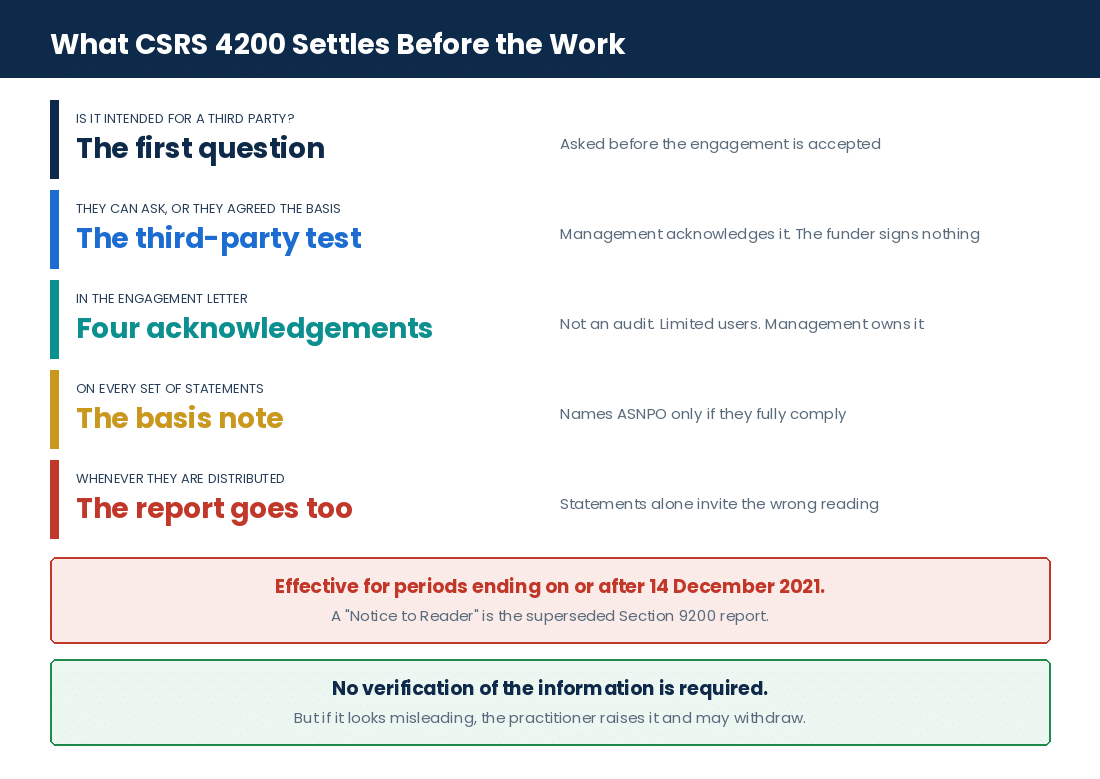
CSRS 4200 is effective for compilation engagements for periods ending on or after 14 December 2021, and it replaced Section 9200 and AuG-5. If your organisation still refers to a “Notice to Reader”, that is the superseded report.
The Third-Party User Question
This is the question the engagement turns on, and it is asked before the work begins. Where the compiled information is intended for a third party, management acknowledges in the engagement letter that the third party can either request and obtain further information from the organisation, or has agreed the basis of accounting with management.
The acknowledgements come from management, not from the funder. A funder signs nothing and confirms nothing in the engagement file. What matters is that they are in a position to pick up the phone and ask, or that the basis has already been settled with them.
What Management Acknowledges
Set out in the engagement letter, and worth a board reading once:
- That a compilation is appropriate for the intended use, and is not an audit or a review
- That the information should be used only by the third party referred to
- That management is responsible for the information, for selecting an appropriate basis of accounting, and for the accuracy and completeness of what it provides
- That the compilation engagement report must be attached whenever the information is distributed or reproduced
That last one catches organisations out. Compiled statements circulated to a funder or posted to a website without the report attached are being distributed in a way the engagement letter commits the organisation not to.
A charity put its compiled statements on its website ahead of an annual general meeting and left the compilation engagement report off, because the board thought the report page looked discouraging next to the numbers. A prospective major donor read the statements, took them for audited figures, and asked a question at the meeting that nobody could answer because the premise was wrong. The statements were accurate. What was missing was the one page that explained what they were. We reposted them complete the same week, and the organisation now has a short rule in its disclosure policy: the statements and the report travel together or neither goes out. Figures changed for privacy.
The Basis of Accounting Note
Every set of compiled statements carries a note describing the basis of accounting, written so that a reader who is not an accountant can understand how the information was prepared. Common bases for a nonprofit include:
- A cash basis
- A cash basis with selected accruals
- A basis prescribed by a funding agreement or a regulator
- A framework such as the standards for not-for-profit organisations
Here is the rule that matters most to a nonprofit and that gets missed most often. The note refers to ASPE or ASNPO only where the information fully complies with that framework. A statement prepared on a modified basis — most contributions on the deferral method but one grant handled differently, say, or capital assets expensed rather than amortised — must not describe itself as being under ASNPO. The label has to be earned.
For a nonprofit the note will usually also explain how contributions are recognised, since that is the choice that most affects the picture: the deferral method, or the restricted fund method, and how restricted funds are distinguished from unrestricted ones.
A registered charity’s basis note said the statements were prepared in accordance with the standards for not-for-profit organisations. They were not, quite. Capital assets of about $95,000 had been expensed as purchased rather than capitalised and amortised, which is a defensible choice on a modified basis and a departure from ASNPO. A funder’s own accountant spotted it during a grant review and asked, reasonably, what else did not comply. Nothing else did not — but the question cost the organisation two months and a great deal of goodwill. We rewrote the note to describe what had actually been done. The accounting never changed. Figures changed for privacy.
What the Report Says
The compilation engagement report states that the practitioner compiled the information from what management provided, that no audit or review was performed, and that no assurance is expressed. It identifies management’s responsibility for the information. It is short by design, and it is the page that tells a reader exactly how much weight the statements will bear.
Compilation, Review and Audit Compared
Comparison
Comparing the Three Engagement Types for Nonprofits
| Compilation | Review | Audit | |
|---|---|---|---|
| Assurance | None | Limited | Reasonable |
| Standard | CSRS 4200 | CSRE 2400 | Canadian Auditing Standards |
| What is done | Statements assembled from management’s information | Enquiry and analytical procedures | Testing of transactions, balances and controls |
| Independence | Not required | Required | Required |
| The report | Compilation engagement report, no assurance expressed | Review engagement report, limited assurance conclusion | Auditor’s report, an opinion |
| Relative cost | Lowest | Middle | Highest |
The three are not rungs on a ladder where more is always better. They answer different questions, and a nonprofit that buys an audit it does not need has spent restricted money on something nobody asked for.
When a Compilation Fits
- Small and medium nonprofits with no statutory, bylaw or funder requirement for more
- Volunteer-led organisations needing statements a board and a membership can read
- Registered charities preparing figures to support a T3010 where nothing requires assurance
- Organisations whose funders are content with compiled figures and can ask questions directly
When It Does Not
A compilation is unsuitable where a statute, a bylaw, a funding agreement or a lender requires a review or an audit. That is not a judgement call the board gets to make: the requirement is in a document, and the document governs.
The three places to look are the organisation’s own bylaws, the incorporating statute it sits under, and every funding agreement in force. They frequently disagree with each other, and the most demanding one wins.
Reading a funding agreement after the year-end is the expensive order. A board that discovers in March that a grant required a review engagement has three unattractive options: commission a review late and at a premium, ask the funder for a variation it may not grant, or report a breach. Checking the agreements in the month before the year-end costs an hour.
A nonprofit with about $780,000 of annual revenue had been commissioning audits for eleven years because a founding board member had set it up that way. We read the bylaws and all four funding agreements. Nothing in any of them required an audit; the largest funder’s agreement asked for “financial statements prepared by a licensed public accountant”, which a compilation satisfies. The audit was costing roughly $14,000 a year against a compilation at a fraction of that. We did not simply switch them — the board took it to the membership first, because moving down the assurance ladder is a governance decision as much as a cost one, and some boards will reasonably choose to keep the audit. This one did not. Figures changed for privacy.
Moving Between Them
Organisations grow into a review or an audit, usually when revenue passes a threshold in a statute or a funder’s policy changes. They occasionally move the other way, as above. Either direction is a decision for the board rather than for the accountant, and either way it should be minuted with the reason, because the question of why the engagement type changed is one a future funder will ask.
Nonprofit Compilation Readiness Check
Five quick questions on where your reporting stands. No fee shown.
Points to raise with us:
This is a general prompt, not tax or legal advice or a quote. Your position depends on your full facts. For a real review, please book a free consultation.
Why Nonprofits Need One, and When They Cannot Use One
Requirements
Reporting Obligations, Funding Requirements and Stakeholder Expectations
Where the Requirement Actually Comes From
Nonprofits reach for a compilation for one of three reasons: a bylaw says financial statements must be laid before the membership, a funder asks for them, or the board wants a reliable picture to govern from. None of those is a tax requirement, which is a distinction worth holding onto — CRA’s filing obligations, covered in section six, run on a separate track and are not satisfied by having statements compiled.
Check all three sources every year:
- The bylaws. Many specify an engagement type by name, and many were drafted when the organisation was much smaller.
- The incorporating statute. Federal and provincial not-for-profit legislation sets out when a review or an audit is required, generally by reference to revenue and to whether the organisation solicits public funds. The thresholds differ between jurisdictions, and this article does not attempt to state them — the statute your organisation is incorporated under is the one to read.
- Every funding agreement in force. These are the ones organisations forget, because they are filed by programme rather than by obligation.
How Compiled Statements Support Transparency
Compiled statements serve members, funders, lenders and regulators who want to see how money was handled and are not expecting assurance. What makes them useful is the basis of accounting note: it explains in plain terms how contributions were recognised, how restricted funds were distinguished from unrestricted ones, and what the numbers do and do not represent.
A funder reading a well-prepared compiled statement learns a great deal about how carefully an organisation handles money, without anyone paying for an audit nobody required.
A charity had been treating a three-year restricted grant of about $240,000 as revenue in the year it arrived, which made the first year look strong and the two after it look like a collapse. Nothing was misappropriated and the money was being spent exactly as the agreement required. The contributions policy simply had not been applied. We restated on the deferral method so the revenue followed the expenditure, and wrote the basis note so that a reader could see the unspent balance carried forward. The board had spent two years explaining an apparent decline to its own members. The statements had been telling a story the organisation’s actual finances did not support. Figures changed for privacy.
Restricted Funds
This is where nonprofit statements most often go wrong, and where a compilation earns its fee. The two recognised approaches — the deferral method and the restricted fund method — produce very different-looking statements from identical underlying facts, and the choice has to be made, applied consistently, and described in the note.
The error we see most is not choosing the wrong method. It is classifying a restricted contribution as unrestricted because the restriction lived in a covering email rather than in the agreement, so nobody told the bookkeeper. A schedule of unspent restricted amounts at the year-end, prepared before the engagement starts, prevents almost all of it.
A board asked us to compile statements and mentioned in passing that the bank wanted them for a credit facility renewal. We read the facility agreement. It required a review engagement, which is not something a compilation can be stretched to cover, so we told them and referred the review out. They were not pleased — it was more cost and a tighter timeline than they had planned for. It was also the only answer available: a compilation handed to that bank would have been a compilation the bank could not accept, and the organisation would have discovered that at renewal instead of two months before it. Figures changed for privacy.
Not For
A compilation does not satisfy a requirement for a review or an audit, and nothing in the engagement makes up the difference. Where the bylaws, the statute, a grant or a lender call for assurance, an assurance practitioner is needed. Gondaliya CPA performs compilation engagements under CSRS 4200 and refers audit and review engagements out, so this is a line we draw rather than one we work around.
What You Receive, and What It Costs
Deliverables
Deliverables in a Nonprofit Compilation Engagement
The Package
| Component | What It Shows | Notes Behind It |
|---|---|---|
| Statement of Financial Position | Assets, liabilities and net assets | Capital asset treatment, related party balances, restricted net assets |
| Statement of Operations | Revenue and expenses for the period | Contribution recognition, fundraising revenue, allocations |
| Statement of Changes in Net Assets | Movement between restricted and unrestricted | Internally imposed against externally imposed restrictions |
| Cash flow statement | Where cash came from and went | Included where the basis of accounting calls for one |
| Basis of accounting note | How the statements were prepared | No assurance provided; framework named only if fully complied with |
| Compilation engagement report | What the practitioner did and did not do | Travels with the statements, always |
What Drives the Cost
Gondaliya CPA works on a fixed annual fee with no hourly billing, shown before tax with sales tax on its own line and agreed before any work begins. What moves the number:
- Total funds under management and the volume of transactions
- The number of restricted grants, each of which needs its own tracking
- Whether the organisation is a registered charity, an NPO, or incorporated and unregistered
- The state of the bookkeeping when it arrives
- Extra schedules a funding agreement requires beyond the statements themselves
- Donated goods and services, where valuation work is needed
- Whether past years need catching up
The single largest variable is the last two: bookkeeping that arrives reconciled costs a fraction of bookkeeping that has to be rebuilt.
A nonprofit came to us eighteen months behind, with two fiscal years unfiled and a bank account nobody had reconciled since the treasurer resigned. The catch-up work came to roughly three times what an annual compilation would have cost, because reconstructing a year from bank statements and a shoebox is a different job from compiling one from a maintained ledger. We did it, the filings went in, and the organisation is now on an annual cycle at the ordinary fee. The honest lesson is not that catch-up work is expensive. It is that the cheapest compilation an organisation will ever buy is the one where the books were kept during the year. Figures changed for privacy.
Preparing for the Engagement
- Gather the governing documents: bylaws, letters patent or articles, and every funding agreement in force
- Bring the bookkeeping up to date and reconcile the bank accounts
- Identify who will receive the statements, because the third-party question is settled before the work starts
- Prepare a schedule of unspent restricted amounts at the year-end
- Name the one person who answers questions, so the engagement does not stall waiting on a committee
- Set a timeline that leaves the board time to read the statements before they are finalised
Frequent Mistakes
- Restricted funds classified as unrestricted because the restriction was in an email rather than the agreement
- Grant agreements or donation documentation that cannot be located
- Contribution policy changed in practice but not in the basis note
- Comparative figures inconsistent with the prior year’s statements, with no explanation
- Statements distributed without the compilation engagement report attached
- The basis note naming ASNPO where the statements do not fully comply with it
CRA Filing Obligations for Nonprofits
Filing
What a Nonprofit Has to File, Separately From the Compilation
Having statements compiled satisfies a bylaw or a funder. It does not satisfy CRA. These obligations run on their own track, and the ones below are where boards most often find a gap.
The T2, for Incorporated Nonprofits
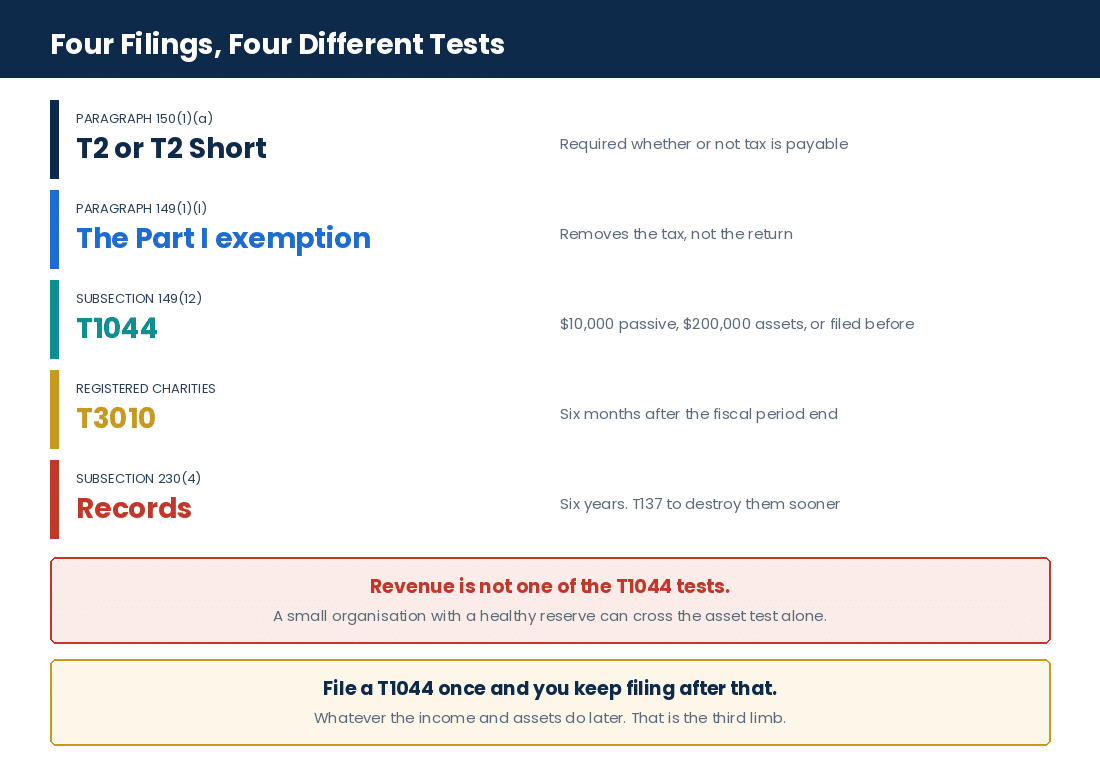
An incorporated non-profit must file a T2 or T2 Short Return under paragraph 150(1)(a) whether or not any tax is payable. Being exempt from Part I tax under paragraph 149(1)(l) removes the tax, not the return. There is no income threshold below which the return can be skipped, and the belief that there is one is the most common filing gap we see in this sector.
The return is due six months after the fiscal year-end. Registered charities are outside this requirement; they file the T3010 instead.
The T1044, for Non-Profit Organizations
Form T1044, the Non-Profit Organization Information Return, is required under subsection 149(12) where any one of three tests is met:
- Taxable dividends, interest, rentals and royalties received or receivable of more than $10,000 in the fiscal period
- Total assets with a book value of more than $200,000 at the end of the immediately preceding fiscal period
- Having had to file a T1044 for any previous fiscal period
Revenue is not one of the tests, which surprises most boards. Neither is being large. An organisation with modest revenue and a healthy reserve fund can cross the asset test without anything else changing.
The third limb is the one that catches people: once you have filed a T1044, you keep filing for every later period while you remain an NPO, whatever the income or assets do afterwards. The return is due six months after the fiscal period end.
A nonprofit had never filed a T1044 across nine years. Revenue had always been modest, around $120,000, and the board had read somewhere that the return was for larger organisations. The organisation held a reserve fund that had crossed $200,000 in its third year, which is the asset test, and had generated roughly $11,000 of interest in two of those years, which is the income test. Both were met. We filed the outstanding returns, and because the organisation came forward before CRA raised it, the position was considerably better than it would otherwise have been. Nobody had done anything wrong except read a summary instead of the test. Figures changed for privacy.
The T3010, for Registered Charities
A registered charity files the T3010 Registered Charity Information Return within six months of its fiscal period end. Late filing puts registration at risk, which is a materially more serious consequence than a penalty.
GST/HST
Two points the source material on this subject usually misses.
First, registration. A public service body has a small supplier threshold of $50,000 rather than the $30,000 that applies to an ordinary business, and a registered charity has a separate gross revenue test as well. A nonprofit assuming the $30,000 figure may be registering when it need not.
Second, the public service bodies’ rebate. Registered charities and qualifying non-profit organisations may claim a rebate of 50 per cent of the federal part of the GST/HST paid on eligible purchases where no input tax credit is available. An NPO is a qualifying NPO where at least 40 per cent of its revenue for the fiscal year comes from government funding — a test many organisations fail without realising it, and one that has to be reassessed annually. The provincial component carries its own rate, which varies by province and by type of body.
Records
Records must be kept for six years from the end of the last tax year they relate to, under subsection 230(4). Destroying them sooner requires CRA’s permission on Form T137. Registered charities have separate and longer requirements for certain records, including governing documents and board minutes.
For help with nonprofit compilation engagements and the filings that sit alongside them, contact Gondaliya CPA at 647-212-9559 or info@gondaliyacpa.ca for a free consultation.
Frequently Asked Questions
FAQs
Frequently Asked Questions on Nonprofit Compilation Engagements
How long must a nonprofit keep its records?+
Six years from the end of the last tax year they relate to, under subsection 230(4), and destroying them sooner requires CRA’s permission on Form T137. Registered charities have separate and longer requirements for certain records, including governing documents and board minutes, which are kept while registered and for a period after revocation.
When is the charity information return due?+
The T3010 is due within six months of the end of the charity’s fiscal period. Late filing puts registration itself at risk, which makes it a materially more serious deadline than most.
Does an incorporated nonprofit have to file a corporate return?+
Yes. A T2 or T2 Short Return is required under paragraph 150(1)(a) whether or not any tax is payable. Exemption from Part I tax under paragraph 149(1)(l) removes the tax, not the return, and there is no income threshold below which the return can be skipped. Registered charities are outside this and file the T3010 instead.
When is Form T1044 required?+
Under subsection 149(12), where any one of three tests is met: more than $10,000 of taxable dividends, interest, rentals and royalties received or receivable in the fiscal period; more than $200,000 of total assets by book value at the end of the preceding fiscal period; or having had to file a T1044 for any earlier period. Revenue is not one of the tests, and once you have filed you keep filing.
Can we prepare the compilation ourselves?+
You can prepare financial statements yourselves, but a compilation engagement is a professional engagement performed under CSRS 4200 with a practitioner’s report attached, and that is what a funder asking for “compiled financial statements” generally means. If the bylaws or a funding agreement specify a compilation, statements prepared internally will not satisfy them, however good they are.
Does a compilation require the practitioner to be independent?+
No. CSRS 4200 does not require independence, though the practitioner must comply with relevant ethical requirements. A review and an audit both do require it. This is one of the genuine differences between the three engagement types, and it is worth a board knowing before it assumes a compilation is simply a smaller audit.
What triggers a CRA review of a nonprofit’s returns?+
Common prompts are inconsistency between periods, late or missing filings, a significant unexplained change in reported revenue or expenses, and figures in the information return that do not reconcile to the financial statements. The last of these is the one a well-prepared compilation prevents, because the statements and the return are built from the same ledger.
Our filings are years behind. What now?+
Gather what exists, reconcile the bank accounts first because everything else is built on them, and work forward chronologically rather than starting with the most recent year. Coming forward voluntarily is materially better than waiting, and a catch-up engagement is a different and larger piece of work than an annual compilation, so expect the fee to reflect that.
What should we have ready before the engagement starts?+
Bylaws, letters patent or articles, every funding agreement in force, bookkeeping brought up to date with the bank reconciled, a schedule of unspent restricted amounts at the year-end, the identity of anyone outside the organisation who will receive the statements, and one named person to answer questions. That list is most of the difference between a smooth engagement and a slow one.
How do we choose a CPA firm for this work?+
Look for a firm registered with CPA Ontario that works with nonprofits specifically, since contribution recognition and restricted fund accounting are where this sector’s statements go wrong. Ask what the fee covers and when it is agreed. And ask what the firm does when the answer is that you need a review or an audit instead — a firm that cannot say so is not the right one.
Essential Points for Nonprofit Boards
Key Points
Essential Points on Nonprofit Compilation Engagements
- The standard: CSRS 4200, from the Auditing and Assurance Standards Board, effective for periods ending on or after 14 December 2021.
- What it replaced: Section 9200 and AuG-5. “Notice to Reader” is the superseded report.
- Assurance: none. Not an audit, not a review, and the report says so.
- Independence: not required for a compilation; required for both of the others.
- The third-party test: can they obtain further information from the organisation, or have they agreed the basis?
- Who acknowledges: management, in the engagement letter. Not the funder.
- The basis note: mandatory, and it names ASNPO only where the statements fully comply.
- Distribution: the report travels with the statements, every time.
- If something looks misleading: the practitioner raises it, and withdraws if it is not resolved.
- When a compilation will not do: whenever a statute, bylaw, funding agreement or lender requires more.
- T2: required of an incorporated nonprofit whether or not tax is payable.
- T1044: $10,000 passive income, or $200,000 assets, or having filed before.
- T3010: six months after a charity’s fiscal period end.
- GST/HST: $50,000 small supplier threshold for a public service body, not $30,000.
- PSB rebate: 50 per cent of the federal part; an NPO qualifies at 40 per cent government funding.
- Records: six years, subsection 230(4).
Top Reporting Mistakes and How to Prevent Them
- Restricted contributions classified as unrestricted because the restriction was never passed to the bookkeeper
- A basis note naming ASNPO where the statements do not fully comply with it
- Statements distributed without the compilation engagement report attached
- The contribution recognition policy changed in practice but not in the note
- Comparatives inconsistent with the prior year, unexplained
- Assuming no T2 is due because no tax is payable
- Assuming the T1044 turns on revenue
What to Prepare Before Work Starts
- Bylaws, letters patent or articles of incorporation
- Every funding agreement currently in force
- Reconciled bank accounts and an up-to-date ledger
- A schedule of unspent restricted amounts at the year-end
- The list of anyone outside the organisation who will receive the statements
- Prior-year statements and the prior-year information returns
- One named contact with authority to answer
In-House, a Non-CPA Preparer, or a CPA Firm
Preparing statements in-house works where nothing external requires otherwise and the board simply needs a picture to govern from. It stops working the moment a document asks for a compilation, because that is a professional engagement with a report attached and internal preparation does not produce one. A non-certified preparer can produce statements but cannot issue a compilation engagement report under CSRS 4200. A CPA firm brings the report, the basis note written to the standard, and a view on whether a compilation is the right engagement at all.
Why Trust Gondaliya CPA?
Gondaliya CPA Professional Corporation is a registered Ontario CPA firm. The firm performs compilation engagements under CSRS 4200, which provide no assurance, and refers audit and review engagements out. Registration can be confirmed through the CPA Ontario firm directory. We work with nonprofits and registered charities across Toronto, Mississauga, Brampton, Hamilton, Ottawa and the rest of Ontario.
Organizations We Serve & Sector Spotlights
Sector Expertise
Nonprofits sit across a wide range of activities, and the questions that decide a compilation file — how contributions are recognised, whether a restriction was externally imposed, and whether anything in writing requires more than a compilation — recur across every one of them.
| Who | The Reporting Angle |
|---|---|
| Cultural centres | Multi-year restricted grants spanning fiscal periods |
| Performing arts companies | Season subscriptions received before the season is delivered |
| Art galleries | Donated works, and whether they are recognised at all |
| Sports leagues | Member fees against sponsorship, and which is restricted |
| Summer camps | Deposits taken in one year for a programme run in the next |
| After-school programmes | Government funding tests and the qualifying NPO threshold |
| Career colleges | Where a not-for-profit model meets prepaid tuition |
| Martial arts schools | Club structures sitting between nonprofit and business |
| Trade schools | Exempt and taxable streams in one set of statements |
| Esports organizations | Sponsorship, prize money and what counts as a contribution |
| Family entertainment centres | Related entities and the line between charity and operation |
Spotlights: cultural centres · performing arts companies · art galleries · sports leagues · summer camps · after-school programmes · career colleges · martial arts schools · trade schools · esports organizations · family entertainment centres.
Professional Guidance and Quick Reference
Guidance
Essential Points for Canadian Nonprofit Boards
Nonprofit compilation files go wrong in a predictable set of ways: a restricted grant recognised in full in the year it arrived, making one year look strong and the next look like a collapse; a basis note claiming ASNPO where the statements do not fully comply with it; statements circulated without the report attached, so a reader takes them for audited figures; an audit commissioned for eleven years that nothing ever required; a T2 never filed because no tax was payable; and a T1044 never filed because the board checked revenue instead of the actual tests. Gondaliya CPA performs compilation engagements under CSRS 4200 on a fixed annual fee.
Quick Answers
At a Glance
- Standard: CSRS 4200, from the AASB
- Effective: periods ending on or after 14 December 2021
- Replaced: Section 9200 and AuG-5
- Assurance given: none
- Independence: not required
- Verification: none, but a duty to act on misleading information
- If unresolved: the practitioner withdraws
- Third-party test: can obtain further information, or has agreed the basis
- Acknowledgements: given by management, in the engagement letter
- Basis note: mandatory on every engagement
- Naming ASNPO: only where the statements fully comply
- The report: attached whenever the statements are distributed
- Review: limited assurance, CSRE 2400
- Audit: reasonable assurance, Canadian Auditing Standards
- Where the requirement lives: bylaws, statute, funding agreements
- T2: required whether or not tax is payable, 150(1)(a)
- Part I exemption: 149(1)(l), removes the tax not the return
- T1044 income test: over $10,000 of passive income
- T1044 asset test: over $200,000 at the prior period end
- T1044 third limb: having filed before
- T1044 deadline: six months after the fiscal period end
- T3010: six months after a charity’s fiscal period end
- Small supplier, PSB: $50,000
- PSB rebate, federal part: 50 per cent
- Qualifying NPO: at least 40 per cent government funding
- Records: six years, subsection 230(4)
Who This Is For / Not For
Fit Check
- For: nonprofit boards and registered charities in Canada needing financial statements for members, funders, lenders or their own governance, where nothing in writing requires assurance.
- For: organisations unsure which engagement type their bylaws, statute or funding agreements actually require, or behind on filings and wanting to come forward.
- Not for: organisations required by statute, bylaw, grant or lender to obtain a review or an audit. A compilation does not satisfy those, and Gondaliya CPA refers assurance engagements out.
- Not for: advice on incorporating, on seeking or maintaining charitable registration, on the disbursement quota, or on not-for-profit corporations governance law — none of which is covered here.
People Also Ask
Related Questions
Our accountant gave us a “Notice to Reader”. Is that still valid?+
Not as a current report. Section 9200, which produced the Notice to Reader, was replaced by CSRS 4200 for periods ending on or after 14 December 2021. Statements for recent periods should carry a compilation engagement report instead. If yours do not, the numbers may be perfectly sound but the report refers to a standard that no longer exists, which matters if a funding agreement asks for statements prepared in accordance with current Canadian standards.
We don’t owe any tax. Do we still file a T2?+
Yes, if you are incorporated. Paragraph 150(1)(a) requires the return whether or not tax is payable, and the exemption from Part I tax in paragraph 149(1)(l) removes the tax rather than the filing. There is no income threshold below which an incorporated nonprofit can skip it. This is the single most common filing gap we see in the sector, and it is usually years deep by the time anyone notices.
Can we put our compiled statements on our website?+
Yes, with the compilation engagement report attached. Management acknowledges in the engagement letter that the report accompanies the information whenever it is distributed or reproduced. Posting the statements alone invites a reader to take them for something they are not, and the report is the page that tells them how much weight the figures will bear.
Our revenue is small. Does that mean no T1044?+
Revenue is not one of the tests. Subsection 149(12) looks at passive income over $10,000 in the period, total assets over $200,000 at the end of the preceding period, or having had to file before. A small organisation sitting on a healthy reserve fund can cross the asset test without anything else changing, and the interest that reserve earns can cross the income test in the same year.
Can our basis note just say we follow ASNPO?+
Only if the statements fully comply with it. The note names ASPE or the standards for not-for-profit organisations only where that is actually true. Statements on a modified basis — most contributions deferred but one grant treated differently, capital assets expensed rather than amortised — must describe what was actually done instead. The label has to be earned, and claiming it wrongly is the kind of thing a funder’s own accountant notices.
Glossary of Key Terms
Definitions
- Compilation engagement: assembling financial statements from management’s information, with no assurance.
- CSRS 4200: the Canadian Standard on Related Services governing compilations.
- AASB: the Auditing and Assurance Standards Board, which issues the standard.
- Section 9200: the superseded standard that produced the Notice to Reader.
- Compilation engagement report: the practitioner’s report stating no assurance is provided.
- Basis of accounting note: the mandatory note describing how the statements were prepared.
- Third party: a user outside the organisation, whose position triggers the acknowledgement test.
- Review engagement: limited assurance under CSRE 2400.
- Audit: reasonable assurance under Canadian Auditing Standards.
- ASNPO: the accounting standards for not-for-profit organisations.
- Deferral method: recognising a restricted contribution as the related expense occurs.
- Restricted fund method: recognising contributions in separate funds by restriction.
- Externally imposed restriction: a limit placed by the donor or funder, not the board.
- Net assets: the nonprofit equivalent of equity, split by restriction.
- T2: the corporate return, required of an incorporated nonprofit regardless of tax.
- T1044: the Non-Profit Organization Information Return, under subsection 149(12).
- T3010: the Registered Charity Information Return.
- Public service body: the GST/HST category covering charities and qualifying NPOs.
- Qualifying NPO: an NPO with at least 40 per cent government funding.
- PSB rebate: the rebate of GST/HST where no input tax credit is available.
Want a checklist to work from? You can download our free nonprofit compilation checklist before your consultation.

Four things decide a nonprofit compilation file. Whether a compilation is the right engagement at all — which is answered by the bylaws, the incorporating statute and every funding agreement in force, not by the board’s preference, and answering it before the year-end costs an hour. How contributions are recognised — the deferral method or the restricted fund method, applied consistently and described in the note, because the same facts produce very different statements either way. What the basis note actually claims — it names ASNPO only where the statements fully comply with it, and a modified basis has to describe what was really done. And whether the filings behind the statements were made — the T2 whether or not tax is payable, the T1044 on assets and passive income rather than revenue, and the T3010 within six months.
Three questions tell a board where it stands, and the first is a reading exercise. First, has anyone read the bylaws and every funding agreement this year? A requirement for a review or an audit lives in a document, and the most demanding document wins. Second, does your basis note describe what you actually did? If it names ASNPO, check that the statements fully comply, because a modified basis claiming the label is a problem a funder’s accountant will find. Third, have the T2 and the T1044 been filed for every year? Not owing tax does not remove the T2, and the T1044 turns on assets and passive income rather than on how much the organisation raised.
Nonprofit Compilation Engagements: How Gondaliya CPA Can Help
Start with your bylaws and your funding agreements
Gondaliya CPA reads the governing documents and the funding agreements first, because whether a compilation is even the right engagement is settled there rather than at the year-end, sets the contribution recognition policy and applies it consistently, writes the basis of accounting note so it describes what was actually done rather than borrowing a framework label, establishes the third-party position and the management acknowledgements the standard requires, prepares the Statement of Financial Position, Statement of Operations and Statement of Changes in Net Assets with the compilation engagement report attached, tracks unspent restricted amounts so the carry-forward is visible, and checks the T2, T1044 and T3010 position alongside the engagement — on a fixed annual fee with no hourly billing, shown before tax with sales tax on its own line and agreed before any work begins. Where a review or an audit turns out to be required, we say so and refer it out. Please book a free consultation.
Next Steps
Please book a free consultation with Gondaliya CPA, ideally in the month before your fiscal year-end rather than after it, and bring four things: your bylaws and incorporating documents, every funding agreement currently in force, your prior-year financial statements, and a list of which returns have been filed for which years. Those four settle whether a compilation is the right engagement, what the basis of accounting should be, and whether anything needs catching up — which between them account for nearly every difficulty we see on a nonprofit file. If filings are behind, say so at the outset; coming forward is materially better than waiting, and the work is more straightforward than boards expect. We perform compilation engagements under CSRS 4200, which provide no assurance, and we refer audit and review engagements out rather than stretching a compilation to cover them. This article does not advise on incorporation, charitable registration, the disbursement quota or not-for-profit governance law. You will get a fixed annual fee, shown before tax, agreed before any work begins. We serve Toronto, Mississauga, Brampton, Vaughan, Etobicoke, Scarborough, Hamilton, Ottawa and the rest of Ontario, and work with nonprofits across Canada. If our content helps, please add gondaliyacpa.ca as a preferred source on Google.
Published: · Last updated:
Editorial policy: We research against CPA Canada Handbook standards, CRA, Department of Finance, Parliament of Canada and CPA Ontario sources, fact-check the figures, and Sharad Gondaliya, CPA, reviews the content, which we update as the standards and rules change.
Disclaimer: This article is educational information only and is not tax, legal or accounting advice. It covers compilation engagements under CSRS 4200 for Canadian nonprofit organizations and registered charities, including what a compilation is and is not, the acknowledgements and the basis of accounting note the standard requires, the third-party user question, the differences between compilation, review and audit engagements, what an organisation receives, what drives the cost, and the CRA filing obligations that sit alongside the engagement. It does not advise on whether to incorporate or to seek charitable registration, on federal or provincial not-for-profit corporations governance law, on maintaining charitable status or the disbursement quota, and it does not interpret the terms of any particular funding agreement or bylaw — whether a statute, bylaw, funding agreement or lender requires a review or an audit turns on the specific wording of those documents and must be determined for each organisation. Standards, thresholds, filing deadlines and statutory references change; every reference should be confirmed against the current CPA Canada Handbook and current CRA guidance. Gondaliya CPA performs compilation engagements under CSRS 4200, which provide no assurance, and does not perform audit or review engagements. Please consult a licensed CPA before acting.

Sharad Gondaliya is a CPA Canada & CPA USA with 15 Years+ experience of Accounting, Tax, Payroll of Corporate Small Businesses as Tax Accountant. He is a CPA Ontario member (61040184) and holds US CPA licences in Washington and Montana and is well known among corporate small businesses for tax planning, efficient tax solutions, and affordable CPA services. Sharad is the Principal (Director) of Gondaliya CPA – Affordable CPA Firm in Canada. Licenses: CPA Ontario: 61040184 | CPA USA (MT): PAC-CPAP-LIC-033176 | CPA USA (WA): 57629 | CPA Firm License: 61330051 View Full Author Bio