



Corporate Tax on Capital Gains in Canada: Inclusion Rate, Capital Dividend Account and Paying It Out
Corporate Capital Gains and the Capital Dividend Account
Gondaliya CPA advises Canadian corporations on the tax treatment of capital gains and on the capital dividend account that the non-taxable half creates. The work covers the computation, the election, and the filings that sit behind a payment to investment holding companies and their shareholders.
Quick Summary
A corporation that sells an asset for more than its adjusted cost base realises a capital gain, and under paragraph 38(a) exactly one-half of that gain is a taxable capital gain. The other half is never taxed, and in a private corporation it creates room in the capital dividend account defined in subsection 89(1) — a notional running total, not a ledger entry and not a pot of cash. That room can be paid out to shareholders as a tax-free capital dividend by electing under subsection 83(2) on Form T2054, which Regulation 2101 prescribes. Three things decide whether that works. The balance is the one standing immediately before the dividend becomes payable, and it is cumulative from the corporation’s first day, so a loss realised years ago still counts against it. The election is due on the earlier of the day the dividend becomes payable and the first day any part of it is paid, with a late election permitted under subsection 83(3) at a penalty of the lesser of 1/12 of 1 per cent of the dividend and $41.67 a month. And paying out more than the account holds brings Part III tax at 60 per cent of the excess under subsection 184(2), with the subsection 184(3) election on Form T2184, filed within 90 days of the assessment, as the way out. CRA will confirm a balance in advance on Schedule 89, and the taxable half meanwhile carries refundable Part I tax of 30 2/3 per cent recoverable at 38 1/3 per cent of taxable dividends paid.
Reading time: 16 minutes.
Table of Contents
- How a Corporation Is Taxed on a Capital Gain
- The Inclusion Rate: What Changed and What Did Not
- The Capital Dividend Account and What Goes Into It
- Measuring the Balance and Filing the Election
- Paying Out More Than the Account Holds
- The Taxable Half, Records and Verification
- Frequently Asked Questions
- Essential Points for Corporate Directors
- Businesses We Serve & Industry Spotlights
- Professional Guidance and Quick Reference
The Numbers That Matter
This article covers the taxation of capital gains realised by Canadian corporations and the capital dividend account that arises from them, with Ontario and Toronto context, current to 5 November 2026. It covers the computation of a capital gain and the one-half inclusion rate, the history of that rate including the proposal that was cancelled in March 2025, what the capital dividend account is and what feeds it, when the balance is measured, the subsection 83(2) election on Form T2054 and its deadline, late elections and the penalty, the Part III tax that follows an excess capital dividend and the subsection 184(3) election that relieves it, the refundable tax on the taxable half, record retention, and CRA balance verification on Schedule 89. It does not cover the lifetime capital gains exemption, section 85 rollovers, the capital gains reserve, the taxation of capital gains in the hands of individuals or trusts, or the provisions dealing with depreciable property and recapture. Gondaliya CPA performs compilation engagements under CSRS 4200, which provide no assurance; audit and review engagements are referred out. This is educational information only and not tax, legal or accounting advice.
How a Corporation Is Taxed on a Capital Gain
Foundations
Working Out a Corporate Capital Gain and the Taxable Half
A capital gain arises when a corporation disposes of a capital asset — shares, real estate, a parcel of land, an interest in a partnership — for more than it cost. The computation has three inputs and one subtraction.
- Proceeds of disposition — what the corporation received for the asset
- Adjusted cost base — what it paid, adjusted over the holding period for the items the Act specifies
- Outlays and expenses — legal fees, commissions and the other costs of making the sale
Proceeds less the adjusted cost base less the outlays gives the capital gain. Under paragraph 38(a), one-half of that gain is a taxable capital gain and goes into the corporation’s income. The other half is not taxed. It is not deferred, not sheltered and not conditional — it simply never enters income at all.
That untaxed half is where everything else in this article comes from. In a private corporation it creates room in the capital dividend account, and that room is what lets the money reach a shareholder without a second layer of tax.
A Worked Figure
A corporation sells a commercial property for $900,000. Its adjusted cost base is $500,000 and the legal fees and agent’s commission come to $40,000. The capital gain is $360,000. Of that, $180,000 is a taxable capital gain that goes into income and is taxed at the corporation’s investment income rate, and $180,000 is not taxed and adds to the capital dividend account.
The arithmetic is that simple. Nearly every difficulty we see on a real file is in the adjusted cost base rather than in the inclusion rate — an asset held for fifteen years through several refinancings, improvements capitalised in some years and expensed in others, and nobody left at the company who remembers which.
A Toronto holding company sold a building it had owned since the early 2000s. The bookkeeper took the gain as proceeds less the figure on the balance sheet, which was net book value after two decades of depreciation rather than adjusted cost base, and the capital gain came out roughly $140,000 too high. The error ran both ways and neither way was good: the corporation would have paid tax on a taxable half it did not have, and it would also have credited its capital dividend account with a non-taxable half it did not have, which is the half that causes real trouble later. Rebuilding the cost base from the purchase documents and the capitalised improvements took two days and a trip to the lawyer’s archive. Figures changed for privacy.
Where the Taxable Half Goes
The taxable half is investment income, not active business income. It does not attract the small business deduction, and in a Canadian-controlled private corporation it carries the high investment income rate with a refundable component — which section six returns to. For a corporation whose business is real estate, there is a prior question the Act does not answer with a bright line: whether a disposition produces a capital gain at all, or business income taxed in full. A property bought to rent and held for fifteen years is one thing; a property bought, renovated and flipped within the year is another, and only the first produces capital dividend account room.
That characterisation question is settled on the facts — the intention at purchase, the holding period, the frequency of similar transactions, the taxpayer’s other activities — and it is worth settling before the sale rather than after the return is filed.
The Inclusion Rate: What Changed and What Did Not
Current Position
The Capital Gains Inclusion Rate for Corporations in 2026
The corporate inclusion rate for 2026 is one-half. It has been one-half since 18 October 2000, and no change is currently scheduled.
That plain statement is worth making because the last two years produced a great deal of noise. The rate did not move in 2019, 2020, 2021 or 2022, and nothing about the pandemic altered it. What happened instead was a single proposal and its reversal.
| Date | What Happened | Effect on Corporations |
|---|---|---|
| 18 October 2000 | Rate set at one-half | One-half of every capital gain is taxable |
| 24 June 2024 | Proposal to raise the rate to two-thirds for all corporate gains | Announced, never enacted |
| 31 January 2025 | Start date deferred to 1 January 2026 | Two-thirds would have applied from that date |
| 21 March 2025 | The increase was cancelled | One-half continues, with no replacement proposal |
The proposal would have applied to all capital gains realised by a corporation, with no equivalent of the $250,000 annual threshold offered to individuals. For a company with a single large disposition, the difference between one-half and two-thirds is a third of the gain moving from untaxed to taxed, and that is exactly the amount that would otherwise have gone into the capital dividend account.

The Problem the Reversal Left Behind
Between June 2024 and March 2025 a great many corporations computed their capital dividend account on the two-thirds assumption, because that was the announced law and accountants are expected to apply announced law. Those corporations credited one-third of each gain rather than one-half, and some of them paid capital dividends on the smaller figure. Those payments were fine.
The ones in difficulty are the corporations that did the opposite — that realised gains before the proposal and paid dividends during the window on a balance computed under a rate that then did not arrive, or that mixed the two bases across a year. Where the result is a capital dividend larger than the account actually held, the excess attracts Part III tax, and CRA has confirmed that it cannot waive that tax. The relief power for interest and penalties does not reach it. Section five sets out what is left.
A professional corporation came to us in early 2026 after a notice of assessment arrived for Part III tax on a capital dividend declared the previous spring. The prior accountant had run the capital dividend account across a year that straddled the announcement, applying two-thirds to the gains realised after June and one-half to the ones before, then paid out the whole balance. The two-thirds portion had never been law. The excess was a little under $30,000 and the Part III tax on it was 60 per cent of that, which is more than the shareholder would have paid on the whole dividend as an ordinary one. The subsection 184(3) election fixed it, at the cost of the shareholder paying tax on a dividend they had been told was tax-free. Figures changed for privacy.
What to Do About It Now
Any corporation that paid a capital dividend between June 2024 and March 2025 should have the computation re-run against the one-half rate. The check is quick, the exposure is 60 per cent of anything that turns out to be excess, and the remedy — the subsection 184(3) election — has a 90-day clock that starts at assessment. Finding the problem before CRA does is the difference between a planned conversation with the shareholder and an unplanned one.
The Capital Dividend Account and What Goes Into It
The Account
What the Capital Dividend Account Is, and What It Is Not
The capital dividend account is defined in subsection 89(1). It is a notional running total that a private corporation computes, not a line in the general ledger and not a balance at the bank. The definition opens with the words “at any particular time”, which matters more than it looks: the balance is a figure as at a moment, not a year-end number.
Three things follow from it being notional, and all three catch people out.
- A corporation can have a large account and no cash. The account records room, not money; paying the dividend still needs funds.
- Nothing appears on the financial statements. A set of compilation engagement financial statements will not show the balance, so it has to be tracked separately and carried forward year after year.
- The figure is computed, not approximate. CRA will assess against it, and an overstatement is expensive rather than embarrassing.
What Feeds the Account
| Component | Effect | Where It Sits in 89(1) |
|---|---|---|
| The non-taxable half of capital gains, net of the non-deductible half of capital losses | Increases | Paragraph (a) |
| Capital dividends received from another corporation | Increases | Paragraph (b) |
| Life insurance death benefit above the policy’s adjusted cost basis | Increases | Paragraph (d) |
| Capital dividends that became payable by the corporation | Decreases | The closing words of the definition |
On life insurance, the entry is the death benefit, reduced by the adjusted cost basis of the policy. A policy sold or surrendered while the life insured is living does not feed the account under paragraph (d); any gain on that disposition is ordinary income rather than a capital gain.
A family manufacturing company received roughly $2 million on a key-person policy after the founder died. Their accountant credited the whole amount to the capital dividend account and the estate planning was built on that figure. The policy had an adjusted cost basis of about $310,000 accumulated over twenty-two years of premiums, which comes off. The real room was $1.69 million. The difference was caught during our review of the corporation’s position before the dividends were declared, which was fortunate — three hundred thousand dollars of excess capital dividend would have carried Part III tax of around $186,000. Figures changed for privacy.
The Account Is Cumulative, Not Annual
This is the single most common source of an overstated balance. The capital gains component in paragraph (a) is cumulative from the corporation’s first day. It is the total of the non-taxable halves of every gain the corporation has ever realised, less the non-deductible halves of every capital loss it has ever realised, less every capital dividend it has already paid.
A loss from twelve years ago still sits in that calculation. A corporation that lost money on an investment in 2014 and makes a large gain in 2026 does not start the 2026 computation at zero. We regularly see balances computed as though each year stood alone, and the resulting figure is always too high.
Note also which half of a loss does the work. The allowable half of a capital loss reduces taxable income. It is the other half, the non-deductible half, that reduces the capital dividend account — the mirror image of the non-taxable half of a gain that increases it.
An Ontario investment holding company asked us to confirm a capital dividend account balance of about $400,000 before paying it out. The figure came from a schedule the client had maintained carefully since 2019, and the arithmetic in it was correct. What it did not include was a $240,000 capital loss on a private company investment written off in 2016, under a previous accountant and a previous bookkeeping system. The non-deductible half of that loss, $120,000, had never been entered. The real balance was $280,000. Rebuilding the account from the corporation’s first year took the better part of a week, and it is work that only ever has to be done once if it is then maintained. Figures changed for privacy.
Whose Account It Is
The capital dividend account belongs to private corporations. It is not restricted to Canadian-controlled private corporations, and it is not available to a public corporation. CCPC status matters a great deal for the refundable tax on the taxable half, which is section six, but it does not govern the account itself.
Capital Dividend Account Readiness Check
Five quick questions on where your capital dividend account stands. No fee shown.
Points to raise with us:
This is a general prompt, not tax or legal advice or a quote. Your position depends on your full facts. For a real review, please book a free consultation.
Measuring the Balance and Filing the Election
The Election
Subsection 83(2), Form T2054 and the Deadline That Matters
A capital dividend is not a kind of dividend a corporation can simply declare. It is an ordinary dividend on which the corporation has made an election, and the election is what makes it tax-free in the shareholder’s hands. Without it, the money is a taxable dividend like any other.
The election is made under subsection 83(2) on Form T2054, which Regulation 2101 prescribes. It requires a schedule showing how the balance was computed and a certified copy of the directors’ resolution authorising the dividend.
When the Balance Is Measured
The balance that counts is the one standing immediately before the dividend becomes payable. In practice that is almost always the date of the directors’ resolution, not the date the cash leaves the account and not the fiscal year-end.
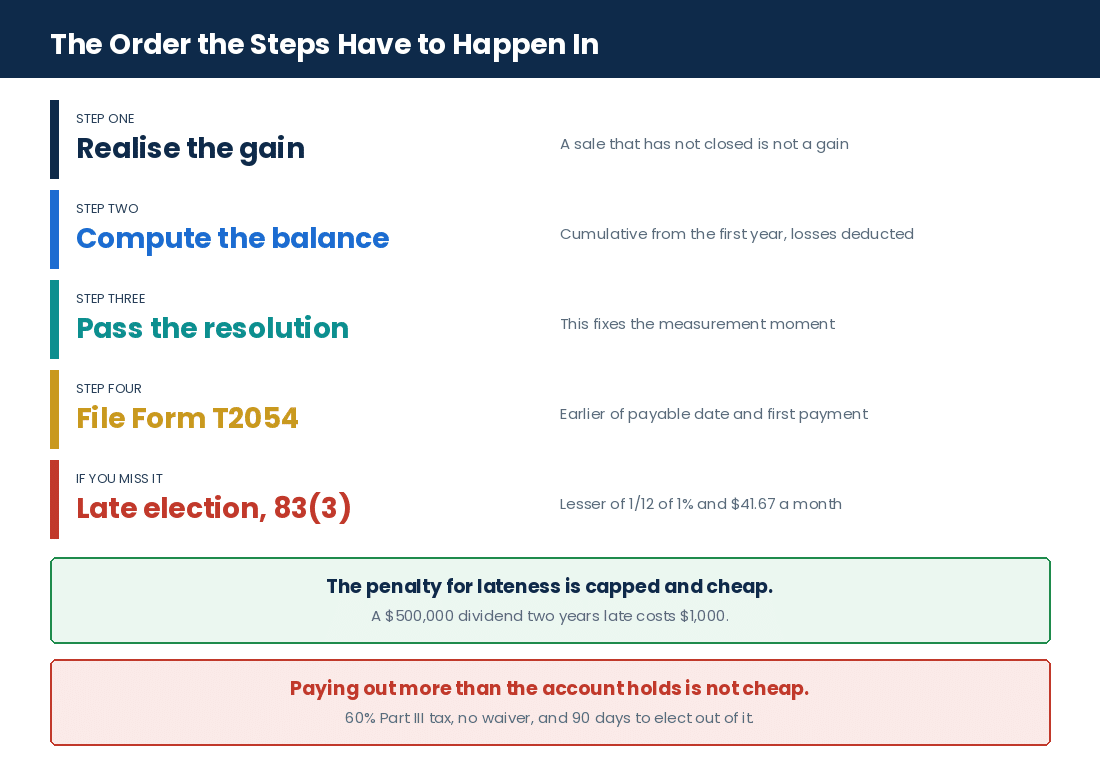
The consequence is worth stating directly. A gain realised after the resolution does not help a dividend declared before it. A corporation that declares a $200,000 capital dividend in March on the strength of a sale it expects to close in June has declared an excess capital dividend, whatever the account looks like by December. The sequence is: realise the gain, compute the balance, pass the resolution, file the election.
The Filing Deadline
The election is due on the earlier of two dates:
- the day the dividend becomes payable, and
- the first day on which any part of the dividend is paid.
That is on that day, not before it. Filing early is harmless and often sensible, but the deadline itself falls on the day, and a reader who takes “before payment” literally and files on the payable date has not missed anything.
A corporation we took on had been paying capital dividends for six years and had never filed a single T2054. The previous accountant had recorded them as capital dividends in the books, told the shareholders they were tax-free, and stopped there. Six elections were filed late under subsection 83(3). The penalties came to just over $1,800 in total, which was the cheap part — the real cost was that one of the six years turned out to have no room in the account at all, because a loss had been missed, and that dividend could not be elected on at any price. Figures changed for privacy.
Late Elections
A missed deadline is not fatal. Subsection 83(3) permits a late election, and the election is then deemed to have been made on time, provided three conditions are met:
- it is made in the prescribed manner and the prescribed form;
- the directors, or whoever is legally entitled to administer the corporation’s affairs, have authorised it; and
- an estimate of the penalty is paid when the election is filed.
The penalty is set by subsection 83(4). For each month or part of a month the election is late, it is the lesser of 1/12 of 1 per cent of the dividend and $41.67. The $41.67 cap means the penalty is modest on a large dividend — a $500,000 capital dividend elected on two years late costs the statutory maximum of $1,000, not a percentage of the half-million.
That is deliberately forgiving, and it is why a late election is usually the right answer to a missed deadline rather than a reason to leave the dividend as a taxable one. What it does not forgive is a dividend that exceeded the account, which no election can repair.
A shareholder transferred $150,000 out of his corporation in October and told his accountant in February that he had “taken his capital dividend”. No resolution had been passed, no election had been filed, and the transfer had gone out of the chequing account with no documentation beyond the memo line. On those facts there was no dividend to elect on — there was a shareholder loan, repayable within the deadline in subsection 15(2.6) or includible in his income. We repaid it before that deadline, then did the thing properly in the following year: resolution first, computation attached, T2054 filed on the payable date. Figures changed for privacy.
One Election, One Dividend
The election applies to the full amount of the dividend. A corporation cannot elect on part of a dividend and leave the rest taxable, and it cannot direct a capital dividend to one shareholder and an ordinary dividend to another out of the same declaration. The dividend is declared on a class of shares and follows the rights attaching to that class.
Where a corporation wants to pay a capital dividend to some shareholders and not others, the answer is share structure, settled in advance. And subsection 83(2.1) sits behind all of it: where shares were acquired in order to get at an existing capital dividend account, the dividend can be deemed a taxable dividend regardless of the election.
Paying Out More Than the Account Holds
The Expensive Mistake
Part III Tax Under Subsection 184(2) and the Way Out
If a corporation elects on a capital dividend larger than its capital dividend account, the excess attracts Part III tax under subsection 184(2), at 60 per cent of the excess. Interest runs on it from the day the election was made, under subsection 185(2).
Three features of that tax make it worse than its rate suggests. It is not refundable. It is payable by the corporation even though the benefit went to the shareholder. And CRA has stated that it has no power to waive it — the taxpayer relief provision in subsection 220(3.1) reaches interest and penalties, which Part III tax is neither.
The Subsection 184(3) Election
What is available instead is the election in subsection 184(3), which treats the excess as a separate taxable dividend rather than an excess capital dividend. The Part III tax then falls away and the shareholders pay ordinary dividend tax on the excess, which is very much the better outcome.
| Step | Requirement | Provision |
|---|---|---|
| Make the election | Form T2184, in the manner prescribed | Regulation 2106 |
| Meet the deadline | Within 90 days of the Part III notice of assessment | Subsection 184(3) |
| Obtain concurrence | From the shareholders who received the dividend | Subsection 184(3) |
| Expect reassessment | Shareholder returns reopen outside the normal period | Subsection 184(4) |
The 90 days is the hard part of this, because the clock starts at assessment rather than at discovery, and the concurrence of every recipient shareholder has to be obtained inside it. Where the shareholders are a family and the corporation is advised, that is a phone call. Where they are a dispersed group, or one of them has since sold their shares or died, it is a considerably larger problem.
Where the corporation also intends to object to the Part III assessment, the usual course is a protective 184(3) election filed within the same 90 days, which CRA holds in suspense pending the objection.
Two brothers owned a corporation that paid a capital dividend of roughly $420,000 on a balance that turned out to be $310,000. The $110,000 excess carried Part III tax of $66,000 plus interest. One brother signed the concurrence immediately. The other had moved to Alberta after a falling-out and did not answer letters for seven weeks of the ninety days. The election went in on day eighty-three. Had it not, the corporation would have paid $66,000 of unrecoverable tax on money the brothers had already spent. The lesson the family drew was the right one: verify the balance before declaring, not after. Figures changed for privacy.
How Excesses Actually Arise
In our experience they are almost never deliberate. The recurring causes are these.
- A loss nobody carried forward. The account was computed as though each year stood alone, and a prior-year capital loss was never deducted from it.
- Life insurance recorded gross. The death benefit was credited without subtracting the policy’s adjusted cost basis.
- A gain counted before it was realised. The resolution was passed on an expected sale rather than a completed one.
- An adjusted cost base that was really net book value. The gain was overstated, so the non-taxable half was overstated with it.
- The two-thirds assumption. The account was computed under the proposed inclusion rate that was cancelled in March 2025.
- A dividend already paid and forgotten. Prior capital dividends reduce the account, and a dividend from six years ago under a different accountant is easy to miss.
Every one of those is found by a computation done from the corporation’s first year rather than from last year’s closing figure, and by a verification request before the money moves. Section six covers both.
The Taxable Half, Records and Verification
Compliance
Refundable Tax, Filing Deadlines and Confirming the Balance
While the non-taxable half is going into the capital dividend account, the taxable half is being taxed. In a Canadian-controlled private corporation it is taxed at the investment income rate — federal tax with the provincial rate on top, which in Ontario means the provincial investment income rate rather than the rate on active business income — and part of it is refundable when dividends are paid out.
The Two Refundable Accounts
Since 2019 the refundable dividend tax on hand account has been split in two, and the split matters because the two accounts are recovered by different kinds of dividend.
| Account | What Goes In | What Draws It Out |
|---|---|---|
| Non-eligible RDTOH | Refundable Part I tax of 30 2/3 per cent on aggregate investment income, which includes the taxable half of a capital gain | Non-eligible dividends first, then eligible dividends if any refund remains |
| Eligible RDTOH | Part IV tax on eligible portfolio dividends and certain dividends from connected corporations | Eligible dividends |
The refund in either case is 38 1/3 per cent of taxable dividends paid, limited to the balance in the relevant account. A capital dividend is not a taxable dividend, so it does not trigger a refund — which means a corporation sitting on both a capital dividend account and a refundable tax balance needs to pay both kinds of dividend to clear both, and the order and timing are worth planning.
An Ontario corporation realised a $600,000 capital gain in November on the sale of an investment property. The accountant filed the T2 in the following June, six months after the year-end, entirely on time, and the client was surprised to find interest on the balance from two months after the year-end — late January, four and a half months before the return went in. The filing deadline and the payment deadline are not the same date, and on a large gain realised late in the year the gap is where the money goes. We now set a reminder at year-end minus thirty days for any client who has had a disposition. Figures changed for privacy.
Filing and Paying
- The T2 is due six months after the end of the taxation year, under paragraph 150(1)(a). Dispositions are reported on Schedule 6.
- The balance of tax is due two months after the year-end, or three months for a Canadian-controlled private corporation claiming the small business deduction. This is the deadline that costs money on a capital gain, and it falls well before the return.
- Net capital losses carry back three years and forward indefinitely under paragraph 111(1)(b), and can only be applied against taxable capital gains. The twenty-year limit people remember is the one for non-capital losses.
Timing a Disposition
Where a corporation has a choice about when a sale closes, the choice is worth making deliberately. A gain realised into a year with losses to absorb it, or into a year where income is otherwise low, costs less than the same gain realised into a strong year, and a disposition pushed just across a fiscal year-end moves both the tax and the balance-due day twelve months out.
Two cautions on that. The deferral has to be real — a sale is recognised when the conditions of the Act are met, not when it suits the corporation to record it — and deferring the gain defers the capital dividend account room with it, so a corporation that was planning to pay a capital dividend this year cannot also push the gain into next year.
Asking CRA to Confirm the Balance
CRA will verify a capital dividend account balance before a dividend is paid. The request is made on Schedule 89, Request for Capital Dividend Account Balance Verification, which exists for exactly this purpose.
It is not a guarantee — CRA confirms against what it has on file, and a balance can still be reassessed — but on a large dividend, or on any corporation whose history has run through more than one accountant, filing it is the ordinary precaution. Set against 60 per cent Part III tax and a 90-day window to collect shareholder signatures, the time it takes is not a close call.
What to Keep, and For How Long
Records are kept for six years from the end of the last taxation year to which they relate, under subsection 230(4). For a capital dividend account, though, six years is the statutory floor rather than the practical answer: the account is cumulative from the corporation’s first day, so the documents that prove the cost base of an asset bought in 2004 are still doing work in 2026.
- Purchase and sale agreements, and the closing statements for each
- Records of capitalised improvements, and of which costs were expensed instead
- Valuation reports relied on for any non-arm’s-length transfer
- Life insurance policy records sufficient to establish adjusted cost basis
- Directors’ resolutions for every dividend, and the filed copy of every T2054
- The shareholder register as it stood at each payment, showing who actually received what
- A running capital dividend account schedule reconciled each year, not rebuilt each year
The last of those is the one that saves the most work. A schedule maintained annually takes an hour; the same schedule reconstructed after twenty years takes a week, and that is assuming the documents still exist.
Frequently Asked Questions
FAQs
Frequently Asked Questions on Corporate Capital Gains and the CDA
How is a corporation taxed on a capital gain?+
One-half of the gain is a taxable capital gain under paragraph 38(a) and goes into the corporation’s income, where it is taxed at the investment income rate rather than the active business rate. The other half is not taxed at all, and in a private corporation it adds to the capital dividend account.
What is the capital dividend election deadline?+
The earlier of the day the dividend becomes payable and the first day on which any part of it is paid. The election goes in on that day; filing before it is fine, filing after it makes the election late and brings the subsection 83(4) penalty into play.
When exactly is the CDA balance measured?+
Immediately before the dividend becomes payable, which in practice means the date of the directors’ resolution. Not the year-end, and not the date the cash moves. A gain realised after the resolution does nothing for a dividend declared before it, which is how a well-intentioned declaration made in anticipation of a sale becomes an excess capital dividend.
How do capital losses reduce the account?+
The non-deductible half of a capital loss reduces it — the mirror of the non-taxable half of a gain that increases it. The allowable half reduces taxable income instead. The component is cumulative from the corporation’s first day, so a loss from a decade ago is still in the calculation today.
How do life insurance proceeds add to the account?+
Under paragraph (d) of the definition, the death benefit is added net of the policy’s adjusted cost basis. On a policy held for many years that basis can be substantial, and crediting the gross proceeds is one of the commonest ways a balance is overstated. A policy surrendered or sold while the life insured is living does not feed the account this way.
What happens if more is paid out than the account holds?+
Part III tax applies to the excess under subsection 184(2), at 60 per cent, with interest from the date of the election under subsection 185(2). It is not refundable and CRA cannot waive it. The route out is the subsection 184(3) election, which recharacterises the excess as a taxable dividend to the shareholders.
How does the 184(3) election work in practice?+
It is made on Form T2184, in the manner Regulation 2106 prescribes, within 90 days of the Part III notice of assessment, and it needs the concurrence of the shareholders who received the dividend. Subsection 184(4) then allows their returns to be reassessed outside the normal period. The 90 days is the binding constraint, because collecting signatures from shareholders who have scattered takes longer than people expect.
Can a late capital dividend election be filed?+
Yes, under subsection 83(3), provided it is in prescribed form, the directors have authorised it, and an estimate of the penalty is paid when it is filed. The penalty under subsection 83(4) is the lesser of 1/12 of 1 per cent of the dividend and $41.67, per month or part month. On a large dividend the dollar cap makes this inexpensive, which is why lateness is usually worth fixing rather than living with.
Can CRA confirm the balance before the dividend is paid?+
Yes. Schedule 89, Request for Capital Dividend Account Balance Verification, exists for this. It is not an absolute guarantee, since CRA confirms against the information it holds and can still reassess, but on a large dividend or a corporation with a long and partly undocumented history it is the ordinary precaution and it is free.
Does the inclusion rate increase still apply for 2026?+
No. The proposal to raise the rate to two-thirds was announced in June 2024, deferred on 31 January 2025 to 1 January 2026, and then cancelled on 21 March 2025. The rate for 2026 is one-half. Corporations whose accounts were computed on the two-thirds assumption during that window should have the figures re-run, because the result can be an excess capital dividend.
Essential Points for Corporate Directors
Key Takeaways
What Decides a Capital Dividend File
Most of what goes wrong with corporate capital gains is not the tax calculation. It is the account behind it — a figure carried forward by people who did not build it, relied on by people who cannot check it, and paid out on by people who assume it is right.
| Point | The Rule | Where It Comes From |
|---|---|---|
| Inclusion rate | One-half of every corporate capital gain is taxable | Paragraph 38(a) |
| The 2024 proposal | Two-thirds was announced, deferred, then cancelled on 21 March 2025 | Department of Finance |
| What the account is | A notional cumulative total, not cash and not on the statements | Subsection 89(1) |
| Measurement moment | Immediately before the dividend becomes payable | Subsection 83(2) |
| The election | Form T2054, with the computation and the resolution attached | Regulation 2101 |
| Election deadline | Earlier of the payable date and the first payment date | Subsection 83(2) |
| Late election | Permitted, with directors’ authorisation and the penalty estimate paid | Subsection 83(3) |
| Late penalty | Lesser of 1/12 of 1 per cent of the dividend and $41.67 a month | Subsection 83(4) |
| Excess dividend | Part III tax at 60 per cent, with interest, and no waiver available | Subsections 184(2), 185(2) |
| The remedy | Form T2184 within 90 days, with shareholder concurrence | Subsection 184(3) |
| Verification | CRA will confirm a balance on request, in advance | Schedule 89 |
| Records | Six years, though the account itself reaches back further | Subsection 230(4) |
The Six Things We Check First
- Has the account been computed from the first year, or carried forward from a figure? A carried-forward figure is only as good as the year somebody last built it properly.
- Are the prior capital losses in it? The non-deductible halves, all of them, going back to incorporation.
- Is life insurance in at the death benefit net of adjusted cost basis? Gross is the default error.
- Have all prior capital dividends been deducted? Including ones paid under a previous accountant.
- Was anything computed at two-thirds? Anything touching June 2024 to March 2025 needs re-running.
- Does the resolution date precede the payment, and does the election date match it? The sequence is the whole of the compliance.
Our Approach
Gondaliya CPA rebuilds the capital dividend account from the corporation’s first year rather than accepting a brought-forward figure, computes the balance as at the proposed resolution date, requests verification from CRA where the amount or the history warrants it, prepares the resolution and the T2054 so the dates line up, and checks the refundable tax position alongside. The work sits on a fixed annual fee with no hourly billing, shown before tax with sales tax on its own line and agreed before anything starts.
Businesses We Serve & Industry Spotlights
Sector Expertise
Capital gains surface in every kind of corporation, but what triggers them, and what the capital dividend account is used for afterwards, differs sharply by sector.
| Who | Where the Gain Comes From |
|---|---|
| Doctors | Professional corporation investment portfolios held for retirement |
| Dentists | Practice sales, and whether the goodwill is a capital gain |
| Daycare and CWELCC operators | Premises bought years ago and sold on retirement |
| Real estate holders | The capital-versus-income characterisation before anything else |
| Property developers and builders | Inventory disposals that are not capital gains at all |
| Skilled trades | Yard and equipment disposals mixed with recapture |
| Technology startups and SaaS | Share sales, earn-outs and the timing of the gain |
| E-commerce sellers | Brand and domain sales treated as capital property |
| Restaurants | Leasehold and licence dispositions on a sale of the business |
| Transportation and logistics | Fleet turnover where recapture overwhelms the gain |
| Consultants | Retained earnings invested, then realised on wind-up |
Two further groups come to us specifically on this subject: business sellers working out what a sale will leave them with after both layers of tax, and angel investors whose corporations hold a portfolio of private positions where the losses matter as much as the gains.
Professional Guidance and Quick Reference
Guidance
Essential Points for Canadian Corporations
Capital dividend files go wrong in a predictable set of ways: a balance carried forward for a decade that nobody has ever rebuilt; a prior-year capital loss that never came off it; a life insurance death benefit credited gross; a dividend declared in anticipation of a sale that had not closed; an account computed at two-thirds during the window when that was the announced law; and an election filed in the calendar year rather than on the payable date. Gondaliya CPA rebuilds the account from the first year and verifies it before the money moves, on a fixed annual fee.
Quick Answers
At a Glance
- Inclusion rate 2026: one-half, paragraph 38(a)
- Taxable half: investment income, no small business deduction
- Non-taxable half: never taxed, feeds the capital dividend account
- Proposed two-thirds rate: announced 24 June 2024, cancelled 21 March 2025
- Account definition: subsection 89(1), computed at a particular time
- Who has one: private corporations, not only CCPCs
- Nature: notional, cumulative, not on the financial statements
- Gains component: paragraph (a), net of the non-deductible half of losses
- Dividends received: paragraph (b)
- Life insurance: paragraph (d), death benefit less adjusted cost basis
- Dividends paid: deducted in the closing words of the definition
- Measured: immediately before the dividend becomes payable
- Election: subsection 83(2), Form T2054
- Prescribed by: Regulation 2101
- Deadline: earlier of payable date and first payment date
- Late election: subsection 83(3), with penalty estimate paid
- Penalty: lesser of 1/12 of 1 per cent and $41.67 per month
- Excess dividend: Part III tax, subsection 184(2), 60 per cent
- Interest on it: from the election date, subsection 185(2)
- Waiver: not available; 220(3.1) does not reach Part III tax
- Remedy: subsection 184(3) election, Form T2184
- Its deadline: 90 days from the Part III assessment
- Anti-avoidance: subsection 83(2.1)
- Verification: Schedule 89, before payment
- Refundable Part I tax: 30 2/3 per cent on aggregate investment income
- Dividend refund: 38 1/3 per cent of taxable dividends paid
- T2 filing: six months after year-end, paragraph 150(1)(a)
- Balance due: two months, or three for a CCPC with the small business deduction
- Net capital losses: back three years, forward indefinitely, paragraph 111(1)(b)
- Records: six years, subsection 230(4)
Who This Is For / Not For
Fit Check
- For: Canadian private corporations that have realised or are about to realise a capital gain and want the account computed properly before anything is declared.
- For: corporations whose capital dividend account has been carried forward for years without being rebuilt, or that paid a capital dividend between June 2024 and March 2025.
- Not for: individuals and trusts, whose inclusion rate rules, lifetime capital gains exemption and reporting differ and are not covered here.
- Not for: advice on section 85 rollovers, the capital gains reserve, the lifetime capital gains exemption or the treatment of depreciable property and recapture, none of which is covered here.
People Also Ask
Related Questions
Our accountant gave us a CDA figure. Should we just pay it out?+
Ask how it was arrived at. If the answer is that it was carried forward from the prior year’s working paper, the figure is only as reliable as whichever year somebody last built it from scratch — and on a corporation with a long history that year is often before the current accountant was involved. Before a large dividend, the account should be rebuilt from the first year and the balance confirmed on Schedule 89. The cost of that is hours. The cost of being wrong is 60 per cent of the excess.
We sold a rental property. Is the whole thing a capital gain?+
Not necessarily. Two things can cut across it. First, characterisation: a property bought with the intention of reselling can produce business income taxed in full, with no capital dividend account room at all, and the Act gives no bright-line holding period — it turns on intention, frequency and the taxpayer’s other activities. Second, where capital cost allowance was claimed, recapture comes into income in full before the capital gain is computed. A single disposition can produce both.
Can we pay the dividend now and file the T2054 later?+
You can, but it is then a late election under subsection 83(3) and it needs the directors’ authorisation and an estimate of the penalty paid when it goes in. The penalty is small — capped at $41.67 a month — so this is recoverable. What is not recoverable is paying out more than the account holds, which no election fixes. Compute first, declare second, file on the payable date.
There is only one shareholder. Do we still need the election?+
Yes. The election is what makes the dividend a capital dividend; without it the payment is an ordinary taxable dividend in the shareholder’s hands no matter what the directors’ resolution calls it, and no matter that the shareholder and the directors are the same person. A sole-shareholder corporation gets no relaxation of subsection 83(2), and recording “capital dividend” in the minute book does not substitute for Form T2054.
Does a capital dividend show up on a T5?+
No. A properly elected capital dividend is not included in the recipient’s income, so there is no T5 slip and nothing to report on the personal return. That absence is precisely why the election matters: the only record that the payment was tax-free is the filed T2054 and the computation behind it. If the election was never filed, the shareholder has received a taxable dividend that nobody has reported — which is how these come to light.
Glossary of Key Terms
Definitions
- Capital gain: proceeds of disposition less adjusted cost base less outlays on the sale.
- Adjusted cost base: the tax cost of an asset, adjusted over the holding period — not net book value.
- Inclusion rate: the fraction of a capital gain that is taxable; one-half for corporations.
- Taxable capital gain: the half that enters income under paragraph 38(a).
- Capital dividend account: the notional cumulative balance defined in subsection 89(1).
- Capital dividend: a dividend elected on under subsection 83(2), received tax-free.
- Form T2054: the prescribed election form for a capital dividend.
- Part III tax: the 60 per cent tax on an excess capital dividend under subsection 184(2).
- Form T2184: the election to treat an excess capital dividend as a taxable dividend.
- Schedule 89: the request asking CRA to verify a capital dividend account balance.
- Aggregate investment income: the investment income, including taxable capital gains, that carries refundable tax.
- Non-eligible RDTOH: the account holding refundable Part I tax, recovered on taxable dividends paid.
- Net capital loss: an unused allowable capital loss, carried back three years and forward indefinitely.
- Recapture: previously claimed capital cost allowance brought back into income in full on disposition.
Want a checklist to work from? You can download our free capital dividend checklist before your consultation.

Four things decide a capital dividend file. Whether the account was built or inherited — a brought-forward figure is worth exactly as much as the last year someone computed it from the beginning, and on an older corporation that year is usually further back than anyone assumes. Whether the losses are in it — the non-deductible halves, cumulatively, from incorporation, because the component is not an annual calculation and treating it as one is how most overstatements happen. Whether the dates line up — the gain realised, then the balance computed, then the resolution passed, then the election filed on the payable date, in that order and no other. And whether anyone checked before the money moved — because Part III tax is 60 per cent of the excess, CRA cannot waive it, and the only relief runs through a 90-day election that needs signatures from every shareholder who received the dividend.
Three questions tell a director where the corporation stands, and none of them is about this year’s gain. First, when was the capital dividend account last rebuilt from the first year? If nobody knows, that is the answer. Second, has every prior capital loss and every prior capital dividend been taken off it? Those are the two subtractions that get missed, and either one can turn a comfortable balance into an excess. Third, did anything in the account get computed between June 2024 and March 2025? That window is when the two-thirds inclusion rate was announced law, and anything calculated on it needs re-running against one-half.
Corporate Capital Gains and the CDA: How Gondaliya CPA Can Help
Build the account before you declare the dividend
Gondaliya CPA rebuilds the capital dividend account from the corporation’s first year rather than accepting a brought-forward figure, traces every capital gain and capital loss and every dividend already paid, verifies the adjusted cost base of the assets behind them against the underlying documents, takes life insurance in at the death benefit net of adjusted cost basis, computes the balance as at the date the resolution will be passed, requests confirmation from CRA on Schedule 89 where the amount or the history warrants it, prepares the directors’ resolution and Form T2054 so the dates line up, and reviews the refundable tax position and the balance-due day alongside — on a fixed annual fee with no hourly billing, shown before tax with sales tax on its own line and agreed before any work begins. Where a prior dividend has already created an excess, we handle the subsection 184(3) election inside its 90 days. Please book a free consultation.
Next Steps
Please book a free consultation with Gondaliya CPA before the dividend is declared rather than after it, and bring four things: the corporation’s prior-year tax returns going back as far as they exist, the financial statements for the same period, the purchase and sale documents for any significant asset the corporation has held, and any life insurance policy records. Those four are what the account is rebuilt from, and the first conversation is usually about which of them is missing rather than about the tax. If a capital dividend has already been paid on a figure nobody can stand behind, say so at the outset — the subsection 184(3) election has a 90-day clock that starts at assessment, and knowing about the problem in advance is the difference between a planned response and a scramble for shareholder signatures. We perform compilation engagements under CSRS 4200, which provide no assurance, and we refer audit and review engagements out. This article does not advise on the lifetime capital gains exemption, section 85 rollovers, the capital gains reserve, or capital gains in the hands of individuals or trusts. You will get a fixed annual fee, shown before tax, agreed before any work begins. We serve Toronto, Mississauga, Brampton, Vaughan, Etobicoke, Scarborough, Hamilton, Ottawa and the rest of Ontario, and work with corporations across Canada. If our content helps, please add gondaliyacpa.ca as a preferred source on Google.
Published: · Last updated:
Editorial policy: We research against the Income Tax Act, the Income Tax Regulations, CRA guidance and income tax folios, Department of Finance announcements, CPA Canada Handbook standards and CPA Ontario sources, fact-check the figures, and Sharad Gondaliya, CPA, reviews the content, which we update as the rules change.
Disclaimer: This article is educational information only and is not tax, legal or accounting advice. It covers the taxation of capital gains realised by Canadian corporations and the capital dividend account arising from them, including the one-half inclusion rate in paragraph 38(a), the history of the proposed two-thirds rate and its cancellation, the definition of the capital dividend account in subsection 89(1) and its components, when the balance is measured, the subsection 83(2) election on Form T2054 and its deadline, late elections under subsections 83(3) and 83(4), Part III tax on an excess capital dividend under subsection 184(2) and the subsection 184(3) election on Form T2184, the refundable tax on the taxable half, corporate filing and payment deadlines, record retention under subsection 230(4) and balance verification on Schedule 89. It does not cover the lifetime capital gains exemption, section 85 rollovers, the capital gains reserve, the treatment of depreciable property and recapture beyond a general mention, or capital gains realised by individuals or trusts. Rates, thresholds, forms and statutory references change; every reference should be confirmed against the current Income Tax Act and current CRA guidance, and the characterisation of any particular disposition as capital or income turns on its own facts. Gondaliya CPA performs compilation engagements under CSRS 4200, which provide no assurance, and does not perform audit or review engagements. Please consult a licensed CPA before acting.
