



Compiled Personal Financial Statements: Net Worth Statements for Mortgages and Personal Guarantees in Canada
Personal Net Worth Statements Under CSRS 4200
Gondaliya CPA prepares compiled personal financial statements for individuals in Canada who need a net worth statement for a mortgage application or a personal guarantee. The work follows CSRS 4200 and suits self-employed borrowers and owner-managers whose position is not evidenced by a pay stub.
Quick Summary
A personal net worth statement sets out what an individual owns, what they owe, and the difference between the two at a date. When a CPA firm prepares one under a compilation engagement, the product is the statement plus a compilation engagement report, and the report says in terms that nothing has been audited, reviewed or verified. CSRS 4200 has governed that work for periods ending on or after 14 December 2021, when it replaced Section 9200 and the Notice to Reader. Four things about it decide whether the result is useful. The standard turns on the intended use of the information, and where a lender is to receive it, management acknowledges that the lender can either obtain further information or has agreed the basis of accounting. There is no Canadian accounting standard for personal financial statements, so the basis of accounting note carries the whole explanation of how the figures were arrived at, which on a net worth statement is almost always estimated current values rather than tax cost. Guarantees are disclosed in a note as contingent obligations at the maximum amount guaranteed, not recognised as liabilities on the face of the statement. And a compilation is not a cheaper substitute for assurance: where a lender wants verification it will ask for a review or an audit, and a compilation will not satisfy that request however it is presented.
Reading time: 15 minutes.
Table of Contents
- What a Compiled Personal Financial Statement Is
- CSRS 4200 Applied to a Personal Net Worth Statement
- What Goes On the Statement, and How It Is Valued
- Guarantees, Joint Ownership and the Notes
- What Lenders Do With It, and When It Is Not Enough
- Preparing It, Submitting It and Keeping the Records
- Frequently Asked Questions
- Essential Points for Borrowers and Guarantors
- Businesses We Serve & Industry Spotlights
- Professional Guidance and Quick Reference
The Numbers That Matter
This article covers compiled personal financial statements — personal net worth statements prepared under a CSRS 4200 compilation engagement — for individuals in Canada supporting a mortgage application or a personal guarantee, with Ontario and Toronto context, current to 5 November 2026. It covers what a compilation is and is not, the scope of CSRS 4200 and where the standard does not apply, the intended-use and third-party questions, the basis of accounting note and why it carries so much weight when there is no accounting framework for personal statements, how assets and liabilities are presented and valued, how guarantees and jointly held or beneficially owned assets are disclosed, the tax note that sits beneath a current-value statement, what a lender does with the statement, when a compilation will not satisfy the request, and the records to keep. It does not advise on whether a mortgage will be approved, on mortgage products, rates, qualification or the stress test, on whether to give a personal guarantee, or on the enforceability of any guarantee, which is a legal question. Gondaliya CPA performs compilation engagements under CSRS 4200, which provide no assurance; audit and review engagements are referred out. This is educational information only and not tax, legal, accounting or financial advice.
What a Compiled Personal Financial Statement Is
Foundations
A Personal Net Worth Statement, and the Report That Comes With It
A personal net worth statement lists what an individual owns, what they owe, and the difference. The arithmetic is not difficult, and anyone can do it. What a CPA firm adds is the engagement around it: a defined basis of accounting, a set of notes describing how each figure was arrived at, and a compilation engagement report under CSRS 4200.
That report is usually the thing a lender actually wants. When an application asks for a net worth statement “prepared by an accountant”, it is asking for a document that has been assembled to a standard and comes with a professional’s name on a report — a report whose first substantive statement is that nothing in the figures has been verified.
What the Practitioner Does and Does Not Do
- Assembles the statement from information the client provides, and does not independently check it
- Performs no audit procedures, no review enquiries and no confirmation of ownership, existence or value
- Prepares a note describing the basis of accounting, so a reader knows how the numbers were arrived at
- Issues a compilation engagement report stating plainly that no assurance is provided
No verification does not mean no responsibility. Where the practitioner becomes aware that the information is misleading, CSRS 4200 requires them to raise it with the client and request corrected or additional information, and to withdraw from the engagement if the matter is not resolved. A practitioner who is told that a property is worth $2 million when its assessment and its recent listing both say otherwise does not simply type the number in.
A self-employed contractor came to us needing a net worth statement for a mortgage renewal, having been turned down once already. The statement he had submitted was a one-page spreadsheet he had made himself, with a total at the bottom and nothing else — no date, no indication of how the house or the equipment had been valued, and a line for “business” at a round number. It was not that the lender thought he was lying. It was that there was nothing on the page to tell them what the figures meant. The same facts, set out with a valuation basis stated for each class of asset and the guarantee he had given on his company’s credit line disclosed in a note, went through. Nothing about his finances had changed. Figures changed for privacy.
What It Is Not
It is worth being blunt about the limits, because the draft versions of this document that circulate are not.
- It is not an audit or a review. No assurance is expressed, and a lender that wants verification has to ask for a different engagement.
- It is not proof that you own what you say you own. The practitioner has not seen a title search.
- It is not a valuation. Estimated current values come from the client, not from an appraiser or a business valuator.
- It is not a tax filing and says nothing about whether returns are up to date.
- It is not a credit assessment. Whether to lend remains entirely the lender’s decision.
None of that makes the document weak. A clearly presented statement with its basis described is considerably more useful to a lender than an unexplained total, which is the realistic alternative. It just is not what it is sometimes sold as.
CSRS 4200 Applied to a Personal Net Worth Statement
The Standard
What the Standard Requires, and Where It Does Not Apply
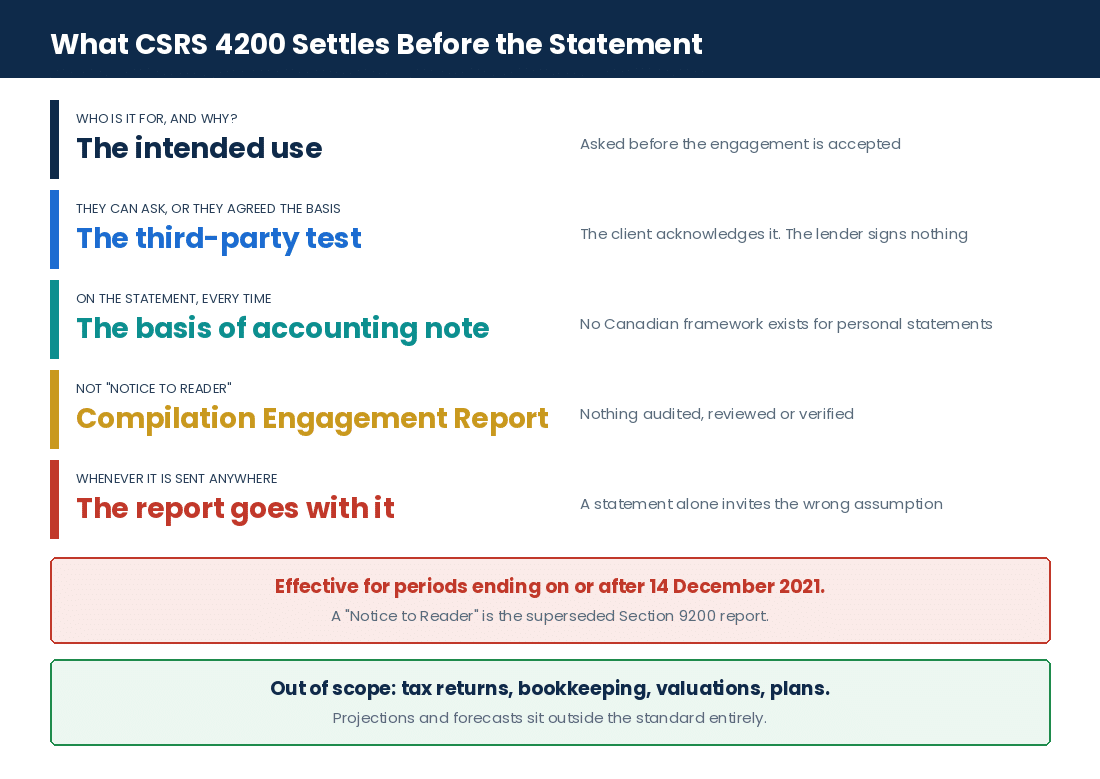
CSRS 4200, the Canadian Standard on Related Services on compilation engagements, is issued by the Auditing and Assurance Standards Board and published in the CPA Canada Handbook. It applies to compiled financial information for periods ending on or after 14 December 2021, replacing Section 9200 and the Notice to Reader. A document still headed “Notice to Reader” is working from a standard that no longer exists.
The standard speaks of financial information rather than financial statements, deliberately, because a practitioner may be compiling a single schedule rather than a full set of statements. A personal net worth statement sits comfortably inside that.
Where CSRS 4200 Does Not Apply
This matters more than it looks, because the same numbers can be inside the standard or outside it depending on why they were assembled.
| Situation | Inside CSRS 4200? |
|---|---|
| A net worth statement engaged for its own sake, to go to a lender | Yes |
| Figures assembled in the course of preparing a tax return | No |
| Bookkeeping output with no report attached | No |
| Information another practitioner will audit or review | No |
| A schedule produced as part of a valuation, litigation support or a financial plan | No |
So a net worth schedule that appears inside a financial planning engagement is not a compiled personal financial statement, carries no compilation engagement report, and will not satisfy a lender asking for one. The distinction is about what was engaged, not about what the page looks like.
The Intended Use Question
Before accepting the engagement, the practitioner asks what the compiled information is for and whether a third party is going to use it. On a net worth statement for a mortgage the answer is obviously yes, which triggers the acknowledgement: management — here, the individual — acknowledges that the third party can either request and obtain further information from them, or has agreed the basis of accounting.
A lender satisfies the first limb almost by definition, since it can and does ask the applicant for anything else it wants. The acknowledgement goes in the engagement letter and is given by the client. The lender signs nothing, is not a party to the engagement, and is not described anywhere in the standard as a “known user”.
A mortgage broker sent us a template he wanted us to sign, which named his client’s lender as an approved recipient and stated that no other party could rely on the report. He had been given it by another accountant and assumed it was standard. It is not in CSRS 4200 at all. What the compilation engagement report does carry is a caution that readers should be aware the information may not be appropriate for their purposes, which is a statement about suitability rather than a list of permitted readers. We explained the difference, issued the report in its proper form, and the lender accepted it without comment. The template had been circulating for years. Figures changed for privacy.
The Basis of Accounting Note
Every set of compiled information carries a note describing the basis on which it was prepared. The standard requires the note but does not prescribe the basis: management selects it, and the standard does not expect it to be a general purpose framework.
On a personal net worth statement that matters a great deal, because there is no Canadian accounting standard for personal financial statements. There is no equivalent of ASPE or the standards for not-for-profit organisations to point at. The note is therefore carrying the entire explanation: that assets are shown at estimated current values supplied by the individual, how each class of asset was estimated, how jointly held property is treated, and what has been excluded. A thin basis note on a personal statement leaves a reader with nothing to interpret the figures by.
What the Report Contains
- The title Compilation Engagement Report, not Notice to Reader
- Identification of what was compiled, and a reference to the basis of accounting note
- The client’s responsibility for the accuracy and completeness of the underlying information and for selecting the basis
- The practitioner’s responsibility, which is assisting in preparing the information under CSRS 4200
- A statement that no audit opinion, review conclusion or other assurance is expressed, and that no procedures were performed to verify anything
- A caution that the information may not be appropriate for the reader’s purposes
- The date the engagement was completed
What Goes On the Statement, and How It Is Valued
Contents
Assets, Liabilities and the Valuation Basis Behind Each Line
A personal net worth statement is a snapshot at a date. Everything on it has to be as at that date, which sounds obvious and is the first thing that goes wrong when figures are gathered over a month and never trued up.
Assets
| Asset | How It Is Usually Shown | What the Note Says |
|---|---|---|
| Principal residence and other real property | Estimated current value | How the estimate was arrived at, and by whom |
| Marketable securities | Quoted value at the statement date | The source and the date of the quotation |
| Registered plans | Current value of the plan | That the whole balance is taxable on withdrawal |
| Shares in a private company | Estimated value supplied by the individual | That no formal valuation has been obtained |
| Vehicles, equipment and personal property | Estimated current value | Whether items below a threshold have been excluded |
| Amounts owed to the individual | Amount outstanding | Whether collection is in doubt |
Two points about valuation. The first is that the figures are estimated current values from the client, not appraisals. The practitioner has not valued anything. The second is that estimated current value is the right basis here even though tax cost is what appears on a tax return, because a lender is asking what the assets are worth now, not what they cost. Tax cost has a place on the statement, but it is in the note on the tax a sale would trigger, not in the asset line.
An applicant’s statement showed a rental duplex at $340,000, which was what it had cost in 2011, because the previous preparer had taken the figure from the capital cost schedule in the tax return. The property was worth something close to $900,000. The applicant had been describing himself to the lender as considerably poorer than he was, and could not understand why the file kept stalling. Rebuilding the statement on estimated current values, with the embedded capital gains tax disclosed in a note so the picture stayed honest in both directions, changed the net worth figure by more than half a million dollars. Figures changed for privacy.
The Private Company Problem
For most self-employed applicants the largest and least tractable line is the one for shares in their own company. There is rarely a formal valuation, and commissioning one is expensive and slow.
What the statement does is show the individual’s own estimate and say in the note exactly that — that the figure is management’s estimate, that no independent valuation has been obtained, and what it is based on, whether that is net book value, a multiple the owner considers reasonable, or an offer received. What it should not do is present the number as though it had been established. A lender reading “shares in a private company, $1,400,000” with no note has been told nothing, and will usually come back asking what that number is.
Where the company’s own position is relevant — and on a guarantee it almost always is — the practical answer is a set of compilation engagement financial statements for the corporation alongside the personal statement, so the lender can see what sits behind the share value.
Liabilities
- Mortgages and lines of credit at the balance outstanding at the statement date, per the lender’s own record
- Term loans and leases at the amount owing, with the maturity noted where it matters
- Credit cards and other revolving balances at the amount owing, not the limit
- Amounts owed to the individual’s own corporation, which applicants forget constantly and lenders look for
- Tax owing, including instalments outstanding and any arrears
A business owner’s first draft showed no liability to her own corporation. During the engagement it became clear she had drawn roughly $180,000 from the company over three years that had been booked to a shareholder loan account and never repaid or declared as income. That is a liability on her personal statement, and it is also a tax problem under the shareholder loan rules that nobody had looked at. The mortgage was the smaller of her two issues. We disclosed the loan on the statement and dealt with the tax position separately, which is the only order those two things can happen in. Figures changed for privacy.
The Tax Note
A statement built on current values has a tax figure hiding in it. If every asset were sold at the values shown, tax would be payable — capital gains on the appreciated property and securities, full inclusion on the registered plans. Net worth before tax and net worth after it can be very different numbers.
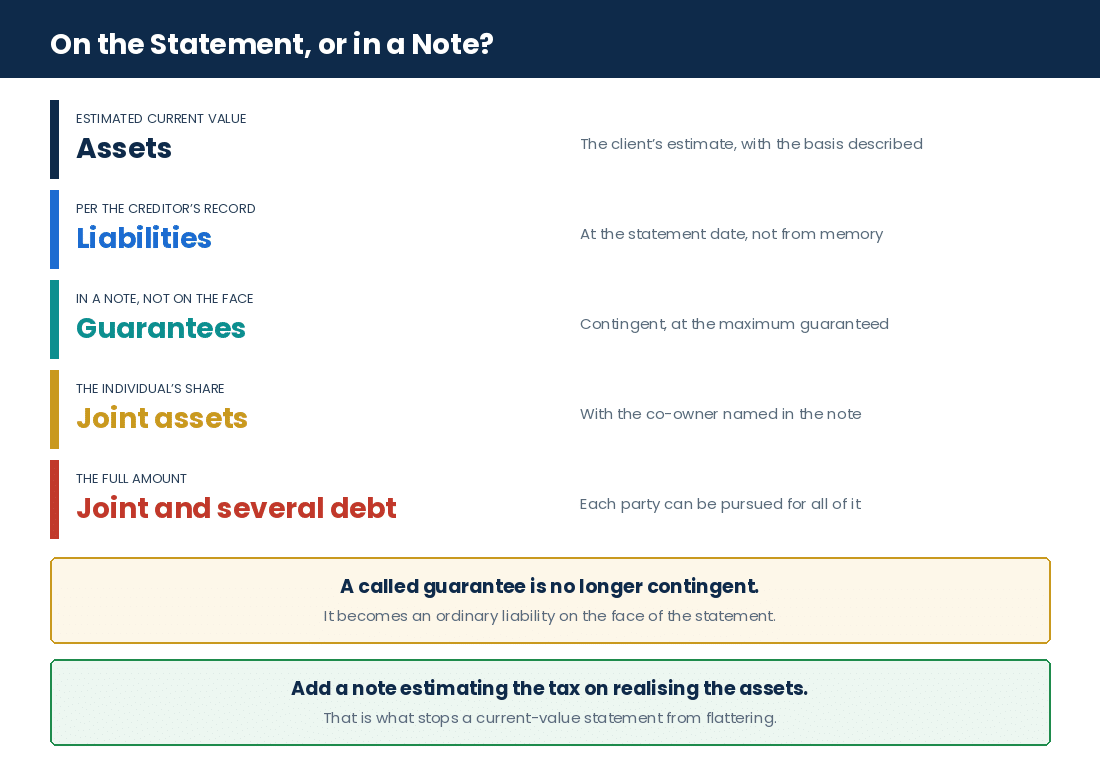
Good practice is a note estimating that tax, described as an estimate and computed on the stated values. It is the disclosure that keeps a current-value statement honest, and leaving it out is how a statement ends up flattering.
Personal Net Worth Statement Readiness Check
Five quick questions on where your net worth statement stands. No fee shown.
Points to raise with us:
This is a general prompt, not tax or legal advice or a quote. Your position depends on your full facts. For a real review, please book a free consultation.
Guarantees, Joint Ownership and the Notes
Disclosure
The Things That Are Not Liabilities, and Not Quite Assets Either
On a personal statement the notes do more work than the statement itself. Two items account for most of that work: guarantees the individual has given, and property they do not wholly own.
Personal Guarantees
A guarantee is a promise to pay if somebody else does not. Until it is called, it is not a debt. It is a contingent obligation, and it is disclosed in a note rather than recognised as a liability on the face of the statement.
What the note sets out for each one:
- What is guaranteed — the obligation, and whose it is
- The date the guarantee was given
- The maximum amount guaranteed, or the fact that it is unlimited
- The amount currently outstanding under the guaranteed obligation, where it is known
- Whether the guarantee is joint and several with anybody else
- Any security given to support it
The last two are the ones that get omitted and the ones that matter most to a lender. A $500,000 guarantee given jointly and severally with two partners is not a third of a problem; the guarantor can be pursued for the whole of it. A guarantee supported by a collateral charge on the family home is a different exposure again, and the home appears on the asset side of the same statement.
An applicant told us he had given “a guarantee on the business lease, years ago”. He could not find it and did not think it mattered because the business was doing fine. The landlord’s copy, when we asked him to request it, turned out to be an unlimited personal guarantee of the full remaining term, which at that point was roughly $740,000 of rent. Disclosing it did not sink the mortgage application. Omitting it and having the lender find it later, which they would have, would have put his credibility rather than his arithmetic in question. We now ask every client to go and get the documents rather than describe them. Figures changed for privacy.
When a Guarantee Stops Being Contingent
If the guaranteed obligation has been called, or default has occurred and payment is being demanded, the amount is no longer contingent. It becomes a liability like any other and belongs on the face of the statement. The note then describes the circumstances. Leaving a called guarantee in the notes because that is where it was last year is a real misstatement, not a presentation preference.
Joint and Beneficial Ownership
A great many of the assets on a personal statement are not wholly the individual’s. The convention is to show the individual’s share and say so.
| Arrangement | How It Is Presented |
|---|---|
| Property held jointly with a spouse | The individual’s interest, with the joint holding and the other party noted |
| A share of an asset held with unrelated co-owners | The individual’s proportionate share, with the co-ownership noted |
| Legal title in one name, beneficial interest in another | By beneficial interest, with the arrangement and the supporting document described |
| An asset held in a trust the individual benefits from | Disclosed in a note rather than taken into net worth, with the nature of the interest described |
| Jointly held debt | The full amount where the liability is joint and several, with the sharing arrangement noted |
The asymmetry in the last row is the one people object to and it is correct. Where a couple are jointly and severally liable on a mortgage, each of them can be pursued for all of it. Showing half the debt against half the house understates the exposure a lender is being asked to take on.
Two brothers each presented net worth statements showing half of a jointly owned commercial building and half of the mortgage on it. They were jointly and severally liable for the whole mortgage, and one of them was also the guarantor of the other’s operating line. Read separately the statements looked fine. Read together, which is what the lender did, the same debt was supporting two applications and the guarantee was invisible on both. We reissued both statements with the full joint liability shown and the cross-guarantee disclosed in each. One of the two applications proceeded. That was the right outcome. Figures changed for privacy.
Other Notes Worth Having
- The statement date, stated once and applied to every figure on the page
- The estimated tax that would arise if the assets were realised at the values shown
- Life insurance, where a policy has a cash surrender value or supports a loan
- Support obligations under a separation agreement or court order
- Anything excluded, and why — household effects below a threshold, for instance
- Subsequent events between the statement date and the date of the report, where they are significant
What Lenders Do With It, and When It Is Not Enough
Lender View
How the Statement Is Read, and the Limits of a Compilation
A lender is not reading the net worth figure. It is reading the composition behind it, and a statement that totals well but is made of the wrong things will not help.
What a Lender Is Actually Looking For
- Liquidity. What could be turned into cash quickly, as against what is tied up in a house and a private company.
- Concentration. Whether the net worth is one asset. A position that is 85 per cent one building is a different risk from the same total spread across five things.
- Contingent exposure. The guarantees, which is why the note matters more than the statement.
- Consistency. Whether the figures agree with the tax returns, the corporate statements and the credit bureau. Discrepancies stall files more often than weak numbers do.
- Recency. Whether the statement date is close enough to today to mean anything.
On the last point, a statement more than a few months old is usually sent back. On the one before it, the most common cause of a stalled application is not a shortfall but a figure that does not reconcile to something the lender already holds.
An applicant’s net worth statement showed a healthy figure and the file still went nowhere for six weeks. The reason turned out to be that his statement showed a line of credit at roughly $40,000 while his credit bureau showed $112,000 drawn on the same facility. He had given us the balance as at the date he remembered checking it, months before the statement date. Nothing was dishonest and the gap did not change whether he qualified. It changed whether the lender trusted the rest of the page, which took a reissued statement and an explanation to repair. Every balance on a statement should come from the creditor’s own record as at the statement date, not from memory. Figures changed for privacy.
Different Lenders, Different Expectations
| Lender | Who They Are | What They Usually Want |
|---|---|---|
| A-lenders | The federally regulated banks | Compiled statements alongside notices of assessment and corporate statements; strict on documentation and on the stress test |
| Credit unions | Provincially regulated, generally lending on A-lender terms | Similar documentation, sometimes more flexibility on how self-employment income is read |
| B-lenders | Alternative and non-prime trust and monoline lenders | More weight on equity and on the net worth statement itself, often with a lender fee and a shorter term |
| Private lenders | Individuals and mortgage investment entities | Primarily the security and the equity, with the statement supporting the exit |
Credit unions are not a category of B-lender, which is a conflation worth avoiding when talking to a broker. B-lenders are the alternative lenders who take applicants the banks decline.
When a Compilation Will Not Do
Sometimes the request is for something a compilation cannot provide, and the sooner that is established the better.
- The lender asks for verified figures or an opinion. That is a review or an audit, and a compilation will not satisfy it however it is worded.
- The lender wants the private company shares valued. That is a business valuation, performed by a Chartered Business Valuator, not a compilation.
- The lender wants the real estate appraised. That is an appraiser.
- The request is for a projection or a forecast. Prospective information is not historical financial information and sits outside CSRS 4200 altogether.
- The lender wants confirmation that tax filings are current. That comes from the returns and the notices of assessment, not from a net worth statement.
Gondaliya CPA performs compilation engagements and refers audit and review work out. Where what a lender is asking for is assurance, we say so at the outset rather than producing a compilation and letting the lender discover the gap.
Preparing It, Submitting It and Keeping the Records
Process
What to Gather, How It Moves, and What to Keep
The work is mostly gathering. Once the documents are in, a straightforward personal statement is quick; the elapsed time on a slow file is almost always spent waiting for a guarantee nobody can find.
What to Bring
- Bank and investment statements as at, or as close as possible to, the statement date
- Mortgage and loan balance confirmations from each lender — the creditor’s figure, not an estimate
- Property tax assessments, recent comparable sales or an appraisal where one exists
- The most recent financial statements and tax returns for any corporation
- Every guarantee you have signed, in full, including ones you believe are spent
- Co-ownership and beneficial ownership documents, and any trust deed under which you benefit
- Separation agreements or court orders creating support obligations
- Life insurance policy statements where there is a cash surrender value or a collateral assignment
The guarantees are the item to start on, because they are the ones that take weeks. Landlords, banks and franchisors hold the signed copies, and asking for them early is the single thing that most reliably shortens the engagement.
A client needed a net worth statement for a conditional offer with twelve days to go. Everything was straightforward except an equipment lease guarantee from 2019 that he was sure had expired with the lease. The leasing company took nine business days to produce the document, which showed it had not expired — it carried over to the replacement schedule signed in 2023. We had the statement ready on day eleven. Had he come to us a fortnight earlier, which he could have, none of that would have been tight. Start the document-gathering before you have a deadline. Figures changed for privacy.
How the Work Runs
- We settle the intended use — which lender, for what, and by when — and the engagement letter records the acknowledgements CSRS 4200 requires.
- You send the documents through a secure portal. Everything lives in one place and there is one current version, which matters when figures are updated mid-engagement.
- We assemble the statement, agree the basis of accounting with you, and draft the notes.
- You review the draft and confirm the information is complete and accurate. We change nothing beyond what you provide.
- We issue the statement with the compilation engagement report attached, and it goes to the lender with the report, never on its own.
That last point is not a formality. A statement circulated without its report invites a reader to assume it has been checked, which is precisely what the report exists to deny.
Security and Retention
A personal net worth statement is among the more sensitive documents a person will hand over. It travels through an encrypted portal rather than email attachments, access inside the firm is limited to the people on the engagement, and the file is retained under the firm’s own policies.
On your side, records supporting your tax filings are kept six years from the end of the last tax year they relate to, under subsection 230(4) of the Income Tax Act. That obligation exists whether or not a compilation is ever prepared. For the net worth statement itself the practical retention period is longer: lenders ask for updates, and the second statement is far quicker to produce when the first one’s working papers still exist.
Keeping It Current
Most people who need one need it again. An annual update, prepared at a consistent date each year, costs a fraction of a first engagement and means there is something current when a renewal or an opportunity arrives on short notice. It also catches the thing nobody tracks otherwise, which is the slow accumulation of guarantees given one at a time over a decade.
For a fee on your own situation, the firm’s pricing calculator gives a fixed annual figure before any work begins.
Frequently Asked Questions
FAQs
Frequently Asked Questions on Compiled Personal Financial Statements
What is a compiled personal financial statement?+
A personal net worth statement — assets, liabilities and the difference, at a date — assembled by a practitioner under a CSRS 4200 compilation engagement and issued with a compilation engagement report. The report states plainly that nothing has been audited, reviewed or verified, and the statement carries a note describing the basis on which the figures were prepared.
Does CSRS 4200 apply to a personal net worth statement?+
Yes, where the statement is engaged for its own sake — for a lender, say — because it is historical financial information. The standard does not apply where the same figures are assembled for a tax return, as bookkeeping with no report attached, for another practitioner to audit or review, or as part of another service such as a valuation, litigation support or a financial plan. Projections and forecasts are prospective and sit outside the standard entirely.
Must a CPA prepare it?+
No. Anyone can write down what they own and what they owe. What a CPA firm adds is the compilation engagement report, the stated basis of accounting and the notes — which is what a lender is usually asking for when it wants statements “prepared by an accountant”. The standard governs the practitioner’s work; it does not reserve the arithmetic.
What does the basis of accounting note have to say?+
How the figures were arrived at. CSRS 4200 requires the note but does not prescribe the basis — the client selects it, and it is not expected to be a general purpose framework. This matters more on a personal statement than a corporate one, because there is no Canadian accounting standard for personal financial statements. There is no ASPE to point at, so the note carries the whole explanation: that values are the client’s estimates of current worth, how each class was estimated, how joint property is treated, and what has been left out.
Are assets shown at cost or at current value?+
Estimated current value, supplied by the client. A lender is asking what things are worth now, not what they cost. Tax cost belongs in the note estimating the tax a sale would trigger, not in the asset line — a statement built on cost would understate a long-held property by everything it has gained.
How is a personal guarantee shown?+
As a contingent obligation in a note, at the maximum amount guaranteed, not as a liability on the face of the statement. The note should give the date, what is guaranteed, the amount outstanding where known, whether the guarantee is joint and several, and any security supporting it. Once a guarantee has been called it stops being contingent and becomes an ordinary liability.
How are jointly owned assets presented?+
At the individual’s share, with the joint holding and the other party noted. Debt is the asymmetric case: where a liability is joint and several, the full amount is shown, because each party can be pursued for all of it. Showing half the mortgage against half the house understates the exposure, and lenders reading two related statements together will notice.
How are shares in a private company valued?+
At the client’s own estimate, with a note saying exactly that — that no independent valuation has been obtained and what the estimate is based on. The practitioner has not valued the company. Where a lender wants the shares valued rather than estimated, that is a business valuation by a Chartered Business Valuator, which a compilation cannot substitute for.
Should the statement show the tax that would arise on a sale?+
It should be disclosed in a note. A statement built on current values has tax embedded in it — capital gains on appreciated property and securities, full inclusion on registered plans — and net worth before and after that tax can differ substantially. Estimating it in a note is what keeps a current-value statement from flattering.
How long must the supporting records be kept?+
Records supporting tax filings are kept six years from the end of the last tax year they relate to, under subsection 230(4). That duty comes from the Income Tax Act and exists whether or not a compilation is prepared. In practice the working papers behind a net worth statement are worth keeping longer, because the next statement is far quicker when they still exist.
Essential Points for Borrowers and Guarantors
Key Takeaways
What Decides Whether the Statement Does Its Job
Statements fail for presentational reasons far more often than financial ones. The figures are usually fine; what is missing is the explanation of what they mean.
| Point | The Rule | Where It Comes From |
|---|---|---|
| The standard | CSRS 4200, from the Auditing and Assurance Standards Board | CPA Canada Handbook |
| Effective | Periods ending on or after 14 December 2021 | Replaced Section 9200 and the Notice to Reader |
| Assurance given | None, and the report says so in terms | CSRS 4200 |
| Verification | None, but a duty to act on misleading information | CSRS 4200 |
| Intended use | Established before the engagement is accepted | CSRS 4200 |
| Third-party test | Can obtain further information, or has agreed the basis | Acknowledged by the client, not the lender |
| Basis note | Mandatory; the client selects the basis | No Canadian framework for personal statements |
| Asset values | Estimated current value, from the client | Described in the note, class by class |
| Guarantees | Contingent obligations in a note, at the maximum guaranteed | Not liabilities until called |
| Joint debt | Shown in full where liability is joint and several | Each party can be pursued for all of it |
| Tax note | Estimated tax if assets were realised at the values shown | What keeps a current-value statement honest |
| Records | Six years for records supporting tax filings | Subsection 230(4) |
The Six Things We Check First
- Is every figure as at the same date? Balances gathered over a month and never trued up are the commonest defect.
- Do the balances come from the creditor’s record? Not from memory, and not from the last statement the client happened to open.
- Have all the guarantees been produced in full? Not described from recollection. The signed document, every time.
- Is joint and several liability shown in full? And is the co-owner named in the note?
- Does the basis note explain each class of asset? A note that says only “estimated current values” explains nothing.
- Does the statement reconcile to the returns and the corporate statements? Discrepancies cost more time than shortfalls.
Our Approach
Gondaliya CPA settles the intended use and the acknowledgements before accepting the engagement, insists on the signed guarantee documents rather than descriptions of them, takes every balance from the creditor’s own record as at the statement date, writes a basis of accounting note that explains each class of asset rather than gesturing at the idea of current value, discloses contingent obligations and joint liabilities so that two related statements read consistently, and attaches the compilation engagement report so the statement never travels alone. Fees are fixed and annual with no hourly billing, shown before tax with sales tax on its own line, and agreed before any work begins.
Businesses We Serve & Industry Spotlights
Sector Expertise
Almost everyone who needs a compiled personal statement is self-employed or an owner-manager, and what makes their position hard to read differs by what they do.
| Who | What Complicates the Statement |
|---|---|
| Doctors | A professional corporation holding the investments, and a practice interest with no market |
| Dentists | Equipment financing and a practice loan guaranteed personally |
| Daycare and CWELCC operators | Premises guarantees and funding receivable that is not quite an asset |
| Real estate holders | Several properties at cost in the records and nothing at current value |
| Property developers and builders | Project-level guarantees stacked across entities |
| Skilled trades | Equipment leases personally guaranteed and forgotten |
| Technology startups and SaaS | Share positions with a priced round but no realisable value |
| E-commerce sellers | Inventory and platform balances held through the company |
| Restaurants | Landlord guarantees, usually unlimited and usually not read |
| Transportation and logistics | Owner-operator equipment financing against fluctuating income |
| Consultants | Retained earnings in a corporation and nothing on paper personally |
Spotlights: doctors · dentists · daycare and CWELCC operators · real estate holders · property developers and builders · skilled trades · technology startups and SaaS · e-commerce sellers · restaurants · transportation and logistics · consultants.
Two further groups come to us on this specifically: business sellers, who are usually asked for a personal statement by the buyer’s lender rather than their own, and farms, where lenders underwrite against a net worth statement as a matter of course.
Professional Guidance and Quick Reference
Guidance
Essential Points for Canadian Borrowers and Guarantors
Personal net worth statements go wrong in a predictable set of ways: balances taken from memory rather than the creditor’s record; figures gathered across a month and presented as at one date; a guarantee described from recollection that turns out to be unlimited; half a mortgage shown against half a house where the liability is joint and several; property carried at what it cost in 2011; a basis note that says “estimated current values” and nothing more; and a statement sent to a lender without the report that explains what it is. Gondaliya CPA prepares compiled personal financial statements under CSRS 4200, which provide no assurance.
Quick Answers
At a Glance
- Standard: CSRS 4200, from the AASB
- Effective: periods ending on or after 14 December 2021
- Replaced: Section 9200 and the Notice to Reader
- Report title: Compilation Engagement Report
- Assurance given: none
- Verification: none, but a duty to act on misleading information
- If unresolved: the practitioner withdraws
- Must a CPA prepare it: no, but the report requires one
- Intended use: established before the engagement is accepted
- Third-party test: can obtain further information, or has agreed the basis
- Who acknowledges: the client, in the engagement letter
- The lender: signs nothing and is not a party to the engagement
- “Known user”: not a term CSRS 4200 uses
- Report caution: the information may not be appropriate for the reader’s purposes
- Basis note: mandatory on every engagement
- Framework: none exists for personal financial statements in Canada
- Asset basis: estimated current value, from the client
- Private shares: client’s estimate, with no valuation obtained
- Registered plans: current value, with the tax on withdrawal noted
- Liabilities: amount owing per the creditor’s record at the statement date
- Guarantees: contingent obligations in a note, at the maximum guaranteed
- Called guarantee: no longer contingent; an ordinary liability
- Joint assets: the individual’s share, with the co-owner noted
- Joint and several debt: shown in full
- Tax note: estimated tax if assets were realised at the stated values
- Out of scope: tax-return figures, bookkeeping, valuations, financial plans
- Projections and forecasts: prospective, outside CSRS 4200
- Review: limited assurance, CSRE 2400
- Audit: reasonable assurance, Canadian Auditing Standards
- Records: six years for tax-filing records, subsection 230(4)
Who This Is For / Not For
Fit Check
- For: self-employed people, owner-managers and incorporated professionals in Canada who have been asked for a personal net worth statement by a lender, a landlord or a franchisor.
- For: anyone being asked to give a personal guarantee who wants their contingent exposure written down properly, including guarantees given years ago.
- Not for: applicants whose lender has asked for verified figures or an opinion. That is a review or an audit, and Gondaliya CPA refers assurance engagements out.
- Not for: advice on whether a mortgage will be approved, on mortgage products, rates or qualification, on whether to give a guarantee, or on whether a guarantee is enforceable — which is a question for a lawyer.
People Also Ask
Related Questions
Can I just fill in the bank’s own net worth form?+
Often yes, and for a straightforward salaried position it may be all that is wanted. The form becomes inadequate when your position does not fit its boxes — a private company with no market value, a guarantee with no line to put it on, property held beneficially rather than legally. A compiled statement exists to carry the explanation the form has no room for. If the bank’s form is accepted, use it; the problem is submitting it with a blank where something complicated should have gone.
My accountant gave me a “Notice to Reader”. Is that still valid?+
Not as a current report. Section 9200, which produced the Notice to Reader, was replaced by CSRS 4200 for periods ending on or after 14 December 2021. The figures may be perfectly sound, but the report on its face refers to a standard that no longer exists, and a lender asking for statements prepared in accordance with current Canadian standards is entitled to query it.
Do I have to disclose a guarantee I think has expired?+
Get the document and find out. In our experience the guarantees clients believe have expired frequently have not — they carry over to a renewal, a replacement schedule or a new facility with the same lender. A guarantee you disclose and that turns out to be spent costs you a sentence in a note. One you omit and the lender finds puts the rest of the statement in question, which is a much more expensive problem.
Can the statement leave out an asset I do not want the lender to see?+
No. You are confirming to the practitioner that the information is complete, and a statement you know to be incomplete is not one we can report on. Where the practitioner becomes aware the information is misleading, CSRS 4200 requires them to raise it and, if it is not resolved, to withdraw. Exclusions of genuinely immaterial items — household effects below a threshold, for instance — are a different matter and are described in the note.
How recent does the statement have to be?+
Lenders generally want a statement date within the last three to six months, and will send back anything materially older. Every figure on the page has to be as at that one date, which is the part applicants most often get wrong — a balance from January and an investment value from April on a statement dated June is not a snapshot of anything. Where you expect to need statements repeatedly, an annual update at a consistent date is cheaper and faster than starting again each time.
Glossary of Key Terms
Definitions
- Compilation engagement: assembling financial information from the client’s figures, with no assurance.
- CSRS 4200: the Canadian Standard on Related Services governing compilations.
- AASB: the Auditing and Assurance Standards Board, which issues the standard.
- Section 9200: the superseded standard that produced the Notice to Reader.
- Compilation engagement report: the practitioner’s report stating no assurance is provided.
- Basis of accounting note: the mandatory note describing how the information was prepared.
- Personal net worth statement: assets less liabilities for an individual, at a date.
- Estimated current value: what an asset is worth now, as estimated by the client.
- Contingent obligation: an exposure that becomes a liability only if something happens.
- Personal guarantee: a promise to pay another party’s obligation if they do not.
- Joint and several: liability under which each party can be pursued for the whole amount.
- Beneficial ownership: who benefits from an asset, where legal title sits elsewhere.
- Review engagement: limited assurance under CSRE 2400.
- Audit: reasonable assurance under Canadian Auditing Standards.
Want a checklist to work from? You can download our free personal net worth statement checklist before your consultation.

Four things decide whether a personal net worth statement does its job. Whether every figure is as at one date, taken from the creditor’s own record — balances from memory and values gathered across a month are the defects that cost files weeks, and neither has anything to do with how wealthy the applicant is. Whether the guarantees have been produced in full — the signed documents, not a description, because the ones clients believe are spent routinely are not. Whether the basis note explains each class of asset — there is no Canadian framework for personal statements, so a note that gestures at “estimated current values” and stops has told the reader nothing. And whether the report travels with the statement — a compilation gives no assurance, the report is the page that says so, and a statement circulating without it invites exactly the assumption the engagement was careful not to make.
Three questions tell you where you stand, and the first one is an errand rather than a calculation. First, can you produce every guarantee you have signed, in full? Landlords, banks and leasing companies hold the copies and take weeks to find them, so that request goes out before anything else. Second, is every balance going to come from the creditor’s record as at the statement date? Not from the last statement you happened to open. Third, do you know what the lender has actually asked for? If the words are “verified” or “opinion”, a compilation will not satisfy it however it is presented, and finding that out now is better than finding it out after the work is done.
Compiled Personal Financial Statements: How Gondaliya CPA Can Help
Start with the guarantees, not the spreadsheet
Gondaliya CPA establishes the intended use and the lender’s position before accepting the engagement and records the acknowledgements CSRS 4200 requires, asks for every signed guarantee in full rather than a description of it, takes each balance from the creditor’s own record as at the statement date, presents assets at estimated current value with the basis of each class described in the note, discloses contingent obligations at the maximum guaranteed and joint liabilities in full so related statements read consistently, adds a note estimating the tax that realising the assets would trigger, and issues the statement with the compilation engagement report attached so it never travels alone. Fees are fixed and annual with no hourly billing, shown before tax with sales tax on its own line, and agreed before any work begins — the pricing calculator gives you the figure in about two minutes. Where a lender is asking for assurance rather than a compilation, we say so at the outset and refer the work out. Please book a free consultation.
Next Steps
Please book a free consultation with Gondaliya CPA before your lender’s deadline rather than against it, and start gathering four things now: balance confirmations from every lender you owe money to, every guarantee you have signed in its full signed form, the most recent financial statements and tax returns for any corporation you own, and the ownership documents for anything you hold jointly or beneficially. The guarantees are the long pole — landlords and leasing companies can take two weeks to produce a copy — and they are also where the surprises are. Tell us at the outset exactly what the lender asked for, in their words: if they have asked for verified figures or an opinion, a compilation will not satisfy it and we would rather say so on the first call than after the work is finished. We perform compilation engagements under CSRS 4200, which provide no assurance, and we refer audit and review engagements out. This article does not advise on mortgage approval, products, rates or qualification, on whether to give a personal guarantee, or on whether any guarantee is enforceable. You will get a fixed annual fee, shown before tax, agreed before any work begins. We serve Toronto, Mississauga, Brampton, Vaughan, Etobicoke, Scarborough, Hamilton, Ottawa and the rest of Ontario, and work with clients across Canada. If our content helps, please add gondaliyacpa.ca as a preferred source on Google.
Published: · Last updated:
Editorial policy: We research against CPA Canada Handbook standards, CRA, Department of Finance, Parliament of Canada and CPA Ontario sources, fact-check the figures, and Sharad Gondaliya, CPA, reviews the content, which we update as the standards and rules change.
Disclaimer: This article is educational information only and is not tax, legal, accounting or financial advice. It covers compiled personal financial statements — personal net worth statements prepared under a CSRS 4200 compilation engagement — for individuals in Canada supporting a mortgage application or a personal guarantee, including what a compilation is and is not, the scope of CSRS 4200 and where it does not apply, the intended-use and third-party questions, the basis of accounting note, how assets and liabilities are presented and valued, how guarantees and jointly held or beneficially owned assets are disclosed, the tax note that accompanies a current-value statement, how lenders read the statement, when a compilation will not satisfy the request, and record retention under subsection 230(4). It does not advise on whether a mortgage will be approved, on mortgage products, rates, qualification or the stress test, on whether to give a personal guarantee, or on the enforceability of any guarantee, which is a legal question for a lawyer. Standards, forms and statutory references change; every reference should be confirmed against the current CPA Canada Handbook and current CRA guidance, and whether a particular lender will accept a compilation is that lender’s decision. Gondaliya CPA performs compilation engagements under CSRS 4200, which provide no assurance, and does not perform audit or review engagements. Please consult a licensed CPA before acting.

Sharad Gondaliya is a CPA Canada & CPA USA with 15 Years+ experience of Accounting, Tax, Payroll of Corporate Small Businesses as Tax Accountant. He is a CPA Ontario member (61040184) and holds US CPA licences in Washington and Montana and is well known among corporate small businesses for tax planning, efficient tax solutions, and affordable CPA services. Sharad is the Principal (Director) of Gondaliya CPA – Affordable CPA Firm in Canada. Licenses: CPA Ontario: 61040184 | CPA USA (MT): PAC-CPAP-LIC-033176 | CPA USA (WA): 57629 | CPA Firm License: 61330051 View Full Author Bio