



CRA Objection Deadline Extended to One Year: What Budget 2026 Changes for Disputing an Assessment
The CRA Objection Deadline in Canada: the 90-Day Rule and the Proposed One-Year Rule
The CRA objection deadline is the time limit to dispute a tax assessment, and it is the one date in a tax dispute that nothing else can rescue. Under section 165(1) of the Income Tax Act as it stands, a taxpayer has 90 days after the day the notice of assessment is sent to file a notice of objection, and individuals and graduated rate estates get the later of that date and one year after the filing-due date for the year. Budget 2026, tabled on 5 November 2026, proposes to replace that with one year after the day the notice is sent, and for individuals and graduated rate estates the later of that date and two years after the filing-due date. Gondaliya CPA sets out what the current rule actually says, what the proposal would change, and how to file a notice of objection that the Appeals Intake Centre will accept. The same deadline discipline runs through every late or disputed file we handle, including catch-up corporate tax filing, where an assessment often arrives before the client has finished reconstructing the year.
Quick Summary
The current deadline runs from the day the CRA sends the notice, not the day you open it, and a notice that sits unread is still running down the clock. Please note that the one-year rule is a Budget 2026 proposal that has not received Royal Assent, so it governs nothing yet and the 90-day rule still applies to every assessment being sent today. Gondaliya CPA works objections and CRA audits directly, and the first thing we check is the date on the notice.
| Aspect | Details |
|---|---|
| The rule today | 90 days after the day the notice of assessment is sent, under Income Tax Act section 165(1); individuals and graduated rate estates get the later of that and one year after the filing-due date. |
| What Budget 2026 proposes | One year after the day the notice is sent, and for individuals and graduated rate estates the later of that and two years after the filing-due date. |
| What you would lose | The application for more time under section 166.1, which today can add up to a further year but only with the CRA’s agreement. |
| When it would start | Assessments and determinations sent on or after the day that is three months after Royal Assent of the enacting legislation, which has not happened. |
Reading time: 18 minutes.
Table of Contents
- The Deadline Today and What Budget 2026 Proposes
- Valid Objections, Invalid Objections and Extensions of Time
- Filing Your Notice of Objection
- After You File: the Appeals Branch Review
- Further Recourse: Tax Court and the Courts Above It
- Resources, Support and Where Different Rules Apply
- Frequently Asked Questions
- Essential Points for Taxpayers
- Industry Spotlights: Sectors We Represent
- Professional Guidance and Quick Reference
The Numbers That Matter
This article covers the federal income tax objection process under the Income Tax Act — the section 165(1) deadline as it stands, the extension of time provisions in sections 166.1 and 166.2, the large corporation requirements in subsection 165(1.11), the normal reassessment period in subsection 152(3.1), the collection restrictions in section 225.1, and the appeal to the Tax Court of Canada under subsection 169(1) — together with the objection measure proposed in Budget 2026, tabled on 5 November 2026, current to 18 November 2026. The Budget 2026 measure is a proposal: the Notice of Ways and Means Motion would replace subsection 165(1) and amend subsections 165(1.1) and 166.1(1), and the enacting legislation has not received Royal Assent, so nothing on this page should be read as confirmation that the one-year rule is in force. It explains how to file online, by mail and by fax, what the notice of objection has to contain, what the Appeals Branch does with it, what happens to collection action and interest while the objection is open, and what the routes beyond an objection decision are. It does not cover the merits of any particular dispute, GST/HST objections under the Excise Tax Act beyond noting that they run on their own rules, Quebec provincial objections administered by Revenu Québec, or Canada Pension Plan and Employment Insurance appeals to the Minister. Gondaliya CPA performs compilation engagements under CSRS 4200, which provide no assurance; audit and review engagements are referred out. We do represent clients through CRA audits and objections, which is a separate service and not an assurance engagement. This is educational information only and not tax, legal or accounting advice. Talk to a Registered pro in Canada or Ontario about your case.
The Deadline Today and What Budget 2026 Proposes
The Rule
CRA Objection Deadline Overview: the 90-Day Rule and the Proposed One-Year Rule
The CRA objection deadline is the time limit to dispute a tax assessment. Right now, the law says you have 90 days after the day the notice of assessment is sent to file a notice under section 165(1) of the Income Tax Act. Budget 2026 proposes to change this. Most taxpayers would get a full year from the day the notice is sent to file an objection. The same proposal would also end the application for extra time to object, because the longer period is meant to do that work instead. So no more extension applications for the new objection period.
The Purpose of a Notice of Objection Under the Income Tax Act
A notice of objection is a formal written statement. It tells the CRA you disagree with their assessment. This starts the Appeals Branch review process. Section 165(1) of the Income Tax Act says you need to file this if you want your case looked at again, and filing it is also what preserves the right to go to the Tax Court of Canada later.
Who Can File an Objection: Individuals, Corporations, Trusts
Many people and entities can file objections, and the category decides the deadline:
- Individuals and graduated rate estates: they get the two-date rule, so the deadline is the later of the general period and a period measured from the filing-due date.
- Corporations: they get the general period only, with no filing-due-date alternative, and a large corporation carries extra content requirements under subsection 165(1.11).
- Trusts other than graduated rate estates: they are outside the individual tier and run on the general period, which is why a trust and an estate on the same facts can have different deadlines.
Knowing which group you belong to helps you understand your deadlines and rights better, and it is the first thing we establish before anything else about the dispute is discussed.
When You Must File: Key Timelines and Statutory Deadlines
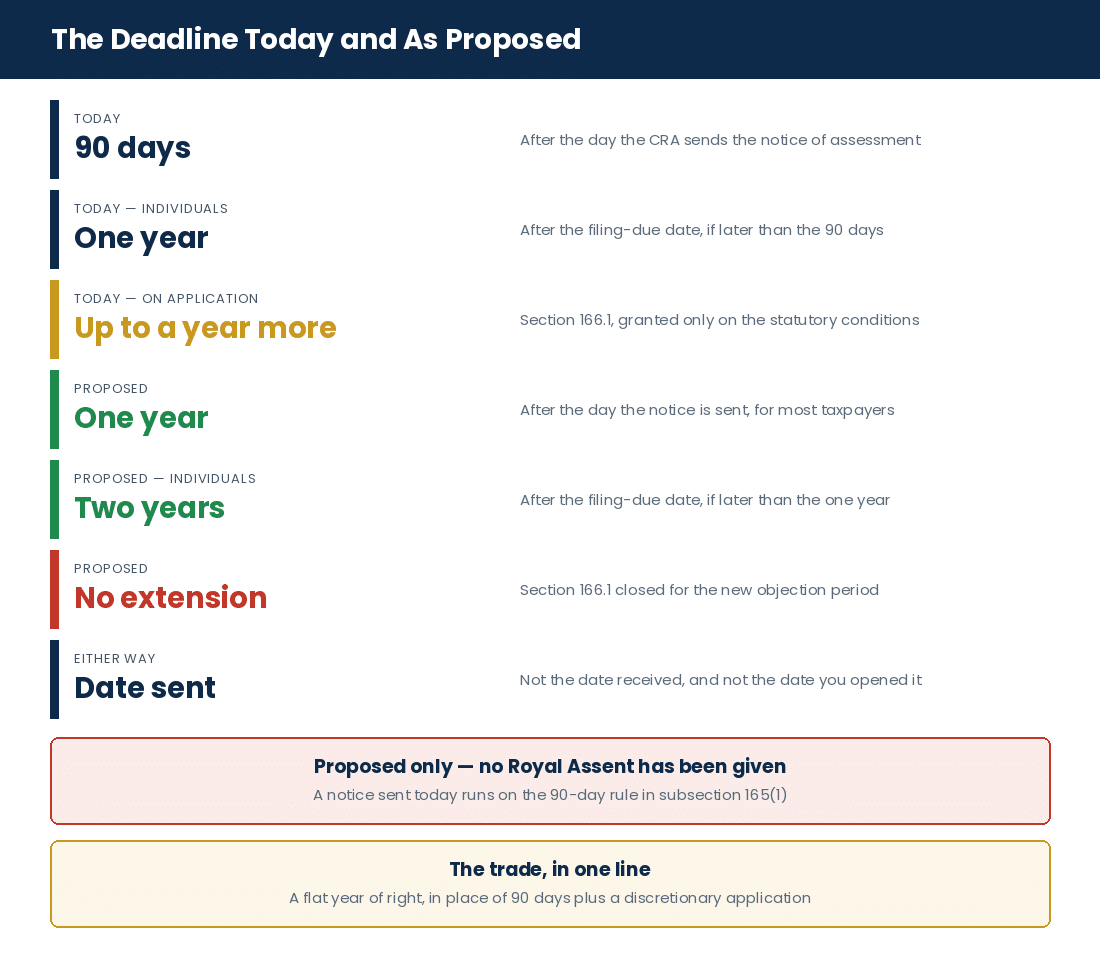
You must file your objection within 90 days after the day the CRA sends your notice of assessment. The clock starts when the notice is sent, not when you receive it or open it, so a notice sitting unopened in a pile of mail or unread in My Business Account is still running the deadline down. For individuals other than trusts and for graduated rate estates there is a two-date rule, and the deadline is the later of the two: 90 days after the day the notice was sent, or one year after the filing-due date for that taxation year. Under the Budget 2026 proposal both tiers move out: one year after the day the notice is sent for most taxpayers, and for individuals and graduated rate estates the later of that date and two years after the filing-due date.
Impact of the Budget 2026 Objection Rules on Filing Deadlines
Budget 2026 brings three changes that matter to anyone holding a notice of assessment:
- The rule would apply to assessments and determinations sent on or after the day that is three months after Royal Assent of the enacting legislation, so it is keyed to Royal Assent rather than to budget day or to a calendar year.
- Subsection 166.1(1) would be amended so that the application to the Minister for more time is no longer available for the new one-year objection period.
- You would file within the fixed period, with no application to make and nothing for the CRA to approve or refuse.
What that means in practice is worth setting out as arithmetic rather than as a mood. Today a corporation has 90 days as of right, and can then apply under section 166.1 for up to a further year — roughly fifteen months at the outside, but only the first three of those months belong to the taxpayer, and the rest depend on persuading the CRA that the lateness was justified. The proposal gives a flat year that nobody has to grant. For most taxpayers that is both more time and far more certainty, because a year of right is worth more than three months plus a discretionary hope. For the taxpayer who would in fact have been granted an extension today, it can be less total runway, which is the honest cost of the trade.
A Scarborough contractor brought us a reassessment adding roughly $148,000 of denied subcontractor costs. He had read the headline about a one-year objection deadline, decided he had until the following autumn, and came in on day 84 with the paperwork half gathered. Two things had to be said in the first five minutes. The one-year rule is a Budget 2026 proposal that has not received Royal Assent, so his file was governed by the 90-day rule, and the 90 days ran from the date the CRA sent the notice — a date three weeks earlier than the day he had opened the envelope. We filed on day 88 with the grounds stated and the schedules marked as to follow, which the Income Tax Act permits, and sent the reconstructed records three weeks later. Had he waited for the proposal, he would have been applying to the Minister for permission to be heard at all. Figures changed for privacy.
Initial Assessments, Reassessments and the Normal Reassessment Period
There is a difference in timing depending on whether you are looking at the CRA’s power to reassess or at your own deadline to object, and the two are often confused. The normal reassessment period in subsection 152(3.1) of the Income Tax Act runs three years from the day the original notice of assessment was sent for a Canadian-controlled private corporation, an individual, a graduated rate estate or a mutual fund trust, and four years for any other corporation. The four-year window turns on the type of taxpayer, not on whether the return was filed late. Your own objection deadline, by contrast, is reset by each new notice: a reassessment carries its own 90 days, measured from the day that reassessment was sent, whatever happened with the original assessment. With the Budget 2026 proposal moving the objection period and removing the extension application, knowing which notice you are objecting to and when it was sent matters more than it ever has.
Scope of Objections: What Disputes Are Eligible Under CRA Rules
You can object to a great deal under the federal income tax rules, but not to everything, and the line is not where most people assume it is:
- A penalty the CRA has assessed is part of the assessment and can be objected to in the ordinary way, with the same deadline and the same process as any other adjustment.
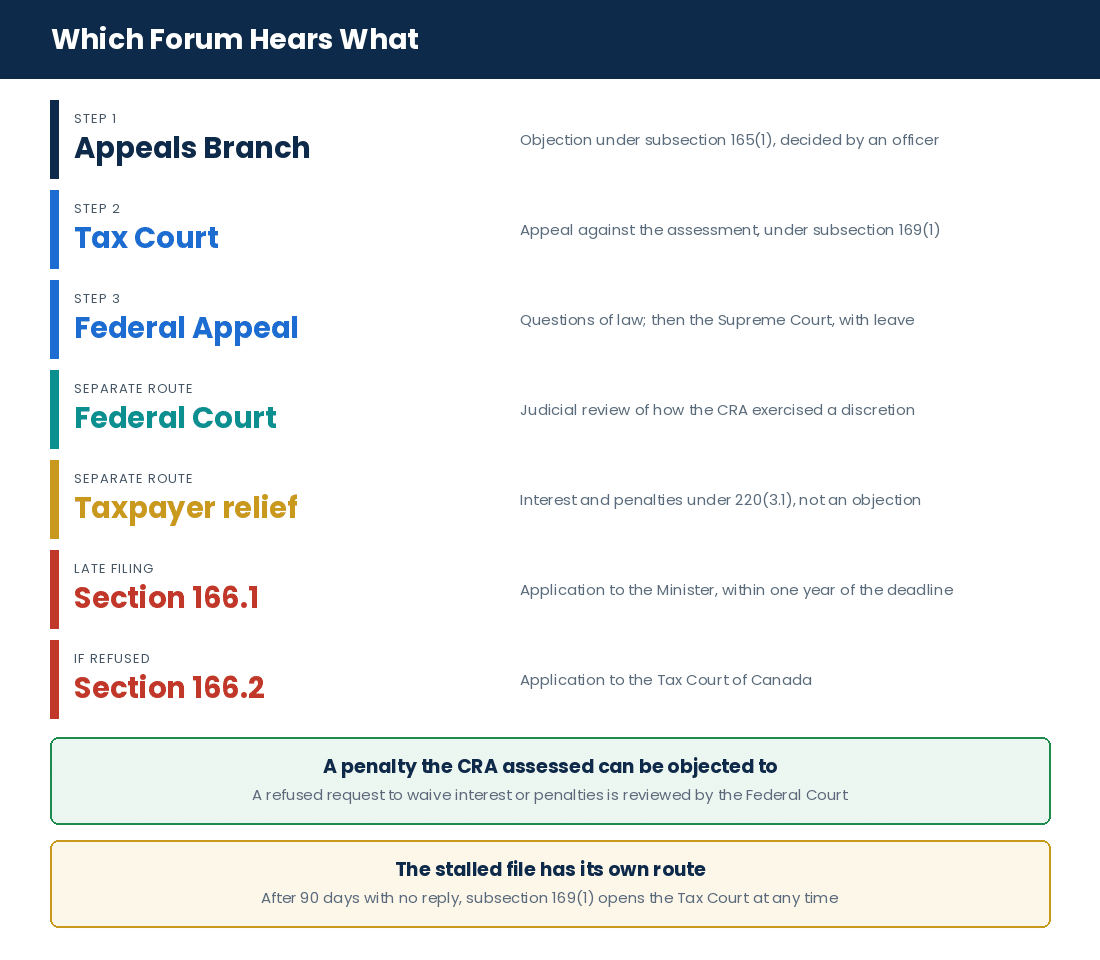
- A discretionary request to waive or cancel interest or penalties under the taxpayer relief provisions in subsection 220(3.1) is not an objection matter at all. It is an administrative request, and if it is refused the route is judicial review in the Federal Court.
- Judicial review in the Federal Court is the remedy for the CRA’s discretionary decisions — taxpayer relief, and in some circumstances a refused extension — and it is a different court from the Tax Court of Canada, which hears appeals against the assessment itself.
Understanding what you can object to, and which forum hears what, helps avoid wasted effort or a missed chance in dealing with the CRA. Filing an objection against a discretionary refusal, or a judicial review application against an assessment, loses time that the deadline does not give back.
Valid Objections, Invalid Objections and Extensions of Time
Eligibility
Determining if You Have a Valid Reason to Object
To object, you must file a notice of objection under Income Tax Act section 165(1). This has to happen before the CRA objection deadline. Usually, taxpayers get 90 days after the day the notice of assessment is sent to file. For individuals other than trusts and for graduated rate estates, the deadline is the later of that 90 days and one year after the filing-due date for the year.
Budget 2026 proposes to change these deadlines. If the legislation passes, most taxpayers would have a single one-year period measured from the day the notice was sent, individuals and graduated rate estates would have the later of that and two years after the filing-due date, and the application for extra time would no longer be available for that period.
Your objection reason has to be about something the CRA has assessed or determined — an amount of income, a denied deduction or credit, a penalty, or a determination of loss. The tax type matters too, because income tax, GST/HST and payroll source deductions are objected to under different statutory schemes and the Budget 2026 measure amends only the Income Tax Act.
Right now, you can also apply for an extension of time if you miss the deadline and qualify. That is the part the proposal would remove once the new period is in force.
Limitations on Objection Rights and Common Invalid Objections
You can apply for an extension beyond your deadline if you miss it. This comes from sections 166.1 and 166.2 of the Income Tax Act. Section 166.1 is the application to the Minister; section 166.2 is the application to the Tax Court of Canada if the Minister refuses, or does not decide within 90 days. Either way the application itself has a deadline: it must be made within one year after the objection deadline expired, which is where the familiar “up to an extra year” comes from, and it is never automatic.
Budget 2026 proposes to amend subsection 166.1(1) so that this route is not available for the new one-year objection period, applying to assessments sent on or after the day that is three months after Royal Assent. So although you would get a longer initial deadline, the fixed year is all there is afterwards.
Invalid objections usually come from one of two places: filing late without an approved extension, or objecting to something that is not an assessed amount at all, such as a refusal of discretionary relief. An objection that arrives one day late and has no extension application with it is not a weak objection; it is not an objection.
If you miss the deadline and have no extension, the assessment generally stands, and the remaining routes — taxpayer relief for interest and penalties, a requested adjustment, or judicial review of a discretionary decision in the Federal Court — address different things and cannot reopen the amount itself.
A Vaughan logistics company came to us eleven months after a reassessment of about $92,000, holding a letter from the CRA refusing interest relief and believing that letter was the objection decision. It was not. The objection had never been filed, the 90 days had long gone, and what they had been arguing about for the better part of a year was a discretionary request under the taxpayer relief provisions, which is reviewed by the Federal Court and cannot change the assessed amount. We filed a section 166.1 application for more time inside the one-year window with the objection attached, because that window was still open by five weeks. It was granted. Five weeks later it would not have been available at all. Figures changed for privacy.
How Disputed Amounts and Tax Types Affect Your Objection
The exact amounts you dispute matter for your objection under section 165(1). Only something the CRA has assessed, reassessed or determined can be challenged through a formal objection, which is why the first page of a well-drafted objection identifies the notice and the lines on it.
Different tax types follow similar logic but run under different provisions and need different paperwork. For example:
- Corporate income tax disputes usually turn on specific schedules of the T2, and the objection is stronger when it points at the schedule and the figure rather than at the result.
- GST/HST objections are made under the Excise Tax Act, on a 90-day deadline of their own under subsection 301(1.1), and the Budget 2026 income tax measure does not extend to them.
- Payroll source deduction and CPP or EI rulings have their own appeal routes to the Minister, which sit outside the section 165 objection process.
Knowing exactly what part of your assessment you are fighting helps with eligibility and with planning your notice inside the deadline.
Situations Requiring Multiple or Separate Objections
Large corporations are often told they must send a separate objection for every issue. That is not what the Act requires. Subsection 165(1.11) requires a large corporation to do three things inside the one objection: reasonably describe each issue, specify the relief sought for each issue as an amount, and give the facts and reasons it relies on for each issue. Everything can and should go into a single notice; what cannot happen is a vague notice that reserves the right to fill in the issues later, because a large corporation is generally confined on appeal to the issues it described.
Separate objections are needed for a different reason: each notice of assessment carries its own deadline. If the CRA reassesses several tax years, each reassessment is objected to on its own, measured from the day that notice was sent, even when the issue is identical across the years and the notices arrive in the same envelope.
Filing a timely objection for every year in dispute avoids losing part of the dispute to a deadline nobody was watching, and reduces the risk of a notice being rejected for incomplete coverage of the issues.
Understanding the Appeals Branch Mandate and Role in Processing Objections
The CRA Appeals Intake Centre receives objections from taxpayers across Canada, and its first job is to check that the filing was made in time before the file goes forward for review. Appeals officers then look at the evidence from both the taxpayer and the audit side, applying the Income Tax Act rather than defending the audit, and they are organisationally separate from the auditors whose work they are reviewing. Because timeliness is checked first, filing on time is critical: a late filing without an approved extension may never be reviewed on its merits at all, however strong those merits are.
Conditions and Eligibility for Requesting an Extension of Time to Object
Right now, under Income Tax Act sections 166.1 and 166.2, you can ask for more time if you missed your original deadline. This can add up to a year to the window in which the objection can be made, but only on the statutory conditions, and the CRA’s own guidance is to apply at the same time as you file the objection itself.
To qualify you have to show that within the original period you were unable to act or to instruct someone to act for you, or that you had a genuine intention to object; that it would be just and equitable to grant the application; and that the application was made as soon as circumstances permitted. The CRA’s published examples are being in the middle of trying to resolve the issue with the office that made the assessment, or circumstances beyond your control. Preferring to wait is not one of them.
Budget 2026 proposes to withdraw this route for assessments sent on or after the day that is three months after Royal Assent, so for a notice already in your hands the extension application still exists.
So if you are holding an assessment today and think you may need the extra time, the application is available now, under the rules as they stand.
Statutory Provisions Governing Objections, Extensions and Deadlines
| Provision | Purpose | Key Detail | Source |
|---|---|---|---|
| ITA s.165(1) | Sets the objection deadline | 90 days after the day the notice of assessment is sent; for individuals other than trusts and graduated rate estates, the later of that and one year after the filing-due date | Income Tax Act |
| ITA s.165(1.11) | Large corporation content requirements | Each issue reasonably described, the relief sought specified for each, and the facts and reasons given for each, in the one objection | Income Tax Act |
| ITA s.166.1 | Application to the Minister for more time | Must be made within one year after the objection deadline expired, on the statutory conditions; not automatic | Income Tax Act; CRA, File an objection – income tax |
| ITA s.166.2 | Application to the Tax Court of Canada where the Minister refuses | Available if the Minister refuses the section 166.1 application or does not decide within 90 days, within the same overall window | Income Tax Act |
| ITA s.152(3.1) | Normal reassessment period | Three years for CCPCs, individuals, graduated rate estates and mutual fund trusts; four years for other corporations | Income Tax Act |
| ITA s.169(1) | Appeal to the Tax Court of Canada | 90 days after the CRA sends its confirmation or reassessment, or any time after 90 days from filing the objection if the CRA has not replied | Income Tax Act |
| Budget 2026 proposal | Replaces the objection deadline | One year after the notice is sent; two-year tier for individuals and graduated rate estates; applies to notices sent three months after Royal Assent | Budget 2026 Notice of Ways and Means Motion; KPMG and Advisor.ca budget coverage |
These rules keep the objection process orderly while leaving some room for fairness through the extension application — which is the room the proposal would close, in exchange for a longer period that nobody has to grant.
How the Budget 2026 Amendments Affect Extension Applications
The proposal reorganises the same idea into one period instead of two:
- A one-year fixed limit replaces the current 90-day period and its filing-due-date variants.
- The extension application is no longer available for that period, because the period itself is the concession.
- The switch happens on the day that is three months after Royal Assent of the enacting legislation, not on the date of the announcement and not at the start of a calendar year.
For most taxpayers the result is clearer and longer. For the minority who would have been granted more time on application, the fixed year is also the ceiling, and that is the part worth planning around while the current rules still apply. The measure as it stands is a Notice of Ways and Means Motion in the budget papers, reported in the budget coverage published by KPMG and Advisor.ca, and it has not received Royal Assent.
Filing Your Notice of Objection
Process
Filing Your Notice of Objection: Process and Requirements
Filing a notice of objection with the CRA starts the official process to challenge an assessment or reassessment. Under Income Tax Act section 165(1), you must send this written statement within the statutory deadline. Budget 2026 proposes to extend that deadline for most taxpayers to one year from the day the notice is sent. Knowing how to file correctly is what makes sure your objection is accepted and reviewed rather than returned.
How to File Your Notice of Objection With the CRA
You have 90 days from the day the CRA sends your notice of assessment or reassessment to file your objection, under subsection 165(1) of the Income Tax Act. For individuals other than trusts and for graduated rate estates there is more time: the later of that 90 days and one year after the filing-due date for the year, which is the rule the CRA sets out on its own page for filing an objection. Budget 2026 would move both of those out to one year and two years respectively.
The objection goes to the CRA Appeals Intake Centre, and the CRA offers three channels: its secure online portals, mail, and fax. Using one of those official channels is what fixes the filing date, which is the only date the Appeals Branch checks first.
Accepted Submission Methods: Online Portals, Mail and Fax
The CRA’s secure portals on Canada.ca are the route it recommends. Sign in to My Account for individuals or My Business Account for a corporation and choose “Register my formal dispute”; an authorised representative does the same thing through Represent a Client. The portal issues a case number, and supporting documents can then be uploaded through the submit documents service against that number.
If you would rather not file online, you can mail or fax the objection to the Appeals Intake Centre at the address below. Other electronic routes — an email to the auditor, a message to a general enquiries line, a letter to the tax centre that issued the assessment — do not count as filing an objection, and time lost that way is not recoverable.
Sticking to the approved methods prevents the lost-in-the-post problem and the misdirected-letter problem, both of which cost deadlines. That matters more while the extension application still exists, and considerably more if the Budget 2026 proposal removes it.
Required Information and Documentation to Include With Your Objection
Your notice of objection must clearly say why you disagree with the assessment. Identify what is wrong with it — an arithmetic or posting error, a deduction or credit denied, a fact the auditor had wrong, a penalty applied to conduct you say does not attract it — issue by issue.
Documents that support those reasons do a great deal of work: copies of the financial records, contracts, invoices, bank statements, correspondence with the CRA, and anything else that evidences the position you are taking.
Giving the full picture at the outset speeds the review up, because it stops the appeals officer having to write to you for the basics. It is better to file on time with the grounds stated and the schedules marked as to follow than to miss the deadline assembling a perfect package.
Addressing the Notice of Objection Properly: Where and How to Send It
Send the finished notice exactly where the CRA’s appeals page directs. For mail or fax that is the Chief of Appeals at the Appeals Intake Centre:
- Chief of Appeals, Appeals Intake Centre, 1050 Notre Dame Avenue, Sudbury ON P3A 5C1
- Fax: 705-670-6649, or toll free 1-866-443-4955
Make sure the notice identifies you — name, social insurance number or business number — and carries a phone number and email address. For a corporation, have it signed by someone authorised to sign, or file it through My Business Account where the sign-in does that work.
Address or format errors give the CRA a reason to return the objection unprocessed, and a returned objection can mean a missed deadline. That risk is larger if the extension application is removed for assessments sent after the Budget 2026 measure comes into force, which is why the five minutes spent checking the address is time well spent.
Including Reference Numbers and the Relevant Notices of Assessment
Always include the identifying details:
- The date the CRA sent the notice, and the date you received it if the two differ
- The reference or assessment number shown on the notice of assessment or reassessment
- Your social insurance number, business number and program account, as applicable
- The taxation year or years and the reporting periods in dispute
These let the CRA match your objection to the right account and the right notice, so there is no confusion about what you are contesting. Attach copies of the notices as well, or at least identify each one precisely, so the record shows exactly which assessments are under objection.
A Mississauga import business emailed its objection to the auditor who had made the adjustments — about $61,000 across two years — and heard nothing for four months. The auditor had no power to receive it; nothing had been filed. By the time the client reached us, the 90 days had expired on both years. We filed both objections together with a section 166.1 application for more time, documenting the email trail as evidence of a genuine intention to object inside the original period, and both were accepted. The lesson we pass on now is blunter than any deadline: the Appeals Intake Centre, My Business Account or the fax number, and nothing else counts as filing. Figures changed for privacy.
Filing Objections for Complex Cases: Large Corporations and Combined Tax Years
A large corporation with assessments across several years needs extra care, because subsection 165(1.11) sets a content standard as well as a deadline. Each issue has to be reasonably described, the relief sought has to be quantified for each issue, and the facts and reasons have to be given for each — and the issues described are generally the issues that can be argued later.
Group the issues by taxation year inside the objection, and watch the deadline attached to each individual notice, because every notice runs its own clock from the day it was sent. If the Budget 2026 measure passes, two notices sent weeks apart either side of the coming-into-force date will run on different rules, which is a scheduling problem as much as a tax one.
Keep the working papers that support each issue, because the appeals officer will test them and because the new timelines would remove the extension application that currently cushions a late discovery.
Large filers generally get professional help with this, and reasonably so: a notice that fails the subsection 165(1.11) content test can leave an issue unarguable even though the objection was filed on time.
Guidelines for the Form and Format of Your Objection Letter
Section 165(1) requires a written objection, and in practice it should contain:
- Your identifying information: name, social insurance or business number, and contact details
- A clear statement that you object to the assessment, in whole or in part, identified by notice and taxation year
- The reasons you disagree and the relevant facts, in enough detail for someone who has not read the audit file
- Your signature, or filing through the authenticated portal, which serves the same purpose
Form T400A, Objection – Income Tax Act, is still a current CRA form and may be used for a mail or fax filing; a signed letter setting out the facts and reasons is equally acceptable.
Write it professionally and plainly. Avoid slang and avoid dense legal construction for its own sake, so the appeals officer can see what you are arguing without reconstructing it — the balance between statutory language and plain English is what makes a notice easy to process at intake.
Leave out anything unrelated to the amounts assessed. It distracts from the issues that need deciding, and it costs time under the current deadlines and under the proposed ones alike.
Sample Objection Letter and Key Components Explained
A workable notice opens by identifying itself:
“I hereby submit my Notice of Objection pursuant to subsection 165(1) of the Income Tax Act regarding Assessment Number XXXX dated YYYY-MM-DD issued in respect of the taxation year ending YYYY-MM-DD.”
Then explain, issue by issue, why you dispute the adjustments, and cite the attached documents that support each point briefly but fully enough that the officer does not have to ask.
Close it formally:
“Signed respectfully,” followed by the printed name, title, date and contact details below the signature line.
That meets the statutory requirements while keeping the document readable — which matters whether the deadline is the 90 days that applies today or the year Budget 2026 proposes, and it is the same discipline we apply for Ontario clients taking a file from audit through to objection.
Need help? Email info@gondaliyacpa.ca or call 647-212-9559 for guidance on a disputed assessment, including how the proposed one-year objection deadline would apply to a notice you are holding now.
Is your objection deadline still open?
Five questions about the notice of assessment in front of you. The one-year rule is a Budget 2026 proposal, so this prompt works from the rules in force.
Points to raise with us:
This is a general prompt, not tax or legal advice or a quote. Your position depends on your full facts. For a real review, please book a free consultation.
After You File: the Appeals Branch Review
What Happens Next
After You File: What Happens Next
When you send your notice of objection to the CRA, the Appeals Branch takes over the file under section 165 of the Income Tax Act, and the Budget 2026 proposal would change the deadline for getting there without changing what happens afterwards. The CRA confirms it has the objection and gives it a case number. An appeals officer then reviews the dispute independently of the audit that produced it. Knowing how that runs helps you read the timelines, the document requests and your own rights while it is open.
Acknowledgment and Assignment of Your Objection Case Number
Once the Appeals Intake Centre receives your notice of objection, it sends an acknowledgment confirming the file is officially with it. A case number is assigned at the same time, and that number is what you quote to check progress or to discuss the objection with the CRA. Filing online gives you the case number immediately, which is one practical reason to use the portal.
The number also keeps the record straight, so there is no mix-up between years, between accounts, or between two taxpayers with similar names.
Review Process by the Appeals Branch: What to Expect
The Appeals Branch reviews your objection separately from the audit function and considers the information you have given on its merits. In practice:
- The officer may ask for further documents or explanations.
- The decision is made on the facts and the law, and it can confirm, vary or vacate the assessment.
- How long it takes depends on how complex the file is and how complete the submission was.
The officer’s job is to resolve the dispute correctly rather than to defend the assessment, and no conclusion is reached before the file has been looked at properly.
Requests for Additional Documents and Information During the Review
You should include as much supporting material as you can when you file. Even then, officers commonly come back for further documents or detail to resolve a question or fill a gap in what was submitted.
Answering quickly and with the right records keeps the file moving. It does not guarantee a particular outcome, and nobody who tells you otherwise is being straight with you.
Your Rights to Request CRA Documents and Confidentiality Limits
You can ask the CRA for the material it holds in relation to your assessment and objection, which is what lets you engage with the dispute properly informed rather than guessing at the basis for the adjustment. Access requests under the federal access and privacy legislation are the formal route where the appeals officer does not simply provide it.
Those rights have a limit: the CRA protects other people’s information, and taxpayer information is confidential under section 241 of the Income Tax Act, so third-party material is withheld or redacted unless the law permits its disclosure.
Decision-Making Procedures and Timeframes for Different Complexity Levels
The Income Tax Act sets no deadline for the Minister to reply, but the CRA does publish how long objections are actually taking, by complexity level, and updates the figures as files close. The numbers below are the CRA’s own, for income tax objections resolved in August 2026, and they are averages rather than a commitment to any individual file. High complexity objections are only two to three per cent of the workload. The CRA also notes it is receiving more objections than normal, so a file can run longer than these averages suggest.
| Complexity Level | Average Time to Resolve | Service Standard Met in 2024-25 | What Sits Here |
|---|---|---|---|
| Low | 145 days | 76% of the time | A single straightforward issue, fully documented at filing |
| Medium | 403 days | 71% of the time | Needs a detailed document review or further submissions |
| High | Over 690 days, estimated | Not published | Multiple issues or years, or a question of statutory interpretation |
The gap between 145 days and 403 days is the part worth planning around: a file that gets classified as medium rather than low is not a little slower, it is roughly three times slower. There is also a route out of a stalled file: once 90 days have passed since the objection was filed and the CRA has not replied, subsection 169(1) lets you appeal to the Tax Court of Canada without waiting for a decision at all.
Status Updates: Checking Objection Progress and Timelines
You can track the objection through My Account or My Business Account, or by calling with your case number. The status tells you whether the file is waiting on documents, under review, or close to a decision, and the officer will sometimes give an expected timeframe.
Checking periodically keeps you informed without waiting for the CRA to make the first move, and it is also how you notice that the 90-day appeal window under subsection 169(1) has opened.
An Etobicoke professional corporation had an objection on roughly $210,000 of disputed shareholder benefits sitting with Appeals for fourteen months with no decision. The client assumed waiting was the only option. It was not: subsection 169(1) had allowed an appeal to the Tax Court of Canada since day 91, because the CRA had not confirmed, vacated or reassessed. We wrote to the appeals officer setting out that the file was now appealable at any time and asked for a decision date. The reassessment, substantially in the client’s favour, came through seven weeks later and no appeal was ever filed. The letter was the leverage, and the leverage existed only because somebody had read the subsection. Figures changed for privacy.
How Collection Actions Are Handled During the Objection Period
Filing a valid objection restricts collection, but it is not a blanket stop, and the exceptions in section 225.1 of the Income Tax Act are the ones that surprise people:
- Generally the CRA will not collect disputed income tax while the objection is under review.
- Amounts you were required to withhold and remit, such as payroll source deductions, must still be paid on time, and collection action on them is never postponed.
- A large corporation must still pay half of the disputed amount, and the same half rule applies to donation credits claimed through a gifting tax shelter.
- Interest continues to accumulate on the disputed amount, and you can pay all or part of it to stop further interest from running.
- After the decision, you have to pay what is no longer in dispute, and collection is usually delayed for 90 days after the decision is sent.
Debts that are not part of the assessment under objection stay open to normal collection throughout, which is why a disputed year and an undisputed year are handled as two separate conversations with Collections.
Payment Requirements and Options While Your Objection Is Under Review
Even where collection on the disputed amount is restricted, everything else remains payable: current instalments, source deductions, GST/HST and the balances for years that are not in dispute. A payment against the disputed amount does not weaken your objection, and because interest keeps running it is sometimes the cheaper decision; if you have paid and no decision has arrived within 120 days, you can ask for the disputed amount back, limited to half in the large corporation and gifting tax shelter cases.
If you want help with the steps after filing a notice of objection — including tracking the deadlines around the proposed one-year objection period — contact Gondaliya CPA at 647-212-9559 or info@gondaliyacpa.ca.
Two points are worth keeping in front of you while the file is open. A valid objection restricts collection of the disputed income tax under section 225.1, with the withholding, large corporation, gifting tax shelter and interest exceptions set out above, and it does nothing for amounts outside that assessment. And the deadline that got you there depends on your taxpayer category and on the date the notice was sent, which is the date the CRA works from and the date the Budget 2026 proposal would also work from.
Further Recourse: Tax Court and the Courts Above It
Appeals
Further Recourse: Appeals Beyond the Objection Stage
When a taxpayer files a notice of objection under section 165 of the Income Tax Act, the CRA Appeals Branch reviews the assessment or reassessment. If the taxpayer does not accept the objection decision, the next step is an appeal to court. Budget 2026 proposes to change the objection deadline that gets a taxpayer to that point, and it leaves the later appeal rights as they are.
Options for Appealing CRA Objection Decisions to the Tax Court of Canada
If you disagree with the objection decision, you appeal to the Tax Court of Canada. That court hears income tax appeals and offers two procedures: the informal procedure, which is faster, cheaper and subject to monetary limits, and the general procedure, which applies above those limits and runs more like ordinary litigation. Judicial review is a different thing in a different court: an application to the Federal Court about how a discretionary decision was made, not an appeal about how much tax is owed.
Appeals follow strict time limits and the Tax Court’s own rules of procedure. The process begins with a notice of appeal, and subsection 169(1) of the Income Tax Act gives two separate openings for filing it.
Time Limits and Procedural Requirements for Court Appeals
The deadline to appeal to the Tax Court is 90 days after the day the CRA sends its notice of confirmation or its reassessment following the objection. There is a second route that matters to anyone waiting on a slow file: once 90 days have passed since the objection was filed and the CRA has not vacated, confirmed or reassessed, you can appeal at any time without a decision. Missing the 90-day window after a decision usually ends the matter, though the Tax Court can extend the time to appeal in limited circumstances on application.
The procedural steps include:
- Filing and serving the notice of appeal as the Tax Court’s rules require
- Paying the filing fee set for the procedure you are using
- Following the court’s case management directions and timetables
Those rules keep the process orderly and protect both the taxpayer’s position and the public interest in the revenue.
Appeals Beyond the Tax Court: Federal Court of Appeal and Supreme Court of Canada
If the Tax Court’s decision goes against you, there are two further levels:
- Federal Court of Appeal: it reviews questions of law, and findings of fact only on a much stricter standard, so it is not a second trial.
- Supreme Court of Canada: it takes cases of national or constitutional significance, and only with leave, which is rarely granted in tax matters.
Each court has its own filing requirements, deadlines and rules, and they differ from the stages below them.
When and How to Initiate a Court Appeal After an Objection Decision
- File the notice of appeal before the deadline expires.
- File the required documents electronically or by mail in accordance with the court’s rules.
- Serve the Crown promptly, which in a tax appeal means the Attorney General of Canada through the Department of Justice.
- Pay the filing fee, unless you qualify for relief from it.
Doing each of those properly is how you avoid losing an appeal right on a technicality rather than on the merits.
Special Considerations for Missed Deadlines or Refused Extensions
Budget 2026 proposes to withdraw the extension application for the new one-year objection period, applying to assessments sent on or after the day that is three months after Royal Assent. The proposal does not alter the appeal deadlines or the court’s own power to extend the time to appeal.
Missing a deadline at any stage generally blocks the next step, and the grounds for relief are narrow and have to be proved rather than asserted.
If the Minister refuses a section 166.1 application for more time, section 166.2 lets you take that refusal to the Tax Court of Canada, and the application has to be made inside the statutory window. Where the decision under challenge is a discretionary one — a refusal of taxpayer relief under subsection 220(3.1), for instance — the forum is the Federal Court on judicial review, not the Tax Court. Either way, get advice quickly, because the options narrow as the dates pass, and they would narrow sooner if the extension application disappears.
A Hamilton family trust lost an objection on roughly $84,000 of disallowed expenses and came to us eight weeks into the 90 days with a plan to apply for judicial review. It was the wrong court. Judicial review in the Federal Court tests how a discretion was exercised; the trust’s complaint was that the deduction was good, which is an appeal against the assessment and belongs in the Tax Court of Canada. We filed a notice of appeal under the informal procedure with three weeks to spare, and the matter settled before hearing on about two-thirds of the amount. Had the application gone to the Federal Court, the 90 days would have expired while it was being told it was in the wrong place. Figures changed for privacy.
Interaction Between Court Appeals, CRA Collection and Refunds
While the objection is still with the Appeals Branch, and after an appeal is filed:
- Collection of the disputed income tax is generally restricted under section 225.1, with the withholding, large corporation and gifting tax shelter exceptions, and it stays restricted while an appeal to the Tax Court is outstanding. Collection is usually delayed for 90 days after a decision is sent.
- You can arrange payment of the amounts that remain payable while the dispute runs, and paying the disputed amount to stop interest does not prejudice the appeal.
- If you paid and the CRA has not decided within 120 days, you can request the disputed amount back, limited to half for a large corporation or a gifting tax shelter claim.
Knowing how collection and interest behave during an appeal is how you manage the cash flow risk without giving up the dispute, and a long appeal makes that arithmetic worth doing early.
For help with the timelines on a corporate assessment — including how the Budget 2026 proposal would affect your dispute options — reach out to Gondaliya CPA in Toronto, Ontario at info@gondaliyacpa.ca or call 647-212-9559.
Resources, Support and Where Different Rules Apply
Resources
Resources, Support and Additional Information
The Canada Revenue Agency publishes a good deal to help taxpayers with objections. The Appeals Branch handles notices of objection under section 165 of the Income Tax Act, and the Appeals Intake Centre can be reached by mail or fax at the Sudbury address, or through the CRA’s general enquiries lines by phone. The CRA’s own page on filing an objection sets out the deadlines, the online and paper channels and the extension of time rules. For anyone who needs them, the CRA offers TTY service and alternative formats for its publications.
On forms and guidance:
- Form T400A, Objection – Income Tax Act, is the CRA’s objection form and is still current; a signed letter with the facts and reasons works equally well.
- The CRA’s instructions on the form and on its appeals pages explain what has to be included.
- The proposed one-year deadline comes from the Notice of Ways and Means Motion published with Budget 2026 at budget.canada.ca/2026, which replaces subsection 165(1) and amends subsections 165(1.1) and 166.1(1), and it has not received Royal Assent.
If your dispute is with a province rather than with Ottawa, the rules are not the same. Revenu Québec administers Quebec’s own income tax under Quebec legislation, with its own objection process and its own deadlines, so a Quebec assessment is not objected to through the CRA at all. Objections about benefit and credit determinations such as the Canada Child Benefit or the disability tax credit are made under the provisions governing that determination, and the CRA’s page for the particular benefit sets out the route and the time limit.
For businesses disputing GST/HST:
- GST/HST objections are made under the Excise Tax Act, not the Income Tax Act.
- The deadline there is 90 days under subsection 301(1.1) of the Excise Tax Act, and the Budget 2026 measure as announced is an income tax measure, so a GST/HST objection should not be assumed to get the longer period.
- The CRA’s GST/HST objection pages set out the form, the channels and the rules for those disputes.
Rebate and other program amounts follow the provisions under which they were determined, so check the CRA page for the specific program before assuming the income tax objection rules apply.
Privacy runs through the whole process. Taxpayer information is confidential under section 241 of the Income Tax Act and protected by the federal privacy legislation, which is why third-party material in an objection file is redacted and why the CRA will not discuss your file with someone who is not authorised on it.
A Toronto consulting company with a Quebec branch received assessments from both administrations on the same reorganisation, about $120,000 federally and a smaller provincial amount. The owner objected to the CRA for both, on the reasonable assumption that one dispute meant one objection. Revenu Québec runs its own objection process under its own legislation and its own deadline, and the federal filing did nothing for the provincial assessment. We filed the Quebec objection inside its deadline with eighteen days left and ran the two disputes in parallel on the same evidence. One set of facts, two administrations, two clocks. Figures changed for privacy.
A Note on What Was Checked and When
The rules and deadlines on this page were checked against the Income Tax Act, the CRA’s published objection guidance and the Budget 2026 documents as at 18 November 2026, and they can change — the central measure described here is a proposal that Parliament has not passed. Always check the current CRA source, or ask us, before you act on a date.
How Gondaliya CPA Helps With Objections and CRA Disputes
Gondaliya CPA can help you file objections on time, including against the deadlines proposed in Budget 2026 for a one-year limit. Acting early is the whole strategy, because it avoids depending on an extension application that the proposal would remove — and that today is granted only on conditions you have to prove.
We represent clients through CRA audits directly, which is the stage where most objections are won or lost, and we carry the same file through to the objection and, where it is needed, to the appeal. If you want advice on your own situation, contact us: we are a Registered Ontario CPA firm since 2013, based in Toronto, Ontario, with more than 1,450 five-star Google reviews, and we serve clients across Canada in places like Toronto, Mississauga, Ottawa, Hamilton and Vaughan.
To talk about your options, or to ask what the proposed objection period would mean for a notice you are holding, call 647-212-9559 or email info@gondaliyacpa.ca today. The initial consultation is free. Beyond that our fees are fixed and annual with no hourly billing, shown before tax with sales tax on its own line, and agreed before any work begins.
A North York restaurant group asked us to review an audit proposal letter rather than wait for the assessment. The auditor’s draft adjustments came to roughly $265,000, most of it an assumed cash sales adjustment built from a sample of four weeks. We answered at the proposal stage with point-of-sale data for the full period, and the adjustment that reached the notice of assessment was about a fifth of the draft. An objection was filed on the remainder inside the 90 days. The clients who have the easiest objections are the ones who were represented during the audit, which is a separate service from any assurance engagement and the one that usually decides the size of the dispute. Figures changed for privacy.
Frequently Asked Questions
FAQs
FAQs on the CRA Objection Deadline and the Budget 2026 Proposal
What starts the CRA objection deadline under Income Tax Act 165(1)?+
The day the CRA sends the notice of assessment or reassessment. Not the day it arrives, and not the day you open it or read it in My Business Account. The filing must be made within 90 days of that sending date, unless the individual tier or an approved extension gives you longer.
How does the later-of-two-dates tier work for individuals?+
For an individual other than a trust, and for a graduated rate estate, the deadline is the later of 90 days after the day the notice was sent and one year after the filing-due date for that taxation year. Budget 2026 proposes to move both limbs out, to one year after the day the notice was sent and two years after the filing-due date.
What role does Income Tax Act 166.1 play in extension applications?+
Section 166.1 is the application to the Minister for more time to object. It must be made within one year after the objection deadline expired, and it is granted only where the statutory conditions are met — that you were unable to act or had a genuine intention to object within the original period, that it is just and equitable to grant it, and that you applied as soon as circumstances permitted. It is never automatic.
How would Budget 2026 change extension applications?+
The Notice of Ways and Means Motion would amend subsection 166.1(1) so that the application for more time is not available for the new one-year objection period. It would apply to assessments and determinations sent on or after the day that is three months after Royal Assent of the enacting legislation, so the trade is a longer fixed period in place of a shorter one plus a discretionary application.
What is the significance of Income Tax Act 166.2?+
Section 166.2 is the route to the Tax Court of Canada where the Minister has refused a section 166.1 application for more time, or has not decided it within 90 days. It is not the provision that explains how to apply to the CRA; that is section 166.1.
Where does the objection actually go?+
To the Appeals Intake Centre, which receives objections from across Canada and checks that each one was filed in time before it goes forward for review. Online, that means “Register my formal dispute” in My Account, My Business Account or Represent a Client. By mail or fax it is the Chief of Appeals, Appeals Intake Centre, 1050 Notre Dame Avenue, Sudbury ON P3A 5C1, or fax 705-670-6649 or 1-866-443-4955.
What is the normal reassessment period under Income Tax Act 152(3.1)?+
Three years from the day the original notice of assessment was sent for a Canadian-controlled private corporation, an individual, a graduated rate estate or a mutual fund trust, and four years for any other corporation. The longer window depends on the type of taxpayer, not on whether the return was filed late. Subsection 152(4) is what lets the CRA reassess beyond those periods in cases such as misrepresentation attributable to neglect, carelessness or wilful default, or where a waiver has been filed.
Where does judicial review fit, and which court hears it?+
Judicial review is an application to the Federal Court about how the CRA exercised a discretion — a refusal of taxpayer relief from interest or penalties under subsection 220(3.1), for example. The Tax Court of Canada hears appeals about the assessment itself. Using the wrong forum costs time that the objection and appeal deadlines do not give back.
What does Income Tax Act 169(1) govern?+
The appeal to the Tax Court of Canada after the objection stage. You may appeal within 90 days after the CRA sends its notice of confirmation or its reassessment, or at any time once 90 days have passed since the objection was filed if the CRA has not vacated, confirmed or reassessed. The second route is the one that matters when a file has gone quiet.
Can a penalty be objected to, and is the one-year deadline law yet?+
Yes to the first: a penalty the CRA has assessed is part of the assessment and is objected to in the ordinary way. A discretionary request to waive or cancel interest or penalties under subsection 220(3.1) is different, and a refusal of that is reviewed by the Federal Court. No to the second: the one-year objection deadline is a Budget 2026 proposal, the enacting legislation has not received Royal Assent, and until it does the 90-day rule governs every notice the CRA sends.
These are the questions that decide an objection in practice — which date the clock runs from, which tier you are in, which provision gives you more time, and which court hears what if the objection does not resolve the dispute.
Essential Points for Taxpayers
Key Takeaways
Key Points on the CRA Objection Deadline and Related Rules
An objection is one decision about the law and a dozen small decisions about dates, categories and paperwork. The table below is what those small decisions look like on a real file.
| Point | What It Means in Practice |
|---|---|
| Deadline, extension and the date sent | The deadline runs from the day the CRA sends the assessment, so track that date; an extension application can add time today, and Budget 2026 would remove it in exchange for a longer fixed period. |
| Legislative status | The one-year deadline is proposed. Until Royal Assent and the three months that follow it, 90 days is the rule. |
| Which tier you are in | Individuals other than trusts and graduated rate estates get the later-of rule; corporations and other trusts do not. |
| Every notice its own clock | Each assessment or reassessment carries its own deadline, including several years assessed at once. |
| Audit-to-objection workflow | After an audit result, a timely objection is what starts formal dispute resolution with the Appeals Branch, and representation during the audit usually decides the size of what is left to dispute. |
| Objection drafting | State plainly why you disagree, attach the evidence, and reference the provisions in issue; precision in the notice shortens the review. |
| Large corporations | Subsection 165(1.11) requires each issue described, the relief quantified for each and the facts and reasons given for each, inside the one objection. |
| Penalties | An assessed penalty can be objected to; discretionary relief from interest and penalties under subsection 220(3.1) cannot, and a refusal goes to the Federal Court. |
| Normal reassessment period | Three years for CCPCs, individuals, graduated rate estates and mutual fund trusts; four years for other corporations, by taxpayer type and not by lateness. |
| The switch date | The proposed rule would apply to notices sent on or after the day three months after Royal Assent — not an announcement date and not a calendar year. |
| Who counts as a taxpayer | Subsection 248(1) of the Income Tax Act defines the terms, including “taxpayer”, which is what determines who may object and on which timetable. |
| Collections | Disputed income tax is generally not collected during the review, but withheld amounts stay payable, a large corporation pays half, and interest keeps running. |
| GST/HST | A separate 90-day rule under the Excise Tax Act, which the income tax proposal does not touch. |
| Quebec | Revenu Québec runs its own objection process on its own deadlines; a federal filing does nothing for a Quebec assessment. |
| The stalled file | Once 90 days have passed since filing with no CRA reply, subsection 169(1) allows an appeal to the Tax Court at any time. |
The Six Things We Check First
- What date did the CRA send the notice? Not the postmark you remember and not the day you opened it — the sending date on the notice is the one the deadline runs from.
- Which taxpayer category are you in? Individual, graduated rate estate, trust, corporation or large corporation decides both the deadline and the content requirements.
- How many notices are there? Each year and each reassessment needs its own objection, filed against its own date.
- Is the deadline already gone? If it is, the section 166.1 application is live for one year after it expired, and that window is what we protect first.
- Is this an assessment dispute or a discretion dispute? The amount goes to the Appeals Branch and then the Tax Court; a refused discretion goes to the Federal Court.
- What is collectible in the meantime? Source deductions, undisputed years, the large corporation half share and the running interest all need a decision before the cash flow surprises you.
Our Approach
Gondaliya CPA starts from the date on the notice, confirms which deadline applies to your category, and files inside it rather than assembling a perfect package past it. We draft the objection issue by issue with the relief quantified, which is what subsection 165(1.11) requires of a large corporation and what makes any objection easier to decide; we keep an assessment dispute and a discretionary relief request in their separate channels; we tell you what remains collectible while the file is open; and we represent clients through CRA audits directly, which is where the size of the eventual dispute is usually settled. The position then carries through the corporate tax return and the year-end file. Our fees are fixed and annual with no hourly billing, shown before tax with sales tax on its own line, and agreed before any work begins.
Industry Spotlights: Sectors We Represent
Industry Expertise
Every sector meets the objection deadline at a different point. Here are eleven, and what usually decides the dispute in each.
| Industry | What Usually Decides the Objection |
|---|---|
| Technology startups & SaaS | Multiple provincial accounts and a head office elsewhere, so notices land in several inboxes at once |
| E-commerce & online retailers | Assessments across GST/HST and income tax, each on its own deadline and its own statute |
| Consulting firms | Expense denials on home office, vehicle and subcontractor costs, usually documentary rather than legal |
| Construction, contractors & skilled trades | Subcontractor versus employee adjustments, where the audit file decides the objection |
| Property developers & builders | Multi-year reassessments on project costing, each notice carrying a separate clock |
| Real estate investors & holding companies | Capital versus income characterisation, and years reassessed together but objected to separately |
| Transportation, logistics & trucking | Per-diem, fuel and driver expense adjustments, often with the large corporation half-payment rule in play |
| Restaurants & food and beverage | Assumed cash sales adjustments built from samples, answered best before the assessment is issued |
| Daycare, childcare & CWELCC services | Funding and grant reporting adjustments, frequently with an unincorporated operator and a personal tier deadline |
| Dentists & dental practices | Shareholder benefit and equipment write-off adjustments in a professional corporation |
| Medical doctors & physician corporations | Incorporation-year and shareholder loan adjustments, and relief requests kept apart from the objection |
- Technology startups & SaaS: Servers, licences and staff spread across provinces mean assessments arrive on several accounts, and each notice has to be diarised from the day the CRA sent it rather than from the day someone noticed it.
- E-commerce & online retailers: A sales tax assessment and an income tax assessment on the same transaction run under different statutes: 90 days under the Excise Tax Act, and the Income Tax Act deadline that the Budget 2026 proposal would extend.
- Consulting firms: The disputes are almost always about records rather than about law, which means an objection filed on time with the grounds stated and the documents following is worth more than a late perfect submission.
- Construction, contractors & skilled trades: Worker classification adjustments are the common assessment, and because the facts come from the audit, representation during the audit decides how much is left to object to.
- Property developers & builders: Reassessments typically cover several years of project costing at once, and every one of those notices needs its own objection filed against its own sending date.
- Real estate investors & holding companies: Whether a disposition was on income or capital account is the recurring issue, and holding companies with multiple years reassessed together must not treat them as a single dispute.
- Transportation, logistics & trucking: Fleet expense adjustments are routine, and an operator that is a large corporation still has to pay half the disputed amount while the objection is open.
- Restaurants & food and beverage: Cash sales estimates derived from short sampling periods are the standard adjustment, and the point-of-sale data that answers them is best produced at the audit proposal stage.
- Daycare, childcare & CWELCC services: Programme funding and reporting adjustments are common, and operators running unincorporated get the individual tier deadline, which is the later of the general period and the date measured from the filing-due date.
- Dentists & dental practices: Equipment, premises and shareholder benefit adjustments are the usual grounds, and the corporation and the dentist personally can be assessed on different dates with different clocks.
- Medical doctors & physician corporations: Shareholder loan and benefit adjustments dominate, and a request to cancel interest has to be kept separate from the objection because the two go to different places.
Where the Deadline Bites Hardest, Sector by Sector
The businesses most exposed to the current 90-day rule are the ones whose mail is slow to reach the person who understands it: groups with several corporations, operators whose bookkeeping is outsourced, and anyone whose registered address is not where the decisions are made. For them the proposed one-year period is a genuine improvement, because the loss of the extension application costs them nothing they were using.
The businesses that would feel the other side of the trade are the ones that currently rely on the extension: a sole operator who was ill through the objection period, or a company whose records were with an adviser who went silent. Today that is a section 166.1 application. Under the proposal there is a year and then nothing, which is more time for almost everyone and a harder stop for a few.
Three objections in one quarter, three different reasons the deadline nearly went. A trucking company with four related corporations had notices totalling about $310,000 sent to a registered address nobody visited, and we found them with nineteen days left. A dental corporation objected on time but described its issues so loosely that the subsection 165(1.11) content requirement had to be cured by a supplementary submission before the appeals officer would accept the relief claimed. A real estate holding company treated five years reassessed in one envelope as one dispute, and two of the five were already out of time when we were retained; the section 166.1 application saved both. None of the three was about the tax at all. Figures changed for privacy.
Professional Guidance and Quick Reference
Guidance
Where Objections Go Wrong
Objections fail in a small number of predictable ways: a deadline counted from the day the envelope was opened rather than the day the CRA sent the notice; five years reassessed in one envelope treated as one dispute; an objection emailed to the auditor, who cannot receive it; a discretionary interest relief request argued for months in the belief that it was the objection; a large corporation’s notice that describes its issues too loosely to support the relief it later wants; a one-year deadline assumed to be in force when it is still a proposal; and a judicial review application filed in the Federal Court about an amount that belongs in the Tax Court of Canada. Gondaliya CPA works the date and the category first, then the merits.
Quick Answers
At a Glance
- Deadline today: 90 days after the day the notice of assessment is sent
- Authority: Income Tax Act subsection 165(1)
- Individual tier today: the later of 90 days and one year after the filing-due date
- Who gets that tier: individuals other than trusts, and graduated rate estates
- Proposed deadline: one year after the day the notice is sent
- Proposed individual tier: the later of that and two years after the filing-due date
- Source of the proposal: Budget 2026, tabled 5 November 2026
- Mechanics: the Motion replaces subsection 165(1) and amends subsections 165(1.1) and 166.1(1)
- Status: proposed; the enacting legislation has not received Royal Assent
- Coming into force: notices sent on or after the day three months after Royal Assent
- Extension today: section 166.1 application to the Minister, within one year after the deadline expired
- If refused: section 166.2 application to the Tax Court of Canada
- Extension under the proposal: not available for the new one-year period
- The arithmetic: 90 days of right plus up to a year on application, against a flat year of right
- File online: “Register my formal dispute” in My Account or My Business Account
- Representatives: the same option through Represent a Client
- File on paper: Chief of Appeals, Appeals Intake Centre, 1050 Notre Dame Avenue, Sudbury ON P3A 5C1
- Fax: 705-670-6649 or 1-866-443-4955
- Form: T400A, Objection – Income Tax Act, or a signed letter with the facts and reasons
- Large corporations: subsection 165(1.11) — each issue described, relief quantified, facts and reasons given
- Penalties: an assessed penalty can be objected to
- Interest and penalty relief: subsection 220(3.1), not an objection; refusal reviewed by the Federal Court
- Normal reassessment period: three years for CCPCs, individuals, graduated rate estates and mutual fund trusts
- Other corporations: four years, by taxpayer type and not by lateness
- Beyond those periods: subsection 152(4), for misrepresentation or where a waiver was filed
- Appeal to the Tax Court: 90 days after the confirmation or reassessment is sent
- Or: any time after 90 days from filing if the CRA has not replied, under subsection 169(1)
- Above that: the Federal Court of Appeal on questions of law, then the Supreme Court of Canada with leave
- Collections: disputed income tax generally not collected while the objection is reviewed, under section 225.1
- Always payable: amounts you were required to withhold and remit
- Large corporations and gifting tax shelters: half the disputed amount is still payable
- Interest: keeps running; you can pay to stop it
- After a decision: collection usually delayed 90 days
- GST/HST: 90 days under Excise Tax Act subsection 301(1.1), outside this proposal
- Quebec: Revenu Québec, its own process and its own deadlines
Who This Is For / Not For
Fit Check
- Ideal candidates: businesses and individuals holding a notice of assessment or reassessment they disagree with and still inside the objection period.
- Ideal candidates: taxpayers who have just missed the deadline and are inside the one-year window for a section 166.1 application.
- Ideal candidates: corporations under audit, where answering the proposal letter decides how much there is to object to later.
- Not suitable for: Quebec provincial assessments, which Revenu Québec administers on its own process, or CPP and EI rulings, which have their own appeal route.
- Not for: anyone wanting certainty about a rule Parliament has not passed, or an opinion on their own assessment without a review of the notice and the audit file, which is what the consultation is for.
People Also Ask
Related Questions
How does Gondaliya CPA handle an objection?+
We start with the date the CRA sent the notice and your taxpayer category, which together fix the deadline, then count the notices so that no year is left behind. We draft the objection issue by issue with the relief quantified and the facts and reasons given, file it through the portal so the filing date and case number are beyond argument, and send the supporting records against that case number. If the deadline has already passed we deal with the section 166.1 application first, because that window closes one year after the objection deadline expired.
What do you actually deliver on this?+
A deadline analysis for every notice in dispute, the drafted notice of objection, the document package, correspondence with the appeals officer, advice on what remains collectible and whether paying to stop interest makes sense, and a view on whether the file is worth taking to the Tax Court if the decision goes against you. We also tell you when an objection is not the right instrument, which is usually when the real complaint is about a discretion rather than an amount.
What does it cost to talk to you about this?+
The initial consultation is free. Beyond that our fees are fixed and annual with no hourly billing, shown before tax with sales tax on its own line, and agreed before any work begins, so you know the number before we start rather than after.
What should I prepare before we start?+
The notice of assessment or reassessment for every year in dispute, with the date it was sent; the audit proposal letter and any correspondence with the auditor; the records behind the adjusted amounts; and your authorisation for us on the account. If you think the deadline may already have gone, bring whatever shows what you were doing during the objection period, because that is what a section 166.1 application turns on.
What does a worked example look like?+
Take a reassessment sent on 10 November 2026 to an operating company. The 90 days run from 10 November, so the objection is due by early February. We confirm the company is not a large corporation, so subsection 165(1.11) does not apply, then draft the objection on the two adjusted items with the relief quantified for each. It is filed through My Business Account, the case number is recorded, and the records follow. Collections is told which amounts are disputed and which are not, source deductions keep being remitted, and interest on the disputed amount is modelled so the client can decide whether to pay it down. If no decision has arrived by early May, subsection 169(1) opens the Tax Court route without one.
Glossary of Key Terms
Definitions
- Notice of objection: the written statement, filed under subsection 165(1), that tells the CRA you dispute an assessment and starts the Appeals Branch review.
- CRA objection deadline: the period in which that notice must be filed, measured from the day the CRA sent the assessment.
- Date sent: the date on the notice of assessment, which is the date every objection deadline runs from, whatever date you received it.
- Graduated rate estate: an estate in its first 36 months that qualifies as such, and one of the taxpayers that gets the later-of deadline.
- Large corporation: a corporation within subsection 225.1(8), which must describe each issue and quantify the relief sought under subsection 165(1.11) and must still pay half of a disputed amount.
- Normal reassessment period: subsection 152(3.1) — three years for CCPCs, individuals, graduated rate estates and mutual fund trusts, four years for other corporations.
- Extension of time to object: the section 166.1 application to the Minister, available within one year after the objection deadline expired and granted only on the statutory conditions.
- Section 166.2 application: the application to the Tax Court of Canada where the Minister refuses an extension or does not decide it within 90 days.
- Appeals Intake Centre: the CRA office that receives objections and checks their timeliness, at 1050 Notre Dame Avenue, Sudbury ON P3A 5C1.
- Form T400A: the CRA’s objection form under the Income Tax Act, usable for a mail or fax filing.
- Taxpayer relief: the discretionary waiver or cancellation of interest and penalties under subsection 220(3.1), which is not an objection matter.
- Judicial review: a Federal Court application about how the CRA exercised a discretion, as distinct from an appeal about the amount assessed.
- Collection restrictions: section 225.1, which generally holds off collection of disputed income tax but never of amounts required to be withheld and remitted.
- Royal Assent: the final step in enacting a bill, and the event the proposed one-year deadline is keyed to, three months afterwards.
- Taxpayer: defined in subsection 248(1) of the Income Tax Act, which is where the question of who may object begins.
Want a checklist to work from? You can download our free notice of objection checklist before your consultation.
Four things decide what the objection deadline means for you. Which rule governs your notice — the one-year period is a Budget 2026 proposal and the enacting legislation has not received Royal Assent, so an assessment sent today is on the 90-day rule and will be until three months after that Assent. Which date you count from — the day the CRA sent the notice, which is often weeks before anyone in the business read it. Which category you are in — an individual or a graduated rate estate gets the later-of rule, a corporation does not, and a large corporation also has to describe each issue and quantify the relief it wants. And whether the trade suits you — a flat year of right is more time and far more certainty than 90 days plus a discretionary application for most taxpayers, while the few who would have been granted an extension today lose the top of their runway, which is a reason to use the current rules while they are still the rules.
Three questions settle an objection before anyone argues the merits. First, what date did the CRA send each notice? Find the notices, write the sending dates down, and count the days; if a deadline has gone, the section 166.1 window runs for one year after it expired and that is the first thing to protect. Second, how many assessments are actually in dispute? Several years in one envelope are several objections, and the year nobody noticed is the year that gets lost. Third, is your complaint about an amount or about a decision? An amount goes to the Appeals Branch and then the Tax Court of Canada; a refusal of interest or penalty relief under subsection 220(3.1) goes to the Federal Court, and filing in the wrong place spends time the deadline will not refund.
CRA Objections and Assessment Disputes: How Gondaliya CPA Can Help
Find the date on the notice before you argue about the tax
Gondaliya CPA reviews every notice of assessment in dispute, fixes the deadline for each from the date it was sent and your taxpayer category, drafts the objection issue by issue with the relief quantified, files it through the CRA’s portal so the filing date and case number are on record, deals with the section 166.1 application where a deadline has already passed, keeps discretionary relief requests in their own channel, advises on what stays collectible and whether paying down a disputed amount to stop interest is worth it, and takes the file to the Tax Court of Canada where the objection decision does not resolve it. We also represent you through the CRA audit that produced the assessment, which is a service we provide directly and keep separate from assurance work. Our fees are fixed and annual with no hourly billing, shown before tax with sales tax on its own line. Please book a free consultation.
Next Steps
Have more questions or need personalized guidance? Schedule a free consultation with our expert CPAs today and get the objection filed against the rule that actually applies to your notice rather than the one in the headlines. Choosing a CPA firm in Ontario for a disputed assessment comes down to two things: knowing exactly where the Budget 2026 measure sits in the legislative process, and the discipline to work from the date on the notice rather than the date it was noticed. Bring three things when you come: every notice of assessment or reassessment in dispute, the audit correspondence that produced them, and the records behind the adjusted amounts. If a deadline may already have passed, say so at the outset, because the section 166.1 application has its own one-year window and it is the first thing we would be protecting. After the consultation, diarise the remaining dates deliberately — the objection deadline, the 90-day point at which subsection 169(1) opens the Tax Court route, and the dates on any undisputed balances. We keep our objections and appeals guidance updated as the legislation moves, and we serve Toronto, Mississauga, Brampton, Vaughan, Etobicoke, Scarborough, Hamilton, Ottawa and the rest of Ontario, with clients across Canada. If our content helps, please add gondaliyacpa.ca as a preferred source on Google.
Published: · Last updated:
Editorial policy: We research against the Income Tax Act and the Excise Tax Act, CRA published guidance on objections and appeals, Department of Finance budget documents and Notices of Ways and Means Motions, Tax Court of Canada and Federal Court procedure, CPA Canada Handbook standards and CPA Ontario sources, fact-check the figures, and Sharad Gondaliya, CPA, reviews the content, which we update as the rules change.
Disclaimer: This article is educational information only and is not tax, legal or accounting advice. It covers the federal income tax objection process under the Income Tax Act — the subsection 165(1) deadline, the large corporation requirements in subsection 165(1.11), the extension of time provisions in sections 166.1 and 166.2, the normal reassessment period in subsection 152(3.1), the collection restrictions in section 225.1 and the appeal to the Tax Court of Canada under subsection 169(1) — together with the objection measure proposed in Budget 2026, tabled on 5 November 2026. That measure is a proposal: the Notice of Ways and Means Motion would replace subsection 165(1) and amend subsections 165(1.1) and 166.1(1), it would apply only to assessments and determinations sent on or after the day that is three months after Royal Assent of the enacting legislation, and no Royal Assent has been given, so the deadline, the tiers and the removal of the extension application may all change before anything becomes law. It does not cover the merits of any particular dispute, GST/HST objections under the Excise Tax Act beyond noting their separate 90-day rule, Quebec provincial objections administered by Revenu Québec, or CPP and EI appeals to the Minister. Gondaliya CPA performs compilation engagements under CSRS 4200, which provide no assurance, and does not perform audit or review engagements; we do represent clients through CRA audits and objections, which is a separate service. Please consult a licensed CPA before acting.

Sharad Gondaliya is a CPA Canada & CPA USA with 15 Years+ experience of Accounting, Tax, Payroll of Corporate Small Businesses as Tax Accountant. He is a CPA Ontario member (61040184) and holds US CPA licences in Washington and Montana and is well known among corporate small businesses for tax planning, efficient tax solutions, and affordable CPA services. Sharad is the Principal (Director) of Gondaliya CPA – Affordable CPA Firm in Canada. Licenses: CPA Ontario: 61040184 | CPA USA (MT): PAC-CPAP-LIC-033176 | CPA USA (WA): 57629 | CPA Firm License: 61330051 View Full Author Bio