



Productivity Mega Deduction 2026: How Canadian Businesses Can Write Off 100% of New Equipment
Productivity Mega Deduction and Immediate Expensing in Canada for 2026
The Productivity Mega Deduction offers businesses a clear advantage through immediate expensing in Canada for 2026 and the capital cost allowance changes that come with it, making it easier to claim a 100% write-off on eligible equipment. Gondaliya CPA explains how these proposed federal changes, along with Ontario’s separate Competitiveness Tax Cut, could affect your capital purchase planning. Keeping track of eligible deductions is an important part of managing business taxes. Working with a professional for tax preparation and filing can help businesses report their expenses accurately and make the most of available tax deductions. The Productivity Mega Deduction is a federal tax rule the government has proposed but not yet enacted. It would let businesses write off certain depreciable capital property right away instead of spreading the cost over years through capital cost allowance. This means a company could expense 100% of an eligible purchase in the year the asset becomes available for use.
Quick Summary
The measure was announced on 15 September 2026 with draft legislation, and it would apply to eligible depreciable property acquired on or after that date, deducted in the year the property becomes available for use. Please note that it has not been enacted, so a capital purchase made today on the strength of it is a purchase made on the strength of draft legislation that Parliament can still change. Ontario announced a parallel provincial immediate expensing measure on 28 October 2026, and that one takes effect only once the federal legislation passes.
| Aspect | Details |
|---|---|
| What it does | Allows a 100% deduction of the cost of eligible depreciable property instead of multi-year capital cost allowance claims. |
| Two separate tests | The property must be acquired on or after 15 September 2026, and the deduction is taken in the year it becomes available for use. |
| Legal status | Proposed. Draft legislation was released on 15 September 2026 and has not been enacted. |
| Ontario’s measure | A separate $8 billion provincial immediate expensing measure, not a rate cut, and contingent on the federal legislation passing. |
Reading time: 18 minutes.
Table of Contents
- What the Productivity Mega Deduction Would Do
- What Qualifies and What Is Excluded
- Used Property, Rollovers and Special Classes
- Who Can Claim It and the Loss-Creation Limit
- The Federal and Ontario Measures Side by Side
- Planning a Capital Purchase Before the Law Passes
- Frequently Asked Questions
- Essential Points for Business Owners
- Industry Spotlights: Sectors We Represent
- Professional Guidance and Quick Reference
The Numbers That Matter
This article covers the proposed federal Productivity Mega Deduction announced by Finance Canada on 15 September 2026, and the parallel Ontario immediate expensing measure announced in Ontario’s Fall Economic Outlook on 28 October 2026, current to 16 November 2026. Both are proposals: the federal measure sits in draft legislation that has not been enacted, and the Ontario measure takes effect only after the corresponding federal legislation passes. Nothing on this page should be read as confirmation that either rule is in force. It covers the acquisition date test and the separate available-for-use test, eligible depreciable property and the capital cost allowance classes involved, the published exclusion list, the used property and non-arm’s-length conditions and the exception to them, Canadian development expenses, the loss-creation restriction and who it applies to, how the measure builds on the Productivity Super-Deduction from Budget 2025, where the Accelerated Investment Incentive still applies, the fixed-asset records a claim depends on, and what Ontario’s measure does and does not change. It does not advise on whether any particular purchase should be made or timed around a measure that is not yet law, on provincial measures outside Ontario, or on the final shape of rules Parliament has not passed. Gondaliya CPA performs compilation engagements under CSRS 4200, which provide no assurance; audit and review engagements are referred out. We do represent clients through CRA audits, which is a separate service and not an assurance engagement. This is educational information only and not tax, legal or accounting advice. Talk to a Registered pro in Canada or Ontario about your case.
What the Productivity Mega Deduction Would Do
The Measure
Definition, Context and Where the Rule Actually Sits
The Productivity Mega Deduction is a federal tax rule the government has proposed and has not yet enacted. It would let businesses write off certain depreciable capital property right away instead of spreading the cost over years. This means companies could expense 100% of eligible purchases in the year those assets become available for use. The measure itself sits in the draft legislation Finance Canada released on 15 September 2026 and in the capital cost allowance class rules in the Income Tax Regulations, rather than in any single existing subsection of the Income Tax Act; the available-for-use timing it relies on is set by subsections 13(26) to 13(28). As proposed, the rule would apply to assets acquired on or after 15 September 2026. The stated aim is to make the deduction simpler while pushing companies to invest in new equipment that lifts productivity.
Historical Background and Rationale
The deduction was announced by Finance Canada on 15 September 2026, with draft legislation released the same day, and it builds on the Productivity Super-Deduction introduced in Budget 2025 rather than replacing the accelerated capital cost allowance framework that already exists. It is meant to boost growth by encouraging more business spending: Finance Canada’s own estimate is that the Super-Deduction reached roughly 15% of capital investment, while the Mega Deduction is projected to cover about two-thirds of it. Immediate expensing cuts taxable income dollar-for-dollar in the year of the claim, so companies keep more cash upfront. This can push firms to spend on big projects they might otherwise delay. The law is still moving through the legislative process, so businesses should watch for updates about how it will finally affect their taxes — and should not treat the current draft as settled.
Boosting Investment, Productivity and Competitiveness in Canada
The deduction is aimed mainly at growing investment across many parts of Canada’s economy. By letting businesses deduct expenses right away, they would save tax sooner, and those savings often go back into running or expanding the business faster than before. The idea fits broader goals such as supporting innovation and raising productivity levels across different industries. Canada also faces stiff competition from other countries for investment dollars, and measures like this one are intended to improve how Canada compares with other G7 countries by offering a stronger incentive to invest. Both local and foreign investors find that attractive because it lowers the effective cost of capital spending. The government’s case is that this helps create jobs and supports lasting economic health in communities across Canada.
Immediate Expensing and the Capital Cost Allowance Changes Behind It
The Productivity Mega Deduction would let a taxpayer deduct the full cost of certain assets right away. This applies to eligible depreciable capital property acquired on or after 15 September 2026. Instead of spreading deductions over years, the full amount would be claimed in the first year the asset is available for use. The proposal changes how the capital cost allowance (CCA) rules work for eligible property by allowing an immediate write-off in place of phased claims, without touching the underlying class rates themselves.
Key Legislative Amendments
The rules come from the draft legislation released on 15 September 2026 together with the CCA class definitions in Part XI of the Income Tax Regulations. These set out who qualifies, when a deduction applies, and what is excluded. The draft legislative text is still under review, and the information on this page matches Finance Canada’s announcement of 15 September 2026. The draft provides that the deduction is taken in the year the property becomes available for use, which is the test built on subsections 13(26) to 13(28) of the Income Tax Act. It also sets limits on used property and lists asset classes that do not qualify.
Immediate Expensing vs Traditional CCA
Immediate expensing would let a business deduct the full cost in the year the asset is available for use. The existing CCA system spreads those deductions over several years based on class rates. Earlier incentives such as the Accelerated Investment Incentive sped up first-year claims but still used multi-year schedules. The new measure would allow a complete write-off straight away without changing the existing class rates, and property that is not eligible for it may still qualify for the Accelerated Investment Incentive.
| Feature | Immediate Expensing (proposed) | Traditional CCA |
|---|---|---|
| Deduction Timing | Year asset becomes available for use | Over multiple years |
| Rate | Full cost (100%) | Percentage by asset class |
| Effective Date | Acquired on or after 15 September 2026, if enacted | Ongoing |
| Asset Classes | Eligible depreciable capital property only | All depreciable classes |
| Legal status | Draft legislation, not enacted | In force |
Immediate expensing would make claiming simpler, but it demands strict timing and eligibility checks — and, until the bill passes, a claim planned around it carries legislative risk as well.
A Mississauga fabricator called us four days after the 15 September announcement, having already signed for a press brake at about $310,000 on the strength of a headline that said businesses could now write off equipment in full. Two things had to be explained before the purchase order went out. The measure is proposed, not law, so the deduction he was counting on depends on a bill passing in a form nobody can guarantee. And the machine was not going to be commissioned until the following March, which put the deduction — whenever it arrives — in the next fiscal year rather than the one he was trying to reduce. He went ahead with the purchase because the equipment made sense on its own terms, which is the only basis on which we were willing to see him sign. Figures changed for privacy.
What Qualifies and What Is Excluded
Eligibility
Eligible Property and Expenses under the Productivity Mega Deduction
Eligible property covers most depreciable capital assets, new or used subject to conditions, acquired on or after 15 September 2026. That mainly means machinery and manufacturing equipment, but it goes well beyond anything you would casually call “equipment.”
Key points:
- The property must be acquired, not leased.
- There are two separate tests, and they are easy to run together by mistake: the property must be acquired on or after 15 September 2026, and the deduction is claimed in the taxation year in which the property becomes available for use.
- Machinery used directly in business activities, including manufacturing and processing, counts.
This wide scope supports industries growing their productive capacity, and it is what underpins the government’s claim that the measure would reach about two-thirds of capital investment, against roughly 15% under the Productivity Super-Deduction it builds on. But it excludes intangibles such as goodwill and franchise rights, as set out in the exclusion list below.
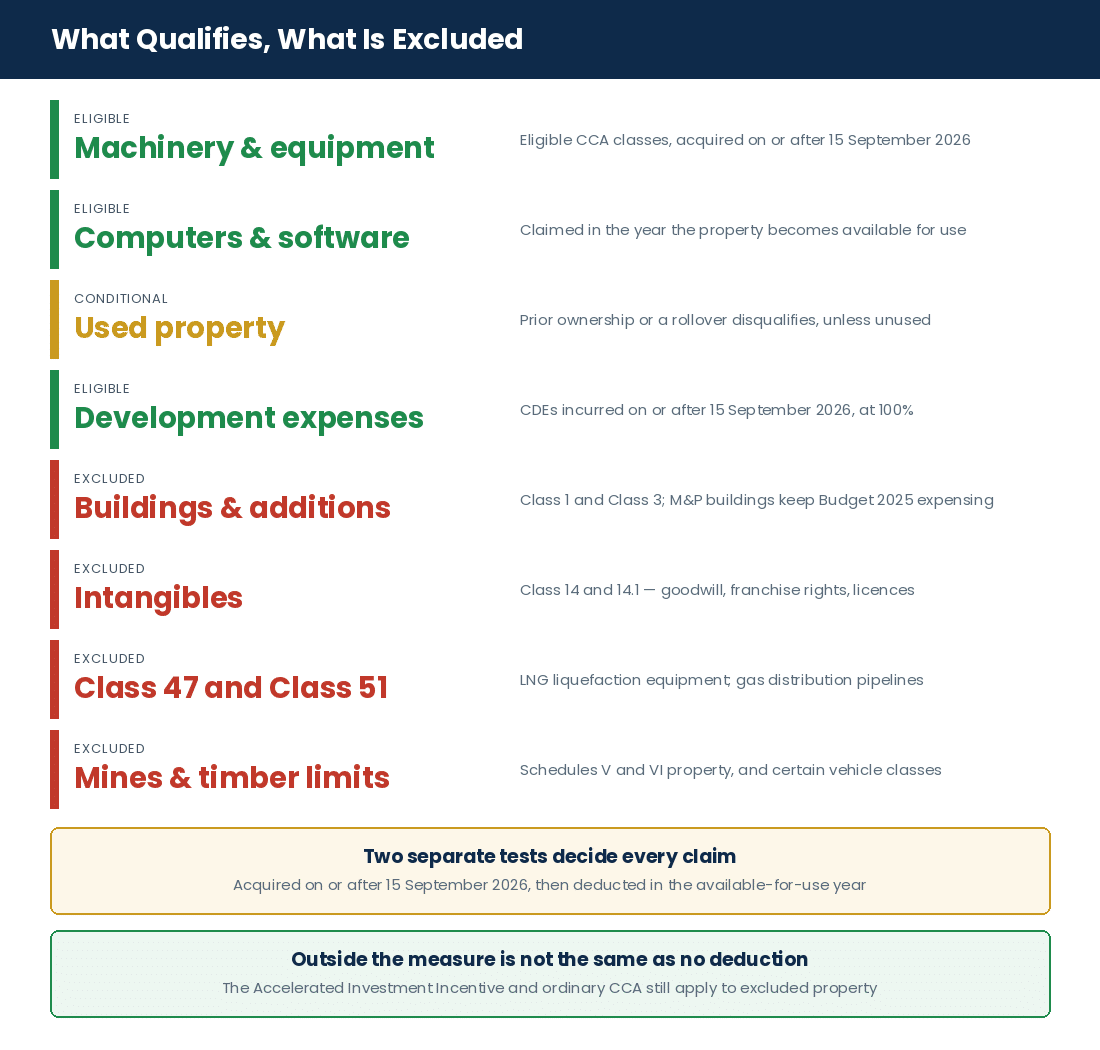
Summary of Depreciable Property Categories
Eligible property is depreciable capital property acquired on or after 15 September 2026 and claimed in the year it becomes available for use, the timing test built on subsections 13(26) to 13(28) of the Income Tax Act.
| Category | Eligibility Status | Notes |
|---|---|---|
| New machinery & equipment | Included | Must fall under an eligible CCA class |
| Computers & software | Included | Defined by their related classes |
| Class 1 buildings | Excluded | Remain on ordinary CCA rates |
| Class 3 additions and alterations | Excluded | Building additions are on the exclusion list |
| Manufacturing and processing buildings | Excluded here | Still eligible for the temporary expensing introduced in Budget 2025 |
| Class 14 and 14.1 intangibles | Excluded | Franchise rights, licences and goodwill follow their normal rules |
| Class 51 pipelines | Excluded | Regulated natural gas distribution pipelines |
| Property under Schedules V and VI | Excluded | Industrial mineral mines and timber limits are depreciated under those schedules |
| Industrial mineral mines | Excluded | Including rights to remove industrial minerals |
| Timber limits | Excluded | And rights to cut timber, other than timber resource property |
| Vehicles | Some classes excluded | Specific vehicle classes are excluded per Schedule II |
| Used property | Conditionally included | Subject to the previous-ownership and rollover tests, and the exception to them |
Excluded categories go back to standard capital cost allowance depreciation rates under the existing rules. The manufacturing and processing building point is the one most often missed: those buildings are outside this measure, but the temporary expensing from Budget 2025 still reaches them, so the right answer is rarely “no deduction.” Property that is not eligible here may also still qualify for the Accelerated Investment Incentive.
All of which means you cannot simply call something “equipment” and expect immediate expensing — the asset needs proper classification under the CCA class rules first.
A food processor in Scarborough brought us a capital plan of roughly $1.9 million for the coming year and assumed the whole thing was now deductible in one go. About $1.2 million of it was production line equipment, which sat squarely inside the proposed measure. Around $540,000 was an addition to the plant itself, which is a building and is on the exclusion list — but is a manufacturing and processing building, so the Budget 2025 temporary expensing still reached it, a point the owner’s previous adviser had not raised at all. The last $160,000 was a licence agreement, a Class 14 intangible, excluded outright and depreciating the ordinary way. Three buckets, three different answers, one invoice pile. Figures changed for privacy.
Used Property, Rollovers and Special Classes
Restrictions
Restrictions and Special Eligibility Rules Including Used Property and Rollover Transactions
Two main conditions affect whether used property is eligible:
- The buyer must not have owned the property before, and neither can a non-arm’s-length person have owned it immediately before.
- The purchase cannot be made on a tax-deferred rollover basis, such as a section 85 election.
These rules are there to stop businesses recycling assets between related entities purely to generate an immediate deduction without any real new investment.
There is an important exception, and the blunt version of this rule gets it wrong. Property acquired from a non-arm’s-length person, or on a rollover, can still qualify — provided it was unused before the taxpayer acquired it and nobody has claimed capital cost allowance or a terminal loss on it. So a brand-new machine that happens to move through a related company on its way to the operating entity is not automatically disqualified; what disqualifies it is prior use or a prior claim against it.
Businesses should therefore keep clear records of ownership history before claiming this deduction on any secondhand purchase, including evidence that the asset was never put into use and that no CCA or terminal loss has been taken on it by anyone.
A two-company group in Vaughan moved a packaging line worth about $265,000 from the holding company into the operating company and assumed, correctly as far as it went, that a non-arm’s-length transfer kills immediate expensing. It would have, except the line had been bought in a crate, stored for eleven months, never installed, never switched on, and no CCA had ever been claimed on it by either entity. That put it inside the exception rather than outside the measure, and the difference was a deduction of the full amount against a deduction spread over the better part of a decade. The one document that settled it was a dated warehouse receipt nobody had thought was worth keeping. Figures changed for privacy.
Liquefied Natural Gas Equipment and Facilities (Class 47)
Class 47 covers qualified liquefaction equipment, and the answer here is specific: Class 47 liquefaction equipment is excluded property under the Productivity Mega Deduction. It is not left without relief. An additional allowance brings its effective capital cost allowance rate up to 100%, but that allowance can only be deducted against income from liquefying natural gas at the facility in question, which is a materially narrower result than immediate expensing against business income generally. The Class 47 enhancement applies to eligible assets acquired after 3 November 2025, and the separate 10% accelerated capital cost allowance for Class 1 non-residential buildings used in LNG facilities continues to apply. Neither benefit now carries the proposed expected emissions intensity requirement. Note that Class 51, regulated natural gas distribution pipelines, is also on the exclusion list but has no equivalent additional allowance, so the two classes are excluded for different reasons and with different consequences.
Canadian Development Expenses and Flow-Through Shares
Canadian development expenses (CDEs) are not left outside the measure — they are inside it. CDEs incurred on or after 15 September 2026 would be immediately deductible at 100% under the proposal, rather than at the ordinary 30% declining-balance rate. Successor expenses under subsection 66.7(4) are excluded from that treatment, and CDE remains ineligible for renunciation under a flow-through share agreement. The enhanced 45% rate for reaccelerated CDE would be retained permanently, with no scheduled phase-out. For the 2026 taxation year, CDE has to be split between amounts incurred before and on or after the effective date, because only the later amounts qualify.
Flow-through shares themselves do not receive immediate expensing treatment under this measure. Companies issuing or holding them should still consider how larger deductions change the taxable income calculations tied to those arrangements for fiscal years from 2026 onward.
Will your planned purchase qualify for the Productivity Mega Deduction?
Five questions on the asset you are about to buy. The measure is proposed, not enacted, so this is a planning prompt rather than a guarantee.
Points to raise with us:
This is a general prompt, not tax or legal advice or a quote. Your position depends on your full facts. For a real review, please book a free consultation.
Who Can Claim It and the Loss-Creation Limit
Who Qualifies
Eligibility for Taxpayers Including Individuals, Partnerships and Corporations
Under the current draft legislation the Productivity Mega Deduction would apply to taxpayers generally, including individuals and partnerships, and to corporations regardless of size or sector. There is no small-business carve-out and no size threshold; Canadian-controlled private corporations get no special treatment here and qualify on the same terms as everyone else.
However:
- A loss-creation restriction applies to individuals, trusts, and partnerships with at least one non-corporate member. For those taxpayers the deduction is capped at the income from the business or property in which the asset is used, so it cannot be used to create or increase a loss.
- That restriction does not apply to corporations.
Taxpayers across Canada would be able to claim it for taxation years in which eligible property acquired on or after 15 September 2026 becomes available for use. This includes Ontario, which has its own parallel provincial measure covered further down this page.
Considerations for Different Business Structures
The deduction reaches many business types — corporations large and small, individuals running a business alone, and partnerships — provided the conditions are met. What changes with the structure is not whether you can claim, but how far the claim can go.
The loss-creation restriction limits the deduction to available income for individuals, trusts and partnerships with a non-corporate member; corporations do not face that cap. This affects how taxpayers plan purchases against their expected income for the year, because for an unincorporated business a large purchase late in a thin year may simply not produce the deduction the headline suggests.
To qualify, the property must:
- Fall within an eligible CCA classification under Part XI of the Income Tax Regulations and not appear on the exclusion list.
- Be depreciable capital property acquired on or after 15 September 2026 and become available for use in the year claimed.
- Meet the used-property tests where relevant: no previous ownership by the taxpayer or a non-arm’s-length person and no acquisition on a rollover basis, unless the property was unused and no CCA or terminal loss has been claimed on it.
Corporations get a simpler path because the loss limit does not apply to them, but they still have to check every asset against the exclusion list before claiming anything under this proposal.
A sole proprietor running a mobile welding business bought a service truck and a rig at about $148,000 in October, expecting the whole cost to come off a year in which the business had cleared roughly $61,000. It does not work that way for an unincorporated business: the loss-creation restriction caps the deduction at the income from the business the asset is used in, so the remainder would carry forward in the capital cost allowance pool rather than landing in that year. Had the same purchase sat inside a corporation, the cap would not have applied at all. He has since incorporated, for reasons that went well beyond this one deduction. Figures changed for privacy.
At-a-Glance Taxpayer Benefits
- 100% immediate expensing: the full cost of eligible depreciable capital property deducted in the year it becomes available for use, as proposed.
- Loss-creation limits: individuals, trusts and partnerships with a non-corporate member face a cap tied to the income of the business or property the asset is used in; corporations do not.
- Taxable income reduction: the deduction lowers taxable income, which is not the same as cash in hand; the actual benefit depends on the tax rate that would otherwise have applied to that income.
| Feature | Description | Source |
|---|---|---|
| Effective Date | Property acquired 15 September 2026 or later | Finance Canada announcement, 15 September 2026 |
| Write-Off Percentage | Up to 100% immediate expensing | Draft legislation released 15 September 2026 |
| Available-for-Use Date | Year the asset is first ready for its intended use | Income Tax Act ss.13(26)-(28) |
| Loss Limit Applies | Individuals, trusts and partnerships with a non-corporate member | Finance Canada |
| Legal Status | Proposed; draft legislation not yet enacted | Finance Canada |
The Federal and Ontario Measures Side by Side
Federal & Provincial
Fiscal Cost and the Estimated Effect on Investment
The Productivity Mega Deduction is a proposed federal tax measure that would let businesses expense eligible capital assets immediately. It would apply to assets acquired on or after 15 September 2026, with the write-off claimed in the year the asset becomes available for use. Firms could write off 100% of qualifying assets in that year rather than over the life of the asset.
It does not replace the accelerated capital cost allowance framework; it builds on the Productivity Super-Deduction from Budget 2025 and sits alongside the Accelerated Investment Incentive, which continues to apply to property this measure does not reach. Finance Canada has put the incremental cost of the package at $36 billion over five years beginning in 2026-27. That cost comes from businesses claiming larger deductions sooner, which defers taxable income rather than erasing it.
The deduction would operate within the existing Finance Canada and CRA framework for capital cost allowance. Businesses have to meet the acquisition date, the available-for-use date and the class rules. Purchases made before the 15 September 2026 cut-off do not qualify, whenever they were paid or invoiced.
This is a tax reduction, not a cash refund. The government gives up revenue now in the expectation of economic gains later as investment grows. And the measure still awaits passage through Parliament, so none of it is settled.
Marginal Effective Tax Rates
The proposal would cut the marginal effective tax rate (METR) that Canadian businesses face on capital investment, because the cost is deducted upfront rather than over years. The one attributable figure here is Finance Canada’s: the measures are projected to cut Canada’s marginal effective tax rate on new business investment from 13% to 6.4%.
That applies to businesses across Canada, with no size limits or income thresholds involved, so the competitiveness effect is broad rather than confined to small companies. Comparisons with individual G7 countries are frequently quoted in coverage of the measure and we have not used any here, because we could not source them.
Sector Effects on Employment and Productivity
Some sectors stand to benefit more than others simply because they rely on costly equipment: manufacturing, technology hardware, logistics and clean energy projects all carry significant machinery spend inside eligible classes.
Immediate expensing improves cash flow timing for those businesses, since the tax relief lands in the year the equipment goes into service rather than trickling in over a decade. That extra cash can support hiring as firms expand or automate, and it may lift productivity because businesses can replace ageing equipment sooner than they otherwise would. Exact employment effects vary with market conditions well beyond tax, but faster capital recovery is the mechanism the policy is relying on.
Ontario’s Competitiveness Tax Cut and How It Relates to the Federal Measure
Ontario announced its Competitiveness Tax Cut in the province’s Fall Economic Outlook on 28 October 2026. Despite the name, it is not a reduction in tax rates. It is an $8 billion parallel immediate expensing measure that would let businesses write off 100% of the cost of eligible depreciable property, mirroring the federal proposal on the provincial side of the return. KPMG’s summary is explicit on the point: the province made no changes to corporate or personal income tax rates.

How the Two Measures Interact
These are two parallel immediate expensing measures, one federal and one provincial, rather than a deduction on one side and a rate cut on the other. The Ontario measure applies to eligible property acquired on or after 15 September 2026, the same date as the federal proposal, and it takes effect only once the corresponding federal legislation passes. That makes it doubly contingent: a business planning around it is relying on a provincial measure that depends on a federal bill that has not been enacted.
| Measure | Federal Productivity Mega Deduction | Ontario Competitiveness Tax Cut |
|---|---|---|
| What it is | Immediate expensing of eligible depreciable property | Immediate expensing of eligible depreciable property |
| Announced | 15 September 2026, with draft legislation | 28 October 2026, Fall Economic Outlook |
| Applies to property acquired | On or after 15 September 2026 | On or after 15 September 2026 |
| Stated size | $36 billion over five years from 2026-27 | $8 billion |
| Rate changes | None | None — corporate and personal rates are unchanged |
| Status | Proposed; draft legislation not enacted | Proposed; takes effect only after the federal legislation passes |
Impact for Ontario Businesses
A business in Ontario would see the same expensing treatment applied federally and provincially rather than one benefit stacked on a different kind of benefit. The two measures run in parallel and are computed separately on each side of the return, and neither one changes the corporate tax rates that apply to the income left over. Companies in Ontario should plan for both together, since one does not replace the other — and should plan for the possibility that neither arrives in its current form.
An Ontario machine shop came to us in early November with a note from a supplier claiming that between the federal deduction and the Ontario “tax cut” the effective cost of a $420,000 CNC cell had fallen by nearly half. Two problems. The Ontario measure is not a rate cut at all, so there was no second, different saving to add on top — it is the same immediate expensing applied provincially. And both measures are proposals, with the Ontario one explicitly waiting on the federal bill. The real modelling, once we ran it on the deduction alone and on the ordinary CCA schedule as the downside case, still supported the purchase. It just supported it for about half the margin the sales note claimed. Figures changed for privacy.
Planning a Capital Purchase Before the Law Passes
Planning & Prep
Practical Planning Considerations for Businesses and CPAs
The proposal would let businesses expense eligible new depreciable capital property right away if they acquire it on or after 15 September 2026. How it works on any given purchase depends on the property’s capital cost allowance class, when it becomes available for use, and whether it meets the used-property rules. You also have to check the exclusion list. Loss-creation limits apply to individuals, trusts and partnerships with a non-corporate member, and not to corporations. Knowing those details is what makes the difference between a plan and a guess.
Key points to keep in mind:
- Only property in eligible CCA classes qualifies.
- The property must become available for use in the year the deduction is claimed.
- Used property has special conditions, and an exception to them.
- Some types of property are excluded altogether.
- Loss-creation limits affect only some taxpayer types.
- The measure is proposed, so the deduction is not guaranteed at the time you sign.
Tax Planning Strategies
For each purchase you need to decide whether immediate expensing under the proposed measure or the existing CCA rules produces the better outcome. The main factors are whether the asset is depreciable capital property in an eligible class and when it becomes available for use. Model both, because the measure is not law yet and the ordinary schedule is the realistic downside case.
Best practice is unglamorous: keep a solid fixed-asset register. Track acquisition dates, payments, delivery, installation, and the date each asset is actually ready for use. Businesses should check planned purchases against the exclusion list early, well before the invoice, rather than at year-end when nothing can be changed.
Some common misconceptions:
- Assuming all equipment qualifies without checking its CCA class.
- Treating the invoice or payment date as the same thing as the available-for-use date.
- Believing used property always qualifies regardless of prior ownership or rollover basis — or, equally wrong, that a non-arm’s-length acquisition always disqualifies it.
- Thinking a full write-off means immediate cash savings rather than a reduction in taxable income.
- Assuming only small corporations qualify when size does not matter, or that only corporations qualify when individuals and partnerships are in scope too.
- Treating the Ontario measure as a rate cut, which it is not.
Avoid these by reviewing the documents carefully and following Finance Canada’s announcement and CRA guidance as it is published. Work with tax professionals who are tracking the bill rather than the headlines.
A logistics client with eleven new trailers and a yard crane, around $780,000 in total, had every invoice dated before 30 September and assumed the fiscal year was covered. Four of the trailers had not been delivered, let alone put into service, by the year end in December, and the crane was waiting on an electrical inspection that ran into February. The acquisition test was met on all of it; the available-for-use test was met on about two-thirds of it. The deduction splits across two years as a result, which is a perfectly good outcome once you have planned for it and a nasty surprise if you have told your bank otherwise. Figures changed for privacy.
Permanence and Long-Term Investment Certainty
The measure is still proposed law, though the government has signalled a clear intent to make immediate expensing a permanent feature rather than a temporary stimulus. That intent is worth something for planning purposes, but it is not the same as enactment, and nothing on a purchase order should treat it as if it were.
The stated goal is to keep Canada competitive in the G7 by encouraging faster capital investment, through this measure and alongside Ontario’s separate provincial measure, which is itself waiting on the federal bill. Keep an eye on changes while planning future purchases, because a shift in the final legislation could affect timing or eligibility.
Future Outlook and Ongoing Initiatives
The Productivity Mega Deduction still needs to pass through Parliament. Finance Canada has said it wants immediate expensing to be permanent, but the law is not finalised. Businesses and advisers should watch for official updates, because the final rules may change eligibility or the exclusion list.
The broader policy aim is to raise Canada’s competitiveness by encouraging capital investment and letting businesses write costs off faster. The Mega Deduction fits that goal by allowing a full write-off in the year property becomes available for use. Until it becomes law, relying on it carries risk, and companies should check their position under the current Income Tax Act rules as well as under the proposal.
Future changes may update the exclusion list or clarify the used-property rules. Provincial programmes such as Ontario’s measure run separately but on the same immediate expensing logic, and the Ontario one cannot commence before the federal one does.
Monitoring and Compliance
Claiming the deduction means working with the available-for-use rules in subsections 13(26) to 13(28) of the Income Tax Act and the class definitions in the Income Tax Regulations. Businesses must verify that each asset fits a prescribed class rather than relying on a label like “equipment.”
The exclusion list identifies the property that does not qualify and stays on ordinary capital cost allowance rules — buildings and building additions, Class 14 and 14.1 intangibles, Class 47 liquefaction equipment, Class 51 pipelines, property depreciated under Schedules V and VI, industrial mineral mines, timber limits and certain vehicle classes.
Used property qualifies only where two conditions are met: neither the taxpayer nor a non-arm’s-length person owned it before, and it was not acquired on a rollover basis — unless the property was unused when acquired and no CCA or terminal loss has been claimed on it, in which case it can still qualify.
Check acquisition dates against available-for-use dates during year-end review rather than afterwards. Good documentation is what keeps a claim defensible if the CRA asks, and we represent clients through CRA audits directly when it does.
A client in precision machining had claimed accelerated CCA on a $95,000 grinder two years earlier and wanted to move it between related companies to pick up the new 100% deduction on the same machine. That is precisely the recycling the used-property rules exist to stop, and the earlier CCA claim closed the exception as well. The honest answer took four minutes and saved a reassessment that would have taken months. What did work for him was the new line he was buying anyway, which nobody had yet checked against the exclusion list. Figures changed for privacy.
How Gondaliya CPA Approaches a Capital Purchase Review
We guide businesses through immediate expensing and the capital cost allowance changes proposed from 15 September 2026, for clients in Ontario and across Canada, including how the federal proposal would sit alongside Ontario’s separate provincial measure. We work from classification tests rather than size or labels like “equipment,” which keeps estimates honest and stops clients overstating a deduction to a lender. Immediate expensing lowers taxable income; it does not hand you cash, and we say so plainly before anyone signs.
Working with us means staying current on the legislative changes while keeping the file compliant on eligible assets, new versus used property, and the year in which each claim belongs. For tailored advice on capital purchases on or after 15 September 2026, call Gondaliya CPA at 647-212-9559 or email info@gondaliyacpa.ca. We offer free initial consultations, focused on identifying the legitimate deductions available to you within Canadian tax law. Our fees are fixed and annual with no hourly billing, shown before tax with sales tax on its own line.
Frequently Asked Questions
FAQs
FAQs on the Productivity Mega Deduction and Immediate Expensing
What happens to excluded property under the Productivity Mega Deduction?+
Excluded property — Class 1 buildings, Class 3 additions and alterations, Class 14 and 14.1 intangibles, Class 47 qualified liquefaction equipment, Class 51 natural gas distribution pipelines, property depreciated under Schedules V and VI, industrial mineral mines, timber limits and certain Class 10 and 10.1 vehicles — passenger and rental vehicles, taxis and certain vans and pickups, though new vehicles of those kinds assembled in Canada do qualify — follows the ordinary capital cost allowance rules and is depreciated over time. Manufacturing and processing buildings are excluded from this measure but remain eligible for the temporary expensing introduced in Budget 2025, and property outside this measure may still qualify for the Accelerated Investment Incentive.
Does the purchase date decide eligibility for the deduction?+
There are two separate tests. The property must be acquired on or after 15 September 2026, and the deduction is then claimed in the taxation year in which the property becomes available for use — not the invoice date and not the payment date. A machine bought in October and commissioned in March meets the first test in one year and the second in the next.
Is a full write-off the same as getting money back?+
No. A full write-off reduces taxable income; it does not produce a cash refund. The value of the deduction depends on the tax rate that would otherwise have applied to the income it shelters, so the same $100,000 of expensing is worth materially different amounts to different businesses.
Is the measure actually law yet?+
No. Finance Canada announced it on 15 September 2026 and released draft legislation alongside the announcement, but it has not been enacted. A capital purchase made today on the strength of it is being made on the strength of draft legislation, and the final rules can change in eligibility, in the exclusion list, or in timing. Ontario’s parallel measure is contingent on the federal legislation passing.
Which decisions sit outside this article?+
Leasing rather than buying, non-depreciable property, and provincial credits other than Ontario’s Competitiveness Tax Cut are outside what this page covers. So is whether any specific purchase should be made or timed around a measure that is not yet law, which depends on the full facts of the business.
Immediate expensing or the existing rules: which fits a given purchase?+
Immediate expensing fits where the asset is in an eligible class, is acquired on or after 15 September 2026 and becomes available for use in a year where the deduction is worth having. Otherwise the ordinary capital cost allowance schedule applies, possibly with the Accelerated Investment Incentive. Because the measure is proposed, model both before you commit.
What changes the answer from purchase to purchase?+
The asset’s CCA class, its available-for-use date, the used-property position including the non-arm’s-length exception, the exclusion list, and whether the claimant is a corporation or an individual, trust or partnership facing the loss-creation cap.
Class test, “equipment” label, or invoice date: what matters most?+
The CCA class and the available-for-use date decide it. What you call the asset does not matter, and neither does when you paid for it. Corporate size does not matter either, and Canadian-controlled private corporations get no special treatment.
What are the main misconceptions, and how do we prevent them?+
The common ones are assuming everything called equipment qualifies, assuming a deduction equals a refund, assuming a non-arm’s-length purchase is always disqualified when an unused asset with no prior CCA claim can still qualify, and treating Ontario’s measure as a rate cut when it is a parallel expensing measure. We clear these up at the planning stage, before the invoices exist.
Which questions matter most across the whole topic?+
Eligibility, asset class, timing of availability for use, ownership history, rollover transactions, exclusions, loss limits, Canadian development expenses, the Ontario measure and its contingency, and audit readiness of the fixed-asset records behind the claim.
This FAQ set covers the points that decide a Productivity Mega Deduction claim in practice, from classification and timing through to the legislative status of the measure itself.
Essential Points for Business Owners
Key Takeaways
Key Points on Capital Purchases and Immediate Expensing
The measure is one decision for Parliament and a long series of small decisions for you. Everything in the table below is what those small decisions look like on a real fixed-asset register.
| Point | What It Means in Practice |
|---|---|
| Legislative status | The measure is proposed, not enacted, so any claim planned around it carries legislative risk. |
| Acquisition date | Property must be acquired on or after 15 September 2026; earlier purchases do not qualify however they were paid. |
| Available-for-use date | The deduction belongs to the year the asset is ready for its intended use, not the year of the invoice. |
| Class discipline | Each asset must be matched to a prescribed CCA class under the Income Tax Regulations. |
| Exclusion list | Buildings, building additions, Class 14 and 14.1 intangibles, Class 47 liquefaction equipment and Class 51 pipelines, Schedules V and VI property, industrial mineral mines, timber limits and certain vehicles are out. |
| Manufacturing buildings | Excluded from this measure but still eligible for the Budget 2025 temporary expensing. |
| Accelerated Investment Incentive | Still available for property this measure does not reach. |
| Used property | Prior ownership and rollovers disqualify, unless the asset was unused and no CCA or terminal loss has been claimed on it. |
| Canadian development expenses | CDEs incurred on or after 15 September 2026 would be fully deductible, excluding successor expenses and non-arm’s-length resource property. |
| Loss-creation cap | Applies to individuals, trusts and partnerships with a non-corporate member; corporations are not capped. |
| Size and status | No size thresholds, and no special treatment for Canadian-controlled private corporations. |
| Ontario’s measure | A parallel $8 billion immediate expensing measure, not a rate cut, and contingent on the federal bill. |
| Fixed-asset records | Acquisition, delivery, installation and ready-for-use dates all recorded, because the claim stands on them. |
| Cash versus tax | A full write-off reduces taxable income; it is not a refund, and the benefit depends on the applicable rate. |
| Audit readiness | Documentation is what defends the claim if the CRA reviews it, and we represent clients through CRA audits directly. |
The Six Things We Check First
- When was the property actually acquired? On or after 15 September 2026 or it is outside the measure entirely, whatever the invoice says.
- When will it be available for use? That date, not the purchase date, decides which year the deduction lands in.
- What CCA class is it, and is that class on the exclusion list? Buildings and intangibles are the usual casualties.
- Is it used, and who owned it before? Prior ownership, a related party or a rollover all matter — and so does whether anyone ever claimed CCA on it.
- Is the claimant a corporation or an individual, trust or partnership? That decides whether the loss-creation cap applies.
- Does the fixed-asset register actually carry these dates? If it does not, the claim is an assertion rather than a position.
Our Approach
Gondaliya CPA reviews the capital plan before the purchase orders go out rather than after the year end, matches every asset to a prescribed CCA class, checks it against the published exclusion list, separates the acquisition date from the available-for-use date in the fixed-asset register, works through the used-property conditions and the non-arm’s-length exception where secondhand assets are involved, models the claim both under the proposed measure and under the ordinary capital cost allowance schedule so the downside is visible, and then carries the position through the corporate tax return and the year-end file. We also represent clients through CRA audits, which is a service we provide directly. Our fees are fixed and annual with no hourly billing, shown before tax with sales tax on its own line, and agreed before any work begins.
Industry Spotlights: Sectors We Represent
Industry Expertise
Every sector meets this measure at a different point on its capital plan. Here are eleven, and what decides the answer in each.
| Industry | What Decides the Immediate Expensing Question |
|---|---|
| Technology startups & SaaS | Hardware and computer classes in, Class 14.1 intangibles and acquired software rights out |
| E-commerce & online retailers | Fulfilment equipment and racking against fit-out that is really a building addition |
| Consulting firms | Modest equipment spend, so the loss-creation cap matters more than the class list |
| Construction, contractors & skilled trades | Heavy equipment acquired in one year and commissioned in the next |
| Property developers & builders | Buildings and Class 3 additions excluded, so the plant and equipment line carries the claim |
| Real estate investors & holding companies | Class 1 buildings outside the measure, and non-arm’s-length transfers between related entities |
| Transportation, logistics & trucking | Vehicle classes, some of which are excluded, plus delivery dates that straddle a year end |
| Restaurants & food and beverage | Kitchen equipment in, leasehold improvements and premises work treated differently |
| Daycare, childcare & CWELCC services | Equipment and fit-out split, often in an unincorporated structure facing the loss cap |
| Dentists & dental practices | Chairs, imaging and sterilisation equipment against practice goodwill in Class 14.1 |
| Medical doctors & physician corporations | Diagnostic equipment timing, and whether the professional corporation or the individual is claiming |
- Technology startups & SaaS: Servers, test rigs and computer equipment sit in eligible classes, while acquired intangibles in Class 14.1 are on the exclusion list, so the capital plan splits in two before any claim is made.
- E-commerce & online retailers: Racking, conveyors and packing equipment are the eligible part; work on the warehouse shell itself is a building addition and stays on the ordinary schedule.
- Consulting firms: Capital spend is usually small, which puts the real question on whether the practice is incorporated, because an unincorporated consultant faces the loss-creation cap.
- Construction, contractors & skilled trades: Excavators, lifts and shop equipment qualify, but delivery and commissioning dates routinely push the deduction into the following year.
- Property developers & builders: The buildings themselves are excluded and Class 3 additions with them, so the claim lives entirely in the plant, equipment and site machinery.
- Real estate investors & holding companies: Class 1 property is outside the measure, and groups that move assets between related companies run straight into the non-arm’s-length rules and the narrow exception to them.
- Transportation, logistics & trucking: Specific vehicle classes are excluded under Schedule II, and fleet orders delivered across a year end split the claim between two taxation years.
- Restaurants & food and beverage: Kitchen equipment, refrigeration and point-of-sale hardware are the eligible spend; the build-out of the premises is treated on its own footing.
- Daycare, childcare & CWELCC services: Equipment and furnishings can qualify while the premises work does not, and operators running unincorporated face the cap on creating a loss.
- Dentists & dental practices: Operatory equipment and imaging are eligible classes, while practice goodwill bought on acquisition is Class 14.1 and expressly excluded.
- Medical doctors & physician corporations: Diagnostic equipment qualifies on the usual tests, and whether the professional corporation or the physician personally is acquiring it decides whether the loss-creation cap bites.
Where the Measure Lands Hardest, Sector by Sector
The sectors that gain most from immediate expensing are the ones that buy expensive, long-lived equipment and currently recover the cost slowly: manufacturing, logistics, hardware development and clean energy. In those businesses the measure changes the timing of a deduction that was always going to be available, which is worth real money in the year of purchase and nothing at all over the full life of the asset.
The sectors where it disappoints are the ones whose capital spend is mostly buildings, premises work or intangibles. A dental practice buying goodwill, a developer putting up a building and a franchisee buying a franchise right all sit outside the measure no matter how large the cheque is. Knowing which side of that line a purchase falls on, before it is made, is the whole exercise.
Three clients in one month, three different answers. A trucking operator ordered six tractors at about $1.1 million and found two of the units in an excluded vehicle class, which nobody had checked. A dental practice bought out a retiring partner for roughly $700,000, almost all of it goodwill in Class 14.1, and got nothing from the measure at all — which is a fine outcome once it is known in advance and a very poor one discovered at year end. A clean energy installer spent about $340,000 on eligible equipment that was delivered, installed and running inside the same fiscal year, and claimed the lot. The difference between the three was not the size of the spend. Figures changed for privacy.
Professional Guidance and Quick Reference
Guidance
Where Capital Purchase Claims Go Wrong
Claims built on this measure fail in a predictable set of ways: an asset acquired before 15 September 2026 and claimed anyway because the invoice was paid later; an invoice date recorded as though it were the available-for-use date, putting the deduction in the wrong year; an asset called equipment that turns out to be a building addition or a Class 14.1 intangible; a secondhand machine from a related company written off in full when CCA had already been claimed on it, or written off as impossible when the unused-asset exception would have allowed it; an unincorporated business planning a deduction larger than the income the loss-creation cap permits; and a purchase committed on the assumption that a proposed measure is already law. Gondaliya CPA works the classification and the dates before the purchase order, not after the year end.
Quick Answers
At a Glance
- What it is: a proposed federal immediate expensing measure
- Announced: 15 September 2026, with draft legislation
- Status: proposed, not enacted
- Write-off: 100% of eligible depreciable property
- Acquisition test: acquired on or after 15 September 2026
- Timing test: deducted in the year available for use
- Available-for-use rules: Income Tax Act ss.13(26) to 13(28)
- Class rules: Part XI of the Income Tax Regulations
- Who can claim: taxpayers generally, including individuals and partnerships
- Loss-creation cap: individuals, trusts and partnerships with a non-corporate member
- Corporations: no cap, and no size threshold
- CCPCs: no special treatment
- Builds on: the Productivity Super-Deduction from Budget 2025
- Coverage: roughly 15% of capital investment before, about two-thirds projected
- Fiscal cost: an incremental $36 billion over five years from 2026-27
- METR effect: projected to fall from 13% to 6.4% on new business investment
- Excluded: Class 1 buildings and Class 3 additions
- Excluded: Class 14 and 14.1 intangibles, including goodwill and franchise rights
- Excluded: Class 47 liquefaction equipment and Class 51 regulated natural gas distribution pipelines
- Excluded: property depreciated under Schedules V and VI
- Excluded: industrial mineral mines and rights to remove industrial minerals
- Excluded: timber limits and rights to cut timber other than timber resource property
- Excluded: certain vehicle classes under Schedule II
- Manufacturing buildings: excluded here, still eligible for Budget 2025 temporary expensing
- Still available: the Accelerated Investment Incentive for property outside this measure
- Used property: disqualified by prior ownership or a rollover
- The exception: unused property with no CCA or terminal loss claimed can still qualify
- Canadian development expenses: fully deductible if incurred on or after 15 September 2026
- CDE exclusions: successor expenses and non-arm’s-length resource property
- Flow-through shares: no immediate expensing treatment under this measure
- Ontario’s measure: an $8 billion parallel immediate expensing measure
- Ontario announced: 28 October 2026, in the Fall Economic Outlook
- Ontario rates: unchanged, corporate and personal
- Ontario timing: effective only after the federal legislation passes
- What a claim rests on: a fixed-asset register with real dates in it
Who This Is For / Not For
Fit Check
- Ideal candidates: businesses planning significant equipment or machinery purchases on or after 15 September 2026.
- Ideal candidates: corporations with capital plans spanning a year end, where the available-for-use date decides the claim year.
- Ideal candidates: groups acquiring assets from related entities who need the used-property position settled before the transfer.
- Not suitable for: businesses whose capital spend is mostly buildings, premises work or intangibles, which sit outside the measure.
- Not for: anyone wanting certainty about rules Parliament has not passed, or a recommendation on your own file without reviewing your facts, which is what the consultation is for.
People Also Ask
Related Questions
How do you review a capital purchase at Gondaliya CPA?+
We verify the asset’s classification against the prescribed CCA classes, check it against the published exclusion list, separate the acquisition date from the available-for-use date and record both, test the used-property conditions and the non-arm’s-length exception where a secondhand asset is involved, confirm whether the loss-creation cap applies to the claimant, and model the outcome both under the proposed measure and under the ordinary capital cost allowance schedule so you can see the downside before you commit.
What do you actually deliver on this?+
An eligibility assessment asset by asset, a documentation checklist for the fixed-asset register, the deduction modelled both ways, the position carried through the corporate return, and updates as the legislation moves — because a measure that is still in draft can change between your purchase and your filing.
What does it cost to talk to you about this?+
The initial consultation is free. Beyond that our fees are fixed and annual with no hourly billing, shown before tax with sales tax on its own line, and agreed before any work begins, so you know the number before we start rather than after.
What should I prepare before we start?+
Asset invoices and purchase agreements, delivery and installation records, your current fixed-asset register, and prior ownership documentation for anything secondhand — including evidence of whether the asset was ever put into use and whether CCA or a terminal loss has been claimed on it.
What does a worked example look like?+
Take a machine bought on 20 September 2026. We confirm its CCA class and check it against the exclusion list; confirm the acquisition date falls on or after 15 September 2026; establish when it became available for use and therefore which taxation year the deduction belongs to; check ownership history if it is not new; confirm whether the loss-creation cap applies; then calculate the full write-off and carry it into the return, with the ordinary CCA schedule modelled alongside it because the measure is not yet law.
Glossary of Key Terms
Definitions
- Productivity Mega Deduction: the proposed federal measure allowing a 100% deduction of eligible depreciable property.
- Immediate expensing: deducting the full cost of an asset in one year instead of over several.
- Capital cost allowance (CCA): the tax depreciation system that spreads an asset’s cost over years by class.
- Available for use: the point at which property is ready for its intended use, which fixes the deduction year.
- Acquisition date: when the property is acquired, which must be on or after 15 September 2026 to be in scope.
- Depreciable capital property: property on which capital cost allowance may be claimed.
- Exclusion list: the classes of property the measure does not reach, which stay on ordinary CCA rules.
- Productivity Super-Deduction: the Budget 2025 measure this proposal builds on, covering roughly 15% of capital investment.
- Accelerated Investment Incentive: the existing incentive that still applies to property outside this measure.
- Loss-creation restriction: the cap stopping individuals, trusts and partnerships with a non-corporate member from creating a loss.
- Non-arm’s-length person: a related party, whose prior ownership normally disqualifies used property.
- Rollover: a tax-deferred transfer, such as a section 85 election, which normally disqualifies the property.
- Canadian development expense (CDE): a resource expense, fully deductible under the proposal if incurred on or after 15 September 2026.
- Marginal effective tax rate (METR): the tax rate on a new increment of business investment, projected to fall from 13% to 6.4%.
- Ontario Competitiveness Tax Cut: Ontario’s $8 billion parallel immediate expensing measure, contingent on the federal legislation.
Want a checklist to work from? You can download our free capital purchase checklist before your consultation.

Four things decide what the Productivity Mega Deduction is worth to you. Whether it becomes law — it was announced on 15 September 2026 with draft legislation and has not been enacted, so a purchase made on the strength of it is a purchase made on the strength of a draft, and the ordinary capital cost allowance schedule is the downside case you should have modelled. Which class the asset is in — machinery and equipment are in, buildings and Class 3 additions are out, Class 14 and 14.1 intangibles are out, and so are Class 47 liquefaction equipment and Class 51 pipelines, Schedules V and VI property, industrial mineral mines, timber limits and certain vehicle classes. When it becomes available for use — the acquisition test and the timing test are separate, and an asset bought in September and commissioned in March produces a deduction in the later year, not the one you were trying to reduce. And who is claiming — corporations face no cap, while individuals, trusts and partnerships with a non-corporate member cannot use the deduction to create a loss, which can make a large purchase worth considerably less than the headline.
Three questions settle a capital purchase before anyone models a deduction. First, does this purchase make sense if the measure never passes? It is a proposal, Ontario’s companion measure depends on it, and the only safe basis for signing is that the equipment earns its keep on its own terms. Second, when will the asset actually be ready for use, as opposed to paid for? That date decides the year of the claim, and delivery and commissioning schedules move. Third, have you matched every line of the capital plan to a CCA class and checked it against the exclusion list? Buildings, building additions and intangibles are where most of the disappointment lives, and finding out at year end is the expensive way to find out.
Productivity Mega Deduction Planning: How Gondaliya CPA Can Help
Check the class and the dates before you sign, not after
Gondaliya CPA reviews your capital plan before the purchase orders go out, matches each asset to a prescribed CCA class, checks it against the published exclusion list, separates the acquisition date from the available-for-use date in your fixed-asset register, works through the used-property and non-arm’s-length conditions where secondhand assets are involved, confirms whether the loss-creation cap applies to you, models the claim under both the proposed measure and the ordinary capital cost allowance schedule so the downside is visible, carries the position through the T2 and the year-end file, and represents you through a CRA audit if the claim is ever reviewed. We also tell you plainly when a purchase sits outside the measure, which is more often than the coverage suggests. Our fees are fixed and annual with no hourly billing, shown before tax with sales tax on its own line, and agreed before any work begins. Please book a free consultation.
Next Steps
Have more questions or need personalized guidance? Schedule a free consultation with our expert CPAs today and make sure your capital purchases are planned against the rules rather than the headlines. Choosing a CPA firm in Ontario for this work comes down to two things: current knowledge of where the measure actually sits in the legislative process, and the discipline to classify assets properly instead of accepting the word “equipment.” Bring three things when you come: your current fixed-asset register, the invoices and purchase agreements for anything bought since 15 September 2026, and the delivery or installation records that show when each asset became available for use. If any of it came from a related company or on a rollover, say so at the outset, because the ownership history decides the answer and the paperwork is usually the hardest part to reconstruct later. After the consultation, plan the rest of the year’s purchases deliberately, with the timing of the available-for-use date treated as a decision rather than an accident. We keep our tax planning guidance updated as the draft legislation moves, and we serve Toronto, Mississauga, Brampton, Vaughan, Etobicoke, Scarborough, Hamilton, Ottawa and the rest of Ontario, with clients across Canada. If our content helps, please add gondaliyacpa.ca as a preferred source on Google.
Published: · Last updated:
Editorial policy: We research against the Income Tax Act, the Income Tax Regulations, Finance Canada announcements and draft legislation, CRA guidance and information circulars, provincial budget and economic outlook documents, CPA Canada Handbook standards and CPA Ontario sources, fact-check the figures, and Sharad Gondaliya, CPA, reviews the content, which we update as the rules change.
Disclaimer: This article is educational information only and is not tax, legal or accounting advice. It covers the proposed federal Productivity Mega Deduction announced by Finance Canada on 15 September 2026 and the parallel Ontario immediate expensing measure announced on 28 October 2026, including the acquisition date test and the separate available-for-use test, eligible depreciable property and its capital cost allowance classes, the published exclusion list, the used property and non-arm’s-length conditions and the exception to them, Canadian development expenses, the loss-creation restriction, the relationship to the Productivity Super-Deduction from Budget 2025 and the Accelerated Investment Incentive, and the fixed-asset records a claim depends on. Both measures are proposed and neither has been enacted: the federal measure sits in draft legislation, and the Ontario measure takes effect only after the corresponding federal legislation passes, so eligibility, exclusions, dates and amounts may all change before anything becomes law and a purchase made now on the strength of them carries that risk. It does not cover whether any particular purchase should be made or timed around a measure that is not yet law, provincial measures outside Ontario, or the final shape of rules Parliament has not passed. Gondaliya CPA performs compilation engagements under CSRS 4200, which provide no assurance, and does not perform audit or review engagements; we do represent clients through CRA audits, which is a separate service. Please consult a licensed CPA before acting.

Sharad Gondaliya is a CPA Canada & CPA USA with 15 Years+ experience of Accounting, Tax, Payroll of Corporate Small Businesses as Tax Accountant. He is a CPA Ontario member (61040184) and holds US CPA licences in Washington and Montana and is well known among corporate small businesses for tax planning, efficient tax solutions, and affordable CPA services. Sharad is the Principal (Director) of Gondaliya CPA – Affordable CPA Firm in Canada. Licenses: CPA Ontario: 61040184 | CPA USA (MT): PAC-CPAP-LIC-033176 | CPA USA (WA): 57629 | CPA Firm License: 61330051 View Full Author Bio