



CRA Penalties Are Going Up: Budget 2026 Penalty Increases and the New Repeated-Failure Penalty
Budget 2026 and the CRA Penalty Increase: What Actually Changed
Budget 2026 was tabled on 5 November 2026, and one of its tax measures rewrites how administrative penalties work across the federal tax statutes. The package does three things at once: it raises most older fixed-dollar penalties to reflect inflation since they were enacted, it scales those penalties by the size of the filer, and it adds a new penalty for repeated failures. It reaches the Income Tax Act, the Excise Tax Act, the Excise Act, 2001, the Select Luxury Items Tax Act and the Air Travellers Security Charge Act, and it touches individuals and companies alike. The stated goal is better compliance with filing obligations. This article covers the new fixed-dollar amounts, the five-year inflation indexing, the size calibration that drives the multipliers, the new repeated-failure rule, and what all of it means for a corporation that files a T2. Gondaliya CPA sets out what is proposed, what is already law, and where the difference matters.
Quick Summary
The headline is a tripling or an eight-fold increase, but it applies to fixed-dollar information-return and compliance penalties, not to the percentage-based late-filing penalty most corporation owners picture when they hear the word. Please note that these are proposals from a budget tabled on 5 November 2026, not enacted law, and the Income Tax Act measures would first apply to taxation years or fiscal periods ending after 2027. Gondaliya CPA helps corporations use that window to clear the filings that would attract these penalties later.
| Aspect | Details |
|---|---|
| What is proposed | Higher fixed-dollar penalties, five-year inflation indexing, size calibration by filer size, and a new repeated-failure penalty. |
| When it would start | Income Tax Act measures apply to taxation years or fiscal periods ending after 2027; the reporting frameworks start with the 2028 and later calendar years. |
| What is not affected | The percentage-based late-filing penalty on unpaid corporate tax, which is a rate rather than a fixed dollar amount. |
| Status | A budget proposal. The enacting legislation has not passed, and nothing here binds the CRA until it does. |
Reading time: 18 minutes.
Table of Contents
- What Budget 2026 Changes, and When It Starts
- Base Amounts, Size Calibration and the Multipliers
- The New Repeated-Failure Penalty
- Inflation Adjustment and Five-Year Indexing
- Corporate Deadlines and the Penalties That Already Apply
- Assessment, Objection, Relief and Practical Mitigation
- Frequently Asked Questions
- Essential Points for Business Owners
- Industry Spotlights: Sectors We Represent
- Professional Guidance and Quick Reference
The Numbers That Matter
This article covers the administrative penalty measures proposed in Budget 2026, tabled on 5 November 2026, as they affect corporations, partnerships and individual filers in Ontario and across Canada, current to 18 November 2026. It covers the inflation adjustment to fixed-dollar penalties, the five-year indexing of those amounts, the size calibration thresholds for corporations and partnerships, the treatment of related and associated corporations, the new repeated-failure penalty and the order in which the doubling and the size multiplier apply, the Excise Act, 2001 demand-to-file penalty, the Common Reporting Standard, the Reporting Rules for Digital Platform Operators and the Crypto-Asset Reporting Framework, the coming-into-force dates for each group of measures, the existing corporate late-filing and failure-to-comply penalties that remain in force in the meantime, the T2 filing and payment deadlines, instalment obligations, and the objection, taxpayer relief and voluntary disclosure routes available after a penalty is assessed. It does not state base penalty amounts that the budget has not published, does not predict whether or in what form the enacting legislation will pass, does not advise on any particular filer’s size calibration without reviewing the group’s figures, and does not cover provincial penalty regimes. Gondaliya CPA performs compilation engagements under CSRS 4200, which provide no assurance; audit and review engagements are referred out. We do represent clients through CRA audits, which is a separate service and not an assurance engagement. This is educational information only and not tax, legal or accounting advice. Talk to a Registered pro in Canada or Ontario about your case.
What Budget 2026 Changes, and When It Starts
The Measure
Budget 2026 Overview: Changes Affecting CRA Penalties
The CRA penalty increase proposed in Budget 2026 brings important changes to how penalties are handled. These changes come from Budget 2026 and affect individuals and companies alike. The goal is to push for better compliance with tax rules under the Income Tax Act and the Excise Act, 2001. This summary covers new fixed-dollar penalty amounts, inflation indexing, the size calibration applied to those amounts, and new rules for repeated failures.
Administrative Penalties in Budget 2026
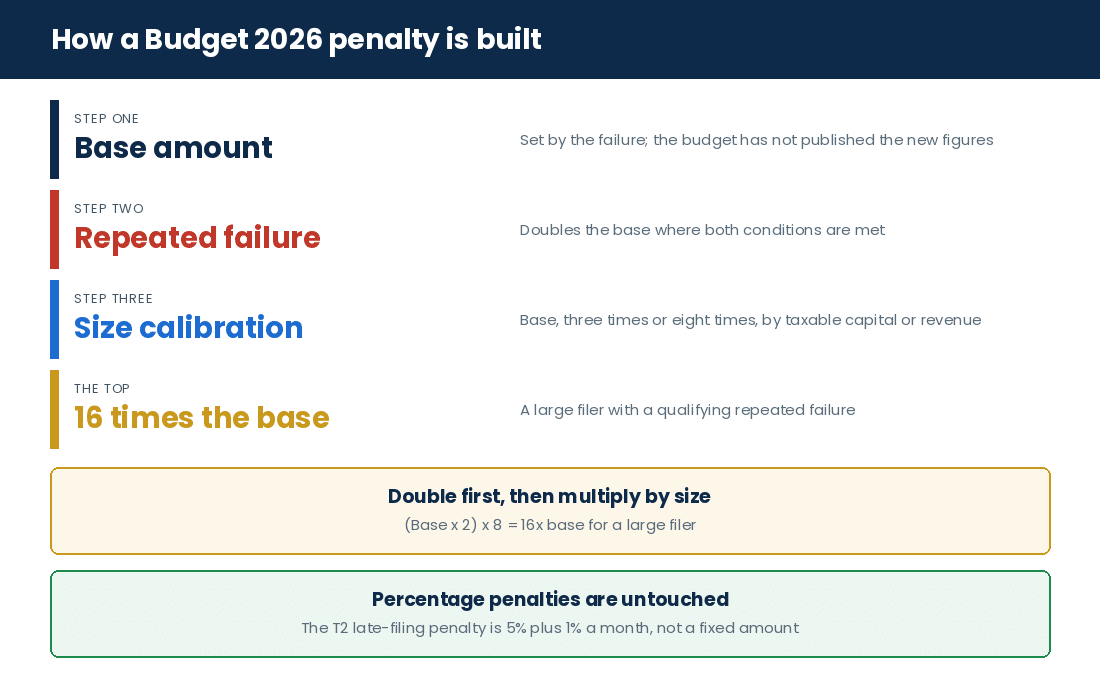
In Budget 2026, the government proposed changes to the administrative penalties that apply to late or missing tax filings. The measures would amend the penalty provisions of the Income Tax Act and of the other federal tax statutes, including the Excise Tax Act, the Excise Act, 2001, the Select Luxury Items Tax Act and the Air Travellers Security Charge Act. Fixed-dollar penalties would go up to match current economic conditions. Also, a new repeated-failure penalty was added. This penalty doubles the base amount before adding size adjustments based on taxable capital or revenue.
Here is what these changes mean:
- Higher fixed-dollar penalties for late or missing filings.
- A repeated-failure penalty that doubles the base fine before the size multiplier.
- Size calibration that depends on taxable capital or gross revenue.
The aim is to push taxpayers to file on time by making the fines stricter.
The Timing Is the Part Worth Writing Down
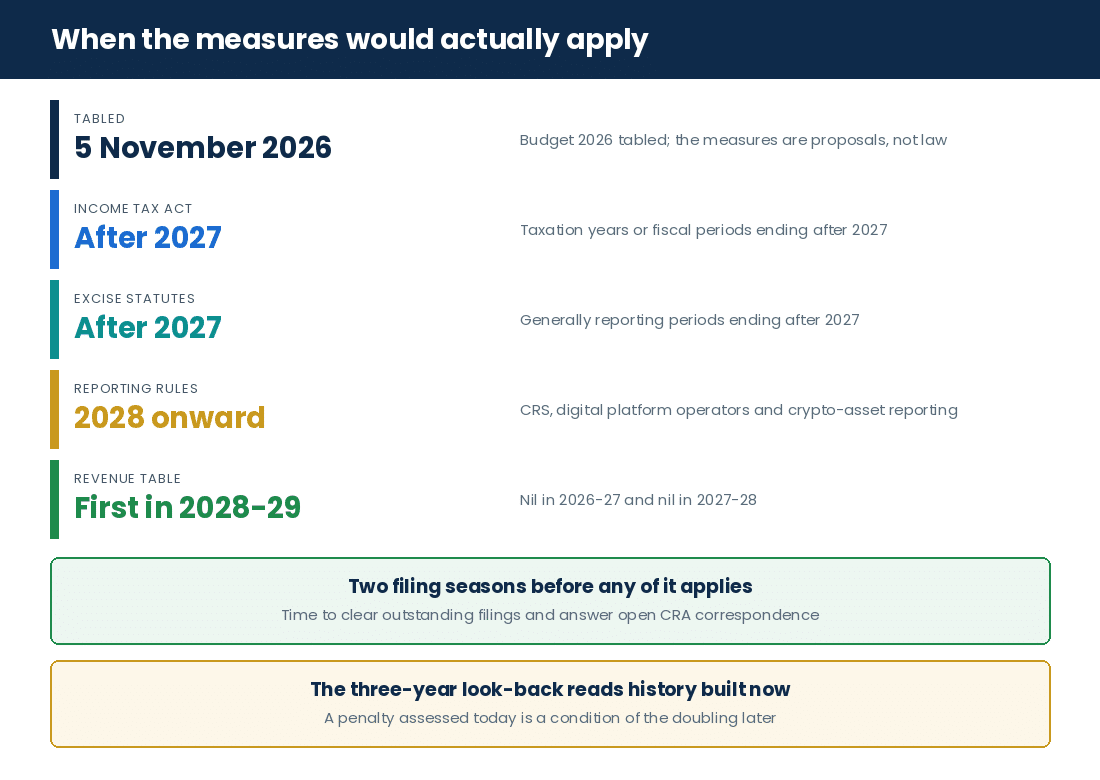
These are proposals. Budget 2026 was tabled on 5 November 2026, the enacting legislation has not passed, and nothing in the package binds the CRA until it does. The coming-into-force dates set out in the budget are staggered, and they are later than most of the commentary suggests. The Income Tax Act penalty measures would apply to taxation years or fiscal periods ending after 2027. The Common Reporting Standard, the Reporting Rules for Digital Platform Operators and the Crypto-Asset Reporting Framework measures would apply to the 2028 and later calendar years. The Excise Tax Act, Excise Act, 2001, Select Luxury Items Tax Act and Air Travellers Security Charge Act changes would generally apply to reporting periods ending after 2027. The budget’s own revenue table confirms the pattern: the measure raises nothing in 2026-27 or 2027-28, and the first revenue appears in 2028-29.
That matters for planning rather than for panic. A corporation with a December year end is not exposed to these amounts on its 2026 or 2027 return. It is exposed on the year ending 31 December 2028, and the repeated-failure test looks back at penalties assessed in the three preceding taxation years, which is why the compliance history being built now is the history that will be read later.
Fixed-Dollar Penalties Are Not the Same as Percentage Penalties
This distinction decides whether the post applies to you at all. The corporate late-filing penalty in subsection 162(1) of the Income Tax Act is a percentage: 5% of the unpaid tax at the due date, plus 1% of that unpaid tax for each complete month the return is late, to a maximum of 12 months. The repeated version in subsection 162(2) is 10% plus 2% per month to a maximum of 20 months, and it applies only where the CRA has demanded the return under subsection 150(2) and a subsection 162(1) penalty was assessed in any of the three preceding taxation years. A percentage penalty has no fixed dollar amount in it, so inflation indexing does not touch it and the new size calibration does not multiply it.
What Budget 2026 changes is the world of fixed-dollar information-return and compliance penalties: the amounts charged for failing to provide required information on a form, for failing to file certain forms at all, and for failing to meet certain other Income Tax Act obligations that carry no more specific penalty. A corporation owner who reads “eight times” and pictures an eight-fold T2 late-filing penalty has read the wrong penalty. The T2 late-filing percentage is unchanged.
A client called us the week after the budget convinced his company was about to face an eight-fold late-filing penalty on a T2 he had filed two months late the previous year. He had read a summary that ran the two ideas together. His actual exposure was the existing percentage penalty on roughly $90,000 of unpaid tax, which was already assessed and already paid, and nothing in Budget 2026 would have changed it by a dollar. What he did have, and had not noticed, was a T1135 filed late in two of the last three years — a fixed-dollar penalty, exactly the kind the size calibration and the repeated-failure doubling are built for. The call he made for the wrong reason found the right problem. Figures changed for privacy.
Base Amounts, Size Calibration and the Multipliers
Size Calibration
Impact of the Proposed CRA Penalty Increases on Corporations and Businesses
The proposed penalty increases reach corporations, partnerships, individual filers and the information-reporting frameworks across Canada. Budget 2026 sets higher base penalties adjusted for inflation. It also adds a repeated-failure penalty that doubles the base amount before the size multipliers are applied. Medium and large businesses face bigger penalties based on taxable capital or gross revenue limits.
Medium corporations, together with their related corporations, have combined taxable capital employed in Canada of more than $10 million and up to $50 million. Large corporations, on the same combined basis, have more than $50 million. For partnerships, medium means gross revenue of $2 million or more but less than $10 million. Large partnerships have gross revenue of $10 million or more. Individuals and smaller corporations and partnerships pay the base amount with no multiplier. These thresholds decide which multiplier applies to the base penalty.
The Related-Corporation Rule That Decides the Band
The test is a group test, not a single-company test, and that is where most owners misjudge their band. Taxable capital is combined across related corporations, so a company with $8 million of taxable capital sitting inside a group that has $30 million between it and its related corporations is a medium filer, not a small one. There is one carve-out that matters: a Canadian-controlled private corporation is treated as related only to corporations with which it is also associated. For an owner-managed CCPC group, that narrows the net considerably compared with the ordinary related-corporation rules, and it is worth working out properly rather than assuming either way.
| Filer | Size Test | Multiplier |
|---|---|---|
| Individuals and smaller corporations and partnerships | Below the medium thresholds | Base amount, no multiplier |
| Medium corporation | Combined taxable capital employed in Canada, with related corporations, of more than $10 million and up to $50 million | Three times the base |
| Large corporation | Combined taxable capital employed in Canada, with related corporations, of more than $50 million | Eight times the base |
| Medium partnership | Gross revenue of $2 million or more but less than $10 million | Three times the base |
| Large partnership | Gross revenue of $10 million or more | Eight times the base |
So medium corporations pay three times the base amount and large corporations pay eight times the base amount, and the multiplier depends on the taxable capital thresholds rather than on anything about the failure itself. This way, bigger companies face stiffer penalties proportional to their size. The system is built so that larger businesses bear fines that fit their economic weight.
The budget does not publish the new base dollar amounts, so no table of final figures can honestly be given here. What is announced is the structure: a base amount, multiplied by one, three or eight according to size. Calibration applies to penalties for failing to provide required information on a form, failing to file certain forms, and failing to meet certain other Income Tax Act obligations.
Partnerships also use gross revenue levels to find their penalty group. This affects what is charged when filing failures happen repeatedly under the new administrative rules. Owners should check their business size every year, because crossing a threshold can increase penalty risk sharply, especially with indexing planned every five years.
For instance, a medium corporation with $25 million of combined taxable capital would face three times the base penalty on a fixed-dollar failure for a taxation year ending after 2027.
A holding company and two operating companies under the same family came to us thinking of themselves as three small businesses, because none of them had more than about $7 million of taxable capital on its own. Combined, the group sat just over $22 million, which would place every one of them in the medium band for a fixed-dollar penalty. The owner’s reaction was that the grouping felt unfair; the useful part was that it was knowable in advance, from balance sheets we already had. We worked the related and associated tests through on paper, confirmed the band, and the only thing that changed afterwards was that the T1134 and T1135 filings stopped being treated as the last job of the season. Figures changed for privacy.
The New Repeated-Failure Penalty
Repeat Failures
Repeated Failure to File: New Conditions and What They Imply
The treatment of repeat failures got tougher in Budget 2026. The new penalty applies to repeated failures to file tax forms and to repeated failures to meet obligations that carry no more specific penalty. If a person or partnership fails again after a similar failure in any of the last three taxation years, and does not fix the current failure after formal notice, the base fine doubles before the size adjustment is applied.
Both conditions have to be met. Neither one is enough on its own:
- The person or partnership was liable for a penalty for the same type of failure in any of the three preceding taxation years.
- The current failure was not remedied after the CRA sent a notice, a requirement or a demand.
If both apply, the base penalty doubles, and the size multiplier is then applied to the doubled amount. This change targets repeat filers with harsher financial consequences based on past behaviour during audits or assessments. Being late once, or making a different type of mistake the second time, does not trigger it.
Examples of Penalty Calculation
Penalties grow with filer size. A medium corporation pays the base times three; a large corporation pays the base times eight. Where a repeated failure meets both conditions, the base doubles first:
| Scenario | Calculation | Total Multiplier |
|---|---|---|
| Medium corporation, single failure | Base × 3 | 3× base |
| Large corporation, single failure | Base × 8 | 8× base |
| Medium corporation, repeated failure | (Base × 2) × 3 | 6× base |
| Large corporation, repeated failure | (Base × 2) × 8 | 16 times the base |
You double the base first, then multiply by size. That order is the whole point of the arithmetic: a large filer with a qualifying repeat failure reaches sixteen times the base amount, not nine times or ten times. The multipliers above are arithmetic on the announced structure, not published dollar figures; the budget has not released the base amounts.
The practical reading is that late filing alone does not double anything. What doubles the exposure is a matching prior failure inside the three-year window combined with an unanswered notice, requirement or demand. Those are both facts about correspondence, and both of them sit in a file a business already has.
A transport company we took on had two unopened CRA envelopes in a drawer and a third that had been opened and put back. All three related to the same form, over two filing seasons. Nobody had decided to ignore them; the bookkeeper had left mid-year and the mail went to an address the owner visited twice a month. Under the current rules the cost was roughly $4,500 in fixed penalties across the two years. Under the proposed structure, the same pattern — same form, prior-year penalty, demand unanswered — is the exact fact pattern the doubling is written for, and the company’s taxable capital would put it in the medium band on top. We fixed the mail problem before we fixed the filings. Figures changed for privacy.
Budget 2026 Penalty Exposure: A Five-Question Check
Five questions on your group size, your filing history and your CRA correspondence.
Points to raise with us:
This is a general prompt, not tax or legal advice or a quote. Your position depends on your full facts. For a real review, please book a free consultation.
Inflation Adjustment and Five-Year Indexing
Indexing
Inflation Indexing of CRA Penalties Under Budget 2026
Under the proposals, fixed-dollar CRA penalties would adjust every five years for inflation. This means fixed-dollar amounts will reflect price changes since they first became law. It keeps penalties meaningful, because values do not stay stuck at old rates while prices rise. This first inflation update is intended to keep penalty amounts relevant and to encourage filers to take their filing responsibilities seriously.
The size of the one-time catch-up depends on when a penalty was enacted. Most older fixed-dollar penalties would rise by a factor of two or three, depending on the year they came into law. Most recently enacted penalties would stay the same, with limited exceptions. Fixed amounts would then be indexed to inflation once every five years. The GST/HST penalties, and those under the Excise Act, 2001, the Air Travellers Security Charge Act and the Select Luxury Items Tax Act, would get the same treatment: the same factor of two or three, and the same five-year indexing.
Indexing adjusts the base figure itself. It does not combine with the size multipliers or with the repeated-failure doubling. Those stay separate steps applied after the base amount is set, which keeps the arithmetic predictable for different-sized filers as costs rise, without extra stacking beyond what the structure sets out.
A client asked us whether indexing meant his penalty exposure would creep up every year like a CPI adjustment on a lease. It does not. The proposed mechanism is a one-time catch-up of two or three times on the older amounts, and then a reset once every five years — closer to a rent review than a monthly escalator. He had been budgeting roughly $3,000 a year of “expected penalties” as a line in his overhead, which is a habit we see more often than we would like. The honest advice was that a penalty you can forecast is a filing you could have made. We removed the line and fixed the calendar instead. Figures changed for privacy.
Financial Consequences of Higher Penalties for Late Filing
The Excise Act, 2001 penalty for failing to file a return after a ministerial demand rises from $250 to $1,000 under the budget proposals. This change matches inflation since the amount was first set, and it is the one hard new dollar figure the package publishes. It applies where the minister demands a filing and it is not made on time.
Fixed-dollar penalties enacted before Budget 2026 rise too. They generally double or triple their old amounts, and the final charge still varies with the size of the filer.
The other change is the repeated-failure penalty. It doubles the base penalty before any size multiplier applies, and it targets filers who keep failing even after notices inside the three preceding taxation years. Together, these updates mean late filing can cost substantially more, especially for medium and large firms where the multipliers are applied to an already doubled base.
Only fixed-base dollar amounts are affected this way. A penalty expressed as a percentage does not move with indexing, and the newest fixed-dollar penalties are largely left where they are.
An excise licensee of ours treated the demand-to-file letter as a reminder rather than a deadline, on the reasoning that the penalty attached to ignoring it was $250 and the filing took a day of work nobody had. That arithmetic was defensible, barely, at $250. At $1,000 it stops being defensible, and that is plainly the point of the change. We now diarise ministerial demands separately from ordinary filing deadlines for every licensee file we hold, because a demand is the one letter where the cost of a week’s delay is fixed, known and about to quadruple. Figures changed for privacy.
Corporate Deadlines and the Penalties That Already Apply
Deadlines
Key Deadlines and Compliance Requirements for Corporate Filings
The proposed CRA penalty increase will take effect for taxation years or fiscal periods ending after 2027. It reaches corporate filers across Canada, including those in Ontario. Budget 2026 raises penalties to match inflation since the original amounts were set. These higher penalties mostly affect corporations and partnerships that file late or miss required filings under the Income Tax Act. Owners who handle compliance need to know their deadlines well to avoid bigger charges when the measures arrive.
Filing and Payment Dates Relevant to Corporate Taxpayers
Corporate taxpayers have to follow strict deadlines set by the Income Tax Act. The T2 Corporation Income Tax Return must be filed within six months after the end of the fiscal year, under paragraph 150(1)(a). The balance of tax is due earlier than the return: two months after the year end, or three months for an eligible Canadian-controlled private corporation, which is worth knowing in a post about the cost of being late, because interest runs from the balance-due day rather than from the filing deadline.
Instalments are not quarterly for most corporations. Under subsection 157(1), monthly instalments are the general rule; quarterly instalments are available only to eligible small CCPCs that meet the conditions in subsections 157(1.1) to (1.5). Assuming quarterly when the company is on a monthly basis is a reliable way to accrue instalment interest without noticing.
If filings are late, the fixed-dollar penalties will be calculated from a base amount and a size multiplier once the measures are in force. Separately, the Excise Act, 2001 demand-to-file penalty rises from $250 to $1,000 under Budget 2026. This applies where a minister demands a filing and it is not made on time.
Missing deadlines can cost more than money. Corporations might lose access to credits or to relief programs offered by the CRA. Here are the key dates every corporate filer should track:
- T2 return due date: six months after the fiscal year end.
- Balance of tax: two months after the year end, or three months for an eligible CCPC.
- Instalments: monthly as the general rule, quarterly only for eligible small CCPCs.
- Demand-to-file response: the deadline given in the minister’s notice.
Failing these deadlines triggers the existing late-filing penalty under subsection 162(1) of the Income Tax Act, together with the higher fixed-dollar charges once the Budget 2026 updates are enacted.
What Already Applies While the Proposals Wait
Nothing in Budget 2026 changes the penalties that are charged today, and those are the ones that will be assessed on every return filed between now and a year ending after 2027. The late-filing penalty in subsection 162(1) is 5% of the unpaid tax plus 1% of that unpaid tax per complete month, to a maximum of 12 months. The repeat version in subsection 162(2) is 10% plus 2% per month to a maximum of 20 months, and it requires both a demand to file under subsection 150(2) and a subsection 162(1) penalty in any of the three preceding taxation years. The general failure-to-comply penalty in subsection 162(7) is $25 per day, with a minimum of $100 and a maximum of $2,500.
Subsection 162(2) is worth a second look, because it is already a repeated-failure penalty with a three-year test and a demand requirement. The new measure is built on a recognisable pattern rather than an unfamiliar one; what is new is that the pattern is extended to fixed-dollar form and compliance penalties, and that the doubled amount is then scaled by size.
Size Multipliers and the Thresholds Behind Them
Budget 2026 uses size multipliers to adjust penalty amounts based on filer size:
| Filer Type | Size Multiplier | Size Test Criterion | Source |
|---|---|---|---|
| Small corporation | Base amount | Combined taxable capital at or below $10 million | Budget 2026 Tax Measures Supplement |
| Medium corporation | ×3 | Combined taxable capital of more than $10 million and up to $50 million | Budget 2026 Tax Measures Supplement |
| Large corporation | ×8 | Combined taxable capital of more than $50 million | Budget 2026 Tax Measures Supplement |
| Medium partnership | ×3 | Gross revenue of $2 million or more but less than $10 million | Budget 2026 Tax Measures Supplement |
| Large partnership | ×8 | Gross revenue of $10 million or more | Budget 2026 Tax Measures Supplement |
These rules decide how far a fixed-dollar penalty grows beyond its base amount once the Budget 2026 measures apply.
A client with a June year end filed his T2 on time every year and still paid roughly $6,000 of instalment interest over two years, because the company had been paying quarterly since it was small and nobody had rechecked the test after it grew. Quarterly instalments are for eligible small CCPCs only; monthly is the general rule, and the company had stopped qualifying two years earlier. There was no late filing and no penalty in the ordinary sense — just interest, accruing quietly, on a schedule nobody had looked at since incorporation. It is the cheapest problem on this page to find and the easiest one to leave unfound. Figures changed for privacy.
Assessment, Objection, Relief and Practical Mitigation
Disputes & Relief
Procedures for Penalty Assessment and Appeal with the CRA
Conditions Under Which Penalties Are Assessed
The CRA assesses penalties based on rules in the Income Tax Act and other federal tax statutes. Once the Budget 2026 measures are in force, some of those fixed-dollar amounts get bigger. A penalty starts when you miss a deadline or do not file something required. The CRA calls this an administrative penalty. The amount is worked out from a base amount, which depends on what was missed or filed late.
That base amount is then adjusted by size calibration. Medium filers pay three times the base; large filers pay eight times. For corporations, size depends on combined taxable capital employed in Canada: medium is more than $10 million and up to $50 million, and large is more than $50 million. For partnerships, size is based on gross revenue: medium is $2 million or more but less than $10 million, and large is $10 million or more.
If failures repeat, the repeated-failure penalty applies, and two things must both be true. First, you were liable for a penalty of the same type in any of the three preceding taxation years. Second, after the CRA sent a notice, requirement or demand about the current failure, you did not remedy it. If both apply, the base penalty doubles before size calibration.
Penalties cover missing forms under many reporting rules. These include the Common Reporting Standard and the rules for digital platform operators, both of which move to the new amounts for the 2028 and later calendar years. Fixed penalty amounts are then indexed to inflation once every five years. The detail sits in the Budget 2026 tax measures supplement, and the existing corporate penalties sit in subsections 162(1), (2), (5) and (7) of the Income Tax Act.
Objecting to a Penalty Assessment
If you disagree with a penalty, the route is a notice of objection, in writing, setting out the reasons for disputing it. Under current law a corporation has 90 days from the day the notice of assessment is sent. Budget 2026 proposes to extend that to one year: the later of one year from the day the notice is sent and, for individuals and graduated rate estates, two years after the filing-due date for the year. That extension would apply to assessments sent on or after the day that is three months after Royal Assent, so the 90-day rule governs every notice issued today. We cover the proposal in detail in our note on the CRA objection deadline extended to one year.
Process for Requesting Cancellation or Reduction of Penalties
If you want penalties lowered or cancelled, you can ask the CRA through a taxpayer relief request under subsection 220(3.1). These are discretionary, which means the CRA may say yes or no depending on the circumstances. The CRA looks at reasons like serious problems outside your control. Relief is limited to the ten preceding calendar years, and if the CRA refuses, the review route is judicial review in the Federal Court rather than an appeal to the Tax Court.
A relief request does not extend an objection or appeal deadline. The two run independently, so a relief request filed while the objection clock is running does not stop that clock, and this is the single most expensive misunderstanding in this part of the process.
To request relief:
- Write a clear letter explaining why you want relief.
- Include proof such as medical notes or disaster reports.
- Show you tried to fix things after you received the notices.
The CRA reviews each case on its own. It does not simply cancel penalties for a filer who has been late many times before, unless the problems were fixed promptly after the notices. Being late once, or making a different type of mistake, does not by itself establish a case for relief here, and the statutory conditions in subsection 220(3.1) have to be met.
The Voluntary Disclosures Program is the other route, and it runs before the CRA makes contact rather than after. A disclosure made before the CRA detects the issue can reduce or avoid penalties in a way that is simply not available once a demand has landed. Our guide to the CRA Voluntary Disclosures Program sets out the conditions.
Recommendations for Businesses to Reduce Penalty Risk
The proposed increase brings higher base amounts and a new repeated-failure penalty, and the penalties depend on the size of the filer. Knowing these changes helps businesses avoid large compliance problems. Budget 2026 administrative penalties now include the repeated-failure charge, and a five-year indexation method updates older fixed-dollar penalties for inflation, so the amounts grow over time.
Best Practices for Timely Corporate Tax Filing and Payment
Filing your corporate tax on time is still very important. Late or missed filings lead to penalties under the Income Tax Act, and with the proposed increases even small delays will cost more. The penalty grows with filer size: medium filers pay about three times the base amount, and large filers pay around eight times, based on taxable capital or gross revenue.
To lower penalty risk, try these steps:
- Keep a calendar with all corporate tax filing deadlines.
- Start preparing T2 returns early.
- Watch your past penalty history carefully, because repeated failures after a CRA notice double the base penalty before size multipliers apply.
- Use controls to make sure every required form is filed on time, including reports for digital platforms or crypto-assets.
- Track previous notices closely, since late filing alone does not double a penalty without a matching prior failure.
These actions help you avoid both late-filing penalties and the new repeated-failure penalty proposed in Budget 2026.
For more on handling unfiled T2 returns and the rules that follow them, see our guide on catch-up corporate tax filing.
Using Professional Advice from Gondaliya CPA to Navigate the Changes
The proposed penalty regime can be confusing, and expert help makes it easier to handle. Gondaliya CPA provides corporate tax filing and CRA representation, and we analyse your penalty exposure closely. Our engagements cover checking your filing duties against current law, reviewing your past compliance history for repeated-failure risk, and calculating your size calibration from taxable capital or gross revenue.
Professional help makes sure you know how the Budget 2026 administrative penalties would affect your business, and it helps you plan your filings as Canada’s rules change. The initial consultation is free. Our fees are fixed and annual with no hourly billing, shown before tax with sales tax on its own line. For help, contact Gondaliya CPA at info@gondaliyacpa.ca or call 647-212-9559.
A client assessed roughly $9,000 in penalties filed a taxpayer relief request, waited for the answer, and let the 90 days on her objection run out while she waited. The relief request was refused on the merits; by then the objection window had closed, and the only route left was judicial review of a discretionary decision in the Federal Court, which is a review of how the decision was made rather than a fresh look at whether the penalty was right. Had the objection been filed first, as a protective step costing an afternoon, both routes would have stayed open. We now file the objection first in every case and treat relief as the parallel track, never the substitute. Figures changed for privacy.
Frequently Asked Questions
FAQs
FAQs on the Budget 2026 Penalty Increases
Which legislation does the Budget 2026 penalty increase sit in?+
These are new rules announced in Budget 2026 that would amend the penalty provisions of the Income Tax Act and of the other federal tax statutes. The enacting legislation has not passed, so there is no subsection number to point you at yet, and pinning one down now would be false precision.
How often would CRA penalties be indexed for inflation?+
Fixed-dollar amounts would be indexed to inflation once every five years under Budget 2026, after a one-time catch-up of two or three times on most older penalties.
What is the size multiplier for partnerships?+
Partnerships with gross revenue of $2 million or more but less than $10 million have a multiplier of three times the base; gross revenue of $10 million or more gives eight times the base.
How is a corporation’s size measured for the multiplier?+
By combined taxable capital employed in Canada, counting related corporations. More than $10 million and up to $50 million is medium; more than $50 million is large. A Canadian-controlled private corporation is treated as related only to corporations with which it is also associated.
Do Common Reporting Standard penalties change?+
Yes. Penalties related to CRS reporting would move to the updated amounts and the indexing rules, applying to the 2028 and later calendar years.
How are Digital Platform Operator reporting penalties affected?+
They follow the same inflation-adjusted and size-calibrated structure as other tax filings, and they too apply from the 2028 and later calendar years.
Are Crypto-Asset Reporting Framework obligations included?+
Yes. Penalties for non-compliance with crypto-asset reporting would rise under the Budget 2026 proposals, applying to the 2028 and later calendar years.
Would my corporate late-filing penalty go up eight times?+
No. The late-filing penalty on a T2 is a percentage — 5% of the unpaid tax plus 1% per complete month to a maximum of 12 months — and a percentage is not touched by inflation indexing or by the fixed-dollar size calibration. The changes apply to fixed-dollar information-return and compliance penalties.
What are the proposed objection deadlines under Budget 2026?+
Budget 2026 proposes one year to object in place of the current 90 days, running from the day the notice is sent, with individuals and graduated rate estates getting the later of that and two years after the filing-due date. It would apply to assessments sent on or after the day three months after Royal Assent. Our note on the CRA objection deadline extended to one year sets it out.
Can taxpayers request discretionary relief for increased penalties?+
Yes. Taxpayer relief under subsection 220(3.1) is available, but it is discretionary, limited to the ten preceding calendar years, and granted only where the circumstances justify it.
This FAQ set covers the main questions we are asked about the Budget 2026 administrative penalty proposals, from the size calibration thresholds to the dispute routes that follow an assessment.
Essential Points for Business Owners
Key Takeaways
Key Points on Penalty Calculations and Compliance
The budget measure is announced once. Everything in the table below is what a business does about it, in the years before and after it applies.
| Point | What It Means in Practice |
|---|---|
| Status of the measures | Proposals from a budget tabled 5 November 2026, not enacted law. |
| Income Tax Act timing | Taxation years or fiscal periods ending after 2027. |
| Reporting frameworks timing | CRS, digital platform operator and crypto-asset reporting from the 2028 and later calendar years. |
| Excise statutes timing | Generally reporting periods ending after 2027. |
| What is calibrated | Fixed-dollar form and compliance penalties, not percentage penalties. |
| Balance-sheet continuity | Check corporate balance-sheet continuity to confirm filing obligations each year. |
| Shareholder accounts | Review shareholder accounts when preparing unfiled T2 returns. |
| Holding versus operating entities | Understand the separate form requirements for holding companies and operating entities. |
| Base versus final | Compare the base amount with the final penalty after multipliers and repeated-failure factors. |
| Misconceptions | Larger fines reflect size calibration, not arbitrary hikes, and the T2 percentage penalty is untouched. |
| Size testing | Verify your business size using taxable capital or gross revenue, on a combined group basis. |
| Three-year history | Gather tax returns and notices from the past three years, because that is the repeated-failure window. |
| Documenting prior failures | Document any prior late filings or notices from the CRA before they are needed. |
| Relief and objections | A relief request does not extend an objection deadline; file the objection first. |
| Audit readiness | Audits are where repeated-failure patterns surface, so keep the correspondence file complete. |
The Six Things We Check First
- What is the combined taxable capital of the whole group? That decides the band, and it is a group number rather than a company number.
- Is the corporation a CCPC, and which corporations is it associated with? A CCPC is related only to corporations it is also associated with, which can move it a band.
- Were any fixed-dollar penalties assessed in the last three taxation years? That is condition one of the repeated-failure test, and it is answerable from notices you already hold.
- Is there an unanswered CRA notice, requirement or demand anywhere in the file? That is condition two, and it is the one people discover late.
- Which information returns does the group actually owe? T1134, T1135, partnership returns and the reporting-framework filings are where fixed-dollar penalties live.
- Are instalments monthly or quarterly, and is that still correct? Monthly is the general rule; quarterly applies only to eligible small CCPCs.
Our Approach
Gondaliya CPA starts with the group’s taxable capital and the associated-corporation picture, because that single answer sets the multiplier before any discussion of amounts. We then pull the last three years of notices and assessments to establish whether a repeated-failure condition could ever be met, inventory the information returns the group actually owes rather than the ones it has been filing, check the instalment basis against subsection 157(1), and set a filing calendar that puts the fixed-dollar forms on the same footing as the T2 instead of at the end of the queue. We also represent clients through CRA audits, which is a service we provide directly. The initial consultation is free, and our fees are fixed and annual with no hourly billing, shown before tax with sales tax on its own line, and agreed before any work begins.
Industry Spotlights: Sectors We Represent
Industry Expertise
Every sector meets these penalties at a different door. Here are eleven, and where the exposure sits in each.
| Industry | Where the Fixed-Dollar Penalty Exposure Sits |
|---|---|
| Technology startups & SaaS | Nationwide customer data flowing into digital platform and crypto-asset reporting obligations |
| E-commerce & online retailers | Platform sales reporting that is a fixed-dollar filing obligation rather than a tax calculation |
| Consulting firms | Foreign clients and foreign accounts that pull T1135 and T1134 into the filing list |
| Construction, contractors & skilled trades | Group structures where combined taxable capital decides the band before any failure happens |
| Property developers & builders | Project companies that multiply the number of entities with their own filing obligations |
| Real estate investors & holding companies | Holding structures with foreign property, where the fixed-dollar forms outnumber the returns |
| Transportation, logistics & trucking | Fuel and excise licences, where a ministerial demand now carries a $1,000 penalty |
| Restaurants & food and beverage | Franchise and multi-entity groups where one missed form repeats across several corporations |
| Daycare, childcare & CWELCC services | Grant and funding reporting on top of the tax filings, with deadlines set by different bodies |
| Dentists & dental practices | Professional corporations inside associated groups, where the association test moves the band |
| Medical doctors & physician corporations | Multiple professional and holding corporations, each with its own three-year penalty history |
- Technology startups & SaaS: Customers and data cross every border from launch, so the digital platform and crypto-asset reporting penalties land here first, and they are fixed-dollar penalties that scale with the group’s size.
- E-commerce & online retailers: Marketplace and platform reporting is a filing obligation in its own right, and a missed report is exactly the kind of fixed-dollar failure the repeated-failure doubling is written for.
- Consulting firms: Foreign clients, foreign accounts and foreign affiliates pull T1134 and T1135 into the annual list, and those are the forms where a second late filing inside three years becomes expensive.
- Construction, contractors & skilled trades: A trades group with several corporations is tested on combined taxable capital, so a company that feels small can sit in the medium band before anything goes wrong.
- Property developers & builders: Each project company is a separate filer with its own obligations, which multiplies the number of three-year histories a single group has to keep clean.
- Real estate investors & holding companies: Holding structures with foreign property file more information returns than tax returns, and the fixed-dollar penalties on those returns are the ones the size multiplier reaches.
- Transportation, logistics & trucking: Fuel and excise licensees deal with ministerial demands directly, and the Excise Act, 2001 demand-to-file penalty rises from $250 to $1,000 under the proposals.
- Restaurants & food and beverage: Multi-location and franchise groups tend to miss the same form in the same way across several entities, which is how one oversight becomes several penalties.
- Daycare, childcare & CWELCC services: Funding and programme reporting sits alongside the tax filings with deadlines set by other bodies, and a calendar that tracks only CRA dates will miss them.
- Dentists & dental practices: Professional corporations usually sit inside associated groups, and a CCPC is related only to corporations it is associated with, so the band has to be worked out rather than assumed.
- Medical doctors & physician corporations: Physician groups often run a professional corporation and a holding corporation together, each carrying its own filing obligations and its own three-year penalty history.
Three clients in three sectors asked us the same question in the fortnight after the budget, and the answer was different each time. A SaaS company’s exposure was almost entirely in the platform and crypto-asset reporting rules, which do not start until the 2028 calendar year. A physician’s two corporations were nowhere near the medium threshold once the association test was worked through properly, so the multipliers were irrelevant to her. A trucking group with roughly $31 million of combined taxable capital was the one that needed to act, because it sat in the medium band and had a prior-year penalty on the same form sitting in its file. Same budget, same page, three different answers. Figures changed for privacy.
Professional Guidance and Quick Reference
Guidance
Summary of the Penalty Updates and Practical Next Steps
Budget 2026 updates fixed-dollar penalties to keep up with inflation, though most recently enacted penalties stay the same, with limited exceptions. There is a new repeated-failure penalty, which doubles the base penalty where two things happen: you were liable for a penalty of the same type within the three preceding taxation years, and you did not fix the current failure after a notice, requirement or demand. The method of indexation has also changed, with fixed amounts reset once every five years. The Excise Act, 2001 raises its demand-to-file penalty from $250 to $1,000, which is a large jump on a small number. These changes mean businesses must check their filing duties carefully, and understanding the rules helps avoid unexpected charges and plan better next steps. Want to dig deeper? The Budget 2026 Tax Measures Supplement published by Finance Canada sets out all of the tax changes, including the increased Excise Act, 2001 demand-to-file penalty, and it is the official source for everything on this page.
Quick Answers
At a Glance
- Status: proposals from Budget 2026, tabled 5 November 2026, not enacted law
- Income Tax Act start: taxation years or fiscal periods ending after 2027
- CRS, platform and crypto reporting start: the 2028 and later calendar years
- Excise statutes start: generally reporting periods ending after 2027
- Inflation catch-up: a factor of two or three on most older fixed-dollar penalties
- Newest penalties: mostly unchanged, with limited exceptions
- Indexing frequency: once every five years
- Medium corporation: combined taxable capital over $10 million and up to $50 million
- Large corporation: combined taxable capital over $50 million
- CCPC rule: related only to corporations with which it is also associated
- Medium partnership: gross revenue of $2 million or more but less than $10 million
- Large partnership: gross revenue of $10 million or more
- Medium multiplier: three times the base
- Large multiplier: eight times the base
- Repeated failure: doubles the base before the size multiplier
- Medium plus repeat: six times the base
- Large plus repeat: 16 times the base
- Repeat condition one: same type of failure penalised in any of the three preceding taxation years
- Repeat condition two: failure not remedied after a CRA notice, requirement or demand
- Excise Act, 2001 demand-to-file: from $250 to $1,000
- What is calibrated: fixed-dollar form and compliance penalties
- What is not: percentage penalties such as the T2 late-filing penalty
- Existing s.162(1): 5% of unpaid tax plus 1% per month, maximum 12 months
- Existing s.162(2): 10% plus 2% per month, maximum 20 months, after a demand
- Existing s.162(7): $25 per day, minimum $100, maximum $2,500
- T2 filing deadline: six months after the fiscal year end
- Balance of tax: two months after year end, three for an eligible CCPC
- Instalments: monthly as the general rule, quarterly for eligible small CCPCs only
- Objection now: 90 days from the day the notice is sent
- Objection proposed: one year from sending, for assessments sent on or after three months after Royal Assent
- Taxpayer relief: discretionary, limited to the ten preceding calendar years
- If relief is refused: judicial review in the Federal Court, not an appeal to the Tax Court
- Voluntary disclosure: available before the CRA makes contact
Who This Is For / Not For
Fit Check
- Ideal readers: owners of corporate groups with information returns to file and a compliance history worth checking.
- Ideal readers: partnerships approaching the $2 million or $10 million gross revenue thresholds.
- Ideal readers: businesses with unopened CRA correspondence or a prior fixed-dollar penalty in the last three years.
- Not suitable for: anyone looking for the new base dollar amounts, which the budget has not published.
- Not for: a conclusion on your own size calibration without reviewing the group’s figures, which is what the consultation is for.
People Also Ask
Related Questions
How do audit outcomes influence penalty assessments now?+
An audit is usually where a pattern becomes visible. It can surface failures that attract the base penalty, and because the repeated-failure test looks back three taxation years, an audit that uncovers the same type of failure twice inside that window is where the doubling becomes a live question. The second condition still has to be met: the current failure must have gone unremedied after a notice, requirement or demand. We represent clients through CRA audits directly, and the correspondence file is usually the first thing we ask for.
What should I know about dispute resolution after receiving a penalty notice?+
There are three routes and they are not alternatives to one another. A formal objection disputes whether the penalty is correct in law. A taxpayer relief request asks the CRA to exercise discretion to cancel or waive it. The Voluntary Disclosures Program applies before the CRA makes contact, not after a notice has arrived. The objection has the hardest deadline, so it is the one to protect first while you decide what else to do.
What is the proper objection route following a penalty assessment?+
Submit a written notice of objection to the CRA setting out the reasons for disputing the penalty and the facts you rely on. For a corporation the current deadline is 90 days from the day the notice of assessment is sent, and Budget 2026 proposes extending that to one year for assessments sent on or after the day three months after Royal Assent. Our page on CRA objections and appeals for corporations covers the process.
How do taxpayer relief requests interact with the objection deadline?+
They do not extend it. A relief request under subsection 220(3.1) runs on its own track and does not stop or pause the objection or appeal clock, which is a misunderstanding that costs people their appeal rights every year. Relief is also limited to the ten preceding calendar years and is discretionary, and a refusal is reviewed by the Federal Court on judicial review rather than appealed to the Tax Court. File the objection first; pursue relief alongside it.
Can a filing extension help me avoid increased late-filing penalties?+
There is no extension to apply for. The CRA does not grant extensions of the T2 filing deadline, so the question is not whether to ask for more time but what to do about time already lost. Two things exist. Before the CRA makes contact, the Voluntary Disclosures Program can reduce or avoid penalties on a filing you come forward with. After the fact, taxpayer relief under subsection 220(3.1) is discretionary and limited to the ten preceding calendar years. Filing late and intending to explain later is not a plan either route rewards.
Glossary of Key Terms
Definitions
- Administrative penalty: a fixed charge the CRA assesses for missing a deadline or failing to file something required.
- Base amount: the starting penalty figure for a particular failure, before doubling or size calibration.
- Size calibration: the multiplier of one, three or eight applied to the base amount according to the filer’s size.
- Taxable capital employed in Canada: the measure used to band corporations, calculated on a combined basis with related corporations.
- Related corporations: corporations whose figures are combined for the size test; a CCPC is related only to corporations it is also associated with.
- Repeated-failure penalty: the proposed doubling of the base amount where a same-type penalty arose in the three preceding taxation years and the current failure went unremedied after a notice.
- Demand to file: a formal CRA requirement to file a return, which starts its own deadline and its own penalty.
- Five-year indexing: the proposed resetting of fixed-dollar penalty amounts for inflation once every five years.
- Common Reporting Standard: the international framework for exchanging financial account information, with its own filing penalties.
- Reporting Rules for Digital Platform Operators: the regime requiring platforms to report seller information to the CRA.
- Crypto-Asset Reporting Framework: the regime requiring crypto-asset service providers to report transactions and holdings.
- T2 return: the corporate income tax return, due six months after the fiscal year end.
- Notice of objection: the written dispute of an assessment, currently due within 90 days of the day the notice is sent.
- Taxpayer relief: the CRA’s discretionary power under subsection 220(3.1) to cancel or waive penalties and interest for the ten preceding calendar years.
- Voluntary Disclosures Program: the route for correcting a filing before the CRA makes contact.
Want a checklist to work from? You can download our free penalty exposure checklist before your consultation.
Four things decide what Budget 2026 actually means for your company. Which penalties you are exposed to — the changes reach fixed-dollar information-return and compliance penalties, so a business whose only exposure is the percentage late-filing penalty on a T2 is largely unaffected. Which band the group falls in — combined taxable capital with related corporations sets the multiplier at one, three or eight, and for a CCPC the association test narrows which corporations count. Whether a repeated-failure condition could ever be met — it takes a same-type penalty inside the three preceding taxation years and a current failure left unremedied after a notice, requirement or demand, and both of those are facts you can establish today from correspondence you already hold. And how much time there is — the Income Tax Act measures reach taxation years or fiscal periods ending after 2027, the reporting frameworks start with the 2028 calendar year, and the budget’s revenue table shows nothing collected until 2028-29, which makes the next two filing seasons a window rather than a deadline.
Three questions settle your exposure before anyone looks at a penalty table. First, what is the combined taxable capital of every related corporation in the group? That one number decides whether the multiplier is one, three or eight, and it is a group figure rather than a company figure. Second, was any fixed-dollar penalty assessed against the group in the last three taxation years? If the answer is no, the repeated-failure doubling cannot apply to you yet, and keeping it that way is the cheapest tax planning available. Third, is there any CRA notice, requirement or demand in the file that has not been answered? That is the second condition of the doubling, and it is the one that is usually sitting in an envelope rather than in a system.
Budget 2026 Penalty Changes: How Gondaliya CPA Can Help
Use the window before the measures apply
Gondaliya CPA works out your group’s size calibration from combined taxable capital and the associated-corporation tests, pulls the last three years of notices and assessments to establish whether a repeated-failure condition could ever be met, inventories the information returns the group genuinely owes, checks the instalment basis against subsection 157(1), builds a filing calendar that treats fixed-dollar forms as seriously as the T2, prepares and files catch-up returns where filings are outstanding, advises on the Voluntary Disclosures Program before the CRA makes contact and on objections and taxpayer relief after an assessment, and represents clients through CRA audits directly. The initial consultation is free. Our fees are fixed and annual with no hourly billing, shown before tax with sales tax on its own line, and agreed before any work begins.
Next Steps
Have more questions or need guidance on your own position? Schedule a free consultation with Gondaliya CPA and we will work through what the Budget 2026 proposals would and would not do to your filings. Bring three things when you do: the last three years of CRA notices and assessments for every corporation in the group, a current list of the related and associated corporations with their taxable capital, and a note of any form you know has been filed late. Tell us at the outset whether there is correspondence nobody has answered, because that single fact decides whether the repeated-failure doubling could ever reach you. Come with your questions grouped — filing duties, compliance history, size calibration, information returns, instalments, relief options and the rest — and we will work through them in order. Gondaliya CPA provides bookkeeping, corporate tax filing and CRA representation, and we give clear advice based on the law as it currently stands rather than guesses about how a proposal will land. Gondaliya CPA Professional Corporation is a Registered Ontario CPA Firm since 2013, based in Toronto, Ontario, and we serve Toronto, Mississauga, Brampton, Vaughan, Etobicoke, Scarborough, Hamilton, Ottawa and the rest of Ontario, and corporate clients across Canada. For questions or tailored advice, call 647-212-9559 or email info@gondaliyacpa.ca. If our content helps, please add gondaliyacpa.ca as a preferred source on Google.
Published: · Last updated:
Editorial policy: We research against the Income Tax Act, the Income Tax Regulations, the Excise Act, 2001 and the other federal tax statutes, the Budget 2026 Tax Measures Supplement published by Finance Canada, CRA guidance and information circulars, CPA Canada Handbook standards and CPA Ontario sources, fact-check the figures, and Sharad Gondaliya, CPA, reviews the content, which we update as the rules change.
Disclaimer: This article is educational information only and is not tax, legal or accounting advice. It covers the administrative penalty measures proposed in Budget 2026, tabled on 5 November 2026, as they would affect corporations, partnerships and individual filers in Ontario and across Canada, including the inflation adjustment to fixed-dollar penalties, five-year indexing, the size calibration thresholds and multipliers, the treatment of related and associated corporations, the new repeated-failure penalty and the order of the doubling and the multiplier, the Excise Act, 2001 demand-to-file penalty, the Common Reporting Standard, the Reporting Rules for Digital Platform Operators and the Crypto-Asset Reporting Framework, the coming-into-force dates, the corporate penalties and deadlines that apply under current law, and the objection, taxpayer relief and voluntary disclosure routes. It does not state base penalty amounts the budget has not published, does not predict whether or in what form the enacting legislation will pass, and does not advise on any particular filer’s size calibration without a review of the group’s figures. These measures are proposals and are not law; rules, thresholds and dates change without notice, and the position should be confirmed against the enacted legislation at the time you file. Gondaliya CPA performs compilation engagements under CSRS 4200, which provide no assurance, and does not perform audit or review engagements; we do represent clients through CRA audits, which is a separate service. Please consult a licensed CPA before acting.

Sharad Gondaliya is a CPA Canada & CPA USA with 15 Years+ experience of Accounting, Tax, Payroll of Corporate Small Businesses as Tax Accountant. He is a CPA Ontario member (61040184) and holds US CPA licences in Washington and Montana and is well known among corporate small businesses for tax planning, efficient tax solutions, and affordable CPA services. Sharad is the Principal (Director) of Gondaliya CPA – Affordable CPA Firm in Canada. Licenses: CPA Ontario: 61040184 | CPA USA (MT): PAC-CPAP-LIC-033176 | CPA USA (WA): 57629 | CPA Firm License: 61330051 View Full Author Bio