



Amazon US Seller Tax Rules in Canada: US Sales Tax, GST/HST & Cross-Border Reporting
Amazon US Seller Tax Canada: Complete Guide on Canadian Amazon US Seller Taxes and Cross Border Amazon Seller Tax Canada
Amazon US seller tax Canada involves understanding both U.S. sales tax rules and Canadian income tax obligations for cross border Amazon sellers. Gondaliya CPA explains key points on how Canadian Amazon US seller taxes, including GST/HST implications and tax treaty benefits, affect Amazon FBA tax Canada US situations.
Quick Summary
Selling into the United States through Amazon puts you under two tax systems at once, and they do not line up. Canada taxes you on worldwide income under subsection 2(1), so every US dollar of Amazon revenue belongs on your Canadian return, with profit computed under 9(1). Report gross, not net. Amazon pays you after fees; CRA wants the revenue before them, with the fees deducted separately. Stock in a US warehouse creates nexus in that state, which is why FBA sellers end up registered in states they have never visited. Marketplace facilitator collection does not cancel that — Amazon remits the tax, you still register and file where the stock sits, and you still handle any sales made off the platform. GST/HST turns on $30,000 of worldwide taxable supplies over four consecutive quarters, and zero-rated exports count toward that total rather than being left out of it. Exports are zero-rated, not exempt, which is what lets you keep claiming input tax credits on the costs behind them. And a Form 1099-K arriving from Amazon is a payment report, not a US tax bill.
Reading time: 14 minutes.
Table of Contents
- Tax Obligations for Canadian Amazon Sellers
- Income Tax, Customs and CPP for Amazon Businesses
- Deductions, Currency and GST/HST in Practice
- US Federal Reporting, Form 1099-K and State Rules
- Case Studies and Tax Planning
- Final Considerations, Resources and Next Steps
- Frequently Asked Questions
- Essential Insights for Amazon Sellers
- Businesses We Serve & Industry Spotlights
- Professional Guidance and Quick Reference
The Numbers That Matter
This article covers Canadian federal income tax and GST/HST for residents selling on Amazon’s US marketplace, with Ontario and Toronto context, and reflects rules current to 19 October 2026. It is written for Canadian sole proprietors and corporations using Amazon FBA, and it covers worldwide income reporting, gross versus net revenue, deductible fees, currency conversion, the GST/HST small supplier threshold, zero-rated exports and input tax credits, inventory nexus in US states, marketplace facilitator collection, Form 1099-K, and importer of record duties. It is not a state-by-state sales tax guide, it does not set out US federal corporate tax computations, and it does not advise on where to place inventory. Gondaliya CPA performs compilation engagements under CSRS 4200, which provide no assurance; audit and review engagements are referred out. This is educational information only and not tax or legal advice.
Canada Tax and Regulatory Considerations for Amazon US Sellers
Tax Obligations for Canadian Amazon Sellers
Start Here
Overview of Tax Obligations for Canadian Amazon Sellers with US Sales
Canadian sellers who sell on US sites like Amazon have some tax duties to handle. You need to know about US sales tax, GST/HST registration in Canada, marketplace facilitator rules, and how inventory locations affect taxes.
- US Sales Tax: If you ship items to the US, you might have to collect sales tax in certain states. It depends where your goods are stored or sold.
- GST/HST Registration: When your Canadian sales go over $30,000 CAD in a year, you must register for GST/HST.
- Marketplace Facilitator Collection: Platforms like Amazon already collect sales tax for sellers on most marketplace transactions, under state laws that have been in force for several years. But sellers still have other duties for registration and reporting.
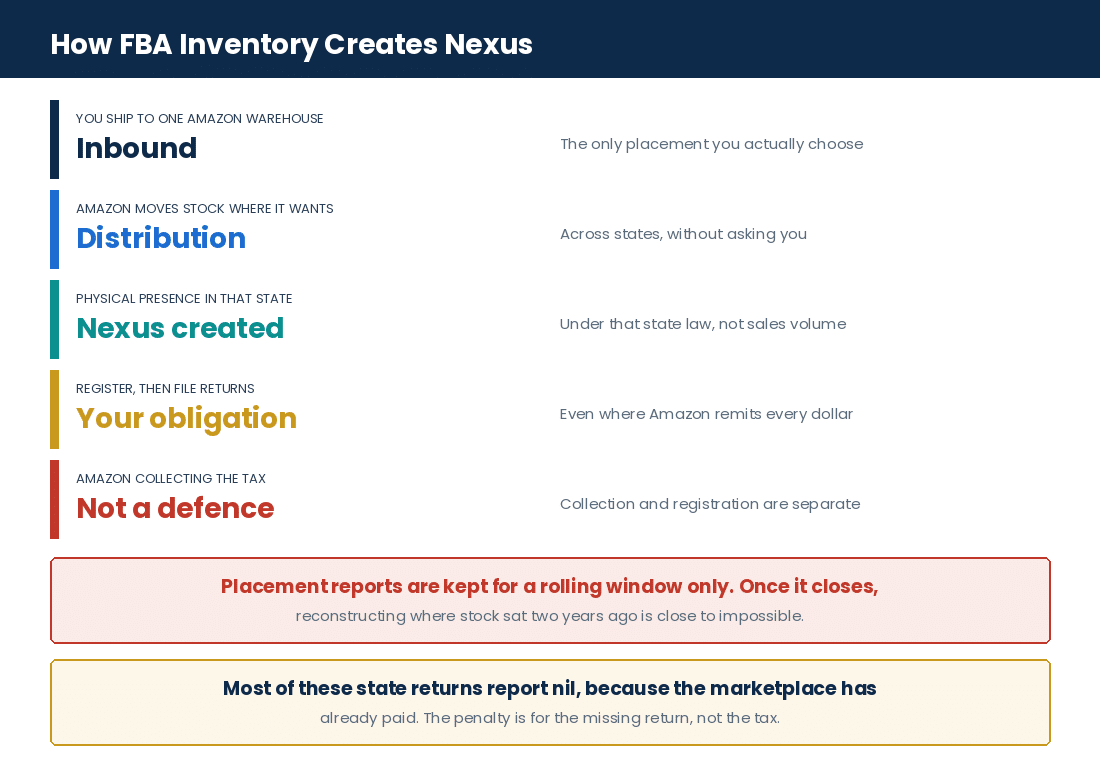
- Inventory Nexus: If you keep stock in a US state, that creates a nexus. That means more tax filings could be required there.
Distinctions Between Canadian and U.S. Tax Rules for Amazon Sellers
There are big differences between Canadian income tax rules and US sales tax laws for sellers across borders. Knowing them helps avoid problems.
- Canadian Income Tax Filing: Canadians report all their income worldwide on their returns — whether from Canada or US sales.
- U.S. Sales Tax Obligations: Each US state sets its own rules about when and how much sales tax you must charge customers. These rules vary a lot from place to place.
- Cross-Border Reporting Requirements: You need good records of your sales between countries to meet both Canadian and US rules on reporting income and taxes paid.
A Mississauga seller came to us convinced they had no US obligations because Amazon was already charging tax on every order. They were partly right and expensively wrong. Amazon was collecting and remitting. Amazon had also, over eighteen months, distributed their inventory across seven states, and each of those states expected a registration and a return from the seller, whether or not the seller was the one holding the money.
The fix was four months of back registrations and zero-dollar returns. No tax was owing anywhere, because Amazon had paid it all. The penalties were for the missing paperwork. Figures changed for privacy.
Income Tax Requirements for Canadian Amazon Sellers Selling on Amazon US
If you’re selling products on Amazon’s US platform as a Canadian:
- You must file an annual income tax return showing all your income, including money made from the US side of things.
- Report your total earnings and subtract any business costs related to those sales.
For example, if your US revenue hits $100,000 CAD but you spent $20,000 CAD on shipping and fees, you only pay tax on $80,000 CAD after those deductions.
GST/HST Registration Thresholds and Filing for Canadian Amazon FBA Sellers
Canada’s tax agency says that if your taxable supplies top $30,000 CAD over four straight quarters, you have to register for GST/HST.
- Once registered, you must charge GST/HST on your taxable domestic sales.
- You can also claim back GST/HST paid on business expenses.
- CRA expects you to file returns regularly — either quarterly or yearly — to avoid penalties.
CRA Guide RC4022: General Information for GST/HST Registrants · Excise Tax Act s. 148 · Income Tax Act ss. 2(1), 9(1)
Understanding Canadian Sales Taxes on Amazon Seller Fees and Marketplace Facilitator Rules
When selling cross-border via platforms like Amazon:
- Marketplace facilitators handle collecting taxes during sales automatically.
- But sellers should still track these transactions carefully.
- Keep good records of all fees charged by marketplaces since these affect your profits and tax filings.
Following these guidelines helps Canadian sellers avoid surprises with taxes when selling in the US market through Amazon. It pays off to keep things clear and up-to-date!
Income Tax, Customs and CPP for Canadian Amazon Businesses
Income Tax, Customs and CPP for Amazon Businesses
The Core Filing
Income Tax Considerations for Incorporated Amazon Businesses in Canada
If you run an incorporated business in Canada selling on Amazon US, you must report all your income worldwide. This includes what you earn from Amazon US sales. The Canadian tax law says corporations resident in Canada report all global income on their tax returns.
When you handle Canadian Amazon US seller taxes, you list your gross revenue before taking out fees or shipping. You can deduct expenses like ads, storage fees at fulfillment centers, and customs duties if you keep good records. Cross border Amazon seller tax Canada rules say you should convert currency using Bank of Canada rates, either yearly averages or the date of each transaction.
You need detailed records to back up your revenues and costs for both Canadian and US parts of your business. Subsection 9(1) and paragraph 18(1)(a) of the Income Tax Act require this. If you don’t report correctly, CRA can reassess your taxes or charge penalties.
Example: Say your company sells $150,000 USD on Amazon FBA in the US in a year ending Dec 31. You report that as CAD using Bank of Canada’s average rate. Fees of $15,000 USD are recorded as expenses after conversion.
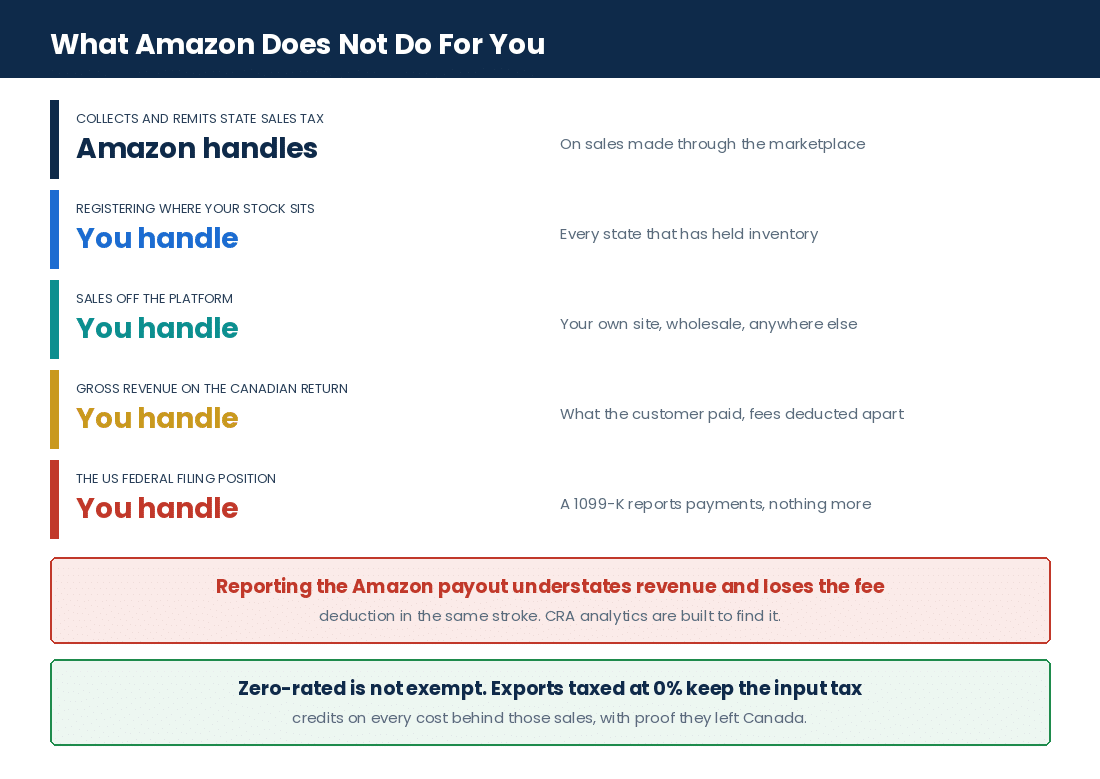
The part that trips people up is that the $150,000 is the number CRA wants to see as revenue, not the roughly $135,000 that actually landed in the bank. Report the deposit and you have understated revenue and omitted a deduction at the same time. Figures changed for privacy.
U.S. Sales Tax Obligations for Canadian Amazon Sellers Using Amazon US Marketplace
Most states make marketplaces like Amazon collect and pay sales tax for sellers on their platform. But this doesn’t free Canadian sellers from registration or filing if they store inventory outside Canada.
Marketplace facilitator laws cover taxable sales through the platform only. They don’t cover sales outside Amazon, like wholesale or private store shipments.
Which states require registration depends on where your stock is during the year. Having inventory there creates nexus no matter who collects the tax. You must file returns even if Amazon collects taxes; returns show taxable sales and what was collected by the marketplace versus paid by you.
Example: A company in Ontario stores goods in two US states’ warehouses during the year. They sell only via Amazon with facilitator collection active. The company registers in both states due to stock presence and files quarterly returns showing total taxable sales versus amounts collected by Amazon.
Those returns mostly report a tax liability of nil, because Amazon has already paid it. The filing is still the thing that keeps the account in good standing, and a state will chase the missing return long after it has stopped caring about the dollars. Figures changed for privacy.
Customs Duties, Import Taxes, and Tariff Rates Affecting Cross-Border Amazon Inventory
The importer of record must declare goods entering the US and pay customs duties based on the classification the importer assigns under the Harmonized Tariff Schedule of the United States, which CBP can review and challenge.
For shipments to US warehouses like FBA centers, who is importer changes how costs are handled but not tax filing obligations here. Customs brokers or freight forwarders usually manage this before goods arrive.
How goods arrive affects when duties are due: direct imports into US warehouses mean immediate payment; other routes might delay payment until final delivery inside the US. This timing affects how you record expenses for tax purposes under relevant import laws.
CPP and Self-Employment Tax Implications for Amazon Sellers in Canada and the U.S.
Incorporated businesses don’t pay CPP on their profits; CPP is deducted through payroll if a shareholder takes a salary, and the company matches it. CPP is federal, under the Canada Pension Plan Act, and Quebec residents are in QPP instead.
Self-employed people with unincorporated businesses pay CPP based on net earnings reported annually on Form T2125 with their personal taxes. This includes income from US sales and may affect GST/HST input credits depending on where supplies happen.
If you hold inventory physically in some US states, a permanent establishment could trigger a protective US tax return even without a formal entity there. US self-employment tax is a separate question from income tax, and a Canadian resident already paying into CPP is generally relieved of it by the Canada-US social security agreement, evidenced by a certificate of coverage from CRA.
Filing Basics: Canadian Tax Return Requirements for Amazon US Sellers
Canadian residents and companies are taxable on worldwide income from all sources, including amazon.com sales, under subsection 2(1) of the Income Tax Act, with business profit computed under subsection 9(1).
What goes on your Canadian return:
- Gross Revenue: Total income before marketplace fees.
- Expenses: All costs directly linked to earning that money like shipping out or customs.
- Currency Conversion: Use same method consistently for year-end or transaction dates.
- Inventory Valuation: Count physical stock held both inside Canada and abroad per accounting rules.
You’ll fill out form T2 for corporations with schedules showing these details clearly. Reconciling monthly statements showing deposits minus fees helps avoid CRA audits flagged around ecommerce reporting mistakes.
Good record keeping is key to staying compliant with CRA deadlines across provinces including Ontario where many sellers operate using cloud accounting tools integrated smoothly to capture transactions well.
Record Keeping Essentials for Accurate Tax Reporting of Amazon US Sales
CRA requires keeping solid records that match what you report during audits. You must keep these documents for at least six years from the end of the last tax year they relate to, under subsection 230(4) of the Income Tax Act.
This applies whether digital or paper copies stored offshore or online clouds accessible anytime during reviews. CRA uses automated systems now that look closely at online sellers including those selling through amazon.com internationally.
Key points:
- Keep invoices, receipts, bank statements, settlement reports.
- Record GST/HST small supplier thresholds carefully.
- Know GST/HST filing deadlines.
- Retain all records securely with easy access when needed.
Following these steps reduces penalties and audit risks greatly while helping maintain clear books aligned with CRA expectations nationally across provinces like Ontario covered extensively here by professionals specializing in cross-border ecommerce taxes.
Deductions, Currency Conversion and GST/HST in Practice
Deductions, Currency and GST/HST in Practice
Where the Money Goes
Common tax deductions available to Canadian Amazon sellers conducting US sales
If you’re a Canadian seller on Amazon US, you can claim several tax deductions in Canada. These deductions help lower your taxable income. They apply under the Income Tax Act and are key for proper cross border Amazon seller tax Canada reporting.
Here are some common deductible expenses:
- Marketplace fees: Fees and commissions you pay to Amazon count as business expenses.
- Fulfillment costs: Fees for storage, packing, and shipping via Amazon FBA qualify as operating costs or part of goods sold.
- Advertising and promotion: Money spent marketing your products, on or off Amazon, can be deducted.
- Inventory purchases: The cost of your inventory is deducted when you figure out gross profit. You must follow the inventory valuation rules in section 10 of the Income Tax Act and Regulation 1801.
- Currency conversion fees: Charges from changing USD to CAD are deductible if you keep good records.
- Professional services: Costs for accountants, bookkeepers, or legal advice tied to cross-border selling are deductible.
Keep detailed documents like invoices, reports showing your total revenue with fees listed separately, and currency exchange receipts. If you only report net deposits without adjusting for fees, your income numbers might be wrong, as the CRA Business Expenses Guide sets out.
Using these deductions helps handle Canadian Amazon US seller taxes the right way while following cross border Amazon seller tax Canada rules.
Managing currency conversion and its impact on cross-border Amazon seller taxes
Currency conversion affects how Canadian sellers report US sales income. Since you get paid in USD but file in CAD, using correct exchange rates matters a lot. It changes your reported revenue and expenses for both tax returns (T2) and GST/HST filings.
Here’s what to know:
- You must convert all foreign money into Canadian dollars using the rules in section 261 of the Income Tax Act and CRA’s published guidance on exchange rates.
- Common methods include the Bank of Canada’s rate on transaction days, a monthly average rate if many sales happen in one month, or an annual average rate if rates stay steady during the year.
- Often, marketplace reports show net proceeds after fees are taken out. You need to add back those fees before converting to CAD to get accurate income.
Wrong or mixed-up currency conversions can mess up your reported revenues or expenses. That affects how much tax you owe as a Canadian Amazon US seller. Keep clear records linking original USD papers with CAD versions for audits.
Also remember foreign exchange gains or losses from payment dates to year-end can affect taxable profits.
Handling currency well cuts mistakes when reporting on your cross border e-commerce with the USA market.
A Toronto seller had been using whatever rate their bank applied on the day the Amazon payout cleared, which is neither the transaction rate nor an average, and which quietly shifted with the size of each transfer. Across a year of weekly payouts, the reported revenue was out by roughly four percent.
Nothing about that is fraudulent and nobody was trying to hide anything. It is simply not a method, and a method is what CRA asks you to pick and stay with. We rebuilt the year on the Bank of Canada annual average and the difference landed in income where it belonged. Figures changed for privacy.
Cross-border tax compliance challenges and solutions for Canadian Amazon US sellers
Selling across borders means following tricky rules from both countries about taxes, registrations, record keeping, and filings. Many Canadian sellers on Amazon.com find this tough but knowing what’s involved helps avoid errors or missing registrations related to Canadian Amazon US seller taxes.
Common issues include:
- Dealing with many state sales tax registrations triggered just by storing inventory (“nexus”) even if no staff are there.
- Figuring out what taxes Amazon collects versus what you owe if you sell off Amazon’s platform like your own site or wholesale customers.
- Valuing inventory held in different states, since stock location creates nexus under each state’s own physical-presence rules regardless of where the business is based.
- Handling GST/HST rules since exports have zero rating but need proof that goods left Canada on time, under Schedule VI Part V of the Excise Tax Act.
Ways to deal with these include:
- Getting regular reports on where FBA inventory is located;
- Tracking all state registrations and filing deadlines;
- Hiring accountants who know ecommerce and cross-border tax details;
- Using software that links accounting data with Amazon reports;
- Keeping export proofs like shipping docs matching customs entries;
Planning ahead limits risks from missed registrations or wrong filings that could lead to audits by CRA or U.S tax offices while helping manage Canadian Amazon US seller taxes better.
Understanding the responsibilities for sales tax collection on Amazon marketplace fees
Amazon collects U.S. sales tax as a marketplace facilitator in every state with such a law. But this doesn’t mean sellers have no filing duties left.
Even if Amazon collects the sales tax:
- You still need to register in states where you hold stock that creates nexus,
- File returns showing total taxable revenue including sales handled by marketplaces,
- Keep clear records showing gross revenues before subtracting marketplace fees,
- Report sales outside marketplaces properly so they get taxed right,
This is how the state marketplace facilitator statutes themselves are written. A third party collecting some of the tax does not remove your own need to register or file returns where state law requires it, and that requirement turns mainly on stock presence rather than on sales thresholds alone.
Marketplace fees count as business costs but don’t change your basic duty to declare revenues correctly based on where orders happen inside the USA.
Knowing this stops confusion about what taxes remain due beyond what Amazon collects — especially important because marketplace facilitator collection is already running in every state that charges sales tax.
Tax refund and exemption options related to Amazon seller fees in Canada
Canadian sellers exporting through places like Amazon might qualify for GST/HST zero-rating plus input tax credits (ITCs). These rules come mainly from Excise Tax Act Schedule VI, which covers zero-rated supplies exported from Canada.
Here’s what matters:
- If your sales go over $30K yearly (the small supplier threshold), you must register for GST/HST so you can claim credits against eligible expenses linked directly or indirectly with exported goods sold on U.S marketplaces;
- ITCs let you recover some of the GST/HST paid internally on professional services tied only to export work, import duties paid when bringing in raw materials meant eventually for export, and domestic storage and fulfillment costs before shipping abroad;
- Goods sent physically outside Canada usually count as zero-rated exports — meaning no GST/HST charged buyers — but only if you keep good proof showing goods left within set timeframes per CRA rules;
- Claims require solid evidence connecting ITCs claimed with real business use supporting exports so auditors don’t deny them;
Knowing these points helps improve cash flow by lowering indirect taxes upfront while keeping fully legal regarding Canadian Amazon US seller taxes stuff.
Practical examples illustrating GST/HST charges on Amazon FBA fulfillment services
Whether GST/HST applies depends mostly on the place-of-supply rules in section 142 of the Excise Tax Act and Schedule IX, which decide whether a supply is made inside Canada or not.
For example,
| Scenario | GST/HST Treatment |
|---|---|
| Goods shipped from USA warehouse | No GST/HST charged |
| Services supplied entirely outside Canada | Outside the scope of GST/HST, not zero-rated |
| Goods returned or stored temporarily in Canada | Might be subject depending on situation |
A real case: A client from Toronto used only U.S.-based FBA centers shipping orders southbound nonstop. They didn’t owe any domestic HST but kept solid export evidence like customs papers proving shipments matched sale dates exactly.
The evidence is the whole of it. Without the customs entries lining up against the sale dates, the position is just an assertion, and an assertion is what gets reassessed. Figures changed for privacy.
Filing deadlines stay standard quarterly or semiannual depending on size. Sellers must file on time with precise reconciliations including inbound/outbound transactions plus reserve adjustments based on accounting standards accepted federally.
These examples show how tricky GST/HST charges can be when mixing Amazon FBA USA Canada activities — proving why expert help is smart amid changing laws.
CRA Guide RC4022 · CRA: Place of supply rules · Excise Tax Act ss. 142, 148, Schedule VI Part V, Schedule IX · Income Tax Act ss. 10, 261
Amazon Seller Tax Readiness Check
Five quick questions on where your departure file stands. No fee shown.
Points to raise with us:
This is a general prompt, not tax or legal advice or a quote. Your position depends on your full facts. For a real review, please book a free consultation.
US Federal Reporting, Form 1099-K and State Sales Tax Rules
US Federal Reporting, Form 1099-K and State Rules
The US Side
U.S. Income Tax Reporting for Canadian Amazon Sellers and Implications of Form 1099-K
Canadian sellers who sell on US marketplaces need to know their federal income tax rules in the U.S. These rules are different from state sales taxes. The IRS asks foreign sellers with income from the US to file returns if they have a taxable presence or meet rules under the Canada-US Tax Treaty.
Form 1099-K shows payment card and third-party network transactions. Both the seller and IRS get a copy. But getting Form 1099-K doesn’t mean you owe US taxes automatically. It just reports gross payments processed by platforms like Amazon. Whether US tax applies runs through two tests in sequence. US domestic law charges income effectively connected with a US trade or business, and the treaty then limits US tax to the profits attributable to a permanent establishment there.
Cross border Amazon seller tax Canada rules say all worldwide business income must be reported on Canadian returns no matter what’s filed in the US. Sellers should keep good records to match gross revenue shown by marketplaces with what they report in both countries. This helps avoid issues during audits.
Example: A seller in Toronto gets $150,000 gross on Amazon, shown on Form 1099-K, but has no offices or workers in any US state. They file a protective treaty return saying no ECI, then report full revenue on their T2 corporate return following CRA rules.
The protective return costs a few hours and settles the question. Skipping it leaves the US statute of limitations open indefinitely, and it is the deductions you would lose in a late-filed return that make that expensive rather than the tax itself. Figures changed for privacy.
Federal and State Sales Tax Requirements Under U.S. Marketplace Facilitator Laws
Marketplace facilitator laws make platforms like Amazon collect, report, and pay sales tax, and every state with a sales tax now has one. These laws shift some sales tax duties from sellers to the marketplace.
But marketplace facilitator collection does not free Canadian sellers from registering or filing if they have inventory or off-marketplace sales in states. Nexus mainly happens because stock is stored there, not because of marketplace collections.
Sellers need to track where their FBA inventory sits over time. Each warehouse location may create nexus, meaning registration is required even if sellers don’t control those warehouses. Not registering can cause penalties even if marketplace pays some taxes.
Here’s what marketplace facilitator laws cover:
| Question | Answer |
|---|---|
| Collecting sales tax? | Yes, for marketplace sales |
| Registration required? | No relief — sellers must register if nexus exists |
| Filing returns? | Depends on state; usually yes |
| Off-marketplace sales? | Sellers handle collection themselves |
So, these laws help with some tasks but don’t remove all cross-border registration or filing duties caused by where inventory sits.
Non-Resident Importer Registration and Compliance Requirements
Canadian sellers bringing goods into the US usually act as importer of record unless a customs broker handles that temporarily. Importer of record means they’re responsible for customs forms, duties, and following import rules.
How goods come in — directly to FBA warehouses or through middlemen — changes needed documents but not core registration rules tied to taxes in either country.
Non-resident importer status is something a Canadian seller elects so it can act as importer of record itself, which means obtaining a CBP-assigned importer number and posting a customs bond. It does not turn on shipment volume. Some states also require permits linked to warehouses where stock is kept.
Keeping good records that prove legal import supports correct costing when figuring cost of goods sold (COGS) for Canadian purposes when reselling here or abroad.
Detailed Comparison of Canadian and U.S. Tax Rules Affecting Amazon Sellers
GST/HST in Canada works differently than US sales tax. It targets value-added consumption instead of just transaction flow:
- You must register for GST/HST once worldwide taxable supplies go over $30,000 CAD over four consecutive calendar quarters, and zero-rated exports count toward that total rather than being left out of it.
- The CRA small supplier threshold protects small businesses from charging GST/HST if below this limit.
- Excise Tax Act Schedule VI lists zero-rated export supplies that get relief when goods leave Canada permanently; keeping proof is very important.
In contrast:
- US states have many different sales tax rules mostly based on physical presence like storing inventory.
- Marketplaces collecting under facilitator laws only cover certain transaction types.
This means accounting across borders needs exact tracking since each country treats supply location versus place-of-sale differently when applying taxes and rates.
Timing and Methods of Tax Charges on Amazon Seller Fees Related To Cross-Border Sales
Amazon fees include referral fees, fulfillment costs, ads — all affect your net earnings subject to taxes.
For accounting:
- Fees paid count as expenses reducing your gross revenue reported federally in both countries.
- Currency conversion matters because Amazon usually pays out in USD but books may be kept in CAD. You must use consistent exchange rates as per CRA rules.
If marketplaces charge VAT/GST directly, those charges need separate accounting too so input credits match these expenses.
Classifying fees correctly avoids underreporting income and helps claim deductions allowed under the Income Tax Act business expense rules.
Invoice Issuance and Documentation Practices for Taxes Paid On Amazon Seller Fees
Keeping good invoices matters because CRA requires documents be kept at least six years including digital settlement reports from marketplaces.
You should reconcile monthly or yearly settlement statements with your own records to keep financial info consistent for T2 corporate filings. This includes checking fee types like storage versus advertising so they’re classified right per CRA expense rules.
Clear audit trails showing how fees lower gross receipts reduce risks when audits check differences between Forms 1099-K data and filed returns.
[1] IRS Publication 519 — U.S. Tax Guide for Aliens · [2] IRS Instructions — Form 1099-K · [3] Income Tax Act RSC 1985 c.1 (5th Supp), ss. 2(1), 9(1); CRA business income guidance · [4] State departments of revenue — marketplace facilitator statutes, in force in every sales tax state · [5] State departments of revenue — physical presence nexus from inventory stored in state · [6] State revenue authorities — inventory location reporting requirements · [7] CBP — importer responsibilities overview · [8] Customs regulations and state-level import permits · [9] CRA Guide RC4022 — General Information for GST/HST Registrants · [10] Excise Tax Act Schedule VI, Part V — zero-rated supplies provisions · [11] Comparative analysis: GST/HST versus US sales taxes — CPA Ontario resources · [12] Accounting Standards Board Handbook — expense recognition principles · [13] Income Tax Act s. 261 and CRA currency conversion guidance · [14] Input credit eligibility criteria — Excise Tax Act Part IX · [15] Income Tax Act subsection 9(1) and paragraph 18(1)(a) — computation of business profit and the limit on deductions · [16] Record retention policy — CRA publications; Income Tax Act s. 230(4) · [17] Reconciliation best practice guides · [18] Expense classification examples — CPA Ontario · [19] Audit triggers related to third-party reporting
If you want advice about Amazon US seller tax Canada questions, contact Gondaliya CPA Professional Corporation at info@gondaliyacpa.ca or call 647-212-9559 for a free consultation.
Case Studies and Tax Planning for Canadian Amazon Sellers
Case Studies and Tax Planning
In Practice
Case study: Organizing Amazon US seller taxes for a Canadian business
Handling Amazon US seller tax Canada rules needs careful planning. A Canadian business selling on Amazon US must keep track of all sales revenue. That means gross amounts before fees. They need this to report correctly on their Canadian T2 tax return and GST/HST filings. Just because marketplace facilitator collects taxes doesn’t mean they skip registering or filing in states where they hold inventory.
For example, a Toronto brand using Amazon FBA with stock in several US warehouses found out that having inventory triggered tax registrations in multiple states. They kept detailed placement reports by period. This helped them match sales with the state returns filed along with their Canadian T2 form. Doing this made sure they reported all foreign income, which subsection 2(1) requires of a Canadian resident. They also claimed input tax credits on Canadian expenses tied to those sales.
The placement reports were the piece nobody had thought to download. Amazon keeps them, but only for a rolling window, and reconstructing where stock sat two years ago once that window has closed is close to impossible. Figures changed for privacy.
This shows how important it is to organize records like settlement statements, placement reports, and registration documents. This helps meet CRA rules for zero-rated exports under the Excise Tax Act Schedule VI. It also meets state filing rules. Not keeping good records can lead to missing returns or understating income.
Case study: Managing cross-border tax complexities using Gondaliya CPA expertise
Cross border Amazon seller tax Canada problems come from the differences between US and Canadian tax rules. One client hired Gondaliya CPA after getting confused by marketplace-collected US sales taxes versus the GST/HST they owed in Canada on exports.
Gondaliya CPA looked at the client’s Amazon FBA stock locations across many US states and checked if registrations and filings matched up there. They also converted net proceeds back to gross revenue as the CRA requires, making sure worldwide income was included as subsection 2(1) requires.
They prepared treaty-based disclosures about permanent establishment risks without causing extra federal filings in the US — something small sellers usually don’t face but was needed here because of stock holdings. Figures changed for privacy.
By working through the marketplace facilitator collections and inventory nexus rules as they currently stand, this client stayed compliant while claiming GST/HST credits on Canadian costs tied to their exports.
Tax planning strategies tailored for Canadian Amazon sellers involved in US sales
Planning taxes for Amazon FBA tax Canada US starts with knowing that having goods in US warehouses creates nexus. That means sellers must register in many states even without staff there. Sellers should:
- Keep detailed records showing when inventory was at each location.
- Separate marketplace-facilitated sales from direct website or wholesale orders.
- Reconcile monthly settlements converting net deposits into gross revenue plus itemized fees as deductible expenses.
- Plan cash flow for quarterly instalments when taxable income rises on their T2.
- Keep export proof ready to support zero-rated GST/HST under Excise Tax Act Schedule VI.
Following these steps lowers audit risks and clarifies cross border Amazon seller tax Canada duties. These points reflect the marketplace facilitator and nexus rules currently in force.
Best practices for setting aside funds to cover Canadian and U.S. seller tax obligations
Canadian sellers selling in the US face two tax systems. So, setting aside money properly is key:
- Estimate total taxes owed — include provincial GST/HST plus US state sales taxes even if marketplace collects some.
- Save money monthly based on gross revenues, not net after fees; add bookkeeping costs tied to tax compliance.
- Use separate bank accounts or ledgers just for collected taxes so funds aren’t spent accidentally.
- Watch for yearly regulatory changes, especially state-level changes to nexus rules caused by inventory locations.
- Get advice early if adding products or markets that increase tax complexity.
Sticking to these tips stops shortfalls that cause penalties or interest both in Ontario and various US states where remote sellers keep stock.
Benefits of working with an e-commerce accountant specialized in Amazon cross-border taxes
Hiring an Ontario CPA firm familiar with cross border Amazon seller tax Canada offers real benefits:
- They understand how CRA laws (Income Tax Act subsections 2(1) and 9(1), paragraph 18(1)(a), and the Excise Tax Act) work with changing US marketplace facilitator rules, so filings are right without extra hassle.
- They use special workflows linked with QuickBooks or Xero set up for ecommerce transactions, which cuts down manual mistakes common in DIY bookkeeping.
- Flat annual fees make budgets easy — no surprise bills during busy seasons or when fixing missed filings.
- They represent clients directly before CRA, easing stress over notices about foreign affiliate info where related US entities hold stock per treaty rules.
Such help reduces costly errors when dealing with complex multi-jurisdictional taxes as the rules keep changing.
Avoiding common pitfalls in Amazon US seller tax compliance for Canadian entrepreneurs
Many Canadians selling on Amazon assume marketplace facilitator collection means no registration or filing needed in all states where they have FBA inventory — this mistake can cause big trouble if audited.
Common mistakes include:
- Forgetting off-marketplace sales like website orders that need separate tracking.
- Applying one state’s threshold rule everywhere instead of checking each state’s nexus tests.
- Reporting income net of fees rather than gross amounts required by CRA recordkeeping.
- Missing year-end reserve adjustments when estimating taxable income.
To avoid these issues:
- Match settlement reports tightly with placement logs.
- Register timely wherever stock sits.
- Use consistent currency conversion based on yearly exchange rates.
- Keep export documents proving zero-rated supplies under Excise Tax Act Schedule VI.
Doing these cuts risks from incomplete filings found during IRS/CRA audits targeting cross-border ecommerce sellers, as CRA and the IRS keep sharpening their focus on cross-border ecommerce.
Final Considerations, Resources and Next Steps
Final Considerations, Resources and Next Steps
Wrapping Up
Final considerations for Canadian Amazon sellers navigating U.S. tax obligations
Canadian sellers on Amazon’s U.S. site face tricky tax rules. They need to follow both Canadian and American laws. Understanding Amazon US seller tax Canada, Canadian Amazon US seller taxes, and cross border Amazon seller tax Canada matters a lot. It helps avoid fines and keeps reporting clean.
Summary of key tax compliance points for cross-border Amazon sellers in Canada and the U.S.
Selling across borders on Amazon FBA means dealing with many tax rules. Even if marketplace facilitators collect sales tax, sellers still must register and file returns in certain states. Holding inventory in U.S. warehouses creates a tax link, or nexus, in those states.
On the Canadian side, GST/HST registration depends on total sales, including exports. When goods go outside Canada, they might qualify as zero-rated sales — but sellers need good records.
Here’s what sellers should know:
- Marketplace facilitators handle sales tax in some states but don’t replace the need to register or file elsewhere.
- Storing goods in U.S. fulfillment centers triggers state tax obligations.
- GST/HST registration depends on worldwide income; exporting requires proof for zero-rating.
- Sellers report all revenue before fees; fees count as expenses separately.
These points follow CRA rules under the Excise Tax Act (section 148 on small suppliers, Schedule VI Part V on exports) and Income Tax Act subsections 2(1) and 9(1). You can check details on the CRA site.
How to stay updated on changing tax laws impacting Amazon US seller tax Canada
Tax laws for cross-border sales change often. Staying up to date helps meet deadlines like the CRA GST/HST filing deadline. Marketplace facilitator rules are already in force in every U.S. state that charges sales tax, and individual states keep amending them.
To keep up:
- Watch official CRA updates on foreign income, GST/HST changes, and record keeping.
- Follow state announcements about marketplace facilitator collections.
- Check the US federal rules for non-resident corporations if you may have a permanent establishment there, and Articles V and VII of the Canada-US treaty, which decide whether US tax applies at all.
Talking with licensed pros who know cross-border taxes helps avoid missing key filings or registrations.
Recommended next steps for Canadian Amazon sellers to optimize tax setup with Gondaliya CPA
Hiring an Ontario CPA firm with cross-border experience can simplify tax work. Gondaliya CPA offers help like:
- Checking your marketplace settings, registrations, filings, and other selling channels
- Matching gross revenues to net after fees following CRA rules
- Preparing correct T2 corporate returns that include worldwide income from U.S. sales
- Advising on GST/HST registration based on export amounts and input credits
We use a flat annual fee so you know costs upfront. Our team replies within one business day and backs service with a 30-day money-back guarantee. This cuts down risks tied to missed filings or wrong reports that self-filers face.
Contact options and calls to action for personalized Amazon seller tax consultations
For tailored advice about your cross-border selling, reach out to Gondaliya CPA Registered Firm at 647-212-9559 or info@gondaliyacpa.ca. We have over 1300+ five-star Google reviews showing trusted service across Ontario cities like Toronto, Mississauga, Brampton, Ottawa — and all over Canada.
We offer free first consultations just for Canadian ecommerce sellers moving into the U.S. That way you get clear answers without confusion or extra hassle.
Additional resources linking to detailed guides, tools, and official tax agency information
| Resource | Description |
|---|---|
| CRA GST/HST Small Supplier Threshold | Explains when you must register for GST/HST based on global sales |
| CRA Records Retention Guidelines | Shows how long businesses keep financial records including those outside Canada |
Using these official guides along with professional advice keeps your operations in line with rules around Amazon FBA tax Canada US.
Income Tax Act ss. 2(1), 9(1), 10, 18(1)(a), 230(4), 261 · Excise Tax Act ss. 142, 148, Schedule VI Part V, Schedule IX · Canada-US Tax Convention, Articles V and VII · IRC 6114 · Forms T2, T2125, 1099-K, 1120-F, 8833
Frequently Asked Questions on Amazon US Seller Tax Canada
Frequently Asked Questions
Answers
What is the CRA retention period for foreign records for Amazon sellers?+
When do Canadian sellers trigger federal instalment payments for income tax?+
How does Income Tax Act s.18(1)(a) affect expense deductions?+
Does holding inventory in a US state create nexus?+
Does an Excise Tax Act provision govern US marketplace facilitator obligations?+
How is Excise Tax Act Schedule VI relevant to GST/HST on exports?+
What does the Income Tax Act require Canadian Amazon sellers to report?+
When should a protective US return be filed?+
Why are placement reports important for cross-border Amazon sellers?+
What are state registration permits in relation to Amazon FBA inventory?+
Essential Insights for Canadian Amazon Sellers
Essential Insights for Amazon Sellers
Key Points
Key bullet points on remaining critical topics for Canadian Amazon sellers:
- Record-Keeping Period: Maintain detailed financial records digitally or physically for six years per CRA records retention guidelines.
- Income Reporting Worldwide: Report all global income, including US sales revenue converted consistently using CRA currency conversion methods.
- Gross Revenue Reporting: Declare total gross revenues before deducting any fees or expenses, as profit is computed under subsection 9(1).
- Marketplace Fees and Reserves Accounting: Account separately for marketplace fees as deductible expenses while reporting gross income fully.
- Input Tax Credits (ITCs): Claim ITCs on GST/HST paid on business expenses related to exported goods as allowed under Excise Tax Act Schedule VI.
- Importer of Record Responsibilities: The importer of record must manage customs declarations, pay duties, and keep import documents compliant with CBP rules.
- Customs Duties & Tariff Rates: Understand applicable customs tariffs affecting your imports into the US which influence cost of goods sold calculations in Canada.
- CPP and Self-Employment Tax: Report self-employment earnings including US sales on Form T2125; incorporated businesses handle CPP differently via payroll deductions.
- CRA Instalment Payments & Filing Deadlines: Monitor taxable income levels to meet CRA instalment payment triggers; file returns by the CRA GST/HST filing deadline to avoid penalties.
- State Nexus Rules: Inventory presence creates nexus requiring registration regardless of marketplace facilitator collection; state facilitator statutes leave the seller liable for registration and filing beyond what the marketplace collects.
- Cross-Border Reporting Requirements: Maintain transparent records of cross-border transactions including currency conversion, sales volumes, fees, and export proofs per Income Tax Act subsections 2(1) and 9(1).
- Tax Planning Complexity & Exposure Risk: Plan registrations and filings carefully across states to reduce audit risk from missing returns or underreporting revenue due to complex multi-jurisdictional laws.
- Marketplace vs Off-Marketplace Sales Distinction: Differentiate between sales where marketplace collects tax and those made off-platform that require seller-managed tax collection and filings.
- CRA Relief and Disclosure Options: Use voluntary disclosures if errors occurred previously; seek professional advice to correct filings involving cross-border sales taxes properly.
- CRA Currency Conversion & Foreign Exchange Gains/Losses: Apply consistent exchange rates for conversions; report foreign exchange gains or losses arising from timing differences on payments and receipts.
These points form essential guidance for Canadian Amazon sellers managing their US-related taxes efficiently with Gondaliya CPA expertise.
Businesses We Serve & Industry Spotlights
Industry Expertise
Amazon sellers sit inside a wider group of businesses that move physical goods or digital products across the border, and the questions that decide an Amazon file — where the stock sat, what the gross revenue really was before the platform took its cut, and whether an export was properly evidenced — recur across every one of these situations.
| Who | The Cross-Border Angle |
|---|---|
| Amazon US sellers in Canada | FBA inventory nexus, gross versus net, Form 1099-K |
| Cross-border e-commerce sellers | Multi-state registrations and zero-rated export proof |
| Wholesale e-commerce sellers | Off-marketplace sales the facilitator never touches |
| Direct-to-consumer brands | Platform fees, advertising spend and currency method |
| Subscription box businesses | Recurring revenue recognition and deferred amounts |
| Digital product businesses | Place-of-supply rules where nothing physical ships |
| Supplement brands | Import classification, duties and landed cost |
| Fulfillment centres | Holding another party’s stock and what it triggers |
| Third-party logistics providers | Customs documentation and importer of record questions |
| Customs brokers | Tariff classification and CBP correspondence |
| Canadian companies expanding to the US | Permanent establishment risk and protective returns |
Spotlights: Amazon US sellers based in Canada · cross-border e-commerce sellers · wholesale e-commerce sellers · direct-to-consumer brands · subscription box businesses · digital product businesses · supplement brands · fulfillment centres · third-party logistics providers · customs brokers · Canadian companies expanding to the US.
Professional Guidance and Quick Reference
Guidance
Essential Tax Points for Canadian Sellers on Amazon US
Amazon files go wrong in a predictable set of ways: reporting the payout instead of the gross revenue, which understates income and skips a deduction at the same time; assuming facilitator collection ends the state obligation; never downloading the inventory placement reports until the window has closed; using whatever rate the bank applied rather than picking a conversion method and keeping to it; leaving zero-rated exports unevidenced; forgetting the sales made off the platform entirely; and treating a Form 1099-K as though it were a US tax assessment. Gondaliya CPA prepares cross-border ecommerce returns on a flat annual fee.
Quick Answers
At a Glance
- Worldwide income: taxed on a Canadian resident under subsection 2(1)
- Business profit: computed under subsection 9(1)
- Deduction limit: paragraph 18(1)(a) denies outlays not made to earn income
- Report gross: revenue before Amazon’s fees, with the fees deducted separately
- Inventory valuation: section 10 and Regulation 1801
- Currency conversion: section 261, one method, applied consistently
- Record retention: six years under subsection 230(4)
- GST/HST threshold: $30,000 of worldwide taxable supplies over four consecutive quarters
- Zero-rated exports count: toward that threshold, rather than being left out
- Zero-rated is not exempt: 0% tax, and input tax credits preserved
- Export proof: customs entries matching the sale dates
- Place of supply: section 142 and Schedule IX decide whether a supply is made in Canada
- State nexus: created by stock sitting in the state, whoever collects the tax
- Facilitator collection: does not relieve registration or filing
- Off-marketplace sales: the seller collects and remits those itself
- Form 1099-K: a report of gross payments, not a US tax bill
- US tax test: effectively connected income first, then permanent establishment under the treaty
- Protective return: Form 1120-F with Form 8833
- Instalments: triggered once net tax owing passes $3,000
Who This Is For / Not For
Fit Check
- For: Canadian sole proprietors and corporations selling on Amazon’s US marketplace, particularly those using FBA and holding inventory in US fulfillment centres.
- For: sellers who have been reporting net payouts rather than gross revenue, who have never checked where their stock has been, or who have received a Form 1099-K and do not know what it means.
- Not for: a state-by-state sales tax guide, a US federal corporate tax computation, or advice on where to place inventory, all of which sit outside this article’s scope.
- Not for: sellers operating only in Canada with no US presence. A seller below the $30,000 threshold is still squarely in scope, because the state-side obligations do not wait for it.
People Also Ask
Related Questions
Amazon already charges tax on my orders. Why would I register anywhere?+
Because collecting and registering are two different obligations. The marketplace facilitator statutes put the collection duty on Amazon, but they do not extinguish a seller’s own registration where that seller has nexus. Stock sitting in a state’s warehouse creates that nexus, so the state expects a registration and a return from you even when the tax has already been paid by someone else. Most of those returns report nil.
Do I report what Amazon deposited, or what the customer paid?+
What the customer paid. Profit is computed under subsection 9(1) from gross revenue, with referral fees, fulfillment costs and advertising deducted separately as expenses. Reporting the deposit nets the fees against revenue invisibly, which understates your revenue and loses you the deduction in the same stroke. It is also the pattern CRA’s analytics are built to spot.
I got a Form 1099-K from Amazon. Do I owe US tax?+
Not on the strength of that form. Form 1099-K reports gross payments processed, nothing more. Whether US tax applies runs through two tests: whether the income is effectively connected with a US trade or business under US domestic law, and then whether the treaty attributes profits to a permanent establishment there. Many Canadian FBA sellers fail the second test and owe nothing, but the position is worth documenting on a protective return.
Do zero-rated exports count toward the $30,000 GST/HST threshold?+
Yes, and this catches people out. The small supplier test looks at worldwide taxable supplies, and zero-rated supplies are taxable supplies charged at 0%. An exporter who assumes their US sales sit outside the test can pass $30,000 without noticing and register late. Registering is usually to your advantage anyway, since zero-rating preserves the input tax credits on everything behind those sales.
Which exchange rate should I use for Amazon payouts?+
Any of the methods CRA accepts under section 261 — the Bank of Canada rate on the transaction date, a monthly average, or the annual average — provided you pick one and stay with it. The error we see most often is not choosing a wrong method but using none: taking whatever rate the bank happened to apply to each transfer, which varies with the size of the transfer and is not a method at all.
Glossary of Key Terms
Definitions
- Nexus: the connection to a US state that obliges a seller to register and file there.
- Marketplace facilitator: a platform required by state law to collect and remit sales tax on sales it processes.
- FBA: Fulfillment by Amazon, where Amazon stores and ships the seller’s stock.
- Placement report: the Amazon record showing which fulfillment centres held your inventory and when.
- Gross revenue: what the customer paid, before marketplace fees are deducted.
- Net payout: what Amazon deposits after its fees, which is not the figure CRA wants as revenue.
- Small supplier: a business below $30,000 of worldwide taxable supplies over four consecutive quarters.
- Zero-rated supply: a taxable supply charged at 0%, which preserves input tax credits.
- Exempt supply: a supply outside the tax entirely, which does not preserve input tax credits.
- Input tax credit (ITC): recovery of GST/HST paid on costs incurred to make taxable supplies.
- Place of supply: the rules in section 142 and Schedule IX deciding whether a supply is made in Canada.
- Importer of record: the party responsible to CBP for the customs entry and the duty.
- Non-resident importer: a foreign seller electing to act as importer of record itself.
- Harmonized Tariff Schedule: the US classification system determining the duty rate on imported goods.
- Effectively connected income: the US domestic test charging income connected with a US trade or business.
- Permanent establishment: the treaty test limiting which profits the US may tax.
- Form 1099-K: the US information return reporting gross payments processed by a platform.
- Protective return: Form 1120-F with Form 8833, filed to preserve a treaty position and deductions.
Want a checklist to work from? You can download our free Amazon seller tax checklist before your consultation.
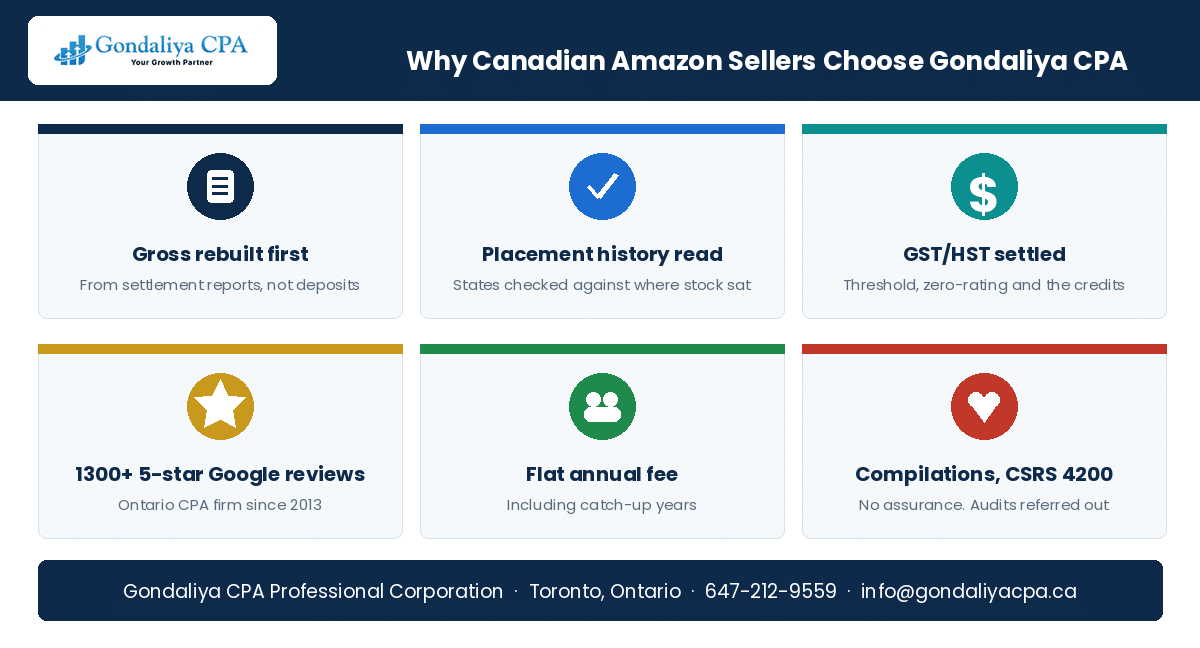
Four things decide an Amazon file. The revenue figure — what the customer paid, not what Amazon deposited, with the fees deducted separately, because profit is computed under subsection 9(1) and a Canadian resident is taxable on worldwide income under subsection 2(1). Where the stock sat — inventory in a US fulfillment centre creates nexus in that state under the state’s own law, and marketplace facilitator collection does not relieve the registration or the return, which is why the placement reports matter more than anything else Amazon gives you. The GST/HST position — $30,000 of worldwide taxable supplies over four consecutive quarters, with zero-rated exports counting toward it, and zero-rating rather than exemption is what preserves the input tax credits on the costs behind those sales. And the US federal question — a Form 1099-K is a payment report, effectively connected income and permanent establishment are two separate tests applied in sequence, and a protective Form 1120-F with Form 8833 settles it cheaply.
Three questions tell you where you stand, and all three are answered from records you already have. First, are you reporting gross or net? Pull a settlement report and compare the revenue line in your books against what the customer actually paid. Second, where has your inventory been? Download the placement reports now rather than later, because Amazon keeps them only for a rolling window. Third, what conversion method are you using? If the answer is whatever rate the bank applied, that is not a method, and picking one is a half-hour job that prevents a year of drift.
Amazon US Seller Tax Canada: How Gondaliya CPA Can Help
Start with a settlement report and your inventory placement history
Gondaliya CPA rebuilds gross revenue from the settlement statements before anything else is calculated, itemises the marketplace fees as deductions rather than letting them disappear into a net figure, sets and documents a currency conversion method you can hold to, reviews the inventory placement history against the states you are registered in, prepares the T2 or the T2125 with worldwide income properly included, advises on the GST/HST registration position and the input tax credits that zero-rated exports preserve, and prepares protective US filings where stock holdings make the permanent establishment question live — on a flat annual fee including HST with a one-business-day response. Please book a free consultation.
Next Steps
Please book a free consultation with Gondaliya CPA and bring three things: a recent Amazon settlement report, your inventory placement history, and a note of any sales you make off the platform. Those three settle the revenue figure, the state registration position and the GST/HST question — which between them account for nearly every difficulty we see on a cross-border ecommerce file. If you have been reporting net payouts for a few years, say so at the outset, because catch-up work is routine and considerably cheaper raised than found. We advise on Canadian tax and on the US federal filing position, and we work with US state and local specialists for the state registrations themselves. You will get a flat annual fee including HST before any work begins. We serve Toronto, Mississauga, Brampton, Vaughan, Etobicoke, Scarborough, Hamilton, Ottawa and the rest of Ontario, and work with ecommerce clients across Canada. If our content helps, please add gondaliyacpa.ca as a preferred source on Google.
Published: · Last updated:
Editorial policy: We research against CRA, Department of Finance, Parliament of Canada, CPA Canada and CPA Ontario sources, fact-check the figures, and Sharad Gondaliya, CPA, reviews the content, which we update as the rules change.
Disclaimer: This article is educational information only and is not tax, legal or financial advice. It covers Canadian federal income tax and GST/HST for residents selling on Amazon’s US marketplace, together with the US federal filing position in outline. It is not a state-by-state sales tax guide, it does not set out US federal corporate tax computations, and it does not advise on where to place inventory, each of which is handled separately. US state registration and filing requirements vary by state and change frequently, and the state-side position should be confirmed with a specialist in the relevant states. Thresholds, filing deadlines and statutory references change; every reference should be confirmed against current CRA and IRS guidance before a return is filed. Gondaliya CPA performs compilation engagements under CSRS 4200 and does not perform audit or review engagements. Please consult a licensed CPA before acting.

Sharad Gondaliya is a CPA Canada & CPA USA with 15 Years+ experience of Accounting, Tax, Payroll of Corporate Small Businesses as Tax Accountant. He is a CPA Ontario member (61040184) and holds US CPA licences in Washington and Montana and is well known among corporate small businesses for tax planning, efficient tax solutions, and affordable CPA services. Sharad is the Principal (Director) of Gondaliya CPA – Affordable CPA Firm in Canada. Licenses: CPA Ontario: 61040184 | CPA USA (MT): PAC-CPAP-LIC-033176 | CPA USA (WA): 57629 | CPA Firm License: 61330051 View Full Author Bio