



Basement Apartment Tax Planning in Canada: Rental Income, Expenses & Tax Savings
Basement Apartment Tax Planning Canada: Maximizing Rental Income Deductions and Filing Correctly
Basement apartment tax planning Canada is essential for maximizing basement rental income tax deductions while complying with CRA rental income rules. Gondaliya CPA guides landlords on proper rental income reporting, claiming rental property expenses, and deciding whether capital cost allowance belongs in the file at all.
Quick Summary
Renting the basement of the home you live in is the one rental arrangement where the biggest tax number is not a deduction but an exemption. CRA will leave your principal residence exemption intact on the whole property where three conditions in paragraph 2.59 of Income Tax Folio S1-F3-C2 are met together: the rental use is ancillary to living there, there is no structural change, and no capital cost allowance is claimed. Claim the allowance and you break the third condition, trigger a partial change in use under paragraph 45(1)(c), and buy yourself recapture under subsection 13(1) on a sale that would otherwise have been tax-free. Everything else follows the ordinary rules. Gross rent is reported before expenses on Form T776 and carried to line 12600. Shared costs are apportioned on one reasonable basis, usually floor area, used the same way every year. Mortgage interest is deductible and principal never is. Financing fees come off over five years under paragraph 20(1)(e). Motor vehicle expenses are far more restricted than landlords expect, and for a suite inside your own home there is usually nothing to claim.
Reading time: 17 minutes.
Table of Contents
- Basement Rental Income and Your Tax Obligations
- Eligible Rental Expenses and Tax Deductions
- Maximizing Tax Savings With Strategic Planning
- Filing Basement Rental Income Taxes Efficiently
- Unique Scenarios and Complexities
- Resources, Compliance Tips and Support
- Frequently Asked Questions
- Essential Points for Basement Landlords
- Businesses We Serve & Industry Spotlights
- Professional Guidance and Quick Reference
The Numbers That Matter
This article covers Canadian federal income tax and GST/HST for homeowners renting a basement apartment or secondary suite inside the home they live in, with Ontario and Toronto context, and reflects rules current to 28 October 2026. It covers reporting rental income, current versus capital expenses, apportioning shared costs, capital cost allowance and its effect on the principal residence exemption, the partial change-in-use rules and the elections under subsections 45(2) and 45(3), motor vehicle and travel restrictions, record-keeping and Form T776, short-term rentals and GST/HST, non-resident withholding, and the tax treatment of a sale. It is written for personal ownership; holding a rental through a corporation changes the analysis and is not covered here. It is not a guide to provincial tenancy law or rent regulation, to municipal zoning or secondary suite licensing, or to whether any particular suite is legal where you live. Gondaliya CPA performs compilation engagements under CSRS 4200, which provide no assurance; audit and review engagements are referred out. This is educational information only and not tax or legal advice.
Basement Rental Income and Your Tax Obligations
Foundations
Understanding Basement Apartment Rental Income and Tax Obligations in Canada
Basement Apartment Rental Income: Definition and Tax Implications
Basement apartment rental income means money you earn by renting out the basement part of your home. In Canada you pay tax on this income under the Income Tax Act, and you report it on your tax return. This extra income changes how much tax you owe and, in the year you first rent, it can change how the property itself is treated. Doing good basement apartment tax planning in Canada means getting both of those right, not just the first.
Reporting Basement Rental Income Accurately Under CRA Rules
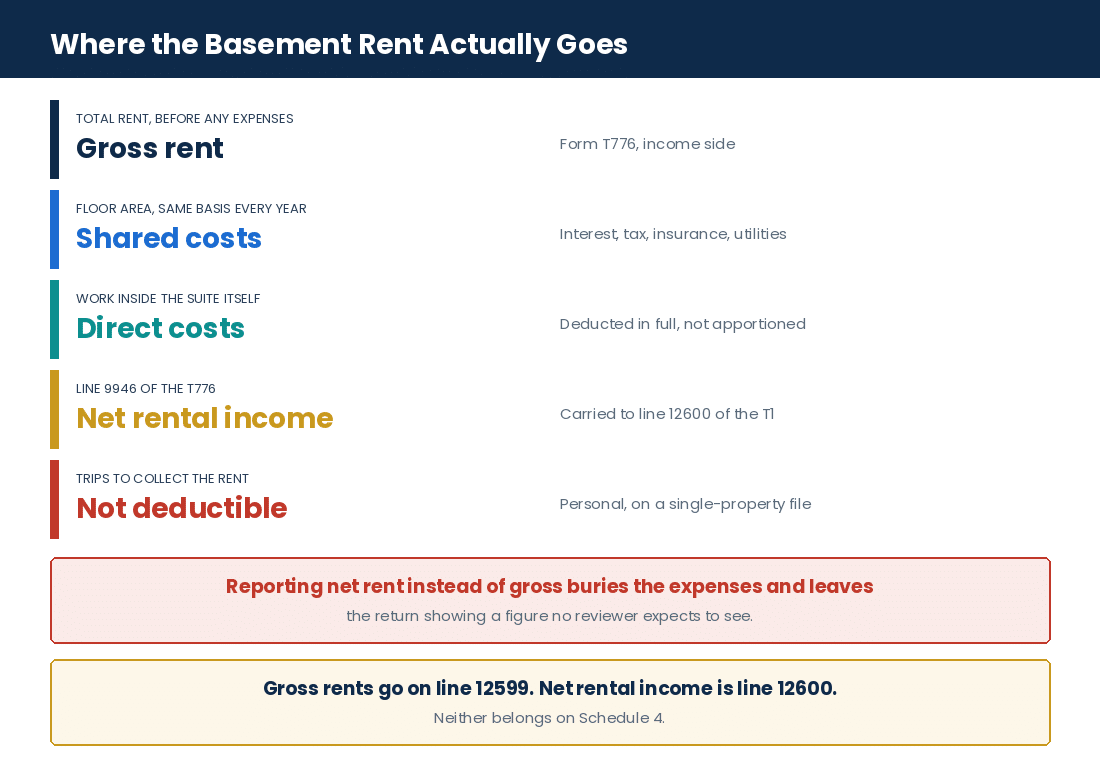
The CRA requires you to report all rental income before expenses on Form T776, the Statement of Real Estate Rentals. The form shows how much money you received and what costs you had for the rental space. Net rental income from line 9946 of the T776 is carried to line 12600 of your T1, with gross rents on line 12599.
The CRA expects rental income to be reported accurately to avoid penalties or review. Landlords should keep good records of all payments and expenses. On a basement suite in particular, the records that matter most are the ones nobody thinks to keep: the floor plan, the measurements, and a note of why you split the costs the way you did.
Overview of Basement Apartment Rental Taxes: What Landlords Need to Know
Landlords should know these things about basement apartment taxes in Canada:
- You can deduct a share of costs like mortgage interest, property taxes, insurance, utilities, repairs and maintenance
- Capital cost allowance lets you claim wear and tear on the rented portion over time — but on an owner-occupied home, claiming it has a cost most landlords do not see coming
- All rent money counts as taxable income, so good bookkeeping helps manage your taxes well
Knowing these points lets landlords plan smartly and use allowed deductions while following tax laws.
A homeowner in Scarborough came to us after four years of renting a basement suite and claiming capital cost allowance on it every year — about $2,300 a year on the rented portion, roughly $9,200 in total. The saving across those four years was somewhere near $3,500. When she sold, the gain on the house was about $310,000. Because capital cost allowance had been claimed, the ancillary-use position in the folio no longer held, a partial change in use was deemed on the rented portion, and roughly a quarter of the gain fell outside the principal residence exemption. The recapture came back as ordinary income on top. The $3,500 she had saved cost her many times that at the closing table. Figures changed for privacy.
Principal Residence Exemption and Its Impact on Basement Apartment Income
The principal residence exemption decides most of the tax on a house with a rented basement suite, and it decides it years before the sale. The formula is in paragraph 40(2)(b) of the Income Tax Act: A × (B ÷ C), where A is the gain otherwise determined, B is the number of years the property was designated as your principal residence plus one, and C is the number of years you owned it. The plus one accounts for the year of acquisition. It is not an extra year granted after renting stops, which is a common misreading.
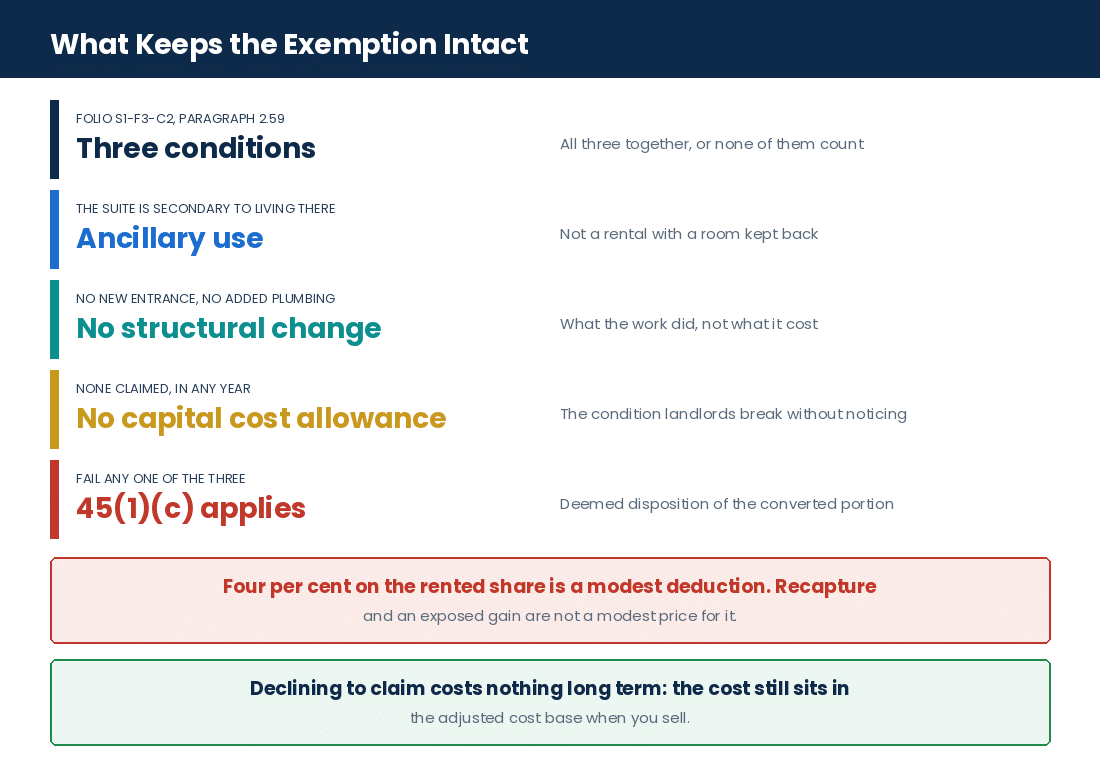
The decisive point is what CRA does not do. Under paragraph 2.59 of Income Tax Folio S1-F3-C2, CRA will not apply the partial change-in-use rule where all three of the following hold together:
- the income-producing use is ancillary to the main use of the property as a residence
- there is no structural change to the property
- no capital cost allowance is claimed on it
Fail any one of the three and paragraph 45(1)(c) deems a disposition of the converted portion at its proportionate fair market value, with a reacquisition at the same amount. From that point the rented share is on its own clock for capital gains purposes.
A couple in North York had finished their basement properly — separate entrance cut through the foundation, second kitchen, its own furnace zone — and asked us whether they could still rely on the ancillary-use position. They could not, and the honest answer was that the work had settled the question before they asked it. The right response was not to pretend otherwise but to establish the value at the date of the change while the evidence was fresh: two appraisals and a dated photographic record. The deemed disposition under paragraph 45(1)(c) produced a modest gain at the time, which was the point. Fixing the cost base then meant the rented share of the eventual gain was measured from a documented number rather than a reconstruction eight years later. Figures changed for privacy.
Key Differences Between Basement Suites and Other Rental Property Types
When it comes to tax rules, basement suites differ from other rentals in some important ways:
- Change in use operates on a portion rather than the whole, under paragraph 45(1)(c), and the deemed proceeds are the fair market value of that portion
- Ancillary use means the rental remains closely tied to your main home with no major changes, which is what preserves the exemption across the whole property
- Structural change makes the rules stricter, and a separate entrance cut into the foundation or a second kitchen installed where none existed is the kind of work CRA has in mind
- Since 19 March 2019 the election under subsection 45(2) has been available on a partial change in use, letting you elect that the deemed disposition not apply where part of a principal residence is converted to income-producing use. Subsection 45(3) does the reverse, deferring the deemed disposition until the property is ultimately sold where part of an income-producing property becomes a principal residence
Knowing these differences helps homeowners rent basements smartly and take proper advantage of benefits allowed by Canadian tax laws.
Eligible Rental Expenses and Tax Deductions
Deductions
Eligible Rental Expenses and Tax Deductions for Basement Apartments
If you rent out a basement apartment in Canada, you can deduct certain expenses from your rental income. This lowers the tax you pay on that income. Knowing which basement apartment tax deductions Canada allows is key to filing correctly and not missing savings.
Rental Property Expenses Landlords Can Deduct
You must report all rental income from your basement apartment. You can then subtract expenses tied directly to earning that income. Common deductible costs include:
- Property taxes
- Insurance
- Utilities
- Mortgage interest linked to the rented part
- Repairs and maintenance
- Advertising for tenants
- Professional fees like accounting or legal help
Only costs that relate to the rental are deductible, and they go on Form T776 when filing with your personal return.
Current Versus Capital Expenses: How to Classify Basement Apartment Costs
Expenses fall into two groups.
Current expenses keep things working without adding lasting value. You write them off in full the year you pay them. Fixing a leaky pipe or repainting walls counts here.
Capital expenses improve the property or add something that was not there. Paragraph 18(1)(b) denies a current deduction for an outlay on account of capital, so the cost joins the building’s Class 1 pool and is recovered through capital cost allowance instead — which, on an owner-occupied home, is a pool you may well decide never to claim from.
Building a new entrance or putting in plumbing for a new basement unit is capital spending, and it is also exactly the kind of structural change that costs you the ancillary-use position described in section one. The classification question and the exemption question are the same question on this file.
Prepaid Expenses Related to Basement Rentals and Their Treatment
Some expenses, like insurance premiums paid upfront for future coverage, are not fully deducted at once. Spread them over the period they cover.
Mortgage interest applies only to the rented part of your home. Work out the portion using floor area or another fair method you can prove, and use that same method for every shared cost and in every year.
A client in Etobicoke had been apportioning by room count because it was easier than measuring: four rooms upstairs, two down, so a third of everything. The basement suite was about 480 square feet in a house of roughly 2,100, which is closer to 23 per cent. Across three years that was about $4,100 of over-claimed interest, property tax and utilities. We measured the suite, filed T1 adjustments for the three years rather than wait for a review, and put the floor plan in the permanent file. Room count is a defensible basis in principle. It was simply the wrong one for this house, and nobody had checked it against the tape measure. Figures changed for privacy.
Advertising, Insurance, Interest and Bank Charges
Here is what you can deduct where it relates directly to renting your basement:
- Advertising costs aimed at finding tenants
- Insurance premiums covering tenant risks, prorated across the coverage period
- Mortgage interest, apportioned on the same basis as your other shared costs — interest only, never principal
- Bank fees related only to rent payments
Loan fees used to get financing for your rental suite — application, appraisal, insurance, brokerage and the related legal fees — are deducted over five years at 20 per cent a year under paragraph 20(1)(e), apportioned to the rented share. If you repay the loan early, the remaining balance is deductible in that year.
Keep good records like invoices and receipts, and use floor space or another reasonable method for dividing costs where your home is partly rented.
Office, Professional, Legal, Accounting and Management Fees
Fees paid for professional help connected with managing your rental are deductible. This includes:
- Accounting fees for preparing Form T776
- Legal advice tied to tenancy issues
- Management fees charged by property managers
Where fees relate directly or indirectly to earning the rent, they qualify as deductions against rental income.
Repairs, Maintenance and Landscaping Costs
Routine repairs inside your rented basement are current expenses and fully deductible. This covers fixing broken fixtures or small repairs needed to keep things safe and livable.
Landscaping costs are deductible only in the year you actually pay them, even if you otherwise report rental income on the accrual basis, and the rented share is the deductible part where the grounds are shared.
Major upgrades are capital expenses instead and follow the capital cost allowance rules rather than immediate deduction.
Salaries, Wages, Benefits and Employer Contributions
If you hire people just for the rental — a cleaner working only in the basement suite, say — their pay is a deductible expense, including employer contributions such as CPP and EI remittances.
Where someone splits time between the rental and your own household tasks, keep records showing hours worked specifically for rental activities. Only those hours qualify.
Property Taxes, Utilities, Travel and Motor Vehicle Expenses
Property taxes are deducted based on how much of your home is rented versus used personally. Use a consistent method each year, usually floor area. Utilities like electricity, heating and water are split the same way where tenants use part of those services, or on metered consumption where the suite is separately metered.
Motor vehicle expenses are far more restricted than most landlords expect. Where you earn income from one rental property in your general area, CRA allows them only where you do some or all of the repairs yourself and use the vehicle to carry tools and materials to the property. Travel to collect rent is a personal expense and is not deductible. The wider allowance — collecting rents, supervising repairs, managing the property — applies only where you own two or more rental properties at a minimum of two separate sites away from your principal residence. For a basement apartment inside your own home, there is usually no travel to claim at all, and a mileage log built on the assumption that there is will not survive a review.
A client in Brampton had kept a careful mileage log for three years — about 4,200 kilometres a year, roughly $2,600 of claimed expense annually — covering trips to collect rent, to the bank to deposit it, and to meet a property manager. The log was meticulous and almost none of it qualified. He had one rental property, in his own house, and on a single-property file CRA allows motor vehicle costs only for carrying tools and materials to do repairs himself. We removed the claim going forward and adjusted the open years rather than wait for the question to be asked. The discipline was admirable. It was simply applied to a deduction that was never available. Figures changed for privacy.
Joint Ownership and Business Use of Vehicles
Where two or more people own a rental together and share vehicles used partly for managing it, costs must be divided fairly between personal use and business travel, within the restriction just described. Documenting usage percentages matters when vehicles serve both purposes, so each owner’s share is clear if CRA reviews the file.
Lease Cancellation Payments and Condominium Fees
A payment you make to cancel a lease is not deducted in full in the year you pay it. It is prorated across the days remaining on the lease: in the year of payment, the payment multiplied by the days left in that year divided by the days left on the lease, and the same proration in later years. A payment a tenant makes to you to get out of a lease is rental income instead. Refundable deposits are neither, until they are forfeited.
Condominium fees paid regularly are deductible but should be allocated on the same basis as your other shared costs, reflecting the rented portion only.
All operating expenses claimed must have clear proof linking them directly to earning rental income, under paragraph 18(1)(a), and interest is deductible under paragraph 20(1)(c). Keep notes explaining how you split each expense alongside the receipts themselves. The split is the part CRA asks about, and it is the part almost nobody documents.
Classifying costs correctly and keeping the records to back the split lowers your risk while making sure you get every legal deduction available on a basement apartment. For help with your own file, contact Gondaliya CPA at 647-212-9559 or info@gondaliyacpa.ca for a free consultation.
Maximizing Tax Savings With Strategic Planning
Planning
Maximizing Tax Savings With Strategic Basement Apartment Tax Planning
If you rent out a basement apartment in Canada, you need to handle the taxes right. Basement apartment tax planning Canada means reporting rental income properly, figuring out which expenses count, and deciding whether capital cost allowance belongs in your file at all. Good records keep you inside CRA rules without raising flags.
Capital Cost Allowance on a Basement Rental: The Decision That Matters Most
Capital cost allowance lets you write off part of your building’s value each year. For basement rentals, Class 1 applies at four per cent on a declining balance, so the amount you claim shrinks over time.
The half-year rule applies too. Under Regulation 1100(2), in the year you acquire or add to an asset you claim only half the usual amount. If you have just built or upgraded your basement suite, expect a smaller deduction in year one.
Then comes the question that decides the file. Should you claim it at all? On a property you live in, usually not. Claiming capital cost allowance breaks the third of the three conditions in paragraph 2.59 of the folio, which is what was preserving the principal residence exemption across the whole property. You trade a deduction worth a few hundred dollars a year against exposure on a gain that may run to six figures, and the trade is rarely close.
Costs to build or fix up your basement rental go into the building’s cost base rather than being current expenses. They accumulate there whether or not you ever claim against them — which means declining to claim capital cost allowance costs you nothing in the long run, because the cost still sits in the adjusted cost base when you sell.
An Ontario homeowner rents the basement and claims no capital cost allowance. The suite is ancillary to living there, nothing structural was changed, and the third condition holds. The home keeps its full principal residence exemption on sale. The same homeowner claiming four per cent on a rented portion of $150,000 would deduct $3,000 in a full year, worth perhaps $1,200 at a middling marginal rate — and would surrender ancillary-use status, face recapture under subsection 13(1) of everything claimed, and expose the rented share of the gain.
Accurate Expense Allocation Between Personal Use and Rental Areas
Where you share space between living and renting, dividing expenses correctly is key. CRA expects expenses split on how much of the property is rented versus used personally. Common bases include floor area in square feet and number of rooms — floor area is usually the more defensible of the two, because rooms vary enormously in size. Keep evidence such as property plans or measurements to back it up.
| Expense Type | How to Split | What You Can Deduct |
|---|---|---|
| Property taxes | Floor area ratio | Percentage of rented space |
| Insurance | Same basis as the other shared costs | Pro-rated share, across the coverage period |
| Utilities | Metered where separate, otherwise floor area | Tenant’s actual or apportioned consumption |
| Repairs | Direct vs general | Tenant-specific repairs in full, shared repairs apportioned |
| Mortgage interest | Same basis as the other shared costs | Interest only, never principal |
Avoiding Common CRA Mistakes on Basement Apartment Deductions
A lot of landlords report net rent instead of total rent received. CRA wants gross rent declared before any deductions, with the expenses shown separately.
Missing records for the expense split is the next most common. Without proof of the basis, CRA may deny the claim outright.
Some claim capital cost allowance without thinking about the principal residence exemption. The claim is made year by year, but its effect on ancillary-use status is not easily undone, and the consequences land at the sale.
What the Loss Rules Actually Say
Ordinary expenses can leave you with a rental loss, and that loss is applied against your other income for the year, including employment income. What cannot create or increase a rental loss is capital cost allowance, which Regulation 1100(11) restricts to the amount of net rental income before the claim. The distinction matters: the restriction is on the allowance, not on your expenses. A landlord who suppresses legitimate deductions out of a belief that a rental loss is forbidden is leaving money on the table.
Where the property’s use changes, CRA treats it as a deemed disposition of the converted portion under paragraph 45(1)(c), unless the ancillary-use conditions hold or an election under subsection 45(2) is filed.
Failing to report income can lead to penalties. A voluntary disclosure must be made before CRA begins any enforcement action, and relief from penalties and interest reaches back ten calendar years from the year the request is made under subsection 220(3.1). Once CRA has contacted you about the unreported rent, that route is closed.
The Role of Professional Advice
Whether to file yourself or hire a CPA depends on complexity. Multiple years of unreported rentals, a renovation that may have been structural, or a sale in prospect all make professional help worth the fee. Gondaliya CPA works with Ontario homeowners who rent parts of their homes, on fixed-fee services covering bookkeeping and tax filing under current law.
Short-Term Basement Suites Versus Long-Term Leases
Short-term basement rentals often require charging GST/HST, because the exemption in the Excise Tax Act covers residential leases of one month or more. Stays shorter than that fall outside it. For short stays, input tax credits become available and relevant, unlike typical long-term leases where GST/HST does not apply at all. The $30,000 small supplier threshold still governs whether you must register.
Corporate Versus Personal Ownership
This guide looks at personal ownership, where the principal residence exemption is in play. Owning through a corporation changes the analysis substantially: there is no principal residence exemption, the income is taxed in the corporation at rates that depend on its character, and getting the money out carries its own tax. That is a different conversation and is not covered here.
Capital Gains on Sale of a Home With a Rented Basement
When selling a home with a rented basement, the personal-use part qualifies for the principal residence exemption under the formula in paragraph 40(2)(b), and where the three ancillary-use conditions have held throughout, so does the whole property.
If you claimed capital cost allowance, watch for recapture under subsection 13(1): CRA adds the previously claimed amounts back as ordinary income in the year of sale, taxed at your full marginal rate, on top of any taxable capital gain on the rented share.
Proper calculations and clear records are essential here to avoid surprises when filing the return for the year you sell.
Basement Apartment Landlord Tax Check
Five quick questions on where your rental file stands. No fee shown.
Points to raise with us:
This is a general prompt, not tax or legal advice or a quote. Your position depends on your full facts. For a real review, please book a free consultation.
Filing Basement Rental Income Taxes Efficiently
Filing
Filing Basement Apartment Rental Income Taxes Efficiently
Reporting basement apartment rental income means listing all rent received and noting related expenses clearly. In Canada you report gross rental income on your tax return and claim allowable expenses against it. Doing this right follows CRA rules and cuts down the chance of review.
Required Forms and Documentation
The key form is T776, the Statement of Real Estate Rentals. It shows the total rent you received, your expenses, any capital cost allowance claimed, and net rental income or loss.
Keep these documents safe:
- Lease agreements or rent receipts
- Bank statements showing rent deposits
- Bills for repairs, maintenance and utilities linked to the rented space
- Property tax bills and insurance for the rented part
- Mortgage interest statements, showing interest separately from principal
- A floor plan with measurements, supporting your apportionment basis
Good records back up your numbers if CRA asks for proof. The floor plan is the one most landlords skip and the one most often asked for.
Step-by-Step Guide to Filing Basement Apartment Rental Taxes
- Gather all rent records from the year and report total gross rent first.
- Fill out Form T776 with gross rents under Rental Income. List expenses separately.
- Apportion shared costs on your chosen basis — usually floor area — and use the same basis you used last year.
- Decide whether to claim capital cost allowance on the rented portion, knowing what it does to your principal residence exemption. On an owner-occupied home the answer is usually no.
- Subtract allowed expenses from gross rents to find net rental income or loss. Remember that capital cost allowance cannot create or increase a loss.
- Carry the net amount from line 9946 of Form T776 to line 12600 of your personal T1 return, with gross rents on line 12599.
- Keep all paperwork for at least six years after filing, as CRA requires.
Following these steps helps with proper basement apartment tax planning in Canada and avoids the mistakes that cause reviews. [CRA Guide T4036: Rental Income]
A Hamilton client had been filing his own returns for six years and had put net rental income on Schedule 4 each time, alongside his investment income. The software had accepted it, CRA had never written, and the totals happened to come out close enough that nothing was flagged. It only surfaced when he sold the house and the prior-year figures had to be reconciled for the disposition. We refiled six years so that the rental figures sat on lines 12599 and 12600 where they belong, which also meant his gross rents finally matched what a reviewer would expect to see. No tax changed in any of the six years. The point is that a return can be wrong in a way that costs nothing for years and then costs a great deal in the one year it matters. Figures changed for privacy.
Claiming Rental Expenses: Best Practices and Common Pitfalls
When claiming basement apartment tax deductions in Canada, separate everyday costs from capital ones. Allowable expense types include:
- Property taxes, on the rented share
- Insurance premiums covering landlord risks
- Utilities paid by the landlord relating to tenant use
- Repairs fixing existing conditions, but not upgrades
- Advertising fees to find tenants
| Mistake | Why It’s Wrong |
|---|---|
| Claiming the full mortgage payment | Only the interest is deductible, under paragraph 20(1)(c). Principal builds your cost base instead. |
| Calling renovations repairs | An outlay on account of capital is denied as a current expense by paragraph 18(1)(b), and recovered through CCA instead. |
| Overstating the expense share | Use a method you can evidence, usually floor area, rather than a guess or a round number. |
| Creating a loss with CCA | Capital cost allowance cannot create or increase a rental loss, under Regulation 1100(11). |
| Claiming motor vehicle costs to collect rent | Travel to collect rent is personal. On one property, only hauling tools and materials for repairs you do yourself qualifies. |
Clear records explaining each expense portion help you stay compliant during a review.
Accounting Software Versus Professional CPA Support
Accounting software makes tracking basement apartment rental taxes easier but can miss the Canadian rules that matter here. Software is good at automating calculations, sorting expenses by type, and connecting with tools like QuickBooks or Xero.
What it will not do is tell you that claiming capital cost allowance has just cost you ancillary-use status, or that your apportionment basis changed between years. Those judgements are where a CPA earns the fee:
- Advice matched to current law, including the change-in-use rules and the elections
- A view on whether a renovation was structural
- Returns prepared so that they stand up if reviewed
Ontario landlords renting out suites in places like Toronto or Hamilton find this worth more than the software saves.
Record Keeping to Support Claims During a CRA Review
- Keep separate logs showing monthly rent payments with dates
- File invoices clearly marked as repair or improvement, with a note on what the work did
- Write down how you split expenses, with the floor plan or measurements behind it
- Save documentation of any major changes to the property
- Back up electronic copies alongside paper files
Hold these records for six years after filing. Organized files make a review straightforward by showing how each deduction was arrived at.
Non-Resident Landlord Obligations
Non-resident landlords face a different regime. Tax of 25 per cent is withheld on the gross rent and remitted to CRA, with no deduction for expenses. Filing Form NR6 before the first rental payment of the year, with a Canadian agent undertaking to remit, allows withholding on the net amount instead, and the landlord then files a return under section 216 to report the rental income on a net basis. This is outside most resident landlord cases but matters a great deal where it applies.
When to Contact a Tax Professional
Calling early helps with the decisions that cannot easily be reversed:
- Before your first year of reporting, to set the apportionment basis and decide the capital cost allowance question
- Before finishing renovations, to check whether the work is structural
- Before selling, to work through the principal residence exemption
Talking early means decisions get documented while the facts are fresh. Gondaliya CPA works across Ontario providing advice on residential rental taxation. For help with basement apartment taxation under current Canadian law, contact us at 647-212-9559 or info@gondaliyacpa.ca for a free consultation.
Unique Scenarios and Complexities
Edge Cases
Addressing Unique Scenarios and Complexities in Basement Apartment Taxation
If you rent out a basement apartment, tax planning in Canada gets tricky at the edges. You have to report income correctly, claim the right deductions and follow the change-in-use rules. Doing this well helps you avoid problems and pay only what you owe.
Basement Rentals in Multi-Unit Properties and Secondary Suites
Renting a basement in a multi-unit building or as a secondary suite means splitting income and expenses fairly. Report rental income using Form T776. Expenses like utilities, property tax, insurance, repairs and mortgage interest are divided on floor area or another basis you can defend.
The principal residence exemption covers the part you live in, and covers the whole property where the three ancillary-use conditions hold. Where they do not, paragraph 45(1)(c) applies to the converted portion.
- Report rental income in full, before expenses
- Apportion shared costs by floor area
- Think hard before claiming capital cost allowance if you want the exemption preserved
For example: renting 30 per cent of the home’s space, with no structural renovation and no capital cost allowance claimed, means reporting 30 per cent of the shared expenses against the rental income while the property remains a principal residence throughout.
Vacant Land and Condominium Basement Units
Renting vacant land near your home, or a condo basement unit, works differently from the usual case.
Rent from vacant land is generally income from property rather than business income, and the restriction that matters is subsection 18(2): interest and property taxes on vacant land are deductible only against the income the land produces and cannot create or increase a loss. The excess is added to the cost base instead.
Condominiums carry shared costs such as maintenance fees. Split these on the same basis as your other shared expenses before claiming them.
Motor Vehicle Expenses and What a Basement Landlord Can Actually Claim
This is where expectations and the rules diverge most sharply. CRA’s position in Guide T4036 distinguishes two cases.
Where you earn income from one rental property in your general area, motor vehicle expenses are deductible only where you personally do some or all of the repairs and maintenance and use the vehicle to carry tools and materials to the property. Travel to collect rent is a personal expense and is not deductible.
Where you own two or more rental properties, at a minimum of two separate sites away from your principal residence, the wider allowance applies and reasonable costs of collecting rents, supervising repairs and managing the properties become deductible.
A basement suite inside the home you live in is the clearest case of the first category, and usually of neither — there is no journey to the property to claim. Where you do drive to collect materials for repairs you carry out yourself, keep a log with dates, destinations and distances. Without it the claim will not hold, and with it the claim is still limited to those trips.
A mileage log built on the assumption that trips to the hardware store, the bank and the property manager are all deductible will not survive a review on a single-property file. The restriction is not about documentation. It is about which trips qualify at all, and on an owner-occupied basement suite most of them do not.
Lease Structures, Loan Fees and Interest Expenses
Lease terms affect when rent is recognised rather than how expenses are deducted. Loan fees taken out to finance your rental suite are amortised over five years at 20 per cent a year under paragraph 20(1)(e) — neither expensed at once nor added to the building’s capital cost.
Mortgage interest is split between personal living space and rented space on your usual basis. Keep loan statements to support it.
- Lease terms affect income timing more than deductions
- Amortise loan fees over five years under 20(1)(e)
- Deduct mortgage interest on the tenant share, never the principal
The key is a reasonable apportionment backed by clear records.
A Toronto client refinanced to finish a basement suite and deducted the full $4,800 of appraisal, broker and legal fees in the year he paid them, against about $9,000 of rent. The deduction was roughly five times what the year actually allowed. Under paragraph 20(1)(e) the fees come off at 20 per cent a year, and only the rented share of them — about $220 a year on his apportionment, not $4,800 all at once. We corrected the year, set up the five-year schedule, and the remaining four years ran through the returns as they should. He had assumed that because the borrowing was for the rental, the cost of borrowing was a rental expense of that year. It is a rental expense. It is just spread. Figures changed for privacy.
Current Versus Capital on Renovations and Improvements
You have to tell current expenses apart from capital ones when renovating a basement rental. Repairs fix things without adding lasting value — patching a leak, say — and are deducted right away. Capital expenses improve the property or add something new, and join the Class 1 pool for recovery through capital cost allowance.
How you classify affects whether you save tax now or later, since it changes your adjusted cost base. On a basement suite it affects something larger: structural work is one of the three things that costs you ancillary-use status, whatever you do with the invoice.
For example: replacing carpet used by tenants is a repair and a current expense. Installing new plumbing lines to enable a separate entrance is a capital improvement and almost certainly a structural change, even where it is done at the same time as ordinary repairs.
Short-Term Rentals Within Basement Apartments
Renting your basement short-term brings GST/HST into play. Residential leases of one month or more are exempt. Shorter stays are not, and where your taxable revenues exceed the $30,000 small supplier threshold you must register and collect.
Report all gross short-term rental income on Form T776 as well. Keep clear records separating short stays from longer ones, because the two are treated differently and a mixed year needs both sets of numbers.
A landlord in Ottawa ran his basement suite on short stays of a week or two through the summer and long tenancies through the winter, and had treated the whole year as exempt residential rent. The short-stay revenue was about $34,000 across two years, over the $30,000 threshold, and should have carried GST/HST. We registered him, filed the returns, and recovered input tax credits on the furnishing and cleaning costs attributable to those stays, which took a meaningful bite out of the arrears. The lesson he took from it was to keep the two streams in separate ledgers from the first booking, which is what he does now. Figures changed for privacy.
Minimizing Rental Income Tax While Staying Compliant
- Keep detailed records of all rent received plus every invoice for claimed costs
- Split shared household bills on one reasonable basis, usually floor area, and keep to it
- Think twice before claiming capital cost allowance; on an owner-occupied home it usually costs more than it saves
- Separate repairs, deducted now, from improvements, capitalised
- Consider the election under subsection 45(2) where a partial change in use has occurred
Getting advice before a renovation or a sale is worth more than getting it after, because the change-in-use position and the valuation evidence are both easier to establish at the time than in hindsight.
If you want advice made for your own case — whether about lease types or renovations affecting basement apartment tax planning in Canada — contact Gondaliya CPA at info@gondaliyacpa.ca or 647-212-9559 for a free consultation.
Resources, Compliance Tips and Support
Resources
Additional Resources, Compliance Tips and Support for Basement Apartment Landlords
Official CRA Publications and Forms
The CRA offers the key publications and forms landlords need. Form T776 reports gross basement rental income along with eligible expenses. Guide T4036, Rental Income, explains the tax rules and what deductions you can claim, including the motor vehicle restriction and the treatment of lease cancellation payments and landscaping. Income Tax Folio S1-F3-C2 sets out CRA’s position on principal residences, including the three ancillary-use conditions at paragraph 2.59.
Landlords should check these resources regularly. They explain how to report rent, divide expenses between your home and the rented space, and handle capital cost allowance on residential property.
Practical Reminders for Staying Compliant
Managing basement apartment tax planning in Canada means paying attention to details. Many landlords miss rental income or claim expenses not related to the rental area. To avoid these problems:
- Always report your total rent accurately each year, before expenses
- Split shared costs like utilities and property taxes on one basis, and keep to it
- Know the difference between a repair, deducted now, and an improvement, capitalised
- Keep all receipts sorted by expense type, with a note on the split
- Remember that claiming capital cost allowance affects your principal residence exemption
A client in Mississauga had rented her basement for nine years and reported none of it, on the understanding from a neighbour that rent from your own home is not taxable. She came to us when she wanted to sell. We filed a voluntary disclosure covering all nine years before CRA had made any contact, which kept the penalties off and limited the exposure to the tax and interest. Roughly $62,000 of rent went onto returns that had never shown it, and because she had never claimed capital cost allowance, the principal residence exemption held across the whole property on the sale. The gap in the file was real and it cost her. It would have cost several times more had CRA written first. Figures changed for privacy.
When and Why to Hire a Tax Accountant Specializing in Rental Properties
A CPA who knows basement suites understands the change-in-use rules, the expense split, and what claiming capital cost allowance does to your exemption. They make sure your filings follow current CRA rules and spot the decisions that will matter at the sale rather than only this year.
If you rent part of your main home, in Ontario or elsewhere, talking with a professional before filing — and particularly before renovating or selling — is where the value is.
Gondaliya CPA’s Approach to Basement Apartment Tax Planning
At Gondaliya CPA Professional Corporation in Ontario, we handle basement apartment landlord accounting with care. Our process covers:
- Checking whether your situation risks a change in use or fits the ancillary-use conditions
- Setting an expense split on the facts — measurements and floor plan, not assumptions
- Reviewing whether claiming capital cost allowance suits your long-term plans, given what it does to the exemption
- Preparing accurate T776 forms showing full rent plus properly apportioned expenses
- Catch-up filings, including voluntary disclosures, where previous rental income was not reported
We work to keep the file consistent year to year, which is what makes it defensible when a sale or a review eventually puts it under scrutiny.
Staying Updated on Changes to Rental Income Tax Rules
- CRA’s real estate rentals pages, updated online
- Annual updates in guides like T4036
- CRA notices of changes affecting rental reporting
- Newsletters from Canadian accounting bodies on personal tax
- Workshops or sessions from firms focused on landlord tax issues
Documenting Rental Activities Systematically
Good recordkeeping is what makes the deductions stick:
- Log rent collected every month, backed by bank deposits
- Sort bills into categories, marking those used only by tenants
- Keep the mortgage statements that separate interest from principal
- Hold contracts and permits for any renovation that could change the property’s status
- Keep dated photographs and a floor plan supporting fair market value and the apportionment
This kind of documentation supports accurate filings and strengthens your position in a review, which matters most for landlords holding a property across many years.
Final Recommendations
- Declare total gross rent earned, however small, to reduce review risk
- Use consistent methods each year when dividing shared expenses, and document any change
- Separate repair costs from improvements so you do not lose an immediate deduction
- Think twice before claiming capital cost allowance, because recapture and the exemption both follow from it
- Keep strong evidence of property value where a partial change in use applies
- Get advice before major renovations that might count as structural
Need help with basement apartment tax planning in Canada? Contact Gondaliya CPA at 647-212-9559 or info@gondaliyacpa.ca for a free consultation focused on owners renting parts of their homes.
Frequently Asked Questions
FAQs
Frequently Asked Questions on Basement Apartment Tax Planning in Canada
What triggers a change in use for a basement apartment rental?+
A change in use occurs when you switch part of your home from personal use to rental or back again. Under paragraph 45(1)(c) this deems a disposition of the converted portion at its proportionate fair market value, with a reacquisition at the same amount. CRA will not apply it where all three conditions in paragraph 2.59 of Income Tax Folio S1-F3-C2 hold: the rental use is ancillary, there is no structural change, and no capital cost allowance is claimed.
How does the principal residence exemption formula work with basement rental gains?+
The formula in paragraph 40(2)(b) is A × (B ÷ C): A is the gain otherwise determined, B is the number of years the property was designated as your principal residence plus one, and C is the number of years you owned it. The plus one accounts for the year of acquisition. Where the three ancillary-use conditions have held throughout, the whole property qualifies. Claiming capital cost allowance breaks the third condition and brings the rented share into the tax net.
What is the half-year rule and how does it affect claims?+
Regulation 1100(2) limits the claim on an addition to half the normal amount in the year the asset becomes available for use. On a basement suite it applies to the rented portion of the building in Class 1 and to any appliances in Class 8. It matters less here than on other rentals, because on an owner-occupied home the better answer is often to claim nothing at all.
Does GST/HST apply to basement apartment rentals?+
Residential leases of one month or more are exempt from GST/HST. Short-term rentals of less than a month are not, and where your taxable revenues exceed the $30,000 small supplier threshold over four consecutive quarters you must register and collect. A year mixing short and long stays needs both sets of records kept separately.
When is rental income reported, and when is the tax due?+
Rental income is reported annually with your personal T1 return, due 30 April, or 15 June where you or your spouse carried on a business. Any balance owing is still due 30 April in either case, and interest runs from 1 May. Quarterly instalments are required where your net tax owing is more than $3,000 — $1,800 for Quebec residents — in the current year and in either of the two preceding years.
Can I create a rental loss with capital cost allowance?+
No. Regulation 1100(11) restricts the claim to the net rental income before the allowance, so it can reduce that income to nil but cannot take it below. Ordinary expenses are different: they can produce a rental loss, and that loss is applied against your other income for the year, including employment income.
When should I consider a voluntary disclosure for unreported basement rent?+
Before CRA contacts you about it. The programme requires the disclosure to be made before any enforcement action begins, and relief from penalties and interest reaches back ten calendar years from the year of the request under subsection 220(3.1). Once CRA has written, that route is closed and the penalties apply.
What does ancillary use mean in practice?+
That the rental remains secondary to your use of the property as a home. A suite occupying a modest share of a house you live in is ancillary. A property where the owner occupies one small room and rents the rest is not, whatever the floor plan is called. It is one of three conditions, and all three have to hold together for the exemption to stay intact across the whole property.
What commonly triggers a CRA review of a basement apartment file?+
Large deductions unexplained by the rent, an apportionment share that changes between years without reason, reporting net rather than gross rent, motor vehicle claims on a single-property file, and a disposition where the prior-year rental figures do not reconcile. The last is the one that catches people, because it surfaces years of filings at once.
Essential Points for Basement Landlords
Key Points
Essential Points on Managing Basement Apartment Taxes
- The exemption outweighs the deduction: on an owner-occupied home, what capital cost allowance saves each year is usually a fraction of what it costs at the sale.
- Three conditions, not two: ancillary use, no structural change, and no capital cost allowance. All three, together, under paragraph 2.59 of the folio.
- Recapture on sale: capital cost allowance claimed is added back as ordinary income under subsection 13(1), on top of the taxable gain on the rented share.
- Apportionment memo: keep a short written note of how you split costs and why, alongside the floor plan. It is the document CRA asks for and the one landlords rarely have.
- Gross, not net: report total rent received before expenses, with each expense on its own line.
- Interest, not principal: only the interest portion of the mortgage is deductible, and only the rented share of it.
- Financing fees over five years: paragraph 20(1)(e), at 20 per cent a year, not deducted in full when paid.
- Motor vehicle claims are narrow: on a single property, only hauling tools and materials for repairs you do yourself. Collecting rent is personal.
- Instalments: required where net tax owing exceeds $3,000 in the current year and either of the two preceding years, on 15 March, 15 June, 15 September and 15 December.
- Records for six years: leases, rent logs, invoices marked repair or improvement, mortgage statements and the floor plan.
- Mistakes to avoid: underreporting rent, overclaiming the shared portion, claiming capital cost allowance without weighing the exemption, and recordkeeping thin enough that the split cannot be evidenced.
- Before the work starts: confirm whether any change was structural, settle the expense allocation, decide the capital cost allowance question, and gather the leases.
Practical Tips for Managing Basement Apartment Rental Taxes
- Measure the suite properly before the first return, not after the third
- Decide the capital cost allowance question once, in writing, with the sale in view
- Mark every invoice at the time with what the work actually did
- Keep short-stay and long-stay income separate if you do both
- Get advice before a renovation that might be structural, not after
DIY, Non-CPA Help and a CPA Firm Compared
Filing yourself risks the errors that cost most here: capital cost allowance claimed without understanding its effect on the exemption, an apportionment basis that drifts between years, net rent reported instead of gross, and motor vehicle claims that do not qualify. Non-certified preparers handle the arithmetic but rarely raise the change-in-use question, which is the one that decides the file. A CPA firm brings a view on whether a renovation was structural, whether the election under subsection 45(2) should be filed, and what the file will look like when the property is eventually sold.
Choosing a CPA Firm in Ontario
Look for experience with residential rentals specifically rather than business clients generally, current knowledge of the change-in-use rules, transparent fees quoted before the work begins, and a willingness to say that a deduction is not available. On this file the most valuable advice is usually advice not to claim something.
Why Trust Gondaliya CPA?
Gondaliya CPA Professional Corporation is a registered Ontario CPA firm, performing compilation engagements under CSRS 4200. Sharad Gondaliya, CPA, is licensed in Ontario and in Washington and Montana. We work with homeowners renting suites across Toronto, Hamilton, Mississauga and the rest of Ontario, on a flat annual fee including HST quoted before any work begins, with a one-business-day response.
Businesses We Serve & Industry Spotlights
Industry Expertise
Basement apartment owners sit inside a wider group of small landlords, and the questions that decide one of these files — how shared costs get split, whether work counted as structural, and whether to claim the allowance at all — recur across every one of these situations.
| Who | The Landlord Angle |
|---|---|
| Basement apartment owners | Part-use of a principal residence and the change-in-use rules |
| Rental property owners | Form T776, current versus capital, and recapture on sale |
| Duplex and triplex owners | Apportioning shared costs, and buildings below the separate-class threshold |
| Student rental owners | Turnover, furnishing costs and short occupancy cycles |
| Multi-residential building owners | A separate CCA class per building once $50,000 is passed |
| Commercial landlords | Taxable rent and a different GST/HST position entirely |
| Foreign investors in Canadian real estate | Part XIII withholding and the section 216 election |
| Real estate syndicators | Partnership reporting and allocations among investors |
| Joint venture businesses | Co-ownership reporting without a partnership return |
| House flippers | Inventory and business income rather than capital property |
| Home-based businesses | Work space in the home under subsection 18(12) |
Spotlights: basement apartment owners · rental property owners · duplex and triplex owners · student rental owners · multi-residential building owners · commercial landlords · foreign investors in Canadian real estate · real estate syndicators · joint venture businesses · house flippers · home-based businesses.
Professional Guidance and Quick Reference
Guidance
Essential Tax Points for Canadian Basement Apartment Landlords
Basement suite files go wrong in a predictable set of ways: capital cost allowance claimed out of habit, taking the principal residence exemption down with it; an apportionment basis picked for convenience and never checked against a tape measure; mortgage principal deducted alongside the interest; financing fees taken in full in the year they were paid; a mileage log kept for trips that never qualified; rent reported net of nothing in particular; and, most expensively of all, rent not reported at all for years because the suite is inside the owner’s own house. Gondaliya CPA prepares small landlord returns on a flat annual fee.
Quick Answers
At a Glance
- Rent received: taxable, reported gross on Form T776
- Net rental income: line 9946 of T776 to line 12600 of the T1
- Gross rents: line 12599 of the T1
- Mortgage interest: deductible, 20(1)(c), rented share only
- Mortgage principal: never deductible, builds the cost base
- Financing fees: five years at 20% under 20(1)(e)
- Apportionment: floor area usually, same basis every year
- Repairs: restore to original condition, deducted now
- Improvements: capital, denied as current by 18(1)(b)
- Landscaping: deductible in the year paid, even on accrual
- Lease cancellation paid: prorated over the days left on the lease
- Motor vehicle, one property: tools and materials only, never rent collection
- CCA on the building: Class 1 at four per cent, and usually not worth claiming
- Half-year rule: Regulation 1100(2) on additions
- CCA and losses: Regulation 1100(11) bars creating or increasing one
- Ordinary rental loss: comes off your other income, salary included
- Ancillary use: folio S1-F3-C2 paragraph 2.59, all three conditions
- Partial change in use: paragraph 45(1)(c), elections at 45(2) and 45(3)
- Exemption formula: paragraph 40(2)(b), A × (B ÷ C)
- Recapture: subsection 13(1), ordinary income in the year of sale
- GST/HST: exempt at one month or more, $30,000 threshold otherwise
- Instalments: net tax owing over $3,000, quarterly
- Records: six years after filing
Who This Is For / Not For
Fit Check
- For: homeowners renting a basement apartment or secondary suite inside the home they live in, reporting on Form T776 with a personal return.
- For: landlords unsure how to split shared costs, whether a renovation counted as structural, or whether claiming capital cost allowance is worth what it does to the principal residence exemption.
- Not for: provincial tenancy law, rent regulation, municipal zoning or secondary suite licensing, each handled separately, and this article takes no position on whether a given suite is legal where you live.
- Not for: rentals held through a corporation, where there is no principal residence exemption and the analysis is different throughout.
People Also Ask
Related Questions
Do I really have to report rent from my own basement?+
Yes. Rent from a suite in the home you live in is income from property like any other, reported gross on Form T776 and carried to line 12600. The belief that rent from your own home is somehow outside the system is the most expensive misunderstanding on this file, because the unreported years accumulate quietly and then surface all at once when the house is sold.
Will renting the basement cost me my principal residence exemption?+
Not by itself. CRA will leave the exemption intact across the whole property where three conditions in paragraph 2.59 of Income Tax Folio S1-F3-C2 hold together: the rental use is ancillary to living there, there is no structural change, and no capital cost allowance is claimed. Renting the basement is not what breaks it. Gutting it into a separate unit, or claiming the allowance, is.
Should I claim capital cost allowance on the rented portion?+
On a home you live in, usually not. The rate is four per cent on the rented share, so the annual deduction is modest. Against it you give up the third ancillary-use condition, trigger a partial change in use, face recapture under subsection 13(1) on everything claimed, and expose the rented share of a gain that might otherwise have been entirely tax-free. The arithmetic rarely favours the claim.
How should I split the costs between my part and the tenant’s?+
On a basis you can evidence and then keep to. Floor area is usually the most defensible, because rooms vary enormously in size and a room count can be wildly off: a 480 square foot suite in a 2,100 square foot house is 23 per cent, not the third that two rooms out of six suggests. Measure once, write the basis down with a floor plan, and use the same fraction every year.
Can I deduct the drives to the hardware store and the bank?+
The hardware store, sometimes. The bank, no. Where you have one rental property in your general area, CRA allows motor vehicle expenses only for carrying tools and materials to the property for repairs you do yourself. Travel to collect rent is personal. The wider allowance covering rent collection and management applies only where you own two or more rental properties at separate sites away from your home, which a basement suite in your own house is not.
Glossary of Key Terms
Definitions
- Basement apartment: a self-contained dwelling unit in the lower level of a house the owner occupies.
- Secondary suite: a second dwelling unit within a single-family home.
- Ancillary use: income-producing use secondary to the property’s use as a residence.
- Structural change: alteration to the building itself, such as a new entrance or added plumbing.
- Partial change in use: paragraph 45(1)(c), deeming a disposition of the converted portion.
- Subsection 45(2) election: electing that the deemed disposition not apply on a conversion to income use.
- Subsection 45(3) election: deferring the deemed disposition until the property is sold.
- Principal residence exemption: the relief from tax on the gain, formula in paragraph 40(2)(b).
- Apportionment: splitting a shared cost between personal and rental use, usually by floor area.
- Current expense: a cost that restores or maintains, deducted in the year incurred.
- Capital expense: a cost that improves or adds, recovered through CCA instead.
- Capital cost allowance (CCA): the optional deduction spreading an asset’s cost over several years.
- Class 1: the CCA class for buildings, at four per cent.
- Half-year rule: Regulation 1100(2), halving the first-year claim on additions.
- Rental loss restriction: Regulation 1100(11), barring CCA from creating or increasing a rental loss.
- Recapture: subsection 13(1), CCA brought back into income on sale as ordinary income.
- Adjusted cost base (ACB): cost plus improvements and acquisition costs, used to compute the gain.
- Deferred or forfeited deposit: a tenant deposit, which becomes income only when forfeited.
- Form T776: the Statement of Real Estate Rentals, filed with a personal return.
- Voluntary disclosure: correcting unreported income before CRA begins enforcement action.
Want a checklist to work from? You can download our free basement apartment landlord tax checklist before your consultation.
Four things decide a basement suite file. Whether the exemption survives — the three conditions in paragraph 2.59 of the folio hold together or not at all, and the one landlords break without noticing is the third. Whether to claim capital cost allowance — a modest annual deduction at four per cent on the rented share, against recapture under subsection 13(1) and exposure on a gain that might otherwise have been tax-free. How the costs are split — measured, written down, and used the same way every year, because a basis chosen for convenience will not hold up and a basis that drifts between years invites questions about both. And whether the rent was reported at all — which is the gap that costs the most, and the one that only ever surfaces when the house is sold.
Three questions tell you where you stand, and the first one takes a tape measure. First, do you know the floor area of the suite and of the whole house? Without both there is no defensible split, and the room count most people use is usually wrong. Second, have you ever claimed capital cost allowance on the rental? If so the ancillary-use position is already gone and the sale needs planning now rather than later. Third, have all the rental years been reported? If any are missing, a voluntary disclosure made before CRA writes is a different outcome entirely from one made after.
Basement Apartment Taxes Canada: How Gondaliya CPA Can Help
Start with your floor plan and your mortgage statements
Gondaliya CPA tests your situation against the three ancillary-use conditions before anything else, sets an apportionment basis from measurements rather than assumptions and documents it, separates interest from principal off the mortgage statement, amortises financing fees over five years instead of deducting them at once, tests each renovation for whether it was structural as well as whether it was capital, advises on whether capital cost allowance belongs in the file at all given what it does to your exemption, considers the election under subsection 45(2) where a partial change in use has already occurred, handles catch-up filings and voluntary disclosures where rental years were missed, and prepares Form T776 with the T1 behind it — on a flat annual fee including HST with a one-business-day response. Please book a free consultation.
Next Steps
Please book a free consultation with Gondaliya CPA and bring four things: the floor area of the suite and of the house, your mortgage statements for the year, your invoices for any work done on the property, and the years in which the suite has been rented. Those four settle the apportionment, the interest deduction, the structural-change question and whether anything needs catching up — which between them account for nearly every difficulty we see on a basement suite file. If any rental years have gone unreported, say so at the outset; it is more common than people expect, it is fixable, and the fix is very much better made before CRA raises it than after. We advise on Canadian federal tax and GST/HST; provincial tenancy law, rent regulation, municipal zoning and secondary suite licensing are handled separately, and this article takes no position on whether a particular suite is permitted where you live. You will get a flat annual fee including HST before any work begins. We serve Toronto, Mississauga, Brampton, Vaughan, Etobicoke, Scarborough, Hamilton, Ottawa and the rest of Ontario, and work with homeowners across Canada. If our content helps, please add gondaliyacpa.ca as a preferred source on Google.
Published: · Last updated:
Editorial policy: We research against CRA, Department of Finance, Parliament of Canada, CPA Canada and CPA Ontario sources, fact-check the figures, and Sharad Gondaliya, CPA, reviews the content, which we update as the rules change.
Disclaimer: This article is educational information only and is not tax, legal or financial advice. It covers Canadian federal income tax and GST/HST for residents renting a basement apartment or secondary suite within the home they occupy, including rental income reporting, current versus capital expenses, apportionment of shared costs, capital cost allowance and its effect on the principal residence exemption, the partial change-in-use rules and the elections under subsections 45(2) and 45(3), motor vehicle restrictions, Form T776, short-term rentals and the tax treatment of a sale. It does not cover rentals held through a corporation, provincial tenancy law or rent regulation, municipal zoning or secondary suite licensing, and it takes no position on whether any particular suite is lawful where the reader lives. Whether a given expenditure is a repair or a capital improvement, whether work amounts to a structural change, and whether an income-producing use is ancillary all turn on the specific facts. Rates, thresholds, filing deadlines and statutory references change; every reference should be confirmed against current CRA guidance before a return is filed. Gondaliya CPA performs compilation engagements under CSRS 4200 and does not perform audit or review engagements. Please consult a licensed CPA before acting.

Sharad Gondaliya is a CPA Canada & CPA USA with 15 Years+ experience of Accounting, Tax, Payroll of Corporate Small Businesses as Tax Accountant. He is a CPA Ontario member (61040184) and holds US CPA licences in Washington and Montana and is well known among corporate small businesses for tax planning, efficient tax solutions, and affordable CPA services. Sharad is the Principal (Director) of Gondaliya CPA – Affordable CPA Firm in Canada. Licenses: CPA Ontario: 61040184 | CPA USA (MT): PAC-CPAP-LIC-033176 | CPA USA (WA): 57629 | CPA Firm License: 61330051 View Full Author Bio