



Why Hiring a CPA for Catch-Up Corporate Tax Filing Can Save Your Business Thousands
Catch-Up Corporate Tax Services for Incorporated Canadian Businesses
As a corporate tax accountant in Canada, Gondaliya CPA offers catch-up tax services for small businesses needing assistance with overdue filings. The focus is on reliable corporate tax services, including business tax savings and thorough corporate tax accounting to support your financial health.
Quick Summary
Catch-up tax services help businesses file overdue taxes, and a CPA for corporate tax filing makes sure the paperwork is right and finds deductions you might miss. Please note these services can bring real business tax savings by cutting down what you owe.
| Aspect | Details |
|---|---|
| What it is | Preparing and sending the overdue T2 returns a corporation has missed. |
| What a CPA adds | Correct paperwork, and the deductions you might otherwise miss. |
| Who it is for | Incorporated small and medium businesses that have missed filing deadlines. |
| Why it matters | A corporate tax accountant knows the rules and helps you avoid penalties and mistakes. |
Reading time: 16 minutes.
Table of Contents
- What Catch-Up Corporate Tax Filing Is
- DIY, a CPA Firm, or a Non-CPA Provider
- When You Need Catch-Up Filing, and Who It Suits
- Deliverables: What You Actually Get
- What Drives the Cost, and What to Ask
- How the Work Runs at Gondaliya CPA
- Frequently Asked Questions
- Essential Points for Business Owners
- Industry Spotlights: Sectors We Represent
- Professional Guidance and Quick Reference
The Numbers That Matter
This article covers catch-up corporate tax filing for incorporated small and medium businesses in Toronto, Ontario and across Canada. It covers what catch-up corporate tax filing is, when you need it in Canada and who should consider it, the choice between a DIY approach, a CPA firm and a non-CPA provider on compliance accuracy, CRA audit readiness and accountability, how the service works at Gondaliya CPA, what we need from you, the deliverables, what affects the cost, the questions worth asking a CPA firm, the risks and common mistakes, what to prepare before you start, how catch-up filing shows up across eleven sectors, and the essential tax and compliance services the firm offers. It does not cover the filing obligations of sole proprietors without a corporation, and it does not say whether CRA will exercise its discretion in any particular case. Gondaliya CPA performs compilation engagements under CSRS 4200, which provide no assurance; audit and review engagements are referred out. This is educational information only and not tax, legal or accounting advice.
What Catch-Up Corporate Tax Filing Is
The Basics
Overdue T2 Returns, Prepared and Sent to the CRA
Catch-up corporate tax filing means getting your overdue corporate tax returns ready and sent to the Canada Revenue Agency. It helps small and medium businesses in Canada that missed filing on time. A CPA for corporate tax filing makes sure all past taxes are figured out right and sent in line with CRA rules.
Many small businesses struggle because their bookkeeping is not done, or because business changes caused the delay. Catch-up tax services look over the old financial records, fix the accounts and correct the mistakes before anything is sent. That lowers the chance of late penalties or interest fees.
A corporate tax accountant in Canada knows the tax laws well, and that is where the second half of the value sits. They help find deductions or credits you might have missed. The goal is not just to file late returns but also to save your business money where it is legal to do so.
| Term | Definition | Why It Matters |
|---|---|---|
| Catch-up corporate tax filing | Preparing and sending overdue T2 returns for companies | Avoids penalties and keeps you legal |
| CPA for corporate tax filing | A professional who handles correct tax return preparation and filing | Makes sure it is accurate, and saves money |
| Business tax savings | Ways to lower taxable income using credits and deductions | Helps keep more cash in hand |
| Corporate tax accountant Canada | A professional who knows the CRA rules and the tax laws | Helps you avoid penalties and mistakes |
Why the CPA Part Matters
Hiring a Certified Public Accountant for catch-up corporate tax filing matters if you run an incorporated business in Canada. They know how to handle the tricky parts of the tax rules set by the Canada Revenue Agency.
When you use catch-up tax services, you dodge steep fines for filing late. A good CPA helps you meet deadlines and spots deductions to save your business money every year. Simply put, having a corporate tax accountant in Canada means less stress over taxes. It lets your business grow while cutting down the financial risks tied to taxes.
Knowing about catch-up corporate tax filing helps your business stay in good standing with the CRA, and may save some money too.
A Toronto consulting corporation came to us three years behind, having already been quoted by a bookkeeping service to “just get the returns in”. We prepared the same three years properly. Two of them had unclaimed capital cost allowance on equipment the owner had bought and charged to the company, and one had a software development spend that qualified for a credit nobody had looked at. The returns cost more to prepare than the cheap quote. The tax across the three years came out roughly $26,000 lower than the drafts he had been shown. Figures changed for privacy.
DIY, a CPA Firm, or a Non-CPA Provider
The Options
Three Choices, and the Pros and Cons of Each
If you run a small or medium business in Canada, you have a few choices for corporate tax filing. You can do it yourself, hire a Registered CPA firm, or use a non-CPA provider. Each choice has its pros and cons when it comes to compliance accuracy, CRA audit readiness and accountability.
| Option | Best For | Benefits | Risk Level | Typical Timeline |
|---|---|---|---|---|
| DIY approach | Small businesses with simple taxes | Saves money and keeps control in your own hands | Medium | Varies |
| CPA services | Businesses needing expert help | Fewer errors, and tax advice alongside the filing | Low | 1–3 months |
| Non-CPA providers | Basic filing needs | Cheaper, but riskier | High | Varies |
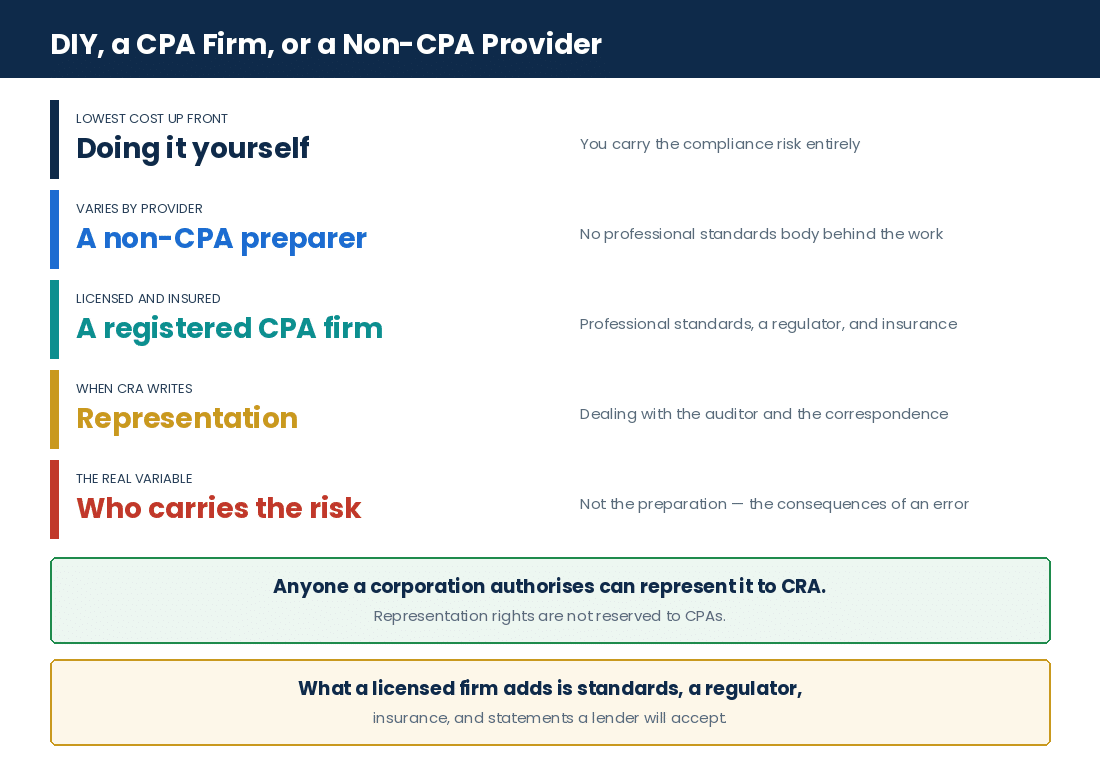
Compliance Accuracy, Audit Readiness and Accountability
| Factor | DIY | CPA Firm | Non-CPA Provider | Key Risk |
|---|---|---|---|---|
| Compliance accuracy | Mistakes are likely with less experience | CPAs know the rules and keep up with the changes | Depends entirely on the provider’s grasp of Canadian tax | Errors cause penalties or lose savings |
| CRA audit readiness | Low; no formal review before the return goes in | Documents are prepared to support an audit | Support may be weak and may not satisfy CRA | No defensible file if the year is reviewed |
| Accountability | You alone are responsible for the errors | Professional liability insurance, and regulation by CPA Ontario | Varies widely; often nobody is formally on the hook | Nobody answerable when it goes wrong |
DIY suits simple returns, or people with accounting knowledge. A CPA firm suits small and medium businesses needing experts, and companies wanting solid protection during audits. A non-CPA provider suits budget-minded clients with moderate needs.
A corporate tax accountant in Canada knows the rules thoroughly and can also take on catch-up tax services where past filings were missed. That work needs a careful review of old records, which is exactly what a CPA firm is set up to do.
An e-commerce corporation had four years filed by an unlicensed preparer who had entered the platform payouts as revenue and the platform fees nowhere. The CRA reviewed two of the years. The preparer had closed his business and could not be reached, there was no liability insurance behind the work and no working papers to produce. We rebuilt the four years from the settlement reports, filed amended returns and handled the review, which took eleven weeks and four rounds of correspondence. Figures changed for privacy.
When You Need Catch-Up Filing, and Who It Suits
Triggers
Eight Situations Where You Need Help
You should think about catch-up corporate tax filing if you want to avoid costly problems from ignoring late filings. These are the times when you need help:
- You missed one or more T2 return deadlines.
- Your bookkeeping is behind by months or even years.
- The CRA sent you letters about missing returns or unpaid taxes.
- You changed ownership but did not update the filings.
- You tried filing yourself but made mistakes caught by the CRA.
- Complex deals happened but are not shown right on the returns.
- Your business plans big growth and needs clean past records.
- You want to stop penalties from getting worse.
Getting a CPA early can make fixing these issues easier.
| Scenario | Risk If Ignored | CRA/Compliance Touchpoint | How a CPA Helps |
|---|---|---|---|
| Missed multiple T2 deadlines | Penalties plus growing interest | Penalty notices for late files | Prepares correct retroactive reports |
| Old bookkeeping | Wrong reports, audit risk | Requests for account checks | Fixes and cleans books |
| CRA demand letters received | Possible legal trouble | Calls or letters from the CRA | Negotiates and represents you |
| Ownership changes not reported | Wrong shareholder information | Updating registrations | Files proper amendments |
| Previous DIY errors | Audit risks | Audits or reviews | Reviews and corrects errors |
Who Should Consider Catch-Up Services
This is good for Canadian incorporated small and medium businesses with delays caused by tough operations, lack of accounting help, or tricky transactions. If you want less risk and real business tax savings under Canadian law, talk to a certified corporate tax accountant.
Sole proprietors without a corporation usually do not need catch-up services, and neither do businesses that already keep their taxes up to date.
A client sold half his shares in 2022 and the share register, the T2 schedules and the corporate minute book all disagreed about who owned what. Nothing had been filed since. By the time he came to us a buyer was running due diligence on the company and had stopped at the ownership question. We reconstructed the register, amended the affected schedules and filed the three outstanding years. The accounting work was a fraction of the price reduction the buyer had opened with, which was roughly $55,000. Figures changed for privacy.
Disclaimer: This is educational information only. It is not legal or financial advice. Check with a Registered professional before doing anything.
Catch-Up Readiness Check
Five quick questions on how ready your catch-up file is. No fee shown.
Points to raise with us:
This is a general prompt, not tax or legal advice or a quote. Your position depends on your full facts. For a real review, please book a free consultation.
Deliverables: What You Actually Get
Deliverables
Four Deliverables, Not Just Completed Forms
When you hire a CPA for corporate tax filing and catch-up tax services, you do not just get forms done. You get real help that keeps your incorporated business in good standing with the Canada Revenue Agency, and it looks for ways to save your business money on taxes.
Here is what you usually get with professional catch-up corporate tax filing:
| Deliverable | What It Is | Who Uses It | When Delivered | What You Provide |
|---|---|---|---|---|
| Filed T2 returns | Official corporate tax return filed with the CRA, covering missed years | Business owners, CRA | After the catch-up work is done | Financial records, past filings |
| Financial statements | Reports showing the company’s financial position, profit and loss and balance sheet | Management, accountants | Before or with the T2 filing | Bank statements, bookkeeping |
| Tax planning report | Analysis showing ways to lower future taxes legally, based on current filings | Business owners | Before or after filing | Historical data and projections |
| CRA correspondence | Letters or notices from the CRA about late filings or audits | Business owner and CPA | When received | Past correspondence and authorisation |
These are the main things that make catch-up corporate tax filing work well. They get your company back on track and find ways to reduce taxes going forward.
Filed T2 Returns
Filing the T2 Corporation Income Tax Return is the main task in Canadian corporate tax work. If you missed deadlines, or did not file before, catch-up means preparing returns for several past years.
A corporate tax accountant makes sure every return follows the CRA rules exactly. They report income, deductions and credits, everything needed for small and medium businesses across Ontario and Canada. Filing quickly stops interest and penalties from growing. It also keeps your business eligible for government programs that require up-to-date taxes.
Financial Statements
Good financial statements matter for correct T2 returns. They also help spot business tax savings by showing what expenses you can deduct. We prepare them under a compilation engagement under CSRS 4200, which provides no assurance. Your CPA will prepare:
- Profit and loss statement
- Balance sheet
- Cash flow statement
These show how your company did each year you are catching up on. They point out the expenses you claimed right and those you might fix, which is key if the bookkeeping got behind too. They also help leaders see trends and make better choices in the future.
Tax Planning Report
Catching up is not just about fixing the past. It is a chance to plan ahead. A tax planning report shows how to lower future taxes while following Canadian law. It includes ideas like:
- Using all allowed deductions
- Timing income in smart ways
- Claiming credits like SR&ED where possible
This report gives advice based on your industry, such as medical offices or real estate companies, to save money while staying within the CRA rules.
CRA Correspondence Handling
If you file late, the CRA might send letters or ask questions. Good CPAs handle all of this so you do not miss deadlines or get confused by what they want. They will:
- Read letters carefully
- Write accurate responses
- Set up payment plans if needed
This helps reduce stress during busy times, with multiple years of paperwork to fix.
A dental practice came to us for the returns alone, and we delivered the statements and the planning report with them. The statements showed roughly $180,000 of equipment bought across the unfiled years with no capital cost allowance claimed on any of it. Claiming it changed the tax in the catch-up years and, because the pools carry forward, in the years after them. The planning report ran to six pages. It was worth more to him than the returns were. Figures changed for privacy.
What Drives the Cost, and What to Ask
Cost & Prep
Seven Cost Drivers, and the Questions That Reveal Them
Knowing what changes costs helps you plan your budget when hiring a corporate tax accountant in Canada who does catch-up work. Prices vary a lot depending on your situation, not just flat fees.
| Driver | How to Keep It Efficient | Question to Ask a Firm | Notes |
|---|---|---|---|
| Number of years behind | Send documents quickly; gather information early | How many years can I file at once? | More years means more time |
| Complexity of records | Keep books neat; use accounting software | Do you handle messy or missing records? | Clean records speed things up |
| Multiple entities or branches | Limit scope if possible | Can you handle files from many companies? | Each entity adds more work |
| Volume of transactions | Use digital tools like QuickBooks or Xero | What platforms do you support? | Automation cuts manual entry |
| Integration needs with payroll and GST/HST | Provide payroll information completely | Are payroll and tax integrations included? | Integrated systems add accuracy |
| Urgency and rush deadlines | Plan ahead when possible | Will extra fees apply for rush jobs? | Last-minute rush costs more |
| Depth of advisory services requested | Be clear about advisory needs upfront | Does pricing cover ongoing advice? | Extra consulting adds costs |
Costs mainly depend on how much cleanup is needed before filing, plus any extra advice beyond the basic preparation. Our fees are fixed and annual with no hourly billing, shown before tax with sales tax on its own line. The pricing calculator gives a figure in about two minutes.
Questions To Ask Your CPA Firm
Picking the right firm means asking questions about how they handle late corporate filings:
- How much experience do you have with Canadian catch-up tax services?
- Can you walk me through your process?
- Do you charge fixed fees without surprise bills?
- How do you communicate if information is missing or delayed?
- Which accounting software do you work best with?
- Are there extra charges for handling CRA letters?
- Can I get advice on lowering future business taxes after filing?
- Do you represent clients facing audits due to late filings?
Their answers should be clear and show practical know-how focused on incorporated small and medium businesses under Canadian laws.
Checklist: What to Prepare Before You Start
Getting your papers ready first makes catch-up corporate tax filing easier. It also helps you keep as much business tax savings as possible. This checklist is for Canadian incorporated small and medium businesses working with a CPA firm like Gondaliya CPA:
- All bookkeeping records or access information
- Bank statements for all relevant years
- Payroll details if you have employees
- Any letters from the CRA you received
- Information about related companies or cross-border matters
Having these early helps us avoid delays and ensures your filings follow the Canadian rules fully.
Two clients arrived the same month, each three years behind. One sent downloaded bank statements for every account and year, named by year, plus a note on what the large transfers were. The other sent a carrier bag of receipts and a password to a bookkeeping file nobody had touched since 2021. The first engagement ran nine days end to end; the second took ten weeks, most of it spent asking what a transfer was for. The returns were comparable in complexity. The difference in fee was more than double. Figures changed for privacy.
How the Work Runs at Gondaliya CPA
Process
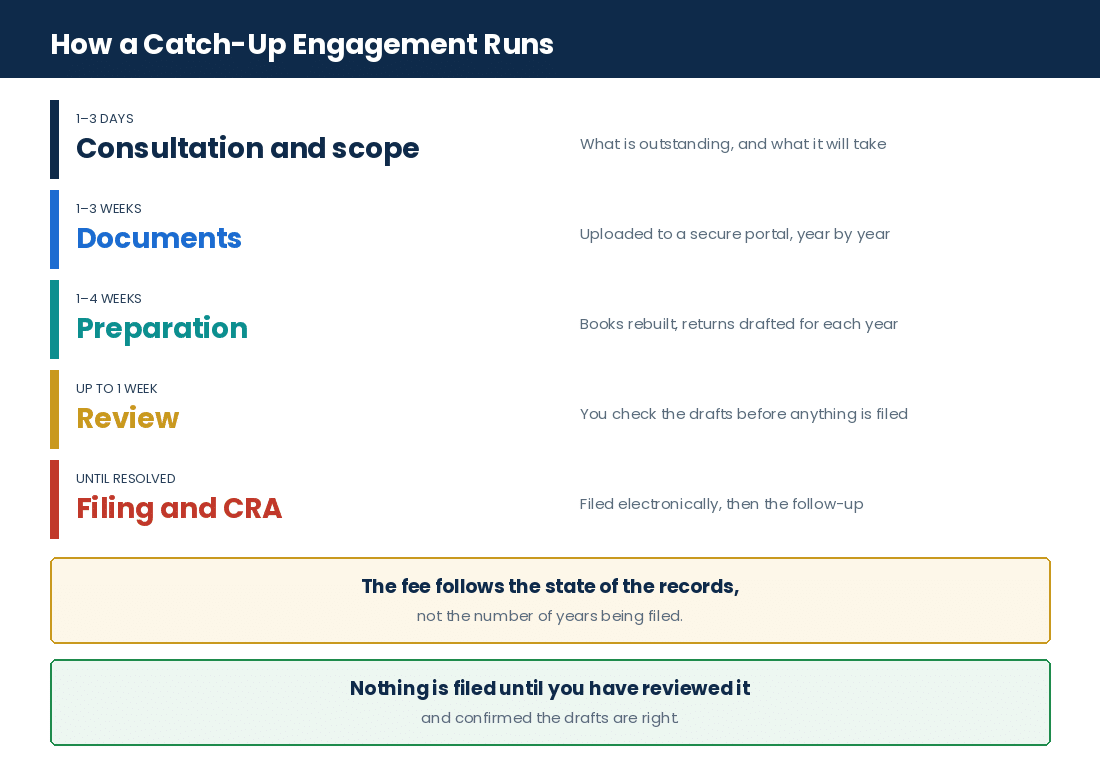
How the Service Works, Phase by Phase
We keep things simple and clear when helping you catch up on corporate tax filings. Here is how it goes.
| Phase | Typical Duration | What You Do | What We Do |
|---|---|---|---|
| Document and data collection | 2–4 weeks* | You collect bank statements, invoices and payroll information | We check records for missing information |
| Preparation and filing | 1–3 weeks* | Answer questions quickly | We prepare your accurate T2 returns, including catch-up periods |
| CRA follow-ups | Ongoing as needed | Reply fast if the CRA contacts you | We handle communications with the CRA |
* Timelines depend on your data and complexity; confirm during your consultation.
What We Need From You
To get the best business tax savings, please send us:
- All bookkeeping records or access information
- Bank statements for all relevant years
- Payroll details if you have employees
- Any letters from the CRA you received
- Information about related companies or cross-border matters
Having these early helps us avoid delays and ensures your filings follow the Canadian rules fully.
Initial Consultation
First, we talk about your specific situation. We want to know whether you need catch-up tax services or regular corporate tax help. Then we explain how working with a trusted corporate tax accountant in Canada saves you time and money, and lowers the risks from late filings.
Document and Data Collection
Collecting correct documents is key when catching up on taxes. Sometimes books need cleaning before the reports are reliable, and we handle that often. Complete financial data lets us find all possible deductions, to increase your business tax savings safely.
Tax Preparation and Filing
After checking everything closely, we prepare correct T2 returns reflecting any fixes from past errors or missed information. Both are common in delayed submissions covered by our catch-up service.
CRA Follow-Ups
If the CRA asks questions after filing, which happens often during catch-ups, we speak to them directly for you. That keeps replies quick and meets their rules, while letting you focus on running your business.
Ongoing Support
After filing is done, we keep giving advice that helps lower future taxes legally under Canada’s rules. This support fits businesses wanting steady growth through smart tax planning by experienced CPAs familiar with Toronto and Ontario laws.
A trucking corporation three years behind sent us everything in the first week: statements for all four accounts, the fuel logs, the driver payroll summaries and a photograph of every CRA envelope. We filed all three years inside nineteen days. A second owner with an almost identical file sent documents one account at a time as he found them, over four months, and we asked the same questions four times. The fast file finished before the slow one reached the preparation stage. The variable was never the number of years. Figures changed for privacy.
Frequently Asked Questions
FAQs
Frequently Asked Questions on Catch-Up Corporate Tax Filing
What is the role of a Registered CPA in corporate tax filing?+
A Registered CPA ensures accurate filings, follows the federal and provincial rules, and helps maximise business tax credits.
How does Gondaliya CPA assist with GST/HST filing and payroll remittance?+
We handle GST/HST submissions and payroll remittances accurately, to keep your business compliant.
Can a CPA firm help with penalty negotiations and audit readiness?+
Yes. CPAs prepare documents for audits and negotiate penalties with the Canada Revenue Agency. Representation during CRA audits is part of the service.
What are SR&ED credits and how can they benefit my business?+
SR&ED credits support scientific research and experimental development expenses. They reduce taxable income.
How do tax credit claims work for investment and business tax credits?+
CPAs identify eligible expenses, prepare the claims, and ensure compliance with the tax credit guidelines.
What is the Voluntary Disclosure Program offered by the CRA?+
The Voluntary Disclosure Program allows businesses to correct past tax errors without facing penalties if the disclosures are timely.
How does cross-border tax advice help Canadian companies?+
It manages US CPA licensing issues and tax compliance requirements, and minimises double taxation risks.
What bookkeeping services does Gondaliya CPA provide?+
We offer ongoing bookkeeping, cleanup, catch-up reports, and we link the bookkeeping to your tax planning needs.
What is catch-up corporate tax filing?+
It means getting your overdue corporate tax returns ready and sent to the Canada Revenue Agency. It helps small and medium businesses in Canada that missed filing on time. A CPA for corporate tax filing makes sure all past taxes are figured out right and sent in line with the CRA rules.
Should I use a DIY approach, a CPA firm, or a non-CPA provider?+
DIY suits simple returns or people with accounting knowledge, and the risk level is medium. A CPA firm suits businesses needing expert help: fewer errors, smart tax advice, a low risk level and a typical timeline of one to three months. A non-CPA provider is cheaper but riskier, and accountability varies a lot with often no official responsibility. CPAs have professional liability and are regulated by CPA Ontario.
Essential Points for Business Owners
Key Takeaways
Risks, CRA Compliance, and Common Mistakes
Handling corporate tax filing in Canada can get tricky. If you miss deadlines or details, the CRA may give you fines or audits. That means you could lose business tax savings too. Hiring a Registered CPA for corporate tax filing and catch-up tax services can help keep you on track.
| Risk Area | What Happens If Missed | CPA Mitigation or Control | Who Is Affected | CRA or Authority Source |
|---|---|---|---|---|
| Late or incomplete filings | Penalties, interest charges, or audits | Preparing and reviewing returns on time | Incorporated small and medium businesses | CRA T2 filing guidelines |
| Missed deductions and credits | Paying more tax than needed; cash flow problems | Checking all eligible expenses and credits | Business owners | Canadian Tax Act |
| Incorrect data reporting | Audits, reassessments, fines | Reconciling books accurately before filing | Corporations | CRA reporting requirements |
| Non-compliance with deadlines | Higher penalties; losing benefits | Setting reminders and managing deadlines | All incorporated businesses | Federal and provincial rules |
| Poor record keeping | Losing proof during reviews | Keeping organised records and bookkeeping | Small to medium businesses | CRA documentation standards |
The Six Things We Check First
- How many years are behind? More years means more time, and it is the first thing that sets the scope.
- What state are the records in? Sometimes books need cleaning before the reports are reliable.
- What has the CRA already sent? Any letters you received about missing returns or unpaid taxes.
- Were deductions or credits missed? Complete financial data lets us find all possible deductions.
- Is payroll or GST/HST involved? Payroll details, remittances and GST/HST filings sit alongside the returns.
- Are there related companies or cross-border matters? Each entity adds more work and changes the filings.
Common Mistakes
Lots of small and medium-sized incorporated businesses make the same errors without a professional’s help:
- Filing incomplete returns — leaving out schedules or income causes reassessments.
- Missing tax credits — skipping credits like SR&ED cuts down your savings.
- Incorrect data reporting — wrong numbers lead to delays, more CRA checks, and fines.
A corporate tax accountant Canada trusts can spot these mistakes early. They know the rules well and keep books precise.
What You Take Away
Hiring a qualified CPA firm offers more than just paperwork when catching up on overdue corporate taxes:
- Timely T2 returns keep your business legal.
- Solid financial statements support reliable reports.
- Tax planning reports suggest real ways to cut taxes.
- Experts manage all CRA letters to lower risks.
- Clear pricing reflects how much work is involved.
- Asking good questions makes sure expectations match service.
Knowing these deliverables upfront, and what makes costs change, helps fix past problems confidently while managing future taxes wisely under Canada’s rules.
Essential Tax and Compliance Services Offered by Gondaliya CPA
- Incorporation services including new business registration
- Preparation of trust returns (T3) and shareholder documents
- Management of corporate documents for compliance
- Handling bank and credit card statements for accurate records
- Review of previously filed tax returns for corrections or amendments
- Use of Wagepoint, Hubdoc and ADP for payroll processing integration
- Claiming eligible investment tax credits
- Filing GST/HST returns on time with the CRA requirements in mind
- Payroll remittance filing aligned with the CRA deadlines
- Assistance with installment payments for balanced cash flow management
- Representation during CRA audits to ensure audit readiness
- Negotiation of penalties related to late or incorrect filings
- Guidance on federal and provincial tax code changes affecting businesses
- Advice on voluntary disclosure program applications for missed filings
- Support with legal advice referrals as needed through professional networks
These services help protect your business from penalties while optimising all available tax savings under Canadian law.
A daycare operator came to us for two unfiled corporate years. The GST/HST returns were behind by the same two years and nobody had mentioned it, because the grant income had been treated as outside the sales tax system entirely. Reconciling the subsidies against the reported revenue changed both the corporate returns and the GST/HST position, and it headed off a clawback question on roughly $70,000 of funding. Catch-up work that stops at the T2 leaves the other half in place. Figures changed for privacy.
Our Approach
Gondaliya CPA starts with a consultation on your specific situation, then collects the bookkeeping, bank statements, payroll details, CRA letters and related-company information; cleans the books where they need it before the reports are relied on; prepares accurate T2 returns for every catch-up period, reflecting fixes to past errors and missed information; prepares financial statements under a compilation engagement; delivers a tax planning report showing how to lower future taxes legally; speaks to the CRA directly on follow-ups and sets up payment plans where needed; and continues advising after filing. Fees are fixed and annual with no hourly billing, shown before tax with sales tax on its own line.
Industry Spotlights: Sectors We Represent
Industry Expertise
Catch-up corporate tax filing matters for many Canadian businesses. Here are eleven sectors, and the money issues each one faces.
| Industry | What Is Unique Financially and Tax-Wise |
|---|---|
| Technology startups & SaaS | Revenue recognition and R&D credits, with proper SR&ED claims needing accurate filings |
| E-commerce & online retailers | Balancing sales channels and shipping expenses, and managing inventory well |
| Consulting firms | Service income and business expenses recorded across the years that were never filed |
| Construction, contractors & skilled trades | Tracking project income and subcontractor payments, payroll taxes and material costs |
| Property developers & builders | Watching construction costs and sales, and declaring sales correctly |
| Real estate investors & holding companies | Keeping track of rent and depreciation, property tax issues and capital gains |
| Transportation, logistics & trucking | Managing fuel, vehicle upkeep and driver pay, and sorting payroll |
| Restaurants & food and beverage | Handling food costs, wages and sales taxes, plus paying payroll taxes |
| Daycare, childcare & CWELCC services | Managing grants and subsidies, GST/HST reports and subsidy checks |
| Dentists & dental practices | Complex income and equipment purchases, RCDSO monitoring and capital cost claims |
| Medical doctors & physician corporations | Tracking billings, OHIP payments and business expenses, T2 returns and RCPSC checks |
- Technology startups & SaaS: Tech startups work with software development costs tied to R&D credits like SR&ED, so revenue recognition has to be managed well and R&D expenses documented fully on annual returns filed promptly.
- E-commerce & online retailers: Online sellers handle sales from platforms like Shopify mixed with Amazon FBA shipping costs, and inventory tracking affects taxable profits, so catch-up service cleans up the data and dodges fines from missing information.
- Consulting firms: Consulting corporations have service income and business expenses to record across the unfiled years, and complete financial data is what lets every allowable deduction be claimed.
- Construction, contractors & skilled trades: Companies working on contracts face incomes that change by project stage and complex subcontractor payments, so catch-up help tracks income by project, keeps detailed subcontractor records and submits payroll remittances, keeping the books ready for audits while claiming every legal deduction.
- Property developers & builders: Builders deal with material costs and project revenues that do not always match the calendar years used by CRA forms, so catch-up services align the financials, record construction expenses accurately, report sales revenue fully and correct past mistakes.
- Real estate investors & holding companies: Real estate owners manage rent from many properties plus separate holding companies that own assets, and must calculate depreciation correctly while reporting rental income in T2 returns, so catching up claims all rightful deductions and maximises business tax savings.
- Transportation, logistics & trucking: Fuel logs and vehicle maintenance receipts shape the deductible expenses that lower taxable income, and driver pay is a big part of the payroll records needed for annual statements even when they are filed late.
- Restaurants & food and beverage: Restaurants manage food purchases and wages while dealing with sales tax collection and payroll remittances, so catch-up services spot overlooked input credits before the final taxes are submitted to the federal and provincial authorities.
- Daycare, childcare & CWELCC services: Childcare providers get grants from programs like CWELCC and those funds need to match the revenue reported on taxes, so catch-up filing reconciles the subsidies against income, submits the GST/HST filings and avoids grant clawbacks.
- Dentists & dental practices: Dentists juggle patient fees plus big equipment buys and the RCDSO requires clear financial records, so catch-up services fix the late paperwork while helping dentists get tax breaks on dental tools through capital cost allowances.
- Medical doctors & physician corporations: Medical doctors must keep exact records of billings tied to OHIP payments and track their business costs carefully, so catch-up filing makes sure everything adds up, claims all the deductions and keeps things in line with the CRA rules and the RCPSC.
This shows why working with a CPA for corporate tax filing matters no matter what business you are in. Each has its own money issues, but all share a need to clear backlogs fast while getting the most business tax savings available through catch-up tax services suited to your company. For help specific to your industry’s catch-up corporate tax needs, call Gondaliya CPA at 647-212-9559 or email info@gondaliyacpa.ca for a free talk about your incorporated business, anywhere in Toronto, Ontario or across Canada’s provinces.
A physician corporation was two years behind and the owner had been paying himself irregular transfers with no payroll and no dividends recorded. The OHIP payment reports gave us the billings precisely; the problem was the roughly $240,000 that had left the company with nothing characterising it. We reconstructed the draws, declared dividends where the retained earnings supported them, and filed both years. The billings were never the difficult part on that file. Figures changed for privacy.
Professional Guidance and Quick Reference
Guidance
Essential Points for Toronto and Canadian Corporations
Catch-up files go wrong in a predictable set of ways: returns filed on books that were never reconciled to the bank; schedules or income left out, which brings a reassessment; credits such as SR&ED skipped in the years they belonged to; GST/HST and payroll discovered to be behind only after the T2 returns are done; CRA letters left unopened while the bookkeeping is being rebuilt; and a related company or a cross-border item mentioned last rather than first. Gondaliya CPA scopes the years outstanding, reconciles the books, then files.
Quick Answers
At a Glance
- Catch-up corporate tax filing: overdue T2 returns prepared and filed until current
- What it fixes: missed deadlines, unreconciled books, incorrect past returns
- Who needs it: incorporated small and medium businesses in Canada
- Who does not: sole proprietors without a corporation
- Who does not: businesses already up to date
- What catch-up tax services do: file overdue taxes without the hassle falling on you
- What a CPA adds: correct paperwork, plus the deductions you would miss
- Where the saving comes from: real business tax savings that cut what you owe
- Why a corporate tax accountant: knows the rules, so penalties and mistakes get avoided
- Three options: DIY, a CPA firm, or a non-CPA provider
- DIY risk level: medium, with no formal review before filing
- CPA risk level: low, with a typical timeline of one to three months
- Non-CPA risk level: high; cheaper, but often nobody is accountable
- Accountability with a CPA firm: professional liability, regulated by CPA Ontario
- Document collection: typically two to four weeks
- Preparation and filing: typically one to three weeks
- CRA follow-ups: ongoing as needed, handled by us
- What we need: bookkeeping, bank statements, payroll, CRA letters
- Also needed: details of related companies or cross-border matters
- Deliverable one: filed T2 returns covering every missed year
- Deliverable two: financial statements, profit and loss, balance sheet, cash flow
- Deliverable three: a tax planning report for the years ahead
- Deliverable four: CRA correspondence handled, including payment arrangements
- Biggest cost driver: the state of the records, then the number of years
- Other drivers: multiple entities, transaction volume, payroll and GST/HST, rush work, advisory depth
- Software we work with: QuickBooks, Xero, Wagepoint, Hubdoc, ADP
- Fees: fixed and annual, no hourly billing, sales tax on its own line
- Common mistakes: incomplete returns, missed credits, incorrect data
- Relief route for missed filings: the Voluntary Disclosure Program, if timely
- Sectors covered: eleven, from medical and dental to trucking and e-commerce
Who This Is For / Not For
Fit Check
- For: incorporated small and medium businesses that have missed one or more corporate filing deadlines.
- For: companies with complicated tax situations, or facing CRA penalties on the overdue years.
- Not for: sole proprietors without a corporation, who do not generally need catch-up corporate services.
- Not for: businesses whose corporate taxes are already up to date.
People Also Ask
Related Questions
How many years can be filed at once?+
There is no practical limit on the number of years a catch-up engagement can cover, and we regularly file several in one sequence. What governs it is whether the records exist for each year, because a year with no bank statements cannot be filed accurately. Ask any firm you are considering how many years they will take on at once, and what they do where records are missing.
Will catching up trigger a CRA audit?+
Filing correctly is not what draws attention; incorrect and incomplete returns are. Omitted schedules, omitted income and figures that do not reconcile are the things that lead to reassessments and reviews. A catch-up file prepared with the books reconciled and the working papers kept is a file that can answer questions. If CRA does review the years, we respond to the queries, assemble the documentation and deal with the auditor on the corporation’s behalf.
My bookkeeping does not exist at all. Is that a problem?+
It is normal rather than exceptional. Where no usable books exist, the accounts are rebuilt from the bank statements, the invoices and whatever platform or payroll records the business has, and the cleanup is the bulk of the engagement. Send what you have as it is rather than tidying it first; incomplete records are still the starting point, and reorganising them before we see them usually costs time rather than saving it.
Can I still claim deductions on years that are already late?+
Yes. The deductions and credits that were available in those years are claimed on the returns for those years, and they are among the main reasons a properly prepared catch-up return costs less in tax than a quickly filed one. Capital cost allowance on equipment, eligible business expenses and credits such as SR&ED are the items most often found sitting unclaimed in the unfiled years.
Do GST/HST and payroll have to be caught up too?+
Almost always, and usually by the same number of years. The GST/HST returns and the payroll remittances are separate obligations with their own deadlines, and discovering them after the corporate returns are finished means the work gets reopened. Tell your CPA about employees and sales tax registration at the first conversation so all of it is scoped together.
Glossary of Key Terms
Definitions
- T2: the corporation income tax return filed with CRA.
- Catch-up corporate tax filing: preparing and filing the overdue returns a corporation has missed.
- CPA for corporate tax filing: a licensed professional who prepares and files the returns accurately.
- Business tax savings: lowering taxable income using the credits and deductions available.
- Corporate tax accountant Canada: a CPA working to the Income Tax Act and CRA rules.
- Compilation engagement: financial statements prepared under CSRS 4200, providing no assurance.
- Financial statements: profit and loss, balance sheet and cash flow for each year.
- Tax planning report: how to lower future tax lawfully, based on the filings.
- SR&ED: credits for scientific research and experimental development expenditure.
- Investment tax credit: a credit against tax for qualifying expenditure.
- GST/HST return: the sales tax return, with its own filing deadlines.
- Payroll remittance: source deductions sent to CRA on the CRA schedule.
- Voluntary Disclosure Program: CRA’s route to correcting past errors where the disclosure is timely.
- CRA correspondence handling: reading, answering and managing the letters CRA sends.
Want a checklist to work from? You can download our free catch-up filing checklist before your consultation.
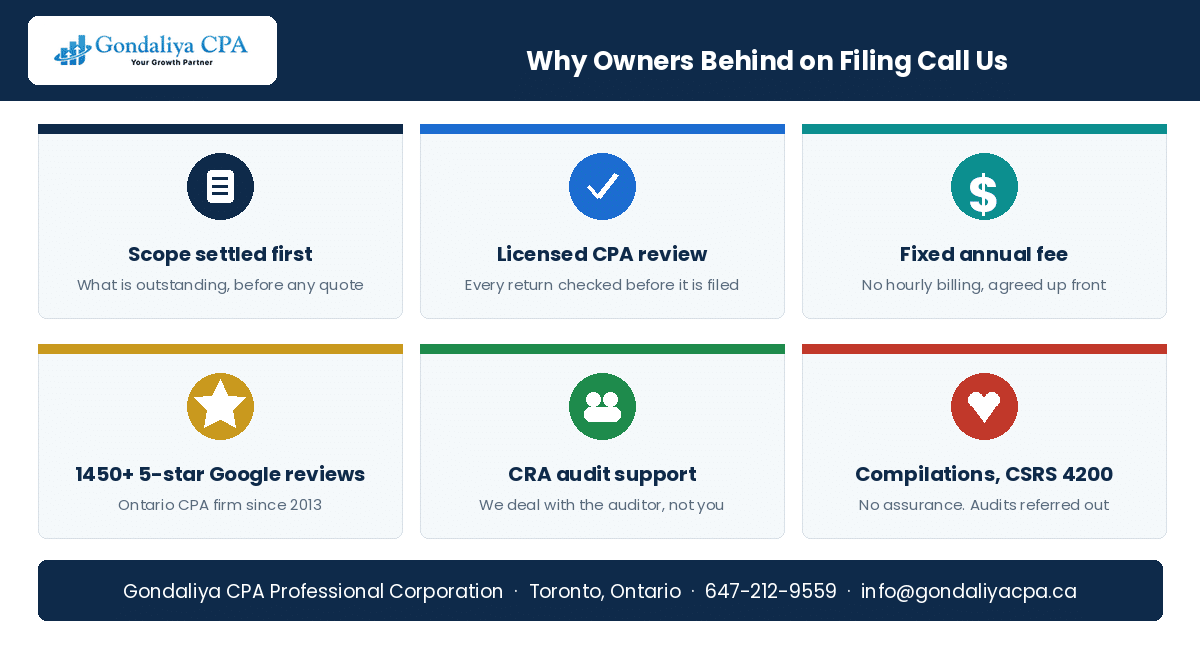
Four things decide what a catch-up engagement is worth. Whether the returns are accurate as well as filed — a return that merely goes in stops the penalties growing, while a return prepared properly also claims the capital cost allowance, the eligible expenses and the credits such as SR&ED that were sitting unclaimed in those years. Whether the books were reconciled first — incomplete returns and incorrect data are what bring reassessments, and the cleanup is normally the bulk of the work rather than an optional extra. Whether the whole compliance position was scoped — GST/HST and payroll are usually behind by the same number of years, and finding that out after the T2 returns are done means reopening the file. And whether anybody is accountable for the work — a CPA firm carries professional liability and is regulated by CPA Ontario, which is the difference that shows up only when CRA looks at a year.
Three questions settle what you are actually dealing with, and none of them requires finished books. First, how many years are outstanding, and can you get bank statements for all of them? That answer sets the scope and the one real constraint on it. Second, are GST/HST and payroll behind as well? They usually are, and scoping them now costs nothing. Third, what has CRA already sent you? The letters carry the deadlines, including the ones still in their envelopes.
Catch-Up Corporate Tax Filing: How Gondaliya CPA Can Help
Get current, and pay no more tax than you owe
Gondaliya CPA scopes the years outstanding and agrees a fixed fee before any work begins, so you know what the catch-up covers. We clean and reconcile the bookkeeping for every unfiled year, rebuilding it from bank statements where no records exist; prepare the T2 returns for every missed year with the deductions and credits those years allow, including capital cost allowance and credits such as SR&ED; prepare financial statements under a compilation engagement; bring the GST/HST returns and payroll remittances up to date alongside them; answer the CRA correspondence directly, represent the corporation if CRA reviews the years, and set up a payment arrangement where the balance cannot be met at once; and deliver a tax planning report so the years ahead are planned rather than repeated. Fees are fixed and annual with no hourly billing, shown before tax with sales tax on its own line. Please book a free consultation.
Next Steps
Please book a free consultation with Gondaliya CPA and bring three things: a list of the years you believe are outstanding, whatever bank statements you can download today, and every piece of CRA correspondence you have, opened or not. We will confirm the real scope rather than working from recollection, and the first conversation is usually shorter and less alarming than owners expect. Tell us at the outset if the corporation had employees or was registered for GST/HST, because those filings are normally behind by the same number of years and scoping them together costs less than discovering them later. Say so too if there is a related company or any cross-border activity, since both change the returns and both tend to get mentioned last. We perform compilation engagements under CSRS 4200, which provide no assurance, and we refer audit and review engagements out; where CRA reviews or audits the filed years, we respond to the queries, assemble the documentation and represent the corporation. You will get a fixed annual fee, shown before tax, agreed before any work begins. We serve Toronto, Mississauga, Brampton, Vaughan, Etobicoke, Scarborough, Hamilton, Ottawa and the rest of Ontario, and work with corporations across Canada. If our content helps, please add gondaliyacpa.ca as a preferred source on Google.
Published: · Last updated:
Editorial policy: We research against the Income Tax Act, the Income Tax Regulations, CRA guidance and information circulars, Department of Finance announcements, CPA Canada Handbook standards and CPA Ontario sources, fact-check the figures, and Sharad Gondaliya, CPA, reviews the content, which we update as the rules change.
Disclaimer: This article is educational information only and is not tax, legal or accounting advice. It covers catch-up corporate tax filing for incorporated small and medium businesses in Toronto, Ontario and across Canada, including what catch-up filing is and when it applies, the choice between a DIY return, a Registered CPA firm and a non-CPA provider, the compliance accuracy, CRA audit readiness and accountability differences between them, the deliverables of a catch-up engagement, the drivers of the fee, the questions worth asking a firm, the risks and common mistakes on overdue filings, what to prepare before the work starts, how catch-up filing arises across eleven sectors, and the wider compliance work that travels with it. It does not cover the personal filing obligations of unincorporated sole proprietors and partnerships, provincial corporate filings outside Ontario, or US and cross-border filing positions beyond the referral stage. Rates, thresholds, forms and statutory references change, and every reference should be confirmed against the current Income Tax Act and current CRA guidance. Whether CRA grants relief in any particular case is discretionary and turns on the facts and the evidence presented. Gondaliya CPA performs compilation engagements under CSRS 4200, which provide no assurance, and does not perform audit or review engagements; where CRA audits or reviews a corporation’s filings, we represent the corporation in that process. Please consult a licensed CPA before acting.

Sharad Gondaliya is a CPA Canada & CPA USA with 15 Years+ experience of Accounting, Tax, Payroll of Corporate Small Businesses as Tax Accountant. He is a CPA Ontario member (61040184) and holds US CPA licences in Washington and Montana and is well known among corporate small businesses for tax planning, efficient tax solutions, and affordable CPA services. Sharad is the Principal (Director) of Gondaliya CPA – Affordable CPA Firm in Canada. Licenses: CPA Ontario: 61040184 | CPA USA (MT): PAC-CPAP-LIC-033176 | CPA USA (WA): 57629 | CPA Firm License: 61330051 View Full Author Bio