



Avoid Corporate Tax Mistakes When Filing Your Incorporated Business Returns – Gondaliya CPA Guidance
Avoid common corporate tax mistakes when filing your incorporated business returns by working with Gondaliya CPA, a Registered CPA firm in Toronto. Their expertise helps Canadian small businesses prevent errors in tax filing, providing reliable support to meet all corporate tax obligations on time.
Quick Summary
Catch-up corporate tax filing helps incorporated SMBs fix overdue T2 returns and stop CRA penalties from growing. This guide walks through when catch-up filing is needed, what DIY versus a non-CPA provider versus a Registered CPA firm actually gets you, and two places where the popular version of this advice understates what is available.
- Catch-up corporate tax filing helps incorporated SMBs fix overdue T2 returns and stop CRA penalties from growing.
- Many corporate tax mistakes happen because businesses miss deadlines or don’t follow the rules well.
- Catch-up filing services offer step-by-step help to clean up old bookkeeping and get filings done right.
- Registered CPAs give advice made for Canadian incorporated businesses, including startups and small companies.
- Using catch-up services lowers the chance of audits and helps get the right tax benefits through proper reporting.
- Talking to a CPA early gives better CRA support and can open doors to voluntary disclosure programs.
- This service fits incorporated businesses behind on filings, with tricky accounting or multiple years not filed.
Quick Comparison Table: Which Option Fits Your Catch-Up Filing Needs?
| Situation/Trigger | Best Next Step | Why It Matters | Risk Level | Typical Timeline | Source/Note |
|---|---|---|---|---|---|
| Overdue T2 return | Hire a CPA | Stops penalties from getting worse | High | 1–3 months | Act fast |
| Missed deadlines | Start catch-up process | Cuts down interest building up | Medium | Depends on case | Depends on case |
| Complex accounting records | Get professional help | Makes sure filings are correct | High | 1–4 months | Needs full review |
| First-time corporate return | Talk to a CPA | Sets you up right from start | Medium | 1–2 months | Helps avoid errors |
For:
- Incorporated small and medium-sized businesses in Canada behind on their corporate tax filings.
- Businesses wanting to avoid or fix CRA late filing penalties and interest charges.
- Companies needing help cleaning up bookkeeping before they file.
- Startups ready for their first corporate tax return or moving from sole proprietorship.
- Businesses looking for expert tips on tax planning and getting max deductions during catch-up.
Not For:
This service isn’t for individuals running sole proprietorships without incorporation or those who have no unpaid returns.
Disclaimer: This content is educational only and does not constitute tax or legal advice.
Reading time: 33 minutes.
Table of Contents
- What Circulates Versus the Rule
- What Is Catch-Up Corporate Tax Filing?
- When You Need Catch-Up Corporate Tax Filing
- DIY vs CPA vs Non-CPA Provider
- The Voluntary Disclosures Program
- Why Choose Gondaliya CPA
- Getting Started
- Payroll & CRA Compliance FAQs
- Payroll & CRA Compliance Services
- Professional Guidance & Quick Reference
The Numbers That Matter
This guide addresses incorporated businesses resident in Canada filing a T2 Corporation Income Tax Return. Sole proprietors file a T1 with a T2125 and are governed by different mechanics throughout. Rules and rates are stated as at 14 May 2026 unless a later update note says otherwise.
What Circulates Versus the Rule
What Circulates Versus the Rule
The Corrections
Two statements in this guide are the kind that circulate widely in catch-up filing advice generally. Each is stated below exactly as it appears in our own guidance, then corrected against the rule.
| What Circulates | The Rule |
|---|---|
| Non-CPA providers usually cannot speak for you before the CRA; they just prepare paperwork | Representation turns on a signed authorization (RC59), not a CPA designation |
| The VDP “might cut down penalties or stop prosecution” | An accepted unprompted application cancels 100% of penalties and 75% of interest, not an undefined “might” |
| Missed deadlines → start catch-up process → cuts down interest building up | Only paying the tax stops interest; starting the process caps the penalty, not interest |
The Representation Claim
Representation before the CRA turns on a signed authorization — a Business Consent form (RC59) or “authorize a representative” — not on holding a CPA designation. A bookkeeper, family member, or non-CPA preparer can be authorized to speak with CRA on a business’s behalf once that consent is on file. What a non-CPA representative generally cannot do is appear as counsel in a Tax Court formal procedure, which requires a lawyer; the informal procedure does not. CPA firms typically hold standing authorization and audit experience that make them the stronger choice for a dispute, but “cannot speak for you” overstates the legal restriction.
The Interest Claim
Starting the catch-up process does not by itself reduce interest already accruing. CRA charges compound daily interest on unpaid corporate tax from the balance-due day regardless of when preparation begins; only paying the tax owed stops it. What starting the process does do is stop the late-filing penalty from continuing to climb once the return is filed, since that penalty is capped at 12 months under subsection 162(1). The saving is on the penalty side, not the interest side.
Risk Warning: Do not file the overdue returns first and ask about the Voluntary Disclosures Program afterwards. A return filed in the ordinary course is not a disclosure, and the penalties assessed on it are not what the program is designed to relieve. The application comes first, with the returns forming part of it. This sequencing error is the single most expensive mistake we see on catch-up files that arrive from elsewhere.
Professional guidance. Ask any preparer two direct questions before engaging them: can you formally represent this business before the CRA if it is audited, and will you assess whether a voluntary disclosure is appropriate before filing anything? A preparer who cannot answer the second question with specifics is planning to file in the ordinary course, which forfeits the relief described above. Our voluntary disclosures work and CRA audit resolution services exist specifically for this gap.
What Is Catch-Up Corporate Tax Filing?
What Is Catch-Up Corporate Tax Filing?
Foundations
Catch-up corporate tax filing helps incorporated businesses in Canada file their overdue T2 corporate income tax returns. When small and medium-sized businesses (SMBs) miss deadlines, they can face penalties, interest, and CRA audits. This service gets those late returns done right and sent to the Canada Revenue Agency (CRA), so companies avoid bigger problems.
The service starts by checking old financial records to find errors or missing info. Then it fixes any bookkeeping issues so the data is correct. Each missed year’s return gets prepared carefully. The process includes fixing classification mistakes and spotting deductions or credits that were missed before.
Catch-up filing services may also give advice about the voluntary disclosure program. This program lets people admit past filing mistakes and might cut down penalties or stop prosecution.
This service only covers catching up on late corporate tax filings. It doesn’t include ongoing bookkeeping, payroll, or GST/HST filings after the catch-up time. Also, personal tax return help is not part of this service but may be offered separately.
| Topic | Included? | Why It Matters | Notes |
|---|---|---|---|
| Preparation of overdue T2 returns | Yes | Ensures legal compliance | Covers multiple years if needed |
| Bookkeeping cleanup | Yes (limited) | Accurate data supports correct filings | Only for catch-up period |
| Voluntary Disclosure Program advice | Yes | Can reduce penalties | Needs detailed case review |
| Ongoing payroll/GST/HST filings | No | Separate service offered | |
| Personal tax return preparation | No |
To wrap up, catch-up corporate tax filing gives SMBs solid help with their overdue federal corporate taxes under Canadian law. This cuts stress from unpaid taxes and helps businesses move forward without CRA worries.
Keywords naturally integrated: Incorporated Business Tax Filing, Catch-Up Filing Services, Corporate Tax Mistakes, Business CPA Canada.
Key Stat: The T2 is due six months after fiscal year-end, but the balance-due day — when tax must actually be paid — is generally two months after year-end, or three months for a CCPC claiming the small business deduction that meets the conditions. Interest runs from the balance-due day regardless of when the return is filed.
Professional guidance. Establish the balance-due day and the filing deadline separately for every open year before any bookkeeping begins. On a multi-year backlog those are two different dates per year, and mixing them up is the most common reason an owner misjudges how much interest has already accrued.
When You Need Catch-Up Corporate Tax Filing in Canada
When You Need Catch-Up Corporate Tax Filing
Trigger Points
Incorporated businesses sometimes need to catch up on their corporate tax filings. This helps them stay in good standing with the Canada Revenue Agency (CRA). It also helps avoid big penalties. Whether you missed a filing, changed ownership, or plan to sell, knowing when to get catch-up filing services matters.
Common Scenarios That Call for Catch-Up Corporate Tax Filing
- Multiple years of unfiled T2 returns: Missing tax returns adds up penalties and interest from CRA fast.
- Getting CRA notices or assessments: If CRA contacts you about missing papers, you should act fast.
- Business ownership changes: New owners want clean and clear financial records.
- Preparing for financing, sale, or restructuring: Banks and buyers expect current tax filings before they agree.
- Finding bookkeeping mistakes: Past errors can cause problems in old returns and trigger audits.
- Planning to use the Voluntary Disclosure Program (VDP): Late filers can lower penalties by telling CRA first.
- Facing possible CRA audits for late or missing returns: Not filing on time raises audit chances; pros help reduce risks.
- Switching from sole proprietorship to corporation with past unfiled taxes: Catching up makes the new business clean and legal.
- Cash flow problems delaying filings: Money issues don’t excuse ignoring overdue taxes.
- Needing expert help with tricky corporate tax rules: CPAs guide small and medium businesses across Canada.
Ignoring overdue tax filings brings more trouble later. A Business CPA in Canada can help you fix these problems the right way.
Scenario Decision Table: When Catch-Up Filing Is Needed
| Scenario | What Can Go Wrong | CRA/Compliance Touchpoint | What a CPA Changes | What to Prepare First |
|---|---|---|---|---|
| Overdue multiple-year filings | Penalties and interest pile up | Late filing notices and demands | Clear catch-up plan | Financial statements and bank records |
| Missing documentation | Returns incomplete; audit risk grows | Audit triggers | Help to rebuild documents | Receipts, invoices, contracts |
| Mixed personal/business expenses | Wrong expense classification; deductions denied | Audit adjustments | Correct expense sorting | Bank statements and expense logs |
| New ownership or sale | Reporting gets complicated | Transfer pricing checks | Keep accurate historical records | Sale agreements and past returns |
| Planning voluntary disclosure | – Lose chance to cut penalties | – Missed VDP deadline | – Guidance for filing correctly | – Complete financial history |
This table shows what might go wrong and how a CPA can help fix it. Firms like Gondaliya CPA work with incorporated small businesses facing these issues.
Catch-up corporate tax filing is needed if you miss T2 returns or go through major business changes. Acting quickly stops fines from growing bigger. It also lowers the chance of audits. Plus, it helps your business stand stronger financially by fixing records right. For Canadian incorporated businesses, talking with a Business CPA gives peace of mind through real expertise in tax rules today.
A Scarborough trades corporation came to us mid-sale, three years behind on T2s, after the buyer’s lawyers asked for current filings as a closing condition. The choice was not really between filing quietly and disclosing — it was between disclosing immediately or losing the sale. We filed the disclosure and the closing proceeded on schedule. Figures changed for privacy.
Professional guidance. Treat “planning voluntary disclosure” as the first row to check, not the last. Everything else in the table above assumes ordinary filing; if a disclosure is on the table, it changes the sequence of every other row, including which documents get prepared first.
Your Options: DIY vs CPA vs Non-CPA Provider
DIY vs CPA vs Non-CPA Provider
Choosing a Route
When you file taxes for an incorporated business in Canada, you have choices. You can do it yourself (DIY), hire a Registered CPA firm like Gondaliya CPA, or use a non-CPA provider. Each choice comes with different results for things like accuracy, understanding tax rules, accountability, cost, and time spent.
Here’s what to think about with each option:
- DIY means you handle everything yourself.
- A Registered CPA firm has experts on Canadian business tax.
- Non-CPA providers offer some help but might miss details.
Compliance Accuracy
Corporate tax mistakes happen a lot. They can cause fines or audits from the CRA. DIY filers face more risk because they might not know all the corporate tax rules. Non-CPA providers often charge less but may miss important credits or deductions.
Registered CPAs know how to handle incorporated business tax filing properly. They keep up with CRA rules and make sure your T2 returns are done right. This lowers chances of errors that lead to problems later.
Understanding Complex Tax Rules
Canadian corporate taxes are tricky. There are many rules about income, expenses, capital cost allowances, dividends, and transfers between companies. Without training, business owners may get confused using DIY or non-CPA services.
A Business CPA Canada knows these complex rules well. They help avoid wrong filings and spot chances to save on taxes through smart planning. Catch-up filing services by CPAs work well when you have late returns to fix.
Accountability & Representation
Accountability is key if the CRA questions your filings or audits your company later on. If you file yourself, you take full responsibility without help.
Non-CPA providers usually cannot speak for you before the CRA; they just prepare paperwork. Registered CPAs have legal rights to represent clients in audits and disputes. That support matters a lot when dealing with catch-up filing services for overdue taxes.
Pro Tip: As corrected in section one, the right question is not “can this preparer legally speak to CRA” — a signed authorization covers that for almost anyone. The right question is what happens if the file becomes a dispute: does this preparer have audit experience, and can they escalate to formal representation if it goes further. That is where the real gap between a non-CPA provider and a Registered CPA firm sits.
Cost Considerations
Cost often drives your choice but watch out for risks:
| Option | Typical Cost Range | Notes |
|---|---|---|
| DIY | Lowest | No fee; high chance of mistakes |
| Non-CPA Provider | Moderate | Cheaper than CPAs; quality varies |
| Registered CPA | Higher | Fixed fees; expert value |
CPAs may cost more upfront for catch-up filing services. But they help prevent costly corporate tax mistakes and big fines down the road.
Time & Effort Required
Tax filing means gathering financial info from programs like QuickBooks or Xero and checking records carefully. This takes time—especially if you’re behind schedule.
DIY means learning forms like the T2 return schedules and keeping track of deadlines—a tough job if you’re busy running a business.
Non-CPAs ease some work but rely heavily on info from you. Missing data can slow things down.
A Business CPA Canada firm guides you through collecting documents quickly and handles the technical parts fast. This saves your time and keeps filings on track—even if catching up on late returns.
Comparison Table: DIY vs CPA vs Non-CPA Provider
| Factor | DIY | Registered CPA Firm | Non-CPA Provider |
|---|---|---|---|
| Compliance Accuracy | High error risk | Expert accuracy | Varies |
| Understanding Tax Rules | Limited | Deep knowledge | Moderate |
| Accountability | Self-responsible | Full legal representation | Limited/no representation |
| Cost | get lowest upfront costs | get higher fixed fees | get moderate/variable costs |
| Maximizing Benefits | No | Yes | No |
| Maximize Audit Readiness | No | Yes | Limited |
| Time & Effort | Very high | Low | Medium |
Your choice depends on how comfy you are with tricky tax stuff versus your budget—and how much peace of mind you want about getting things right.
This section breaks down popular options for incorporated business tax filing in Canada. It shows why hiring a Registered Business CPA Canada firm gives better control over risks tied to corporate tax mistakes while offering responsible help during catch-up filing services.
A Mississauga consulting corporation arrived after a non-CPA provider had prepared two years of T2s. The provider could speak to CRA on routine matters using a signed authorization; what surfaced later was that neither year had been reviewed for the small business deduction properly, and both had claimed personal vehicle costs at 100% instead of the business-use percentage. The provider could speak to CRA; it was the technical review that was missing. Figures changed for privacy.
Professional guidance. “Can they talk to CRA” and “will they catch a misapplied deduction” are two separate questions, and the DIY vs CPA vs non-CPA table above answers only the second one accurately. Weight your decision on technical accuracy and audit defence, not on who is legally permitted to send an email to CRA.
The Voluntary Disclosures Program, Correctly Stated
The Voluntary Disclosures Program
Correctly Stated
The source guidance treats the VDP in one sentence: it “lets people admit past filing mistakes and might cut down penalties or stop prosecution.” That is not wrong, but “might cut down” tells a business owner nothing they can plan around. Here is what the program actually does, current as of 14 May 2026.
Since 1 October 2025, CRA operates the VDP under Information Circular IC00-1R7, with a parallel change to GST/HST Memorandum 16-5-1. The old General and Limited programs were replaced by a simpler question: did you come forward on your own, or were you prompted?
| Stream | What It Means | Penalty Relief | Interest Relief |
|---|---|---|---|
| Unprompted | You came forward before CRA communicated with you about the specific issue | 100% | 75% |
| Prompted | CRA had already raised a specific concern, but no audit or investigation had started | Up to 100% | 25% |
Both streams, where accepted, carry protection from prosecution, and gross negligence penalties are not assessed on the information disclosed. The application is made on Form RC199. CRA generally cannot grant relief for any period that ended more than ten years before the calendar year the application is submitted, and the program requires all relevant information for the applicable years together with payment of the tax owing or an arrangement to pay it.
Risk Warning: Being under audit or investigation closes the door entirely. A disclosure that is incomplete also risks rejection, and a rejected application has told CRA everything while securing nothing. Establish whether CRA has already contacted the corporation about a specific issue before deciding which stream applies — that single fact decides 75% interest relief versus 25%.
Professional guidance. Whether a disclosure is the right route is a judgement about completeness, payment capacity, and what CRA already knows — it should be the first question asked on any multi-year backlog, not an afterthought once returns are already prepared. Our voluntary disclosures work handles this assessment before any T2 is filed.
Why Choose Gondaliya CPA for Incorporated Business Tax Filing?
Why Choose Gondaliya CPA
Why Us
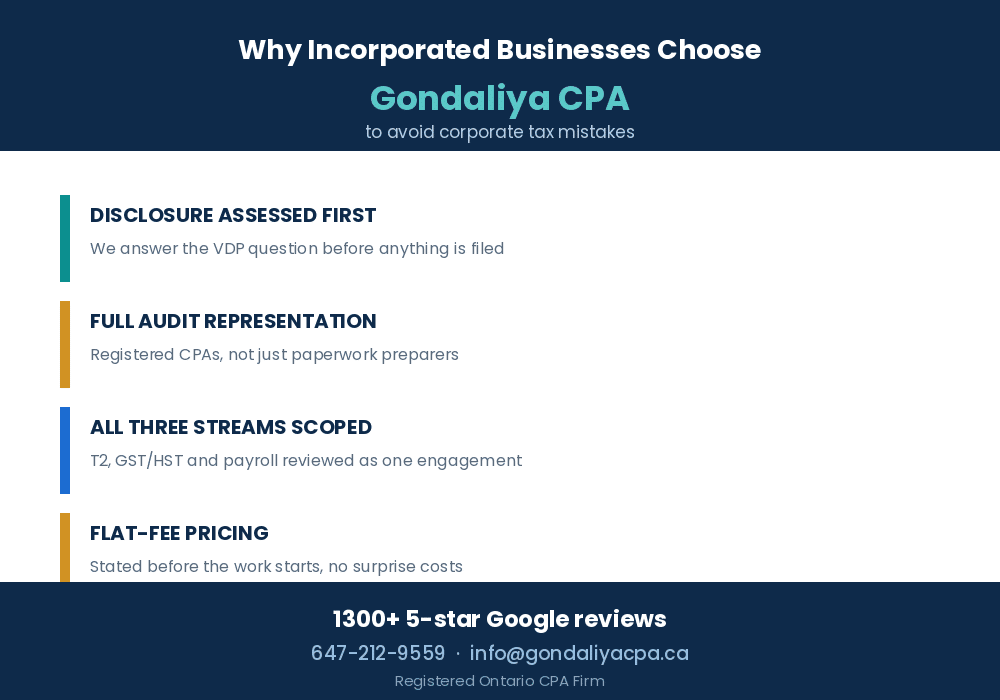
Picking the right help for your incorporated business tax filing matters a lot. It can stop big corporate tax mistakes and keep you clear of CRA troubles. Gondaliya CPA has Registered experts who know Canadian corporate tax law well. We get the challenges that small and medium businesses face all over Canada.
Our team offers catch-up filing services made just for your business size, type, and how much backlog you have. This way, we clear old filings fast and cut down penalties and audit chances.
We know how to handle CRA audits and voluntary disclosure applications (VDP). We help lower penalties by working closely with you during reviews. Plus, we clean up bookkeeping records before filing, fixing payroll remittance errors if needed.
We charge flat fees that are easy to understand—no surprise bills here. We talk clearly with you every step of the way. While we mainly serve startups and SMBs in Ontario, we also help clients all across Canada.
If you have late T2 returns or tricky catch-up work, our CPAs offer solid support. We protect your business money while making sure you get the tax benefits you can claim.
| Why Choose Gondaliya CPA? | What It Means for Your Business |
|---|---|
| Registered CPA Expertise | Keeps your business followin g Canadian tax laws |
| Personalized Catch-Up Filing Plans | Plans fit your business size & filing backlog |
| Proven Audit Management & Penalty Reduction | Cuts risks when CRA checks your filings |
| Integrated Bookkeeping Cleanup | Fixes errors so filings are spot on |
| Transparent Flat-Fee Pricing | No hidden costs; easy to plan your budget |
| Nationwide Support with Ontario Focus | Knows local rules but helps clients across Canada |
| Voluntary Disclosure Program Assistance | Helps lower penalties using CRA’s official programs |
By going with a Registered business CPA firm like ours in Canada, you get peace of mind. Experts take care of your incorporated business tax filing right. That keeps you safe from costly mistakes or delays that cause problems later on.
Getting Started with Catch-Up Corporate Tax Filing
Getting Started
The Process
Starting catch-up corporate tax filing can feel like a lot. Your incorporated business might have missed some deadlines or slipped behind on bookkeeping. The best way to handle this is to take clear, simple steps from the start. That keeps you in line with the rules and helps you avoid corporate tax mistakes.
First, reach out to a Business CPA Canada firm like Gondaliya CPA. They can check your current tax filing status. This quick look shows if you have overdue filings or any risks tied to your business.
Next, gather all your financial papers. You’ll want bank statements, bookkeeping records, old T2 return filings, and any letters from the CRA. Having everything ready lowers chances for errors that often happen with catch-up filing services.
After that, talk about your business timeline and any notices you got with our CPA team. Tell us when things started going wrong or what caused the delays. This helps us create solutions that fit what you need now and later.
Once we chat, we’ll send you a catch-up filing proposal made just for you. It explains every step—from cleaning up bookkeeping to filing late T2 returns—plus timelines and fees. This way, you know exactly what to expect.
When you agree, our CPA experts get busy fixing your bookkeeping records and preparing accurate overdue T2 corporate tax returns for the CRA. We fix past mistakes before sending files in.
During the whole process, we keep you updated regularly. You can ask questions anytime or set up extra talks if needed. Staying in touch helps build trust while meeting CRA rules.
Finally, use Gondaliya CPA’s ongoing advice beyond just catching up. We help with future tax planning that fits incorporated businesses across Canada. This support keeps your company on track with CRA rules and saves money where possible.
Here’s a quick look at the steps:
- Initial Assessment: Contact Gondaliya CPA to check for missed filings and see your current status
- Document Collection: Gather bank statements, bookkeeping records & previous T2 returns
- Business Timeline Discussion: Share key dates & notices that affect your taxes
- Customized Proposal: Get a detailed plan showing work scope & fees
- Bookkeeping Cleanup: Let CPAs fix accounts & correct mistakes
- Overdue Return Preparation: Prepare accurate late T2 returns based on fixed data
- Regular Updates: Receive progress reports & have chances for check-ins
- Ongoing Advisory: Get expert advice on future tax plans & compliance
Taking these steps early makes catching up easier and less stressful. This works well for incorporated businesses everywhere in Canada—including clients in Toronto and Ontario served by Gondaliya CPA’s Registered experts focused on small-to-medium businesses (SMBs).
Pro Tip: Add a question to the initial assessment that the eight-step list above doesn’t name directly: is the corporation also behind on GST/HST or payroll? Those run on separate schedules with separate penalties, and a disclosure that covers the T2 alone leaves the other two exposed once CRA is looking at the file.
FAQs on Payroll Remittance and CRA Compliance for Incorporated Businesses
Payroll & CRA Compliance FAQs
FAQ
What are common payroll remittance mistakes businesses make?+
Payroll remittance mistakes include late payments, incorrect amounts, and missing slips. These errors cause penalties and interest from the CRA.
How can payroll remittance validation prevent errors?+
Validation reviews payroll records before submission. It ensures amounts match records and deadlines are met to avoid penalties
Why is payroll review important during catch-up filing?+
Payroll reviews identify remittance errors or missed payments. Correcting them prevents CRA penalties and interest charges.
Can CPA firms assist with payroll remittance corrections?+
Yes. Registered CPAs help fix remittance mistakes, validate reports, and ensure compliance with CRA payroll regulations.
How does integration with accounting software like QuickBooks or Xero help tax filing?+
Accounting software integration simplifies bookkeeping cleanup. It automates record keeping and supports accurate tax and payroll filings.
What support does Gondaliya CPA offer for the CRA Voluntary Disclosure Program?+
We assist businesses in preparing voluntary disclosure applications to reduce penalties and avoid prosecution for late filings.
How do CPAs help with audit readiness and representation?+
CPAs prepare audit documentation, manage communications with CRA, and represent clients during audits for better outcomes.
Can a non-CPA provider represent my corporation if CRA writes to us?+
Only if the corporation has signed the required authorization, and even then a non-CPA representative generally cannot appear in a Tax Court formal procedure — that requires a lawyer. A Registered CPA firm brings both the authorization and the audit experience to handle a dispute as it escalates.
Does the Voluntary Disclosures Program only “maybe” reduce penalties?+
No — where an application is accepted, the relief is defined, not discretionary in amount. An unprompted application under IC00-1R7 (effective 1 October 2025) cancels 100% of penalties and 75% of interest. A prompted application gets up to 100% penalty relief and 25% interest relief.
Should I file my overdue T2s before applying to the VDP?+
No. A return filed in the ordinary course is not a disclosure. The application must come first, with the overdue returns forming part of it.
Key Payroll & CRA Compliance Support Services by Gondaliya CPA
Payroll & CRA Compliance Services
Services
- Payroll remittance reviews to catch errors before submission
- Correction of payroll remittance mistakes to avoid penalties
- Validation of payroll remittance slips against records
- Integration support with payroll platforms like Wagepoint, QuickBooks, Xero
- Accounting software setup for streamlined bookkeeping cleanup
- Assistance with CRA voluntary disclosure program applications
- Audit preparedness training tailored for incorporated businesses
- Professional CPA audit representation and defense services
- Corporate tax instalment estimate and adjustment guidance
- Management of GST/HST overdue filings and compliance tracking
- Record retention compliance advice aligned with CRA requirements
- Tax planning for year-end filings to optimize deductions and credits
These services protect incorporated businesses from common corporate tax mistakes related to payroll and CRA obligations. They reduce risks of audits, penalties, and interest charges while improving compliance accuracy.
Want a checklist to work from? You can download our free catch-up filing readiness checklist before your consultation.
Professional Guidance, Glossary and Next Steps
Professional Guidance & Quick Reference
Guidance
Incorporated businesses get into catch-up difficulty in a predictable set of ways: assuming a non-CPA preparer legally cannot deal with the CRA at all, when representation actually turns on a signed authorization rather than a designation; treating the Voluntary Disclosures Program as a vague “might help,” when an accepted unprompted application defines exact relief under IC00-1R7; and assuming that simply starting the catch-up process slows the interest clock, when only payment does that. Gondaliya CPA handles catch-up filing on a flat, stated fee.
We handle what decides the outcome: scoping whether a voluntary disclosure applies before any return is filed, confirming representation and authorization up front, computing the penalty exposure year by year against the 17% first-offence ceiling, reviewing GST/HST and payroll alongside the T2 rather than treating them as separate problems, and correcting bookkeeping before the returns are prepared rather than after.
Our team starts with a quick review of your current filing status, a list of open years, and any CRA correspondence you’ve received. Whatever your backlog, you get clear advice and a fixed price before we start.
Quick Answers
| Question | Answer |
|---|---|
| Can a non-CPA preparer speak to CRA for my business? | Yes, with a signed authorization — not exclusive to CPAs |
| Unprompted VDP relief | 100% of penalties, 75% of interest |
| Prompted VDP relief | Up to 100% of penalties, 25% of interest |
| T2 filing deadline | Six months after fiscal year-end |
| Balance-due day | Two months after year-end; three for an eligible CCPC |
| First-offence late-filing penalty | 5% plus 1% per month, capped at 17% |
| VDP application form | RC199 |
| VDP look-back limit | Generally ten years before the year of application |
Who This Is For
- For: Incorporated Canadian businesses with one or more unfiled T2 returns, owners weighing DIY, a non-CPA provider, or a Registered CPA firm for a backlog, businesses that have received a CRA letter and don’t know what it means for their options, and corporations also behind on GST/HST or payroll who haven’t connected the three.
- Not For: Sole proprietors, who file a T1 with a T2125 under different mechanics throughout, corporations already under CRA audit or investigation, where the VDP route discussed here is closed and representation is the immediate need, and corporations fully current on all filings, where nothing here applies.
People Also Ask
Is catch-up filing the same as a voluntary disclosure?+
No. Catch-up filing describes bringing overdue returns up to date. A voluntary disclosure is a specific application under IC00-1R7 that seeks relief from the penalties and interest arising on those returns.
Can I still be represented by my bookkeeper if CRA opens a file?+
For most communications, yes, once a signed authorization is on file. For a formal Tax Court dispute, representation generally requires a lawyer.
Does the Ontario small business rate change affect my open years?+
Each open year is taxed at the rate that applied at its own year-end, not at today’s rate. Confirm the applicable rate for each unfiled year separately.
Glossary of Key Terms
- Balance-due day: The date corporate tax must be paid, generally two months after year-end, three for an eligible CCPC.
- CCPC: Canadian-controlled private corporation.
- IC00-1R7: The CRA information circular governing the Voluntary Disclosures Program for applications received on or after 1 October 2025.
- Prompted application: A VDP application made after CRA raised a specific concern but before an audit began; 25% interest relief.
- RC199: The CRA form on which a voluntary disclosure application is made.
- Subsection 162(1): The first-offence late-filing penalty: 5% plus 1% per complete month, capped at twelve months.
- T2: The Corporation Income Tax Return, due six months after fiscal year-end.
- Unprompted application: A VDP application made before CRA communicated about the specific issue; 100% penalty and 75% interest relief.
- VDP: Voluntary Disclosures Program, the CRA program that can cancel penalties and part of the interest on a late or incorrect filing.
Catch-Up Filing Readiness Check
This quick self-check indicates where your corporation most likely has exposure. Please answer the five questions below.
Catch-Up Filing Readiness Check
Five quick questions on your backlog. No fee shown.
Points to raise with us:
This is a general prompt, not tax or legal advice or a quote. Your position depends on your full facts. For a real review, please book a free consultation.
Confirm representation is in place regardless of who prepares the filing. Treat the Voluntary Disclosures Program question as the first question on any multi-year backlog, not the last. Compute the penalty year by year against the 17% ceiling before assuming the worst. Scope GST/HST and payroll alongside the T2, not after it. File the disclosure application before any overdue return goes in, never the reverse.
Incorporated Business Tax Filing: How Gondaliya CPA Supports You
Behind on corporate filings?
We scope the position first — which years are open, what CRA already knows, whether GST/HST and payroll are also behind — and only then decide how the returns go in, on a flat fee stated before the work starts.
Next Steps
Please book a free consultation with Gondaliya CPA and bring your last filed corporate return, a list of the taxation years you believe are unfiled, and any correspondence you’ve received from CRA. Those three show where the real exposure sits, whether a disclosure is available, and what remains to be gathered. You will get a flat fee stated before any work begins.
Published: · Last updated:
Editorial policy: Every rule stated here is checked against the Income Tax Act, CRA publications, or CRA information circulars current at the date above. Where a statement in the original guidance was incomplete or imprecise, the original wording has been preserved and corrected alongside it rather than removed.
Disclaimer: This article is educational information only and is not tax, legal, or financial advice. Tax rules change and outcomes depend on your specific facts. Please speak with a CPA before acting.

Sharad Gondaliya is a CPA Canada & CPA USA with 15 Years+ experience of Accounting, Tax, Payroll of Corporate Small Businesses as Tax Accountant. He is a CPA Ontario member (61040184) and holds US CPA licences in Washington and Montana and is well known among corporate small businesses for tax planning, efficient tax solutions, and affordable CPA services. Sharad is the Principal (Director) of Gondaliya CPA – Affordable CPA Firm in Canada. Licenses: CPA Ontario: 61040184 | CPA USA (MT): PAC-CPAP-LIC-033176 | CPA USA (WA): 57629 | CPA Firm License: 61330051 View Full Author Bio