



T4 Deadline for 2026 Slips Is March 1, 2027: E-Filing Rules for More Than 5 Slips
T4 Filing Deadline 2027 and CRA Employer Reporting Overview
The T4 filing deadline for 2027 tells Canadian employers when to send all T4 slips to the Canada Revenue Agency. Regulation 205(1) of the Income Tax Regulations sets the date: information returns are due on or before the last day of February in each year, in respect of the preceding calendar year. A separate provision, Regulation 205.1(1), says that a prescribed return type must be filed electronically if more than five information returns of that type are required for a calendar year. Electronic filing keeps payroll information consistent and is faster for the CRA to process. Employers should also read the CRA’s Employers’ Guide to filing the T4 slip and summary alongside the legislation, because it explains how the rules are applied in practice and that is where most avoidable penalties come from. Gondaliya CPA handles the year-end return as part of its payroll services for incorporated employers.
Quick Summary
The 2026 T4 return is due Monday 1 March 2027, because the last day of February 2027 falls on a Sunday and the Interpretation Act moves a deadline that lands on a holiday to the next day that is not one. Please note that the same date applies to giving employees their copies, so there is no second, later deadline for distribution. Gondaliya CPA prepares and files T4 returns for incorporated employers in Ontario and across Canada.
| Aspect | Details |
|---|---|
| Filing deadline for 2026 slips | Monday 1 March 2027, because 28 February 2027 is a Sunday and 2027 is not a leap year. |
| Employee copies | Due the same day as the CRA filing, under Regulation 209, not later. |
| Electronic filing | Required under Regulation 205.1(1) once more than five T4 slips are filed for the year. |
| What the count measures | Slips of one type, not employees, so one person with two T4s from you is two slips. |
Reading time: 18 minutes.
Table of Contents
- The Deadline, and Why It Moves to 1 March
- Who Must File, and What Counts as a Slip
- Electronic Filing Above Five Slips
- What Late or Paper Filing Actually Costs
- Filling the Slip: Earnings, Deductions and Codes
- Distribution, Corrections and Records
- Frequently Asked Questions
- Essential Points for Business Owners
- Industry Spotlights: Sectors We Represent
- Professional Guidance and Quick Reference
The Numbers That Matter
This article covers the T4 information return for the 2026 calendar year, filed by employers in Ontario and across Canada, current to 19 November 2026. It covers the filing deadline under Regulation 205(1) and why it falls on Monday 1 March 2027, the next-day rule in section 26 of the Interpretation Act, the duty to file under Regulation 200(1), the mandatory electronic filing threshold in Regulation 205.1(1), the accepted filing methods, the late-filing penalty in subsection 162(7.01) and CRA’s more generous relieving administrative policy, the wrong-method penalty in subsection 162(7.02), the general failure-to-comply penalty in subsection 162(7), the distribution of employee copies under Regulation 209, the identification and earnings boxes, the other-information codes, amended and cancelled slips, pensionable and insurable earnings reporting and the PIER review it drives, record retention under subsection 230(4), and where an owner-manager’s own salary fits. It does not cover payroll remittance frequency or remitter type, the current year’s CPP and EI rates and ceilings, Quebec-specific RL-1 reporting, the T4A and T4A-NR returns in detail, or whether any particular worker is an employee or a contractor. Gondaliya CPA performs compilation engagements under CSRS 4200, which provide no assurance; audit and review engagements are referred out. We do represent clients through CRA audits, which is a separate service and not an assurance engagement. This is educational information only and not tax, legal or accounting advice. Talk to a Registered pro in Canada or Ontario about your case.
The Deadline, and Why It Moves to 1 March
The Date
Official T4 Filing Deadline: March 1, 2027, and Slip Distribution Deadlines
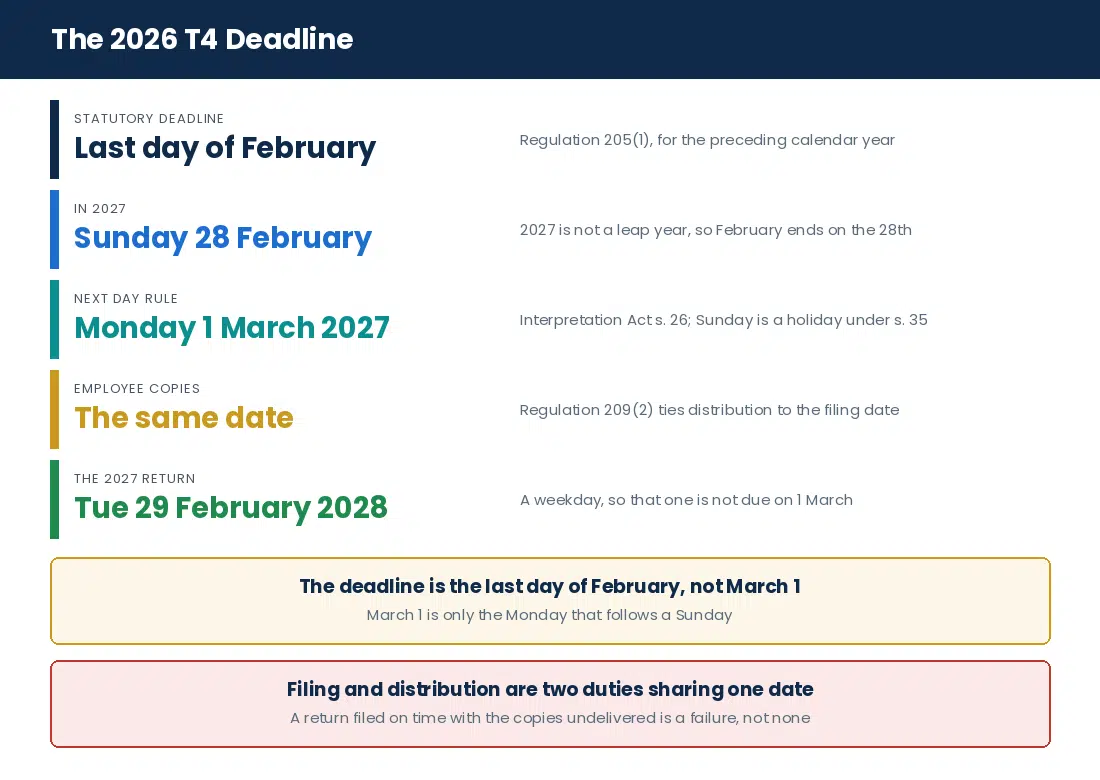
You need to file your 2026 T4 slips by March 1, 2027. The governing provision is Regulation 205(1), which requires every return under Part II of the Income Tax Regulations to be filed with the Minister, without notice or demand, on or before the last day of February in each year, in respect of the preceding calendar year. Usually that is simply the end of February. Since February 28, 2027 is a Sunday, the next-day rule moves the deadline to Monday, March 1, 2027. This applies both for submitting the return to the CRA and for giving copies to employees.
Here is what employers need to do:
- Submit the T4 Summary and all slips by March 1, 2027.
- Make sure employees get their copies by that same date.
This timing keeps everything on track and meets Canadian payroll rules. It is also worth storing the rule rather than the date. Section 26 of the Interpretation Act says that where the time limited for doing a thing expires or falls on a holiday, the thing may be done on the day next following that is not a holiday, and "holiday" in section 35 of that Act includes any Sunday. That is why 1 March replaces 28 February in 2027. It is not an extension; it moves the date forward legally and nothing more. The CRA states the same practice in its own guidance: when the due date falls on a Saturday, a Sunday or a public holiday it recognises, the return is on time if the CRA receives it, or it is postmarked, on or before the next business day.
The Rule Matters More Than the Date
A reader who files this away as "T4s are due March 1" will be wrong in most years. The deadline is the last day of February, and it only shifts when that day is not a working day. February ends on a Sunday in 2027, so the 2026 return is due 1 March 2027. February ends on Tuesday 29 February in 2028, a weekday, so the 2027 return will be due 29 February 2028 and not 1 March. The date to diarise each year is the last day of February, with the shift applied only if it lands on a weekend or a holiday.
Importance of Meeting the 2026 T4 Slips Filing Deadline
Missing this date leads to penalties, and they come from three different provisions rather than one:
- Late-filing penalties depend on how many slips you file, and they are charged by the day.
- A wrong-method penalty applies if you file on paper once the electronic threshold is passed.
- A failure to give employees their copies on time is a separate failure to comply with the Regulations.
These penalties work separately. So, you might get hit with more than one at once — a return filed late, on paper, with the employee copies still undelivered is three distinct failures, not one.
A client with eleven employees had the whole return ready on 26 February and held it back because she had read that the deadline was "March 1" and assumed she had the extra day in hand every year. That year February ended on a Friday. The return went in on the Monday, three days late, and the CRA assessed the late-filing penalty on eleven slips. The penalty came out at the $100 floor rather than the three days of daily charges, because the floor is the greater of the two, and it was entirely avoidable: the deadline had never been March 1, it had been the last day of February, and March 1 was only ever the Monday that follows a Sunday. She now files in the second week of February and has not been late since. Figures changed for privacy.
Deadline Reference Table
| Item | Deadline for the 2026 year | Authority |
|---|---|---|
| T4 slips and T4 Summary filed with the CRA | Monday 1 March 2027 | Reg. 205(1), with Interpretation Act s. 26 |
| Employee copies of the T4 slip | Monday 1 March 2027 | Reg. 209(2) and 209(3) |
| Electronic delivery of the slip to an employee | Monday 1 March 2027 | Reg. 209(3) and 209(5) |
| Record of Employment after an interruption of earnings | Within five calendar days, to Service Canada | Service Canada ROE guidance |
| Payroll records supporting the slips | Six years from the end of the last tax year they relate to | ITA 230(4) |
Who Must File, and What Counts as a Slip
Obligation
Who Must File a T4 Slip: Employer Reporting Requirements
If you pay wages in Canada and give out T4 slips for 2026 earnings, you have to file them with the CRA. That includes small businesses, mid-sized firms, and big companies. The duty itself comes from Regulation 200(1): every person who makes a payment described in subsection 153(1) of the Income Tax Act must make an information return in prescribed form in respect of the payment, unless a return for that payment has already been made under one of a short list of other sections. The CRA uses these slips to check income taxes and contributions. Employers must prepare, file, and send out the slips by the last day of February after the tax year ends. For 2026, that means the deadline is March 1, 2027.
Employers must:
- Submit all required forms on time.
- Keep accurate records behind each slip.
Knowing these rules helps every employer follow federal tax law without trouble. No matter how big or small a business is, if employees earn taxable wages or benefits, the employer must file. Not filing on time can lead to penalties from the CRA.
The Count Is Slips, Not Employees
This is the single most common counting error we see, and it decides whether you are allowed to file on paper. Regulation 205.1(1) counts information returns of a type, not people. An employee who received two T4 slips from you in the same year — because you moved them between two payroll accounts, or because a province of employment changed partway through and you issued a second slip — is two slips toward the threshold, not one employee. Six employees who each received one slip is six slips. Five employees where one of them received two slips is also six slips. Count the paper you are producing, not the names on your payroll.
Where an Owner-Manager’s Own Salary Fits
Most of the incorporated businesses we act for have one or two people on payroll, and at least one of them is the owner. A salary paid by your own corporation to you is employment income like any other: it goes on a T4 slip, with CPP contributions and income tax withheld, and it counts toward the slip threshold the same as an arm’s-length employee’s slip does. A single owner-manager drawing a salary from a corporation files one T4 slip, which means paper filing is still open and the flat $100 late-filing penalty under CRA’s relieving policy is the exposure if it goes in late. Dividends are not employment income and do not appear on a T4 at all; they are reported on a T5, which is a separate return with its own deadline. Where an owner takes both, there are two returns to file, and the five-slip count is applied to each type separately.
A client counted five employees, filed five T4 slips on paper, and was assessed a wrong-method penalty of $125 anyway. One of the five had transferred between two of the company’s payroll accounts in July, so there were two slips for that person and six slips in total. Nobody had looked at the stack; they had looked at the staff list. The $125 was not a late-filing penalty — the return was on time — it was the flat charge for filing on paper when the electronic threshold had been crossed by exactly one slip. Counting the slips rather than the people would have cost nothing. Figures changed for privacy.
Special Cases: Branch Offices, Amalgamations and Certified Non-Resident Employers
Federal tax law sets rules beyond just one business location. Where a business has more than one payroll deduction account, it files a T4 information return for each account rather than one combined return, and a branch that remits under its own separate account files the T4 information return of that branch as a separate return. Payroll that sits in a single account is reported in a single return with one slip per employee.
When businesses amalgamate during a year, which return covers which period depends on what happens to the remittance balance. If the predecessor’s remittance balance moves to the successor’s payroll account, the predecessor does not file T4 slips for the period leading up to the amalgamation and the successor files for the full year. If the balance does not move across, the predecessor files slips for the period up to the day before the amalgamation. The CRA’s Employers’ Guide sets out how this works.
Certification under the CRA’s non-resident employer certification programme works the other way round from how it is often described. Certification relieves a qualifying non-resident employer of the requirement to withhold and remit income tax on payments to a qualifying non-resident employee; CPP contributions and EI premiums may still apply, subject to their own exemptions. The reporting obligation does not disappear with the withholding. A certified employer that makes tax-exempt payments to a qualifying non-resident employee is still required to file a T4 slip and a T4 Summary for that employee, with one exception: no T4 is required if, after reasonable enquiry, the employer has no reason to believe that the employee’s total Canadian taxable income for the calendar year, including treaty-exempt amounts, is more than CAN $10,000. Even where the head office is outside Canada, the slips showing Canadian earnings are still filed.
All these employers still must keep payroll records for at least six years from the end of the last tax year to which the records relate.
Employees Outside Canada, Deceased Employees and Service Bureaus
The deadline to give employees their T4 copies is March 1, 2027 — the next business day after February’s last Sunday — for 2026 income. This applies whether the employee lives in Canada or abroad at year-end. If an employee works outside Canada but is paid by a Canadian employer, a T4 slip is still prepared; the CRA puts it plainly in the Employers’ Guide, which says that if you pay CPP on behalf of an employee working outside Canada, for all or part of the year, you have to prepare a T4 slip.
For an employee who died during the year, the CRA’s position is that you have to file a T4 slip for any income you paid to the employee during the year, and the copies are delivered without delay — in practice to the estate representative. A death benefit paid to a surviving spouse, common-law partner or heir is not reported on the T4 at all; it belongs on a T4A slip.
If your business has multiple payroll deduction accounts, you are still responsible for including all data in your annual returns, even if your remittance schedule varies, which is a separate topic from this one. When you use a service bureau, make sure the bureau’s reports match your internal records before anything is submitted, and keep solid payroll records supporting each slip issued, because they are what back up the filing and any audit review that follows. Keeping all accounts aligned helps you stay compliant across complex setups throughout Canada’s provinces, Ontario included.
T4 Against the Other Information Returns
A T4 slip reports employment income like salaries and taxable benefits subject to source deductions. Other forms cover different payments, and matching the payment to the right form is where mix-ups start.
| Return | What it reports | Goes to |
|---|---|---|
| T4 — Statement of Remuneration Paid | Employment income, taxable benefits and source deductions | Canada Revenue Agency |
| T4A — Statement of Pension, Retirement, Annuity and Other Income | Pension and other income, including fees or commissions for services that are not employment income subject to source deductions | Canada Revenue Agency |
| T5 — Statement of Investment Income | Dividends and interest, including dividends paid to an owner-manager | Canada Revenue Agency |
| Record of Employment (ROE) | An interruption of earnings affecting an Employment Insurance claim; it does not replace the annual income reporting done on a T4 slip | Service Canada, not the CRA |
That last row is worth a sentence of its own, because the ROE is routinely listed alongside the T4 and the T4A as though all three went to the same place. They do not. T4, T4A and T5 returns are filed with the Canada Revenue Agency. The Record of Employment goes to Service Canada, electronically through ROE Web or on the paper form to the ROE centre, and it is due within five calendar days of the interruption of earnings rather than at the end of February. Employers need to match payments with the right form carefully; mixing them up causes problems under the CRA’s filing rules and deadlines, and mixing up the recipient causes a different problem entirely.
Electronic Filing Above Five Slips
E-Filing Rules
Mandatory Electronic Filing When Submitting More Than Five T4 Slips
The electronic filing requirement lives in Regulation 205.1(1) of the Income Tax Regulations, not in a penalty section. It prescribes about twenty-five types of information return — the T4 among them, alongside the T4A, the T5, the T3, the NR4, the T5013 and the T4FHSA — and provides that a return of a prescribed type must be filed electronically if more than five information returns of that type are required to be filed for a calendar year. The count is applied per type.
So, if your business issues six or more T4s, you have to use CRA-approved electronic methods: Web Forms or Internet file transfer. The threshold moved from more than fifty returns to more than five with effect from 1 January 2024, so it has governed every filing season since, including this one. If you file five or fewer, paper remains available.
If you do not comply:
- You will be charged the wrong-method penalty under subsection 162(7.02), starting at $125 for six to fifty paper-filed returns.
- Late-filing penalties under subsection 162(7.01) apply separately and are calculated by the day.
These rules speed up processing and cut down errors from handling large volumes manually.
Accepted T4 Filing Methods: Web Forms, Internet File Transfer and Paper
The Canada Revenue Agency lets employers file T4 slips three ways: Web Forms, Internet file transfer of an XML file, or paper where the return is small enough to allow it. The T4 filing deadline for 2027 does not change by method, but the method you are permitted to use is decided by how many slips you have. If you submit five or fewer slips, paper filing is allowed without penalty. If you file between six and fifty slips on paper instead of electronically, you face the wrong-method penalty starting at $125.
Late filing brings another penalty on top of that, charged as a daily rate that depends on the slip count. And if you do not give employees their copies on time, that is a further failure to comply with the Regulations, dealt with in its own section below. So employers need to pick their filing method carefully. This helps avoid penalties and follow the mandatory e-filing rules that apply above the five-slip count.
| Method | Who it suits | Limit |
|---|---|---|
| CRA Web Forms | Small-to-medium filers just over five slips, working through My Business Account | Up to 100 slips per return, entered directly in the browser |
| Internet file transfer (XML) | Larger filers, payroll software users and service bureaus | An XML file of up to 150 MB, uploaded securely to the CRA |
| Paper | Employers with five or fewer slips of the type | Five slips or fewer; six or more triggers subsection 162(7.02) |
Step-by-Step Guidance for Web Forms and Internet File Transfer
If you need to e-file, here are your two main options. CRA Web Forms is best for small-to-medium filers just over five slips. You reach it through the CRA’s My Business Account portal and enter the data directly, and it builds the summary from the slips you enter. Internet file transfer is made for bigger filers or service bureaus: your payroll software produces an XML file matching the CRA’s schema, and you upload it to the CRA over a secure connection. It is a web upload, not an FTP transfer, and the file size rather than the slip count is the practical limit.
How to file electronically:
- Register your business for the CRA’s online services and confirm you can reach the payroll account in My Business Account.
- Get your payroll data ready in the correct format, as set out in the CRA’s Employers’ Guide, and reconcile the slip totals to the T4 Summary before you start.
- Submit before March 1, 2027 — the next business day after the last day of February — for the 2026 tax year, and keep the confirmation number the CRA returns.
E-filing cuts processing time but requires sticking to the formatting rules strictly.
A client with fourteen employees had always filed on paper and saw no reason to change, on the view that the return was accepted every year and nobody had complained. Nobody had complained because the threshold had been more than fifty returns until the start of 2024. The first return filed on paper after the change drew the $125 wrong-method penalty, and the second drew it again, because the letter about the first had gone to an old address. Two years of paper filing cost $250 in penalties on a return that would have taken twenty minutes in Web Forms. The return had been correct and on time both years. Figures changed for privacy.
Paper Filing for One to Five Slips, and the T4 Summary Without Slips
Small employers with five or fewer T4 slips can still file paper copies without penalty. This works well for small businesses with minimal payroll or seasonal workers, and it covers most of the owner-manager companies we act for.
However:
- Filing only a T4 Summary without the individual slips is not allowed. The CRA’s position is that a complete return must be filed including the slips; if the summary arrives on its own, the CRA considers the return not received and the summary is not processed.
- If you file more than five slips on paper instead of electronically, penalties start at $125 for six through fifty paper-filed returns.
Counting your slips correctly helps you pick the right filing method and avoids fees caused by filing errors rather than by payroll mistakes themselves.
CRA Digital Services and Employer Support Resources
The CRA offers digital services that help employers meet their reporting duties. Its online Employers’ Guide explains how to prepare and send T4 slips, by mail or electronically where each is allowed. You can use secure portals like My Business Account to confirm submissions and keep records safe, and the CRA’s own pages set out the electronic filing requirement under Regulation 205.1(1) along with the penalty provisions that back it up and guidance on meeting the deadlines. These tools help employers follow the mandatory electronic filing rule — required when you have more than five T4 slips — and prevent the mistakes that lead to penalties.
T4 Year-End Readiness Check
Five questions on your 2026 T4 return, due Monday 1 March 2027.
Points to raise with us:
This is a general prompt, not tax or legal advice or a quote. Your position depends on your full facts. For a real review, please book a free consultation.
What Late or Paper Filing Actually Costs
Penalties
Late Filing Penalties: Calculation, Minimum Amounts, and Examples
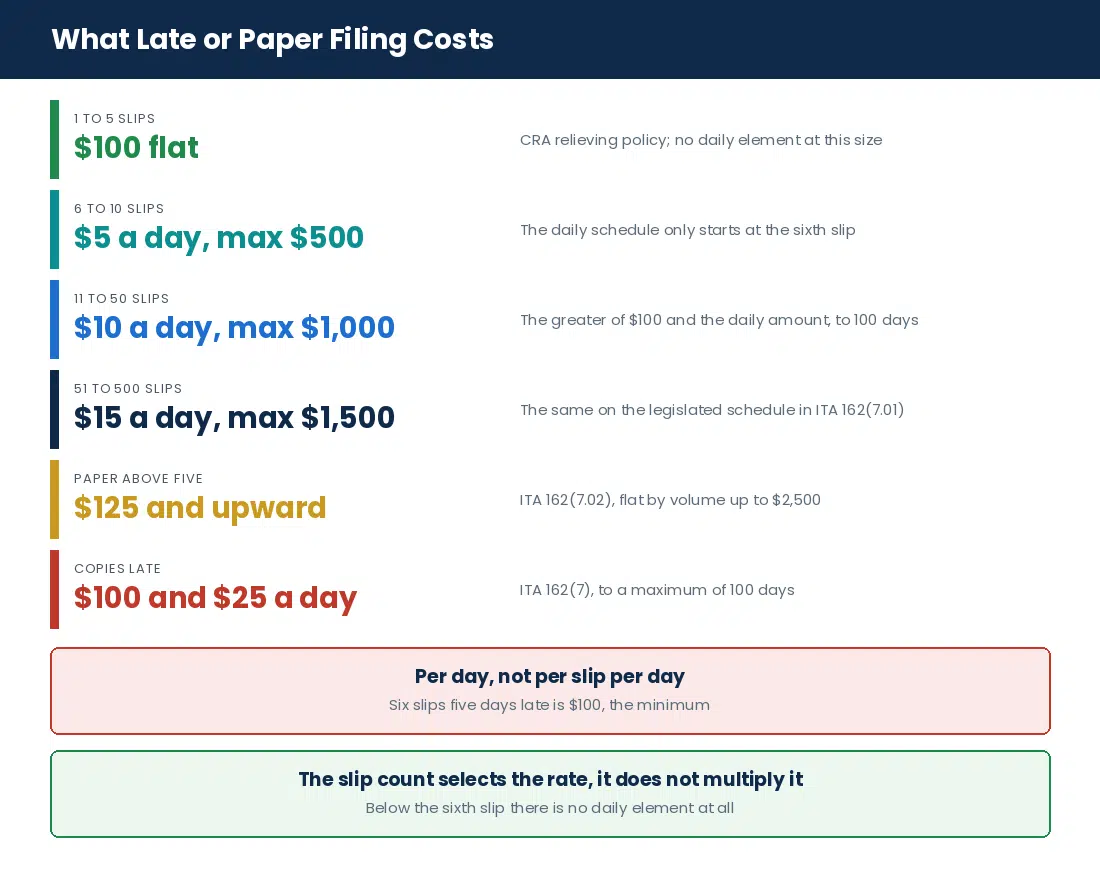
Late filings come with charges that can grow fast, and there are two schedules in circulation. The one the CRA actually applies to T4 returns is its relieving administrative policy, which is more generous than the statute at the small end. Start here, because for most incorporated employers this is the only line that matters.
| Information returns filed late | Penalty per day, to 100 days | Maximum penalty |
|---|---|---|
| 1 to 5 | Not based on the number of days | $100 flat penalty |
| 6 to 10 | $5 | $500 |
| 11 to 50 | $10 | $1,000 |
| 51 to 500 | $15 | $1,500 |
| 501 to 2,500 | $25 | $2,500 |
| 2,501 to 10,000 | $50 | $5,000 |
| 10,001 or more | $75 | $7,500 |
The flat $100 for one to five slips is the most useful number on this page for an owner-manager company. A corporation that files a single T4 slip three weeks late is looking at $100, not at three weeks of daily charges. The daily schedule only starts to bite from the sixth slip.
The Legislated Schedule Behind It
The statutory version is subsection 162(7.01) of the Income Tax Act, which applies where a person fails to file one or more prescribed types of information return when required. The T4 is a prescribed type; Regulation 205(3) lists about twenty-eight of them for this purpose. The penalty is the greater of $100 and a daily amount, for up to 100 days:
| Number of returns | Daily amount under ITA 162(7.01) | Maximum over 100 days |
|---|---|---|
| Fewer than 51 | $10 a day | $1,000 |
| 51 to 500 | $15 a day | $1,500 |
| 501 to 2,500 | $25 a day | $2,500 |
| 2,501 to 10,000 | $50 a day | $5,000 |
| More than 10,000 | $75 a day | $7,500 |
Penalties accumulate each day until the filing is made, and the band does not change partway through; the count of returns sets one rate.
A Worked Example, Done Correctly
Six T4 slips filed five days late. The arithmetic people reach for is six slips multiplied by $10 multiplied by five days, which gives $300. That is wrong twice over, and it is worth being precise about why, because the wrong version is the sort of figure a client repeats back to you.
First, the penalty is a daily amount, not a per-slip-per-day amount. The slip count selects which daily rate applies; it is not a multiplier on top of it. Multiplying by the number of slips inflates the answer by exactly that number.
Second, the floor applies. Under the relieving policy that the CRA uses for T4s, six slips sit in the 6-to-10 band at $5 a day, so five days gives $25, and the greater of $100 and $25 is $100. Under the legislated schedule in subsection 162(7.01), six returns sit in the "fewer than 51" band at $10 a day, so five days gives $50, and the greater of $100 and $50 is again $100. Either way the answer is $100, not $300. On these numbers the daily rate never gets near the floor; a six-slip return would need to be twenty days late before the daily charge overtook $100 even on the legislated rate.
A client called in March convinced he owed about $2,700. He had eighteen slips, had filed fifteen days late, and had multiplied eighteen by $10 by fifteen days. The real figure was $150: eighteen slips sit in the 11-to-50 band at $10 a day under the relieving policy, fifteen days gives $150, and that is above the $100 floor so the floor does not apply. He had spent a weekend deciding whether to take money out of the business to cover a penalty that was an eighteenth of what he thought. The per-slip-per-day reading is the commonest arithmetic error we see on this subject, and it always overstates the number. Figures changed for privacy.
Overview of the Three Penalties, and How They Stack
Here is a quick look at what can be charged and under which provision.
| Penalty | Provision | Amount |
|---|---|---|
| Late-filing penalty | ITA 162(7.01), with CRA’s relieving administrative policy | The greater of $100 and a daily amount set by the slip count, for up to 100 days |
| Wrong-method penalty | ITA 162(7.02) | A flat charge: $125 for 6 to 50 returns, $250 for 51 to 250, $500 for 251 to 500, $1,500 for 501 to 2,500, $2,500 for more than 2,500, and nil for five or fewer |
| Failure to give employees their copies on time | ITA 162(7), for the failure to meet the duty in Reg. 209 | The greater of $100 and $25 a day, to a maximum of 100 days, so a $2,500 ceiling. It does not apply where another provision already penalises the same failure |
These penalties do not cancel each other out. You could face all three if you miss different parts of the filing process: the return itself late, filed on paper above the threshold, and the employee copies undelivered. Each failure is assessed against its own provision.
The third row works differently from the first two. Failing to give employees their copies by the deadline is a failure to comply with Regulation 209, and the penalty that reaches it is the general one in subsection 162(7): the greater of $100 and $25 a day to a maximum of 100 days. That is a daily amount for the failure itself, not a charge per slip per day. Subsection 162(7) also applies only where no other provision of the Act sets out a penalty for the same failure, so where the copies are late alongside a late return, the quantum comes from whichever provision reaches the failure in front of you.
Third-Party Civil Penalties and Interest on Outstanding Balances
There are other charges beyond late-filing penalties. Section 163.2, headed "Misrepresentation of a Tax Matter by a Third Party," reaches a person who makes, furnishes or participates in making a false statement that they know, or would reasonably be expected to know, could be used for tax purposes by someone else — which is the provision that sits behind the phrase "third-party civil penalties." Separately, you may owe interest on unpaid balances arising from the amounts reported on your T4 Summary, charged at the CRA’s prescribed rate and compounded daily.
These charges work separately from the late-filing penalties. Two further provisions are worth distinguishing while we are here, because they are routinely cited for T4 deadlines and have nothing to do with them. Subsection 227(8) penalises a failure to deduct or withhold, at 10% of the amount that should have been withheld, rising to 20% for a second occurrence in the same year made knowingly or in circumstances amounting to gross negligence. Subsection 227(9) penalises a failure to remit on time, on a sliding scale of 3%, 5%, 7% and 10% depending on how many days late the Receiver General receives the money, again rising to 20% on the same knowing-or-grossly-negligent test. Both are about the money, not about the slips. Employers should know these extra charges do not replace late-filing penalties; they come in addition when they apply.
A client with thirty-one employees filed the 2024 return eight weeks late, on paper, and did not hand out the employee copies until April. All three penalties were assessed. The late-filing charge ran at $10 a day in the 11-to-50 band and hit the $1,000 band maximum. The wrong-method charge was $125 for the thirty-one paper returns. The copies had gone out late as well, which drew the $100 floor under the general failure-to-comply provision. Roughly $1,200 of penalties on a payroll of about $1.4 million, and the whole exposure came from a bookkeeper leaving in January and nobody picking up the year-end file. The return itself contained no errors at all. Figures changed for privacy.
Cancelling or Waiving Penalties and Interest
There are no automatic waivers for missed deadlines. But relief is available: subsection 220(3.1) of the Income Tax Act lets the Minister waive or cancel all or part of a penalty or interest, on application made within ten calendar years after the end of the relevant year, and that is the taxpayer relief route rather than a concession built into the penalty provisions themselves. You can ask the CRA to cancel or reduce penalties where you can show a valid reason — serious hardship, circumstances beyond your control, or CRA delay or error.
The Voluntary Disclosures Programme is a different route, for correcting a filing position you have not yet been contacted about, and it has its own conditions. Either way you will need proper documentation supporting the case, not simply an explanation that the deadline was forgotten or that a small mistake was made. It helps to talk to a professional before applying, because the criteria are strict and the application is where most of the work is.
Filling the Slip: Earnings, Deductions and Codes
The Slip Itself
Identification Sections: Employer and Employee Information, SIN Requirements
The identification part of the slip is the part nobody checks and the part the CRA matches on. Employers must give their business number, legal name, and address as registered with the CRA. For employees, the full name and Social Insurance Number must be exact. Missing or wrong SINs cause matching delays and can expose you to penalties for an incomplete return, and the slip cannot be credited to the right person without one.
If you file more than five T4 slips, you follow the CRA’s electronic filing rules, and the accuracy expectations do not relax because the file is machine-read. The mandatory e-filing threshold counts slips by type, so getting the identification right on each slip is also what lets the file validate on upload rather than coming back for correction after the deadline has passed.
Here is what to include:
- Employer business number and legal name
- Employer address on record with the CRA
- Employee full name
- Employee SIN exactly as issued
- Province of employment, which drives whether CPP or QPP applies
Reporting Employment Income and Contributions: CPP/QPP, EI, RPP and Tax
You report gross wages and statutory deductions on the T4 slip. The main boxes are these:
| Box | What it reports |
|---|---|
| 14 | Employment income before deductions |
| 16 | Employee’s CPP contributions, where the province of employment is not Quebec |
| 17 | Employee’s QPP contributions, for employees working in Quebec |
| 18 | Employee’s EI premiums deducted |
| 20 | Employee’s registered pension plan contributions, where they apply |
| 22 | Income tax deducted at source |
| 24 | EI insurable earnings |
| 26 | CPP or QPP pensionable earnings |
| 52 | Pension adjustment, in whole dollars |
Payroll remittance frequency is not covered here. The T4 Summary rolls up the totals from all slips for the year, and the slips and the summary have to agree before you file. Check that the CPP amounts match the payroll records before sending the return by the T4 filing deadline in 2027. This makes sure employees get credited properly and avoids CRA questions later.
The Two Boxes That Produce a PIER Review
Boxes 24 and 26 are the ones most often left blank or filled in carelessly, and they are the ones that generate a pensionable and insurable earnings review. Box 24 is EI insurable earnings; box 26 is CPP or QPP pensionable earnings. The CRA’s instruction is to report the total insurable earnings in box 24 and the total pensionable earnings in box 26, and to report "0" only where the employee genuinely had none and you reported no amount in the matching contribution box. In many situations boxes 14 and 24 will be the same amount, and so will boxes 14 and 26 — but "the same as box 14" is not a reason to leave them empty.
What happens when they are wrong is mechanical. The CRA recalculates the CPP contributions and EI premiums that should have been withheld on the pensionable and insurable earnings you reported, compares that to the contributions in boxes 16, 17 and 18, and issues a PIER report for the difference. The CRA says in terms that reporting these boxes accurately, and correcting deduction errors before you file, reduces unnecessary PIER reports for CPP and EI deficiency calculations. A PIER is not a penalty, but it is a letter, a reconciliation and usually an amount to remit, and it arrives months after the file has been closed.
A client’s payroll software had been set to treat a car allowance as non-pensionable. The slips went out with box 14 including the allowance and box 26 excluding it, which is a defensible combination in a handful of cases and was not one of them. The PIER report arrived in July: a CPP deficiency of about $3,100 across nine employees, half of it the employer’s share and the rest the employee portion the company could no longer recover from people who had already been paid. Nothing on the return had been late, nothing had been filed on paper, and no penalty was charged. The whole amount came from one setting in the payroll module and a box nobody reconciled. Figures changed for privacy.
Other Information Codes 30 to 95: Taxable Allowances and Benefits
The numbers in the 30-to-95 range are not boxes on the face of the slip; they are codes entered in the "Other information" area, and they report taxable benefits and allowances. The ones that come up most often in small-business payroll are these:
| Code | What it reports |
|---|---|
| 30 | Board and lodging |
| 32 | Travel in a prescribed zone |
| 34 | Personal use of an employer’s automobile or motor vehicle |
| 40 | Other taxable allowances and benefits, used where the benefit is not reported under another code |
Those four are the ones we have confirmed against the CRA’s current T4 slip instructions, and they are the ones worth memorising, because an automobile benefit in code 40 and a housing benefit in code 34 are both wrong and both look plausible. Stock options and employer gifts also have their own codes; check the current code list on the CRA’s T4 slip page for anything outside the four above rather than relying on memory, because codes are added and retired.
Using these codes correctly is vital for tax compliance. Employers must report these amounts in full so employees get accurate information for their own returns. Mistakes here lead to CRA reassessments of the employee, or questions to you after filing, and a benefit reported under the wrong code is still a reporting error even when the dollar total is right.
Special Situations: Salary Overpayments, Retiring Allowances and Foreign Income
Some cases need special reporting, sometimes on a different slip type altogether. Each slip type counts separately toward the electronic filing threshold, so a year with six T4s and three T4As is above the threshold on the T4 return and below it on the T4A return.
- Salary overpayments recovered within the same year are adjusted in the employment income reported, rather than reported and then corrected separately.
- Retiring allowances paid when someone leaves are reported in the specific codes for them on the right slip, and they are not simply added to employment income.
- Foreign income earned abroad may need reporting depending on the employee’s residence and on whether you paid CPP on their behalf; follow the CRA’s instructions for the particular case closely.
Each type you file matters because the threshold counts per slip type, not total slips across every return you file.
Distribution, Corrections and Records
After You File
Methods and Timing for Distributing T4 Slips to Employees
Regulation 209 is the provision that requires employers to give employees their copies, and it ties the timing to the filing date rather than setting a separate one. Under Regulation 209(1) and 209(2), a person required to make an information return must forward to each taxpayer two copies of the portion of the return relating to that taxpayer, sent to the taxpayer’s last known address or delivered in person, on or before the date the return is required to be filed with the Minister. For the 2026 year that date is March 1, 2027, because February 28 is a Sunday.
That is the point employers most often get wrong. There is no later deadline for distribution. The copies are due the same day the return is due, so a return filed on the last afternoon with the employee copies still in the printer is already two separate things: one done and one not.
You can deliver slips by mail, in person, or electronically. Electronic delivery has its own rules. Under Regulation 209(3), you may send the document in an electronic format if you have the taxpayer’s express consent, and in that case you send a single copy rather than two, by the same deadline; express consent under Regulation 209(4) means consent given in writing or in an electronic format. Regulation 209(5) goes further for the T4 specifically: you may provide it as a single electronic document without separate consent, by the same deadline, unless the specified criteria in section 221.01 of the Act are not met, the employee has asked for paper, or, at the time the slip is issued, the employee is on extended leave, is no longer your employee, or cannot reasonably be expected to have access to it electronically. In plain terms, a current employee with normal access to your systems can be sent a secure electronic slip; a departed employee or one on long-term leave gets paper.
Remember:
- Keep proof that employees received their slips, or that they were sent to the last known address.
- Follow privacy law when using digital methods, because a T4 carries a SIN and full earnings.
- Both paper and electronic copies discharge the duty if they go out by the deadline.
A client emailed T4 slips as unprotected PDF attachments to a staff distribution list, with every employee’s slip in the same message. Fourteen people saw each other’s salaries and SINs on the last day of February. The filing with the CRA was on time and correct, and the copies were technically delivered within the deadline, so no penalty followed. What followed instead was a week of conversations, two resignations, and a privacy complaint that took until June to close. The deadline had been met; the method had not been thought about at all. The slips now go out through the payroll portal with individual access. Figures changed for privacy.
Reviewing, Correcting and Amending Filed T4 Returns
Employers need to get their T4 slips right before the T4 filing deadline in 2027, which falls on March 1, 2027 for reporting the 2026 payroll year. If mistakes show up after filing, they must be fixed promptly following the CRA’s correction rules. The CRA lets you change returns already sent, but amending does not give you more time on the original deadline and does not reduce a penalty that has already accrued on a late filing.
Amended Against Cancelled Slips
These are two different operations and they are not interchangeable. An amended slip replaces what you filed for that employee: you enter all the data that has not changed and correct the fields that need correcting, and you send only the slips being amended, with report type code "A" on the slips and the summary. An amended T4 is not a second original — it supersedes the first one, and the amended summary carries only the totals from the amended slips, not the whole year again. A cancelled slip removes a slip that should never have been filed: you enter all the data that was on the original slip, because an empty slip is rejected, and you use report type code "C" on the slips with "A" on the summary.
Sending a corrected slip as a fresh original, rather than as an amendment, is the error that doubles an employee’s reported income on the CRA’s system and produces a reassessment of their personal return months later. Filing corrections should happen as soon as an error is discovered; leaving them increases the chance that the employee has already filed on the wrong numbers.
Record-Keeping and Managing Undeliverable Slips
Good record-keeping makes T4 filings easier and more accurate. Employers must keep the payroll records that support each slip they report. Subsection 230(4) of the Income Tax Act sets the period: records and books of account, together with every account and voucher necessary to verify the information in them, are retained until the expiration of six years from the end of the last taxation year to which they relate. That is six years measured from the end of the tax year, not six years from the calendar year-end or from the date you filed, and for an employer with a non-calendar fiscal year the two are not the same date.
This includes wage lists, payment receipts, contracts, benefit statements, timesheets, pay registers and remittance receipts. These documents prove what you reported on each slip type, and they are the first thing requested in a payroll review. Organising them well helps you meet deadlines like March 1, 2027, and clear records also help during CRA checks or audits — representation through a CRA audit is a service Gondaliya CPA provides directly.
Records of all issued T4 slips are kept for the same six years, and that includes the ones that came back. If an employee leaves without giving a new address, and you made reasonable efforts to contact them, you still have to prepare and send the final slips on time; the duty is to send to the last known address, not to succeed in reaching them. If mail comes back undelivered after someone has left, document the attempts, try electronic delivery where the Regulation 209 conditions allow it, and keep the returned envelope with the file.
Compliance Tips for Employers
- Reconcile the twelve monthly remittances to the total of boxes 16, 17, 18 and 22 before you file, not after.
- Check boxes 24 and 26 on every slip, including the ones where they equal box 14.
- Count the slips, not the employees, before choosing a filing method.
- Diarise the last day of February, and apply the next-business-day shift only if it lands on a weekend or a holiday.
- Send the employee copies the same day you file, because that is the day they are due.
- Keep the CRA confirmation number from the electronic submission with the year-end file.
Frequently Asked Questions
FAQs
FAQs on the T4 Filing Deadline, E-Filing and Penalties
Which provision sets the T4 filing deadline?+
Regulation 205(1) of the Income Tax Regulations. It requires returns under that Part to be filed with the Minister, without notice or demand, on or before the last day of February in each year, in respect of the preceding calendar year. The duty to make the return in the first place comes from Regulation 200(1).
Which provision requires electronic filing above five slips?+
Regulation 205.1(1). It lists the prescribed return types, the T4 among about twenty-five of them, and requires a type to be filed electronically if more than five information returns of that type are required for a calendar year. The count is per type, not across all your returns.
What penalty does subsection 162(7.01) impose for late T4 filing?+
The greater of $100 and a daily amount for up to 100 days, with the daily rate set by the number of returns: $10 a day for fewer than 51, $15 for 51 to 500, $25 for 501 to 2,500, $50 for 2,501 to 10,000 and $75 for more than 10,000. The daily amount is per day, not per slip per day.
What is the penalty for filing on paper when electronic filing was required?+
Subsection 162(7.02) charges a flat amount by volume: $125 for 6 to 50 returns, $250 for 51 to 250, $500 for 251 to 500, $1,500 for 501 to 2,500 and $2,500 for more than 2,500. For five or fewer returns it is nil, which is why paper remains available at that size.
What does Regulation 209 say about distributing T4 slips?+
It requires you to forward each employee the portion of the return relating to them, sent to their last known address or delivered in person, on or before the date the return is due to the Minister. Electronic delivery is allowed under Regulation 209(3) with express consent, and under Regulation 209(5) for T4s without separate consent subject to the exceptions listed there.
How long must employers keep payroll records?+
Subsection 230(4) of the Income Tax Act requires records and books of account, with every account and voucher needed to verify them, to be kept until six years from the end of the last taxation year to which they relate. That is measured from the end of the tax year, not from the calendar year-end and not from the filing date.
What is the late-filing penalty for one to five T4 slips?+
A flat $100 under the relieving administrative policy the CRA applies to information returns, with no daily element. For an owner-manager company filing a single T4 slip, that is the whole exposure however many weeks late it is, and it is the most useful number on this page for a small employer.
How is the penalty different for 51 to 500 slips?+
The daily rate rises to $15 a day with a maximum of $1,500 over 100 days, on both the CRA’s relieving schedule and the legislated one in subsection 162(7.01). The band is fixed by the slip count; it does not escalate as the days accumulate.
Does payroll remittance frequency affect the T4 filing deadline?+
No. Remitter type and remittance frequency govern when you pay the deductions over to the Receiver General, and a failure there is penalised under subsection 227(9). The T4 information return deadline is fixed at the last day of February regardless of whether you remit monthly, quarterly or more often. Our payroll remitter type calculator covers that separate question.
Where can employers find current CPP and EI rates and ceilings?+
From the CRA’s own payroll deductions pages, checked each year rather than carried forward. The maximum pensionable earnings, the maximum insurable earnings and the contribution and premium rates change annually, and the second additional CPP contribution has its own ceiling, so last year’s figures will produce a deficiency on this year’s slips.
This FAQ set covers the provisions that actually govern the T4 information return, the two penalty schedules and the distribution duty, for employers filing the 2026 return by March 1, 2027.
Essential Points for Business Owners
Key Takeaways
Summary of Key T4 Filing Responsibilities for the 2027 Payroll Year-End
For reporting payroll from calendar year 2026, the obligations below are the whole set. Each row is a separate duty with its own provision behind it.
| Point | What It Means in Practice | Source |
|---|---|---|
| Filing deadline | All T4 returns, including employee copies, are due by the last day of February following the year. | Reg. 205(1); Reg. 209(2) |
| Why it is 1 March 2027 | 28 February 2027 falls on a Sunday, so the deadline moves to Monday 1 March. It is not an extension. | Interpretation Act s. 26 and s. 35 |
| Electronic filing | Required once more than five T4 slips are filed for the year; the threshold moved from fifty on 1 January 2024. | Reg. 205.1(1) |
| Counting the threshold | Slips of one type, not employees; one person with two T4s from you is two slips. | Reg. 205.1(1) |
| Paper above the limit | A flat charge from $125 for six to fifty returns, rising by volume to $2,500. | ITA 162(7.02) |
| Late filing | The greater of $100 and a daily amount by slip count, for up to 100 days. Per day, not per slip per day. | ITA 162(7.01) |
| Small employers late | One to five slips is a flat $100 under the CRA’s relieving administrative policy. | CRA information return penalties |
| Employee copies | Due the same date as the CRA filing; electronic delivery allowed on the stated conditions. | Reg. 209(2), (3) and (5) |
| Failure to distribute | A failure to comply, reached by the general penalty of the greater of $100 and $25 a day to a maximum of 100 days. | ITA 162(7) |
| Amendments | An amended slip supersedes the original and is not a second original; cancelled slips use a different report code. | CRA electronic filing guidance |
| Pensionable and insurable earnings | Boxes 24 and 26 drive the PIER review; report them even where they equal box 14. | CRA T4 slip instructions |
| Benefit codes | Code 30 is board and lodging, code 34 is personal use of an employer’s automobile, code 40 is other taxable allowances and benefits. | CRA T4 slip instructions |
| Record retention | Six years from the end of the last taxation year to which the records relate. | ITA 230(4) |
| Deduction and remittance failures | Separate penalties of 10% or 20% for failing to withhold, and 3% to 10% or 20% for remitting late. | ITA 227(8); ITA 227(9) |
| Relief | The Minister may waive or cancel penalties and interest on application within ten calendar years. | ITA 220(3.1) |
| Contractor classification | Treating an employee as a contractor produces no T4 at all, which is a failure to file rather than a reporting error. | ITA 153(1); Reg. 200(1) |
| Supporting records | Payroll registers, timesheets, remuneration ledgers, contracts and remittance proofs are what substantiate each slip. | ITA 230(4) |
| The ROE is different | It goes to Service Canada within five calendar days of the interruption of earnings, not to the CRA at year-end. | Service Canada ROE guidance |
This set applies across Canada, Ontario included. Following it closely avoids penalties and returns the CRA treats as not received.
The Six Things We Check First
- How many slips, not how many people? That single count decides whether paper is still legal and whether a $125 charge is in play.
- Do the slip totals reconcile to the remittances? Boxes 16, 17, 18 and 22 against the twelve monthly payments, before anything is submitted.
- Are boxes 24 and 26 completed on every slip? This is what the PIER review recalculates, and blank is not the same as nil.
- Is every taxable benefit under the right code? Automobile use is code 34 and the catch-all is code 40, and the two are not interchangeable.
- Are the employee copies going out the same day as the filing? They are due the same day, and employers routinely assume otherwise.
- Is the owner’s own remuneration on the right return? Salary on a T4, dividends on a T5, and the five-slip threshold applied to each separately.
Our Approach
Gondaliya CPA counts the slips before choosing a filing method, reconciles the slip totals to the year’s remittances rather than filing and finding out, completes the pensionable and insurable earnings boxes on every slip to keep the PIER reports away, checks each taxable benefit against the current code list, prepares and submits the return electronically with the confirmation number kept on file, sends the employee copies on the same date the return goes in, and handles the amended or cancelled slips properly if something has to be corrected afterwards. We also represent clients through CRA audits, which is a service we provide directly. Our fees are fixed and annual with no hourly billing, shown before tax with sales tax on its own line, and agreed before any work begins. The initial consultation is free.
Industry Spotlights: Sectors We Represent
Industry Expertise
Every sector hits the T4 return at a different point. Here are eleven, and what tends to go wrong in each.
| Industry | What Usually Complicates the T4 Return |
|---|---|
| Technology startups & SaaS | Share-based compensation and remote hires in several provinces, so province of employment and benefit codes both move |
| E-commerce & online retailers | Seasonal peaks that push the slip count over five in the busy year and back under it the next |
| Consulting firms | Owner-manager salary on one slip, with the contractor-or-employee question sitting behind every other engagement |
| Construction, contractors & skilled trades | Large crews, mid-year transfers between payroll accounts, and board and lodging under code 30 |
| Property developers & builders | Site staff hired and released within the year, each one still a slip to issue and distribute |
| Real estate investors & holding companies | A single T4 for the owner, or none at all where the income is taken as dividends on a T5 |
| Transportation, logistics & trucking | Drivers paid across provincial lines, with personal use of company vehicles under code 34 |
| Restaurants & food and beverage | High turnover, so more slips than headcount and a long list of departed employees to reach |
| Daycare, childcare & CWELCC services | Funded staffing with wage floors, where the pensionable and insurable earnings boxes have to be exact |
| Dentists & dental practices | Hygienists and associates split between employment and contract, which decides whether a T4 exists |
| Medical doctors & physician corporations | A professional corporation paying the physician and often a family member, so two slips and one count |
- Technology startups & SaaS: Equity and bonus timing decide which year a benefit lands in, and a developer hired in another province changes the province of employment on the slip rather than just the payroll setup.
- E-commerce & online retailers: A retailer that ran five slips last year and eight this year has crossed the electronic filing threshold without any decision being made, and the $125 wrong-method charge arrives on an otherwise correct return.
- Consulting firms: One owner-manager slip is the whole return for most consultancies, which means the flat $100 late-filing penalty is the exposure and a misclassified associate is the real risk.
- Construction, contractors & skilled trades: Crews move between payroll accounts mid-season, which produces two slips for one person, and board and lodging provided on site belongs in code 30 rather than the catch-all.
- Property developers & builders: Project staff come and go inside the calendar year, and every one of them is a slip to file by the last day of February and a copy to deliver on the same date.
- Real estate investors & holding companies: Holding companies often file nothing at all because the owner takes dividends, and the moment a salary is introduced a T4 return and its deadline come with it.
- Transportation, logistics & trucking: A driver working across provincial lines needs the right province of employment, and personal use of a company tractor or van is reported under code 34 and not under code 40.
- Restaurants & food and beverage: Turnover means the slip count runs ahead of the headcount, and the departed employees are the ones Regulation 209(5) says cannot be sent an electronic slip.
- Daycare, childcare & CWELCC services: Wage enhancement and funded staffing make boxes 24 and 26 the most reconciled lines on the return, because a PIER report in July is a reconciliation nobody budgeted for.
- Dentists & dental practices: Whether a hygienist or associate is an employee or a contractor decides whether there is a T4 at all, and getting it wrong is a failure to file rather than a filled-in box that needs correcting.
- Medical doctors & physician corporations: A physician corporation paying the physician and a spouse for genuine work files two slips, which is still under the threshold, and both still have to be distributed by the deadline.
A restaurant with nine people on the books at year-end had issued nineteen T4 slips, because the kitchen had turned over twice. The owner had filed on paper for years on the basis that he had "under ten staff", and the wrong-method penalty of $125 arrived on a return that was accurate and on time. Six of the nineteen had left during the year, so those copies had to go out on paper under Regulation 209(5) rather than through the staff portal, and two came back undelivered. A dental practice we act for had the opposite problem the same month: three slips, well under the threshold, and a hygienist who should have had a fourth. Figures changed for privacy.
Professional Guidance and Quick Reference
Guidance
Where T4 Returns Go Wrong for Canadian Employers
T4 files go wrong in a predictable set of ways: a deadline remembered as "March 1" in a year when February ends on a weekday; five employees counted where six slips were issued, so paper filing drew a $125 charge on an accurate return; a penalty estimated per slip per day and feared at several times its real size; boxes 24 and 26 left blank because they matched box 14, producing a PIER report in July; an automobile benefit entered under code 40 instead of code 34; employee copies treated as a job for the following week when they were due the same day; a corrected slip sent as a fresh original so the employee’s income doubled on the CRA’s system; and a certified non-resident employer told that certification removed the T4 as well as the withholding. Gondaliya CPA counts the slips before choosing a filing method.
Quick Answers
At a Glance
- Deadline for 2026 slips: Monday 1 March 2027
- Why not 28 February: it is a Sunday, and 2027 is not a leap year
- Statutory deadline: the last day of February, under Regulation 205(1)
- Next-day rule: section 26 of the Interpretation Act, with Sunday a holiday under section 35
- Duty to file: Regulation 200(1)
- Employee copies: due the same date, under Regulation 209(2)
- Electronic filing threshold: more than five slips of the type, under Regulation 205.1(1)
- Threshold changed: 1 January 2024, down from more than fifty
- What is counted: slips of one type, not employees
- Filing methods: Web Forms, Internet file transfer of XML, or paper at five slips or fewer
- Web Forms limit: up to 100 slips per return
- Internet file transfer limit: an XML file up to 150 MB
- Late filing, 1 to 5 slips: a flat $100 under the CRA’s relieving policy
- Late filing, 6 to 10 slips: $5 a day, maximum $500
- Late filing, 11 to 50 slips: $10 a day, maximum $1,000
- Late filing, 51 to 500 slips: $15 a day, maximum $1,500
- Legislated schedule: subsection 162(7.01), the greater of $100 and the daily amount
- Per day or per slip: per day, with the slip count selecting the rate
- Maximum days: 100
- Paper above the threshold: $125 for 6 to 50 returns, under subsection 162(7.02)
- Wrong-method ceiling: $2,500 for more than 2,500 returns
- Copies not delivered: a failure to comply, reached by subsection 162(7)
- General penalty: the greater of $100 and $25 a day, capped at 100 days
- Failure to withhold: 10%, or 20% on a repeat knowing or grossly negligent failure, under subsection 227(8)
- Late remittance: 3% to 10% by days late, or 20%, under subsection 227(9)
- Record retention: six years from the end of the last taxation year, under subsection 230(4)
- Penalty relief: subsection 220(3.1), on application within ten calendar years
- Board and lodging: code 30
- Automobile personal use: code 34
- Other taxable allowances and benefits: code 40
- EI insurable earnings: box 24
- CPP or QPP pensionable earnings: box 26
- What a PIER checks: boxes 24 and 26 against boxes 16, 17 and 18
- Amended slips: report type code A, superseding the original
- Cancelled slips: report type code C on the slip, A on the summary
- Summary alone: not accepted; the CRA treats the return as not received
- Owner’s salary: a T4 slip; dividends go on a T5 instead
- Record of Employment: to Service Canada within five calendar days, not to the CRA
Who This Is For / Not For
Fit Check
- Ideal readers: incorporated owner-managers filing one to five T4 slips who want to know the real exposure if the return slips.
- Ideal readers: employers who have just crossed six slips and have been filing on paper for years without noticing the threshold moved.
- Also for: bookkeepers and office managers reconciling slip totals to remittances before a year-end file goes out.
- Not suitable for: Quebec payroll, where the RL-1 return and Revenu Québec’s own deadlines sit alongside the federal T4 and are not covered here.
- Not for: deciding whether a particular worker is an employee or a contractor, which turns on the facts of the arrangement and needs a review.
- Not for: current-year CPP and EI rates, ceilings and the second additional CPP contribution, which change annually and should be taken from the CRA each year.
People Also Ask
Related Questions
Can T4 slips be amended after the return has been filed?+
Yes, and promptly is the right answer rather than eventually. You send only the slips that are changing, with report type code "A" on the slips and on the summary, entering all the data that has not changed and correcting the fields that have. The amended summary carries only the totals from the amended slips. An amended T4 is not a second original: it replaces the one already on the CRA’s system, which is why sending a corrected slip as a fresh original is the error that doubles the employee’s reported income and triggers a reassessment of their personal return months later. Amending does not extend the original deadline or reduce a penalty that has already accrued.
Do I count slips or employees for the five-slip threshold?+
Slips, and of one type. Regulation 205.1(1) counts information returns of a type, so an employee who received two T4 slips from you in the same year — a mid-year transfer between payroll accounts, or a change in province of employment — is two slips against the threshold. Five employees where one of them got two slips is six slips, which is above the limit and makes paper filing a $125 charge on an otherwise correct return. Count the slips you are producing, not the names on the payroll. The count is also applied separately to each return type, so six T4s and three T4As is over the line on one return and under it on the other.
When is a T4A required instead of a T4?+
The T4A is the Statement of Pension, Retirement, Annuity and Other Income, and it covers payments that are not employment income subject to source deductions — pension and annuity payments, and fees or commissions for services where the relationship is not employment. A genuine contractor’s fees are not T4 income. A death benefit paid to a surviving spouse, common-law partner or heir also goes on a T4A rather than on the deceased employee’s T4. Each return type has its own five-slip electronic filing count, so a year with four T4s and seven T4As files the T4s on paper and the T4As electronically if you want to.
How does contractor classification affect T4 reporting?+
It decides whether a T4 exists at all, which makes it a bigger exposure than any box on the slip. If a worker you treated as a contractor is found to have been an employee, there was a payment described in subsection 153(1) of the Act, so Regulation 200(1) required an information return and none was filed. That is a failure to file rather than a reporting error, and the CRA can also assess the CPP contributions and EI premiums that should have been withheld, with the failure-to-deduct penalty under subsection 227(8) and interest on top. Misclassification is one of the commoner findings in a payroll review and it is worth settling before the slips are prepared, not after.
What happens if the employee copies go out late but the filing was on time?+
They are two separate duties, so meeting one does not cover the other. Regulation 209 requires the copies to reach each employee, at their last known address or in person, on or before the date the return is due to the Minister — the same day, not later. Failing to do it is a failure to comply with the Regulations, and the provision that reaches a failure of that kind is the general penalty in subsection 162(7): the greater of $100 and $25 a day, to a maximum of 100 days. That is a daily amount, not a charge per slip per day, and subsection 162(7) does not apply where another provision already penalises the same failure. The practical consequence usually arrives sooner than any assessment: employees cannot file their own returns without the slip.
Glossary of Key Terms
Definitions
- T4 slip: the Statement of Remuneration Paid, reporting employment income, taxable benefits and source deductions for one employee for one calendar year.
- T4 Summary: the return that rolls up the totals from all the slips in a payroll account for the year; it cannot be filed on its own.
- Information return: a return reporting payments made to someone else, rather than reporting your own income.
- Regulation 205(1): the provision setting the filing deadline at the last day of February for the preceding calendar year.
- Regulation 205.1(1): the electronic filing requirement, triggered above five information returns of a type for a calendar year.
- Regulation 209: the duty to forward each employee their portion of the return, by the date the return is due to the Minister.
- Prescribed information return: a return type listed in Regulation 205(3) for the purposes of the late-filing penalty in subsection 162(7.01).
- Wrong-method penalty: the flat charge under subsection 162(7.02) for filing on paper when electronic filing was required, from $125.
- Relieving administrative policy: the CRA’s own late-filing schedule for information returns, more generous than the statute below fifty-one slips.
- Web Forms: the CRA’s browser-based filing service, for returns of up to 100 slips.
- Internet file transfer: the secure upload of an XML file produced by payroll software, up to 150 MB.
- Amended slip: a slip filed with report type code A that supersedes a slip already filed, rather than adding to it.
- Cancelled slip: a slip filed with report type code C to remove a slip that should not have been filed, carrying all the original data.
- PIER: a pensionable and insurable earnings review, raised when the CPP contributions and EI premiums reported do not match the pensionable and insurable earnings reported.
- Other information codes: the 30-to-95 code range used for taxable allowances and benefits, including code 30, code 34 and code 40.
- Qualifying non-resident employer: a certified employer relieved of withholding on payments to a qualifying non-resident employee, but still required to file a T4 above the CAN $10,000 income test.
- Record of Employment: the Service Canada form reporting an interruption of earnings for Employment Insurance purposes, due within five calendar days.
- Taxpayer relief: the Minister’s discretion under subsection 220(3.1) to waive or cancel penalties and interest on application within ten calendar years.
Want a checklist to work from? You can download our free T4 year-end filing checklist before your consultation.
Four things decide whether your 2026 T4 return goes in cleanly. The date is the last day of February, not March 1 — it falls on Sunday 28 February 2027, so this year the return and the employee copies are both due Monday 1 March 2027, and next year the same rule puts the deadline on Tuesday 29 February 2028 instead. The threshold counts slips, not people — more than five T4 slips of the type and electronic filing is mandatory under Regulation 205.1(1), so an employee with two slips can put you over the line and a $125 wrong-method charge on a return that was accurate and on time. The late-filing penalty is per day, not per slip per day — one to five slips is a flat $100 under the CRA’s relieving policy, and above that the slip count selects a daily rate rather than multiplying it, so the figure is almost always smaller than the arithmetic people reach for. And the copies are due the same day as the filing — Regulation 209 ties distribution to the filing date, so there is no later deadline for handing out slips, and the two boxes nobody reconciles, 24 and 26, are what bring a PIER report back in July.
Three questions settle the T4 return before anyone opens the payroll software. First, how many slips are you producing, not how many people do you employ? Six or more of one type and paper filing becomes a penalty rather than a choice, and mid-year transfers and province changes are what quietly add the sixth. Second, do the slip totals reconcile to the twelve remittances? Boxes 16, 17, 18 and 22 against what actually went to the Receiver General, done before you file rather than after the CRA asks, and boxes 24 and 26 completed on every slip even where they equal box 14. Third, how are the employee copies going out, and on what date? They are due the same day as the filing, departed employees and those on extended leave cannot be sent an electronic slip under Regulation 209(5), and a single email with everybody’s slip attached is a privacy incident rather than a delivery method.
T4 Filing Compliance: How Gondaliya CPA Can Help
Count the slips first, then file once
Gondaliya CPA helps Canadian employers, including those in Ontario, with payroll that meets the CRA’s rules around the T4 filing deadline for 2027. We count the slips before choosing a filing method, reconcile the slip totals to the year’s remittances, complete the pensionable and insurable earnings boxes on every slip so PIER reports do not come back in July, check each taxable benefit against the current code list, prepare and submit the return through Web Forms or Internet file transfer and keep the confirmation number on file, send the employee copies on the same date the return goes in, handle amended and cancelled slips properly where something has to be corrected, and represent clients through CRA audits of employer reporting. Our fees are fixed and annual with no hourly billing, shown before tax with sales tax on its own line, and agreed before any work begins. The initial consultation is free. If you want to talk about your payroll year-end, electronic filing, or a deadline that has already passed, please book one.
Next Steps
Have more questions or need personalized guidance? Schedule a free consultation with our expert CPAs today and ensure your business stays fully compliant. Bring three things when you do: the count of T4 slips you expect to issue for 2026, the twelve remittance confirmations for the year, and a note of any taxable benefits you provided, because those three answer most of the return between them. Tell us at the outset whether any employee received more than one slip from you during the year, since that single fact decides whether paper filing is still open to you. If you have already missed a deadline, or a PIER report has arrived, say so first; the relief application under subsection 220(3.1) and the reconciliation behind a PIER are both easier to run early than late. If you need the wider payroll work rather than just the year-end return, our payroll services cover the remittances and the slips together, and CRA audit support and representation is a service we provide directly. If the books behind the payroll are behind as well, catch-up corporate tax filing and catch-up bookkeeping for unfiled T2 returns are the places to start. We serve Toronto, Mississauga, Brampton, Vaughan, Etobicoke, Scarborough, Hamilton, Ottawa and the rest of Ontario, and file for clients across Canada. If our content helps, please add gondaliyacpa.ca as a preferred source on Google.
Published: · Last updated:
Editorial policy: We research against the Income Tax Act, the Income Tax Regulations, the Interpretation Act, CRA guidance and the Employers’ Guide to filing the T4 slip and summary, Service Canada’s Record of Employment guidance, CPA Canada Handbook standards and CPA Ontario sources, fact-check the figures, and Sharad Gondaliya, CPA, reviews the content, which we update as the rules change.
Disclaimer: This article is educational information only and is not tax, legal or accounting advice. It covers the T4 information return for the 2026 calendar year filed by employers in Ontario and across Canada, including the filing deadline under Regulation 205(1) and why it falls on Monday 1 March 2027, the next-day rule in section 26 of the Interpretation Act, the duty to file under Regulation 200(1), the mandatory electronic filing threshold in Regulation 205.1(1), the accepted filing methods, the late-filing penalty in subsection 162(7.01) and the CRA’s relieving administrative policy, the wrong-method penalty in subsection 162(7.02), the general failure-to-comply penalty in subsection 162(7), the distribution of employee copies under Regulation 209, the identification and earnings boxes, the other-information codes, amended and cancelled slips, the pensionable and insurable earnings boxes and the PIER review, record retention under subsection 230(4), and where an owner-manager’s own remuneration belongs. It does not cover payroll remittance frequency or remitter type, the current year’s CPP and EI rates and ceilings, Quebec RL-1 reporting, the T4A and T4A-NR returns in detail, or whether any particular worker is an employee or a contractor. Penalty amounts, thresholds, codes, forms and CRA administrative policies change without notice, and the current position should be confirmed on the relevant government website at the time you file. Gondaliya CPA performs compilation engagements under CSRS 4200, which provide no assurance, and does not perform audit or review engagements; we do represent clients through CRA audits, which is a separate service. Please consult a licensed CPA before acting.

Sharad Gondaliya is a CPA Canada & CPA USA with 15 Years+ experience of Accounting, Tax, Payroll of Corporate Small Businesses as Tax Accountant. He is a CPA Ontario member (61040184) and holds US CPA licences in Washington and Montana and is well known among corporate small businesses for tax planning, efficient tax solutions, and affordable CPA services. Sharad is the Principal (Director) of Gondaliya CPA – Affordable CPA Firm in Canada. Licenses: CPA Ontario: 61040184 | CPA USA (MT): PAC-CPAP-LIC-033176 | CPA USA (WA): 57629 | CPA Firm License: 61330051 View Full Author Bio