



Why You Should Hire a Virtual CPA in Ontario for Your Business
Virtual CPA Ontario: Remote Accounting for Canadian Businesses
Gondaliya CPA works as a virtual firm from Toronto, serving incorporated businesses in Ontario and across Canada. The virtual accounting services cover the books, the corporate returns, the payroll and the CRA correspondence, delivered through a secure client portal rather than a meeting room, for small incorporated businesses that would rather not carry a salaried bookkeeper.
Quick Summary
Hiring a virtual CPA is a decision about cost, access and scale rather than about technology. Please note that remote delivery changes how the work reaches you, not what the work is or which professional standards govern it. The case for it rests on four things.
| Aspect | Details |
|---|---|
| What it saves | Expert help without office space, travel time or an in-house bookkeeper on payroll. |
| How it is priced | Fixed-fee or subscription-based, so the figure is known before the work starts. |
| How it scales | Service level moves up or down as the business grows or slows, without rehiring. |
| Where it reaches | Toronto, Vancouver, Calgary or a small town; the same CPA either way. |
Reading time: 16 minutes.
Table of Contents
- Why Businesses Move to a Virtual CPA
- The Benefits, and What They Save
- What a Virtual CPA Actually Does
- Reach, Tools and Security
- Onboarding and Staying in Touch
- Virtual Against a Traditional Local Firm
- Frequently Asked Questions
- Essential Points for Business Owners
- Industry Spotlights: Sectors We Represent
- Professional Guidance and Quick Reference
The Numbers That Matter
This article makes the case for hiring a virtual CPA in Ontario and compares remote delivery against a traditional local firm, current to 6 November 2026. It covers what virtual accounting, remote CPA services and outsourced accounting mean in practice; cloud accounting and cloud-based CPA services; who benefits, from startups to established incorporated businesses; cost-effectiveness, convenience, scalable service levels and the fixed-fee and subscription-based pricing models behind them; tax preparation and planning, bookkeeping and financial reporting, and business consulting and advisory work; nationwide reach across Canada; the technology stack of QuickBooks, Xero, Wagepoint, Rotessa, Hubdoc and ADP; onboarding, the client portal and secure migration; communication and collaboration by video call, message and shared document space; data security, encrypted document sharing, multi-factor authentication and secure storage; and how to choose a firm on licensing, industry expertise, service range, technology and pricing transparency. It does not set out personal tax filing for unincorporated proprietors, software configuration instructions, or the fee for any particular engagement. Gondaliya CPA performs compilation engagements under CSRS 4200, which provide no assurance; audit and review engagements are referred out, though we do represent clients through CRA audits. This is educational information only and not tax, legal or accounting advice.
Why Businesses Move to a Virtual CPA
The Case
What a Virtual CPA Is, and Who Ends Up Hiring One
A virtual accountant handles the finances online, using cloud tools rather than a filing cabinet and a meeting room. The records sit on the internet, which means the owner can look at them at any hour from any device, and so can we. That is the whole of the technical difference.
Three terms get used for it, and they are not quite interchangeable.
| Term | What It Means | What You Get |
|---|---|---|
| Virtual accounting services | The books and the reports prepared online | Current records without anyone on site |
| Remote CPA services | Expert help from a CPA who is not in the same place | Advice and filings without a local office |
| Outsourced accounting | The accounting function handed to a firm rather than a hire | Lower cost than a salaried bookkeeper |
Cloud accounting is what carries all three. It is the part that lets a business in Ontario keep the ledger, the receipts and the payroll in one place that both sides can open, and it is why owners say the arrangement saves time and hassle rather than adding to it.
Why It Matters in Ontario
The reasons owners give us are consistent, and none of them are about software.
- CRA compliance. Tax rules are intricate and a CPA who works in them daily knows where they bite.
- Canadian tax regulations. Federal and provincial rules both apply, and getting them right is how fines are avoided.
- Data security. Financial records are a target, so how they are stored and who can reach them is part of the service, not an afterthought.
The result is financial information that stays correct and stays private, while the owner spends the week on the business instead of the bookkeeping.
A Mississauga equipment distributor carried a part-time bookkeeper two days a week at roughly $34,000 a year, plus a desk, a workstation and the accounting licence. The books were still three months behind every quarter, because two days a week is not enough when invoicing spikes. We took the bookkeeping remotely onto Xero with receipts flowing through Hubdoc, and the owner stopped paying for the desk. What he actually noticed was not the saving. It was that he could open the current month’s position on a Tuesday afternoon instead of waiting for a quarter end. Figures changed for privacy.
Who Benefits Most
Not every business needs this, and the ones that gain most are easy to describe.
- Small incorporated businesses for whom a full-time finance hire is simply too expensive for the volume of work there is.
- Owners who want the cost known in advance and are choosing on an affordable, stated figure rather than on an hourly rate.
- Businesses with ordinary small-business problems — payroll, GST/HST, a shareholder draw nobody has characterised — that want them handled by someone who sees them every week.
A new startup and a company twenty years old both qualify. What a virtual CPA does for either is make the money side simpler to run, and give the owner back the hours that running it was taking.
The Benefits, and What They Save
Benefits
Four Advantages a Traditional Arrangement Does Not Offer
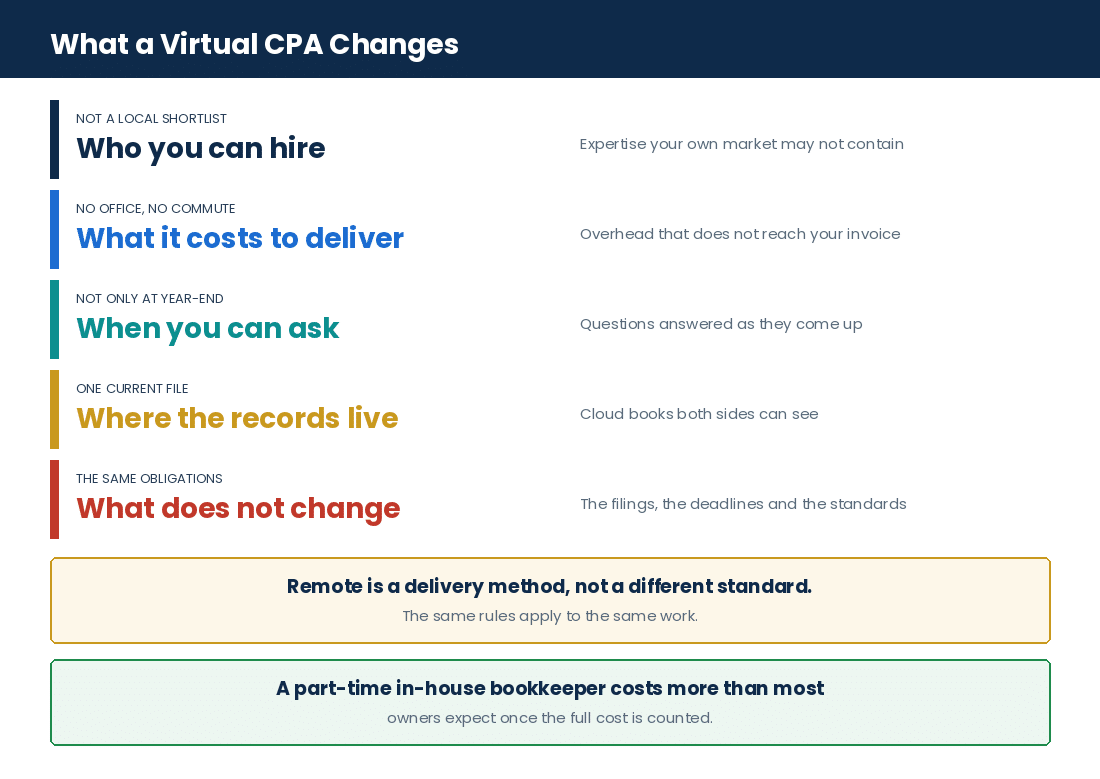
Hiring a virtual CPA buys flexibility and a lower cost base. Whether the business is a startup or an established small company, the records stay right and the Canadian tax rules get followed; what changes is what that costs and how it reaches you.
- Cost-effectiveness and convenience. Expert help without office space, a desk, or extra staff on payroll.
- Scalable accounting services. The service level moves up when the business grows and down when it slows, without hiring or firing anybody.
- Cloud-based CPA services. Both sides work on the same secure platform, sharing files in real time rather than by courier.
- Digital accounting solutions. QuickBooks, Xero and Hubdoc automate the bookkeeping that used to be typed in by hand.
Taken together these suit a busy owner who wants solid support and does not want to manage it.
Price and Ease, Which Are the Same Argument
The commonest reason owners give for moving is the pricing. Virtual firms tend to publish clear models built for small businesses rather than quoting by the hour.
| Pricing Model | Description | Benefits |
|---|---|---|
| Fixed-fee pricing | A set monthly or yearly fee for an agreed set of tasks | Budgeting is simple; no surprise bills |
| Subscription-based pricing | Plans that adjust by volume of work or complexity | Grows with the business; stays flexible |
For a small incorporated business watching its costs, both models remove the thing hourly billing creates, which is a bill nobody could forecast. At Gondaliya CPA, fees are fixed and annual with no hourly billing, shown before tax with sales tax on its own line. The pricing calculator returns a figure in about two minutes, and the pricing transparency promise sets out what is and is not inside it.
Convenience is the other half of the same point. Remote work removes the travel and the diary problem entirely. A question gets answered on a video call or through the portal, at the point the owner has the question, not at the point a meeting could be arranged.
A Hamilton landscaping company had been billed hourly by a local practice and could never predict the year. Three seasons running the invoice landed between roughly $6,000 and $19,000, the high year being the one where a reconciliation went wrong and every hour spent fixing it was billable. The owner had stopped phoning with questions because each call cost him money, which is the worst possible incentive to build into an accounting relationship. On a fixed annual fee he phoned four times in the first month. Two of those calls caught things worth catching. Figures changed for privacy.
Affordable Does Not Mean Thin
The point of a virtual arrangement is that the overhead comes out and the expertise stays in. A business gets online help backed by real knowledge of its own sector and its own filings, and the financial care it needs without the fuss that used to come attached.
What a Virtual CPA Actually Does
Services
Tax, Books and Advice, All Delivered Remotely
Virtual CPAs in Ontario cover the range a small or medium incorporated business needs. The cloud is how the work gets delivered quickly and safely; the work itself is ordinary professional work, and the owner stays inside the Canadian tax rules while getting on with growth.
Tax Preparation and Planning
This is where most of the volume sits. Tax preparation covers T2 corporate returns and T3 trust filings, prepared against current CRA rules, and filing remotely means they go in on time with fewer mistakes than a last-minute scramble produces.
| Work | What It Covers |
|---|---|
| Tax accountant online | Returns prepared remotely by a qualified accountant, which saves the owner time without costing accuracy |
| Tax compliance | Federal and provincial rules both met, which is how fines are avoided |
| GST/HST filing | Returns prepared and filed through online systems |
| CRA filing help | Forms and audits handled for the client, online, including the correspondence |
| SR&ED tax credits | Research and development costs identified where they qualify for the credit |
| Tax planning strategies | Advice on lowering the tax through deductions or income splitting |
The CRA row deserves a word, because owners worry about it. We do represent clients through CRA audits and reviews, and doing it remotely is no handicap: the file, the correspondence and the supporting records are already digital, which is what CRA asks for. Corporate tax return filing and tax planning sit on the same file, so the planning is informed by the return rather than guessed at.
Bookkeeping and Financial Reporting
It is worth separating the two. A bookkeeper records the daily sales and expenses. A CPA produces the higher-level reporting a business needs to make decisions with, and checks the bookkeeping that feeds it.
| Service | Description |
|---|---|
| Bookkeeping services | Sales, bills and payroll tracked with cloud tools such as QuickBooks or Xero |
| Financial statement preparation | Balance sheets and income statements, for the owner or for a lender |
Putting cloud bookkeeping together with professional review gives real-time information that has also been looked at by somebody qualified. That is what keeps the numbers right before they go to a bank or to the government. Our financial statements are prepared under a compilation engagement under CSRS 4200, which provides no assurance; where a lender or a stakeholder needs an audit or a review engagement, we refer that work out.
An Ottawa software company asked for “audited statements” because its investor had used the word in an email. The investor, asked directly, wanted to see a balance sheet and an income statement with a professional behind them, which is a compilation. The audit the owner had been quoted for by another firm would have cost several times as much and taken six weeks he did not have before the funding round. We prepared the compilation in nine days and told him plainly what it does and does not provide. He forwarded the engagement wording to the investor, who accepted it the same afternoon. Figures changed for privacy.
Business Consulting and Advisory
Virtual CPAs do not only process numbers. They also advise startups and growing businesses in Ontario on the decisions that set the numbers up.
- CPA for startups. Choosing the business structure that fits the plan, rather than the one that was convenient on day one.
- Business incorporation. Registrations handled online, and the continuing obligations kept up — the minute book maintained, shareholder agreements reviewed.
Handled online, these decisions get made quickly and without a paperwork round trip. A message thread is also faster than a meeting, which matters when the question is small and the answer changes what happens next week.
Expertise That Fits the Business
What a virtual CPA knows is specific to the kind of business in front of them.
- Startups: company type, the early tax plan, and government credits such as SR&ED identified while the costs are still being incurred.
- Small incorporated businesses: books kept current and payroll run through tools such as ADP Core or Rotessa.
- Online tax work: CRA filings including GST/HST returns, prepared to the provincial rules that apply.
Because the delivery is online, a client anywhere in Canada reaches a registered professional who knows the local rules. The advice fits the current CRA position and it arrives quickly, because the channel it arrives through is already open.
Virtual CPA Fit Check
Five quick questions on whether remote accounting suits your business. No fee shown.
Points to raise with us:
This is a general prompt, not tax or legal advice or a quote. Your position depends on your full facts. For a real review, please book a free consultation.
Reach, Tools and Security
How It Works
Nationwide Access, a Known Tool Stack, and Records That Stay Private
Hiring remotely removes geography from the decision. A business in Toronto, Vancouver, Calgary or a town with no CPA in it reaches the same firm on the same terms, and the finances get handled to the same Canadian tax rules and CRA requirements. Watching for changes in those rules is part of the engagement, so a filing or a report does not go out against last year’s position.
- Nationwide accessibility. The CPA is available wherever the business is.
- Current CRA compliance. Federal and provincial rules tracked continuously, not revisited at year end.
- Cost-effective delivery. Less than a large traditional firm charges for the same work.
- Flexible communication. Phone, email or video, whichever suits the question.
That shape fits small and medium businesses that want the accounting support to grow alongside them rather than be replaced every few years.
The Tools, and Why Each One Is There
Virtual accounting only works when the technology is dependable. We use cloud tools that are already standard among Canadian businesses, which means a client moving to us is usually moving to something they or their bookkeeper already recognise.
| Tool | Purpose | Benefits |
|---|---|---|
| QuickBooks | Bookkeeping and invoicing | Straightforward to use; handles payroll well |
| Xero | Cloud accounting | Tracks the finances in real time |
| Wagepoint | Payroll processing | Pays employees automatically |
| Rotessa | Recurring payment collections | Makes collecting payments simple |
| Hubdoc | Document capture and storage | Cuts out manual data entry |
| ADP | Payroll solutions | Keeps payroll compliant |
These keep the data accurate and the privacy protected under Canadian law. Because the systems are cloud systems, the owner can check an update at any time from any device, which is the point if the week is already full. Combined with hands-on professional work, that is what online CPA service across Ontario looks like without any loss of quality or safety.
A Thunder Bay manufacturer had used the same local accountant for eleven years, until the accountant retired and the nearest replacement was a four-hour drive. The owner assumed remote work would mean worse service. The first thing that changed was response time: questions that used to wait for a quarterly visit got answered the next business day. The second was that the payroll moved from a spreadsheet and a chequebook onto Wagepoint, which removed about six hours a month of his own time. He has not met us in person. Figures changed for privacy.
What to Expect Day to Day
Online CPA services give a business a flexible way to run its accounting without leaving the office. Cloud platforms carry the real-time position, so the financial information is available at any hour from wherever the owner happens to be. Automation does the repetitive part of the bookkeeping, the tax work and the payroll, and QuickBooks or Xero usually connects straight into it.
Where records are coming from an older system, a secure migration moves the historical financial data into the cloud without exposing it and without a gap in service. From that point a single client portal holds the documents, the reports, the invoices and the messages in one place, which is what makes working with a CPA team clear rather than scattered across email.
Security and Confidentiality
Financial data is sensitive, so this is not a secondary consideration. Protection runs in layers.
- Encrypted document sharing. Files are protected by strong encryption while they are being uploaded.
- Multi-factor authentication. A password alone does not get anyone in; a second factor, such as a code to a phone, is required.
- Secure storage. Data sits on cloud servers held to strict Canadian security requirements, backed up regularly, without the information being exposed outside.
A Toronto consultancy had been emailing payroll spreadsheets with employee social insurance numbers in the attachment, to three different addresses, for years. Nobody had told them not to. Moving the payroll into a portal with multi-factor authentication took one afternoon and cost nothing beyond the setup already in the engagement. The owner’s reaction was the one we usually get: not relief about security, but surprise that there had been an alternative. Nothing had gone wrong. That is not the same as nothing being at risk. Figures changed for privacy.
These measures keep the information private and meet what CRA requires, and they are a large part of why a client trusts a virtual accountant with the details of the business in the first place.
Onboarding and Staying in Touch
Process
How the Engagement Starts, and What Contact Looks Like After
Engaging an online CPA begins with onboarding, and onboarding begins with access. Login details for the secure client portal are issued at the outset, so there is somewhere to put documents from the first day rather than an email thread that grows.
Security holds through that period, which is the period most likely to be careless. Files move through encrypted channels, including the first bulk upload of historical records.
| Stage | What Happens | What You Do |
|---|---|---|
| Portal access | Login details issued and the document checklist posted | Sign in and look at the list |
| Business review | Your details checked carefully against the records | Confirm what is right and flag what is not |
| Software linking | Existing accounting software connected to the new system where needed | Give access to QuickBooks or Xero |
| Guided steps | Clear instructions set out inside the portal | Work through them in order |
| Progress updates | Regular updates until everything is running | Nothing; you are told where it stands |
The review stage is deliberately careful, because the details that get checked at onboarding are the details everything afterwards relies on. Where the business already runs software, that gets linked rather than replaced. And the steps sit inside the portal in order, so nothing has to be remembered from a phone call.
A Brampton retailer came to us mid-year with two years of QuickBooks history and a conviction that moving firms meant starting the file again. It did not. We linked the existing company file, reconciled the opening position against the bank, and carried on from the month she arrived. The onboarding took eleven days, nine of which were waiting for one bank to release a statement. She had delayed the move for most of a year on the assumption it would be disruptive. Figures changed for privacy.
Communication and Collaboration
Remote bookkeeping depends on the contact being good, not frequent. Video calls and messaging answer questions quickly during tax preparation or a monthly review, which is when questions actually arise.
The shared document space inside the portal is the other half of it. Both sides open the same file at the same time, and the changes are tracked, so there is no version of a statement circulating that somebody has not seen.
Collaboration also means the system does some of the remembering. Reminders go out for deadlines such as GST/HST filings, and alerts flag payments and other dates that matter. On top of that, a CPA can give advice shaped by the local rules that apply to small businesses in Ontario and across Canada, because knowing which of those rules bites is the part that cannot be automated. Where something needs a conversation rather than a message, please book a free consultation.
Virtual Against a Traditional Local Firm
The Comparison
How to Choose, and What the Two Arrangements Really Differ On
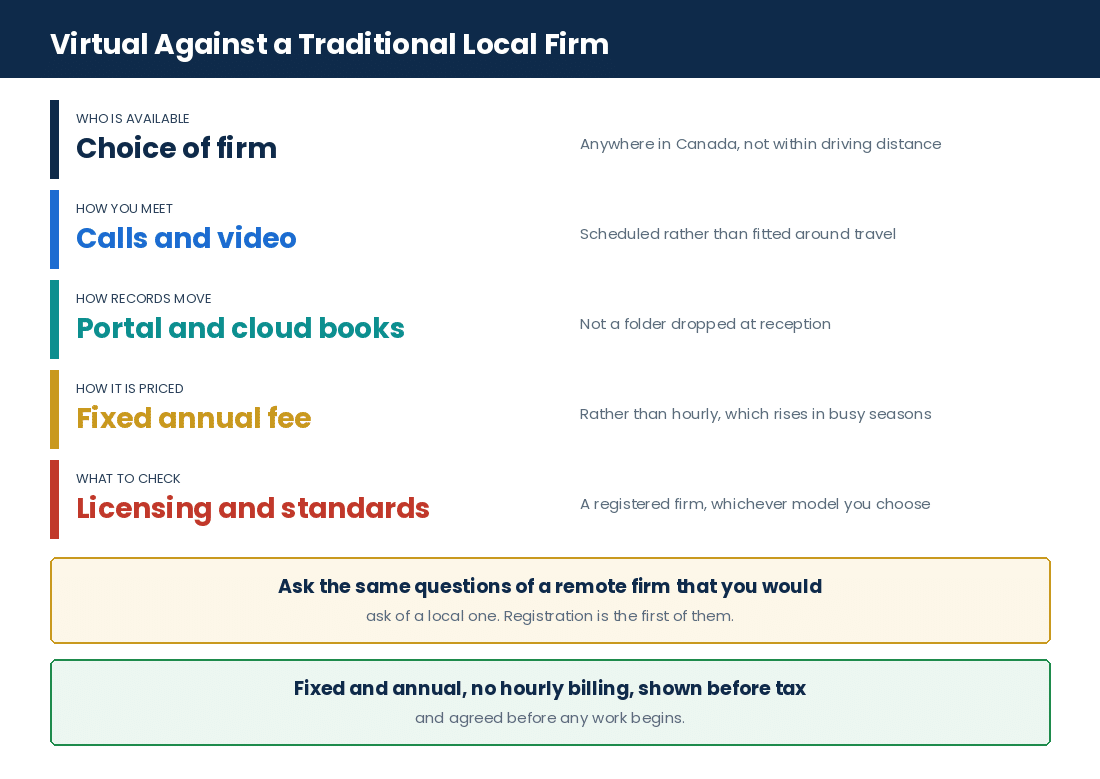
Picking a virtual CPA matters because the choice decides how well the money gets managed and how reliably the rules get followed. Whether the search is Canada-wide or specifically for an affordable Ontario firm, the criteria are the same, and they are not criteria about distance.
| Factor | What to Look For |
|---|---|
| Licensing | Registered by CPA Ontario and recognised by the Canadian regulators |
| Industry expertise | Experience in your own business sector |
| Service range | The full set: tax filing, bookkeeping, payroll |
| Technology | Cloud platforms, QuickBooks or Xero |
| Pricing transparency | Fixed fees, no hidden costs |
The Five Questions, Answered Properly
- Licensing and credentials. Check the firm holds a licence from CPA Ontario and that the Canadian regulators recognise it. A registered firm is held to professional standards and handles the CRA rules properly; distance does not alter either.
- Industry expertise. Tax treatment shifts by field — retail is not manufacturing — and a CPA who knows the sector makes fewer mistakes in it.
- Service range. Confirm everything you need can be done online: T2 corporate returns, GST/HST, payroll, bookkeeping. Some firms also take the whole accounting function on an outsourced basis Canada-wide.
- Technology adoption. Cloud software is a genuine advantage rather than a badge. QuickBooks Online and Xero make sharing information and keeping records accurate workable at a distance.
- Pricing transparency. A fixed-fee model tells you what you will pay before the work starts, and nothing arrives later that was not in it.
Why Owners Choose Gondaliya CPA
We are a registered Ontario CPA firm, based in Toronto and working with clients coast to coast without a difference in service. The work is adapted to the client’s industry and size, so the advice makes sense for the business in front of us and fits the Canadian rules clearly.
- A registered Ontario CPA firm since 2013, working with Toronto small businesses and clients throughout Canada.
- Qualified CPAs who work in the Canadian rules daily, particularly for incorporated small and medium businesses.
- Fees fixed and annual with no hourly billing, shown before tax with sales tax on its own line.
- Secure cloud platforms that keep the data safe and make the contact straightforward.
- Coverage across the range, from CRA filings and GST/HST returns to SR&ED claims.
- Scalable service, from simple bookkeeping for a startup to more involved corporate tax work for a larger business.
- Client-specific financial oversight, with reporting focused on cash flow, profitability and the deadlines that matter.
- CRA representation, handling audits and queries directly so the owner does not have to.
The pricing stays clear and fixed, and the schedule is built around the client’s rather than ours. Both policies behind the fee are published in full: the 30-Day Money-Back Guarantee and the 60-Day Fee Matching Policy, which is worth reading before signing an engagement letter with any firm.
An owner interviewed us against a traditional downtown practice and told us afterwards what decided it. Not the fee, which was close. It was that he asked both firms how a mid-year question would reach them, and the other answer involved a scheduled appointment three weeks out. He had a lease decision in front of him that month with a tax consequence attached to the timing. We answered the lease question in the first week. The appointment he did not have to wait for was worth more to him than the difference in price. Figures changed for privacy.
What Clients Say, and What It Tells You
Our Google reviews run to a volume that tells its own story, and the themes in them are consistent: clear communication, work delivered on time, and packages priced at a level a small business can plan around. Clients also point to advice that reduced their tax while staying inside the CRA rules, which is the combination that matters. A firm that knows the numbers and pays attention to the people behind them is possible at a distance; the distance is not the thing that decides it.
A Few Things Worth Knowing
- Payment platforms such as Stripe integrate into the file, so transactions track without being re-entered.
- Fixed-fee pricing makes the cost of small business accounting predictable rather than seasonal.
- Hiring Canada-wide opens up expertise that a single local market may not contain.
- Where stakeholders need an audit or a review engagement, that assurance work is referred out; we perform compilations under CSRS 4200, which provide no assurance.
- Online bookkeeping syncs into the CPA reporting, so accuracy holds through the year rather than being restored at year end.
- Representation during a CRA review is handled remotely, and the digital file is what makes that straightforward.
- Client-specific oversight is how budget goals get tracked against actual results rather than estimated.
- Scalable service is what lets the same firm still fit once a startup has become a larger company.
Frequently Asked Questions
FAQs
Frequently Asked Questions on Hiring a Virtual CPA in Ontario
What is the difference between bookkeeping and CPA services?+
Bookkeeping tracks the daily transactions — the sales and the expenses, as they happen. CPA services analyse the finances, prepare the reporting on top of them and provide tax planning. The bookkeeping is the record; the CPA work is the higher-level financial insight drawn from it, and the review that confirms the record is sound before anyone relies on it.
Do I need a CPA for a small business in Canada?+
Yes. A CPA keeps the tax filings accurate, keeps the business compliant with the Canadian small business tax rules, and gives expert financial advice as the business grows. For an incorporated business the filings are not optional and the consequences of getting them wrong are measurable, which is the practical answer to the question.
Why hire a virtual CPA instead of a traditional accountant?+
Because the service is flexible and scalable and the pricing is fixed-fee rather than hourly. The expertise is provided remotely, which removes the office cost from the fee and the travel and scheduling from the client’s week. The professional standards are identical; what changes is the overhead and how quickly a question gets answered.
How does subscription-based pricing help a small business?+
The plan adjusts with the workload or the complexity of the work. That means the business pays for the services it needs at the level it currently needs them, and the figure moves when the business grows or downsizes instead of staying fixed against a volume that has changed.
What about audit and assurance services?+
Assurance work means reviewing financial statements for accuracy and compliance, which is what builds confidence with investors and satisfies a regulatory requirement. Gondaliya CPA performs compilation engagements under CSRS 4200, which provide no assurance, and refers audit and review engagements out. Ask what the person requesting the statements actually needs, because the word “audited” is often used for something a compilation covers.
Can a virtual CPA represent me to CRA?+
Yes. We communicate with CRA on the client’s behalf during an audit or a dispute, and doing it remotely is no limitation — the authorisation, the correspondence and the supporting records are all handled digitally, which is the form CRA prefers in any case. Representation during a CRA review is part of the service, not an add-on to be negotiated when it happens.
What is client-specific financial oversight?+
Reporting tailored to the figures that matter in your business rather than a standard pack. In practice that means the metrics an owner actually makes decisions on — cash flow, profitability, the deadlines coming up — set out so the decisions can be made on information rather than impression.
How do scalable accounting services help a growing business?+
They let the service level change without the relationship changing. Accounting support is added as demand rises and reduced when it falls, which is difficult to arrange with a salaried hire and straightforward to arrange with a firm. A startup that becomes a mid-sized company does not have to change accountants to get the work it now needs.
Do virtual CPAs handle EI and CPP calculations?+
Yes. Payroll deductions including Employment Insurance and Canada Pension Plan contributions are calculated and managed as part of running the payroll, which keeps the business compliant with the Canadian rules. The work is done through payroll platforms such as Wagepoint or ADP, so the remittances follow the pay run rather than being assembled afterwards.
What about the Ontario Employer Health Tax?+
Employer Health Tax calculations and filings are handled as part of the payroll work, accurately and on schedule, so the provincial employer obligation is met without the owner having to track it separately. It sits alongside the EI and CPP remittances on the same file.
Essential Points for Business Owners
Key Takeaways
What Decides Whether a Virtual CPA Is the Right Choice
The professional standards do not change with distance. What changes is the cost base, the speed of contact, and whether the business is set up to work in the cloud at all.
| Point | The Position | Why It Matters |
|---|---|---|
| What a virtual CPA is | A CPA handling the finances online through cloud tools | Access to the records at any hour, from anywhere |
| What it replaces | An in-house bookkeeper, the desk and the office visit | Expertise stays, overhead comes out |
| How it is priced | Fixed-fee or subscription-based | The figure is known before the work starts |
| How it scales | Service level rises and falls with the business | No hiring cycle to change the capacity |
| Where it reaches | Ontario and across Canada | Geography stops limiting the choice of firm |
| Tax work covered | T2 and T3 returns, GST/HST, SR&ED, tax planning | The planning sits on the same file as the return |
| Bookkeeping and reporting | Cloud bookkeeping with professional review on top | Numbers are right before a lender or CRA sees them |
| Assurance | Compilation engagements under CSRS 4200, which provide no assurance | Audit and review engagements are referred out |
| CRA audits | Representation handled for the client, remotely | The digital file is what CRA asks for anyway |
| Payroll | EI, CPP and Employer Health Tax through Wagepoint or ADP | Remittances follow the pay run |
| Technology | QuickBooks, Xero, Hubdoc, Rotessa | Standard tools, so a move is rarely a rebuild |
| Security | Encrypted sharing, multi-factor authentication, secure storage | Records stay private and the standard is Canadian |
The Six Things We Check First
- What does the business currently spend on the accounting function? Salary, desk, software licence and the owner’s own hours, not just the invoice from the accountant.
- Where do the records live now? Cloud software, a desktop file, a shoebox or a bank feed nobody reconciles.
- What is behind? GST/HST, payroll remittances and the corporate return are rarely behind by different amounts.
- Who actually needs the financial statements? A lender, an investor or the owner, because the answer decides whether a compilation is enough.
- Is there any CRA correspondence open? An audit or a query in progress sets the order of work, whatever else is planned.
- How does the owner prefer to be reached? Portal message, video call or phone — asked at the start, because contact that does not suit the client does not get used.
Our Approach
Gondaliya CPA issues portal access at the outset and posts a document checklist, so there is somewhere for the records to go on day one; links the accounting software already in use rather than rebuilding the file; reconciles the opening position against the bank before anything is reported on; keeps the bookkeeping current through the year in QuickBooks or Xero with receipts captured through Hubdoc; runs the payroll through Wagepoint or ADP so EI, CPP and Employer Health Tax follow the pay run; prepares the T2 and GST/HST filings against the current CRA position; prepares financial statements under a compilation engagement under CSRS 4200, which provides no assurance, and refers audit and review engagements out; and represents the client directly on CRA audits and queries. Fees are fixed and annual with no hourly billing, shown before tax with sales tax on its own line, and agreed before any work begins.
Industry Spotlights: Sectors We Represent
Industry Expertise
Remote accounting suits every sector, but for different reasons. Here are eleven, and what working with a virtual CPA changes in each.
| Industry | What Remote Delivery Changes |
|---|---|
| Technology startups & SaaS | Already cloud-native, and SR&ED costs get identified while they are being incurred |
| E-commerce & online retailers | Platform and payment feeds flow straight into the books without manual entry |
| Consulting firms | No office to visit on either side, and the shareholder draws get characterised early |
| Construction, contractors & skilled trades | Receipts captured from the site rather than carried back to a desk |
| Property developers & builders | Project-level reporting visible between year ends rather than after them |
| Real estate investors & holding companies | Several entities handled on one portal with one point of contact |
| Transportation, logistics & trucking | Owner-operators file and approve from the road, not from an office |
| Restaurants & food and beverage | Payroll and remittances run on schedule through the service period |
| Daycare, childcare & CWELCC services | Funding records and the returns kept together in one place |
| Dentists & dental practices | Equipment purchases recorded as they happen, with the capital pools kept current |
| Medical doctors & physician corporations | Remuneration decisions reviewed mid-year rather than at filing time |
- Technology startups & SaaS: These businesses already run on cloud systems, so the accounting joining them changes nothing about how the team works, and SR&ED-eligible costs get flagged in the month they are spent.
- E-commerce & online retailers: Platform settlement data and payment processors such as Stripe feed directly into the ledger, which removes the re-entry that used to make online sales expensive to account for.
- Consulting firms: A consultant with no fixed office has nothing to gain from an accountant who has one, and the draws out of the corporation get characterised while the year is still open.
- Construction, contractors & skilled trades: Receipts and subcontractor invoices get photographed on site into Hubdoc, which is the difference between books that are current and books that are reconstructed each quarter.
- Property developers & builders: Project-level cost and revenue reporting is available while the project is running, which is when a decision can still be influenced by it.
- Real estate investors & holding companies: Multiple corporations sit on one portal with one point of contact, so intercompany positions agree without a round of phone calls.
- Transportation, logistics & trucking: An owner-operator who is rarely at a desk can approve a return and upload fuel records from a phone, which is the only version of this that works.
- Restaurants & food and beverage: Payroll runs and remittances follow the schedule through the busiest weeks, because the processing does not depend on anybody being in the office.
- Daycare, childcare & CWELCC services: Funding records and the filings they have to agree with are held in the same place, which is what makes a reconciliation quick instead of a search.
- Dentists & dental practices: Equipment invoices are recorded when they are issued, so the capital cost allowance pools are current rather than assembled from a folder at year end.
- Medical doctors & physician corporations: Salary and dividend decisions get reviewed partway through the year, while there is still time for the answer to change what gets paid.
A dental practice had bought roughly $220,000 of chairs and imaging equipment over two years, and nobody had told the accountant until the file arrived at year end each time. The invoices came out of a drawer in March. Once the practice manager began photographing them into Hubdoc on the day they arrived, the capital pools stayed current and a half-year rule question that had been answered wrongly the previous year got answered correctly in the month the asset was bought. The equipment had not changed. When we found out about it had. Figures changed for privacy.
Professional Guidance and Quick Reference
Guidance
Essential Points for Ontario and Canadian Businesses
The decision to hire remotely goes wrong in a small number of predictable ways: choosing on distance rather than on licensing, industry experience, service range, technology and pricing transparency; assuming a virtual firm cannot represent the business to CRA, when the digital file is the form CRA prefers; accepting an hourly rate because the quote looked lower, and then not asking questions because each question costs money; asking for an audit when the person requesting the statements would accept a compilation; emailing payroll data because nobody suggested a portal; and leaving the move for a year on the assumption that changing firms means rebuilding the file. Gondaliya CPA links the software already in use and reconciles the opening position before reporting on anything.
Quick Answers
At a Glance
- Virtual CPA: a CPA handling the finances online through cloud tools
- Virtual accounting services: the books and the reports prepared online
- Remote CPA services: expert help without being in the same place
- Outsourced accounting: the function handed to a firm rather than a hire
- Cloud accounting: records stored and managed on the internet
- What it replaces: an in-house bookkeeper, the desk and the office visit
- Pricing models: fixed-fee or subscription-based
- Our fee basis: fixed and annual, no hourly billing
- How it is shown: before tax, with sales tax on its own line
- Scalability: service level rises and falls with the business
- Reach: Ontario and across Canada
- Corporate tax: T2 returns prepared and filed electronically
- Trust filings: T3 returns where a trust is in the structure
- Sales tax: GST/HST returns prepared and filed online
- Credits: SR&ED costs identified where they qualify
- Payroll deductions: EI and CPP calculated with the pay run
- Provincial payroll: Ontario Employer Health Tax filed on schedule
- Payroll platforms: Wagepoint and ADP
- Bookkeeping platforms: QuickBooks and Xero
- Document capture: Hubdoc
- Payment collection: Rotessa for recurring, Stripe for online sales
- Financial statements: compilation engagements under CSRS 4200
- What a compilation provides: no assurance
- Audit and review engagements: referred out
- CRA audits: we represent clients through them
- Onboarding: portal access and a document checklist at the outset
- Secure migration: historical records moved to the cloud without a gap
- Security: encrypted sharing, multi-factor authentication, secure storage
- Contact: portal message, phone, email or video call
- Response standard: 1 business day
Who This Is For / Not For
Fit Check
- For: incorporated small and medium businesses in Ontario and across Canada that want qualified accounting without carrying an in-house bookkeeper.
- For: owners who want the annual figure known before the work starts, and who would rather ask a question by message than schedule a meeting.
- Not for: businesses that need an audit or a review engagement, which we refer out; we perform compilations under CSRS 4200, which provide no assurance.
- Not for: a fee quotation, which depends on the entity, the volume and what is outstanding, and which the pricing calculator or a consultation will give you properly.
People Also Ask
Related Questions
Is a virtual CPA actually a licensed CPA?+
It depends entirely on the firm, which is why licensing is the first thing to check rather than the last. “Virtual” describes how the work is delivered and carries no professional meaning on its own. A registered firm appears on the CPA Ontario public firm directory and is held to the professional standards and the complaint process that go with registration. Confirm the registration before anything else, because the rest of the criteria only matter if that one is satisfied.
Will I lose the personal relationship by going remote?+
What usually happens is the opposite, for an unglamorous reason: contact gets cheaper. An hourly arrangement teaches an owner not to phone, and a quarterly visit concentrates a year of questions into four afternoons. On a fixed annual fee with a portal and a one business day response standard, the conversation happens when the question arises. Clients who have never met us in person are not the ones who report feeling distant.
Can I switch mid-year without starting the books again?+
Yes, and this is the misconception that delays the move most often. An existing QuickBooks or Xero company file gets linked rather than replaced; the opening position is reconciled against the bank; and the work continues from the month you arrive. Where the records are in an older desktop system, a secure migration moves the history into the cloud. The slow part is usually a bank releasing a statement, not the accounting.
Is my financial data safe in the cloud?+
It is considerably safer than the alternative most small businesses are actually using, which is attachments in email. Documents move through encrypted channels, access needs a second factor beyond the password, and the data sits on servers held to strict Canadian security requirements with regular backups. The question worth asking a prospective firm is not whether they use the cloud but how they handle payroll data, because that is where the sensitive information is.
Does a virtual firm know the local rules where I am?+
The rules that matter are federal and provincial, not municipal, and they are published. A registered Ontario firm working with clients across Canada deals with provincial variation as a matter of routine, which is a different thing from guessing at it. Where a client’s province has a filing or a credit of its own, that is part of the engagement rather than a surprise; the thing that creates risk is a firm that sees a given province once a decade, wherever its office happens to be.
Glossary of Key Terms
Definitions
- Virtual CPA: a Chartered Professional Accountant who handles the finances remotely.
- Virtual accounting services: bookkeeping and reporting prepared and delivered online.
- Remote CPA services: professional accounting help provided without being on site.
- Outsourced accounting: the accounting function handed to a firm instead of staffed internally.
- Cloud accounting: financial records stored and managed on internet-based systems.
- Cloud-based CPA services: CPA work delivered through shared online platforms.
- Digital accounting solutions: tools that automate the bookkeeping, such as QuickBooks, Xero and Hubdoc.
- Fixed-fee pricing: a set monthly or annual fee for an agreed scope of work.
- Subscription-based pricing: a plan that adjusts with the volume or complexity of the work.
- Scalable accounting services: service levels that move up or down with the business.
- Client portal: the single secure place holding documents, reports, invoices and messages.
- Secure migration: moving historical financial records into the cloud without exposure or interruption.
- Multi-factor authentication: sign-in requiring a second factor beyond the password.
- Compilation engagement: financial statements prepared under CSRS 4200, which provide no assurance.
Want a checklist to work from? You can download our free virtual CPA selection checklist before your consultation.
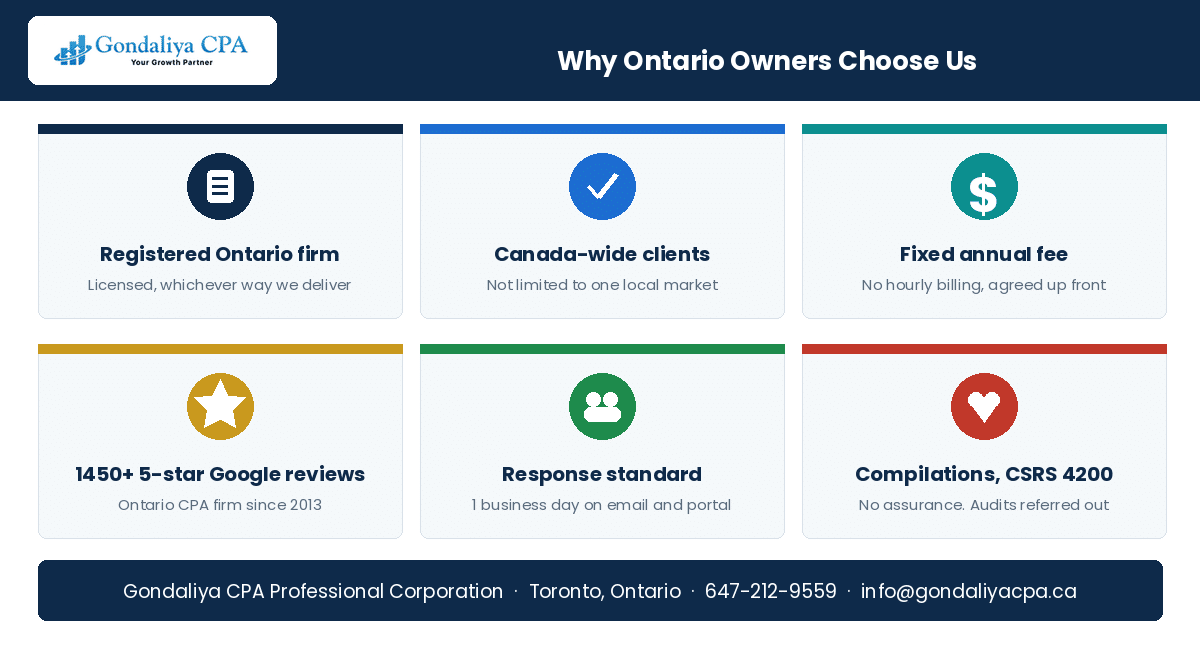
Four things make the case for hiring a virtual CPA. The cost base — the expertise stays in and the office space, the desk and the salaried bookkeeper come out, which is why an affordable fixed fee buys work that used to require a hire. The pricing model — fixed-fee or subscription-based, so the figure is known before the work starts and an owner stops being charged for asking a question, which is the single worst incentive in an hourly relationship. The scale — the service level moves with the business rather than being set by whoever was hired three years ago, so a startup and the company it becomes can use the same firm. And the reach — a business in Toronto, Vancouver, Calgary or a town with no CPA in it chooses on licensing, industry experience, service range, technology and pricing transparency instead of on which office is nearest.
Three questions settle whether a virtual firm suits you, and none of them are about software. First, is the firm registered with CPA Ontario? “Virtual” carries no professional meaning on its own, and registration is checkable on the public directory. Second, who actually needs your financial statements? If a lender or an investor needs an audit or a review engagement, that work is referred out; a compilation under CSRS 4200 covers a great deal of what gets asked for under the word “audited”. Third, where do your records live today? An existing QuickBooks or Xero file gets linked rather than rebuilt, which is usually the reason the move was being put off.
Virtual CPA Services in Ontario: How Gondaliya CPA Can Help
The work of a CPA, without the office visit
Gondaliya CPA issues portal access and a document checklist at the outset, links the QuickBooks or Xero file already in use rather than rebuilding it, reconciles the opening position against the bank before reporting on anything, keeps the bookkeeping current through the year with receipts captured through Hubdoc, runs the payroll through Wagepoint or ADP so Employment Insurance, Canada Pension Plan and Ontario Employer Health Tax follow the pay run, prepares and files the T2 and GST/HST returns against the current CRA position, identifies SR&ED-eligible costs while they are being incurred, prepares financial statements under a compilation engagement under CSRS 4200, which provides no assurance, refers audit and review engagements out, and represents clients directly through CRA audits and queries. Fees are fixed and annual with no hourly billing, shown before tax with sales tax on its own line, and agreed before any work begins. Please book a free consultation.
Next Steps
Please book a free consultation with Gondaliya CPA and bring three things: the name of whatever accounting software your records are in, if any; a note of what is currently outstanding, including GST/HST and payroll remittances as well as the corporate return; and any CRA correspondence that is open. We will tell you what moving actually involves, which in most cases is linking the file you already have rather than rebuilding it. If a lender or an investor has asked for financial statements, say what word they used and who they are, because a compilation satisfies a great deal of what gets requested as an audit and it is considerably quicker. If an audit or a query from CRA is in progress, mention it at the outset — it sets the order of the work, and representation is part of the service rather than something to negotiate later. We perform compilation engagements under CSRS 4200, which provide no assurance, and we refer audit and review engagements out. You will get a fixed annual fee, shown before tax, agreed before any work begins. We serve Toronto, Mississauga, Brampton, Vaughan, Etobicoke, Scarborough, Hamilton, Ottawa and the rest of Ontario, and work with corporations across Canada. If our content helps, please add gondaliyacpa.ca as a preferred source on Google.
Published: · Last updated:
Editorial policy: We research against the Income Tax Act, the Income Tax Regulations, CRA guidance and information circulars, Department of Finance announcements, CPA Canada Handbook standards and CPA Ontario sources, fact-check the figures, and Sharad Gondaliya, CPA, reviews the content, which we update as the rules change.
Disclaimer: This article is educational information only and is not tax, legal or accounting advice. It sets out the case for hiring a virtual CPA in Ontario and compares remote delivery against a traditional local firm, covering what virtual accounting, remote CPA services and outsourced accounting mean in practice, cloud accounting and cloud-based CPA services, who benefits from them, cost-effectiveness and convenience, scalable service levels, fixed-fee and subscription-based pricing, tax preparation and planning including T2 and T3 returns, GST/HST filing and SR&ED credits, bookkeeping and financial reporting, business consulting and advisory work, nationwide reach across Canada, the QuickBooks, Xero, Wagepoint, Rotessa, Hubdoc and ADP tool stack, onboarding and secure migration through a client portal, communication and collaboration methods, data security including encrypted document sharing, multi-factor authentication and secure storage, and how to choose a firm on licensing, industry expertise, service range, technology and pricing transparency. It does not cover personal tax filing for unincorporated proprietors, software configuration instructions, or the fee for any particular engagement. Rates, thresholds, forms and statutory references change, and every reference should be confirmed against the current Income Tax Act and current CRA guidance. Gondaliya CPA performs compilation engagements under CSRS 4200, which provide no assurance, and does not perform audit or review engagements, though we do represent clients through CRA audits. Please consult a licensed CPA before acting.

Sharad Gondaliya is a CPA Canada & CPA USA with 15 Years+ experience of Accounting, Tax, Payroll of Corporate Small Businesses as Tax Accountant. He is a CPA Ontario member (61040184) and holds US CPA licences in Washington and Montana and is well known among corporate small businesses for tax planning, efficient tax solutions, and affordable CPA services. Sharad is the Principal (Director) of Gondaliya CPA – Affordable CPA Firm in Canada. Licenses: CPA Ontario: 61040184 | CPA USA (MT): PAC-CPAP-LIC-033176 | CPA USA (WA): 57629 | CPA Firm License: 61330051 View Full Author Bio