



Corporate Year-End Tax Planning Strategies Every Business Owner Should Know
Effective Year-End Tax Strategies and T2 Filing Guide by Gondaliya CPA
For effective corporate tax planning Canada, Gondaliya CPA offers practical year-end tax strategies to optimize your corporation income tax return and simplify T2 filing. Their approach focuses on detailed corporate tax strategy and business tax planning to ensure a smooth corporate tax return process.
The distinction that matters most is between decisions and reporting. Corporate year-end accounting and filings record what already happened; planning changes what happens, and the window for that closes on your year-end date.
Quick Summary
Year-end planning has four parts: getting the corporate rate right, timing income and expenses across the year-end line, deciding how the owner is paid, and filing correctly afterwards. Only the last one can be done late.
Reading time: 52 minutes.
Table of Contents
The Numbers That Matter
This article covers Canada, with Ontario and Toronto context, and reflects rules current to 2026. It is written for incorporated Canadian-controlled private corporations. Figures marked illustrative are examples, not quotes, and any masked engagement notes end with “Figures changed for privacy.” This is educational information only and not tax or legal advice. Owner remuneration outcomes depend on personal income, province, family circumstances and the corporation’s tax accounts, so a general comparison cannot substitute for a calculation on your own numbers.
The Planning Window
The Planning Window
The Deadline
What Closes and What Stays Open
| Decision | Must Happen |
|---|---|
| Buying and commissioning equipment | Before year-end, and available for use |
| Paying a bonus or accruing it | Declared before year-end, paid within the allowed period |
| Declaring a dividend | By resolution in the calendar year it belongs to |
| Repaying a shareholder loan | Within the period the Act allows after the year it arose |
| Realising a gain or loss on investments | Before year-end |
| Writing off a bad debt or obsolete stock | Before year-end, with evidence |
| Choosing the capital cost allowance claim | On the return, so still open |
| Electing how much of a loss to apply | On the return, so still open |
The last two rows are why filing still matters. But they are the exception. Most levers in the table cannot be pulled retroactively, and an accountant meeting you in the sixth month after year-end is preparing a report on decisions you already made.
Start the Conversation Early
The practical recommendation is a review roughly two to three months before your fiscal year-end, when there is still time to act on what it finds.
For a smaller corporation this need not be elaborate. It is a projection of where the year is landing and a short list of decisions that follow from it, which is the substance of corporate tax planning for small and medium businesses. What it covers:
- Project the year’s taxable income against the business limit
- Check whether investment income has crossed the grind threshold
- Decide on any capital purchases while there is time to commission them
- Settle the owner remuneration mix while both years can still be balanced
- Identify bad debts and obsolete stock while the evidence is fresh
- Review the shareholder loan against its repayment deadline
Your Year-End Date Is Itself a Choice
A corporation chooses its fiscal year-end at the outset, and the choice has consequences worth understanding.
A non-calendar year-end can spread the workload away from the busiest season and creates a gap between the corporate year and the personal calendar year, which gives some flexibility in timing owner remuneration across two personal tax years.
Changing an established year-end requires CRA approval and needs a sound business reason, so it is a decision better made at incorporation than revisited later.
The most common thing we cannot fix is timing. The equipment arrived in the wrong week, or the bonus was never declared. Both were decisions, and both had closed. Figures changed for privacy.
Risk Warning: Most planning levers close on your year-end date. Please book the review before it, not after.
Getting the Corporate Rate Right
Getting the Corporate Rate Right
The Rate
The Two Rates
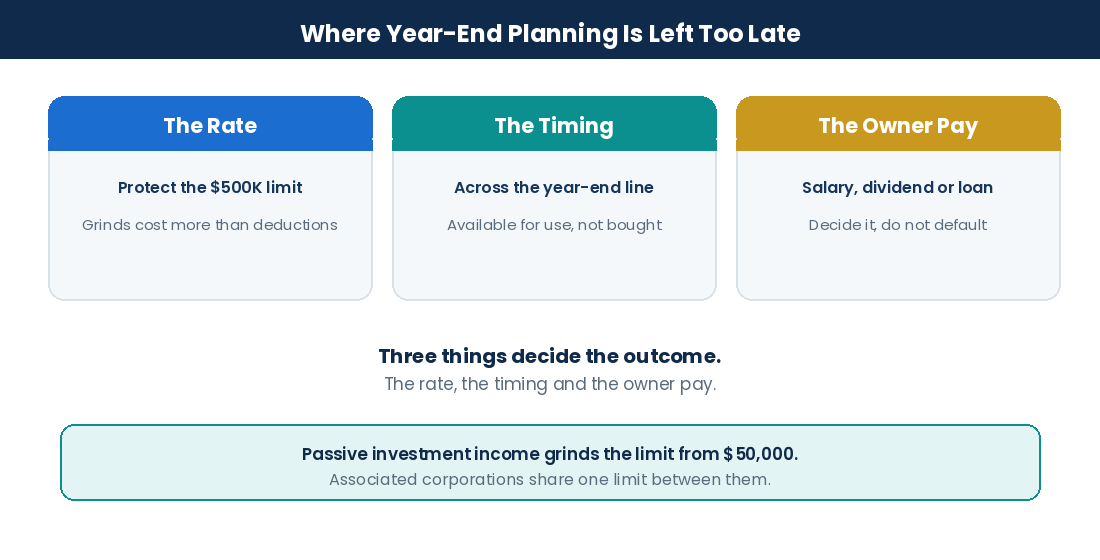
A Canadian-controlled private corporation pays a reduced federal rate of 9% on active business income up to the federal business limit of $500,000, and the general rate on anything above it.
Ontario reduced its small business rate to 2.2% effective 1 July 2026. For a calendar-year corporation that gives a blended provincial rate of roughly 2.7% for 2026 and a combined rate near 11.7%, against the 12.2% that applied before.
The gap between the small business rate and the general rate is the largest single number in corporate planning, which is why protecting the business limit matters more than most individual deductions.
Provincial rates move independently of the federal one and are worth checking each year rather than assuming. We keep the current figures and the effective dates in our summary of the Ontario corporate tax rate.
The Taxable Capital Grind
The business limit is reduced where taxable capital employed in Canada is large, measured across the associated group.
This surprises owners who do not feel wealthy. Taxable capital broadly reflects the size of the balance sheet: retained earnings, loans, share capital and similar. A business that has retained profits for years, or carries significant inventory and receivables, can approach the threshold without any change in trading.
The Passive Income Grind
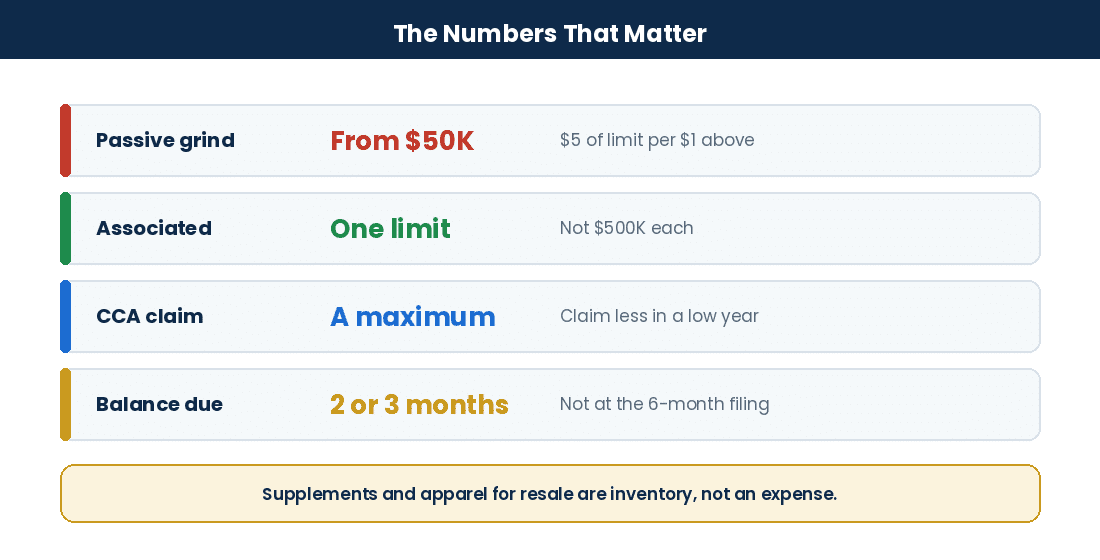
Separately, the business limit is reduced where adjusted aggregate investment income exceeds $50,000, at a rate of $5 of limit for every $1 of investment income above that figure, eliminating the limit entirely at $150,000.
Two things are commonly stated wrongly here. The grind does not begin at $150,000, it ends there. And it is not dollar for dollar; it is five to one, which is why a modest amount of investment income has a disproportionate effect.
A corporation earns $90,000 of investment income in a year. That is $40,000 above the threshold, so the business limit is reduced by $200,000, leaving $300,000 at the small business rate and pushing $200,000 of active income to the general rate. The additional corporate tax is substantial, and it was caused by the investment portfolio rather than by anything in the operating business. Figures changed for privacy.
The planning point is that the grind uses the prior year’s investment income to reduce the current year’s limit, so a good investment year has its effect the following year. That gives warning, if anyone is watching.
Associated Corporations
Where corporations are associated, they share one $500,000 business limit between them rather than each having their own.
- Association turns on control and share ownership, not on whether the businesses are related commercially
- Ownership by spouses, children and other related persons can create association
- An allocation agreement is filed to divide the limit
- Where no agreement is filed, the CRA can allocate it
- The taxable capital and passive income grinds are measured across the group
Owners who incorporate a second company expecting a second $500,000 are frequently mistaken. Please have the association question answered before assuming otherwise.
Active Against Investment Income
Only active business income qualifies for the small business rate. Investment income is taxed at a high corporate rate, part of which is refundable when taxable dividends are paid out.
That refundable mechanism is why holding investments in a corporation is not automatically punitive. It is designed so that the combined corporate and personal tax approximates what an individual would have paid, which is the principle of integration.
Investment income inside an operating company is the quiet cost. The grind lands the following year, and by then the return that caused it was filed long ago. Figures changed for privacy.
Key Stat: The passive income grind starts at $50,000 and removes $5 of business limit per $1 above it. Please check the threshold, not the $150,000 endpoint.
Timing Income, Expenses and Capital
Timing Income, Expenses and Capital
The Timing
Deferral is not avoidance. Moving income to a later year does not reduce the total tax, but it moves the cash outflow, and in a business that needs working capital that is worth having.
Income Side
- Revenue is recognised when earned, not when invoiced or collected, so delaying an invoice on work already done does not defer anything
- Where work genuinely straddles the year-end, the reserve for unbilled amounts may apply
- Deferred revenue on prepaid services belongs in the period the service is delivered
- Timing a discretionary capital gain, such as an investment disposition, is a real choice
- A reserve may be available where sale proceeds are receivable over more than one year
The first point disposes of the most common misconception. Holding back an invoice for work completed in the year does not move the income; it just delays collecting the cash while the tax stays where it was.
Expense Side
| Item | Position at Year-End |
|---|---|
| Costs incurred but not yet invoiced | Accrue them; the liability existed |
| Bonuses to employees or the owner | Deductible if declared, and paid within the allowed period |
| Bad debts | Write off where uncollectible, with the collection record |
| Obsolete or damaged inventory | Write down to net realisable value, with evidence |
| Prepaid expenses | Belong to the period they cover, not the payment date |
| Repairs against improvements | Repairs are deducted; improvements are capitalised |
| Accrued vacation and payroll liabilities | Accrue what was earned in the year |
Prepaid expenses catch people out because paying early feels like accelerating the deduction. It usually is not. A twelve-month insurance premium paid in the last month of the year belongs mostly to the following year.
Capital Purchases and the 2026 Change
Bill C-15 received Royal Assent on 26 March 2026, reinstating the accelerated investment incentive for most depreciable property acquired after 2024 and available for use before 2030, with leasehold improvements among the excluded classes. It also reinstated immediate expensing for manufacturing and processing machinery acquired on or after 1 January 2025.
This is the largest change in the current planning environment, and any return prepared on the plain half-year rule for a recent purchase is worth revisiting.
| Asset | Class | Rate |
|---|---|---|
| Computers and systems software | Class 50 | 55% |
| General equipment and furniture | Class 8 | 20% |
| Vehicles under the ceiling | Class 10 | 30% |
| Passenger vehicles above the ceiling | Class 10.1 | 30%, capped |
| Manufacturing machinery after 2025 | Class 43 | 30%, expensing may apply |
| Application software | Class 12 | 100%, subject to the rules |
| Leasehold improvements | Class 13 | Over the lease term |
| Buildings | Class 1 | 4%, enhanced rates in some cases |
Available for use is the test, not purchase. Equipment delivered in the final week of the year but not commissioned until the next does not help the earlier year, which is the detail most often missed when a purchase is rushed to beat a deadline.
The Claim Is Discretionary
Capital cost allowance is a maximum, not a requirement. In a loss year or one where income falls below the business limit anyway, claiming less preserves the pool for a year when the deduction is worth more.
This is one of the few genuine levers still available when preparing the return, and it is regularly overlooked in favour of claiming the maximum by default.
Losses
Non-capital losses can generally be carried back three years and forward twenty. Capital losses carry back three years and forward indefinitely, but only against capital gains.
Carrying a loss back generates a refund of tax already paid, which is real cash. Carrying it forward is worth more where future years will be taxed at a higher rate. That choice is made on the return, so it stays open.
Equipment bought on the last day of the year and commissioned in January helps the wrong year. The invoice date is not the test. Figures changed for privacy.
Key Stat: Capital cost allowance is a maximum, not an obligation. Please consider claiming less in a low-income year.
Paying the Owner
Paying the Owner
The Remuneration
Integration, and Why the Answer Is Rarely Dramatic
Canada’s system aims at integration: earning income through a corporation and paying it out should produce roughly the same total tax as earning it personally. The corporation deducts salary but not dividends, and the dividend tax credit compensates personally for tax the corporation already paid.
Integration is imperfect, so differences exist, but they are usually modest. Articles promising large savings from switching between salary and dividends are generally overstating it, and any specific comparison depends on your personal income, your province, your family circumstances and the corporation’s tax accounts.
Please treat a general comparison as a framework rather than an answer. The calculation has to be run on your own numbers, and it changes annually.
What Each Actually Does
| Feature | Salary | Dividend |
|---|---|---|
| Deductible to the corporation | Yes | No |
| Creates RRSP contribution room | Yes | No |
| Requires CPP contributions | Yes, both halves for an owner | No |
| Builds CPP retirement benefit | Yes | No |
| Source deductions and slips | Yes, T4 | T5, no withholding |
| Supports childcare and some other claims | Yes, earned income | Generally not |
| Timing flexibility | Limited by payroll | Higher, by resolution |
| Affects the business limit | Reduces corporate income | Paid from after-tax income |
CPP is the item owners weigh most. It is a real cost on salary, both halves, and whether that is a burden or a retirement contribution depends on how you view the benefit it buys.
Eligible and Non-Eligible Dividends
Dividends are not all taxed the same personally. Income taxed at the general corporate rate can generally support eligible dividends, which carry a more generous dividend tax credit. Income that received the small business rate supports non-eligible dividends, taxed more heavily personally.
The designation is made when the dividend is paid and depends on the corporation’s balances. Designating incorrectly carries its own penalty, so it is worth confirming rather than assuming.
The Capital Dividend Account
This is the item most often missed entirely. The non-taxable portion of capital gains, and certain life insurance proceeds, accumulate in a notional account that can be paid out to shareholders tax-free with an election filed.
A corporation that has realised capital gains over the years may have a meaningful balance available. It is worth checking rather than assuming there is nothing there, and the election must be filed before or at the time the dividend becomes payable.
Shareholder Loans
Money taken that is neither salary nor dividend builds a shareholder loan. If it is not repaid within the period the Act allows, generally by the end of the taxation year following the one in which it arose, it can be included in your personal income.
- Track the balance through the year rather than discovering it at year-end
- Note the repayment deadline for each year’s advances
- Be aware that repaying and immediately re-borrowing can be challenged
- A deemed interest benefit can arise on an outstanding balance
- Decide deliberately whether an amount is salary, dividend or a loan
Family Members
Paying a spouse or adult child is legitimate where they genuinely work in the business and the amount is reasonable for the work done. Keep the record: what they did, hours, and how the rate was set.
Dividends to family members are a different question. The tax on split income rules restrict the old approach substantially, and whether an exclusion applies depends on the individual’s actual involvement, age and the nature of the business. This is an area to have reviewed rather than assumed, because the consequence of getting it wrong is tax at the top rate.
The capital dividend account is the most valuable thing owners do not know they have. A balance built up over years can come out entirely tax-free. Figures changed for privacy.
Pro Tip: Please check your capital dividend account balance before paying an ordinary dividend. That portion may come out tax-free.
Sector Notes
Sector Notes
The Variations
Medical and Dental Practices
Professional corporations generally qualify as CCPCs and access the small business deduction on active income. Two sector points matter at year-end.
Most medical services are exempt for sales tax purposes, meaning credits on costs are generally not recoverable. Dental practices commonly make both taxable and exempt supplies, since cosmetic work can be taxable while care is exempt, requiring credits to be apportioned on a documented basis.
Equipment purchases are the main capital lever, and the available-for-use test applies as everywhere else.
Childcare and Care Services
Childcare services are largely exempt rather than zero-rated, and the distinction is not cosmetic. Exempt supplies carry no input tax credit recovery, so a daycare generally cannot recover tax on its costs. Guidance describing these services as zero-rated has it wrong, and the practical consequence is the opposite of what that implies.
Government subsidies and grants need separating from fee revenue in the records, since their treatment can differ.
Construction and Trades
- Contract payment slips are due six months after your chosen reporting period ends
- Holdbacks receivable and payable need consistent treatment across the year-end
- Work in progress on incomplete contracts belongs in inventory
- Equipment purchases may qualify for the reinstated incentive
- Long-term subcontractors should be tested against employment factors
Real Estate and Development
The defining question is whether a gain is a capital gain or business income, and it turns on intention at acquisition and the pattern of activity rather than on how it is described. Property held for resale is inventory, and the profit is fully taxable business income.
Development also brings its own sales tax questions, including rebate conditions and the self-supply rules where a new residential property is rented rather than sold.
Restaurants and Hospitality
Two distinct things get confused here. Food and beverage purchased as inventory for resale is cost of goods sold and fully deductible. The 50% limitation applies to meals and entertainment consumed by the business, such as taking a client to lunch. A restaurant has both, and they belong in different accounts.
Year-end also means a stock count, and tips and gratuities need consistent treatment in payroll.
E-Commerce and Digital
Inventory valuation drives cost of goods sold and therefore taxable income. Please note that LIFO is not an accepted method in Canada. The usual approaches are specific identification, first in first out, or weighted average, and guidance listing LIFO as an option is describing a United States method.
Record sales at gross with processing fees as an expense, since processors report gross independently, and reconcile platform reports to recorded revenue before year-end rather than after.
Startups and Growth Businesses
Early losses are an asset. Carried forward they shelter future profit, and where a loss year follows a profitable one, carrying back generates a refund of tax already paid.
SR&ED tax credits can be significant for a CCPC doing genuine development work, with an enhanced refundable rate on qualifying expenditures. Bill C-15 included enhancements to the programme, so an earlier decision not to claim is worth revisiting. Documentation decides these claims: the technological uncertainty, the approaches tried including the failures, and time by project.
Transport and Logistics
Vehicle logs are the whole file. Note also that a corporation does not prorate vehicle costs by business use the way a sole proprietor does; it claims the cost and reports a taxable benefit where there is personal use.
Sector changes which lever matters most. It does not change the calendar, and the calendar is what decides whether the lever is still available. Figures changed for privacy.
Risk Warning: LIFO is not an accepted inventory method in Canada. Please use specific identification, first in first out, or weighted average.
Filing, Deadlines and Working With Gondaliya CPA
Filing, Deadlines and Working With Us
The Compliance
The Deadlines
| Obligation | Deadline | If Missed |
|---|---|---|
| T2 corporate return | Six months after fiscal year-end | 5% plus 1% per complete month, to twelve |
| Balance owing | Three months for an eligible CCPC, otherwise two | Interest from the due date |
| Corporate instalments | Monthly, or quarterly for an eligible CCPC | Instalment interest, and possibly a penalty |
| T4 and T4A slips | Last day of February | Penalty by slip count |
| T5 slips for dividends | Last day of February | Penalty by slip count |
| GST/HST return | Per your assigned reporting period | Penalty plus interest |
| Payroll remittances | Per your remitter type | Penalty and director liability |
Two points are commonly stated wrongly. The balance is due two or three months after year-end, not at the six-month filing deadline, so a corporation that files on time can still owe interest. And instalments are generally monthly; quarterly is available only to an eligible CCPC meeting the conditions, including a clean compliance history.
The instalment base itself is a choice between prior-year and current-year methods, and a business having a materially different year should look at which one fits rather than paying last year’s figure by default. Our page on corporate tax instalments sets out how the calculation works and when interest starts.
What a Compilation Engagement Is
Worth stating precisely, because this is described wrongly almost everywhere. A compilation engagement under CSRS 4200 produces financial statements from information you provide and gives no assurance. That is its defining characteristic.
The old “Notice to Reader” terminology was replaced by the compilation engagement report. Descriptions of it as “an independent review confirming accuracy” are wrong on both counts: a compilation is not a review, and it confirms nothing.
| Engagement | Assurance | Typical Use |
|---|---|---|
| Compilation, CSRS 4200 | None | Corporate return, owner-managed reporting |
| Review | Limited | Some lender and credit requirements |
| Audit | Reasonable | Larger financing, external shareholders |
Most incorporated small businesses need a compilation. Where a lender specifies a review or audit, confirm what is actually required before commissioning it, since the cost and work differ considerably.
From Trial Balance to Return
The trial balance maps to GIFI codes populating the financial schedules. Schedule 8 carries capital cost allowance, Schedule 1 reconciles accounting income to taxable income, and the notes checklist schedule records who prepared the statements and on what basis.
Filing is electronic. Please note that NETFILE is the personal service; corporations file through the corporation internet filing service.
What We Do
We support incorporated businesses on a flat annual fee covering bookkeeping through the year, the pre-year-end planning review while decisions are still open, bookkeeping cleanup and reconciliation, compilation financial statements, capital cost allowance and the reinstated incentive applied, owner remuneration modelling, dividend designation and capital dividend account review, shareholder loan monitoring, GST/HST and payroll reconciliation, slips, the corporate return and support if the CRA follows up.
Pricing is quoted before any work begins, including HST. It reflects transaction volume, the condition of the records, how many periods are outstanding, whether payroll and sales tax are involved, and sector complexity. Our engagements carry a 30-day money-back arrangement and a 60-day fee-matching arrangement, and we respond within one business day with evening and weekend availability around deadlines.
Catching Up
Where returns are outstanding, the order matters: assemble the records, reconcile the bank accounts, rebuild the ledger, then file oldest first. Filing quickly with unreconciled numbers produces returns that will not withstand review.
Where a past filing was wrong, the Voluntary Disclosures Program may reduce penalties, provided you come forward before the CRA raises the issue. Our guide to corporate year-end accounting and T2 filings sets out the full sequence.
Getting Started
Bring your last filed corporate return, a current trial balance, and your shareholder loan account. Those three show us what is still open before your year-end and what needs fixing.
Contact Gondaliya CPA at info@gondaliyacpa.ca, call 647-212-9559, or send us a message.
Owners assume the balance is due when the return is. It is due two or three months after year-end, and the interest starts there. Figures changed for privacy.
Risk Warning: Instalments are generally monthly. Quarterly applies only to an eligible CCPC meeting the conditions. Please confirm which applies to you.
FAQs on Corporate Year-End Tax Planning
Frequently Asked Questions
FAQ
When should year-end planning actually happen?+
Roughly two to three months before your fiscal year-end, while decisions can still be acted on. After the year-end date most levers have closed and you are reporting rather than planning.
What is the federal small business limit?+
$500,000 of active business income, taxed at a reduced federal rate of 9%, shared across associated corporations rather than available to each separately.
What is the combined small business rate in Ontario?+
Ontario reduced its rate to 2.2% effective 1 July 2026, giving roughly 2.7% blended for a calendar-year corporation and a combined rate near 11.7%.
How does the passive income grind work?+
The business limit is reduced by $5 for every $1 of adjusted aggregate investment income above $50,000, eliminating it entirely at $150,000. It does not start at $150,000.
Can I incorporate a second company for a second $500,000?+
Generally not. Where corporations are associated they share one business limit. Association turns on control and share ownership, including through family members.
Does delaying an invoice defer the income?+
No. Revenue is recognised when earned, not when invoiced. Holding back an invoice for completed work delays the cash without moving the tax.
Does paying an expense early accelerate the deduction?+
Usually not. Prepaid expenses belong to the period they cover. A twelve-month premium paid in the final month belongs mostly to the following year.
Do I have to claim the maximum capital cost allowance?+
No. It is a maximum rather than an obligation. In a low-income year, claiming less preserves the pool for a year when the deduction is worth more.
When does an asset start earning capital cost allowance?+
When it is available for use, not when it is purchased. Equipment delivered in the last week but commissioned in January does not help the earlier year.
Did the capital cost allowance rules change in 2026?+
Yes. Bill C-15 received Royal Assent on 26 March 2026, reinstating the accelerated investment incentive for property acquired after 2024 and immediate expensing for manufacturing machinery from 2025.
Is salary or dividend better?+
It depends on your personal income, province, family circumstances and the corporation’s tax accounts. Integration means the difference is usually modest, and the calculation has to be run on your own numbers.
What is the capital dividend account?+
A notional account holding the non-taxable portion of capital gains and certain insurance proceeds, which can be paid to shareholders tax-free with an election filed. It is the item most often missed.
What happens if I do not repay a shareholder loan?+
If it is not repaid within the period the Act allows, generally by the end of the following taxation year, the amount can be included in your personal income.
When is my corporate balance due?+
Two months after year-end, or three for an eligible CCPC. That is different from the six-month filing deadline, so a corporation filing on time can still owe interest.
Are corporate instalments monthly or quarterly?+
Generally monthly. Quarterly is available only to an eligible CCPC meeting the conditions, including a clean compliance history. Guidance saying instalments are usually quarterly is wrong.
Does a compilation engagement confirm my statements are accurate?+
No. A compilation under CSRS 4200 provides no assurance and confirms nothing. It replaced the old Notice to Reader terminology, and describing it as an independent review is incorrect.
Sixteen questions and one underneath most of them: is that decision still open. The year-end date answers it. Figures changed for privacy.
The Year-End Planning Checklist
The Year-End Planning Checklist
Quick Reference
Before the Year-End Date
- Book the planning review two to three months out.
- Project taxable income against the $500,000 business limit.
- Check investment income against the $50,000 grind threshold.
- Confirm whether any corporations are associated and share the limit.
- Review taxable capital across the group.
- Decide capital purchases with time to commission them.
- Declare any bonus before year-end, and pay within the allowed period.
- Review the shareholder loan against its repayment deadline.
- Write off bad debts and obsolete stock while the evidence is fresh.
- Realise any discretionary gain or loss on investments.
- Settle the owner remuneration mix across both years.
At the Year-End
- Count inventory and support the valuation.
- Accrue costs incurred but not yet invoiced.
- Accrue vacation pay and payroll liabilities earned in the year.
- Split prepaid expenses to the periods they cover.
- Separate repairs from capitalised improvements.
- Reconcile every bank and card account.
- Reconcile revenue to your GST/HST filings.
- Reconcile wage expense to slips and remittances.
- Confirm available-for-use dates on new assets.
On and After the Return
- Choose the capital cost allowance claim rather than defaulting to maximum.
- Apply the reinstated incentive to assets acquired after 2024.
- Decide whether to carry losses back or forward.
- Check the capital dividend account before paying an ordinary dividend.
- Designate dividends as eligible or non-eligible correctly.
- Pay the balance two or three months after year-end, not at filing.
- Confirm whether instalments are monthly or quarterly for you.
- File T4, T4A and T5 slips by the last day of February.
- File the T2 within six months of year-end.
- Confirm what engagement level your lender actually requires.
For a planning review before your year-end closes, contact Gondaliya CPA at info@gondaliyacpa.ca, call 647-212-9559, or book a free consultation.
Thirty points and one underneath them: the date. Everything above the line is a decision, and everything below it is a report. Figures changed for privacy.
Businesses We Serve
Industry Expertise
Which lever matters most differs by the business. Here are ten and the usual focus.
| Business Type | The Main Year-End Lever |
|---|---|
| Professional corporations | Owner remuneration and the dividend mix |
| Corporations holding investments | The passive income grind on next year’s limit |
| Groups with several companies | Association and sharing one business limit |
| Businesses buying equipment | Commissioning date and the reinstated incentive |
| Manufacturers | Immediate expensing on processing machinery |
| Inventory businesses | Count, valuation and obsolescence write-downs |
| Construction and trades | Holdbacks, work in progress and contract slips |
| Real estate operators | Capital against income on dispositions |
| Corporations with past gains | The capital dividend account balance |
| Owner-managed corporations | The shareholder loan repayment deadline |
- Professional corporations: Integration means the answer is rarely dramatic.
- Corporations holding investments: The grind lands the following year.
- Groups with several companies: One limit, not one each.
- Businesses buying equipment: Available for use, not purchased.
- Manufacturers: The largest deduction available right now.
- Inventory businesses: Closing stock moves income dollar for dollar.
- Construction and trades: Consistent treatment across the line.
- Real estate operators: Intention at acquisition decides it.
- Corporations with past gains: That money may come out tax-free.
- Owner-managed corporations: The deadline is real and dated.
The business changes which lever matters. It does not change the calendar, and the calendar is what decides whether the lever is still available to pull. Figures changed for privacy.
Professional Guidance and Quick Reference
Guidance
Professional Guidance: How Gondaliya CPA Handles Your Year-End
Businesses lose money at year-end in a predictable set of ways: meeting the accountant six months after the year closed, when every planning decision has already been made, letting investment income cross the $50,000 threshold so next year’s business limit is ground down, incorporating a second company expecting a second $500,000 when the two are associated and share one, buying equipment in the last week and commissioning it in the next year, claiming maximum capital cost allowance in a year when the deduction was worth little, never checking the capital dividend account before paying an ordinary dividend, and assuming the balance owing is due when the return is rather than two or three months after year-end. Gondaliya CPA handles corporate year-end planning on a fixed annual fee.
We handle what decides the outcome: the planning review while decisions are still open, projecting income against the business limit and checking both grinds, confirming association across any group, timing capital purchases around the available-for-use test and applying the reinstated incentive, choosing the capital cost allowance claim rather than defaulting to maximum, modelling owner remuneration on your actual numbers, checking the capital dividend account and designating dividends correctly, and tracking the shareholder loan against its repayment deadline.
Our team starts with your last filed return, a current trial balance and the shareholder loan account. Those three show what is still open before your year-end. Whatever your sector, you get clear advice and a fixed price before we start.
Quick Answers
- The window: Closes on your year-end date
- Business limit: $500,000, shared if associated
- Ontario combined: Near 11.2% from 1 July 2026
- Passive grind: Starts at $50,000, $5 per $1
- Assets: Available for use, not purchased
- CCA claim: A maximum, not an obligation
- Capital dividend account: Can come out tax-free
- Balance owing: Two or three months after year-end
- Instalments: Monthly, quarterly only if eligible
- Compilation: Provides no assurance
Who This Is For
- For: Incorporated Canadian-controlled private corporations planning ahead of a fiscal year-end, or preparing the corporate return afterwards.
- Not For: A substitute for a calculation on your own numbers, since remuneration outcomes depend on personal income, province, family circumstances and the corporation’s tax accounts.
People Also Ask
Can I use LIFO for inventory?+
No. LIFO is not accepted in Canada. Use specific identification, first in first out, or weighted average.
Should I carry a loss back or forward?+
Carrying back refunds tax already paid, which is real cash. Carrying forward is worth more where future years will be taxed higher. The choice is made on the return.
Can I pay my spouse from the company?+
Where they genuinely work in the business and the amount is reasonable for the work done, with the record kept. Dividends to family members raise separate split income questions.
Glossary of Key Terms
- T2: The corporation income tax return.
- CCPC: A Canadian-controlled private corporation.
- Business limit: The income eligible for the small business rate.
- Taxable capital grind: Reduction of the limit where the balance sheet is large.
- Passive income grind: Reduction of the limit above $50,000 of investment income.
- Associated corporations: Companies sharing one business limit.
- Integration: The principle that corporate and personal routes should match.
- Eligible dividend: Paid from generally taxed income, with a larger credit.
- Non-eligible dividend: Paid from small business rate income.
- Capital dividend account: A balance payable to shareholders tax-free.
- Shareholder loan: Company funds used personally, taxable if not repaid.
- Available for use: When an asset becomes eligible for depreciation.
- Capital cost allowance: The tax depreciation claim, a maximum not an obligation.
- Non-capital loss: A business loss carried back three or forward twenty years.
- Compilation engagement: Statements prepared under CSRS 4200 with no assurance.
- GIFI: The coding system mapping your accounts onto the return.
Year-End Planning Check
This quick self-check indicates where your operation most likely has room. Please answer the six questions below.
Year-End Planning Check
Six quick questions on your year-end. No fee shown.
Points to raise with us:
This is a general prompt, not tax or legal advice or a quote. Your position depends on your full facts. For a real review, please book a free consultation.
Want a checklist to work from? You can download our free corporate year-end planning checklist before your consultation.
Book the planning review before your year-end, not after. Project income against the $500,000 limit and check both grinds. Confirm whether any corporations are associated. Commission equipment before year-end, not just buy it. Choose the capital cost allowance claim rather than defaulting to maximum. Check the capital dividend account before paying dividends. Pay the balance two or three months after year-end. Please keep six years of records.
2026 Update — what is current: This article reflects rules current to 2026. The federal small business limit of $500,000 at a 9% federal rate, the $50,000 passive income threshold with the limit reduced by $5 per $1 above it and eliminated at $150,000, the six-month T2 filing deadline, the 5% plus 1% per month late-filing penalty, the end-of-February deadline for T4, T4A and T5 slips, and the six-year retention requirement are unchanged. Ontario reduced its small business rate to 2.2% effective 1 July 2026, giving a combined rate near 11.2%. Bill C-15 received Royal Assent on 26 March 2026, reinstating the accelerated investment incentive for most depreciable property acquired after 2024 and available for use before 2030, reinstating immediate expensing for manufacturing and processing machinery acquired on or after 1 January 2025, and enhancing the SR&ED programme. Please note that the corporate balance owing is due two months after year-end, or three for an eligible CCPC, rather than at the six-month filing deadline; that corporate instalments are generally monthly, with quarterly available only to an eligible CCPC meeting the conditions; that a compilation engagement under CSRS 4200 provides no assurance and replaced the former Notice to Reader terminology, so describing it as an independent review confirming accuracy is incorrect; that childcare services are exempt rather than zero-rated, meaning no input tax credit recovery; and that LIFO is not an accepted inventory method in Canada.
Corporate Year-End Tax Planning Canada: How Gondaliya CPA Supports Your Business
Start before the year-end
Gondaliya CPA runs the planning review while decisions are still open, projects income against the business limit and checks both grinds, confirms association across any group, times capital purchases around the available-for-use test and applies the reinstated incentive, chooses the capital cost allowance claim rather than defaulting to maximum, models owner remuneration on your actual numbers, checks the capital dividend account and designates dividends correctly and tracks the shareholder loan against its repayment deadline, on a flat annual fee including HST with a one-business-day response. Please book a free consultation.
Next Steps
Please book a free consultation with Gondaliya CPA and bring your last filed corporate return, a current trial balance, and your shareholder loan account. Those three show us what is still open before your year-end, where the rate sits, and what remains to claim on the equipment, and where the documentation is thin. You will get a flat annual fee including HST before any work begins. If our content helps, please add gondaliyacpa.ca as a preferred source on Google.
Published: · Last updated:
Editorial policy: We research against CRA and CPA Ontario sources, fact-check the figures, and Sharad Gondaliya, CPA, reviews the content, which we update as the rules change.
Disclaimer: This article is educational information only and is not tax, legal, or financial advice. Figures marked illustrative are examples rather than quotes or guarantees. It reflects CRA rules current to 2026, including the $30,000 GST/HST threshold, the Class 8 rate, Class 13 leasehold treatment, the half-year rule, and the six-year retention requirement. Rates, limits and expensing rules change and outcomes depend on your specific facts. Please consult a CPA Ontario member before acting.

Sharad Gondaliya is a CPA Canada & CPA USA with 15 Years+ experience of Accounting, Tax, Payroll of Corporate Small Businesses as Tax Accountant. He is a CPA Ontario member (61040184) and holds US CPA licences in Washington and Montana and is well known among corporate small businesses for tax planning, efficient tax solutions, and affordable CPA services. Sharad is the Principal (Director) of Gondaliya CPA – Affordable CPA Firm in Canada. Licenses: CPA Ontario: 61040184 | CPA USA (MT): PAC-CPAP-LIC-033176 | CPA USA (WA): 57629 | CPA Firm License: 61330051 View Full Author Bio