



Flat-Fee Breakdown for Compilation Engagements in Canada
Quick Summary
Our compilation engagement fee starts from $400 plus applicable taxes, charged as a flat fee rather than by the hour, so you know the number before we begin. What sits inside that fee is the preparation of your compiled financial statements under CSRS 4200, with the Compilation Engagement Report attached. What moves the fee is the state of your books, the size of the business, and how many extras you need alongside it. Please read the fee as covering the compilation itself; bookkeeping and tax filing are priced separately where you need them.
| Aspect | Details |
|---|---|
| Starting fee | From $400 plus applicable taxes, flat, not hourly. |
| What it covers | Compiled financial statements with the CSRS 4200 report. |
| What moves it | Bookkeeping quality, business size, and any add-on services. |
| What it does not include | Assurance. A compilation gives none, by design. |
Reading time: 22 minutes.
Table of Contents
- The Compilation Engagement Fee, Plainly
- What the Flat Fee Covers
- What Moves the Fee Up or Down
- Why Flat Fee Instead of Hourly
- What CSRS 4200 Is, and What It Is Not
- Compilation vs Review vs Audit
- The Process and the Turnaround
- How to Keep Your Fee Low
- Industry Spotlights: Sectors We Represent
- Glossary of Key Terms
- Frequently Asked Questions
- People Also Ask
The Fee at a Glance
This page covers compilation engagements for incorporated businesses in Canada, with Ontario and Toronto context, current to 2026. The fee stated is our starting flat fee for a compilation engagement and is quoted in writing after a free consultation. It is exclusive of applicable taxes. Bookkeeping, corporate tax filing, GST/HST, and payroll are separate services with their own fees. Items marked “illustrative” are examples, not quotes, and any masked engagement notes end with “Figures changed for privacy.” This is general information, not accounting or tax advice for your specific business. Please confirm your own scope with a Registered CPA.
The Compilation Engagement Fee, Plainly
The Fee
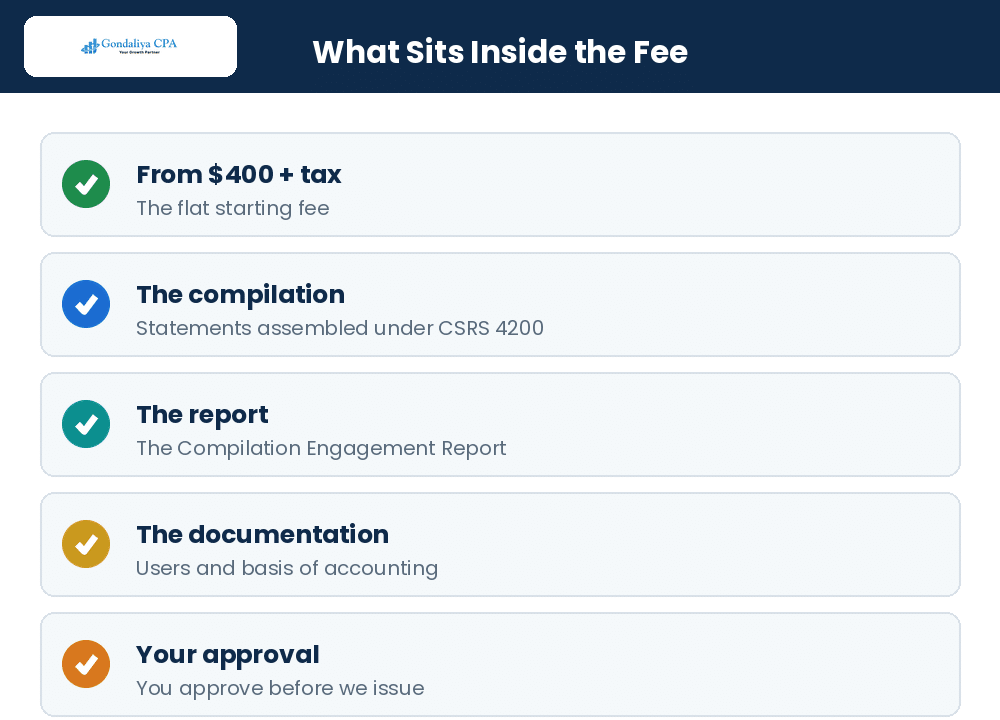
Here is the number without the runaround. Our compilation engagement fee starts from $400 plus applicable taxes. It is a flat fee, agreed in writing before any work begins, and it does not change because a file took longer than expected on our end. You are quoted once, you approve once, and you pay the amount you agreed to.
Why We Lead With the Number
Most business owners searching for a compilation engagement fee have had the opposite experience: a vague “it depends,” an hourly rate with no ceiling, or an invoice that arrived larger than the conversation suggested. A compilation is a defined piece of work with a defined output, so the price for it can be defined too. Starting from $400 plus applicable taxes gives you a floor you can plan around, and the final quote reflects your specific business once we have seen the books. Nothing about the fee is hidden, and the consultation that produces the quote is free.
Flat, Not Hourly
The fee is flat on purpose. Hourly billing puts the risk on you: the slower the work, the more you pay, which is a strange incentive to hand your accountant. A flat fee puts the risk on us, where it belongs. If your file is more involved than it first appeared, that is a conversation we have before we start, reflected in the quote, not a number that creeps upward while the clock runs. Please treat the starting fee as the beginning of a clear conversation about scope, not as a teaser rate.
Key Stat: The fee starts from $400 plus applicable taxes and is fixed in writing before the engagement begins. There is no hourly meter, no minimum-hours clause, and no charge for the consultation that produces your quote.
A business owner came to us after an hourly compilation ran well past the estimate they were given verbally, with no cap in place. We quoted a flat fee up front for the next year. Same report, a number they could plan around. Figures changed for privacy.
A client had been quoted three different hourly ranges by three firms and could not budget any of them. We gave one flat number from the starting fee. Certainty was worth more to them than shaving a few dollars. Figures changed for privacy.
What the Flat Fee Covers
The Inclusions
The fee covers the compilation engagement itself, from accepting the work to delivering the finished statements. It is worth being specific about what that means, because “financial statements” gets used loosely.
What You Receive
For the flat fee, you receive a set of compiled financial statements prepared from the information your management provides, with the Compilation Engagement Report attached under CSRS 4200. The engagement includes accepting and documenting the engagement as the standard requires, discussing the intended users and the basis of accounting with you, assembling the financial information into statements, preparing the report, and giving you the finished package for your approval. You also get a straight answer to your questions along the way, and the file kept in order in case a lender or the CRA asks about it later.
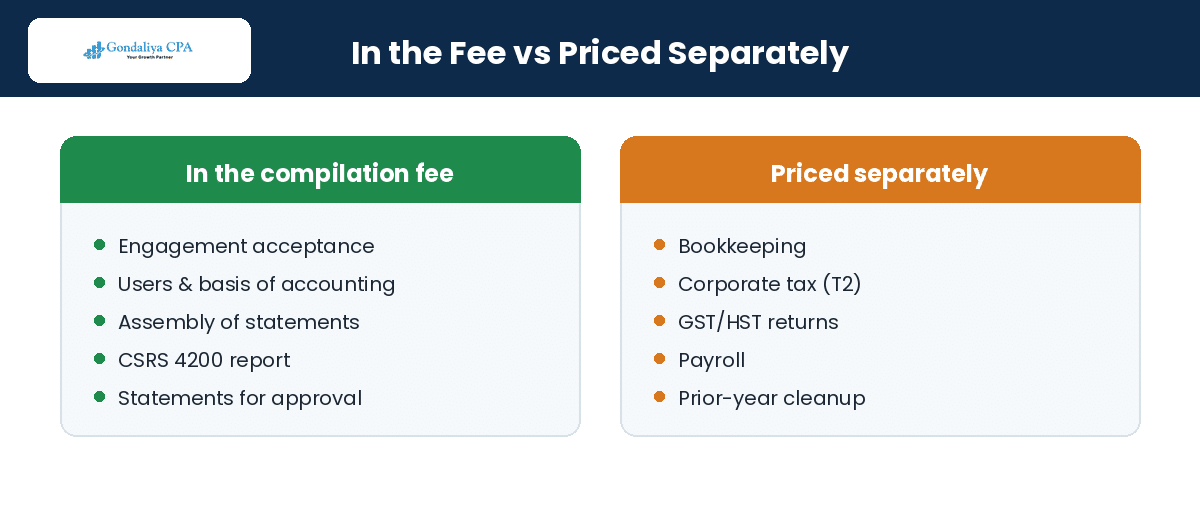
| In the compilation fee | Priced separately |
|---|---|
| Engagement acceptance and documentation | Monthly or annual bookkeeping |
| Discussion of intended users and basis of accounting | Corporate tax return (T2) preparation |
| Assembly of the compiled financial statements | GST/HST returns |
| The CSRS 4200 Compilation Engagement Report | Payroll |
| The finished statements for your approval | Catch-up or cleanup of prior years |
What the Fee Does Not Include
Two things are worth naming plainly. First, the fee does not include assurance, because a compilation provides none; that is not a gap in the service, it is the nature of a compilation, covered in full below. Second, the fee is for the compilation, so if your books are not ready, the bookkeeping to get them ready is a separate service. Many clients ask us to do both, and we quote both, but keeping them separate is what lets us hold the compilation fee steady. A common pairing is the compilation alongside your corporation’s year-end financial statements and T2, which we are happy to price together.
Pro Tip: If a lender asked for “financial statements,” ask them whether they need a compilation, a review, or an audit before you buy anything. The three cost very differently, and most small-business lending accepts a compilation. Buying more assurance than the lender needs is the most common way businesses overpay.
A client was about to commission a review engagement because a lender’s form said “financial statements.” One call to the lender confirmed a compilation was fine for the credit line they wanted. The compilation cost a fraction of the review. Figures changed for privacy.
A client assumed the compilation fee covered their T2 as well and was surprised it was separate. We walk through the itemized quote up front now, so every line is clear before work starts. Figures changed for privacy.
What Moves the Fee Up or Down
The Drivers
The starting fee is $400 plus applicable taxes. Where your final quote lands above that depends on a short list of things, and none of them is a mystery. Understanding them lets you influence your own price.
The State of Your Books
This is the single biggest driver. A clean, reconciled set of books, where the bank balances tie out and the transactions are classified sensibly, is quick to compile. A shoebox of receipts, a bank feed nobody has reconciled in eight months, or a chart of accounts where everything lands in “miscellaneous” is not. The compilation itself is the same piece of work either way; the difference is the tidying that has to happen before the compiling can start. If we are doing that tidying, it is bookkeeping, and it is quoted as bookkeeping. If your books arrive ready, that cost is simply not there.
The Size and Complexity of the Business
A single-owner corporation with one bank account, modest revenue, and a handful of expense categories is a smaller job than a company with several revenue streams, inventory, foreign currency, intercompany balances, or a holding-and-operating structure. More moving parts mean more to assemble and more to get right, so the fee reflects that. Complexity is not the same as revenue, but they often move together, and a larger business usually carries more of both.
The Add-Ons You Choose
Most clients do not want only a compilation; they want the compilation, the T2, the GST/HST, and the bookkeeping handled together by one firm. Each of those is its own service with its own fee. Bundling them with one provider is usually more efficient than splitting them across several, but the compilation fee stated here is for the compilation. When you ask us to quote the whole year, we quote the whole year, itemized, so you can see what each piece costs.
| Fee driver | Pushes the fee down | Pushes the fee up |
|---|---|---|
| Bookkeeping quality | Clean, reconciled books | Unreconciled or disorganized records |
| Business size | Single owner, simple operations | Multiple streams, inventory, group structure |
| Currency and intercompany | One currency, no related parties | Foreign currency, intercompany balances |
| Prior years | Current year only | Catch-up across several years |
| Add-on services | Compilation only | Compilation plus tax, bookkeeping, payroll |
Two clients the same size received different compilation quotes. One kept clean cloud books all year; the other handed over an unreconciled file. The compilation work was identical; the difference was entirely the bookkeeping the second one needed first. Figures changed for privacy.
A holding-and-operating pair came in expecting one small fee for one small company. Two entities with an intercompany balance is two compilations, not one. We explained why before quoting, so the number made sense. Figures changed for privacy.
Why Flat Fee Instead of Hourly
The Model
The flat fee is not a marketing line; it changes the incentives, and the incentives are what protect you.
Hourly Billing Pays for Slowness
Under an hourly model, every inefficiency on the firm’s side is billable to you. A junior who takes longer, a partner who reviews slowly, a software hiccup, all of it lands on your invoice. You have no way to price the job in advance and no ceiling once it starts. That is why “it depends” and “we will send the invoice after” are the phrases business owners dread. A flat fee removes the meter entirely.
Flat Fee Pays for the Result
When the fee is fixed, you are buying the finished compilation, not the hours it took. Our efficiency is our problem, not your cost. It also means the conversation about scope happens up front, where it should, rather than after the work when you can no longer do anything about it. If your file turns out to need more than we quoted, we tell you before proceeding and re-quote, so you are never surprised. This is the same flat-fee model we apply across corporate tax, bookkeeping, and payroll, so a full-year quote is a set of fixed numbers, not a range.
A compilation is a defined engagement with a defined output, so it deserves a defined price. Flat-fee billing puts the risk of an overrun on the firm, gives you a number you can plan around, and settles scope before the work rather than after the invoice.
A client had budgeted for their compilation using last year’s hourly invoice, which had been unpredictable. Our flat quote let them put the exact figure in their cash-flow plan for the year. Predictability was the thing they valued most. Figures changed for privacy.
A new client arrived with a “Notice to Reader” issued under the old Section 9200 by a previous preparer. We reissued under CSRS 4200. The old report name is a signal the work has not kept current. Figures changed for privacy.
What CSRS 4200 Is, and What It Is Not
The Standard
The fee buys a compilation prepared under CSRS 4200, so it helps to know what that standard is and, just as importantly, what it does not promise.
CSRS 4200 Replaced the Notice to Reader
For years, compiled statements came with a short cover note called a Notice to Reader, prepared under the old Section 9200. CSRS 4200, the Canadian Standard on Related Services for compilation engagements, replaced that standard entirely for compiled financial information for periods ending on or after December 14, 2021. The old “Notice to Reader” name still gets used in conversation, but the correct name for the report now is the Compilation Engagement Report, and Section 9200 is no longer permitted. If someone is still issuing you a “Notice to Reader” under the old standard, that is a sign the work is not current.
What Changed, and Why It Matters to Your Fee
The new standard asks for more than the old one. The practitioner has to discuss and document who the intended users of the statements are, describe the basis of accounting in a note, document engagement acceptance, and obtain management’s acknowledgement of its responsibilities. In plain terms, there is more disciplined documentation behind the report than there used to be. That is part of why a compilation done properly is real work with a real fee attached, rather than a form letter. It is also why our fee reflects a compilation done to the current standard, not a shortcut.
A Compilation Assembles, It Does Not Verify
This is the point that saves clients the most money, so please read it twice. A compilation engagement assembles financial information that management provides into financial statements. It does not verify that information, does not test it, and provides no assurance about it. A review engagement provides limited assurance through inquiry and analysis; an audit provides reasonable assurance through detailed testing. A compilation provides none of that, on purpose, which is exactly why it costs far less. If all you need is professional financial statements assembled and reported under the standard, you should not be paying for assurance you do not need.
Risk Warning: A compilation provides no assurance. If a lender, a court, a buyer, or a regulator specifically requires a review or an audit, a compilation will not satisfy them no matter how well prepared it is. Please confirm what the third party actually requires before you commission the cheaper engagement, so you do not have to pay twice.
A client’s compiled statements were rejected by a party that had, in its own paperwork, required a review engagement. The compilation was well prepared; it was simply the wrong engagement for that requirement. Reading the request first would have avoided the redo. Figures changed for privacy.
Compilation vs Review vs Audit
The Comparison
Because the three engagements differ so much in price, it is worth seeing them side by side. The right one is whichever the users of your statements actually require, and no more.

| Feature | Compilation | Review engagement | Audit |
|---|---|---|---|
| Assurance level | None | Limited | Reasonable |
| What the CPA does | Assembles the information | Inquiry and analysis | Detailed testing |
| Standard | CSRS 4200 | CSRE 2400 | Canadian Auditing Standards |
| Relative cost | Lowest | Higher | Highest |
| Typical users | Owners, many small-business lenders, the CRA | Lenders wanting more comfort, some investors | Public companies, regulators, large financings |
| When you need it | Standard year-end statements, most SMB lending | A lender or investor asks for limited assurance | A statute, regulator, or large deal requires it |
Our page on compilation report vs review engagement goes deeper on the choice between the two you are most likely to face, and what a CPA compilation report is and why banks require it explains where compilations fit in lending. For most incorporated small businesses, the compilation is the right and sufficient engagement.
Our Take: The most expensive mistake in this whole area is buying assurance you were never asked for. Confirm the requirement, match the engagement to it, and pay for exactly that. For the large majority of incorporated SMBs, that is a compilation.
A client sent a clean, reconciled cloud file and approved the statements the same week we delivered them. Nothing about the compilation was slow because nothing about the books needed fixing first. Figures changed for privacy.
The Process and the Turnaround
The Steps
The fee buys a process, not just a document. Here is what happens once you engage us.
From Quote to Finished Statements
We start with a free consultation, where we look at the business and the state of the books and give you a fixed quote from $400 plus applicable taxes. Once you accept, we issue the engagement letter, gather the records, and confirm the intended users and the basis of accounting as CSRS 4200 requires. We then assemble the compiled financial statements, prepare the Compilation Engagement Report, and send you the package for approval. The report is dated on your approval, because under the current standard the statements are yours to approve before they are issued. If you have asked us to handle the T2 or the bookkeeping alongside, those run in step with the compilation.
| Step | What happens |
|---|---|
| 1. Free consultation | We review the business and quote a flat fee |
| 2. Engagement letter | Scope and fee confirmed in writing |
| 3. Records and scoping | We gather records, confirm users and basis of accounting |
| 4. Assembly | We compile the financial statements |
| 5. Report and approval | We attach the CSRS 4200 report; you approve and we issue |
How Long It Takes
Turnaround depends far more on the state of your books than on the compiling itself. When the records arrive clean and reconciled, the engagement moves quickly; when they need work first, that work sets the pace. We give a realistic timeline with the quote rather than a promise we cannot keep, and our page on compilation report turnaround time in Canada explains what drives it. The single best thing you can do for both your fee and your timeline is to bring reconciled books; our list of documents required for a compilation engagement shows exactly what to prepare.
A client with tidy cloud books had their compilation finished quickly and near the starting fee. Another the same size, with months of unreconciled transactions, needed bookkeeping first, which set both the fee and the timeline. The books, not the compiling, decided both. Figures changed for privacy.
A client kept everything in a shoebox and expected the starting fee. The compiling would have been quick; the missing bookkeeping was not. We quoted the cleanup separately so the compilation fee stayed clear. Figures changed for privacy.
How to Keep Your Fee Low
Save Money
You have real control over where your quote lands. Almost all of it comes down to arriving prepared.
Bring Reconciled Books
Reconcile your bank and credit card accounts so the balances tie to the statements. Classify transactions sensibly rather than dumping them in one catch-all account. Deal with the odd items during the year instead of leaving a pile for year-end. Books that are ready to compile remove the biggest variable in the fee, because there is no cleanup to quote.
Use Cloud Accounting and Bundle Sensibly
Keeping your records in cloud accounting through the year, rather than reconstructing them in one push, keeps everything current and cheaper to compile. If you need the T2 and the GST/HST anyway, having one firm handle them alongside the compilation is usually more efficient than splitting the work. And confirm what your lender actually needs before you buy: a compilation, not a review, is enough for most small-business lending, and buying up unnecessarily is the fastest way to overspend. If prior years are behind, tackling the compilation your business needs sooner is cheaper than letting several years stack up.
Check Your Readiness
This quick self-check flags the things that most affect your compilation fee. Please answer the six questions below.
Compilation Fee Readiness Check
Six quick questions on what affects your quote. No fee shown.
In your favour:
This is a general prompt, not a quote or accounting advice. Your actual fee depends on your books and business. For a fixed quote, please book a free consultation.
Want a checklist to work from? You can download our free compilation engagement readiness checklist and get your books ready before you ask for a quote.
2026 Update — what is current: CSRS 4200 remains the governing standard for compilation engagements, replacing Section 9200 and the old Notice to Reader for periods ending on or after December 14, 2021. A compilation still provides no assurance. Our starting flat fee is from $400 plus applicable taxes, quoted in writing after a free consultation.
Industry Spotlights: Sectors We Represent
Industry Expertise
Compilation engagements look a little different in each sector, usually because of what the lender wants and what the books contain. Here are ten sectors and where the compilation fits.
| Industry | Where the Compilation Fits |
|---|---|
| Medical doctors & physician professional corporations | Year-end statements for the PC, often for a lender or lease |
| Dentists & dental practices | Statements for practice financing and equipment loans |
| Daycare, childcare & CWELCC services | Statements alongside funding and subsidy reporting |
| Real estate investors, landlords & holding companies | Statements per entity, often for mortgage renewals |
| Property developers & builders | Statements for project and construction financing |
| Construction, contractors & skilled trades | Statements for bonding and operating credit |
| Technology startups & SaaS | Statements for investors and lender covenants |
| E-commerce & online retailers | Statements where inventory drives complexity |
| Restaurants & food and beverage | Statements for leases, lenders, and franchisors |
| Transportation, logistics & trucking | Statements for equipment finance and fleet loans |
- Medical doctors & physician professional corporations: A physician professional corporation usually needs clean year-end statements for a lender or a lease, and a compilation is the standard fit. The books tend to be simple, so the fee tends to sit near the starting point.
- Dentists & dental practices: Practice financing and equipment loans are the common trigger, and lenders in this space generally accept a compilation for the amounts involved.
- Daycare, childcare & CWELCC services: Compiled statements often sit alongside funding and subsidy reporting, and the fee reflects how clean the subsidy reconciliations are kept through the year.
- Real estate investors, landlords & holding companies: Each entity is its own compilation, which matters for a holding-and-operating structure, and mortgage renewals are a frequent reason to have current statements ready.
- Property developers & builders: Project and construction financing drives the need, and multiple project entities mean multiple compilations, each with its own fee.
- Construction, general contractors & skilled trades: For electricians, plumbers, and HVAC firms, bonding and operating credit are the usual reasons, and reconciled job costing keeps the fee down.
- Technology startups & SaaS: Investors and lender covenants often ask for statements, and where covenants demand more comfort, a review may be required instead of a compilation, so confirm first.
- E-commerce & online retailers: Inventory is what drives the complexity here, so clean inventory records are the single biggest factor in the fee for online retailers.
- Restaurants & food and beverage: Leases, lenders, and franchisors are the common requesters, and tidy point-of-sale and payroll records make the compilation straightforward.
- Transportation, logistics & trucking: Equipment finance and fleet loans are the usual triggers, and where the fleet and lease records are current, the compilation moves quickly.
A physician professional corporation with simple, clean books received a compilation quote near the starting fee for a lease application. Small, tidy files are exactly where the flat fee shines. Figures changed for privacy.
An online retailer’s fee was driven almost entirely by unreconciled inventory rather than the compilation itself. Once the inventory records were cleaned up, the following year’s quote dropped noticeably. Figures changed for privacy.
A trades client moved to cloud accounting and reconciled monthly after their first year with us. Their second-year compilation quote came in lower simply because the books were ready. Preparation paid for itself. Figures changed for privacy.
Glossary of Key Terms
Plain-English Definitions
- Compilation engagement: An engagement where a CPA assembles management’s financial information into statements, with no assurance.
- Compilation engagement fee: The price for that engagement; ours starts from $400 plus applicable taxes.
- CSRS 4200: The Canadian standard governing compilation engagements since December 14, 2021.
- Section 9200: The old compilation standard CSRS 4200 replaced; no longer permitted.
- Notice to Reader: The old name for the compilation report, replaced by the Compilation Engagement Report.
- Compilation Engagement Report: The current report attached to compiled statements under CSRS 4200.
- Assurance: A CPA’s conclusion on whether statements are fairly presented; a compilation gives none.
- Review engagement: An engagement providing limited assurance under CSRE 2400.
- Audit: An engagement providing reasonable assurance through detailed testing.
- Basis of accounting: The framework used to prepare the statements, described in a note under CSRS 4200.
- Intended users: The people expected to use the statements, which the CPA must discuss and document.
- Flat fee: A fixed price agreed before the work, rather than an hourly charge.
- Reconciliation: Matching your records to the bank so the balances agree; the biggest fee driver.
- Compiled financial statements: The statements produced by a compilation engagement.
Frequently Asked Questions
FAQ
How much does a compilation engagement cost in Canada?+
Our compilation engagement fee starts from $400 plus applicable taxes, charged as a flat fee. The final quote depends on the state of your books, the size of the business, and any add-on services, and it is confirmed in writing after a free consultation.
Is the fee hourly or flat?+
Flat. It is agreed in writing before the work starts and does not move because a file took us longer than expected. There is no hourly meter and no charge for the consultation.
What does the compilation fee include?+
Engagement acceptance and documentation, discussion of intended users and the basis of accounting, assembly of the compiled financial statements, the CSRS 4200 Compilation Engagement Report, and the finished statements for your approval. Bookkeeping and tax filing are separate services.
Why is a compilation cheaper than a review or an audit?+
Because it provides no assurance. A compilation assembles the information management provides. A review adds limited assurance through inquiry and analysis, and an audit adds reasonable assurance through detailed testing, which is why each costs more.
Is a compilation the same as a Notice to Reader?+
It is the modern version. The Notice to Reader under the old Section 9200 was replaced by the Compilation Engagement Report under CSRS 4200 for periods ending on or after December 14, 2021. People still say “Notice to Reader” out of habit.
Do banks accept compiled financial statements?+
Many Canadian lenders accept a compilation for smaller operating credit and small-business loans. Whether a compilation is enough depends on the lender and the amount, so please confirm the requirement before you commission the engagement.
What makes my compilation fee higher?+
Unreconciled or disorganized books are the biggest driver, followed by business size and complexity such as inventory, foreign currency, or a group structure, catch-up across prior years, and any add-on services you bundle in.
Does the fee include my corporate tax return?+
No. The compilation fee is for the compilation. The T2 corporate return, GST/HST, payroll, and bookkeeping are separate services, each with its own flat fee, which we are glad to quote alongside the compilation.
How long does a compilation take?+
It depends mostly on your books. Clean, reconciled records move quickly; records that need cleanup first set the pace. We give a realistic timeline with the quote.
Can I lower my fee?+
Yes. Bring reconciled books, keep records in cloud accounting through the year, organize your source documents, and confirm your lender needs a compilation rather than a review. Preparation is what keeps the quote near the starting fee.
Compilation Fee Checklist
- Reconcile your bank and credit card accounts to the statements.
- Classify transactions sensibly, not into one catch-all account.
- Keep records in cloud accounting through the year.
- Gather source documents before requesting a quote.
- Note any group structure; each entity is its own compilation.
- Flag prior years that need catching up.
- Confirm with your lender whether a compilation is enough.
- Ask for the compilation, T2, and bookkeeping quoted together if you need all three.
Who This Is For / Not For
- For: Incorporated Canadian businesses needing professional year-end financial statements, usually for a lender, a lease, or their own records.
- Not For: Businesses that a statute, regulator, or counterparty specifically requires to obtain a review or an audit; those need a different engagement.
People Also Ask
Quick Answers
What is the starting price for a compilation engagement?+
From $400 plus applicable taxes, as a flat fee. The final number is quoted in writing after a free consultation, based on your books and business.
Does a compilation provide any assurance?+
No. A compilation provides no assurance by design. If you need limited assurance you need a review engagement; for reasonable assurance you need an audit.
Can one firm do my compilation and my taxes?+
Yes. We handle the compilation, the T2, GST/HST, payroll, and bookkeeping, each on a flat fee, and quote them together so you can see what each piece costs.
Contact Gondaliya CPA at 647-212-9559 or info@gondaliyacpa.ca for a fixed compilation engagement fee from $400 plus applicable taxes, quoted in writing after a free consultation.
Get your compilation engagement fee in writing
Gondaliya CPA prepares compilation engagements under CSRS 4200 on a flat fee from $400 plus applicable taxes, quoted before we start, with a one-business-day response. Please book a free consultation.
Next Steps
A compilation engagement fee should be a number you can plan around, and ours is: from $400 plus applicable taxes, flat, quoted in writing before we begin. What moves it is the state of your books, the size of the business, and the add-ons you choose, all of which you can see coming. Bring reconciled records, confirm what your lender actually needs, and ask us to quote the compilation on its own or alongside your T2 and bookkeeping. Please call 647-212-9559, email info@gondaliyacpa.ca, or book a free consultation. If our content helps, please add gondaliyacpa.ca as a preferred source on Google.
Published: July 15, 2026 · Last updated: July 15, 2026
Disclaimer: This page is general information, not accounting or tax advice for your specific business. It reflects CSRS 4200, the Canadian standard for compilation engagements effective for periods ending on or after December 14, 2021, which replaced Section 9200 and the former Notice to Reader. A compilation engagement provides no assurance. Our starting compilation engagement fee is from $400 and is exclusive of applicable taxes; the final fee is quoted in writing after a free consultation and depends on your specific circumstances. Please consult a Registered CPA before acting.

Sharad Gondaliya is a CPA Canada & CPA USA with 15 Years+ experience of Accounting, Tax, Payroll of Corporate Small Businesses as Tax Accountant. He is a CPA Ontario member (61040184) and holds US CPA licences in Washington and Montana and is well known among corporate small businesses for tax planning, efficient tax solutions, and affordable CPA services. Sharad is the Principal (Director) of Gondaliya CPA – Affordable CPA Firm in Canada. Licenses: CPA Ontario: 61040184 | CPA USA (MT): PAC-CPAP-LIC-033176 | CPA USA (WA): 57629 | CPA Firm License: 61330051 View Full Author Bio