



The Ultimate Guide to Accountant Services for Dentists in Canada: Tax Planning, Bookkeeping & Corporate Compliance
Gondaliya CPA provides reliable dentist CPA and dental accountant services in Canada, focusing on corporate tax for dentists, dental clinic bookkeeping, and year-end accounting for dentists. Our team supports dental practice tax planning, bookkeeping for dentists, and professional corporation accounting to simplify financial management for your dental practice.
Quick Summary
A dentist CPA handles the corporate tax, bookkeeping, payroll, and year-end accounting a dental practice needs, and keeps the professional corporation compliant with both the CRA and the RCDSO. Please note the work that saves the most tax happens across the year, not at year-end: the salary and dividend mix, the capital cost allowance on equipment, the shareholder loan position, and the TOSI position on any family payments.
| Aspect | Details |
|---|---|
| The core service | Corporate tax, bookkeeping, payroll, and year-end accounting for dentists. |
| The annual levers | Salary versus dividends, capital cost allowance, shareholder loans, TOSI. |
| The compliance side | CRA program accounts, RCDSO minute books, and Ontario annual returns. |
| Who it suits | Incorporated dentists and dental professional corporations across Canada. |
Reading time: 24 minutes.
Table of Contents
- Accounting Firm for Dentists: Specialized Services in Canada
- How Gondaliya CPA Supports Dentists with Financial Management
- Client Success Stories and Testimonials from Dental Professionals
- Frequently Asked Questions Addressing Common Dental Accounting Concerns
- Call to Action: Schedule a Consultation for Tailored Dental Accounting Services
- Additional Resources and Insights for Dentists
- Frequently Asked Questions on Dental Accounting and Compliance
- Essential Insights on Dental Practice Financial Management
- Industry Spotlights: Sectors We Represent
- Professional Guidance and Quick Reference
The Numbers That Matter
This article covers Canada, with Ontario and Toronto context, and reflects CRA rules current to 2026. It assumes an incorporated dental practice or dental professional corporation. “Illustrative” figures are examples, not quotes, and any masked engagement notes end with “Figures changed for privacy.” This is educational information only and not tax, legal, or financial advice. Fees include HST. Corporate, payroll, and regulatory rules change, so please confirm your own situation with a Registered CPA before acting.
Accounting Firm for Dentists: Specialized Services in Canada
Comprehensive Accounting, Tax, and Advisory Support for Dental Practices
The Services
As a dentist tax accountant, we handle accounting work made just for dental offices across Canada. We focus on corporate compliance and CRA representation services that fit dentists’ specific needs. Taxes can get tricky. So, our team helps keep your practice legal with the CRA while helping you keep more money.
Core Accounting and Bookkeeping Services Designed for Dentists
Good bookkeeping matters a lot for dental clinics. Your bookkeeping should keep dental supplies and lab fees separate. This makes it easier to track costs and report correctly if the CRA checks your records.
You might wonder if you should hire a full-service CPA or do bookkeeping yourself. Think about what you need: A full-service CPA understands complex money issues in dental offices better than most.
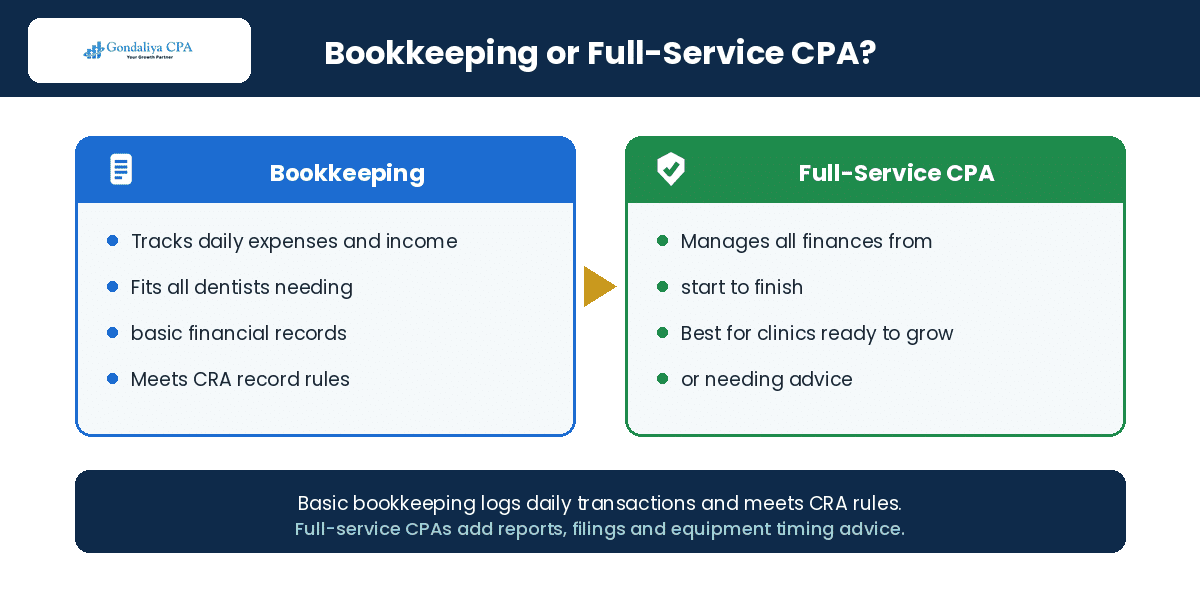
| Option | What it does | Who it fits |
|---|---|---|
| Bookkeeping | Tracks daily expenses and income | Fits all dentists needing basic financial records |
| Full-Service CPA | Manages all finances from start to finish | Best for clinics ready to grow or needing advice |
A clinic had lab fees and dental supplies posted to a single account, which made the cost of production impossible to read and complicated the GST/HST position. Splitting the two codes took an afternoon and changed what the owner could see every month. Figures changed for privacy.
Corporate Tax Planning and Compliance Tailored to Dental Professionals
Corporate tax planning helps lower your taxes while following CRA rules. A dentist CPA knows how to claim capital cost allowance (CCA) and manage shareholder loans smartly. This knowledge can save you money every year.
Tax planning also lets dentists decide how much pay should be salary versus dividends. This balance helps avoid extra taxes while preparing your clinic for the future.
Business Advisory and Strategic Consulting for Growing Dental Clinics
Besides taxes, we help clinics plan their growth each year. Having an accountant who knows dentistry helps you face yearly challenges with fewer surprises.
Our advice covers:
- Getting ready to hand over your practice someday (succession readiness)
- Choosing the right mix of pay types based on what works best now
Specialized Accounting Solutions Including Forensic Audits and Practice Valuations
Sometimes things go wrong with money records, or there are questions about fraud. Forensic audits check these concerns closely. We defend you during any audits or CRA disputes to keep things fair.
If you get penalties for late reports or other issues, we help appeal those charges too. Our work follows CSRS 4200 standards designed for small businesses like dental practices.
With Gondaliya CPA’s focus on dentists in Canada—from Toronto and beyond—you can relax knowing your finances are handled by pros who get your world clearly.
Our Take: The single most valuable thing a dental clinic can do for its own numbers is code lab fees and dental supplies separately from day one. Almost every diagnostic question an owner later asks, about production, margin, or the GST/HST position, depends on that one split being right.
How Gondaliya CPA Supports Dentists with Financial Management
How Gondaliya CPA Supports Dentists with Financial Management
The Support
Gondaliya CPA works closely with dentists across Canada to manage their finances. We act as a dentist tax accountant and a dental accountant Canada-wide. Our team helps dentists with tax planning, bookkeeping, payroll, and staying on top of corporate compliance. This helps keep your practice’s money matters in good shape.
Initial Practice Evaluation and Discovery for Customized Financial Planning
We start by checking out your practice’s financial setup. This step is key to making plans that fit your clinic well. As an accountant for dentist clients, we look at your current books, business structure, income sources, expenses, and tax situation.
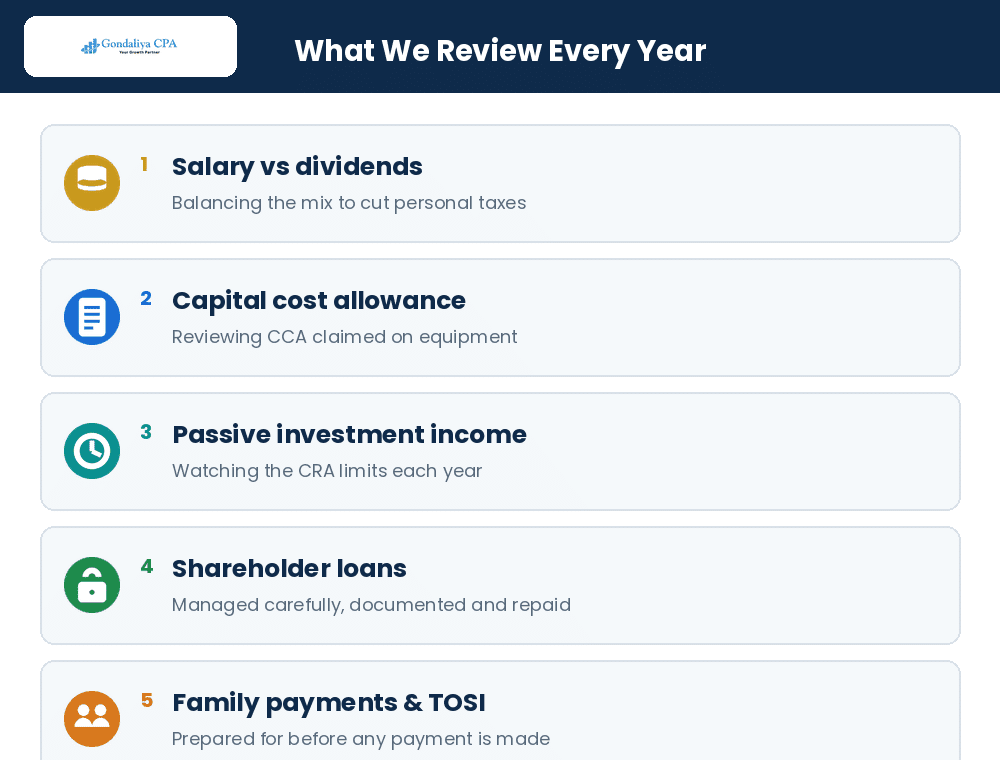
What tax planning should a dentist accountant bring every year? Here’s what we focus on annually:
- Balancing salary and dividends to cut personal taxes
- Reviewing capital cost allowance (CCA) on equipment
- Watching passive investment income limits from CRA rules
- Managing shareholder loans carefully
- Preparing for family payments that could trigger TOSI rules
This yearly check helps avoid surprises like missed deductions or unexpected bills.
Our review finds chances to improve things based on how big your clinic is, how associates work with you, the complexity of payroll, and growth goals.
Strategic Equipment Acquisition and Capital Cost Allowance Optimization
Capital cost allowance (CCA) lets you claim depreciation on assets like dental chairs or digital X-ray machines. Planning purchases right can save you taxes without hurting cash flow.
How should a dental clinic set up its bookkeeping? It’s best to:
- Separate production revenue from lab fees or supplies
- Track asset buys clearly for proper CCA reporting
- Reconcile accounts every month to catch all purchases
Bookkeeping vs full-service CPA: which does your clinic need? Basic bookkeeping logs daily transactions—this meets CRA rules. Full-service CPAs take it further by producing financial reports and handling tax filings. They also advise when to buy equipment so it fits your profit cycles.
Using full-service accounting cuts audit risks related to wrong asset classifications or missed depreciation claims. Plus, it improves cash flow forecasting.
Pro Tip: Time a major equipment purchase against the profit cycle rather than the calendar. Please remember the half-year rule limits the first-year claim, so a chair bought in the last weeks of a fiscal year rarely delivers the deduction an owner expects it to.
Ongoing Accounting, Payroll, and Bookkeeping Support for Dental Practices
Payroll management is tricky because you might have employees like hygienists and contractors like associates. You need to handle deductions properly — CPP contributions and EI premiums where needed — and send payments on time.
Payroll remittance frequency varies but missing deadlines can cause penalties.
The T4/T4A slip filing deadline is the last day of February after the calendar year ends. Sending slips late risks fines and messes up associates’ records.
Bookkeeping tracks daily deposits from credit cards separately from insurance payouts. Monthly closes check if expenses are coded right—lab fees vs supplies often get mixed up. That affects GST/HST credits and profit analysis.
Many clinics use payroll tools like ADP or Wagepoint paired with cloud software such as QuickBooks or Xero. Adding Hubdoc helps capture documents automatically. This keeps your accounting data clean throughout the year.
Risk Warning: Treating an associate as a contractor when the CRA would see an employee is the costliest classification error in dentistry. The reassessment lands on the practice, not the associate, and it carries the unremitted source deductions plus penalties and interest. Please have the arrangement reviewed before the first payment, not after a CRA letter.
Active Regulatory Monitoring and Advisory for CRA Compliance
Dental professional corporations must follow many rules beyond usual filings. They need to file annual returns on time with Ontario’s Ministry of Government Services. Minute books must record meetings as per RCDSO certificate conditions.
Checking directors’ eligibility prevents problems that might risk your license.
CRA corporate instalment due dates come quarterly usually. Paying late causes interest charges on tax owing from business income.
We keep an eye on these deadlines so clients pay on time in manageable amounts instead of one big lump sum at year end.
We also review registrations like GST/HST numbers to make sure they’re under the right corporation name. When reps change, updates happen through My Business Account portals authorized by the client themselves.
This ongoing monitoring cuts down risks tied to complex rules for incorporated dentists working in Ontario and across Canada.

| Obligation | Who it is with | What it protects |
|---|---|---|
| Annual return | Ontario’s Ministry of Government Services | Good corporate standing |
| Minute book upkeep | RCDSO certificate conditions | The certificate of authorization |
| Corporate instalments | The CRA, usually quarterly | Against interest on tax owing |
| GST/HST registration | The CRA, under the corporation name | Input tax credit claims |
| T4 and T4A slips | The CRA, by the last day of February | Against late-filing fines |
Client Success Stories and Testimonials from Dental Professionals
Client Success Stories and Testimonials from Dental Professionals
The Results
Dental pros all over Canada count on a dentist tax accountant to handle their tricky finances. Our clients often share stories about big tax savings, easier bookkeeping, and quick help made just for dentists. These examples show how good accounting makes running a dental practice smoother and keeps everything up to code.
Highlighting Tax Savings and Personalized Accounting Strategies
Good tax planning helps incorporated dentists keep more money after taxes while staying within CRA rules. We guide dental corporations on using capital cost allowance (CCA) to lower taxes on new equipment without setting off audits.
Careful management of shareholder loans stops penalties or unwanted benefits under CRA rules. We create plans that track repayments and paperwork to fit professional corporation laws.
Corporate tax filing needs exact numbers. We make sure T2 forms include all write-offs like lab fees and payments to associates. This lowers chances of reviews by CRA and helps plan instalments to keep cash flowing.
Here’s one case: a Toronto dental office cut its corporate tax rate by using faster CCA rates on new digital tools, along with smart shareholder loan repayments—numbers changed for privacy.
Demonstrating Responsive Service and Trusted Partnership with Dentists
Dentists want more than just number crunchers; they want an accountant who gets their work. We offer CRA representation that handles audits or questions fast so clients stress less. If a letter does arrive, our CRA audit representation team responds on the corporation’s behalf.
We set up bookkeeping systems designed for dental offices. This tracks money from patient visits, insurance payments, lab costs, supplies, payroll, and other clinic items following CRA record keeping rules.1 This setup keeps monthly closes and year-end reports smooth.
Payroll covers staff and associates paid with T4A slips if needed. We guide clients through source deduction deadlines so they don’t face penalties.2
Clients like that we answer questions quickly—usually within one business day—and offer weekend help too. That builds trust beyond simple accounting tasks.
Sources: Canada Revenue Agency – Record Keeping Requirements; Canada Revenue Agency – Payroll Deductions & Remittances.
A practice was paying its corporate tax in one lump at year-end and absorbing instalment interest every cycle. Moving to quarterly instalments matched to the profit pattern removed the interest and made the cash flow predictable. Figures changed for privacy.
Frequently Asked Questions Addressing Common Dental Accounting Concerns
Frequently Asked Questions Addressing Common Dental Accounting Concerns
The Detail
Tax Deductible Expenses Specific to Dental Clinics and Professional Fees
Dental clinics can write off lots of costs that relate directly to their work. These deductions lower the money they owe in taxes. Common deductible expenses include:
- Office rent
- Dental supplies
- Lab fees
- Staff wages
- Professional dues like RCDSO membership
- Classes and training
An accountant for dentists helps make sure these expenses fit right into bookkeeping setup and payroll management. This keeps everything in line with CRA rules about corporate compliance.
Fees paid for legal or accounting advice connected to the dental practice also count as deductible. But personal costs or buying big assets need special tax treatment. Good bookkeeping splits business costs from personal ones clearly.
Keeping all receipts and invoices is key when the CRA does an audit or review. Payroll must list employees and contractors correctly — mixing them up can cause fines[1].
Understanding Depreciation Rules for Dental Equipment (CCA)
The Capital Cost Allowance (CCA) lets dental offices claim wear-and-tear on equipment over time. Instead of deducting the full cost at once, they spread it out.
Here’s a quick look at common dental equipment classes:
| Equipment Type | CCA Class | Rate (%) |
|---|---|---|
| General medical/dental gear | 8 | 20 |
| Computer hardware | 50 | 55 |
This method reduces taxable income bit by bit, matching how assets lose value in real life. A dentist CPA usually handles this well.
Incorporated dentists must track purchase dates and prices carefully because of partial-year rules if assets arrive mid-year[2]. A professional corporation accountant can advise when is best to buy gear, fitting tax planning needs.
Choosing Between Incorporation and Sole Proprietorship for Dental Practices
Many dentists think about whether to incorporate or stay sole proprietors. Incorporation gives perks like limited liability and possible tax deferral through professional corporation incorporation recognized by RCDSO.
Managing shareholder loans is important here — loans between shareholders and the company need clear paperwork to avoid CRA penalties[3]. Incorporated dentists get small business deductions but face stricter corporate filing rules than sole proprietors.
Sole proprietors have simpler books but risk personal liability. They might pay more tax on profits over certain limits too. Talking with a dentist tax accountant helps find the best fit for goals and ensures corporate compliance stays smooth.
| Factor | Sole proprietorship | Professional corporation |
|---|---|---|
| Liability | Personal liability risk | Limited liability |
| Tax deferral | None | Possible, through retained earnings |
| Filing obligations | Simpler books | Stricter corporate filing rules |
| Small business deduction | Not available | Available on active business income |
| Regulator | Not applicable | Recognized by RCDSO |
Avoiding Common Corporate and Personal Tax Pitfalls in Dentistry
Dentists often struggle with CRA compliance because they mix personal and business money or keep poor records. Some common mistakes are:
- Missing T2 return deadlines
- Wrong payroll remittances, especially if associates are labeled contractors not employees
- forgetting instalment payments causing interest charges
- Lacking proof for expense claims[4]
If CRA questions you, audit defense by a skilled CPA protects you during reviews. Good tax planning for dentists balances salary and dividends while following TOSI rules for family dental businesses[5].
Regular checks before year-end filings catch errors early, avoiding costly reassessments later.
[1] CRA – Payroll Deductions
[2] CRA – Capital Cost Allowance Classes
[3] CRA – Shareholder Loans
[4] CRA – Corporate Filing Deadlines & Penalties
[5] CPA Canada – Tax Planning Strategies For Dentists
Almost every pitfall on this list is a calendar problem before it is a tax problem. The T2 deadline, the remittance schedule, the instalment dates, and the February slip deadline are all known in advance. A practice that diarizes them at the start of the fiscal year removes most of its own risk.
An owner had been claiming a share of home and vehicle costs with no supporting log, and the CRA asked for the backup during a review. Rebuilding the records after the fact is far harder than keeping them, and part of the claim could not be supported. Figures changed for privacy.
Call to Action: Schedule a Consultation for Tailored Dental Accounting Services
Call to Action: Schedule a Consultation for Tailored Dental Accounting Services
Next Step
Finding the right dentist tax accountant or dentist CPA can really help your dental practice’s money matters. A dental accountant in Canada knows the specific challenges dentists face. They offer accounting, tax planning, and corporate compliance services made just for you. Working with an accountant for dentists keeps you in line with CRA rules and helps reduce your taxes.
Contact Information and Easy Booking Options for Dental Practice Accountants
Get in touch with experts who work as dentist CPAs at Gondaliya CPA. Our team helps with bookkeeping, payroll, GST/HST filings, year-end reports, and corporate taxes for dental offices in Toronto and Ontario.
To book a talk with a dentist tax accountant:
- Phone: 647-212-9559
- Email: info@gondaliyacpa.ca
Booking is simple — just call or email us to set up a free chat about how we can support your clinic’s growth and keep you compliant.
Invitation to Connect for Expert Support in Tax Planning and Financial Management
Dentists who run corporations should plan their taxes every year. A good dentist CPA gives advice on pay structures, claiming capital costs, handling passive income, TOSI rules for families, buying equipment at the right time, and planning exits.
Dental professional corporations must follow rules like keeping minute books that meet RCDSO standards. They also need to file CRA program accounts on time. Having expert help during audits or letters from CRA lowers risks a lot.
Work with Gondaliya CPA for full CRA representation plus smart money management. We keep your practice legal while helping you get the most benefits allowed under Canadian law. Contact us now to talk about how we focus on services just for dentists in Ontario and across Canada.
Additional Resources and Insights for Dentists
Additional Resources and Insights for Dentists
Resources
Downloadable Guides, Tax Checklists, and Regulatory Updates
Dental pros often need clear info on taxes and records. A dentist tax accountant can provide handy guides. These include CRA corporate instalment due dates and rules about keeping records.
The CRA says dentists who run incorporated businesses must keep their papers for at least six years after the tax year ends. This covers things like payroll slips, GST/HST filings, and corporate tax returns. Having checklists makes it easier to follow these rules.
Using an accountant for dentists who shares these resources helps prevent mistakes. It also lowers the chance of missing important deadlines. Some guides explain upcoming changes in 2026, like digital bookkeeping standards that affect dental offices.
Links to Government Resources for Dental Professionals
Getting info straight from the government is key for dental business owners. The CRA T2 Corporate Tax Return filing deadline tells dentists when to send their yearly tax return. This is six months after the company’s fiscal year ends. Filing late can bring penalties based on how much tax you owe.
In Ontario, the Employer Health Tax (EHT) exempts employers with less than $490,000 in annual payroll from paying this tax. Dental clinics should track their payroll so they don’t miss this limit. Going over it means more taxes to pay.
Here are useful links to official sites with the latest on these topics:
- CRA T2 Corporate Income Tax Guide
- Ontario Employer Health Tax Exemption Threshold
Checking these pages often keeps your dental practice up to date with Canadian tax rules.
Latest Articles and Blog Posts on Dentist Tax Strategy and Accounting Trends
Dental accountants and CPAs write articles that help dentists manage money smarter. Many focus on the Small Business Deduction limit of $500,000 taxable income federally. This affects how much corporate tax a dental practice pays every year.
Other posts discuss timing for buying equipment or claiming capital cost allowances. A dentist CPA can give advice here based on your situation. Knowing important dates like the T2 Corporate Tax Return deadline helps avoid trouble during audits.
Reading expert blogs regularly also helps dentists understand new rules coming in 2026. These include changes for professional corporations’ reporting needs. Dentists in Toronto and across Canada learn about pay structures, passive income, and paying family members in smart ways.
For fresh insights related just to dentistry, look at reliable sources with clear guidance based on CRA rules. Our guides to catch-up bookkeeping for dentists, dental office payroll, and what taxes corporations pay in Canada are the place to start.
2026 Update — what is current: The federal Small Business Deduction limit is $500,000 of active business income. The T2 corporate return is due six months after the fiscal year-end. T4 and T4A slips are due the last day of February. The Ontario Employer Health Tax exemption threshold is $490,000 of annual payroll. CRA records must be kept at least six years after the tax year ends.
Frequently Asked Questions on Dental Accounting and Compliance
Frequently Asked Questions on Dental Accounting and Compliance
FAQ
What is the CRA corporate instalment due date for dental practices?+
Dental corporations must pay quarterly tax instalments to CRA. Missing deadlines causes interest charges on unpaid taxes. Gondaliya CPA helps track these dates.
How long should dental clinics retain CRA required records?+
The CRA requires dentists to keep records for at least six years after the tax year ends. This includes receipts, payroll, GST/HST filings, and tax returns.
What is the T4/T4A slip filing deadline for dental offices?+
All T4 and T4A slips must be filed with CRA by the last day of February each year. Late filing may result in penalties.
How do shareholder loans affect dental professional corporations?+
Shareholder loans need proper documentation and timely repayments. Mismanagement can lead to penalties under CRA rules.
What is the Ontario employer health tax exemption threshold?+
Employers with annual payroll below $490,000 are exempt from Ontario Employer Health Tax (EHT). Above this, EHT applies.
How does Gondaliya CPA assist with payroll management for dentists?+
We manage payroll remittances, statutory deductions, and prepare T4/T4A slips. We also help classify employees versus contractors correctly per CRA guidelines.
What are family compensation and TOSI rules in dental corporations?+
Family payments may trigger Tax on Split Income (TOSI) rules, causing extra tax. We advise on compliant compensation plans to avoid these issues.
Why choose a full-service CPA over DIY or non-CPA providers?+
Full-service CPAs offer expert tax planning, audit defense, and compliance support that DIY or non-CPA providers usually cannot match.
What is CSRS 4200 compilation engagement in dental accounting?+
CSRS 4200 ensures financial statements meet Canadian standards for small businesses like dental clinics. Gondaliya CPA follows these standards strictly.
How does Gondaliya CPA support audit defense and penalty appeals?+
We represent clients during CRA audits and file penalty or interest appeals when justified to reduce financial risks for dentists.
Essential Insights on Dental Practice Financial Management
Essential Insights on Dental Practice Financial Management
Key Insights
- Payroll remittance processing must follow CRA schedules to avoid fines and penalties.
- Using software like ADP, Wagepoint, QuickBooks, Xero, and Hubdoc improves accuracy in bookkeeping and payroll tracking.
- Proper lab fees invoicing and dental supplies coding streamline GST/HST claim processes.
- Digital bookkeeping cleanup ensures clean records ready for CRA reviews or audits.
- Practice valuations help dentists plan succession readiness or business sale strategies effectively.
- Minute books must comply with RCDSO standards and record meetings as required by professional corporation compliance reporting.
- Annual returns are mandatory filings with Ontario Ministry of Government Services to maintain good corporate standing.
- Form T1013 submissions authorize representatives to access client accounts through My Business Account portals securely.
- WSIB premium rate management helps clinics control workplace insurance costs while meeting regulatory requirements.
- Consolidated year-end statements provide clear financial views across associates or multiple clinic locations.
- Input tax credits (ITCs) reduce GST/HST payable by reclaiming taxes paid on business expenses properly coded by accountants.
- Financial statement preparation must align with GIFI codes for accurate CRA corporate filings.
Key Stat: The CRA requires records to be kept for at least six years after the tax year ends. For a dental practice that means payroll slips, GST/HST filings, and corporate tax returns, and it is the reason a clean digital filing system pays for itself long before an audit ever arrives.
Want a checklist to work from? You can download our free dental practice accounting checklist before your consultation.
Dental Practice Year-End Readiness Check
This quick self-check flags where the compliance and planning work sits for your practice. Please answer the six questions below.
Dental Practice Year-End Readiness Check
Six quick questions on your practice’s compliance position. No fee shown.
Items to address:
This is a general prompt, not tax or legal advice or a quote. Your position depends on your full facts. For a real review, please book a free consultation.
Industry Spotlights: Sectors We Represent
Industry Expertise
Dental practices sit alongside other owner-managed sectors we serve, and the accounting pressure points differ by field. Here are ten sectors and where the work tends to concentrate.
| Industry | The Accounting Angle |
|---|---|
| Dentists & dental practices | Lab fees and supplies coded apart, associates on slips |
| Medical doctors & physician professional corporations | PPC dividends and passive income against the SBD |
| Daycare, childcare & CWELCC services | Funded revenue tracked separately from fees |
| Real estate investors, landlords & holding companies | Property, adjusted cost base and GST/HST on transfers |
| Property developers & builders | Multiple entities reconciling to each other |
| Construction, contractors & skilled trades | Payroll, source deductions and equipment CCA |
| Technology startups & SaaS | Deferred revenue and cross-border transactions |
| E-commerce & online retailers | Platform revenue, inventory and GST/HST registration |
| Restaurants & food and beverage | Inventory swings and tip and payroll complexity |
| Transportation, logistics & trucking | Fleet CCA, fuel and per-diem treatment |
| Consulting firms | Owner compensation planning and instalments |
- Dentists & dental practices: The whole of this article, from lab fee coding to the RCDSO minute book, is built around the way a dental professional corporation actually runs.
- Medical doctors & physician professional corporations: Physicians face the same salary and dividend question as dentists, with passive investment income inside the corporation the usual pressure point on the small business deduction.
- Daycare, childcare & CWELCC services: Funded revenue has to be tracked apart from parent fees, which is the same discipline as separating lab fees from supplies in a clinic.
- Real estate investors, landlords & holding companies: Where a dentist owns the clinic property personally or in a holdco, the adjusted cost base and the GST/HST treatment on any transfer both need planning.
- Property developers & builders: Multiple entities mean the corporate filings have to reconcile to each other, the same requirement as a clinic with an associated holding company.
- Construction, general contractors & skilled trades: Payroll, source deductions and equipment capital cost allowance run the same way for a trades firm as for a dental office with hygienists on payroll.
- Technology startups & SaaS: Deferred revenue and cross-border work drive the bookkeeping, and the Class 50 computer hardware rate applies just as it does to a clinic’s digital equipment.
- E-commerce & online retailers: Platform revenue and inventory reporting sit alongside GST/HST registration questions, which dental clinics meet on taxable services such as cosmetic work.
- Restaurants & food and beverage: Inventory swings and payroll complexity make monthly closes essential, exactly as they are for a clinic reconciling supplies against production.
- Transportation, logistics & trucking: Fleet capital cost allowance and fuel treatment mirror the equipment planning a dental practice does on chairs and imaging.
- Consulting Firms: Owner compensation planning and quarterly instalments are the recurring work, the same two levers a dentist reviews each year.
Key Stat: Class 8 general dental equipment is written off at 20% a year and Class 50 computer hardware at 55%, and the CRA requires the supporting records to be kept for at least six years. Those three figures shape almost every equipment decision a clinic makes.
A clinic bought imaging equipment two weeks before its fiscal year-end, expecting a full year of capital cost allowance. The half-year rule cut the first-year claim in half. Buying a month into the new year would have produced a better result. Figures changed for privacy.
An owner paid a spouse a salary for administrative work but kept no timesheets or contract, and the CRA questioned the deduction on review. The work was real; the evidence was not there. Documentation is what makes a family salary hold. Figures changed for privacy.
A practice crossed the Ontario Employer Health Tax exemption threshold mid-year as it hired, and nobody was watching the payroll total. Tracking it monthly turned a surprise assessment into a planned cost. Figures changed for privacy.
An owner drew funds through the year as a shareholder loan intending to declare a dividend later, then left the balance outstanding past the year-end. Documenting and clearing the loan on time avoided an income inclusion. Figures changed for privacy.
Professional Guidance and Quick Reference
Guidance
Professional Guidance in Dental Practice Accounting: How Gondaliya CPA Supports Canadian Dentists
Dental practice accounting can get tricky. You need know-how to handle professional corporation rules, RCDSO conditions and CRA filing calendars at the same time. Gondaliya CPA offers accounting and corporate tax services that fit your practice, and we focus on incorporated dentists and dental professional corporations across Toronto, Ontario and Canada.
We help you with the things that move the number: the salary and dividend mix, capital cost allowance on equipment, the shareholder loan position, passive investment income against the small business deduction, and family compensation tested against the TOSI rules. Alongside that we run the bookkeeping, the payroll and the T4 and T4A slips, the GST/HST returns, and the year-end accounting.
Our team follows CRA and Ontario practice closely and builds the plan around your own facts rather than a template. Whether you are incorporating for the first time, cleaning up books that drifted, or preparing a practice for sale, we give clear advice based on the current rules, including what changes in 2026.
Quick Answers: Key Numbers & Concepts at a Glance
At a Glance
- Small Business Deduction limit: $500,000 of active business income federally
- Ontario Employer Health Tax exemption: $490,000 of annual payroll
- T4 and T4A slip deadline: The last day of February after the calendar year ends
- T2 corporate return deadline: Six months after the fiscal year-end
- CRA record retention: At least six years after the tax year ends
- CCA Class 8, general dental gear: 20% a year
- CCA Class 50, computer hardware: 55% a year
- Corporate instalments: Usually quarterly, with interest on late payment
- Shareholder loans: Documented and repaid on time to avoid CRA penalties
- TOSI: Applies to family payments that do not reflect real involvement
Who This Is For / Not For
Fit Check
- For: Incorporated dentists and dental professional corporations in Ontario and across Canada who want corporate tax, bookkeeping, payroll and year-end accounting handled together, and who pay associates or family from the corporation.
- Not For: Practices outside Canada seeking local advice, and associates who are employees of another practice with no corporation of their own, for whom personal tax filing is the whole requirement.
Glossary of Key Terms
Plain-English Definitions
- Dental professional corporation: The corporation through which a dentist practises, subject to RCDSO certificate conditions as well as CRA rules.
- Capital cost allowance (CCA): The deduction that spreads equipment cost across years instead of claiming it all at once.
- Half-year rule: The rule that limits the first-year CCA claim on a newly acquired asset.
- Class 8: The CCA class covering general medical and dental equipment, at 20%.
- Class 50: The CCA class covering computer hardware, at 55%.
- Shareholder loan: A loan between the shareholder and the corporation, needing clear paperwork and timely repayment.
- TOSI: Tax on Split Income, which can apply extra tax to family payments from a corporation.
- T4 slip: The slip reporting employment income and source deductions for staff such as hygienists.
- T4A slip: The slip used to report certain other payments, including payments to associates where applicable.
- Employer Health Tax (EHT): The Ontario payroll tax, exempt below $490,000 of annual payroll.
- Input tax credit (ITC): The credit reducing GST/HST payable by reclaiming tax paid on business expenses.
- CSRS 4200: The Canadian standard for compilation engagements, used for small businesses like dental clinics.
- GIFI codes: The codes financial statements must align with for CRA corporate filings.
- Minute book: The corporate record of board and shareholder decisions, kept current as RCDSO conditions require.
- Corporate instalments: The periodic payments of corporate tax at the corporate tax rate, usually quarterly, that avoid interest on the balance.
People Also Ask
Quick Answers
Should a dentist pay themselves salary or dividends?+
Usually a mix. Salary creates RRSP room and CPP contributions and is deductible to the corporation; dividends do not create RRSP room but can be taxed more favourably personally. The right balance depends on the practice’s profit, your personal needs, and the corporation’s other payments.
Is dental work GST/HST exempt in Canada?+
Most general dental services are exempt, but some work such as orthodontics and cosmetic procedures can be taxable. Once taxable supplies pass the registration threshold, the practice must register and file, which also opens up input tax credits on purchases.
Can I claim a new dental chair in full in the year I buy it?+
Not usually. General dental equipment falls in Class 8 at 20% a year, and the half-year rule limits the first-year claim further. The asset also has to be available for use before the year-end to be claimed in that year.
Do I need a CPA if my dental practice is small?+
A small unincorporated practice may manage with bookkeeping alone. Once there is a professional corporation, associates on slips, equipment to depreciate, or family being paid, the filings and the planning both benefit from a CPA who works with dental practices.
Risk Warning: Passive investment income building up inside a dental professional corporation quietly erodes the small business deduction, and most owners only notice at year-end when the corporate tax bill lands higher than expected. Please have the investment income reviewed during the year, not after it.
The practices that pay the least tax are not the ones with the cleverest year-end entries. They are the ones whose books were coded correctly all year, whose slips went out on time, and whose equipment purchases and family payments were planned before they happened.
Dentist CPA and Dental Accountant in Canada | Expert Corporate Tax, Bookkeeping, and Year-End Accounting for Dentists
Running a dental practice? We handle the corporation, the payroll, and the year-end
Gondaliya CPA delivers expert services ensuring your dental practice meets all regulatory demands efficiently while optimizing tax benefits under Canadian law. Contact us today to protect your financial interests professionally, on a flat annual fee, HST included, with a one-business-day response.
Next Steps
A dental practice’s tax outcome is decided across the year by the salary and dividend mix, the capital cost allowance timing, the shareholder loan position, and the coding of lab fees against supplies. Please contact us for a straight answer on your own corporation, gather your prior-year statements and equipment records while they are to hand, and let us review the whole picture before year-end rather than after it. Contact Gondaliya CPA at 647-212-9559 or info@gondaliyacpa.ca, serving dentists in Toronto, Ontario, and across Canada. If our content helps, please add gondaliyacpa.ca as a preferred source on Google.
Published: July 29, 2026 · Last updated: July 29, 2026
Disclaimer: This article is educational information only and is not tax, legal, or financial advice. It reflects CRA and Ontario rules current to 2026, including the $500,000 federal Small Business Deduction limit, the T2 corporate return due six months after the fiscal year-end, the T4 and T4A slip deadline of the last day of February, the six-year record retention requirement, the Ontario Employer Health Tax exemption threshold of $490,000 of annual payroll, and CCA Class 8 at 20% and Class 50 at 55%. Rules change and outcomes depend on your specific facts. Please consult a Registered CPA before acting. Fees include HST.

Sharad Gondaliya is a CPA Canada & CPA USA with 15 Years+ experience of Accounting, Tax, Payroll of Corporate Small Businesses as Tax Accountant. He is fully certified CPA Ontario and CPA USA and is well known among corporate small businesses for tax planning, efficient tax solutions, and affordable CPA services. Sharad is the Principal (Director) of Gondaliya CPA – Affordable CPA Firm in Canada. Licenses: CPA Ontario: 61040184 | CPA USA (MT): PAC-CPAP-LIC-033176 | CPA USA (WA): 57629 | CPA Firm License: 61330051 View Full Author Bio