



When Should You Set Up a Holding Company? Tax Planning Triggers Canadian Business Owners Should Know
TLDR: If you’re considering when to set up a holding company in Canada, Gondaliya CPA guides you through the best time to create a holding company to optimize tax planning, corporate wealth protection, and business succession. Our advice covers key factors like intercorporate dividends, small business deduction, capital dividend account, and section 85 rollover to help business owners benefit from holding company tax advantages.
Quick Summary
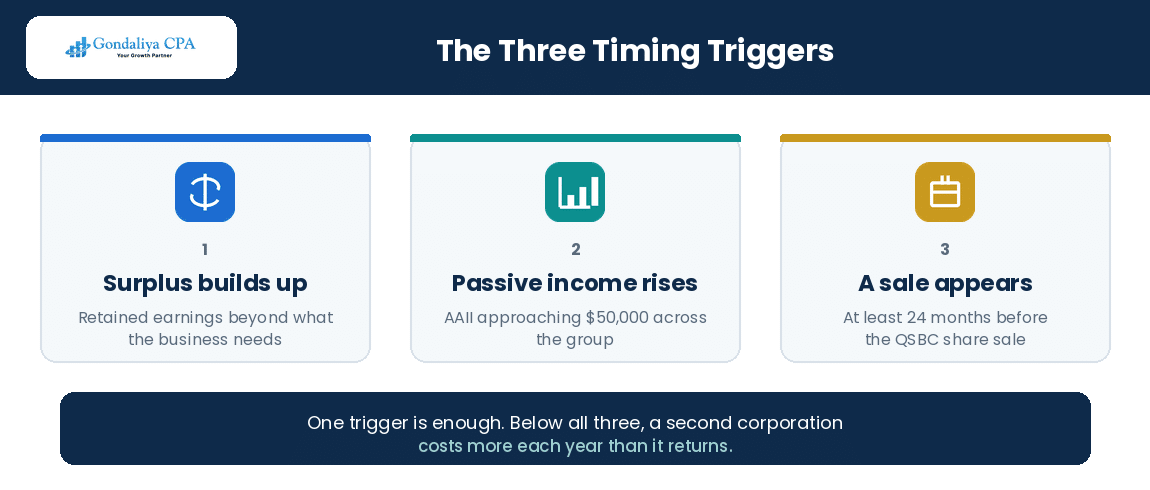
The question is not whether a holdco works but when it starts earning its cost. Three signals matter: retained earnings beyond what the business needs, passive income approaching the threshold that grinds the small business deduction, and a sale or succession far enough ahead that the 24-month holding period can still be met. Please note that the last one has a deadline attached.
| Aspect | Details |
|---|---|
| The surplus trigger | Retained earnings beyond immediate operating needs. |
| The passive income trigger | AAII approaching $50,000 across associated corporations. |
| The exit trigger | A sale ahead, with the 24-month QSBC holding period to meet. |
| The cost of acting early | A second T2 every year with nothing yet to protect. |
Reading time: 33 minutes.
Table of Contents
- What is a holding company and how does it work for business owners?
- When is the best time to create a holding company?
- Holding Company Tax Planning Considerations
- Building and Managing a Holding Company Structure
- Advantages of a Holding Company for Small Business Owners in Canada
- Holding Companies for Real Estate, Investments, and Specific Industries
- Frequently Asked Questions
- Quick Comparison Table: Holding Company Setup Options
- Industry Spotlights: Sectors We Represent
- Professional Guidance and Quick Reference
The Numbers That Matter
This article covers Canada, with Ontario and Toronto context, and reflects CRA rules current to 2026. It assumes an incorporated Canadian business owner deciding whether the timing is right for a holding company. Figures marked illustrative are examples, not quotes, and any masked engagement notes end with “Figures changed for privacy.” This is educational information only and not tax, legal, or financial advice. Rates, thresholds, and rules change, so please confirm your own situation with a CPA Ontario member before acting.
What is a holding company and how does it work for business owners?
What is a holding company and how does it work for business owners?
The Basics
A holding company mainly owns shares in other companies. It doesn’t run daily business activities. Instead, it manages investments, assets, or subsidiaries. Canadian business owners often use holding companies for tax planning and managing wealth.
You might wonder when to set up a holding company. It depends on your finances and future plans. Setting one up at the right time can save you taxes. For example, Section 112 of the Income Tax Act lets operating companies send profits to the holding company as dividends without immediate tax. This helps with cash flow and tax management.
Key differences between holding and operating companies
Here’s how holding and operating companies differ:
- Holding companies own shares or assets.
- Operating companies run the business and sell products or services.
- Holding companies earn dividends from their subsidiaries.
- Operating companies make money from sales revenue.
- Tax rules differ: holding companies benefit from intercorporate dividend inclusion under Section 112.
- Operating companies pay regular corporate income tax.
- Holding companies face less risk because they don’t do daily operations.
- Operating companies take on more risk since they handle business activities.
A holding company accountant helps manage these differences. They ensure you follow rules and use smart tax strategies.
Who should consider setting up a holding company in Canada?
Some Canadian business owners might find a holding company useful:
- Owners with extra profits not needed for daily expenses.
- Those planning to pass their business on smoothly.
- People looking into an estate freeze to lock asset values now, avoiding bigger capital gains taxes later.
Thinking about these points can help you decide if setting up a holdco fits your long-term plan.
Common reasons Canadian business owners establish holding companies
Many choose holdcos for good reasons:
- Asset protection: Keep personal assets safe from risks tied to the operating company.
- Tax efficiency: Hold passive investments inside the holdco to control taxable income better. This avoids hitting limits on passive income that reduce small business deductions.
- Investment flexibility: A holdco lets you invest without disturbing daily operations’ cash flow.
Knowing what sets a holding company apart from an operating one gives Canadian owners clearer choices. It supports smarter decisions about their corporate setup while improving financial safety and growth through careful tax planning tailored to their situation.
An owner asked about a holdco three weeks before signing a letter of intent. The 24-month holding period could not be met in time, and the exemption planning had to be abandoned for that sale. Figures changed for privacy.
Key Stat: The 24-month holding period is the one trigger with a hard deadline attached. Surplus and passive income can be addressed whenever they appear, but a sale timeline cannot be moved backwards once talks begin.
When is the best time to create a holding company?
When is the best time to create a holding company?
The Timing
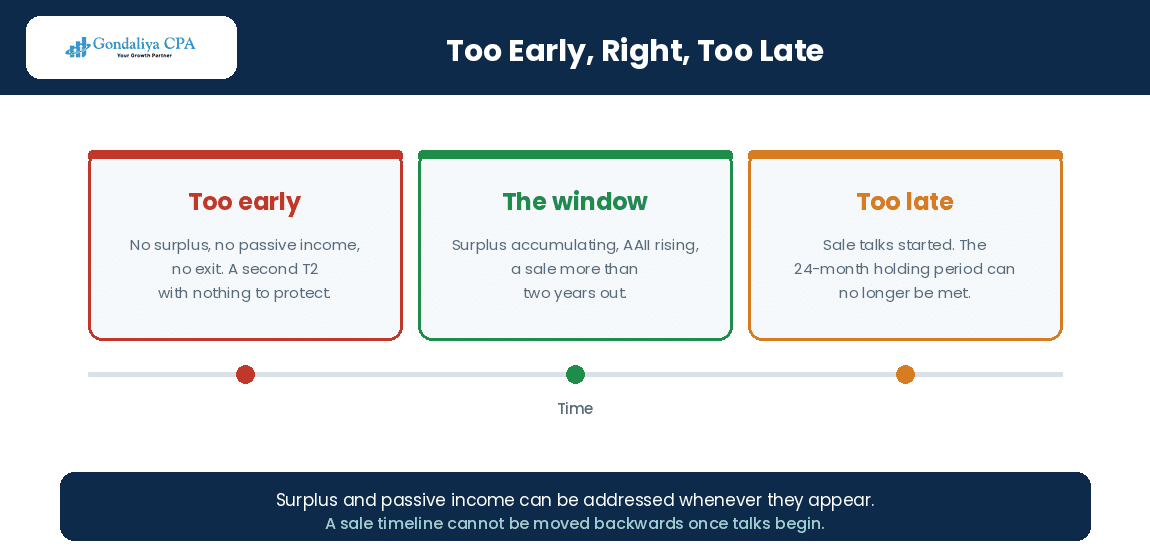
Setting up a holding company in Canada works best when certain tax or business reasons appear. For example, when your operating company keeps earnings beyond what you need right away, or when passive investments pile up and risk shrinking your small business deduction. Holding company tax planning helps manage extra funds, protect assets, and plan for succession. But setting up too early might cost you more than it’s worth. Waiting too long could mean missing out on tax perks from CRA rules.
Signs your business may benefit from a holding company structure
You might want to talk to a holding company accountant if your retained earnings keep growing without clear plans to reinvest. Another sign is when your passive income nears the threshold that lowers the small business deduction’s limit — currently at $50,000 adjusted aggregate investment income (AAII), which starts reducing your benefit, and gone at $150,000 AAII. Also, if you own lots of passive investments or real estate that don’t link to active business work, think about a holdco.
Here’s a quick look:
- Retained Earnings Exceed Needs: Extra money could face creditor claims. Next step: move dividends between companies using a holdco.
- Passive Income Near Threshold: You risk losing small business deduction benefits. Next step: check how AAII affects your limits.
- Multiple Owners or Complex Shares: You need tighter control and flexibility. Next step: consider reshaping shares with holdco help.
It’s wise to get advice from a CPA who knows Canadian tax law well. That way, you time it right and stay onside with rules.
Should you set up a holding company before selling your business or investments?
Setting up a holding company before selling can help you use the lifetime capital gains exemption (LCGE). This exemption lets you avoid paying tax on up to $913,630 in gains from qualified small business corporation (QSBC) shares. But there are conditions:
- You must hold shares for at least 24 months before selling.
- The operating company needs to meet QSBC rules during that time.
You can use section 85 rollover rules to move assets into the holdco without immediate taxes. This keeps your LCGE intact. If you wait until after starting sales talks, you might miss deadlines and lose exemptions.
Also, setting up holdco first lets you separate non-active assets like property or investments from the operating business before selling. This helps keep QSBC status intact so you get full capital gains relief.
Evaluating if a holding company aligns with your long-term business goals
Holding companies protect assets by separating money from day-to-day business risks. For instance, putting real estate into the holdco keeps it safe from creditors chasing the operating company.
They also help with succession planning using estate freeze strategies. This locks in current share values but allows future growth to pass on to family members—helping them use LCGE too.
Things to think about include:
- Does separating wealth from risks fit your comfort level?
- Can you handle ownership changes easily with shareholder agreements?
- Will matching fiscal year ends make reporting simpler?
A good CPA can help make sure the structure fits your goals like retirement plans or leaving a legacy.
A business hit $60,000 of investment income in a strong market year without noticing. The grind had already started, and the small business deduction reduction showed up on the return rather than in a plan. Figures changed for privacy.
Risk Warning: Setting up the holdco after sale discussions have started is usually too late for the exemption planning. The 24-month clock runs from the transfer, not from the closing, so please act while the timeline still allows it.
Holding Company Tax Planning Considerations
Holding Company Tax Planning Considerations
The Rules
Holding company tax planning in Canada means thinking ahead about timing and rules. Knowing when to set up a holding company helps business owners save on taxes, protect assets, and prepare for succession. Setting it up at the right moment can bring big benefits under Canadian tax laws.
Tax planning for holding companies in Canada: Core rules and opportunities
Tax planning with holding companies focuses on managing money flows, capital gains, and profits between your operating company (opco) and the holdco. A good holdco setup lets you keep profits inside the corporate group without immediate personal taxes. This works thanks to intercorporate dividends being tax-free under section 112 of the Income Tax Act.
Here are some key points:
- Protect your earnings from business risks.
- Use estate freezes to move wealth smartly.
- Take advantage of the lifetime capital gains exemption (LCGE) with qualifying shares.
- Keep passive investment income separate so you don’t lose small business deduction benefits.
Hiring a skilled holding company accountant early on helps you follow CRA rules and get the most from these options.
Intercorporate dividends, section 112, and the flow of funds between companies
When an opco pays dividends to its holdco, these are usually tax-free under section 112(1) ITA. This rule lets you move after-tax profits into your holdco smoothly, without extra taxes then.
This tax break lets you:
- Build earnings outside active business work.
- Spread investments through different companies.
- Plan distributions that fit shareholder goals.
Still, keep good records and watch CRA’s anti-surplus stripping rules. Otherwise, you might face unexpected taxes or penalties.
Small business deduction and passive investment income limits
The small business deduction (SBD) lowers corporate taxes on active business income up to $500,000 per group of connected corporations. But new rules starting in 2026 change how passive income affects this limit:
| Threshold/Limit | Amount | Source |
|---|---|---|
| Business Limit for SBD | $500,000 | CRA – Small Business Deduction |
| Passive Income Threshold | $50,000 | CRA – Adjusted Aggregate Investment Income |
| Full SBD Elimination Point | $150,000 AAII | CRA – Passive Income Grind |
If your adjusted aggregate investment income passes $50,000 across associated companies — including holdcos — your SBD starts shrinking dollar-for-dollar until gone at $150,000. This means you have to plan passive investments carefully inside holding companies to keep your low tax rates on active earnings.
Section 85 rollover and transfers of assets to a holding company
Section 85 rollovers let shareholders transfer property—like shares or real estate—to a new holdco without paying immediate tax. You pick a value between fair market value (FMV) and adjusted cost base (ACB).
Timing is key because:
- Both transferor and corporation must file the election together.
- Waiting too long triggers capital gains or recapture taxes right away.
Using section 85 during setup keeps cost bases steady and makes owning everything under one group easier—a must if you’re wondering when to set up a holding company before profits or assets grow.
Capital dividend account and tax-free corporate distributions
The capital dividend account (CDA) tracks non-taxable amounts like life insurance proceeds or certain capital gains in private companies. You can pay out CDA balances tax-free from either an opco or its holdco if handled properly.
You must keep precise records because mistakes lead to penalties—twice the wrong amount plus interest from CRA. Managing the CDA well gives more flexibility with cash while keeping after-tax wealth inside your structure.
Income splitting options, TOSI implications, and family trusts
Income splitting through family trusts combined with shares in corporations still works but faces tougher rules due to TOSI (Tax On Split Income). These rules stop unfair dividend shifts among related adults who don’t actively run the business.
Holding companies often help make family trust structures legit where beneficiaries get dividends matching their real involvement—avoiding TOSI penalties—but only if planned with a CPA who knows current “excluded shares” exceptions recognized by CRA.
Impact of adjusted aggregate investment income on tax rates
Adjusted aggregate investment income counts all passive earnings across associated corporations: interest, rent, royalties, portfolio dividends, taxable capital gains minus losses. This matters because it affects whether you lose small-business deduction rates federally—and sometimes provincially too (like Ontario starting in 2026).
Going over these limits raises your combined federal-provincial tax rate from about 12% for CCPCs toward nearly double that general rate. So setting up your holdco timely and watching investment income closely helps keep taxes low while you grow retained earnings inside Canadian-controlled private corporations.
Lifetime capital gains exemption and estate freeze strategies
The Lifetime Capital Gains Exemption (LCGE) lets individuals avoid paying personal tax on qualified sales of shares—up to roughly $971K indexed—if they own those QSBC shares for two years before selling. The CRA checks this closely.
Estate freezes use new share classes often held by a new holdco so senior owners lock (“freeze”) their equity value today. Future growth then goes onto junior shares owned by heirs. This can increase LCGE claims across family members when done right.
Both strategies need careful timing so share restructuring meets deadlines before sales happen. Expert CPA advice specializing in Canadian holdcos protects your interests through these tricky rules.
Sharad Gondaliya, CPA, has over 10 years helping Canadian businesses set up smart corporate structures that follow rules yet reduce taxes effectively.
Text-only consultation offer: Wondering when to set up a holding company for your situation anywhere in Toronto/Ontario/Canada? Call us at 647‑212‑9559 or email info@gondaliyacpa.ca today.
Key Stat: Intercorporate dividends paid between connected firms stay exempt from extra taxes under Section 112(1)(a), easing fund movement inside groups [CRA].
Pro Tip: Watch adjusted aggregate investment incomes once they hit $40K among associates—you risk losing part or all small-business deductions soon [CRA].
Risk Warning: Missing Section 85 election deadlines causes instant gain recognition creating surprise tax bills [CRA].
Our Take: Act early; choosing when to set up a holding company calls for proactive review—not fixing problems after they start.
Next: When Is It Too Early To Set Up A Holding Company?
Building and Managing a Holding Company Structure
Building and Managing a Holding Company Structure
The Build
Setting up and running a holding company in Canada takes some careful thinking. You want to save on taxes, protect your assets, and follow the rules. Knowing when to set up a holding company plays a big role in smart tax planning that fits your business goals.
Steps for Settingting Up a Holding Company in Canada
Starting a holding company needs a few important steps. These help you get legal status and make ownership easier for your operating businesses or investments. First, figure out the right time. This could be when your earnings grow or if you plan to sell.
- Check if your business has enough extra money or passive income.
- Pick where to incorporate: federal under the CBCA or provincial like Ontario’s OBCA.
- Incorporate by filing articles with Corporations Canada or ServiceOntario, and pay government fees.
- Set up share classes showing control, voting rights, and dividend rights for owners.
- Move operating company shares using section 85 rollover to avoid taxes now.
- Put governance rules in place, like board meetings and dividend plans.
Make sure all steps follow CRA rules and corporate law while fitting your long-term tax plans.
Incorporation, Share Structure, and Required Documentation
To incorporate a holding company right, you need the correct papers and help from a holding company accountant who knows Canadian laws.
- Articles of Incorporation state your company’s name, share details (number/types), any transfer limits, and minimum directors (usually one Canadian resident federally).
- Shareholder agreements explain rights about dividends and decisions; lawyers often write these.
- Government filing fees are $200 CAD plus HST when you submit federally through Corporations Canada.
- Keep detailed minutes of decisions in a minute book for legal proof.
A good CPA helps avoid mistakes with share structure that might mess up future estate or succession plans.
Transferring Shares of Your Operating Company to the Holding Company
Moving shares from your operating business to your holding company usually uses section 85 rollover rules. These let you defer paying capital gains tax on asset transfers between related companies.
This lets you:
- Transfer shares at chosen values without immediate tax.
- Keep adjusted cost bases so future sales won’t cause surprises.
- Properly file documents with T2 returns as CRA requires.
Also, dividends paid from operating firms to holdcos are generally exempt from taxes because they count as non-taxable intercompany dividends. You have to follow governance rules closely here.
Dividend Flow Strategies and Ongoing Governance Requirements
Managing dividend payments inside your corporate group needs care and good record keeping.
- Intercorporate dividends don’t add to taxable income but must show correctly in financial records with capital dividend accounts.
Corporate governance means holding board meetings on dividends and annual meetings on time. Minutes must be kept as Corporations Canada or ServiceOntario demands.
Clear records back up your tax position and help keep small business deductions safe under associated corporation rules linked to shared income limits.
Connected Corporation Rules and Associated-Corporation Limits
| Factor | Description | Reference |
|---|---|---|
| Small Business Deduction Business Limit | The $500,000 CAD limit is shared among associated corporations | CRA ITA s125(7)(a) |
| Passive Income Threshold | More than $50K passive investment income cuts down SBD dollar-for-dollar | CRA ITA s125(1)(l) |
| Associated Corporation Definition | Corporations controlled by same person(s) share combined limits | CRA ITA s256 |
Knowing these helps avoid losing SBD benefits when passive investments push income over thresholds causing gradual cutbacks.
Ongoing Compliance, Filings, and Working With a Holding Company Accountant
Running a holdco means keeping up with many rules. A holding company accountant makes this easier.
- File separate T2 Corporate Income Tax Returns each year even if only investment income exists.
- Submit annual returns on time; late filings bring fines.
- Update ISC registers after director or shareholder changes quickly.
- Track intercorporate dividends carefully among group companies.
- Stay aware of new laws changing how passive investments or intercompany dividends are handled starting 2026.
Working with an accountant early smooths integration into accounting software like QuickBooks or Xero. They may offer fixed fees so costs don’t surprise you.
For specific advice about when it makes sense to set up a holding company in Toronto, Ontario, or anywhere else in Canada, contact Gondaliya CPA at info@gondaliyacpa.ca or call 647‑212‑9559 for a free consultation.
A holdco was incorporated but the section 85 election was never filed, so the share transfer sat unsupported for a full year. Correcting it cost more than doing it properly at the outset would have. Figures changed for privacy.
Advantages of a Holding Company for Small Business Owners in Canada
Advantages of a Holding Company for Small Business Owners in Canada
The Advantages
A holding company in Canada can offer real benefits for small business owners. It helps with tax planning and gives more control over finances. Knowing when to set up a holding company matters. For example, if profits grow or passive income nears certain limits, it might be the right time.
This kind of company keeps operating risks separate from investments. It also lets you move money between companies without paying immediate tax thanks to intercorporate dividends under section 112.
Holding companies let profits build up outside the operating business. That means no personal tax right away. The money stays inside the corporate group and can be reinvested or saved. But setting up too soon can cost more than it’s worth. Waiting for the right moment helps make it worthwhile.
Many Canadian-controlled private corporations (CCPCs) use holding companies this way. Places like Ontario see lots of businesses working with accountants to figure out when to create these structures while staying compliant with CRA rules.
Asset Protection, Creditor Proofing, and Safeguarding Retained Earnings
A holding company helps protect assets by keeping profits safe from business risks. When an operating company has extra money beyond what it needs, it can send that cash tax-free as intercorporate dividends to its holdco.
This shields funds from creditors if problems come up in the operating business. The intercorporate dividend inclusion rate is zero percent between connected Canadian corporations if they meet CRA rules. So, profits move up without taxes hitting immediately.
Hiring a good holding company accountant is key here. They help set up share classes and dividend policies that follow CRA guidelines. Keeping clear records also avoids trouble during audits or annual filings.
Without expert help, businesses might slip on creditor proofing or accidentally trigger taxes.
Tax Deferral and Strategic Corporate Wealth Protection
Using intercorporate dividends wisely lets owners delay paying personal tax on corporate earnings. Section 112 allows connected companies to move money back and forth without tax hits.
A properly set-up holdco also helps with the lifetime capital gains exemption (LCGE). If you hold qualifying shares for two years or more, you can sell them free of federal tax on gains—up to $971,190 as of 2026.
Timing matters here too. Starting your holdco before selling shares ensures you meet ownership requirements for LCGE by doing estate freezes or share reorganizations with professionals.
Wealth protection also means managing refundable dividend tax on hand and capital dividend accounts carefully. That keeps distributions tax-efficient and avoids double taxation traps.
Investment Opportunities and Managing Multiple Businesses Under One Structure
As passive investment income nears the threshold that cuts into small business deductions, a holdco becomes useful to separate investments from active business income.
That threshold starts at $50,000 of adjusted aggregate investment income and triggers a “grind” on tax advantages.
One holdco can own several businesses or properties in different sectors. This setup simplifies managing them under one roof and makes reporting easier according to Corporations Canada rules.
Cash flow between related entities moves smoothly with intercompany loans or well-timed dividends around fiscal year-ends.
Watching passive income limits is important to avoid lowering the combined small business deduction across affiliated groups—something many growing Canadian entrepreneurs face.
Estate Planning, Succession, and Multiplying the Capital Gains Exemption
Holding companies help with estate planning by allowing estate freezes that lock in current values but let future growth go to heirs using different share classes.
This tactic multiplies lifetime capital gains exemptions across family members owning qualified small business corporation (QSBC) shares through family-held holdcos.
It also makes passing ownership easier after death by avoiding probate delays tied to multiple individual shareholders versus one parent company owning everything.
Business owners should work closely with their CPA accountant and lawyers familiar with Ontario laws like OBCA/CBCA. This ensures proper freeze transactions amid changing rules—including recent 2026 updates affecting rollovers.
Potential Disadvantages and Common Mistakes With Holding Companies
Setting up a holding company too early adds costs like extra T2 returns yearly—even if just investment income is involved—and increases bookkeeping work.
Common errors include:
- Not using section 85 rollovers on asset transfers
- Failing to keep ISC registers updated
- Mixing personal and corporate finances
- Overlooking associated corporation rules that reduce small business deductions
- Mishandling shareholder loans causing unexpected income inclusions
- Incorrect use of capital dividend accounts leading to taxable surprises
Experts warn against these mistakes because they can cause penalties, lost tax benefits, or costly legal fixes later on.
Working with specialized accountants and lawyers helps avoid problems while supporting steady growth for incorporated small businesses in places like Ontario’s Toronto area served by firms such as Gondaliya CPA Professional Corporation.
Pro Tip: Track the combined investment income figure across every associated corporation each quarter rather than at year-end. The grind is easier to plan around when you see it approaching than when it appears on the return.
Holding Companies for Real Estate, Investments, and Specific Industries
Holding Companies for Real Estate, Investments, and Specific Industries
By Sector
Holding companies in Canada let business owners keep assets like real estate and investments separate from their main business. This separation helps with holding company tax planning by cutting down risks and making taxes easier to manage. When a company earns more than it needs for day-to-day work, moving money into a holding company can protect those funds.
In real estate, holding companies often own properties while the main business handles operations. This setup keeps creditors away from property assets if the business runs into trouble. Investors also use holding companies to group different investments under one roof, making management simpler and taxes smoother.
This approach works well in industries like manufacturing, where big equipment is involved, or tech companies that hold patents or trademarks inside a holding company. Timing matters here; businesses should set up holding companies when they start to grow and cash flows become steady.
Use in Manufacturing, Distribution, Technology, Healthcare, and Trades
Knowing when to set up a holding company depends on your industry. Manufacturing and distribution businesses usually do it once they have steady profits and enough earnings beyond what they need right away.
Tech startups might wait until they have stable revenue or are ready for investors before creating a holding company. Healthcare providers like doctors or dentists must follow special rules about ownership, so forming a holding company makes sense when they’re growing or planning who will take over later.
Here’s what to watch for:
- Growing profits that can be separated from daily risks
- Passive income levels close to Canada Revenue Agency (CRA) limits
- Multiple owners needing clear rules on shares
Starting too soon can mean extra paperwork without much benefit.
Holding Companies for Professional Corporations and Retirement Planning
Professional corporations (PCs) face rules about who can own shares. Many regulated jobs don’t allow non-professionals to hold shares directly through a holding company. Still, using family trusts alongside PCs can protect wealth while following these rules.
For retirement planning, professionals like doctors use holding companies to pull money out slowly with dividends instead of just salaries. This helps lower personal taxes and keeps options open for lifetime capital gains exemptions on certain shares.
A good CPA accountant knows these special rules well. They help make sure setting up your holding company follows laws without risking licenses or triggering unexpected taxes from complicated rollover rules.
Case Studies: How Holding Companies Produce Value in Practice
We’ve seen how timing affects success with holding companies in real Canadian businesses:
Example 1:
A Toronto e-commerce seller earned $250K yearly extra profits beyond what it reinvested (just an example). Setting up a federal holdco let them move that money tax-free under section 112 of the Income Tax Act. They also moved passive investments into the holdco’s portfolio account which cut down provincial surtax on passive income nearing $50K annually (just numbers for illustration). The client used their capital dividend account smartly when transferring ownership later with well-kept corporate records from the start.
Example 2:
A construction contractor added owners from family members as part of an estate freeze plan using a holdco before selling their business. This kept small business deduction limits intact across associated companies according to CRA rules (again, an example).
These stories show that knowing “when to set up a holding company” depends on clear financial signs — not just guesses about timing.
When Holding Companies Are Not Suitable and Available Alternatives
Creating a holding company too early means dealing with extra tax filings even if you only have some passive income. Startups still losing money or without saved earnings don’t get much benefit but face more costs and admin work.
Instead, early businesses might choose partnerships or wait until profits hit CRA’s small business deduction limit of $500K federally before going multi-layered with corporations sharing tax benefits.
| Scenario | Suitability | Reason |
|---|---|---|
| Pre-revenue startup | Not suitable | No extra money saved; higher costs |
| Single-owner sole proprietorship | Alternative preferred | Simpler taxes; fewer forms |
| Business below $100K net profit | Defer | Costs outweigh gains |
In short: don’t rush into creating Canadian-controlled private corporations plus subsidiaries until key financial triggers show up.
Consulting a CPA for Holding Company Planning and Setup
Working with a CPA who knows Canadian corporate tax rules is vital when thinking about setting up a holdco. They’ll check if your timing makes sense and help pick between federal or provincial setups.
They handle share transfers using section 85 rollovers properly under current laws updated through 2026 — including changes affecting intercorporate dividends and passive income calculations.
A good CPA accountant will:
- Maximize benefits from your holding company Canada
- Avoid risks tied to associated-corporation rules impacting small business deductions
- Keep minute books compliant at federal/provincial level
- Register necessary CRA program accounts
- Advise on best fiscal year-end dates
- Prepare solid documents for future reviews
- Help integrate everything smoothly with accounting software like QuickBooks or Xero
You can reach out to Gondaliya CPA anytime at 647-212-9559 or info@gondaliyacpa.ca for free text-only consultations about holding company accountant questions or figuring out when it is best time to create your own holding company anywhere in Ontario/Toronto or across Canada.
Sharad Gondaliya, CPA, has over 10 years helping Canadian business owners figure this stuff out.
Reading time: approximately 8 minutes
The pattern we see is that owners ask about a holdco either two years too early, when there is nothing to move, or two months too late, when a sale is already in motion. The useful window sits between those two points. Figures changed for privacy.
Frequently Asked Questions
Frequently Asked Questions
FAQ
What triggers indicate it’s time to set up a holding company?+
Retained earnings beyond immediate needs, passive income nearing thresholds, plans to sell, desire for asset protection, and succession or estate freeze goals all signal a good time.
How does a holding company affect the small business deduction and passive income limits?+
Holding companies can protect active income but passive investment income above $50,000 reduces the small business deduction gradually until eliminated at $150,000.
What are the key steps to set up a holding company once a trigger is met?+
Incorporate the holdco, use section 85 rollovers to transfer shares tax-deferred, establish governance documents, and engage a CPA for compliance and tax planning.
What CRA and compliance obligations come with owning a holding company?+
Filing separate T2 returns annually, maintaining minute books, updating corporate records promptly, tracking intercorporate dividends properly, and following new tax rules are required.
What costs should I expect when setting up and maintaining a holding company in Canada?+
Costs include incorporation fees, accounting and legal fees for setup and ongoing filings, plus additional bookkeeping expenses for managing complex structures.
Should I choose a DIY approach or hire professionals like lawyers or CPA firms to set up my holding company?+
DIY can be risky due to complex tax rules. Lawyers handle legal structure; CPA firms provide tax planning. Combining both ensures compliance and optimal benefits.
How does Gondaliya CPA assess the right timing for creating a holding company?+
We review your financials, retained earnings, passive income levels, growth plans, and succession needs before recommending the best timing tailored to your business.
What deliverables come with Gondaliya CPA’s holding company timing assessment?+
You receive a personalized report outlining timing triggers met, tax impact analysis, incorporation strategy, share structure advice, and ongoing compliance recommendations.
What risks and compliance issues should I be aware of with holding companies?+
Common risks include missing section 85 elections causing unexpected taxes, losing small business deduction due to passive income limits, poor record-keeping penalties.
How should I prepare before assessing my holding company timing with an accountant?+
Gather financial statements, shareholder details, current corporate structure info, details on passive investments and plans for business sale or succession.
Quick Comparison Table: Holding Company Setup Options
Quick Comparison Table: Holding Company Setup Options
Quick Reference
- DIY Setup: Low upfront cost; high risk of errors; no tax planning guidance.
- Lawyer Only: Proper legal documents; limited tax advice; higher fees.
- CPA Firm: Full tax strategy; compliance monitoring; coordinated legal support optional.
Who This Is For / Not For
- For: Businesses with growing profits; passive investments nearing limits; owners planning succession or sale.
- Not For: Startups without profits; sole proprietors with simple finances; businesses under $100K net income.
How Holding Company Timing Triggers Differ Across Industries
- Manufacturing & Distribution: Ideal when profits stabilize beyond operating needs.
- Technology Startups: Best once revenue steadies or investor interest arises.
- Healthcare Professionals: Timing depends on ownership rules and growth stage.
A Realistic Numeric Walkthrough
Consider an operating company earning $600K yearly with $100K passive income. Setting up holdco helps shield excess profits from immediate personal taxes while managing passive income to maintain small business deductions effectively.
What Should a Business Owner Prepare Before Assessing Holding Company Timing?
Have clear financial records showing retained earnings growth. Document any planned asset transfers or sales. Note ownership structures including family members involved.
How Do We Assess Holding Company Timing at Gondaliya CPA?
We analyze profitability trends versus passive income limits. Then consider your future plans like selling or estate freezing. Our review guides timing decisions supported by current CRA rules.
What Are the Risks, Compliance Issues, and Prevention Controls?
Ignoring associated corporation rules may reduce your tax savings. Missing critical election deadlines causes immediate taxable gains. Maintaining meticulous records prevents penalties during audits.
What Does It Cost to Set Up and Maintain a Holding Company in Canada?
Incorporation fees range from $200 federally plus provincial charges. Accounting fees vary but expect ongoing costs for separate tax filings and bookkeeping support from $1,000+ annually depending on complexity.
Holding Company Route: DIY vs Lawyer vs CPA Firm – Which Route Fits?
DIY suits simple cases but risks costly mistakes. Lawyers ensure valid legal formation only. CPA firms offer full-service solutions including tax planning and ongoing CRA compliance management.
How Do You Set Up a Holding Company Once a Trigger Is Met?
- Incorporate your holdco federally or provincially.
- Use section 85 rollovers to transfer shares without immediate taxes.
- Define share classes aligned with ownership control.
- Draft shareholder agreements governing distributions.
- Engage a CPA for ongoing filings and tax strategies.
What CRA and Compliance Obligations Come With a Holding Company?
Holdcos must file separate corporate returns yearly regardless of activity level. They require keeping minute books updated after director/shareholder changes plus proper reporting of intercompany dividends under section 112.
What Deliverables Do You Get With a Holding Company Timing Assessment and Setup?
A customized plan showing optimal incorporation timing tied to your finances along with share structuring options supported by documentation templates ensuring smooth CRA audits later on.
How Do Holding Company Timing Triggers Differ Across the 10 Industries We Serve?
Each industry has unique cash flow cycles impacting optimal timing: retail favors early setup once profits exceed needs; real estate uses holdcos for liability shielding; professional services weigh licensing regulations heavily.
How to Choose the Right CPA Firm in Toronto/Ontario for Holding Company Timing Advice?
Look for expertise in Canadian corporate tax law plus proven experience with multi-layered corporations. Check client reviews emphasizing timely compliance assistance and strategic guidance tailored to your sector.
Why Trust Gondaliya CPA?
We combine over 10 years of Canadian & U.S. cross-border expertise delivering actionable advice rooted in deep knowledge of CRA rules plus clear communication focused on maximizing client value every step of the way.
The most common question is what the trigger actually looks like on a balance sheet. In practice it is cash that has sat unused for two consecutive years, or investment income that grew without anyone deciding it should. Figures changed for privacy.
Industry Spotlights: Sectors We Represent
Industry Expertise
The trigger arrives at a different point in each sector. Here are eleven and the signal that usually comes first.
| Industry | The Signal That Usually Comes First |
|---|---|
| Technology startups & SaaS | Revenue steadies, or an investor round appears |
| E-commerce & online retailers | A strong year leaves surplus beyond reinvestment |
| Consulting firms | Retained earnings build with no reinvestment plan |
| Construction, contractors & skilled trades | Job site exposure rises alongside accumulated cash |
| Property developers & builders | A second project corporation is about to be formed |
| Real estate investors & holding companies | Rental income pushes AAII toward $50,000 |
| Transportation, logistics & trucking | Fleet value grows enough to be worth separating |
| Restaurants & food and beverage | Surplus survives a full year without being needed |
| Daycare, childcare & CWELCC services | The premises are bought rather than leased |
| Dentists & dental practices | Succession planning begins, within college rules |
| Medical doctors & physician corporations | The same, under a different college’s restrictions |
- Technology startups & SaaS: The trigger is usually revenue becoming predictable or an investor round appearing, since both change what the share structure needs to do.
- E-commerce & online retailers: Surplus builds fast in a good year, and the question is whether it will be reinvested or should be moved somewhere safer.
- Consulting Firms: Retained earnings accumulate quietly here because there is little to reinvest in, which is the clearest version of the surplus trigger.
- Construction, general contractors & skilled trades: Liability and accumulated cash rise together, so the protection argument usually arrives before the tax one does.
- Property developers & builders: Forming a second project corporation is the moment to think about the structure above it, and about the shared business limit.
- Real estate investors, landlords & holding companies: Rental income counts toward adjusted aggregate investment income, so the passive trigger tends to arrive earliest in this sector.
- Transportation, logistics & trucking: Once the fleet carries real value, holding it separately from the entity that takes on operating claims starts to matter.
- Restaurants & food and beverage: Surplus that survives a full year without being needed is the signal, and exposure here makes moving it worthwhile sooner.
- Daycare, childcare & CWELCC services: Buying the premises rather than leasing them is usually the point at which a separate holding entity earns its cost.
- Dentists & dental practices: Succession planning is the common trigger, though the college restricts who may hold shares, which shapes what is possible.
- Medical doctors & physician professional corporations: The same restriction applies, so the holdco usually sits alongside the practice rather than owning it outright.
Across timing reviews in one year, the two most common findings were surplus that had sat unused for three years, and owners who had never checked their combined investment income figure. Figures changed for privacy.
Professional Guidance and Quick Reference
Guidance
Professional Guidance on Holding Company Timing: How Gondaliya CPA Supports Canadian Business Owners
Timing a holdco properly means reading three signals correctly: whether surplus has genuinely accumulated, whether investment income is approaching the threshold, and whether a sale is far enough away for the holding period to be met. Gondaliya CPA assesses holding company timing and handles the setup and compliance that follow.
We handle the work that decides whether the timing is right: reviewing retained earnings against operating needs, calculating combined investment income across associated corporations, checking the QSBC position and the sale horizon, then incorporating, preparing the section 85 election, and setting the dividend policy.
Our team follows CRA practice closely and builds the assessment around your own numbers rather than a rule of thumb. Whether you are considering a first holdco, revisiting a structure set up years ago, or preparing for a sale, we give clear advice based on the current rules.
Quick Answers: Key Numbers & Concepts at a Glance
At a Glance
- Passive income grind starts: $50,000 of AAII
- Small business deduction gone at: $150,000 of AAII
- Federal business limit: $500,000, shared when associated
- QSBC holding period: 24 months before selling
- Section 112 inclusion rate: 0% between connected corporations
- Federal incorporation fee: $200 CAD
- Section 85 election: Filed jointly by both parties
- T2 returns required: One per corporation, every year
- ISC register: Updated after director or shareholder changes
- Federal director residency: At least 25% Canadian resident
Who This Is For / Not For
Fit Check
- For: Incorporated Canadian businesses with surplus beyond operating needs, owners whose investment income is approaching the threshold, and anyone with a sale or succession more than two years out.
- Not For: Pre-revenue startups and businesses with no retained earnings, where a second corporation adds filings without benefit, and regulated professionals whose college restricts share ownership.
People Also Ask
Quick Answers
Can I set up the holdco and transfer shares in the same year?+
Yes, but the section 85 election has to be filed with the returns for that year. The transfer itself is straightforward; the filing deadline is what catches people.
Does a holdco help if I have no passive investments yet?+
Less than you might expect. With no surplus and no investments, it mostly adds a second T2 return each year without doing much else.
How long before a sale should the holdco be in place?+
At least 24 months, since that is the QSBC holding period. Earlier is safer, because the operating company must also meet the tests throughout.
Glossary of Key Terms
Plain-English Definitions
- Holding company: A corporation that owns shares or assets rather than carrying on active business.
- Operating company: The corporation that trades with customers and earns active business income.
- Retained earnings: Accumulated profits kept in the corporation rather than distributed.
- Intercorporate dividend: A dividend paid from one corporation to another within a group.
- Section 112: The provision allowing those dividends to flow without immediate tax.
- Section 85 rollover: A tax-deferred transfer of property into a corporation, elected jointly.
- AAII: Adjusted aggregate investment income, the measure used for the business limit grind.
- Passive income grind: The reduction of the small business deduction as AAII rises.
- Associated corporations: Corporations under common control that share one business limit.
- SBD: The small business deduction reducing corporate tax on active business income.
- LCGE: The lifetime capital gains exemption available on qualifying share sales.
- QSBC shares: Qualified small business corporation shares eligible for the LCGE.
- Estate freeze: Locking in today’s share value so future growth accrues to others.
- Capital dividend account: The account tracking amounts distributable tax-free.
- TOSI: Tax on split income, limiting dividends to family members not active in the business.
- ISC register: The record of individuals with significant control over the corporation.
Holding Company Timing Check
This quick self-check flags which timing triggers apply to you right now. Please answer the six questions below.
Holding Company Timing Check
Six quick questions on your position. No fee shown.
Triggers met:
This is a general prompt, not tax or legal advice or a quote. Your position depends on your full facts. For a real review, please book a free consultation.
Want a checklist to work from? You can download our free holding company timing checklist before your consultation.
Wait until at least one trigger is genuinely met, then act rather than waiting for a second. Surplus sitting unused, investment income approaching $50,000, or a sale more than two years out each justify the structure on their own. Below those points, a second corporation costs more than it returns.
2026 Update — what is current: The passive income grind still begins at $50,000 of adjusted aggregate investment income and eliminates the federal small business deduction at $150,000. Section 112 keeps connected intercorporate dividends at a 0% inclusion rate, and the QSBC holding period remains 24 months. Please confirm the current business limit, the LCGE amount, and filing fees before relying on the figures in this article.
When to set up a holding company in Canada: Tax planning, accountant advice, and business benefits with Gondaliya CPA
For tailored advice about when to create your holding company in Canada’s evolving tax landscape contact Gondaliya CPA at info@gondaliyacpa.ca or call 647‑212‑9559 today!
Gondaliya CPA reviews your retained earnings against operating needs, calculates combined investment income across associated corporations, checks the QSBC position and sale horizon, then handles the incorporation, the section 85 election, and the dividend policy, on a fixed annual fee including HST with a one-business-day response. Please book a free consultation.
Next Steps
Please book a free consultation with Gondaliya CPA and bring your financial statements, shareholder details, and any plans for a sale or succession. We will work through the triggers against your actual numbers before anything is incorporated. If our content helps, please add gondaliyacpa.ca as a preferred source on Google.
Published: July 10, 2026 · Last updated: July 10, 2026
Editorial policy: We research against CRA and CPA Canada sources, fact-check the figures, and Sharad Gondaliya, CPA, reviews the content, which we update as the rules change.
Disclaimer: This article is educational information only and is not tax, legal, or financial advice. Figures marked illustrative are examples rather than quotes or guarantees. It reflects CRA rules current to 2026, including the $50,000 passive income threshold, the $150,000 elimination point, the $500,000 federal business limit, the 24-month QSBC holding period, and stated filing fees. Rates, thresholds, and rules change and outcomes depend on your specific facts. Please consult a CPA Ontario member before acting.

Sharad Gondaliya is a CPA Canada & CPA USA with 15 Years+ experience of Accounting, Tax, Payroll of Corporate Small Businesses as Tax Accountant. He is a CPA Ontario member (61040184) and holds US CPA licences in Washington and Montana and is well known among corporate small businesses for tax planning, efficient tax solutions, and affordable CPA services. Sharad is the Principal (Director) of Gondaliya CPA – Affordable CPA Firm in Canada. Licenses: CPA Ontario: 61040184 | CPA USA (MT): PAC-CPAP-LIC-033176 | CPA USA (WA): 57629 | CPA Firm License: 61330051 View Full Author Bio