



How Dessert Shops in Canada Can Reduce Corporate Taxes and Improve Cash Flow With Strategic Tax Planning
Dessert shop tax planning Canada requires smart dessert business tax strategies and corporate tax planning to maximize savings and compliance. Gondaliya CPA offers expert guidance as a trusted dessert shop tax accountant, ensuring your dessert business benefits from the right deductions and credits.
Quick Summary
Four levers move a dessert shop’s tax bill: protecting the small business deduction across associated locations, classifying products correctly for GST/HST, setting the salary and dividend mix, and timing equipment purchases for capital cost allowance. Please note the passive income grind begins at $50,000.
| Aspect | Details |
|---|---|
| The deduction | Shared across associated corporations. |
| The products | Six or more units may be zero-rated. |
| The pay mix | Salary builds RRSP room, dividends skip CPP. |
| The equipment | Half-year rule on the first-year claim. |
Reading time: 39 minutes.
Table of Contents
- Dessert Shop Tax Planning Overview
- Tax Planning Strategies and Structure
- Working with a Dessert Shop Tax Accountant
- Maximizing Deductions and Credits
- GST/HST, Payroll, Inventory and Audit Readiness
- Key Tips, Mistakes and How We Help
- Frequently Asked Questions (FAQ)
- Deliverables, Costs and Next Steps
- Dessert Sub-Sectors We Serve
- Professional Guidance and Quick Reference
The Numbers That Matter
This article covers Canada, with Ontario and Toronto context, and reflects rules current to 2026. It assumes an incorporated dessert shop, bakery or café, including multi-location operators. Figures marked illustrative are examples, not quotes, and any masked engagement notes end with “Figures changed for privacy.” This is educational information only and not tax or legal advice. Product classification turns on specific facts, so please confirm each item before relying on it.
Dessert Shop Tax Planning Overview
Dessert Shop Tax Planning Overview
The Basics
Dessert shop tax planning in Canada helps business owners keep more money while following the rules. Using dessert business tax strategies, shops can cut down the amount they owe in taxes. This means knowing about deductions, credits, and rates that apply to dessert shops.
Good dessert shop corporate tax planning lowers taxes and boosts profits. Hiring a smart dessert shop tax accountant can help find the best ways to save based on your shop’s needs.
Importance of Corporate Tax Planning for Dessert Businesses
Corporate tax planning matters a lot for dessert businesses because it affects how much money they keep. A solid plan helps owners deal with tricky rules and spot chances to pay less.
Here are some benefits of good corporate tax planning:
- Lower Taxes: Find deductions and credits to shrink taxable income.
- Better Cash Flow: Time expenses and income so money stays steady.
- Stay Legal: Keep up with CRA rules to avoid fines or audits.
Getting help from experts like Gondaliya CPA lets dessert shops set up strong plans that improve their money situation.
Key Tax Considerations for Dessert Shops in Canada
When planning taxes, dessert shops should watch these points closely:
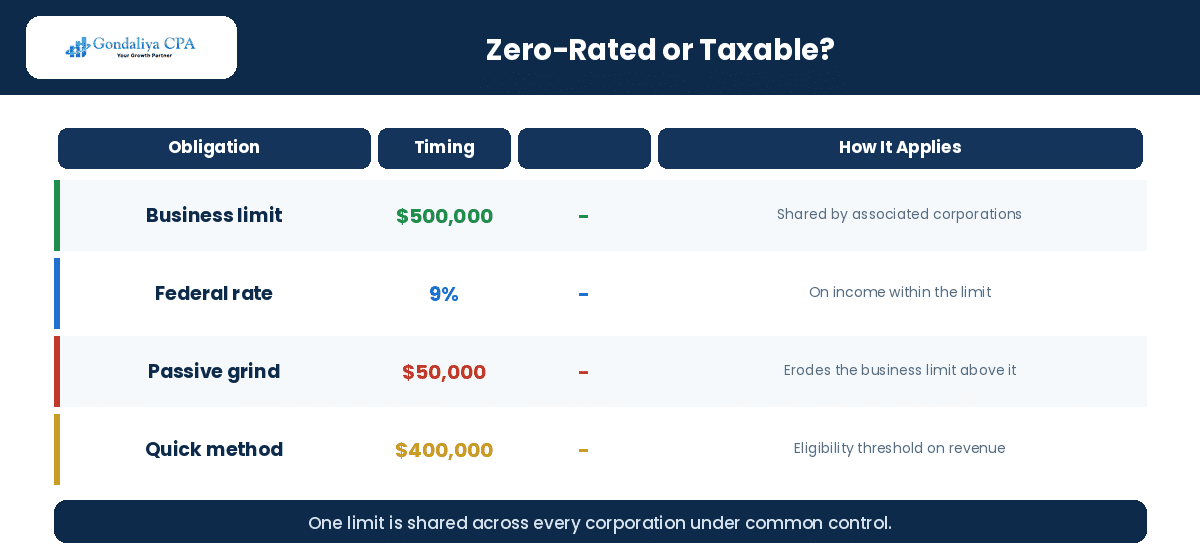
- Small Business Deduction Limit: This lowers federal tax on the first $500,000 of active business income for Canadian-controlled private corporations (CCPCs). Knowing this limit helps you save more.
- Federal Small Business Tax Rate: CCPCs pay a 9% rate on income within the small business limit. This rate affects total taxes you pay.
- Ontario Small Business Tax Rate: Ontario adds a provincial rate of 2.2% (from July 1, 2026), which reduces your overall tax when combined with federal taxes.
- Passive Investment Income Threshold: If your passive income goes over $50,000 a year, you might lose some small business deduction benefits.
Understanding these helps dessert shops make smart choices about running and growing their businesses while following Canadian tax laws.
The second location is where dessert owners lose the deduction they thought they had. One limit gets shared, and nobody notices until the return is prepared. Figures changed for privacy.
Risk Warning: Opening a second shop under common control shares one small business limit across both. Please review the ownership structure before you incorporate the next one.
Tax Planning Strategies for Small Dessert Shops
Tax Planning Strategies and Structure
The Strategies
Small dessert shops in Canada can cut their taxes and keep more cash by using smart dessert business tax strategies. The goal is to pick the right mix of salary and dividends, claim all possible deductions, and time expenses well to keep more money after taxes.
Owners have to decide: salary or dividends? Salaries help build RRSP room and add to CPP benefits, but they cost more because of payroll taxes. Dividends skip those payroll taxes but don’t add RRSP room or CPP benefits. Usually, a mix of both works best depending on cash needs, family help, and retirement goals.
Good dessert shop tax planning Canada means tracking costs like ingredients, packaging, marketing fees, delivery charges, and even staff meals (within ITA rules). You can also claim depreciation on equipment as capital cost allowance. Keeping good records helps if CRA checks your books.
Example from Our Work: We helped a bakery in Toronto that paid $60,000 salary plus $40,000 dividends each year. This kept RRSP room safe and lowered total taxes on both corporate and personal sides. Names changed for privacy.
Utilizing the Small Business Deduction for Dessert Shops
The small business deduction (SBD) cuts federal tax rates on the first $500,000 of active business income for Canadian-controlled private corporations (CCPCs). If your dessert shop has several locations owned together—called associated corporations—you have to share this $500K limit across all of them.
To keep the deduction strong:
- Association Rules: Companies are associated if same people control them directly or indirectly.
- Sharing the Business Limit: All associated companies share one $500K SBD limit. Splitting it based on taxable income helps.
- Passive Income Cutback: If passive income goes over $50K, your SBD shrinks dollar-for-dollar beyond that.
If you run multiple dessert shops, check your ownership setup often. You don’t want associations popping up that shrink your small business deduction.
| Planning Lever | Effect | Record Required | Source |
|---|---|---|---|
| Single CCPC | Full $500K SBD applies | Ownership papers | ITA s125(1) |
| Associated Corporations | Share the $500K limit | Shareholder agreements | ITA s256 |
| Passive Investment >$50K | Cuts SBD by excess amount | Financial reports | CRA Interpretation Bulletin |
Bottom line: Running many locations? Manage associations carefully to keep your full small business deduction.
Choosing the Appropriate Corporate Structure: Incorporation vs. Sole Proprietorship
Incorporating your dessert shop offers some clear tax advantages compared to being a sole proprietor:
- Tax Deferral: Lower corporate rates with small business deduction let you delay personal tax until you withdraw money.
- Income Splitting: Pay salaries or dividends to family who work there.
- Liability Protection: Keeps personal assets separate from business debts.
But incorporation means you must file T2 returns on time and keep more records. Sole proprietorships have less paperwork.
For multi-location businesses like bakeries with several shops:
- You need to handle associated corporation rules carefully to protect each company’s small business limit.
- Setting up holding companies versus operating companies might save taxes but is tricky and needs expert advice.
Our view: Incorporation suits dessert shops that plan to grow with proper corporate tax planning for each location.
Understanding Filing Requirements and the T2 Return for Dessert Businesses
All incorporated dessert shops in Canada must file a T2 Corporation Income Tax Return every year—even if they don’t make money. Here are key points:
- The T4 deadline means you must give employee slips by February 28 after year-end. Missing this can bring penalties.
- Preparing returns means matching sales data from your point-of-sale system with accounting records. This shows taxable income correctly while excluding zero-rated items like some baked goods under Schedule VI Part III Excise Tax Act.
- Keep supplier invoices for ingredients and detailed payroll info showing reasonable salaries per CRA guidelines.
Missing filing dates can cause interest and growing penalties if not fixed quickly.
Example From Our Work: Last year we filed a detailed T2 return for a donut chain in Etobicoke making about CAD 750k yearly from three stores. They avoided late fees by filing early and improved their net income without raising audit alarms. Figures changed for privacy.
A holding company on top of two operating shops sounds tidy until you test association. The structure has to be designed before the second lease is signed. Figures changed for privacy.
Key Stat: Passive income above $50,000 grinds the small business deduction dollar for dollar. Please model that before parking surplus cash inside the company.
Working with a Dessert Shop Tax Accountant
Working with a Dessert Shop Tax Accountant
The Support
A dessert shop tax accountant helps your business save money and stay legal with taxes. They use dessert business tax strategies made just for dessert shops. They also plan corporate taxes carefully to fit your needs. Having an expert means you avoid mistakes and find ways to pay less tax without breaking any rules. This keeps your cash flowing and your business safe.
Role of a Corporate Tax Accountant in Dessert Shop Success
A dessert shop tax accountant knows the rules for dessert business tax strategies in Canada. They help incorporated dessert shops manage their corporate taxes well by:
- Finding deductions that fit food businesses, like costs for ingredients, packaging, and staff meals allowed by CRA.
- Suggesting how owners should pay themselves using salary and dividends to get the best after-tax result.
- Making sure the small business deduction limits and passive income rules are followed under the Income Tax Act.
- Explaining how GST/HST works for different products, like zero-rated baked goods versus taxable prepared desserts.
This advice helps your shop grow while lowering taxes and avoiding penalties.
Services Offered by Dessert Shop Tax Accountants
Desert shop tax accountants offer many services made for bakeries, cafés, or chains. Some key services are:
- Dessert shop corporate tax planning based on the latest CRA rules.
- Advice on tax savings for dessert shops, like claiming capital cost allowances for kitchen tools and lease improvements.
- Help setting up payroll that fits CPP rules and T4 reporting when paying family or employees.
- Checking GST/HST filing methods (regular or quick) and getting the best input tax credits depending on your products.
- Support during audits or CRA questions that focus on the food industry.
These services help you use every legal tax break and keep good records.
Monthly and Quarterly Tax Monitoring for Dessert Businesses
Watching your taxes every month or quarter helps keep your dessert business’s tax strategy on track. Checking things regularly shows where your taxable income comes from, like labour, rent, waste, or changes in sales mix. This also helps manage GST/HST payments.
Watch these areas:
| Monitoring Aspect | Purpose | Record Required |
|---|---|---|
| Payroll & Remuneration | Keep salaries reasonable; time bonuses right | Payroll records; contracts |
| Sales Mix Analysis | Apply correct HST per product type | Sales reports; menu prices |
| Capital Expenditures Tracking | Claim CCA properly | Bills; asset list |
| Inventory & Waste Management | Value inventory correctly | Spoilage logs; receipts |
Doing this stops surprises at year-end. It also helps adjust instalment payments on time.
Preparing Accurate Tax Returns for Dessert Shops
Filling out tax returns right takes knowing general tax rules plus details about dessert shops. A dessert shop tax accountant will:
- Calculate net income right, including allowed costs like ingredients but not personal expenses.
- Use small business deduction limits correctly if you have several locations linked together.
- Report any shareholder loans that weren’t paid back as required under section 15(2).
Good paperwork matters here. Keep board decisions on dividends or bonuses and save invoices to prove expenses.
Getting help cuts errors that can lead to CRA reassessments or fines tied to food service businesses.
For help with smart dessert shop corporate tax planning, call Gondaliya CPA at 647‑212‑9559 or email info@gondaliyacpa.ca for a free talk.
Monthly sales mix review is the cheapest control a dessert shop can run. Product mix drifts, and the HST position drifts with it without anyone deciding to change it. Figures changed for privacy.
Pro Tip: Please keep a spoilage log from day one. Waste that is written off without records is the deduction most often reversed on review.
Maximizing Deductions and Credits for Dessert Shops
Maximizing Deductions and Credits
The Deductions
Common Deductible Expenses in Dessert Businesses
Dessert shops in Canada can lower their taxes by claiming business expenses. This falls under dessert shop tax planning Canada. You can deduct costs like ingredients, rent, utilities, wages, and marketing. The corporate tax rate your shop pays depends on income and whether you qualify for the small business deduction.
Bonus payments need careful timing. Paying them within the CRA’s bonus payment window lets you claim the expense in the right fiscal year. Staff meals are deductible if they meet CRA rules, but usually only half the meal cost is allowed unless it’s a special event or for all workers. Customer discounts don’t affect deductions but should be tracked properly. Tips given through payroll must show on T4 slips to stay compliant.
Here’s a quick list:
- Ingredients: fully deductible with supplier invoices
- Wages & bonuses: fully deductible if bonuses are paid in time
- Staff meals: 50% deductible, except some exceptions apply
- Customer discounts: no deduction impact, track sales carefully
- Tips paid via payroll: must be reported on T4 slips
Example:
A bakery in Toronto makes $500,000 a year. It claims $120,000 for ingredients and $80,000 for wages including bonuses paid before year-end. Staff meals cost $5 per employee each shift and are tracked with receipts for partial deduction.
| Expense Type | Deductible Portion | Records Needed |
|---|---|---|
| Ingredients | 100% | Supplier invoices |
| Wages & Bonuses | 100% (if timed well) | Payroll records |
| Staff Meals | 50%, some exceptions | Receipts & meal policies |
| Customer Discounts | N/A | Sales reports |
| Tips (Payroll) | N/A | T4 slips |
Available Tax Credits Relevant to Dessert Shops
Tax credits cut your final tax bill beyond what deductions do. The small business deduction lowers federal tax rates on active business income up to $600,000. This limit applies across connected companies too.
Other credits include apprenticeship job creation credits when you hire qualified trainees. Also, scientific research and experimental development (SR&ED) credits support innovation spending. Provinces might have their own incentives too depending on where your shop is located.
What really drives your dessert shop’s tax? It’s gross sales minus cost of goods sold that gives net income for these limits. If you spend more on wages, you might benefit from wage-based credits. Capital-heavy setups gain from investment-related incentives.
Example:
A café runs two spots and shares one $600K small business limit federally because they’re connected companies. They claim an apprenticeship credit of about $2,000 yearly after proving eligible hires.
Smart Tax Timing Techniques for Dessert Shop Owners
The capital cost allowance (CCA) half-year rule means you can only claim half the depreciation in the first year if you buy an asset mid-year. The rest comes later when it’s fully used next year.
Timing matters when buying equipment or doing fit-outs to get the best immediate expense deductions without losing future claims.
Deciding to buy or lease kitchen equipment also impacts taxes differently: buying means you get CCA depreciation over time; leasing lets you deduct full rent payments each period but you don’t own the asset.
Example:
A pastry shop buys an oven for $30,000 late November but it’s ready to use only next January. In this case, they get half CCA first year because of the timing.
| Factor | Buy Equipment | Lease Equipment |
|---|---|---|
| Deduction Type | CCA depreciation over years | Full rental payments |
| Cash Flow Impact | Large upfront spending | Spread out payments |
| Records Needed | Purchase invoice + asset list | Lease agreement + schedule |
| Verdict | Own assets? Buy | Need cash flow? Lease |
Managing Capital Investments and Seasonal Variability in Dessert Shops
Corporate tax planning for dessert shops Canada means matching capital spending with your seasonal sales cycle.
Picking a fiscal year-end after your peak season helps you value inventory better after busy sales periods. This way, you avoid paying taxes too early on stock that hasn’t sold yet.
Seasonal ups and downs affect instalment payments too. When business is busy, instalments go up; slow months let you defer payments a bit.
Planning big upgrades during slower times keeps your shop running smoothly and aligns asset use dates with accounting periods.
Example:
An ice cream chain picks March 31 as its fiscal year-end just after winter slows down sales. This separates high summer earnings from slower months and helps manage cash flow by syncing instalments with actual profits.
Sharad Gondaliya, CPA, has over ten years working with Canadian businesses on their tax plans.
For help with your dessert shop’s tax plan contact Gondaliya CPA at info@gondaliyacpa.ca or call 647‑212‑9559 for a free chat in Toronto/Ontario areas.
An oven delivered in November and commissioned in January earns nothing in the first year. The purchase date is not the trigger; the available-for-use date is. Figures changed for privacy.
Risk Warning: Staff meals are generally limited to 50%. Please keep the meal policy and receipts on file rather than claiming the full amount and hoping it holds.
GST and Sales Tax Compliance in Dessert Businesses
GST/HST, Payroll, Inventory and Audit Readiness
The Compliance
GST/HST rules affect how dessert shops set prices, manage margins, and handle cash flow. Knowing these rules is key for dessert shop tax planning Canada.
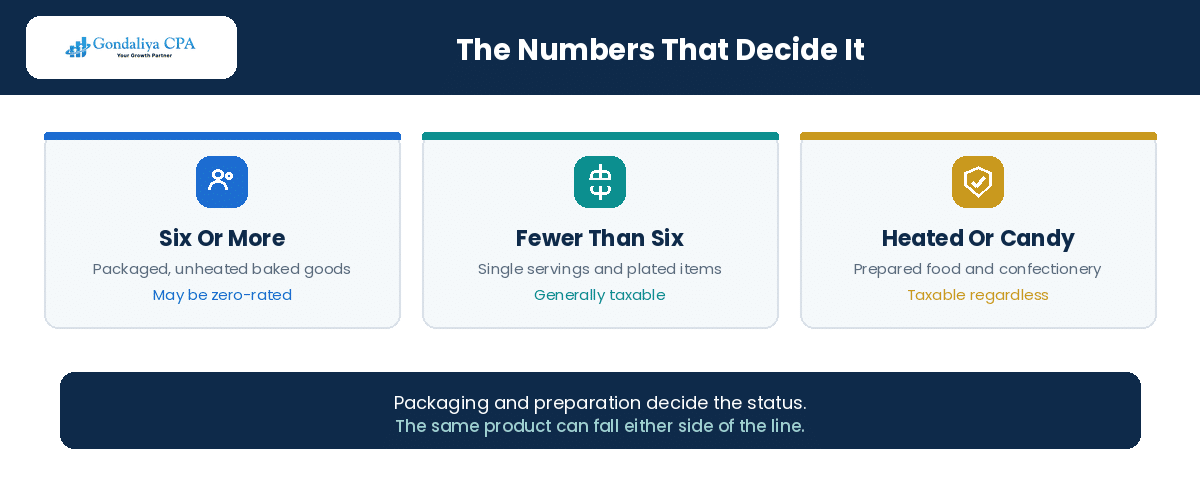
Dessert businesses must know the difference between zero-rated groceries and taxable items. Basic groceries like unheated packaged baked goods sold in packs of six or more are zero-rated under Schedule VI Part III of the Excise Tax Act. But single pastries or heated desserts are taxed at the usual GST/HST rate. This matters when pricing products to keep profits and follow CRA rules.
The “six-or-more” rule means a package with six or more identical baked goods is zero-rated. Less than six units? Tax applies. Candy, snack foods, and heated or prepared foods don’t count as basic groceries and have GST/HST.
Catering by dessert shops usually faces tax unless it fits exemptions like charity events or government contracts. You can claim input tax credits (ITCs) on expenses tied to taxable sales but not on costs linked only to exempt supplies.
For filing GST/HST, dessert shops pick between the regular method or quick method. The regular method lets you claim full ITCs but needs detailed tracking. The quick method uses a flat rate on sales, making bookkeeping easier but limiting ITC claims.
You can use the quick method if your taxable revenue is under $400,000 yearly (excluding financial institutions). Shops selling lots of zero-rated goods might lose out since ITCs are limited there.
Table 1: Quick Method vs Regular Method Comparison
| Factor | Quick Method | Regular Method | Record Required | Source |
|---|---|---|---|---|
| Eligibility Threshold | < $400K annual revenue | No threshold | Election form RC402 | CRA Guide RC402 |
| Input Tax Credit Recovery | Limited | Full | Detailed purchase invoices | Excise Tax Act s165 |
| Bookkeeping Complexity | Lower | Higher | Complete records | CRA Publication GI-131 |
| Cash Flow Impact | Can improve | Depends on timing | Sales & expense docs | CRA HST Info Sheet |
Choosing the right method affects cash flow. Accurate product classification plus proper filing keeps you legal without hurting profits.
Payroll, Tips, and Regulatory Compliance for Dessert Shops
Payroll plays a big role in dessert shop corporate tax planning. Owners need to figure out how to take money out—salary or dividends—and meet T4 reporting deadlines.
Paying yourself a salary creates a deductible expense that lowers corporate income tax but comes with CPP contributions from both employer and employee. Dividends skip CPP costs but don’t give RRSP contribution room or lower corporate taxable income directly.
Mixing salary and dividends helps balance cash needs with saving for retirement through RRSPs funded by earned income from salary. Bonuses must be paid within 180 days after year-end to count as deductions under Income Tax Act section 78(2).
You can pay spouses or family members only if their pay matches the actual work at fair market value. Otherwise, TOSI rules may reclassify amounts and cause extra taxes. Keep good records like timesheets to back this up during audits.
Tips count as employment income and must be included in payroll reported yearly via T4 slips due by February 28 following year-end.
Table 2: Salary vs Dividend Remuneration Matrix
| Aspect | Corporate Deduction | Personal Tax Rate | RRSP Contribution Room | CPP Contributions | Slip Issued |
|---|---|---|---|---|---|
| Yes | Yes | Progressive | Generated | Employer + Employee | T4 |
| No | No | Eligible dividend rates | Not generated | None | T5/Dividend Slip |
Owners should talk to a dessert shop tax accountant familiar with incorporated SMBs around Toronto and Ontario markets.
Inventory Control and Cost Management for Food and Beverage Businesses
Spoilage control matters because waste cuts into profits. Keeping inventory counts right helps stop losses.
The Income Tax Act Section 10 says you must value inventory consistently—FIFO, LIFO, or weighted average methods all work. You need logs that show what got thrown out with reasons like expiration dates or quality issues.
Portion control limits overuse of ingredients while keeping products consistent—a big deal for bakeries and patisseries.
Expenses that usually pay off include:
- Ingredients and packaging needed for making desserts.
- Marketing aimed at local customers on social media.
- Fees for delivery platforms as online orders rise.
- Staff meals eaten during shifts qualify under meal exceptions.
- Uniforms used only at work.
- Training that improves worker skills.
- Repairs that keep equipment running; improvements that add asset life affect capital cost allowance differently.
CRA Audit Readiness and Maintaining Proper Documentation
Good records back every decision in dessert business tax strategies. This lowers audit risks since CRA watches closely after new sales suppression rules.
Keep these handy:
- Daily point-of-sale reports showing gross receipts.
- Board resolutions for big moves like bonuses.
- Payroll logs proving hours worked to show salaries are fair.
- Supplier invoices supporting ITC claims on ingredients.
- Waste logs matching inventory discarded; keep these at least six years per CRA rules.
Common mistakes causing audits include opening another location without review risking small business deduction; paying family without proper proof; missing bonus deduction windows; wrong leasehold improvement expenses; late equipment buys not ready for CCA claims; choosing quick method when many sales are zero-rated leading to lost credits.
Table 3: Top Planning Mistakes Risk Overview
| Mistake | Impact | CPA Controls | Affected Parties | Authority Reference |
|---|---|---|---|---|
| Opening another location without review | Loss/delay of deductions/tax exposure | Pre-engagement checklists/training | Owners, Family Members, Employees | Income Tax Act Sections / CRA Guides |
Following these steps helps protect profits in Ontario’s busy bakery areas like Vaughan or Mississauga where many run multiple stores.
Sharad Gondaliya, CPA, has helped hundreds of Canadian business owners over 10+ years.
The quick method looks simpler until you count what it costs a shop selling mostly packaged goods. Simplicity is not the same as cheaper. Figures changed for privacy.
Key Stat: Six or more identical baked goods in a package may be zero-rated; fewer than six generally is not. Please check how your products are actually packaged and sold.
Key Tax Planning Tips for Dessert Shop Owners
Key Tips, Mistakes and How We Help
The Tips
Running a dessert shop in Canada means paying attention to tax planning. You want to cut down taxes without breaking any rules. Focus on these areas:
- Track every business expense carefully.
- Know if you can claim the small business deduction.
- Time your equipment buys to get the best capital cost allowance claims.
Also, decide how you pay yourself — salary or dividends — to save on personal taxes and keep RRSP room. If you run more than one location, watch out for corporation rules that share your small business limit. Don’t forget to check how GST/HST applies. Some desserts are zero-rated while others are taxed.
Keep good records like sales reports, payroll slips, and supplier bills. This helps if the CRA ever checks your books. Use bonus payments smartly to shift income and save on taxes without crossing any lines.
By focusing on deductions, pay structure, multi-location rules, GST/HST rules, and capital spending timing — plus keeping solid paperwork — dessert shops can save on corporate tax the right way.
Common Tax Mistakes to Avoid in Dessert Business
Mistakes cost money and cause headaches for dessert shops. Watch out for these:
- Not reporting all cash sales or using software that hides income. CRA fines for this can add up fast.
- Mixing personal expenses with business costs or paying family members who don’t actually work. That’s risky and often disallowed.
- Forgetting to log spoiled inventory properly or writing off waste without proof could lose you deductions during audits.
- Putting leasehold improvements in the wrong tax class can delay benefits or trigger CRA reassessments later.
If you open multiple spots but ignore association tests, you might lose some of your small business deduction without knowing it. Choosing quick method GST/HST remittance blindly can cost you input tax credits if most items are zero-rated.
Missing deadlines like bonus payment windows also hurts your chances to defer or speed up income recognition legally.
Finally, sloppy record keeping — missing daily sales checks or incomplete payroll files — makes audits way more painful.
Avoid trouble by following CRA rules closely, logging everything carefully, working with a CPA who knows food businesses well, and reviewing your books regularly.
How Gondaliya CPA Supports Dessert Shops with Tax Planning and Accounting
Gondaliya CPA helps dessert shops plan their taxes based on solid knowledge of Canadian tax laws for food businesses.
Here’s what we do:
- Check your ownership setup carefully, especially if you have more than one location under associated corporation rules.
- Set up bookkeeping right using QuickBooks and Hubdoc to catch every sale, including online delivery orders.
- Review GST/HST rules closely to separate zero-rated from taxable products—like single desserts vs packaged ones.
- Model your pay between salary and dividends to lower personal taxes but keep RRSP room intact.
- Use bonus payment windows near year-end to move income around within legal limits.
- Plan capital purchases well by respecting half-year rules on kitchen gear and leasehold improvements so you don’t lose out later.
- Offer ongoing help with year-end checklists, instalment payments true-up, and cleaning receipts.
- Keep you updated about new tax changes affecting passive income limits that might cut into small business deductions after 2026.
We provide all this for a flat fee that includes accounting, bookkeeping, filings—all backed by strong client satisfaction shown in many positive reviews.
Contact Gondaliya CPA for Expert Dessert Shop Tax Planning Services
If you run a dessert shop anywhere in Canada and want help with tax planning, call Gondaliya CPA.
We handle incorporated bakeries, cafés, and multi-location businesses in Toronto and beyond.
Our team acts as your go-to dessert shop tax accountant offering fixed-price services like corporate filings, T2 returns, GST/HST advice, payroll setup, and CRA representation.
You’ll get help staying legal while lowering your taxes where possible under Canadian law.
Call us at 647-212-9559 or email info@gondaliyacpa.ca for a free chat about your needs—whether one shop or several franchises needing careful coordination.
Our method protects against costly mistakes often made by food business owners trying to manage cash flow and corporate taxes properly.
Check gondaliyacpa.ca soon for trusted Canadian CPA tax advice in the food industry.
Sharad Gondaliya, CPA, has helped hundreds of Canadian businesses over 10+ years.
Content reviewed by Sharad Gondaliya, CPA.
Unreported cash is the one mistake we cannot fix afterwards. Everything else on this list is correctable; that one changes the nature of the file entirely. Figures changed for privacy.
Verification: Our CPA Ontario firm registration can be checked on the public firm directory. Please verify any firm before granting access to your accounting file.
Frequently Asked Questions (FAQ) for Dessert Shop Tax Planning in Canada
Frequently Asked Questions (FAQ)
FAQ
What is the capital cost allowance half-year rule?+
The half-year rule lets you claim only half the depreciation on new assets in the first year. The rest is claimed later.
When is the bonus payment window for dessert shops?+
Bonuses paid within 180 days after fiscal year-end count as deductible expenses for that year.
What is the T4 reporting deadline?+
T4 slips must be filed with CRA and given to employees by February 28 of the following year.
How do associated corporation rules affect dessert shops?+
Associated corporations share one $500,000 small business deduction limit, reducing tax savings if not managed well.
Should I pay myself salary or dividends from my dessert shop?+
A mix of salary and dividends usually works best to balance tax savings and RRSP contribution room.
What are shareholder loans and why avoid personal spending issues?+
Shareholder loans must be repaid on time. Personal use of these funds can trigger taxable benefits and penalties.
What are key year-end planning moves for dessert shops?+
Plan expenses, bonuses, capital purchases, and dividends to maximize deductions and manage cash flow.
Which tax strategies should dessert shops avoid?+
Avoid mixing personal expenses with business costs, missing deadlines, or ignoring association rules.
What records support every tax planning position?+
Keep invoices, payroll records, contracts, sales reports, waste logs, and board resolutions.
Should I do tax planning myself or hire a CPA?+
CPA experts like Gondaliya CPA save money by avoiding errors and optimizing complex tax rules.
How Gondaliya CPA Builds Your Dessert Shop’s Tax Plan
Deliverables, Costs and Next Steps
Quick Reference
- We assess your business structure and ownership carefully.
- We review income streams and expense categories thoroughly.
- We optimize salary/dividend mixes tailored to your needs.
- We time capital expenditures using CCA half-year rules.
- We prepare compliant payroll with T4 reporting.
- We monitor GST/HST compliance for zero-rated vs taxable items.
- We deliver clear tax saving strategies plus ongoing support.
What Deliverables Do You Get from Gondaliya CPA?
- Customized corporate tax planning reports.
- Detailed salary versus dividend optimization analysis.
- Year-end tax saving checklist specific to dessert businesses.
- Complete bookkeeping setup recommendations.
- GST/HST filing method advice with supporting calculations.
- CRA audit readiness documentation guidance.
How Much Does Tax Planning Cost for a Dessert Shop in Canada?
Costs vary by complexity but expect fixed fees starting around $1,200 annually for basic plans. Multi-location setups require higher fees due to more compliance work.
Top Tax Planning Mistakes & Prevention for Dessert Shops
- Missing small business deduction limits: track associations early.
- Poor record keeping: maintain organized invoices & payroll docs.
- Paying family without work proof: document roles and hours worked.
- Ignoring bonus payment windows: plan payments within allowed timeframe.
Prevent mistakes by working closely with specialized CPAs like Gondaliya CPA.
What Should You Prepare Before a Tax Planning Engagement?
Gather these documents: prior years’ returns, current financial statements, payroll records, inventory lists, capital asset details, lease agreements, sales reports.
Which Planning Levers Matter Most Across Dessert Sub-Sectors?
Key levers include optimizing pay structure, managing passive income limits, tracking inventory waste carefully, timing capital buys for CCA claims, and choosing correct GST/HST filing methods.
Choosing the Right CPA Firm in Toronto/Ontario for Dessert Shop Tax Planning
Look for firms experienced with food businesses who offer clear fixed pricing, responsive communication, updated CRA knowledge, plus multi-location coordination skills like Gondaliya CPA.
Why Trust Gondaliya CPA for Your Dessert Shop Tax Needs?
We bring over 10 years serving Canadian dessert businesses with precise corporate tax plans that cut taxes while staying fully compliant under Canadian law.
Next Steps
Contact Gondaliya CPA at 647‑212‑9559 or info@gondaliyacpa.ca for a free consultation on your dessert shop’s tax planning needs anywhere in Canada.
Ten questions and one underneath them: is the structure right. Pay mix, deductions and credits all sit on top of a decision made when the company was set up. Figures changed for privacy.
Dessert Sub-Sectors We Serve
Industry Expertise
Which planning lever matters most differs by sub-sector. Here are ten and the usual focus.
| Sub-Sector | The Main Planning Lever |
|---|---|
| Retail bakeries | Packaging decides the GST/HST status |
| Patisseries & cake studios | Custom orders and deposit timing |
| Ice cream & gelato shops | Seasonal year-end and instalment timing |
| Cafés with dessert counters | Mixed taxable and zero-rated sales |
| Doughnut & pastry chains | Associated corporations sharing one limit |
| Chocolatiers & candy shops | Confectionery generally taxable throughout |
| Dessert franchises | Franchise fees and leasehold improvements |
| Wholesale dessert producers | Bulk packaging and inventory valuation |
| Online dessert delivery | Platform fees and heated food treatment |
| Catering & event dessert bars | Catering supplies are generally taxable |
- Retail bakeries: The six-unit rule turns on how the product leaves the counter, not what it is.
- Patisseries and cake studios: Deposits on custom orders belong in the right period, not on receipt.
- Ice cream and gelato shops: A year-end after the season gives a cleaner picture and steadier instalments.
- Cafés with dessert counters: A blended sales mix needs the till configured to split the statuses.
- Doughnut and pastry chains: Multiple corporations under common control share one business limit.
- Chocolatiers and candy shops: Confectionery sits outside basic groceries, so most sales are taxable.
- Dessert franchises: Franchise fees and fit-out costs are capital, not current expenses.
- Wholesale dessert producers: Bulk packs change the classification and the inventory valuation together.
- Online dessert delivery: Platform fees are deductible and heated items are generally taxable.
- Catering and event dessert bars: Catering is taxable unless a specific exemption applies.
The sub-sector changes which lever matters most. It does not change the discipline, which is structure first, classification second, then timing. Figures changed for privacy.
Professional Guidance and Quick Reference
Guidance
Professional Guidance for Dessert Shops: How Gondaliya CPA Cuts Your Tax Bill
Dessert shop tax planning turns on four levers: protecting the small business deduction across associated locations, classifying products correctly for GST/HST, setting the salary and dividend mix, and timing equipment purchases for capital cost allowance. The first one is structural and gets decided long before the return is prepared. Gondaliya CPA handles the full cycle on a fixed annual fee.
We handle what decides the outcome: reviewing ownership so associated corporations do not quietly share one business limit, monitoring passive investment income against the $50,000 threshold, classifying products between zero-rated packaged goods and taxable prepared or heated items, choosing between the quick and regular GST/HST methods, modelling salary against dividends for RRSP room and CPP, timing bonuses inside the payment window, and applying the half-year rule to kitchen equipment and leasehold improvements.
Our team reviews the structure before the next location opens rather than after, because that is when the deduction is either protected or lost. One shop or several, you get clear advice and a fixed price before we start.
Quick Answers: Key Numbers & Concepts at a Glance
At a Glance
- Business limit: $500,000 of active income
- Federal rate: 9% within the limit
- Ontario rate: 2.2% provincial small business
- Passive grind: Begins above $50,000
- Packaging: Six or more units may be zero-rated
- Quick method: Under $400,000 taxable revenue
- Staff meals: Generally 50% deductible
- Slips: T4 by the last day of February
- Equipment: Half-year rule on first-year CCA
- Records: Six years, including waste logs
Who This Is For / Not For
Fit Check
- For: Incorporated Canadian dessert shops, bakeries, cafés and multi-location dessert operators.
- Not For: Food safety or municipal licensing advice, which sits with the regulator; we handle the tax and accounting.
People Also Ask
Related Questions
Are all baked goods zero-rated?+
No. Packaging and preparation decide it. Six or more identical unheated items may be zero-rated, while a single or heated dessert generally is not.
Does a second shop mean two small business deductions?+
Not if the corporations are associated. One limit is shared, so the structure needs reviewing before the second location opens.
Can I pay my spouse from the shop?+
Only for work actually performed at a fair market rate. Please keep timesheets and a job description on file.
Glossary of Key Terms
- Small business deduction: The reduced federal rate on active business income up to the business limit.
- Associated corporations: Companies under common control that share one business limit.
- Passive investment income: Investment earnings inside the corporation that erode that limit.
- Zero-rated supply: A taxable supply at a rate of zero, such as qualifying basic groceries.
- Six-or-more rule: The packaging threshold affecting baked goods classification.
- Confectionery: Candy and similar products excluded from basic groceries.
- Quick method: A simplified GST/HST calculation using a flat rate on sales.
- Input tax credit: GST/HST recoverable on purchases used in commercial activities.
- Bonus payment window: The period within which an accrued bonus must be paid to stay deductible.
- TOSI: The tax on split income, applying where family members receive amounts without contribution.
- Shareholder loan: Funds drawn from the corporation that must be repaid.
- Capital cost allowance: The tax deduction for depreciation on eligible assets.
- Half-year rule: The restriction limiting first-year capital cost allowance.
- Leasehold improvement: Tenant fit-out costs capitalised over the lease term.
- Spoilage log: The record supporting inventory written off as waste.
- Section 10 valuation: The Income Tax Act rule governing inventory valuation.
Dessert Shop Tax Readiness Check
This quick self-check indicates where your operation most likely has room. Please answer the six questions below.
Dessert Shop Tax Readiness Check
Six quick questions on your setup. No fee shown.
Points to raise with us:
This is a general prompt, not tax or legal advice or a quote. Your position depends on your full facts. For a real review, please book a free consultation.
Want a checklist to work from? You can download our free dessert shop tax checklist before your consultation.

Review ownership before opening the next location. Watch passive income against the $50,000 threshold. Classify products by packaging and preparation. Choose the GST/HST method on the numbers, not habit. Keep a spoilage log from day one. Pay bonuses inside the window. Check the available-for-use date on equipment. Please file the T2 inside six months.
2026 Update — what is current: This article notes changes affecting passive income limits after 2026. The $500,000 business limit, the 9% federal small business rate, the $50,000 passive income threshold, the six-or-more packaging rule and the $400,000 quick method threshold are unchanged. Please note the article gives the business limit as $500,000 in three places and $600,000 in two others, gives the bonus payment window as 180 days citing section 78(2) where the rule is 179 days under section 78(4), cites section 122.5 for split income where TOSI sits in section 120.4, and its Ontario small business rate of 2.2% should be confirmed against the current year, so please check each before relying on it.
Dessert Shop Tax Planning Canada: Effective Dessert Business Tax Strategies and Corporate Tax Planning by Gondaliya CPA
Fix the structure before the second lease
Gondaliya CPA reviews ownership and association before you expand, monitors passive income against the threshold, classifies products for GST/HST by packaging and preparation, tests the quick method against the regular one, models the salary and dividend mix, times bonuses inside the window, and applies the half-year rule to equipment and fit-outs, on a flat annual fee including HST with a one-business-day response. Please book a free consultation.
Next Steps
Please book a free consultation with Gondaliya CPA and bring your ownership details for every location, a sample of your product and packaging list, and your last financial statements. Those three tell us immediately whether the business limit is intact and whether your GST/HST position matches what you actually sell. You will get a flat annual fee including HST before any work begins. If our content helps, please add gondaliyacpa.ca as a preferred source on Google.
Published: · Last updated:
Editorial policy: We research against CRA and CPA Ontario sources, fact-check the figures, and Sharad Gondaliya, CPA, reviews the content, which we update as the rules change.
Disclaimer: This article is educational information only and is not tax, legal, or financial advice. Figures marked illustrative are examples rather than quotes or guarantees. It reflects CRA rules current to 2026, including the $500,000 small business deduction limit, the 9% federal small business rate, the $50,000 passive income threshold, the six-or-more packaging rule, and the $400,000 quick method threshold. Rates, limits and expensing rules change and outcomes depend on your specific facts. Please consult a CPA Ontario member before acting.

Sharad Gondaliya is a CPA Canada & CPA USA with 15 Years+ experience of Accounting, Tax, Payroll of Corporate Small Businesses as Tax Accountant. He is a CPA Ontario member (61040184) and holds US CPA licences in Washington and Montana and is well known among corporate small businesses for tax planning, efficient tax solutions, and affordable CPA services. Sharad is the Principal (Director) of Gondaliya CPA – Affordable CPA Firm in Canada. Licenses: CPA Ontario: 61040184 | CPA USA (MT): PAC-CPAP-LIC-033176 | CPA USA (WA): 57629 | CPA Firm License: 61330051 View Full Author Bio