



International Student Business Tax Filing in Canada: Reporting Income, Expenses & Tax Obligations
International Student Business Tax Canada: A Guide to Tax Filing, Self-Employed Taxes, and Business Income Tax with Gondaliya CPA
International student business tax Canada requires careful attention to tax filing rules, especially for those earning self-employed income or running a small business. Gondaliya CPA helps international students understand their obligations for business income tax and self-employed tax to ensure accurate compliance with Canadian tax laws.
Quick Summary
Two misunderstandings cause most of the trouble here. The first: your study permit has nothing to do with your tax residency. CRA decides that from residential ties — a home, a spouse or dependants here — and from the 183 day count, and the answer sets whether you report worldwide income or only Canadian-source. The second: earning a little does not exempt you. Tutoring, freelancing, selling online — it goes on a T1 with Form T2125, by June 15 if self-employed, with anything owing paid by April 30. Then the pieces that follow from having a business: CPP at roughly 11.9% on net earnings above $3,500, GST/HST registration past $30,000, Form T1135 if foreign property passes CAD $100,000, instalments past $3,000 owing, and a SIN or an ITN on Form T1261 before any of it can be filed. Tuition on your T2202 carries forward if you cannot use it yet.
Reading time: 13 minutes.
Table of Contents
- Taxes for International Students and Residency
- Tax Filing Requirements and Deadlines
- Step-by-Step Guide to Filing Business Taxes
- Tax Credits, Deductions and Benefits
- Support, Resources and Protection
- Preparing to File and Catching Up
- Frequently Asked Questions
- Essential Tax Insights for Student Filers
- Businesses We Serve & Industry Spotlights
- Professional Guidance and Quick Reference
The Numbers That Matter
This article covers Canadian federal income tax and GST/HST, with Ontario and Toronto context, and reflects rules current to 16 October 2026. It is written for international students in Canada who earn self-employment or business income, and it covers residency determination, filing requirements and deadlines, deductible expenses, CPP, tuition credits, foreign property reporting and catching up on missed years. It is not advice on immigration, study permits or the hours a permit allows you to work, each of which is administered separately and may restrict activity this article treats only as a source of income. Gondaliya CPA performs compilation engagements under CSRS 4200, which provide no assurance; audit and review engagements are referred out. This is educational information only and not tax or legal advice.
Taxes for International Students Studying in Canada
Taxes for International Students and Residency
Start Here
If you’re an international student running a business in Canada, you need to know about your tax duties. The rules around international student business tax Canada matter a lot. Even if you work for yourself or have a small business, you must file taxes. It doesn’t matter what your residency status is—you still have to report your income.
Residency Status and Its Impact on Tax Obligations
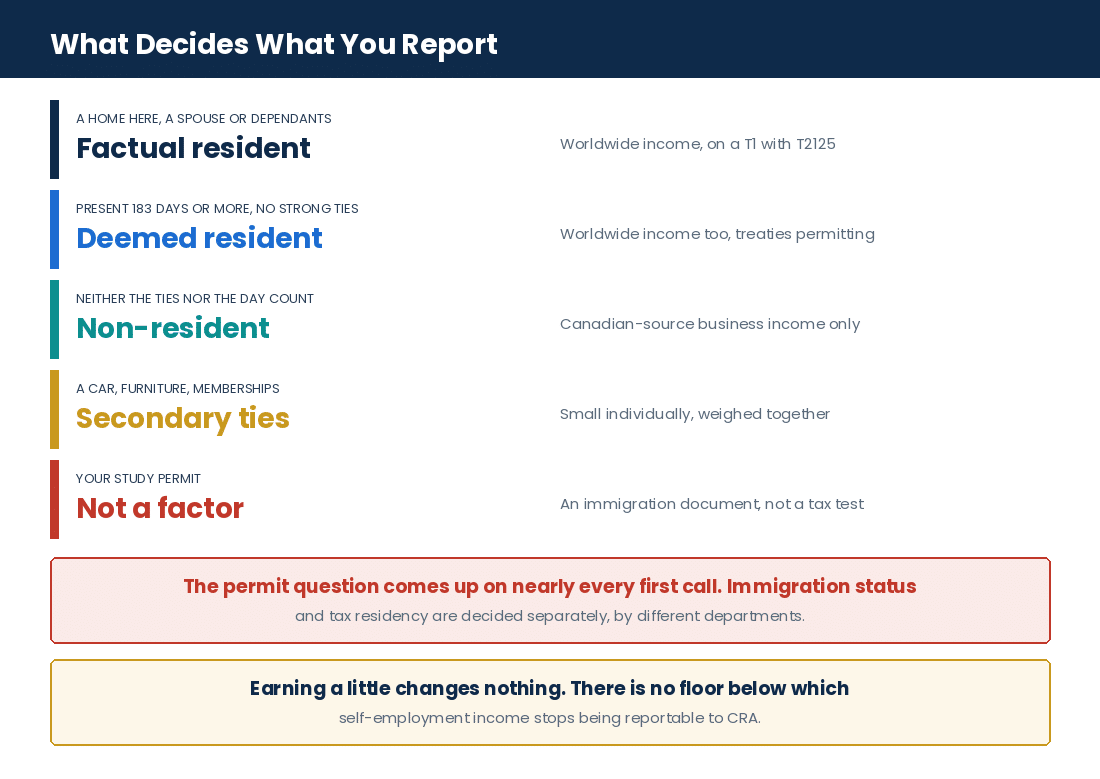
Your residency status changes how you pay taxes. Canada’s tax agency, the CRA, uses different labels like factual resident, deemed resident, or non-resident to describe where you “live” for tax reasons. These labels affect what income you report and how much tax you owe.
Defining Residency: Resident, Non-Resident, Deemed Resident, and Deemed Non-Resident
Here’s a quick breakdown:
- Factual Residents have strong ties to Canada—like a home or family here.
- Deemed Residents stay in Canada 183 days or more but might not have strong ties.
- Non-Residents live mostly outside Canada and don’t meet the above tests.
Some folks think having a study permit decides residency. Nope—that’s not true. The permit doesn’t control how the CRA sees your residency.
The permit question comes up on nearly every first call, and the answer surprises people every time.
A study permit is an immigration document. It says you may be here and under what conditions. It says nothing about whether CRA considers you resident, which is decided on an entirely separate test by an entirely different department. Students who assume the two travel together are the ones who file nothing for three years. Figures changed for privacy.
Residential Ties: Primary and Secondary Factors in Determining Residency
Your residential ties help decide your status:
- Primary ties include:
- Your home in Canada
- Your spouse or dependents living here
- Secondary ties include:
- Things like your car or furniture
- Social links such as memberships
Knowing these helps figure out if you count as a resident for taxes.
Why Filing Taxes Matters for International Students
If you make money from a business here, filing taxes isn’t optional—it’s required. You might ask: must an international student file a Canadian tax return if they have a business? The answer is yes! Even if you earn little or work only within your permit’s allowed hours, report it all.
If you skip filing, the CRA can charge penalties. The minimum penalty starts with late-filing fees that add up over time with interest. Filing keeps things clean and avoids trouble later.
So, if you’re an international student running any kind of business in Canada, knowing and meeting your tax duties keeps you clear of headaches down the road.
Tax Filing Requirements and Deadlines
Tax Filing Requirements and Deadlines
The Dates
Do International Students Need to File Taxes in Canada?
If you’re an international student earning business or self-employed income in Canada, you need to file a Canadian tax return. Running a business or working for yourself means filling out the T1 personal income tax form plus the T2125 business statement. These forms show your income and let you claim expenses allowed by Canadian tax rules.
It doesn’t matter what your immigration status or study permit says. The CRA decides if you’re a resident based on where you live, not your permit type. So if you do business in Canada, you should know about your international student tax filing Canada duties.
Not reporting income can lead to penalties and interest from the CRA. Always file on time to avoid trouble.
Key Tax Filing Deadlines and Penalties for Late Filing
For students who are self-employed or have businesses, deadlines can be tricky. Here’s what you need to know:
- Self-Employed Tax Return (T1 + T2125): due by June 15
- Payment of any balance owing: due by April 30
- Late-filing penalty: $100 or 5% of amount owed (whichever is more), plus 1% per month for up to 12 months
If you file late but pay what you owe by April 30, you won’t get a penalty — but interest will still build up from May 1 onward. Missing both dates means penalties stack up fast.
Late filing may also raise red flags with CRA and increase audit chances. Filing on time cuts down these risks.
The two dates catch people out because they sound like one date and are not.
June 15 is when the return is due. April 30 is when the money is due. A student who files in June owing nothing is perfectly fine; a student who files in June owing $900 has had interest running on it for six weeks. The filing extension is real, but it is only a filing extension. Figures changed for privacy.
Understanding Taxable vs. Non-Taxable Income for Students
Knowing what counts as taxable income is key for international student business tax Canada matters:
- Taxable income includes all self-employment money earned inside Canada.
- Residents must report income from around the world, including foreign scholarships, unless a treaty says otherwise.
- Some scholarships might be partly exempt but must still be reported.
You can only deduct reasonable business expenses that help earn your income. Keep receipts! Personal expenses like meals not related to work or commuting costs usually don’t count.
Reporting Worldwide Income and Foreign Assets as an International Student
Whether you report worldwide income depends on your residency status:
- Factual residents report all global income.
- Deemed residents do the same unless rules say otherwise.
- Non-residents report only Canadian-source income like local business earnings.
If your foreign property is worth over CAD $100,000 at any time during the year, you must declare it with Form T1135 — Foreign Income Verification Statement — even if it doesn’t generate any earnings.
For example, if you live in Ontario and run an online tutoring service outside Canada while receiving foreign scholarships, include all that income on your tax return and report foreign assets above the limit.
This keeps your filing honest with CRA’s current rules.
Social Insurance Number (SIN) and Individual Tax Number (ITN) Requirements
To file taxes properly, most international students need a SIN or an ITN:
- A SIN comes from Service Canada when you’re eligible; it ties work records to your taxes.
- If you’re not eligible for a SIN—common for some temporary residents—you apply for an ITN from CRA. This number helps identify you on tax returns but does not allow work rights.
Both numbers appear on your tax return. They help process refunds, credits, CPP contributions (if any), and benefits tied to reported incomes—including those from businesses students run here.
Get these numbers early so filing goes smoothly before deadlines hit.
For advice about international student self employed tax Canada issues, contact Gondaliya CPA professionals with flat-fee annual services backed by many positive reviews. Reach them at info@gondaliyacpa.ca or call 647‑212‑9559 today.
All info here matches current Government of Canada rules effective through December 31st, 2026 unless noted otherwise in official links above.
Step-by-Step Guide to Filing Business and Self-Employment Taxes
Step-by-Step Guide to Filing Business Taxes
How To
How to File Taxes as an International Student with Business Income
If you’re an international student earning business income in Canada, you must report all the money you make here. This applies even if your study permit is active or not. Report your total income and subtract reasonable expenses on the right tax forms. Keep detailed records—they back up your claims and follow CRA rules.
When you file taxes as an international student, it’s key to know what counts as taxable income. For example, money made from tutoring or selling stuff online is business income. Reporting this correctly helps you avoid penalties or problems with the CRA.
Here’s a quick example: An international student earns $12,000 by freelancing graphic design. They have receipts for $600 on software and $400 on office supplies.
So, they report $11,000 net income on their T1 General form using Form T2125 (Statement of Business Activities). Figures changed for privacy.
Filing Self-Employed Tax Returns for International Students
International students who work for themselves need to file a self-employed tax return each year. Use the T1 General form plus Form T2125 to detail your business activities. You have until June 15 to file if you’re self-employed but must pay any owed taxes by April 30 to avoid interest.
You’ll also pay Canada Pension Plan (CPP) contributions if your net earnings are above $3,500. The rate is about 11.9% for 2026. These payments go toward future benefits but increase what you owe now.
Example time: A student reports $20,000 in self-employment earnings after expenses.
They owe around $2,380 in CPP contributions along with their taxes. CPP is the line that surprises students most, because it is owed on the profit regardless of how low the income tax itself works out to be. Figures changed for privacy.
Preparing Documents for Business Income Tax Filing
Getting your documents ready matters a lot when filing business income tax:
- Business expenses need to be reasonable and linked directly to earning money. Keep receipts or invoices.
- Capital Cost Allowance (CCA): If you buy equipment, it falls into special CCA classes that let you claim depreciation over time instead of all at once.
- Foreign Property Reporting: Own foreign property over CAD 100,000? You must report it using Form T1135.
Good records make tracking expenses easier and support your tax claims if CRA asks questions.
| Document Type | What You Need | Notes |
|---|---|---|
| Receipts & Invoices | Must show date and amount | Keep these safe |
| Equipment Purchases | Record price and purchase date | Assign correct CCA class |
| Foreign Property Info | Report if value exceeds CAD 100k | Use Form T1135 |
Essential Tax Forms for International Students: T1 General, T4, T4A, T2202, T5
You might deal with several forms depending on how you earn money:
- T1 General: Your main personal tax return that includes all taxable income.
- Form T2125: This reports business or self-employment details within your return.
- T4/T4A Slips: These come from employment or scholarships.
- T2202 Slip: Shows tuition fees paid; useful for education credits.
- T5 Slip: Reports any investment or dividend income.
Before filing, make sure you have a Social Insurance Number (SIN) or an Individual Tax Number (ITN) if you don’t qualify for a SIN.
About GST/HST: If your business earns more than CAD 30,000 per year, you must register for GST/HST unless you choose not to below that limit.
Reviewing and Submitting Your Tax Return
The last step is reviewing everything before sending in your return:
- Check all numbers match your documents.
- Remember the deadlines: June 15 to file if self-employed; pay by April 30 to avoid interest.
Late filing causes penalties right away based on how much you owe plus interest calculated daily by CRA.
Filing electronically is faster and checks for errors before submission compared to paper forms.
A first-time filer sends their tax return two weeks before June 15 with no taxes owing—so no late fees at all.
CRA – Reporting Self Employment Income · CRA – What Is Considered Business Income? · CRA – Completing Your Personal Tax Return · CRA – Deadlines For Individuals · Canada Pension Plan Contribution Rates – CRA · CRA – Deductible Expenses · CRA – Capital Cost Allowance Classes · CRA – Foreign Property Reporting Requirements · CRA – SIN vs ITN Requirements · GST/HST Registration Threshold – CRA Excise Act Section 123(1) · Late-Filing Penalties And Interest – CRA Policy Statement PPM‑022R
Student Business Tax Check
Five quick questions on where your filings stand. No fee shown.
Points to raise with us:
This is a general prompt, not tax or legal advice or a quote. Your position depends on your full facts. For a real review, please book a free consultation.
Tax Credits, Deductions, and Benefits for International Students
Tax Credits, Deductions and Benefits
What Comes Off
If you’re an international student running a business or working for yourself in Canada, you need to know how tax credits and deductions work for you. The rules for international student business tax Canada say you must report all your taxable income properly. You can lower your taxable income by claiming expenses that count. Also, certain tax credits help cut down the amount of tax you pay.
When it comes to filing taxes with a business, international students can claim deductions to reduce their international student self employed tax Canada bill. This includes things like supplies, ads, or fees you paid to professionals. Make sure to keep good records in case the CRA asks for proof.
Your business earnings affect benefits too. The rules around international student business income tax show that what you earn impacts if you get refundable credits like GST/HST. Knowing this helps you plan better without getting into trouble.
Tuition, Education Amounts, and Other Student-Specific Tax Benefits
Tuition fees for international students can give you non-refundable tax credits at the federal and provincial level. These credits lower the tax you owe on any business or job income. If you don’t use all your tuition credits in one year, the tuition carry-forward limit lets you save them for later.
The federal government phased out the education amount credit, but some provinces still have similar benefits. Check your province’s rules when filing an international student business tax return.
To claim tuition amounts, get official receipts called T2202 slips from your school. These slips show eligible tuition fees. You enter these on Schedule 11 of your T1 personal return where your business or self-employment income is reported.
Here’s an example: Say an international student pays $6,000 in tuition but only earns $3,000 from tutoring this year.
They use $3,000 of tuition credit now and carry forward the other $3,000 until they have more income to offset. Nothing is lost by earning little in a given year — but nothing is claimed either unless the T2202 is actually entered on the return. Figures changed for privacy.
GST/HST Credit Update and Other Refundable Benefits (Effective July 2026)
Starting July 2026, some rules change about how GST/HST credit and other benefits work with your self-employed or business income:
- If your business revenue goes over $30,000 a year (the GST/HST registration threshold), you must register.
- After registering, you collect GST/HST on sales but can claim input tax credits on eligible buys.
- If your net income goes up because of business earnings, it might lower the benefits like GST/HST credit.
Knowing these rules keeps you on track with reporting and claiming benefits under Canadian law.
| Benefit Type | Impact of Business Income | Notes |
|---|---|---|
| GST/HST Credit | Lower if family net income rises | Based on adjusted family net |
| Child Benefit | Might go down | Depends on total household earnings |
| Goods & Services Tax Threshold | Must register if over $30K | Voluntary if below threshold |
Claiming Allowable Expenses Related to Business and Self-Employment Income
You can only deduct expenses that are reasonable and directly linked to earning your international student self employed income Canada. Personal stuff doesn’t count.
Typical deductible costs include office supplies, marketing fees, software needed for work, and professional services like accountants.
Home Office Expenses: If part of your home is used just for work, then deduct a share of rent, mortgage interest, utilities, and upkeep. You figure this based on how much space is used versus total space. Shared study areas need careful splitting with evidence like floor plans.
Capital Cost Allowance Class For Equipment: Big equipment over $500 counts as capital property. This means you spread out the cost over years using Capital Cost Allowance (CCA). Most computers fall under Class 50 with a 55% yearly declining rate. You don’t get the full deduction right away unless small asset limits apply.
| Expense Category | Claimable? | Notes |
|---|---|---|
| Office Supplies | Yes | Keep receipts |
| Advertising | Yes | Includes online ads |
| Rent – Workspace Portion | Yes | Only the part used for business |
| Personal Phone Bills | No | |
| Meals & Entertainment | Limited (50%) | Must relate to business |
The CRA usually limits meal and entertainment claims to half.
Good record keeping helps support all these claims in your international student CRA tax filing. It also lowers risks during audits.
CRA – Tuition Fees · Provincial details vary; check local sites · CRA – Schedule 11 · Example based on common cases · CRA – Excise Tax Act amendments July 2026 · GST/HST Info Circular IC75‑17R4 · Income Tax Act Section 18(1)(a) · See CRA guide IT519R “Business Use Of Home Expenses” · Floor plans or lease documents help prove workspace size · CRA CCA Classes List
Support, Resources, and Protection
Support, Resources and Protection
Where To Get Help
If you’re an international student making business income in Canada, tax filing can get tricky. You need to know where to find help and how to protect yourself. This part covers key support options, ways to avoid CRA scams, and where to grab official forms for international student tax filing Canada.
Accessing Emergency Financial Support and Volunteer Tax Assistance
Handling taxes for personal income or self-employment can feel confusing. Sometimes, emergency financial help is available through government programs if you face sudden money problems. But your eligibility depends on your status here and how much income you report.
Volunteer Income Tax Assistance (VITA) programs offer free help with simple tax returns. They can guide you with T1 forms and things related to international student self employed tax Canada cases. Volunteers help you fill out Form T2125 (Statement of Business or Professional Activities) so you report your business money right.
Keep a good record of all your earnings and expenses before you ask for volunteer help. VITA saves you money but does not replace pro accountants or CRA representation services for international students who get audited or have disputes.
Protecting Yourself from CRA-Related Scams and Fraudulent Communications
The CRA warns about scams that target students and business people alike. Scammers often pretend to be the CRA and demand payments fast or threaten penalties like the late-filing penalty minimum.
Watch out for:
- Calls asking for your Social Insurance Number (SIN) without warning
- Threats made over the phone without any official letters
- Requests for payment by gift cards or Bitcoin
- Emails from strange senders without proof they’re legit
If something feels off, call the real CRA number yourself. Never give out your SIN or bank info unless you started the call. Check deadlines only on canada.ca — don’t trust texts or emails alone.
CRA review triggers happen if your reported income doesn’t match or if you skip registering when needed. Answer quickly through real channels to stay safe.
International students are a deliberate target for these calls, because the threat that works is deportation.
No tax authority in Canada settles anything by phone with gift cards, and no tax matter has ever been resolved by an urgent payment demanded on a call you did not start. If a caller raises your immigration status to pressure you about a tax debt, that alone tells you what it is. Hang up and call CRA on the number published on canada.ca.
Free volunteer help is genuinely good, and it is also scoped. It is built for simple returns.
A student with one source of income, a T2202 and nothing complicated is well served by it. A student with a business, equipment to depreciate, foreign property or three unfiled years is past what a volunteer clinic is set up to handle, and sending them there usually costs a season rather than saving a fee. Figures changed for privacy.
Where to Find Official Forms, Publications, and Tax Software Tools
You need correct forms when reporting business income as an international student in Canada. The main form is the T1 General Income Tax Return. It shows all income worldwide if you’re a resident based on ties to Canada [Income Tax Act s 2(3)].
For self-employment in Canada — like running a small business — use Form T2125 – Statement of Business or Professional Activities with your T1 return. This form records what you earned and what costs count as expenses [CRA Guide RC4110].
You can find guides about deductions on canada.ca/taxes-business-income-resources/. Also, CRA-approved tax software helps file online while watching GST/HST registration thresholds [Excise Tax Act s 240].
These sources keep your filings legal under rules that will stay in effect into 2026—covering how residency affects what income you report and whether you must register for GST/HST.
If you want advice that fits your situation with international student self employed tax Canada questions — including bookkeeping help — licensed pros like Gondaliya CPA offer flat-fee yearly plans backed by many 5-star reviews. Contact them at info@gondaliyacpa.ca or call 647-212-9559 for a free talk just about Canadian federal taxes (no immigration advice).
Preparing for Canadian Income Tax Filing: Document Checklist and Timeline
Preparing to File and Catching Up
Get Ready
If you’re an international student filing business taxes in Canada, getting your documents ready is key. You’ll need records showing all your income from self-employment. Also, keep receipts for any business expenses. Bank statements help prove the money moving in and out. If you registered for GST/HST, have those details handy too. Don’t forget tuition slips like the T2202, and your Social Insurance Number (SIN) or Individual Tax Number (ITN). If you filed before, keep last year’s notices of assessment around.
Try to keep your bookkeeping tidy all year. It makes tax time way easier.
Here’s a quick checklist:
- Income records: Show all money earned from business.
- Expense receipts: Backup for deductions.
- Bank statements: Confirm cash flow matches invoices.
- GST/HST registration info: Needed if you make over $30K.
- Tuition slips (T2202): For education credits.
- SIN or ITN: Identification on your tax return.
- Prior year assessments: Useful if catching up on old returns.
The tax deadline for self-employed folks is June 15. But pay what you owe by April 30 to avoid interest. Starting early gives you time to check your residency status and claim everything you can.
Source: CRA Self-Employed Individuals – Filing Deadlines Canada.ca
What to Do if You Missed Filing Taxes in Previous Years
Oops! Missed filing taxes as an international student in Canada? It happens. But don’t ignore it — penalties and interest can add up fast.
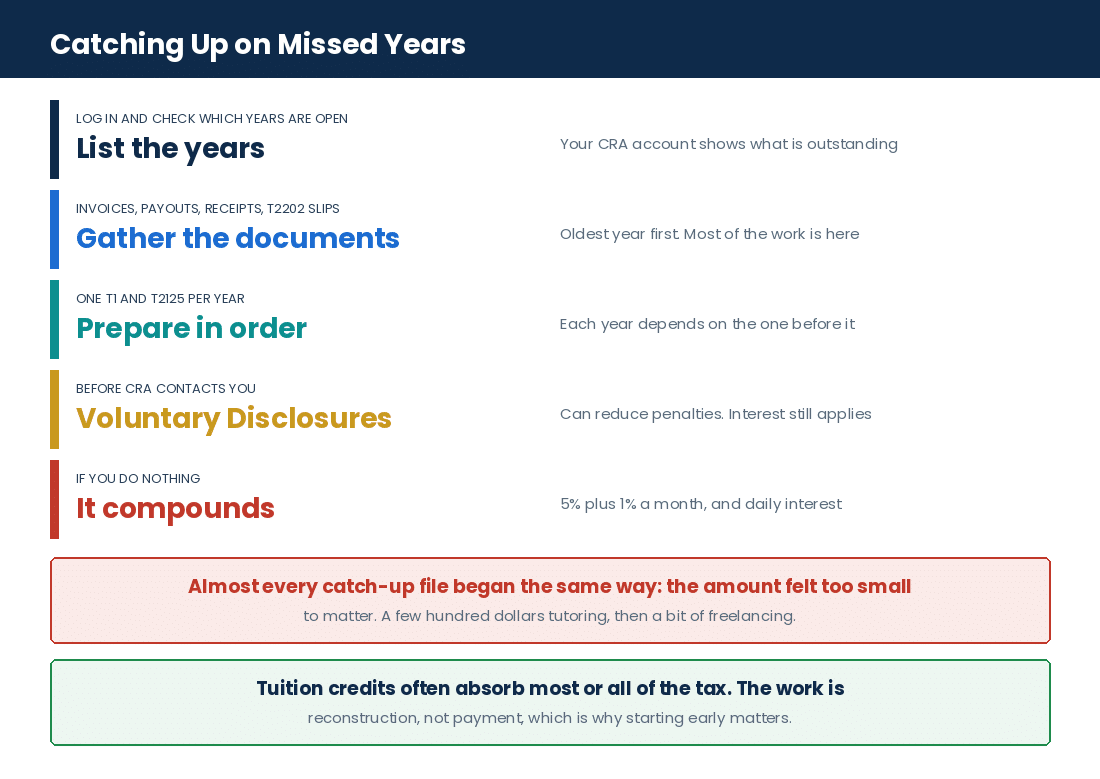
First, figure out which years you missed. Check your records or log into your CRA account. Next, collect all the income proofs and expense receipts for those years.
File late returns as soon as possible to cut down penalties. The CRA has a Voluntary Disclosures Program that lets people fix mistakes before they get caught, which can reduce penalties. But interest on unpaid tax usually still applies.
Some common errors that cause missed filings are thinking small earnings don’t count or confusion about residency rules. Keep good records each year to avoid these slip-ups.
Here’s how to catch up:
- List all unfiled tax years.
- Gather financial documents from those years.
- Prepare your returns with correct forms including business income.
- File using a tax pro who knows international student self-employed tax Canada rules if you can.
- Apply to the Voluntary Disclosure Program if penalties have been charged.
Almost every catch-up file we see began the same way: the student thought the amount was too small to matter.
A few hundred dollars of tutoring in first year, a bit of freelance work in second. None of it felt like a business, so none of it was filed. By graduation there are three or four open years, and the work of putting them right is mostly reconstruction rather than tax. Figures changed for privacy.
How Residency Status Affects Your Ongoing Tax Obligations
Your residency status decides what income you must report—not your study permit or visa. If you’re a factual resident, you report income from everywhere worldwide. A deemed resident also reports global income but might have treaty exceptions. Non-residents only report Canadian-source business income.
Different statuses mean different filing rules:
- Factual residents file a T1 with all self-employed earnings included.
- Deemed residents do the same but may apply treaties that reduce taxable amounts.
- Non-residents use Form T1-NR and only report Canadian business income.
Residency depends on ties like owning a home in Canada versus another country, where your family lives, social connections, and economic links, as defined under subsection 250(3) of the Income Tax Act.
Knowing your status helps avoid problems with missing foreign assets or misreporting income that could trigger audits or reassessments.
CRA Voluntary Disclosures Program · Income Tax Act s250(3); CRA Residency Determination Canada.ca · Treaty Articles on Business Profits · Non-Resident Reporting Requirements – CRA Guide T4058 · Factors per Income Tax Act s250(3)(a)-(e) · Department of Justice – Income Tax Act
Encouragement to File Early and Keep Records for Future Tax Years
Filing early helps students juggling international student self employed tax Canada tasks by cutting stress later on. The deadline is June 15 if you run a business or earn self-employment income. Still, pay what you owe by April 30 so no interest stacks up.
Keep good records every year. Track expenses like home office costs or equipment purchases carefully. Watch GST/HST limits since hitting $30K means extra steps.
If you file late, expect penalties starting at $100 plus 5% of what you owe within three months after the deadline. These charges grow fast along with daily compounding interest. Avoid common mistakes like forgetting instalment payments or not using tuition credits.
Here’s some advice:
- Save receipts digitally right when you buy things.
- Reconcile bank statements every month.
- Check revenue often against GST/HST rules.
- Update bookkeeping software quarterly if used.
- Talk with a CPA familiar with international student taxes early in the year.
This way, you stay on top of things and avoid surprises during tax season.
CRA Self Employed Deadlines · GST/HST Threshold Information · Late Filing Penalty Rules – CRA · Interest Charges – CRA
Frequently Asked Questions (FAQs) on International Student Business Tax in Canada
Frequently Asked Questions
Answers
What is the GST/HST registration threshold for international student businesses?+
How do I claim Capital Cost Allowance for equipment in my business?+
When must I report foreign property to the CRA?+
What is the current CPP contribution rate on self-employment income?+
How does the tuition carry-forward limit benefit international students?+
What penalties apply if I miss the late-filing deadline?+
What is Form T2125 and why is it important?+
Do international students need to make instalment payments?+
How does CRA classify a business vs. a hobby for tax purposes?+
Essential Tax Insights for Student Filers
Key Points
Essential Tax Insights for International Student Business Filers
- Quick Comparison Table by Residency Status: Determines which income you report and forms you file.
- NR Return and Form T1-NR: Non-residents use this to report Canadian-source business income only.
- Form NR74: Used to inform CRA of residency status change when arriving or leaving Canada.
- Form T1261: Application form for an Individual Tax Number (ITN) if you don’t qualify for a SIN.
- Input Tax Credit: Claim GST/HST paid on business purchases after registering for GST/HST.
GST/HST Filing Options
- Quick Method GST/HST: Simplifies reporting GST collected by applying a fixed percentage on sales.
- Regular Method GST/HST: Report actual GST collected and claim input tax credits on eligible expenses.
Benefits and Credits Impacted by Business Income
- Goods and Services Tax Credit (GSTC): Your business earnings can lower eligibility or credit amounts.
Correcting Past Tax Issues
- Voluntary Disclosures Program: Allows you to correct unfiled returns with reduced penalties before CRA detection.
Support Programs Available
- VITA Programs: Volunteer Income Tax Assistance offers free help for simple international student tax filings.
CRA Review Triggers To Avoid
Unreported income discrepancies and missed GST/HST registrations often prompt CRA audits or reviews.
Choosing How to File Your Taxes
| Filing Method | Pros | Cons |
|---|---|---|
| DIY | Cost-effective | Risk of errors |
| CPA Firm (e.g., Gondaliya CPA) | Expert advice, audit support | Higher fees |
| Non-CPA Professionals | Moderate cost | May lack specialized knowledge |
What Deliverables Do CPA Firms Provide?
- Complete tax preparation including Form T2125
- Personalized tax planning advice
- Audit support and representation if needed
How Much Does Professional Help Cost?
Fees vary but expect flat annual rates starting from around $400 for basic individual returns with business income.
Common Student Business Tax Mistakes & Prevention Tips
- Forgetting to register for GST/HST when required
- Mixing personal and business expenses without records
- Missing CPP contributions on self-employed income
- Ignoring instalment payment obligations
Key Questions That Matter Across Student Groups
- What’s my residency status for tax purposes?
- Do I need an ITN or SIN?
- Am I correctly reporting all worldwide income?
Example Walkthrough: Filing as an International Student Freelancer
An international student earning $15,000 freelancing reports gross revenue, deducts eligible expenses via Form T2125, pays CPP on net income, registers GST/HST if over threshold, files before June 15, and claims tuition credits appropriately.
That sequence is the whole job, and it is the same every year once it is set up properly the first time. Figures changed for privacy.
Selecting a CPA Firm in Ontario: Why Choose Gondaliya CPA?
Gondaliya CPA specializes in international student taxes with transparent pricing, flat-fee plans, expert guidance on self-employed taxes, and many positive client reviews.
Businesses We Serve & Industry Spotlights
Industry Expertise
Student businesses in Canada cluster into a recognisable set of trades, and the questions that decide a student’s return — which residency status applies, whether the activity is a business or a hobby, and what can actually be deducted against it — recur across every one of them.
| Who | The Student Filer Angle |
|---|---|
| International students with businesses | Residency, T2125, CPP and tuition credits together |
| Online course creators | Revenue from a platform, with no slip issued for it |
| Virtual assistants | Small recurring fees that pass $30,000 before anyone notices |
| Product design studios | Freelance design work and the software claimed against it |
| No-code development agencies | Side projects that become a business without a decision |
| Digital product businesses | Sales arriving from several countries at once |
| Corporate trainers | Tutoring and teaching work billed directly to clients |
| Digital nomads | The same residency test, asked from the other direction |
| Food delivery drivers | Gig income that is self-employment, not employment |
| Rideshare drivers | GST/HST rules that apply differently to ride fares |
| Administrative service businesses | Home office apportionment on a shared study space |
- International students with businesses: The core of this work. Residency, the T2125, CPP on net earnings and unused tuition credits account for almost every adjustment we make.
- Online course creators: Platform payouts arrive with no T4 and no T4A, which is exactly why the income so often goes unreported.
- Virtual assistants: Small monthly retainers add up quietly, and the $30,000 GST/HST threshold is usually crossed before anyone has thought to track it.
- Product design studios: Freelance design is the classic student business, with software subscriptions and a laptop as the whole expense claim.
- No-code development agencies: Side projects that turn into paid work gradually, which is where the business-versus-hobby question actually gets decided.
- Digital product businesses: Sales from several countries raise the worldwide income question immediately for anyone who is a factual resident.
- Corporate trainers: Tutoring and teaching billed directly rather than through a payroll is self-employment, whatever it is called on the invoice.
- Digital nomads: Residential ties weighed against time away — the same test a student faces, asked by someone leaving rather than arriving.
- Food delivery drivers: Gig platform earnings are business income on a T2125, not employment income, and CPP follows on the net.
- Rideshare drivers: Ride fares carry their own GST/HST treatment, which does not wait for the $30,000 threshold the way other work does.
- Administrative service businesses: Working from a shared student room makes the home office apportionment the hardest claim on the return to support.
In every one of these, nobody set out to start a business. The income arrived first and the label came later.
That is why so many of these returns go unfiled: there is no moment of incorporation, no registration, no point at which someone says you are now self-employed. CRA’s test is about profit intention and regularity, not about whether it felt like a business at the time.
Professional Guidance and Quick Reference
Guidance
Essential Tax Points for International Students With a Business
International students get caught out in a predictable set of ways: assuming the study permit settles the residency question; believing small earnings are below some exemption that does not exist; treating June 15 as the payment deadline when only the filing is extended; forgetting CPP, which is owed on net self-employment income even when the income tax works out to nothing; missing the $30,000 GST/HST threshold crossed mid-year; claiming a share of rent for a study space with nothing to show how the proportion was worked out; expensing a laptop in full instead of claiming capital cost allowance; and leaving tuition on a T2202 unclaimed because there was no income to offset. Gondaliya CPA handles student business filings on a flat annual fee.
Quick Answers
At a Glance
- What decides residency: residential ties and the day count, never the study permit
- Factual resident: strong ties here; report worldwide income
- Deemed resident: 183 days or more without strong ties; worldwide income too
- Non-resident: Canadian-source business income only, on Form T1-NR
- Main forms: T1 General with Form T2125 for the business
- Filing deadline: June 15 if self-employed
- Payment deadline: April 30, with interest from May 1 regardless
- Late-filing penalty: $100 or 5% of the amount owed, plus 1% per month up to 12
- CPP: about 11.9% on net self-employment income above $3,500
- Instalments: may be required once more than $3,000 is owing
- GST/HST: register past $30,000 of annual revenue; voluntary below
- Foreign property: Form T1135 once it exceeds CAD $100,000
- Identification: a SIN, or an ITN applied for on Form T1261
- Residency change: Form NR74 on arriving or leaving
- Tuition: T2202 slip, entered on Schedule 11, carried forward if unused
- Equipment over $500: capital property; most computers are Class 50 at 55%
- Meals and entertainment: limited to 50%, and only where business-related
- Missed years: the Voluntary Disclosures Program can reduce penalties
Who This Is For / Not For
Fit Check
- For: international students in Canada earning self-employment or business income — tutoring, freelancing, design work, online sales, gig platform work — whether or not it feels like a business.
- For: students unsure which residency status applies to them, and those with one or more unfiled years behind them.
- Not for: advice on immigration, study permits, or how many hours a permit allows you to work, each of which is administered separately and may restrict activity this article treats only as a source of income.
- Not for: students whose only income is a T4 job with tax already withheld. A student who earned a few hundred dollars tutoring is still squarely in scope, because there is no floor below which the income stops being reportable.
People Also Ask
Related Questions
I only made a few hundred dollars tutoring. Do I really have to report it?+
Yes. There is no minimum below which self-employment income stops being reportable. The amount of tax may well be nil once tuition credits are applied, but the reporting obligation does not scale with the size of the income. Most catch-up files we see started exactly here, with an amount that felt too small to matter.
Does my study permit make me a non-resident for tax?+
No. A study permit is an immigration document and says nothing about tax residency. CRA looks at residential ties — a home here, a spouse or dependants, and secondary links like a car or memberships — and at whether you were here 183 days or more. The two questions are decided separately by different departments.
I file by June 15, so why am I being charged interest?+
Because only the filing date moves. Self-employed filers have until June 15 to file, but any balance owing was due April 30, and interest runs from May 1 regardless of when the return goes in. File late with nothing owing and there is no penalty; file late with a balance and both penalty and interest apply.
Why do I owe CPP when my tax came out to almost nothing?+
Because they are separate calculations. CPP is charged at roughly 11.9% on net self-employment earnings above $3,500, and tuition credits reduce income tax but not CPP. A student with $20,000 of net earnings can owe around $2,380 in CPP with little or no income tax alongside it.
Can I claim my laptop and part of my rent?+
Partly. A laptop over $500 is capital property, claimed through capital cost allowance over several years rather than deducted in full — most computers sit in Class 50 at 55% declining balance. Rent is claimable only for the portion of the space used for work, and a shared study area needs something like a floor plan behind the split.
Glossary of Key Terms
Definitions
- Factual resident: someone with significant residential ties to Canada, taxable on worldwide income.
- Deemed resident: someone present 183 days or more without significant ties, also reporting worldwide income.
- Non-resident: someone without those ties or the day count, reporting Canadian-source income only.
- Residential ties: the home, spouse or dependants, belongings and social links CRA weighs to set residency.
- T1 General: the personal income tax return on which all taxable income is reported.
- Form T2125: the Statement of Business or Professional Activities, filed with the T1 by the self-employed.
- Form T1-NR: the return used by non-residents reporting Canadian-source business income.
- Form NR74: the form informing CRA of a residency change on arriving in Canada.
- Form T1261: the application for an Individual Tax Number for those not eligible for a SIN.
- ITN: Individual Tax Number, an identifier for tax filing that confers no right to work.
- Form T1135: the Foreign Income Verification Statement, required above CAD $100,000 of foreign property.
- T2202: the slip issued by a school showing eligible tuition fees, entered on Schedule 11.
- Tuition carry-forward: unused tuition credits held over to reduce tax in a later year.
- Capital Cost Allowance (CCA): the depreciation claim on capital property, spread over years by class.
- Input tax credit: GST/HST paid on business purchases, recoverable once registered.
- Voluntary Disclosures Program: the CRA process for correcting unfiled returns with reduced penalties before detection.
Want a checklist to work from? You can download our free international student business tax checklist before your consultation.

Four things decide an international student’s return. Residency, not the permit — CRA weighs residential ties and the 183 day count, and that sets whether you report worldwide income or only Canadian-source. The forms and the two dates — a T1 with Form T2125, filed by June 15 if self-employed, with any balance paid by April 30 because interest runs from May 1 either way. What follows from having a business — CPP at about 11.9% on net earnings above $3,500, GST/HST past $30,000, instalments past $3,000 owing, Form T1135 past CAD $100,000 of foreign property, and a SIN or an ITN on Form T1261 before any of it. And what comes off — reasonable business expenses with receipts, the workspace share of rent, equipment over $500 through capital cost allowance in Class 50 at 55%, meals at half, and tuition from the T2202 carried forward if you cannot use it yet.
Three questions tell you where you stand, and you can answer all of them today. First, do you have a SIN or an ITN? Without one there is nothing to file under, and applying takes time you will not have in June. Second, have you earned anything at all from tutoring, freelancing, selling or gig work since you arrived? Not “enough to matter” — anything. That answer decides whether returns are outstanding. Third, do you have receipts for what you spent earning it? Expenses are what turn gross revenue into the net figure CPP and tax are calculated on, and a claim without a receipt behind it is the first thing a review asks about.
International Student Business Tax Canada: How Gondaliya CPA Can Help
Start with your SIN or ITN, your income records and your T2202
Gondaliya CPA settles your residency position before anything is prepared, files the T1 with Form T2125 showing revenue and the expenses that genuinely support it, calculates CPP on net self-employment earnings so the amount is not a surprise, applies tuition credits from your T2202 and carries forward what you cannot use, checks whether GST/HST registration or instalments have been triggered, reports foreign property on Form T1135 where the threshold is passed, applies for an ITN on Form T1261 where you are not eligible for a SIN, and works through unfiled years in sequence including the Voluntary Disclosures Program where it applies — on a flat annual fee including HST with a one-business-day response. Please book a free consultation.
Next Steps
Please book a free consultation with Gondaliya CPA and bring three things: your SIN or ITN, a record of everything you have earned from your own work since arriving, and your T2202 slips. Those three settle the residency position, which years are outstanding and how much of the tax your tuition can absorb — which between them account for nearly every adjustment we make on a student file. If you have gone a year or two without filing, or you were not sure whether what you were doing counted as a business, say so at the outset, because both are completely routine and far cheaper to raise than to have found. You will get a flat annual fee including HST before any work begins. We serve Toronto, Mississauga, Brampton, Vaughan, Etobicoke, Scarborough, Hamilton, Ottawa and the rest of Ontario, and work with student-run businesses across Canada. We advise on Canadian federal and provincial tax only, not on immigration or study permit conditions. If our content helps, please add gondaliyacpa.ca as a preferred source on Google.
Published: · Last updated:
Editorial policy: We research against CRA, Department of Finance, Parliament of Canada, CPA Canada and CPA Ontario sources, fact-check the figures, and Sharad Gondaliya, CPA, reviews the content, which we update as the rules change.
Disclaimer: This article is educational information only and is not tax, legal, financial or immigration advice. It covers Canadian federal income tax and GST/HST for international students earning self-employment or business income, and it does not cover immigration, study permits, or the hours a permit allows the holder to work, each of which is administered separately and may restrict activity this article treats only as a source of income. Contribution rates, thresholds, deadlines, penalty amounts and capital cost allowance rates are set annually and change; the figures in this article are those stated in the source material and every one should be confirmed against current CRA guidance before a return is filed. Whether a particular activity is a business or a hobby, and which residency status applies, both turn on the full facts. Gondaliya CPA performs compilation engagements under CSRS 4200 and does not perform audit or review engagements. Please consult a licensed CPA before acting.

Sharad Gondaliya is a CPA Canada & CPA USA with 15 Years+ experience of Accounting, Tax, Payroll of Corporate Small Businesses as Tax Accountant. He is a CPA Ontario member (61040184) and holds US CPA licences in Washington and Montana and is well known among corporate small businesses for tax planning, efficient tax solutions, and affordable CPA services. Sharad is the Principal (Director) of Gondaliya CPA – Affordable CPA Firm in Canada. Licenses: CPA Ontario: 61040184 | CPA USA (MT): PAC-CPAP-LIC-033176 | CPA USA (WA): 57629 | CPA Firm License: 61330051 View Full Author Bio